Похожие презентации:




Canberra
1. Canberra
CANBERRAPART 2: CULTURE, EDUCATION AND DEMOGRAPHY
2. Arts and entertainment
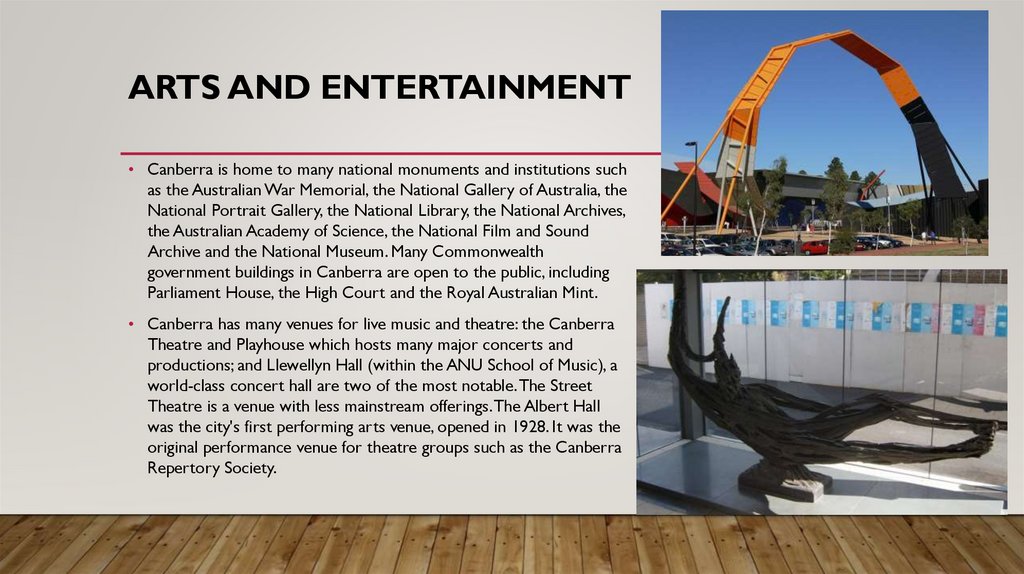
ARTS AND ENTERTAINMENT• Canberra is home to many national monuments and institutions such
as the Australian War Memorial, the National Gallery of Australia, the
National Portrait Gallery, the National Library, the National Archives,
the Australian Academy of Science, the National Film and Sound
Archive and the National Museum. Many Commonwealth
government buildings in Canberra are open to the public, including
Parliament House, the High Court and the Royal Australian Mint.
• Canberra has many venues for live music and theatre: the Canberra
Theatre and Playhouse which hosts many major concerts and
productions; and Llewellyn Hall (within the ANU School of Music), a
world-class concert hall are two of the most notable. The Street
Theatre is a venue with less mainstream offerings. The Albert Hall
was the city's first performing arts venue, opened in 1928. It was the
original performance venue for theatre groups such as the Canberra
Repertory Society.
3. Sport
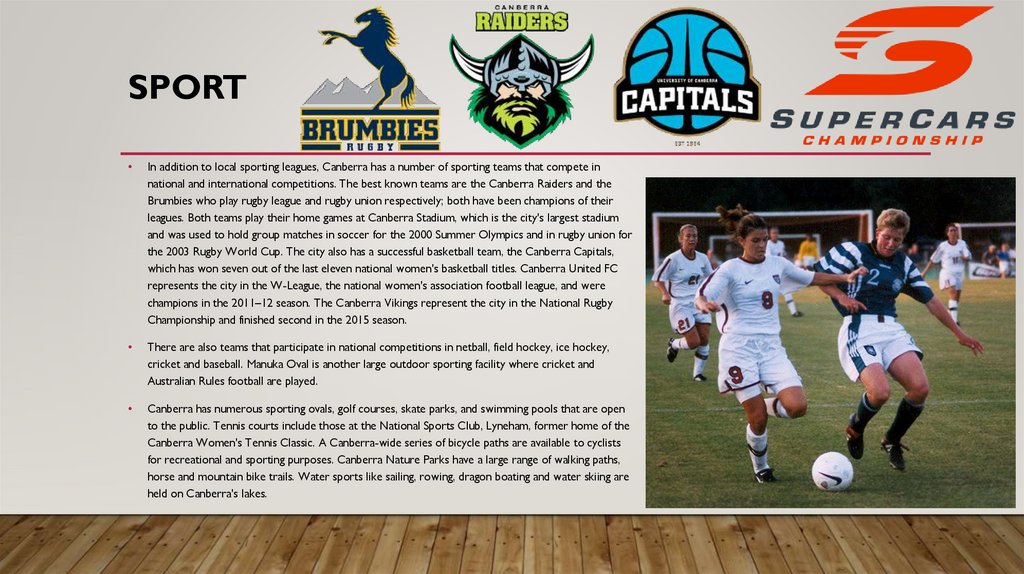
SPORTIn addition to local sporting leagues, Canberra has a number of sporting teams that compete in
national and international competitions. The best known teams are the Canberra Raiders and the
Brumbies who play rugby league and rugby union respectively; both have been champions of their
leagues. Both teams play their home games at Canberra Stadium, which is the city's largest stadium
and was used to hold group matches in soccer for the 2000 Summer Olympics and in rugby union for
the 2003 Rugby World Cup. The city also has a successful basketball team, the Canberra Capitals,
which has won seven out of the last eleven national women's basketball titles. Canberra United FC
represents the city in the W-League, the national women's association football league, and were
champions in the 2011–12 season. The Canberra Vikings represent the city in the National Rugby
Championship and finished second in the 2015 season.
There are also teams that participate in national competitions in netball, field hockey, ice hockey,
cricket and baseball. Manuka Oval is another large outdoor sporting facility where cricket and
Australian Rules football are played.
Canberra has numerous sporting ovals, golf courses, skate parks, and swimming pools that are open
to the public. Tennis courts include those at the National Sports Club, Lyneham, former home of the
Canberra Women's Tennis Classic. A Canberra-wide series of bicycle paths are available to cyclists
for recreational and sporting purposes. Canberra Nature Parks have a large range of walking paths,
horse and mountain bike trails. Water sports like sailing, rowing, dragon boating and water skiing are
held on Canberra's lakes.
4. Education
EDUCATIONThe two main tertiary institutions are the Australian National University
(ANU) in Acton and the University of Canberra (UC) in Bruce, with over
10,500 and 8,000 full-time-equivalent students respectively. Established in
1946, the ANU has always had a strong research focus and is ranked
among the leading universities in the world and the best in Australia by
The Times Higher Education Supplement and the Shanghai Jiao Tong
World University Rankings.
There are two religious university campuses in Canberra: Signadou in the
northern suburb of Watson is a campus of the Australian Catholic
University; St Mark's Theological College in Barton is part of the secular
Charles Sturt University.
In 2016 there were 132 schools in Canberra; 87 were operated by the
government and 45 were private. During 2006, the ACT Government
announced closures of up to 39 schools, to take effect from the end of
the school year, and after a series of consultations unveiled its “Towards
2020: Renewing Our Schools” policy. As a result, some schools closed
during the 2006–08 period, while others were merged; the creation of
combined primary and secondary government schools will proceed over
the next decade. The new policy has provoked significant opposition.
5. Media
MEDIA• As Australia's capital, Canberra is the most important centre for much of
Australia's political reportage and thus all the major media, including the
Australian Broadcasting Corporation, the commercial television networks, and
the metropolitan newspapers maintain local bureaus. News organisations are
represented in the "press gallery", a group of journalists who report on the
national parliament. The National Press Club of Australia in Barton has regular
television broadcasts of its lunches at which a prominent guest, typically a
politician or other public figure, delivers a speech followed by a question-andanswer session.
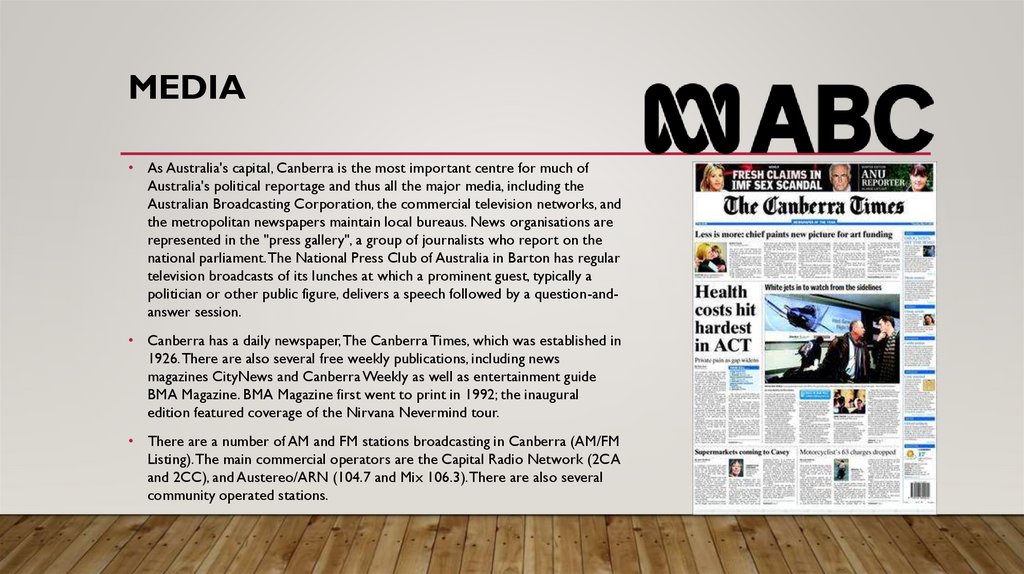
• Canberra has a daily newspaper, The Canberra Times, which was established in
1926.There are also several free weekly publications, including news
magazines CityNews and Canberra Weekly as well as entertainment guide
BMA Magazine. BMA Magazine first went to print in 1992; the inaugural
edition featured coverage of the Nirvana Nevermind tour.
• There are a number of AM and FM stations broadcasting in Canberra (AM/FM
Listing). The main commercial operators are the Capital Radio Network (2CA
and 2CC), and Austereo/ARN (104.7 and Mix 106.3).There are also several
community operated stations.
6. Demographics
DEMOGRAPHICS• At the 2016 census, the population of Canberra was 395,790, up from 355,596 at the 2011 census and
322,036 at the 2006 census.
• Canberrans are relatively young, highly mobile and well educated. The median age is 35 years and only
12.7% of the population is aged over 65 years. Between 1996 and 2001, 61.9% of the population either
moved to or from Canberra, which was the second highest mobility rate of any Australian capital city. As
at May 2017, 43% of ACT residents (25–64) had a level of educational attainment equal to at least a
bachelor's degree, significantly higher that the national average of 31%.
• According to statistics collected by the National Australia Bank and reported in The Canberra Times,
Canberrans on average give significantly more money to charity than Australians in other states and
territories, for both dollar giving and as a proportion of income.
7. 2016 census
2016 CENSUSAt the 2016 census, the most commonly nominated ancestries were:
• English (35%)
• German (4.7%)
• Filipino (1.3%)
• Australian (34%)
• Indian (3.9%)
• Vietnamese (1.3%)
• Irish (14%)
• Italian (3.5%)
• Greek (1.3%)
• Scottish (11%)
• Dutch (1.7%)
• Croatian (1.2%)
• Chinese (6%)
• Indigenous (1.6%)
• Polish (1.1%)
32% of Canberra's inhabitants were born overseas.
1.6% of the population, or 6,476 people, identified as Indigenous Australians (Aboriginal Australians and Torres
Strait Islanders) in 2016.
8. Language and Religion
LANGUAGE AND RELIGION• At the 2016 census, 72.7% of people spoke only English at home.
• The other languages most commonly spoken at home were Mandarin (3.1%),Vietnamese
(1.1%), Cantonese (1%), Hindi (0.9%) and Spanish (0.8%).
• On census night in 2016, approximately 50.0% of ACT residents described themselves as
Christian (excluding not stated responses), the most common denominations being
Catholic and Anglican; 36.2% described themselves as having no religion.