
 История
Похожие презентации:


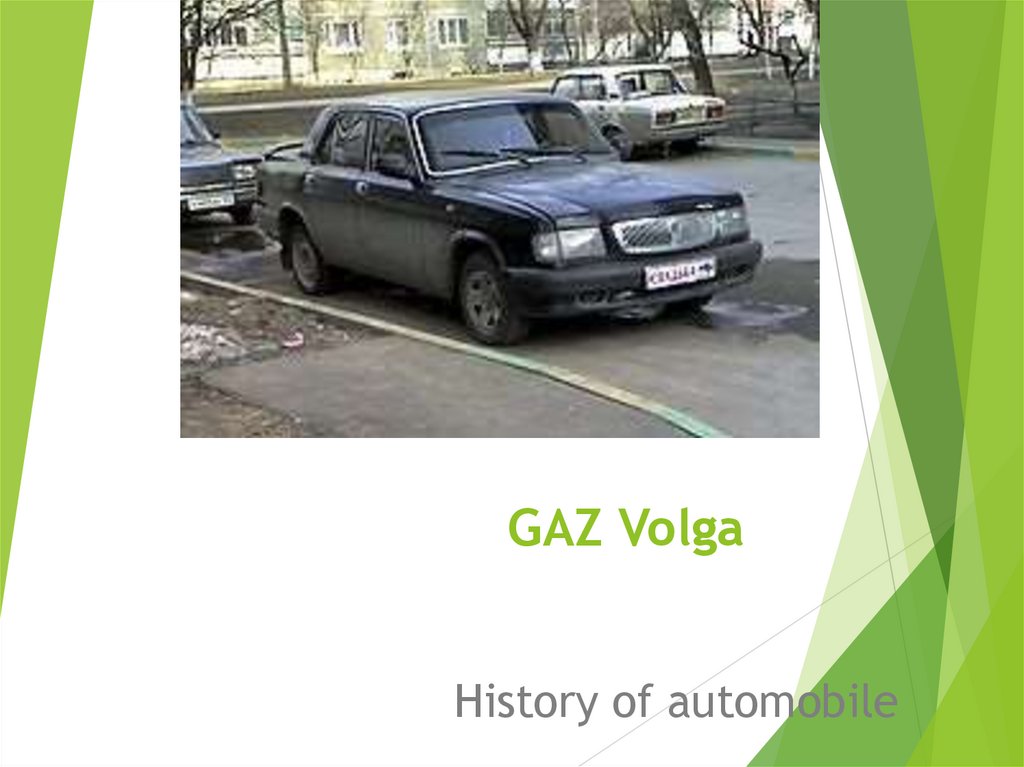
GAZ Volga
1. GAZ Volga
History of automobile2. GAZ Volga
ManufacturerGAZProduction1956–2010
PredecessorGAZ-M20 Pobeda
Class Mid-size car
Layout Front engine, rear-wheel drive
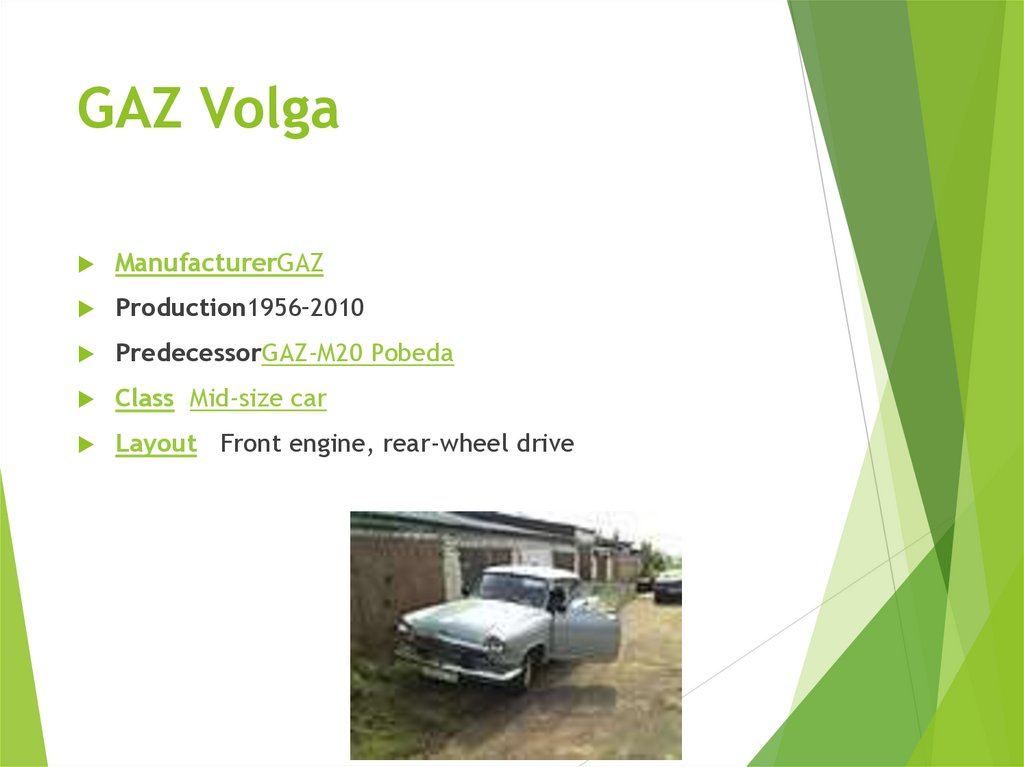
3. GAZ Volga
Volgais an automobile brand that originated in the
Soviet Union to replace the venerated GAZ-M20
Pobeda in 1956. Modern in design, it became a
symbol of higher status in the Soviet nomenklatura.
Volga cars were also traditionally used as taxi cabs,
road police interceptors, and ambulances (based on
the estate versions).
Four generations of Volga cars have been produced,
each undergoing several updates during the
production run.
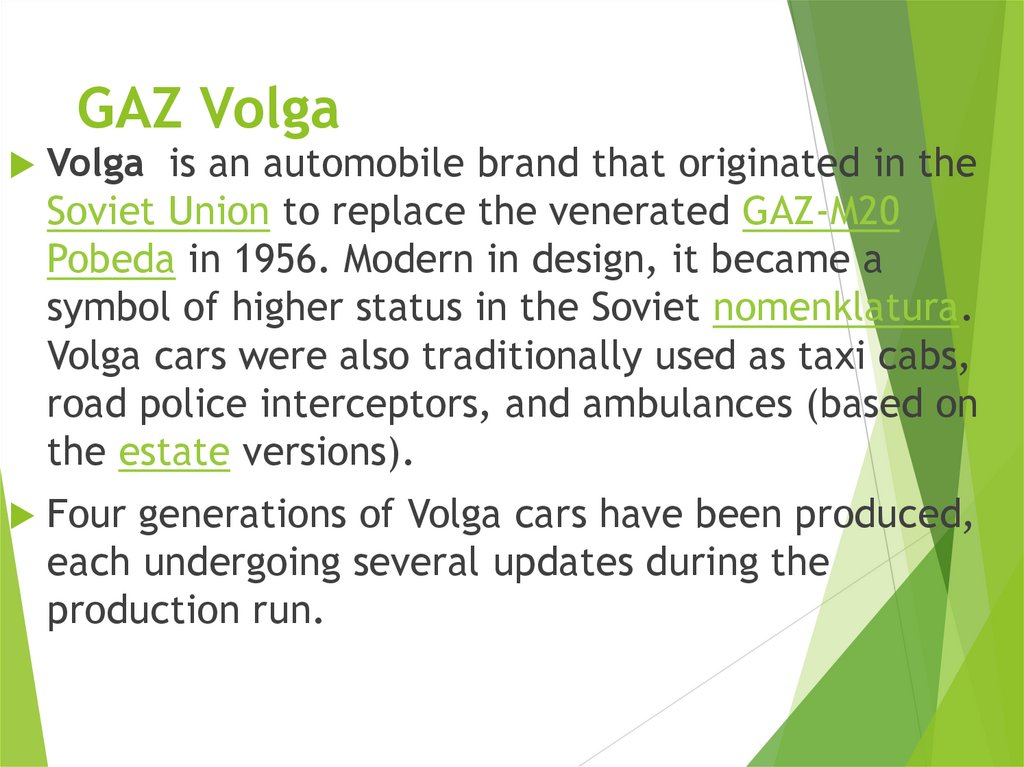
4. GAZ-M-21, GAZ-21
1956-1958 (first series)1958-1962 (second series)
1962-1970 (third series)
5.
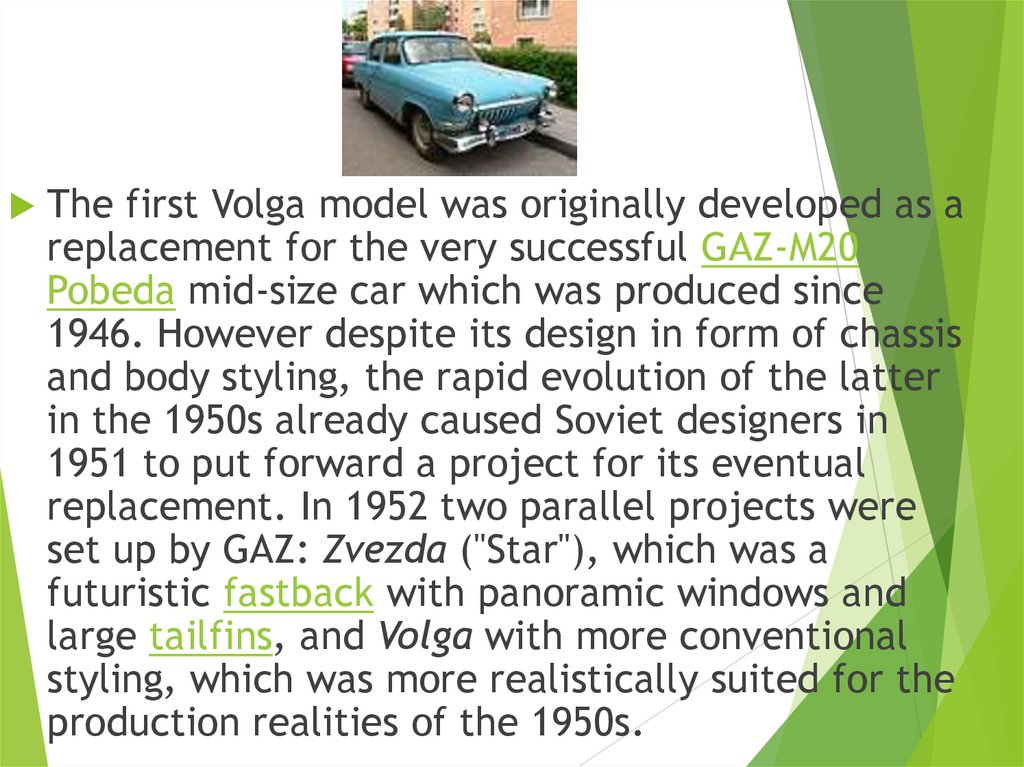
The first Volga model was originally developed as areplacement for the very successful GAZ-M20
Pobeda mid-size car which was produced since
1946. However despite its design in form of chassis
and body styling, the rapid evolution of the latter
in the 1950s already caused Soviet designers in
1951 to put forward a project for its eventual
replacement. In 1952 two parallel projects were
set up by GAZ: Zvezda ("Star"), which was a
futuristic fastback with panoramic windows and
large tailfins, and Volga with more conventional
styling, which was more realistically suited for the
production realities of the 1950s.
6.
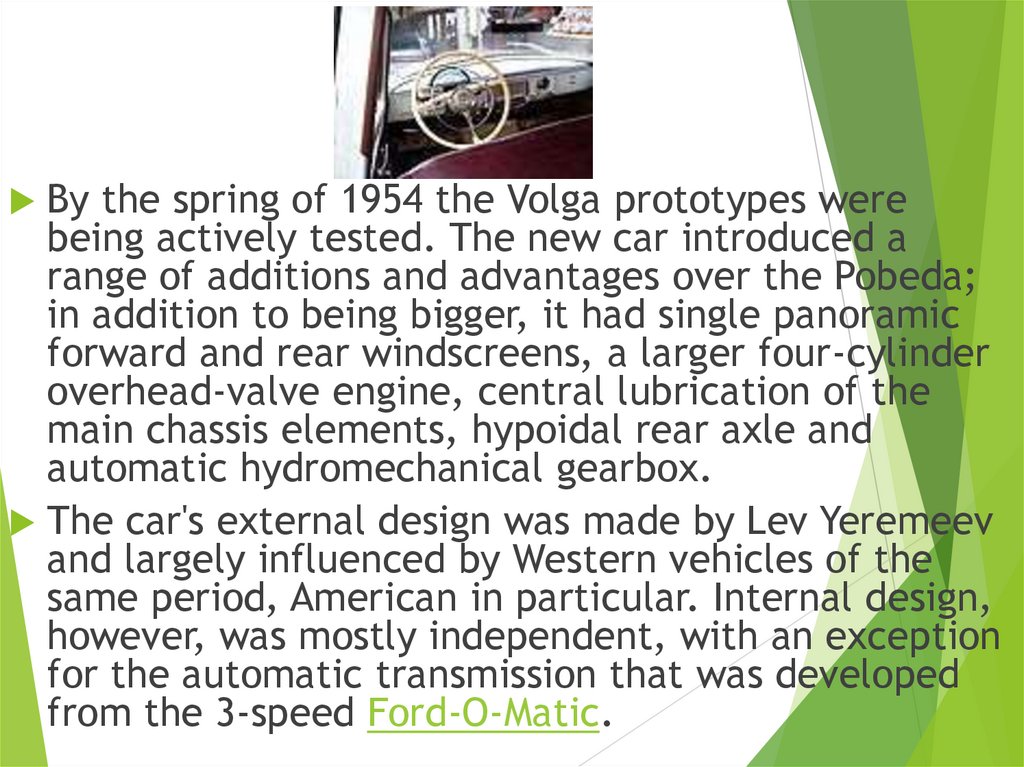
By the spring of 1954 the Volga prototypes werebeing actively tested. The new car introduced a
range of additions and advantages over the Pobeda;
in addition to being bigger, it had single panoramic
forward and rear windscreens, a larger four-cylinder
overhead-valve engine, central lubrication of the
main chassis elements, hypoidal rear axle and
automatic hydromechanical gearbox.
The car's external design was made by Lev Yeremeev
and largely influenced by Western vehicles of the
same period, American in particular. Internal design,
however, was mostly independent, with an exception
for the automatic transmission that was developed
from the 3-speed Ford-O-Matic.
7.
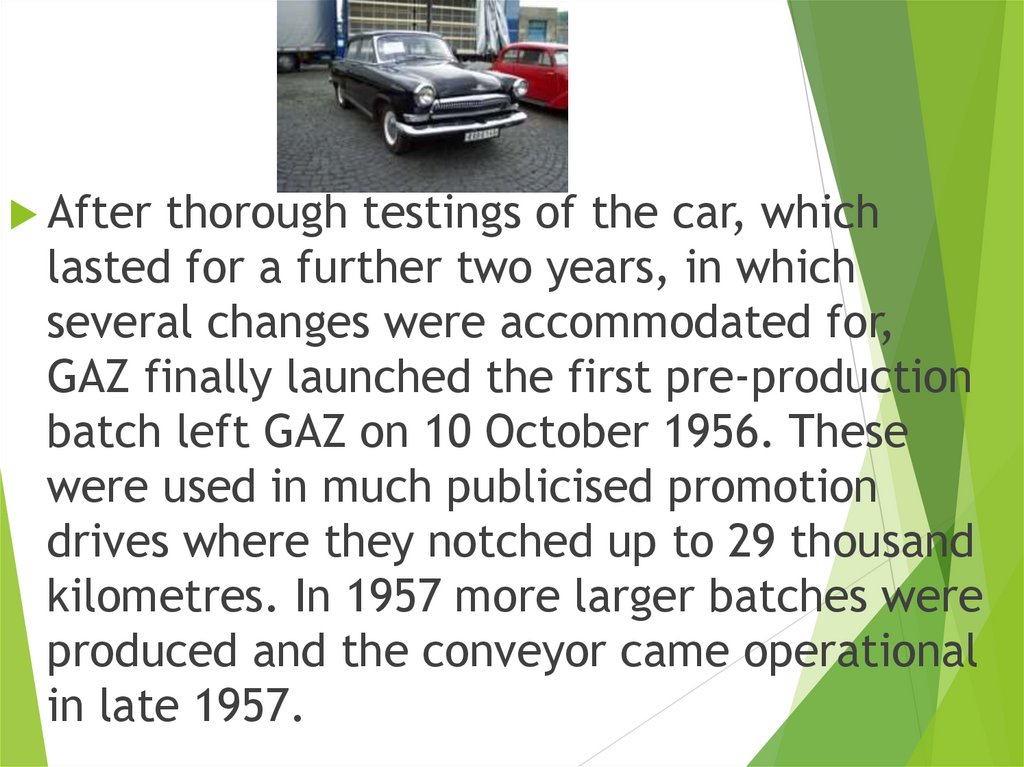
After thorough testings of the car, whichlasted for a further two years, in which
several changes were accommodated for,
GAZ finally launched the first pre-production
batch left GAZ on 10 October 1956. These
were used in much publicised promotion
drives where they notched up to 29 thousand
kilometres. In 1957 more larger batches were
produced and the conveyor came operational
in late 1957.
8. GAZ-24 Volga
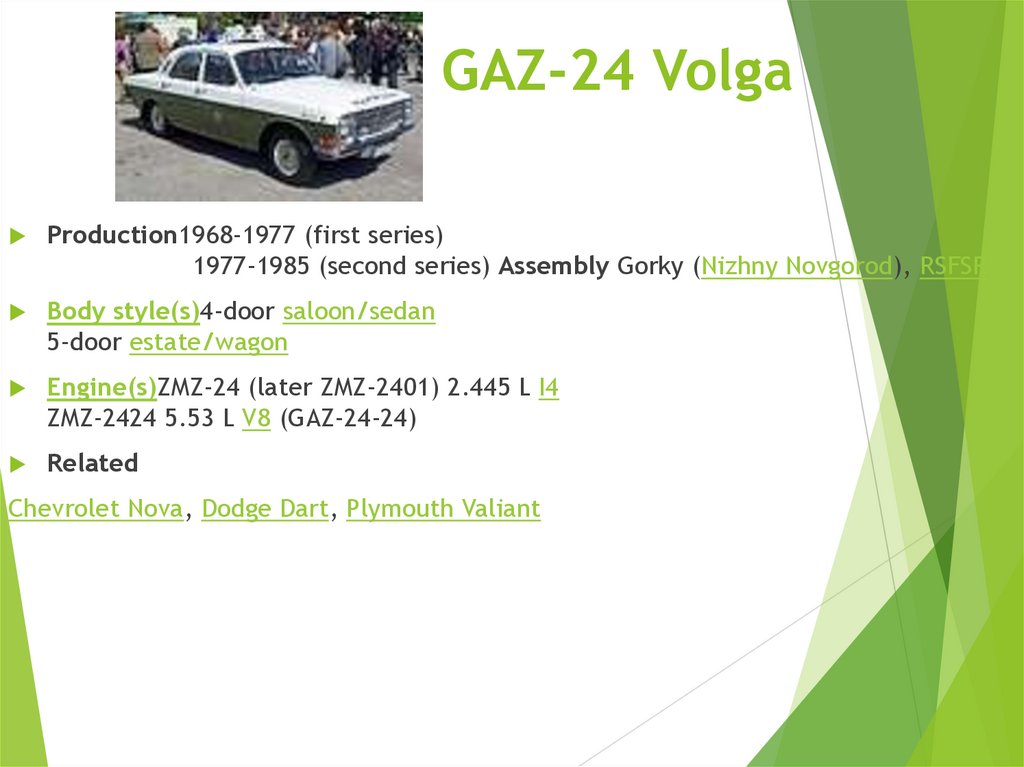
Production1968-1977 (first series)1977-1985 (second series) Assembly Gorky (Nizhny Novgorod), RSFSR
Body style(s)4-door saloon/sedan
5-door estate/wagon
Engine(s)ZMZ-24 (later ZMZ-2401) 2.445 L I4
ZMZ-2424 5.53 L V8 (GAZ-24-24)
Related
Chevrolet Nova, Dodge Dart, Plymouth Valiant
9. GAZ-24-10 Volga
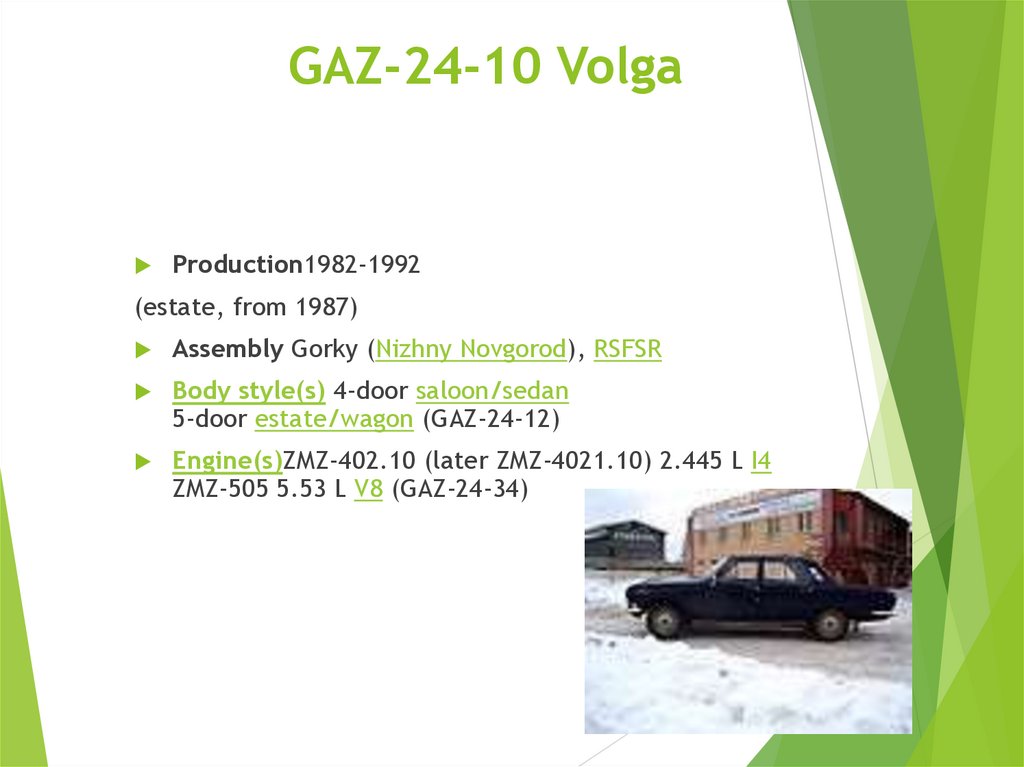
Production1982-1992(estate, from 1987)
Assembly Gorky (Nizhny Novgorod), RSFSR
Body style(s) 4-door saloon/sedan
5-door estate/wagon (GAZ-24-12)
Engine(s)ZMZ-402.10 (later ZMZ-4021.10) 2.445 L I4
ZMZ-505 5.53 L V8 (GAZ-24-34)
10.
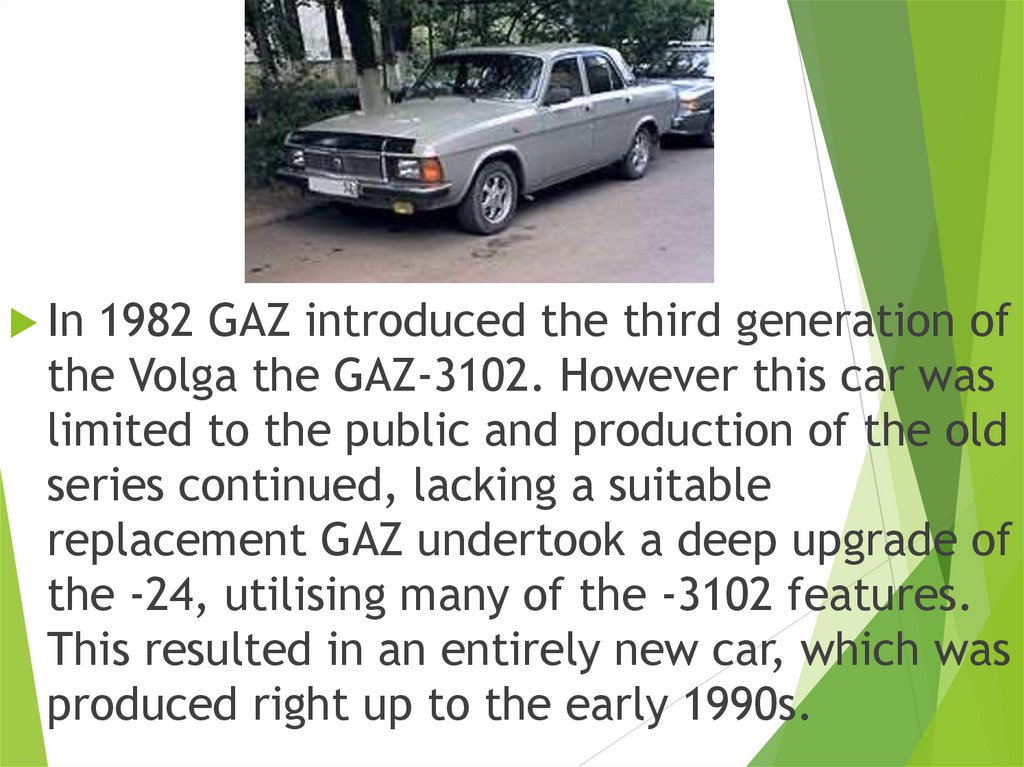
In 1982 GAZ introduced the third generation ofthe Volga the GAZ-3102. However this car was
limited to the public and production of the old
series continued, lacking a suitable
replacement GAZ undertook a deep upgrade of
the -24, utilising many of the -3102 features.
This resulted in an entirely new car, which was
produced right up to the early 1990s.
11.
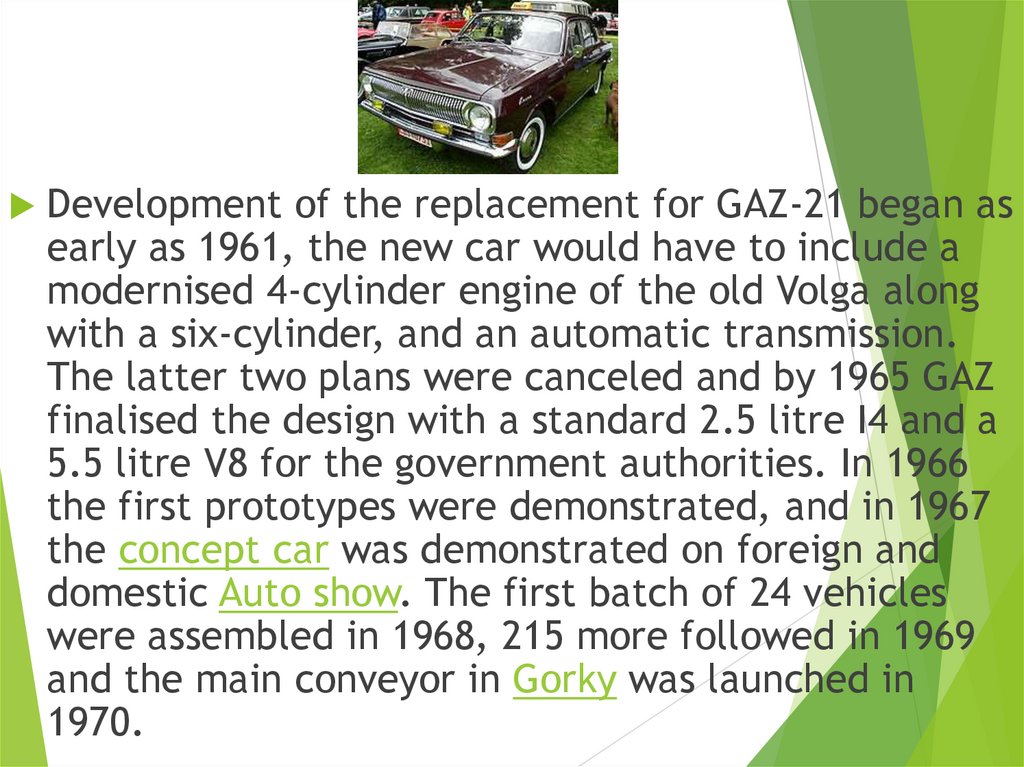
Development of the replacement for GAZ-21 began asearly as 1961, the new car would have to include a
modernised 4-cylinder engine of the old Volga along
with a six-cylinder, and an automatic transmission.
The latter two plans were canceled and by 1965 GAZ
finalised the design with a standard 2.5 litre I4 and a
5.5 litre V8 for the government authorities. In 1966
the first prototypes were demonstrated, and in 1967
the concept car was demonstrated on foreign and
domestic Auto show. The first batch of 24 vehicles
were assembled in 1968, 215 more followed in 1969
and the main conveyor in Gorky was launched in
1970.
12.
The car can be broken down into threegenerations. The first years (1970—1975) saw
changes to many early design faults, bonnetmounted mirrors were removed, changes to
leaf spring suspension, and new ignition and
boot locks. One unique feature that the early
series featured was a belt-speedometer, which
proved too complicated and was removed. In
1977 the car saw the first serious
modernization, this introduced "teeth" on the
bumpers, retractable seat belts, front fog
lights and new dashboard. The interior of the
car saw the front bench seat replaced by two
individual adjustable seats. The third
generation was introduced in 1985
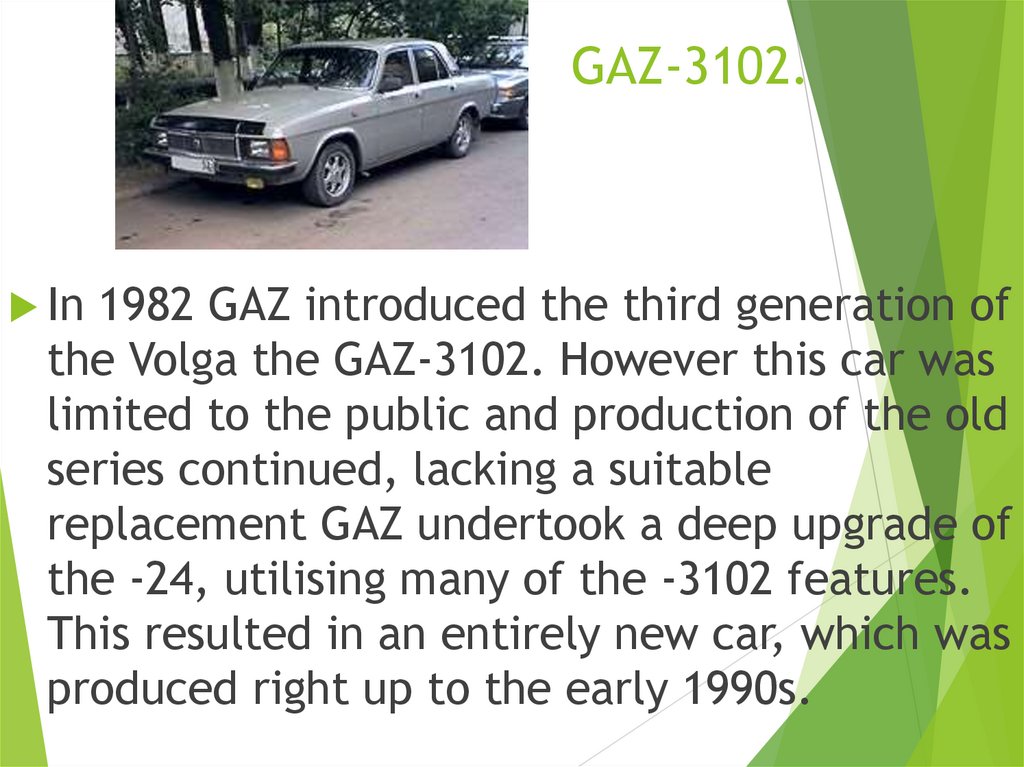
13. GAZ-3102.
In 1982 GAZ introduced the third generation ofthe Volga the GAZ-3102. However this car was
limited to the public and production of the old
series continued, lacking a suitable
replacement GAZ undertook a deep upgrade of
the -24, utilising many of the -3102 features.
This resulted in an entirely new car, which was
produced right up to the early 1990s.
14.
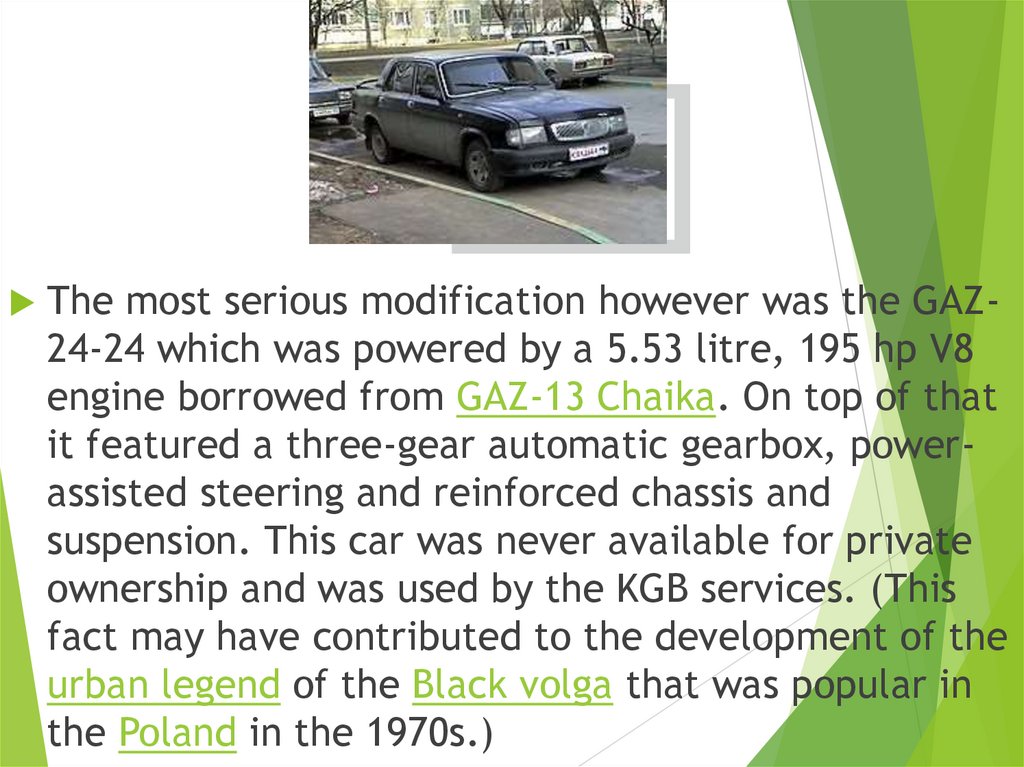
The most serious modification however was the GAZ-24-24 which was powered by a 5.53 litre, 195 hp V8
engine borrowed from GAZ-13 Chaika. On top of that
it featured a three-gear automatic gearbox, powerassisted steering and reinforced chassis and
suspension. This car was never available for private
ownership and was used by the KGB services. (This
fact may have contributed to the development of the
urban legend of the Black volga that was popular in
the Poland in the 1970s.)
15. GAZ-3102 Volga
Production1982-2010AssemblyGorky (Nizhny Novgorod), Russia
Body style(s)4-door saloon/sedan
Engine(s)ZMZ-4022.10 I4
ZMZ-402.10 2.445 L I4
ZMZ-4062.10 2.3 L I4
ZMZ-4021.10 I4
ZMZ-505 5.53 L V8 (GAZ-31013, produced up to 1996)
16.
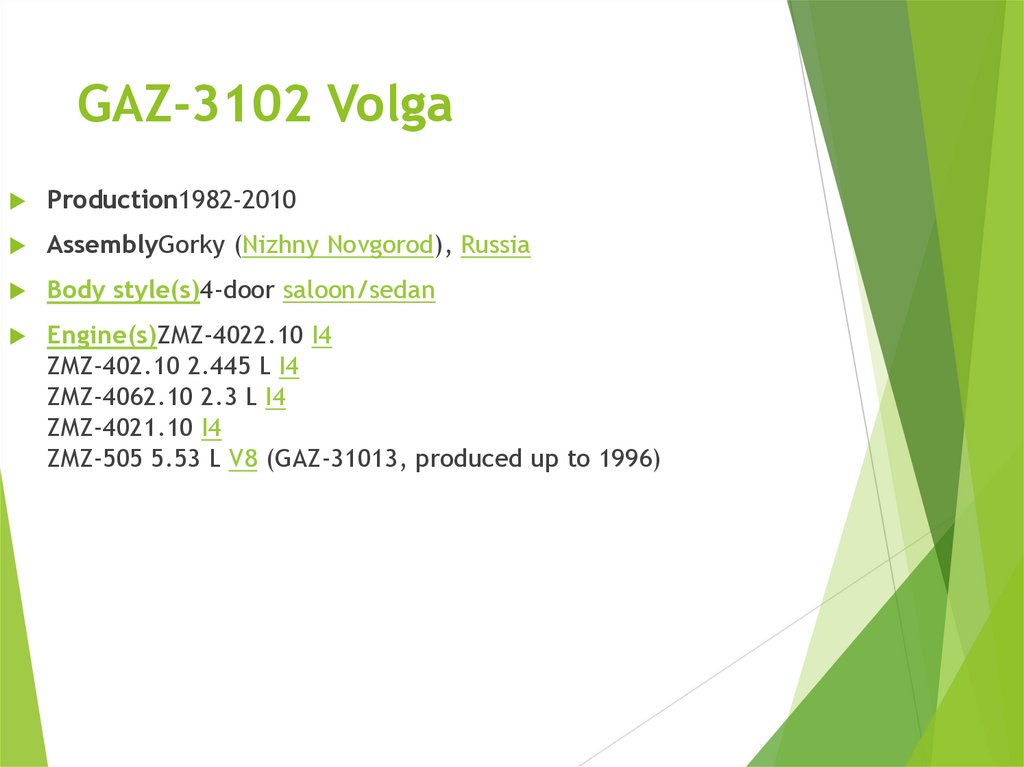
In late 1976, a review of the GAZ-24 was tasked withfinding out the main drawbacks that would need to
be fixed in its replacement, the design of which was
scheduled to begin. However funds were never
allocated for the project. Simultaneously GAZ
launched the second generation of the Chaika
limousine. The GAZ-14 in its size and interior jumped
the class from its predecessor. Thus instead of
replacing the Volga, GAZ was tasked with creating a
new vehicle that would be suitable for the mid-class
of the Soviet nomenklatura. Loosely based on its
predecessor, the new Volga, in addition to receiving a
new model number, had much of the Chaika's
innovations incorporated in the design.
17. Volga
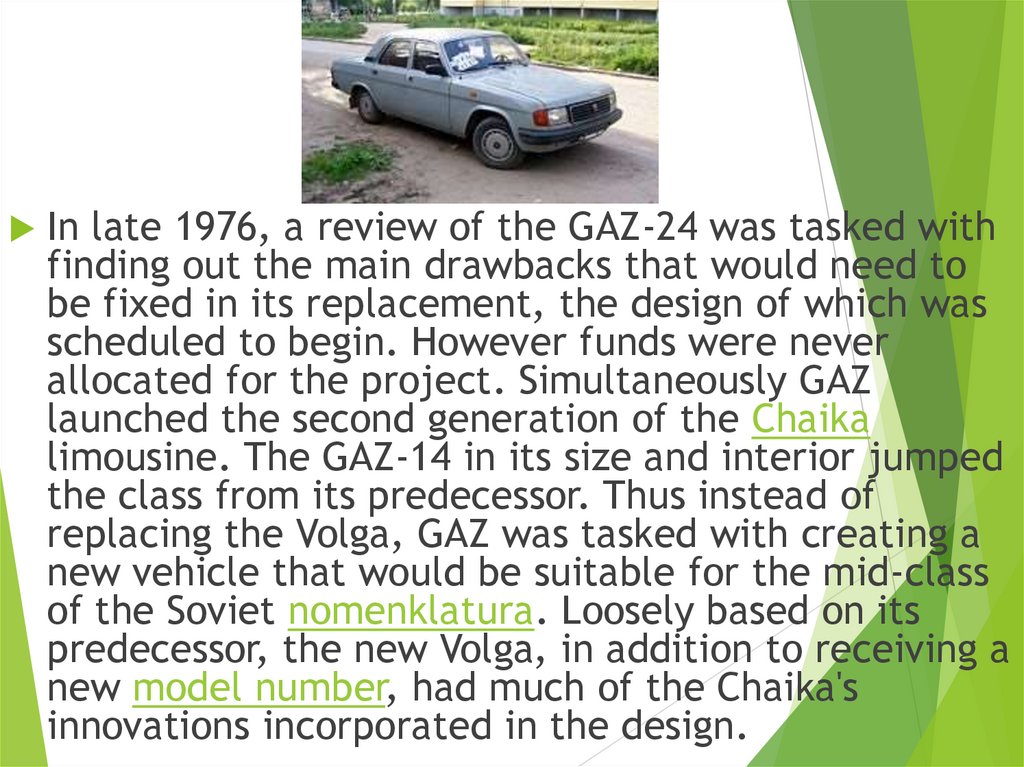
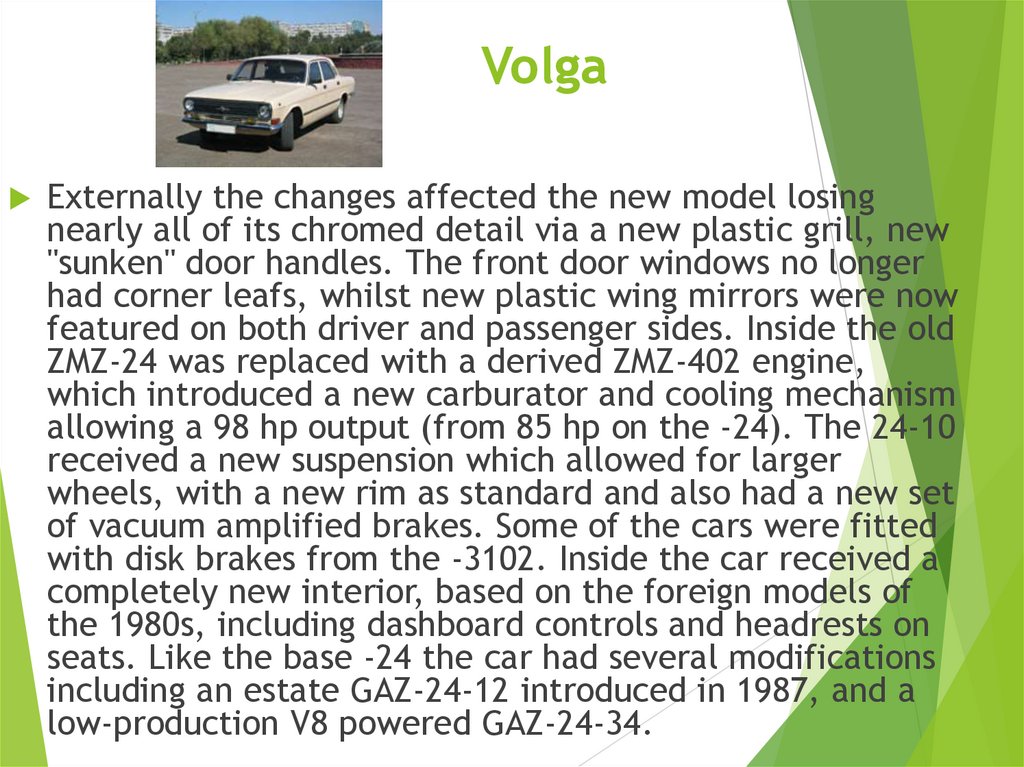
Externally the changes affected the new model losingnearly all of its chromed detail via a new plastic grill, new
"sunken" door handles. The front door windows no longer
had corner leafs, whilst new plastic wing mirrors were now
featured on both driver and passenger sides. Inside the old
ZMZ-24 was replaced with a derived ZMZ-402 engine,
which introduced a new carburator and cooling mechanism
allowing a 98 hp output (from 85 hp on the -24). The 24-10
received a new suspension which allowed for larger
wheels, with a new rim as standard and also had a new set
of vacuum amplified brakes. Some of the cars were fitted
with disk brakes from the -3102. Inside the car received a
completely new interior, based on the foreign models of
the 1980s, including dashboard controls and headrests on
seats. Like the base -24 the car had several modifications
including an estate GAZ-24-12 introduced in 1987, and a
low-production V8 powered GAZ-24-34.
18.
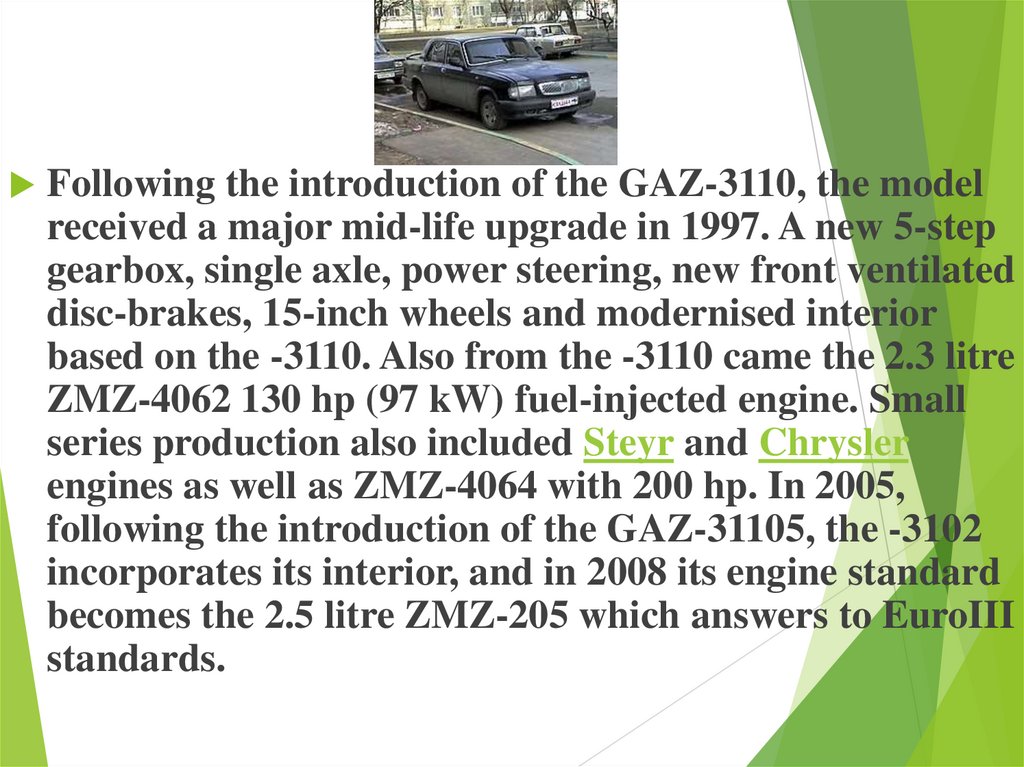
Following the introduction of the GAZ-3110, the modelreceived a major mid-life upgrade in 1997. A new 5-step
gearbox, single axle, power steering, new front ventilated
disc-brakes, 15-inch wheels and modernised interior
based on the -3110. Also from the -3110 came the 2.3 litre
ZMZ-4062 130 hp (97 kW) fuel-injected engine. Small
series production also included Steyr and Chrysler
engines as well as ZMZ-4064 with 200 hp. In 2005,
following the introduction of the GAZ-31105, the -3102
incorporates its interior, and in 2008 its engine standard
becomes the 2.5 litre ZMZ-205 which answers to EuroIII
standards.
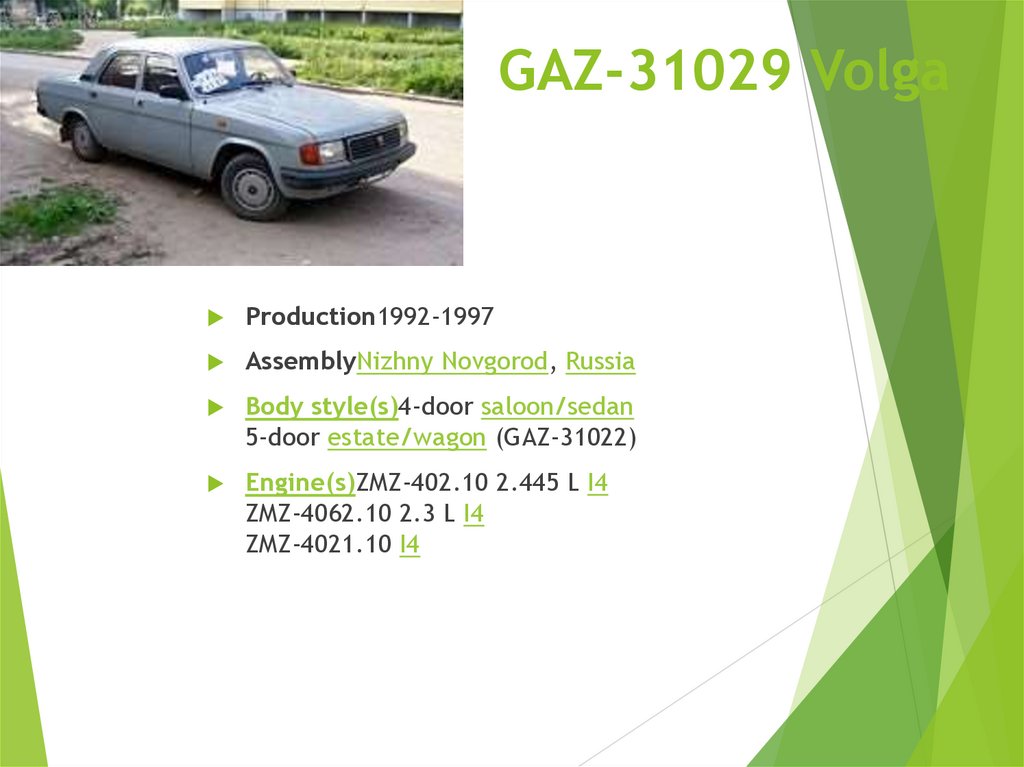
19. GAZ-31029 Volga
Production1992-1997AssemblyNizhny Novgorod, Russia
Body style(s)4-door saloon/sedan
5-door estate/wagon (GAZ-31022)
Engine(s)ZMZ-402.10 2.445 L I4
ZMZ-4062.10 2.3 L I4
ZMZ-4021.10 I4
20.
Initially the car enjoyed popularity, given thearchaic age of the GAZ-24-10 it replaced, but
the economic hardships of the 1990s meant
that soon its reputation would be broken by
the poor quality of assembly and corrosion
problems, and the older 3102, still produced
on the special conveyor was soon given
preference after it was made available to the
public following the collapse of the Soviet
Union. Despite this and its short production
run, GAZ set a record of more than 115
thousand per annum with the 31029.
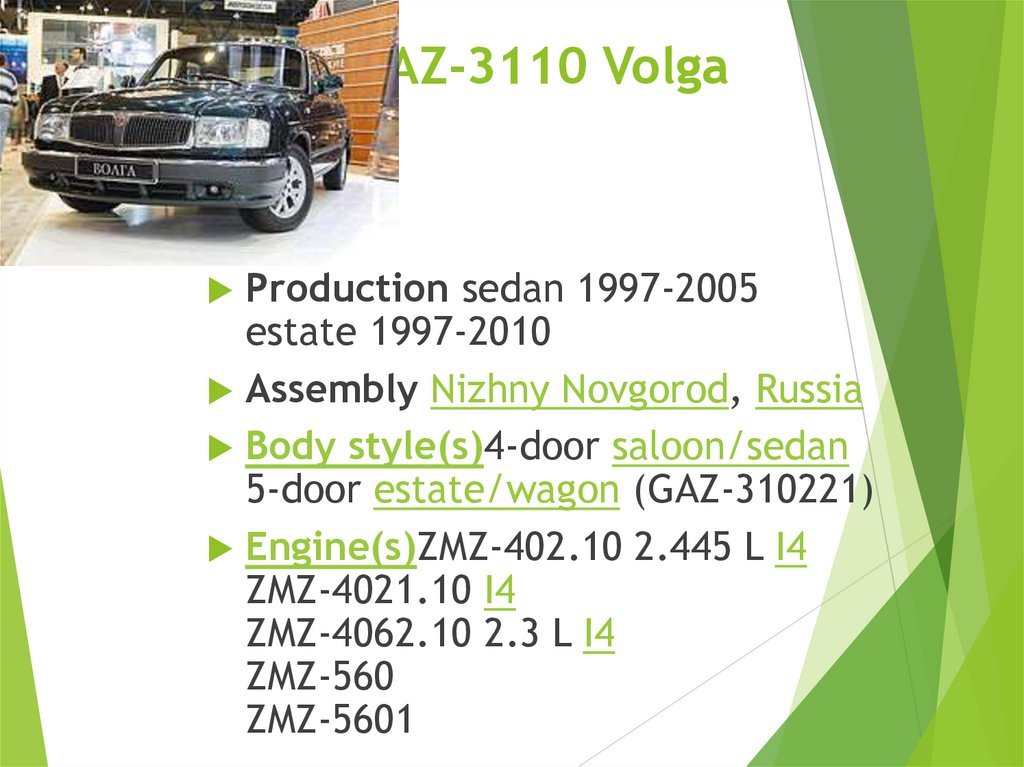
21. GAZ-3110 Volga
Production sedan 1997-2005estate 1997-2010
Assembly Nizhny Novgorod, Russia
Body style(s)4-door saloon/sedan
5-door estate/wagon (GAZ-310221)
Engine(s)ZMZ-402.10 2.445 L I4
ZMZ-4021.10 I4
ZMZ-4062.10 2.3 L I4
ZMZ-560
ZMZ-5601
22.
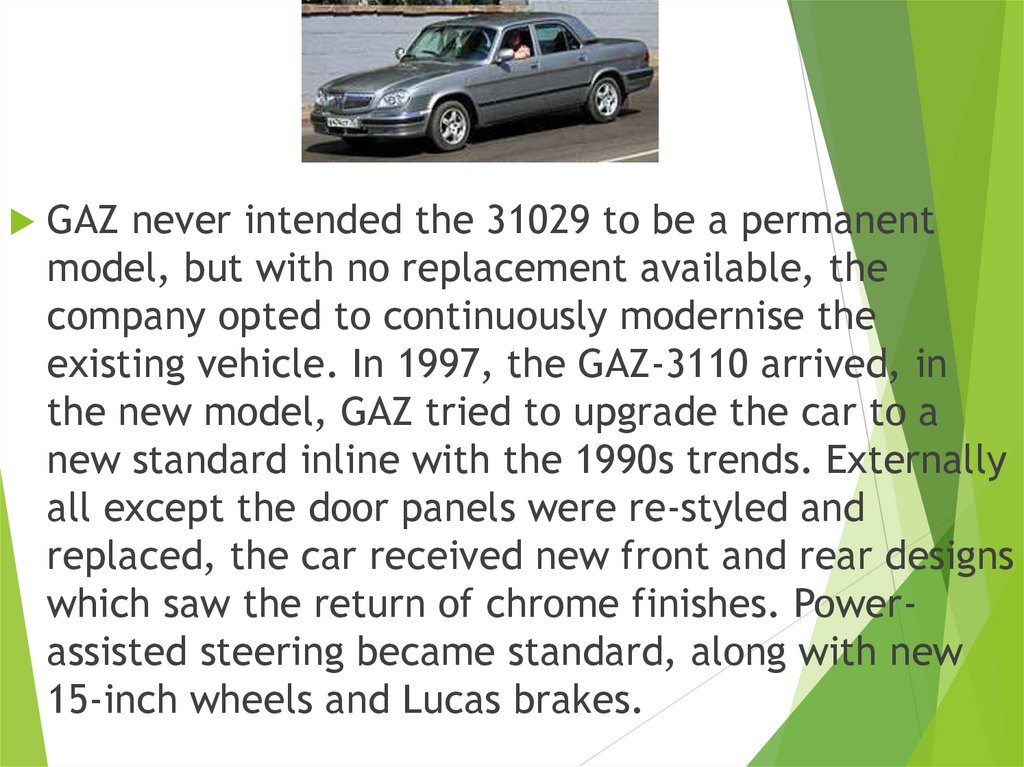
GAZ never intended the 31029 to be a permanentmodel, but with no replacement available, the
company opted to continuously modernise the
existing vehicle. In 1997, the GAZ-3110 arrived, in
the new model, GAZ tried to upgrade the car to a
new standard inline with the 1990s trends. Externally
all except the door panels were re-styled and
replaced, the car received new front and rear designs
which saw the return of chrome finishes. Powerassisted steering became standard, along with new
15-inch wheels and Lucas brakes.
23.
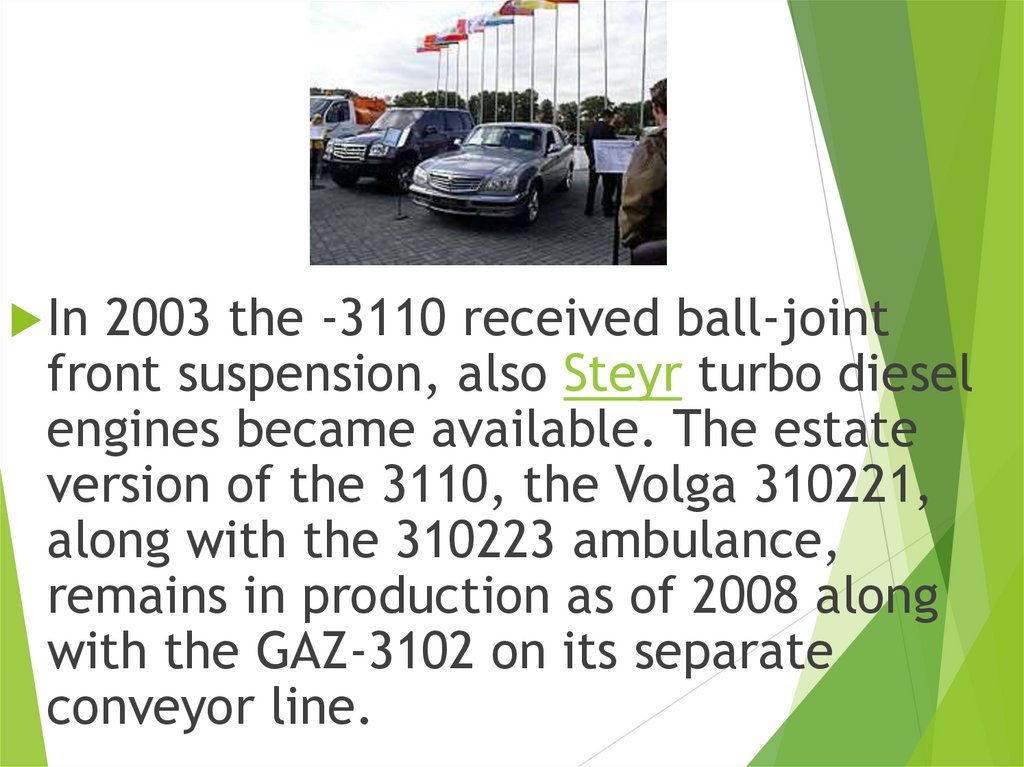
In 2003 the -3110 received ball-jointfront suspension, also Steyr turbo diesel
engines became available. The estate
version of the 3110, the Volga 310221,
along with the 310223 ambulance,
remains in production as of 2008 along
with the GAZ-3102 on its separate
conveyor line.
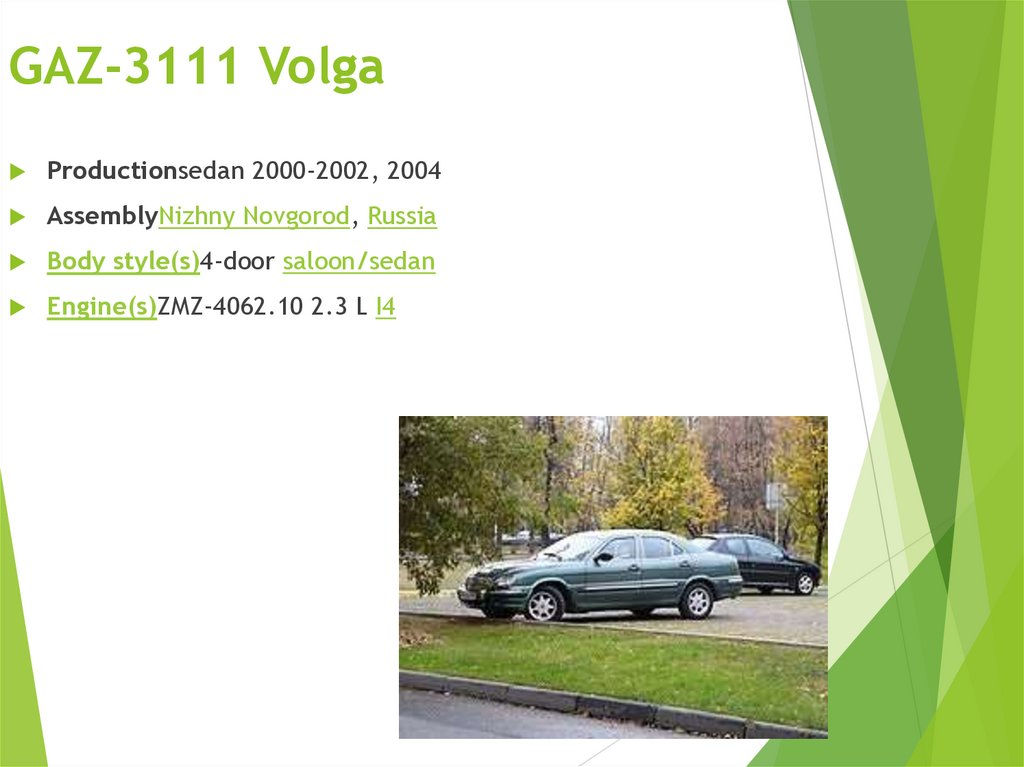
24. GAZ-3111 Volga
Productionsedan 2000-2002, 2004AssemblyNizhny Novgorod, Russia
Body style(s)4-door saloon/sedan
Engine(s)ZMZ-4062.10 2.3 L I4
25.
During the early 1990s GAZ managed to survivethe crises by having the Volga do a generation
jump from the GAZ-24-10 to the GAZ-3110 in
1997. Simultaneously it never abandoned its
quest to develop its eventual replacement,
and continued designing a new car, which
would feature ABS, power steering, climate
control, automatic gearbox and most of all V6
and even V8 engines as standard, along with
leather interiors. The external design was
completely new and featured many GAZ-21
influenced retro styling cues developed in
collaboration with a US-based company.
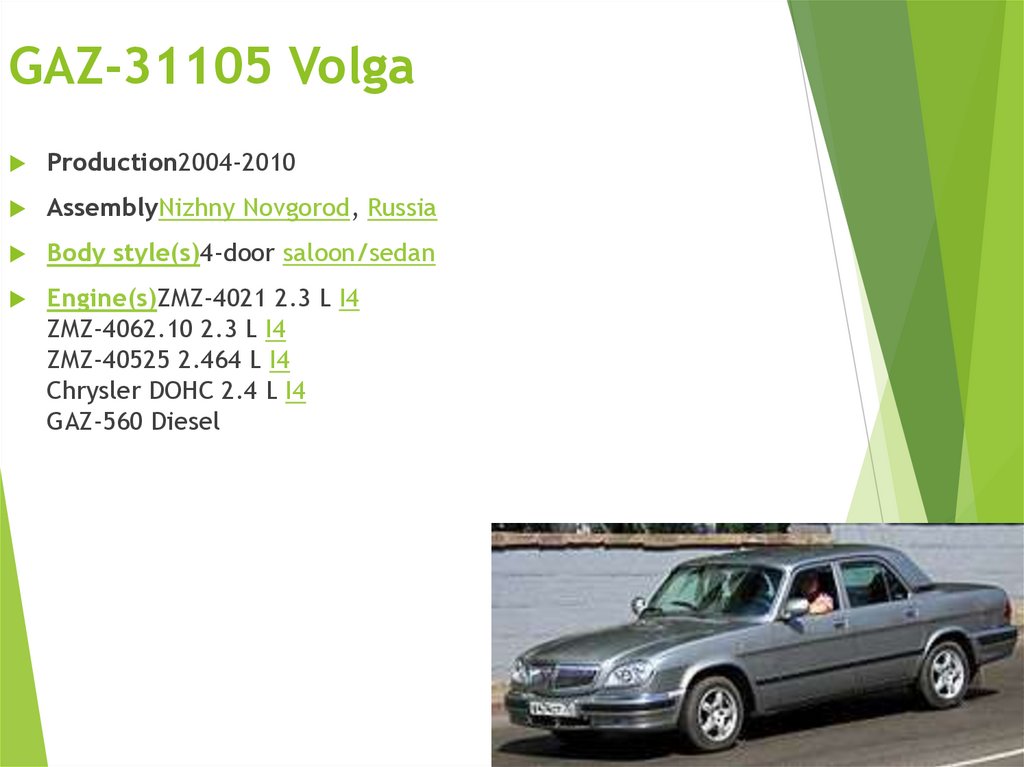
26. GAZ-31105 Volga
Production2004-2010AssemblyNizhny Novgorod, Russia
Body style(s)4-door saloon/sedan
Engine(s)ZMZ-4021 2.3 L I4
ZMZ-4062.10 2.3 L I4
ZMZ-40525 2.464 L I4
Chrysler DOHC 2.4 L I4
GAZ-560 Diesel
27.
In 2005 GAZ introduced a long-wheelbase311055 luxury model, with a new interior that
included a wooden trim. The latter feature
became standard on models produced from
2007 onwards when GAZ gave the car a minor
facelift. Among changes were completely new
taillights and a conversion to Euro III standard
with the introduction of its new 2.4 litre
123 hp ZMZ-40525 engine, complementing the
Chrysler engine, with which the archaic ZMZ4021 and 4062.10 were phased out. The 31105
is available only as a saloon, with the estate
continuing with the old 3110 styling.
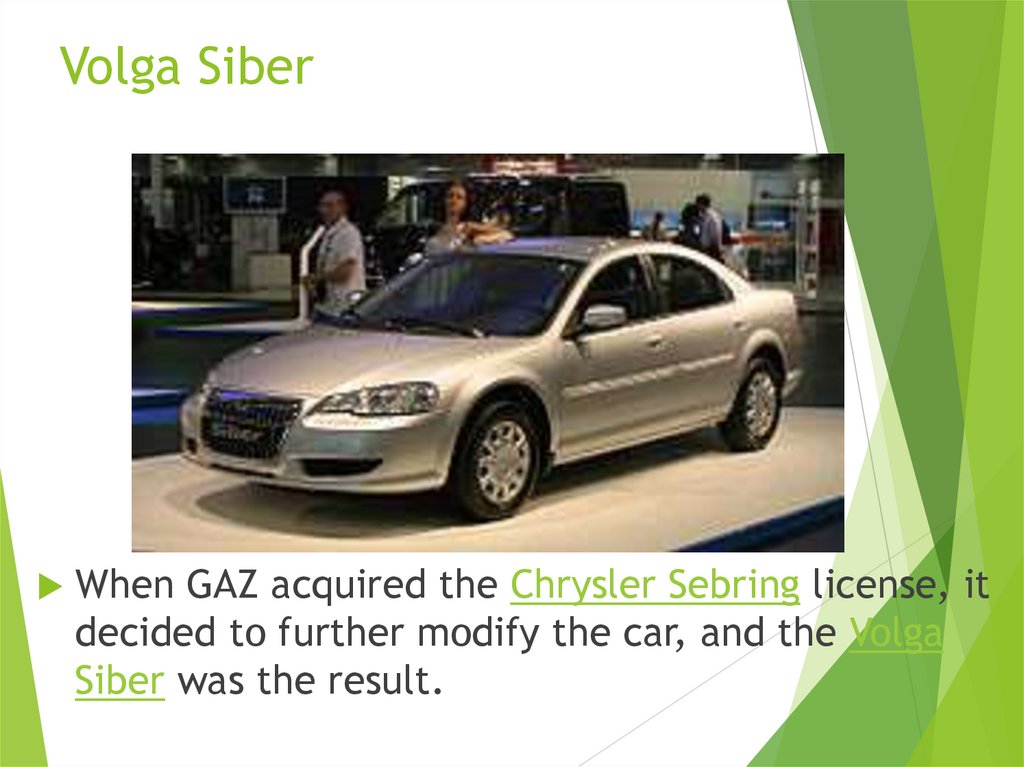
28. Volga Siber
When GAZ acquired the Chrysler Sebring license, itdecided to further modify the car, and the Volga
Siber was the result.