
Похожие презентации:




Hiking tourism
1. Hiking tourism
2. HISTORY
The idea of taking a walk in the countryside forpleasure developed in the 18th-century, and arose
because of changing attitudes to the landscape and
nature, associated with the Romantic movement. In
earlier times walking generally indicated poverty and
was also associated with vagrancy.
3. WHAT MEAN HIKING?
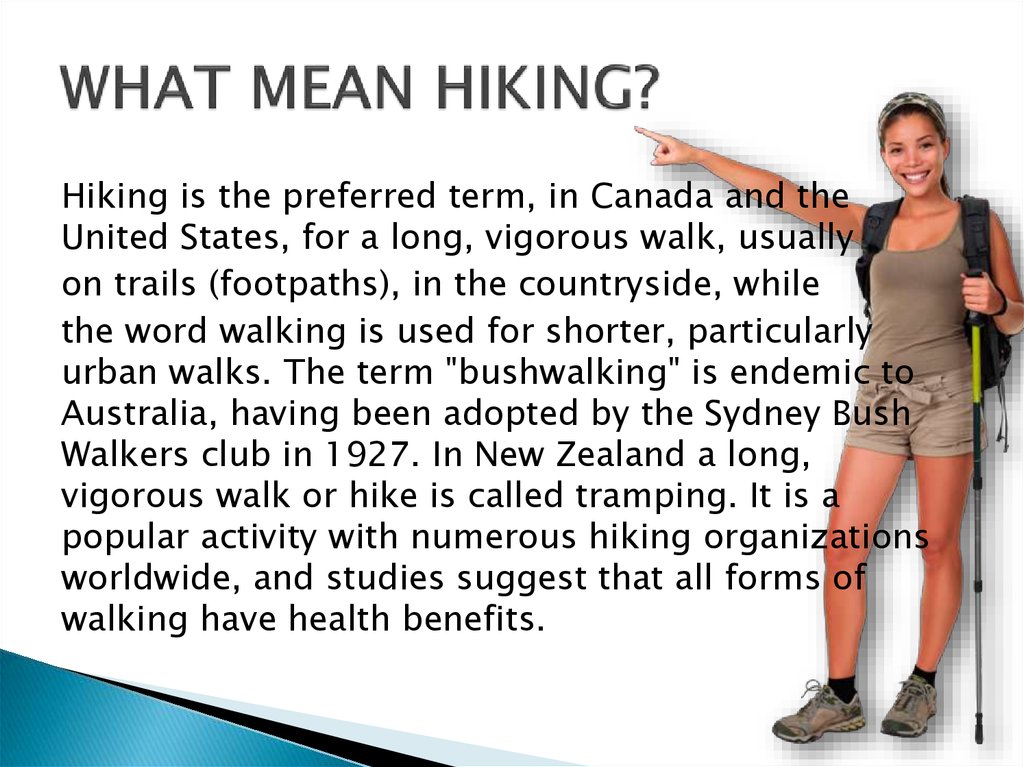
Hiking is the preferred term, in Canada and theUnited States, for a long, vigorous walk, usually
on trails (footpaths), in the countryside, while
the word walking is used for shorter, particularly
urban walks. The term "bushwalking" is endemic to
Australia, having been adopted by the Sydney Bush
Walkers club in 1927. In New Zealand a long,
vigorous walk or hike is called tramping. It is a
popular activity with numerous hiking organizations
worldwide, and studies suggest that all forms of
walking have health benefits.
4. RELATED TERMS
Hiking sometimes involves bushwhacking and is sometimesreferred to as such. This specifically refers to difficult walking
through dense forest, undergrowth, or bushes, where forward
progress requires pushing vegetation aside. In extreme cases of
bushwhacking, where the vegetation is so dense that human
passage is impeded, a machete is used to clear a pathway.
Common terms for hiking used by New Zealanders are tramping
(particularly for overnight and longer trips), walking or
bushwalking. Trekking is the preferred word used to describe
multi-day hiking in the mountainous regions of India, Pakistan,
Nepal, North America, South America, Iran and in the highlands
of East Africa. Hiking a long-distance trail from end-to-end is
also referred to as trekking and as thru-hiking in some places.
In North America, multi-day hikes, usually with camping, are
referred to as backpacking.
5. TYPES
Dog hiking – hiking with dogs that carry apack
Nordic Walking – fitness walking with poles
Scrambling – "non-technical" rock climbing or
mountaineering, or "technical" hiking
Swimhiking
Waterfalling – aka waterfall hunting and
waterfall hiking, is hiking with the purpose of
finding and enjoying waterfalls
6. MOST POPULAR PLACES FOR HIKING
Frequently nowadays long-distance hikes(walking tours) are undertaken along longdistance paths, including the:
National Trails in England and Wales
National Trail System in the United States
Grande Randonnée (France)
Lange-afstand-wandelpaden (Holland)
Grande Rota (Portugal)
Gran Recorrido (Spain)
7.
There are extensive networks in other Europeancountries of long-distance trails, as well as in
Canada, Australia, New Zealand, Nepal, and to a
lesser extent other Asiatic countries, like
Turkey, Israel, and Jordan. In the Alps of
Austria, Slovenia, Switzerland, Germany, France,
and Italy walking tours are often made from
'hut-to-hut', using an extensive system of
mountain huts.
8. EQUIPMENT
The equipment required for hiking depends onthe length of the hike, but day hikers generally
carry at least water, food, a map, and rainproof gear. Hikers usually wear sturdy hiking
boots for mountain walking and backpacking,
as protection from the rough terrain, as well as
providing increased stability.
9.
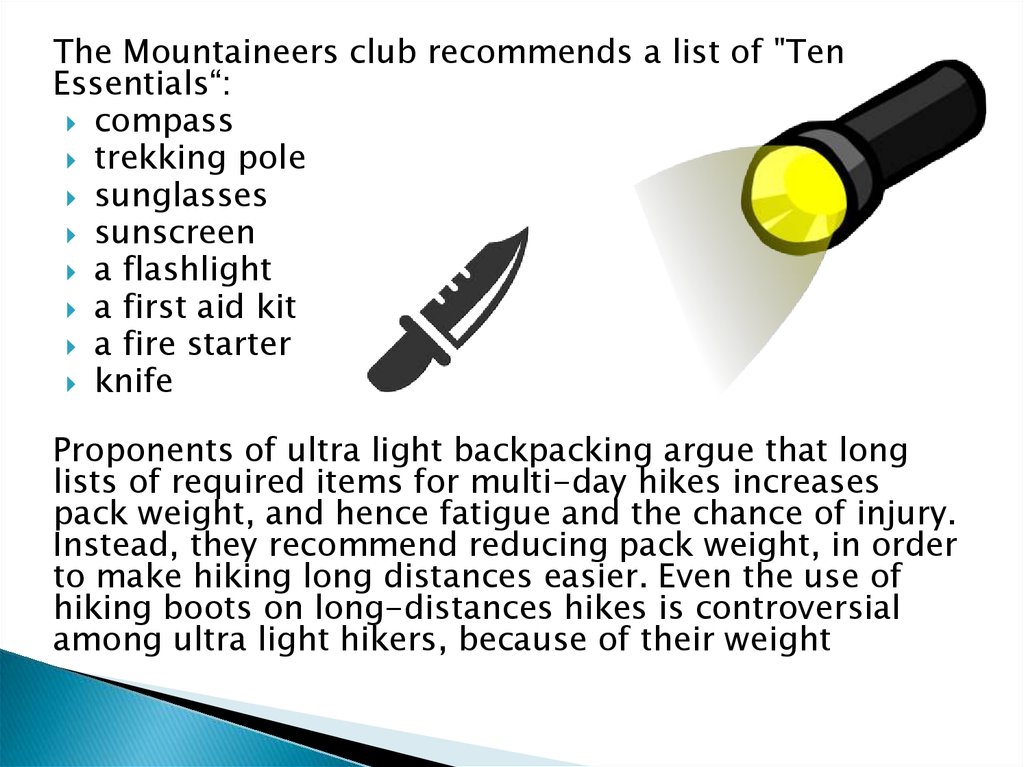
The Mountaineers club recommends a list of "TenEssentials“:
compass
trekking pole
sunglasses
sunscreen
a flashlight
a first aid kit
a fire starter
knife
Proponents of ultra light backpacking argue that long
lists of required items for multi-day hikes increases
pack weight, and hence fatigue and the chance of injury.
Instead, they recommend reducing pack weight, in order
to make hiking long distances easier. Even the use of
hiking boots on long-distances hikes is controversial
among ultra light hikers, because of their weight