 Программирование
Похожие презентации:




Tropes are lexico-semantic stylistic devices based on a certain change/transposition of meaning
1.
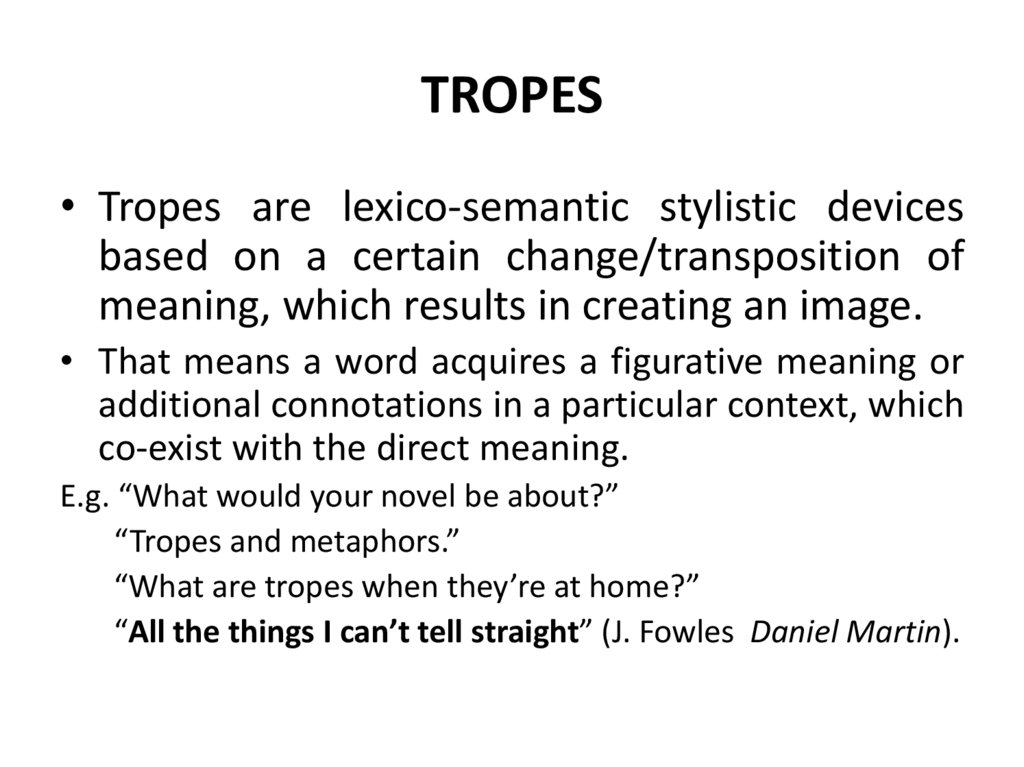
TROPES• Tropes are lexico-semantic stylistic devices
based on a certain change/transposition of
meaning, which results in creating an image.
• That means a word acquires a figurative meaning or
additional connotations in a particular context, which
co-exist with the direct meaning.
E.g. “What would your novel be about?”
“Tropes and metaphors.”
“What are tropes when they’re at home?”
“All the things I can’t tell straight” (J. Fowles Daniel Martin).
2.
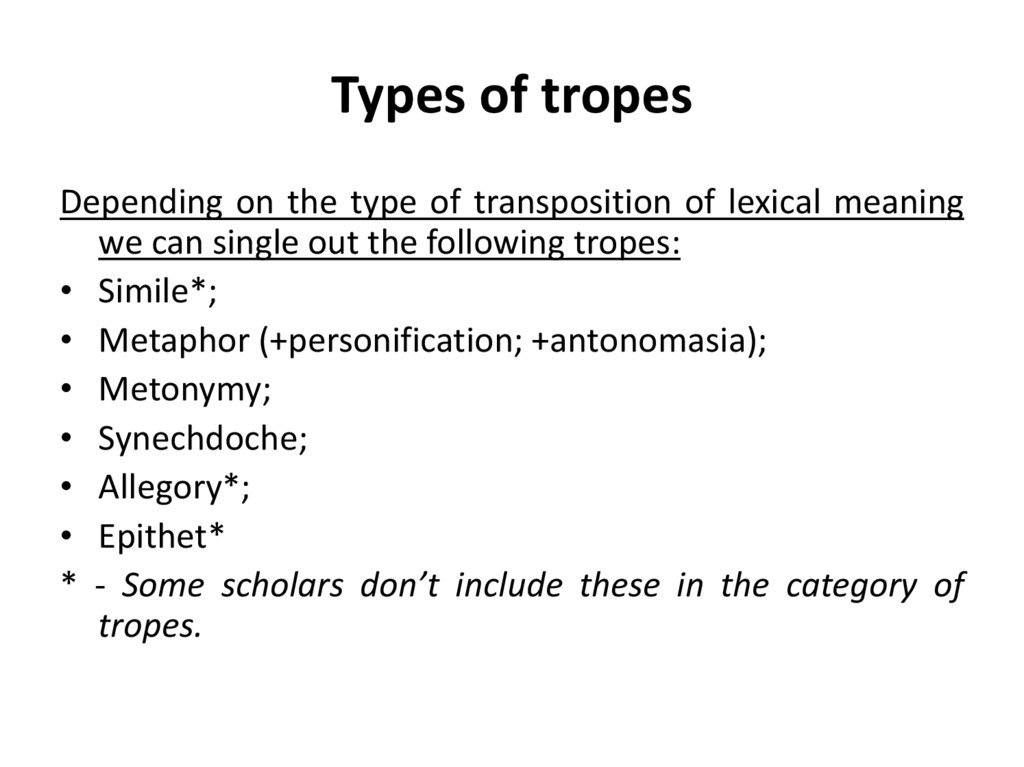
Types of tropesDepending on the type of transposition of lexical meaning
we can single out the following tropes:
• Simile*;
• Metaphor (+personification; +antonomasia);
• Metonymy;
• Synechdoche;
• Allegory*;
• Epithet*
* - Some scholars don’t include these in the category of
tropes.
3.
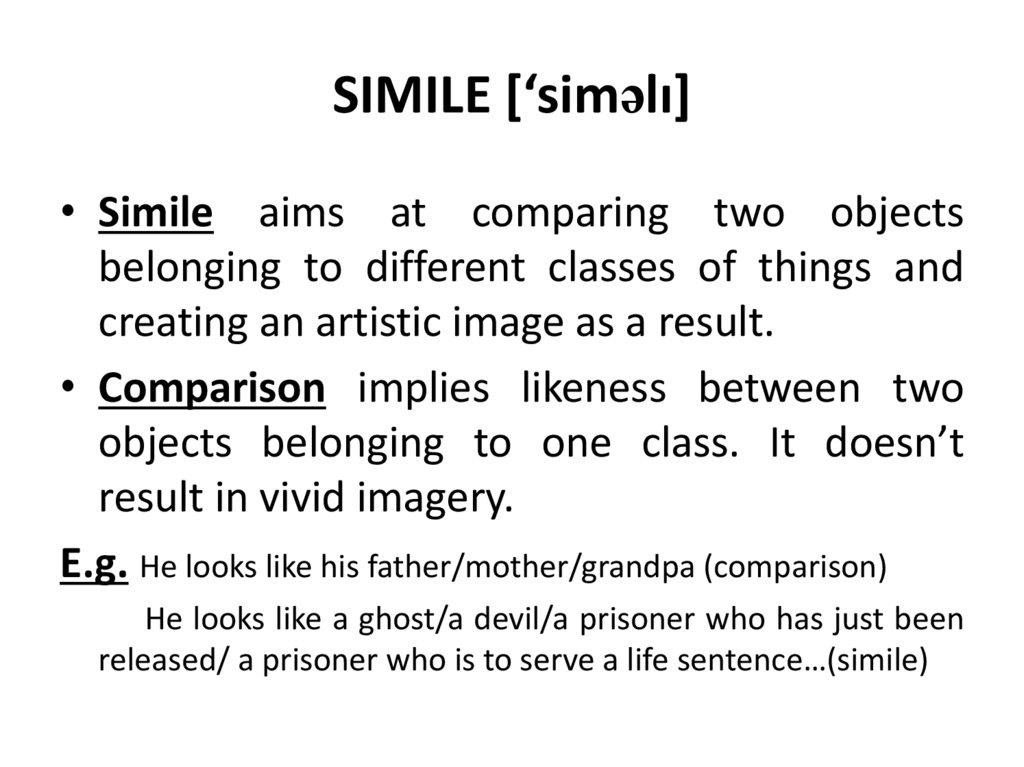
SIMILE [‘siməlı]• Simile aims at comparing two objects
belonging to different classes of things and
creating an artistic image as a result.
• Comparison implies likeness between two
objects belonging to one class. It doesn’t
result in vivid imagery.
E.g. He looks like his father/mother/grandpa (comparison)
He looks like a ghost/a devil/a prisoner who has just been
released/ a prisoner who is to serve a life sentence…(simile)
4.
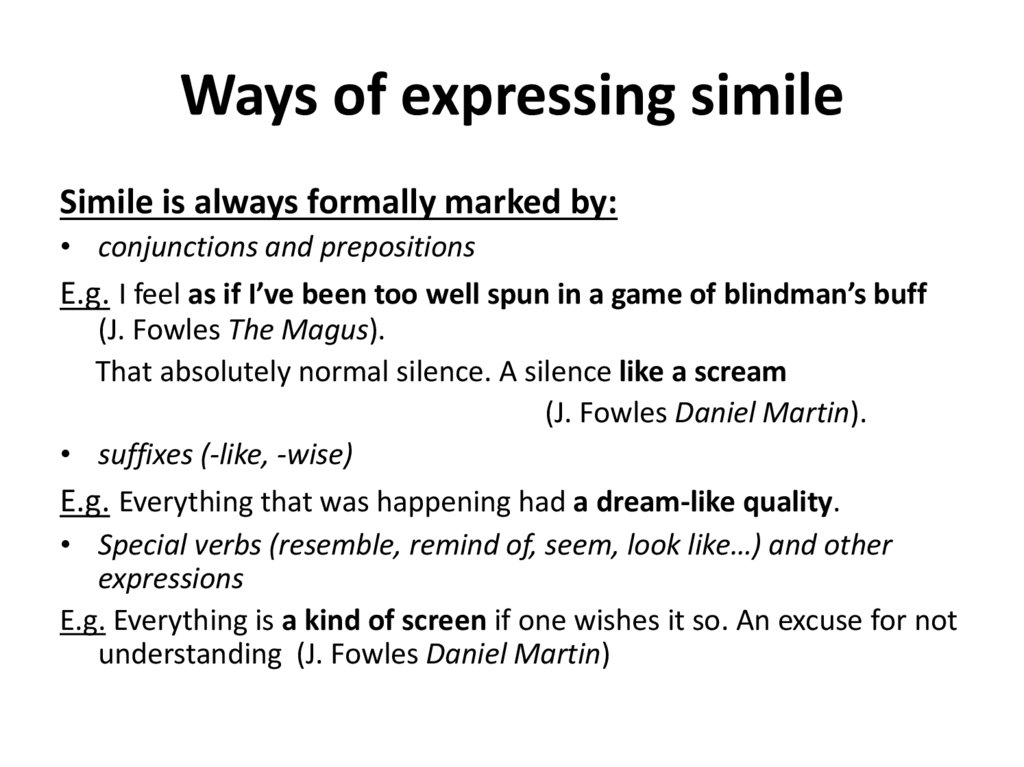
Ways of expressing simileSimile is always formally marked by:
• conjunctions and prepositions
E.g. I feel as if I’ve been too well spun in a game of blindman’s buff
(J. Fowles The Magus).
That absolutely normal silence. A silence like a scream
(J. Fowles Daniel Martin).
• suffixes (-like, -wise)
E.g. Everything that was happening had a dream-like quality.
• Special verbs (resemble, remind of, seem, look like…) and other
expressions
E.g. Everything is a kind of screen if one wishes it so. An excuse for not
understanding (J. Fowles Daniel Martin)
5.
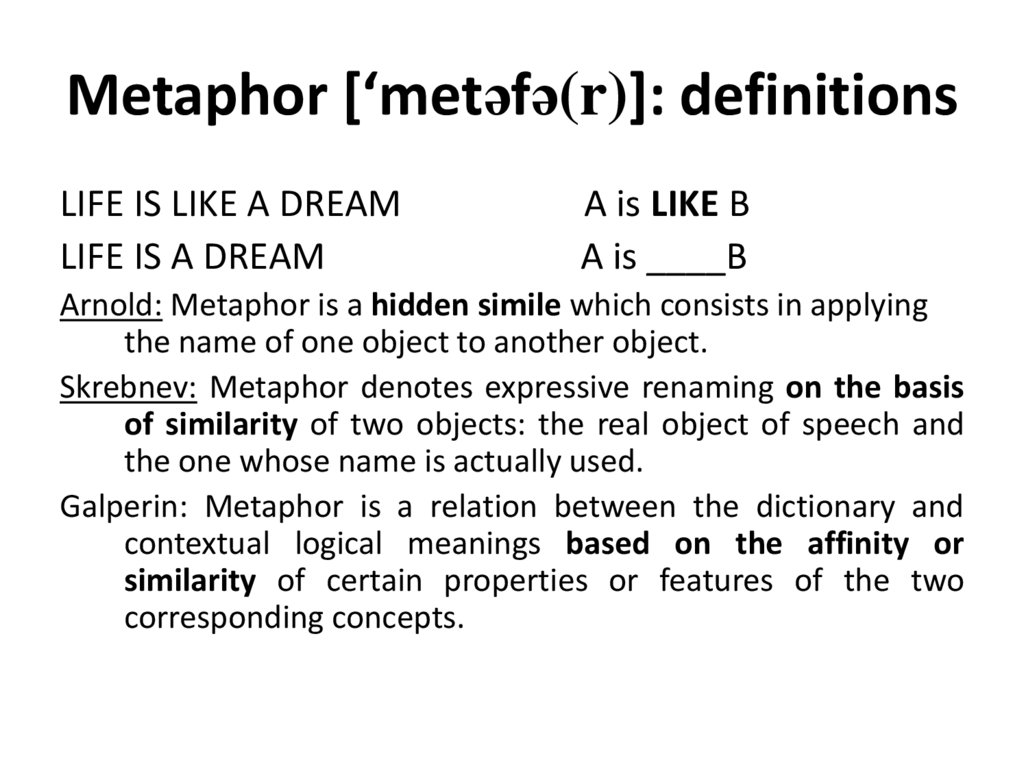
Metaphor [‘metəfə(r)]: definitionsLIFE IS LIKE A DREAM
LIFE IS A DREAM
A is LIKE B
A is ____B
Arnold: Metaphor is a hidden simile which consists in applying
the name of one object to another object.
Skrebnev: Metaphor denotes expressive renaming on the basis
of similarity of two objects: the real object of speech and
the one whose name is actually used.
Galperin: Metaphor is a relation between the dictionary and
contextual logical meanings based on the affinity or
similarity of certain properties or features of the two
corresponding concepts.
6.
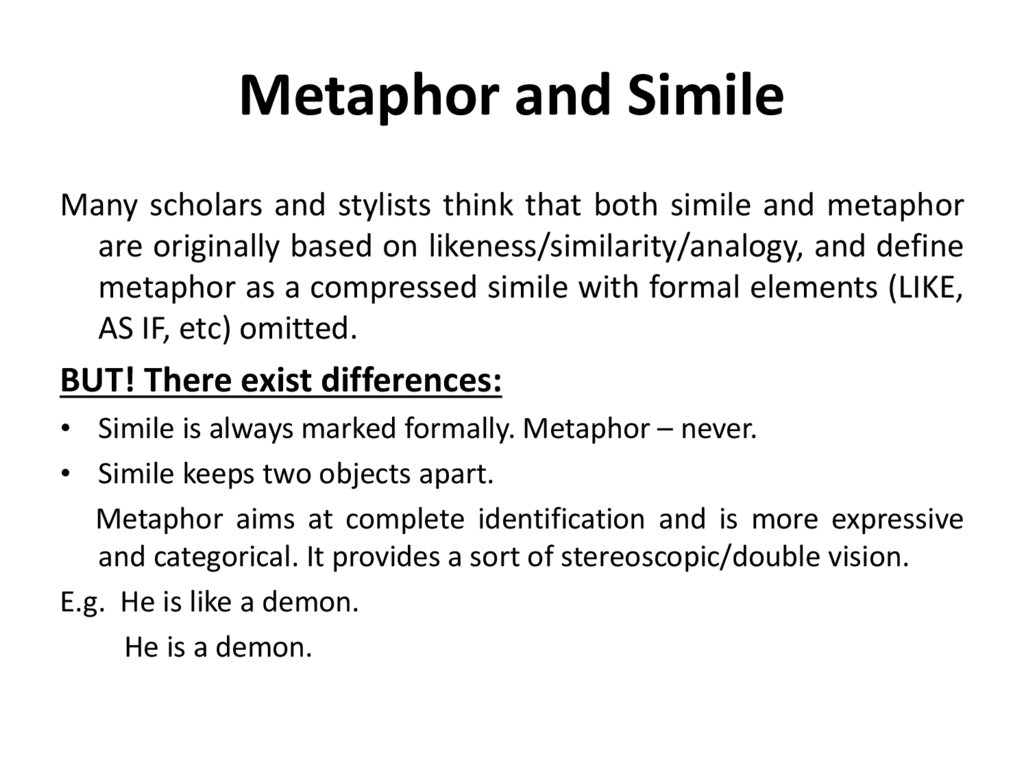
Metaphor and SimileMany scholars and stylists think that both simile and metaphor
are originally based on likeness/similarity/analogy, and define
metaphor as a compressed simile with formal elements (LIKE,
AS IF, etc) omitted.
BUT! There exist differences:
• Simile is always marked formally. Metaphor – never.
• Simile keeps two objects apart.
Metaphor aims at complete identification and is more expressive
and categorical. It provides a sort of stereoscopic/double vision.
E.g. He is like a demon.
He is a demon.
7.
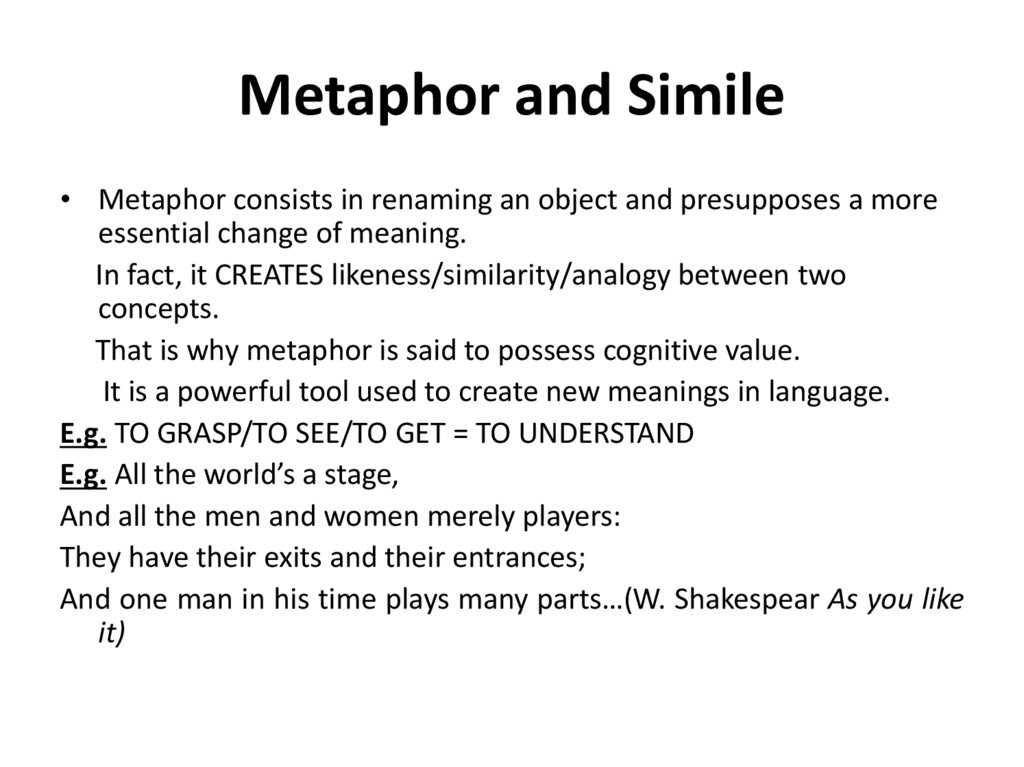
Metaphor and Simile• Metaphor consists in renaming an object and presupposes a more
essential change of meaning.
In fact, it CREATES likeness/similarity/analogy between two
concepts.
That is why metaphor is said to possess cognitive value.
It is a powerful tool used to create new meanings in language.
E.g. TO GRASP/TO SEE/TO GET = TO UNDERSTAND
E.g. All the world’s a stage,
And all the men and women merely players:
They have their exits and their entrances;
And one man in his time plays many parts…(W. Shakespear As you like
it)
8.
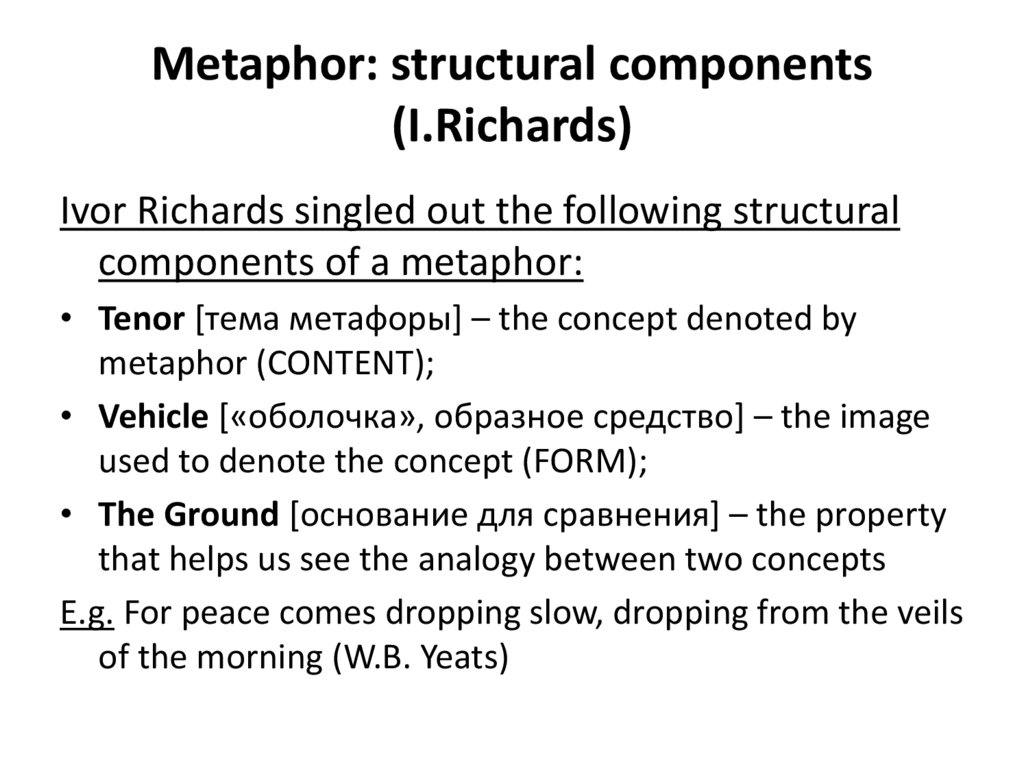
Metaphor: structural components(I.Richards)
Ivor Richards singled out the following structural
components of a metaphor:
• Tenor [тема метафоры] – the concept denoted by
metaphor (CONTENT);
• Vehicle [«оболочка», образное средство] – the image
used to denote the concept (FORM);
• The Ground [основание для сравнения] – the property
that helps us see the analogy between two concepts
E.g. For peace comes dropping slow, dropping from the veils
of the morning (W.B. Yeats)
9.
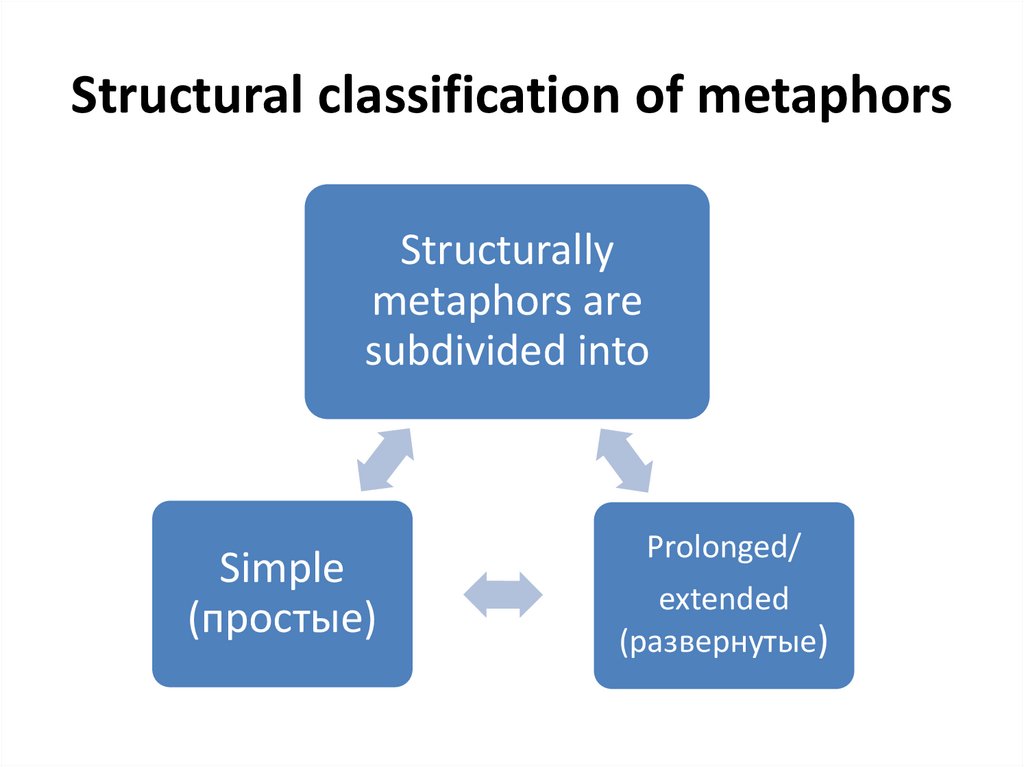
Structural classification of metaphorsStructurally
metaphors are
subdivided into
Simple
(простые)
Prolonged/
extended
(развернутые)
10.
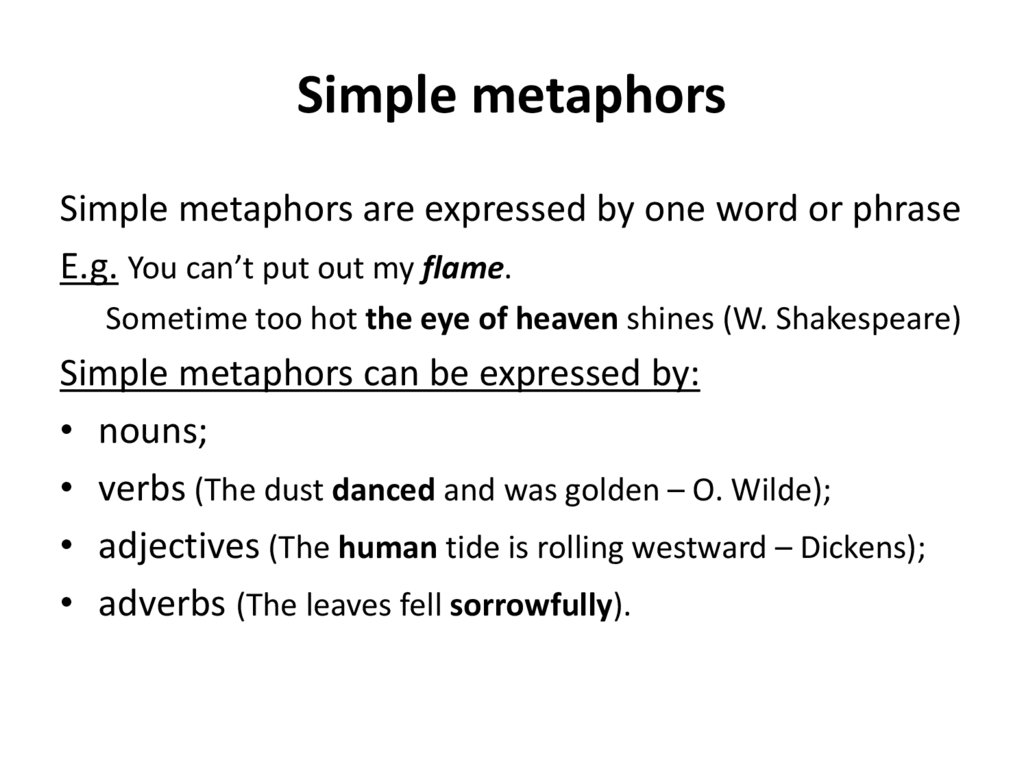
Simple metaphorsSimple metaphors are expressed by one word or phrase
E.g. You can’t put out my flame.
Sometime too hot the eye of heaven shines (W. Shakespeare)
Simple metaphors can be expressed by:
• nouns;
• verbs (The dust danced and was golden – O. Wilde);
• adjectives (The human tide is rolling westward – Dickens);
• adverbs (The leaves fell sorrowfully).
11.
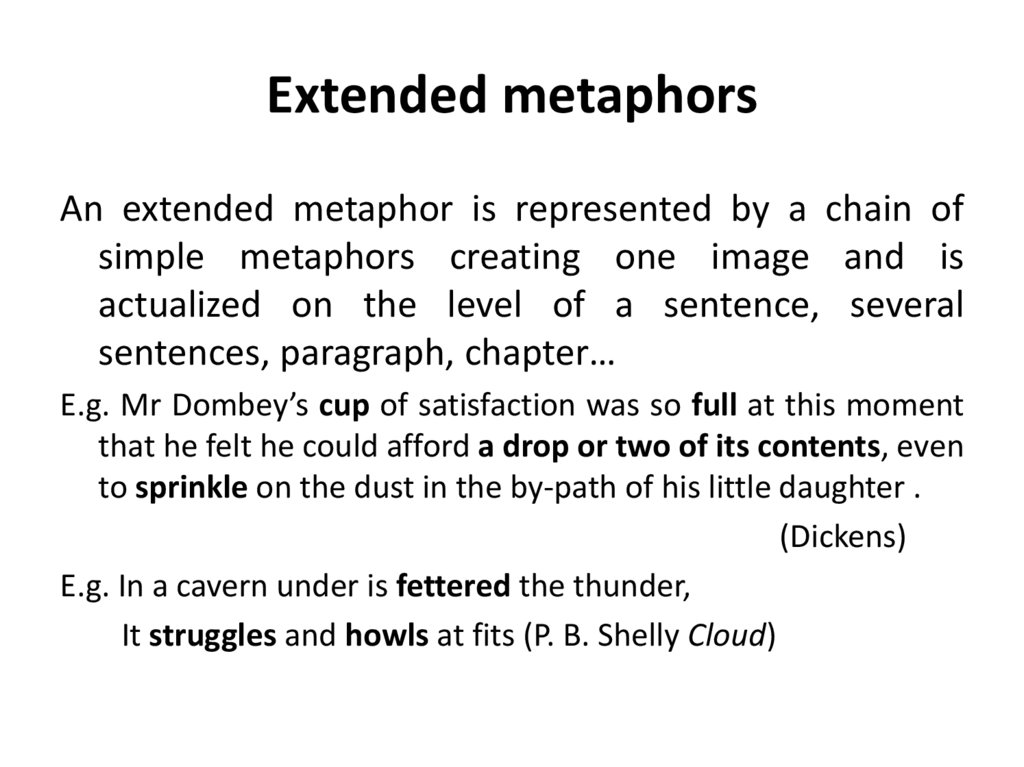
Extended metaphorsAn extended metaphor is represented by a chain of
simple metaphors creating one image and is
actualized on the level of a sentence, several
sentences, paragraph, chapter…
E.g. Mr Dombey’s cup of satisfaction was so full at this moment
that he felt he could afford a drop or two of its contents, even
to sprinkle on the dust in the by-path of his little daughter .
(Dickens)
E.g. In a cavern under is fettered the thunder,
It struggles and howls at fits (P. B. Shelly Cloud)
12.
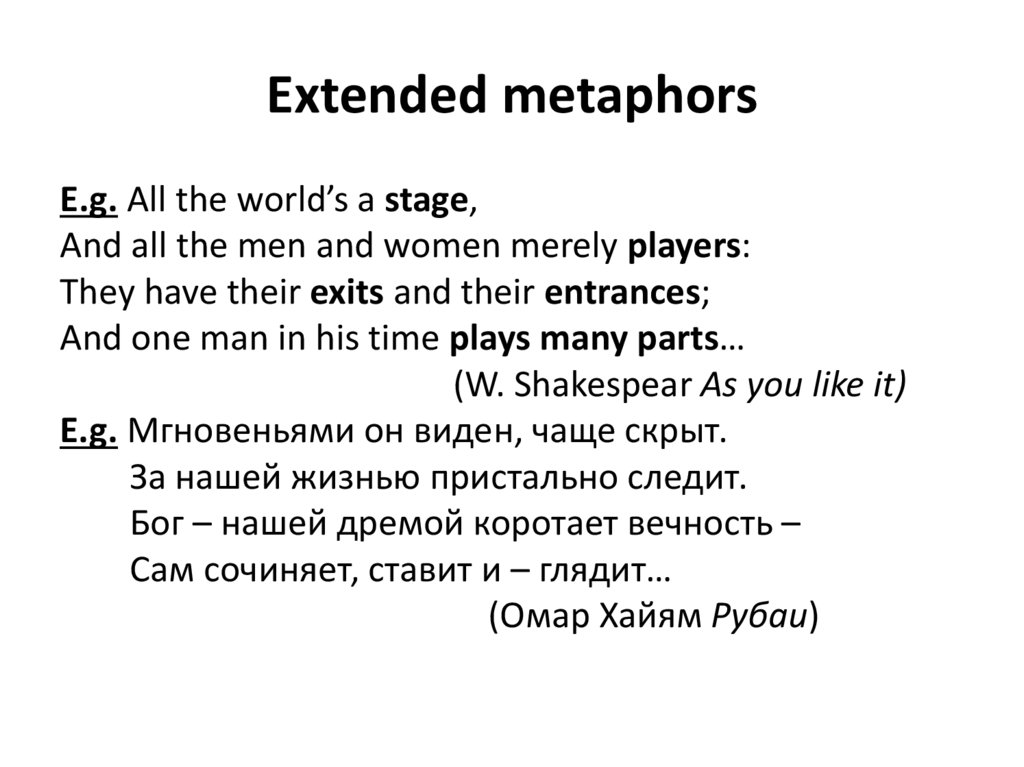
Extended metaphorsE.g. All the world’s a stage,
And all the men and women merely players:
They have their exits and their entrances;
And one man in his time plays many parts…
(W. Shakespear As you like it)
E.g. Мгновеньями он виден, чаще скрыт.
За нашей жизнью пристально следит.
Бог – нашей дремой коротает вечность –
Сам сочиняет, ставит и – глядит…
(Омар Хайям Рубаи)
13.
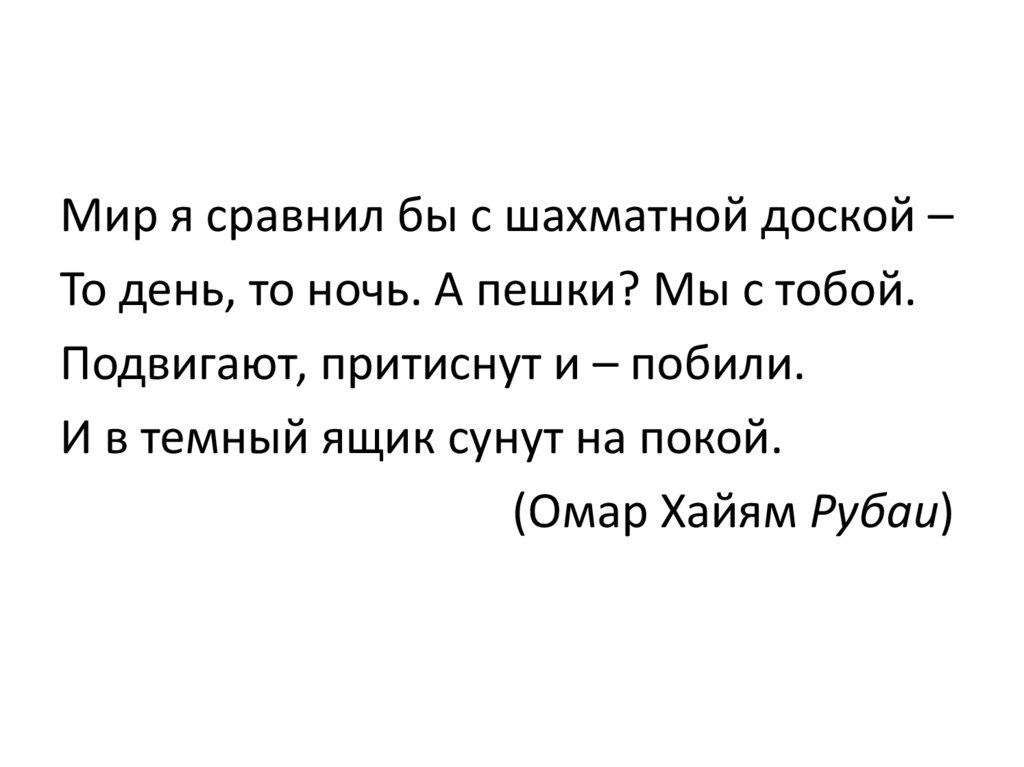
Мир я сравнил бы с шахматной доской –То день, то ночь. А пешки? Мы с тобой.
Подвигают, притиснут и – побили.
И в темный ящик сунут на покой.
(Омар Хайям Рубаи)
14.
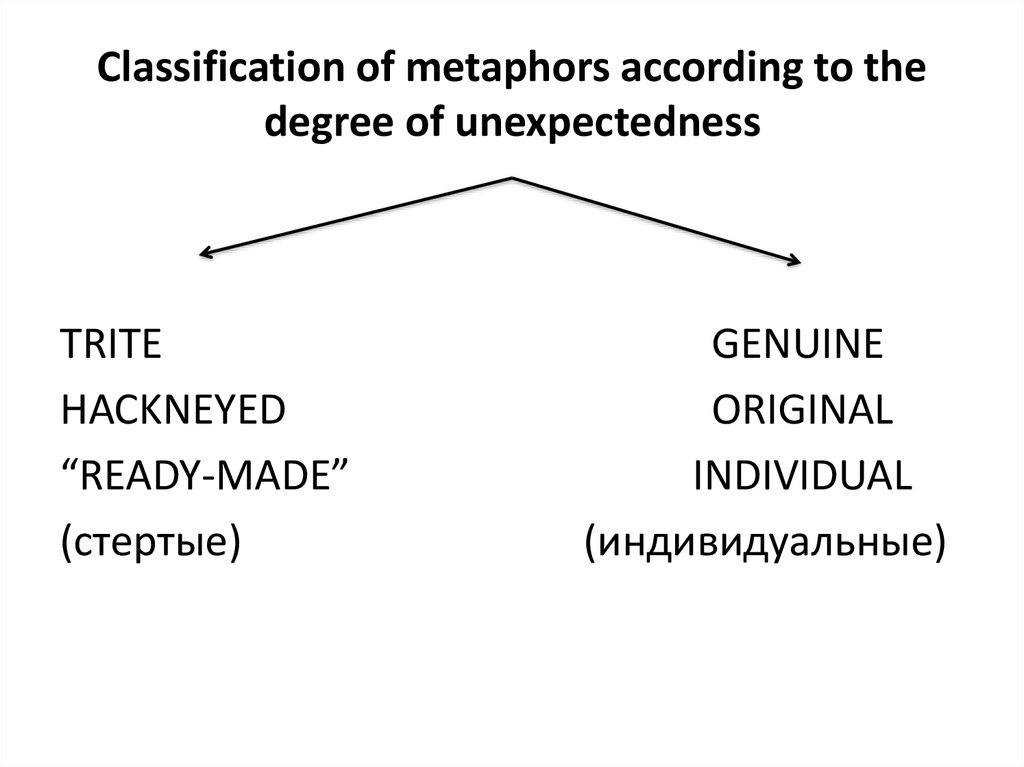
Classification of metaphors according to thedegree of unexpectedness
TRITE
HACKNEYED
“READY-MADE”
(стертые)
GENUINE
ORIGINAL
INDIVIDUAL
(индивидуальные)
15.
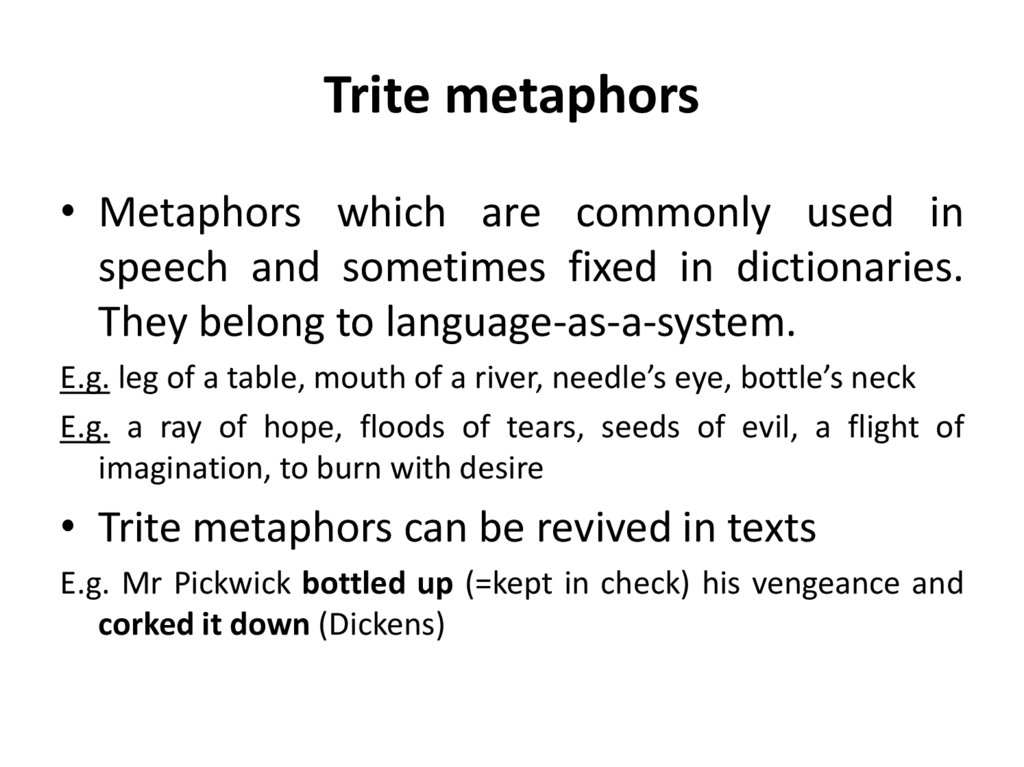
Trite metaphors• Metaphors which are commonly used in
speech and sometimes fixed in dictionaries.
They belong to language-as-a-system.
E.g. leg of a table, mouth of a river, needle’s eye, bottle’s neck
E.g. a ray of hope, floods of tears, seeds of evil, a flight of
imagination, to burn with desire
• Trite metaphors can be revived in texts
E.g. Mr Pickwick bottled up (=kept in check) his vengeance and
corked it down (Dickens)
16.
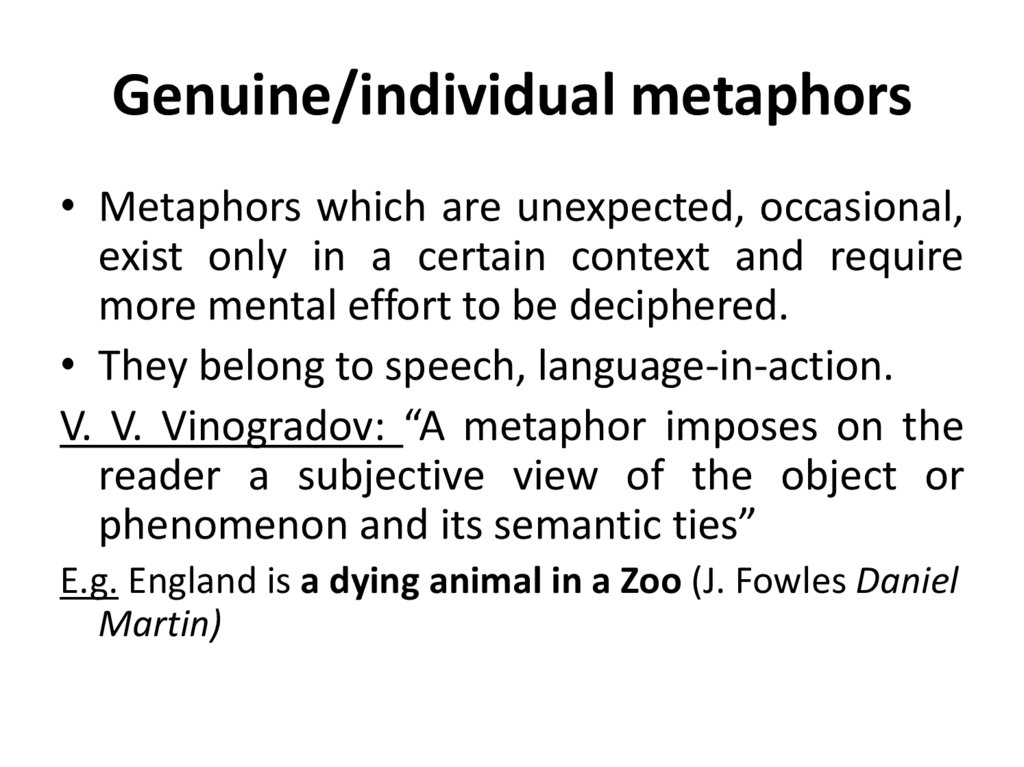
Genuine/individual metaphors• Metaphors which are unexpected, occasional,
exist only in a certain context and require
more mental effort to be deciphered.
• They belong to speech, language-in-action.
V. V. Vinogradov: “A metaphor imposes on the
reader a subjective view of the object or
phenomenon and its semantic ties”
E.g. England is a dying animal in a Zoo (J. Fowles Daniel
Martin)