
 Бизнес
Похожие презентации:








Competitors. Technological entrepreneurship
1.
CompetitorsTechnological Entrepreneurship
Assel Nurguzhina
PhD associated professor
2.
Why do you need to know yourcompetitors?
Understanding Competitors
In the fast-paced world of technological
entrepreneurship, understanding your competitors is
crucial.
Competitors are other businesses that offer similar
products or services to your target market.
By analyzing their strengths, weaknesses, and
strategies, you can identify opportunities to
differentiate your business and gain a competitive
edge.
3.
Key Questions to Ask AboutCompetitors:
•Who are your direct competitors? These are businesses that
offer identical or very similar products or services to yours.
•What are their strengths and weaknesses? Identify their
unique selling points and areas where they may be vulnerable.
•What is their market share? How much of the market do they
control?
•What is their marketing strategy? How do they reach their
target audience and promote their products or services?
•What is their pricing strategy? How do they position
themselves in terms of price?
4.
Competitive AdvantageCompetitive advantage is the unique factor that sets your business apart from
your competitors. It can be based on various factors, including:
• Product or service differentiation: Offering a unique or superior product
or service that meets customer needs better than your competitors.
• Cost leadership: Being able to produce or deliver products or services at a
lower cost than your competitors.
• Innovation: Developing innovative products or services that disrupt the
market.
• Strong brand: Building a strong brand reputation that inspires customer
loyalty.
• Customer service: Providing exceptional customer service that exceeds
customer expectations.
• Distribution channels: Having a more efficient or effective distribution
network.
• Intellectual property: Owning valuable patents, trademarks, or
copyrights.
5.
Strategies for Gaining a Competitive Advantage• Innovation: Continuously invest in research and
development to create new and innovative products or
services.
• Customer focus: Listen to customer feedback and tailor
your offerings to meet their needs.
• Efficiency: Streamline your operations to reduce costs and
improve efficiency.
• Strategic partnerships: Collaborate with other businesses
to expand your reach and capabilities.
• Marketing and branding: Develop a strong brand identity
and effective marketing campaigns.
• Talent acquisition: Hire talented individuals who can
contribute to your business's success.
6.
How to Sustain Competitive AdvantageContinuous innovation: Invest in research and development to stay ahead of competitors.
Customer focus: Listen to customer feedback and adapt your offerings to meet their evolving
needs.
• Efficiency: Optimize operations to reduce costs and improve efficiency.
• Strategic partnerships: Collaborate with other businesses to expand your reach and capabilities.
• Talent management: Invest in your employees' development and create a positive work
environment.
• Intellectual property protection: Safeguard your intellectual property to maintain a competitive
edge.
• Analyzing Competitors:
• Identify direct competitors: Businesses offering similar products or services.
• Assess their strengths and weaknesses: Identify their unique selling points and areas where they
may be vulnerable.
• Analyze their market share and pricing strategies: Understand their market position and
competitive pricing.
• Monitor their marketing and innovation efforts: Stay informed about their strategies and
activities.
By understanding these concepts and actively working to develop and sustain a competitive advantage,
you can position your business for long-term success.
7.
• By carefully analyzing your competitors andidentifying your unique competitive
advantage, you can position your
technological venture for success in a
competitive market.
8.
2.Sources of Competitive Advantage:• Product or Service Differentiation: Unique features,
quality, or performance.
• Cost Leadership: Efficient operations, economies of scale,
or access to low-cost resources.
• Innovation: New or improved products, processes, or
business models.
• Brand Equity: Strong brand reputation and customer
loyalty.
• Distribution Channels: Efficient and effective distribution
networks.
• Intellectual Property: Patents, trademarks, or copyrights.
• Human Capital: Skilled and motivated employees.
9.
3. Sustaining Competitive Advantage:• Continuous Innovation: Investing in research and
development to stay ahead of competitors.
• Customer Focus: Understanding and meeting customer
needs better than competitors.
• Efficiency: Streamlining operations to reduce costs and
improve efficiency.
• Strategic Partnerships: Collaborating with other businesses
to enhance capabilities.
• Intellectual Property Protection: Safeguarding valuable
assets through patents, trademarks, and copyrights.
• Talent Management: Attracting, developing, and retaining
top talent.
10.
4. Assessing Competitive Advantage:• SWOT Analysis: Evaluating your business's strengths,
weaknesses, opportunities, and threats.
• Competitive Analysis: Examining competitors'
strategies, strengths, and weaknesses.
• Customer Feedback: Gathering insights into customer
preferences and satisfaction.
• Financial Performance: Analyzing profitability, market
share, and return on investment.
• By understanding these concepts and implementing
effective strategies, you can build a sustainable
competitive advantage and position your business for
long-term success.
11.
Analyzing Competitors and IdentifyingYour Unique Competitive Advantage
To effectively analyze your competitors and identify your unique competitive advantage, follow these
steps:
1. Identify Your Competitors:
• Direct Competitors: Businesses offering identical or similar products or services.
• Indirect Competitors: Businesses offering products or services that can substitute for yours.
2. Gather Information:
• Public Sources: Websites, social media, press releases, annual reports, industry publications.
• Industry Research: Market research reports, analyst firms.
• Customer Surveys: Feedback on competitors' products or services.
3. Assess Competitors' Strengths and Weaknesses:
• Product or Service: Quality, features, pricing, branding.
• Marketing and Sales: Channels, messaging, customer service.
• Operations: Efficiency, supply chain, distribution.
• Financial Performance: Revenue, profitability, market share.
4. Identify Competitor Strategies:
• Cost Leadership: Focus on low costs.
• Differentiation: Offer unique features or benefits.
• Focus Strategy: Target a specific niche.
5. Analyze Market Trends:
• Industry Trends: Technological advancements, regulatory changes, consumer preferences.
• Economic Trends: Market size, growth rate, competition intensity.
12.
6.Determine Your Unique Selling Proposition (USP):• What sets your business apart? Unique features, benefits, or value proposition.
• How do you solve customer problems better than competitors?
• What is your competitive advantage?
7. Conduct a SWOT Analysis:
• Strengths: Internal capabilities that give you an advantage.
• Weaknesses: Internal limitations that could hinder your success.
• Opportunities: External factors that can benefit your business.
• Threats: External factors that could harm your business.
8. Develop a Competitive Strategy:
• Align your strategy with your USP.
• Leverage your strengths and address your weaknesses.
• Capitalize on opportunities and mitigate threats.
Example:
• If you're a tech startup offering a cloud-based project management tool, your
competitive advantage might be a more intuitive user interface, advanced
automation features, or superior data security. To analyze your competitors, you
could compare their pricing, feature sets, customer reviews, and market share.
• By following these steps, you can gain a deep understanding of your competitive
landscape and develop a winning strategy for your business.
13.
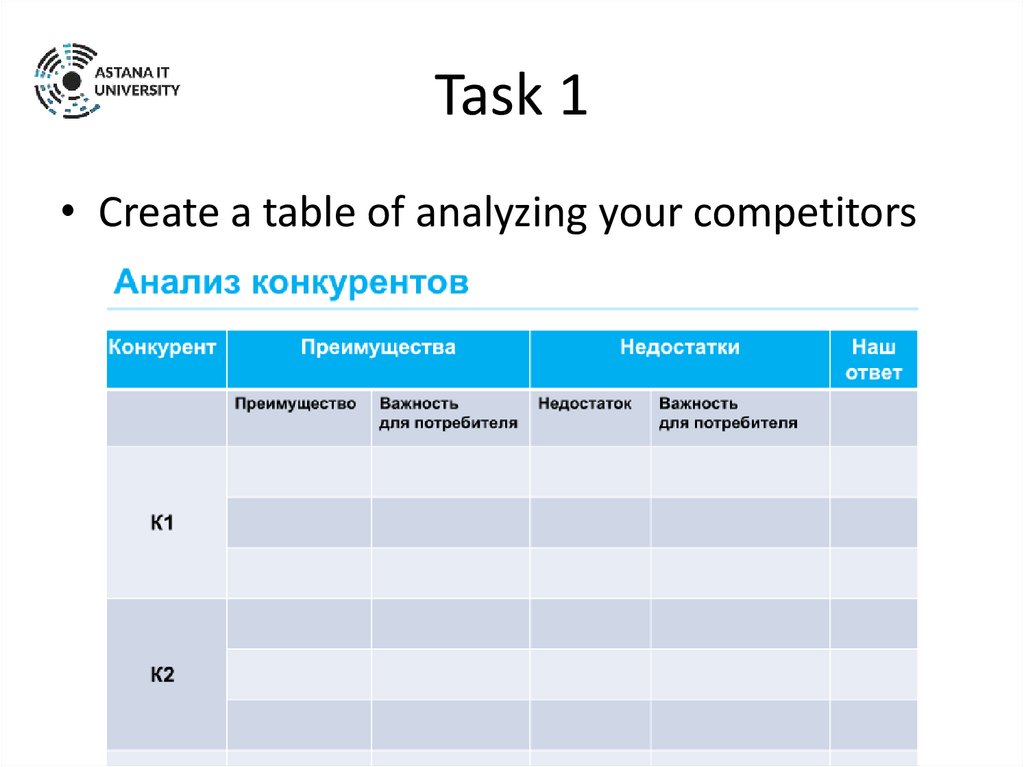
Task 1• Create a table of analyzing your competitors
14.
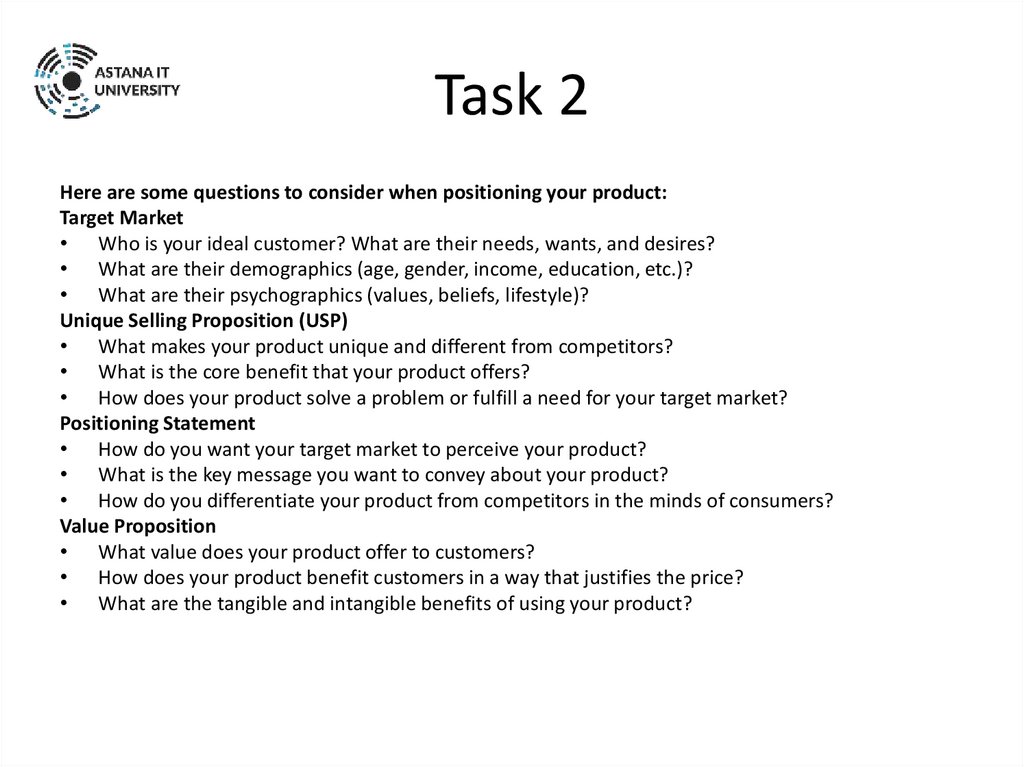
Task 2Here are some questions to consider when positioning your product:
Target Market
• Who is your ideal customer? What are their needs, wants, and desires?
• What are their demographics (age, gender, income, education, etc.)?
• What are their psychographics (values, beliefs, lifestyle)?
Unique Selling Proposition (USP)
• What makes your product unique and different from competitors?
• What is the core benefit that your product offers?
• How does your product solve a problem or fulfill a need for your target market?
Positioning Statement
• How do you want your target market to perceive your product?
• What is the key message you want to convey about your product?
• How do you differentiate your product from competitors in the minds of consumers?
Value Proposition
• What value does your product offer to customers?
• How does your product benefit customers in a way that justifies the price?
• What are the tangible and intangible benefits of using your product?
15.
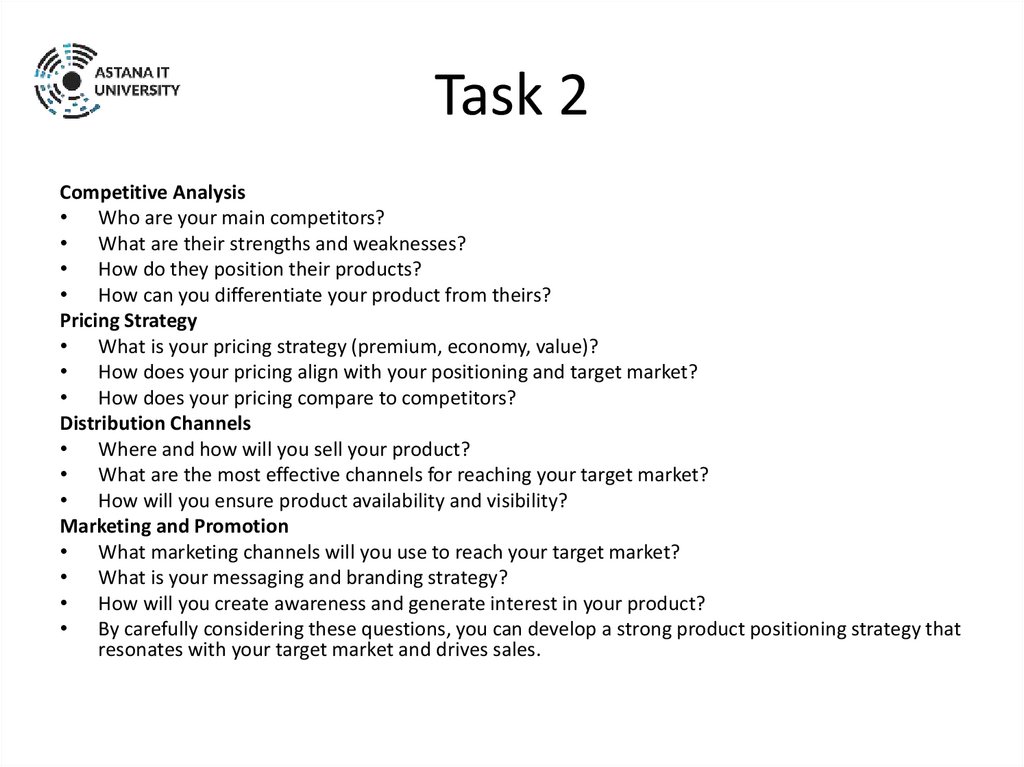
Task 2Competitive Analysis
• Who are your main competitors?
• What are their strengths and weaknesses?
• How do they position their products?
• How can you differentiate your product from theirs?
Pricing Strategy
• What is your pricing strategy (premium, economy, value)?
• How does your pricing align with your positioning and target market?
• How does your pricing compare to competitors?
Distribution Channels
• Where and how will you sell your product?
• What are the most effective channels for reaching your target market?
• How will you ensure product availability and visibility?
Marketing and Promotion
• What marketing channels will you use to reach your target market?
• What is your messaging and branding strategy?
• How will you create awareness and generate interest in your product?
• By carefully considering these questions, you can develop a strong product positioning strategy that
resonates with your target market and drives sales.
16.
Task 3• Create a list of direct and indirect competitors
• Fill all table of competitors
• Create own position on market
• Create own competitive advantage