
 История
Похожие презентации:




Sapienza University of Rome Fashion Studies (LM)
1.
Sapienza University of RomeFashion Studies (LM)
History Cultures Identities (Prof. Andrea Carteny)
2.
KeywordsIslam:
1: the religious faith of Muslims including belief in Allah as the sole deity and in Muhammad as
his prophet
2-a: the civilization erected upon Islamic faith
-b: the group of modern nations in which Islam is the dominant religion
https://www.merriam-webster.com/dictionary/Islam
Turk:
1: a native or inhabitant of Turkey
2: a member of any of numerous Asian peoples speaking Turkic languages who live in a region
extending from the Balkans to eastern Siberia and western China
3: MUSLIM
specifically: a Muslim subject of the Turkish sultan
https://www.merriam-webster.com/dictionary/Turk
3.
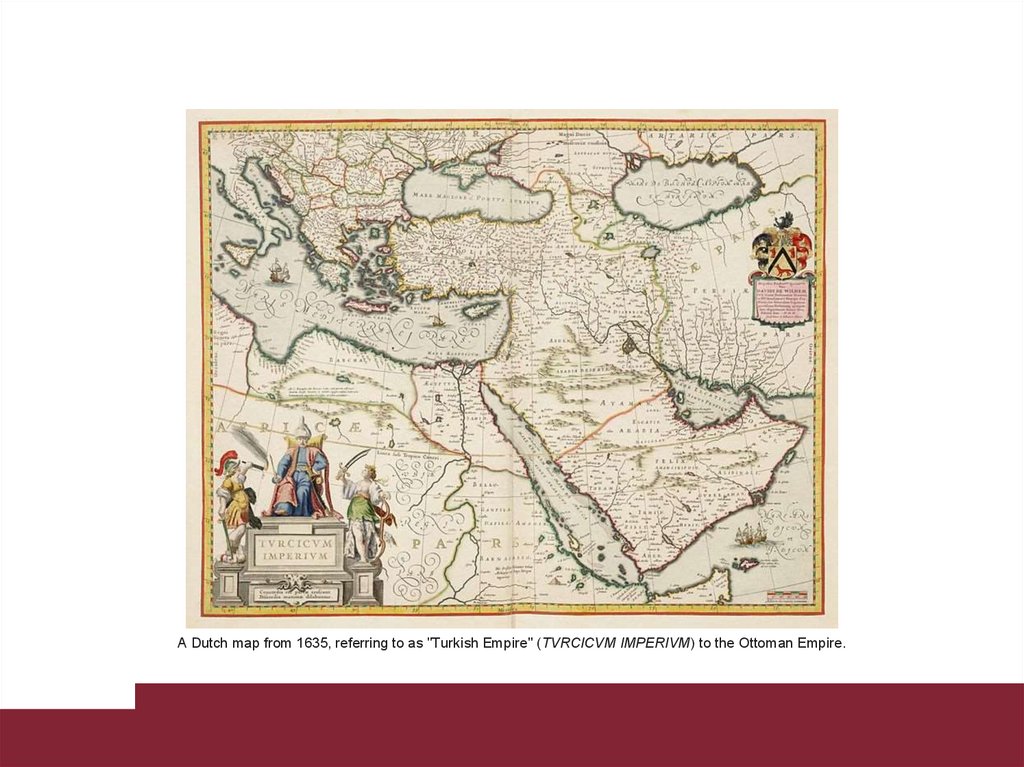
A Dutch map from 1635, referring to as "Turkish Empire" (TVRCICVM IMPERIVM) to the Ottoman Empire.4.
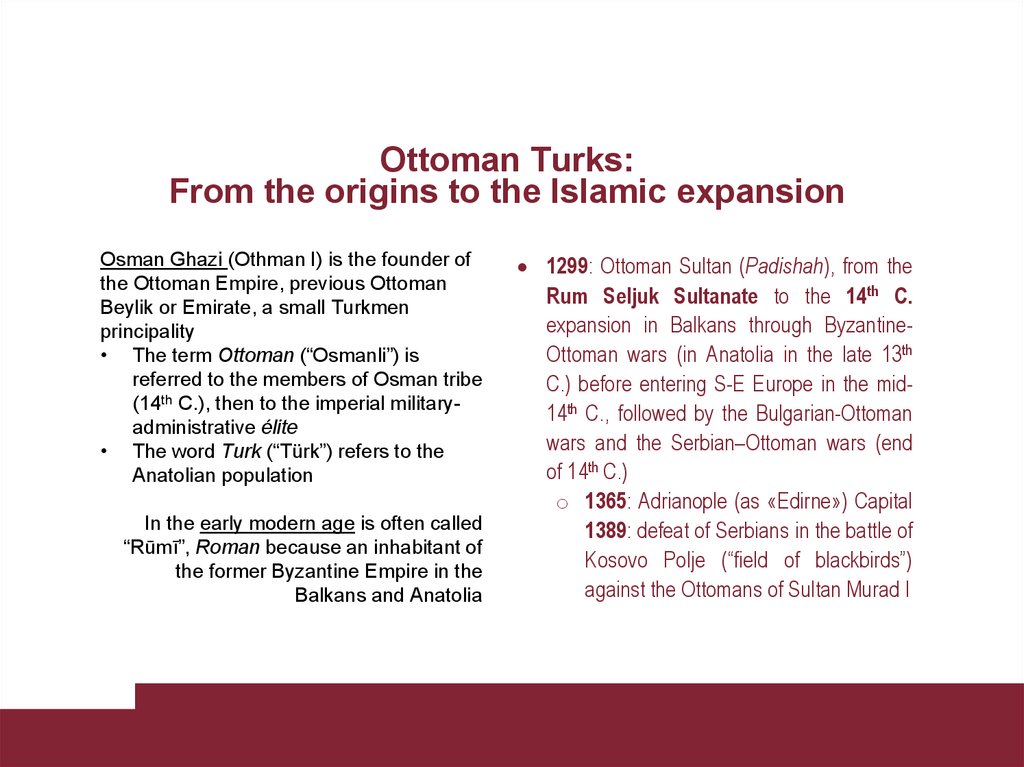
Ottoman Turks:From the origins to the Islamic expansion
Osman Ghazi (Othman I) is the founder of
the Ottoman Empire, previous Ottoman
Beylik or Emirate, a small Turkmen
principality
• The term Ottoman (“Osmanli”) is
referred to the members of Osman tribe
(14th C.), then to the imperial militaryadministrative élite
• The word Turk (“Türk”) refers to the
Anatolian population
In the early modern age is often called
“Rūmī”, Roman because an inhabitant of
the former Byzantine Empire in the
Balkans and Anatolia
1299: Ottoman Sultan (Padishah), from the
Rum Seljuk Sultanate to the 14th C.
expansion in Balkans through ByzantineOttoman wars (in Anatolia in the late 13th
C.) before entering S-E Europe in the mid14th C., followed by the Bulgarian-Ottoman
wars and the Serbian–Ottoman wars (end
of 14th C.)
o 1365: Adrianople (as «Edirne») Capital
1389: defeat of Serbians in the battle of
Kosovo Polje (“field of blackbirds”)
against the Ottomans of Sultan Murad I
5.
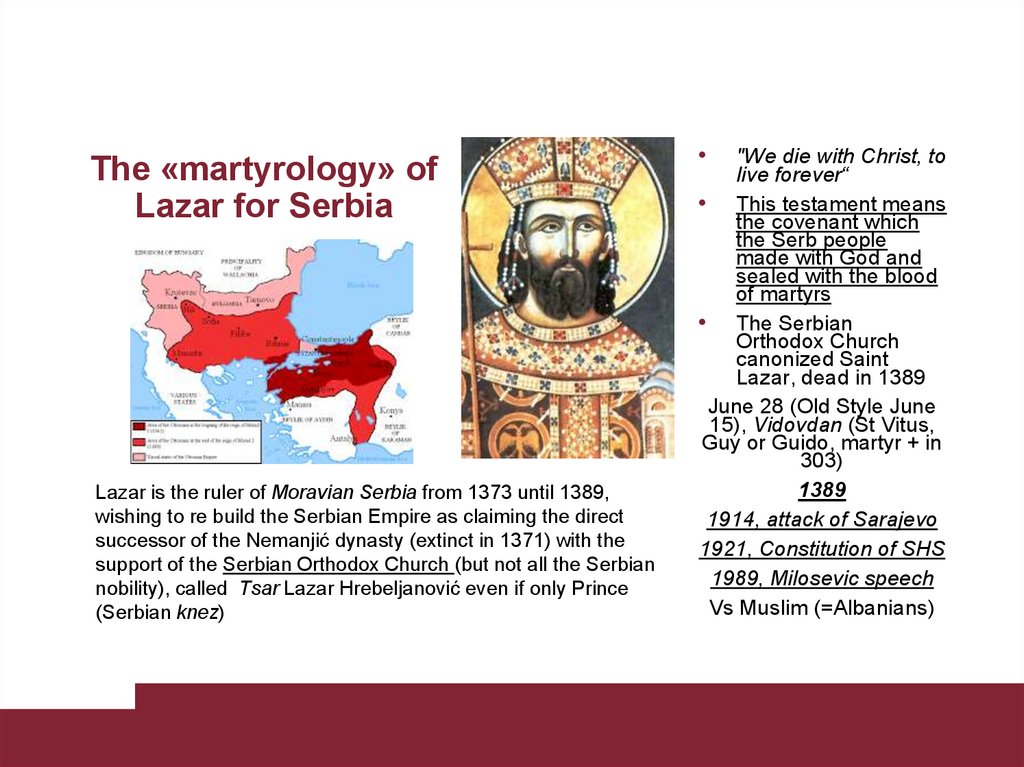
The «martyrology» ofLazar for Serbia
Lazar is the ruler of Moravian Serbia from 1373 until 1389,
wishing to re build the Serbian Empire as claiming the direct
successor of the Nemanjić dynasty (extinct in 1371) with the
support of the Serbian Orthodox Church (but not all the Serbian
nobility), called Tsar Lazar Hrebeljanović even if only Prince
(Serbian knez)
"We die with Christ, to
live forever“
• This testament means
the covenant which
the Serb people
made with God and
sealed with the blood
of martyrs
• The Serbian
Orthodox Church
canonized Saint
Lazar, dead in 1389
June 28 (Old Style June
15), Vidovdan (St Vitus,
Guy or Guido, martyr + in
303)
1389
1914, attack of Sarajevo
1921, Constitution of SHS
1989, Milosevic speech
Vs Muslim (=Albanians)
6.
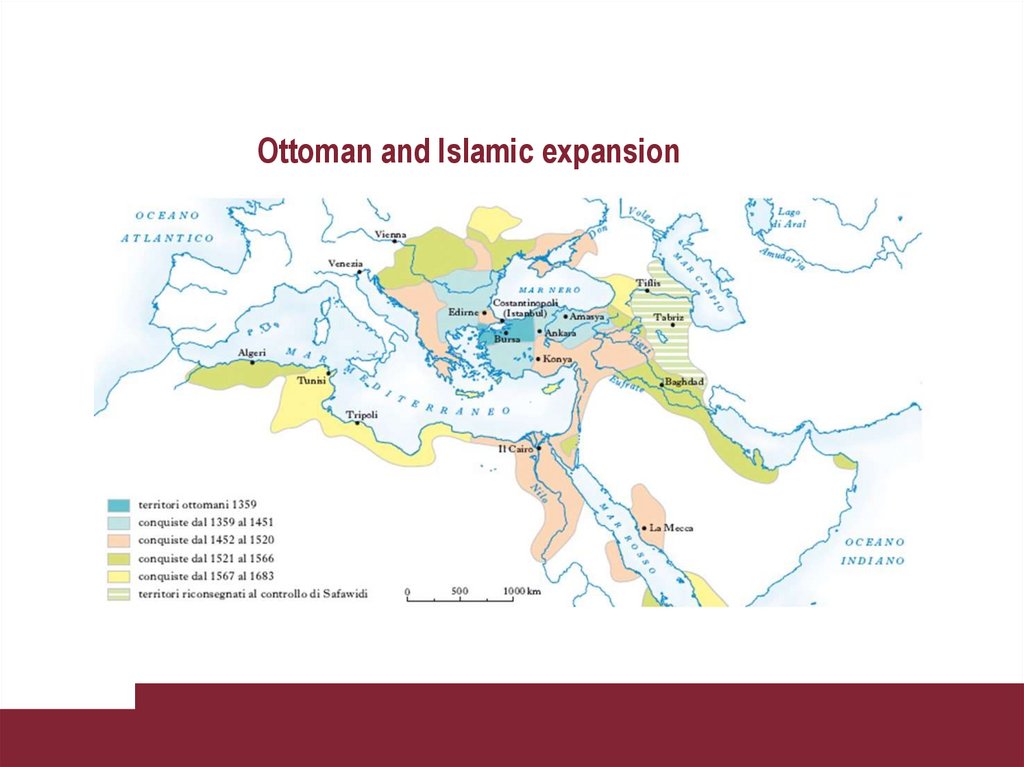
Ottoman and Islamic expansion7.
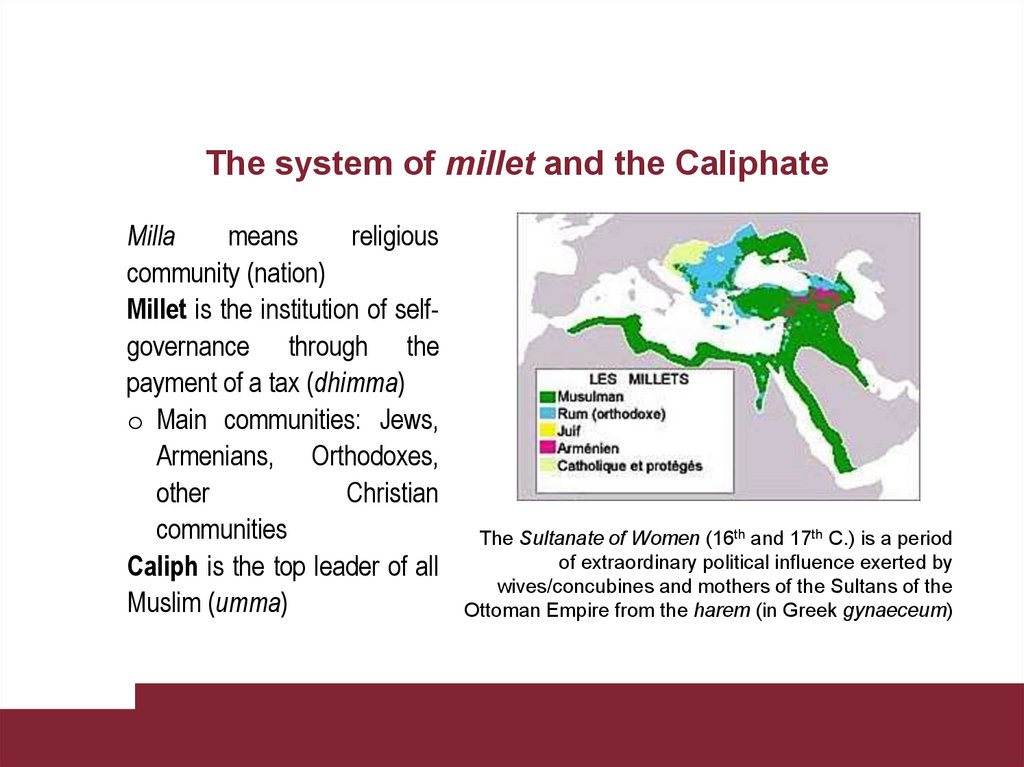
The system of millet and the CaliphateMilla
means
religious
community (nation)
Millet is the institution of selfgovernance through the
payment of a tax (dhimma)
o Main communities: Jews,
Armenians, Orthodoxes,
other
Christian
communities
Caliph is the top leader of all
Muslim (umma)
The Sultanate of Women (16th and 17th C.) is a period
of extraordinary political influence exerted by
wives/concubines and mothers of the Sultans of the
Ottoman Empire from the harem (in Greek gynaeceum)
8.
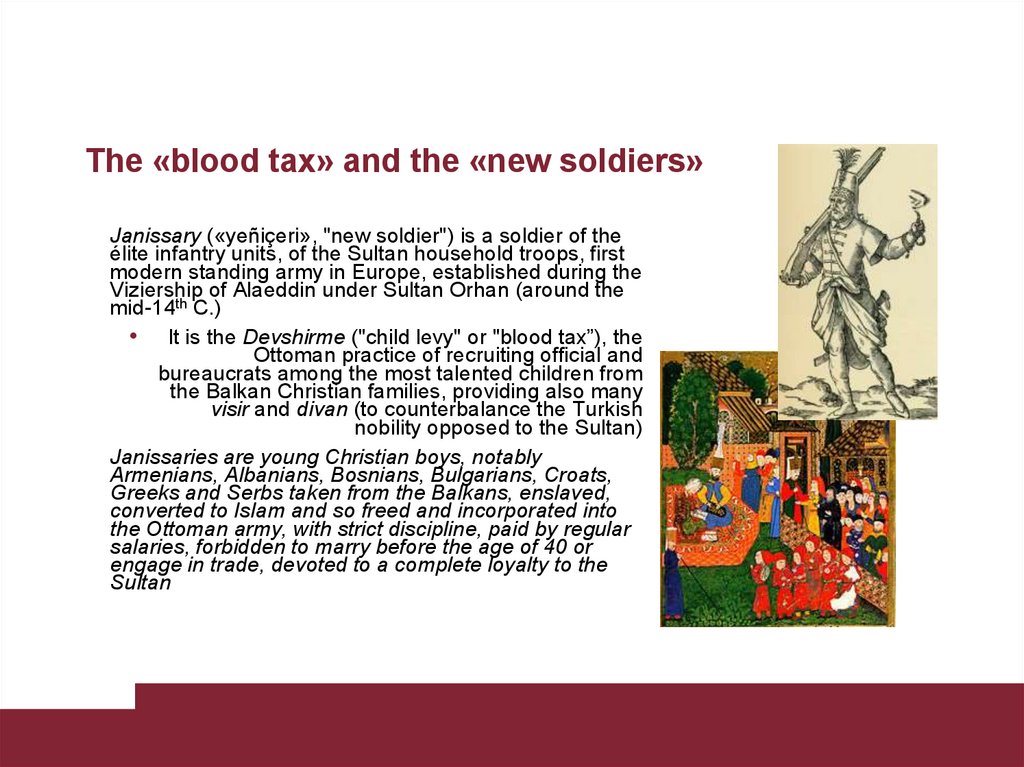
The «blood tax» and the «new soldiers»Janissary («yeñiçeri», "new soldier") is a soldier of the
élite infantry units, of the Sultan household troops, first
modern standing army in Europe, established during the
Viziership of Alaeddin under Sultan Orhan (around the
mid-14th C.)
• It is the Devshirme ("child levy" or "blood tax”), the
Ottoman practice of recruiting official and
bureaucrats among the most talented children from
the Balkan Christian families, providing also many
visir and divan (to counterbalance the Turkish
nobility opposed to the Sultan)
Janissaries are young Christian boys, notably
Armenians, Albanians, Bosnians, Bulgarians, Croats,
Greeks and Serbs taken from the Balkans, enslaved,
converted to Islam and so freed and incorporated into
the Ottoman army, with strict discipline, paid by regular
salaries, forbidden to marry before the age of 40 or
engage in trade, devoted to a complete loyalty to the
Sultan
9.
Early Modern European expansionIn 1402 the Turco-Mongol leader Tamerlane, or
Timur, founder of the Timurid Empire, occupies
Ottoman Anatolia from the east and with the Battle
of Ankara defeats the Ottoman forces taking Sultan
Bayezid I as a prisoner
The Balkan territories lost are later recovered
between the 1430s and 50s: in 1444 Murad II
defeats the Christian armies (Hungarian, Polish, and
Wallachian soldiers under Władysław III, king of
Poland and of Hungary, and John Hunyadi) at the
Battle of Varna, while Albanians with the leader
Skanderbeg resists
Selim I the Resolute (1512-20)
expands the Empire to East and
South:
Persian Safavid Empire and
Mamluk Sultanate of Egypt
1517
Recognition of
the Ottoman
Caliphate
United Christian armies are again defeated at
the Second Battle of Kosovo, in 1448
Mehmed II “the Conqueror” of Constantinople, in 1453
John Hunyadi is able to stop Ottoman only in Belgrade, in 1456
10.
Not only Balkans15th C.: Greece (1458-60), Moldavia, Serbia,
Crimea, Genoese colonies, Bosnia, Albania
1513-18: Conquest of Armenia, Syria, Egypt,
Maghreb
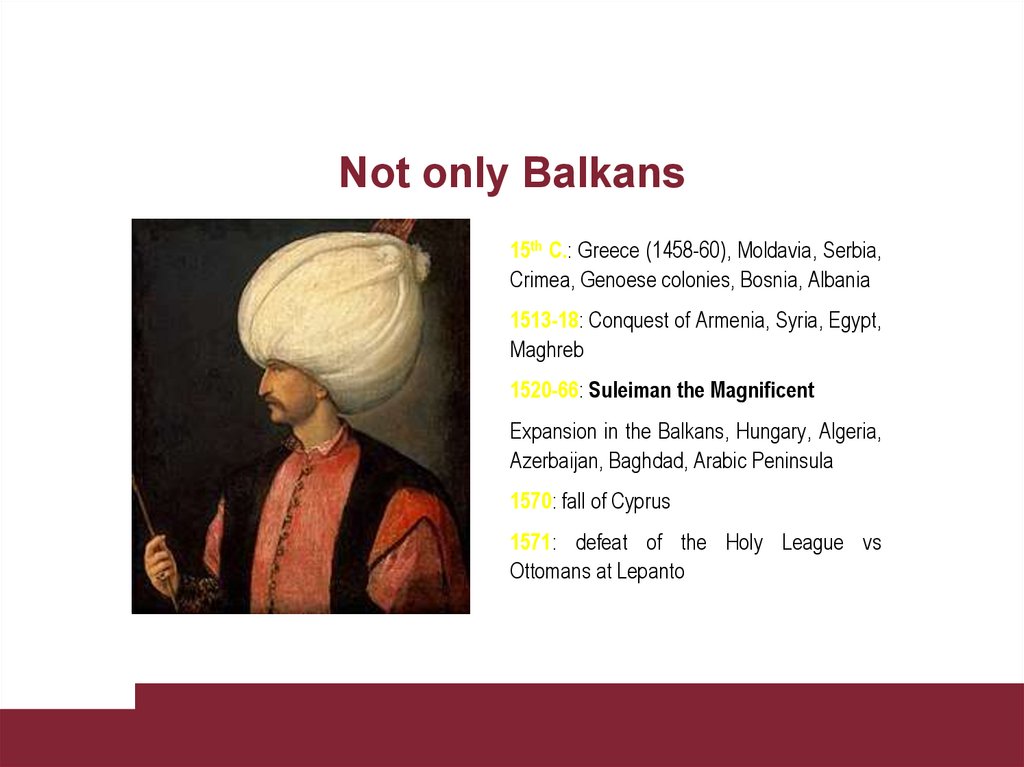
1520-66: Suleiman the Magnificent
Expansion in the Balkans, Hungary, Algeria,
Azerbaijan, Baghdad, Arabic Peninsula
1570: fall of Cyprus
1571: defeat of the Holy League vs
Ottomans at Lepanto
11.
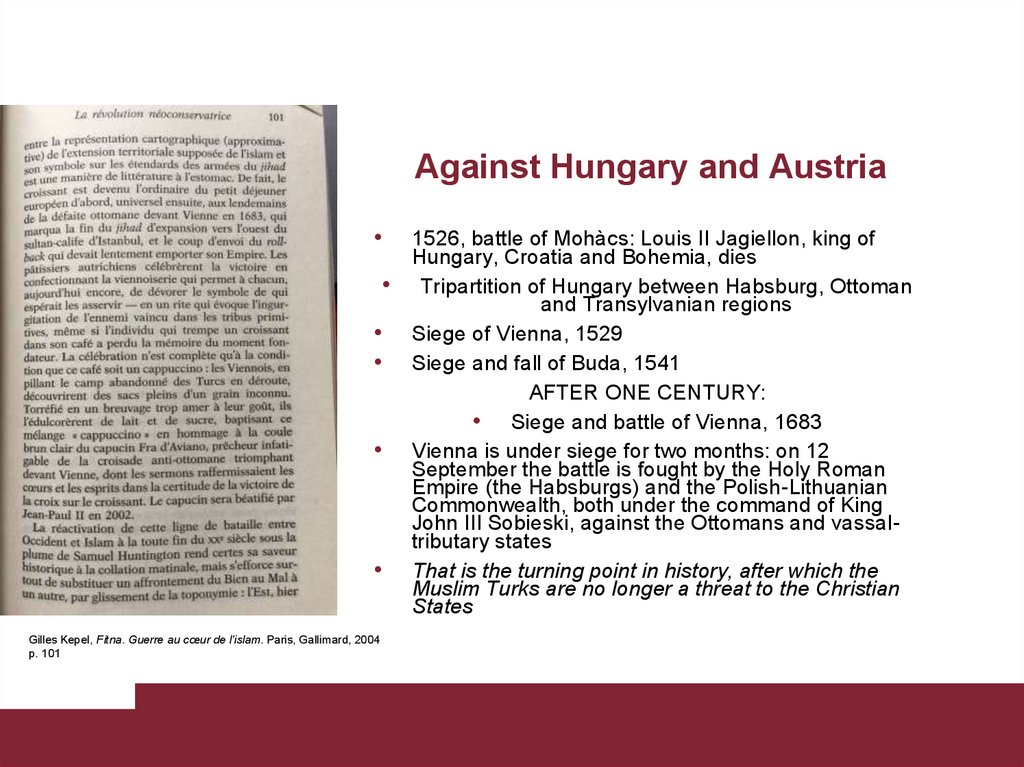
Against Hungary and AustriaGilles Kepel, Fitna. Guerre au cœur de l'islam. Paris, Gallimard, 2004
p. 101
1526, battle of Mohàcs: Louis II Jagiellon, king of
Hungary, Croatia and Bohemia, dies
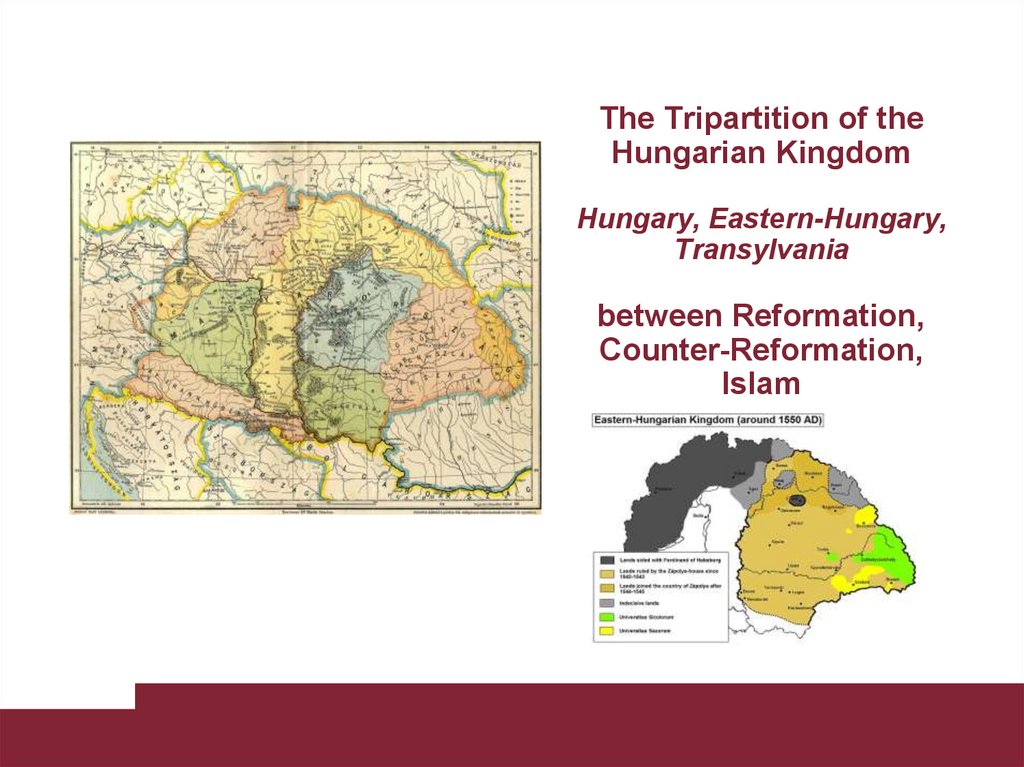
Tripartition of Hungary between Habsburg, Ottoman
and Transylvanian regions
Siege of Vienna, 1529
Siege and fall of Buda, 1541
AFTER ONE CENTURY:
• Siege and battle of Vienna, 1683
Vienna is under siege for two months: on 12
September the battle is fought by the Holy Roman
Empire (the Habsburgs) and the Polish-Lithuanian
Commonwealth, both under the command of King
John III Sobieski, against the Ottomans and vassaltributary states
That is the turning point in history, after which the
Muslim Turks are no longer a threat to the Christian
States
12.
The Tripartition of theHungarian Kingdom
Hungary, Eastern-Hungary,
Transylvania
between Reformation,
Counter-Reformation,
Islam
13.
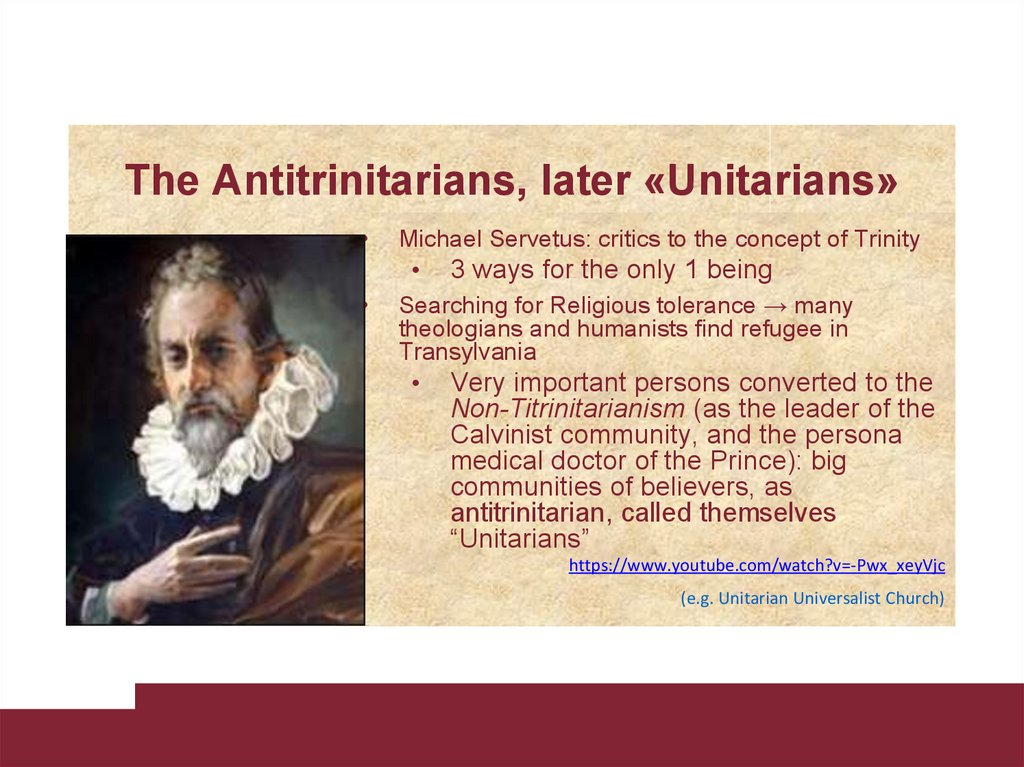
The Antitrinitarians, later «Unitarians»Michael Servetus: critics to the concept of Trinity
3 ways for the only 1 being
Searching for Religious tolerance → many
theologians and humanists find refugee in
Transylvania
Very important persons converted to the
Non-Titrinitarianism (as the leader of the
Calvinist community, and the persona
medical doctor of the Prince): big
communities of believers, as
antitrinitarian, called themselves
“Unitarians”
https://www.youtube.com/watch?v=-Pwx_xeyVjc
(e.g. Unitarian Universalist Church)
14.
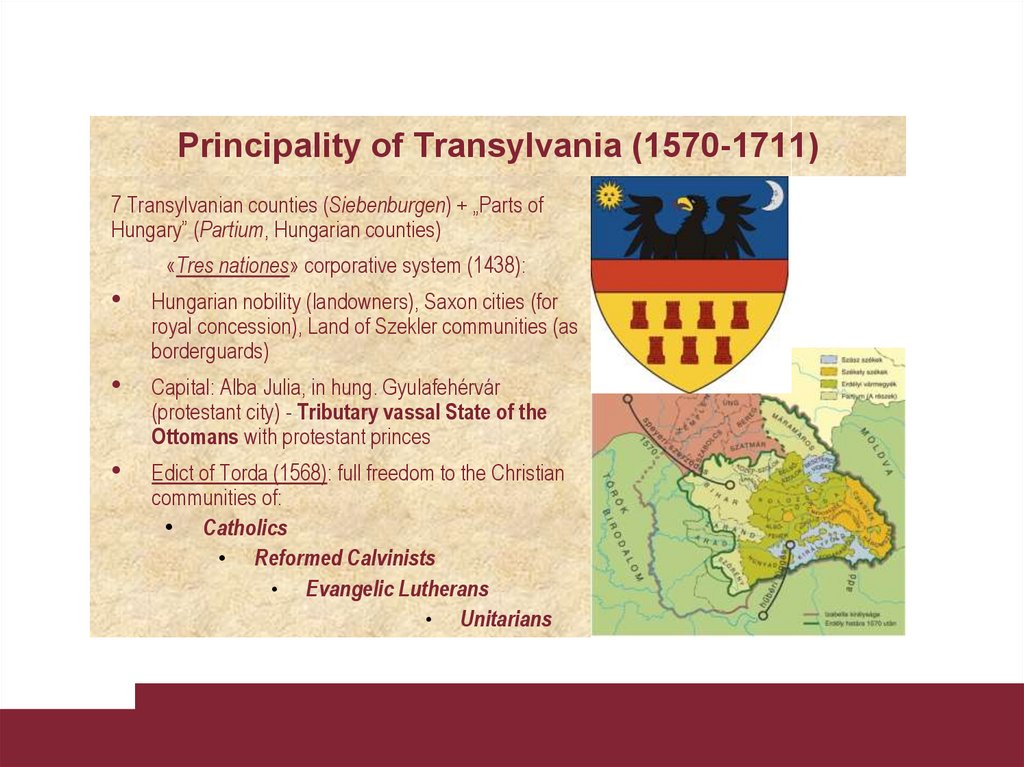
Principality of Transylvania (1570-1711)7 Transylvanian counties (Siebenburgen) + „Parts of
Hungary” (Partium, Hungarian counties)
«Tres nationes» corporative system (1438):
Hungarian nobility (landowners), Saxon cities (for
royal concession), Land of Szekler communities (as
borderguards)
Capital: Alba Julia, in hung. Gyulafehérvár
(protestant city) - Tributary vassal State of the
Ottomans with protestant princes
Edict of Torda (1568): full freedom to the Christian
communities of:
• Catholics
• Reformed Calvinists
• Evangelic Lutherans
• Unitarians
15.
Reading:Karlsson, Ingmar. “The Turk as a Threat and Europe’s ‘Other’ Author(s)”,
International Issues & Slovak Foreign Policy Affairs, Vol. 15, No. 1: ‘Searching for
European Identity’ (2006), pp. 62-72. JSTOR,
https://www.jstor.org/stable/10.2307/26590546