
















 Психология
Похожие презентации:





Psychoanalysis
1.
PSYCHOANALYSIS2.
Psychoanalysis has been seen as aform of therapy which aims to cure mental
disorders ‘by investigating the interaction
of conscious and unconscious elements
the minds’
3.
HISTORICAL BACKGROUND4.
• Aristotle, a catharsis• William
Wordsworth,
“emotion
recollected
in
tranquillity”
• Samuel Taylor Coleridge, the primary imagination and
the secondary one
• Friedrich Nietzsche, personalities as being Apollonian
(the use of critical reasoning) and Dionysian (creativeintuitive power).
5.
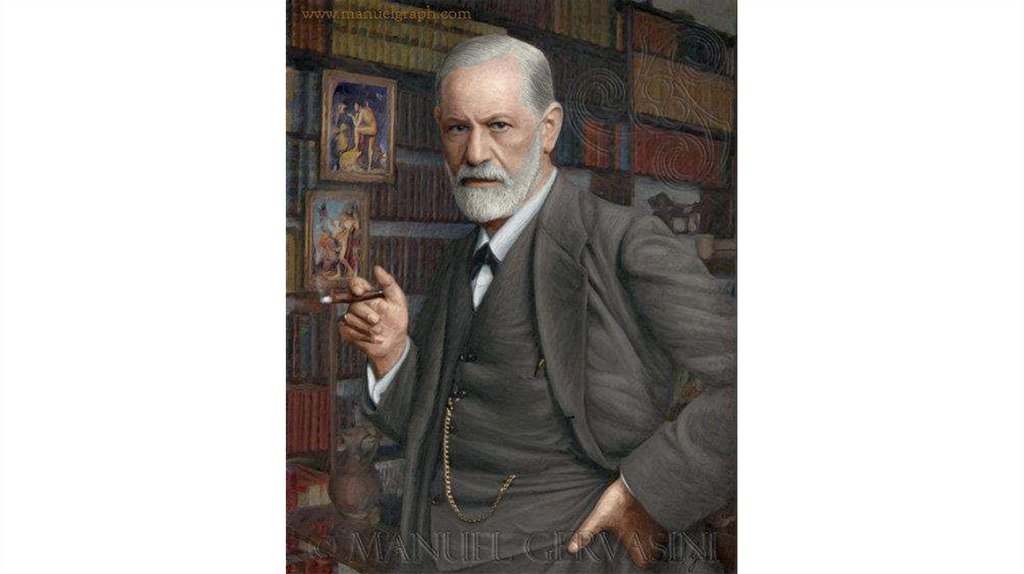
SIGMUND FREUD(1856–1939)
6.
7.
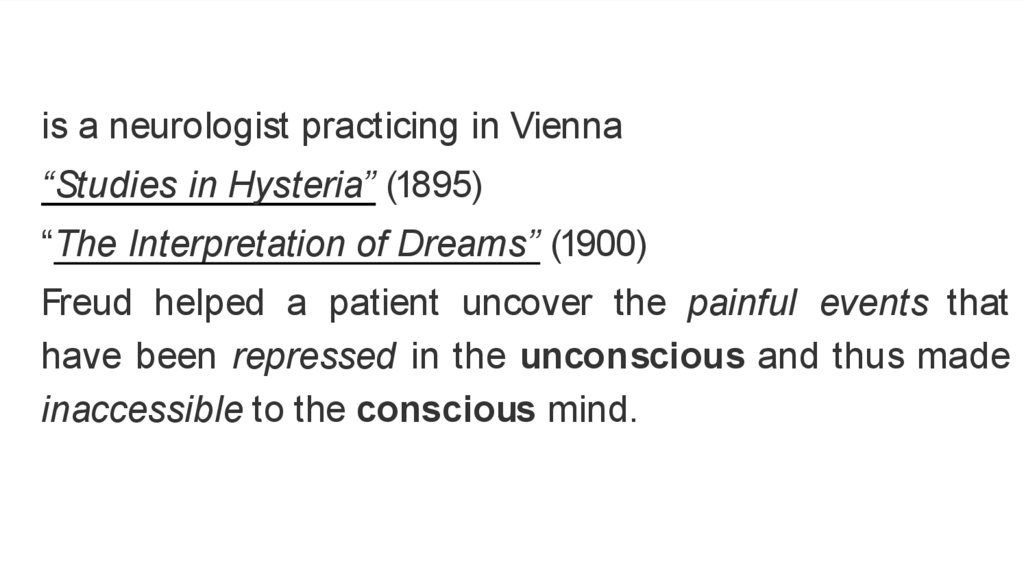
is a neurologist practicing in Vienna“Studies in Hysteria” (1895)
“The Interpretation of Dreams” (1900)
Freud helped a patient uncover the painful events that
have been repressed in the unconscious and thus made
inaccessible to the conscious mind.
8.
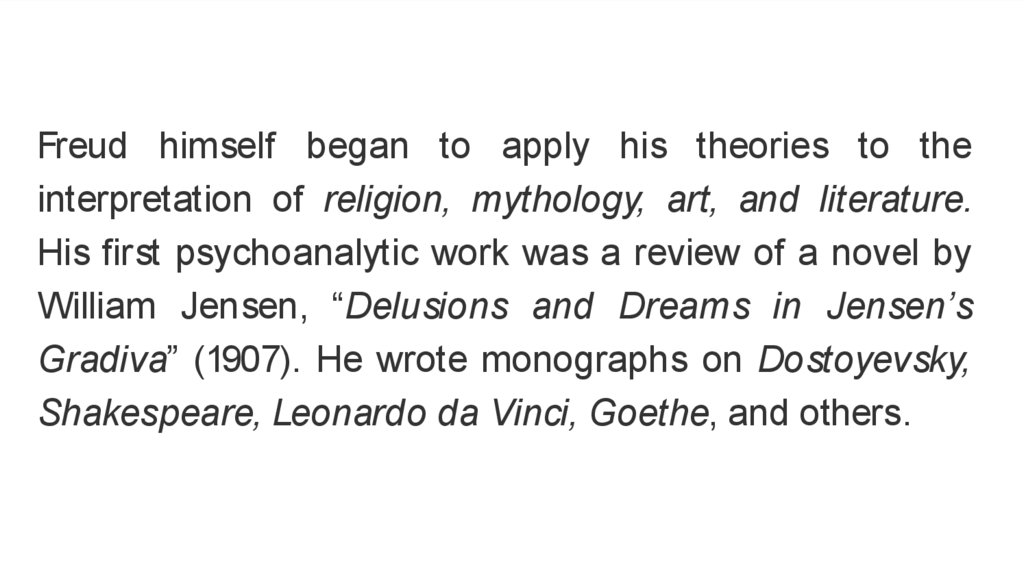
Freud himself began to apply his theories to theinterpretation of religion, mythology, art, and literature.
His first psychoanalytic work was a review of a novel by
William Jensen, “Delusions and Dreams in Jensen’s
Gradiva” (1907). He wrote monographs on Dostoyevsky,
Shakespeare, Leonardo da Vinci, Goethe, and others.
9.
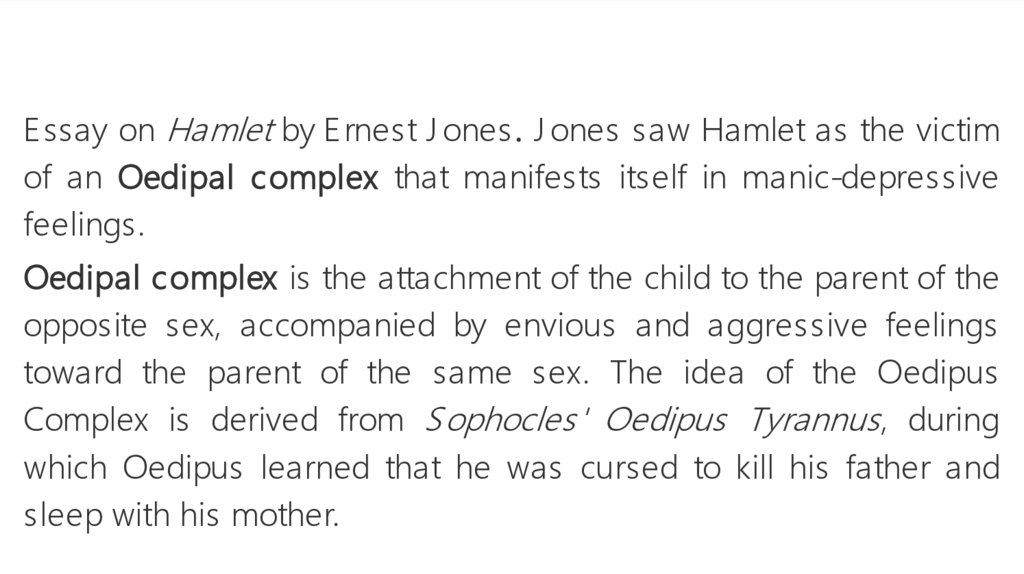
Essay on Hamlet by E rnest J ones . J ones saw Hamlet as the victimof an Oedipal complex that manifests itself in manic-depressive
feelings.
Oedipal complex is the attachment of the child to the parent of the
opposite sex, accompanied by envious and aggressive feelings
toward the parent of the same sex. The idea of the Oedipus
Complex is derived from S ophocles' Oedipus Tyrannus , during
which Oedipus learned that he was cursed to kill his father and
sleep with his mother.
10.
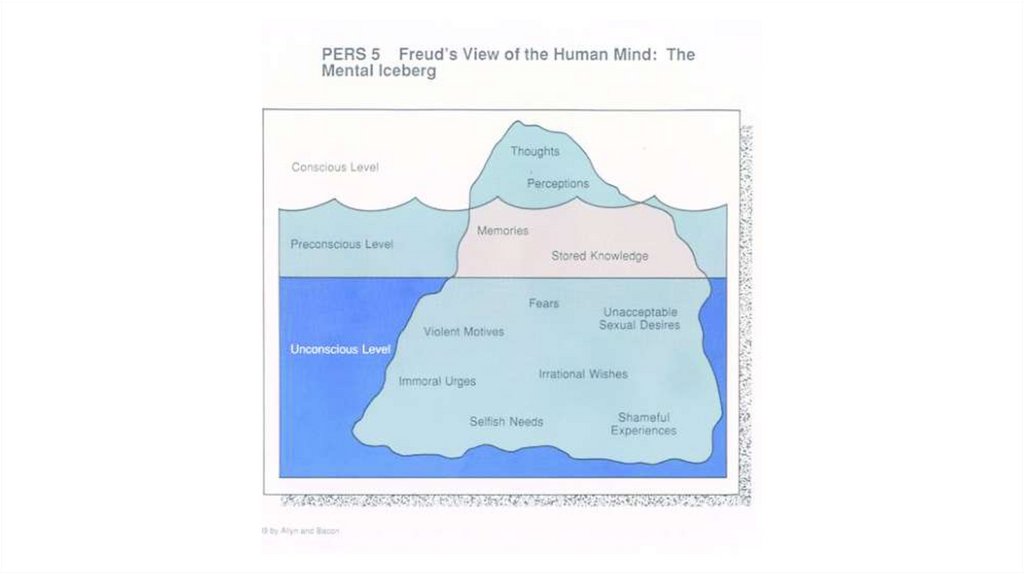
The Unconscious11.
12.
13.
14.
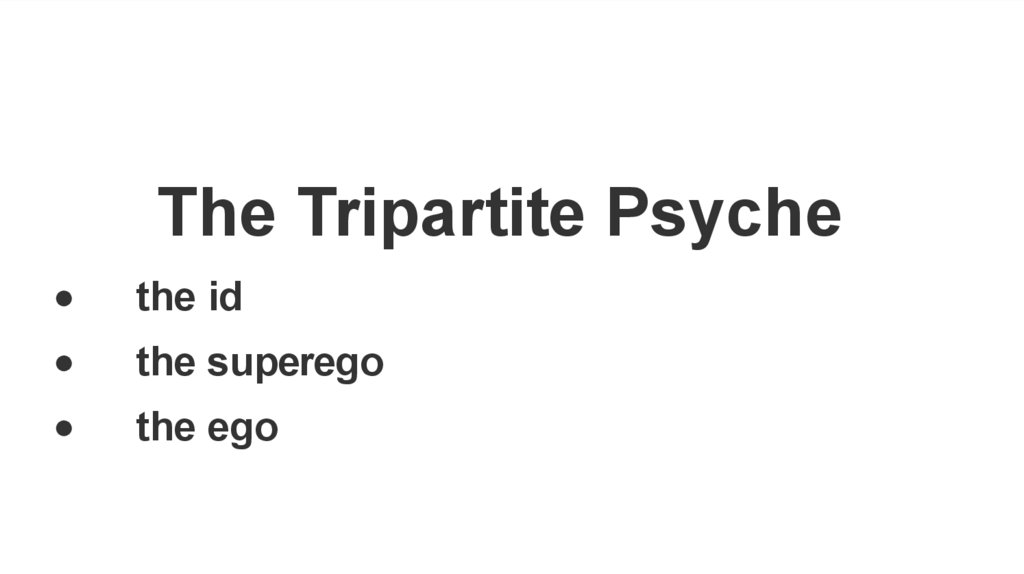
The Tripartite Psychethe id
the superego
the ego
15.
The id (libido) the source of our psychic energy and ourpsychosexual desires, gives us our vitality. Obviously the id can
be a socially destructive force. To prevent the chaos that would
result if the id were to go untamed, other parts of the psyche
must balance its passions.
The ego, which operates according to the reality principle, is one
such regulating agency.
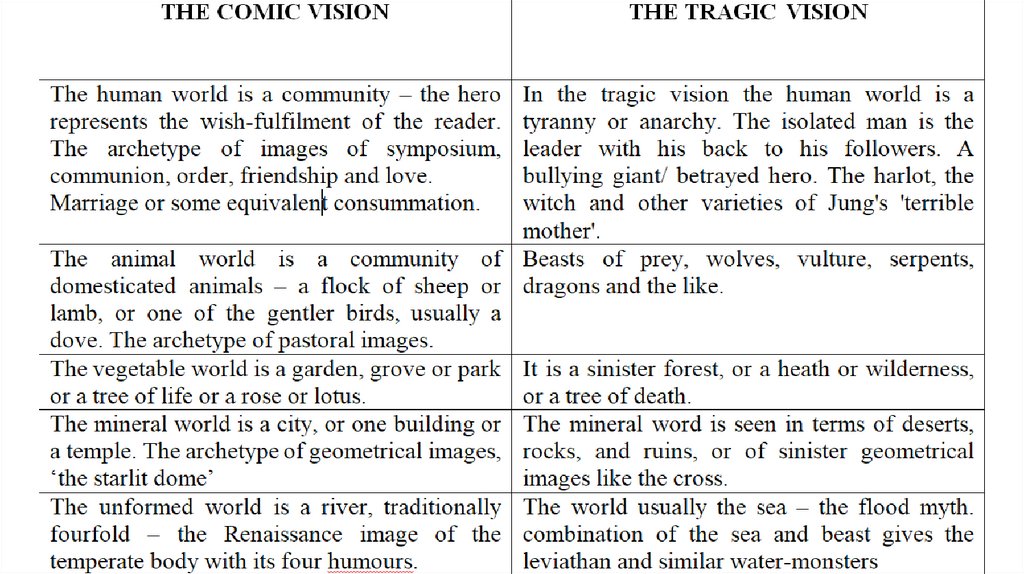
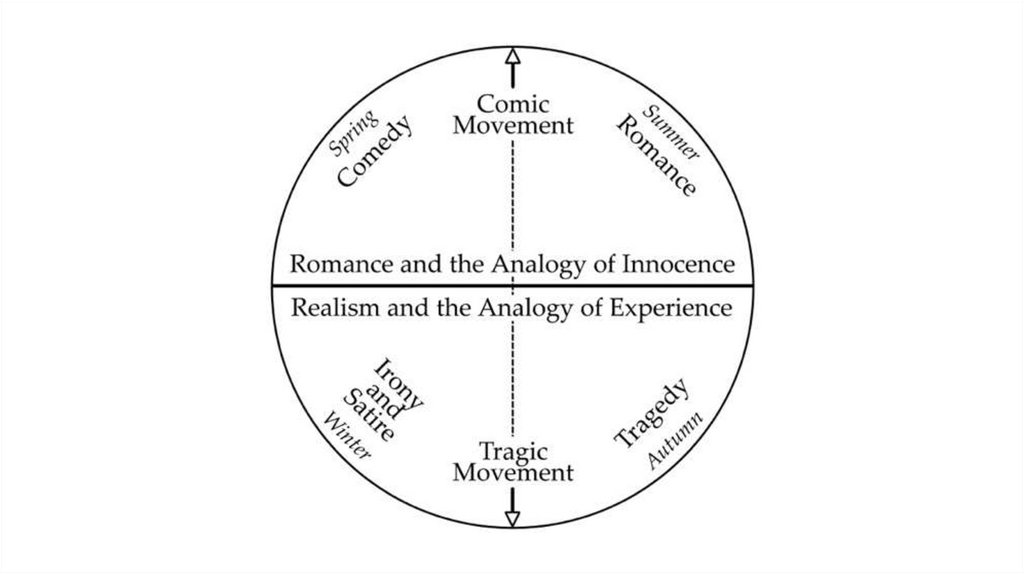
The s uperego provides additional balance to the id and operates
according to the morality principle.
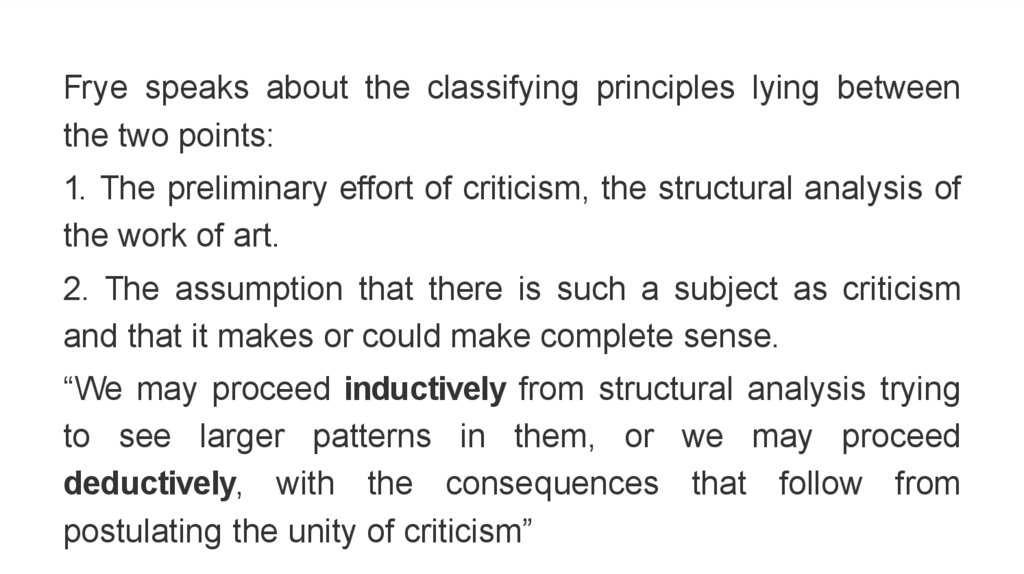
16.
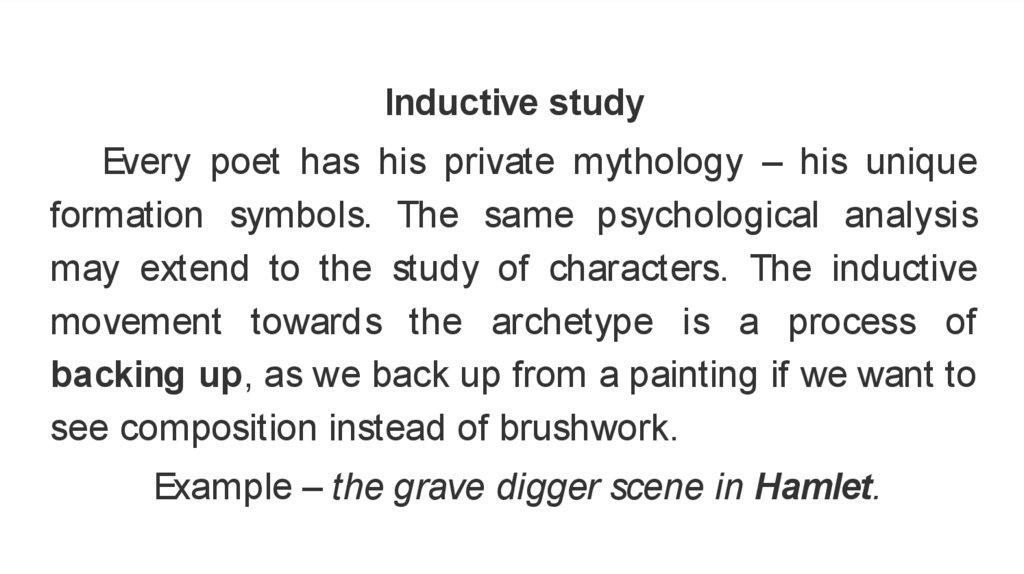
17.
The Significance of Sexuality18.
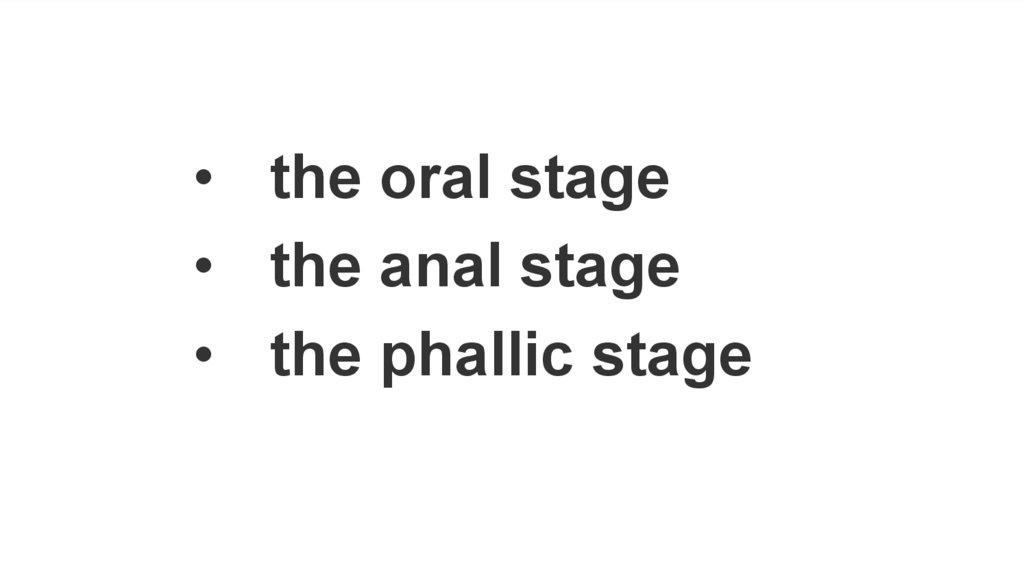
• the oral stage• the anal stage
• the phallic stage
19.
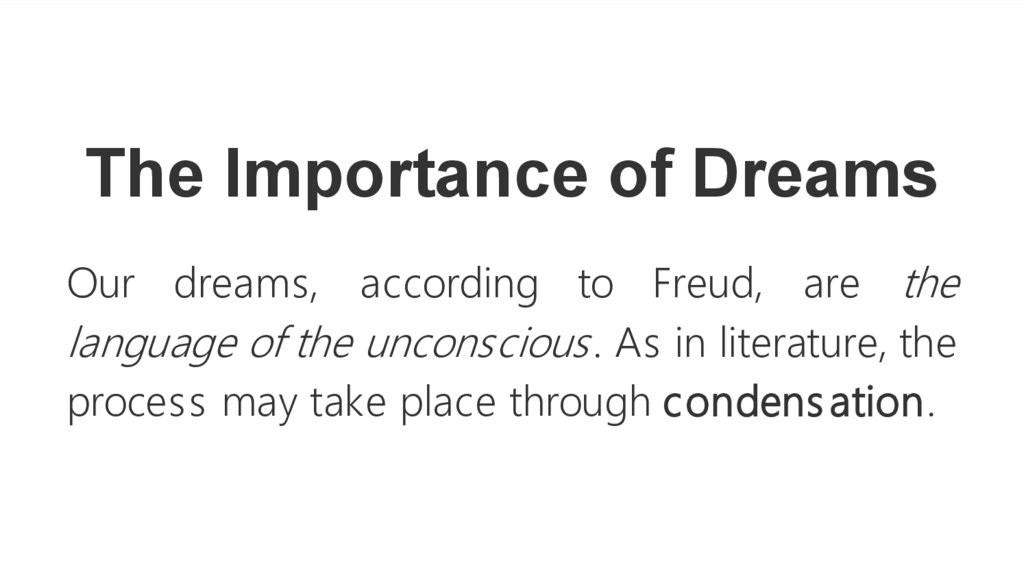
The Importance of DreamsOur dreams, according to Freud, are the
language of the unconscious . As in literature, the
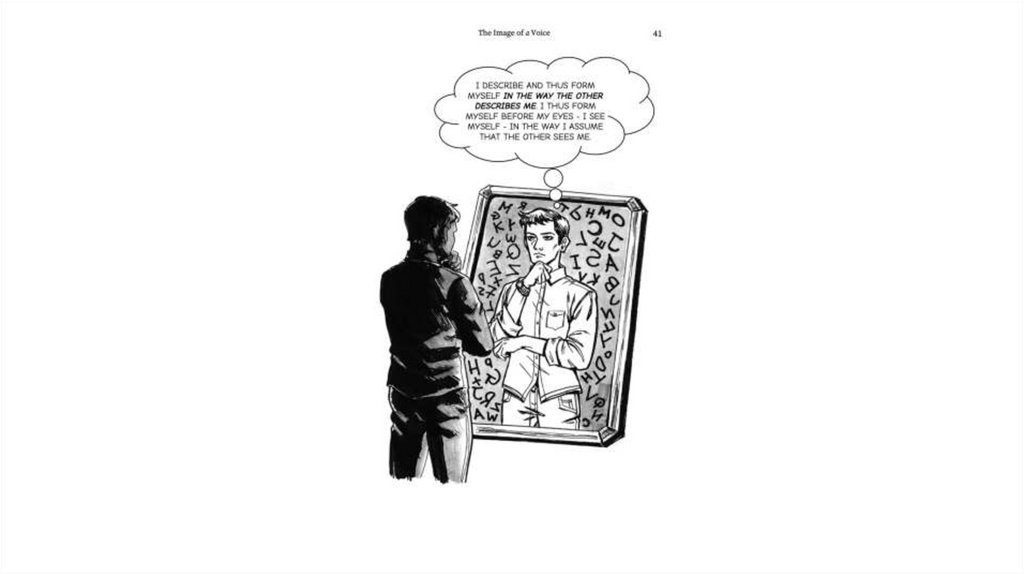
process may take place through condens ation.
20.
SymbolsFreud’s recognition of the often subtle and always
complex workings of sexuality in human beings
and in literature led to a new awareness of what
symbols mean in literature as well as in life.
Yonic and phallic symbols
21.
CreativitySublimation is the diversion or deflection of
instinctual drives, usually sexual ones, into
noninstinctual channels. Psychoanalytic theory
holds that the energy invested in sexual impulses
can be shifted to the pursuit of more acceptable
and even socially valuable achievements, such as
artistic or scientific endeavours.
22.
Literature and Freud23.
Psychoanalytic literary criticism can focus on one or more ofthe following:
I. The writer: The theory is used to analyze the writer and
his/her life and the literary work.
II. The characters: This theory is used to analyze one or
more of the characters.
III. The audience: The theory is used to explain the appeal of
the work for those who read it.
IV. The text: The theory is used to analyze the role of
language and symbolism in the work.
24.
25.
26.
CARL JUNG (1875–1961)AND
MYTHOLOGICAL CRITICISM
27.
Carl Jung (1875–1961) is a favored pupil of Freud,Swiss physician, psychiatrist, and philosopher.
Freud conceived of each individual unconscious
as separate and distinct from that of others, Jung
asserted that some of our unconscious is shared
with all other members of the human species.
28.
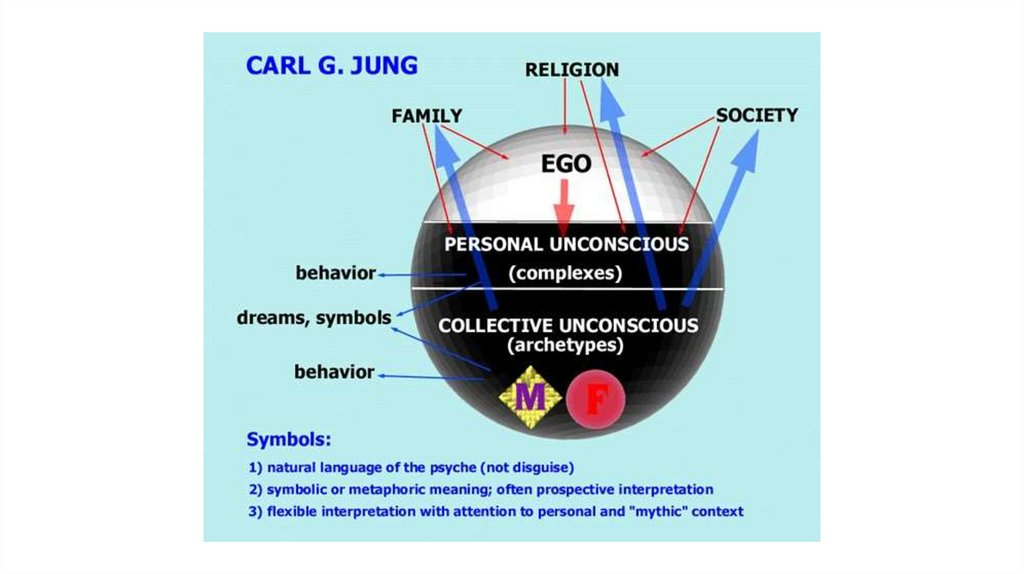
Jung described the psyche as having three parts:the EGO (the conscious mind comprised of perceptions, memories,
thoughts, and feelings)
the PERSONAL UNCONSCIOUS (experiences that were once conscious
but which have been repressed, suppressed, forgotten, or ignored. (There
is a great deal of two-way traffic between the personal unconscious and
the ego.)
the COLLECTIVE UNCONSCIOUS (a storehouse of knowledge,
experiences, and images of the human race; it is an ancestral memory
often expressed outwardly in myth and ritual). Jung explained: “This
psychic life is the mind of our ancient ancestors, the way in which they
thought and felt, the way in which they conceived of life and the world, of
gods and human beings”.
29.
30.
Thecollective
unconscious is
not
directly
approachable, it can be found in archetypes, which Jung
defined as “universal images that have existed since the
remotest times.” An archetype is “a figure …that repeats
itself in the course of history...” John Sanford explained:
archetypes “form the basis for instinctive unlearned
behavior patterns common to all mankind and assert
themselves in certain typical ways.”
31.
3 powerful archetypes compose the self. They arethe shadow (our darker side, the part of ourselves we
would prefer not to confront, those aspects that we
dislike)
the anima (the “soul-image,” the life force that causes
one to act. It is given a feminine designation in men, and
a masculine one (animus) in women)
the persona (the image that we show to others, the
32.
33.
34.
“Steppenwolf” by Hermann Hesse is the story of a man who isdogged by controversy: he feels himself to be a human and a
wolf at the same time. Harry Haller learns that he has more than
two natures. Actually, he consists of hundreds and thousands of
them. This idea is based on Jung’s concept of the collective
unconscious. And the very novel «Steppenwolf» brightly
illustrates Jung’s individuation process. Harry Haller’s mission is
to overcome opposition between his social cultural «I» and
Shadow (Steppenwolf), to recognize and accept his Anima, to
understand the mystery of the identity, who embodies chthonic
depths, and Mozart, who represents sublime spirituality, that is, to
35.
36.
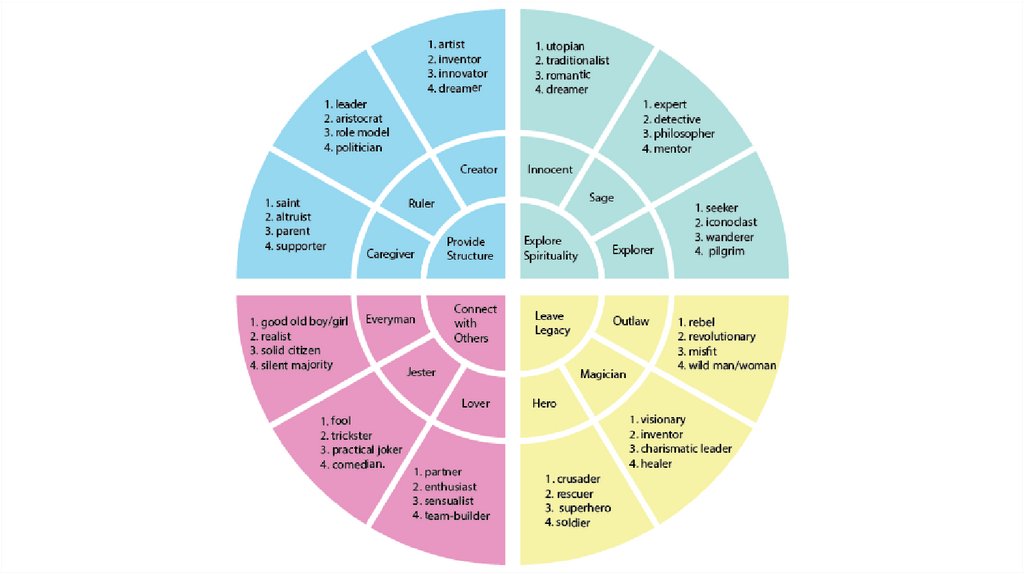
The heroA hero in Greek mythology and folklore, was originally a demi-god, the
offspring of a mortal and a deity.
• a birth that has unusual circumstances (such as a virgin mother);
• an early escape from attempts to murder him;
• a return to his homeland, where, after a victory over some antagonist, he
marries a princess, assumes the throne, and only later falls victim to a
fate that may include being banished from the kingdom only to die a
mysterious death.
The archetype is exemplified by such characters as Oedipus, Jason,
and Jesus Christ.
37.
Propp ModelVladimir Propp analyzed the Russian fairy tale.
The actions fell into a hero’s sphere included
• departure on the quest
• reacting to the test of the donor
• marrying the princess
He distinguished between s eekers and vic timheroes .
38.
Modern Definitions . “Hero” or “heroine” issometimes used to simply describe the
protagonist of a story. Post-modern fictional
works have fomented the increased
popularity of the anti-hero, who does not
follow common conceptions of heroism.
39.
Cultural HeroA culture hero is a mythological hero specific to
some group (cultural, ethnic, racial, religious, etc.)
who changes the world through invention or
discovery.
Noah • Abraham • Isaac • Jacob • Moses • Beowulf
• Hercules • Jesus
40.
E pic and folk HeroAn epic hero is a larger-than-life figure from a
history or legend.
• Siegfried • Beowulf • Odysseus Folk Hero
Achilles • Hercules • Aeneas
41.
Romantic HeroThe romantic hero is a literary type referring to a
character that rejects established norms and
conventions, has been rejected by society, and has
the self as the center of his or her own existence.
The characteristics: introspection, the triumph of the
individual over the restraints of theological and
social conventions, melancholy, alienation, and
isolation. A classic literary example of the romantic
hero includes Byron's Don Juan.
42.
Tragic HeroAn Aristotelian
characteristics:
tragic
hero
must
have
four
• Nobility (of a noble birth) or wisdom (by virtue of
birth).
• Hamartia (translated as flaw or error of judgment).
• A reversal of fortune (peripeteia) brought about
because of the hero’s hamartia.
• The discovery or recognition that the reversal was
43.
• Hero must suffer more than he deserves.• Hero must be noble in nature, but imperfect so that the audience can
see themselves in him.
• Hero must have discovered his fate by his own actions, not by things
happening to him.
• Hero must see and understand his doom.
• Hero’s story should arouse fear and empathy.
• Hero must be physically or spiritually wounded by his experiences, often
resulting in his death.
• Ideally, the hero should be a king or leader of men, so that his people
experience his fall with him.
• The hero must be intelligent so he may learn from his mistakes.
44.
The Wise Old Man (a.k.a. Helper or Guide Figure)• is a savior, redeemer
• personifies spirituality or the reflective/ fuller life
• possesses knowledge, insight, cleverness, or intuition
• exemplifies moral qualities
• tests the moral qualities of others and makes gifts dependent on
this test
• frequently functions as a surrogate father for the hero
• assists the hero (materially or spiritually) along the difficult road
toward his goal
• introduces the hero into a larger world than he has previously
known.
45.
The outcas tThe outcast is a character who is thrown out of
the community as punishment for a crime
against it.
The R ime of the Ancient Mariner (example)
46.
The Devil Figure• stands in opposition to both the hero and the wise old
man
• fights the hero either spiritually, psychologically, or
physically
• personifies chaos, mystery, destruction, evil,
corruption, deceit, selfishness, sensuality, carnality,
crime, greed, misery, and/or pride
• may be seen in various animal forms
• is often alone, although he has legions of followers
whose loyalty he demands and even tests
47.
FEMALE FIGURESThe Good Mother represents life, birth, nourishment,
protection, fertility, growth, and abundance. Typically gives
the hero maternal support and care.
The Terrible Mother characterized as the witch, sorceress,
siren; represents sensuality, fear, danger, darkness, death,
the unconscious in its terrifying aspects. Serves as the
female counterpart to the Devil Figure.
The Soul Mate characterized as the princess or beautiful
lady; functions as the incarnation of inspiration and spiritual
fulfillment.
48.
The tricks terThe trickster archetype is a character that is often associated
with disruption, mis chief, and humor. He disrupts the rigidity of
rule-bound cultures . For example, in the tales of Till
Eulenspiegel, main hero, a shrewd peasant, outwits the
arrogant townspeople and satirizes their social practices.
Carl J ung: “The trickster is a collective shadow figure, a
summation of all the inferior traits of character in individuals .
And since the individual shadow is never absent as a
component of personality, the collective figure can construct
itself out of it continually.”
49.
The Trickster archetype is characterized by a set of distinctfeatures.
Firstly, cleverness is often utilized in conjunction with the
second characteristic: deceit. Tricksters are known for using
tricks, pranks and cunning strategies.
Humor is another prevalent trait. Their actions are often
accompanied by disruption. The adaptability is coupled with
ambiguity. Symbolizing ambiguity and duality, the Trickster
blurs traditional moral lines.
50.
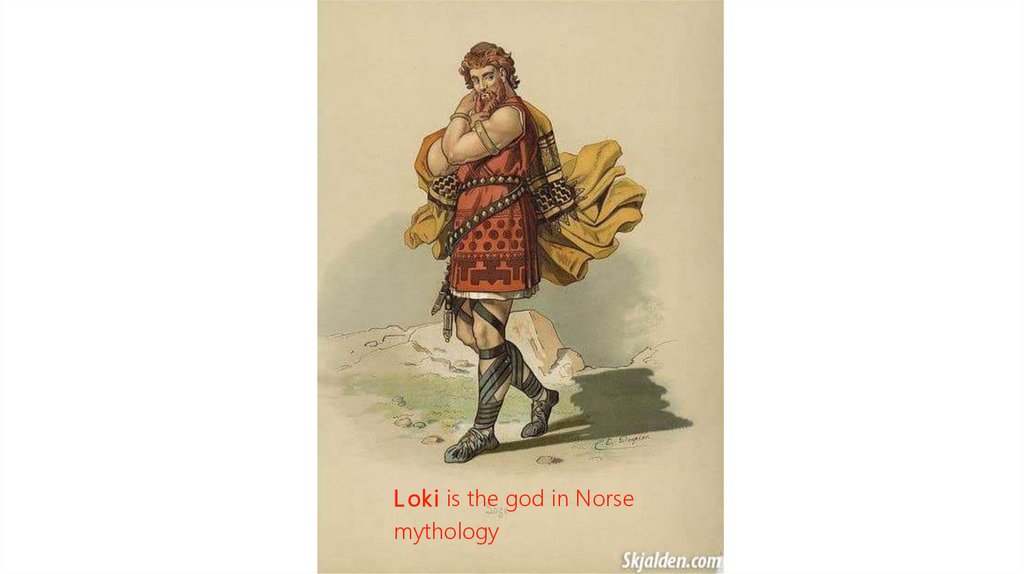
L oki is the god in Norsemythology
51.
Coyote is a Trickster in Native American folklore52.
Anansi is a spider in African folklore53.
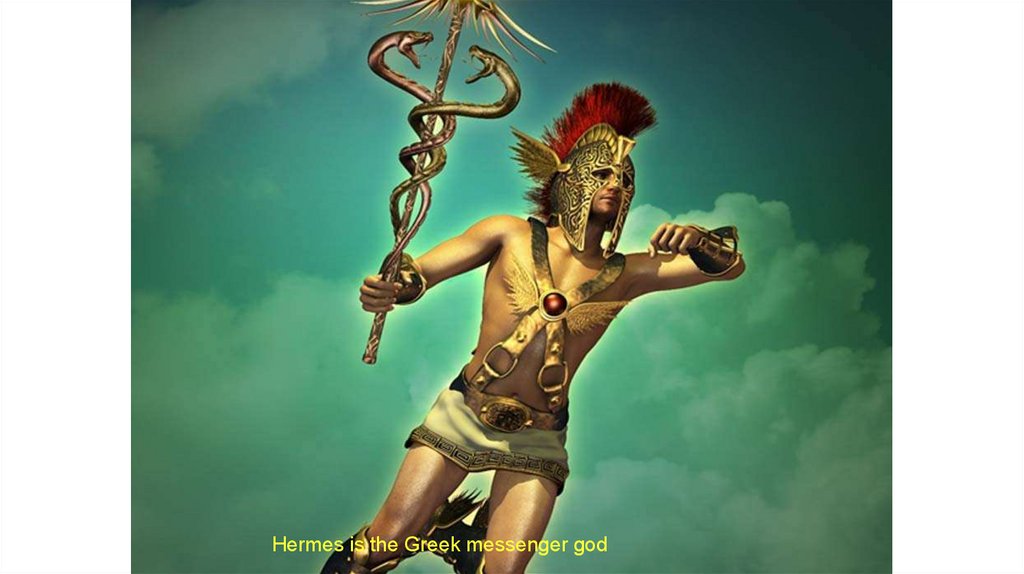
Hermes is the Greek messenger god54.
Puck is a sprite in Shakespeare’s “A Midsummer Night’s Dream“.55.
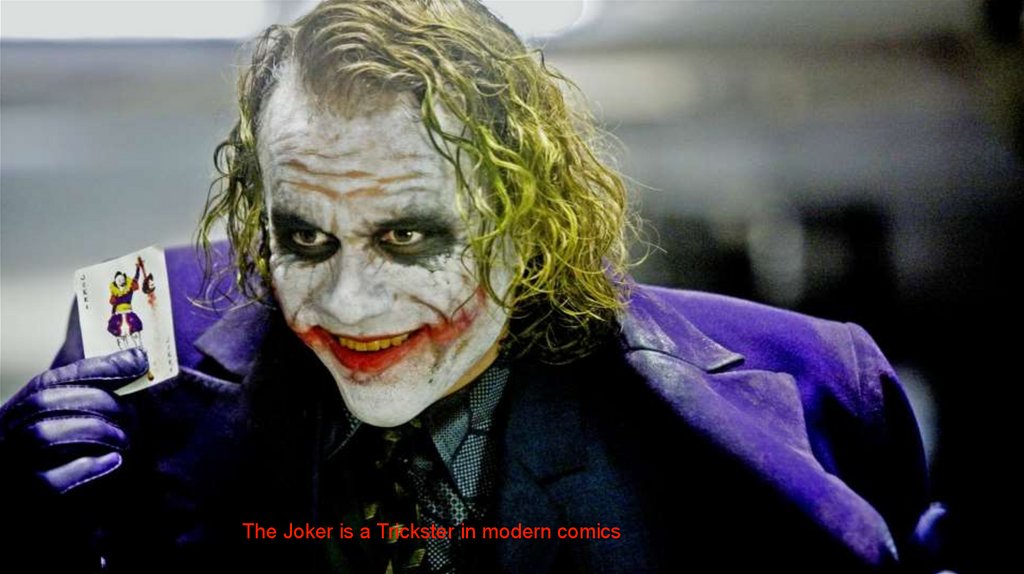
The Joker is a Trickster in modern comics56.
Captain Jack Sparrow is a Trickster in the “Pirates of the Caribbean”57.
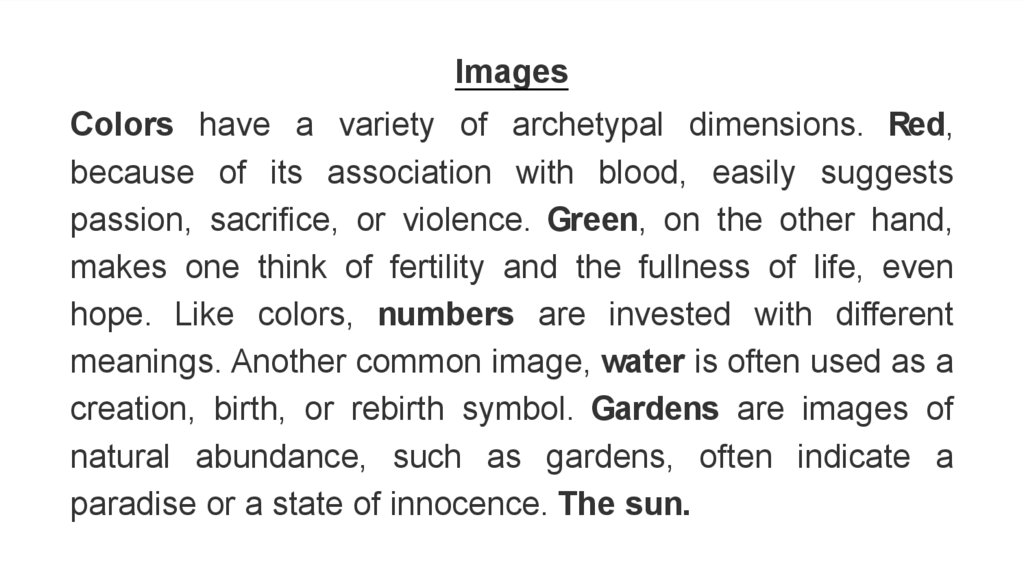
ImagesColors have a variety of archetypal dimensions. Red,
because of its association with blood, easily suggests
passion, sacrifice, or violence. Green, on the other hand,
makes one think of fertility and the fullness of life, even
hope. Like colors, numbers are invested with different
meanings. Another common image, water is often used as a
creation, birth, or rebirth symbol. Gardens are images of
natural abundance, such as gardens, often indicate a
paradise or a state of innocence. The sun.
58.
SituationsThe ques t usually involves a difficult search for a magical or holy item that
will return fertility and abundance to a desolate state.
The rebirth may take the form of natural regeneration, that is , of submission
to the cycles of nature, or of escape from this troubled life to an endless
paradise. “Kubla Khan” Coleridge.
Dying-and-ris ing gods are Osiris, Adonis, Dionysus, and Jesus.
Initiation. The protagonist goes through the initiation alone, experiencing
tests and ordeals that change him so that he can return to the family or
larger group as an adult member.
59.
Northrop Frye (1912 – 1991)and
Mythological Criticism
60.
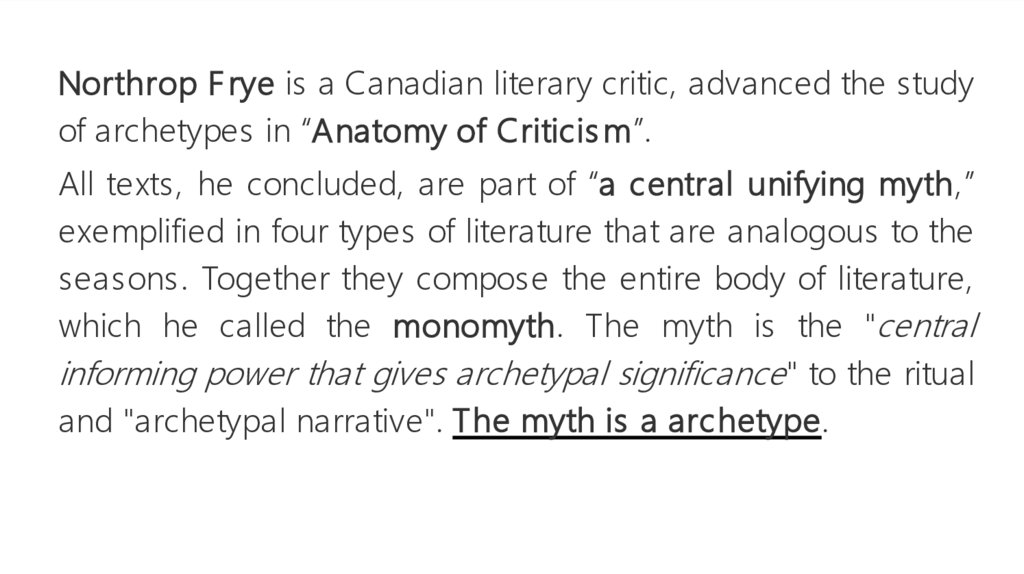
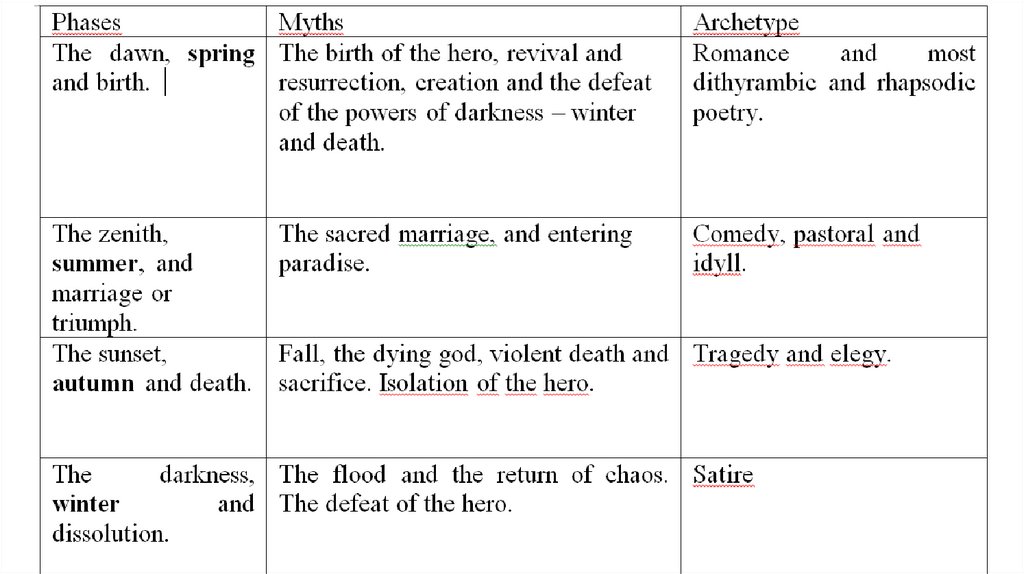
Northrop F rye is a Canadian literary critic, advanced the studyof archetypes in “Anatomy of Criticis m”.
All texts, he concluded, are part of “a central unifying myth,”
exemplified in four types of literature that are analogous to the
seasons. Together they compose the entire body of literature,
which he called the monomyth. The myth is the "central
informing power that gives archetypal significance " to the ritual
and "archetypal narrative". The myth is a archetype.
61.
62.
Frye speaks about the classifying principles lying betweenthe two points:
1. The preliminary effort of criticism, the structural analysis of
the work of art.
2. The assumption that there is such a subject as criticism
and that it makes or could make complete sense.
“We may proceed inductively from structural analysis trying
to see larger patterns in them, or we may proceed
deductively, with the consequences that follow from
postulating the unity of criticism”
63.
Inductive studyEvery poet has his private mythology – his unique
formation symbols. The same psychological analysis
may extend to the study of characters. The inductive
movement towards the archetype is a process of
backing up, as we back up from a painting if we want to
see composition instead of brushwork.
Example – the grave digger scene in Hamlet.
64.
65.
66.
JACQUES LACAN (1901-1981):AN UPDATE ON FREUD
67.
Lacan’s work has been described as a reinterpretationof F reud in light of the ideas of structuralist and
poststructuralist theories. L acan claimed that the ego
(the “I” self) is only an illusion produced by the
unconscious. F reud believed that the healthy psyche
was characterized by unity. In contrast, Lacan
recognized that it is always fraught with fragmentation,
abs ence, and lack.
68.
Lacan’s notes that the unconscious is orderly and structured,not chaotic and jumbled and full of repressed desires and
wishes, as Freud conceived of it. In fact, Lacan asserted that the
unconscious is structured like a language. Unlike Saussure,
who saw a signifier and a signified as two parts of a sign,
Lacan saw in the unconscious only signifiers that refer to other
signifiers. The unconscious is a constantly moving chain of
signifiers. The signifiers have no reference beyond themselves,
making them unstable. We spend our lives trying to stabilize this
system so that meaning and self become possible.
69.
Character Analys isLacan’s rejects the traditional view of the human self as a whole.
We move through 3 stages, or orders as Lacan calls them – the
real, the imaginary, and the s ymbolic, corresponding to the
experience of need, demand, and desire.
The new infant exists in a state of nature, a psychological place
characterized by wholenes s and fullnes s . It does not recognize
itself as an individual. It knows only that it has needs (food, for
example) and does not distinguish itself from the mother. It
exists in the Real Order, a psychological state characterized by
unity and completenes s .
70.
Between 6 and 18 months of age, the baby seesits own reflection and begins to perceive a state of
separation between itself and the surrounding
world, an experience known as the mirror stage,
which is part of the Imaginary Order. The infant
thinks the reflection is real and uses what it sees to
create the ego, the sense of “I”. It is only an
illusion, however, and she is, in actuality, not whole
and complete.
71.
72.
When the infant realizes it is not connected to that whichserves its needs, when it recognizes the Other (Mother)
and its own other, it begins to enter the Symbolic Order.
The Symbolic also initiates socialization by setting up
rules of behavior and putting limits on desire. The
Imaginary Order is centered in the mother, the Symbolic
Order is ruled by what Lacan calls the Law of the
Father, because it is the father who enforces cultural
norms and laws.
73.
AntirealismThe reader must accept that a narrative is
likely to be broken and interrupted. Lacan’s
early association with surrealist writers and
painters is evident in the tendency of his
followers to favor bizarre and nonlinear
narratives.
74.
WRITING PSYCHOLOGICALCRITICISM
75.
The following questions can help to get you started:What do you see as the character’s main traits?
What does the narrator reveal about the character?
In the course of the narrative, does the character change? If
so, how and why?
Where do you find evidence of the id, superego, and ego at
work?
How is he or she viewed by other characters?
What images are associated with the character?
76.
What principal symbols enrich your understanding of thecharacters?
Which symbols are connected with forces that affect the
characters?
Does the character have any interior monologues or dreams?
If so, what do you learn from them about the character that is
not revealed by outward behavior or conversation?
Are there suggestions that the character’s childhood
experiences have led to problems in maturity, such as
uncompleted sexual stages or unresolved dilemmas?
Where do the characters act in ways that are inconsistent with
77.
An archetypal approach can start with these questions:What similarities do you find among the characters , situations , and
settings of the text under consideration and those in other works that you
have read?
What commonly encountered archetypes do you recognize?
Is the narrative like any classic myths you know?
Where do you find evidence
Anima/animus? S hadow?
of
the
protagonist’s
persona?
Does the protagonist at any point reject some part of his or her
personality and project it onto someone or something else?
Would you describe the protagonist as individuated, as having a realistic
and accurate sense of self?
78.
You can begin a Lacanian approach by considering the following questions:Where do you recognize the appearance of the Real, Imaginary, and/or
S ymbolic Orders?
How do they demonstrate the fragmented nature of the self?
Are there instances where the Imaginary interrupts the S ymbolic Order?
Is the character aware of the lack or absence of something significant in the
self?
Are there objects that symbolize what is missing or lacking?
Do you find examples of the mirror stage of the developing psyche?
Is the text an antirealist one that subverts traditional storytelling?
79.
Drafting and RevisingBecause such studies can look at a single character, the relationships
among characters, meaningful symbolism, narrative patterns, or even the
life of the author, an indication of the direction your paper will take makes it
easier for others to follow the development of your discussion. Another
approach is to comment on similarities and differences between the work
with which you are dealing and other works by the same writer
Reveal what is happening in the character’s unconscious as suggested by
images, symbols, or interior monologues. Identify the nature of the
character’s conflicts; look for indications of whether he or she has the
attitudes of a healthy adult male or female.
80.
To use Lacan’s ideas as the basis of your discussion, you can apply thefollowing analytical strategies:
Identify the Real, Imaginary, and S ymbolic Orders in the narrative, and
explain the position of a character in relation to each. Note instances
where a character’s fragmentation or lack is evident. Pay attention to
characters’ needs , demands , and desires , noting how they indicate the
characters movement towards adulthood. Point out antirealistic elements
of a narrative, noting what those elements suggest about the
inaccessibility of a whole, integrated self. Identify any mirror-stage
experiences and explain how they demonstrate Lacan’s ideas about the
developing psyche.