

 Маркетинг
Похожие презентации:






Employee Behavior and Motivation. Chapter 8
1.
EmployeeBehavior and
Motivation
Chapter 8
Copyright©
©2017
2012Pearson
PearsonEducation,
Education, Ltd.
Inc.
Copyright
Publishing as Prentice Hall
8-1
2.
IntroductionIn this chapter we
– describe the different forms of behaviors that
employees exhibit at work
– examine many of the ways that people differ
from one another
– look at some important models and concepts of
employee motivation, as well as some strategies
and techniques used by organizations to
improve employee motivation
Copyright©
©2017
2012Pearson
PearsonEducation,
Education, Ltd.
Inc.
Copyright
Publishing as Prentice Hall
8-2
3.
Learning Objectives1. Identify and discuss the basic forms of behaviors
that employees exhibit in organizations.
2. Describe the nature and importance of individual
differences among employees.
3. Explain the meaning and importance of
psychological contracts and the person-job fit in
the workplace.
Copyright©
©2017
2012Pearson
PearsonEducation,
Education, Ltd.
Inc.
Copyright
Publishing as Prentice Hall
8-3
4.
Learning Objectives4. Identify and summarize the most important
models and concepts of employee motivation.
5. Describe some of the strategies and techniques
used by organizations to improve employee
motivation.
Copyright©
©2017
2012Pearson
PearsonEducation,
Education, Ltd.
Inc.
Copyright
Publishing as Prentice Hall
8-4
5.
Forms of Employee BehaviorEmployee Behavior
– the pattern of actions by the members of an
organization that directly or indirectly influences
the organization’s effectiveness
Performance Behaviors
– the total set of work-related behaviors that the
organization expects employees to display
– directly contribute to productivity and
performance.
Copyright©
©2017
2012Pearson
PearsonEducation,
Education, Ltd.
Inc.
Copyright
Publishing as Prentice Hall
8-5
6.
Organizational CitizenshipOrganizational Citizenship
– positive behaviors that do not directly
contribute to the bottom line
Copyright©
©2017
2012Pearson
PearsonEducation,
Education, Ltd.
Inc.
Copyright
Publishing as Prentice Hall
8-6
7.
Counterproductive BehaviorsCopyright©
©2017
2012Pearson
PearsonEducation,
Education, Ltd.
Inc.
Copyright
Publishing as Prentice Hall
8-7
8.
Personality at WorkPersonality
– the relatively stable set of psychological
attributes that distinguish one person from
another
Copyright©
©2017
2012Pearson
PearsonEducation,
Education, Ltd.
Inc.
Copyright
Publishing as Prentice Hall
8-8
9.
The “Big Five” Personality TraitsCopyright©
©2017
2012Pearson
PearsonEducation,
Education, Ltd.
Inc.
Copyright
Publishing as Prentice Hall
8-9
10.
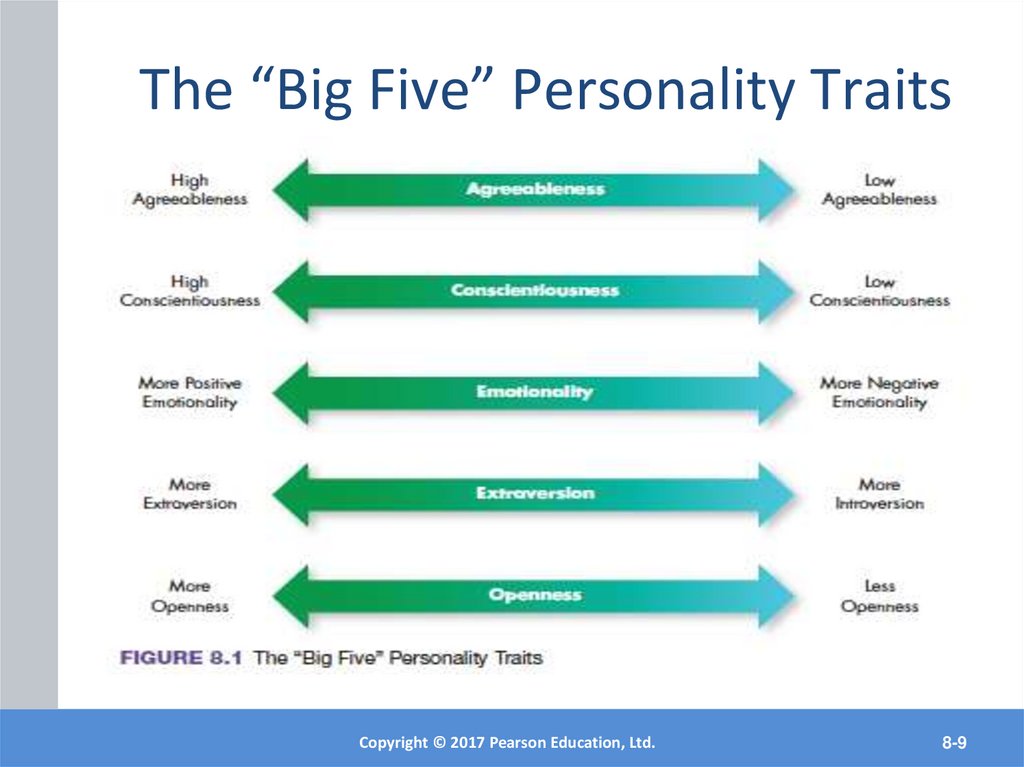
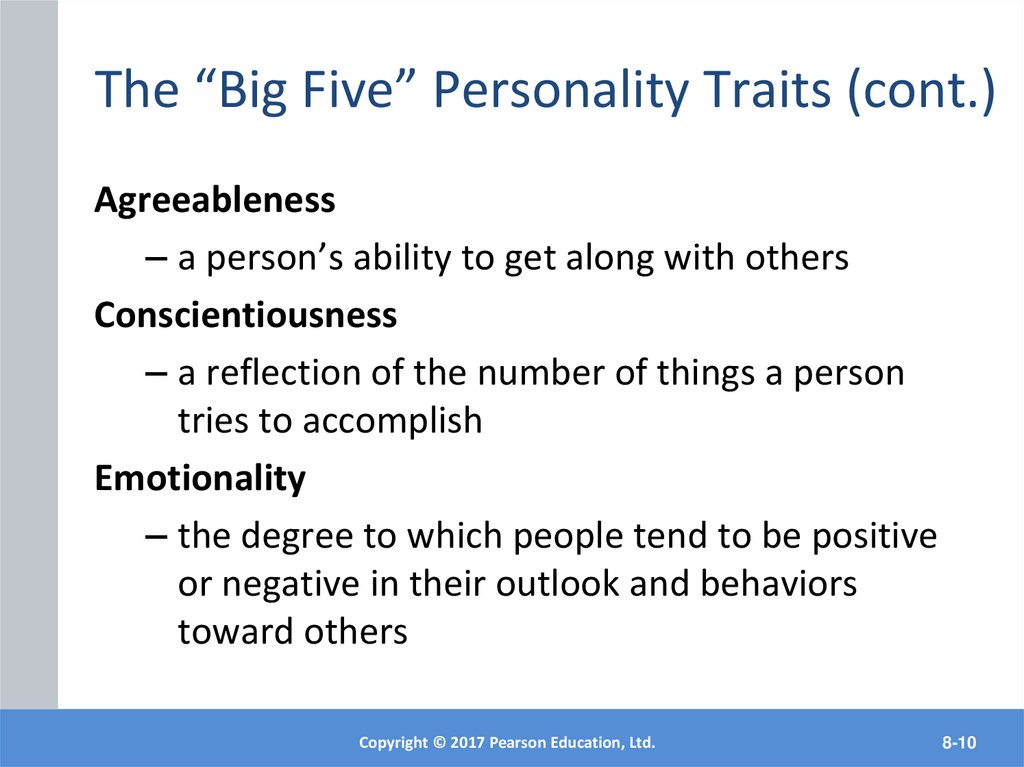
The “Big Five” Personality Traits (cont.)Agreeableness
– a person’s ability to get along with others
Conscientiousness
– a reflection of the number of things a person
tries to accomplish
Emotionality
– the degree to which people tend to be positive
or negative in their outlook and behaviors
toward others
Copyright©
©2017
2012Pearson
PearsonEducation,
Education, Ltd.
Inc.
Copyright
Publishing as Prentice Hall
8-10
11.
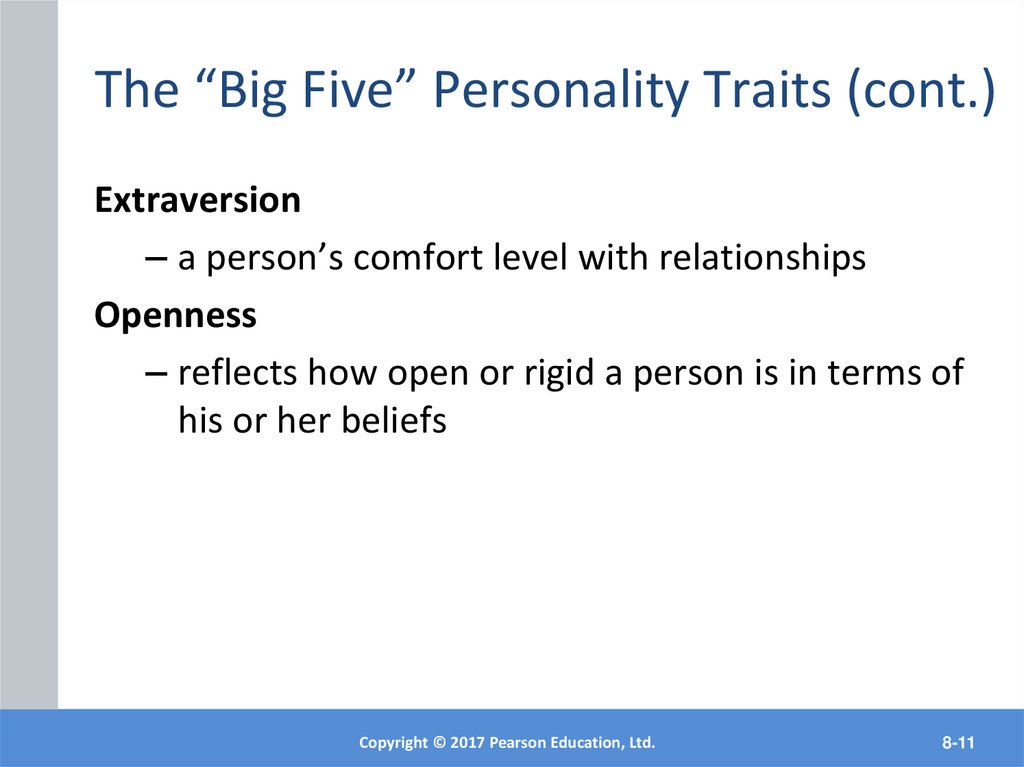
The “Big Five” Personality Traits (cont.)Extraversion
– a person’s comfort level with relationships
Openness
– reflects how open or rigid a person is in terms of
his or her beliefs
Copyright©
©2017
2012Pearson
PearsonEducation,
Education, Ltd.
Inc.
Copyright
Publishing as Prentice Hall
8-11
12.
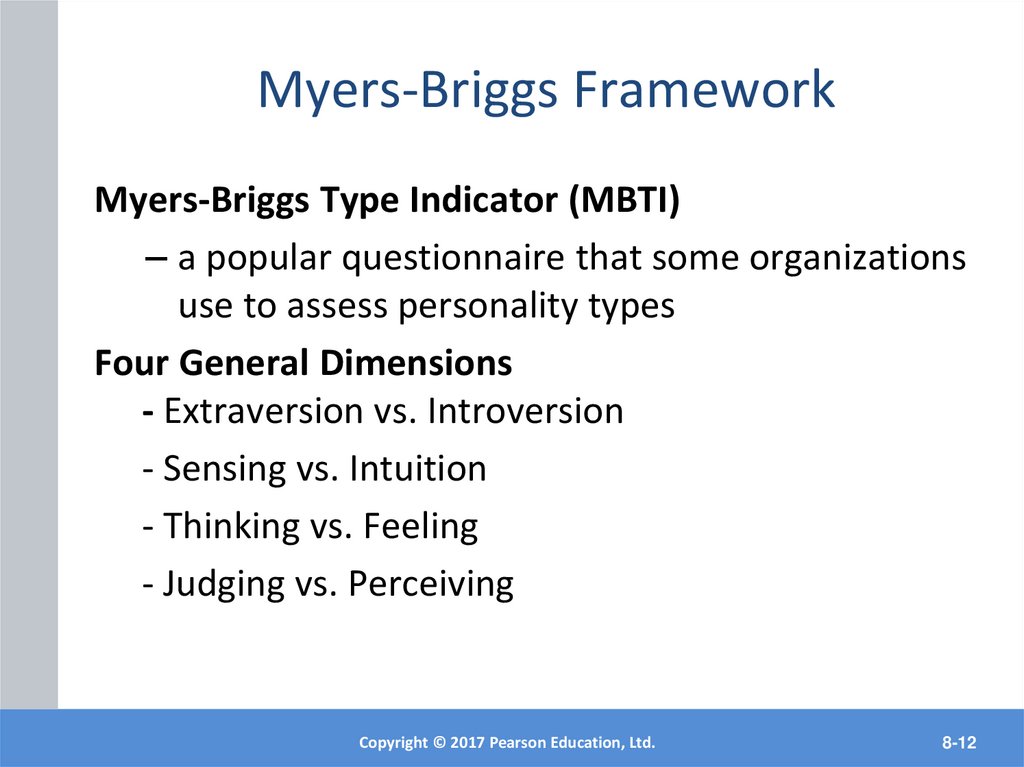
Myers-Briggs FrameworkMyers-Briggs Type Indicator (MBTI)
– a popular questionnaire that some organizations
use to assess personality types
Four General Dimensions
- Extraversion vs. Introversion
- Sensing vs. Intuition
- Thinking vs. Feeling
- Judging vs. Perceiving
Copyright©
©2017
2012Pearson
PearsonEducation,
Education, Ltd.
Inc.
Copyright
Publishing as Prentice Hall
8-12
13.
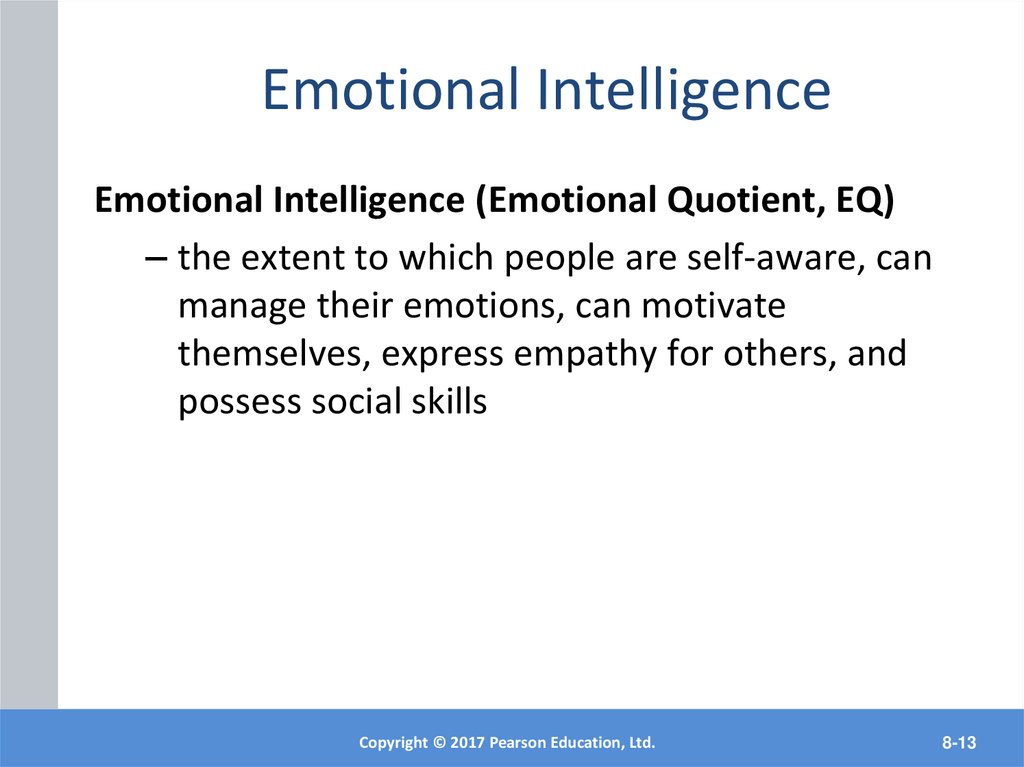
Emotional IntelligenceEmotional Intelligence (Emotional Quotient, EQ)
– the extent to which people are self-aware, can
manage their emotions, can motivate
themselves, express empathy for others, and
possess social skills
Copyright©
©2017
2012Pearson
PearsonEducation,
Education, Ltd.
Inc.
Copyright
Publishing as Prentice Hall
8-13
14.
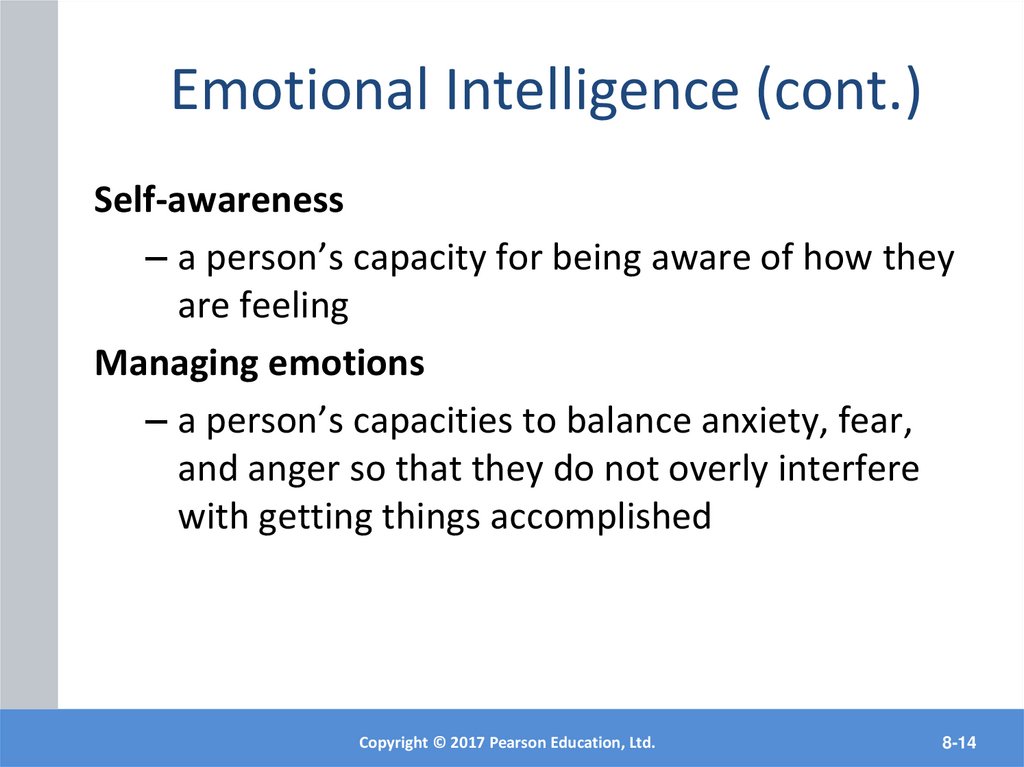
Emotional Intelligence (cont.)Self-awareness
– a person’s capacity for being aware of how they
are feeling
Managing emotions
– a person’s capacities to balance anxiety, fear,
and anger so that they do not overly interfere
with getting things accomplished
Copyright©
©2017
2012Pearson
PearsonEducation,
Education, Ltd.
Inc.
Copyright
Publishing as Prentice Hall
8-14
15.
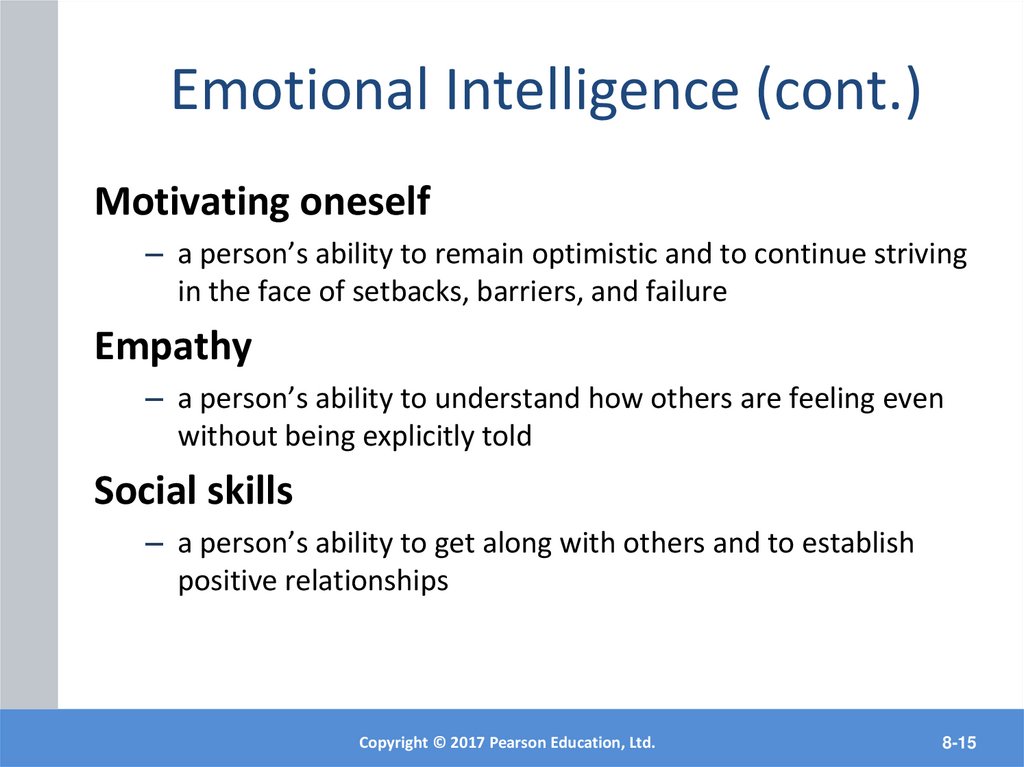
Emotional Intelligence (cont.)Motivating oneself
– a person’s ability to remain optimistic and to continue striving
in the face of setbacks, barriers, and failure
Empathy
– a person’s ability to understand how others are feeling even
without being explicitly told
Social skills
– a person’s ability to get along with others and to establish
positive relationships
Copyright©
©2017
2012Pearson
PearsonEducation,
Education, Ltd.
Inc.
Copyright
Publishing as Prentice Hall
8-15
16.
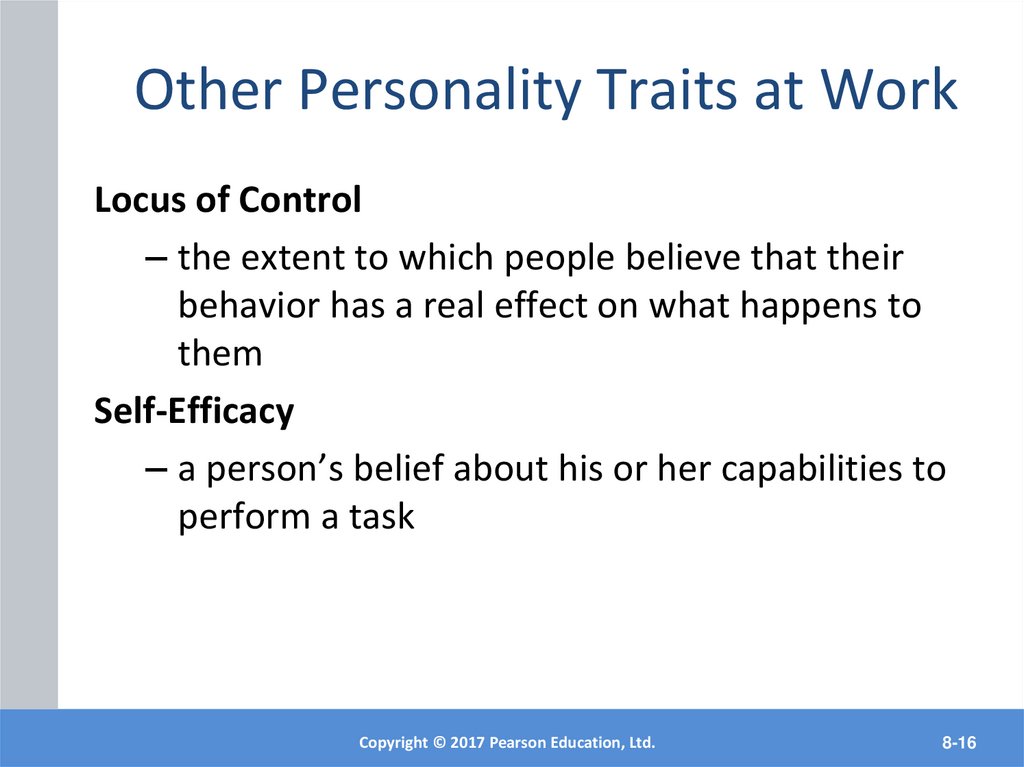
Other Personality Traits at WorkLocus of Control
– the extent to which people believe that their
behavior has a real effect on what happens to
them
Self-Efficacy
– a person’s belief about his or her capabilities to
perform a task
Copyright©
©2017
2012Pearson
PearsonEducation,
Education, Ltd.
Inc.
Copyright
Publishing as Prentice Hall
8-16
17.
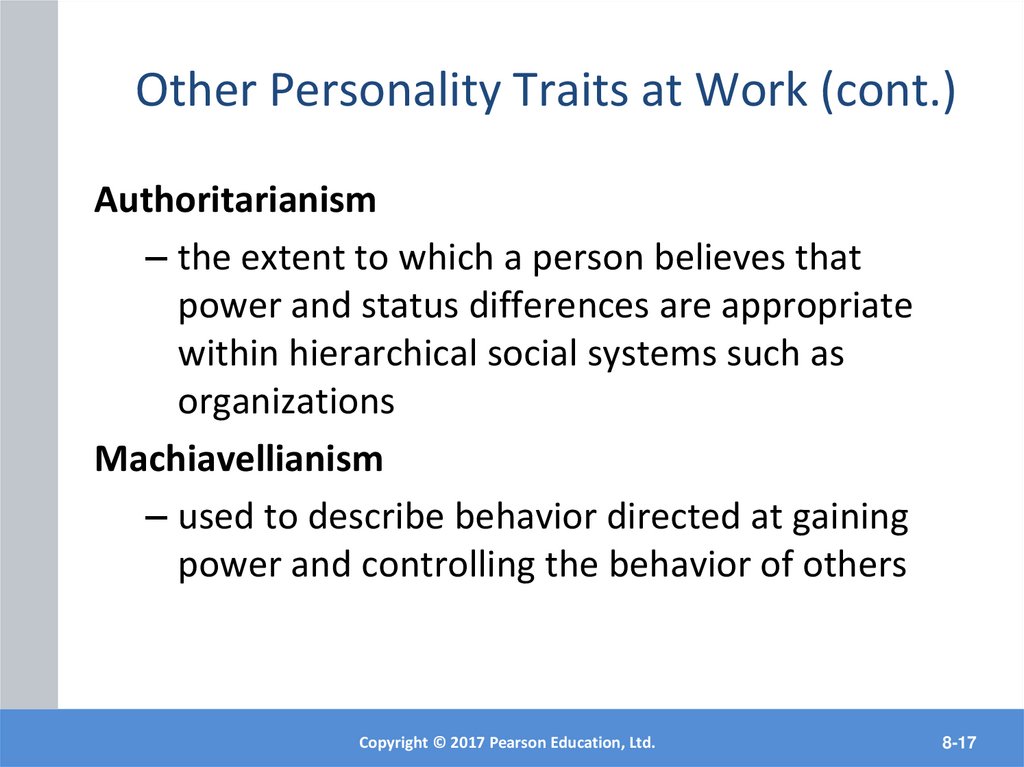
Other Personality Traits at Work (cont.)Authoritarianism
– the extent to which a person believes that
power and status differences are appropriate
within hierarchical social systems such as
organizations
Machiavellianism
– used to describe behavior directed at gaining
power and controlling the behavior of others
Copyright©
©2017
2012Pearson
PearsonEducation,
Education, Ltd.
Inc.
Copyright
Publishing as Prentice Hall
8-17
18.
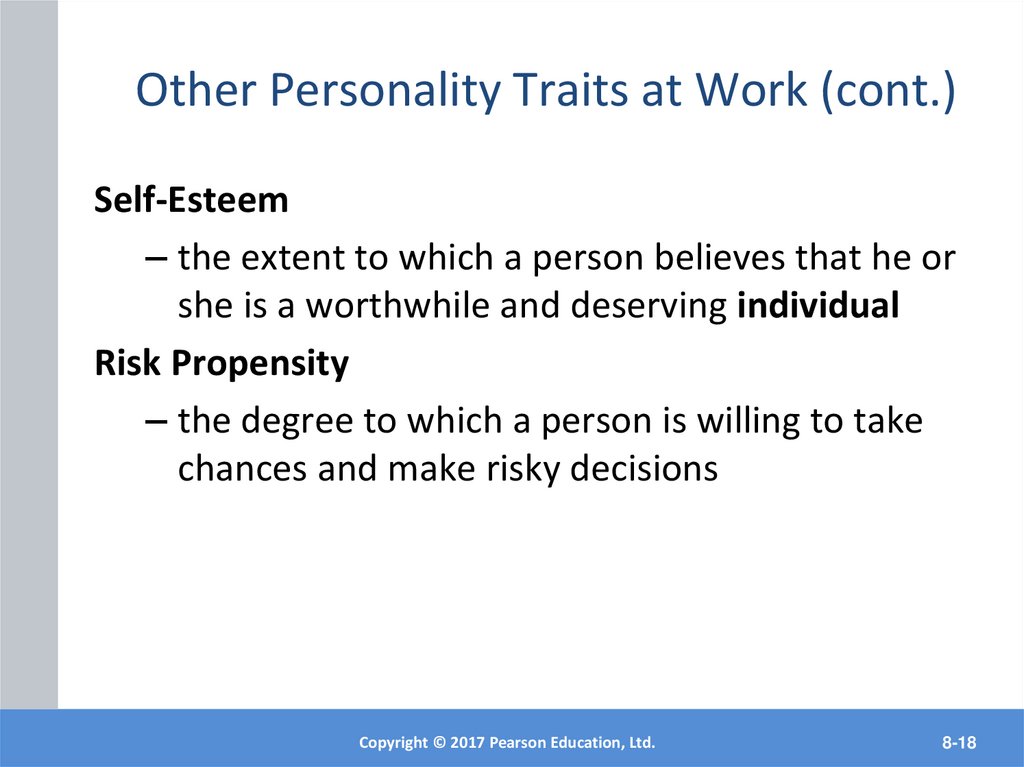
Other Personality Traits at Work (cont.)Self-Esteem
– the extent to which a person believes that he or
she is a worthwhile and deserving individual
Risk Propensity
– the degree to which a person is willing to take
chances and make risky decisions
Copyright©
©2017
2012Pearson
PearsonEducation,
Education, Ltd.
Inc.
Copyright
Publishing as Prentice Hall
8-18
19.
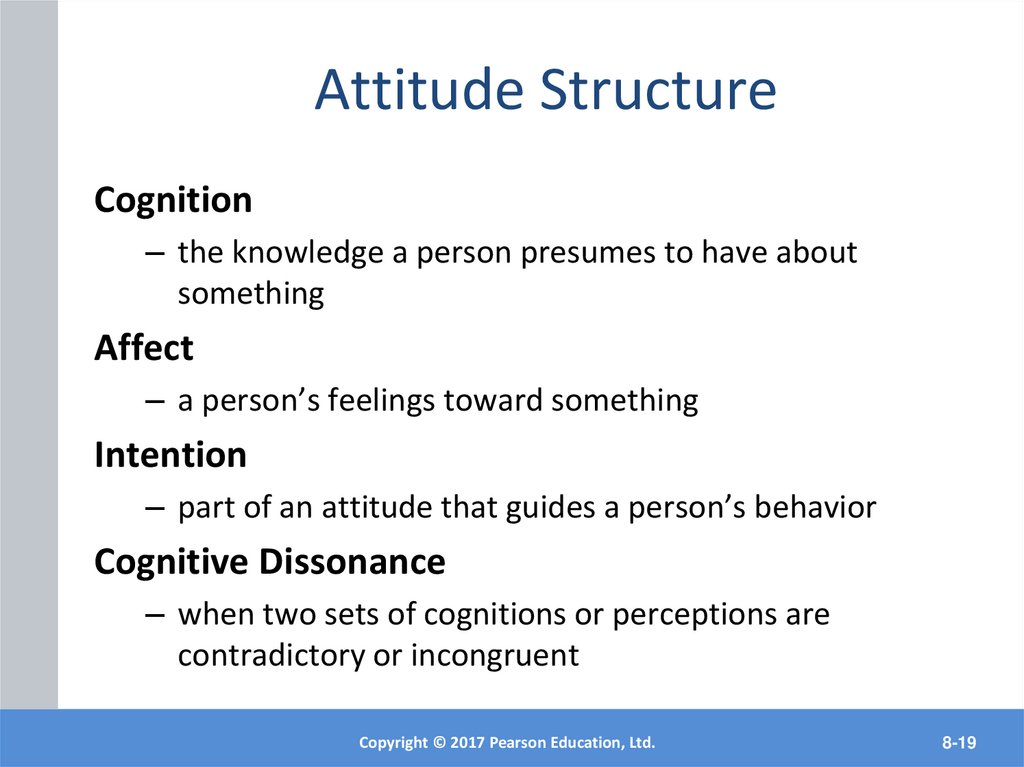
Attitude StructureCognition
– the knowledge a person presumes to have about
something
Affect
– a person’s feelings toward something
Intention
– part of an attitude that guides a person’s behavior
Cognitive Dissonance
– when two sets of cognitions or perceptions are
contradictory or incongruent
Copyright©
©2017
2012Pearson
PearsonEducation,
Education, Ltd.
Inc.
Copyright
Publishing as Prentice Hall
8-19
20.
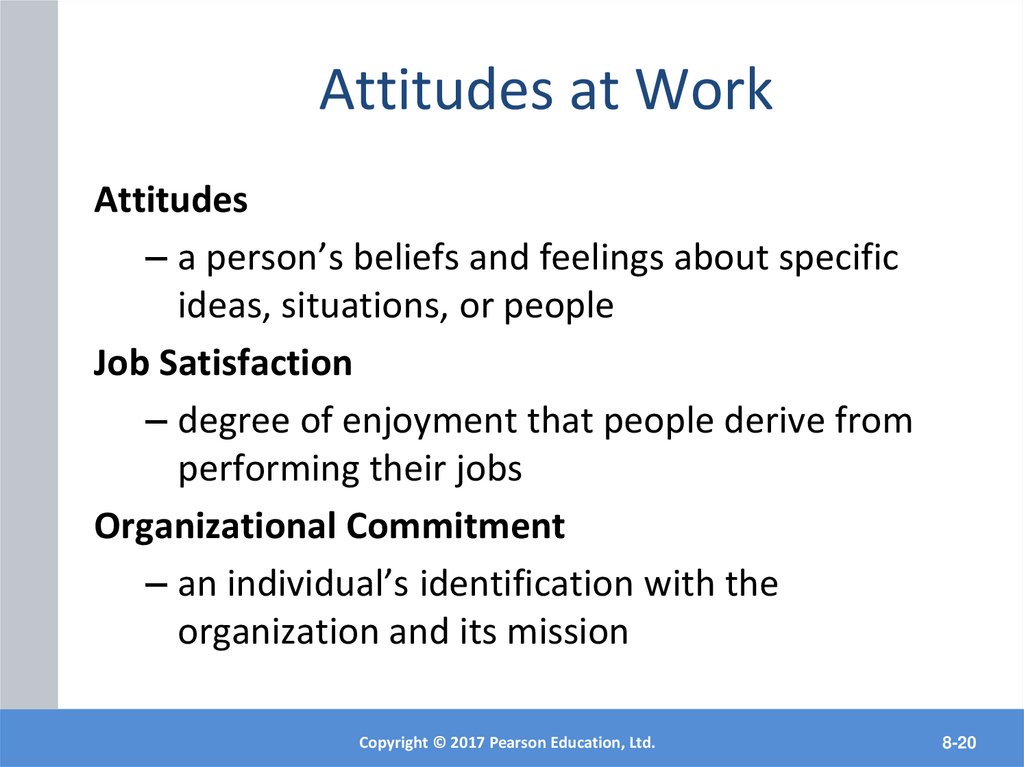
Attitudes at WorkAttitudes
– a person’s beliefs and feelings about specific
ideas, situations, or people
Job Satisfaction
– degree of enjoyment that people derive from
performing their jobs
Organizational Commitment
– an individual’s identification with the
organization and its mission
Copyright©
©2017
2012Pearson
PearsonEducation,
Education, Ltd.
Inc.
Copyright
Publishing as Prentice Hall
8-20
21.
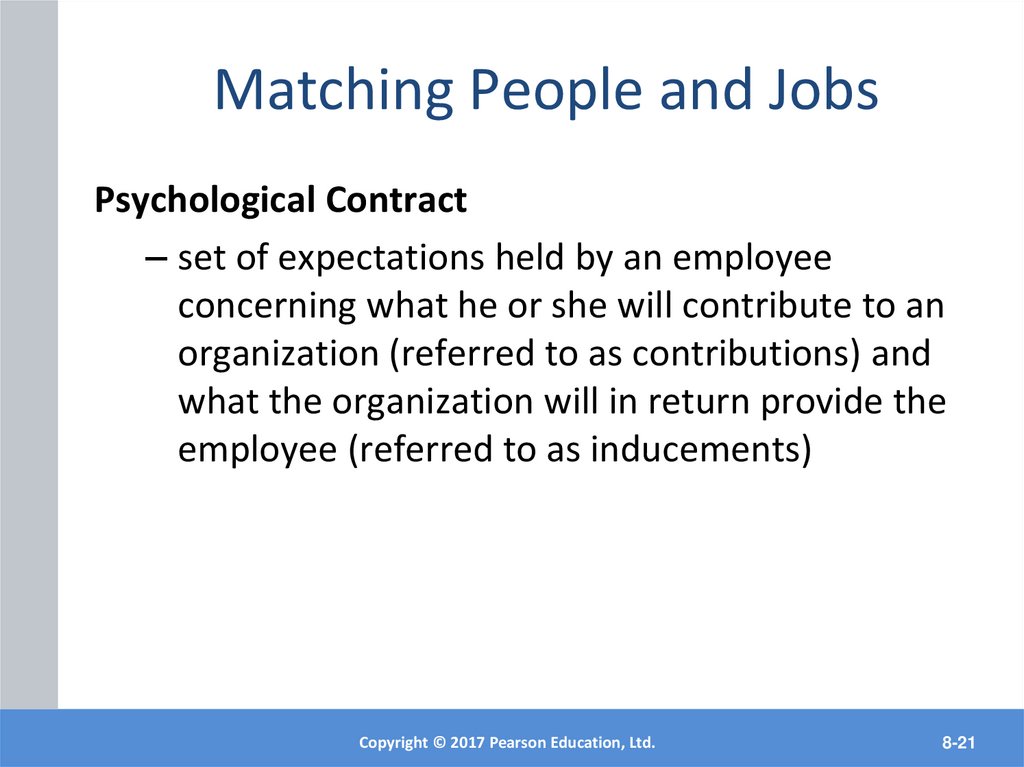
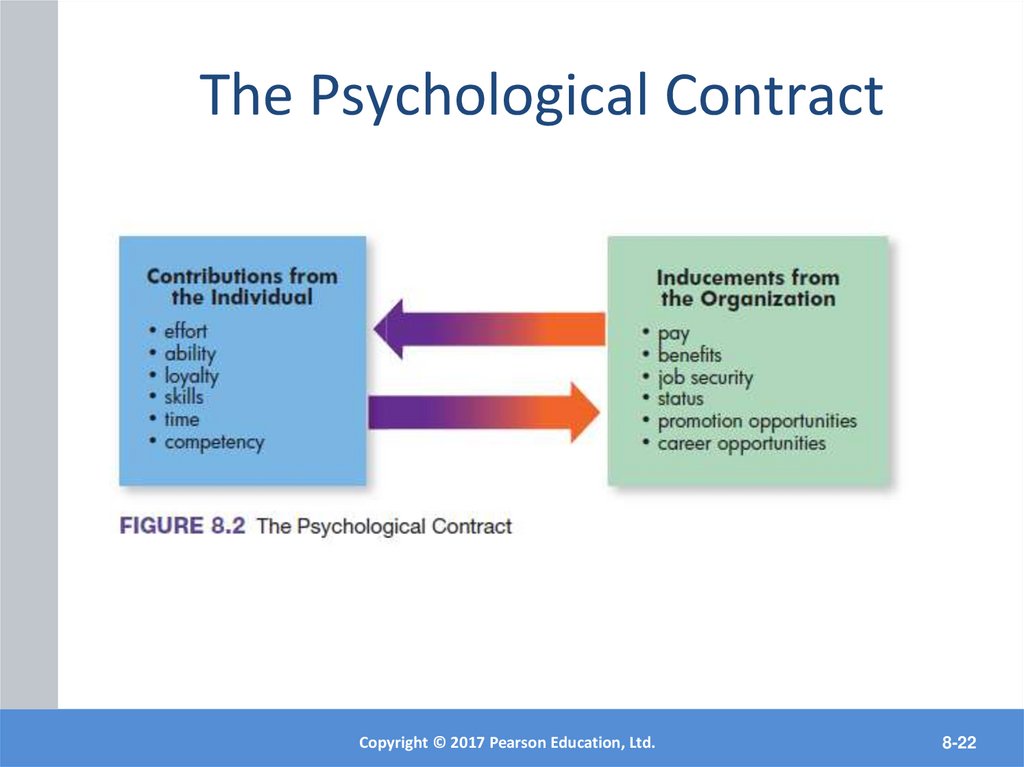
Matching People and JobsPsychological Contract
– set of expectations held by an employee
concerning what he or she will contribute to an
organization (referred to as contributions) and
what the organization will in return provide the
employee (referred to as inducements)
Copyright©
©2017
2012Pearson
PearsonEducation,
Education, Ltd.
Inc.
Copyright
Publishing as Prentice Hall
8-21
22.
The Psychological ContractCopyright©
©2017
2012Pearson
PearsonEducation,
Education, Ltd.
Inc.
Copyright
Publishing as Prentice Hall
8-22
23.
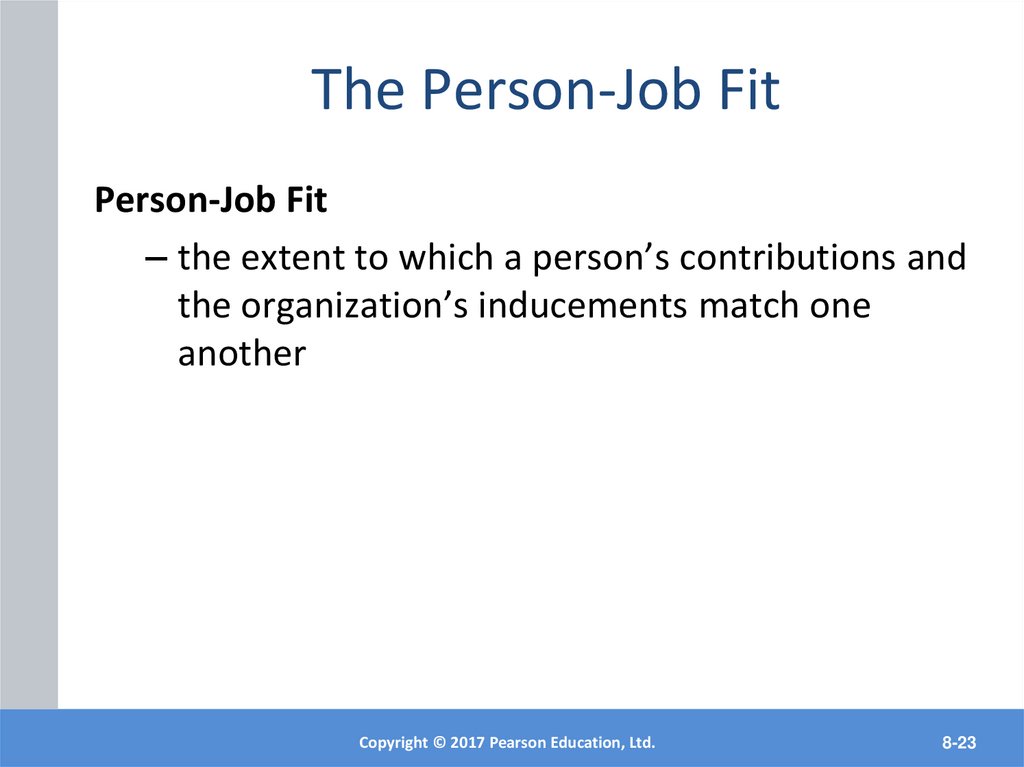
The Person-Job FitPerson-Job Fit
– the extent to which a person’s contributions and
the organization’s inducements match one
another
Copyright©
©2017
2012Pearson
PearsonEducation,
Education, Ltd.
Inc.
Copyright
Publishing as Prentice Hall
8-23
24.
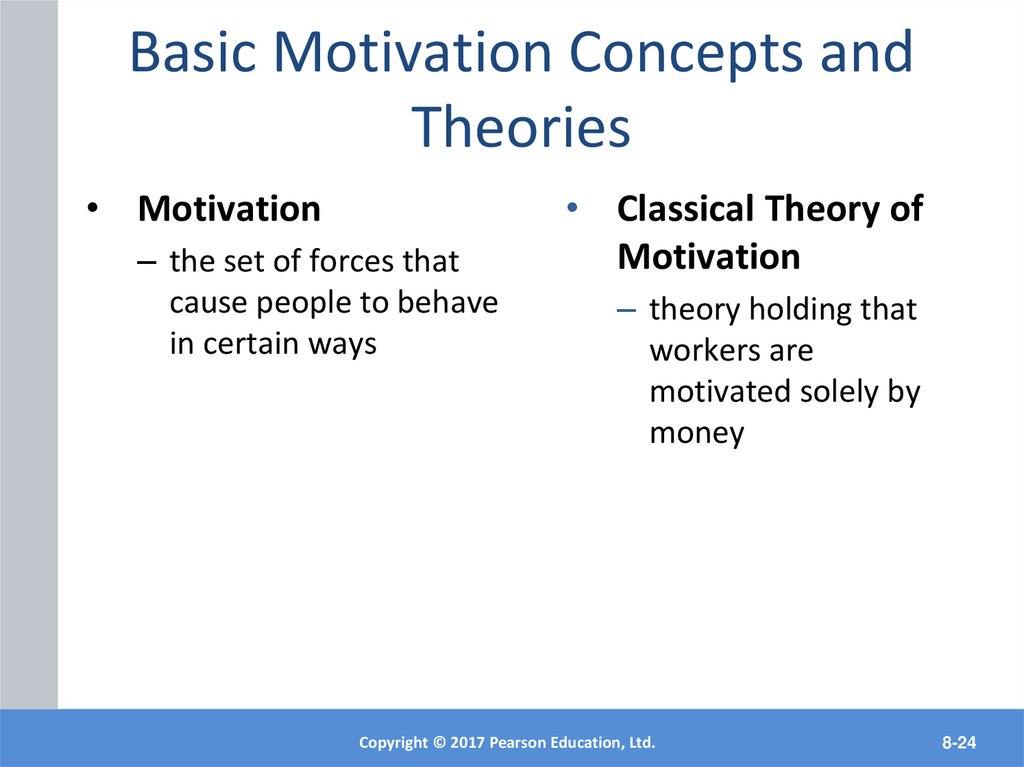
Basic Motivation Concepts andTheories
• Motivation
– the set of forces that
cause people to behave
in certain ways
• Classical Theory of
Motivation
– theory holding that
workers are
motivated solely by
money
Copyright©
©2017
2012Pearson
PearsonEducation,
Education, Ltd.
Inc.
Copyright
Publishing as Prentice Hall
8-24
25.
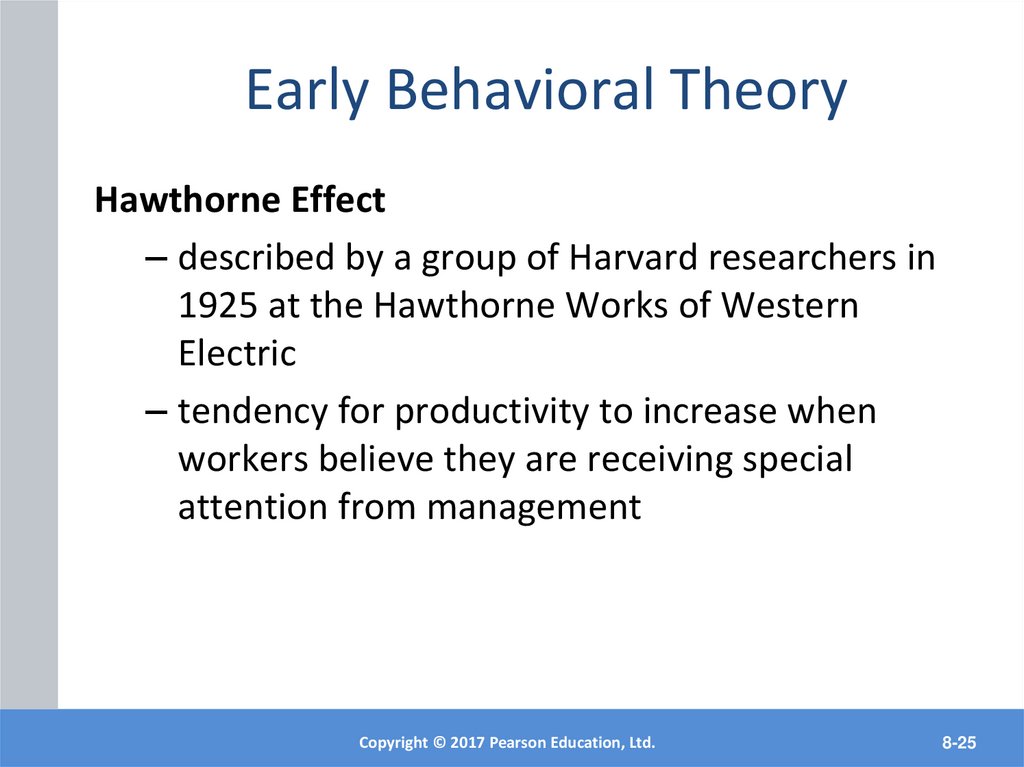
Early Behavioral TheoryHawthorne Effect
– described by a group of Harvard researchers in
1925 at the Hawthorne Works of Western
Electric
– tendency for productivity to increase when
workers believe they are receiving special
attention from management
Copyright©
©2017
2012Pearson
PearsonEducation,
Education, Ltd.
Inc.
Copyright
Publishing as Prentice Hall
8-25
26.
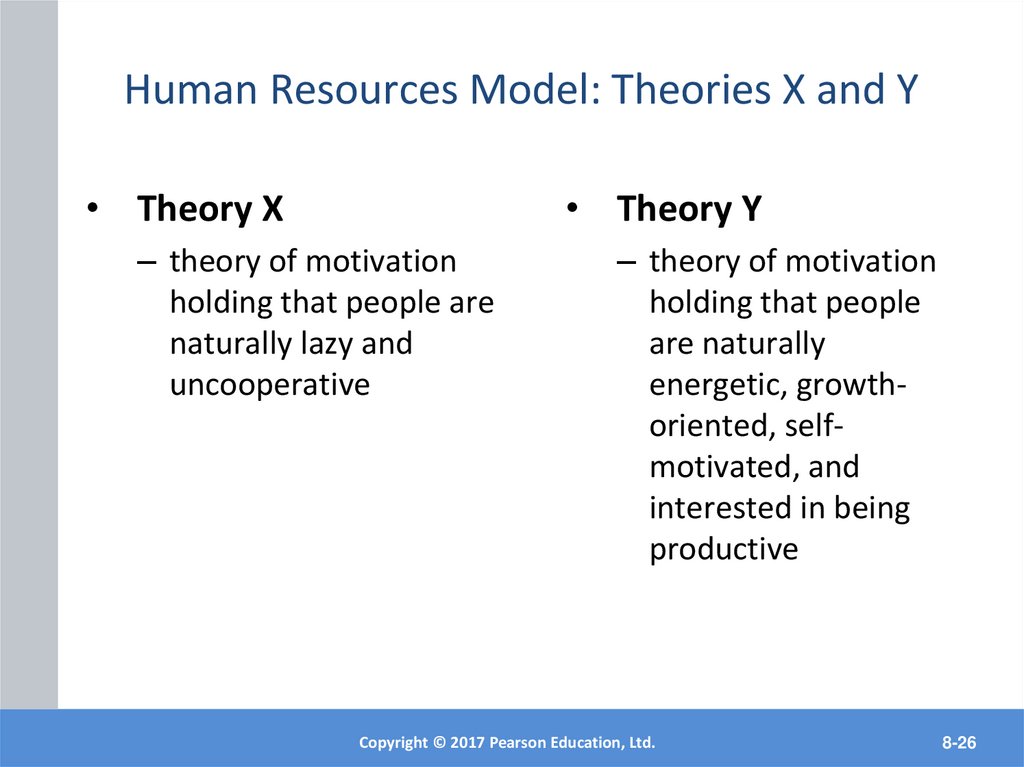
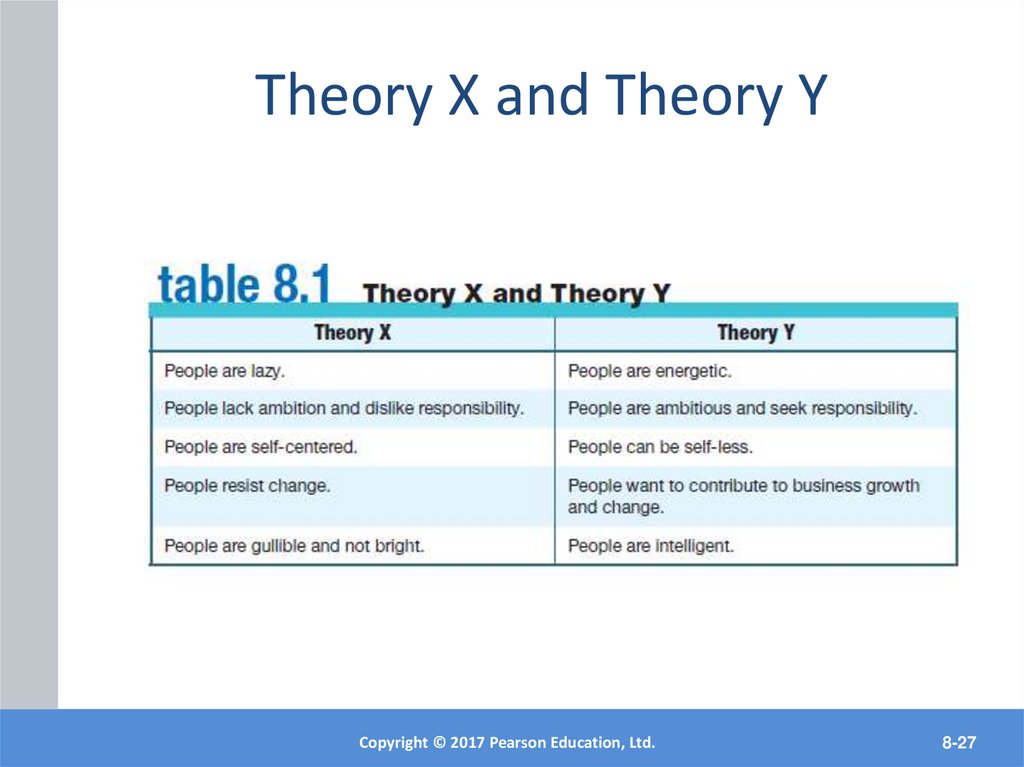
Human Resources Model: Theories X and Y• Theory X
• Theory Y
– theory of motivation
holding that people are
naturally lazy and
uncooperative
– theory of motivation
holding that people
are naturally
energetic, growthoriented, selfmotivated, and
interested in being
productive
Copyright©
©2017
2012Pearson
PearsonEducation,
Education, Ltd.
Inc.
Copyright
Publishing as Prentice Hall
8-26
27.
Theory X and Theory YCopyright©
©2017
2012Pearson
PearsonEducation,
Education, Ltd.
Inc.
Copyright
Publishing as Prentice Hall
8-27
28.
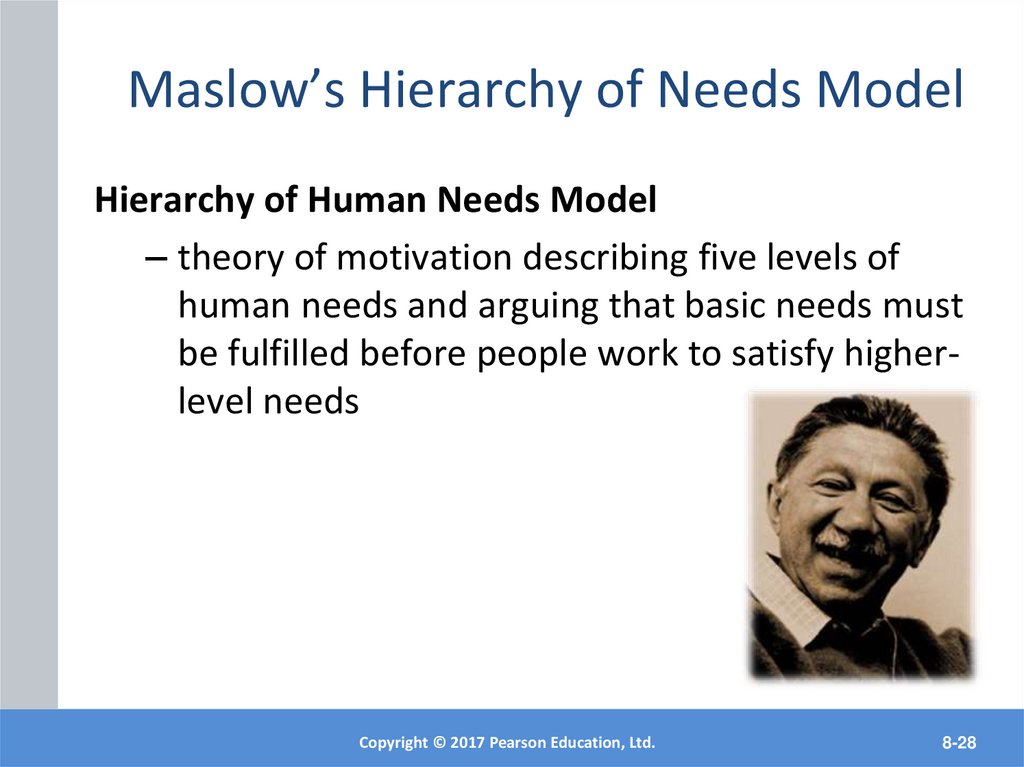
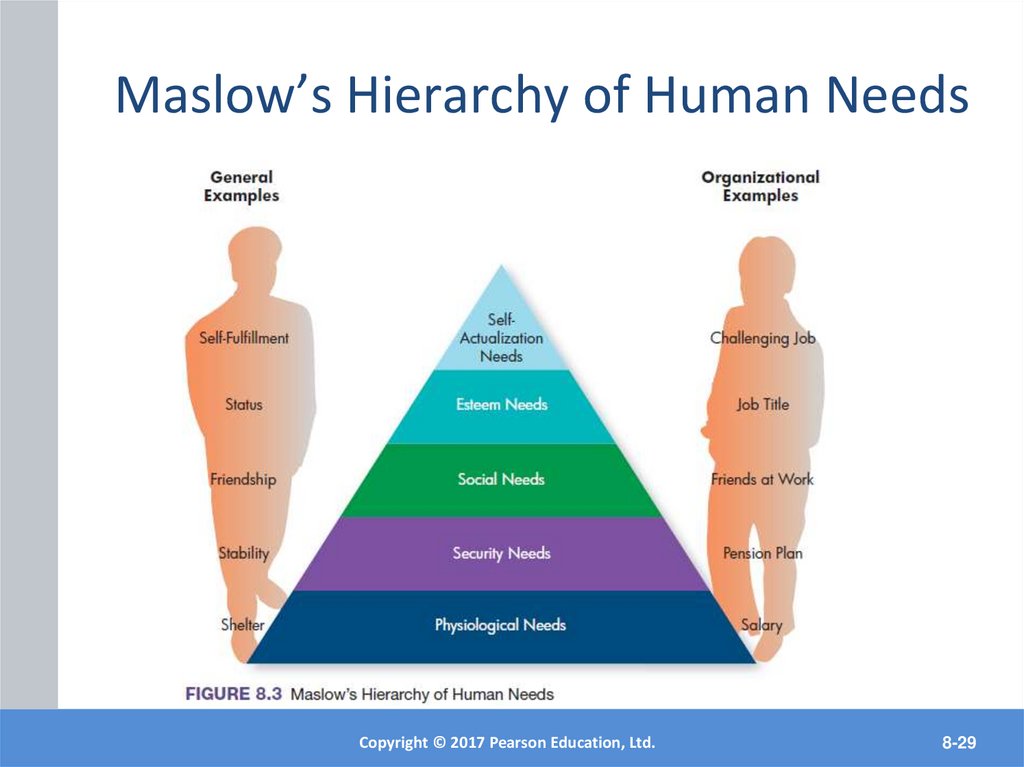
Maslow’s Hierarchy of Needs ModelHierarchy of Human Needs Model
– theory of motivation describing five levels of
human needs and arguing that basic needs must
be fulfilled before people work to satisfy higherlevel needs
Copyright©
©2017
2012Pearson
PearsonEducation,
Education, Ltd.
Inc.
Copyright
Publishing as Prentice Hall
8-28
29.
Maslow’s Hierarchy of Human NeedsCopyright©
©2017
2012Pearson
PearsonEducation,
Education, Ltd.
Inc.
Copyright
Publishing as Prentice Hall
8-29
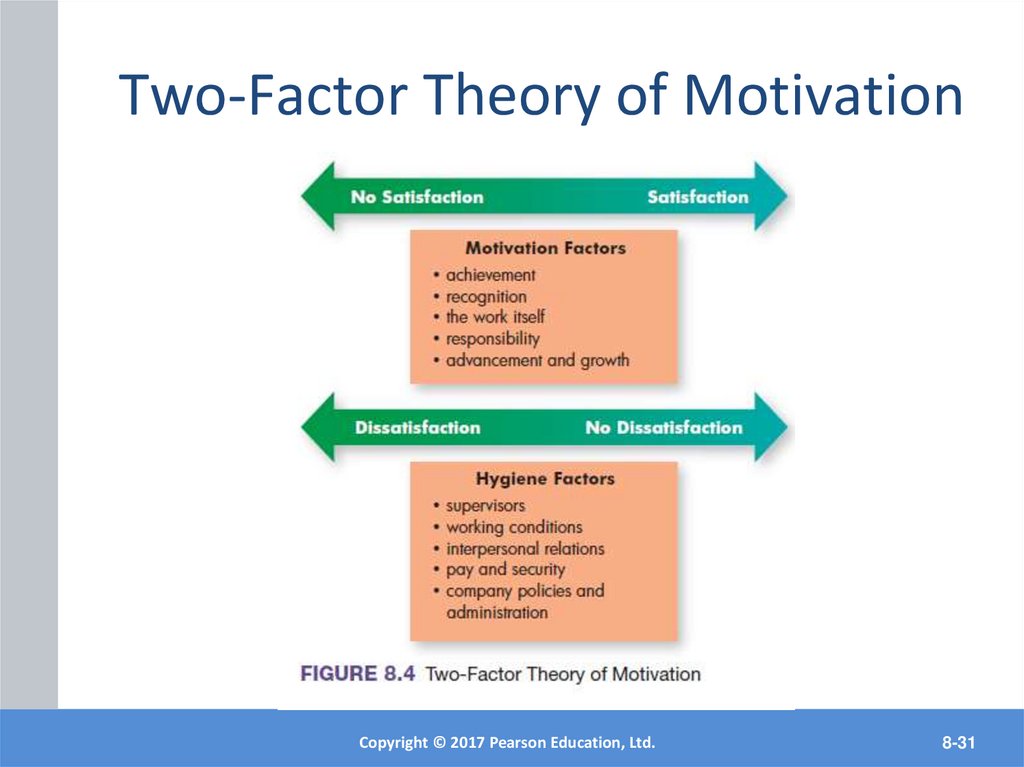
30.
Two-Factor TheoryTwo-Factor Theory
– theory of motivation holding that job
satisfaction depends on the following two
factors:
• Hygiene
• motivation
Copyright©
©2017
2012Pearson
PearsonEducation,
Education, Ltd.
Inc.
Copyright
Publishing as Prentice Hall
8-30
31.
Two-Factor Theory of MotivationCopyright©
©2017
2012Pearson
PearsonEducation,
Education, Ltd.
Inc.
Copyright
Publishing as Prentice Hall
8-31
32.
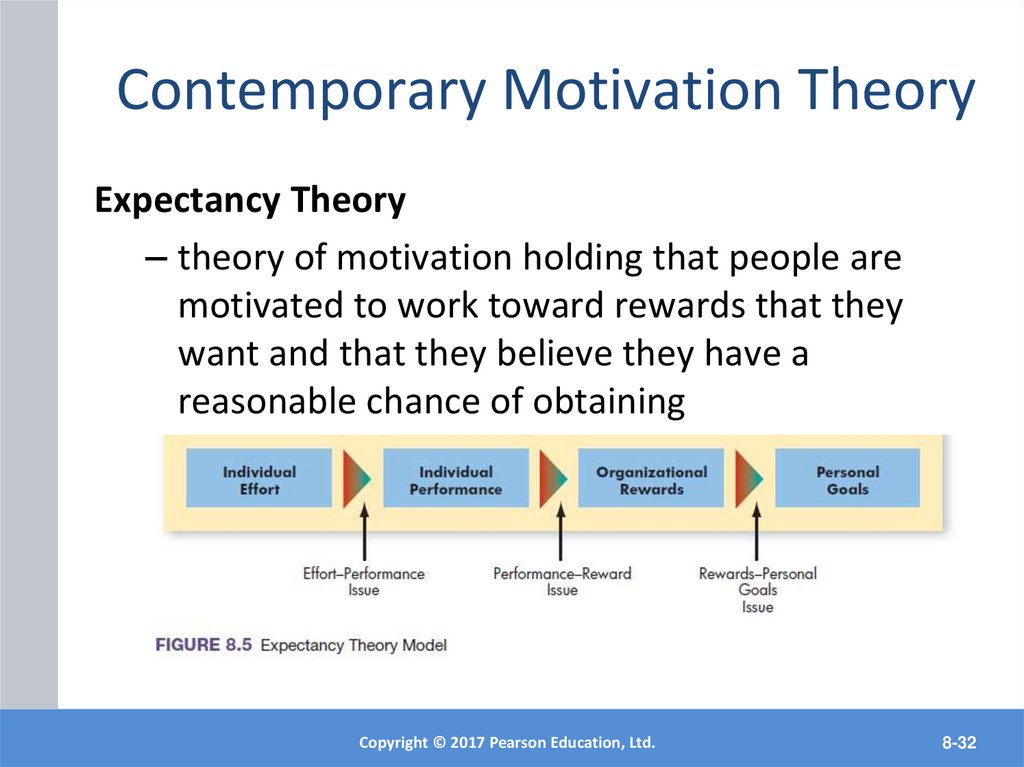
Contemporary Motivation TheoryExpectancy Theory
– theory of motivation holding that people are
motivated to work toward rewards that they
want and that they believe they have a
reasonable chance of obtaining
Copyright©
©2017
2012Pearson
PearsonEducation,
Education, Ltd.
Inc.
Copyright
Publishing as Prentice Hall
8-32
33.
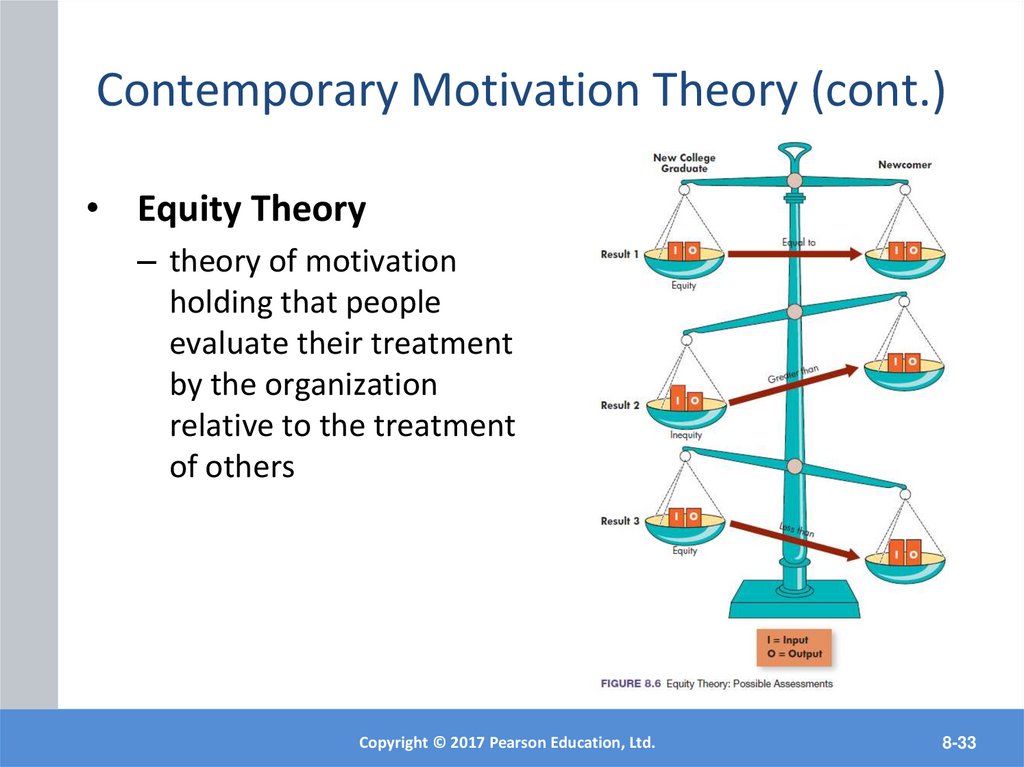
Contemporary Motivation Theory (cont.)• Equity Theory
– theory of motivation
holding that people
evaluate their treatment
by the organization
relative to the treatment
of others
Copyright©
©2017
2012Pearson
PearsonEducation,
Education, Ltd.
Inc.
Copyright
Publishing as Prentice Hall
8-33
34.
Reinforcement/Behavior ModificationPositive Reinforcement
– reward that follows desired behaviors
Punishment
– unpleasant consequences of an undesirable
behavior
Copyright©
©2017
2012Pearson
PearsonEducation,
Education, Ltd.
Inc.
Copyright
Publishing as Prentice Hall
8-34
35.
Using Goals to Motivate BehaviorManagement by Objectives (MBO)
– set of procedures involving both managers and
subordinates in setting goals and evaluating
progress
Copyright©
©2017
2012Pearson
PearsonEducation,
Education, Ltd.
Inc.
Copyright
Publishing as Prentice Hall
8-35
36.
Participative Management andEmpowerment
Participative Management and Empowerment
– method of increasing job satisfaction by giving
employees a voice in the management of their
jobs and the company
Copyright©
©2017
2012Pearson
PearsonEducation,
Education, Ltd.
Inc.
Copyright
Publishing as Prentice Hall
8-36
37.
Job Enrichment and Job RedesignJob Enrichment
– method of increasing job satisfaction by adding
one or more motivating factors to job activities
– i.e.: job rotation
Job Redesign
– method of increasing job satisfaction by
designing a more satisfactory fit between
workers and their jobs
– i.e.: combining tasks, establishing client
relationships, forming natural work groups
Copyright©
©2017
2012Pearson
PearsonEducation,
Education, Ltd.
Inc.
Copyright
Publishing as Prentice Hall
8-37
38.
Job Redesign ProgramsCombining Tasks
– involves enlarging jobs and increasing their
variety to make employees feel that their work
is more meaningful
Forming Natural Work Groups
– help employees see the importance of their jobs
in the total structure of the firm
Establishing Client Relationships
– letting employees interact with customers
Copyright©
©2017
2012Pearson
PearsonEducation,
Education, Ltd.
Inc.
Copyright
Publishing as Prentice Hall
8-38
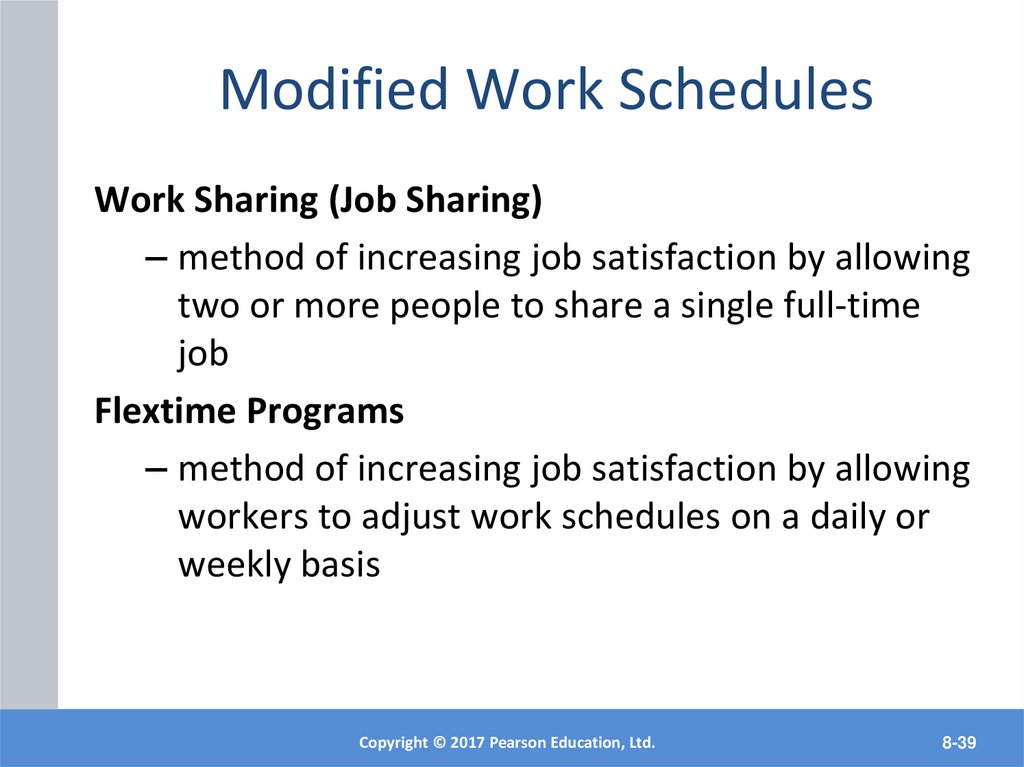
39.
Modified Work SchedulesWork Sharing (Job Sharing)
– method of increasing job satisfaction by allowing
two or more people to share a single full-time
job
Flextime Programs
– method of increasing job satisfaction by allowing
workers to adjust work schedules on a daily or
weekly basis
Copyright©
©2017
2012Pearson
PearsonEducation,
Education, Ltd.
Inc.
Copyright
Publishing as Prentice Hall
8-39
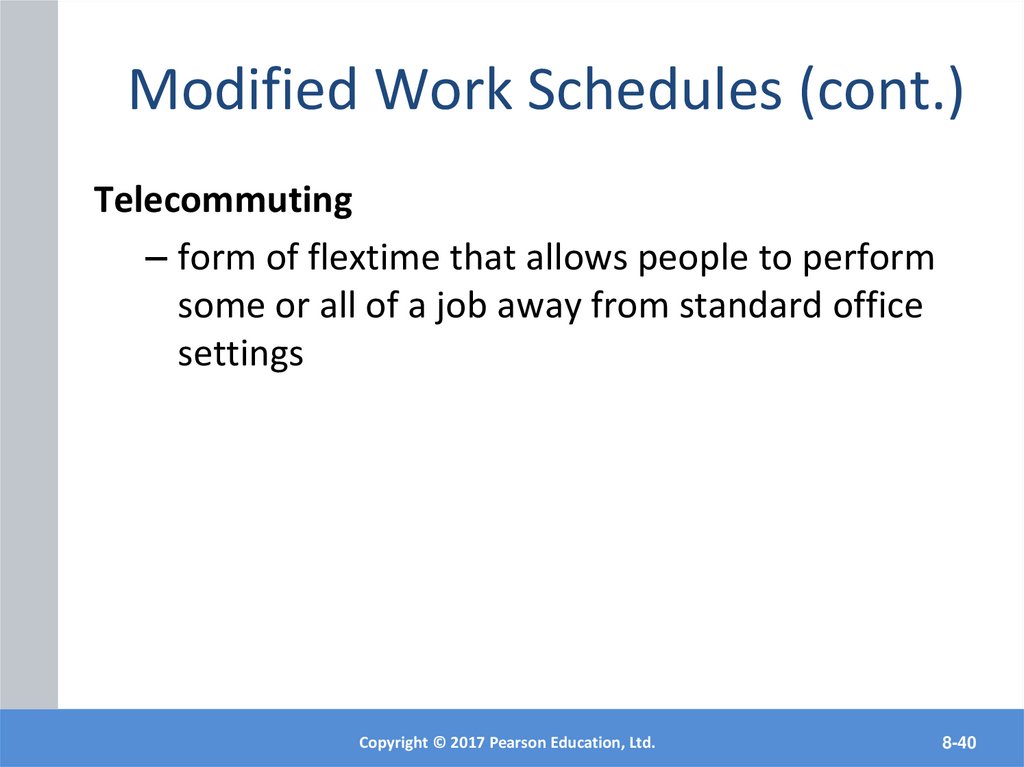
40.
Modified Work Schedules (cont.)Telecommuting
– form of flextime that allows people to perform
some or all of a job away from standard office
settings
Copyright©
©2017
2012Pearson
PearsonEducation,
Education, Ltd.
Inc.
Copyright
Publishing as Prentice Hall
8-40
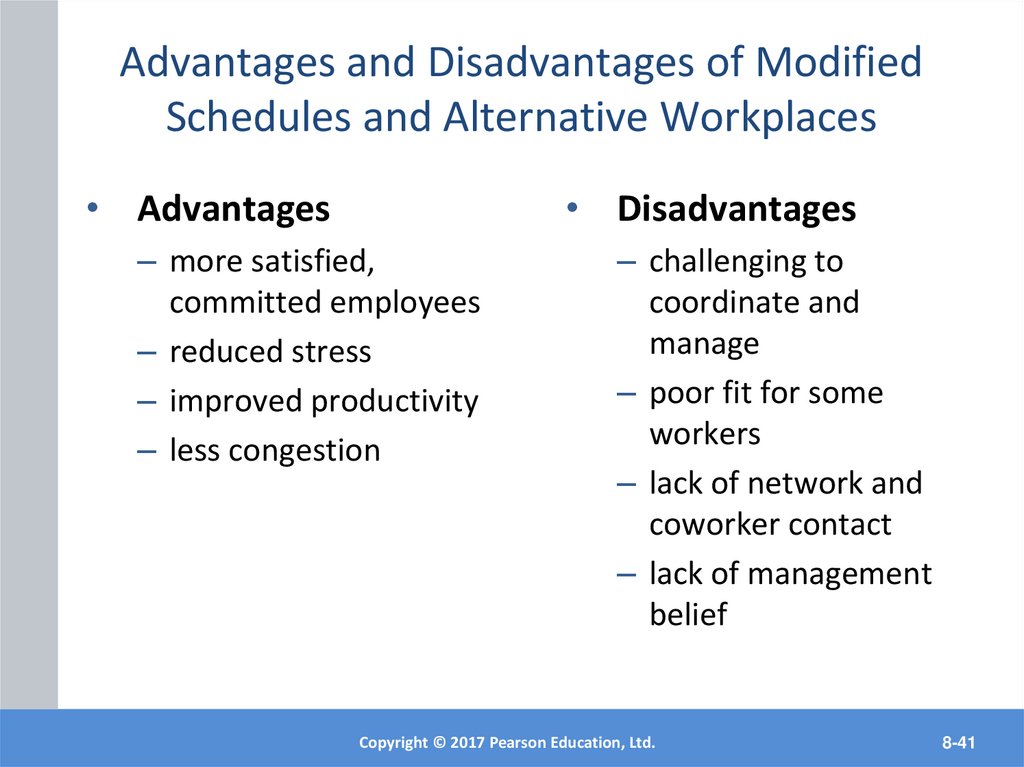
41.
Advantages and Disadvantages of ModifiedSchedules and Alternative Workplaces
• Advantages
• Disadvantages
– more satisfied,
committed employees
– reduced stress
– improved productivity
– less congestion
– challenging to
coordinate and
manage
– poor fit for some
workers
– lack of network and
coworker contact
– lack of management
belief
Copyright©
©2017
2012Pearson
PearsonEducation,
Education, Ltd.
Inc.
Copyright
Publishing as Prentice Hall
8-41
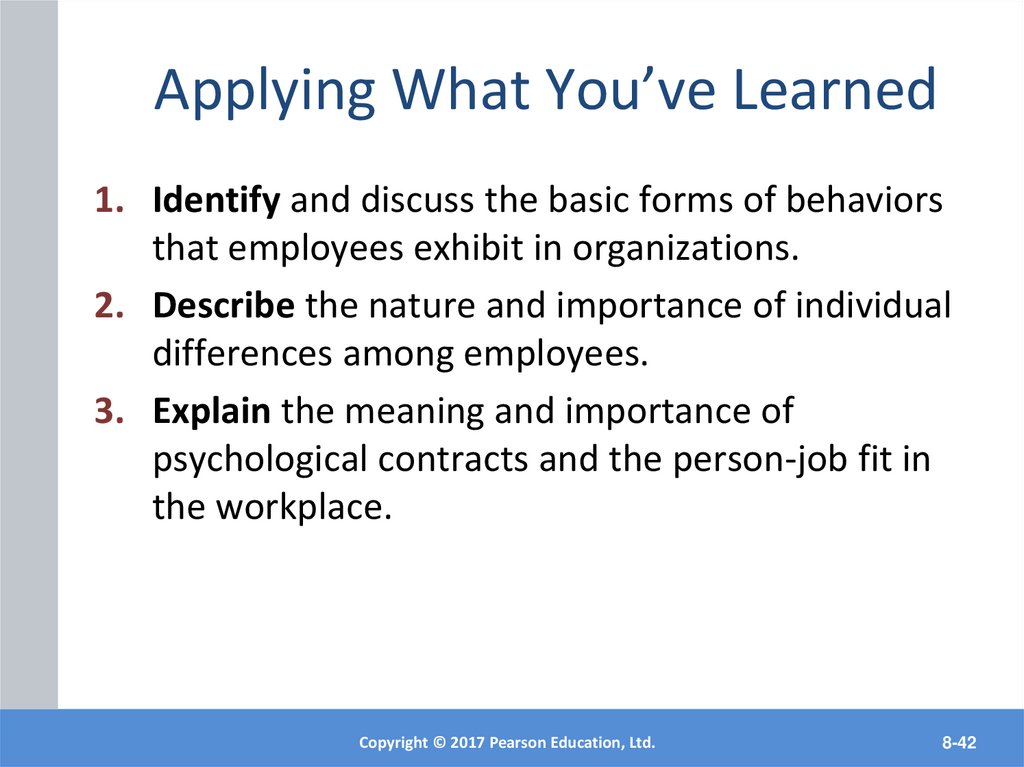
42.
Applying What You’ve Learned1. Identify and discuss the basic forms of behaviors
that employees exhibit in organizations.
2. Describe the nature and importance of individual
differences among employees.
3. Explain the meaning and importance of
psychological contracts and the person-job fit in
the workplace.
Copyright©
©2017
2012Pearson
PearsonEducation,
Education, Ltd.
Inc.
Copyright
Publishing as Prentice Hall
8-42
43.
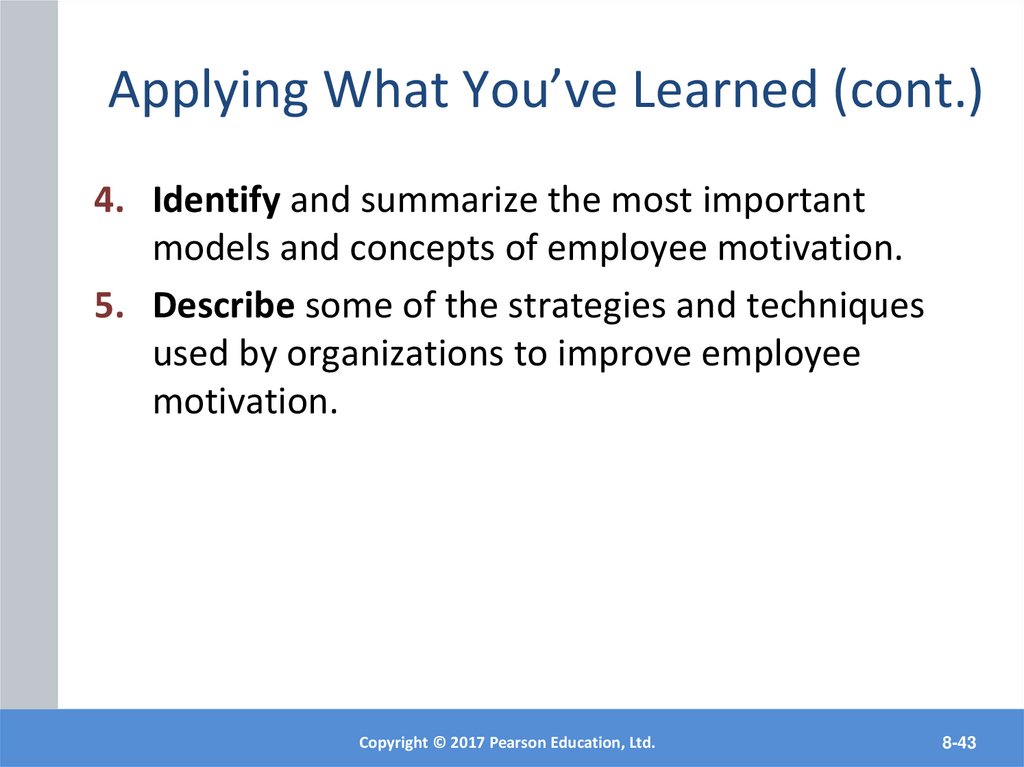
Applying What You’ve Learned (cont.)4. Identify and summarize the most important
models and concepts of employee motivation.
5. Describe some of the strategies and techniques
used by organizations to improve employee
motivation.
Copyright©
©2017
2012Pearson
PearsonEducation,
Education, Ltd.
Inc.
Copyright
Publishing as Prentice Hall
8-43