


 Маркетинг
Похожие презентации:









Nanjing Maijia Technology Co., Ltd
1.
2.
Nanjing Maijia Technology Co., Ltd. is a professional institutionsp eci al i z i ng i n t he re s earch and proce ss re s earch a nd
development of oil/ heavy oil/ cold recovery additives. Our
company absorbs international advanced oil extraction technology,
and has a R & D team composed of experts in the industry to
cooperate with Nanjing University and other professional
institutes, with many years of industry experience and a large
number of technical data accumulation.
Our company focuses on the process design, program
development, product research and development of heavy oil
exploitation. The company has dozens of professionals (1 scholar
from the Institut Française, 8 doctors, 18 masters) for a long time,
and has a long-term cooperative relationship with the Institut
Française. Welcome industry colleagues, cooperation, share our
scientific and technological achievements, and contribute to the
development of the world!
Our mission, make oil heavy oil extraction no longer worry!
3.
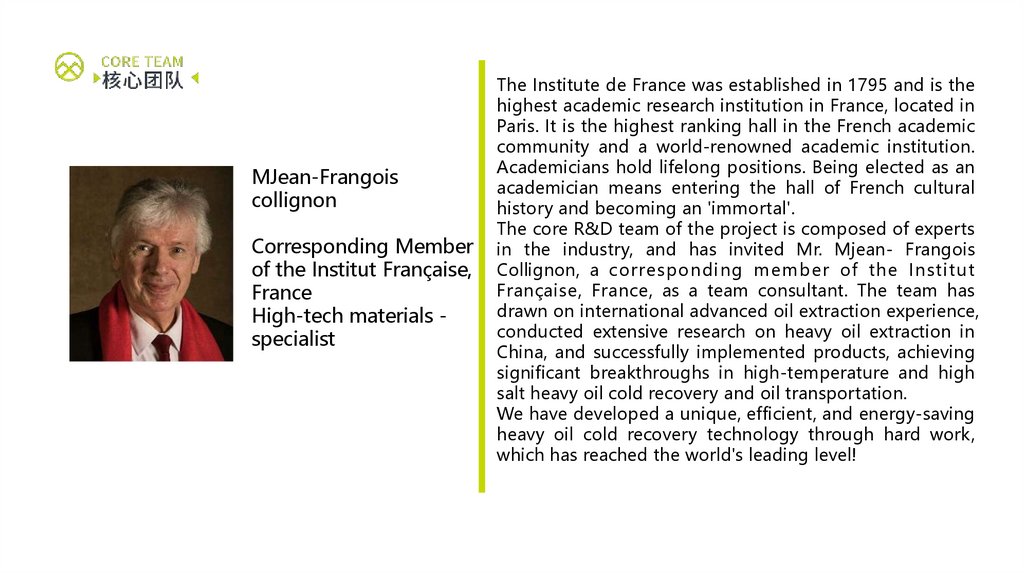
MJean-Frangoiscollignon
Corresponding Member
of the Institut Française,
France
High-tech materials specialist
The Institute de France was established in 1795 and is the
highest academic research institution in France, located in
Paris. It is the highest ranking hall in the French academic
community and a world-renowned academic institution.
Academicians hold lifelong positions. Being elected as an
academician means entering the hall of French cultural
history and becoming an 'immortal'.
The core R&D team of the project is composed of experts
in the industry, and has invited Mr. Mjean- Frangois
Collignon, a corresponding member of the Institut
Française, France, as a team consultant. The team has
drawn on international advanced oil extraction experience,
conducted extensive research on heavy oil extraction in
China, and successfully implemented products, achieving
significant breakthroughs in high-temperature and high
salt heavy oil cold recovery and oil transportation.
We have developed a unique, efficient, and energy-saving
heavy oil cold recovery technology through hard work,
which has reached the world's leading level!
4.
High Amphiphilic Heavy OilViscosity Reducer: Research
Background
• Heavy oil has high viscosity, which leads to
poor fluidity, making it difficult to extract
and transport. Traditional methods for
heavy oil extraction are mostly thermal
recover y, which involves using high
temperatures to break the hydrogen bonds
between molecules, thereby reducing the
viscosity of heavy oil and improving its
fluidity. However, in the context of
achieving the national and industry "dual
carbon" goals, traditional thermal recovery
methods face significant pressure to
reduce emissions and there is an urgent
need for technological upgrades.
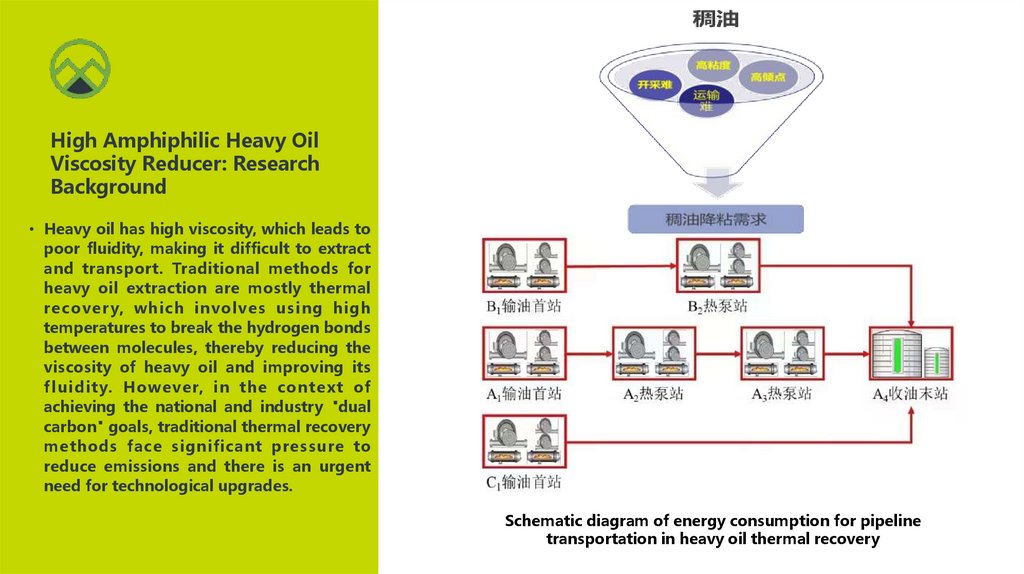
Schematic diagram of energy consumption for pipeline
transportation in heavy oil thermal recovery
5.
High Amphiphilic Heavy OilViscosity Reducer: Research
Background
2021 China Petroleum Heavy Oil Production Composition Chart
6.
Heavy oil extraction and transportation is a long-term national industrial strategy and akey way to increase oil production.
Heavy oil in the world
Heavy oil accounts for a significant proportion of the
world's oil and gas resources, ultra heavy oil, and oil
sands worldwide, with proven reserves of 100 billion tons
of heavy oil,
With the development of petroleum exploration
technology, the geological reserves of proven heavy oil,
ultra heavy oil, and oil sands continue to steadily
increase.
According to data from the United States Geological
Survey, the estimated total amount of recoverable heavy
oil worldwide is approximately 400 billion tons.
Countries with abundant heavy oil resources include
Canada and Venezuela, and China also has considerable
reserves of oil resources. How to effectively extract
heavy oil and turn it into usable reserves is a problem
faced by the global petroleum industry.
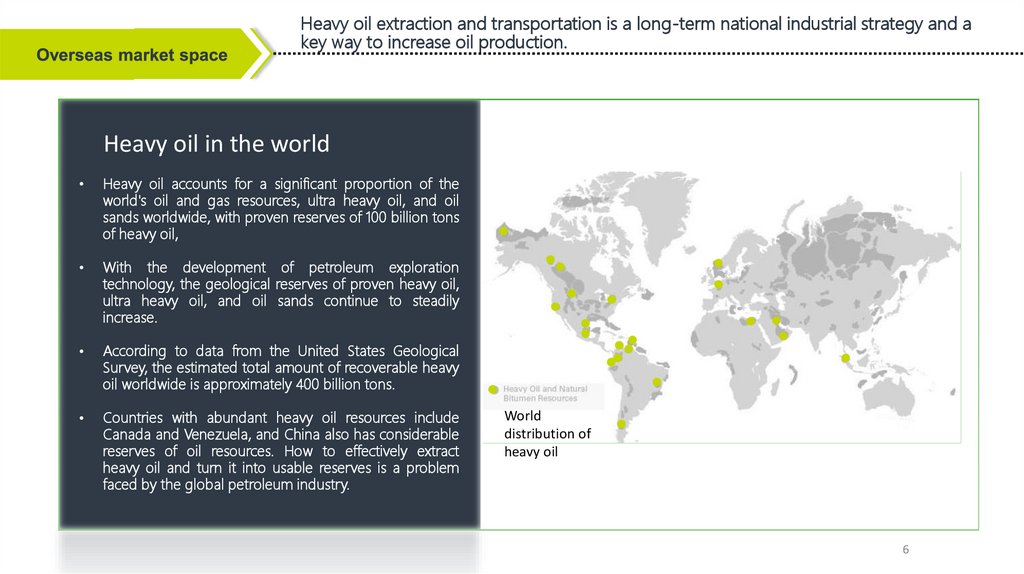
World
distribution of
heavy oil
6
7.
Heavy oil extraction and transportation is a long-term national industrial strategy,and it is also a key way to increase oil production
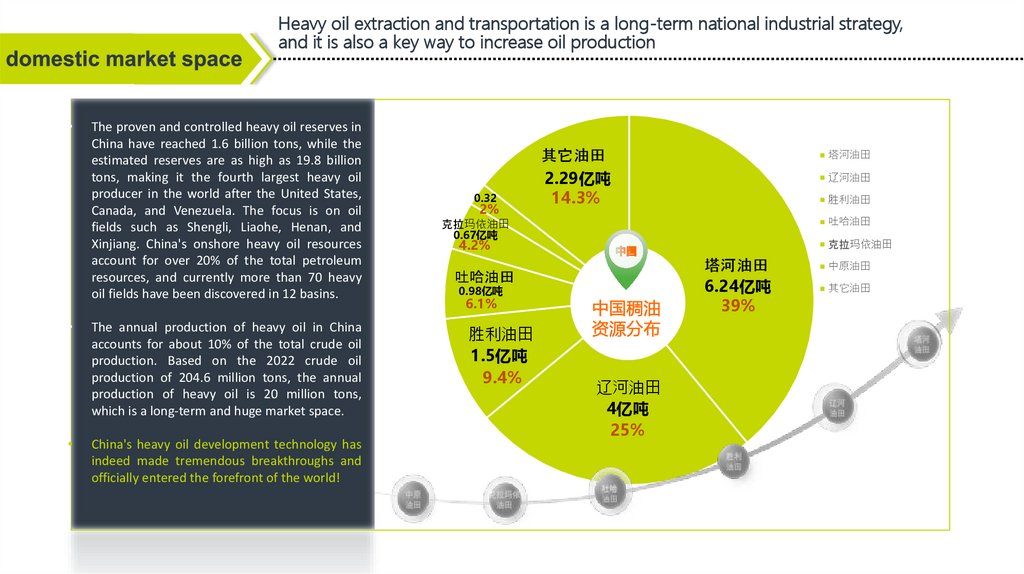
The proven and controlled heavy oil reserves in
China have reached 1.6 billion tons, while the
estimated reserves are as high as 19.8 billion
tons, making it the fourth largest heavy oil
producer in the world after the United States,
Canada, and Venezuela. The focus is on oil
fields such as Shengli, Liaohe, Henan, and
Xinjiang. China's onshore heavy oil resources
account for over 20% of the total petroleum
resources, and currently more than 70 heavy
oil fields have been discovered in 12 basins.
稠油在中国
The annual production of heavy oil in China
accounts for about 10% of the total crude oil
production. Based on the 2022 crude oil
production of 204.6 million tons, the annual
production of heavy oil is 20 million tons,
which is a long-term and huge market space.
China's heavy oil development technology has
indeed made tremendous breakthroughs and
officially entered the forefront of the world!
0.32
2%
其它油田
2.29亿吨
14.3%
塔河油田
辽河油田
胜利油田
吐哈油田
克拉玛依油田
0.67亿吨
4.2%
克拉玛依油田
吐哈油田
0.98亿吨
6.1%
胜利油田
1.5亿吨
9.4%
中国稠油
资源分布
辽河油田
4亿吨
25%
塔河油田
6.24亿吨
39%
中原油田
其它油田
8.
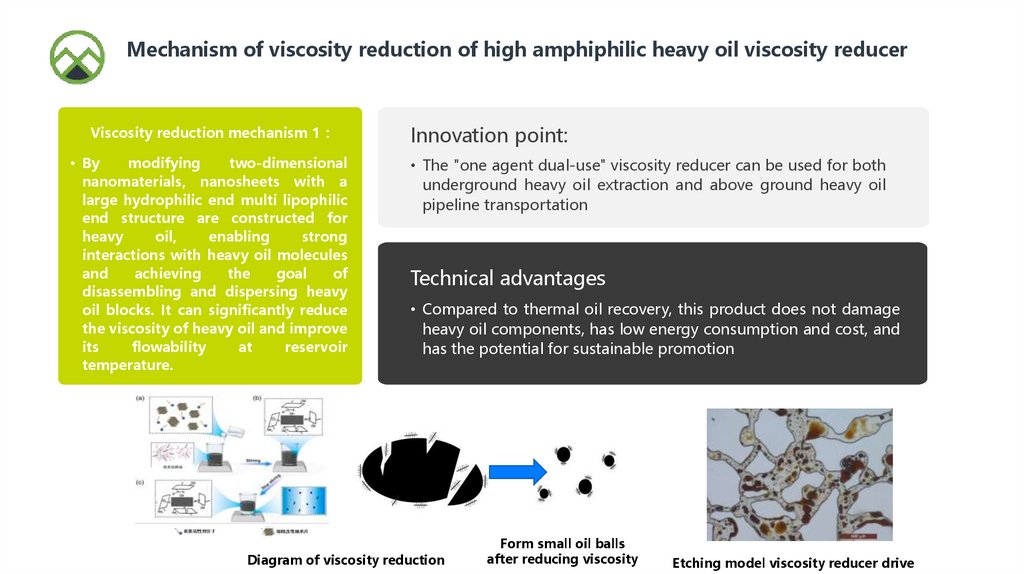
Mechanism of viscosity reduction of high amphiphilic heavy oil viscosity reducerViscosity reduction mechanism 1
• By
modifying
two-dimensional
nanomaterials, nanosheets with a
large hydrophilic end multi lipophilic
end structure are constructed for
heavy
oil,
enabling
strong
interactions with heavy oil molecules
and
achieving
the
goal
of
disassembling and dispersing heavy
oil blocks. It can significantly reduce
the viscosity of heavy oil and improve
its
flowability
at
reservoir
temperature.
Innovation point:
• The "one agent dual-use" viscosity reducer can be used for both
underground heavy oil extraction and above ground heavy oil
pipeline transportation
Technical advantages
• Compared to thermal oil recovery, this product does not damage
heavy oil components, has low energy consumption and cost, and
has the potential for sustainable promotion
Diagram of viscosity reduction
Form small oil balls
after reducing viscosity
Etching model viscosity reducer drive
9.
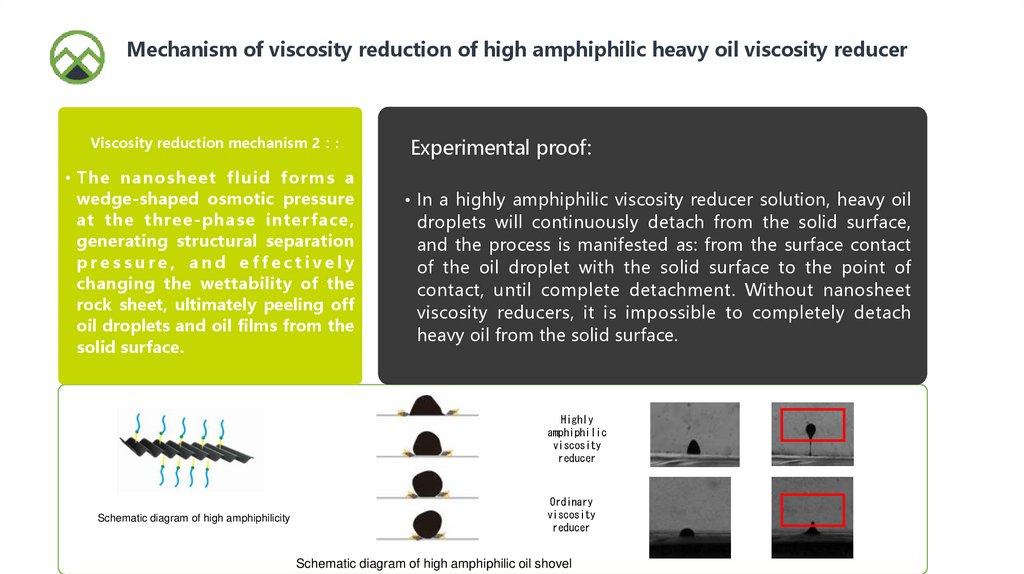
Mechanism of viscosity reduction of high amphiphilic heavy oil viscosity reducerViscosity reduction mechanism 2 :
• The nanosheet fluid forms a
wedge-shaped osmotic pressure
at the three-phase inter face,
generating structural separation
pressure, and effectively
changing the wettability of the
rock sheet, ultimately peeling off
oil droplets and oil films from the
solid surface.
Experimental proof:
• In a highly amphiphilic viscosity reducer solution, heavy oil
droplets will continuously detach from the solid surface,
and the process is manifested as: from the surface contact
of the oil droplet with the solid surface to the point of
contact, until complete detachment. Without nanosheet
viscosity reducers, it is impossible to completely detach
heavy oil from the solid surface.
Highly
amphiphilic
viscosity
reducer
Schematic diagram of high amphiphilicity
Ordinary
viscosity
reducer
Schematic diagram of high amphiphilic oil shovel
10.
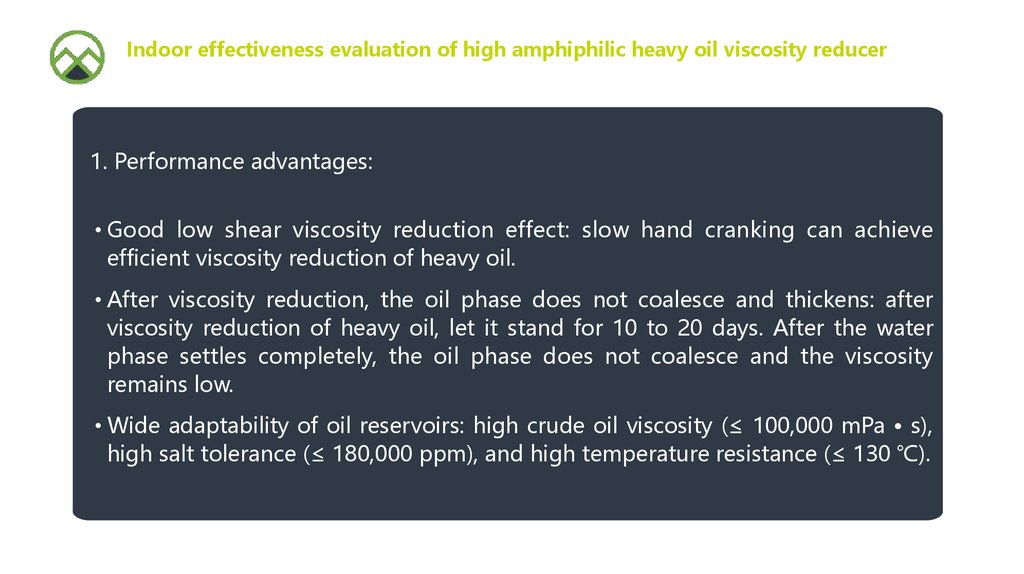
Indoor effectiveness evaluation of high amphiphilic heavy oil viscosity reducer1. Performance advantages:
• Good low shear viscosity reduction effect: slow hand cranking can achieve
efficient viscosity reduction of heavy oil.
• After viscosity reduction, the oil phase does not coalesce and thickens: after
viscosity reduction of heavy oil, let it stand for 10 to 20 days. After the water
phase settles completely, the oil phase does not coalesce and the viscosity
remains low.
• Wide adaptability of oil reservoirs: high crude oil viscosity (≤ 100,000 mPa • s),
high salt tolerance (≤ 180,000 ppm), and high temperature resistance (≤ 130 ℃).
11.
Indoor effectiveness evaluation of high amphiphilic heavy oil viscosity reducerHigh
amphiphilic
viscosity
reducer
system
Similar nano
viscosity
reducer
products
Strong shear (mechanical agitator,
50°C, 400 rpm) viscosity reduction
Viscosity
reduction Weak shear (constant temperature
Antimerging
Viscosity
reduction
Antimerging
≥98%
shaking box, 50°C, 120 frequency/min)
viscosity reduction
≥95%
Heavy oil after viscosity reduction,
50°C, leave for 24 hours
No resticking
Crude oil
viscosity
1,000~5,000
Strong shear (mechanical agitator,
mPa•s
50°C, 400 rpm) viscosity reduction
Weak shear (constant temperature
shaking box, 50 °C, 120 fpm.)
Heavy oil after viscosity reduction,
50°C, leave for 24 hours
2. Comparison with similar properties:
≥95%
Viscosity
reduction
cannot be
achieved
Returns the
initial
viscosity
Contrast
product, weak
shear (handheld shaking)
Graphene
viscosity reducer,
weak shear
(hand-held
shaking)
• Compared with similar products, the developed high amphiphilic viscosity reducer system can effectively
reduce the viscosity of heavy oil under low shear force, which is more in line with the actual situation of
oil displacement agent migration in the reservoir.
12.
Indoor effectiveness evaluation of high amphiphilic heavy oil viscosity reducerNo.
High
amphiphilic
viscosity
reducer
concentrati
on/%
1
Time
/day
0
2
10
0.4
3
4
Initial
viscosity
of heavy
oil
20
30
Viscosity
of heavy
oil after
viscosity
reduction
/mPa.s
Phenomenon after viscosity
reduction
28.64
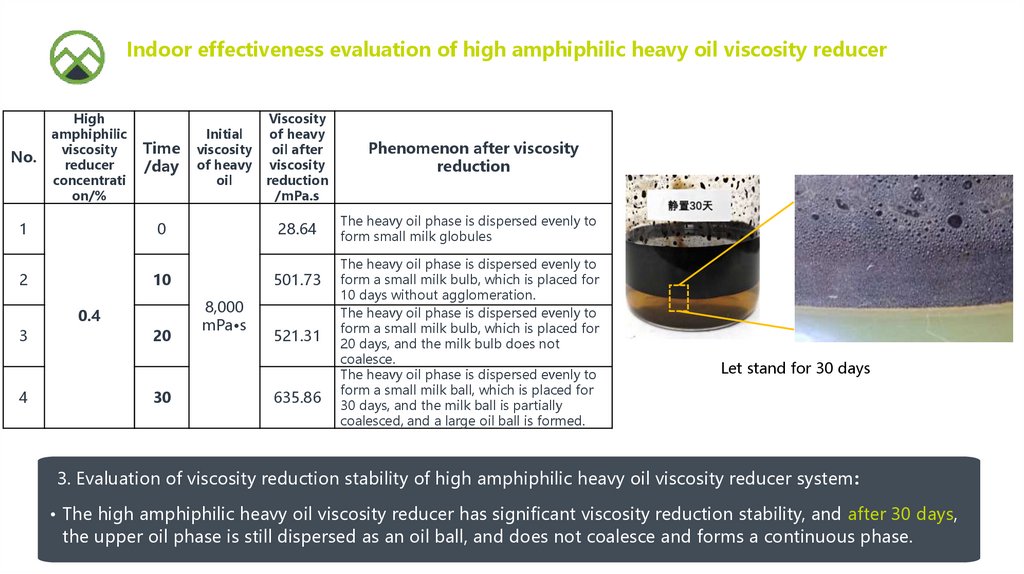
The heavy oil phase is dispersed evenly to
form small milk globules
501.73
8,000
mPa•s
521.31
635.86
The heavy oil phase is dispersed evenly to
form a small milk bulb, which is placed for
10 days without agglomeration.
The heavy oil phase is dispersed evenly to
form a small milk bulb, which is placed for
20 days, and the milk bulb does not
coalesce.
The heavy oil phase is dispersed evenly to
form a small milk ball, which is placed for
30 days, and the milk ball is partially
coalesced, and a large oil ball is formed.
Let stand for 30 days
3. Evaluation of viscosity reduction stability of high amphiphilic heavy oil viscosity reducer system:
• The high amphiphilic heavy oil viscosity reducer has significant viscosity reduction stability, and after 30 days,
the upper oil phase is still dispersed as an oil ball, and does not coalesce and forms a continuous phase.
13.
Indoor effectiveness evaluation of high amphiphilicheavy oil viscosity reducer
Viscosity of
High
Initial
Experi
heavy oil after
amphiphilic viscosity of
mental
viscosity
viscosity
heavy
group
reduction
reducer%
oil/mPa.s
/mPa.s
The viscosity
of heavy oil is
reduced and
left for 3
days/mPa.s
1
8,000
36.43
664
2
25,600
48.26
2546
3
11,700
40.92
741
4
100,000
71.72
4910
0.4
Phenomenon after viscosity
reduction
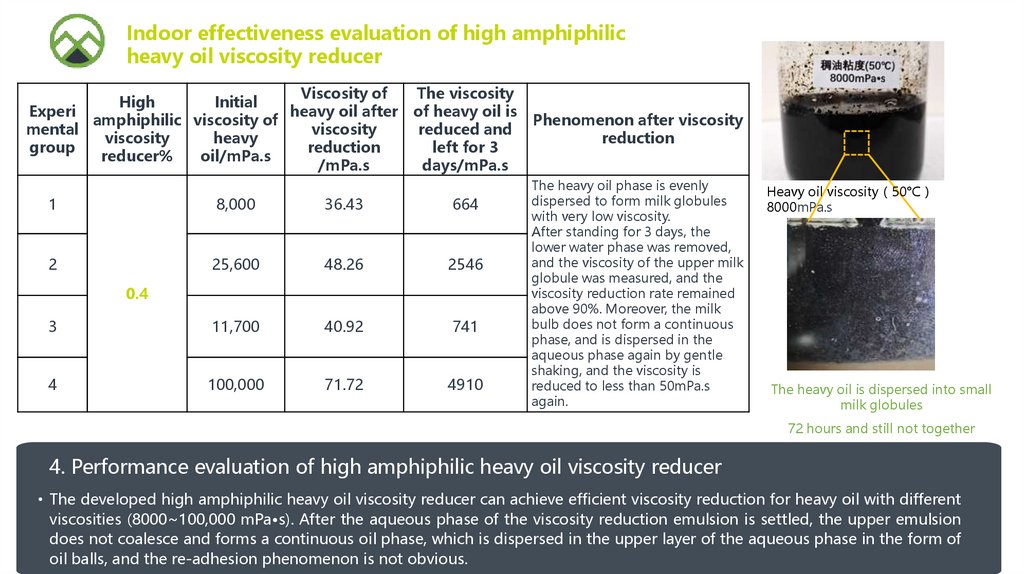
The heavy oil phase is evenly
dispersed to form milk globules
with very low viscosity.
After standing for 3 days, the
lower water phase was removed,
and the viscosity of the upper milk
globule was measured, and the
viscosity reduction rate remained
above 90%. Moreover, the milk
bulb does not form a continuous
phase, and is dispersed in the
aqueous phase again by gentle
shaking, and the viscosity is
reduced to less than 50mPa.s
again.
Heavy oil viscosity 50°C
8000mPa.s
The heavy oil is dispersed into small
milk globules
72 hours and still not together
4. Performance evaluation of high amphiphilic heavy oil viscosity reducer
• The developed high amphiphilic heavy oil viscosity reducer can achieve efficient viscosity reduction for heavy oil with different
viscosities (8000~100,000 mPa•s). After the aqueous phase of the viscosity reduction emulsion is settled, the upper emulsion
does not coalesce and forms a continuous oil phase, which is dispersed in the upper layer of the aqueous phase in the form of
oil balls, and the re-adhesion phenomenon is not obvious.
14.
Indoor effectiveness evaluation of high amphiphilic heavy oil viscosity reducerHigh
amphiphilic
Aging
viscosity
temper
No.
reducer
ature
concentration
/℃
/%
1
2
3
Initial
viscosity
of heavy
oil
100
0.4
120
130
Viscosity of
heavy oil
after
viscosity
reduction
/mPa.s
28.79
8,000
mPa•s
33.51
42.11
24 hours, after the
oil-water
stratification, the
viscosity of the
upper oil/mPa.s
Phenomenon after viscosity reduction
613.82
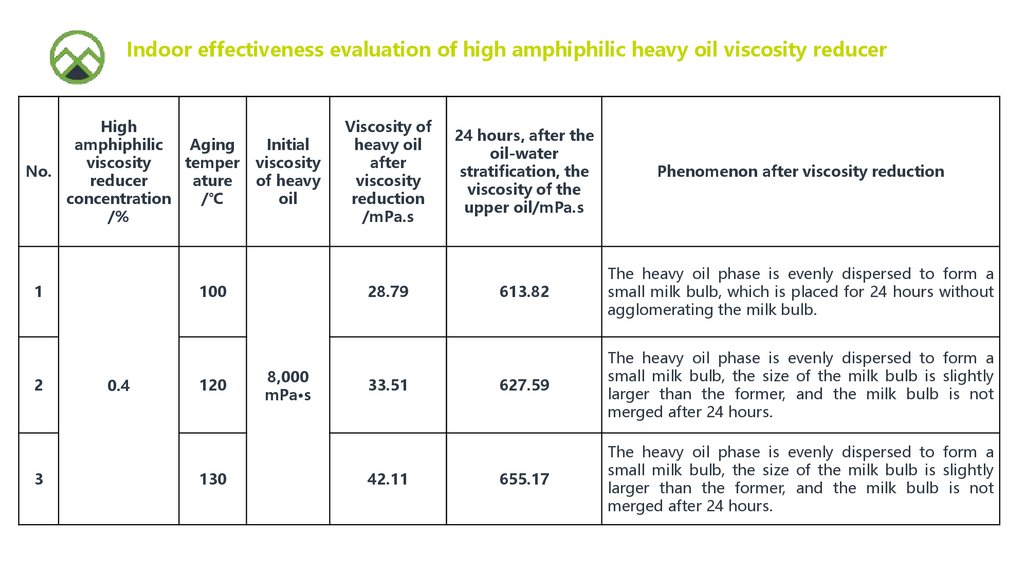
The heavy oil phase is evenly dispersed to form a
small milk bulb, which is placed for 24 hours without
agglomerating the milk bulb.
627.59
The heavy oil phase is evenly dispersed to form a
small milk bulb, the size of the milk bulb is slightly
larger than the former, and the milk bulb is not
merged after 24 hours.
655.17
The heavy oil phase is evenly dispersed to form a
small milk bulb, the size of the milk bulb is slightly
larger than the former, and the milk bulb is not
merged after 24 hours.
15.
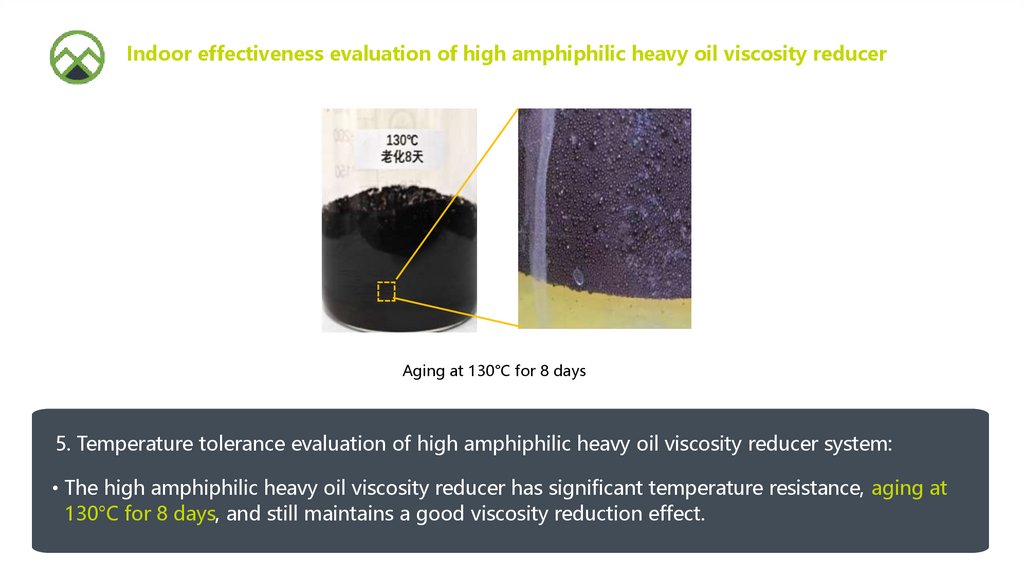
Indoor effectiveness evaluation of high amphiphilic heavy oil viscosity reducerAging at 130°C for 8 days
5. Temperature tolerance evaluation of high amphiphilic heavy oil viscosity reducer system:
• The high amphiphilic heavy oil viscosity reducer has significant temperature resistance, aging at
130°C for 8 days, and still maintains a good viscosity reduction effect.
16.
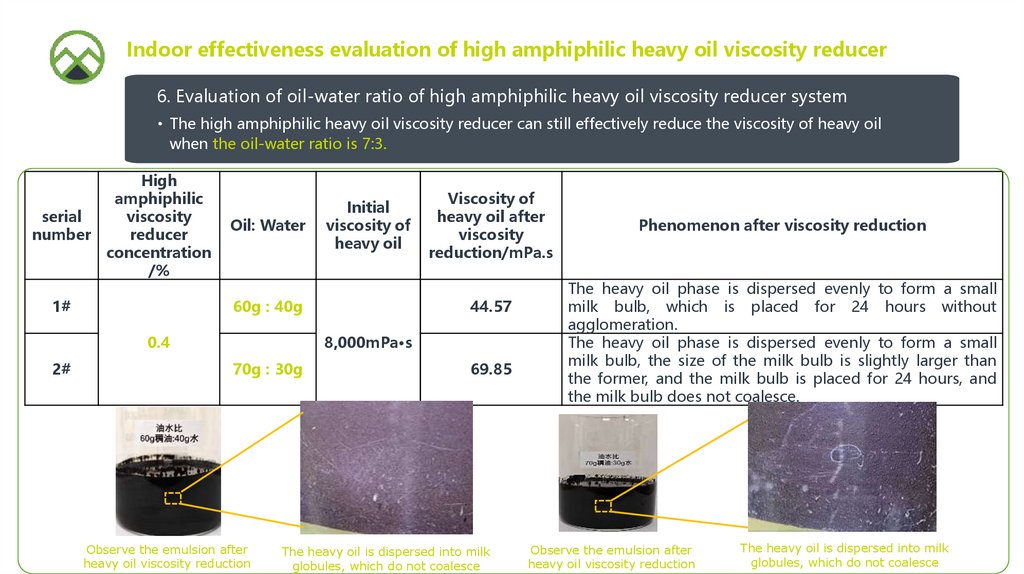
Indoor effectiveness evaluation of high amphiphilic heavy oil viscosity reducer6. Evaluation of oil-water ratio of high amphiphilic heavy oil viscosity reducer system
• The high amphiphilic heavy oil viscosity reducer can still effectively reduce the viscosity of heavy oil
when the oil-water ratio is 7:3.
serial
number
High
amphiphilic
viscosity
reducer
concentration
/%
1#
Oil: Water
60g : 40g
0.4
2#
Initial
viscosity of
heavy oil
Viscosity of
heavy oil after
viscosity
reduction/mPa.s
44.57
8,000mPa•s
70g : 30g
Observe the emulsion after
heavy oil viscosity reduction
69.85
The heavy oil is dispersed into milk
globules, which do not coalesce
Phenomenon after viscosity reduction
The heavy oil phase is dispersed evenly to form a small
milk bulb, which is placed for 24 hours without
agglomeration.
The heavy oil phase is dispersed evenly to form a small
milk bulb, the size of the milk bulb is slightly larger than
the former, and the milk bulb is placed for 24 hours, and
the milk bulb does not coalesce.
Observe the emulsion after
heavy oil viscosity reduction
The heavy oil is dispersed into milk
globules, which do not coalesce
17.
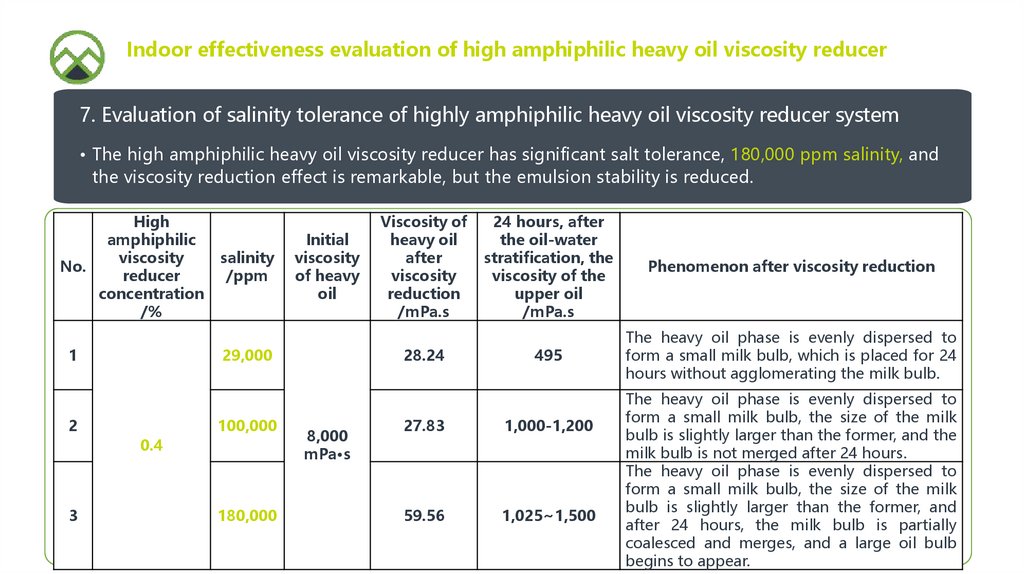
Indoor effectiveness evaluation of high amphiphilic heavy oil viscosity reducer7. Evaluation of salinity tolerance of highly amphiphilic heavy oil viscosity reducer system
• The high amphiphilic heavy oil viscosity reducer has significant salt tolerance, 180,000 ppm salinity, and
the viscosity reduction effect is remarkable, but the emulsion stability is reduced.
High
amphiphilic
viscosity
No.
reducer
concentration
/%
1
2
3
salinity
/ppm
Initial
viscosity
of heavy
oil
29,000
0.4
100,000
180,000
Viscosity of
heavy oil
after
viscosity
reduction
/mPa.s
28.24
8,000
mPa•s
24 hours, after
the oil-water
stratification, the
viscosity of the
upper oil
/mPa.s
Phenomenon after viscosity reduction
495
The heavy oil phase is evenly dispersed to
form a small milk bulb, which is placed for 24
hours without agglomerating the milk bulb.
27.83
1,000-1,200
59.56
1,025~1,500
The heavy oil phase is evenly dispersed to
form a small milk bulb, the size of the milk
bulb is slightly larger than the former, and the
milk bulb is not merged after 24 hours.
The heavy oil phase is evenly dispersed to
form a small milk bulb, the size of the milk
bulb is slightly larger than the former, and
after 24 hours, the milk bulb is partially
coalesced and merges, and a large oil bulb
begins to appear.
18.
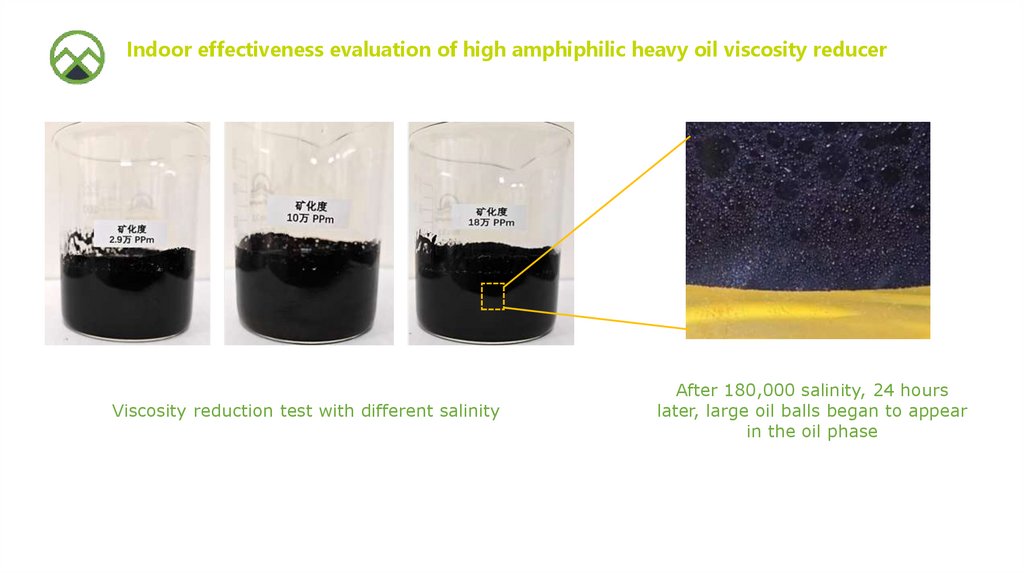
Indoor effectiveness evaluation of high amphiphilic heavy oil viscosity reducerViscosity reduction test with different salinity
After 180,000 salinity, 24 hours
later, large oil balls began to appear
in the oil phase
19.
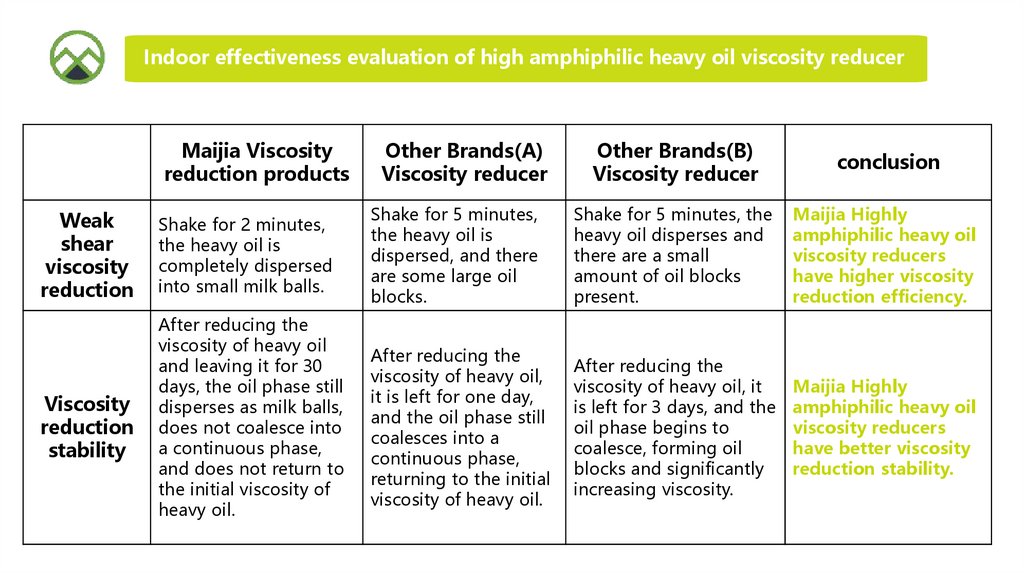
Indoor effectiveness evaluation of high amphiphilic heavy oil viscosity reducerWeak
shear
viscosity
reduction
Viscosity
reduction
stability
Maijia Viscosity
reduction products
Other Brands(A)
Viscosity reducer
Other Brands(B)
Viscosity reducer
conclusion
Shake for 2 minutes,
the heavy oil is
completely dispersed
into small milk balls.
Shake for 5 minutes,
the heavy oil is
dispersed, and there
are some large oil
blocks.
Shake for 5 minutes, the
heavy oil disperses and
there are a small
amount of oil blocks
present.
Maijia Highly
amphiphilic heavy oil
viscosity reducers
have higher viscosity
reduction efficiency.
After reducing the
viscosity of heavy oil,
it is left for one day,
and the oil phase still
coalesces into a
continuous phase,
returning to the initial
viscosity of heavy oil.
After reducing the
viscosity of heavy oil, it
is left for 3 days, and the
oil phase begins to
coalesce, forming oil
blocks and significantly
increasing viscosity.
Maijia Highly
amphiphilic heavy oil
viscosity reducers
have better viscosity
reduction stability.
After reducing the
viscosity of heavy oil
and leaving it for 30
days, the oil phase still
disperses as milk balls,
does not coalesce into
a continuous phase,
and does not return to
the initial viscosity of
heavy oil.
20.
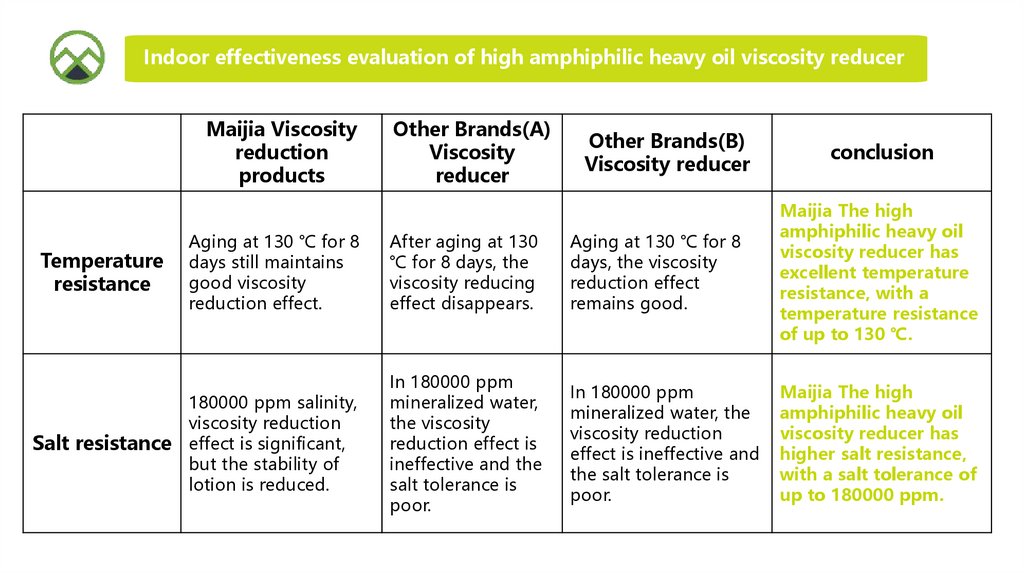
Indoor effectiveness evaluation of high amphiphilic heavy oil viscosity reducerMaijia Viscosity
reduction
products
Temperature
resistance
Salt resistance
Other Brands(A)
Viscosity
reducer
Other Brands(B)
Viscosity reducer
conclusion
Aging at 130 ℃ for 8
days still maintains
good viscosity
reduction effect.
After aging at 130
℃ for 8 days, the
viscosity reducing
effect disappears.
Aging at 130 ℃ for 8
days, the viscosity
reduction effect
remains good.
Maijia The high
amphiphilic heavy oil
viscosity reducer has
excellent temperature
resistance, with a
temperature resistance
of up to 130 ℃.
180000 ppm salinity,
viscosity reduction
effect is significant,
but the stability of
lotion is reduced.
In 180000 ppm
mineralized water,
the viscosity
reduction effect is
ineffective and the
salt tolerance is
poor.
In 180000 ppm
mineralized water, the
viscosity reduction
effect is ineffective and
the salt tolerance is
poor.
Maijia The high
amphiphilic heavy oil
viscosity reducer has
higher salt resistance,
with a salt tolerance of
up to 180000 ppm.
21.
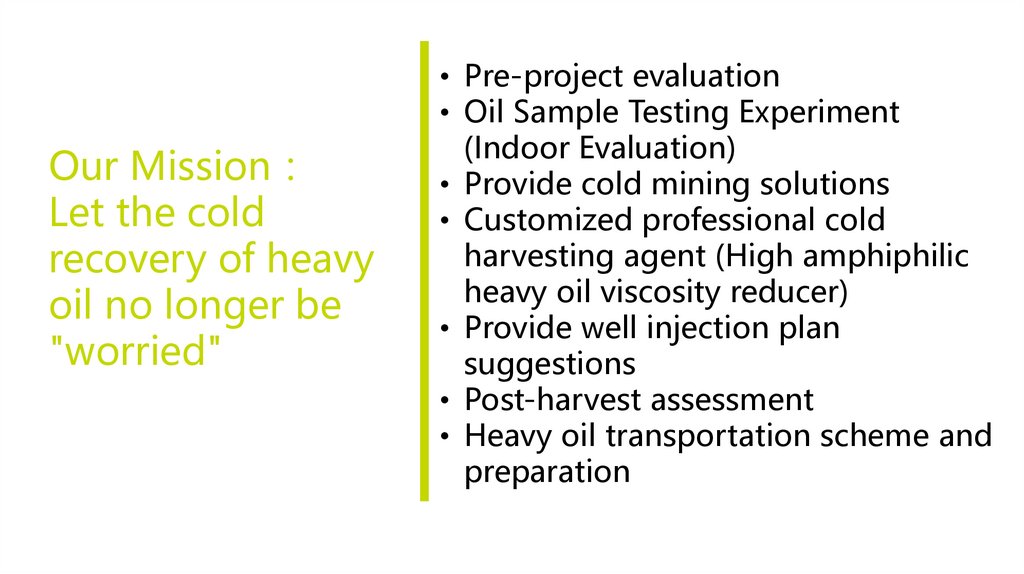
Our MissionLet the cold
recovery of heavy
oil no longer be
"worried"
• Pre-project evaluation
• Oil Sample Testing Experiment
(Indoor Evaluation)
• Provide cold mining solutions
• Customized professional cold
harvesting agent (High amphiphilic
heavy oil viscosity reducer)
• Provide well injection plan
suggestions
• Post-harvest assessment
• Heavy oil transportation scheme and
preparation
22.
高两亲性稠油降粘剂石油稠油冷采