



 Бизнес
Похожие презентации:






Corporate Strategy
1.
Corporate Strategy2. Models of Corporate Influence
Catherine Magelssen
London Business School
April 30, 2018
2.
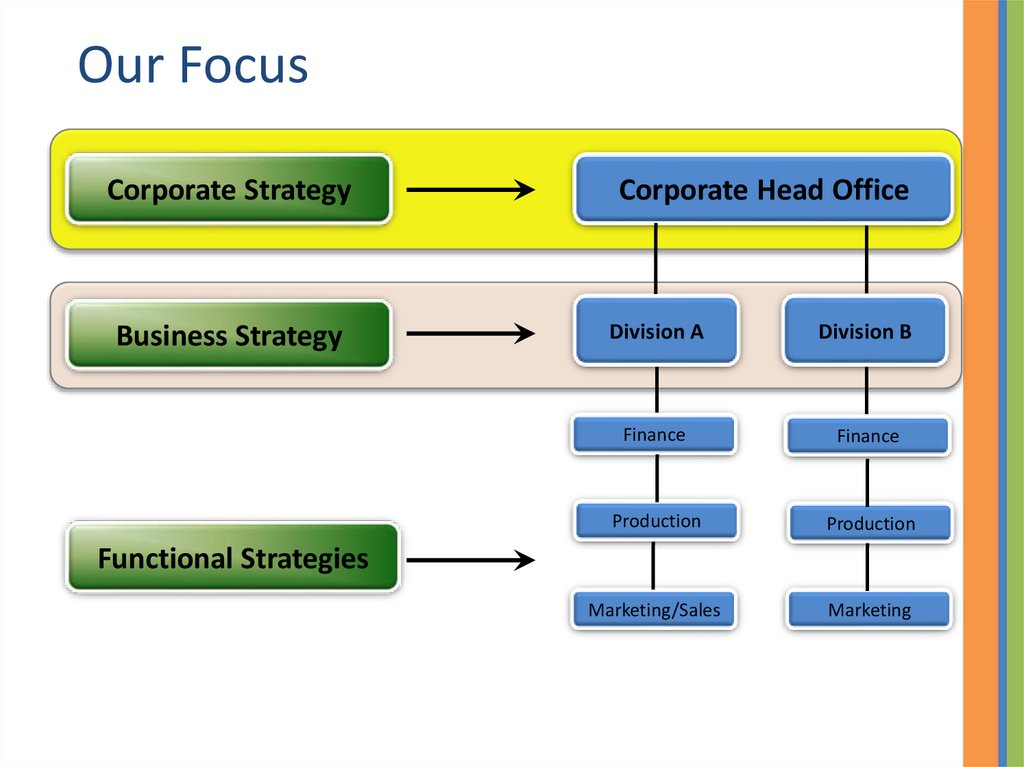
Our FocusCorporate Strategy
Corporate Head Office
Business Strategy
Division A
Division B
Finance
Finance
Production
Production
Marketing/Sales
Marketing
Functional Strategies
3.
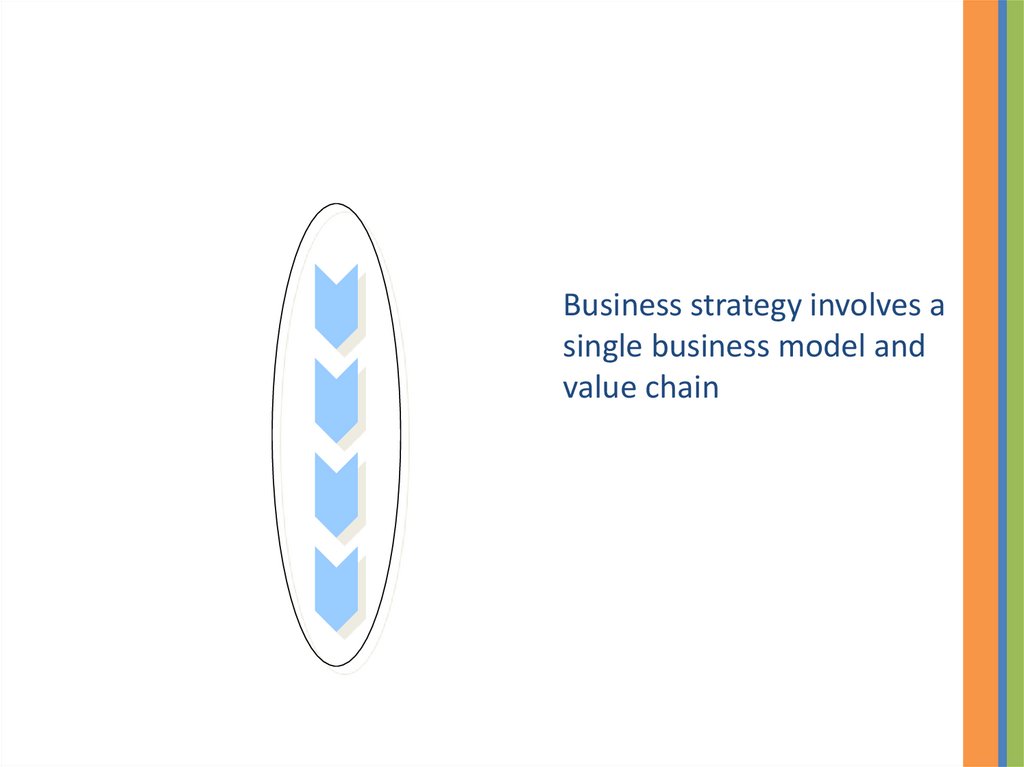
Business strategy involves asingle business model and
value chain
4.
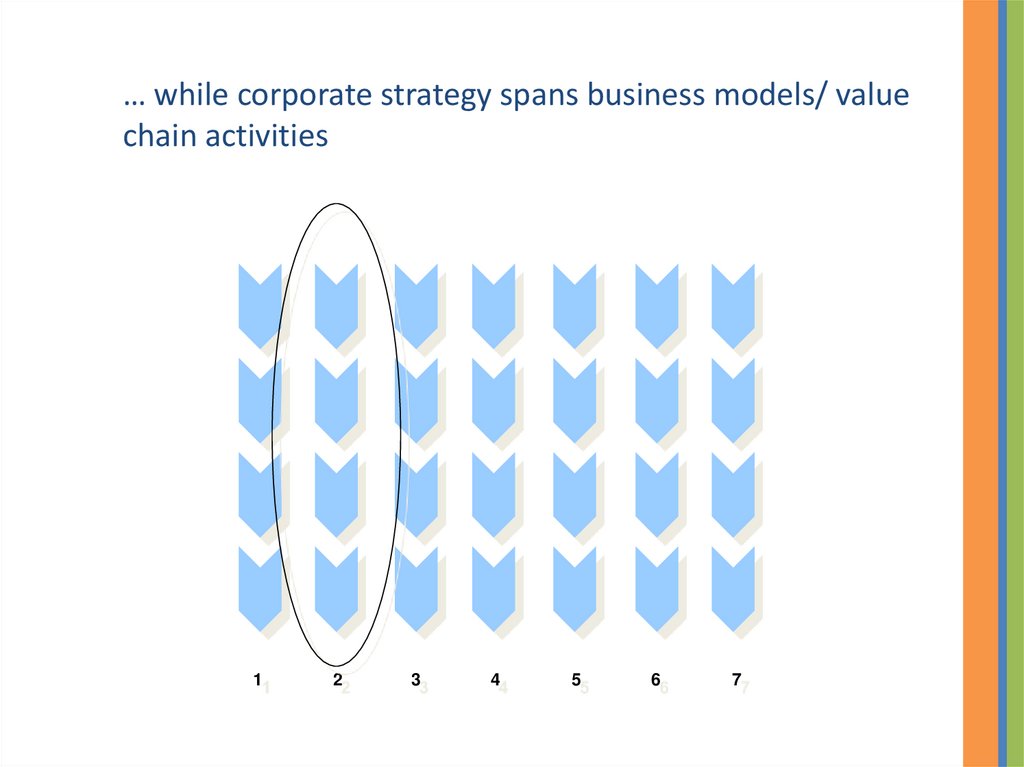
… while corporate strategy spans business models/ valuechain activities
1
2
3
4
5
6
7
5.
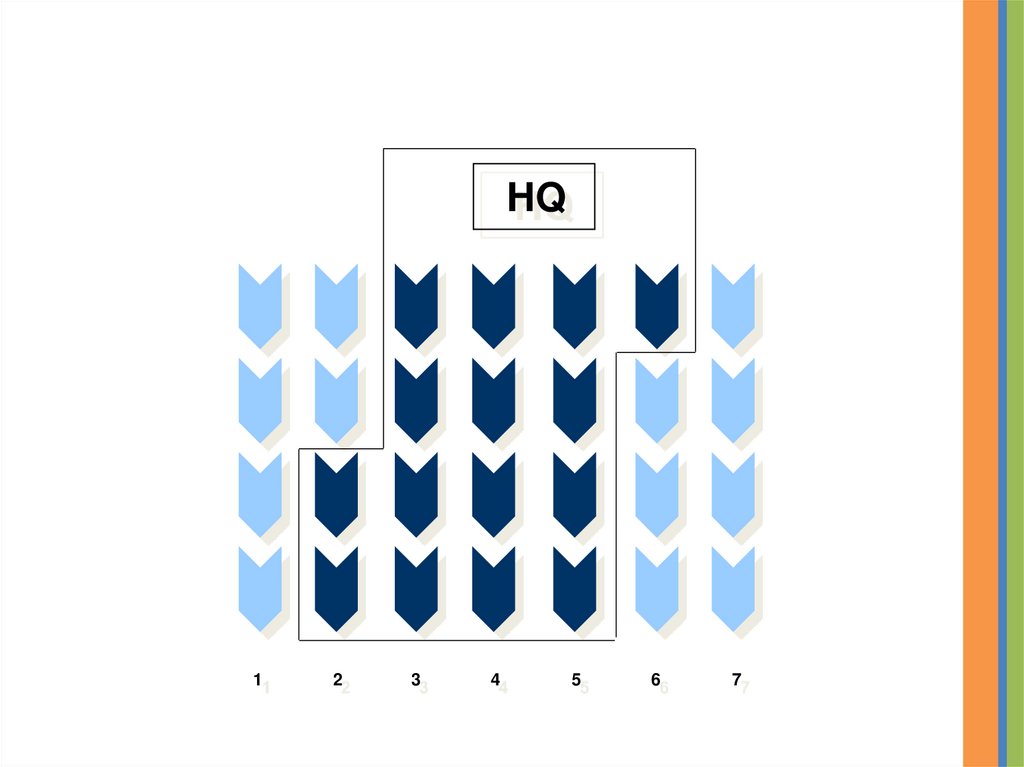
HQ1
2
3
4
5
6
7
6.
A corporation is a portfolio of value chainactivities
Corporate advantage exists if portfolio
performance exceeds the sum of performance
of individual activities
7.
1. All strategy depends on marketimperfections.
In addition to the market imperfections you looked at in core
strategy (e.g. barriers to entry), important market
imperfections in corporate strategy are
capital market imperfections (which help some firms grow
faster than others),
imperfect human resource markets (which help some firms
gain talent more cheaply than others),
and political capital (which give some firms privileged
rights to operate).
8.
2. Strategy is easy for incumbents whenmarket imperfections are high.
In the 50s-70s, Grand Met could acquire multiple companies
without doing anything to add value to their operations.
As capital markets became more perfect, adding value
through operational improvements became imperative.
9.
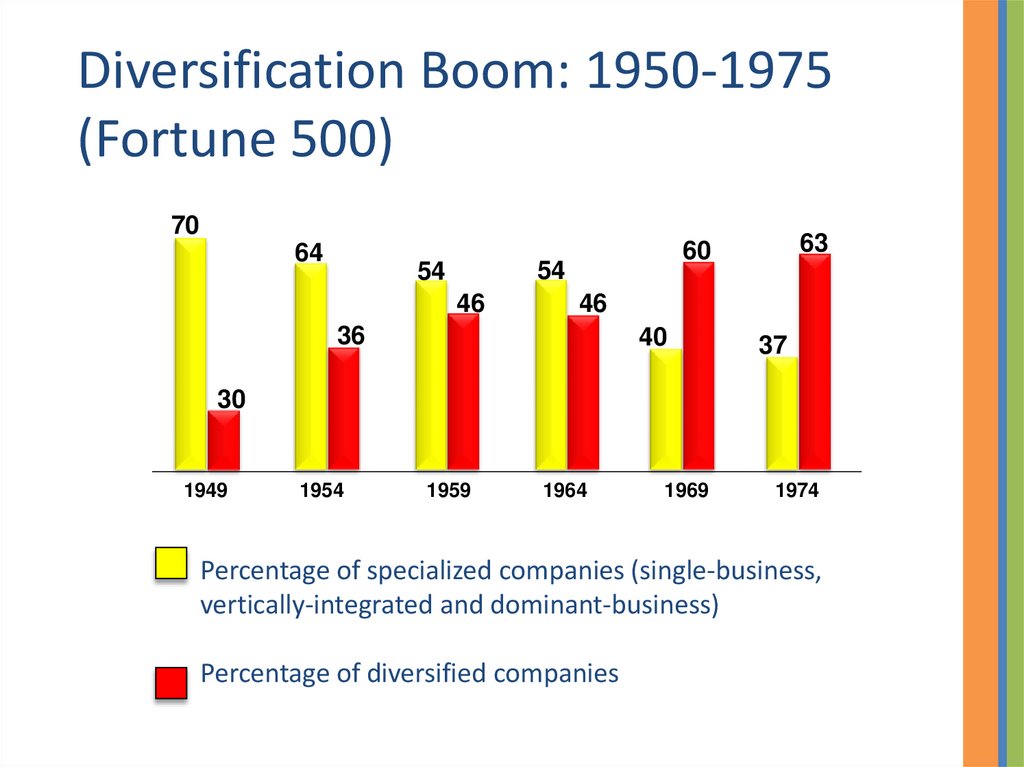
Diversification Boom: 1950-1975(Fortune 500)
70
64
54
54
46
63
60
46
36
40
37
30
1949
1954
1959
1964
1969
1974
Percentage of specialized companies (single-business,
vertically-integrated and dominant-business)
Percentage of diversified companies
10.
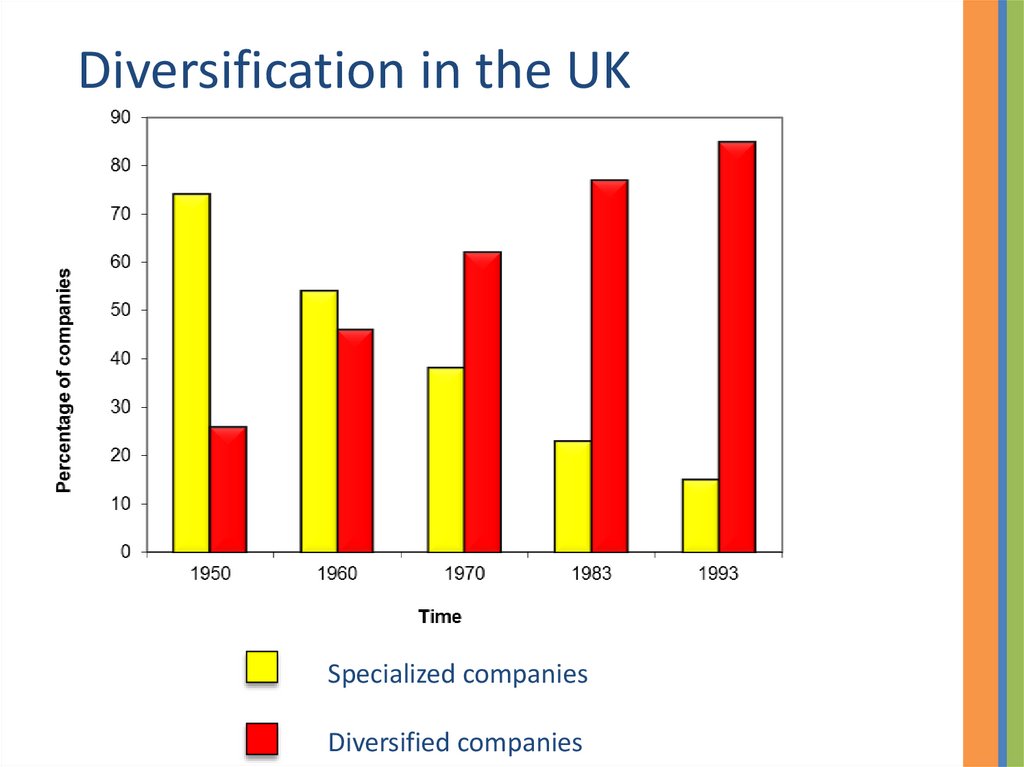
Diversification in the UKSpecialized companies
Diversified companies
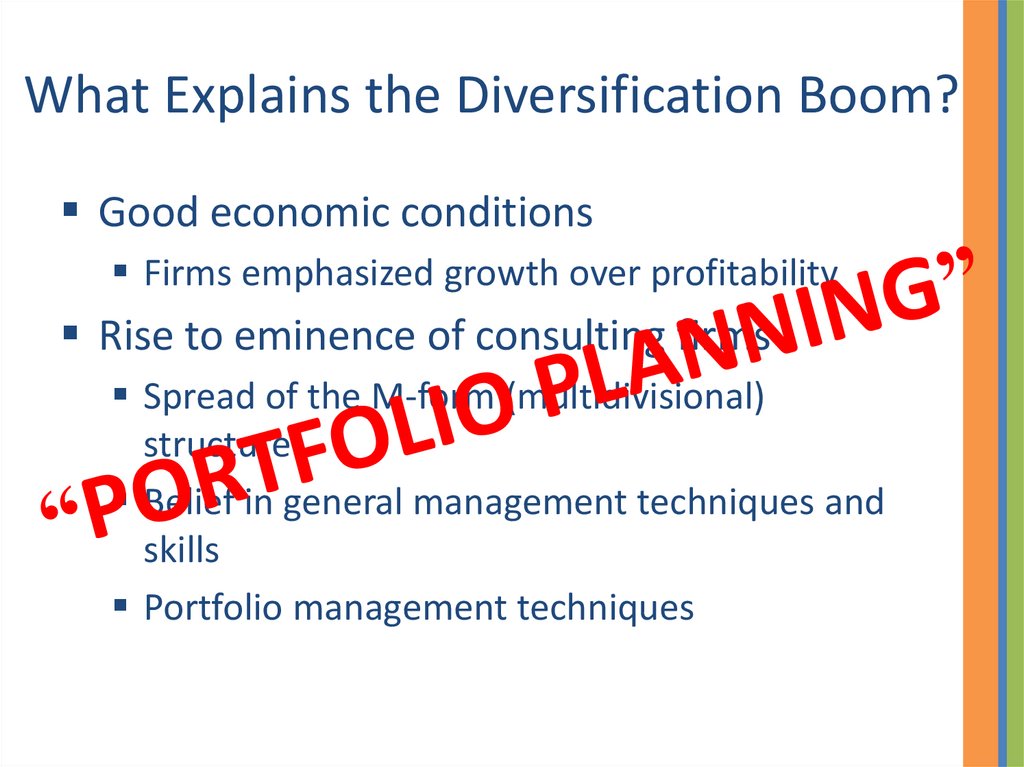
11. What Explains the Diversification Boom?
Good economic conditionsFirms emphasized growth over profitability
Rise to eminence of consulting firms
Spread of the M-form (multidivisional)
structure
Belief in general management techniques and
skills
Portfolio management techniques
12.
The 1970s13.
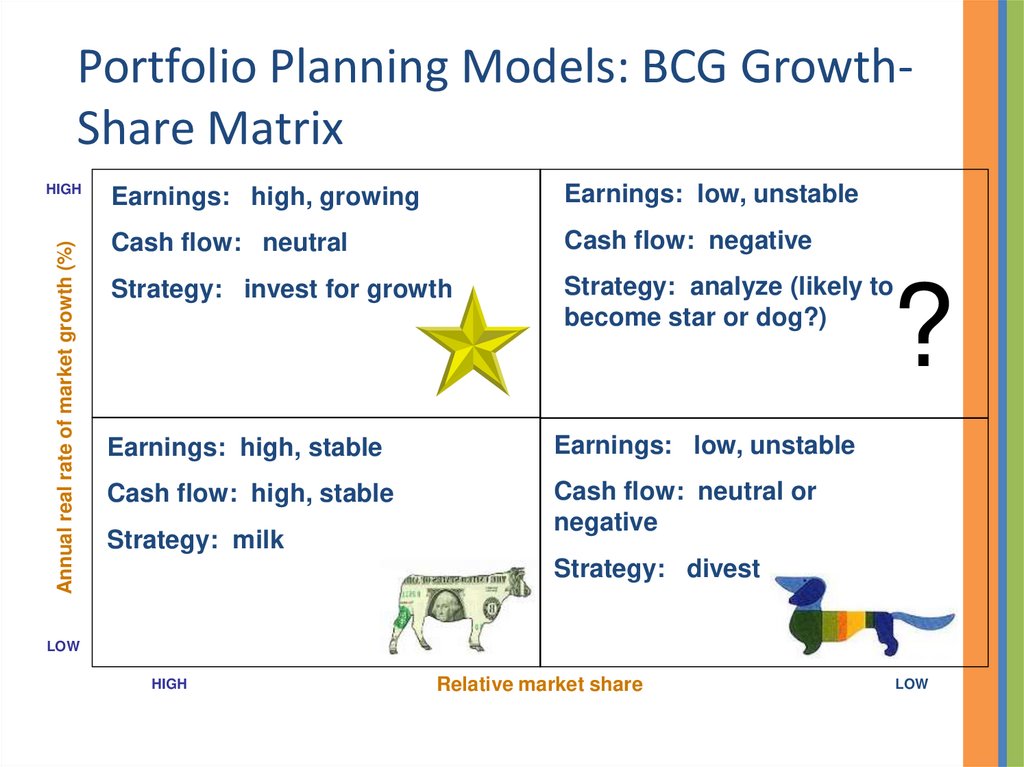
Portfolio Planning Models: BCG GrowthShare MatrixAnnual real rate of market growth (%)
HIGH
Earnings: high, growing
Earnings: low, unstable
Cash flow: neutral
Cash flow: negative
Strategy: invest for growth
Strategy: analyze (likely to
become star or dog?)
Earnings: high, stable
Earnings: low, unstable
Cash flow: high, stable
Cash flow: neutral or
negative
Strategy: milk
?
Strategy: divest
LOW
HIGH
Relative market share
LOW
14.
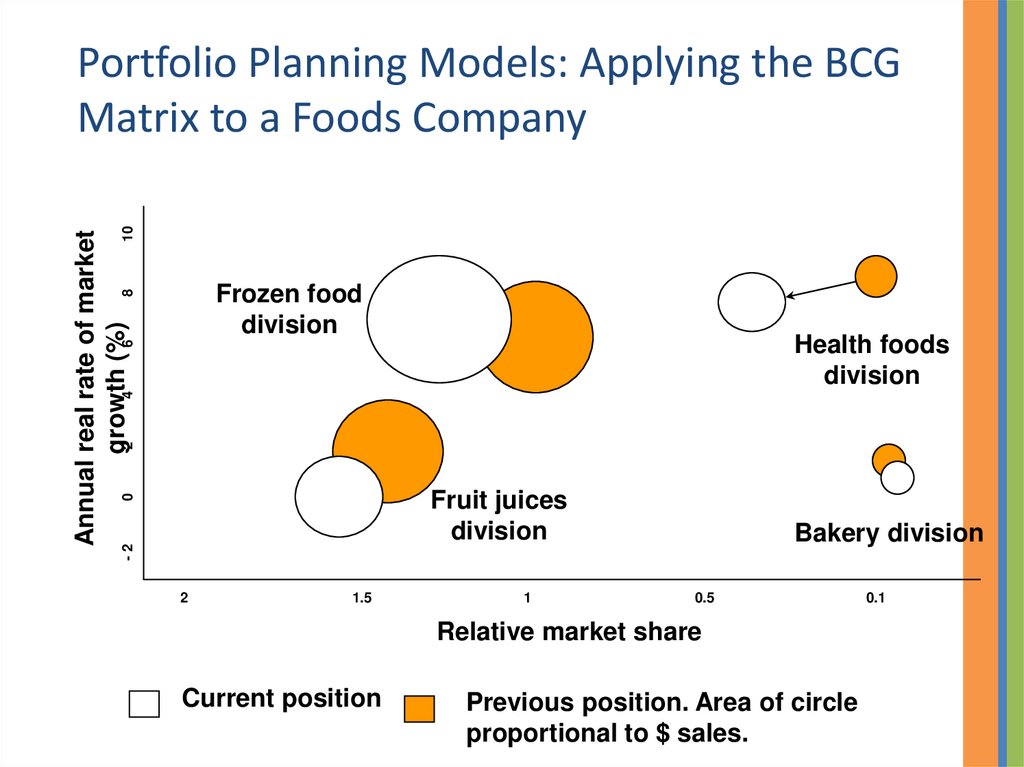
Annual real rate of market(%)
growth
10
8
6
4
2
0
-2
Portfolio Planning Models: Applying the BCG
Matrix to a Foods Company
Frozen food
division
Health foods
division
Fruit juices
division
2
1.5
1
Bakery division
0.5
Relative market share
Current position
Previous position. Area of circle
proportional to $ sales.
0.1
15.
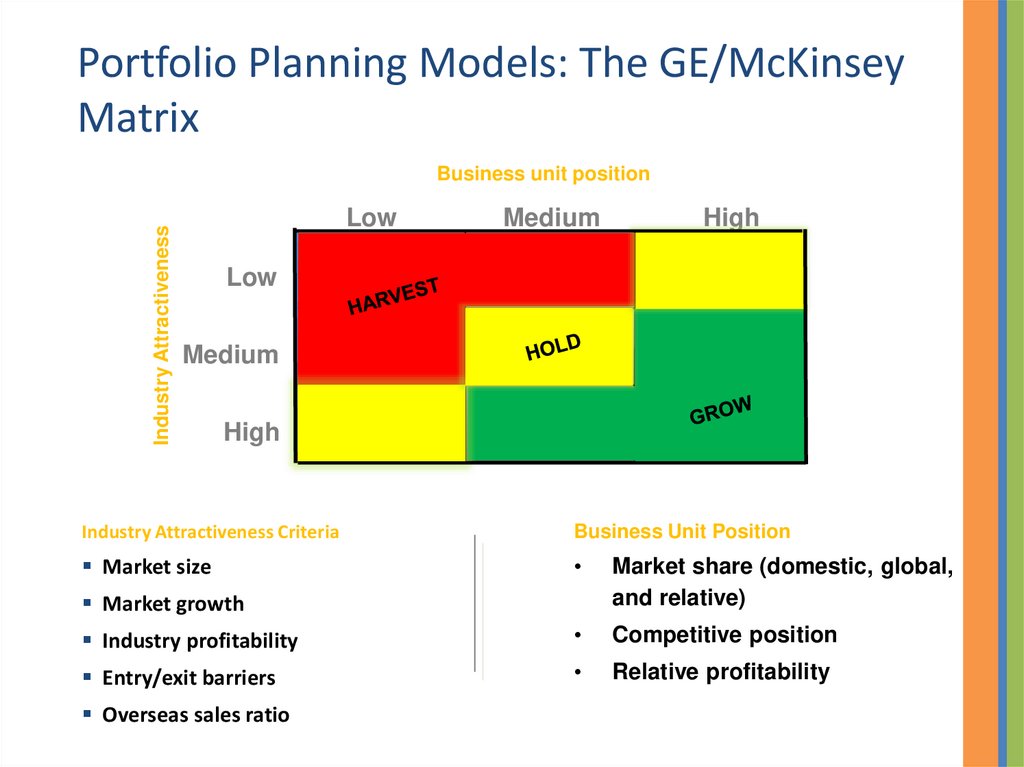
Portfolio Planning Models: The GE/McKinseyMatrix
Industry Attractiveness
Business unit position
Low
Medium
High
Low
Medium
High
Industry Attractiveness Criteria
Business Unit Position
Market size
Market share (domestic, global,
and relative)
Industry profitability
Competitive position
Entry/exit barriers
Relative profitability
Market growth
Overseas sales ratio
16.
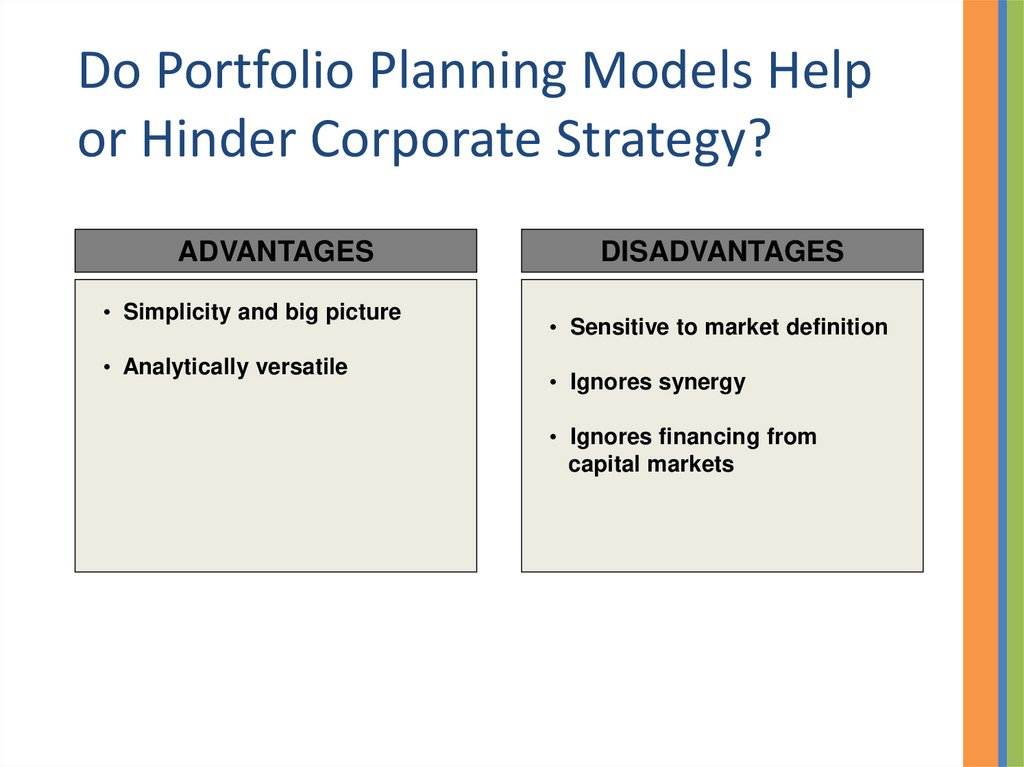
Do Portfolio Planning Models Helpor Hinder Corporate Strategy?
ADVANTAGES
• Simplicity and big picture
• Analytically versatile
DISADVANTAGES
• Sensitive to market definition
• Ignores synergy
• Ignores financing from
capital markets
17.
The 1980s18.
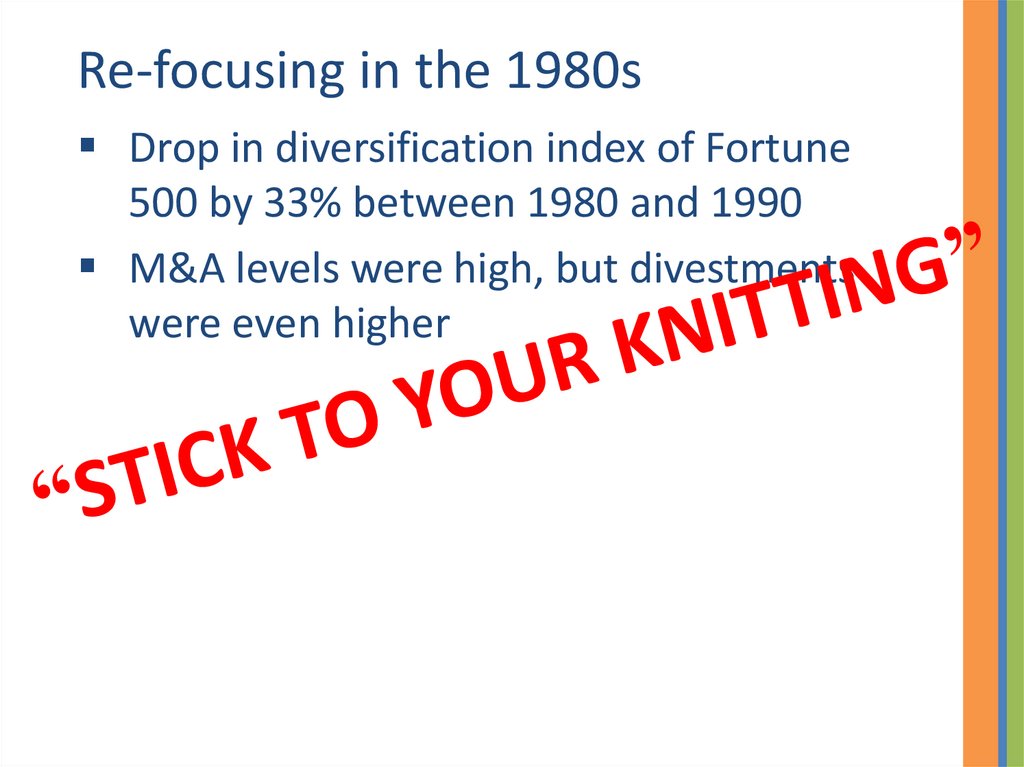
Re-focusing in the 1980sDrop in diversification index of Fortune
500 by 33% between 1980 and 1990
M&A levels were high, but divestments
were even higher
19.
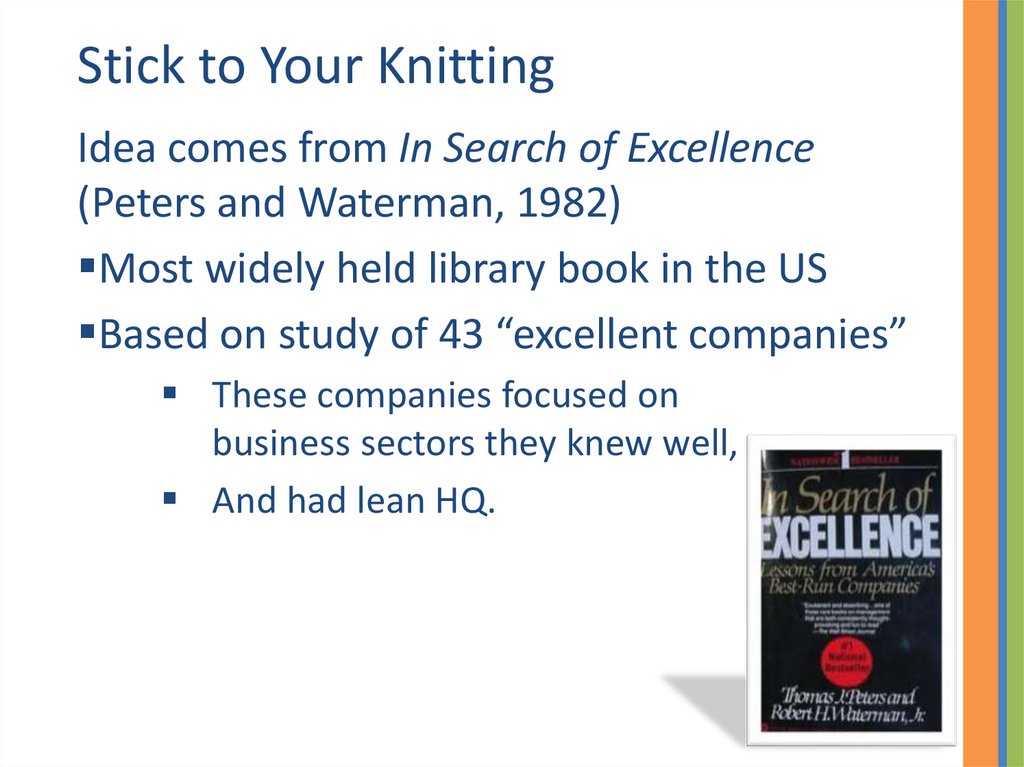
Stick to Your KnittingIdea comes from In Search of Excellence
(Peters and Waterman, 1982)
Most widely held library book in the US
Based on study of 43 “excellent companies”
These companies focused on
business sectors they knew well,
And had lean HQ.
20.
But…?Is the sample reliable?
Need to understand the practices of
unsuccessful firms too
Atari, Wang Laboratories…
Compare In Search of Stupidity
21.
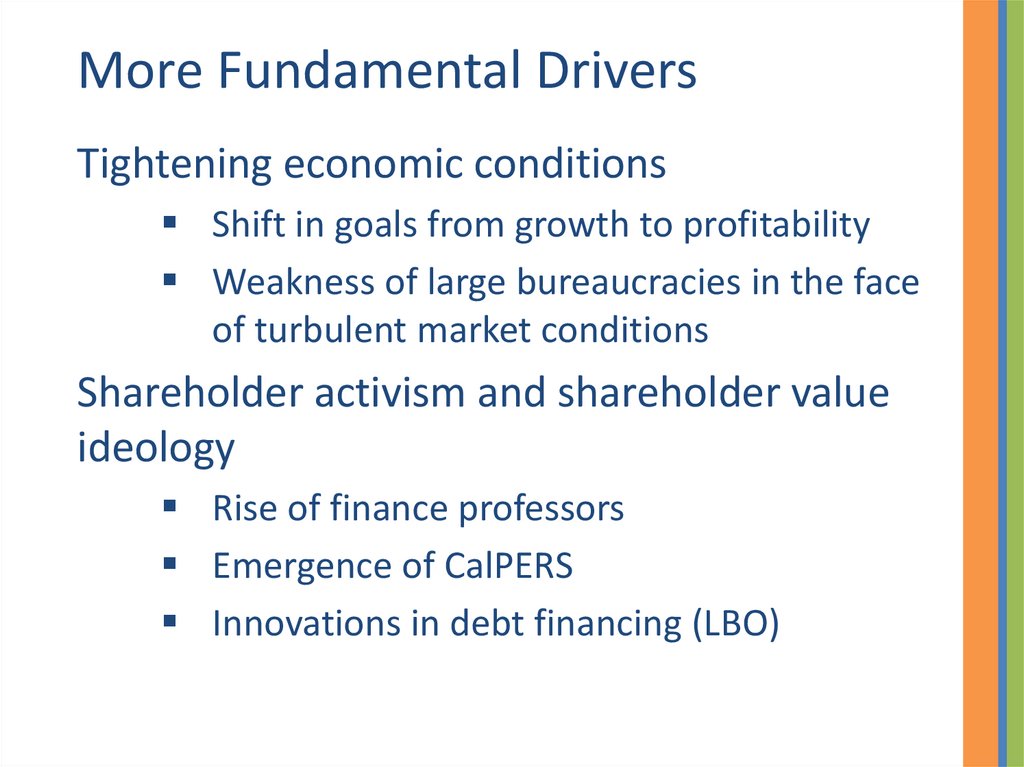
More Fundamental DriversTightening economic conditions
Shift in goals from growth to profitability
Weakness of large bureaucracies in the face
of turbulent market conditions
Shareholder activism and shareholder value
ideology
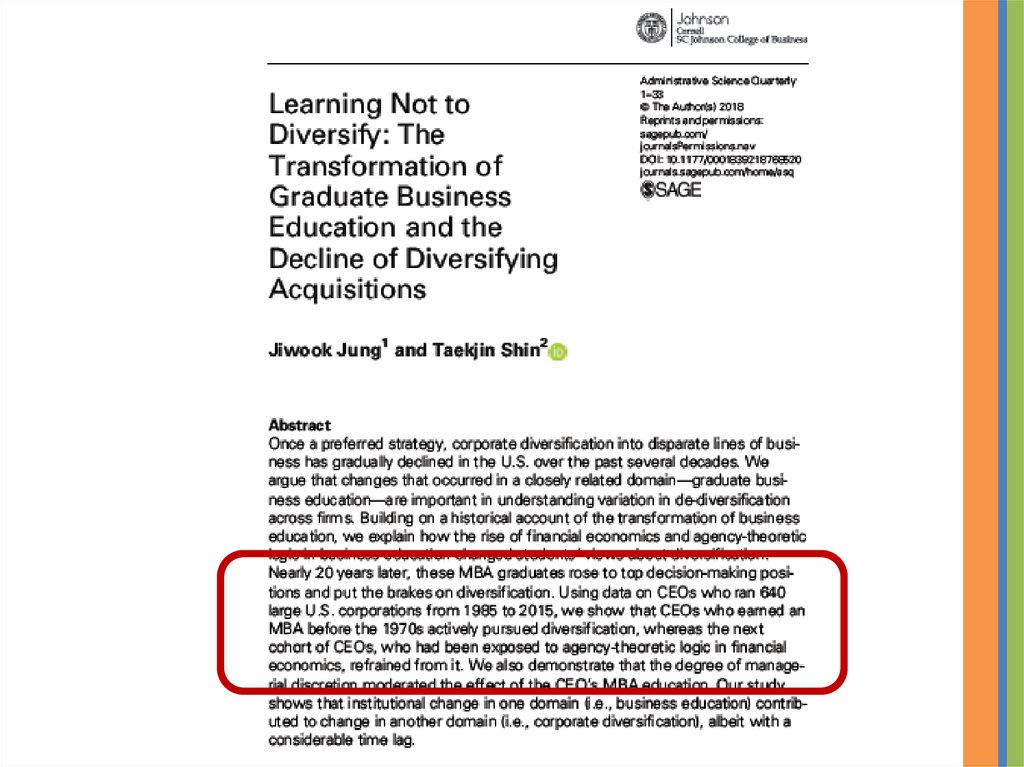
Rise of finance professors
Emergence of CalPERS
Innovations in debt financing (LBO)
22.
23.
Founded 1984 - 198724.
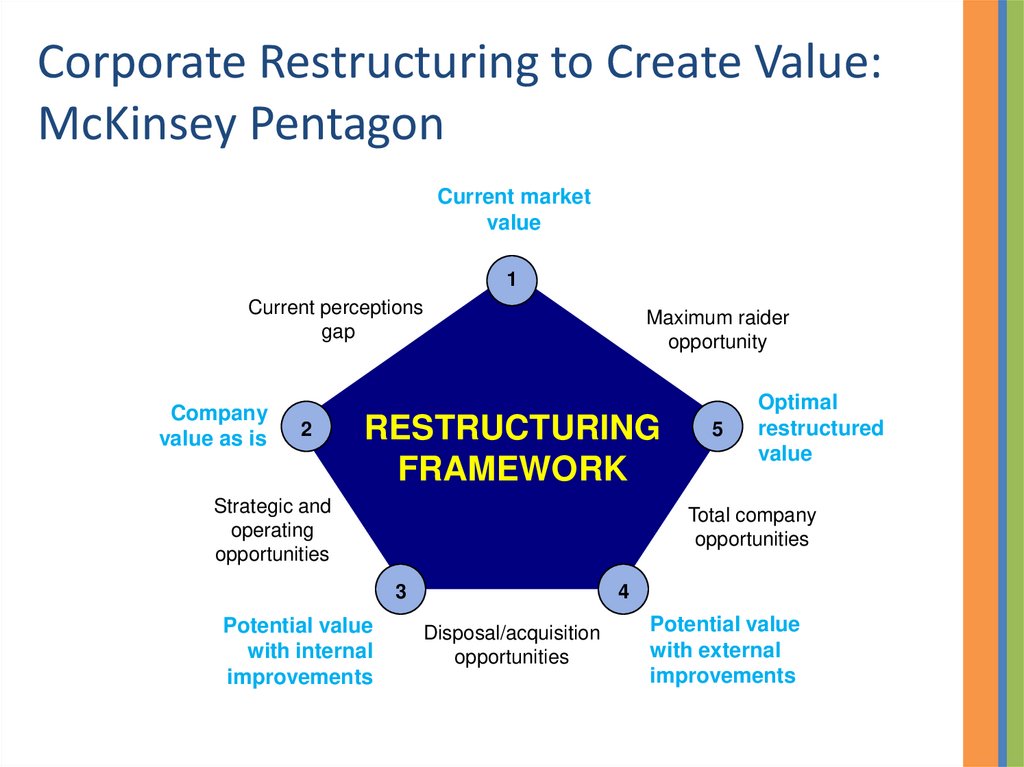
Corporate Restructuring to Create Value:McKinsey Pentagon
Current market
value
1
Current perceptions
gap
Company
value as is
2
Maximum raider
opportunity
RESTRUCTURING
FRAMEWORK
Strategic and
operating
opportunities
Total company
opportunities
3
Potential value
with internal
improvements
5
Optimal
restructured
value
4
Disposal/acquisition
opportunities
Potential value
with external
improvements
25.
The 1990s onwards26.
27.
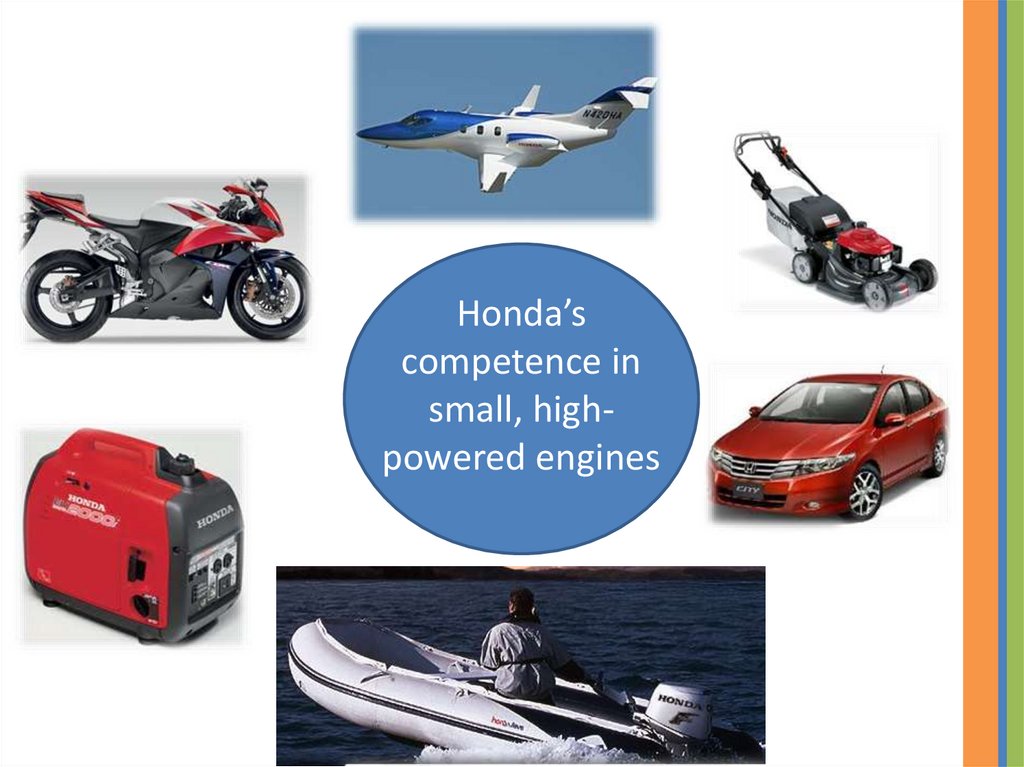
Honda’scompetence in
small, highpowered engines
28.
Corporate Strategy in the 1990sDistinguishing related from unrelated
diversification
Not all diversification is bad
Diversify around your core competence
Organizational economics
Multiple alternatives for entering new
businesses
M&A, alliances, JVs
29.
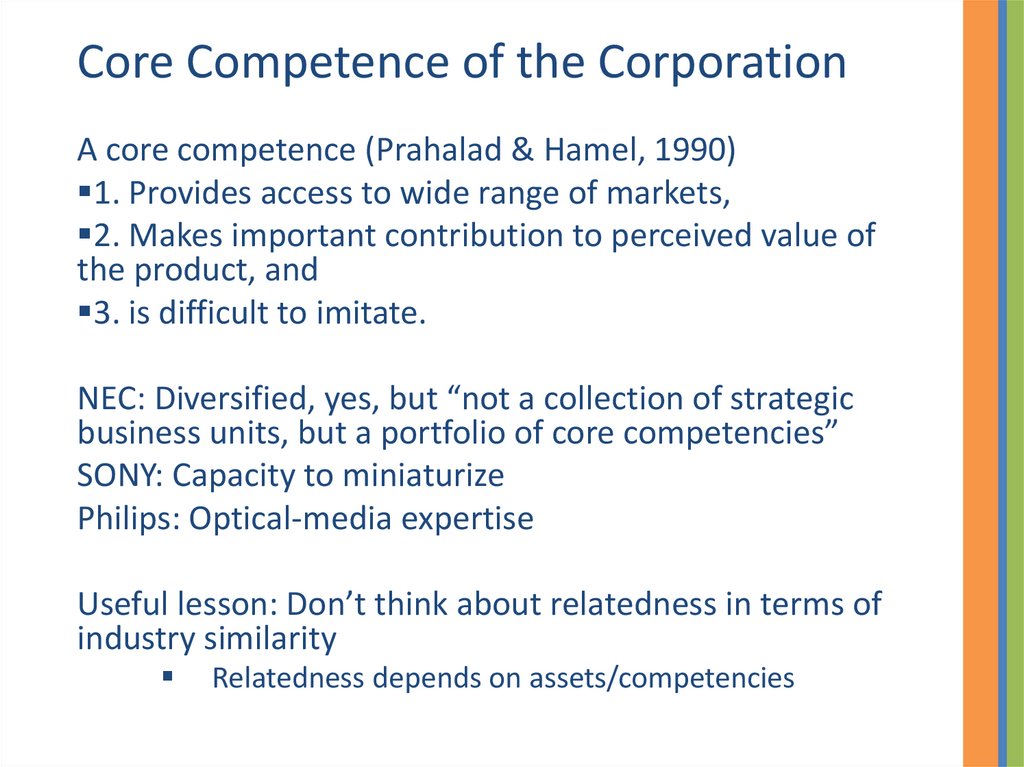
Core Competence of the CorporationA core competence (Prahalad & Hamel, 1990)
1. Provides access to wide range of markets,
2. Makes important contribution to perceived value of
the product, and
3. is difficult to imitate.
NEC: Diversified, yes, but “not a collection of strategic
business units, but a portfolio of core competencies”
SONY: Capacity to miniaturize
Philips: Optical-media expertise
Useful lesson: Don’t think about relatedness in terms of
industry similarity
Relatedness depends on assets/competencies
30.
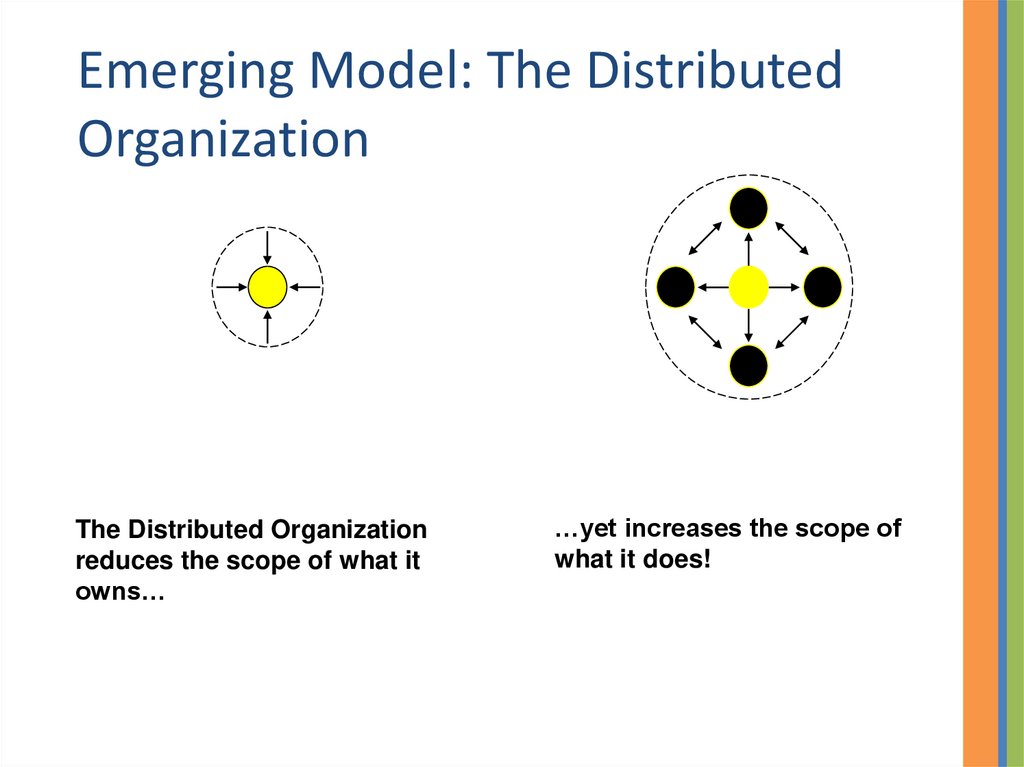
Emerging Model: The DistributedOrganization
The Distributed Organization
reduces the scope of what it
owns…
…yet increases the scope of
what it does!
31.
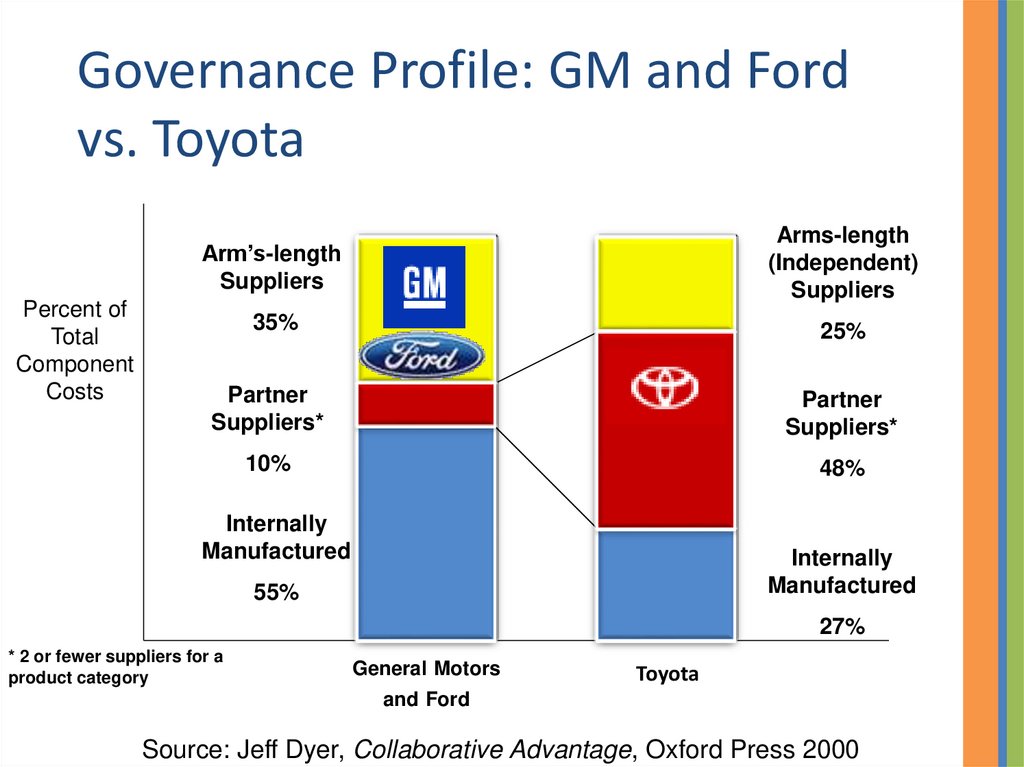
Governance Profile: GM and Fordvs. Toyota
Percent of
Total
Component
Costs
Arm’s-length
Suppliers
Arms-length
(Independent)
Suppliers
35%
25%
Partner
Suppliers*
Partner
Suppliers*
10%
48%
Internally
Manufactured
Internally
Manufactured
55%
27%
* 2 or fewer suppliers for a
product category
General Motors
Toyota
and Ford
Source: Jeff Dyer, Collaborative Advantage, Oxford Press 2000
32.
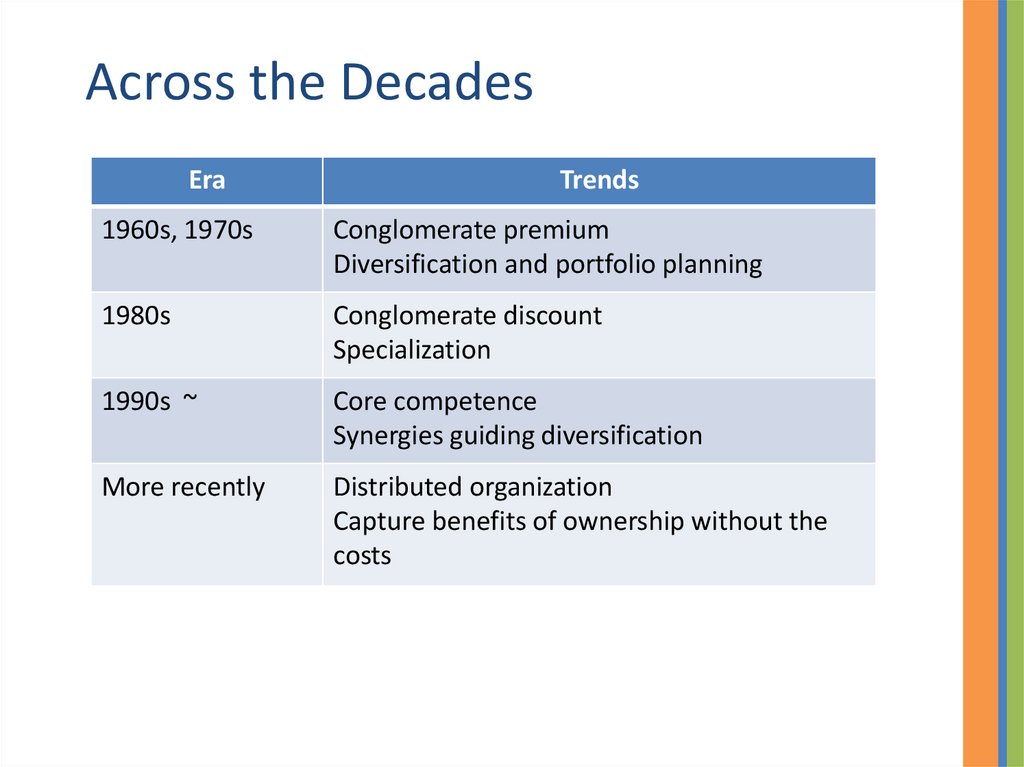
Across the DecadesEra
Trends
1960s, 1970s
Conglomerate premium
Diversification and portfolio planning
1980s
Conglomerate discount
Specialization
1990s ~
Core competence
Synergies guiding diversification
More recently
Distributed organization
Capture benefits of ownership without the
costs
33.
Publicis GroupeCase Discussion
34.
Publicis Groupe35.
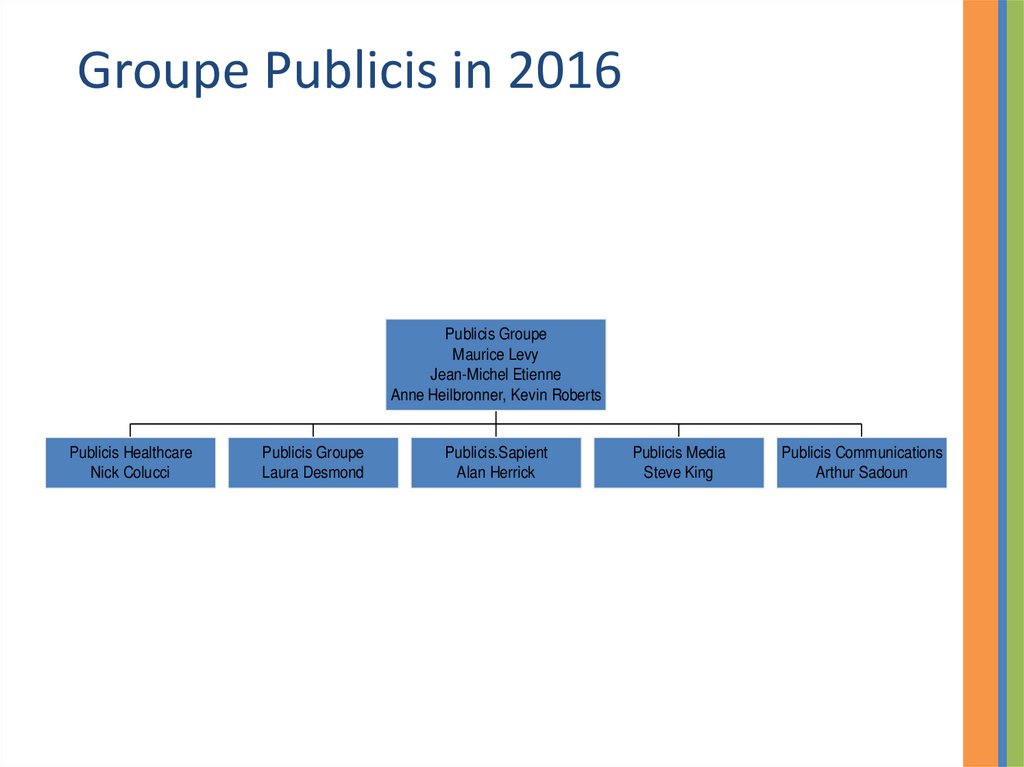
Groupe Publicis in 2016Publicis Groupe
Maurice Levy
Jean-Michel Etienne
Anne Heilbronner, Kevin Roberts
Publicis Healthcare
Nick Colucci
Publicis Groupe
Laura Desmond
Publicis.Sapient
Alan Herrick
Publicis Media
Steve King
Publicis Communications
Arthur Sadoun
36. In 2016
How well are they doing?37.
LEVY’S ACHIEVEMENT• Third largest advertising and marketing
communications company in the world
Grown through acquisitions
Many accolades and awards
38.
LEVY’S VISION OF THE FUTURE“to be the admired force for business
transformation, driven through alchemy of
creativity and technology.”
“No silo, no solo, no bozo” (2016)
39.
THE REALITYFailed Omnicon merger
Many threats
• Ad-blocking
• Lack of transparency
• Disintermediation
• Questionable necessity
40. DEBATE
“The Power of One reorganizationfrom holding company to “connecting
company” will be a success for Groupe
Publicis.”
41.
A corporation is a portfolio of value chainactivities
Corporate advantage exists if portfolio
performance exceeds the sum of performance
of individual activities
42.
How does Publicis Groupe AddValue?
Financial
Accounting, finance, treasury
Human resources
Compensation, hiring
Strategic development
Partnerships, synergy, leverage
Procurement
Practice development
Virtual companies
43.
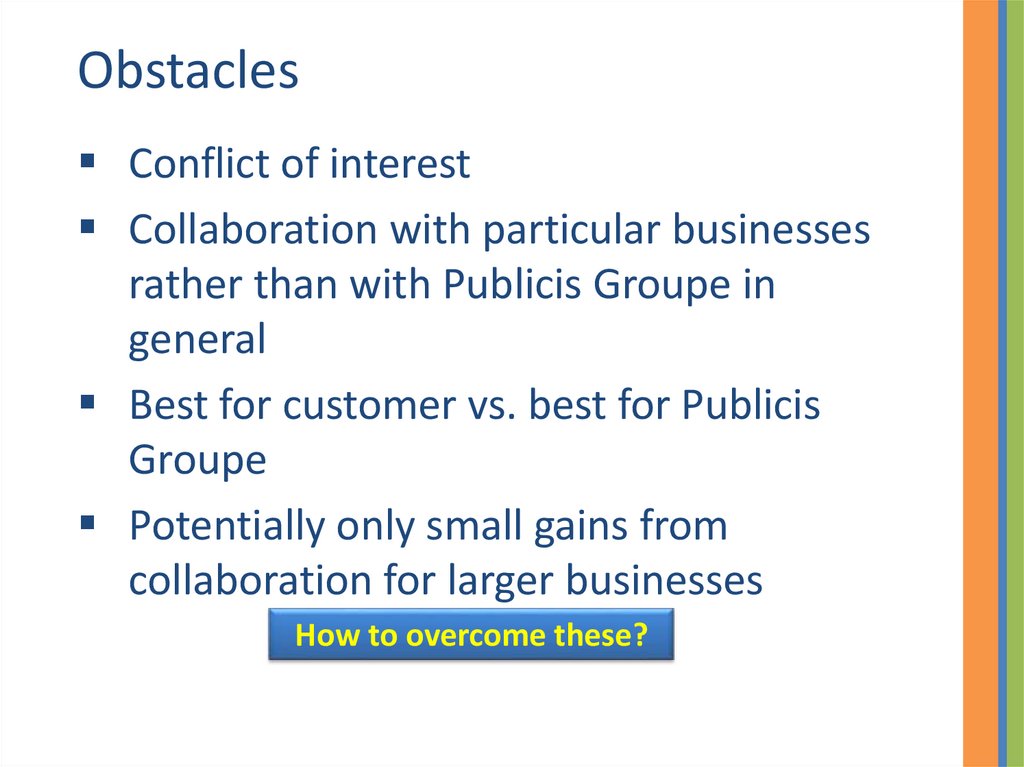
ObstaclesConflict of interest
Collaboration with particular businesses
rather than with Publicis Groupe in
general
Best for customer vs. best for Publicis
Groupe
Potentially only small gains from
collaboration for larger businesses
How to overcome these?
44.
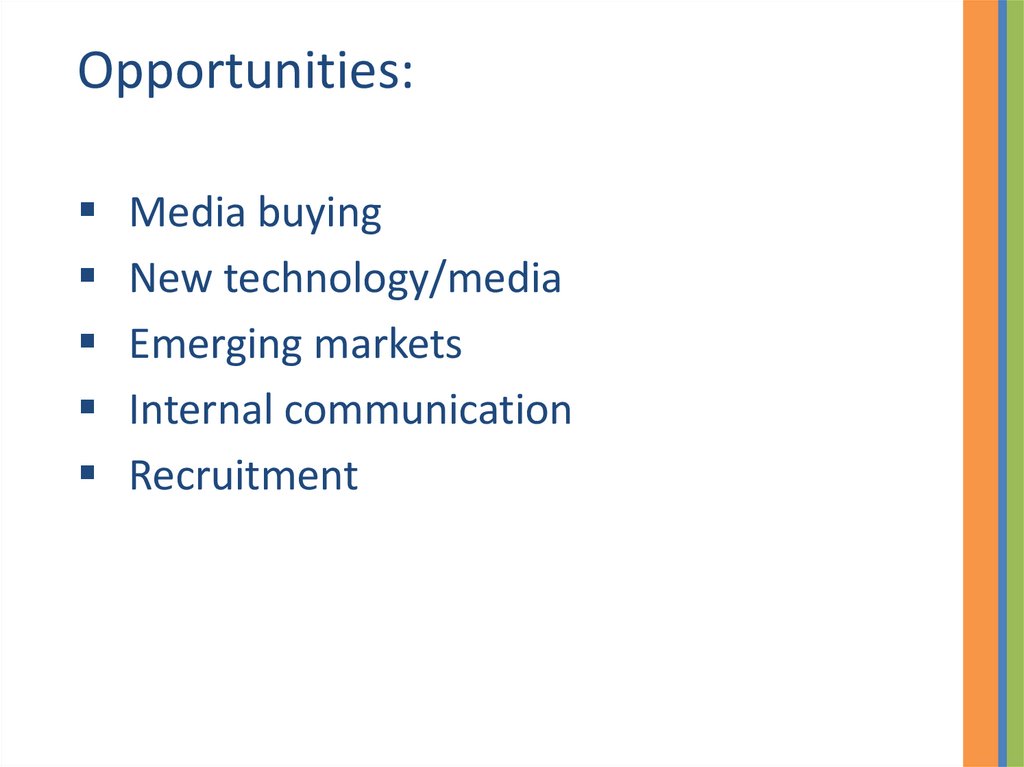
Opportunities:Media buying
New technology/media
Emerging markets
Internal communication
Recruitment
45.
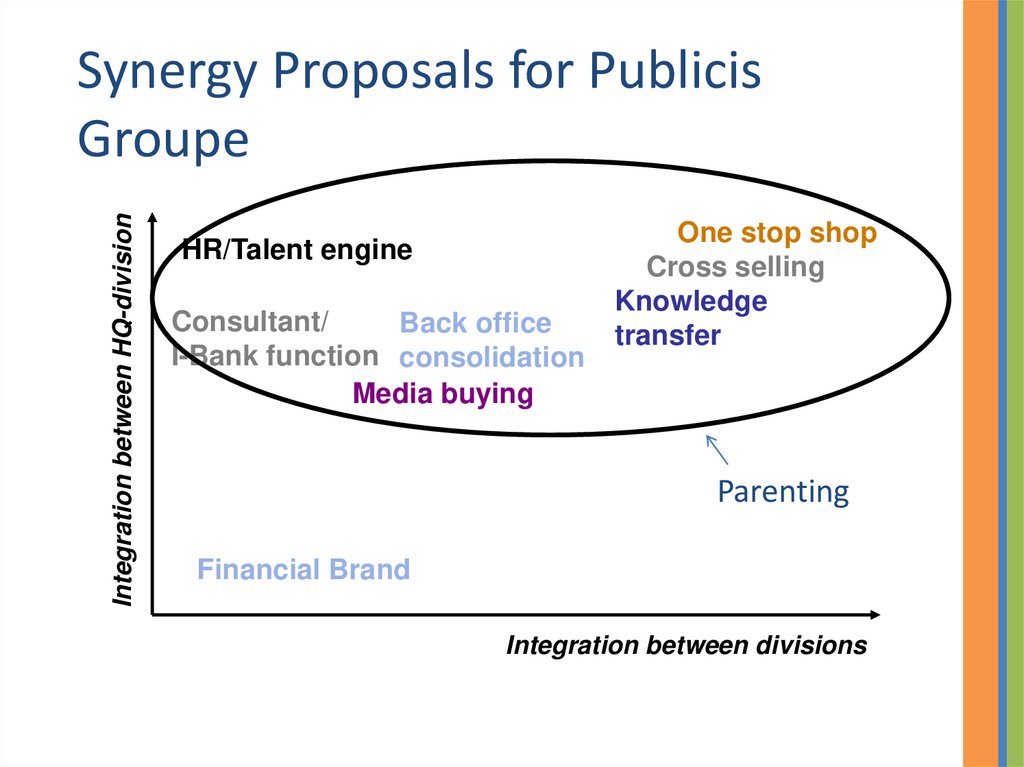
Integration between HQ-divisionSynergy Proposals for Publicis
Groupe
HR/Talent engine
Consultant/
Back office
I-Bank function consolidation
Media buying
One stop shop
Cross selling
Knowledge
transfer
Parenting
Financial Brand
Integration between divisions
46.
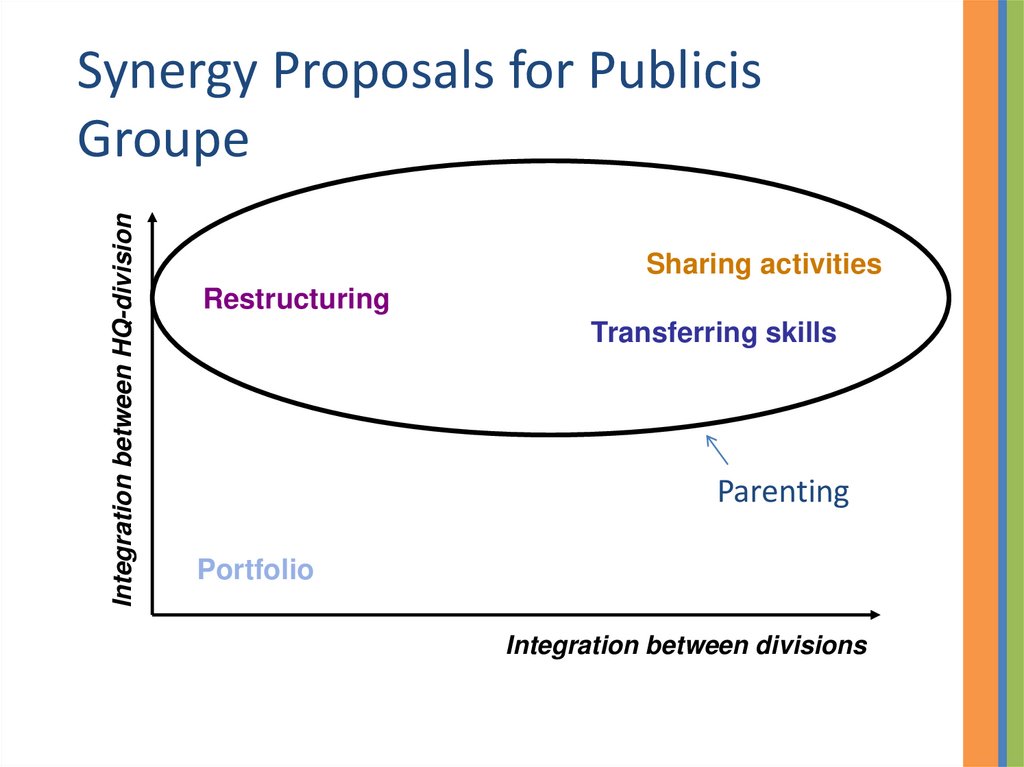
Integration between HQ-divisionSynergy Proposals for Publicis
Groupe
Sharing activities
Restructuring
Transferring skills
Parenting
Portfolio
Integration between divisions
47.
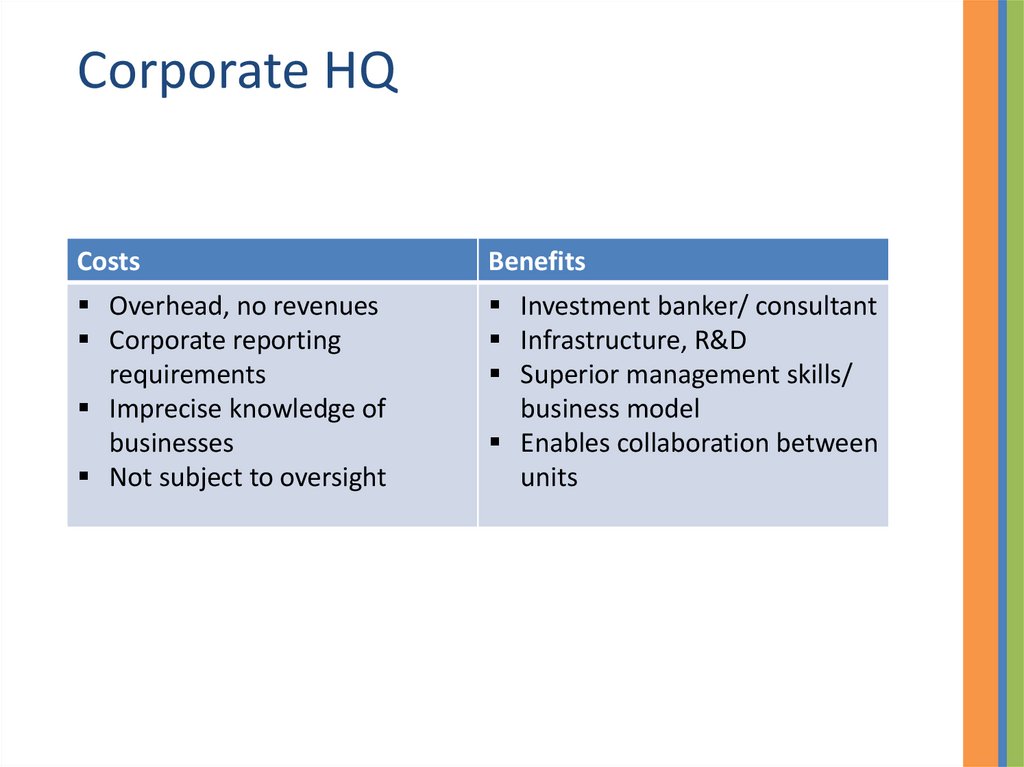
Corporate HQCosts
Benefits
Overhead, no revenues
Corporate reporting
requirements
Imprecise knowledge of
businesses
Not subject to oversight
Investment banker/ consultant
Infrastructure, R&D
Superior management skills/
business model
Enables collaboration between
units
48.
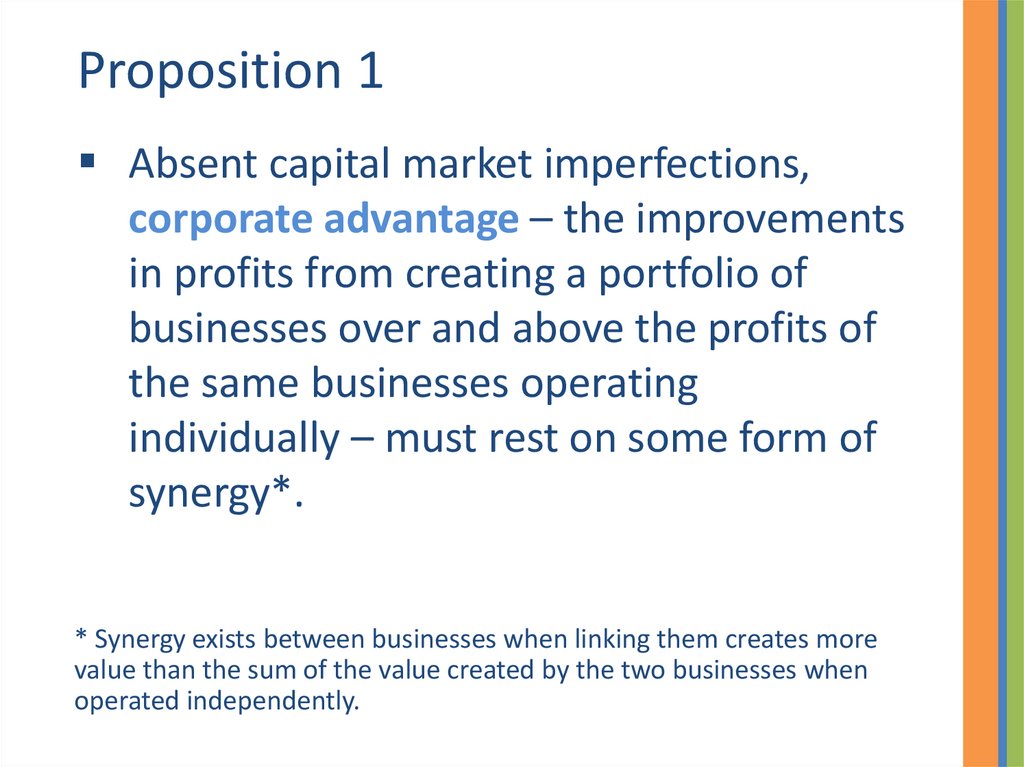
Proposition 1Absent capital market imperfections,
corporate advantage – the improvements
in profits from creating a portfolio of
businesses over and above the profits of
the same businesses operating
individually – must rest on some form of
synergy*.
* Synergy exists between businesses when linking them creates more
value than the sum of the value created by the two businesses when
operated independently.
49.
Corporate AdvantageValue
Independent
Businesses
Integrated
Corporation
50.
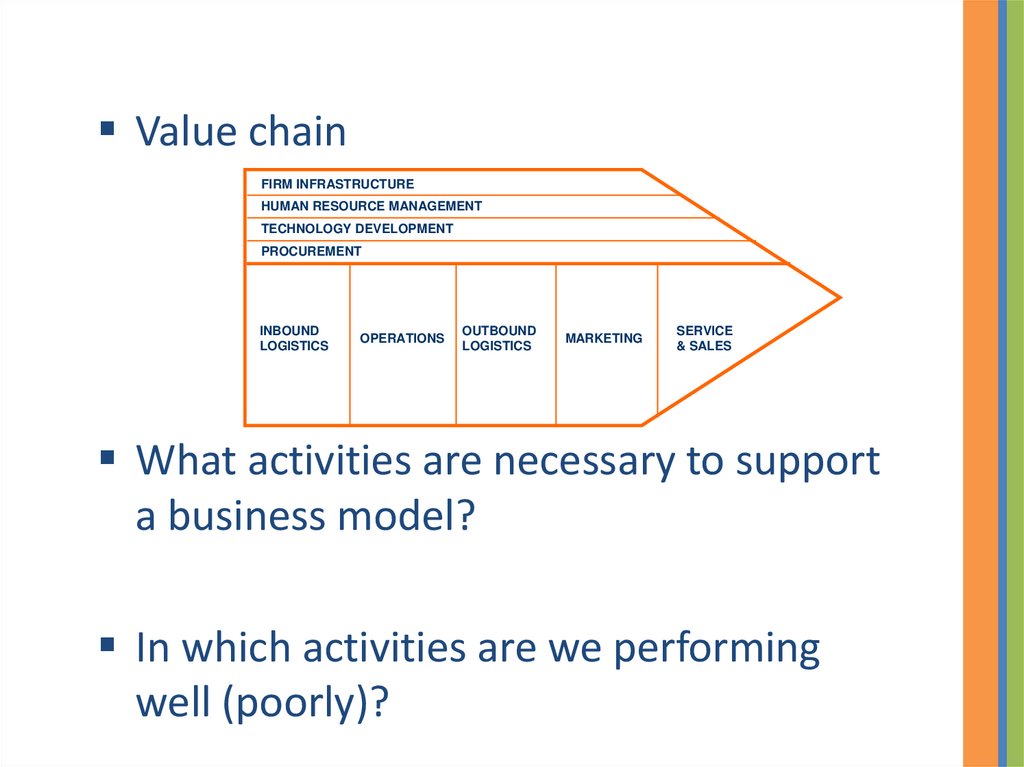
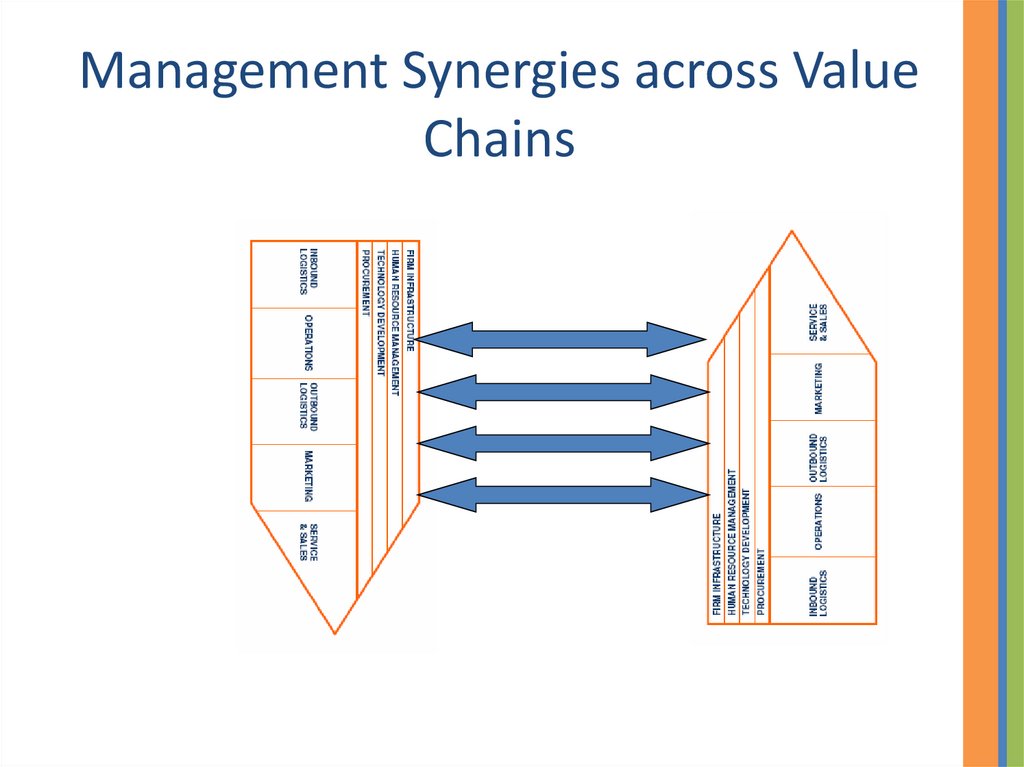
Value chainFIRM INFRASTRUCTURE
HUMAN RESOURCE MANAGEMENT
TECHNOLOGY DEVELOPMENT
PROCUREMENT
INBOUND
LOGISTICS
OPERATIONS
OUTBOUND
LOGISTICS
MARKETING
SERVICE
& SALES
What activities are necessary to support
a business model?
In which activities are we performing
well (poorly)?
51.
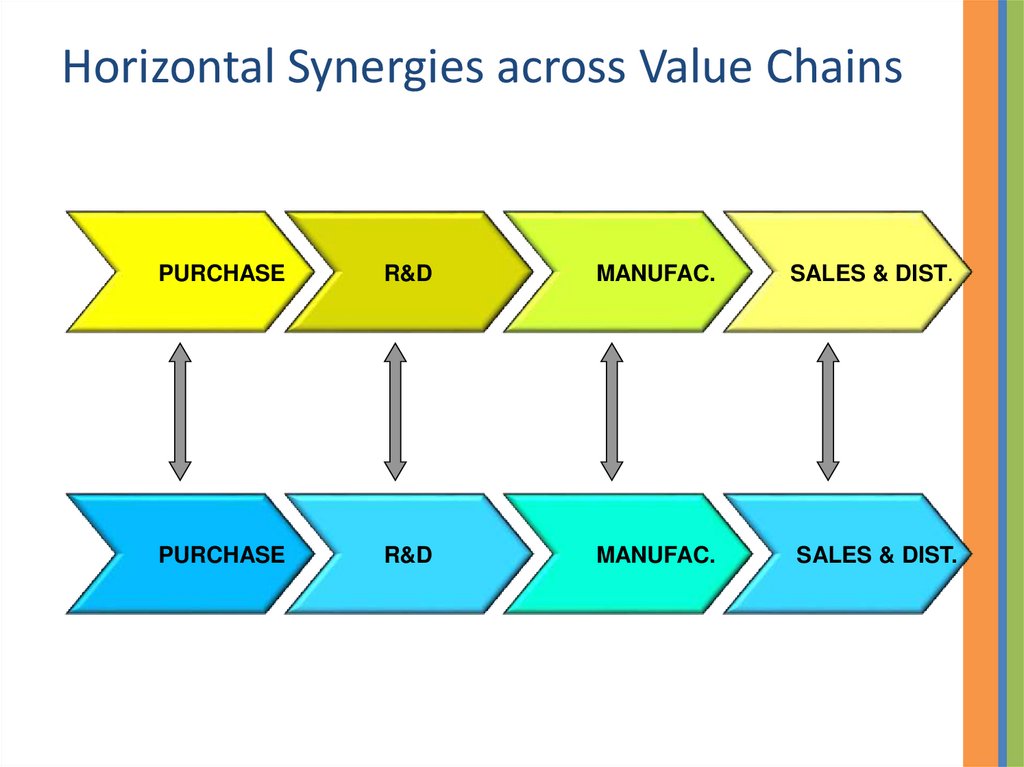
Horizontal Synergies across Value ChainsPURCHASE
R&D
MANUFAC.
SALES & DIST.
PURCHASE
R&D
MANUFAC.
SALES & DIST.
52.
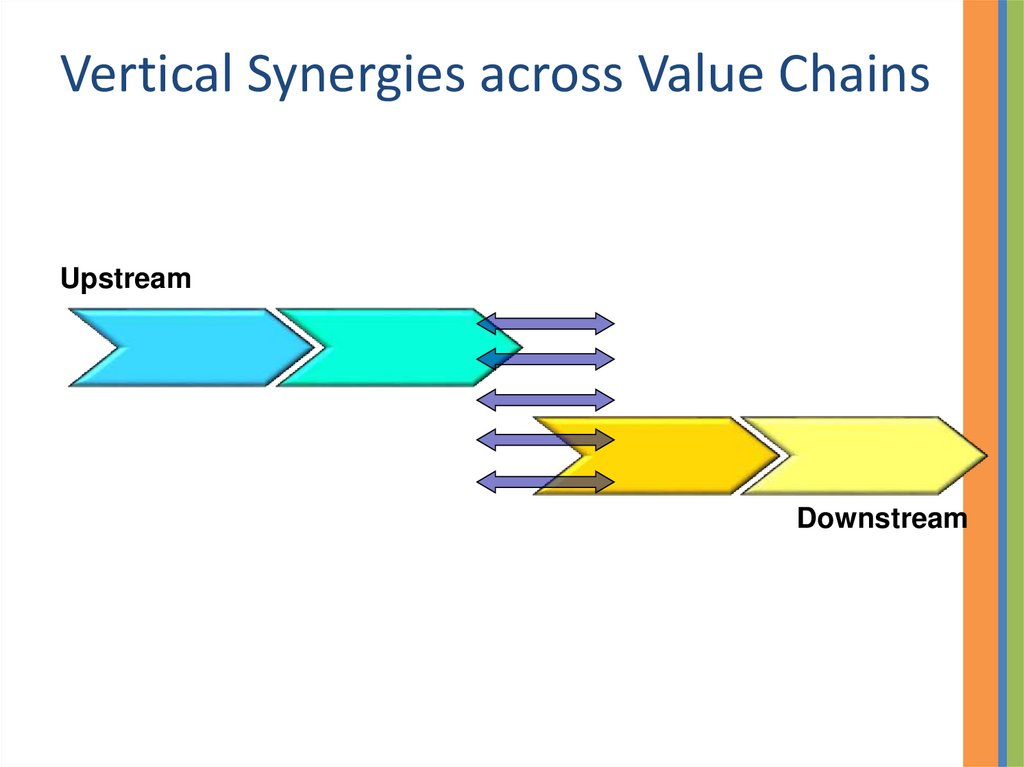
Vertical Synergies across Value ChainsUpstream
Downstream
53.
Management Synergies across ValueChains
54.
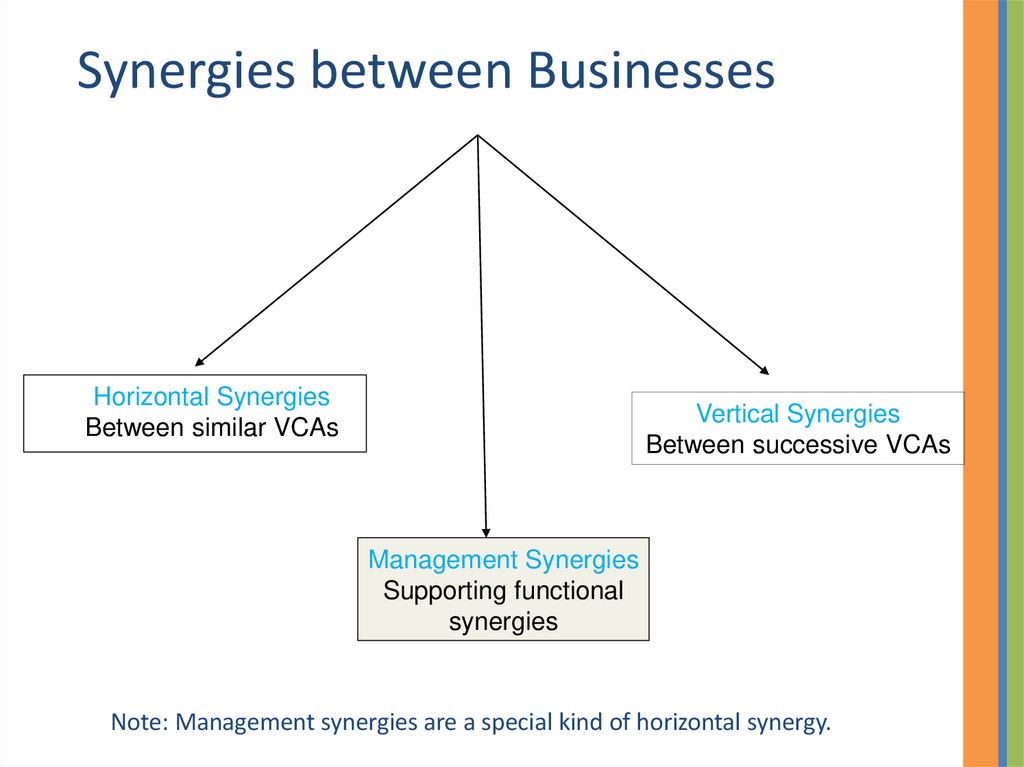
Synergies between BusinessesHorizontal Synergies
Between similar VCAs
Vertical Synergies
Between successive VCAs
Management Synergies
Supporting functional
synergies
Note: Management synergies are a special kind of horizontal synergy.
55.
Proposition 2Whether HQs are actually creating or
destroying value over and above the sum
of the parts is typically hard to tell (or do
anything about) except in the most
egregious cases.
56.
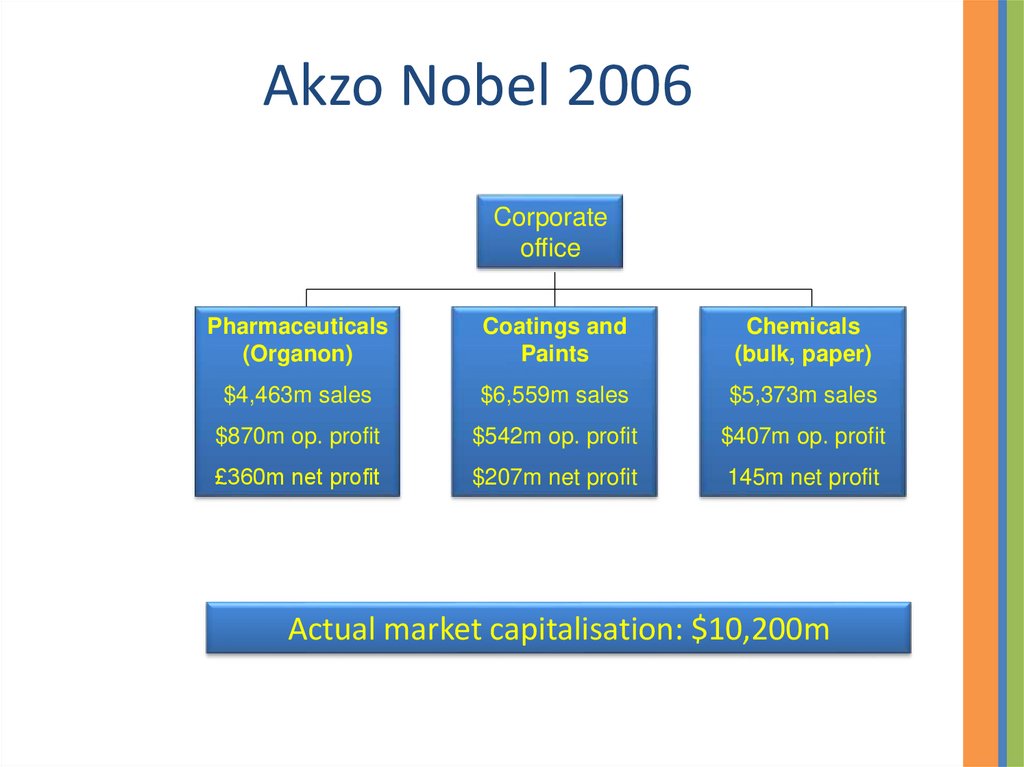
Akzo Nobel 2006Corporate
office
Pharmaceuticals
(Organon)
Coatings and
Paints
Chemicals
(bulk, paper)
$4,463m sales
$6,559m sales
$5,373m sales
$870m op. profit
$542m op. profit
$407m op. profit
£360m net profit
$207m net profit
145m net profit
Actual market capitalisation: $10,200m
57.
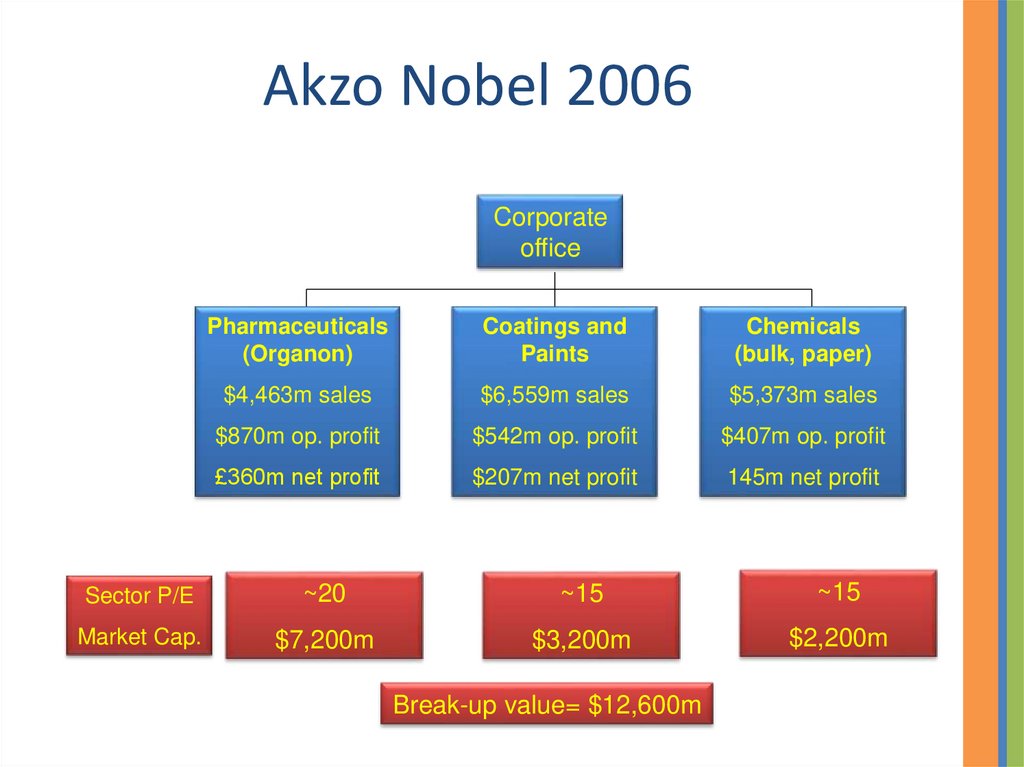
Akzo Nobel 2006Corporate
office
Pharmaceuticals
(Organon)
Coatings and
Paints
Chemicals
(bulk, paper)
$4,463m sales
$6,559m sales
$5,373m sales
$870m op. profit
$542m op. profit
$407m op. profit
£360m net profit
$207m net profit
145m net profit
Sector P/E
~20
~15
~15
Market Cap.
$7,200m
$3,200m
$2,200m
Break-up value= $12,600m
58.
Akzo Nobel 2008Corporate
office
Pharmaceuticals
(Organon)
Coatings and
Paints
Chemicals
(bulk, paper)
$4,463m sales
$6,559m sales
$5,373m sales
$870m op. profit
$542m op. profit
$407m op. profit
SOLD to Schering Plough
for $14 billion
Merger with ICI
completed Jan 08
59.
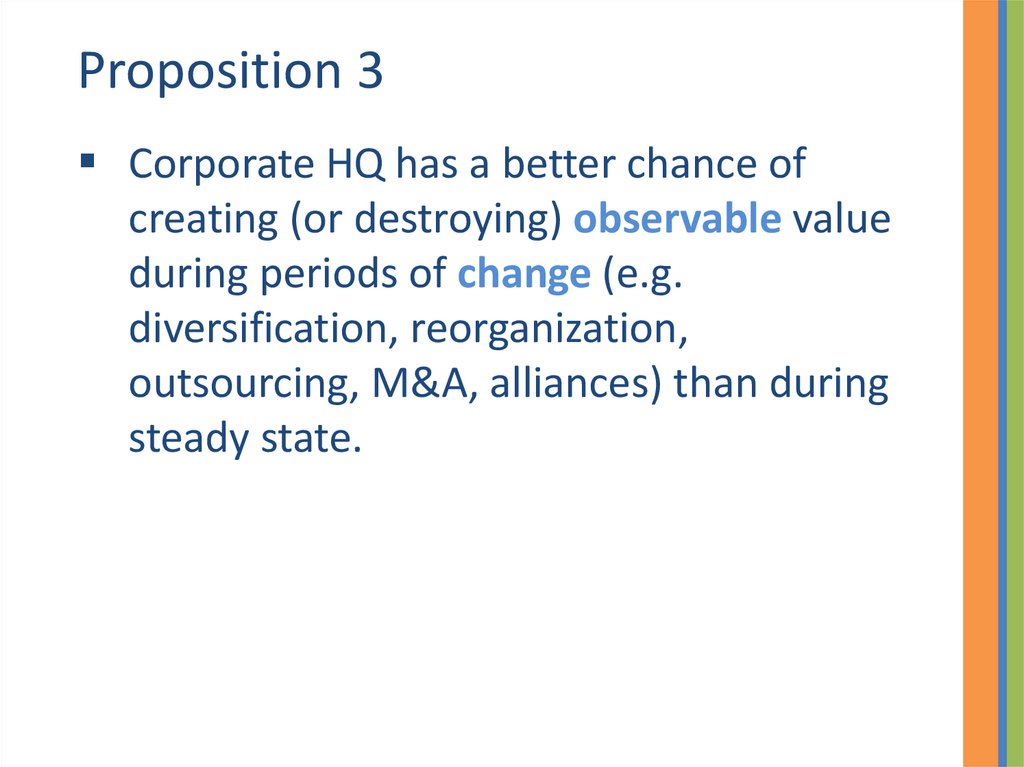
Proposition 3Corporate HQ has a better chance of
creating (or destroying) observable value
during periods of change (e.g.
diversification, reorganization,
outsourcing, M&A, alliances) than during
steady state.
60.
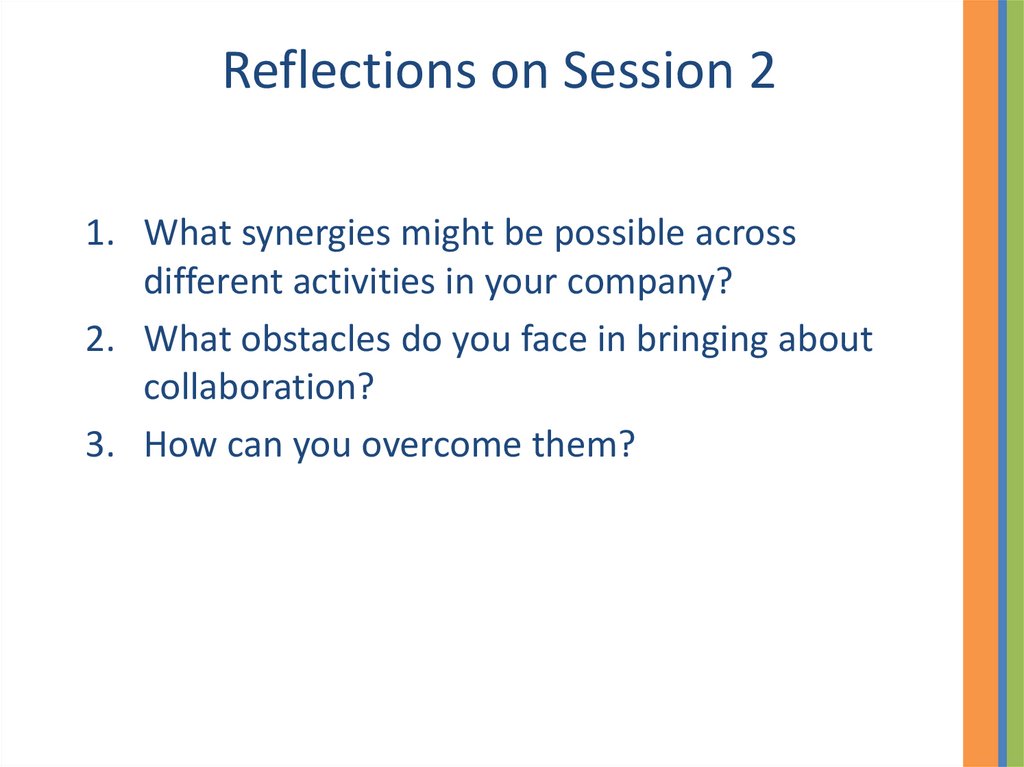
Reflections on Session 21. What synergies might be possible across
different activities in your company?
2. What obstacles do you face in bringing about
collaboration?
3. How can you overcome them?
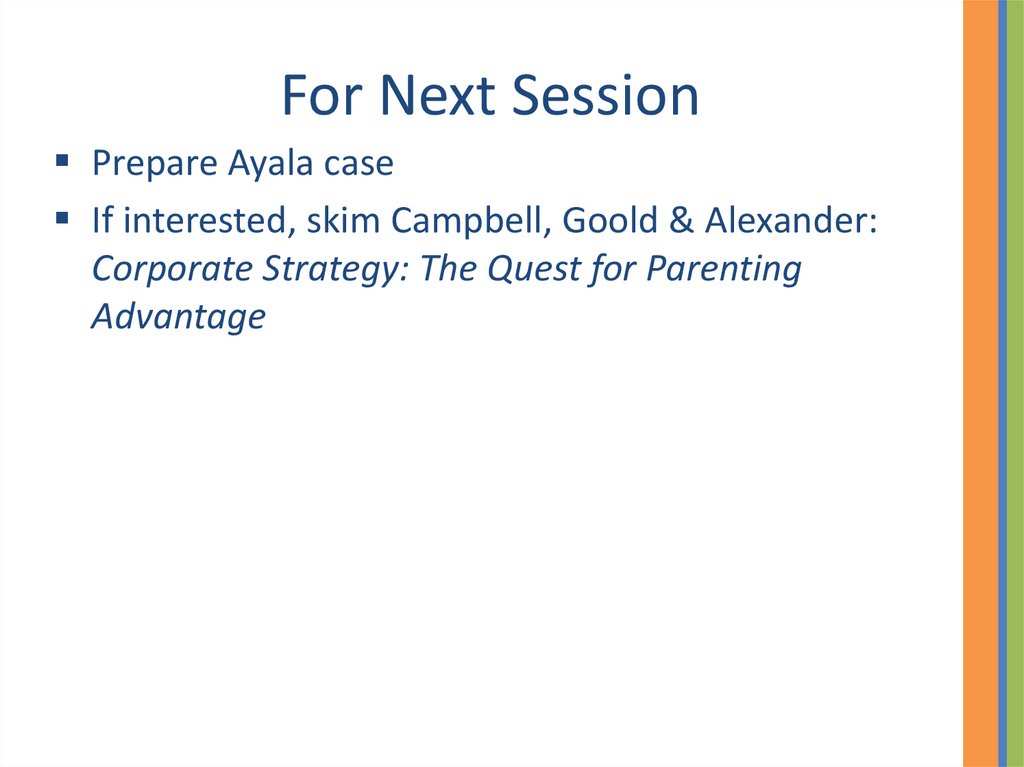
61. For Next Session
Prepare Ayala caseIf interested, skim Campbell, Goold & Alexander:
Corporate Strategy: The Quest for Parenting
Advantage
62.
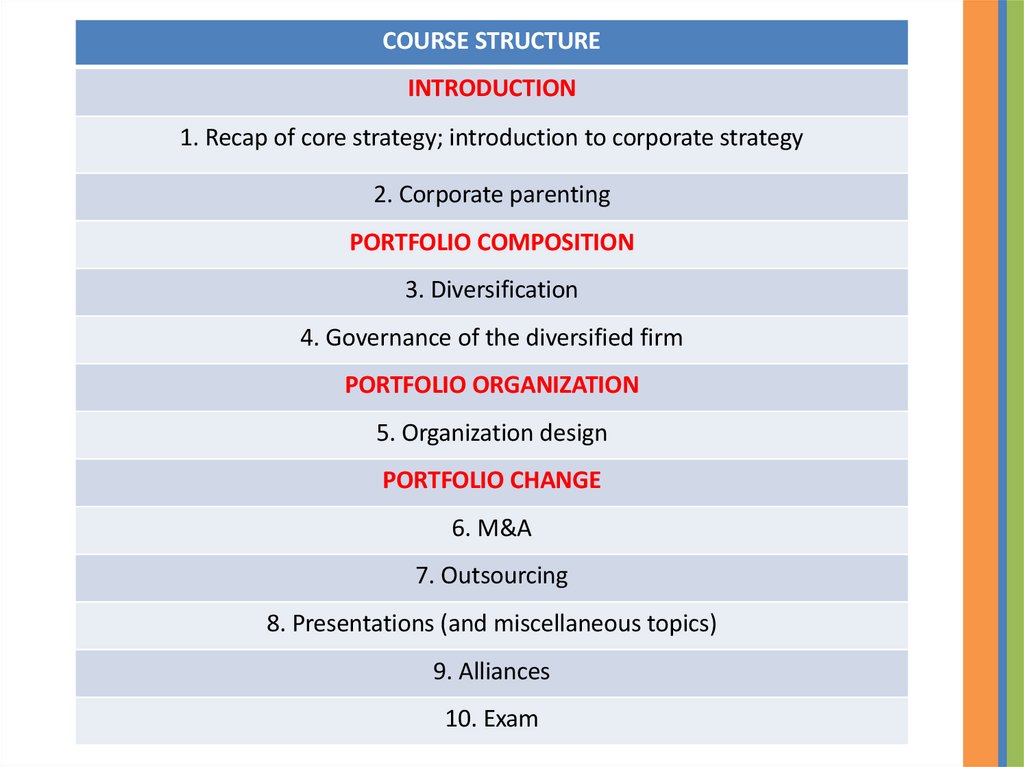
COURSE STRUCTUREINTRODUCTION
1. Recap of core strategy; introduction to corporate strategy
2. Corporate parenting
PORTFOLIO COMPOSITION
3. Diversification
4. Governance of the diversified firm
PORTFOLIO ORGANIZATION
5. Organization design
PORTFOLIO CHANGE
6. M&A
7. Outsourcing
8. Presentations (and miscellaneous topics)
9. Alliances
10. Exam