
 Психология
Похожие презентации:




Etiquette excersises week3, part 1
1.
ETIQUETTEEXCERSISES
WEEK3, PART 1
2.
In-Class Activity: Emotional Intelligence RolePlay – Reading and Responding to GuestEmotionsObjective
Instructions for Students:
Step 1 – Form Pairs (5 minutes)Divide into pairs: One student will play the
Hospitality Professional (front desk, concierge, or waiter) and the other will play
the Guest. Each pair will receive a scenario card describing the guest’s emotional
state and situation.
Step 2 – Understand Your Role (5 minutes)Guest: Read your emotional state and
situation privately. Think about how you would behave, tone of voice, and body
language (e.g., irritable, anxious, excited).Hospitality Professional: Review the
EI skills checklist (Self-Awareness, Self-Regulation, Empathy, Social Skills,
Adaptability). Prepare to observe the guest’s mood and respond appropriately.
Presentation title
2
3.
Step 3 – Role-Play Interaction (5-7 minutes per pair)The Guest approaches theHospitality Professional with their scenario.
The Hospitality Professional must: Observe verbal and non-verbal cues Assess
the guest’s emotional state Respond using empathy and emotional intelligence
Adapt tone, body language, and service approach
Goal: Create a positive first impression and resolve the guest’s emotional
discomfort.
Step 4 – Debrief and Feedback (5 minutes per pair)After the role-play, both
students will discuss: What emotional cues were observed? What EI skills were
used? What went well and what could be improved? Students provide
constructive feedback to each other.
Presentation title
3
4.
Step 5 – Class Reflection (10 minutes)Volunteers share examples of whatworked best and what was challenging. Instructor summarizes key learning
points:
The importance of empathy and adaptability
How small actions can transform guest experiences
The impact of EI on guest satisfaction and loyalty
Presentation title
4
5.
Example Scenario CardsGuest is exhausted after a delayed flight.
Guest is visibly frustrated due to a reservation error.
Guest is excited and chatty, eager to share their vacation plans.
Guest is anxious because they lost their luggage.
Guest is reserved and seems uncomfortable speaking English.
Presentation title
5
6.
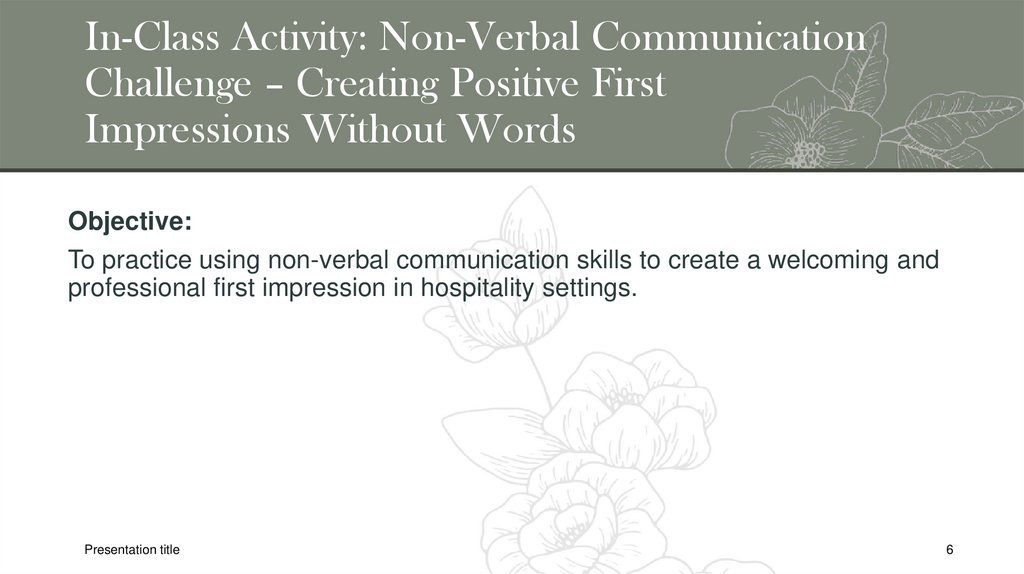
In-Class Activity: Non-Verbal CommunicationChallenge – Creating Positive First
Impressions Without Words
Objective:
To practice using non-verbal communication skills to create a welcoming and
professional first impression in hospitality settings.
Presentation title
6
7.
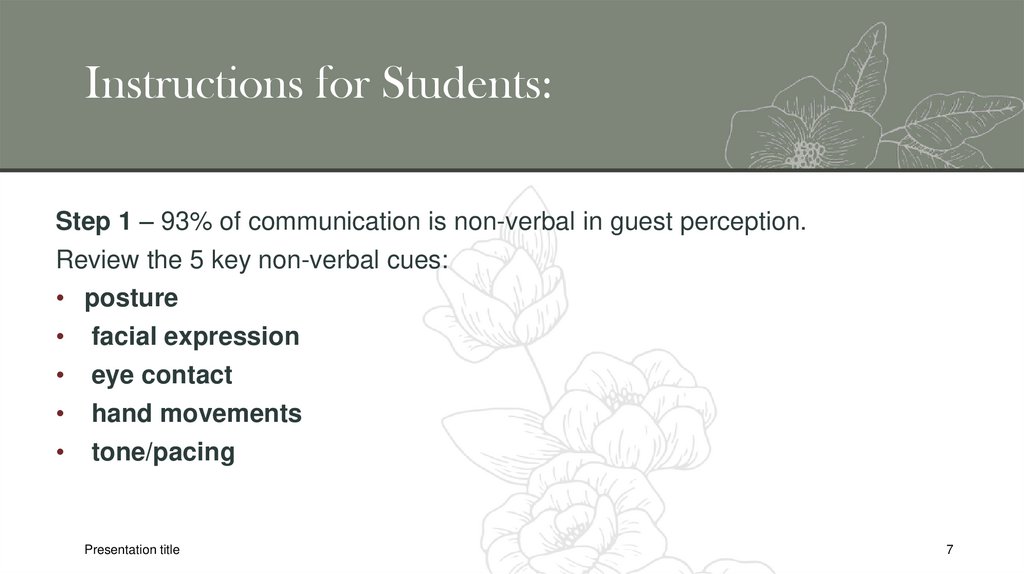
Instructions for Students:Step 1 – 93% of communication is non-verbal in guest perception.
Review the 5 key non-verbal cues:
• posture
• facial expression
• eye contact
• hand movements
• tone/pacing
Presentation title
7
8.
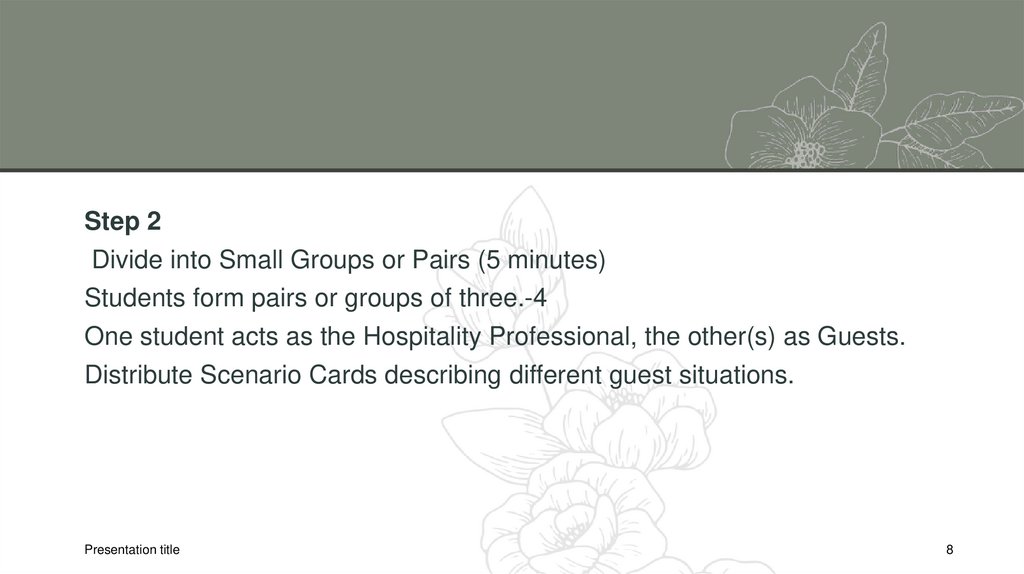
Step 2Divide into Small Groups or Pairs (5 minutes)
Students form pairs or groups of three.-4
One student acts as the Hospitality Professional, the other(s) as Guests.
Distribute Scenario Cards describing different guest situations.
Presentation title
8
9.
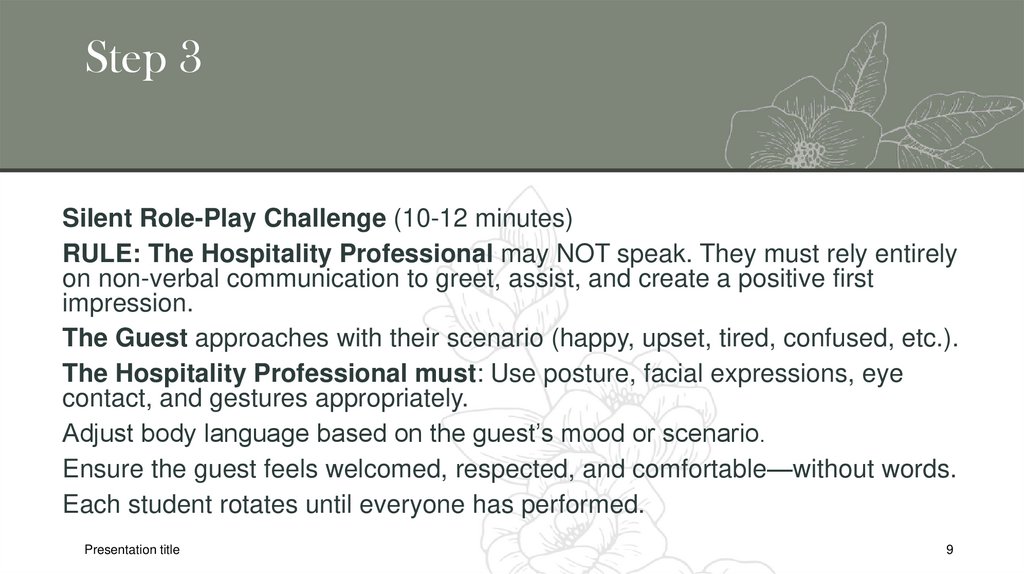
Step 3Silent Role-Play Challenge (10-12 minutes)
RULE: The Hospitality Professional may NOT speak. They must rely entirely
on non-verbal communication to greet, assist, and create a positive first
impression.
The Guest approaches with their scenario (happy, upset, tired, confused, etc.).
The Hospitality Professional must: Use posture, facial expressions, eye
contact, and gestures appropriately.
Adjust body language based on the guest’s mood or scenario.
Ensure the guest feels welcomed, respected, and comfortable—without words.
Each student rotates until everyone has performed.
Presentation title
9
10.
Step 4 – Peer Feedback and Reflection(10 minutes)
After each round, the Guest shares:
How the non-verbal communication made them feel.
What gestures or expressions were most effective or confusing.
Peers observe and provide constructive feedback:
• Was the posture confident?
• Did facial expressions match the scenario?
• Was eye contact appropriate and welcoming?
• Were gestures clear and open?
Presentation title
10
11.
Scenario Cards for Non-Verbal Role-Play• 1. The Exhausted Guest
• The guest has just arrived after a 12-hour flight. They look tired, frustrated,
and want to check in quickly. Hospitality Professional must convey empathy,
efficiency, and calm through posture, facial expression, and gestures.
• 2. The VIP Guest
• A returning VIP guest arrives and expects recognition without having to
introduce themselves. Hospitality Professional must use respectful eye
contact, open posture, and subtle gestures to acknowledge their status and
make them feel valued.
Presentation title
11
12.
• 3. The Lost Guest• A guest is standing in the hotel lobby looking around, clearly confused
and unsure where to go. Hospitality Professional must use open body
language, friendly facial expressions, and clear pointing gestures to
offer help.
• 4. The Shy or Reserved Guest
• A guest seems uncomfortable or anxious, avoiding eye contact and
keeping their distance. Hospitality Professional must maintain soft,
warm eye contact, gentle gestures, and respect personal space to build
trust.
Presentation title
12
13.
• 5. The Excited Guest Celebrating• A couple walks in smiling and taking photos — they’re celebrating a
special occasion (anniversary/birthday). Hospitality Professional must
mirror the positive energy with open gestures, a big genuine smile,
and inviting posture.
• 6. The Angry Guest
• A guest approaches with visible frustration, slamming their bag down,
breathing heavily.Hospitality Professional must stay calm, maintain
open posture, neutral but attentive facial expressions, and nonthreatening gestures to de-escalate tension.
Presentation title
13
14.
• 7. The Business Traveler in a Rush• A professionally dressed guest walks briskly toward the desk, checking
their watch repeatedly.Hospitality Professional must signal efficiency
with quick, purposeful movements, clear gestures, and minimal
unnecessary interaction.
• 8. The Curious Tourist
• A guest is looking at brochures or maps, visibly curious but hesitant to
ask for help.Hospitality Professional uses friendly eye contact, smiles,
and inviting gestures to signal readiness to assist.
Presentation title
14
15.
9. The Elderly Guest• An older guest approaches slowly, appearing unsure of where to go or what
to do next. Hospitality Professional shows patience, uses respectful body
language, makes space, and offers physical assistance non-verbally
(gesturing toward an elevator or offering an arm).
10. The Guest with Language Barrier
• A guest approaches but gestures they don’t speak the local language.
Hospitality Professional uses slow, clear hand gestures, open posture, and
a warm smile to put the guest at ease and offer help visually.
Presentation title
15