







 Лингвистика
Похожие презентации:










Artificial Languages
1.
11
t
h
g
r
Exploring the diversity and functionality
of languages created by
a
humans.
d
e
Artificial Languages
2.
IntroductionThis presentation delves into artificial languages, their
types, and applications, demonstrating their significance in
various fields.
3.
01Types
4.
Constructed languages(conlangs)
Constructed languages, or conlangs, are languages that have been artificially created
rather than having naturally evolved. Examples include Esperanto, created to foster
international communication; Klingon, constructed for the Star Trek franchise; and
Dothraki, developed for George R.R. Martin's Game of Thrones series. Conlangs often
serve specific purposes such as facilitating communication in fictional universes or
promoting linguistic equality.
5.
Programminglanguages
Programming languages are formal languages consisting of instructions that can be compiled or
interpreted by computers. They are used in software development and include languages such
as Python, Java, and C++. Each programming language has specific syntax rules and
paradigms, allowing developers to create software applications, control hardware, and process
data. These languages are integral to modern technology, driving innovations in various fields.
6.
Formal languagesFormal languages are mathematical constructs used primarily in
theoretical computer science and linguistics. They consist of sets of
strings made from a finite alphabet, governed by specific
grammatical rules. Formal languages serve as the foundation for
various computational theories, including automata theory, formal
language theory, and computational linguistics. They enable the
development of algorithms and software intended for natural
language processing and artificial intelligence, facilitating the
interaction between computers and human language.
7.
02Applications
8.
Linguistic researchArtificial languages contribute significantly to linguistic research by providing clear
frameworks for studying language structure, syntax, and semantics. Researchers can
analyze how languages function in isolation and compare these systems to natural
languages, allowing insights into language acquisition, evolution, and cognition. They
also serve as experimental tools in psycholinguistics, helping to assess language
processing in the human brain.
9.
Computer scienceIn computer science, artificial languages facilitate the design and implementation of algorithms,
programming languages, and compilers. By creating formal specifications, developers can
establish rigorous standards for programming and ensure code reliability and efficiency.
Furthermore, the principles derived from formal languages underpin the development of natural
language processing systems, enabling machines to understand and generate human
language.
10.
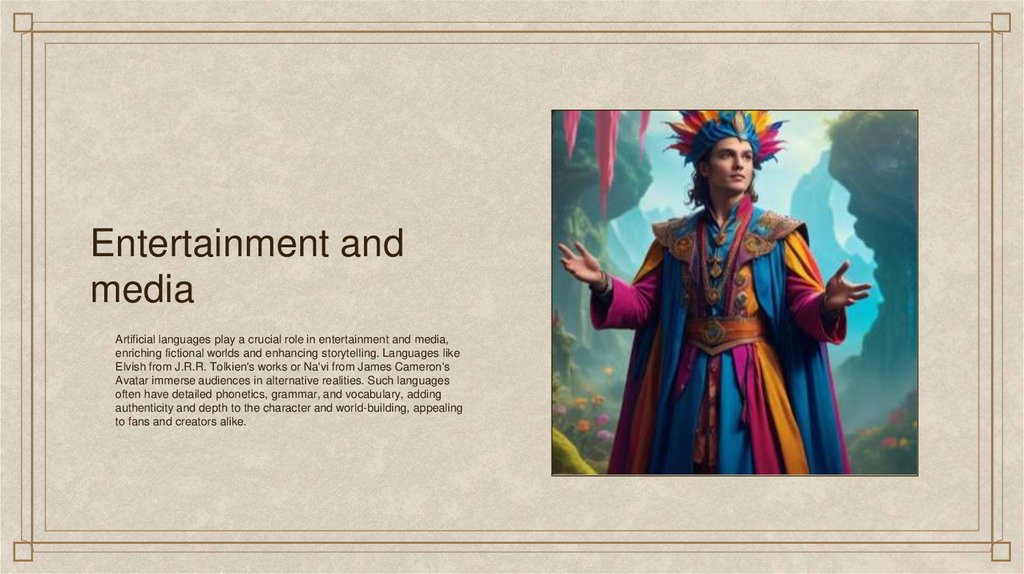
Entertainment andmedia
Artificial languages play a crucial role in entertainment and media,
enriching fictional worlds and enhancing storytelling. Languages like
Elvish from J.R.R. Tolkien's works or Na'vi from James Cameron's
Avatar immerse audiences in alternative realities. Such languages
often have detailed phonetics, grammar, and vocabulary, adding
authenticity and depth to the character and world-building, appealing
to fans and creators alike.
11.
ConclusionsArtificial languages represent a fascinating intersection of linguistics,
computer science, and creativity. Their diverse types and
applications illustrate their significance across various fields, from
fostering communication and enhancing technological
advancements to enriching cultural narratives in entertainment.
Understanding these languages not only broadens our perspective
on linguistic and computational theories but also underscores the
potential for innovation in both academic and practical domains.
12.
Thank you!Do you have any questions?
CREDITS: This presentation template was created by Slidesgo, and
includes icons by Flaticon, and infographics & images by Freepik
+
9
1
6
2
0