







 Философия
Похожие презентации:







Hedonism – Epicurus and Aristippus
1.
2.
PHIL130 ETHICSHEDONISM – EPICURUS AND ARISTIPPUS
Dr Anthi Chrysanthou PhD
Week 8/Teaching Session 16 – March 6, 2025
ac00@aubmed.ac.cy | American University of Beirut
3.
Hedonism – Epicurus and AristippusHedonism
The word “Hedonism” comes from the Greek word
hēdonē, which means “pleasure”.
Hedonism: the view that our life is good if it is filled
with pleasure and is free of pain.
Pleasure is the only thing that is intrinsically good for
people.
4.
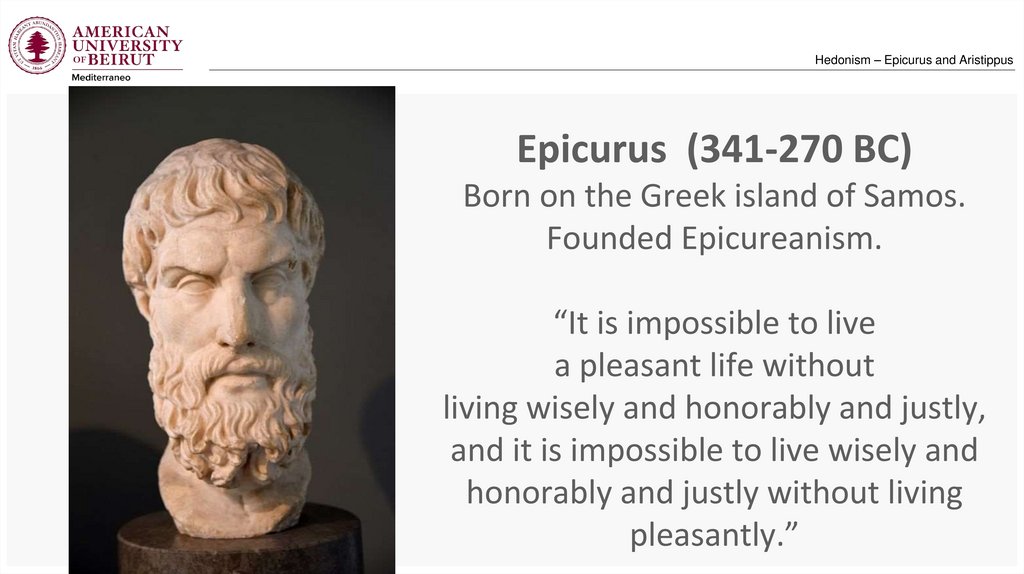
Hedonism – Epicurus and AristippusEpicurus (341-270 BC)
Born on the Greek island of Samos.
Founded Epicureanism.
“It is impossible to live
a pleasant life without
living wisely and honorably and justly,
and it is impossible to live wisely and
honorably and justly without living
pleasantly.”
5.
Hedonism – Epicurus and AristippusPsychological Hedonism and Ethical Hedonism
Psychological Hedonism: Suggests that everything we do, we do it so we ultimately
gain pleasure.
Ethical Hedonism: Suggests that only pleasure has worth or value. Only pleasure is
an intrinsic good.
Normative Hedonism: the idea that pleasure should be people’s primary
motivation.
Motivational Hedonism: only pleasure and pain cause people to do what they do.
Egoistical Hedonism: requires a person to consider only his or her own pleasure in
making choices.
Altruistic Hedonism: the creation of pleasure for all people is the best way to
measure if an action is ethical.
6.
Hedonism – Epicurus and Aristippus7.
Hedonism – Epicurus and AristippusHedonism: the view that our life is good if it is filled with
pleasure and there is absence of pain.
Epicurus:
“Luxurious food and drinks, in no way protect you from
harm. Wealth beyond what is natural, is no more use than an
overflowing container.”
“He who is not satisfied with a little, is satisfied with
nothing.”
8.
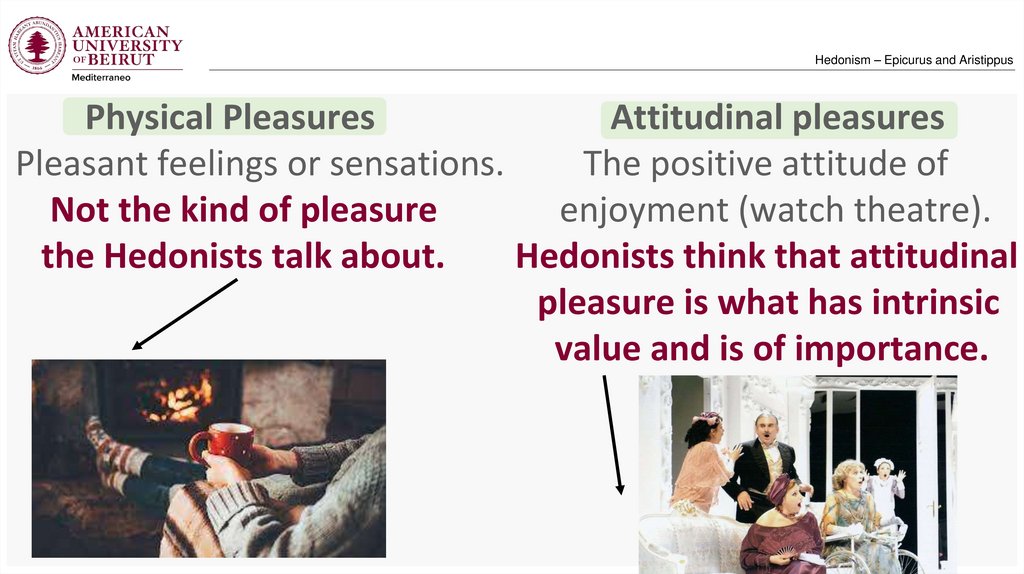
Hedonism – Epicurus and AristippusPhysical Pleasures
Attitudinal pleasures
Pleasant feelings or sensations.
The positive attitude of
Not the kind of pleasure
enjoyment (watch theatre).
the Hedonists talk about.
Hedonists think that attitudinal
pleasure is what has intrinsic
value and is of importance.
9.
Hedonism – Epicurus and AristippusATARAXIA
“The greatest reward of righteousness is peace of mind.”
“The just man is most free from disturbance, while the unjust is full of the utmost
disturbance.”
“There are two kinds of pleasure: one consisting in a state of rest, in which both body
and mind are undisturbed by any kind of pain; the other arising from an agreeable
agitation of the senses, producing a correspondent emotion in the soul. It is upon the
former of these that the enjoyment of life chiefly depends. Happiness may therefore
be said to consist in bodily ease, and mental tranquility.”
10.
Hedonism – Epicurus and AristippusEPICURUS:
“Philosophy instructs us to pay homage to the gods, not
through hope or fear, but from veneration of their
superior nature. It moreover enables us to conquer the
fear of death, by teaching us that it is no proper object of
terror; since, whilst we are, death is not, and when death
arrives, we are not: so that it neither concerns the living
nor the dead.”
11.
Hedonism – Epicurus and AristippusEpicurus: “A happy and eternal being has
no trouble himself and brings no trouble upon any other
being; hence he is exempt from movements of anger and
partiality, for every such movement implies weakness.”
“A happy life neither resembles a rapid torrent, nor a
standing pool, but is like a gentle stream, that glides
smoothly and silently along.”
12.
Hedonism – Epicurus and AristippusPositives of Hedonism
Many kinds of good life.
What makes me happy might not make you happy.
Personal authority concerning well-being.
What makes you happy is up to you.
13.
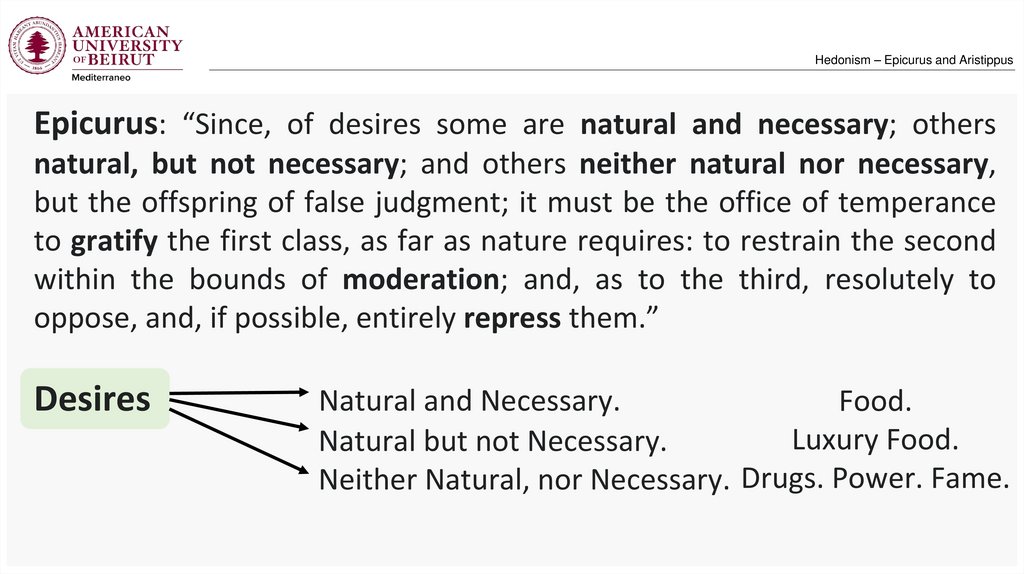
Hedonism – Epicurus and AristippusEpicurus: “Since, of desires some are natural and necessary; others
natural, but not necessary; and others neither natural nor necessary,
but the offspring of false judgment; it must be the office of temperance
to gratify the first class, as far as nature requires: to restrain the second
within the bounds of moderation; and, as to the third, resolutely to
oppose, and, if possible, entirely repress them.”
Desires
Natural and Necessary.
Food.
Luxury Food.
Natural but not Necessary.
Neither Natural, nor Necessary. Drugs. Power. Fame.
14.
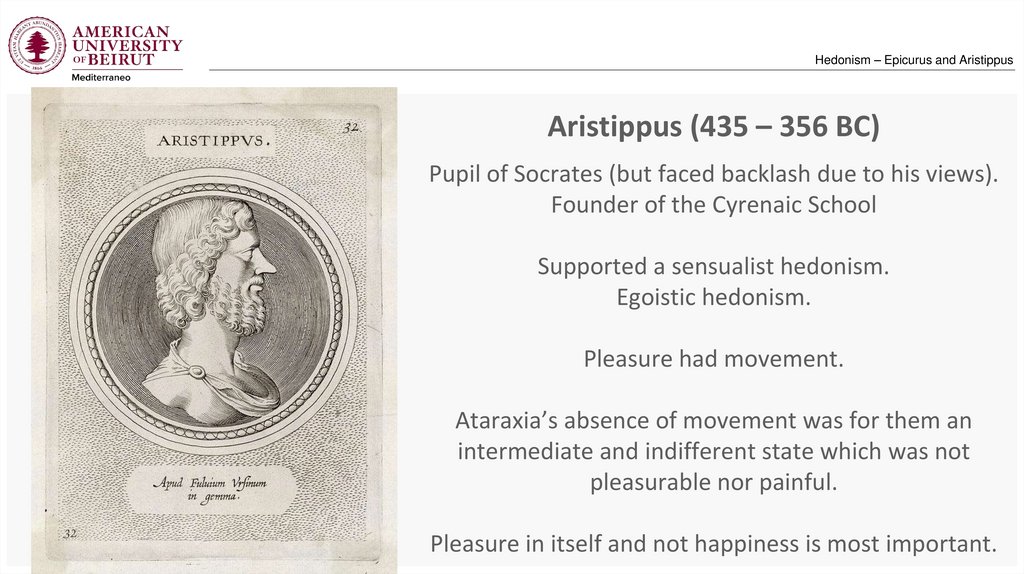
Hedonism – Epicurus and AristippusAristippus (435 – 356 BC)
Pupil of Socrates (but faced backlash due to his views).
Founder of the Cyrenaic School
Supported a sensualist hedonism.
Egoistic hedonism.
Pleasure had movement.
Ataraxia’s absence of movement was for them an
intermediate and indifferent state which was not
pleasurable nor painful.
Pleasure in itself and not happiness is most important.
15.
Hedonism – Epicurus and AristippusRobert Nozick’s Thought
Experiment
The Experience Machine
https://youtu.be/XNP1x11Z2Ig?feature=shared
16.
Hedonism – Epicurus and AristippusEpicurus:
“Let no one be slow to seek wisdom when he is young nor weary in the search of
it when he has grown old. For no age is too early or too late for the health of
the soul. And to say that the season for studying philosophy has not yet come, or
that it is past and gone, is like saying that the season for happiness is not yet or
that it is now no more. Therefore, both old and young alike ought to seek wisdom,
the former in order that, as age comes over him, he may be young in good things
because of the grace of what has been, and the latter in order that, while he is
young, he may at the same time be old, because he has no fear of the things
which are to come. So we must exercise ourselves in the things which bring
happiness, since, if that be present, we have everything, and, if that be absent, all
our actions are directed towards attaining it.”
17.
The Problem of False HappinessHedonism – Epicurus and Aristippus
The Problem of False Happiness
1. If Hedonism is true, then our lives go well to the extent
that we are happy.
2. It’s not always the case that our lives go well to the
extent that we are happy; those whose happiness is
based on false beliefs have worse lives than those
whose happiness is based on true beliefs, even if both
lives are equally happy.
3. Therefore, hedonism could be false.