




 Маркетинг
Похожие презентации:








Essentials of Services Marketing
1.
5Distributing Services
THROUGH PHYSICAL AND
ELECTRONIC CHANNELS
WIRTZ LOVELOCK
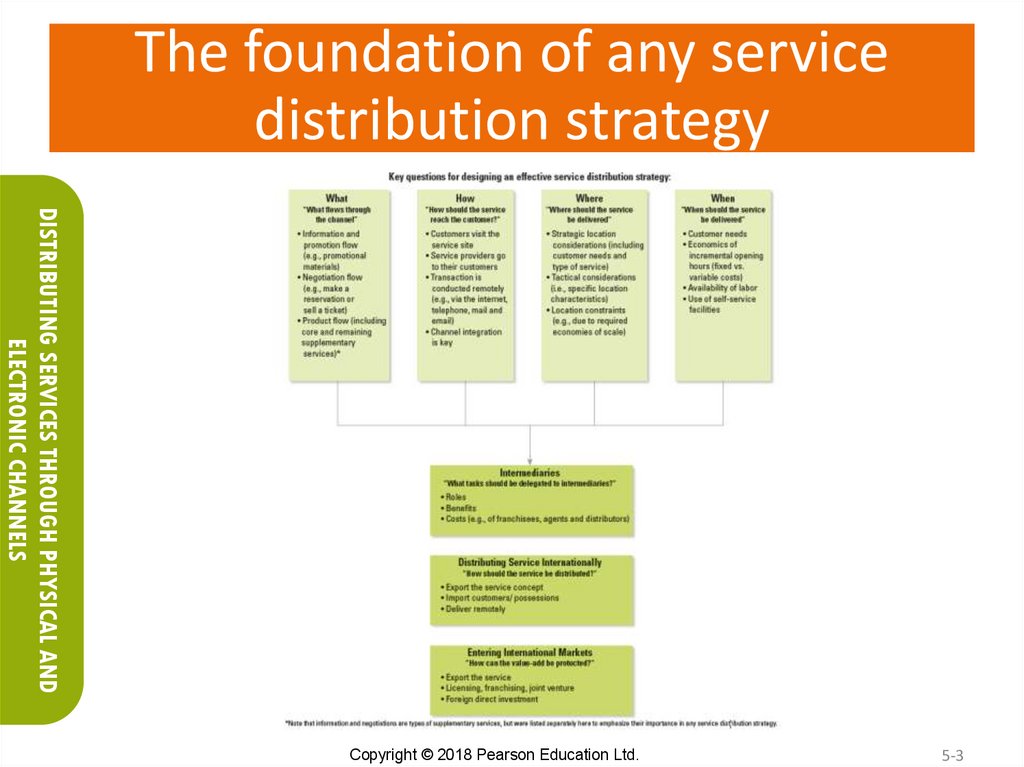
2. Know the four key questions that form the foundation of any service distribution strategy.
Distributing Services throughPhysical and Electronic Channels
5.1
Know the four key questions that form
the foundation of any service
distribution strategy.
WIRTZ LOVELOCK
3. The foundation of any service distribution strategy
DISTRIBUTING SERVICES THROUGH PHYSICAL ANDELECTRONIC CHANNELS
Copyright © 2018 Pearson Education Ltd.
5-3
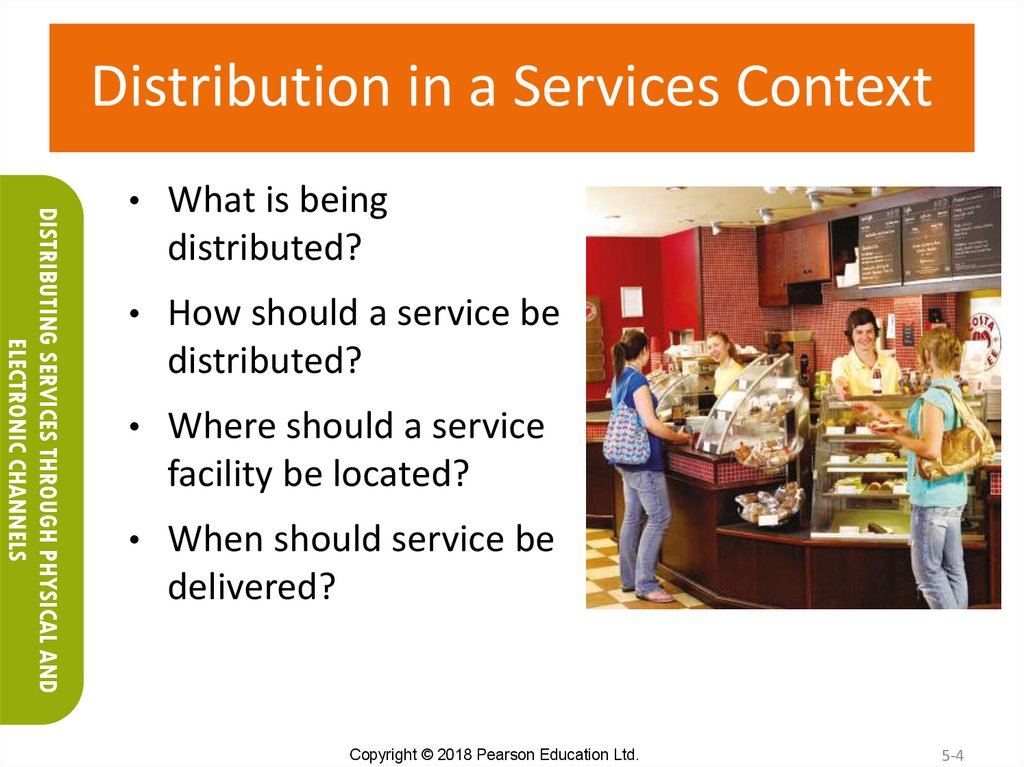
4. Distribution in a Services Context
DISTRIBUTING SERVICES THROUGH PHYSICAL ANDELECTRONIC CHANNELS
What is being
distributed?
How should a service be
distributed?
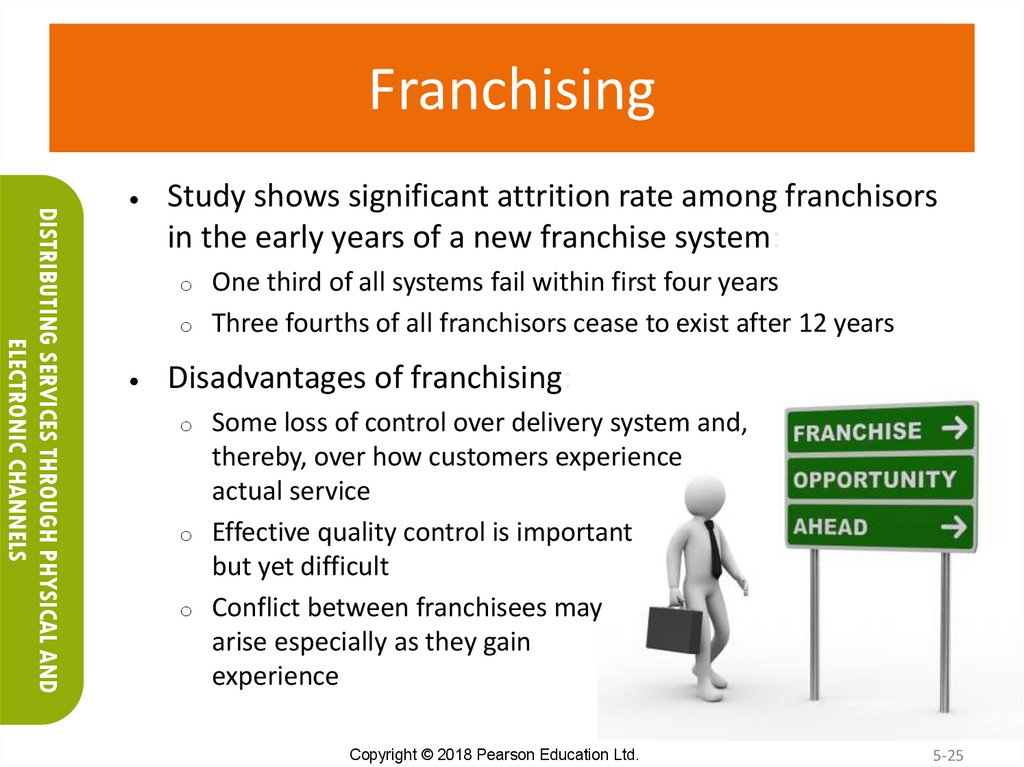
Where should a service
facility be located?
When should service be
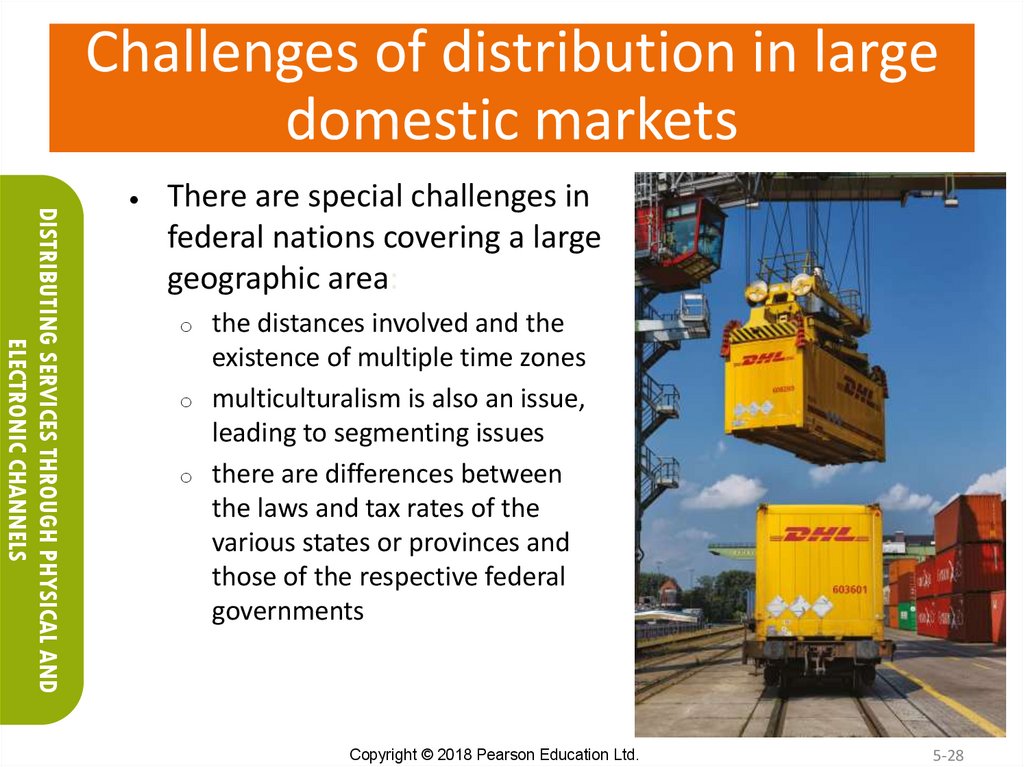
delivered?
Copyright © 2018 Pearson Education Ltd.
5-4
5. Describe the three interrelated flows that show what is being distributed.
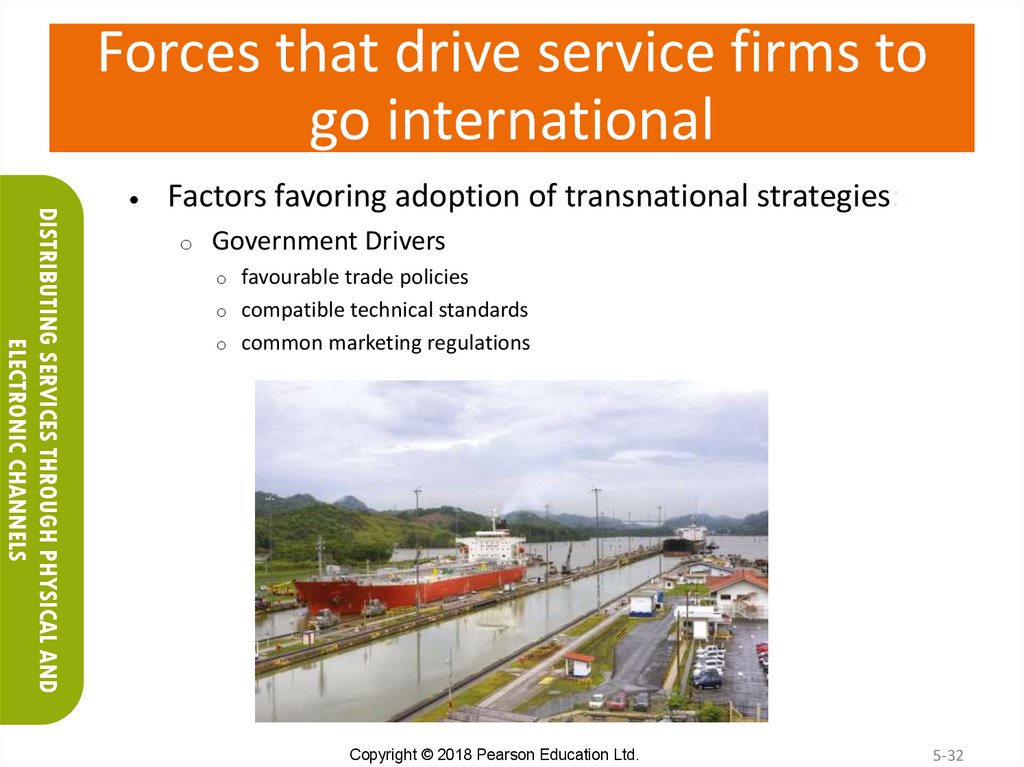
Distributing Services throughPhysical and Electronic Channels
5.2
Describe the three interrelated flows
that show what is being distributed.
WIRTZ LOVELOCK
6. What is being distributed?
DISTRIBUTING SERVICES THROUGH PHYSICAL ANDELECTRONIC CHANNELS
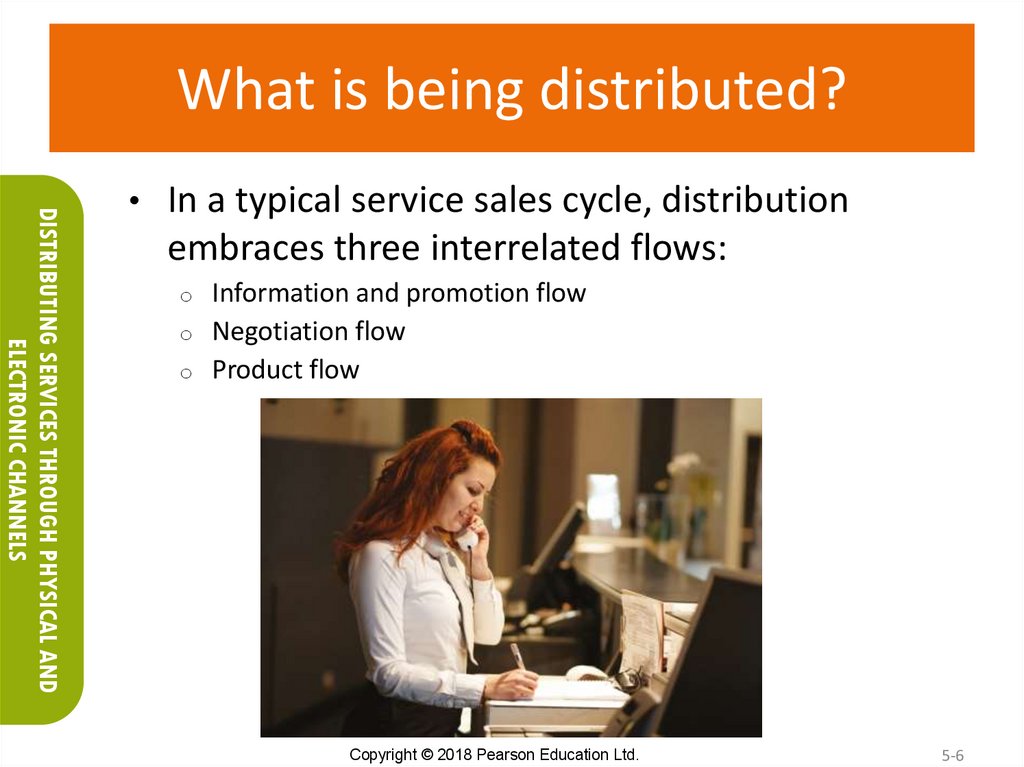
In a typical service sales cycle, distribution
embraces three interrelated flows:
Information and promotion flow
o Negotiation flow
o Product flow
o
Copyright © 2018 Pearson Education Ltd.
5-6
7. How services can be distributed using three main options; the importance of distinguishing between the distribution of core and
Distributing Services throughPhysical and Electronic Channels
5.3
How services can be distributed using
three main options; the importance of
distinguishing between the distribution
of core and supplementary services.
WIRTZ LOVELOCK
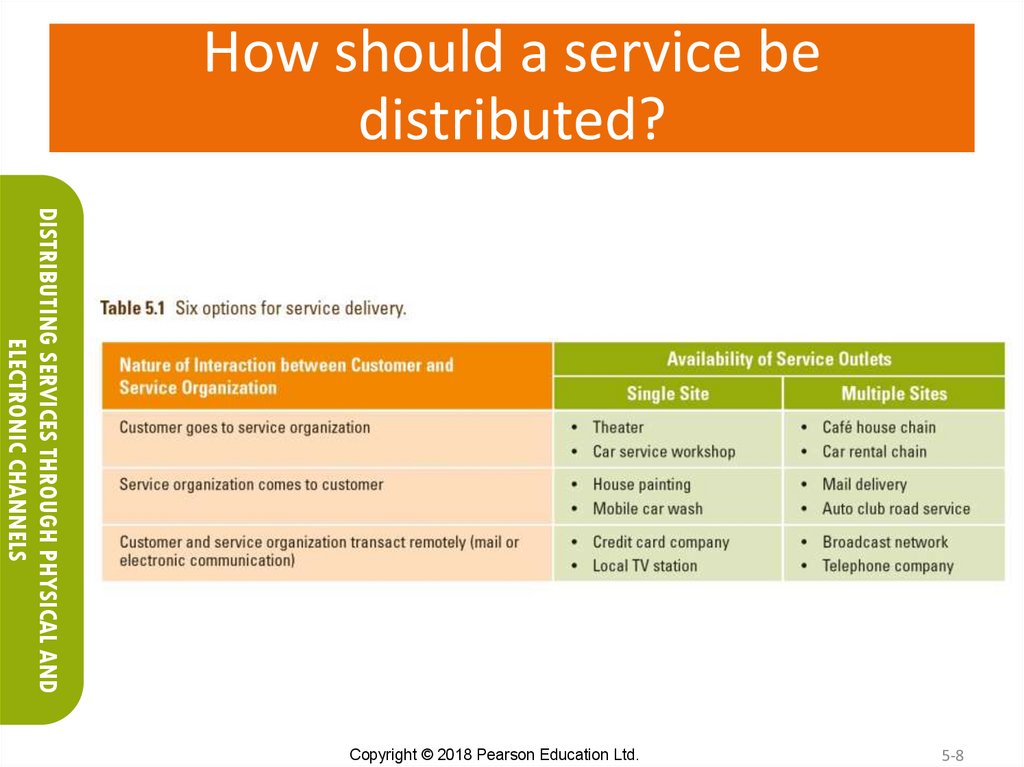
8. How should a service be distributed?
DISTRIBUTING SERVICES THROUGH PHYSICAL ANDELECTRONIC CHANNELS
Copyright © 2018 Pearson Education Ltd.
5-8
9. Recognize the issues of delivering services through electronic channels, and discuss the growth of service delivery via
Distributing Services throughPhysical and Electronic Channels
5.4
Recognize the issues of delivering
services through electronic channels,
and discuss the growth of service
delivery via cyberspace.
WIRTZ LOVELOCK
10. Delivering services through electronic channels
DISTRIBUTING SERVICES THROUGH PHYSICAL ANDELECTRONIC CHANNELS
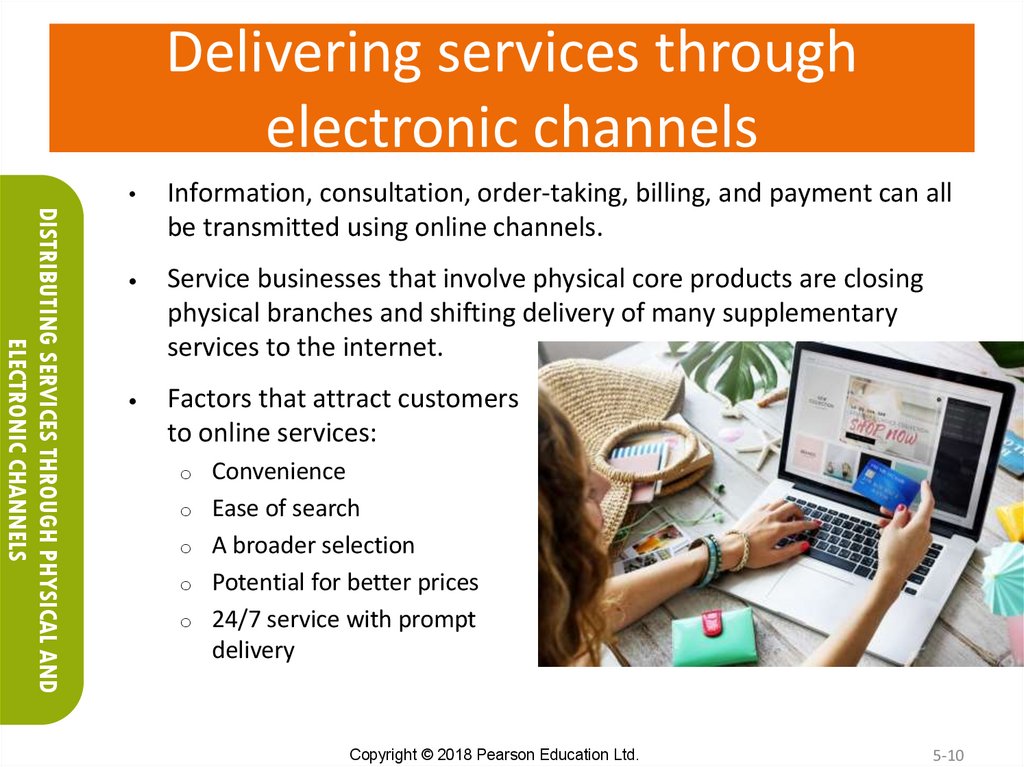
Information, consultation, order-taking, billing, and payment can all
be transmitted using online channels.
Service businesses that involve physical core products are closing
physical branches and shifting delivery of many supplementary
services to the internet.
Factors that attract customers
to online services:
o
o
o
o
o
Convenience
Ease of search
A broader selection
Potential for better prices
24/7 service with prompt
delivery
Copyright © 2018 Pearson Education Ltd.
5-10
11. Understand the determinants of customers’ channel preferences.
Distributing Services throughPhysical and Electronic Channels
5.5
Understand the determinants of
customers’ channel preferences.
WIRTZ LOVELOCK
12. Channel Preferences Vary among Customers
DISTRIBUTING SERVICES THROUGH PHYSICAL ANDELECTRONIC CHANNELS
For complex and high-perceived risk services, people
tend to rely on personal channels.
Individuals with greater confidence and knowledge
about a service/channel tend to use impersonal and selfservice channels
Customers who are more technology savvy
Customers with social motives tend to use personal
channels
Convenience is a key driver of channel choice
Copyright © 2018 Pearson Education Ltd.
5-12
13. Know the importance of channel integration
Distributing Services throughPhysical and Electronic Channels
5.6
Know the importance of channel
integration
WIRTZ LOVELOCK
14. The importance of channel integration
DISTRIBUTING SERVICES THROUGH PHYSICAL ANDELECTRONIC CHANNELS
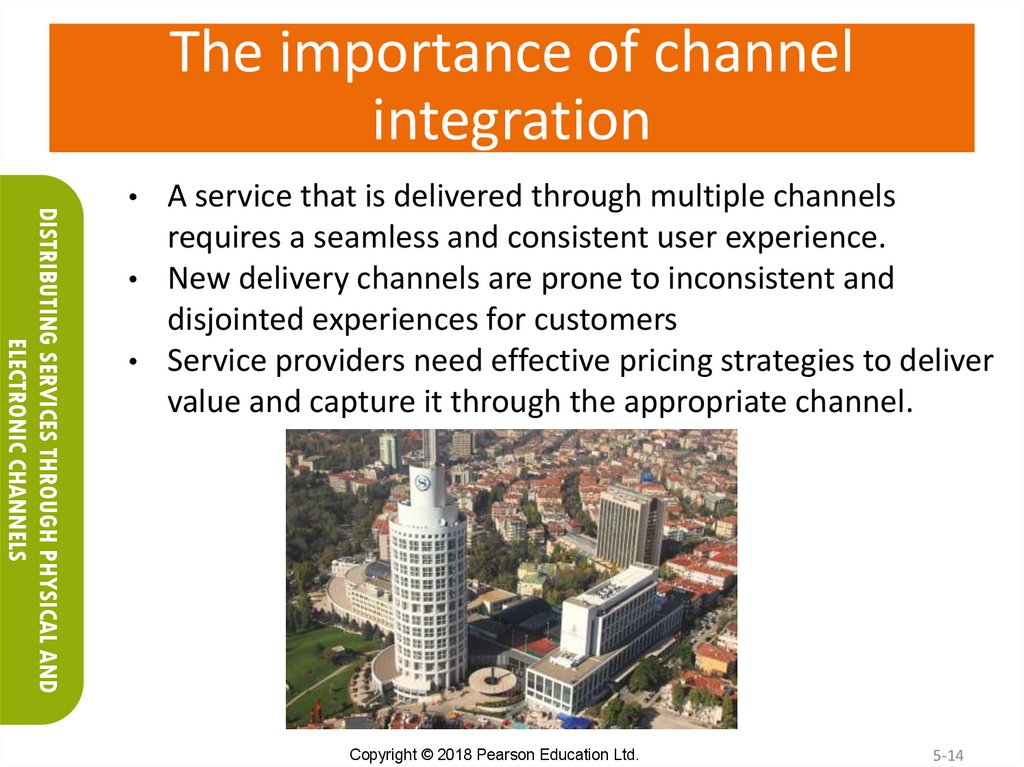
A service that is delivered through multiple channels
requires a seamless and consistent user experience.
• New delivery channels are prone to inconsistent and
disjointed experiences for customers
• Service providers need effective pricing strategies to deliver
value and capture it through the appropriate channel.
Copyright © 2018 Pearson Education Ltd.
5-14
15. Describe the where (place) decisions of physical channels, and be familiar with the strategic and tactical location
Distributing Services throughPhysical and Electronic Channels
5.7
Describe the where (place) decisions of
physical channels, and be familiar with
the strategic and tactical location
considerations.
WIRTZ LOVELOCK
16. Strategic and tactical location considerations
DISTRIBUTING SERVICES THROUGH PHYSICAL AND
ELECTRONIC CHANNELS
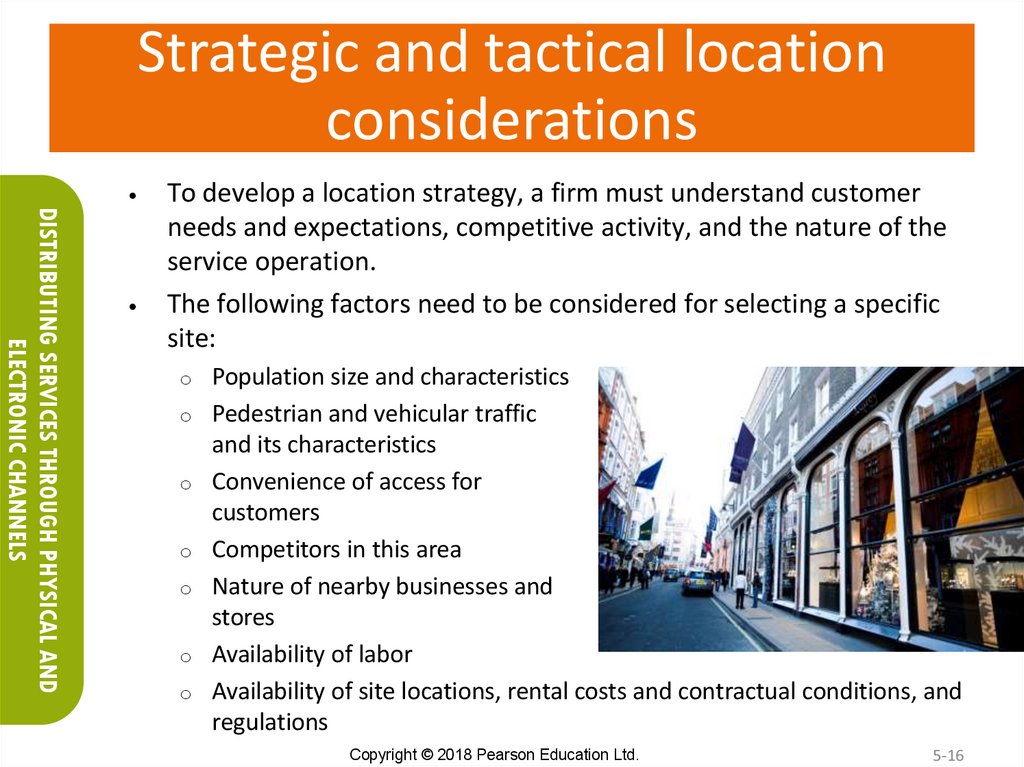
To develop a location strategy, a firm must understand customer
needs and expectations, competitive activity, and the nature of the
service operation.
The following factors need to be considered for selecting a specific
site:
o
o
o
o
o
o
o
Population size and characteristics
Pedestrian and vehicular traffic
and its characteristics
Convenience of access for
customers
Competitors in this area
Nature of nearby businesses and
stores
Availability of labor
Availability of site locations, rental costs and contractual conditions, and
regulations
Copyright © 2018 Pearson Education Ltd.
5-16
17. Strategic and tactical location considerations
DISTRIBUTING SERVICES THROUGH PHYSICAL ANDELECTRONIC CHANNELS
Places of service delivery
Ministered:
Creating many small service factories to maximize geographic
coverage (automated kiosks)
o Separating front and back stages of operation (Taco Bell)
o Purchasing space from another provider in complementary field
(Dunkin Donuts with Burger King)
o
Locating in Multipurpose Facilities:
o
Proximity to where customers live or work (service stations)
Copyright © 2018 Pearson Education Ltd.
5-17
18. Strategic and tactical location considerations
DISTRIBUTING SERVICES THROUGH PHYSICAL ANDELECTRONIC CHANNELS
Places of service delivery
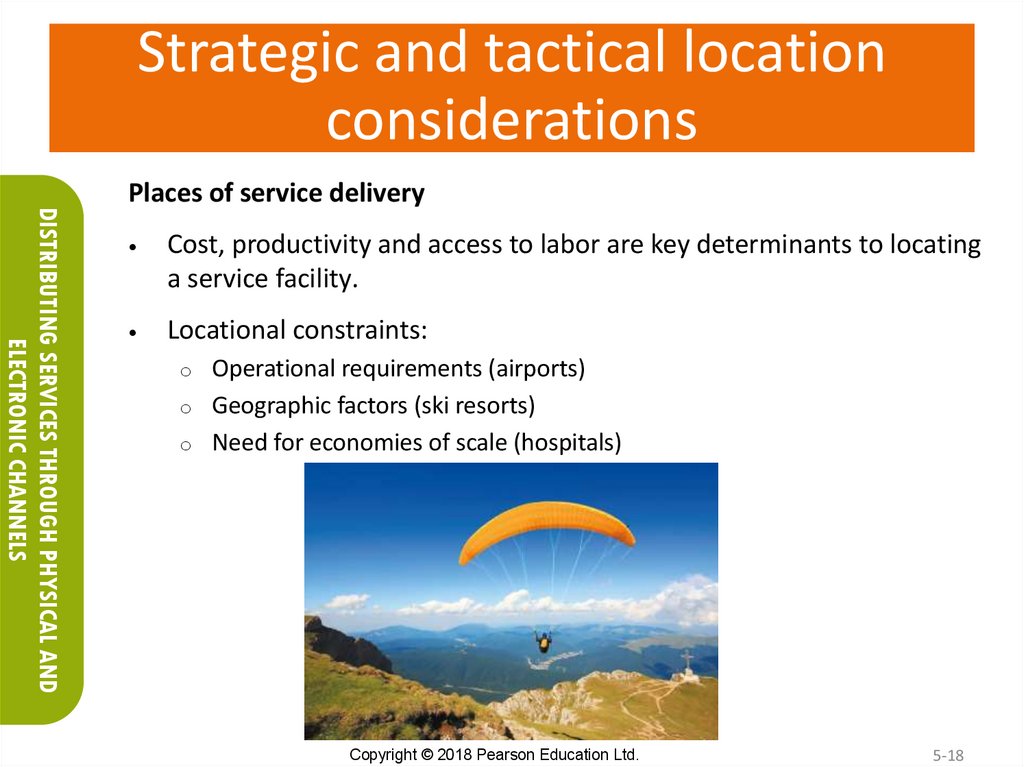
Cost, productivity and access to labor are key determinants to locating
a service facility.
Locational constraints:
Operational requirements (airports)
o Geographic factors (ski resorts)
o Need for economies of scale (hospitals)
o
Copyright © 2018 Pearson Education Ltd.
5-18
19. Describe the when (time) decisions of physical channels and the factors that determine extended operating hours.
Distributing Services throughPhysical and Electronic Channels
5.8
Describe the when (time) decisions of
physical channels and the factors that
determine extended operating hours.
WIRTZ LOVELOCK
20. Time of Service Delivery
DISTRIBUTING SERVICES THROUGH PHYSICAL ANDELECTRONIC CHANNELS
Traditionally, schedules were
restricted.
o
Service availability limited to daytime,
40–50 hours a week
Today:
o
For flexible, responsive service
operations
o
24/7 service – 24 hours a day, 7 days a week,
around the world
Copyright © 2018 Pearson Education Ltd.
5-20
21. Understand the role, benefits, and costs of using intermediaries in distributing services
Distributing Services throughPhysical and Electronic Channels
5.9
Understand the role, benefits, and
costs of using intermediaries in
distributing services
WIRTZ LOVELOCK
22. The Role of Intermediaries
DISTRIBUTING SERVICES THROUGH PHYSICAL ANDELECTRONIC CHANNELS
Challenges for original supplier:
Act as guardian of overall process
o Ensure that each element offered by intermediaries fits overall
service concept
o
Copyright © 2018 Pearson Education Ltd.
5-22
23. Know why franchising is such a common way of delivering services to end users.
Distributing Services throughPhysical and Electronic Channels
5.10
Know why franchising is such a
common way of delivering services to
end users.
WIRTZ LOVELOCK
24. Franchising
DISTRIBUTING SERVICES THROUGH PHYSICAL ANDELECTRONIC CHANNELS
Popular way to expand delivery of effective service
concept, without a high level of monetary investments
compared to rapid expansion of company-owned and managed sites
Franchisor provides training, equipment and support
marketing activities. Franchisees invest time and finance,
and follow copy and media guidelines of franchisor
Growth-oriented firms like franchising because
franchisees are motivated to ensure good customer
service and high-quality service operations
Copyright © 2018 Pearson Education Ltd.
5-24
25. Franchising
DISTRIBUTING SERVICES THROUGH PHYSICAL ANDELECTRONIC CHANNELS
Study shows significant attrition rate among franchisors
in the early years of a new franchise system:
One third of all systems fail within first four years
o Three fourths of all franchisors cease to exist after 12 years
o
Disadvantages of franchising:
Some loss of control over delivery system and,
thereby, over how customers experience
actual service
o Effective quality control is important
but yet difficult
o Conflict between franchisees may
arise especially as they gain
experience
o
Copyright © 2018 Pearson Education Ltd.
5-25
26. Franchising
DISTRIBUTING SERVICES THROUGH PHYSICAL ANDELECTRONIC CHANNELS
Alternative: license another supplier to act on
the original supplier’s behalf to deliver core
product, for example:
Trucking companies
o Banks selling insurance products
o
Copyright © 2018 Pearson Education Ltd.
5-26
27. Understand the challenges of distribution in large domestic markets
Distributing Services throughPhysical and Electronic Channels
5.11
Understand the challenges of
distribution in large domestic markets
WIRTZ LOVELOCK
28. Challenges of distribution in large domestic markets
DISTRIBUTING SERVICES THROUGH PHYSICAL ANDELECTRONIC CHANNELS
There are special challenges in
federal nations covering a large
geographic area:
the distances involved and the
existence of multiple time zones
o multiculturalism is also an issue,
leading to segmenting issues
o there are differences between
the laws and tax rates of the
various states or provinces and
those of the respective federal
governments
o
Copyright © 2018 Pearson Education Ltd.
5-28
29. Be familiar with the forces that drive service firms to go international.
Distributing Services throughPhysical and Electronic Channels
5.12
Be familiar with the forces that drive
service firms to go international.
WIRTZ LOVELOCK
30. Forces that drive service firms to go international
DISTRIBUTING SERVICES THROUGH PHYSICAL ANDELECTRONIC CHANNELS
Factors favoring adoption of transnational strategies:
o
Market Drivers
common customer needs across many countries
o global customers who demand consistent service from suppliers around the
world
o availability of international
channels
o
o
Competition Drivers
presence of competitors
from different
o Countries
o interdependence of countries
o transnational policies of the
competitors
o
Copyright © 2018 Pearson Education Ltd.
5-30
31. Forces that drive service firms to go international
DISTRIBUTING SERVICES THROUGH PHYSICAL ANDELECTRONIC CHANNELS
Factors favoring adoption of transnational strategies:
o
Technology Drivers
enhanced performance and capabilities in telecommunications,
computerization, and software
o miniaturization of equipment
o digitization of voice, video, and text
o the growing availability of broadband telecommunication channels
o
o
Cost Drivers
economies of scale
o sourcing efficiencies
o improved performance and lower operating costs for telecommunications
and transportation
o
Copyright © 2018 Pearson Education Ltd.
5-31
32. Forces that drive service firms to go international
DISTRIBUTING SERVICES THROUGH PHYSICAL ANDELECTRONIC CHANNELS
Factors favoring adoption of transnational strategies:
o
Government Drivers
favourable trade policies
o compatible technical standards
o common marketing regulations
o
Copyright © 2018 Pearson Education Ltd.
5-32
33. Appreciate the special challenges of distributing services internationally.
Distributing Services throughPhysical and Electronic Channels
5.13
Appreciate the special challenges of
distributing services internationally.
WIRTZ LOVELOCK
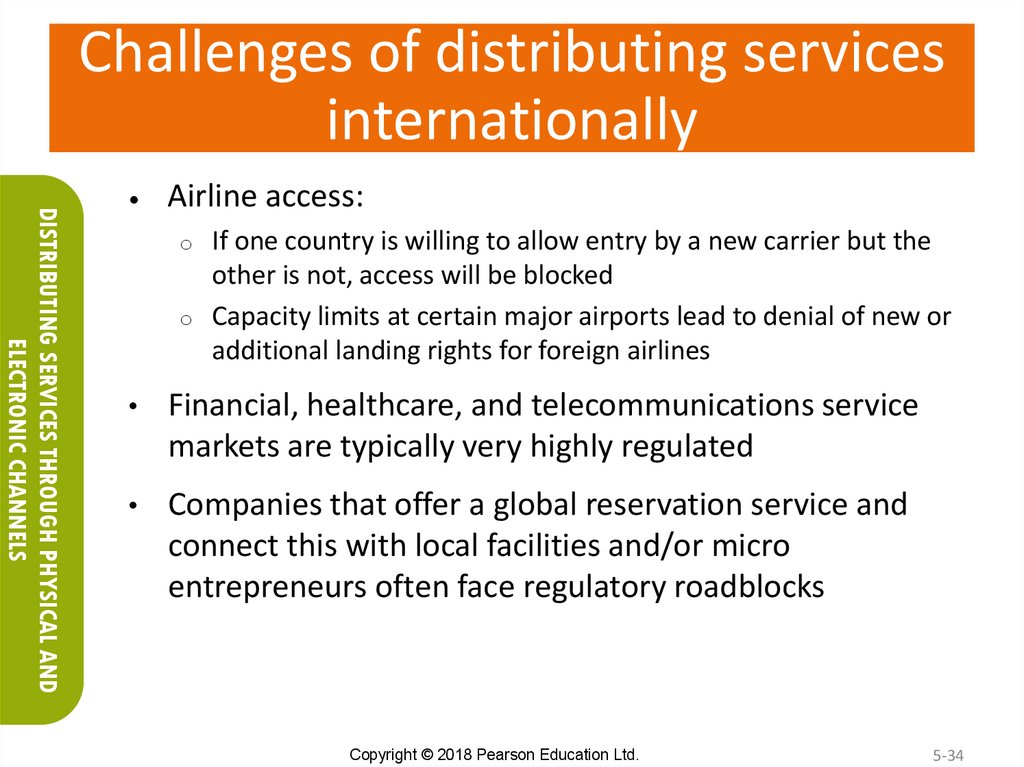
34. Challenges of distributing services internationally
DISTRIBUTING SERVICES THROUGH PHYSICAL ANDELECTRONIC CHANNELS
Airline access:
If one country is willing to allow entry by a new carrier but the
other is not, access will be blocked
o Capacity limits at certain major airports lead to denial of new or
additional landing rights for foreign airlines
o
Financial, healthcare, and telecommunications service
markets are typically very highly regulated
Companies that offer a global reservation service and
connect this with local facilities and/or micro
entrepreneurs often face regulatory roadblocks
Copyright © 2018 Pearson Education Ltd.
5-34
35. Explain the determinants of international market entry strategies
Distributing Services throughPhysical and Electronic Channels
5.14
Explain the determinants of
international market entry strategies
WIRTZ LOVELOCK
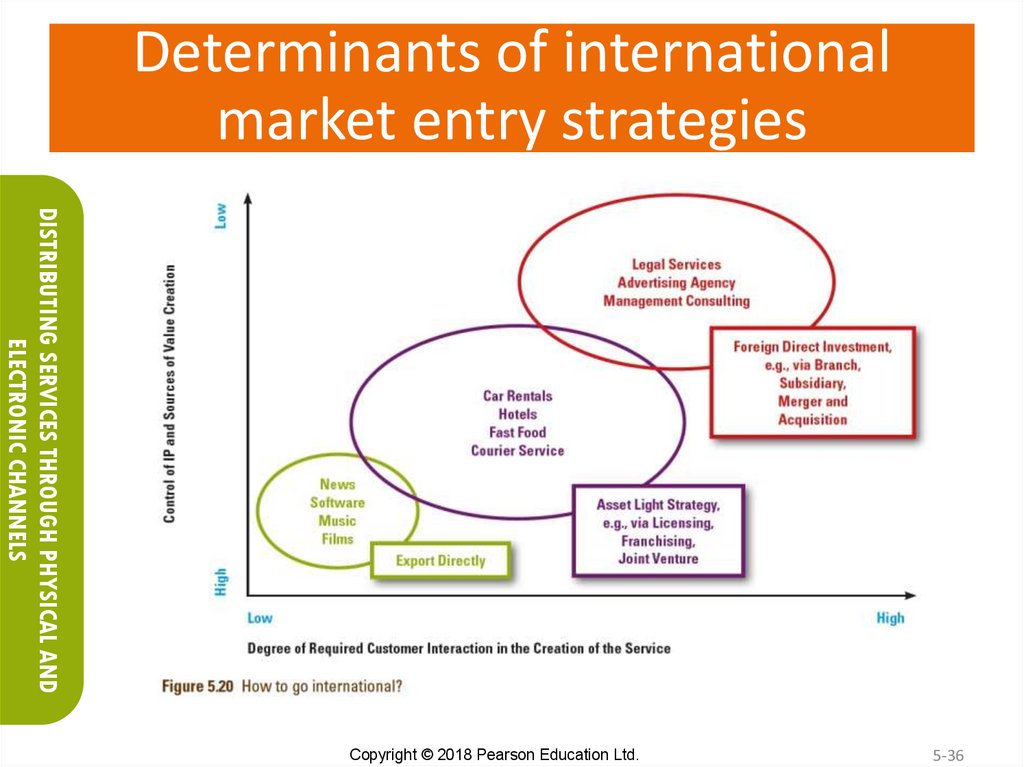
36. Determinants of international market entry strategies
DISTRIBUTING SERVICES THROUGH PHYSICAL ANDELECTRONIC CHANNELS
Copyright © 2018 Pearson Education Ltd.
5-36