
 Программирование
Похожие презентации:








F#, GUI Programming and the Problem of Mutually Referential Objects in ML-style Programming
1. F#, GUI Programming and the Problem of Mutually Referential Objects in ML-style Programming
Don SymeMSR Cambridge
2. Topics for today
A brief introduction to F#goals, project status etc.
more detail in AH Review on Oct 15
An F# sample
An experimental extension related to
value recursion
Motivated by and used in the sample
“Value recursion in a strict language when
initialization effects cannot be statically
controlled”
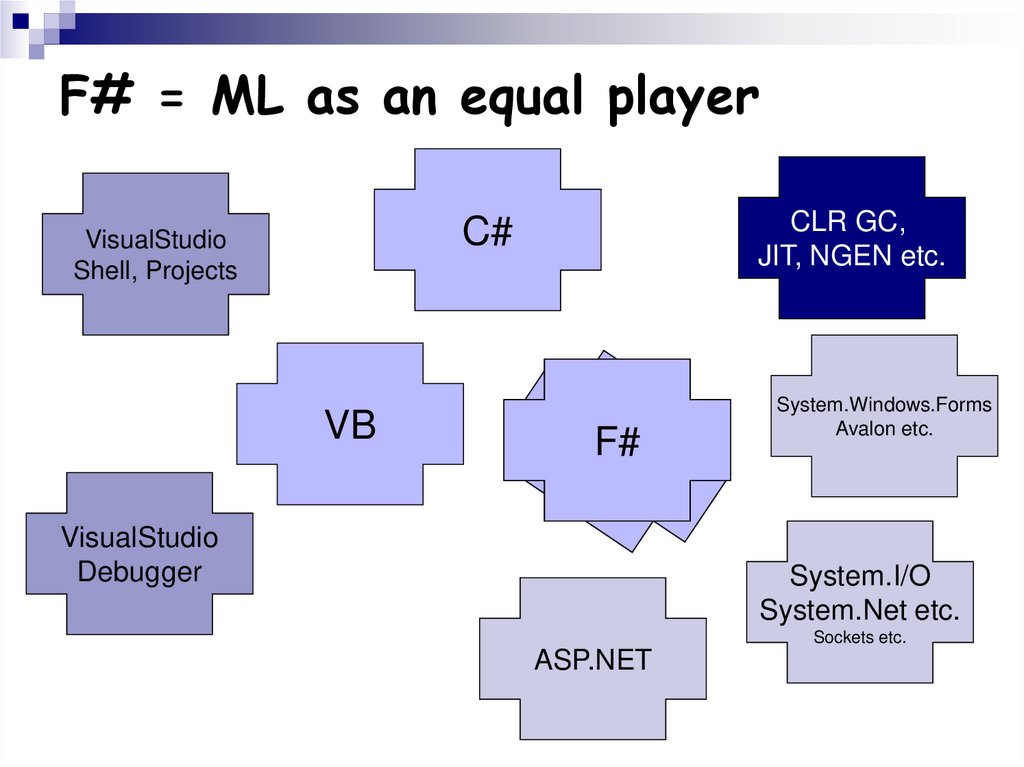
3. F# = ML as an equal player
CLR GC,JIT, NGEN etc.
C#
VisualStudio
Shell, Projects
VB
ML
F#
VisualStudio
Debugger
System.Windows.Forms
Avalon etc.
System.I/O
System.Net etc.
Sockets etc.
ASP.NET
4. What does ML offer over C#?
Type inferenceTuples, lists
Discriminated unions
Inner definitions
Functions as first-class values
Simple but powerful optimization story
Explicit mutual dependencies and self-
reference (e.g. no ‘this’ pointer by default)
Immutability the norm
However the same “basic model”, e.g. w.r.t
I/O, effects, exceptions
5. What does ML offer over C#?
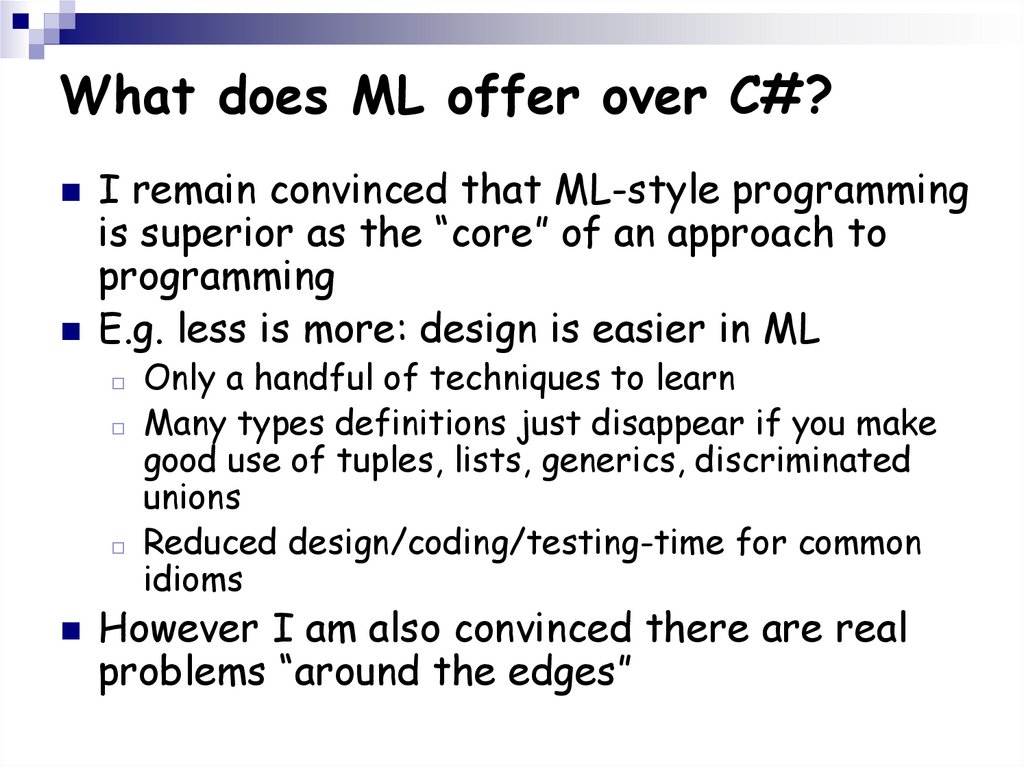
I remain convinced that ML-style programmingis superior as the “core” of an approach to
programming
E.g. less is more: design is easier in ML
Only a handful of techniques to learn
Many types definitions just disappear if you make
good use of tuples, lists, generics, discriminated
unions
Reduced design/coding/testing-time for common
idioms
However I am also convinced there are real
problems “around the edges”
6. What does F# offer over ML?
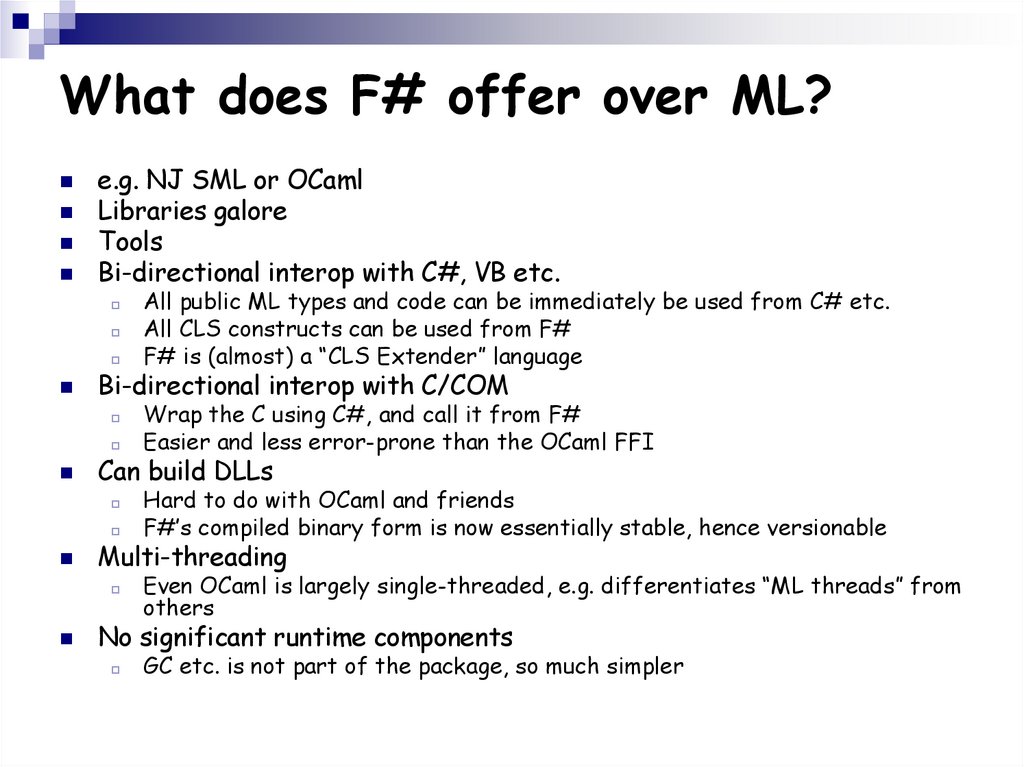
e.g. NJ SML or OCamlLibraries galore
Tools
Bi-directional interop with C#, VB etc.
Bi-directional interop with C/COM
Hard to do with OCaml and friends
F#’s compiled binary form is now essentially stable, hence versionable
Multi-threading
Wrap the C using C#, and call it from F#
Easier and less error-prone than the OCaml FFI
Can build DLLs
All public ML types and code can be immediately be used from C# etc.
All CLS constructs can be used from F#
F# is (almost) a “CLS Extender” language
Even OCaml is largely single-threaded, e.g. differentiates “ML threads” from
others
No significant runtime components
GC etc. is not part of the package, so much simpler
7. What does F# offer over ML?
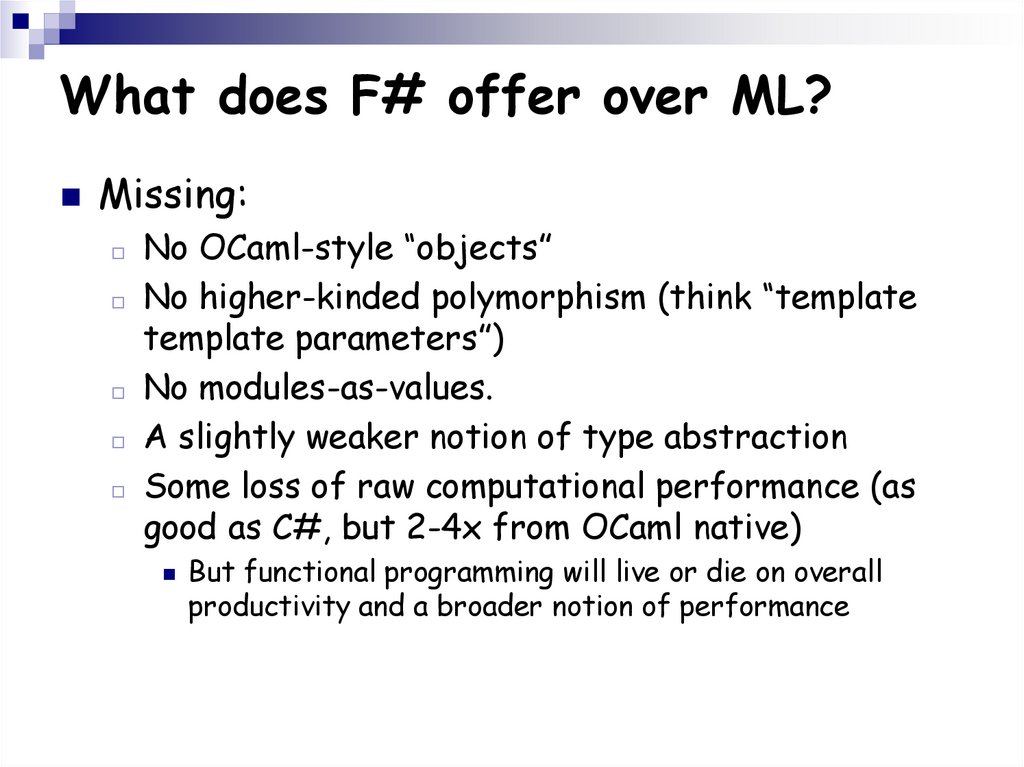
Missing:No OCaml-style “objects”
No higher-kinded polymorphism (think “template
template parameters”)
No modules-as-values.
A slightly weaker notion of type abstraction
Some loss of raw computational performance (as
good as C#, but 2-4x from OCaml native)
But functional programming will live or die on overall
productivity and a broader notion of performance
8. F# Status
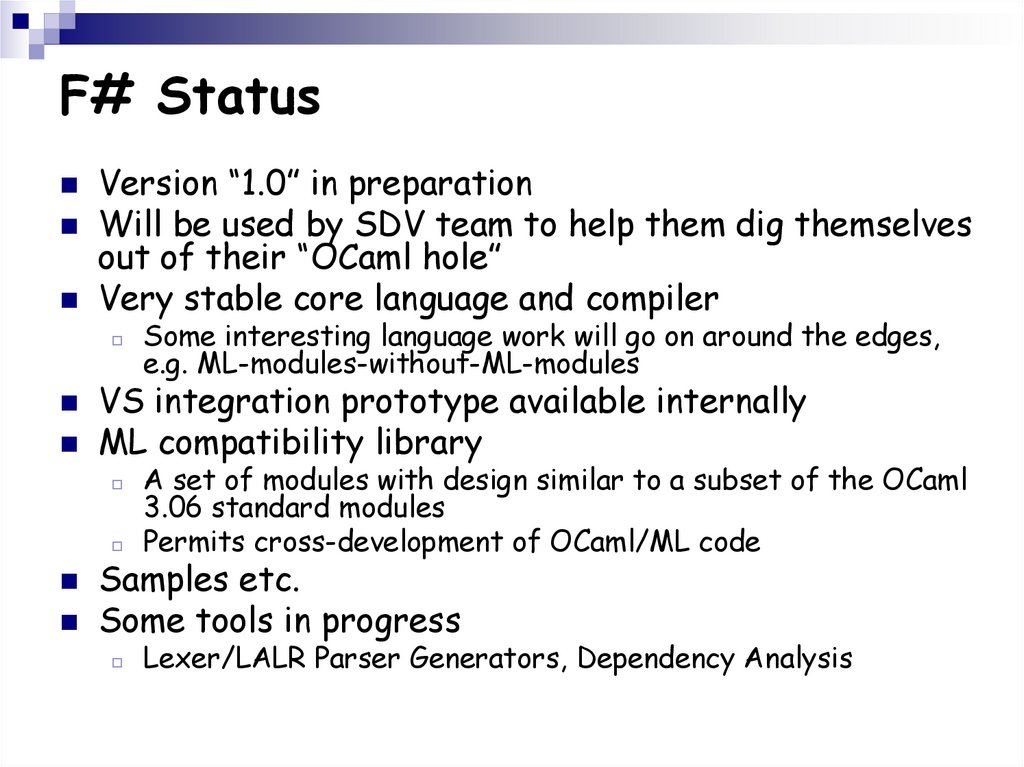
Version “1.0” in preparationWill be used by SDV team to help them dig themselves
out of their “OCaml hole”
Very stable core language and compiler
Some interesting language work will go on around the edges,
e.g. ML-modules-without-ML-modules
VS integration prototype available internally
ML compatibility library
A set of modules with design similar to a subset of the OCaml
3.06 standard modules
Permits cross-development of OCaml/ML code
Lexer/LALR Parser Generators, Dependency Analysis
Samples etc.
Some tools in progress
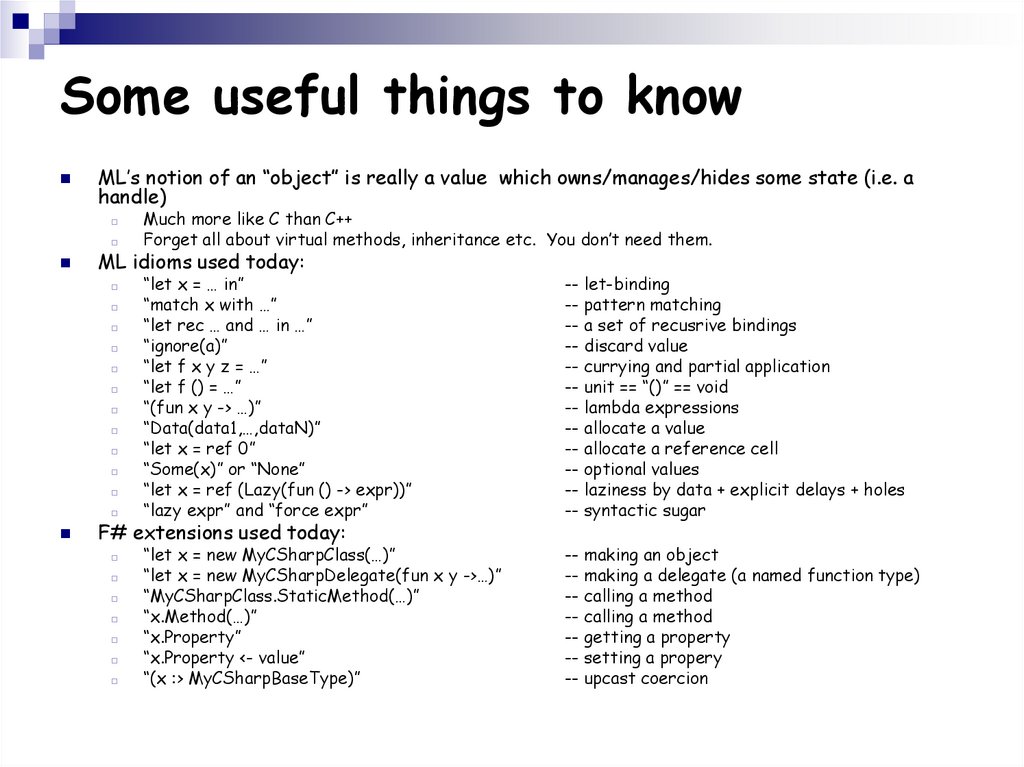
9. Some useful things to know
ML’s notion of an “object” is really a value which owns/manages/hides some state (i.e. ahandle)
ML idioms used today:
Much more like C than C++
Forget all about virtual methods, inheritance etc. You don’t need them.
“let x = … in”
“match x with …”
“let rec … and … in …”
“ignore(a)”
“let f x y z = …”
“let f () = …”
“(fun x y -> …)”
“Data(data1,…,dataN)”
“let x = ref 0”
“Some(x)” or “None”
“let x = ref (Lazy(fun () -> expr))”
“lazy expr” and “force expr”
-- let-binding
-- pattern matching
-- a set of recusrive bindings
-- discard value
-- currying and partial application
-- unit == “()” == void
-- lambda expressions
-- allocate a value
-- allocate a reference cell
-- optional values
-- laziness by data + explicit delays + holes
-- syntactic sugar
“let x = new MyCSharpClass(…)”
“let x = new MyCSharpDelegate(fun x y ->…)”
“MyCSharpClass.StaticMethod(…)”
“x.Method(…)”
“x.Property”
“x.Property <- value”
“(x :> MyCSharpBaseType)”
-- making an object
-- making a delegate (a named function type)
-- calling a method
-- calling a method
-- getting a property
-- setting a propery
-- upcast coercion
F# extensions used today:
10. F# Observations
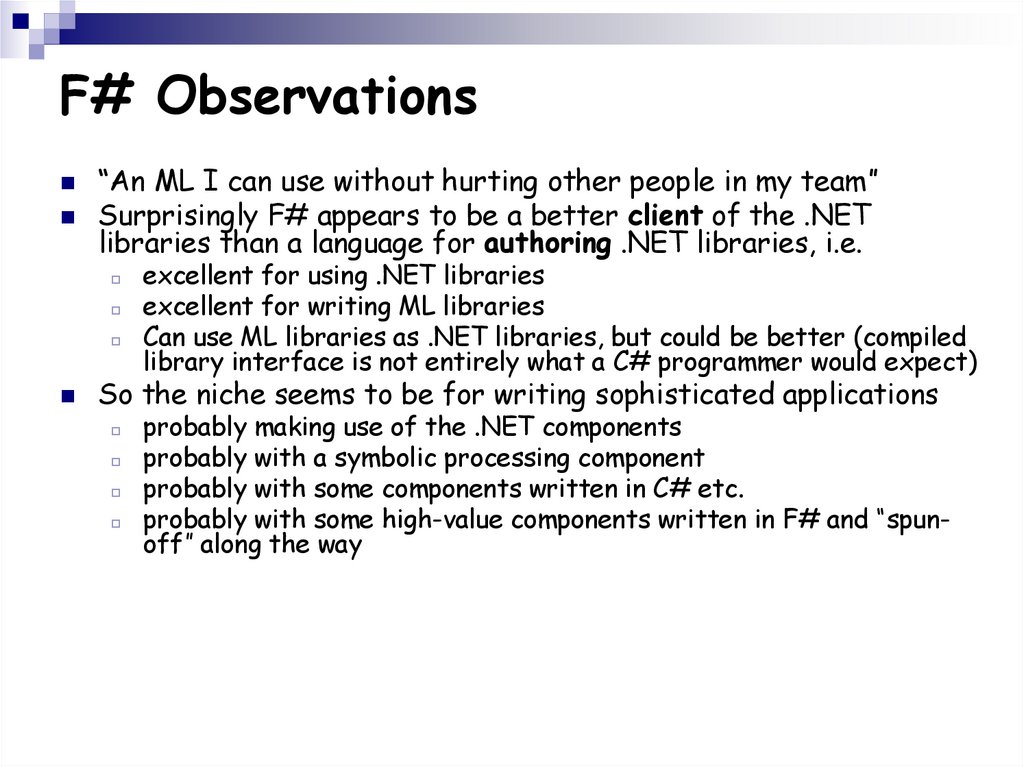
“An ML I can use without hurting other people in my team”Surprisingly F# appears to be a better client of the .NET
libraries than a language for authoring .NET libraries, i.e.
excellent for using .NET libraries
excellent for writing ML libraries
Can use ML libraries as .NET libraries, but could be better (compiled
library interface is not entirely what a C# programmer would expect)
So the niche seems to be for writing sophisticated applications
probably making use of the .NET components
probably with a symbolic processing component
probably with some components written in C# etc.
probably with some high-value components written in F# and “spunoff” along the way
11. An F# sample
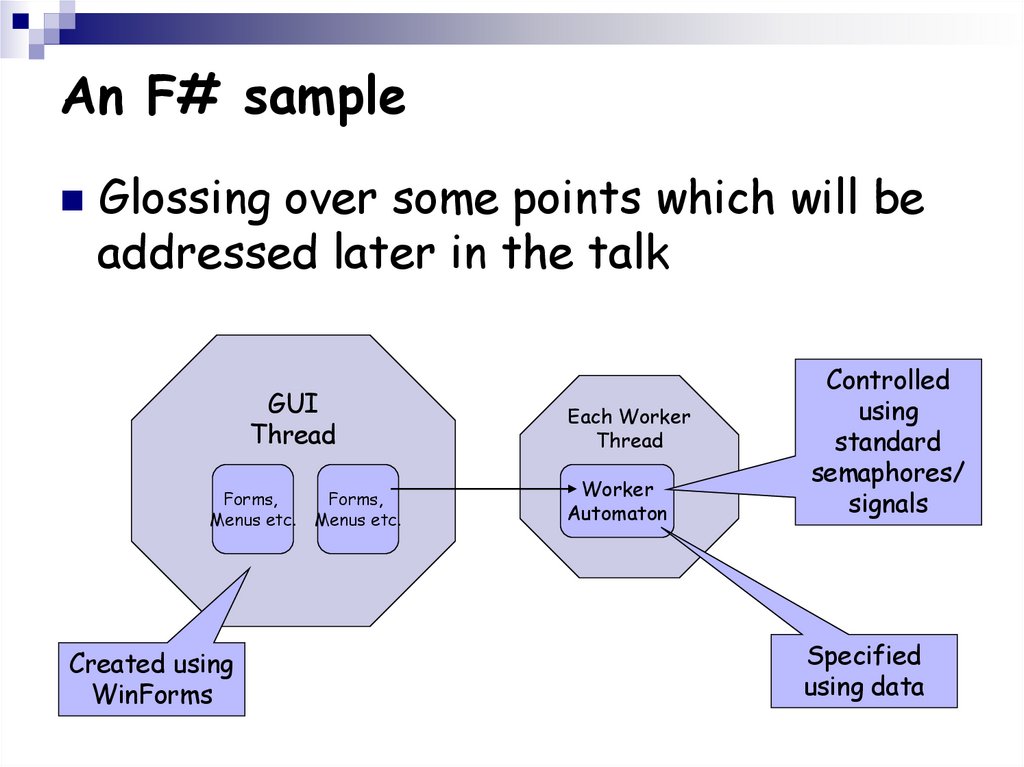
Glossing over some points which will beaddressed later in the talk
GUI
Thread
Forms,
Menus etc.
Created using
WinForms
Forms,
Menus etc.
Each Worker
Thread
Worker
Automaton
Controlled
using
standard
semaphores/
signals
Specified
using data
12. Part II: Value recursion in strict programming
13. Summary
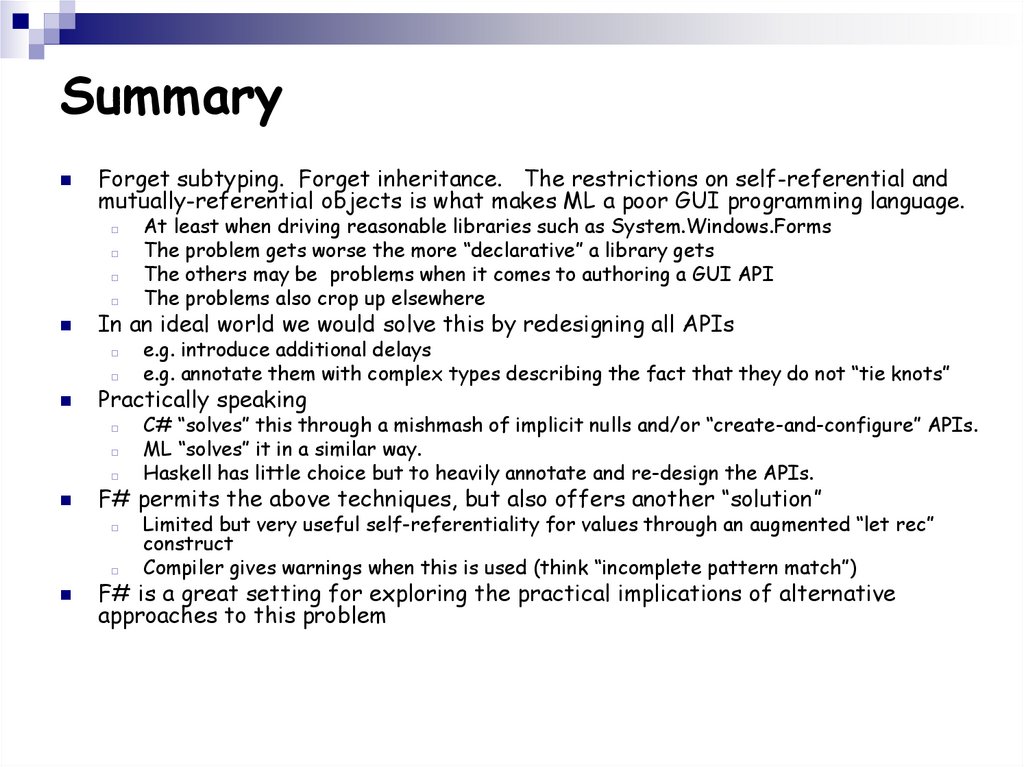
Forget subtyping. Forget inheritance. The restrictions on self-referential andmutually-referential objects is what makes ML a poor GUI programming language.
In an ideal world we would solve this by redesigning all APIs
C# “solves” this through a mishmash of implicit nulls and/or “create-and-configure” APIs.
ML “solves” it in a similar way.
Haskell has little choice but to heavily annotate and re-design the APIs.
F# permits the above techniques, but also offers another “solution”
e.g. introduce additional delays
e.g. annotate them with complex types describing the fact that they do not “tie knots”
Practically speaking
At least when driving reasonable libraries such as System.Windows.Forms
The problem gets worse the more “declarative” a library gets
The others may be problems when it comes to authoring a GUI API
The problems also crop up elsewhere
Limited but very useful self-referentiality for values through an augmented “let rec”
construct
Compiler gives warnings when this is used (think “incomplete pattern match”)
F# is a great setting for exploring the practical implications of alternative
approaches to this problem
14. Self-referential functions (recursion)
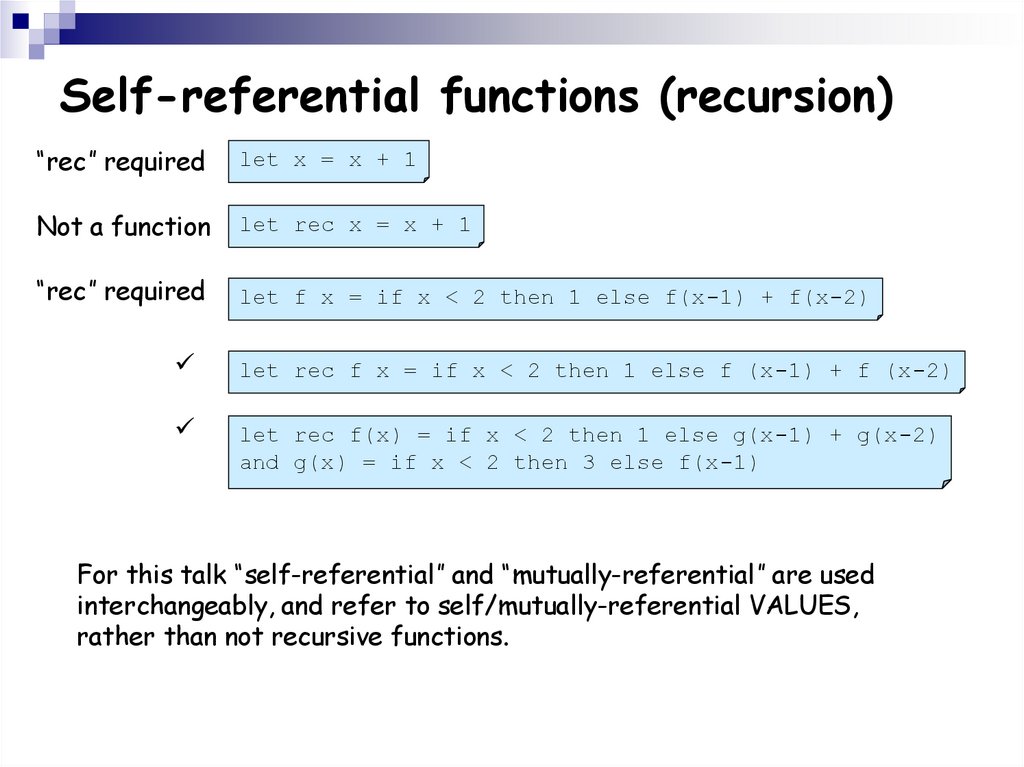
“rec” requiredlet x = x + 1
Not a function
let rec x = x + 1
“rec” required
let f x = if x < 2 then 1 else f(x-1) + f(x-2)
let rec f x = if x < 2 then 1 else f (x-1) + f (x-2)
let rec f(x) = if x < 2 then 1 else g(x-1) + g(x-2)
and g(x) = if x < 2 then 3 else f(x-1)
For this talk “self-referential” and “mutually-referential” are used
interchangeably, and refer to self/mutually-referential VALUES,
rather than not recursive functions.
15. Self-referential values/objects
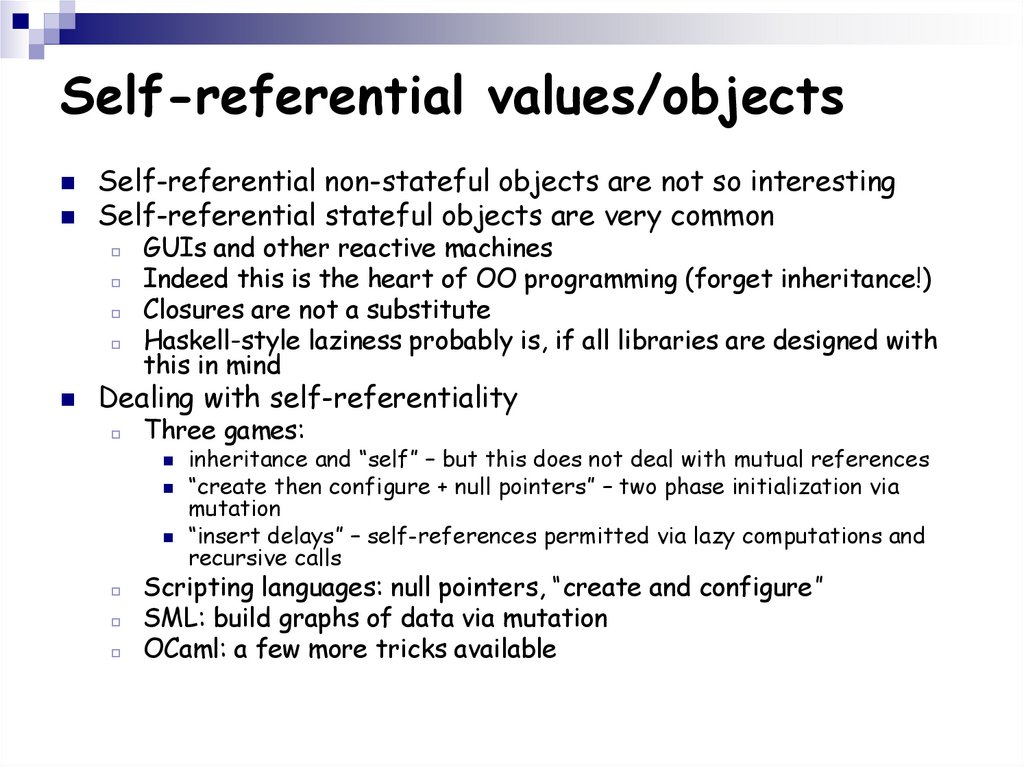
Self-referential non-stateful objects are not so interestingSelf-referential stateful objects are very common
GUIs and other reactive machines
Indeed this is the heart of OO programming (forget inheritance!)
Closures are not a substitute
Haskell-style laziness probably is, if all libraries are designed with
this in mind
Dealing with self-referentiality
Three games:
inheritance and “self” – but this does not deal with mutual references
“create then configure + null pointers” – two phase initialization via
mutation
“insert delays” – self-references permitted via lazy computations and
recursive calls
Scripting languages: null pointers, “create and configure”
SML: build graphs of data via mutation
OCaml: a few more tricks available
16. Self-referential values via mutation
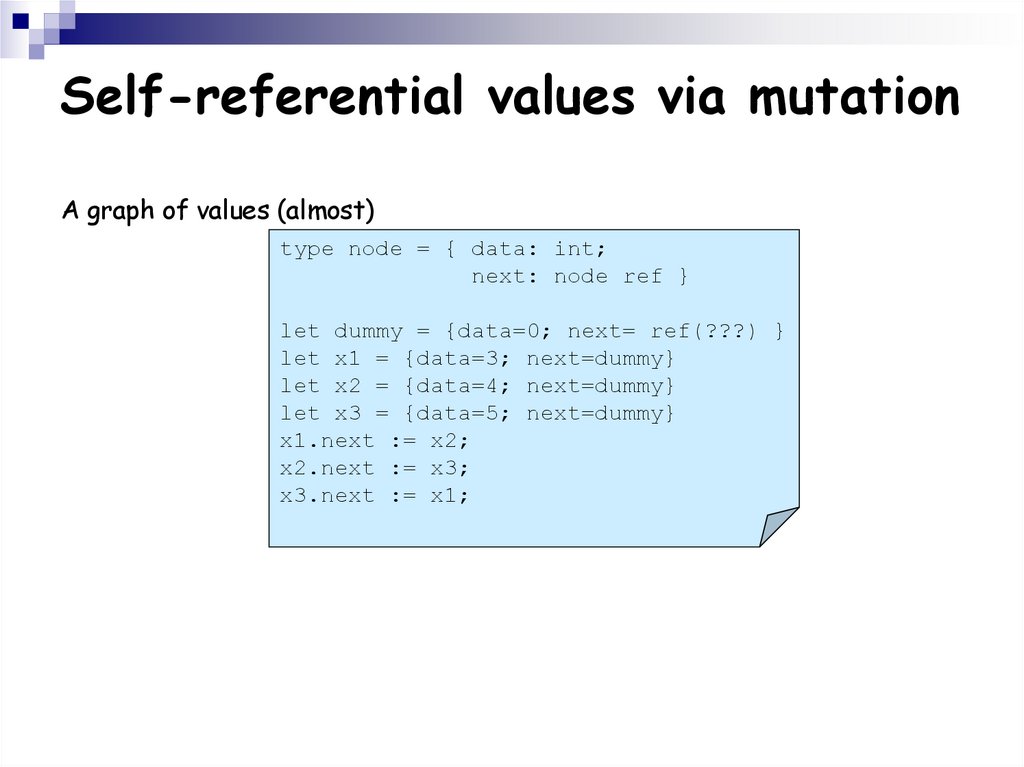
A graph of values (almost)type node = { data: int;
next: node ref }
let dummy = {data=0; next= ref(???) }
let x1 = {data=3; next=dummy}
let x2 = {data=4; next=dummy}
let x3 = {data=5; next=dummy}
x1.next := x2;
x2.next := x3;
x3.next := x1;
17. Self-referential values via mutation
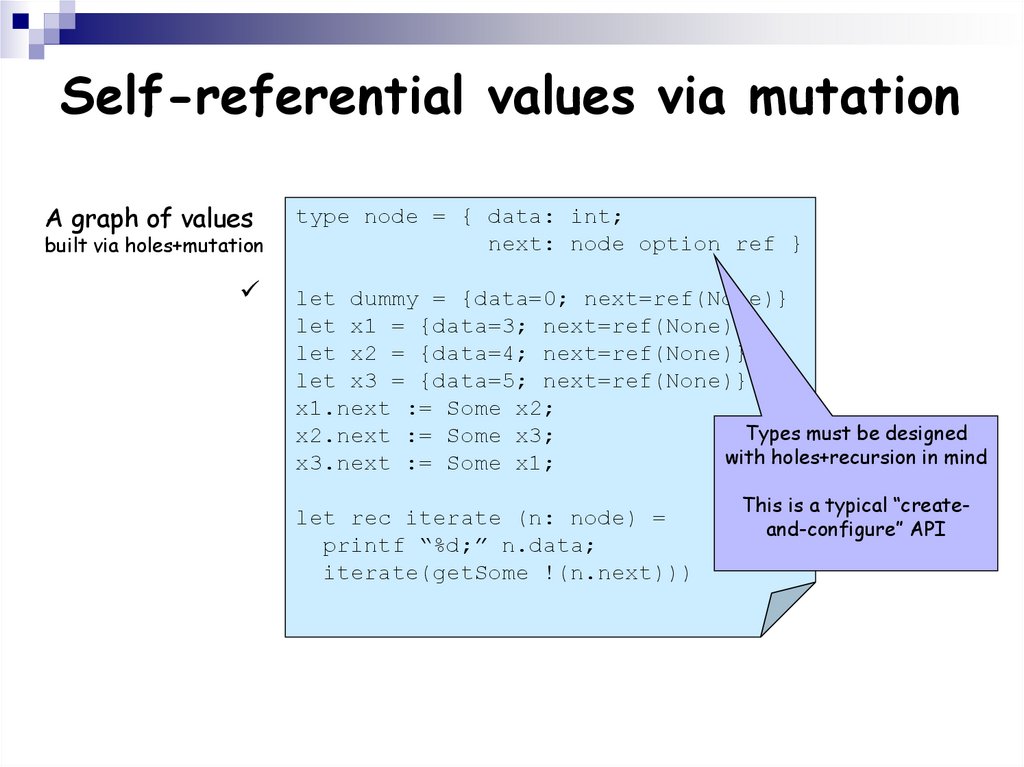
A graph of valuesbuilt via holes+mutation
type node = { data: int;
next: node option ref }
let dummy = {data=0; next=ref(None)}
let x1 = {data=3; next=ref(None)}
let x2 = {data=4; next=ref(None)}
let x3 = {data=5; next=ref(None)}
x1.next := Some x2;
Types must be designed
x2.next := Some x3;
with holes+recursion in mind
x3.next := Some x1;
let rec iterate (n: node) =
printf “%d;” n.data;
iterate(getSome !(n.next)))
This is a typical “createand-configure” API
18. Self-referential values via delays
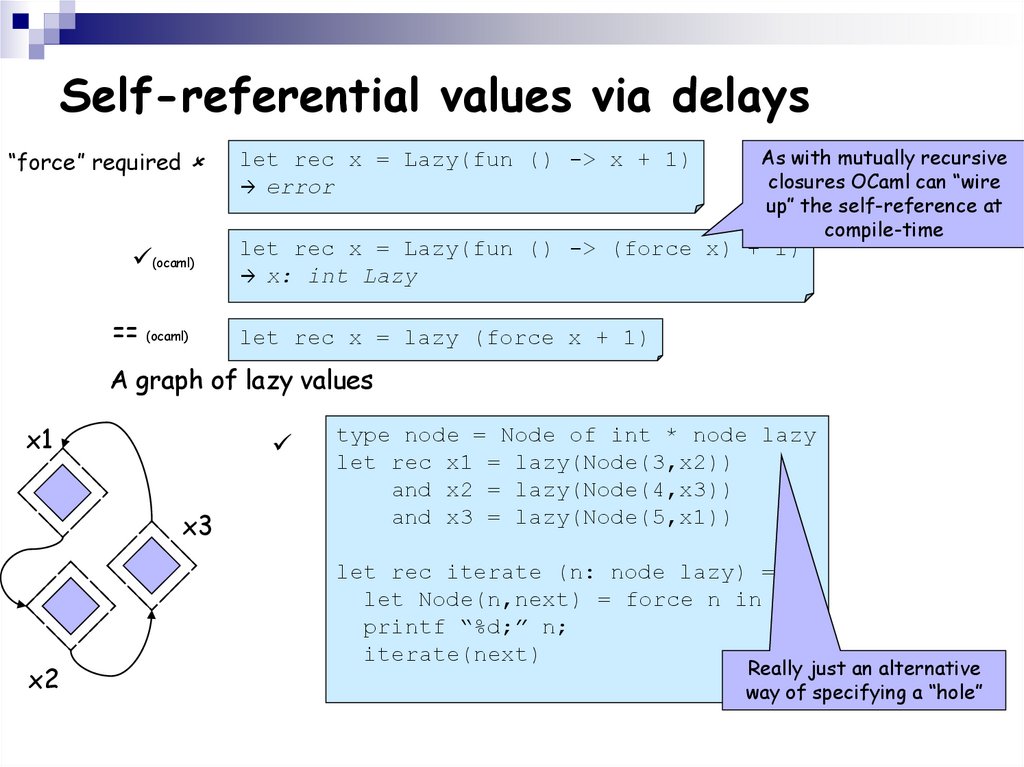
“force” required(ocaml)
== (ocaml)
let rec x = Lazy(fun () -> x + 1)
error
As with mutually recursive
closures OCaml can “wire
up” the self-reference at
compile-time
let rec x = Lazy(fun () -> (force x) + 1)
x: int Lazy
let rec x = lazy (force x + 1)
A graph of lazy values
x1
x3
x2
type node = Node of int * node lazy
let rec x1 = lazy(Node(3,x2))
and x2 = lazy(Node(4,x3))
and x3 = lazy(Node(5,x1))
let rec iterate (n: node lazy) =
let Node(n,next) = force n in
printf “%d;” n;
iterate(next)
Really just an alternative
way of specifying a “hole”
19. GUI elements are highly self-referential
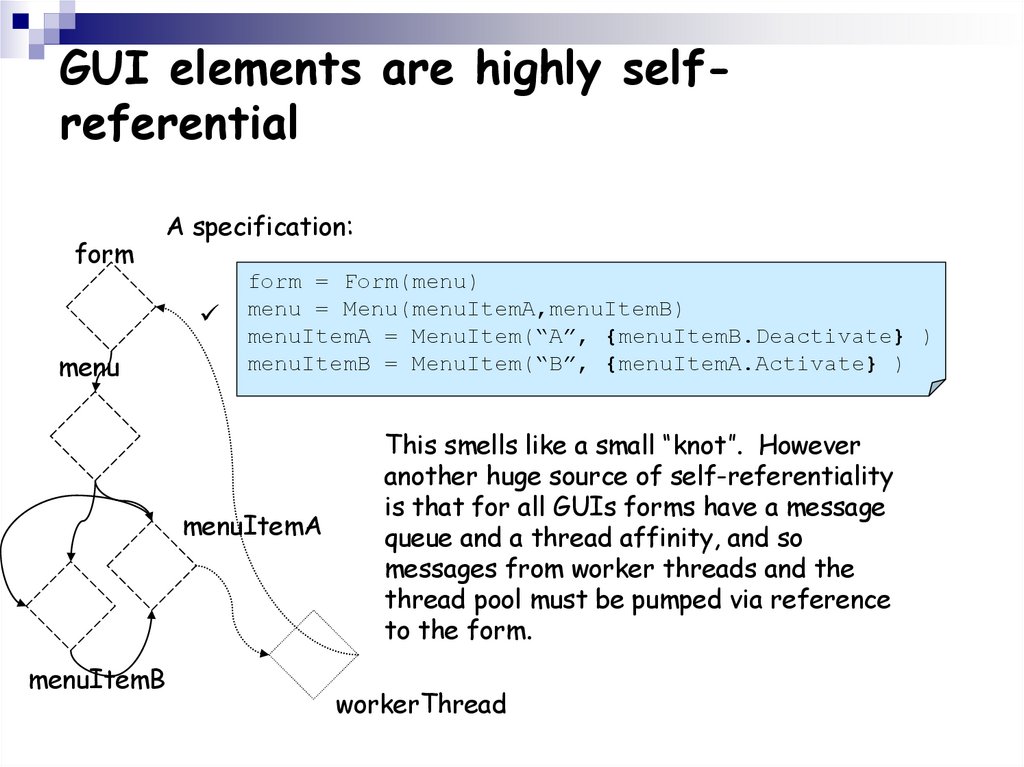
GUI elements are highly selfreferentialform
A specification:
menu
form = Form(menu)
menu = Menu(menuItemA,menuItemB)
menuItemA = MenuItem(“A”, {menuItemB.Deactivate} )
menuItemB = MenuItem(“B”, {menuItemA.Activate} )
menuItemA
menuItemB
This smells like a small “knot”. However
another huge source of self-referentiality
is that for all GUIs forms have a message
queue and a thread affinity, and so
messages from worker threads and the
thread pool must be pumped via reference
to the form.
workerThread
20. “Create and configure” in C#
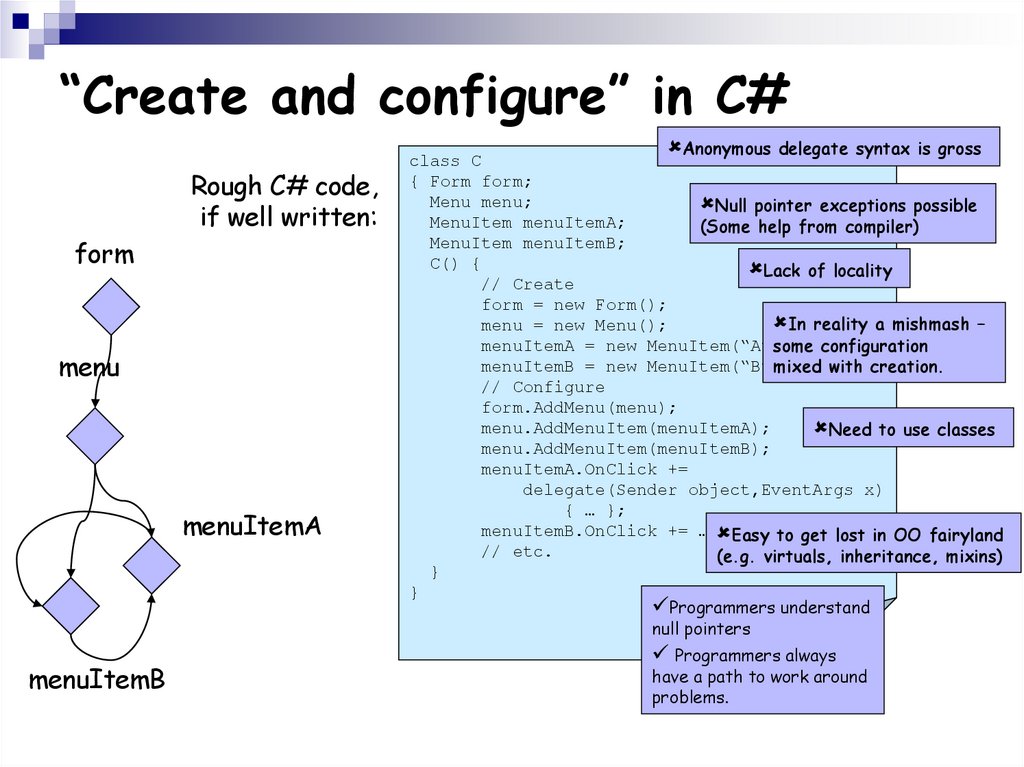
Rough C# code,if well written:
form
menu
menuItemA
menuItemB
Anonymous delegate syntax is gross
class C
{ Form form;
Menu menu;
Null pointer exceptions possible
MenuItem menuItemA;
(Some help from compiler)
MenuItem menuItemB;
C() {
Lack of locality
// Create
form = new Form();
In reality a mishmash –
menu = new Menu();
menuItemA = new MenuItem(“A”);
some configuration
menuItemB = new MenuItem(“B”);
mixed with creation.
// Configure
form.AddMenu(menu);
menu.AddMenuItem(menuItemA);
Need to use classes
menu.AddMenuItem(menuItemB);
menuItemA.OnClick +=
delegate(Sender object,EventArgs x)
{ … };
menuItemB.OnClick += … ;
Easy to get lost in OO fairyland
// etc.
(e.g. virtuals, inheritance, mixins)
}
}
Programmers understand
null pointers
Programmers always
have a path to work around
problems.
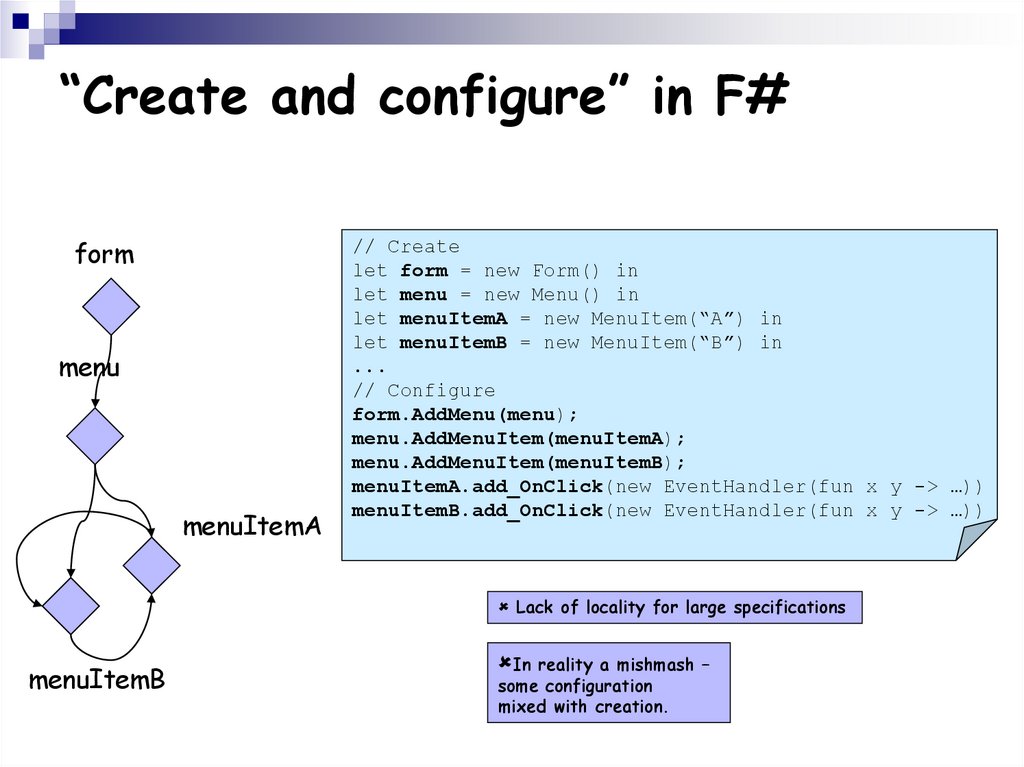
21. “Create and configure” in F#
formmenu
menuItemA
// Create
let form = new Form() in
let menu = new Menu() in
let menuItemA = new MenuItem(“A”) in
let menuItemB = new MenuItem(“B”) in
...
// Configure
form.AddMenu(menu);
menu.AddMenuItem(menuItemA);
menu.AddMenuItem(menuItemB);
menuItemA.add_OnClick(new EventHandler(fun x y -> …))
menuItemB.add_OnClick(new EventHandler(fun x y -> …))
Lack of locality for large specifications
menuItemB
In reality a mishmash –
some configuration
mixed with creation.
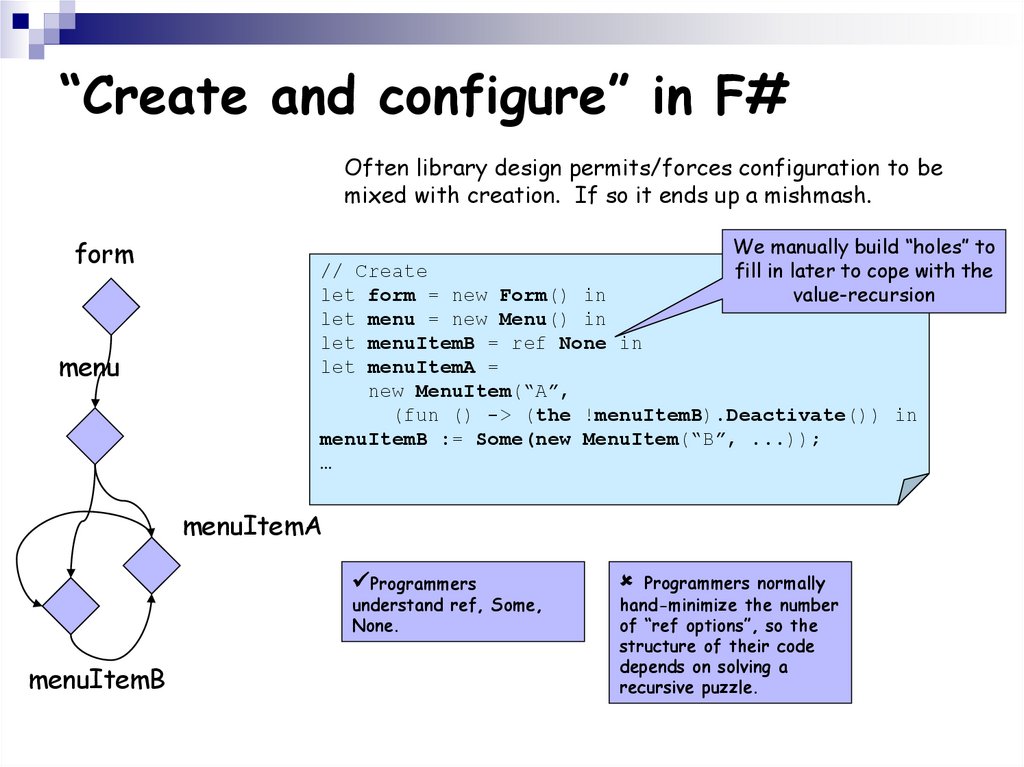
22. “Create and configure” in F#
Often library design permits/forces configuration to bemixed with creation. If so it ends up a mishmash.
form
menu
We manually build “holes” to
fill in later to cope with the
value-recursion
// Create
let form = new Form() in
let menu = new Menu() in
let menuItemB = ref None in
let menuItemA =
new MenuItem(“A”,
(fun () -> (the !menuItemB).Deactivate()) in
menuItemB := Some(new MenuItem(“B”, ...));
…
menuItemA
Programmers
understand ref, Some,
None.
menuItemB
Programmers normally
hand-minimize the number
of “ref options”, so the
structure of their code
depends on solving a
recursive puzzle.
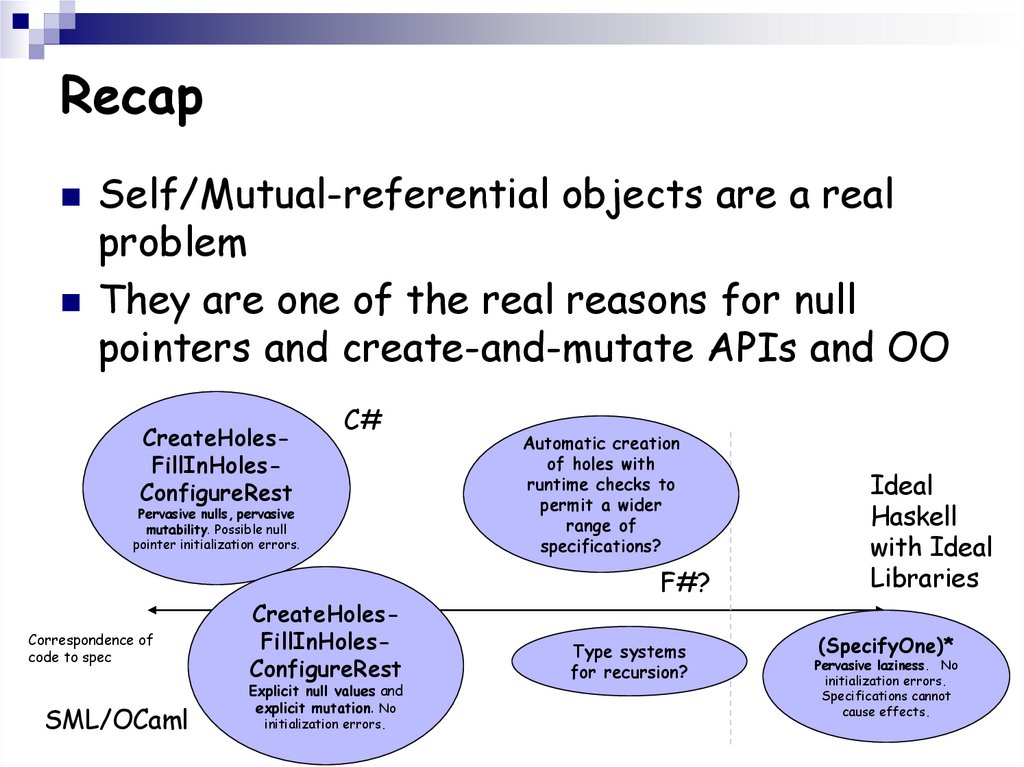
23. Recap
Self/Mutual-referential objects are a realproblem
They are one of the real reasons for null
pointers and create-and-mutate APIs and OO
CreateHolesFillInHolesConfigureRest
C#
Pervasive nulls, pervasive
mutability. Possible null
pointer initialization errors.
Correspondence of
code to spec
SML/OCaml
CreateHolesFillInHolesConfigureRest
Explicit null values and
explicit mutation. No
initialization errors.
Automatic creation
of holes with
runtime checks to
permit a wider
range of
specifications?
F#?
Type systems
for recursion?
Ideal
Haskell
with Ideal
Libraries
(SpecifyOne)*
Pervasive laziness. No
initialization errors.
Specifications cannot
cause effects.
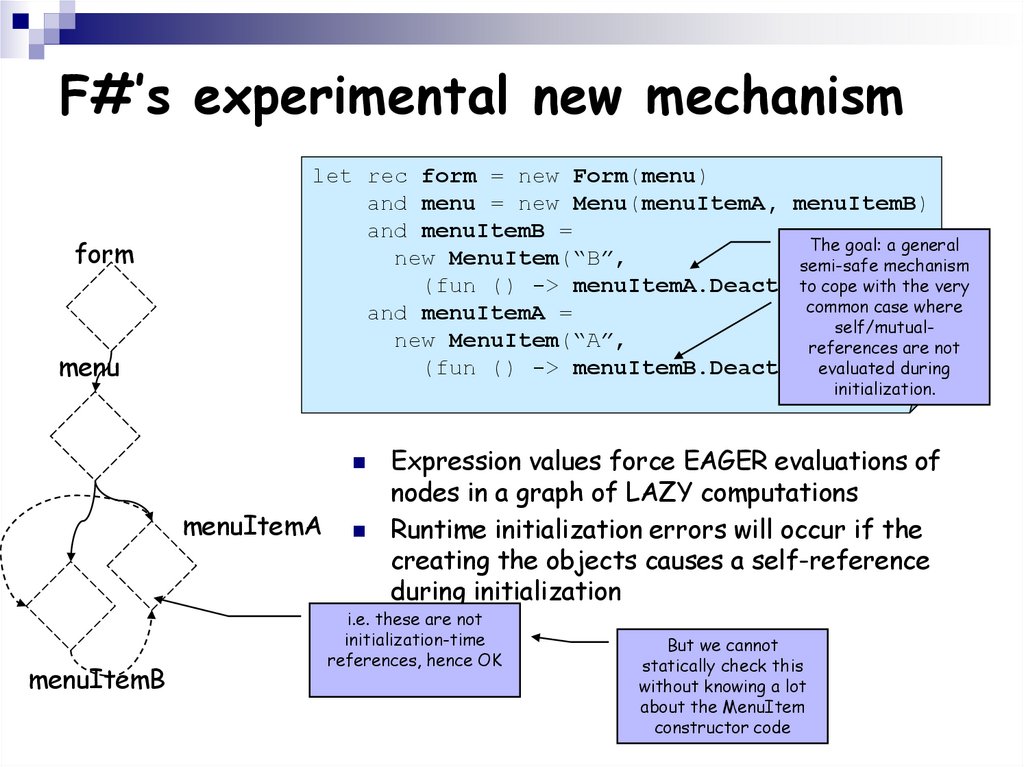
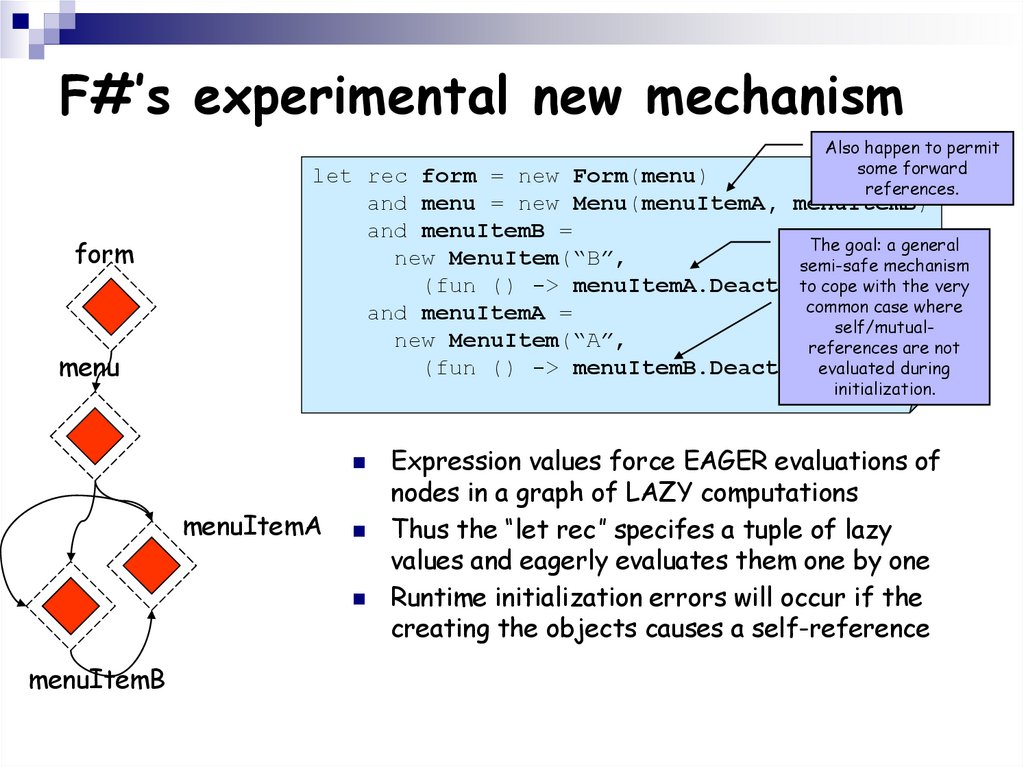
24. F#’s experimental new mechanism
formmenu
let rec form = new Form(menu)
and menu = new Menu(menuItemA, menuItemB)
and menuItemB =
The goal: a general
new MenuItem(“B”,
semi-safe mechanism
to cope with the very
(fun () -> menuItemA.Deactivate())
common case where
and menuItemA =
self/mutualnew MenuItem(“A”,
references are not
evaluated during
(fun () -> menuItemB.Deactivate())
initialization.
menuItemA
menuItemB
Expression values force EAGER evaluations of
nodes in a graph of LAZY computations
Runtime initialization errors will occur if the
creating the objects causes a self-reference
during initialization
i.e. these are not
initialization-time
references, hence OK
But we cannot
statically check this
without knowing a lot
about the MenuItem
constructor code
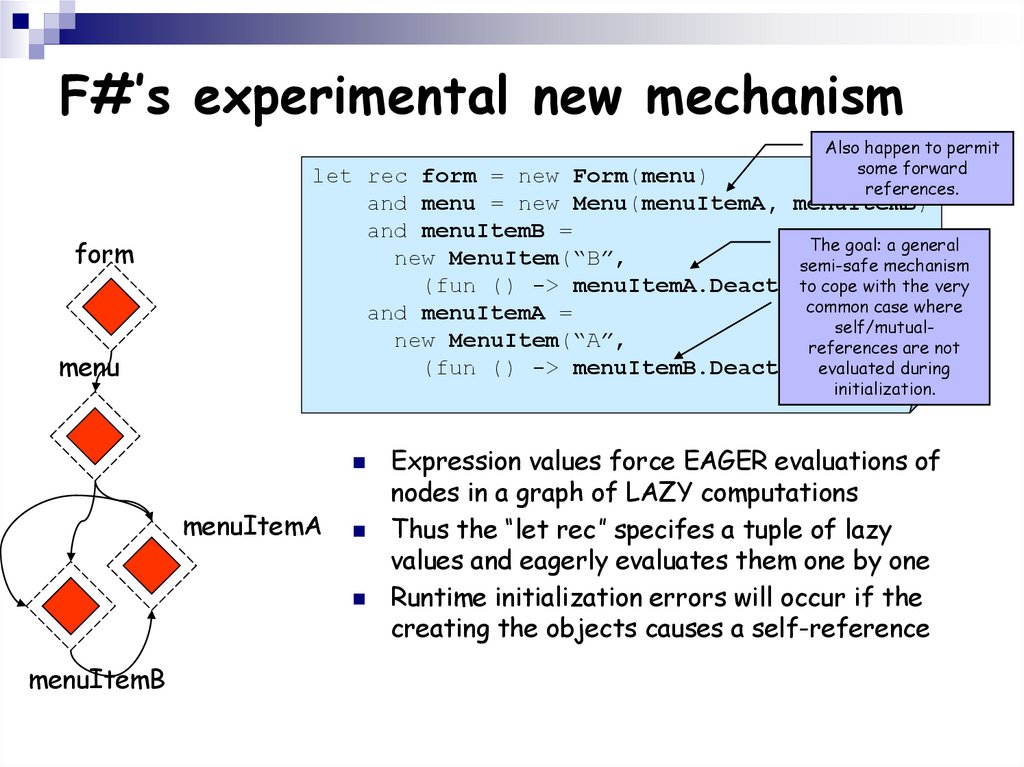
25. F#’s experimental new mechanism
Also happen to permitsome forward
references.
form
menu
let rec form = new Form(menu)
and menu = new Menu(menuItemA, menuItemB)
and menuItemB =
The goal: a general
new MenuItem(“B”,
semi-safe mechanism
to cope with the very
(fun () -> menuItemA.Deactivate())
common case where
and menuItemA =
self/mutualnew MenuItem(“A”,
references are not
evaluated during
(fun () -> menuItemB.Deactivate())
initialization.
menuItemA
menuItemB
Expression values force EAGER evaluations of
nodes in a graph of LAZY computations
Thus the “let rec” specifes a tuple of lazy
values and eagerly evaluates them one by one
Runtime initialization errors will occur if the
creating the objects causes a self-reference
26. F#’s experimental new mechanism
Also happen to permitsome forward
references.
form
menu
let rec form = new Form(menu)
and menu = new Menu(menuItemA, menuItemB)
and menuItemB =
The goal: a general
new MenuItem(“B”,
semi-safe mechanism
to cope with the very
(fun () -> menuItemA.Deactivate())
common case where
and menuItemA =
self/mutualnew MenuItem(“A”,
references are not
evaluated during
(fun () -> menuItemB.Deactivate())
initialization.
menuItemA
menuItemB
Expression values force EAGER evaluations of
nodes in a graph of LAZY computations
Thus the “let rec” specifes a tuple of lazy
values and eagerly evaluates them one by one
Runtime initialization errors will occur if the
creating the objects causes a self-reference
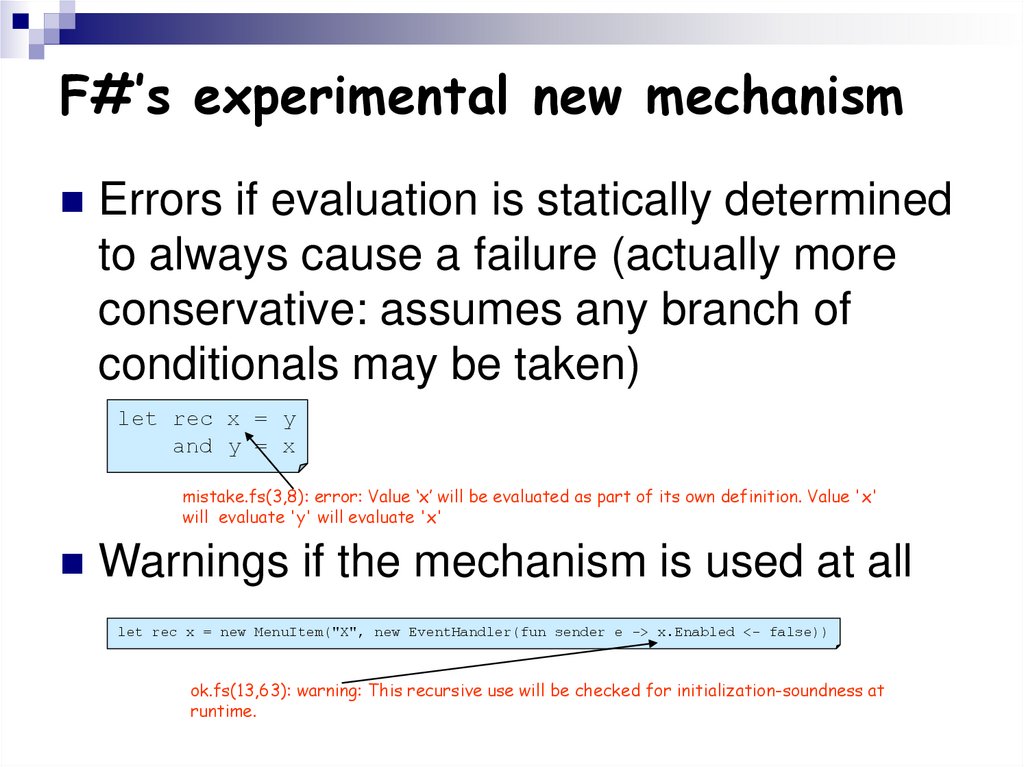
27. F#’s experimental new mechanism
Errors if evaluation is statically determinedto always cause a failure (actually more
conservative: assumes any branch of
conditionals may be taken)
let rec x = y
and y = x
mistake.fs(3,8): error: Value ‘x’ will be evaluated as part of its own definition. Value 'x'
will evaluate 'y' will evaluate 'x'
Warnings if the mechanism is used at all
let rec x = new MenuItem("X", new EventHandler(fun sender e -> x.Enabled <- false))
ok.fs(13,63): warning: This recursive use will be checked for initialization-soundness at
runtime.
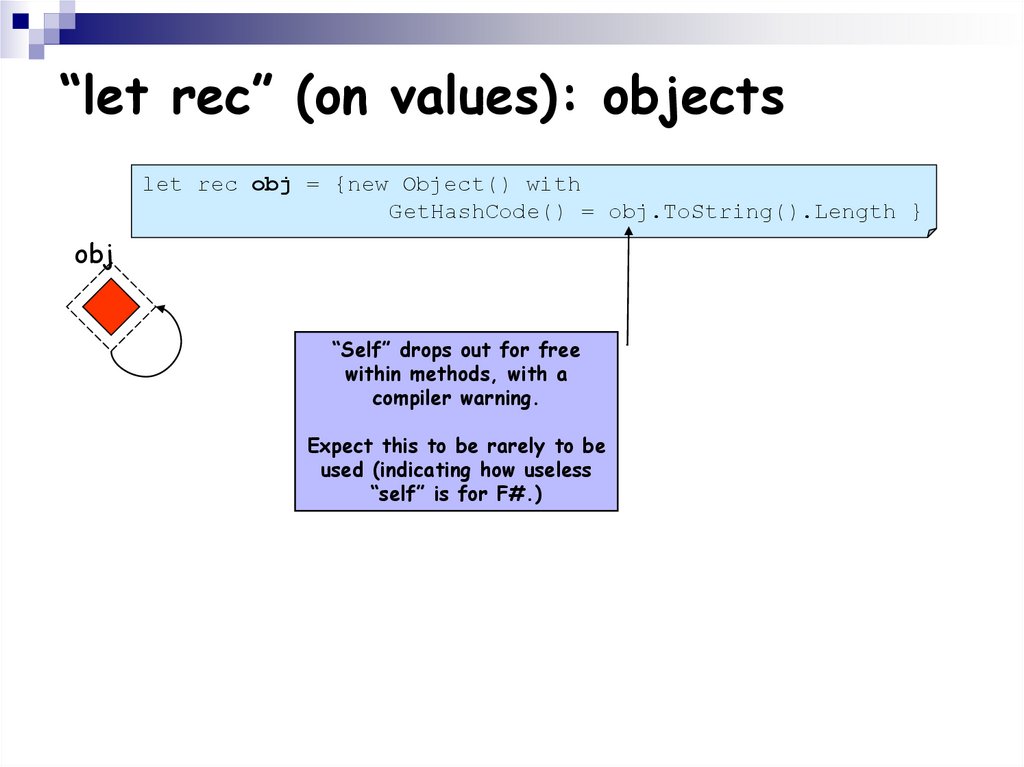
28. “let rec” (on values): objects
let rec obj = {new Object() withGetHashCode() = obj.ToString().Length }
obj
“Self” drops out for free
within methods, with a
compiler warning.
Expect this to be rarely to be
used (indicating how useless
“self” is for F#.)
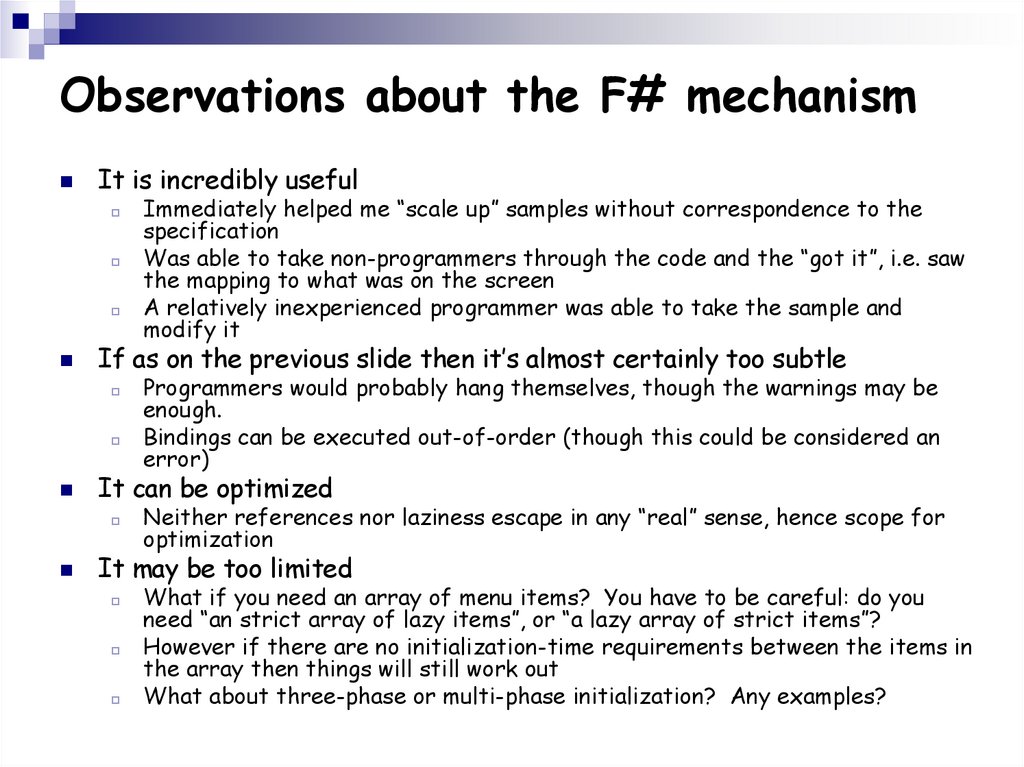
29. Observations about the F# mechanism
It is incredibly usefulIf as on the previous slide then it’s almost certainly too subtle
Programmers would probably hang themselves, though the warnings may be
enough.
Bindings can be executed out-of-order (though this could be considered an
error)
It can be optimized
Immediately helped me “scale up” samples without correspondence to the
specification
Was able to take non-programmers through the code and the “got it”, i.e. saw
the mapping to what was on the screen
A relatively inexperienced programmer was able to take the sample and
modify it
Neither references nor laziness escape in any “real” sense, hence scope for
optimization
It may be too limited
What if you need an array of menu items? You have to be careful: do you
need “an strict array of lazy items”, or “a lazy array of strict items”?
However if there are no initialization-time requirements between the items in
the array then things will still work out
What about three-phase or multi-phase initialization? Any examples?
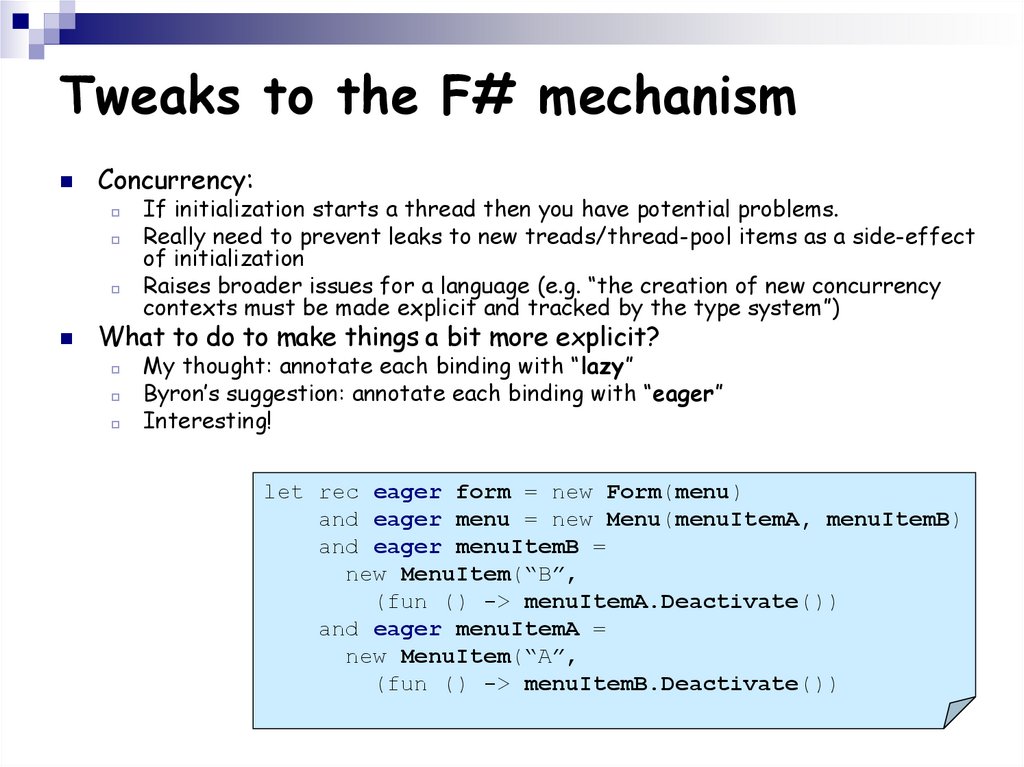
30. Tweaks to the F# mechanism
Concurrency:If initialization starts a thread then you have potential problems.
Really need to prevent leaks to new treads/thread-pool items as a side-effect
of initialization
Raises broader issues for a language (e.g. “the creation of new concurrency
contexts must be made explicit and tracked by the type system”)
What to do to make things a bit more explicit?
My thought: annotate each binding with “lazy”
Byron’s suggestion: annotate each binding with “eager”
Interesting!
let rec eager form = new Form(menu)
and eager menu = new Menu(menuItemA, menuItemB)
and eager menuItemB =
new MenuItem(“B”,
(fun () -> menuItemA.Deactivate())
and eager menuItemA =
new MenuItem(“A”,
(fun () -> menuItemB.Deactivate())
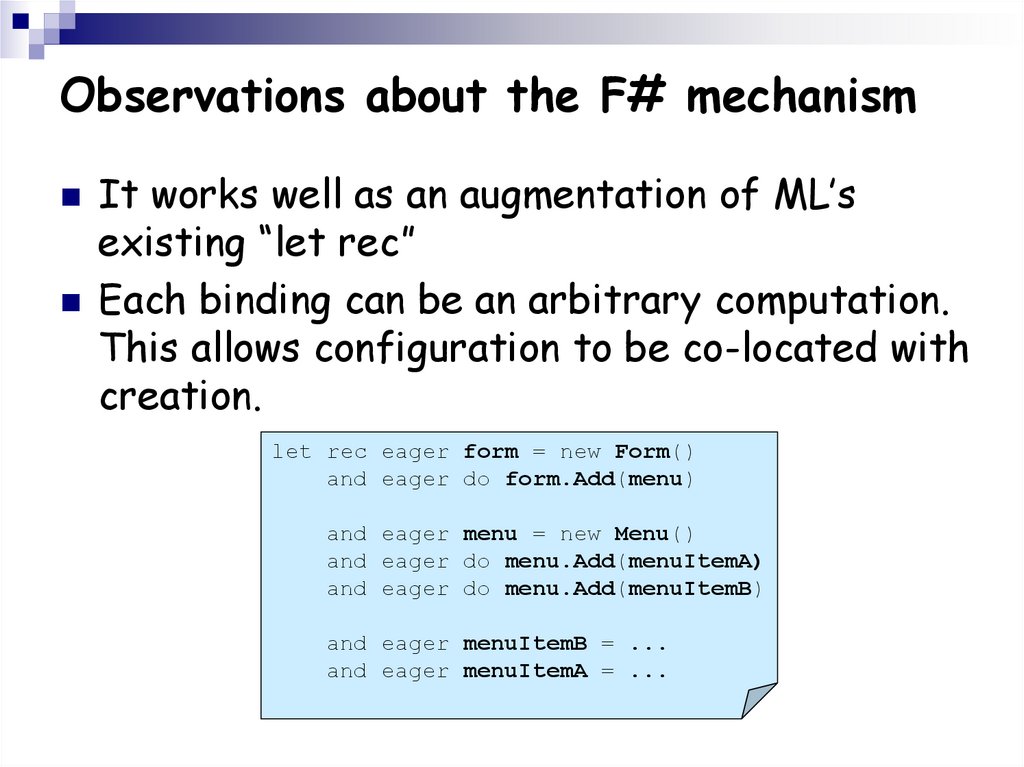
31. Observations about the F# mechanism
It works well as an augmentation of ML’sexisting “let rec”
Each binding can be an arbitrary computation.
This allows configuration to be co-located with
creation.
let rec eager form = new Form()
and eager do form.Add(menu)
and eager menu = new Menu()
and eager do menu.Add(menuItemA)
and eager do menu.Add(menuItemB)
and eager menuItemB = ...
and eager menuItemA = ...
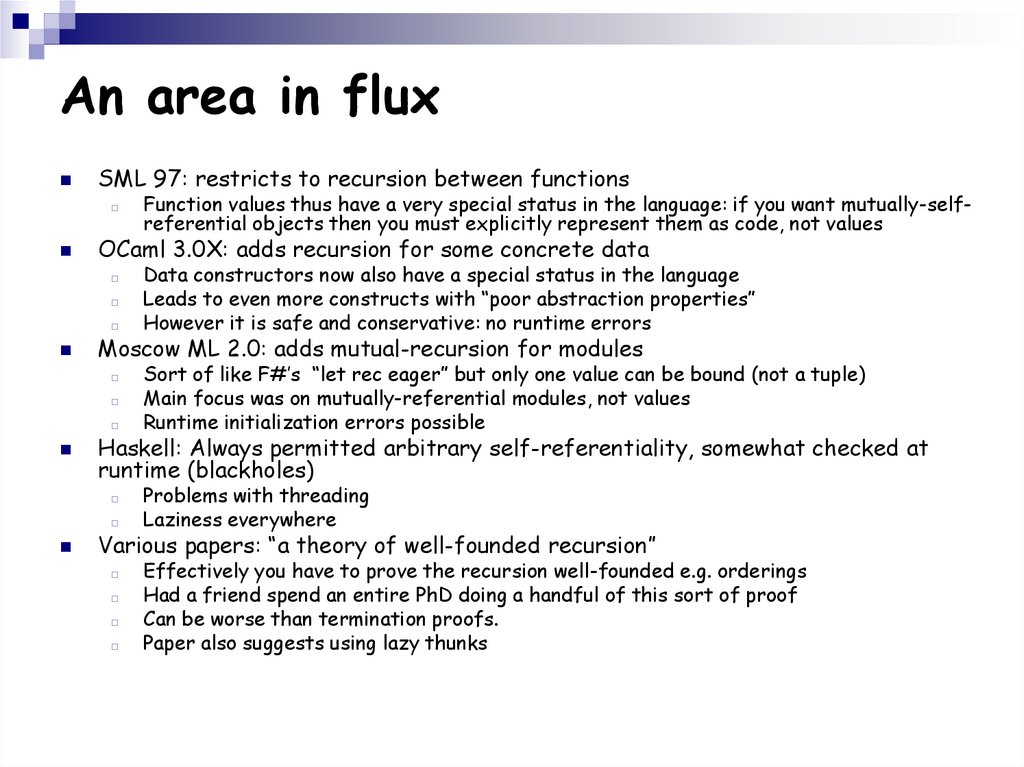
32. An area in flux
SML 97: restricts to recursion between functionsOCaml 3.0X: adds recursion for some concrete data
Sort of like F#’s “let rec eager” but only one value can be bound (not a tuple)
Main focus was on mutually-referential modules, not values
Runtime initialization errors possible
Haskell: Always permitted arbitrary self-referentiality, somewhat checked at
runtime (blackholes)
Data constructors now also have a special status in the language
Leads to even more constructs with “poor abstraction properties”
However it is safe and conservative: no runtime errors
Moscow ML 2.0: adds mutual-recursion for modules
Function values thus have a very special status in the language: if you want mutually-selfreferential objects then you must explicitly represent them as code, not values
Problems with threading
Laziness everywhere
Various papers: “a theory of well-founded recursion”
Effectively you have to prove the recursion well-founded e.g. orderings
Had a friend spend an entire PhD doing a handful of this sort of proof
Can be worse than termination proofs.
Paper also suggests using lazy thunks