 Экономика
Похожие презентации:






The 1997 Thai Baht Currency Crisis
1.
The 1997 Thai Baht CurrencyCrisis
Sabitov Ali
University of Economics and
Humanistic Sciences in Warsaw
Finance – Full-time
International Finance
2.
Background of the Crisis• • Rapid growth in Asian 'Tiger Economies' in
the 1970s–1990s
• • Thailand had a fixed exchange rate to the US
dollar
• • By mid-1997: high current account deficit
(>8% of GDP)
• • July 1997: Baht floated → sharp
depreciation
• • Triggered wider Asian financial crisis
3.
Causes of the Crisis• • Macroeconomic instability: deregulation,
real estate bubble
• • Speculative attacks: loss of confidence in
baht
• • Political factors: corruption, poor
governance
• • External shocks: dollar/yen volatility
• • Structural weaknesses: weak supervision,
bad loans
4.
IMF Intervention and FinancialSupport
• • $35 billion IMF loans to Indonesia, Korea,
and Thailand
• • $77 billion from ADB, World Bank, and
bilateral sources
• • Structural reforms: transparency,
governance, banking reform
• • Monetary tightening: high interest rates to
stabilize currency
• • Flexible fiscal policy for social support
5.
Policy Effectiveness and Outcomes• • Macroeconomic stabilization achieved by
mid-1998
• • Inflation and exchange rate stabilized,
growth returned in 1999
• • IMF restored investor confidence, but fiscal
austerity criticized
• • Reforms led to improved supervision and
governance
6.
Financial Sector Reforms• • Closure of insolvent financial institutions
• • Recapitalization of banks and AMCs for NPLs
• • Adoption of international accounting
standards
• • Market liberalization: trade and investment
openness
• • IMF (1999): “Lay the foundation for
sustainable growth”
7.
Long-term Improvements• • Stronger banking supervision
• • More flexible exchange rate regime
• • Better corporate governance
• • Greater data transparency
8.
Key Lessons from the Crisis• • Effective regulation is crucial in liberalized
markets
• • Fixed exchange rates are risky under free
capital flow
• • Timely, transparent data prevents panic
• • Early, credible reforms regain investor
confidence
9.
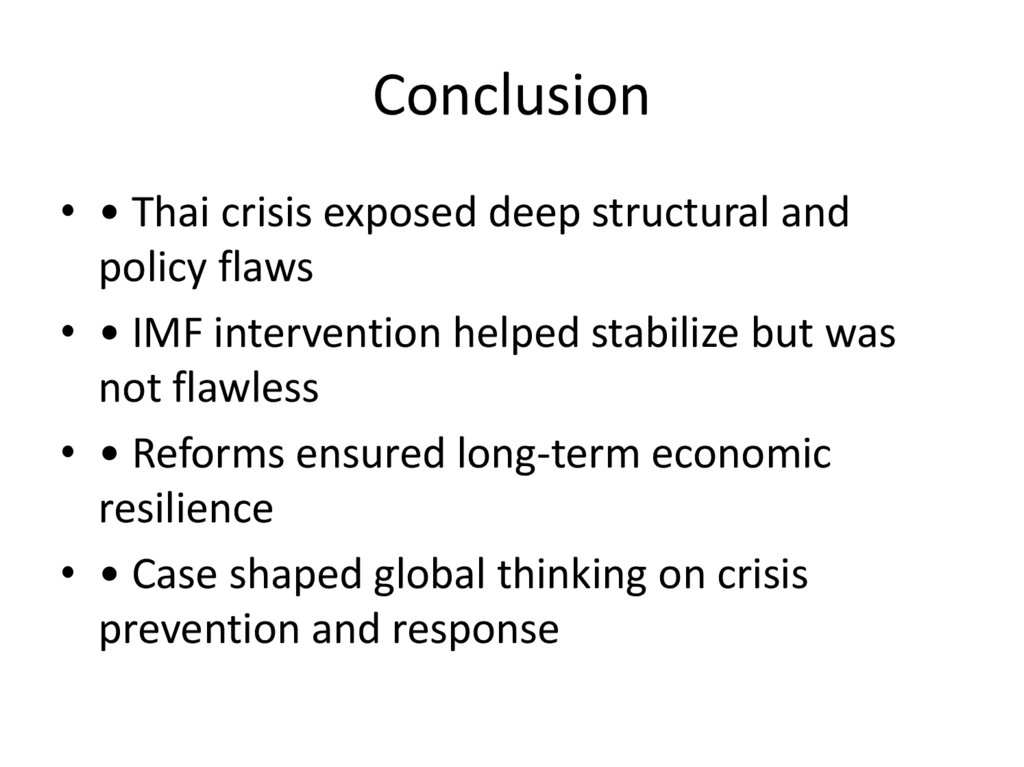
Conclusion• • Thai crisis exposed deep structural and
policy flaws
• • IMF intervention helped stabilize but was
not flawless
• • Reforms ensured long-term economic
resilience
• • Case shaped global thinking on crisis
prevention and response
10.
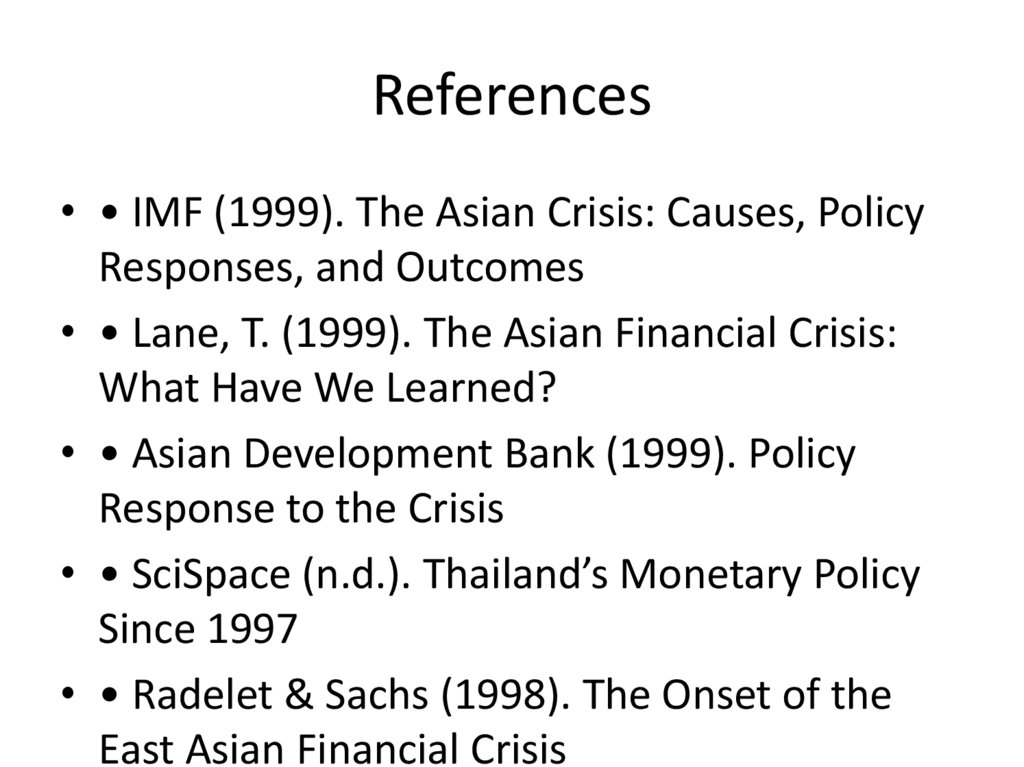
References• • IMF (1999). The Asian Crisis: Causes, Policy
Responses, and Outcomes
• • Lane, T. (1999). The Asian Financial Crisis:
What Have We Learned?
• • Asian Development Bank (1999). Policy
Response to the Crisis
• • SciSpace (n.d.). Thailand’s Monetary Policy
Since 1997
• • Radelet & Sachs (1998). The Onset of the
East Asian Financial Crisis