
 История
Похожие презентации:




History of Anglo-Saxon Tribes. Lecture 1
1. Lecture 1. History of Anglo-Saxon Tribes
Lecture 1. History of AngloSaxon TribesLectures in the History of the English language (prof. Igor V. Chekulai).
Chekulai 2023©
2. Problems viewed in the Lecture
1. The place of the Germanic tribes within the Indo-Europeanlanguage family.
2. The ancient Germanic tribes, their social and ethnic peculiarities.
3. The sub-groups of the Germanic tribes and their linguistic
classification.
4. The Ingaevones on the British Isles: their prehistory and the
invasion on the island.
5. The history of England before and during the Norman Conquest.
3. Preface
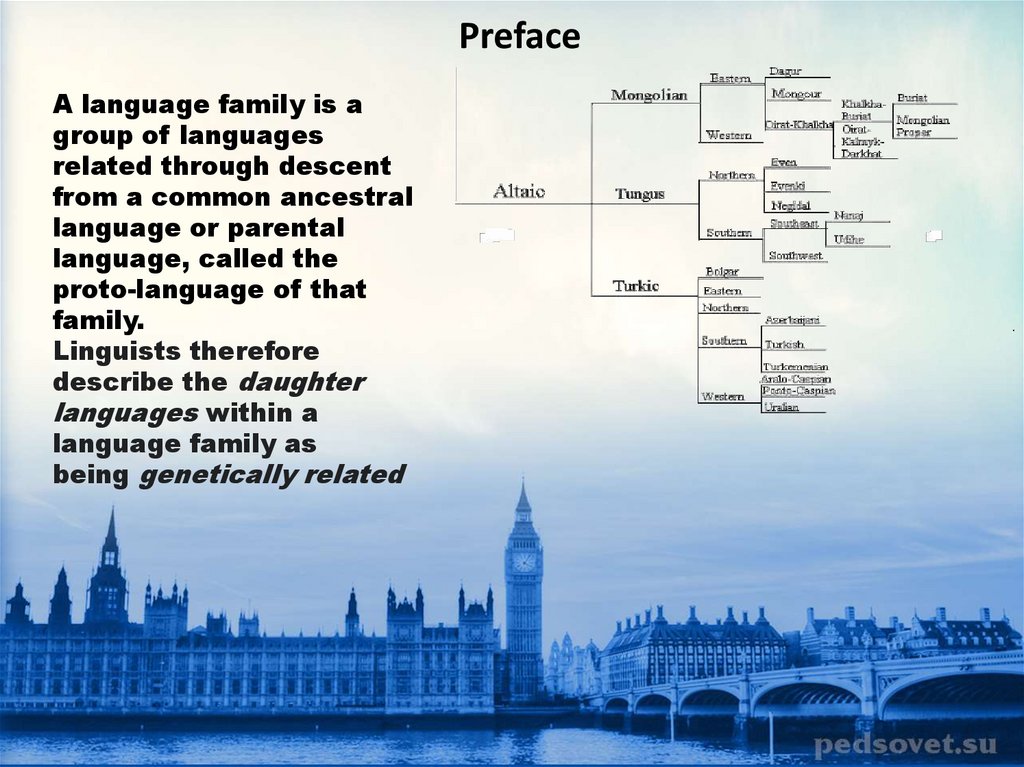
A language family is agroup of languages
related through descent
from a common ancestral
language or parental
language, called the
proto-language of that
family.
Linguists therefore
describe the daughter
languages within a
language family as
being genetically related
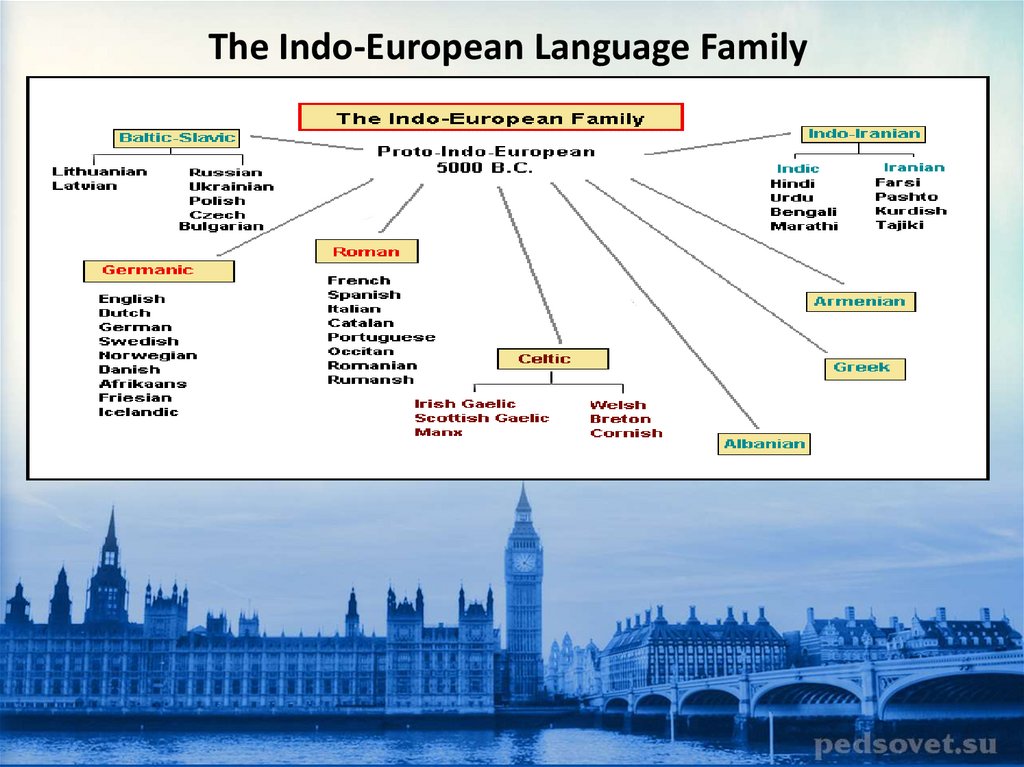
4. The Indo-European Language Family
5.
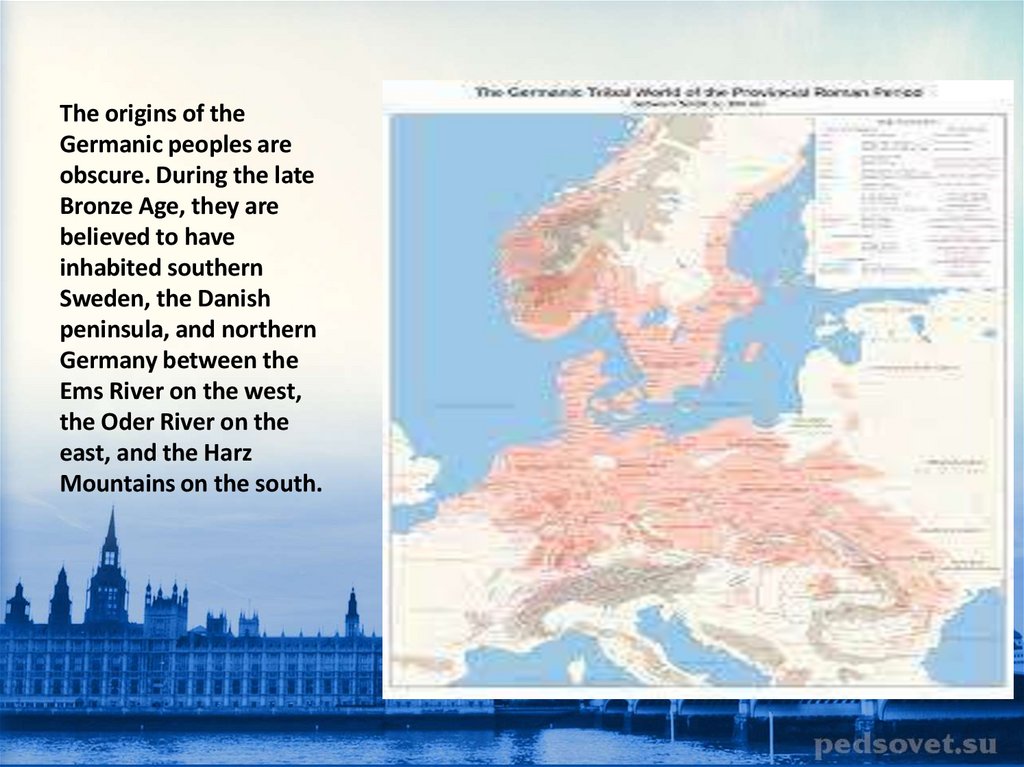
The origins of theGermanic peoples are
obscure. During the late
Bronze Age, they are
believed to have
inhabited southern
Sweden, the Danish
peninsula, and northern
Germany between the
Ems River on the west,
the Oder River on the
east, and the Harz
Mountains on the south.
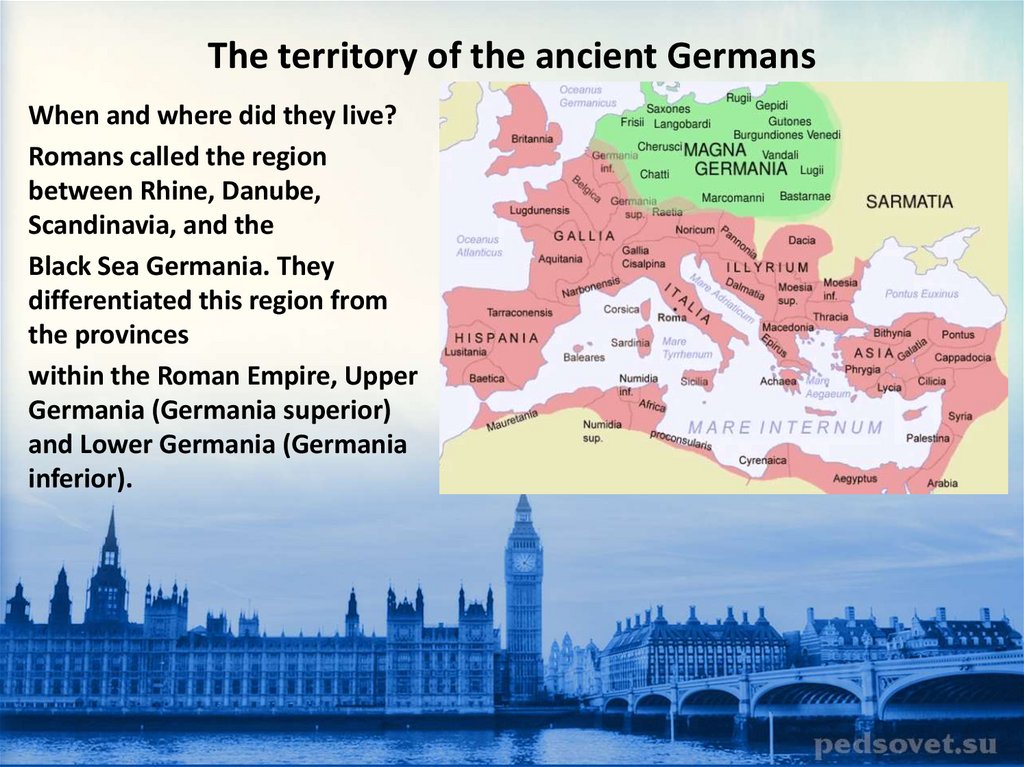
6. The territory of the ancient Germans
When and where did they live?Romans called the region
between Rhine, Danube,
Scandinavia, and the
Black Sea Germania. They
differentiated this region from
the provinces
within the Roman Empire, Upper
Germania (Germania superior)
and Lower Germania (Germania
inferior).
7. Crafts and Professions in the Germanic tribes
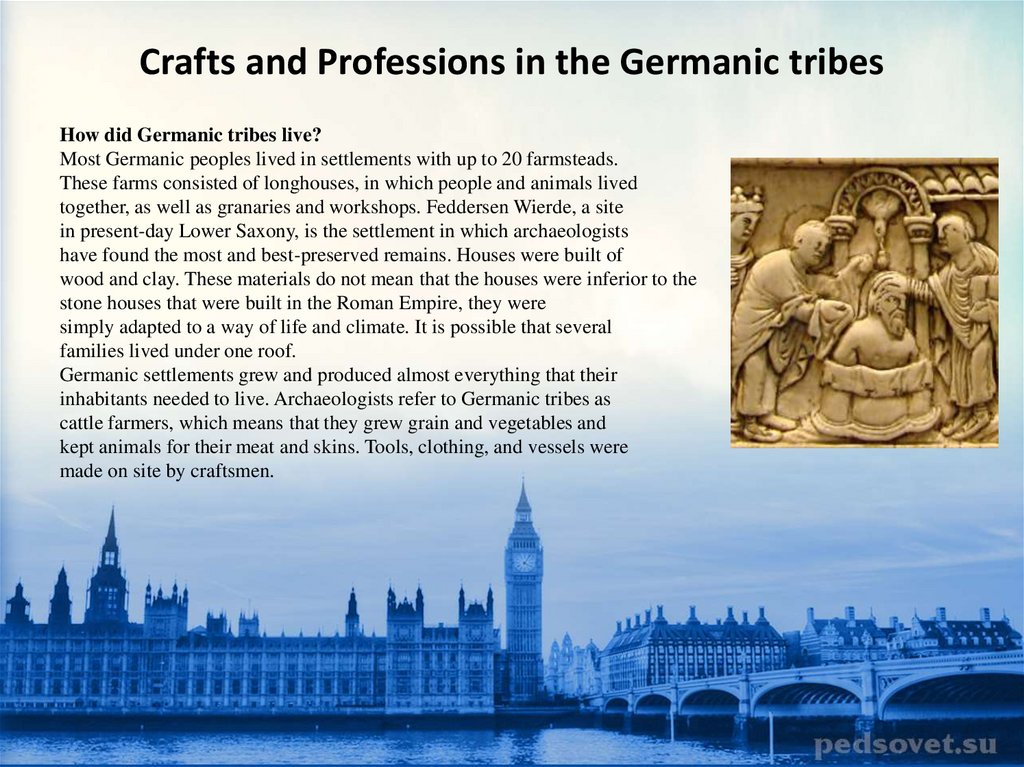
How did Germanic tribes live?Most Germanic peoples lived in settlements with up to 20 farmsteads.
These farms consisted of longhouses, in which people and animals lived
together, as well as granaries and workshops. Feddersen Wierde, a site
in present-day Lower Saxony, is the settlement in which archaeologists
have found the most and best-preserved remains. Houses were built of
wood and clay. These materials do not mean that the houses were inferior to the
stone houses that were built in the Roman Empire, they were
simply adapted to a way of life and climate. It is possible that several
families lived under one roof.
Germanic settlements grew and produced almost everything that their
inhabitants needed to live. Archaeologists refer to Germanic tribes as
cattle farmers, which means that they grew grain and vegetables and
kept animals for their meat and skins. Tools, clothing, and vessels were
made on site by craftsmen.
8. The nation of warriors
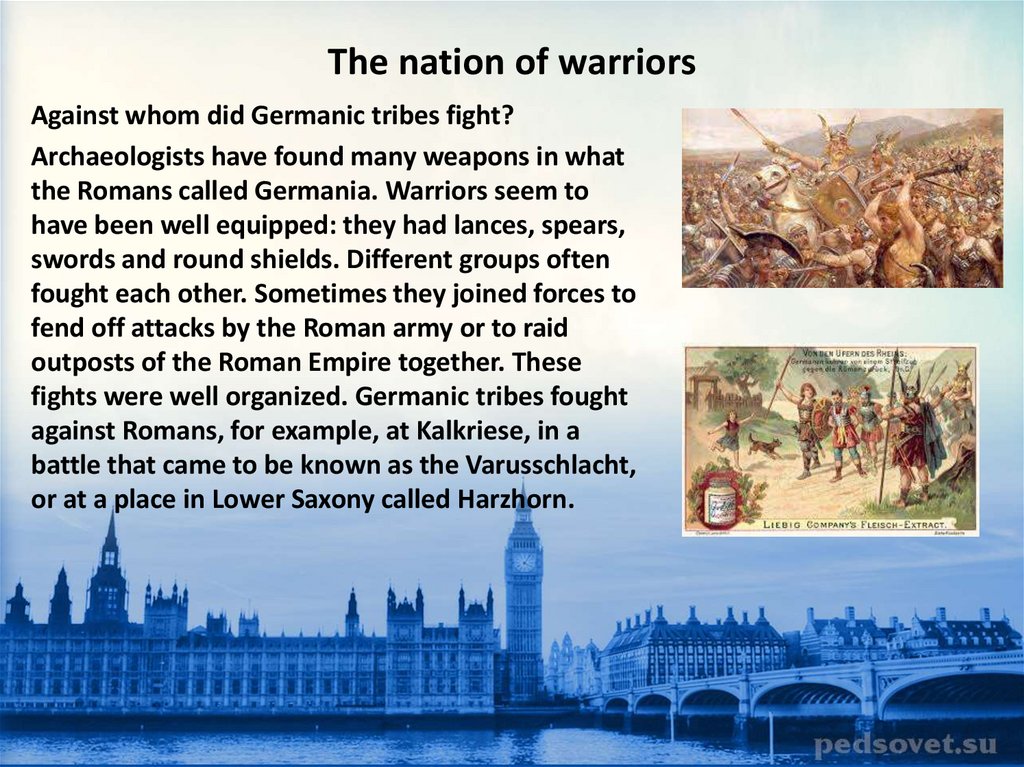
Against whom did Germanic tribes fight?Archaeologists have found many weapons in what
the Romans called Germania. Warriors seem to
have been well equipped: they had lances, spears,
swords and round shields. Different groups often
fought each other. Sometimes they joined forces to
fend off attacks by the Roman army or to raid
outposts of the Roman Empire together. These
fights were well organized. Germanic tribes fought
against Romans, for example, at Kalkriese, in a
battle that came to be known as the Varusschlacht,
or at a place in Lower Saxony called Harzhorn.
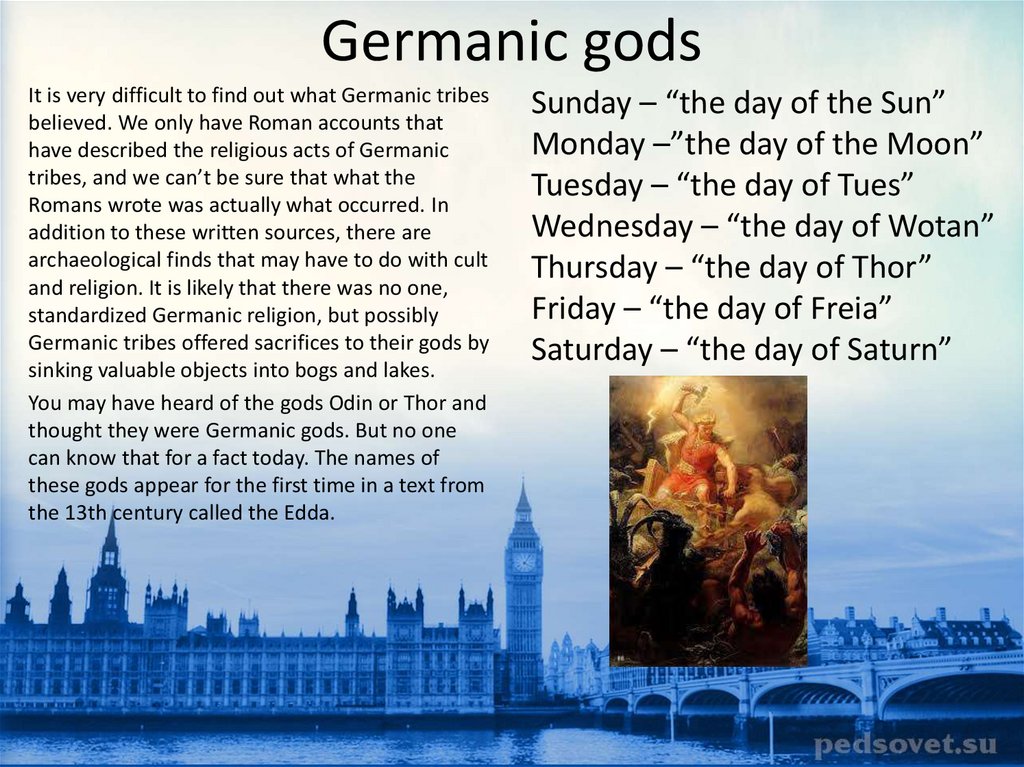
9. Germanic gods
It is very difficult to find out what Germanic tribesbelieved. We only have Roman accounts that
have described the religious acts of Germanic
tribes, and we can’t be sure that what the
Romans wrote was actually what occurred. In
addition to these written sources, there are
archaeological finds that may have to do with cult
and religion. It is likely that there was no one,
standardized Germanic religion, but possibly
Germanic tribes offered sacrifices to their gods by
sinking valuable objects into bogs and lakes.
You may have heard of the gods Odin or Thor and
thought they were Germanic gods. But no one
can know that for a fact today. The names of
these gods appear for the first time in a text from
the 13th century called the Edda.
Sunday – “the day of the Sun”
Monday –”the day of the Moon”
Tuesday – “the day of Tues”
Wednesday – “the day of Wotan”
Thursday – “the day of Thor”
Friday – “the day of Freia”
Saturday – “the day of Saturn”
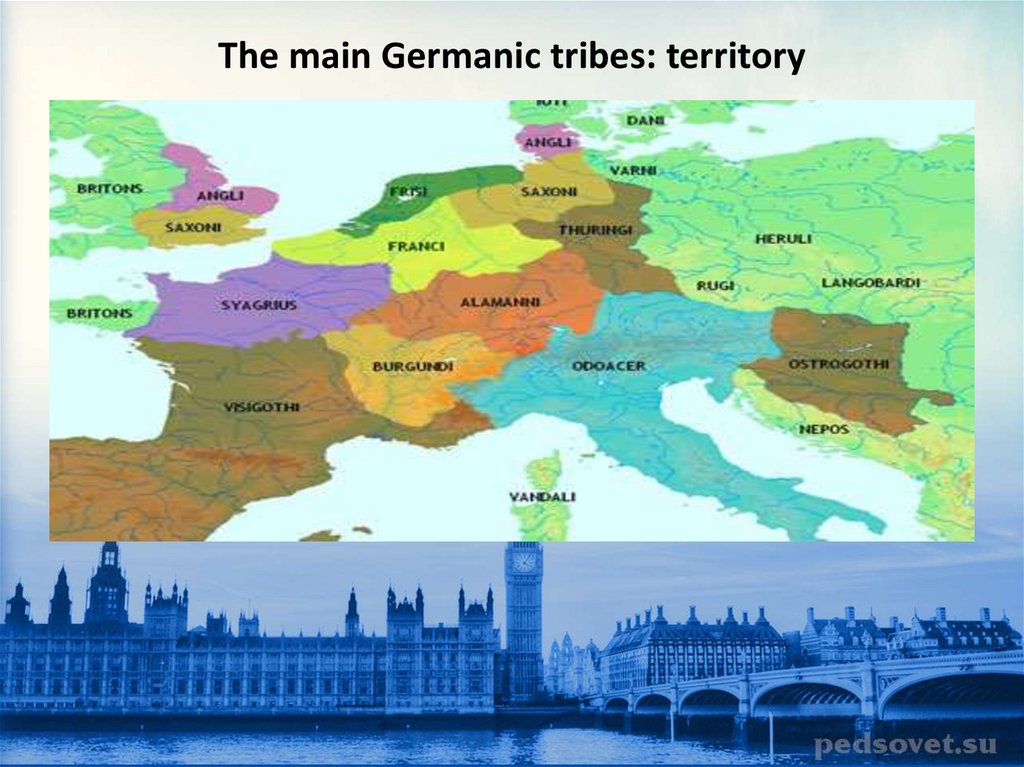
10. The main Germanic tribes: territory
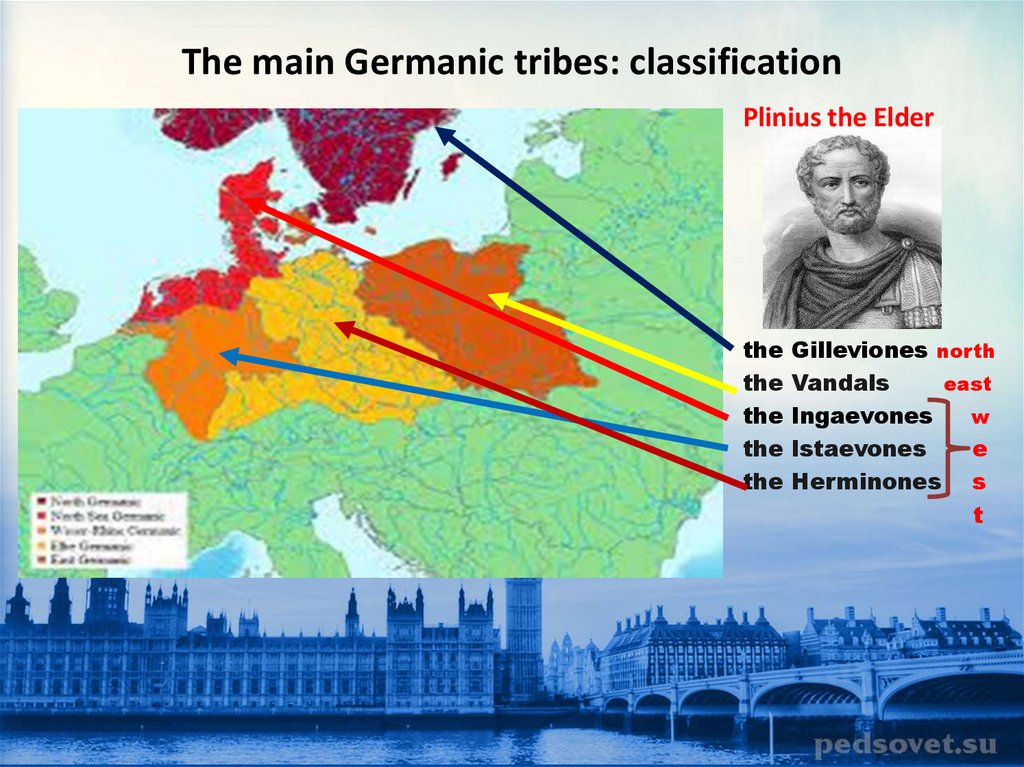
11. The main Germanic tribes: classification
Plinius the Elderthe Gilleviones north
the Vandals
east
the Ingaevones
w
the Istaevones
e
the Herminones s
t
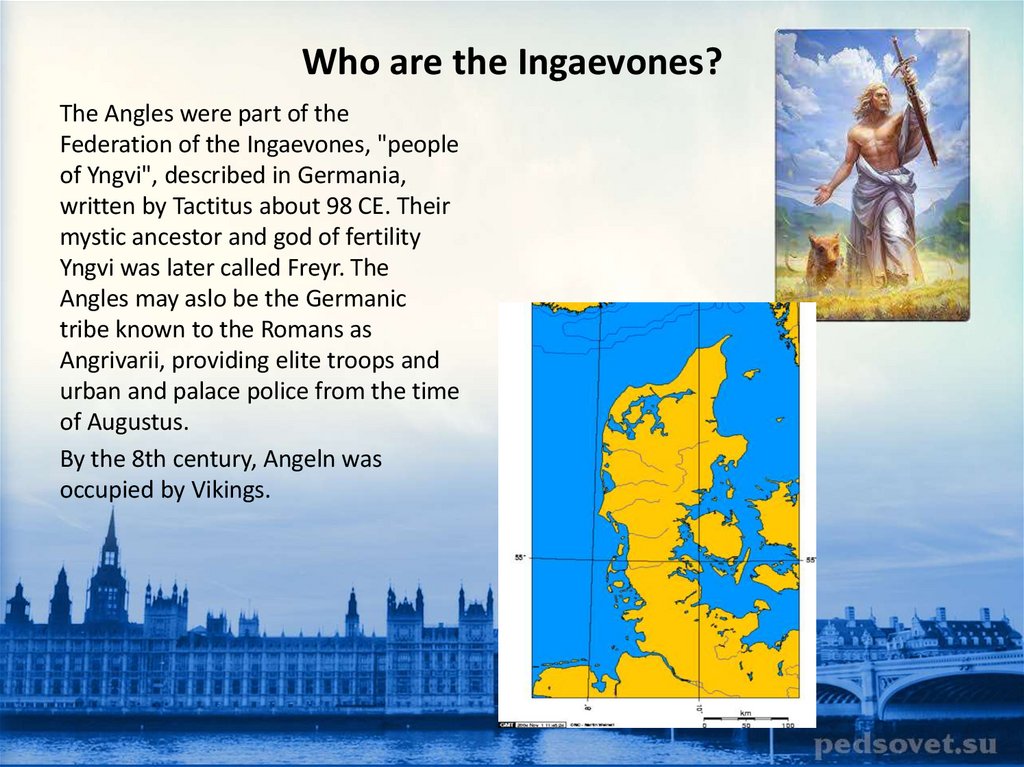
12. Who are the Ingaevones?
The Angles were part of theFederation of the Ingaevones, "people
of Yngvi", described in Germania,
written by Tactitus about 98 CE. Their
mystic ancestor and god of fertility
Yngvi was later called Freyr. The
Angles may aslo be the Germanic
tribe known to the Romans as
Angrivarii, providing elite troops and
urban and palace police from the time
of Augustus.
By the 8th century, Angeln was
occupied by Vikings.
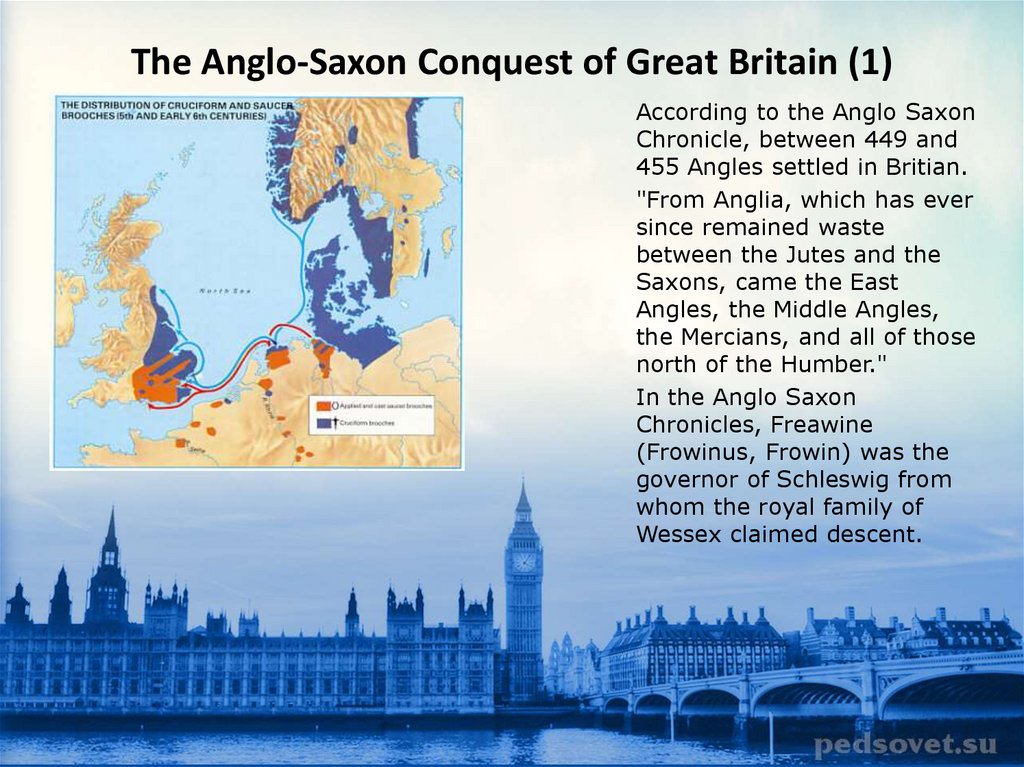
13. The Anglo-Saxon Conquest of Great Britain (1)
According to the Anglo SaxonChronicle, between 449 and
455 Angles settled in Britian.
"From Anglia, which has ever
since remained waste
between the Jutes and the
Saxons, came the East
Angles, the Middle Angles,
the Mercians, and all of those
north of the Humber."
In the Anglo Saxon
Chronicles, Freawine
(Frowinus, Frowin) was the
governor of Schleswig from
whom the royal family of
Wessex claimed descent.
14. The Anglo-Saxon Conquest of Great Britain (2)
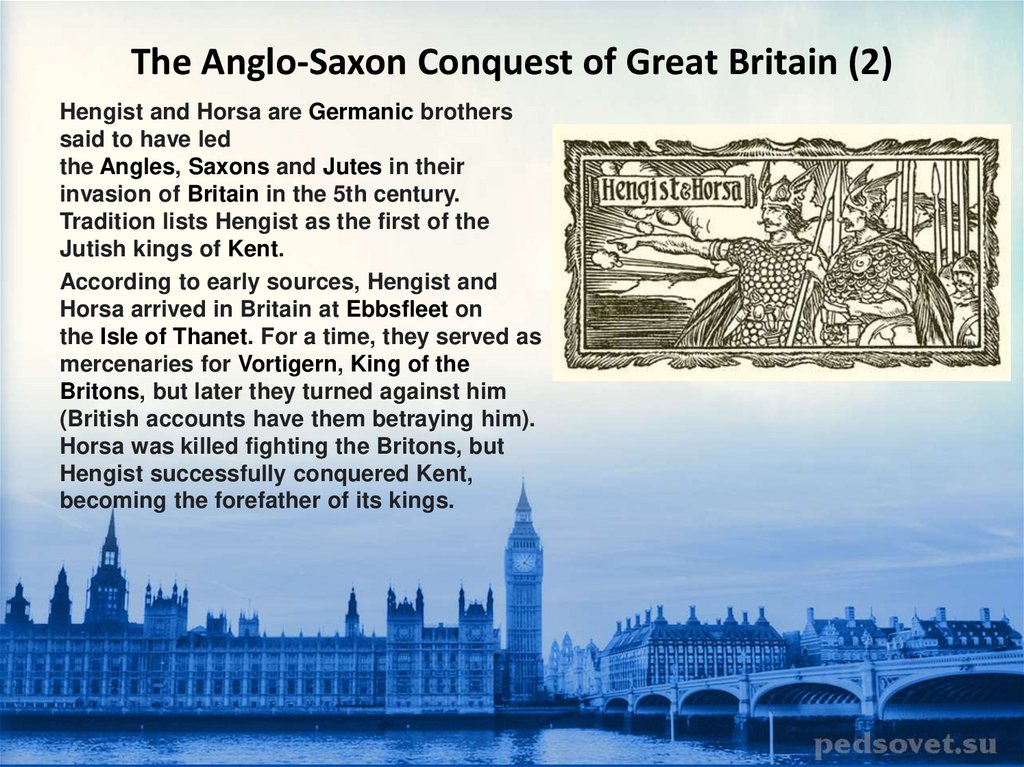
Hengist and Horsa are Germanic brotherssaid to have led
the Angles, Saxons and Jutes in their
invasion of Britain in the 5th century.
Tradition lists Hengist as the first of the
Jutish kings of Kent.
According to early sources, Hengist and
Horsa arrived in Britain at Ebbsfleet on
the Isle of Thanet. For a time, they served as
mercenaries for Vortigern, King of the
Britons, but later they turned against him
(British accounts have them betraying him).
Horsa was killed fighting the Britons, but
Hengist successfully conquered Kent,
becoming the forefather of its kings.
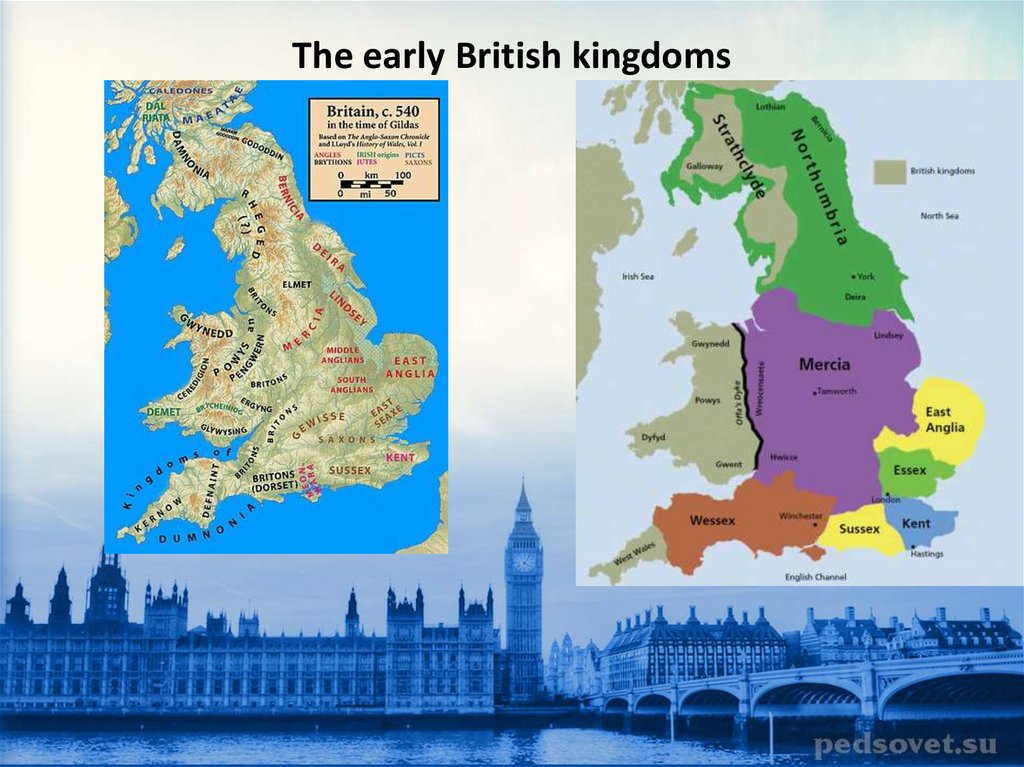
15. The early British kingdoms
16. The main historic events between the 5th and 11th centuries (1)
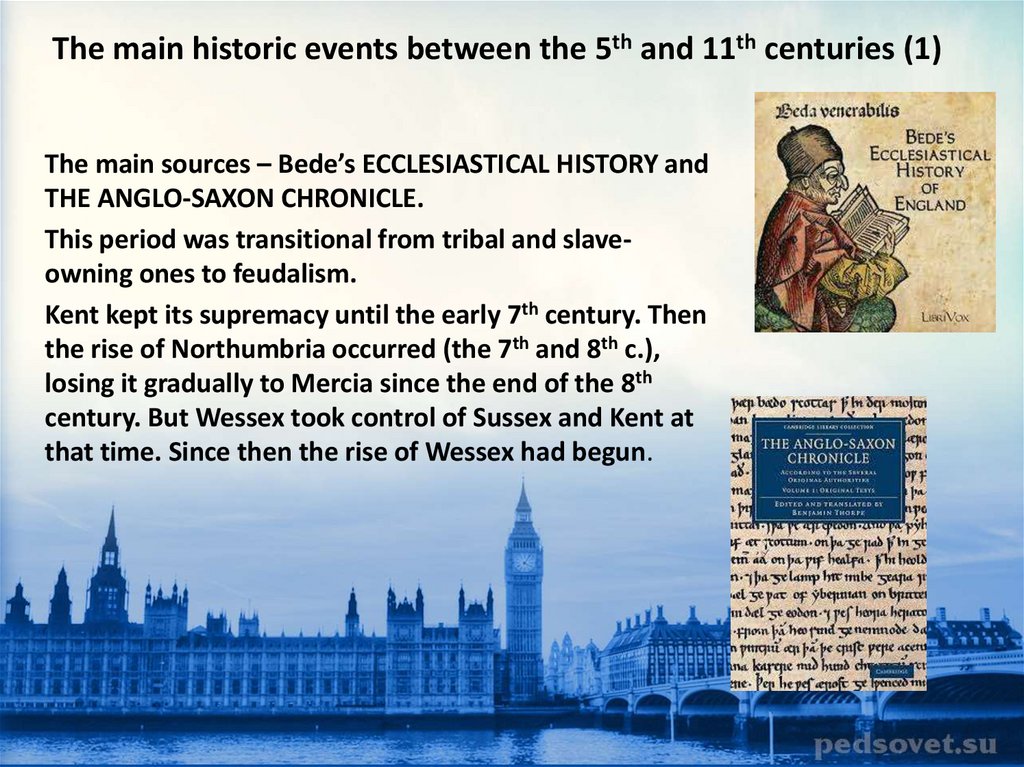
The main sources – Bede’s ECCLESIASTICAL HISTORY andTHE ANGLO-SAXON CHRONICLE.
This period was transitional from tribal and slaveowning ones to feudalism.
Kent kept its supremacy until the early 7th century. Then
the rise of Northumbria occurred (the 7th and 8th c.),
losing it gradually to Mercia since the end of the 8th
century. But Wessex took control of Sussex and Kent at
that time. Since then the rise of Wessex had begun.
17. The main historic events between the 5th and 11th centuries (1)
The kingdoms of Wessex, Mercia, Northumbria and East Anglia each still possessed their owndynasty; smaller kingdoms remained important as internal components of these larger polities,
but no longer had the capacity for independent political action (for the case of Essex at this time,
see Yorke 1985, 24, 36).
The status quo between the four main kingdoms was relatively stable during this period following
a brief but tumultuous phase of warfare between Wessex and Mercia in the 820s. It was these
military successes that established Wessex as a serious challenger to Mercian hegemony in
southern England (Keynes 1995, 39–41). Ecgberht's victory in 825 brought the south-east of
England (Essex, Surrey, Sussex and Kent) under West Saxon control, and these territories were to
remain important components of the West Saxon kingdom, more integrated into the workings of
royal government than they had been under Mercian overlordship (Keynes 1993). Another
campaign against Mercia in 829 made Ecgberht king of the Mercians (as well as the West Saxons)
for a year, and he traversed the kingdom to meet with the ruler of the Northumbrians at Dore,
South Yorkshire, as well. This action later prompted the Anglo-Saxon Chronicle to acclaim
Ecgberht as the eighth in a line of kings with dominion over all England south of the Humber,
temporary though his supremacy was: Wiglaf, former king of the Mercians, regained the throne
the following year (827–9, 830–40). After 830 there is no further evidence of direct conflict
between the English kingdoms.
18. The main historic events between the 5th and 11th centuries (3)
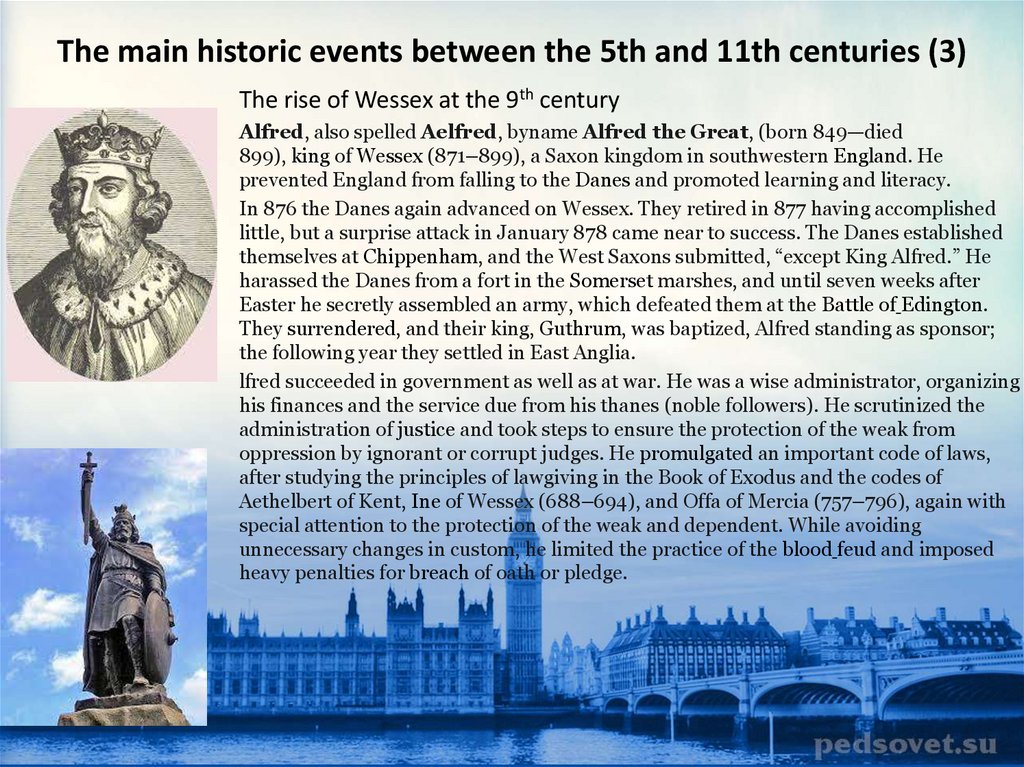
The rise of Wessex at the 9th centuryAlfred, also spelled Aelfred, byname Alfred the Great, (born 849—died
899), king of Wessex (871–899), a Saxon kingdom in southwestern England. He
prevented England from falling to the Danes and promoted learning and literacy.
In 876 the Danes again advanced on Wessex. They retired in 877 having accomplished
little, but a surprise attack in January 878 came near to success. The Danes established
themselves at Chippenham, and the West Saxons submitted, “except King Alfred.” He
harassed the Danes from a fort in the Somerset marshes, and until seven weeks after
Easter he secretly assembled an army, which defeated them at the Battle of Edington.
They surrendered, and their king, Guthrum, was baptized, Alfred standing as sponsor;
the following year they settled in East Anglia.
lfred succeeded in government as well as at war. He was a wise administrator, organizing
his finances and the service due from his thanes (noble followers). He scrutinized the
administration of justice and took steps to ensure the protection of the weak from
oppression by ignorant or corrupt judges. He promulgated an important code of laws,
after studying the principles of lawgiving in the Book of Exodus and the codes of
Aethelbert of Kent, Ine of Wessex (688–694), and Offa of Mercia (757–796), again with
special attention to the protection of the weak and dependent. While avoiding
unnecessary changes in custom, he limited the practice of the blood feud and imposed
heavy penalties for breach of oath or pledge.
19. The Scandinavian invasion (the 9th- 11th centuries) (1)
In 793 came the first recorded Viking raid, where 'on the Ides of June the harrying ofthe heathen destroyed God's church on Lindisfarne, bringing ruin and slaughter' (The
Anglo-Saxon Chronicle).
These ruthless pirates continued to make regular raids around the coasts of England,
looting treasure and other goods, and capturing people as slaves. Monasteries were
often targeted, for their precious silver or gold chalices, plates, bowls and crucifixes.
Gradually, the Viking raiders began to stay, first in winter camps, then settling in land
they had seized, mainly in the east and north of England. See The Vikings settle down.
Outside Anglo-Saxon England, to the north of Britain, the Vikings took over and settled
Iceland, the Faroes and Orkney, becoming farmers and fishermen, and sometimes
going on summer trading or raiding voyages. Orkney became powerful, and from
there the Earls of Orkney ruled most of Scotland. To this day, especially on the northeast coast, many Scots still bear Viking names.
20. The Scandinavian invasion (the 9th- 11th centuries) (2)
To the west of Britain, the Isle of Man became a Viking kingdom. The island still has itsTynwald, or ting-vollr (assembly field), a reminder of Viking rule. In Ireland, the Vikings
raided around the coasts and up the rivers. They founded the cities of Dublin, Cork
and Limerick as Viking strongholds.
Meanwhile, back in England, the Vikings took over Northumbria, East Anglia and parts
of Mercia. In 866 they captured modern York (Viking name: Jorvik) and made it their
capital. They continued to press south and west. The kings of Mercia and Wessex
resisted as best they could, but with little success until the time of Alfred of Wessex,
the only king of England to be called ‘the Great'.
21. The Scandinavian invasion (the 9th- 11th centuries) (3)
King Alfred and the DanesKing Alfred ruled from 871-899 and after many trials and tribulations he defeated the
Vikings at the Battle of Edington in 878. After the battle the Viking leader Guthrum
converted to Christianity. In 886 Alfred took London from the Vikings and fortified it.
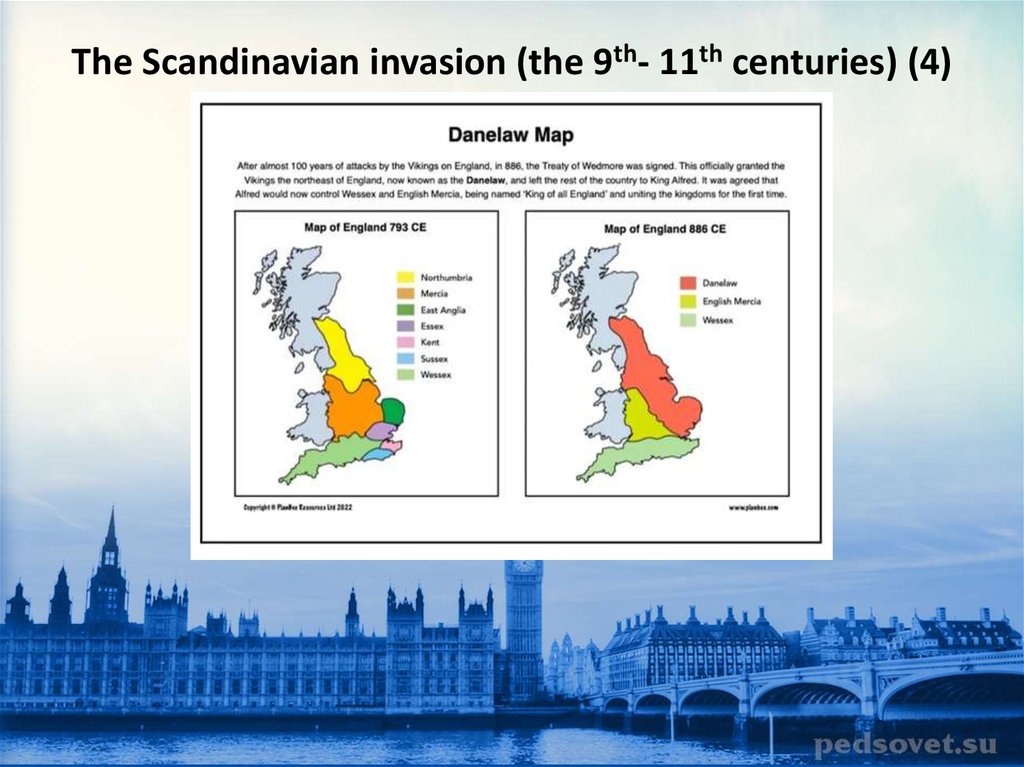
The same year he signed a treaty with Guthrum. The treaty partitioned England
between Vikings and English. The Viking territory became known as the Danelaw. It
comprised the north-west, the north-east and east of England. Here, people would be
subject to Danish laws. Alfred became king of the rest.
Alfred's grandson, Athelstan, became the first true King of England. He led an English
victory over the Vikings at the Battle of Brunaburh in 937, and his kingdom for the first
time included the Danelaw. In 954, Eirik Bloodaxe, the last Viking king of York, was
killed and his kingdom was taken over by English earls.
22. The Scandinavian invasion (the 9th- 11th centuries) (4)
23. The Norman Conquest (1066): the preliminary events
One of the most influential monarchies in the history of England began in 1066 C.E.with the Norman Conquest led by William, the Duke of Normandy. England would
forever be changed politically, economically, and socially as a result.
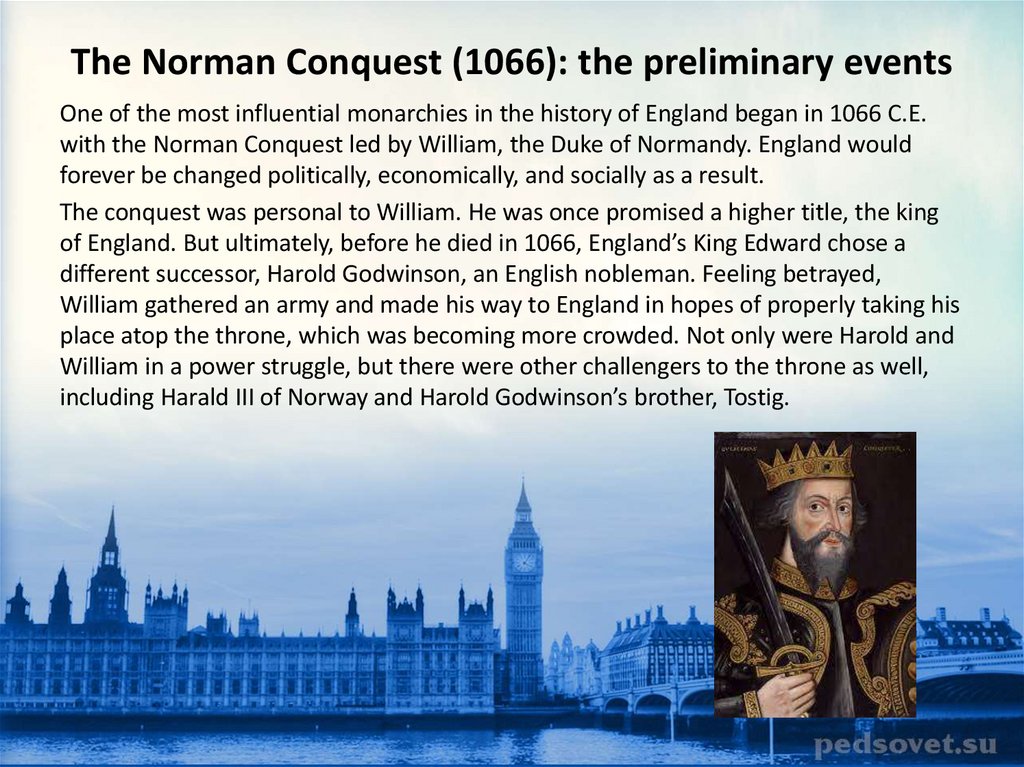
The conquest was personal to William. He was once promised a higher title, the king
of England. But ultimately, before he died in 1066, England’s King Edward chose a
different successor, Harold Godwinson, an English nobleman. Feeling betrayed,
William gathered an army and made his way to England in hopes of properly taking his
place atop the throne, which was becoming more crowded. Not only were Harold and
William in a power struggle, but there were other challengers to the throne as well,
including Harald III of Norway and Harold Godwinson’s brother, Tostig.
24. The Norman Conquest (1066): the battle at Hastings
Strategy combined with a critical weather delayresulted in William invading the south of England
just days after Harald III. Harald III had
unsuccessfully attempted to wrestle the crown
away from Harold, perishing in the process. Harold’s
troops could not rest and spent the next two weeks
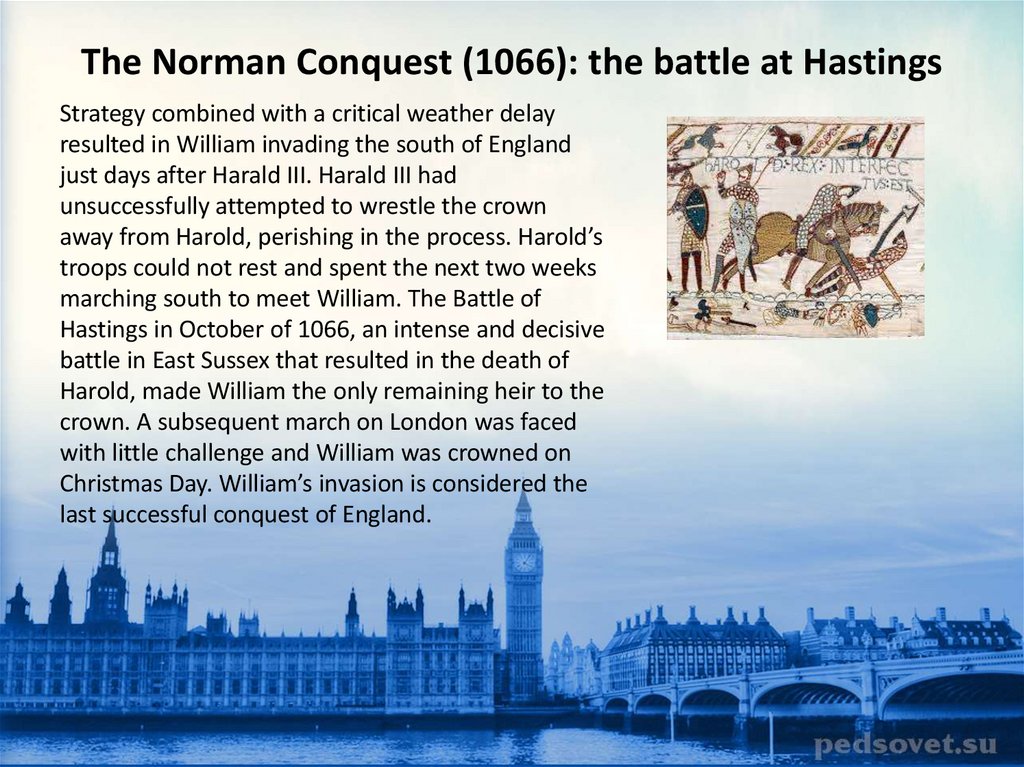
marching south to meet William. The Battle of
Hastings in October of 1066, an intense and decisive
battle in East Sussex that resulted in the death of
Harold, made William the only remaining heir to the
crown. A subsequent march on London was faced
with little challenge and William was crowned on
Christmas Day. William’s invasion is considered the
last successful conquest of England.
25. The Norman Conquest (1066): results (1)
Early on, King William endured a number ofinvasions, attacks, rebellions, and threats.
He survived through a series of military
victories and controversial tactics such as
his devastating “harrying the north” policy.
This policy involved damaging the land in
the north to minimize the chances that
rebel groups could strengthen and
challenge his army. William also introduced
new military strategies, which included
building many castles across the country as
defensive measures.
26. The Norman Conquest (1066): results (2)
English culture changed dramatically as well. William replaced the Englishlandowning elite with Norman landowners, resulting in the first steps toward
feudalism. William also directly redistributed land to these people, often in return
for military service. William ordered that this new system of land ownership be
recorded in a comprehensive manuscript, known as the Domesday Book. He also
replaced the church elite, which was mainly made up of Anglo-Saxons, with his
Norman supporters. Furthermore, the introduction of the French language into elite
English circles influenced English vocabulary and composition.
The results of the Norman Conquest linked England to France in the years that
followed. In addition to the introduction of French words to the English language,
the French influence was also felt in politics, as William and his noblemen retained
an interest in the affairs of France and the European continent.