 История
Похожие презентации:


Edward Said’s Orientalism
1. Edward Said’s Orientalism
ULI SCHAMILOGLUDepartment of Kazakh Language and Turkic Studies
KAZ 300—Week 1-Wednesday
2. The Big Question this Course Poses:
Does post-colonial theory
apply to the case
of Kazakhstan?
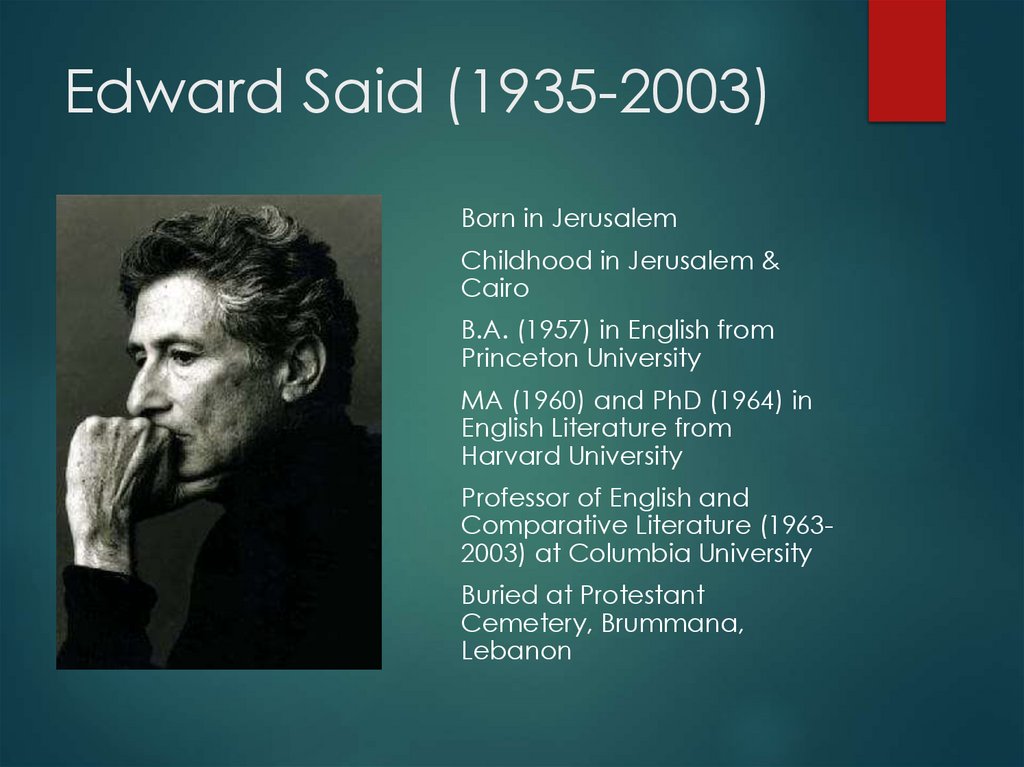
3. Edward Said (1935-2003)
Born in JerusalemChildhood in Jerusalem &
Cairo
B.A. (1957) in English from
Princeton University
MA (1960) and PhD (1964) in
English Literature from
Harvard University
Professor of English and
Comparative Literature (19632003) at Columbia University
Buried at Protestant
Cemetery, Brummana,
Lebanon
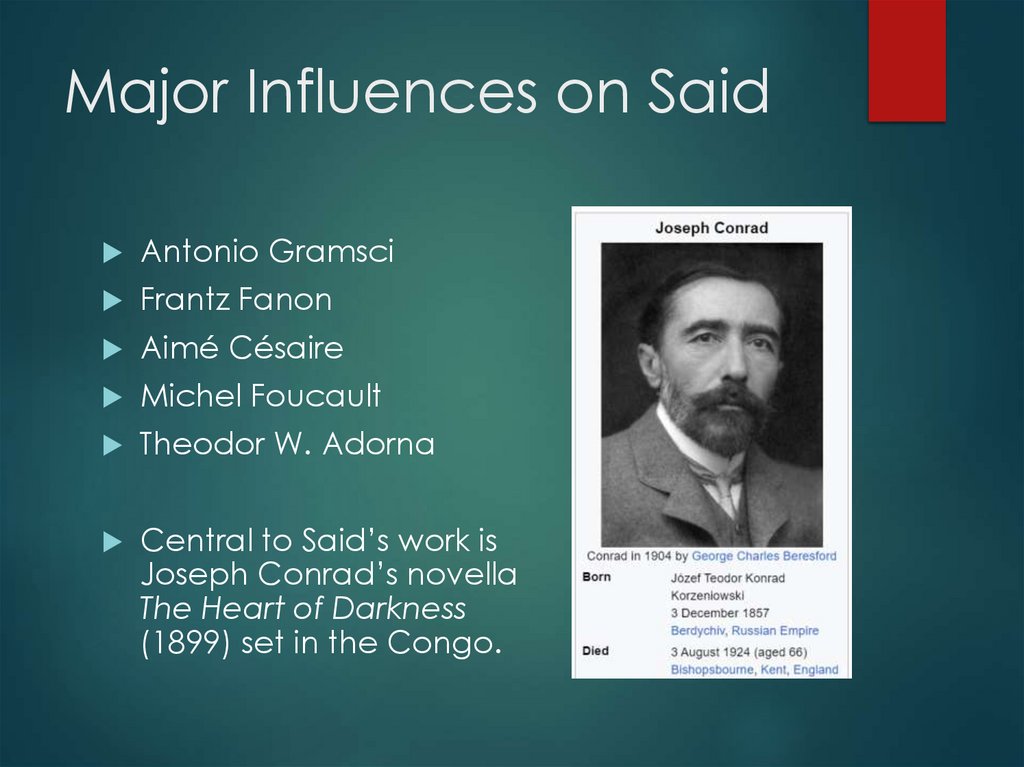
4. Major Influences on Said
Antonio GramsciFrantz Fanon
Aimé Césaire
Michel Foucault
Theodor W. Adorna
Central to Said’s work is
Joseph Conrad’s novella
The Heart of Darkness
(1899) set in the Congo.
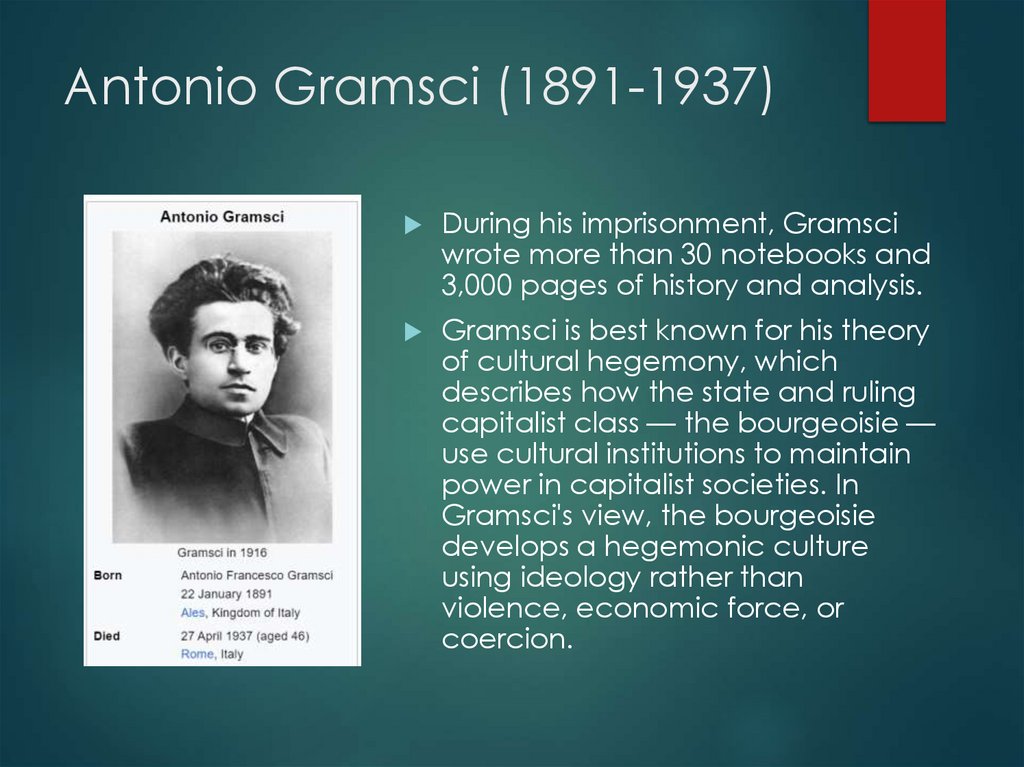
5. Antonio Gramsci (1891-1937)
During his imprisonment, Gramsciwrote more than 30 notebooks and
3,000 pages of history and analysis.
Gramsci is best known for his theory
of cultural hegemony, which
describes how the state and ruling
capitalist class — the bourgeoisie —
use cultural institutions to maintain
power in capitalist societies. In
Gramsci's view, the bourgeoisie
develops a hegemonic culture
using ideology rather than
violence, economic force, or
coercion.
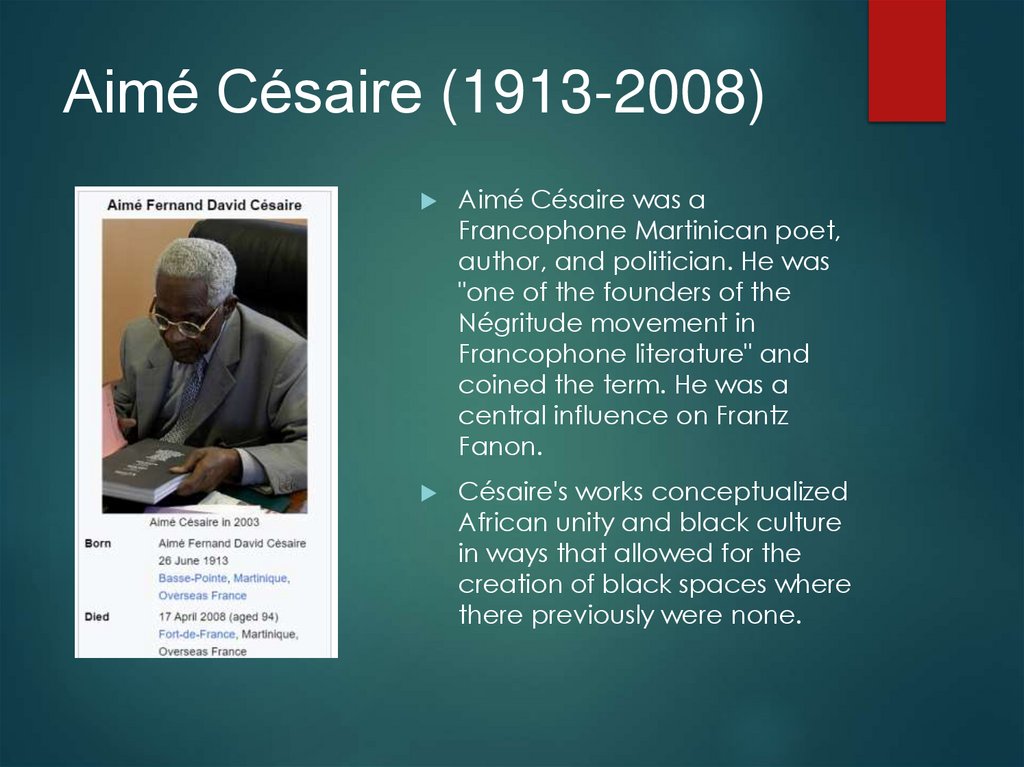
6. Aimé Césaire (1913-2008)
Aimé Césaire was aFrancophone Martinican poet,
author, and politician. He was
"one of the founders of the
Négritude movement in
Francophone literature" and
coined the term. He was a
central influence on Frantz
Fanon.
Césaire's works conceptualized
African unity and black culture
in ways that allowed for the
creation of black spaces where
there previously were none.
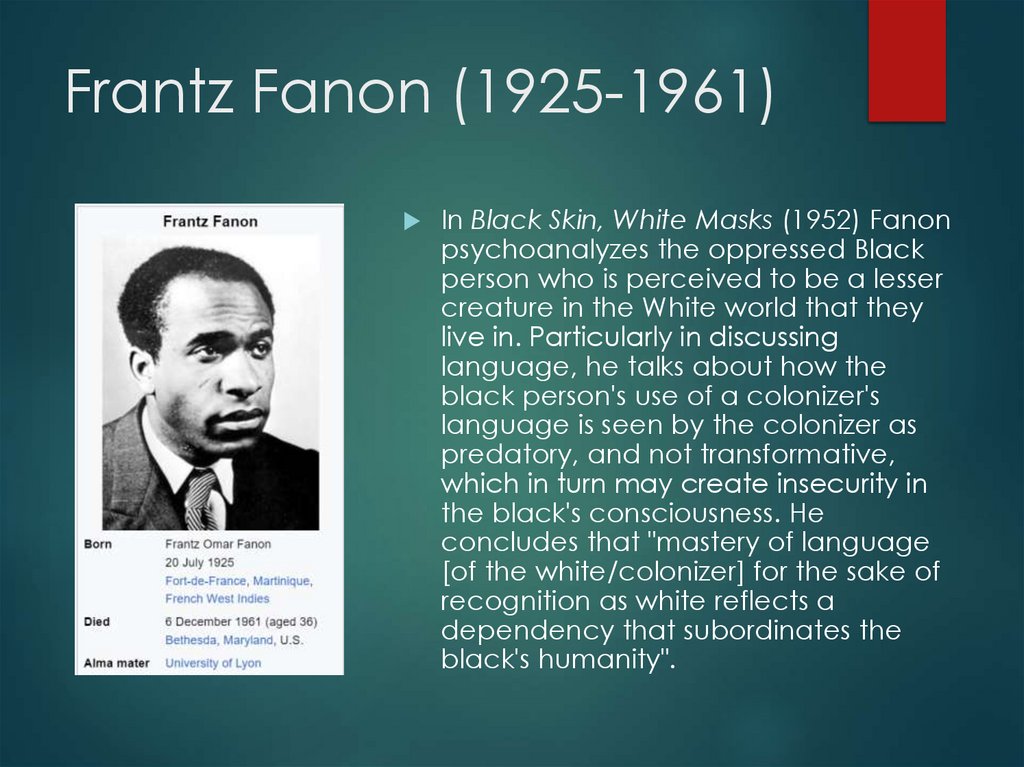
7. Frantz Fanon (1925-1961)
In Black Skin, White Masks (1952) Fanonpsychoanalyzes the oppressed Black
person who is perceived to be a lesser
creature in the White world that they
live in. Particularly in discussing
language, he talks about how the
black person's use of a colonizer's
language is seen by the colonizer as
predatory, and not transformative,
which in turn may create insecurity in
the black's consciousness. He
concludes that "mastery of language
[of the white/colonizer] for the sake of
recognition as white reflects a
dependency that subordinates the
black's humanity".
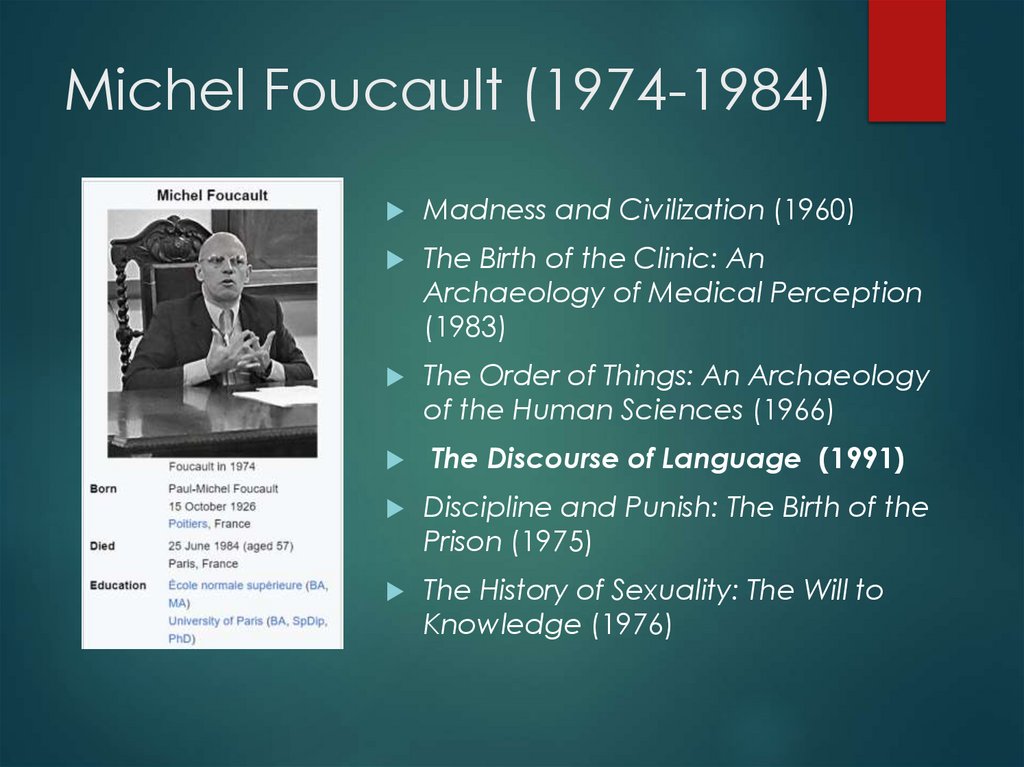
8. Michel Foucault (1974-1984)
Madness and Civilization (1960)The Birth of the Clinic: An
Archaeology of Medical Perception
(1983)
The Order of Things: An Archaeology
of the Human Sciences (1966)
The Discourse of Language (1991)
Discipline and Punish: The Birth of the
Prison (1975)
The History of Sexuality: The Will to
Knowledge (1976)
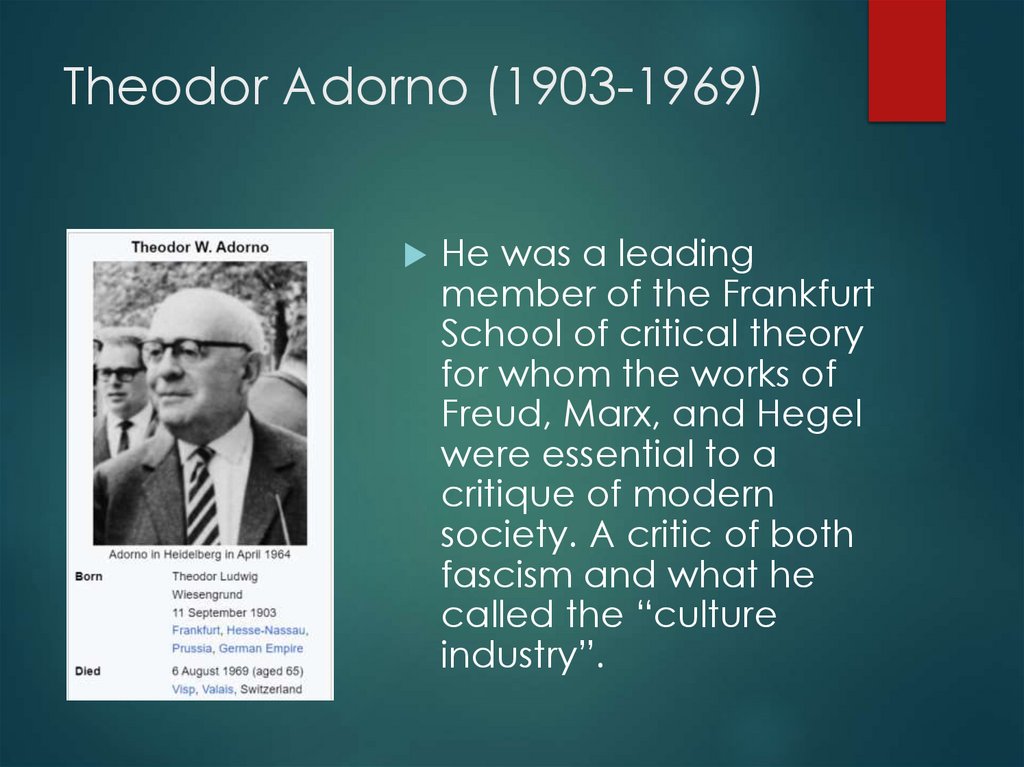
9. Theodor Adorno (1903-1969)
He was a leadingmember of the Frankfurt
School of critical theory
for whom the works of
Freud, Marx, and Hegel
were essential to a
critique of modern
society. A critic of both
fascism and what he
called the “culture
industry”.
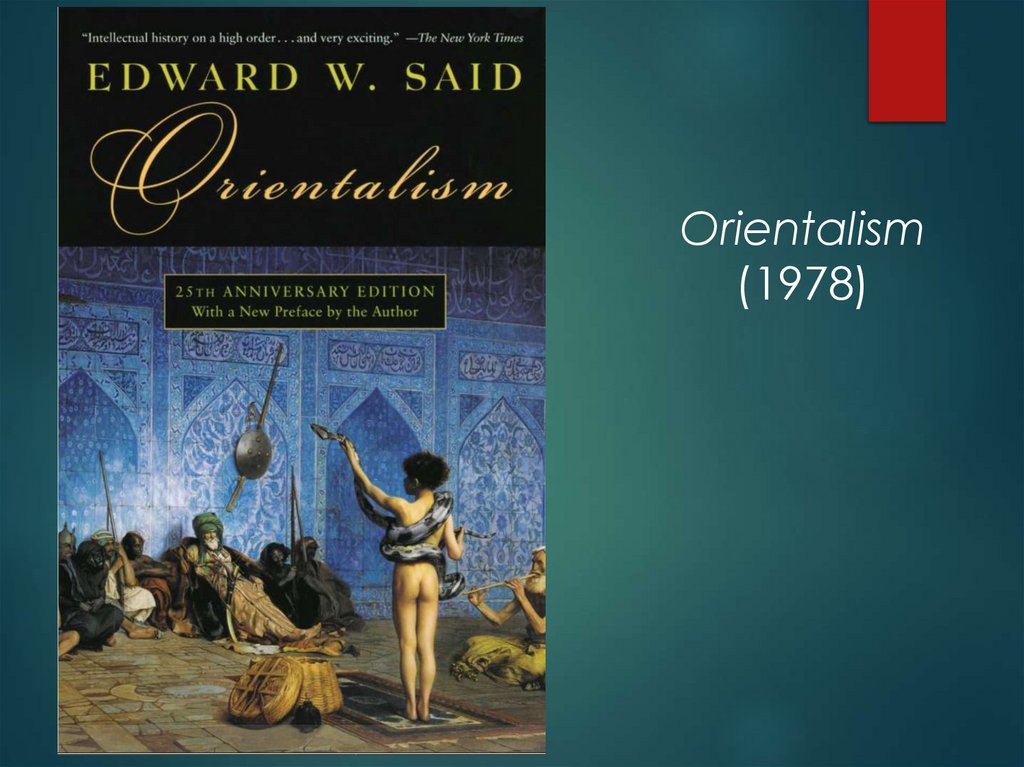
10.
Orientalism(1978)
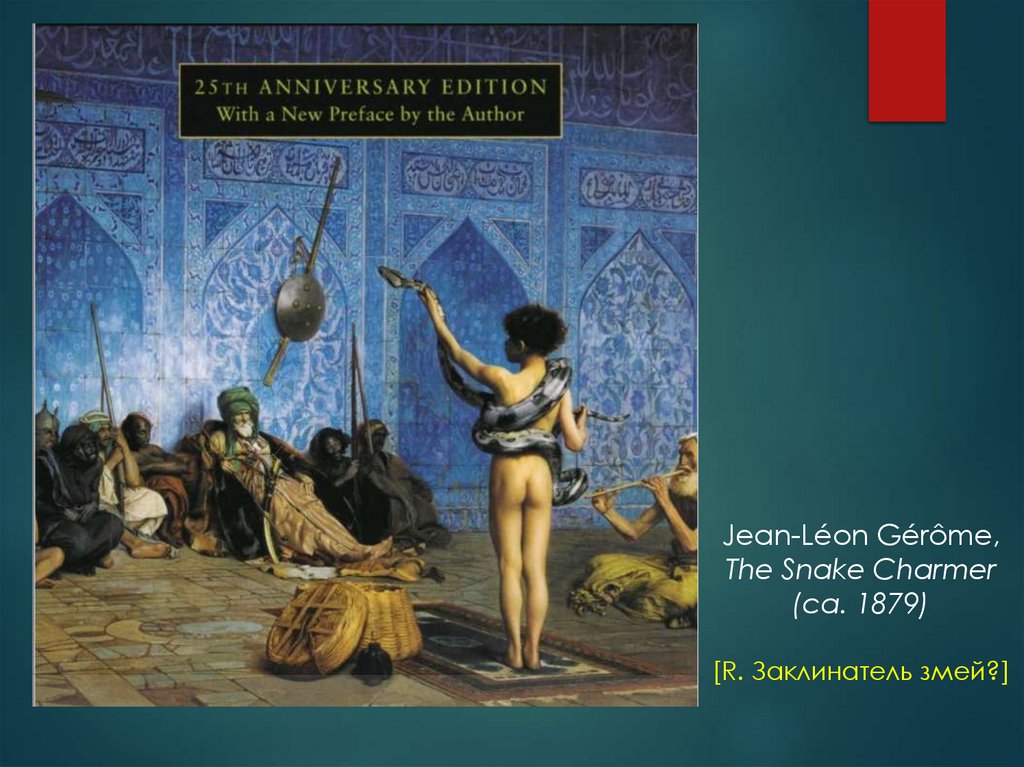
11.
Jean-Léon Gérôme,The Snake Charmer
(ca. 1879)
[R. Заклинатель змей?]
12. Orientalism as a Discourse
In Michel Foucault's philosophy, the notion of discourse refers tothe ways in which knowledge is produced, disseminated, and
accepted within a society. For Foucault, discourse is not just a
means of communication, but a way of creating and shaping
knowledge and understanding of the world.
В философии Мишеля Фуко понятие
дискурса относится к способам
производства, распространения и принятия
знаний в обществе. Для Фуко дискурс — это
не просто средство общения, а способ
создания и формирования знаний и
понимания мира.
13. Legacy of Orientalism on Discourse
Uzbek Шарқ одамиRussian Восточный человек = ???
Islam = Terrorism ~ Muslim = Terrorist
These all rely on stereotypes!
14. Introduction
The “Orient” means different things to differentpeoples (British, French, Germans, Americans; BTWRussians, too!)
The “Orient” means the “not Occident”. Europeans
have accepted the basic distinction as the basis for
elaborate theories, epics, social descriptions, etc.
concerning the “Orient”, its peoples, its mind, etc.
Orientalism as a Western style for dominating,
restructuring, and having authority over the Orient.
Said is concerned with understanding Orientalism’s
internally consistent body of ideas about the Orient.
It is predicated on a doctrine of European
superiority.
The European representations are not “natural”,
rather they are representations.
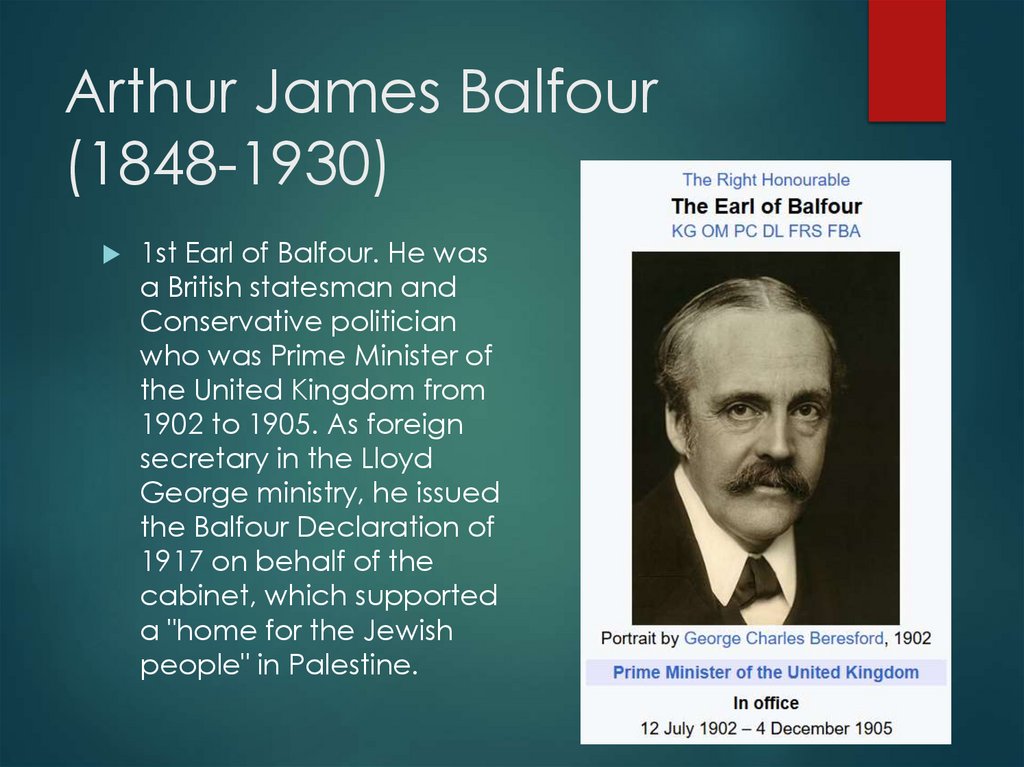
15. Arthur James Balfour (1848-1930)
1st Earl of Balfour. He wasa British statesman and
Conservative politician
who was Prime Minister of
the United Kingdom from
1902 to 1905. As foreign
secretary in the Lloyd
George ministry, he issued
the Balfour Declaration of
1917 on behalf of the
cabinet, which supported
a "home for the Jewish
people" in Palestine.
16. Chapter 1.1 (I)
Lord Balfour:“We know the civilization of Egypt better
than we know the civilization of any other
country.... We know it further back; we
know it more intimately; we know more
about it. It goes past the petty span of the
history of our race, which is lost in the
prehistoric period at a time when the
Egyptian civilization had already passed its
prime. Look at all the Oriental countries. Do
not talk about superiority or inferiority.”
17. Chapter 1.1 (2)
Lord Balfour:“First of all, look at the facts of the case.
Western nation as as soon as they emerge
into history show the beginnings of those
capacities for self-government…having
merits of their own…You may look through
the whole of the history of the
Orientals…and you never find traces of selfgovernment. All their great centuries…have
been passed under despotisms, under
absolute government.”
18. Chapter 1.1 (3)
Lord Balfour:“Is it a good thing for these great nations—I
admit their greatness—that this absolute
government should be exercised by us? I
think it is a good thing…We are in Egypt not
merely for the sake of the Egyptians, though
we are there for their sake; we are there
also for the sake of Europe at large.”
19. Evelyn Baring, 1st Earl of Cromer (1841-1917)
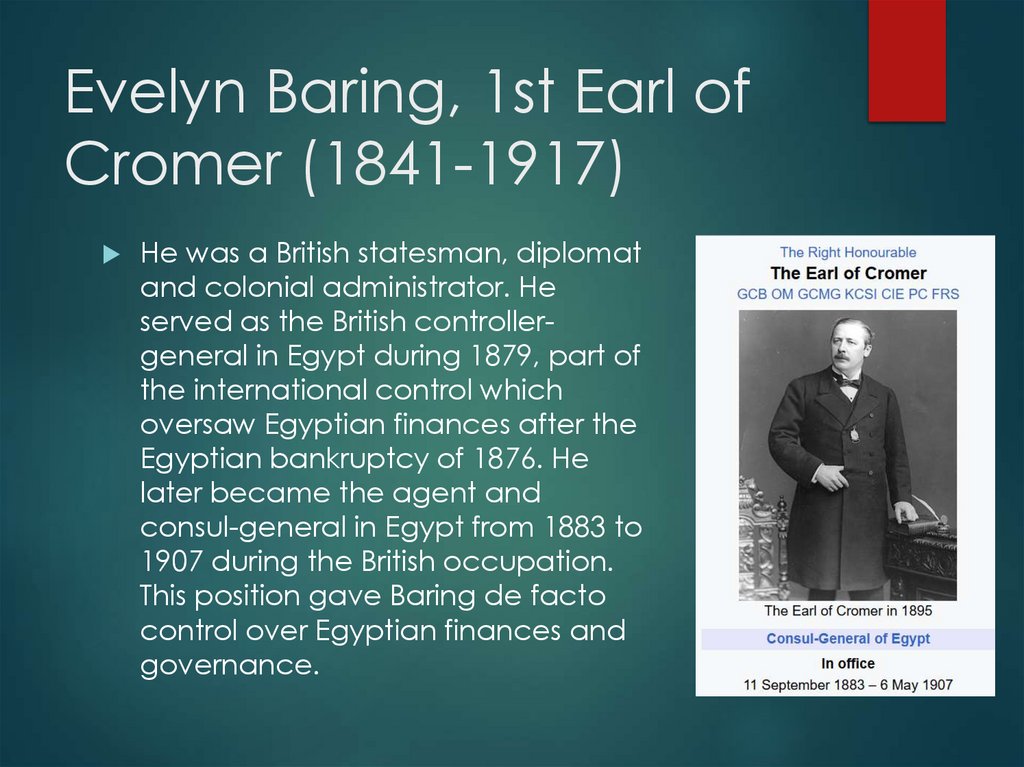
He was a British statesman, diplomatand colonial administrator. He
served as the British controllergeneral in Egypt during 1879, part of
the international control which
oversaw Egyptian finances after the
Egyptian bankruptcy of 1876. He
later became the agent and
consul-general in Egypt from 1883 to
1907 during the British occupation.
This position gave Baring de facto
control over Egyptian finances and
governance.
20. Chapter 1.1 (4)
Lord Cromer:“in dealing with Indians or Egyptians, or
Shilluks, or Zulus, the first question is to
consider what these people, who are all,
nationally speaking, more or less in statu
pupillari, themselves think is best in their own
interests…”
21. Chapter 1.1 (5a)
Lord Cromer:“Sir Alfred Lyall once said to me: “Accuracy
is abhorrent to the Oriental mind. Every
Anglo-Indian should always remember that
maxim.” Want of accuracy, which easily
degenerates into untruthfulness, is in the
fact the main characteristic of the Oriental
mind.
The European is a close reasoner; his
statements of fact are devoid of any
ambiguity; he is a natural logician, albeit he
may not have studied logic; he is by nature
—>
22. Chapter 1.1 (5b)
sceptical and requires proof before he canaccept the truth of any proposition; his
trained intelligences works like a piece of
mechanism. The mind of the Oriental, on
the other hand, like his picturesque streets, is
eminently wanting in symmetry. His
reasoning is of the most slipshod description.
Although the ancient Arabs acquired in
somewhat higher degree the science of
dialectics, their descendants are singularly
deficient in the logical faculty. They are
often incapable of drawing the most
obvious conclusions from any simple
premises of which they may admit the truth.
23. Chapter 1.1 (6)
Orientals or Arabs are shown to be gulliblemuch given to “fulsome flattery”, intrigue,
cunning, and unkindness to animals
Orientals cannot walk on either a road or a
pavement (their disordered minds fail to
understand what the clever European
grasps immediately, that roads and
pavements are made for walking)
Orientals are inveterate liars, “lethargic and
suspicious”
opposite to the clarity, directness, and
nobility of the Anglo-Saxon race
24. Chapter 1.2 (1)
Contrast between East and West already exists in ancientGreek times (Aeschylus’s The Persians and other works) in
which Asia is “represented” speaking through and by virtue
of the European imagination.
[early Christian views of Muhammad as a “false prophet”US]
[2 dimensional figure of the Saracen, to which language or
ethnicity did they belong?-US]
Until the end of the 17th century the “Ottoman peril” was a
lasting trauma symbolizing terror, devastation, the demonic
hordes of hate barbarians.
Analogical understanding of Islam: Muhammad was to
Islam as Christ was to Christianity (therefore
“Muhammadanism”).
25. Chapter 1.2 (2)
With regard to Christian knowledge about Islam:Southern demonstrates that “it is finally Western ignorance
which becomes more refined and complex, not some body
of positive Western knowledge which increases in size and
accuracy. For fictions have their own logic and their own
dialectic of growth or decline. Onto the character of
Mohammed in the Middle Ages was heaped a bundle of
attributes that corresponded to the “character of the [12th
century] prophets of the ‘Free Spirit’”.
Lechery, debauchery, sodomy, and a whole batter of
assorted treacheries…
“the heresy which we call Mohammedanism” is “caught as
the imitation of a Christian imitation of true religion”
26. Chapter 1.3
Sir William Jones (1746–1794) on Indo-European languages(on the similarity of Sanskrit, Greek, and Latin)
Napoleon’s Description de l’Égypte (after 1798)
Chapter 1.4
Discoveries of Jones, Franz Bopp, Jakob Grimm led to
elevation of the status of philologists as having insight into
long lost truths of the past… (US)
27. Chapter 2.2
Syvestre de Sacy compiled a Chrestomathie arabe, 3 vols.(1806-1827) which came to be studied by all leading
Arabists in Europe. It selected and represented Islam. Sacy
placed the Arabs in the Orient, which was itself placed in
the general tableau of modern learning.
Ernst Renan (1823-1892) saw Indo-Europeans as organic,
and Orientals and Semites as inorganic, ossified. Semitic is a
case of arrested development. He was a philologist whose
background allowed him authoritative, racist
pronouncements.
28. Chapter 2.3
Residence in the Orient. Being aEuropean in the Orient
Edward Lane (1801-1876), lexicographer & author of
Manners and Customs of the Modern Egyptians.
Gustave Flaubert (1821–1880)
29. Chapter 2.4
Pilgrims and PilgrimagesChateaubriand, Nerval, Lamartine (also Mark
Twain et al.)
In the system of knowledge about the Orient, the
Orient is less a place than a topos, a set of references,
a congeries of characteristics, that seem to have its
origin in a quotation, or a fragment of a text, or a
citation from someone’s work on the Orient, or some
bit of previous imagining, or an amalgam of all these.
Direct observation or circumstantial description of the
Orient are fictions presented by writing on the Orient.
The Orient as a re-representation of canonical
material guided by an aesthetic and executive will
capable of producing interest in the reader.
30. My Conclusions…
Orientalism is about the development of a complex body ofknowledge which is circular (a tautology).
Knowledge about the Orient is often stereotypical
(see: Pan-Islamism, Pan-Turkism in the Russian Empire)
Overemphasis on religious determinism (studying the Qur’an in
order to explain Egyptian elections, but not studying the Bible to
explain elections in France or Israel)
It still dominates Euro-American popular understanding of non-EuroAmerican societies.
Edward Said’s Orientalism is a cornerstone (according to Spivak the
foundational text) of post-colonial theory…
See also concerning Gayatri Chakravorty Spivak…
https://nyti.ms/49sHCHj
31.
Questions:What is the field of “post-colonial” studies?
Was the Russian Empire a “colonial empire”?
Was the governor-generalate of Turkistan a “colonial
subject”?
Was the Kazakh steppe a “colonial subject”?
Was the U.S.S.R. an “empire”?
What are the theoretical implications of being a
“colonial subject”?
Post-colonial theory is now dominant in South Asian,
African, Latin American, Caribbean, Native
American studies; its application in the Middle East is
conflicted.
Stereotypical representations of the “native” are
widely analyzed through post-colonial theory.
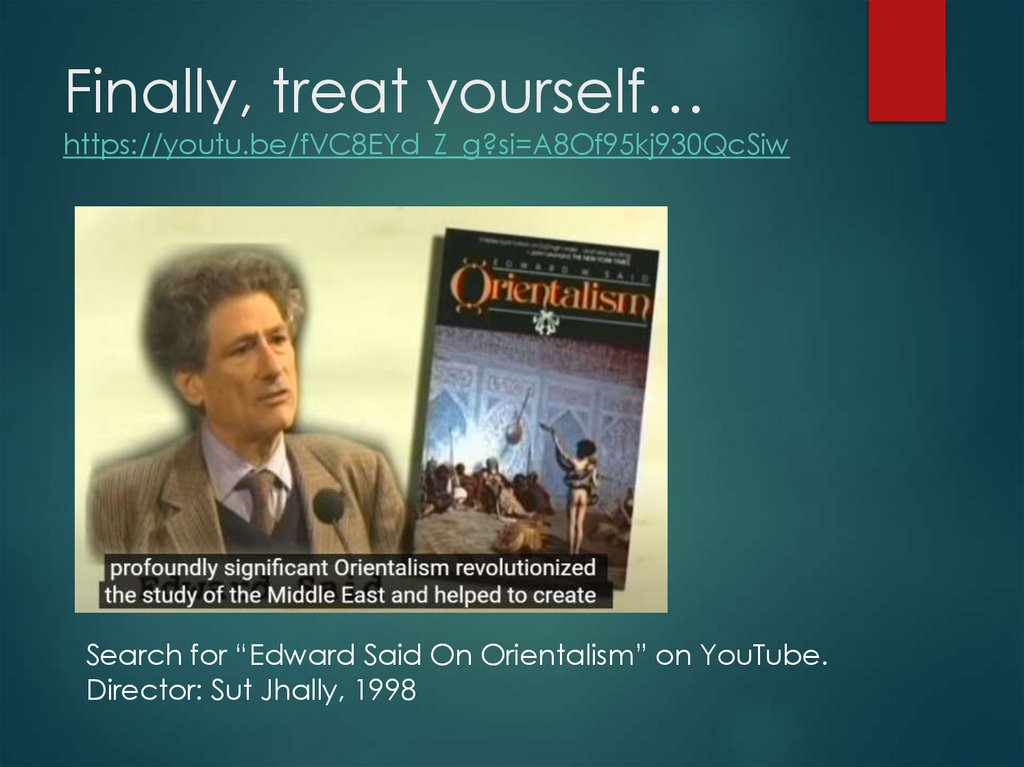
32. Finally, treat yourself… https://youtu.be/fVC8EYd_Z_g?si=A8Of95kj930QcSiw
Search for “Edward Said On Orientalism” on YouTube.Director: Sut Jhally, 1998
33. Thank you! Назар аударғаныңыз үшін раxмет!
Uli Schamilogluuli.schamiloglu@nu.edu.kz
Professor & chair,
Department of Kazakh Language
and Turkic Studies (KazLT)
Director,
Ph.D. in Eurasian Studies Program