

 Политика
 Социология
Похожие презентации:




Module of Social and Political Knowledge
1. Module of Social and Political Knowledge
INTRODUCTION TO POLITICAL SCIENCE.PLAN
1. HISTORY OF POLITICAL THOUGHT
2. SUBJECT OF POLITICAL SCIENCE
3. POLITICS & POLICY
INSTRUCTOR: MALIKOV A.V.
2. HISTORY OF POLITICAL THOUGHT
Ancient Greece is the cradle of modern culture, art andphilosophy.
Plato (5th-4th centuries BC) - ancient Greek philosopher,
author of the work "The State“
He identified several types of government:
aristocracy - the fair rule of a minority;
monarchy - the fair rule of one person;
timocracy - the unfair rule of a minority;
oligarchy - the unfair rule of the rich;
democracy - the rule of the majority;
tyranny - the unfair rule of one person.
3. HISTORY OF POLITICAL THOUGHT
The Middle Ages - a time when many achievements of Antiquitywere lost, and a religious worldview prevails. Authority is the
implementation of God's providence, and obedience is the duty of
a Christian.
The Renaissance is the era of Great Geographical Discoveries,
the development of science, technology, economics, and art. A
time of increased political activity.
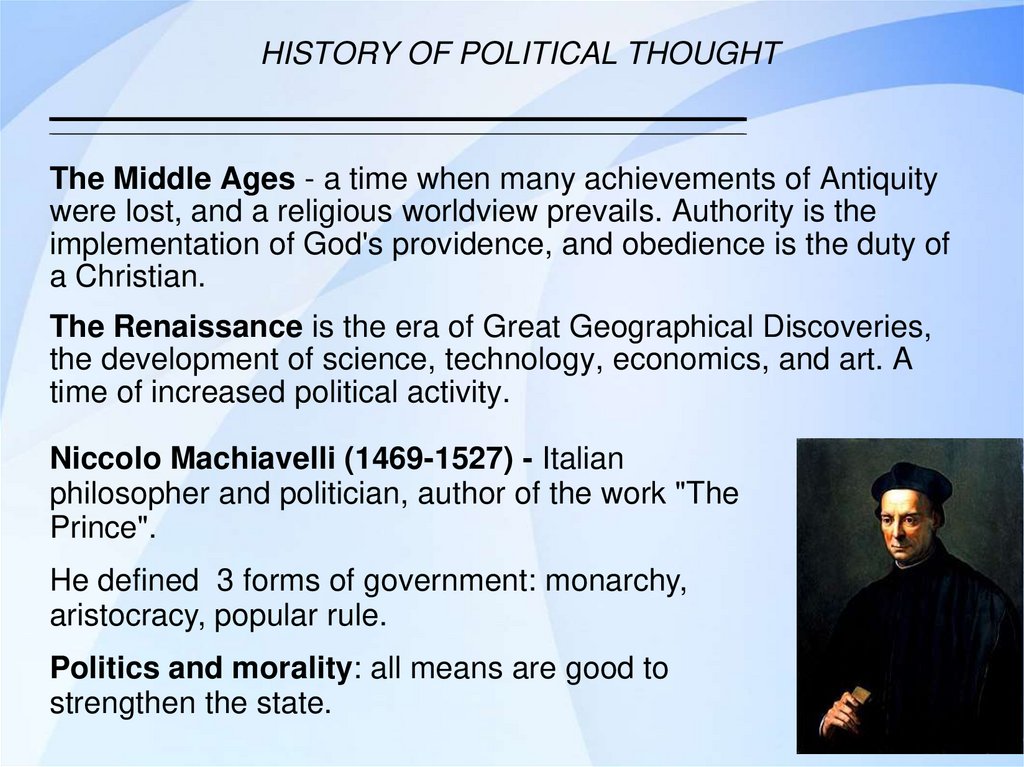
Niccolo Machiavelli (1469-1527) - Italian
philosopher and politician, author of the work "The
Prince".
He defined 3 forms of government: monarchy,
aristocracy, popular rule.
Politics and morality: all means are good to
strengthen the state.
4. HISTORY OF POLITICAL THOUGHT
Thomas Hobbes (1588-1679) - English philosopher, author ofthe work "Leviathan": The state of nature - "war of all against
all“
To overcome hostility and protection, people enter into a "social
contract" - they transfer part of their rights and freedoms to the
state in exchange for protection and security.
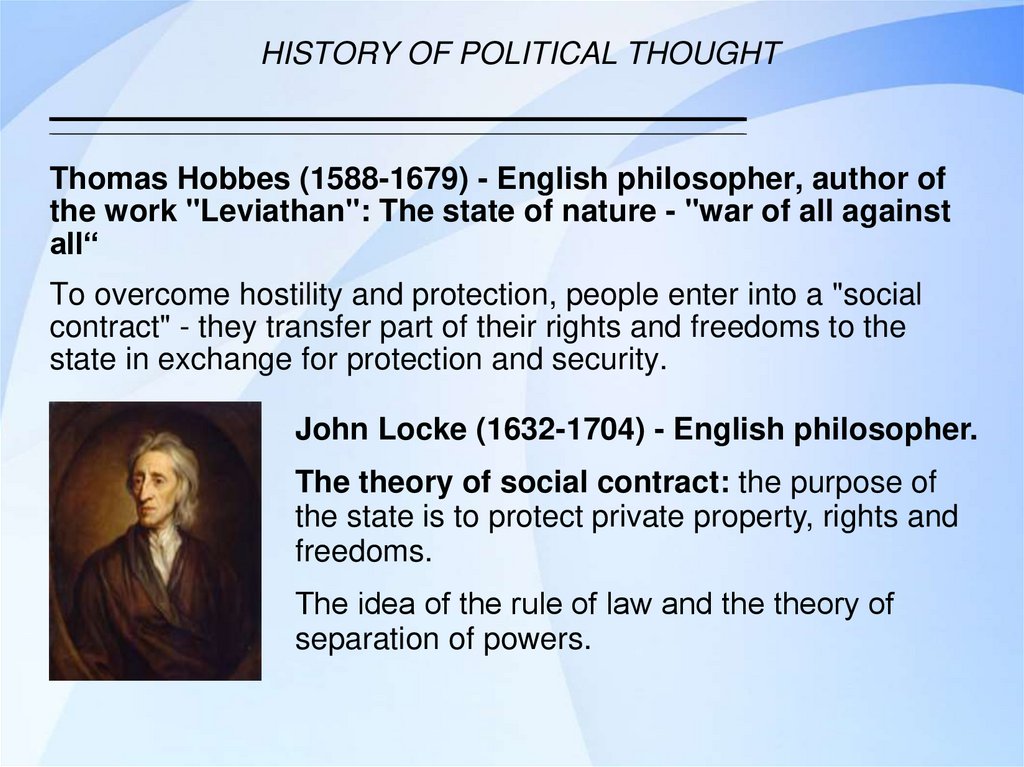
John Locke (1632-1704) - English philosopher.
The theory of social contract: the purpose of
the state is to protect private property, rights and
freedoms.
The idea of the rule of law and the theory of
separation of powers.
5. HISTORY OF POLITICAL THOUGHT
In the 19th-20th centuries, new political doctrines appeared,based on the ideas of the philosophers of Ancient Greece and
the Renaissance:
Marxism: class struggle is the basis of historical development,
the state is an instrument of oppression of some classes by
others. 5 socio-economic formations.
Elite theory: political life is considered as a struggle of elites
and their change.
Behavioral theories: the most important role in politics is
played by the individual will of a person, the peculiarities of his
behavior, the desire for power.
Keynesianism: in order to overcome crises, it is necessary to
strengthen state regulation. The relationship between
economics and politics.
6. Subject of Political Science
Who coined the political science term?Aristotle is called the father of
political science because he
elaborated on the topics and thinking
of the Ideal State, slavery, revolution,
education, citizenship, forms of
government, the theory of golden
mean, theory of constitution etc.
7. Subject of Political Science
Why is it called political science?Political science is called political science
because it deals with the study of politics
and government. Not so much how politics
and government are organized but how they
are related to people and communities.
Political science studies and analyzes
political thought, political behaviors, and
political activities.
8. Subject of Political Science
What are the three Importance of political science?It helps raise good citizens and good leaders. 2.It provides
knowledge about the state's constitution, laws, and duties. 3.It
helps people understand the significance of Political institutions
like political parties, federations, and local bodies in our state.
What are the benefits of political science?
Studying Political Science prepares students for a variety of
careers including journalism, international affairs, law, teaching,
and career in political offices. Students will get a chance to study
the social, economic and political life of people learning about their
political values.
9. Subject of Political Science
What is the best definition of political science?political science, the systematic study of governance by the application of
empirical and generally scientific methods of analysis. As traditionally defined
and studied, political science examines the state and its organs and institutions
What is theory in political science?
Compares and evaluates alternative ideas of justice, legitimacy, and the
common good as they apply to the institutions and conduct of domestic and
global life.
What is nature of political science?
Political Science is concerned with describing and explaining the realities of
political behavior, generalizations about men and political institutions on
empirical evidence and the role of power in the society.
10. POLITICS & POLICY
POLITICS & POLICYPolitics can be defined as a science or art of governing or
government, especially governing a political entity like a nation. A
policy can be defined as an overall plan that embraces the general
goals.
Politics refers to authority and refers to public life. Politics generally
revolves round government and its activities. Politics is a term that
refers to the organizational process.
Policy can be termed as a “principle.”
A policy can also be termed as a commitment or statement of intent.
It is because of the policy that people, an organization, or a party is
held accountable. Policy is a set of rules or principles that guide
decisions.
Political parties run the government which all adhere to certain
policies.
A policy can also be said to be a course or action that is proposed by
a government, an individual, business firm, or any party.
Politics refers to the theory and practice of governance.