



 Педагогика
Похожие презентации:


Principles and breaches of Academic Integrity and Student conduct
1. Principles and breaches of Academic Integrity and Student conduct. Using Databases for searching scientific sources.
Astana IT UniversityDepartment of General Disciplines
English for Academic Purposes
B2 level
Principles and breaches
of Academic Integrity and Student conduct.
Using Databases for searching scientific sources.
Introduction to APA.
Week 1. Lesson 3 (asynchronous)
2025-2026
2. Lesson objectives:
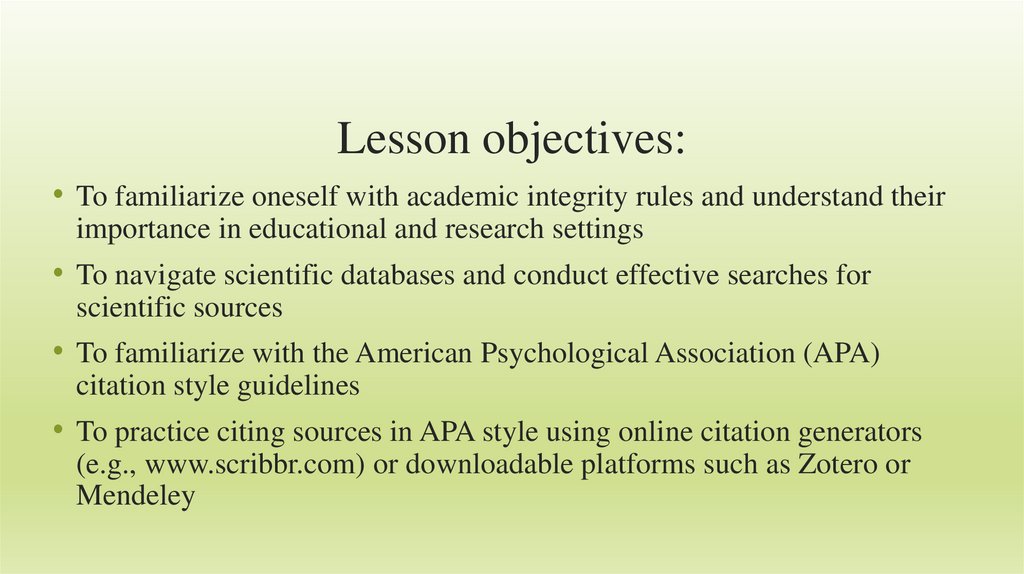
• To familiarize oneself with academic integrity rules and understand theirimportance in educational and research settings
• To navigate scientific databases and conduct effective searches for
scientific sources
• To familiarize with the American Psychological Association (APA)
citation style guidelines
• To practice citing sources in APA style using online citation generators
(e.g., www.scribbr.com) or downloadable platforms such as Zotero or
Mendeley
3. Outline
1. Academic integrity: basic concepts and practical tasks2. Introduction to APA citation style
3. Using databases for searching scientific sources: a practical task
4. Lesson reflection
4. Academic integrity
Academic integrity is:This Photo by Unknown author is licensed under CC BY.
The act of fulfilling your academic work following strong moral and ethical
principles, to provide true and reliable information, acting truthfully and honestly
• Academic integrity= honesty, conscientiousness, transparency, trust, truth
• Academic misconduct= breaching academic integrity or academic dishonesty or
committing an academic crime
Used sources:
1.www.teqsa.gov.au
2.Cambridge online dictionary
5. Task 1. Put the types of behaviour from A-K into the correct column (4-5 min)
Behaviours that support academic integrityBehaviours that undermine academic
integrity
A)Plagiarism
B)Acknowledging where the information you use comes from, clearly citing or referencing the source
C)Sitting your own exams and submitting your own work
D)Exam cheating
E)Collusion (an illegitimate cooperation with one or more students in completing an assignment)
F)Accurately reporting research findings and abiding by research policies
G)Using information appropriately, according to copyright and privacy laws
H)Fabricating information (forgery)
I)Acting ethically or doing the 'right thing', even when you are facing difficulties.
J)Contract cheating and impersonating (paying to someone to do the assignment for you)
K)Recycling or resubmitting work
The task on the slide was developed based on the content published on TEQSA website www.teqsa.gov.au
6. Task 2. Define the type of academic misconduct (5 min)
ImpersonationPlagiarism Forgery Falsifying information Collusion
• 1.Student brought a sick note with a fake signature of a therapist._________
• 2.Student needed a chemical reaction to be positive, but instead, it was negative. In their
assignment, the student wrote the reaction was positive. _________
• 3. Student copied a paragraph from the Internet source and used that text in their
assignment. The student included a reference to the original text. ________
• 4.There was a take-home assignment to complete individually in English and the course
teacher asked students to not cheat or ask for an external help. However, Omar asked his
classmate, who is good at English, help him. He handed in the assignment as he did it on
his own. _______
• 5.Lucy was busy doing other assignments, but not History. The deadline was close, so
she decided to write on a telegram channel to find a person who would do the
assignment for her. She paid for that and submitted the assignment as she did it by
herself. ________
7. Find the instances of plagiarism (3 min)
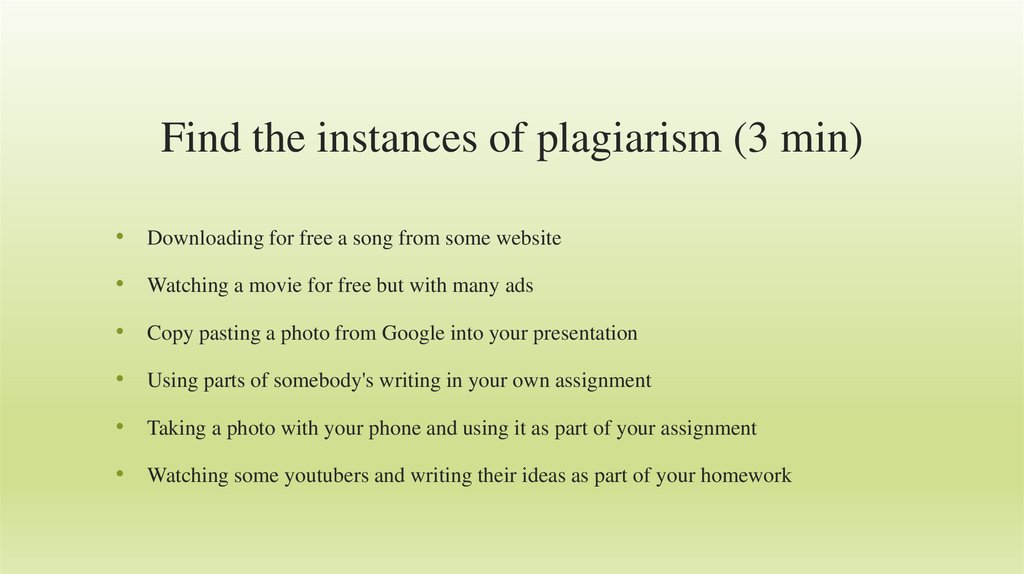
• Downloading for free a song from some website• Watching a movie for free but with many ads
• Copy pasting a photo from Google into your presentation
• Using parts of somebody's writing in your own assignment
• Taking a photo with your phone and using it as part of your assignment
• Watching some youtubers and writing their ideas as part of your homework
8. Food for thought (Be ready to discuss your ideas in the next week’s 1st lesson, 3-4 mins)
• Why is it important to follow the rules of academic integrity?• What kind of academic integrity rules does AITU have?
• How could students avoid plagiarism?
• What do you know about citing other authors’ works? Or
referencing?
9. Citation styles
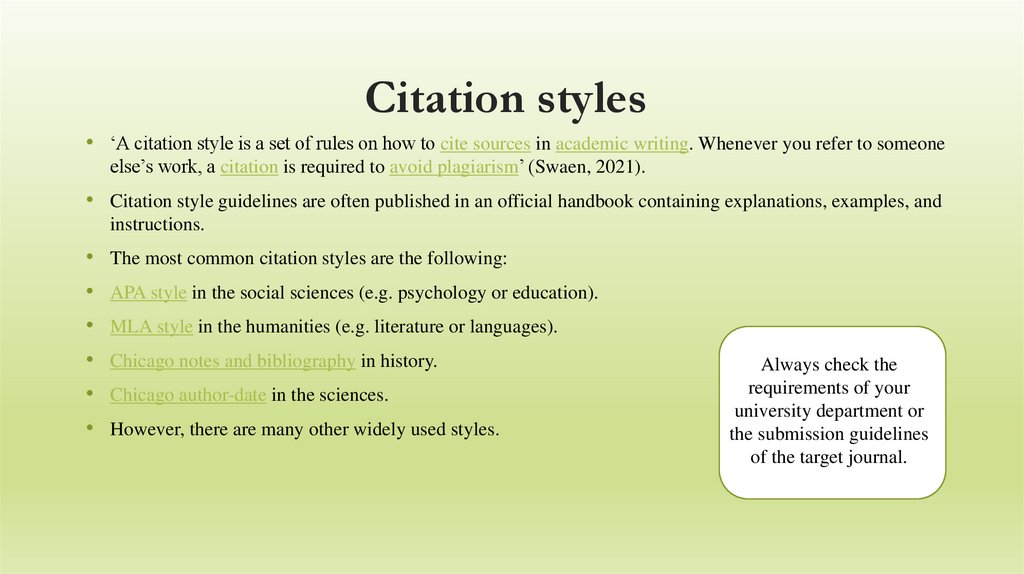
• ‘A citation style is a set of rules on how to cite sources in academic writing. Whenever you refer to someoneelse’s work, a citation is required to avoid plagiarism’ (Swaen, 2021).
• Citation style guidelines are often published in an official handbook containing explanations, examples, and
instructions.
• The most common citation styles are the following:
• APA style in the social sciences (e.g. psychology or education).
• MLA style in the humanities (e.g. literature or languages).
• Chicago notes and bibliography in history.
• Chicago author-date in the sciences.
• However, there are many other widely used styles.
Always check the
requirements of your
university department or
the submission guidelines
of the target journal.
10. What is APA?
The American Psychological Association (APA) “style provides a foundation foreffective scholarly communication because it helps authors present their ideas in a
clear, concise, and organized manner” (APA, 2019, p. xvii).
Disciplines that Use APA:
o Business
o Sciences
o Social Sciences
o Health Sciences
Source: APA style retrieved from https://twitter.com/apa_style
APA regulates:
• Document format
• Style and language
• In-text citations
• References
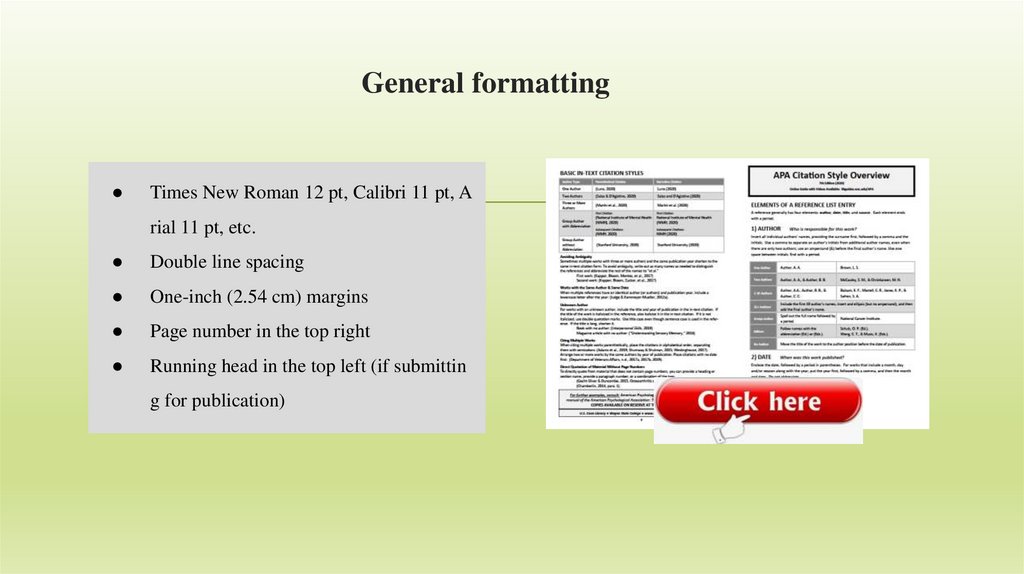
11. General formatting
Times New Roman 12 pt, Calibri 11 pt, A
rial 11 pt, etc.
Double line spacing
One-inch (2.54 cm) margins
Page number in the top right
Running head in the top left (if submittin
g for publication)
12. REFERENCES
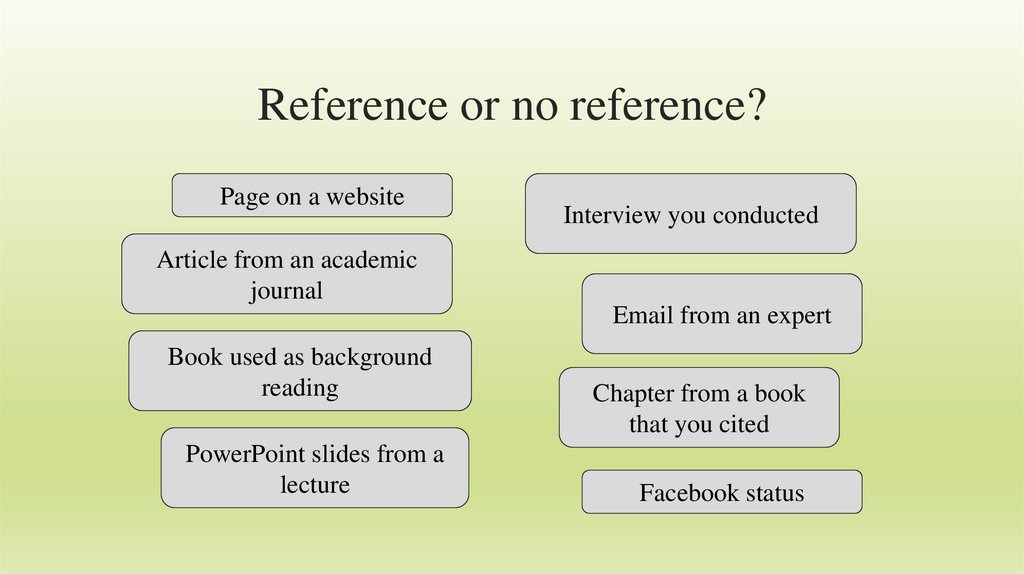
13. Reference or no reference?
Page on a websiteInterview you conducted
Article from an academic
journal
Email from an expert
Book used as background
reading
PowerPoint slides from a
lecture
Chapter from a book
that you cited
Facebook status
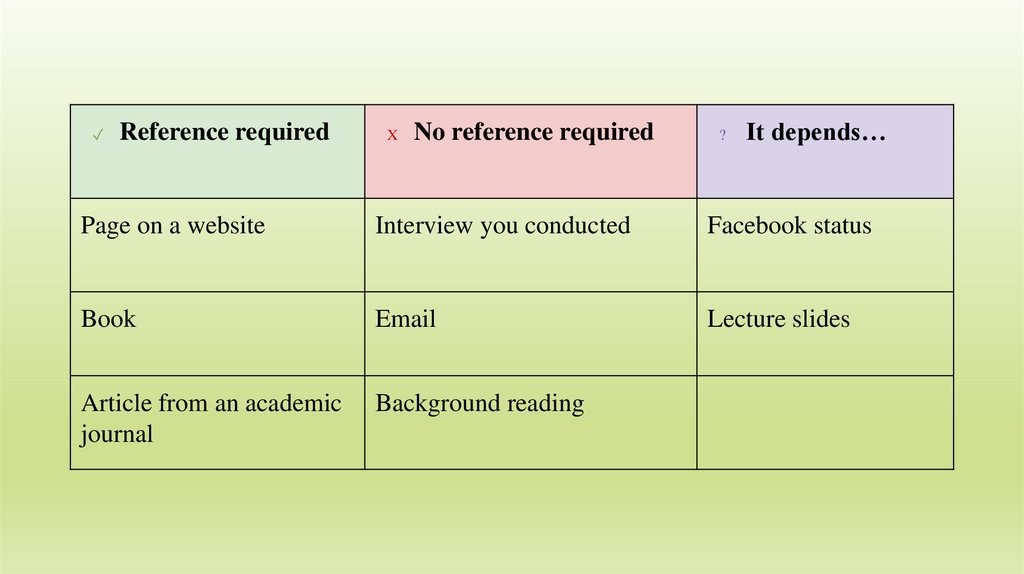
14.
✓Reference required
X
No reference required
?
It depends…
Page on a website
Interview you conducted
Facebook status
Book
Lecture slides
Article from an academic
journal
Background reading
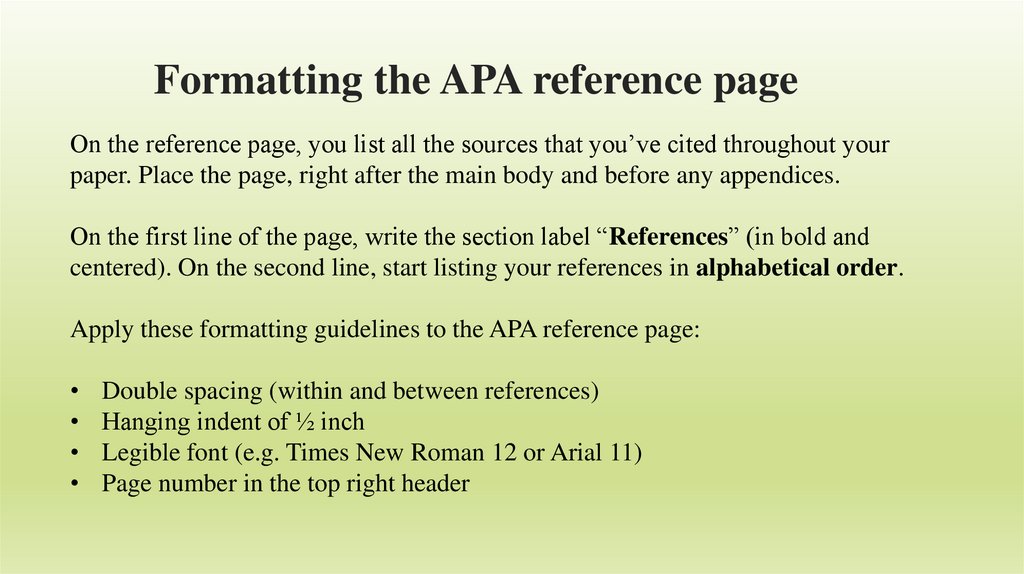
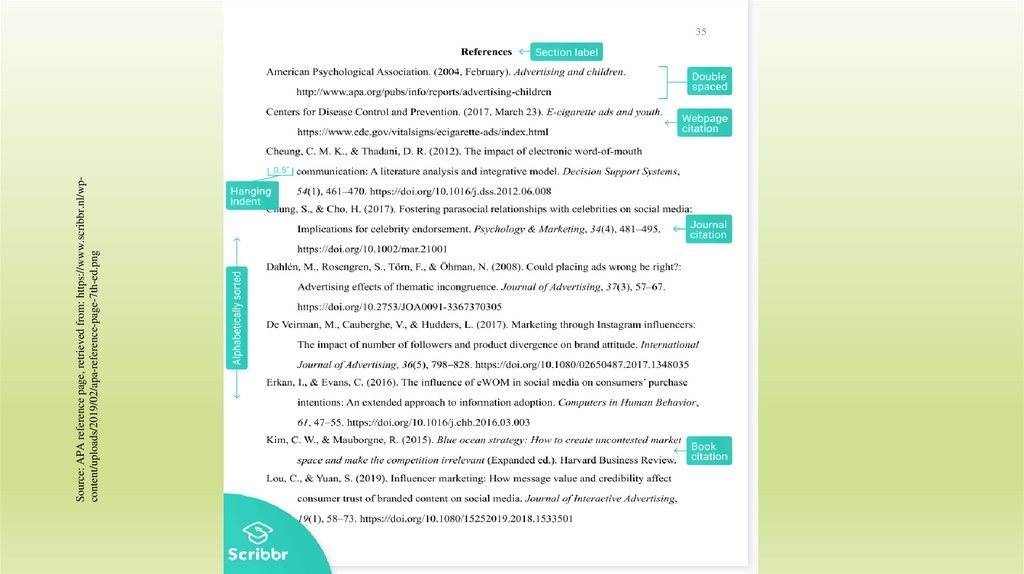
15. Formatting the APA reference page
On the reference page, you list all the sources that you’ve cited throughout yourpaper. Place the page, right after the main body and before any appendices.
On the first line of the page, write the section label “References” (in bold and
centered). On the second line, start listing your references in alphabetical order.
Apply these formatting guidelines to the APA reference page:
Double spacing (within and between references)
Hanging indent of ½ inch
Legible font (e.g. Times New Roman 12 or Arial 11)
Page number in the top right header
16.
Source: APA reference page, retrieved from: https://www.scribbr.nl/wpcontent/uploads/2019/02/apa-reference-page-7th-ed.png17. Reference elements
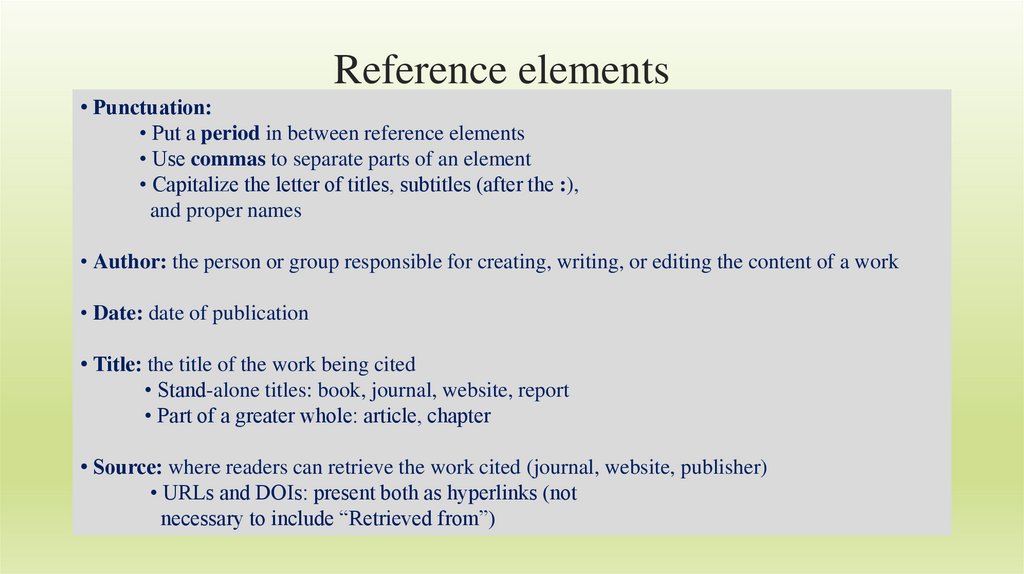
• Punctuation:• Put a period in between reference elements
• Use commas to separate parts of an element
• Capitalize the letter of titles, subtitles (after the :),
and proper names
• Author: the person or group responsible for creating, writing, or editing the content of a work
• Date: date of publication
• Title: the title of the work being cited
• Stand-alone titles: book, journal, website, report
• Part of a greater whole: article, chapter
• Source: where readers can retrieve the work cited (journal, website, publisher)
• URLs and DOIs: present both as hyperlinks (not
necessary to include “Retrieved from”)
18. IN-TEXT CITATION
19. There are two types of in-text citation:
QuotationParaphrasing
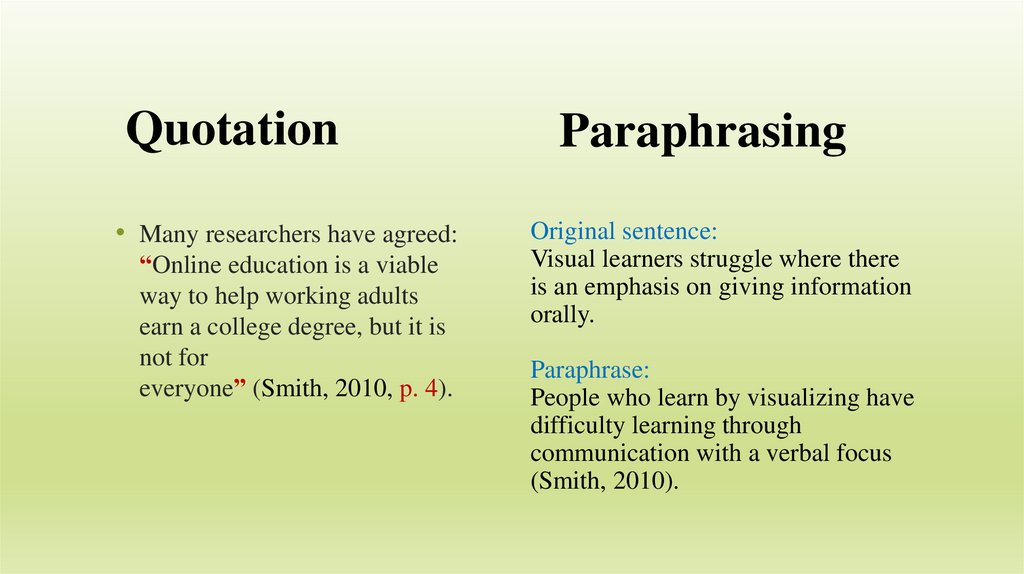
20.
Quotation• Many researchers have agreed:
“Online education is a viable
way to help working adults
earn a college degree, but it is
not for
everyone” (Smith, 2010, p. 4).
Paraphrasing
Original sentence:
Visual learners struggle where there
is an emphasis on giving information
orally.
Paraphrase:
People who learn by visualizing have
difficulty learning through
communication with a verbal focus
(Smith, 2010).
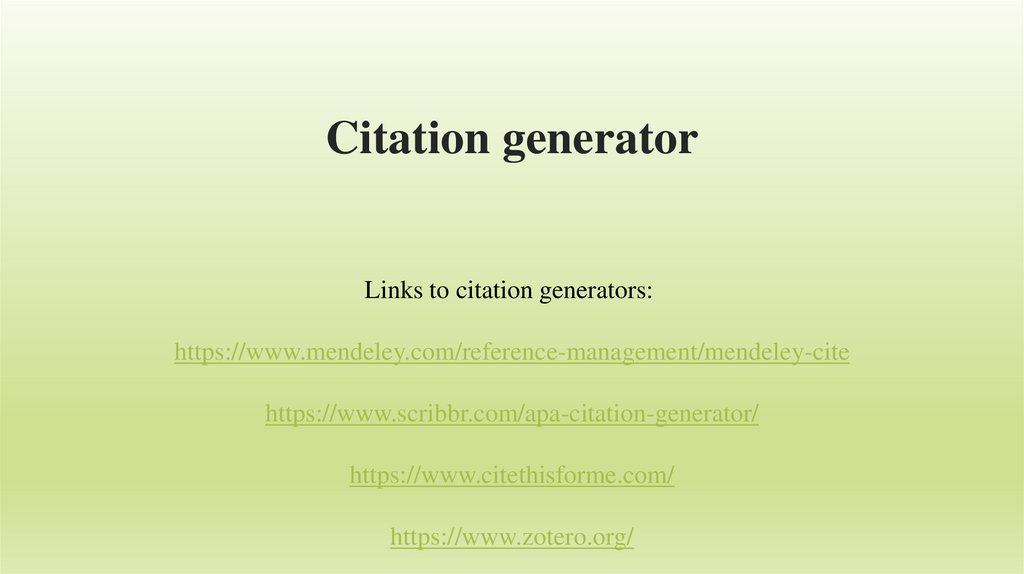
21. Citation generator
Links to citation generators:https://www.mendeley.com/reference-management/mendeley-cite
https://www.scribbr.com/apa-citation-generator/
https://www.citethisforme.com/
https://www.zotero.org/
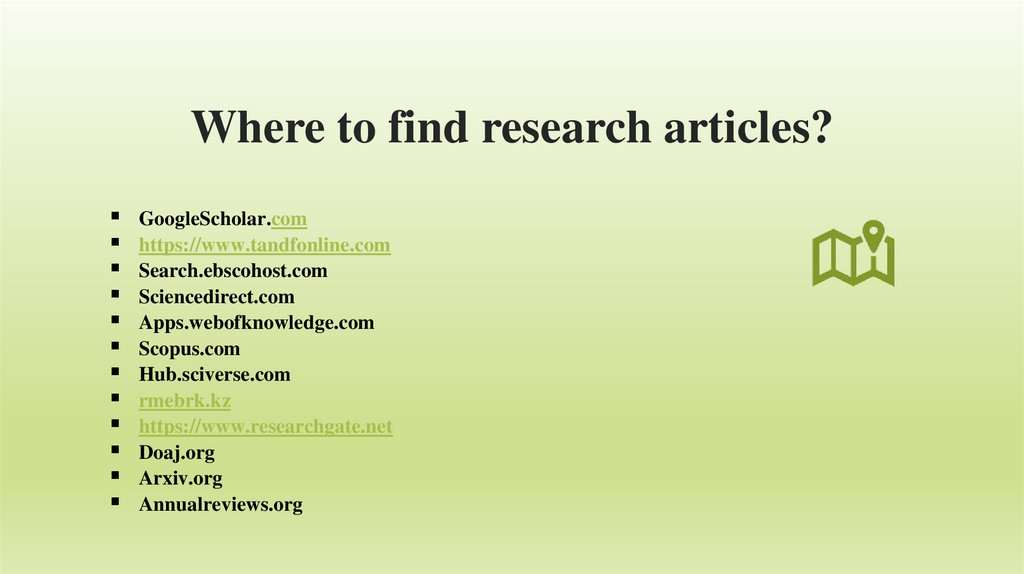
22. Where to find research articles?
GoogleScholar.comhttps://www.tandfonline.com
Search.ebscohost.com
Sciencedirect.com
Apps.webofknowledge.com
Scopus.com
Hub.sciverse.com
rmebrk.kz
https://www.researchgate.net
Doaj.org
Arxiv.org
Annualreviews.org
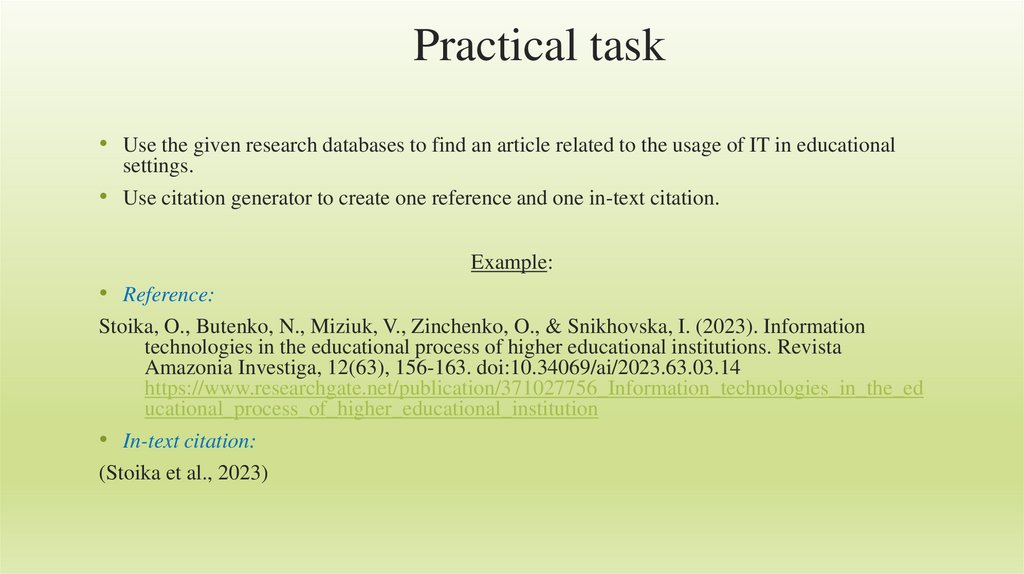
23. Practical task
• Use the given research databases to find an article related to the usage of IT in educationalsettings.
• Use citation generator to create one reference and one in-text citation.
Example:
• Reference:
Stoika, O., Butenko, N., Miziuk, V., Zinchenko, O., & Snikhovska, I. (2023). Information
technologies in the educational process of higher educational institutions. Revista
Amazonia Investiga, 12(63), 156-163. doi:10.34069/ai/2023.63.03.14
https://www.researchgate.net/publication/371027756_Information_technologies_in_the_ed
ucational_process_of_higher_educational_institution
• In-text citation:
(Stoika et al., 2023)
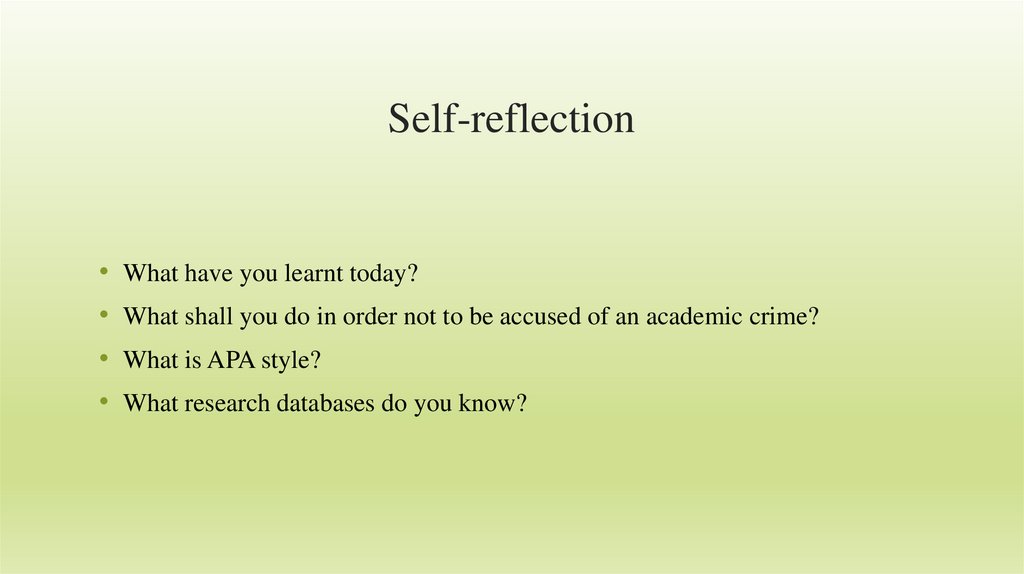
24. Self-reflection
• What have you learnt today?• What shall you do in order not to be accused of an academic crime?
• What is APA style?
• What research databases do you know?
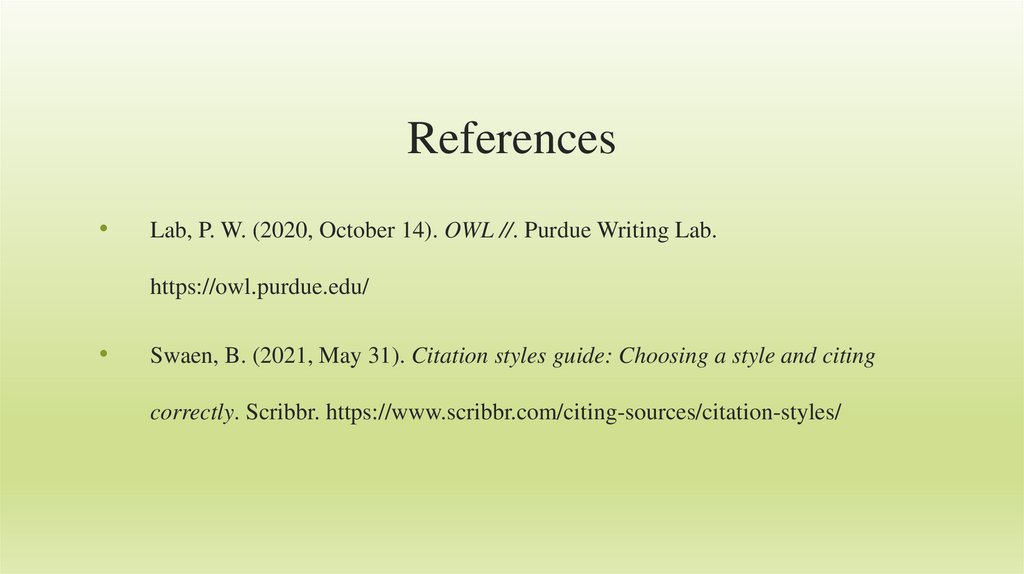
25. References
Lab, P. W. (2020, October 14). OWL //. Purdue Writing Lab.
https://owl.purdue.edu/
Swaen, B. (2021, May 31). Citation styles guide: Choosing a style and citing
correctly. Scribbr. https://www.scribbr.com/citing-sources/citation-styles/