


 Электроника
Похожие презентации:






Biometrics: applications and implications
1.
WELCOMEYOU ARE SAFE HERE Talk as much as possible!
2.
Goals of this lesson:0
1
0
2
0
3
Have fun!
Get to know each
other!
Learn new words!
3.
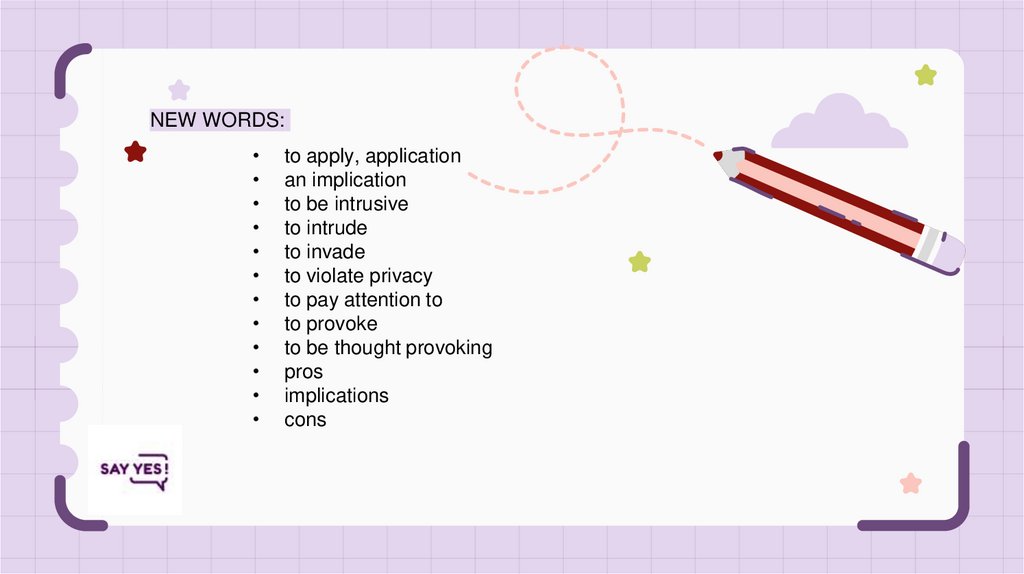
NEW WORDS:to apply, application
an implication
to be intrusive
to intrude
to invade
to violate privacy
to pay attention to
to provoke
to be thought provoking
pros
implications
cons
4.
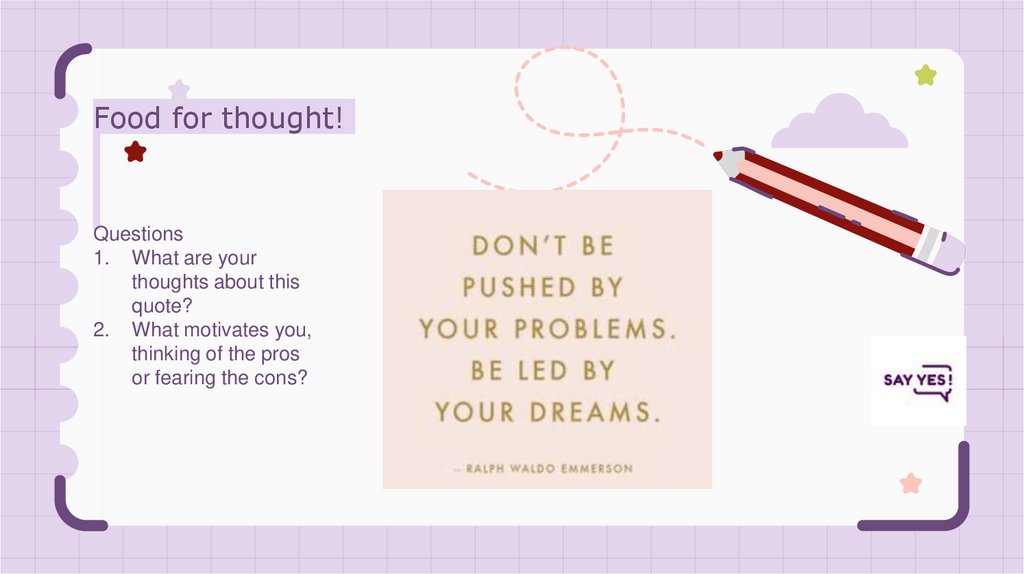
Food for thought!Questions
1. What are your
thoughts about this
quote?
2. What motivates you,
thinking of the pros
or fearing the cons?
5.
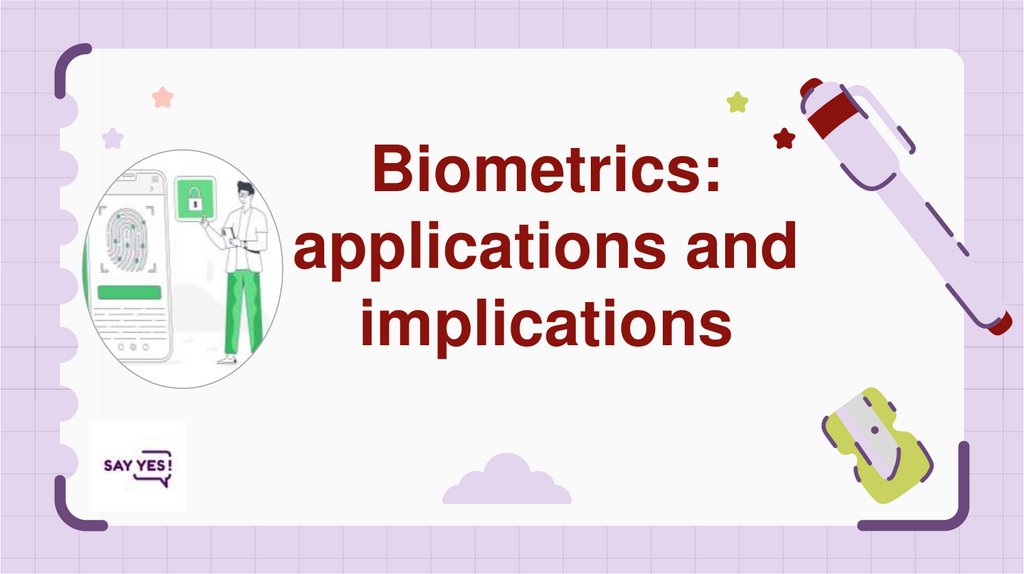
Biometrics:applications and
implications
6.
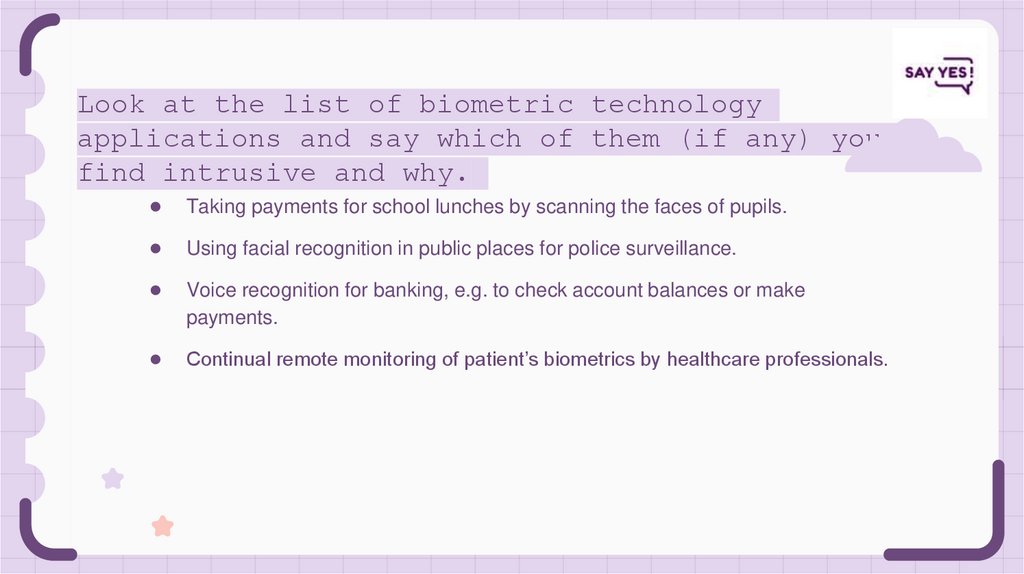
Look at the list of biometric technologyapplications and say which of them (if any) you
find intrusive and why.
Taking payments for school lunches by scanning the faces of pupils.
Using facial recognition in public places for police surveillance.
Voice recognition for banking, e.g. to check account balances or make
payments.
Continual remote monitoring of patient’s biometrics by healthcare professionals.
7.
Biometrics Text:8.
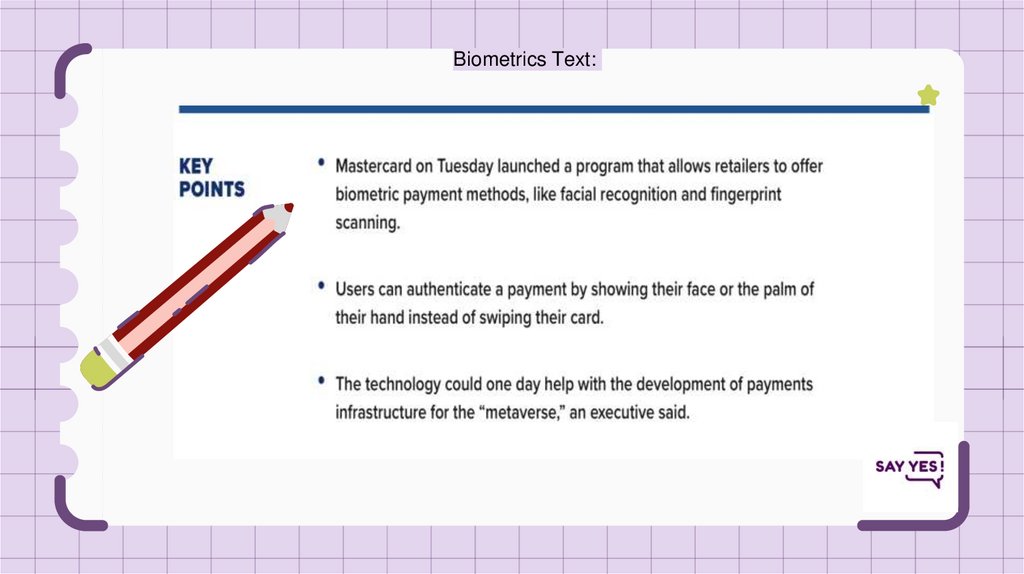
Biometrics Text:Mastercard is piloting new technology that lets shoppers make payments with just their face or hand at the checkout
point.
The company on Tuesday launched a program for retailers to offer biometric payment methods, like facial recognition
and fingerprint scanning. At checkout, users will be able to authenticate their payment by showing their face or the palm
of their hand instead of swiping their card.
The program has already gone live in five St Marche grocery stores in Sao Paulo, Brazil. Mastercard says it plans to
roll it out globally later this year.
“All the research that we’ve done has told us that consumers love biometrics,” Ajay Bhalla, Mastercard’s president of
cyber and intelligence, told CNBC.
“They want making a payment at a store to be as convenient as opening their phone.”
About 1.4 billion people are expected to use facial recognition technology to authenticate a payment by 2025, more
than doubling from 671 million in 2020, according to a forecast from Juniper Research.
9.
Biometrics Text:How does it work?
To sign up on Mastercard, you take a picture of your face or scan your fingerprint to register it
with an app. This is done either on your smartphone or at a payment terminal. You can then
add a credit card, which gets linked to your biometric data.
It’s similar to tech that’s being trialed by Amazon in the U.S.
Mastercard says it plans to bring the program to the U.S., Europe, the Middle East and Asia at
a later date.
In the long run, Mastercard’s vision is to make the tech “globally interoperable,” Bhalla said. “So
once you’ve stored your credentials, you could use this anywhere.”
The feature could integrate with loyalty schemes and make personalized recommendations
based on previous purchases,
Mastercard said.
10.
Biometrics Text:Is it safe?
The use of biometric information for payments raises a host of concerns around privacy and how
the data gets collected
For its part, Mastercard says all the data customers enter into its system is encrypted in such a
way that ensures their privacy isn’t compromised.
When you enrol, your face or fingerprint scan is replaced with a “token” — a random string of
alphanumeric characters — and then linked to your payment card.
Mastercard said it has created a set of standards to ensure users’ data is protected. The
company is working with several other firms to launch the feature, including Fujitsu, NEC,
Payface, Aurus, PaybyFace and PopID.
11.
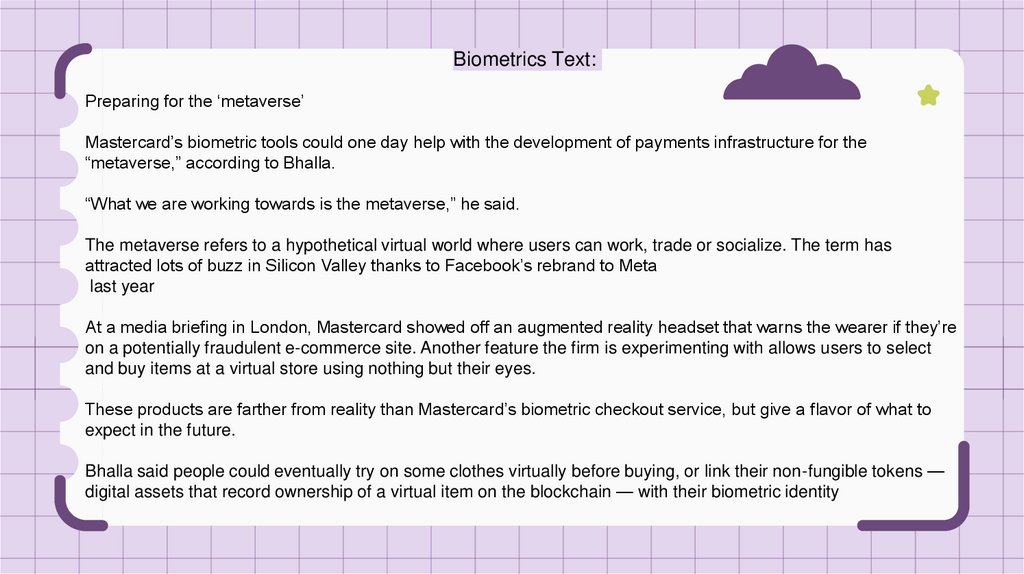
Biometrics Text:Preparing for the ‘metaverse’
Mastercard’s biometric tools could one day help with the development of payments infrastructure for the
“metaverse,” according to Bhalla.
“What we are working towards is the metaverse,” he said.
The metaverse refers to a hypothetical virtual world where users can work, trade or socialize. The term has
attracted lots of buzz in Silicon Valley thanks to Facebook’s rebrand to Meta
last year
At a media briefing in London, Mastercard showed off an augmented reality headset that warns the wearer if they’re
on a potentially fraudulent e-commerce site. Another feature the firm is experimenting with allows users to select
and buy items at a virtual store using nothing but their eyes.
These products are farther from reality than Mastercard’s biometric checkout service, but give a flavor of what to
expect in the future.
Bhalla said people could eventually try on some clothes virtually before buying, or link their non-fungible tokens —
digital assets that record ownership of a virtual item on the blockchain — with their biometric identity
12.
Biometrics Questions:What kind of technology is the article about and what does it allow
Mastercard users to do?
Mastercard says you can pay “with a smile or a wave”. Would you like
to be able to authenticate your payments this way?
What identity, privacy and security concerns with regard to using
biometric technology might there be?
13.
HOMEWORK:DO YOUR BEST!
MIN:
Read through slides 7-11 & answer questions on slide 12
MAX:
Learn the new words and create examples of sentences with them!
14.
REFLECTION:01
02
03
How do you feel?
Is there anything that I
can do to make our
lessons better?
What was the best part
of our lesson for you?
Are you comfortable?
15.
Thank you!You are amazing!