




 Литература
Похожие презентации:









A Rose for Emily
1. “A Rose for emily”
“A ROSE FORE M I LY ”
WLL 110
2. EXPECTATIONS!
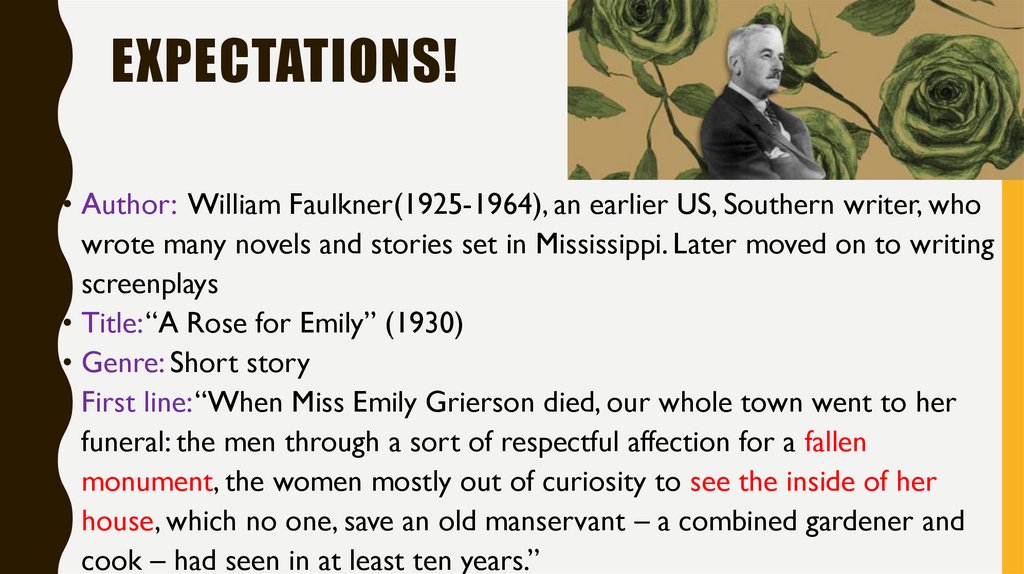
• Author: William Faulkner(1925-1964), an earlier US, Southern writer, whowrote many novels and stories set in Mississippi. Later moved on to writing
screenplays
• Title: “A Rose for Emily” (1930)
• Genre: Short story
• First line: “When Miss Emily Grierson died, our whole town went to her
funeral: the men through a sort of respectful affection for a fallen
monument, the women mostly out of curiosity to see the inside of her
house, which no one, save an old manservant – a combined gardener and
cook – had seen in at least ten years.”
3. Geographical Setting
GEOGRAPHICAL SETTING• Jefferson, Mississippi (fictional town)
• Inspired by actual Southern towns– engages with Southern traditions, racial tensions, and
changes in society that followed the Civil War
4. Temporal setting
TEMPORAL SETTING• Despite being a ‘short’ story the story spans various decades, covering a period from
sometime immediately after Civil War to the early 20th century
• The story is narrated mainly as flashbacks, capturing moments in Emily’s life
5. Physical Setting
PHYSICAL SETTING• Emily’s house is at the center of the story
• It used to be beautiful and impressive now it is falling apart
• The neighborhood used to be prestigious but is now surrounded by signs of industrialization
and modern buildings
• Represents decline of old Southern aristocracy
“It was a big, squarish frame house that had once been white, decorated with cupolas and spires
and scrolled balconies in the heavily lightsome style of the seventies”
6. Social Setting
SOCIAL SETTING• Traditional Southern society divided by class, gender, and race
• Community plays an important role in story– neighbors judge and observe Emily
• Clash between old traditions and changing world
“But garages and cotton gins had encroached and obliterated even the august names of that neighborhood; only
Miss Emily’s house was left, lifting its stubborn and coquettish decay above the cotton wagons and the gasoline
pumps”
“Alive, Miss Emily had been a tradition, a duty, and a care; a sort of hereditary obligation upon the town…”
7.
It was a big, squarish frame house that had once been white,decorated with cupolas and spires and scrolled balconies in the
heavily lightsome style of the seventies, set on what had once
been our most select street. But garages and cotton gins had
encroached and obliterated even the august names of that
neighborhood; only Miss Emily’s house was left, lifting its
stubborn and coquettish decay above the cotton wagons and
the gasoline pumps— an eyesore among eyesores. And now
Miss Emily had gone to join the representatives of those
august names where they lay in the cedar- bemused cemetery
among the ranked and anonymous graves of Union and
Confederate soldiers who fell at the battle of Jefferson.
8. Elements of Fiction
ELEMENTS OF FICTION1.Plot – what happens?
2.How is it narrated?
3.Who are the characters?
4.What is the setting?
5.Style – HOW is it written?
6.Theme – What does it MEAN?
9. Questions
QUESTIONS1. What can we say about the narrator? Is (s)he like the other
townspeople?
2. What are important/repeating details?
3. Why is their all this detail about taxes? What’s the point?
4. Why is there so much detail about her house?
5. How is Miss Emily described and why is this important
6. What is our first hint about the body?
7. What are other instances of foreshadowing?
8. What do we know about her relations with Homer Barron?
9. What is the meaning of the iron-gray hair on the pillow at the
end?