
 Образование
Похожие презентации:







Data Analyst Course in Kerala Fees and Career Opportunities
1.
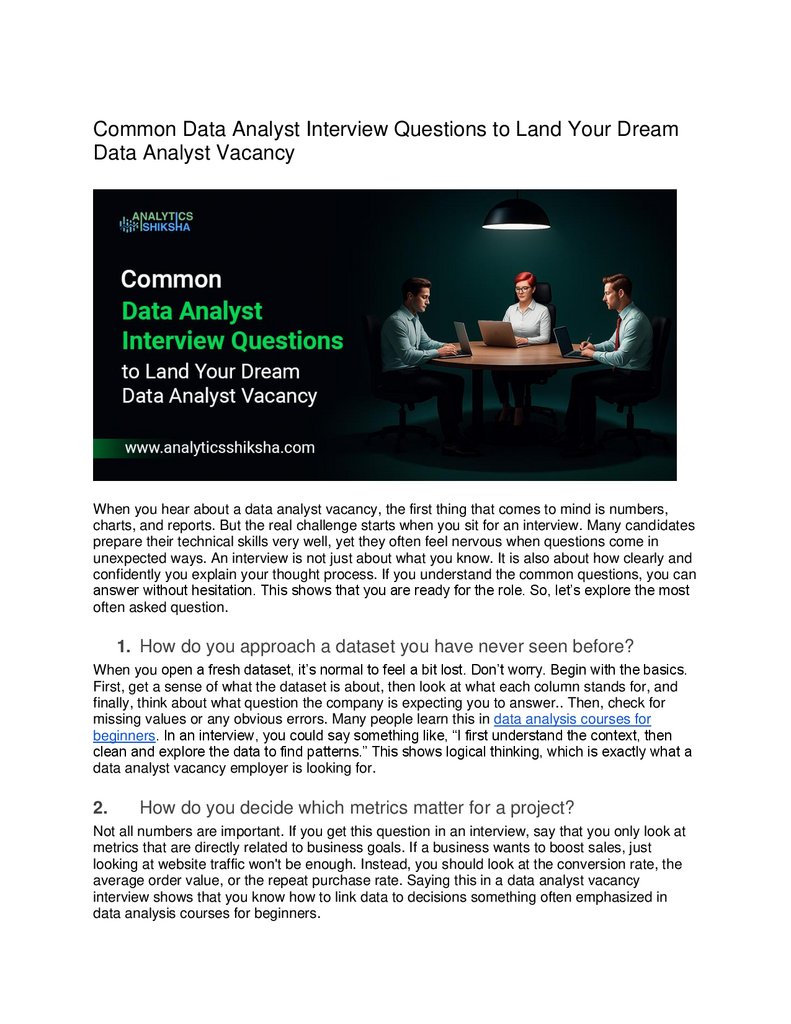
Common Data Analyst Interview Questions to Land Your DreamData Analyst Vacancy
When you hear about a data analyst vacancy, the first thing that comes to mind is numbers,
charts, and reports. But the real challenge starts when you sit for an interview. Many candidates
prepare their technical skills very well, yet they often feel nervous when questions come in
unexpected ways. An interview is not just about what you know. It is also about how clearly and
confidently you explain your thought process. If you understand the common questions, you can
answer without hesitation. This shows that you are ready for the role. So, let’s explore the most
often asked question.
1. How do you approach a dataset you have never seen before?
When you open a fresh dataset, it’s normal to feel a bit lost. Don’t worry. Begin with the basics.
First, get a sense of what the dataset is about, then look at what each column stands for, and
finally, think about what question the company is expecting you to answer.. Then, check for
missing values or any obvious errors. Many people learn this in data analysis courses for
beginners. In an interview, you could say something like, “I first understand the context, then
clean and explore the data to find patterns.” This shows logical thinking, which is exactly what a
data analyst vacancy employer is looking for.
2.
How do you decide which metrics matter for a project?
Not all numbers are important. If you get this question in an interview, say that you only look at
metrics that are directly related to business goals. If a business wants to boost sales, just
looking at website traffic won't be enough. Instead, you should look at the conversion rate, the
average order value, or the repeat purchase rate. Saying this in a data analyst vacancy
interview shows that you know how to link data to decisions something often emphasized in
data analysis courses for beginners.
2.
3.Can you explain a time you solved a problem using data?
Interviewers love real examples. If you don’t have work experience, use practice projects from
your data analysis courses for beginners. For instance, “I analyzed sample sales data and found
that most customers abandoned their cart at the payment page. By presenting insights and
possible solutions in my project report, I learned how data can guide decisions.” This shows you
can handle real-world situations, which is exactly what they look for in a data analyst vacancy.
4.
How do you validate your findings?
Validation is key in data analysis. You can say that you always cross-check results using
multiple methods or tools. For example, if a calculation shows a trend, you might double-check it
using pivot tables, Python scripts, or SQL queries. Interviewers want to see that you care about
accuracy. This is a skill that many data analysis courses for beginners emphasize because
errors can cost businesses a lot. Highlighting this will make you stand out for a data analyst
vacancy.
5.
How do you handle tight deadlines?
Data analysts frequently face pressure to deliver results fast. So the good answer is to prioritize
tasks based on importance and impact. For example, if a dashboard needs to go live, focus first
on data cleaning and key metrics, then refine visuals later. You can mention that data analysis
courses for beginners teach you to work efficiently on small projects first, which builds
confidence in handling deadlines. Interviewers for a data analyst vacancy love candidates who
can stay calm even in a hectic situation.
6.
What steps do you take to clean messy data?
Messy data is everywhere. Explain that you start by identifying missing or duplicate entries,
correcting inconsistencies, and sometimes transforming values to a common format. Many data
analysis courses for beginners provide hands-on exercises for this. You could say in a data
analyst vacancy interview, “I always spend sufficient time cleaning and organizing data because
accurate insights depend on it.” This simple answer shows you understand a fundamental part
of the job.
7.
How do you choose visualization techniques for your findings?
Data is only useful if others can understand it. When asked, talk about matching visuals to the
story. Bar charts are good for comparisons, line charts for trends, pie charts for proportions.
Many candidates forget to mention this. Sharing that you practiced these techniques in data
analysis courses for beginners shows that you know how to communicate insights clearly, a key
requirement in a data analyst vacancy.
8.
How would you explain technical results to a non-technical audience?
This is about storytelling. You can explain that you focus on simplicity: avoid jargon, use visuals,
and tell the “why” behind the numbers. For example, instead of showing a regression equation,
show how one factor affects sales in simple terms. This is something often taught in advanced
data analysis courses for beginners. Interviewers for a data analyst vacancy value candidates
who can make data accessible to everyone.
3.
9.How do you deal with conflicting data from different sources?
In real life, data often conflict. The interview answer could be: check which source is more
reliable, compare datasets, and document assumptions. This shows analytical thinking. Many
data analysis courses for beginners include exercises on merging multiple sources, preparing
you for real data analyst vacancy challenges.
10.
How do you keep up with new tools and trends?
The field of data keeps evolving. A good answer is to mention the following blogs, joining online
forums, or taking short courses. Saying, “I regularly update myself through data analysis
courses for beginners and online communities,” shows initiative. Employers posting a data
analyst vacancy love candidates who are self-motivated learners.
11. What would you do if your analysis contradicts the manager’s
opinion?
Be honest and tactful. You can explain, “I would first double-check my analysis, then present the
results clearly with supporting evidence. The goal is to show data, not personal opinion.” This
answer shows maturity and professionalism, something highly valued in any data analyst
vacancy interview.
12.
How do you handle repetitive tasks or boring datasets?
It’s human to get bored sometimes. A smart answer is to automate repetitive tasks using scripts
in Python, SQL, or Excel macros. This shows efficiency and problem-solving skills. Mentioning
that you learned such techniques in data analysis courses for beginners will make the
interviewer confident in your ability to handle real data analyst vacancy responsibilities.
13. Can you describe a project where you had to learn a new tool
quickly?
Interviews often test adaptability. Share a story from your learning experience. For example: “In
my data analysis courses for beginners, I hadn’t used Tableau before. I quickly learned it to
visualize project data, and it helped me build a functional dashboard.” This demonstrates that
you are proactive — exactly what hiring managers want in a data analyst vacancy candidate.
14.
How do you ensure your analysis impacts business decisions?
Always link your work to business goals. Mention that you focus on actionable insights, not just
numbers. For example, “I highlight trends and patterns that suggest clear next steps for the
business.” Many data analysis courses for beginners stress this, as interviews for a data analyst
vacancy often test if you can translate analysis into real value.
Conclusion
Getting a data analyst vacancy is not just about knowing tools; it is about solving problems with
data and showing results clearly. Here, Analytics Shiksha's analysis courses for beginners can
help you gain these skills, practice on projects, and build confidence. They also prepare you for
mock interviews so you can handle questions calmly. With practice and guidance, you can
4.
stand out and succeed in any data analyst vacancy. Join Analytics Shiksha today and get readyto crack your dream data analyst vacancy.