
 Программное обеспечение
Похожие презентации:









Functional Requirements Specification (FRS) Best Practices in Mumbai
1.
Functional Requirements Specification (FRS) Best Practices inMumbai
In Mumbai's fast-paced business and technology landscape, clear system documentation is no
longer optional—it's a necessity. Whether developing healthcare software, financial systems, or
smart city solutions like Mumbai's traffic management system, a well-structured Functional
Requirements Specification (FRS) serves as the foundation for successful project execution.
If you're a professional wanting to hone your essential documentation skills, a business analyst
course in Mumbai is a fantastic opportunity. It offers thorough training to help you craft
effective FRS documents that seamlessly connect business requirements with technical
solutions.
Why FRS Matters in Mumbai's Growing Tech Ecosystem
The Cost of Poor Requirements
Consider Mumbai's intelligent traffic management system that processes real-time data from
thousands of sensors. Without precise FRS documentation:
Developers might misinterpret how congestion algorithms should work
Traffic controllers could receive incomplete dashboard functionalities
System integrations might fail during peak hours
This scenario applies equally to healthcare, banking, or e-commerce systems where unclear
requirements lead to costly rework and operational failures.
Benefits of a Well-Structured FRS
1. Precision in Critical Systems
o
For hospitals, precise FRS ensures accurate patient data management
o
In banking, it guarantees secure transaction processing
2. Stakeholder Alignment
o
Creates shared understanding between business teams and developers
3. Regulatory Compliance
o
Essential for healthcare (HIPAA) and financial (RBI) sectors
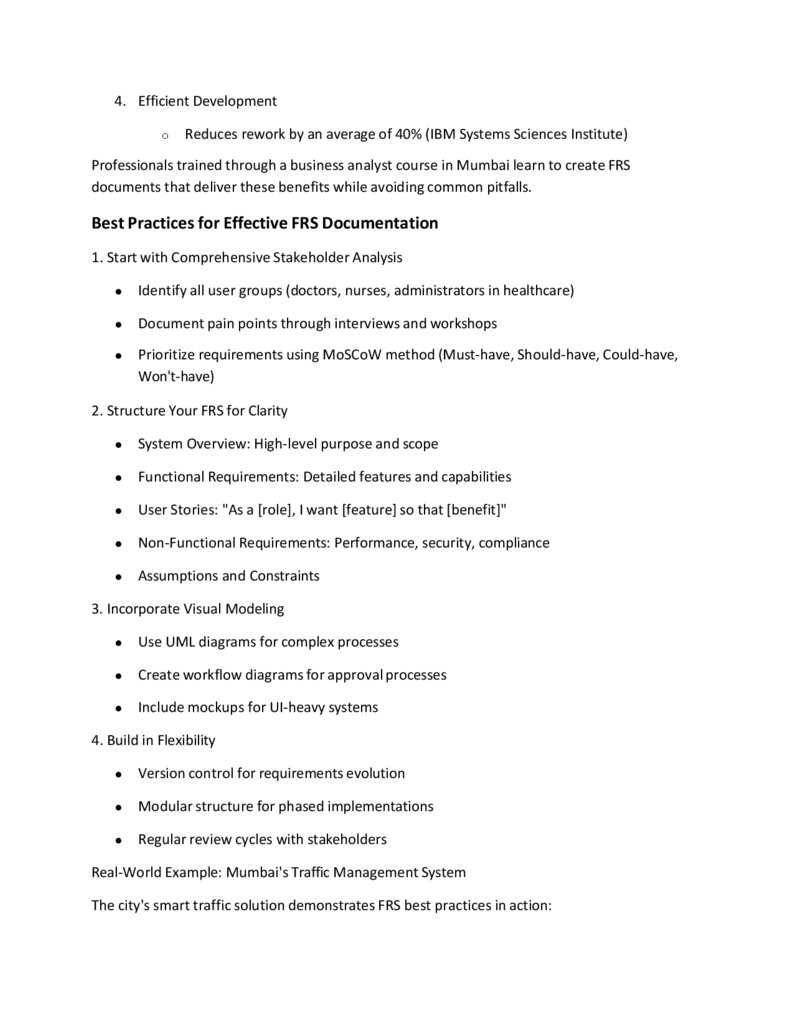
2.
4. Efficient Developmento
Reduces rework by an average of 40% (IBM Systems Sciences Institute)
Professionals trained through a business analyst course in Mumbai learn to create FRS
documents that deliver these benefits while avoiding common pitfalls.
Best Practices for Effective FRS Documentation
1. Start with Comprehensive Stakeholder Analysis
Identify all user groups (doctors, nurses, administrators in healthcare)
Document pain points through interviews and workshops
Prioritize requirements using MoSCoW method (Must-have, Should-have, Could-have,
Won't-have)
2. Structure Your FRS for Clarity
System Overview: High-level purpose and scope
Functional Requirements: Detailed features and capabilities
User Stories: "As a [role], I want [feature] so that [benefit]"
Non-Functional Requirements: Performance, security, compliance
Assumptions and Constraints
3. Incorporate Visual Modeling
Use UML diagrams for complex processes
Create workflow diagrams for approval processes
Include mockups for UI-heavy systems
4. Build in Flexibility
Version control for requirements evolution
Modular structure for phased implementations
Regular review cycles with stakeholders
Real-World Example: Mumbai's Traffic Management System
The city's smart traffic solution demonstrates FRS best practices in action:
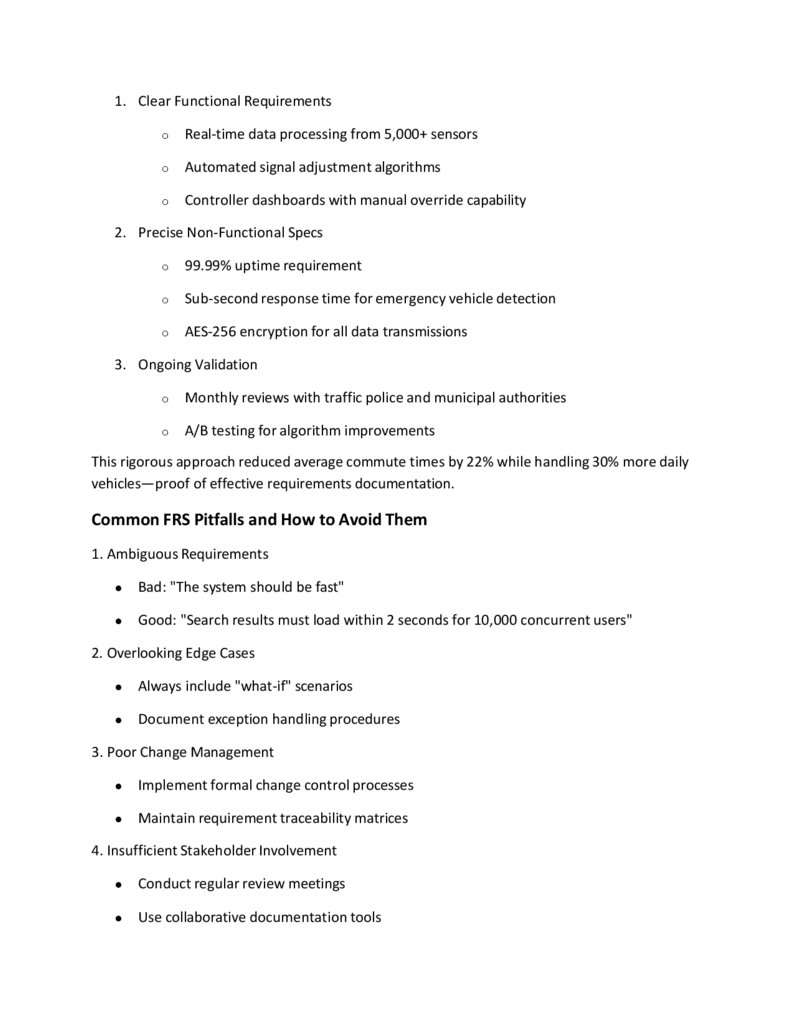
3.
1. Clear Functional Requirementso
Real-time data processing from 5,000+ sensors
o
Automated signal adjustment algorithms
o
Controller dashboards with manual override capability
2. Precise Non-Functional Specs
o
99.99% uptime requirement
o
Sub-second response time for emergency vehicle detection
o
AES-256 encryption for all data transmissions
3. Ongoing Validation
o
Monthly reviews with traffic police and municipal authorities
o
A/B testing for algorithm improvements
This rigorous approach reduced average commute times by 22% while handling 30% more daily
vehicles—proof of effective requirements documentation.
Common FRS Pitfalls and How to Avoid Them
1. Ambiguous Requirements
Bad: "The system should be fast"
Good: "Search results must load within 2 seconds for 10,000 concurrent users"
2. Overlooking Edge Cases
Always include "what-if" scenarios
Document exception handling procedures
3. Poor Change Management
Implement formal change control processes
Maintain requirement traceability matrices
4. Insufficient Stakeholder Involvement
Conduct regular review meetings
Use collaborative documentation tools
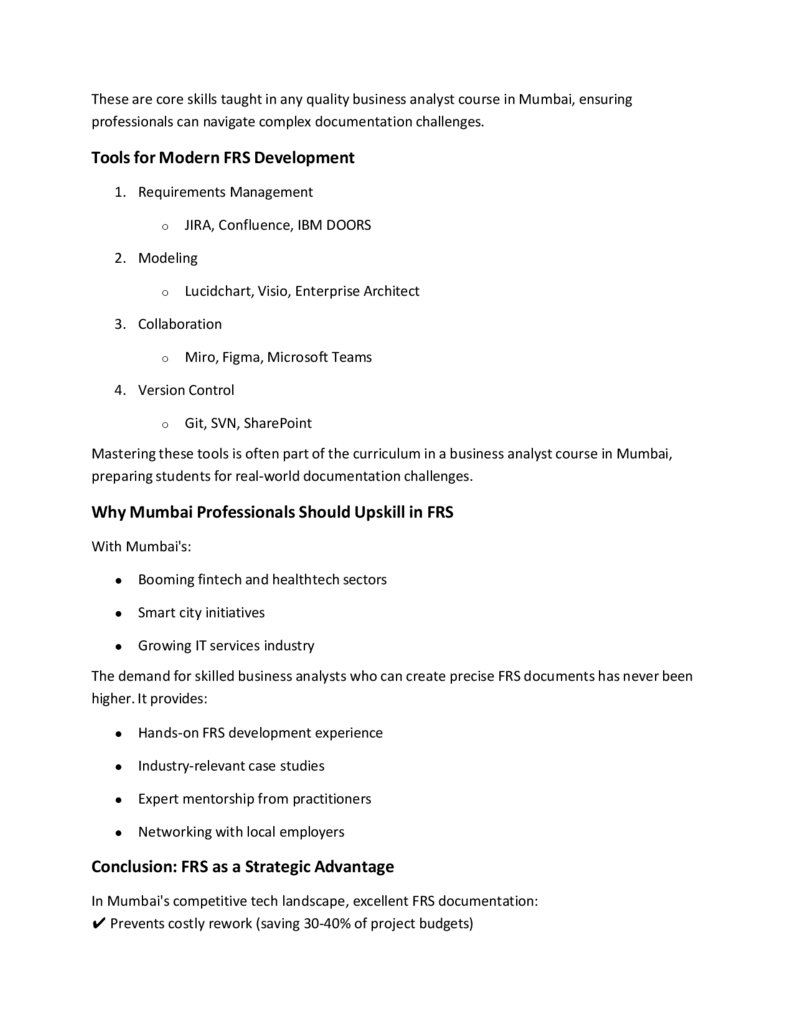
4.
These are core skills taught in any quality business analyst course in Mumbai, ensuringprofessionals can navigate complex documentation challenges.
Tools for Modern FRS Development
1. Requirements Management
o
JIRA, Confluence, IBM DOORS
2. Modeling
o
Lucidchart, Visio, Enterprise Architect
3. Collaboration
o
Miro, Figma, Microsoft Teams
4. Version Control
o
Git, SVN, SharePoint
Mastering these tools is often part of the curriculum in a business analyst course in Mumbai,
preparing students for real-world documentation challenges.
Why Mumbai Professionals Should Upskill in FRS
With Mumbai's:
Booming fintech and healthtech sectors
Smart city initiatives
Growing IT services industry
The demand for skilled business analysts who can create precise FRS documents has never been
higher. It provides:
Hands-on FRS development experience
Industry-relevant case studies
Expert mentorship from practitioners
Networking with local employers
Conclusion: FRS as a Strategic Advantage
In Mumbai's competitive tech landscape, excellent FRS documentation:
✔ Prevents costly rework (saving 30-40% of project budgets)
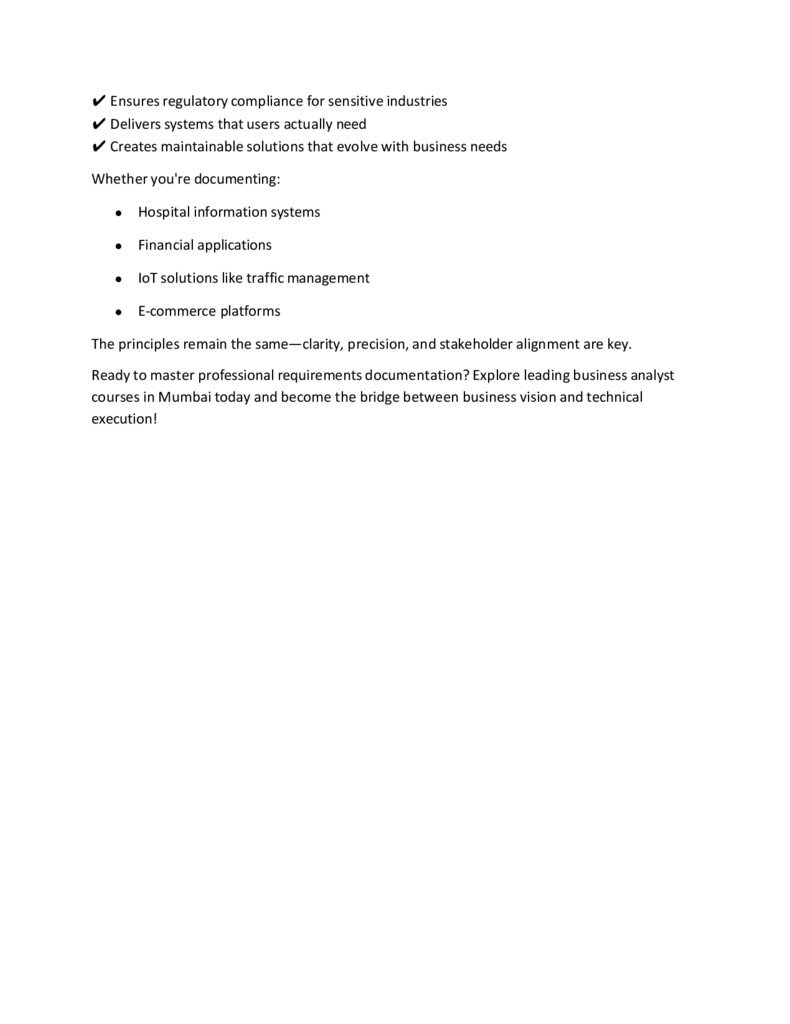
5.
✔ Ensures regulatory compliance for sensitive industries✔ Delivers systems that users actually need
✔ Creates maintainable solutions that evolve with business needs
Whether you're documenting:
Hospital information systems
Financial applications
IoT solutions like traffic management
E-commerce platforms
The principles remain the same—clarity, precision, and stakeholder alignment are key.
Ready to master professional requirements documentation? Explore leading business analyst
courses in Mumbai today and become the bridge between business vision and technical
execution!