 Экономика
Похожие презентации:



Introduction to tourism economics and sustainability Introductory concepts
1.
Introduction to tourism economicsand sustainability
Introductory concepts
2.
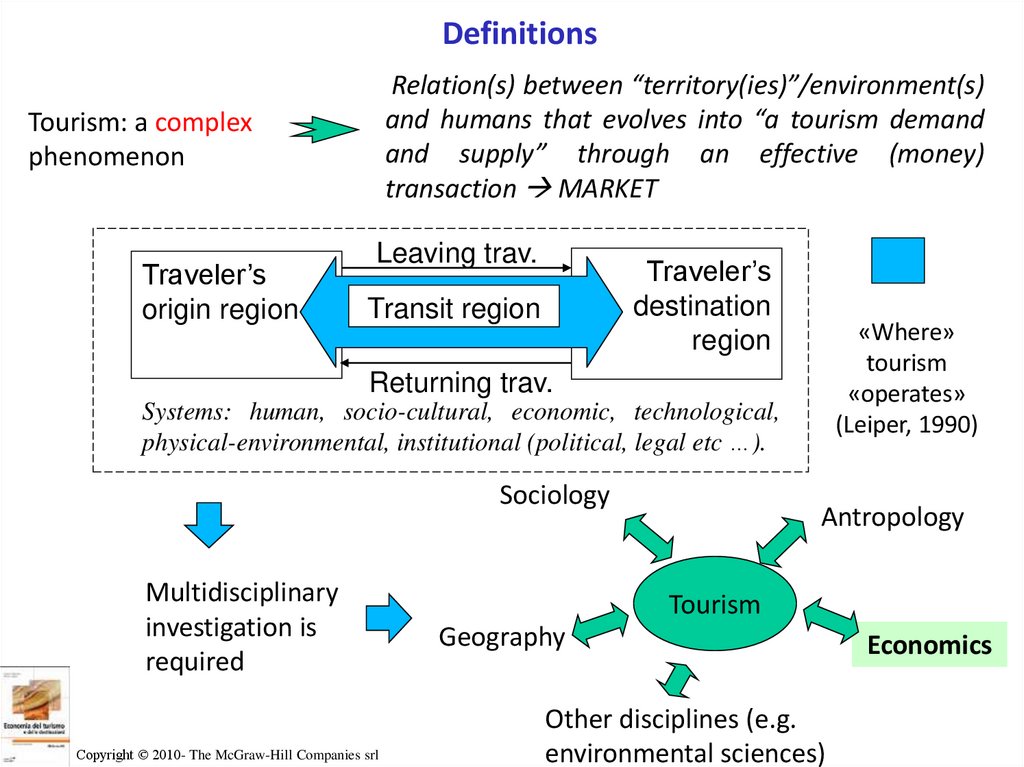
DefinitionsRelation(s) between “territory(ies)”/environment(s)
and humans that evolves into “a tourism demand
and supply” through an effective (money)
transaction MARKET
Tourism: a complex
phenomenon
Traveler’s
origin region
Leaving trav.
Traveler’s
destination
region
Transit region
«Where»
tourism
«operates»
(Leiper, 1990)
Returning trav.
Systems: human, socio-cultural, economic, technological,
physical-environmental, institutional (political, legal etc …).
Sociology
Multidisciplinary
investigation is
required
Copyright © 2010- The McGraw-Hill Companies srl
Antropology
Tourism
Geography
Other disciplines (e.g.
environmental sciences)
Economics
3.
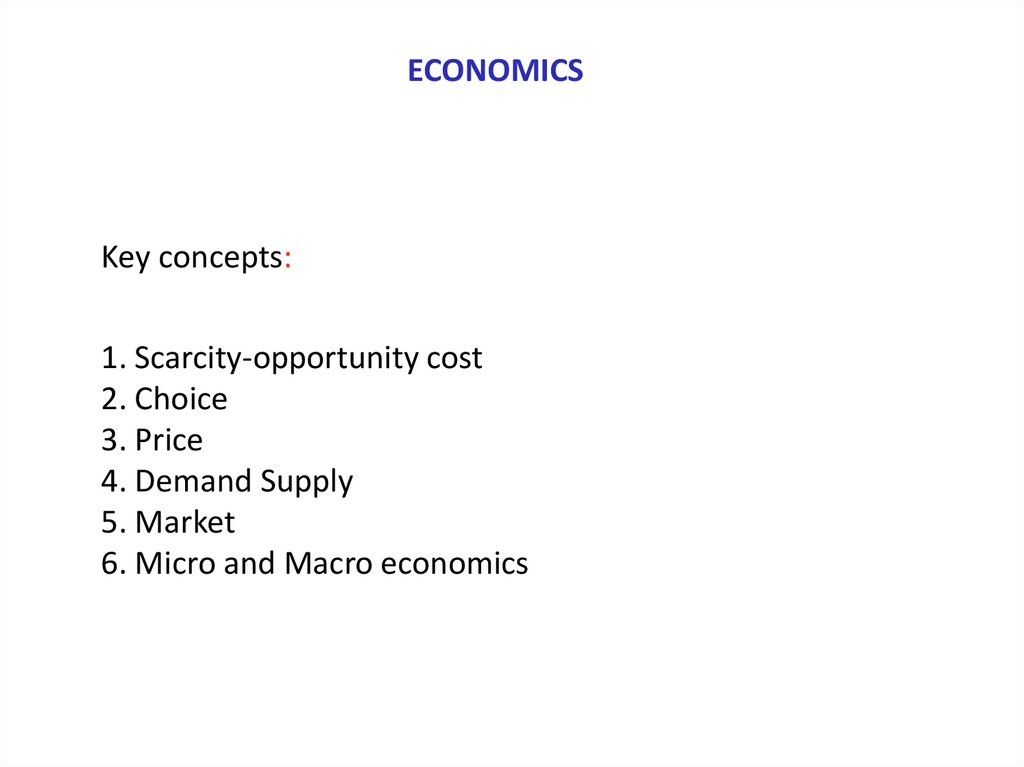
ECONOMICSKey concepts:
1. Scarcity-opportunity cost
2. Choice
3. Price
4. Demand Supply
5. Market
6. Micro and Macro economics
4.
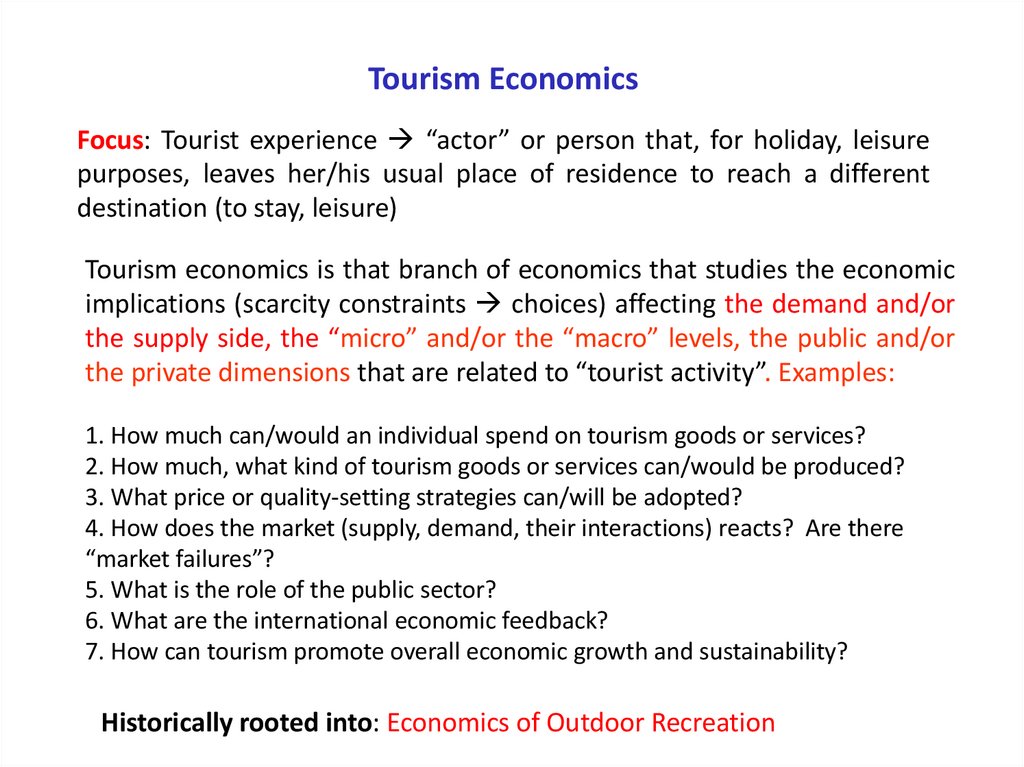
Tourism EconomicsFocus: Tourist experience “actor” or person that, for holiday, leisure
purposes, leaves her/his usual place of residence to reach a different
destination (to stay, leisure)
Tourism economics is that branch of economics that studies the economic
implications (scarcity constraints choices) affecting the demand and/or
the supply side, the “micro” and/or the “macro” levels, the public and/or
the private dimensions that are related to “tourist activity”. Examples:
1. How much can/would an individual spend on tourism goods or services?
2. How much, what kind of tourism goods or services can/would be produced?
3. What price or quality-setting strategies can/will be adopted?
4. How does the market (supply, demand, their interactions) reacts? Are there
“market failures”?
5. What is the role of the public sector?
6. What are the international economic feedback?
7. How can tourism promote overall economic growth and sustainability?
Historically rooted into: Economics of Outdoor Recreation
5.
Who’s the Tourist?Many definitions are available:
“The person that spends at least 24h in a country different from
that of usual residence” League of Nations (1937)
“Traveller for more than 5 days 4 nights away from home for
recreational motivation” Italian Statistical Office
“Traveller in a country different from that of residence for
whatever purpose different from payed work” International
Union of Official Travel Organization (1968)
6.
What is Tourism?i. Burkart and Medlik (1974): “Tourism are the relationships and
phenomena linked to the stay of foreigners in a place where they
did not play a relevant permanent or temporary paid activity”
ii. Jafari (1977): “Tourism is the study of man away from his usual
habitat, of the industry satisfying his needs and of the impacts that
both produce on the social-cultural-economic and physic
environment of the hosting communities”
iii. British Tourism Society (1979): “Tourism includes all the
activities related to the temporary short-term displacement of
people towards destinations outside the place where they usually
live and work and all the activities conducted during the period of
stay in these destinations”
7.
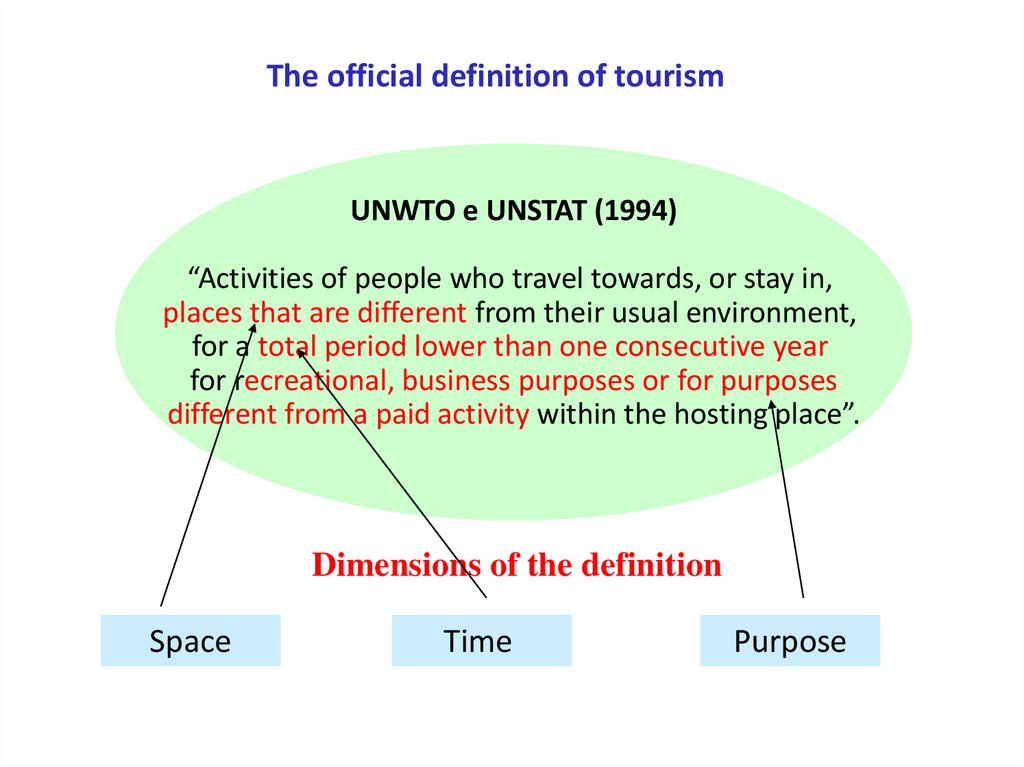
The official definition of tourismUNWTO e UNSTAT (1994)
“Activities of people who travel towards, or stay in,
places that are different from their usual environment,
for a total period lower than one consecutive year
for recreational, business purposes or for purposes
different from a paid activity within the hosting place”.
Dimensions of the definition
Space
Time
Purpose
8.
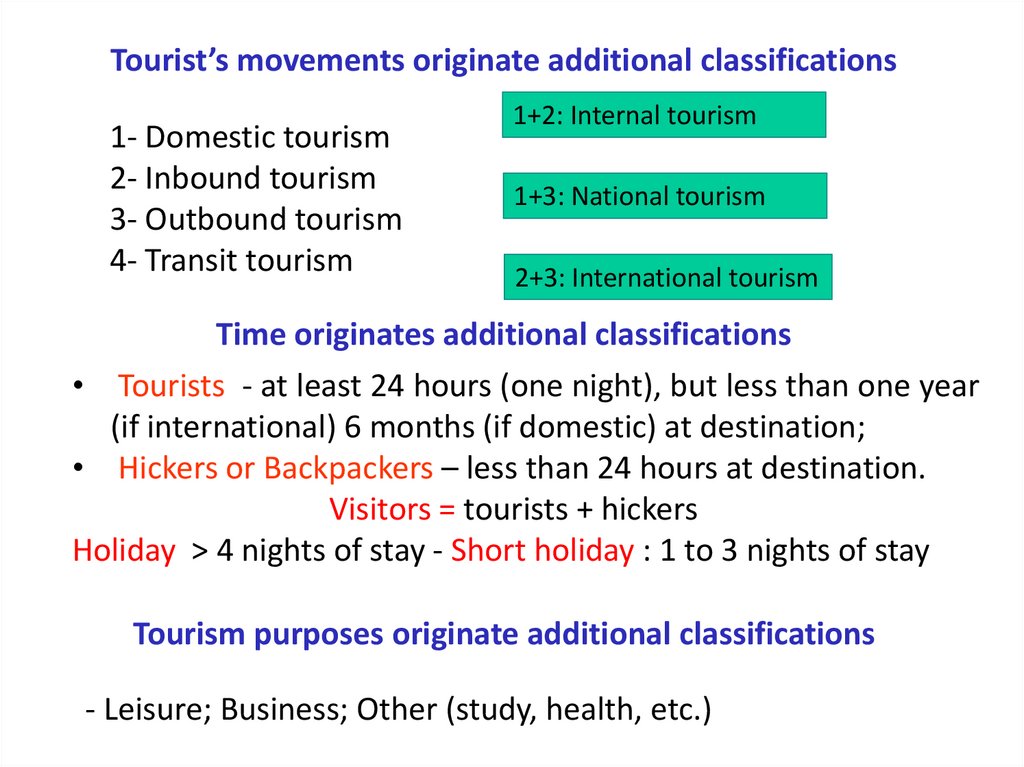
Tourist’s movements originate additional classifications1- Domestic tourism
2- Inbound tourism
3- Outbound tourism
4- Transit tourism
1+2: Internal tourism
1+3: National tourism
2+3: International tourism
Time originates additional classifications
• Tourists - at least 24 hours (one night), but less than one year
(if international) 6 months (if domestic) at destination;
• Hickers or Backpackers – less than 24 hours at destination.
Visitors = tourists + hickers
Holiday > 4 nights of stay - Short holiday : 1 to 3 nights of stay
Tourism purposes originate additional classifications
- Leisure; Business; Other (study, health, etc.)
9.
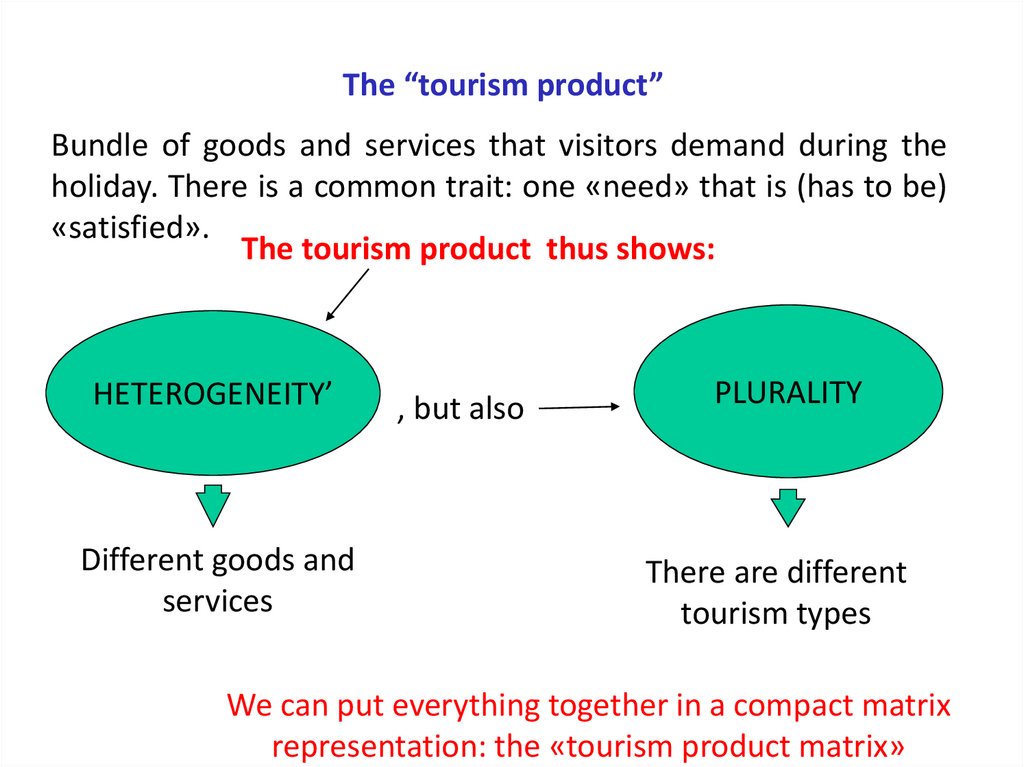
The “tourism product”Bundle of goods and services that visitors demand during the
holiday. There is a common trait: one «need» that is (has to be)
«satisfied».
The tourism product thus shows:
HETEROGENEITY’
Different goods and
services
, but also
PLURALITY
There are different
tourism types
We can put everything together in a compact matrix
representation: the «tourism product matrix»
10.
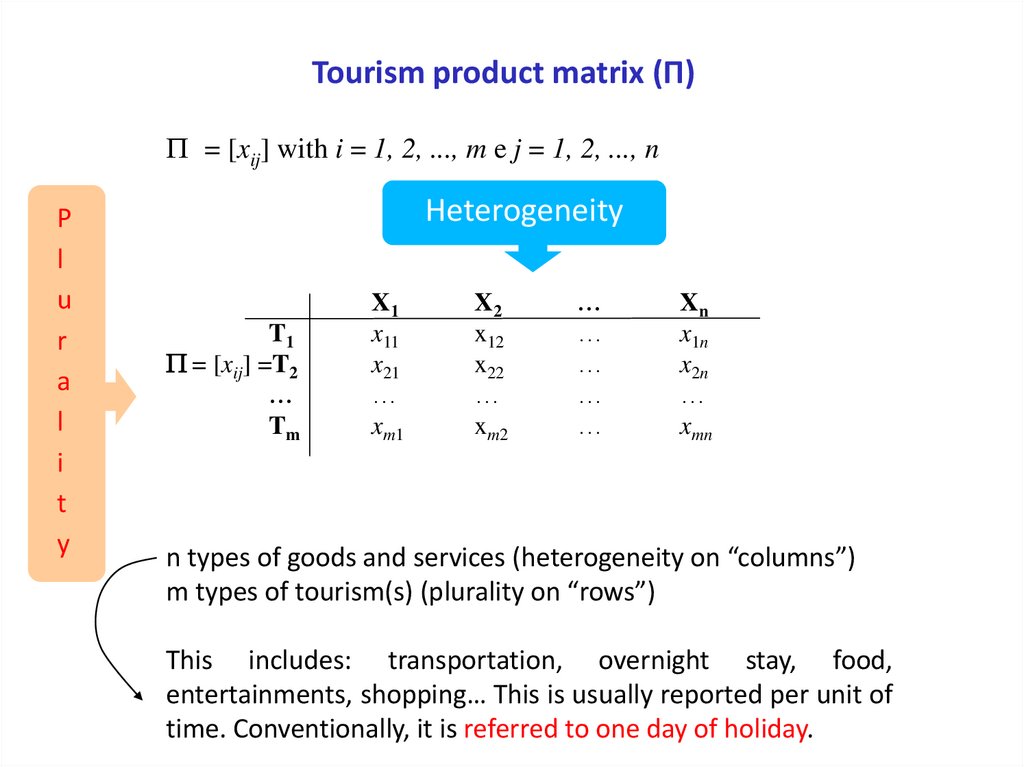
Tourism product matrix (Π)= [xij] with i = 1, 2, ..., m e j = 1, 2, ..., n
P
l
u
r
a
l
i
t
y
Heterogeneity
T1
= [xij] =T2
…
Tm
X1
x11
x21
…
xm1
X2
x12
x22
…
xm2
…
…
…
…
…
Xn
x1n
x2n
…
xmn
n types of goods and services (heterogeneity on “columns”)
m types of tourism(s) (plurality on “rows”)
This includes: transportation, overnight stay, food,
entertainments, shopping… This is usually reported per unit of
time. Conventionally, it is referred to one day of holiday.
11.
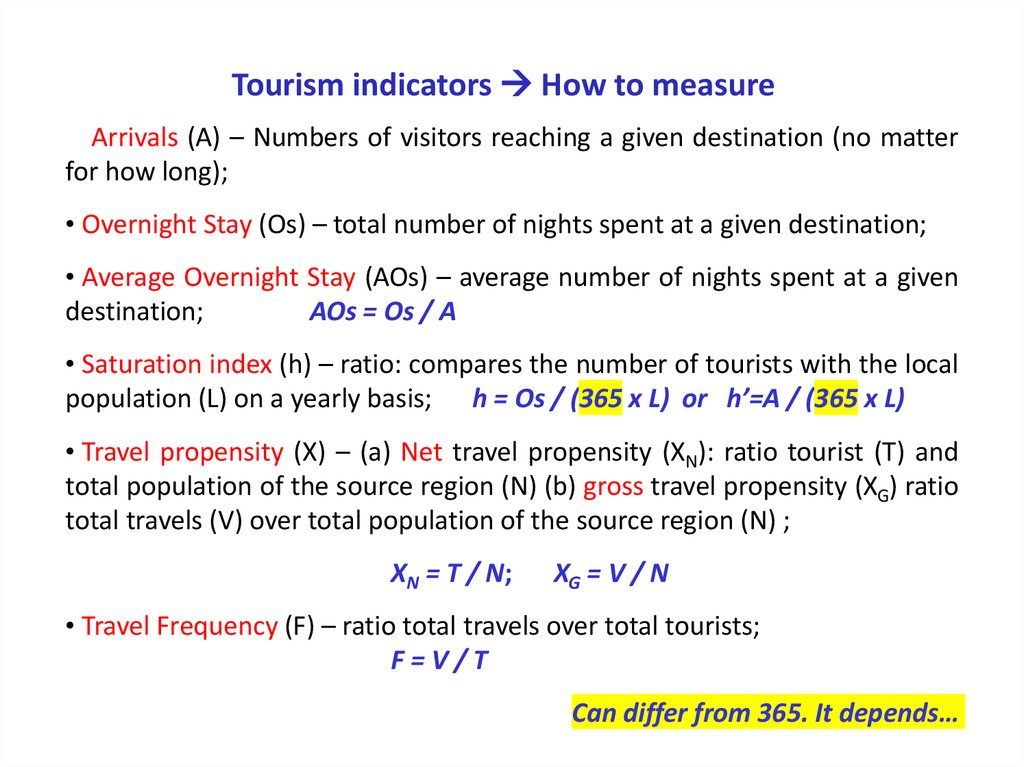
Tourism indicators How to measureArrivals (A) – Numbers of visitors reaching a given destination (no matter
for how long);
• Overnight Stay (Os) – total number of nights spent at a given destination;
• Average Overnight Stay (AOs) – average number of nights spent at a given
destination;
AOs = Os / A
• Saturation index (h) – ratio: compares the number of tourists with the local
population (L) on a yearly basis; h = Os / (365 x L) or h’=A / (365 x L)
• Travel propensity (X) – (a) Net travel propensity (XN): ratio tourist (T) and
total population of the source region (N) (b) gross travel propensity (XG) ratio
total travels (V) over total population of the source region (N) ;
XN = T / N;
XG = V / N
• Travel Frequency (F) – ratio total travels over total tourists;
F=V/T
Can differ from 365. It depends…
12.
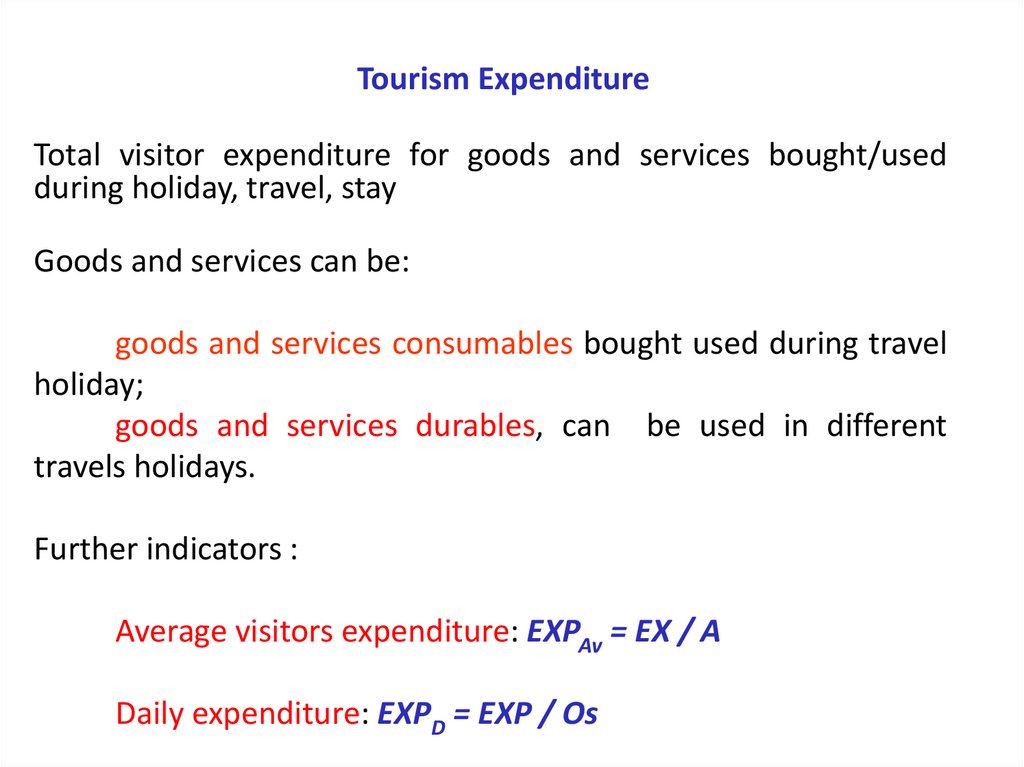
Tourism ExpenditureTotal visitor expenditure for goods and services bought/used
during holiday, travel, stay
Goods and services can be:
goods and services consumables bought used during travel
holiday;
goods and services durables, can be used in different
travels holidays.
Further indicators :
Average visitors expenditure: EXPAv = EX / A
Daily expenditure: EXPD = EXP / Os