 Информатика
 История
Похожие презентации:
Sissejuhatus infotehnoloogiasse seitsmekümnendad ja kaheksakümnendad
1.
Sissejuhatus infotehnoloogiasseseitsmekümnendad ja
kaheksakümnendad
-1-
2. Loengu ülevaade: seitsmekümnendad
1970-1979: mikroprotsessoritest personaalarvutiteniEsimene mikroprotsessor: Intel 4004
Arpanet: interneti eelkäija
Esimesed arvutimängud
Email, ethernet ja muu võrguvärk
Esimesed ise-kokkupandavad mikroarvutid
Miniarvutite tarkvara: Unix, C, ..., Smalltalk, Prolog
Mikroarvutite tarkvara: CP/M, PL/1 ja BASIC kloonid
Personaalarvutite teke: Commodore PET, Apple II, Radio Shack
Microsoft ja BASIC
Visicalc
Xerox ALTO
-2-
3. Loengu ülevaade: kaheksakümnendad
1980-1989:USENET
Spetsiaalprotsessorid
Sinclair ja Acorn archimedes
IBM PC
Kontoritarkvara
Workstationid: Sun ja Apollo
SQL ja Oracle
Macintosh
Portaablid arvutid
GNU, gcc, X-windows
arpanet => nsfnet
-3-
4. 1970
Xerox opens the Palo Alto Research Center (PARC).Intel creates the 1103 chip, the first generally available DRAM
memory chip.
Wayne Pickette takes his computer-on-a-chip design to Intel, and is
hired, began working for Dr. Ted Hoff.
At Intel, Wayne Pickette proposes to Ted Hoff the idea of building a
computer-on-a-chip for the Busicom project.
Gilbert Hyatt files a patent application entitled "Single Chip Integrated
Circuit Computer Architecture", the first basic patent on the
microprocessor.
Work begins at Intel on the layout of the circuit for what would be the
4004 microprocessor. Federico Faggin directs the work.
Intel creates the first 4004 microprocessor.
-4-
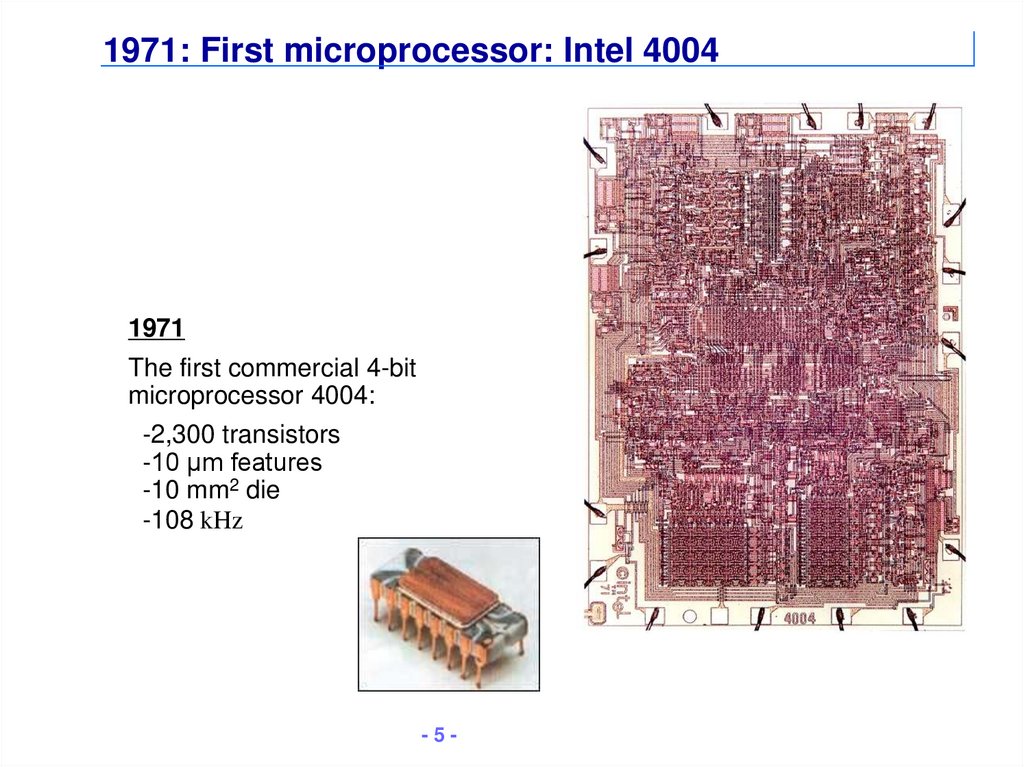
5. 1971: First microprocessor: Intel 4004
1971The first commercial 4-bit
microprocessor 4004:
-2,300 transistors
-10 µm features
-10 mm2 die
-108 kHz
-5-
6. …1970
Relational database software: theory and first research groupsIn 1970 an IBM researcher named Ted Codd published the first article
on relational databases.
Codd envisaged a system where the user would be able to access
information with English like commands, and where information would
be stored in tables.
Due to the technical nature of the article, and the reliance on
mathematics to support its case, the significance of it was not realized
immediately. However, it did lead to IBM starting a research group
known as 'System R'.
Eventually System R evolved into SQL/DS which later became DB2.
The language created by the System R group, SQL (Structured Query
Language) has become the industry standard for relational databases
and is now an ISO standard.
First commercial SQL database created by Honeywell Information
Systems Inc., which released a commercial product in June of 1976.
-6-
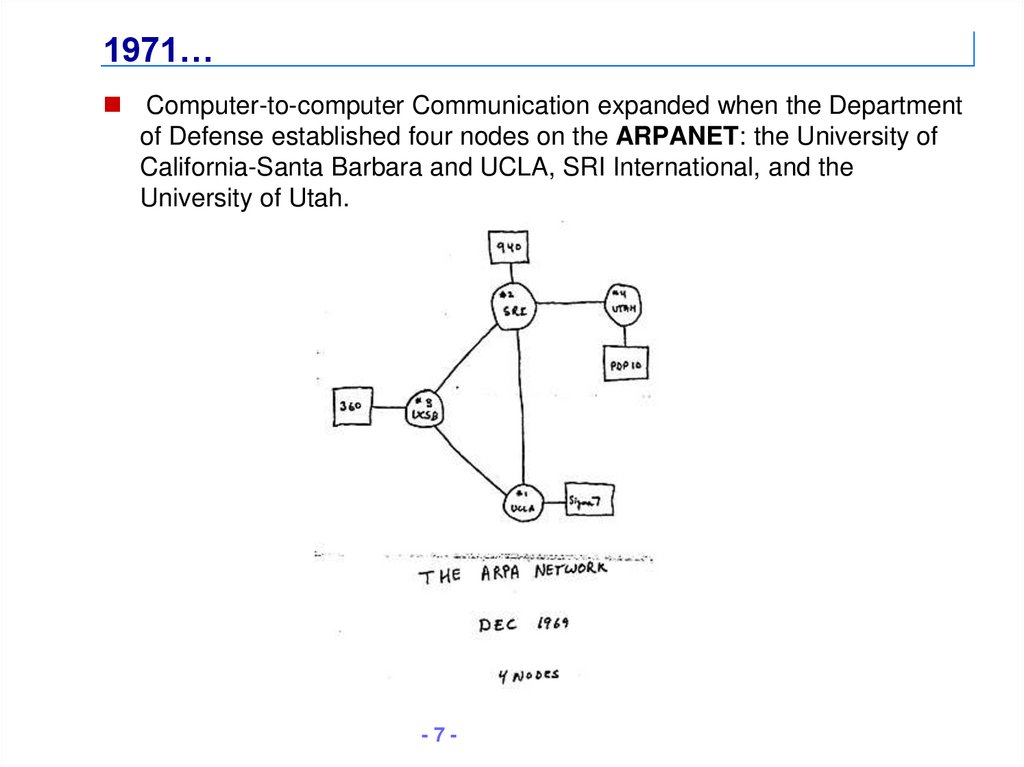
7. 1971…
Computer-to-computer Communication expanded when the Departmentof Defense established four nodes on the ARPANET: the University of
California-Santa Barbara and UCLA, SRI International, and the
University of Utah.
-7-
8. ...1972…
Some gaming stuff:Space war was a first graphical computer game, created on PDP-1
in 1961.
In 1970, an engineer called Ralph Baer created the system which
later became Magnavox Odyssey
Nolan Bushnell tried to make an arcade version of Space War and
created Computer Space. Nutting Associates bought the game,
hired Nolan and manufactured 1,500 Space War machines. The
game was not a success because people found it difficult to play.
As Nolan felt he didn't receive enough pay, he created his own
company: Atari in 1972.
Atari ships Pong, one of the first really successful commercial video
games.
In 1977 Atari enters the home computer market among others
-8-
9. …1972 ...
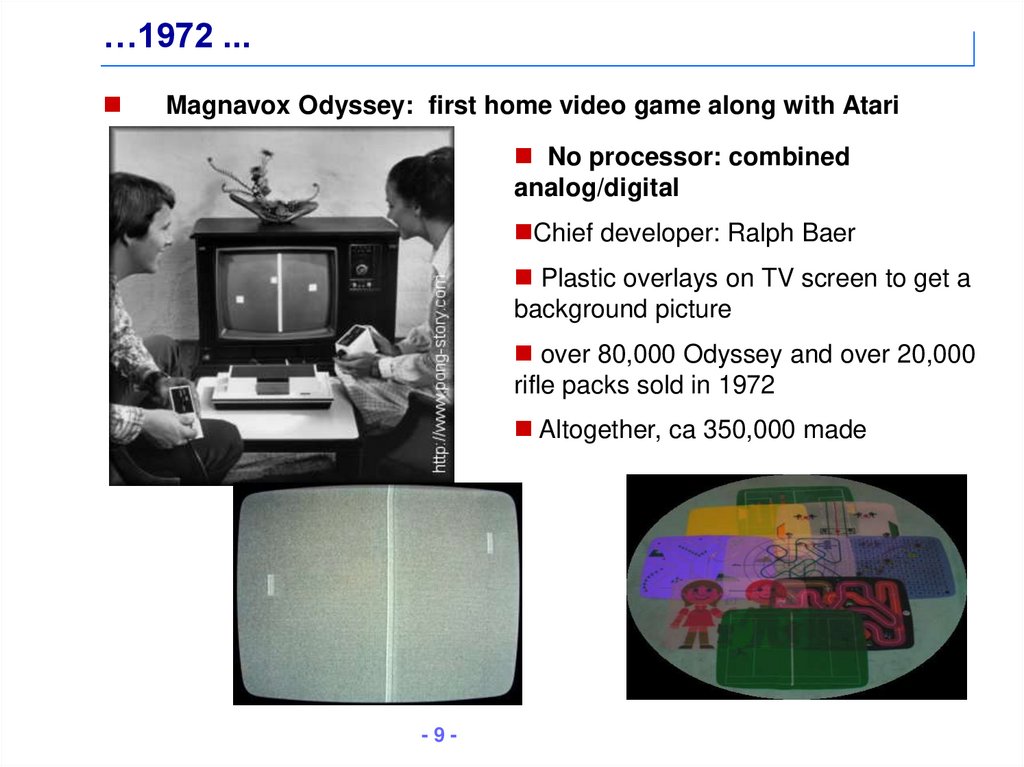
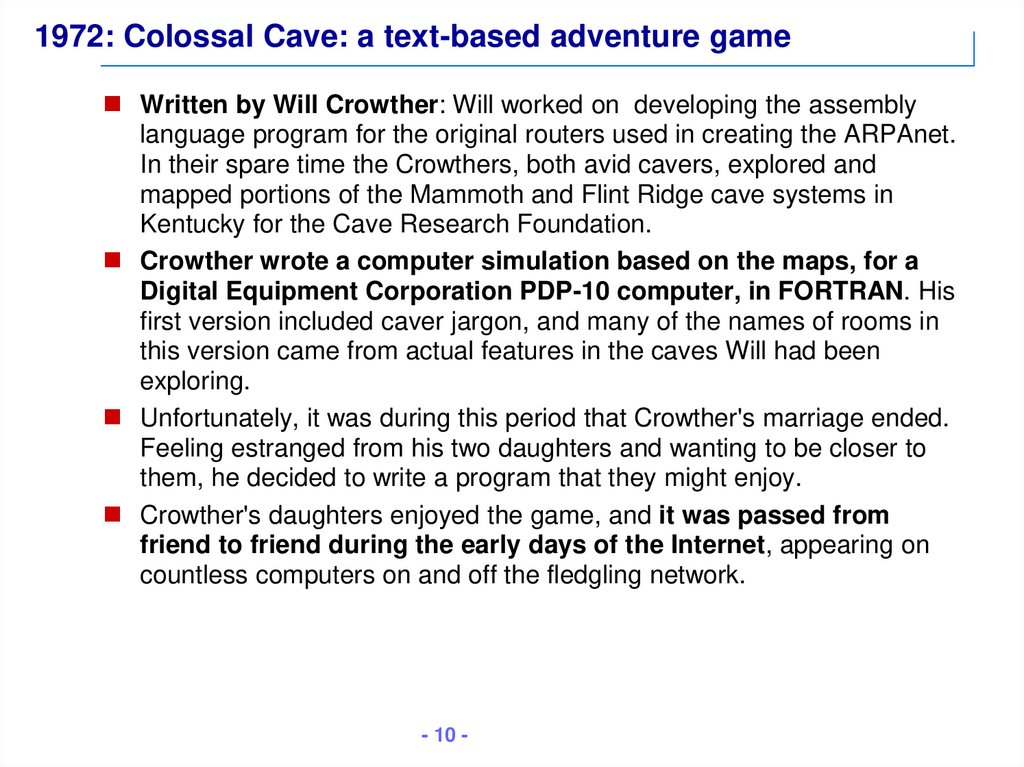
Magnavox Odyssey: first home video game along with AtariNo processor: combined
analog/digital
Chief developer: Ralph Baer
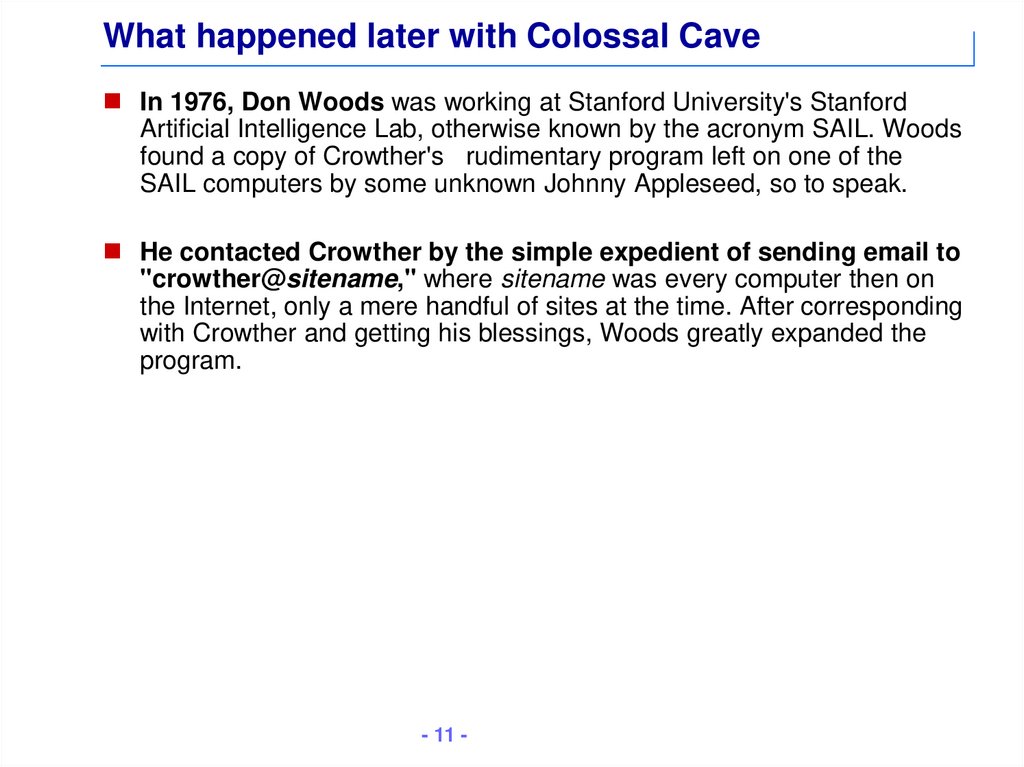
Plastic overlays on TV screen to get a
background picture
over 80,000 Odyssey and over 20,000
rifle packs sold in 1972
Altogether, ca 350,000 made
-9-
10. 1972: Colossal Cave: a text-based adventure game
Written by Will Crowther: Will worked on developing the assemblylanguage program for the original routers used in creating the ARPAnet.
In their spare time the Crowthers, both avid cavers, explored and
mapped portions of the Mammoth and Flint Ridge cave systems in
Kentucky for the Cave Research Foundation.
Crowther wrote a computer simulation based on the maps, for a
Digital Equipment Corporation PDP-10 computer, in FORTRAN. His
first version included caver jargon, and many of the names of rooms in
this version came from actual features in the caves Will had been
exploring.
Unfortunately, it was during this period that Crowther's marriage ended.
Feeling estranged from his two daughters and wanting to be closer to
them, he decided to write a program that they might enjoy.
Crowther's daughters enjoyed the game, and it was passed from
friend to friend during the early days of the Internet, appearing on
countless computers on and off the fledgling network.
- 10 -
11. What happened later with Colossal Cave
In 1976, Don Woods was working at Stanford University's StanfordArtificial Intelligence Lab, otherwise known by the acronym SAIL. Woods
found a copy of Crowther's rudimentary program left on one of the
SAIL computers by some unknown Johnny Appleseed, so to speak.
He contacted Crowther by the simple expedient of sending email to
"crowther@sitename," where sitename was every computer then on
the Internet, only a mere handful of sites at the time. After corresponding
with Crowther and getting his blessings, Woods greatly expanded the
program.
- 11 -
12. …1972
Gary Kildall implements PL/I on the Intel 4004 processor.Bill Gates and Paul Allen form the Traf-O-Data company.
Traf-O-Data develops a primitive microcomputer based on Intel's 8008
microprocessor for recording automobile traffic flow on a highway.
5 1/4 inch diskettes first appear.
Xerox decides to build a personal computer to be used for research.
Project "Alto" begins.
In 1971 Ray Tomlinson of BBN invents email program to send
messages across a distributed network.
In 1972 Ray Tomlinson modifies email program for ARPANET where it
becomes a quick hit. The @ sign was chosen from the punctuation keys
on Tomlinson's Model 33 Teletype for its "at" meaning
- 12 -
13. 1972
Two important programming concepts introduced:The first object-oriented language Smalltalk developed at
XEROX PARC, based on ideas by Alan Kay.
The first logic programming language Prolog developed by Alan
Colmerauer at University of Marseilles
- 13 -
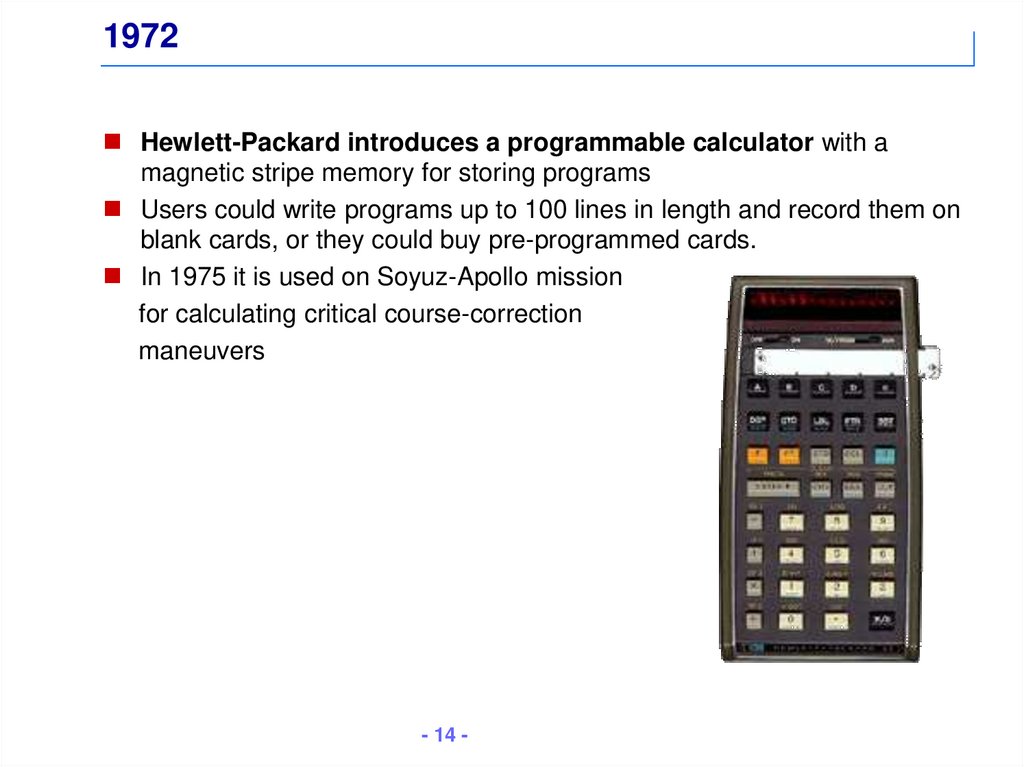
14. 1972
Hewlett-Packard introduces a programmable calculator with amagnetic stripe memory for storing programs
Users could write programs up to 100 lines in length and record them on
blank cards, or they could buy pre-programmed cards.
In 1975 it is used on Soyuz-Apollo mission
for calculating critical course-correction
maneuvers
- 14 -
15. 1973…
The first prototype Alto workstation computer is turned on at Xerox'Palo Alto Research Center. Its first screen display is a bitmapped image
of the Sesame Street character Cookie Monster.
Traf-O-Data shuts down. It made about US$20,000.
Design work is completed on the Micral, the first non-kit computer
based on a microprocessor (the Intel 8008). Built in France, the Micral is
advertised in the U.S., but is not successful there.
The term "microcomputer" first appears in print, in reference to the
Micral.
- 15 -
16. …1973…
Gary Kildall writes a simple operating system in his PL/M language. Hecalls it CP/M (Control Program/Monitor).
Gary Kildall creates PL/M for the Intel 8008, based on PL/I.
IBM develops a cheap disk and drive:
IBM introduces the IBM 3340 hard disk unit, known as the Winchester,
IBM's internal development code name. The recording head rides on a
layer of air 18 millionths of an inch thick. It uses four 8-inch diameter
platters, giving it a capacity of 70 MB.
- 16 -
17. …1973
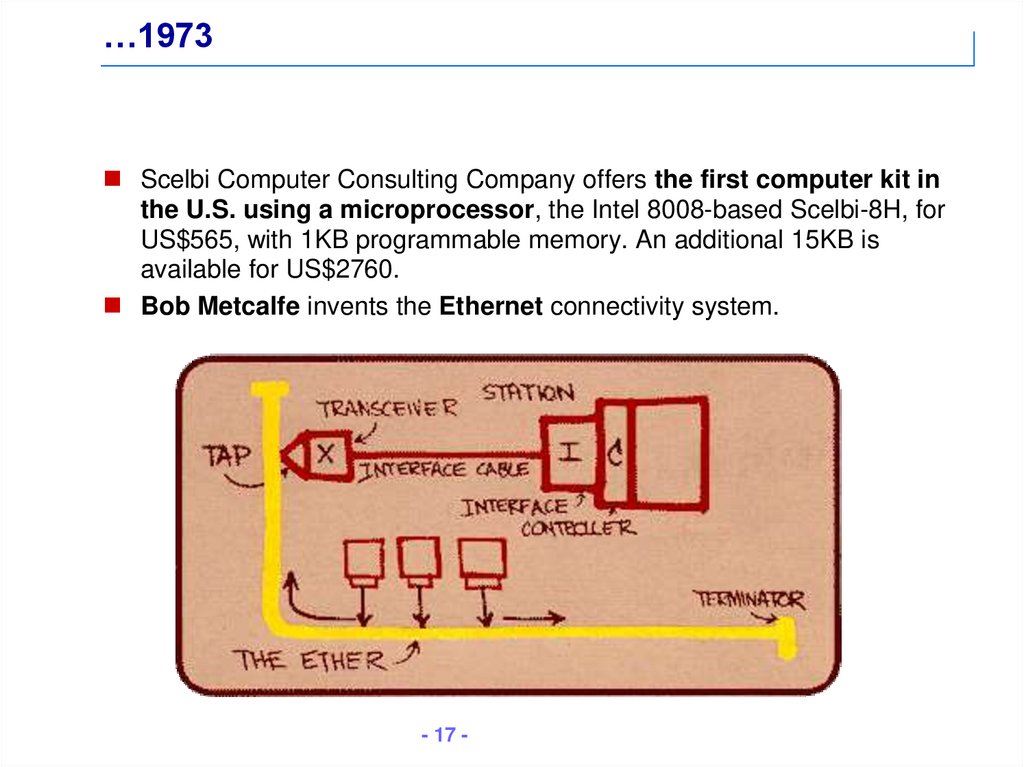
Scelbi Computer Consulting Company offers the first computer kit inthe U.S. using a microprocessor, the Intel 8008-based Scelbi-8H, for
US$565, with 1KB programmable memory. An additional 15KB is
available for US$2760.
Bob Metcalfe invents the Ethernet connectivity system.
- 17 -
18. 1974…
Intel releases its 2-MHz 8080 chip, an 8-bit microprocessor. It canaccess 64KB of memory. It uses 6000 transistors, based on 6-micron
technology. Speed is 0.64 MIPS.
In a desperate act to save his failing calculator company, MITS
company owner Ed Roberts begins building a small computer based on
Intel's new 8080 chip, with plans to sell it for the unheard-of price of
US$500.
MITS completes the first prototype Altair 8800 microcomputer.
Bravo is developed for the Xerox Alto computer. It is the first
WYSIWYG program for a personal computer.
- 18 -
19. Altair
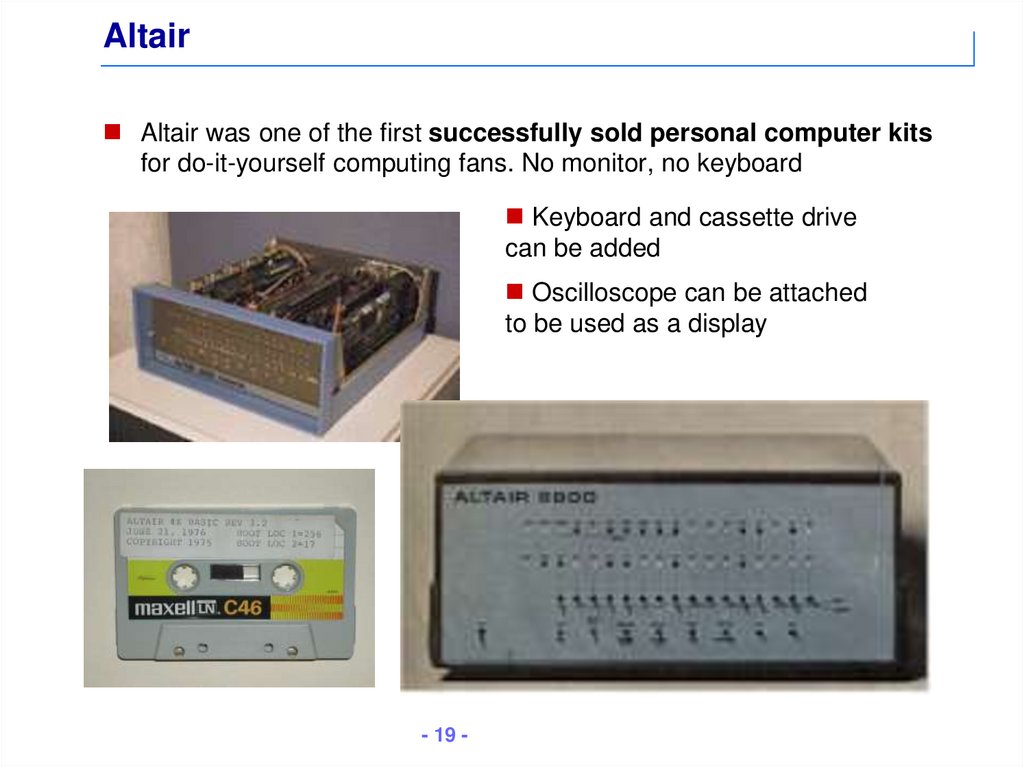
Altair was one of the first successfully sold personal computer kitsfor do-it-yourself computing fans. No monitor, no keyboard
Keyboard and cassette drive
can be added
Oscilloscope can be attached
to be used as a display
- 19 -
20. …1974…
Popular Electronics publishes an article by MITS announcing theAltair 8800 computer for US$439 in kit form. It uses the Intel 8080
processor. The Altair pictured on the cover of the magazine is actually a
mock-up, as an actual computer was not available.
Paul Allen sees the Popular Electronics issue with the Altair, and tells
Bill Gates that the microcomputer revolution is just beginning.
- 20 -
21. …1974
Gary Kildall, of Microcomputer Applications Associates, develops theCP/M operating system for Intel 8080-based systems.
Motorola introduces its 6800 chip, an early 8-bit microprocessor used
in microcomputers and industrial and automotive control devices. The
6800 was designed by Chuck Peddle and Charlie Melear.
Engineer David Ahl suggests Digital Equipment produce an inexpensive
version of its PDP-8 minicomputer, for US$5000. Top management call
the idea foolish.
- 21 -
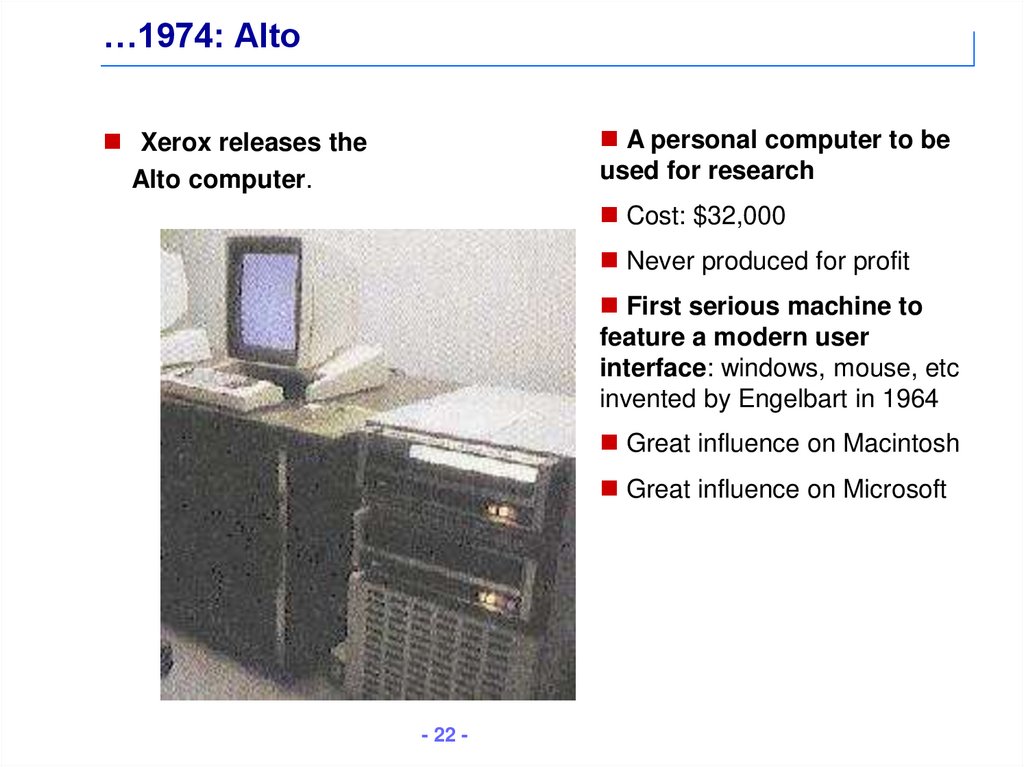
22. …1974: Alto
A personal computer to beused for research
Xerox releases the
Alto computer.
Cost: $32,000
Never produced for profit
First serious machine to
feature a modern user
interface: windows, mouse, etc
invented by Engelbart in 1964
Great influence on Macintosh
Great influence on Microsoft
- 22 -
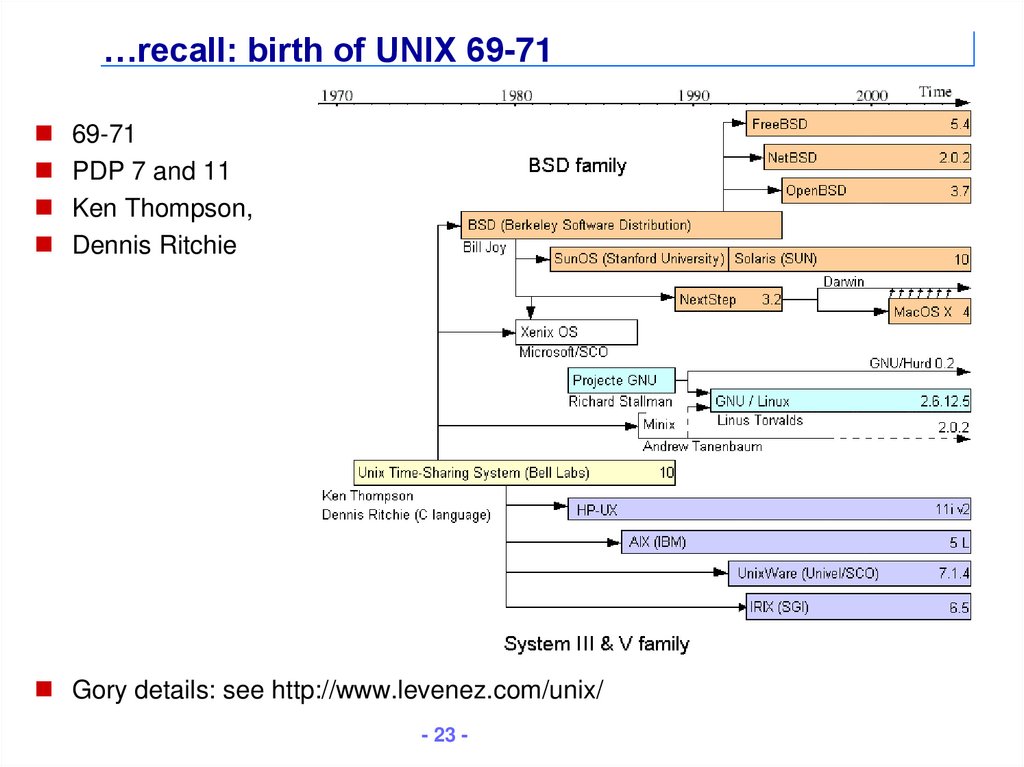
23. …recall: birth of UNIX 69-71
69-71PDP 7 and 11
Ken Thompson,
Dennis Ritchie
Gory details: see http://www.levenez.com/unix/
- 23 -
24. C language: first half of 70s
Influences/derivation history: from ALGOL to CALGOL 58/60: Hoare, Perlis, Dijkstra, Kurtz, ..., Kotli,...
BCPL derivative of ALGOL (Strachey)
B simplified derivative of BCPL (Ken Thompson)
C derivative of B (Dennis & Ritchie)
C development 1969-1973
Famous C book 1978 “ The C Programming Language”
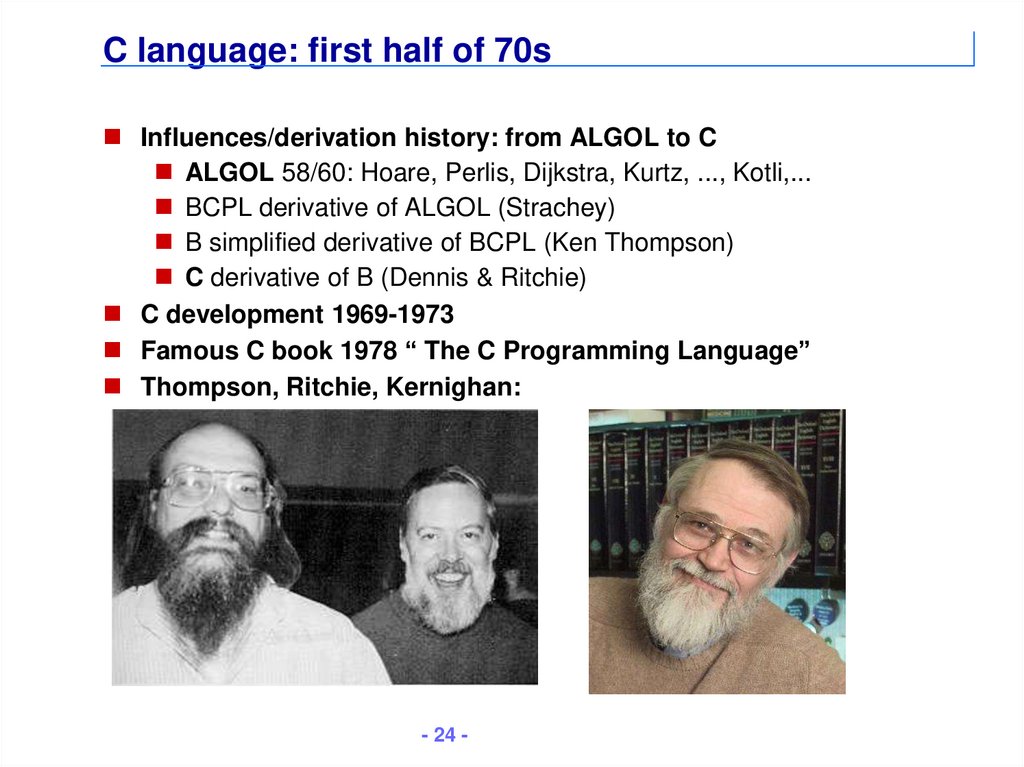
Thompson, Ritchie, Kernighan:
- 24 -
25. 1975
Paul Allen meets with Ed Roberts to demonstrate the newly writtenBASIC interpreter for the Altair. Despite never having touched an Altair
before, the BASIC works flawlessly.
Bill Gates and Paul Allen license their newly written BASIC to MITS,
their first customer. This is the first computer language program written
for a personal computer.
Fred Moore and Gordon French hold the first meeting of a new
microcomputer hobbyist's club in French's garage, in Menlo Park,
California. 32 people meet, including Bob Albrect, Steve Dompier, Lee
Felsenstein, Bob Marsh, Tom Pittman, Marty Spergel, Alan Baum, and
Steven Wozniak. Bob Albrect shows off an Altair, and Steve Dompier
reports on MITS, and how they had 4000 orders for the Altair.
The second meeting of Fred Moore/Gordon French's computer
hobbyists group is held at the Stanford AI lab. 40 attend. The name for
the group is chosen: Bay Area Amateur Computer Users Group Homebrew Computer Club.
- 25 -
26. 1975
Bill Gates and Paul Allen found Micro-Soft (the hyphen is laterdropped).
Bill Gates and Paul Allen ship 4K and 8K version of BASIC v2.0.
MITS delivers the first generally-available Altair 8800, sold for US$375
with 1KB memory.
MOS Technology announces the MC6501 at US$20 and the MC6502 at
US$25. At this point, the Intel 8080 costs about US$150.
- 26 -
27. 1975
The first issue of Byte magazine is published.MITS releases a version of MicroSoft BASIC 2.0 for its Altair 8800, in
4K and 8K editions.
Paul Terrell opens the Byte Shop, in Mountain View, California, one of
the first computer stores in the US.
Bill Gates writes an open letter to microcomputer hobbyists,
complaining about software piracy, to be published in an Altair
newsletter.
Lee Felsenstein and Bob Marsh begin work on a complete computer,
8080-based with a keyboard and color video display capabilities built-in.
To date, MITS has sold 2,000 Altair 8800 systems.
Zilog is founded.
MITS begins work on a Motorola 6800-based Altair.
MITS sales of Altair computers hits US$1 million.
- 27 -
28. 1976
Steve Wozniak and Steve Jobs finish work on a computer circuit board,that they call the Apple I computer
By the end of its first year in business, Micom Data Systems ships 180
Micom 2000 computers, worth $2 million.
Intel introduces the 5-MHz 8085 microprocessor. Speed is 0.37 MIPS.
It uses 6500 transistors, based on 3-micron technology. It supports an 8bit bus. Operates on a single 5-volt power supply. (1978)
Bill Gates writes a second open letter to computer hobbyists,
condemning software piracy. Again it is published in the Altair
newsletter.
Microsoft hires its first employee, Marc McDonald.
- 28 -
29. 1976
National Semiconductor releases the SC/MP 8-bit microprocessor,providing early advanced multiprocessing.
Digital Research copyrights CP/M, its industry-standard
microcomputer operating system, created by company founder Gary
Kildall.
Texas Instruments introduces the TMS9900, the first 16-bit
microprocessor. The microprocessor implemented Texas Instrument's
16-bit architecture on the TI 990 minicomputer.
Wang Laboratories announces a word-processing system using
advanced computer technology, rather than traditional
electromechanical devices. The price is US$30,000, more than twice
that of the most expensive competitor's word-processor.
- 29 -
30. 1976
Steve Jobs and Steve Wozniak form the Apple Computer Company,on April Fool's Day.
The Apple I computer board is sold in kit form, and delivered to
stores by Steve Jobs and Steve Wozniak. Price: US$666.66.
Paul Terrell orders 50 Apple computers from Steve Jobs, for his Byte
Shop.
- 30 -
31. 1976
Zilog releases the 2.5-MHz Z80, an 8-bit microprocessor whoseinstruction set is a superset of the Intel 8080.
iCOM advertises their "Frugal Floppy" in BYTE magazine, an 8-inch
floppy drive, selling for US$1200.
Steve Wozniak begins work on the Apple II.
Commodore International buys MOS Technology.
Advanced Micro Devices and Intel sign a patent cross-license
agreement, giving Advanced Micro Devices the right to copy Intel's
processor microcode and instruction codes.
Mike Markkula, ex-marketing wizard at Intel, visits Steve Jobs' garage,
to see the Apple computers.
Steve Wozniak decides to remain at Hewlett-Packard, but is soon
convinced that he should leave and join Apple Computer permanently.
Paul Allen resigns from MITS and joins Microsoft full time
Bill Gates drops out of Harvard, to devote his full attention to Microsoft.
- 31 -
32. 1976
Xerox management rejects two proposals to market the Alto computer.Gary Kildall founds Intergalactic Digital Research.
Gary Kildall grants a license to CP/M to GNAT Computers for US$90, to
IMSAI for US$25,000.
- 32 -
33. 1976
U.S. Robotics is founded, in Skokie, IllinoisMOS Technology ships the 6502 microprocessor. The 6502 was
developed by Chuck Peddle.
MOS Technology Inc. announces the KIM-1 Microcomputer System,
with 1-MHz 6502 CPU, 1KB RAM, 2KB ROM monitor, 23-key keypad,
LED readout, cassette and serial interfaces, for US$245.
Chuck Peddle designs the Commodore PET.
MITS unveils the Altair 680, based on the Motorola 6800
microprocessor.
Steve Wozniak proposes that Hewlett-Packard create a personal
computer. Steve Jobs proposes the same to Atari. Both are rejected.
- 33 -
34. 1976
Warner Communications buys Atari from Nolan Bushnell forUS$26 million.
The first issue of Dr. Dobbs is published
IMSAI begins shipping the IMSAI 8080.
Polymorphic Systems introduces the Poly morphic 8800. It is the first
microcomputer with an interface for a video monitor, a connection for a
cassette tape recorder, and its basic operating system in ROM
Cray Research introduces the Cray-1 vector-processing computer.
Bill Joy writes “vi”: a simple visual text editor for UNIX.
Vi is a follow-up to the line editors ed and em
Joy later became:
Main author of the Berkeley UNIX (BSD) version
One of the founders of Sun Microsystems
One the main authors of Java
- 34 -
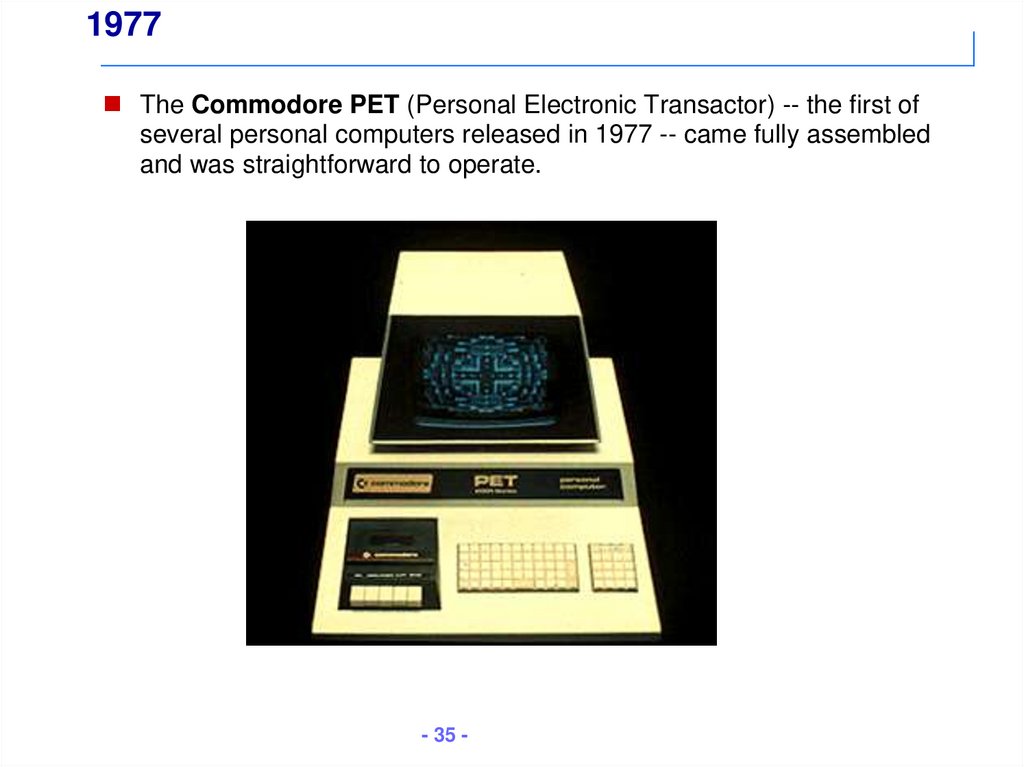
35. 1977
The Commodore PET (Personal Electronic Transactor) -- the first ofseveral personal computers released in 1977 -- came fully assembled
and was straightforward to operate.
- 35 -
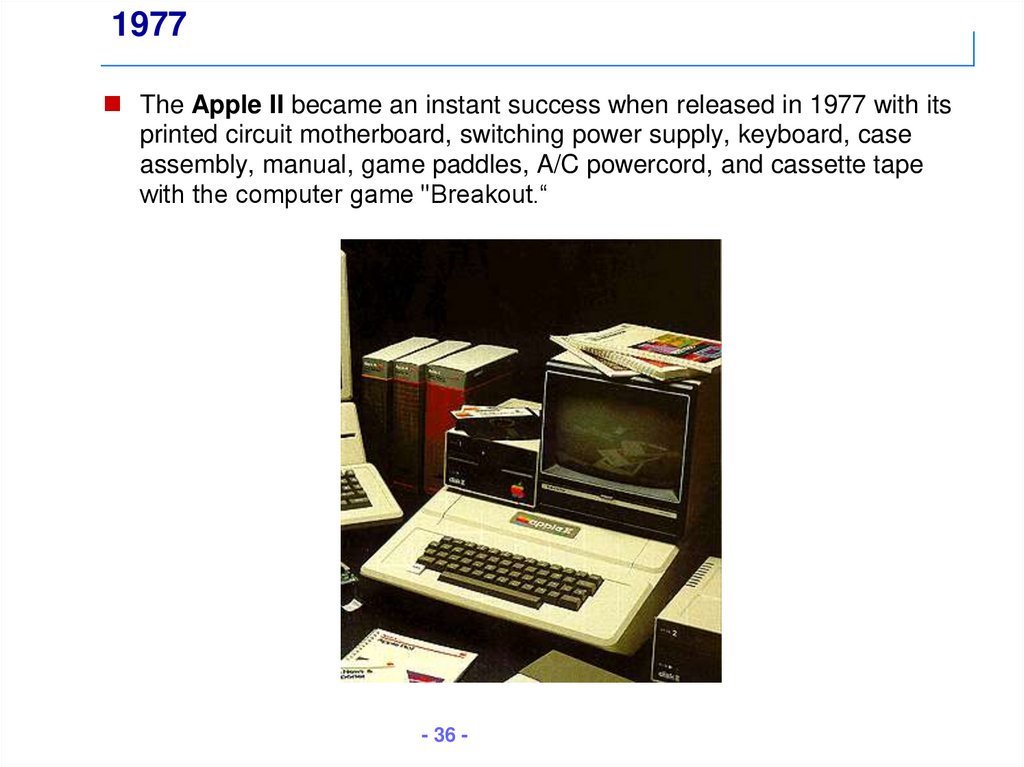
36. 1977
The Apple II became an instant success when released in 1977 with itsprinted circuit motherboard, switching power supply, keyboard, case
assembly, manual, game paddles, A/C powercord, and cassette tape
with the computer game "Breakout.“
- 36 -
37. 1977
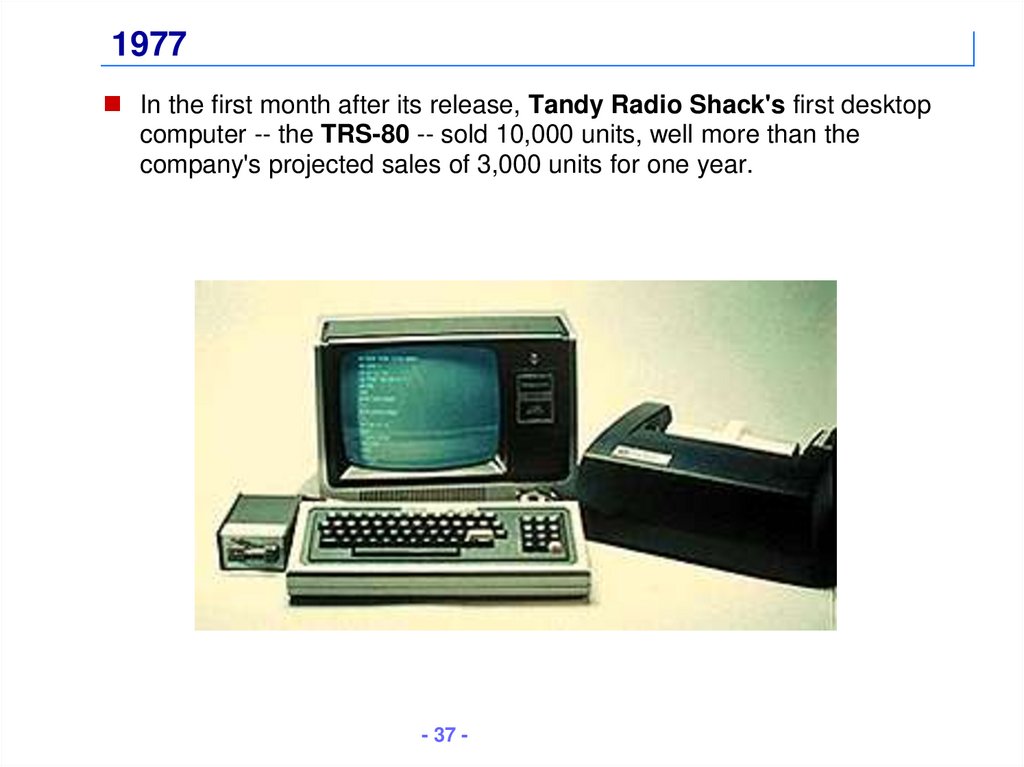
In the first month after its release, Tandy Radio Shack's first desktopcomputer -- the TRS-80 -- sold 10,000 units, well more than the
company's projected sales of 3,000 units for one year.
- 37 -
38. 1977
Commodore Business Machines Inc. shows its PET 2001 computer atthe West Coast Computer Faire. The PET includes a 6502 CPU, 4KB
RAM, 14KB ROM, keyboard, display, and tape drive, for US$600.
Apple Computer introduces the Apple II at the West Coast Computer
Faire. The computer features a 6502 CPU, 4KB RAM, 16KB ROM,
keyboard, 8-slot motherboard, game paddles, graphics/text interface to
color display, and built-in BASIC, for US$1300. It is the first personal
computer with color graphics
10 months after its introduction, 175 Apple I kits have sold.
Pertec buys MITS and the Altair line for US$6 million in stock.
Microsoft ships "Microsoft FORTRAN" for CP/M-based computers
Radio Shack (a division of Tandy Corp.) announces the TRS-80
microcomputer, with Z80 CPU, 4KB RAM, 4KB ROM, keyboard, blackand-white video display, and tape cassette for US$600.
- 38 -
39. 1977
One month after launching the TRS-80, 10,000 are sold, despite salesprojections of only 3,000 in the first year.
Apple Computer releases Applesoft, a version of BASIC with floatingpoint capabilities. It is licensed from Microsoft
Heath Schlumber Company introduces its first microcomputer kit, the H8 personal computer kit, based on the Intel 8080.
- 39 -
40. 1978
Intel introduces the 4.77-MHz 8086 microprocessor. It uses 16-bitregisters, a 16-bit data bus, and 29,000 transistors, using 3-micron
technology. Price is US$360. It can access 1 MB of memory. Speed is
0.33 MIPS. Later speeds included 8-MHz (0.66 MIPS) and 10-MHz.
Microsoft ships Microsoft COBOL.
Apple Computer introduces the Disk II, a 5.25 inch floppy disk drive
linked to the Apple II by cable. Price: US$495, including controller card.
Pertec ceases production of the Altair.
- 40 -
41. 1978
Epson announces the MX-80 dot matrix printer, which established a newstandard in high performance with low price for printers.
Atari announces the Atari 400 and 800 personal computers, using the
6502 microprocessor.
Microsoft's sales for the year reach US$1 million.
Apple Computer begins work on a supercomputer with a bit-sliced
architecture, code-named Lisa.
- 41 -
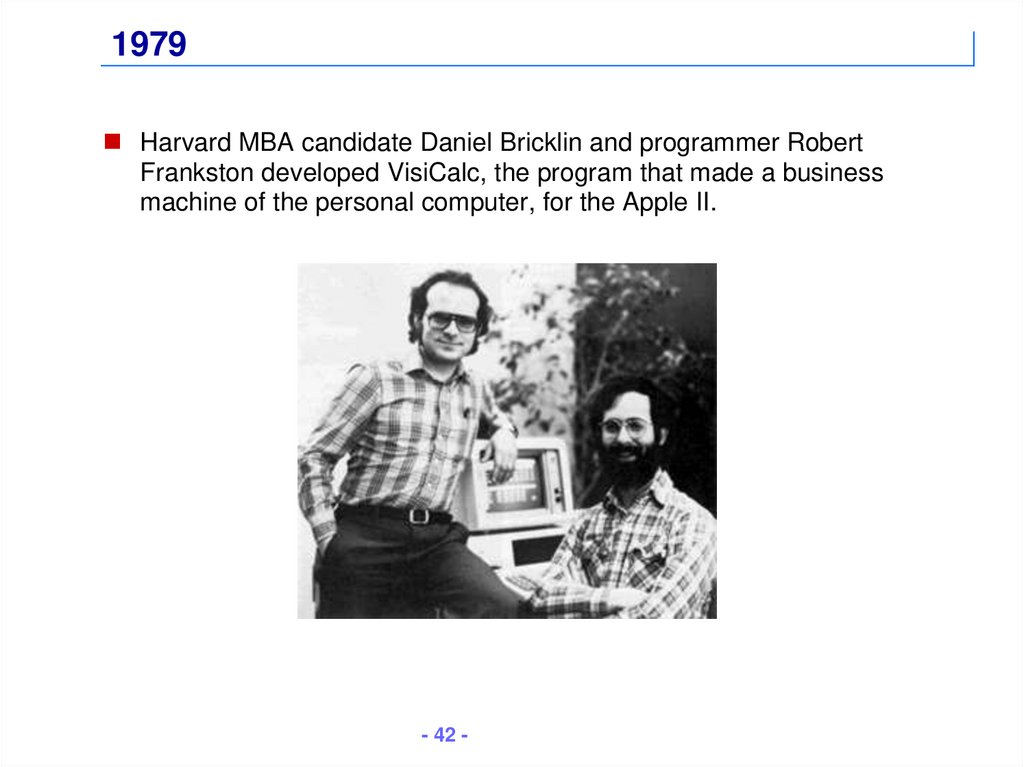
42. 1979
Harvard MBA candidate Daniel Bricklin and programmer RobertFrankston developed VisiCalc, the program that made a business
machine of the personal computer, for the Apple II.
- 42 -
43. 1979
Apple Computer introduces the Apple II Plus, with 48KB memory, forUS$1195.
Apple Computer introduces its first printer, the Apple Silentype, for
US$600. It is a Trendcom Model 200, released under the Apple name.
Intel introduces the 4.77-MHz 8088 microprocessor. It was created as
a stepping stone to the 8086, as it operates on 16 bits internally, but
supports an 8-bit data bus, to use existing 8-bit device-controlling chips.
It contains 29,000 transistors, using 3-micron technology, and can
address 1MB of memory. Speed is 0.33 MIPS. A later version operates
at 8-MHz, for a speed of 0.75 MIPS.
Bob Metcalfe founds 3Com Corporation.
Texas Instruments introduces the TI-99/4 personal computer, for an
initial price of US$1500. It uses the TI 9940 16-bit microprocessor.
MicroPro releases the WordStar word processor, written by Rob
Barnaby. It is made available for Intel 8080A Zilog Z-80 based CP/M-80
systems. written by Seymour Rubenstein
Microsoft announces Microsoft BASIC 8086 at the National Computer
Conference.]
- 43 -
44. 1979
Wayne Ratliff develops the Vulcan database program (Ashton- Tatelater markets it as dBase II).
Motorola's 68000 16-bit microprocessor appears. It uses 68,000
transistors, giving it its name.
2.5 years after the introduction of the Apple II, 50,000 units have been
sold.
Personal Software releases VisiCalc for the Apple II, for US$100.
A group of Apple Computer engineers and executives is given a demo
of Xerox Palo Alto Research Center's Alto computer system, in
exchange for Xerox buying 100,000 Apple Computer shares for US$1
million.
Ross Perot asks Bill Gates about buying Microsoft. Gates recalls asking
US$6-15 million. Perot recalls Gates asking US$40-60 million.
Xerox shows its Alto personal computer in TV commercials.
After airing a TV commercial for the Alto several times, Xerox decides
not to market the Alto.
- 44 -
45. 79-80: USENET : varane “web” : tekstiuudised
USENET on hiiglaslik kogus uudisgruppe. Tekstid liiguvad masinastmasinasse.
USENET: Unix Users Network founded late 1979.
Info liikus algselt: UUCP protolli abil (Unix to Unix communications
protocol, enamasti moodemi abil sissehelistamisega).
V7 Unix with UUCP. Two Duke University grad students in North
Carolina, Tom Truscott and Jim Ellis, thought of hooking computers
together to exchange information with the Unix community. Steve
Bellovin, a grad student at the University of North Carolina, put together
the first version of the news software using shell scripts and installed it
on the first two sites: "unc" and "duke." At the beginning of 1980 the
network consisted of those two sites and "phs" (another machine at
Duke), and was described at the January Usenix conference.
1986 murrang: Network News Transfer Protocol (NNTP) . Uudised
liiguvad TCP/IP (interneti) kaudu.
- 45 -
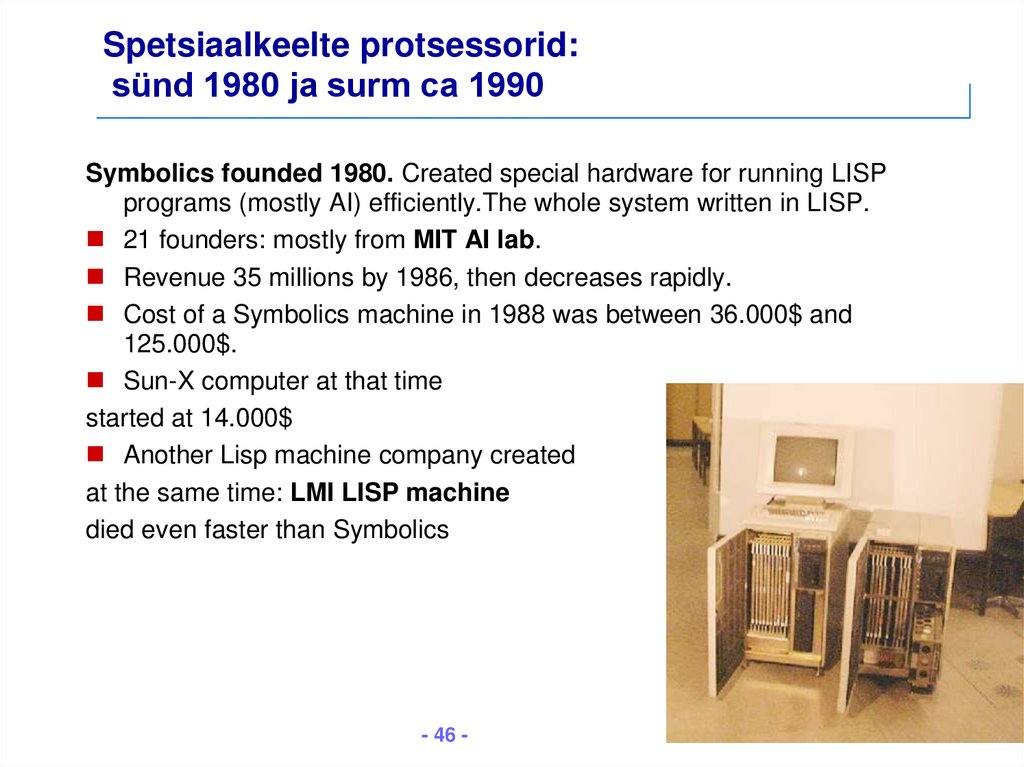
46. Spetsiaalkeelte protsessorid: sünd 1980 ja surm ca 1990
Symbolics founded 1980. Created special hardware for running LISPprograms (mostly AI) efficiently.The whole system written in LISP.
21 founders: mostly from MIT AI lab.
Revenue 35 millions by 1986, then decreases rapidly.
Cost of a Symbolics machine in 1988 was between 36.000$ and
125.000$.
Sun-X computer at that time
started at 14.000$
Another Lisp machine company created
at the same time: LMI LISP machine
died even faster than Symbolics
- 46 -
47. 1980: planning for IBM PC
IBM's Corporate Management Committee gives William Lowe approval tobegin Project Chess, by recruiting 12 engineers, and building a prototype
microcomputer.
IBM representatives meet with Microsoft's Bill Gates and Steve Ballmer
to talk about Microsoft products, and home computers. IBM asks Bill Gates
to write the operating system for their coming PC.
IBM's Project Chess task force contacts Digital Research about using
CP/M-86 for IBM's upcoming microcomputer. Gary Kildall is not interested,
for a variety of reasons.
IBM meets with Microsoft again, and shows plans for Project Chess, a
personal computer. The code name for the computer is "Acorn". Bill Gates
argues that IBM should use the 16-bit 8086, rather than the 8-bit 8080
processor.
QDOS 0.10 (Quick and Dirty Operating System) is shipped by Seattle
Computer Products. Even though it had been created in only two manmonths, the DOS worked surprisingly well. A week later, the EDLIN line
editor was created. EDLIN was supposed to last only six months, before
being replaced.
- 47 -
48. 1980
Apple Computer sells over 78,000 Apple II computers during the fiscalyear.
Microsoft announces the Microsoft XENIX OS, a portable and
commercial version of the UNIX operating system for the Intel 8086,
Zilog Z8000, Motorola M68000, and Digital Equipment PDP-11.
Microsoft decides to propose to IBM that they provide the operating
system for IBM's microcomputer.
William Lowe assembles the members of "Project Chess", known as the
"Dirty Dozen", the 12 engineers assembled to design and build the IBM
PC, in Boca Raton, Florida.
IBM meets with Microsoft again, to formalize plans to work together in
creating a new microcomputer.
- 48 -
49. 1980
Microsoft's Paul Allen contacts Seattle Computer Products' TimPatterson, asking for the rights to sell SCP's DOS to an unnamed client
(IBM). Microsoft pays less than US$100,000 for the right.
Bill Gates, Paul Allen, and Steve Ballmer meet with IBM in Boca Raton,
Florida, to deliver a report to IBM. They propose that Microsoft be put in
charge of the entire software development process for IBM's new
microcomputer, including converting Seattle Computer Products' SCPDOS to run on the computer.
Microsoft and IBM sign a contract for Microsoft to develop certain
software products for IBM's microcomputer.
IBM delivers the first PC prototype to Microsoft, so they can begin
developing BASIC and the machine's operating system.
Apple Computer becomes a publicly held company, selling 4.6 million
shares at US$22 per share. More than 40 Apple employees and
investors become instant millionaires.
- 49 -
50. 1981: big portable
Adam Osborne completed the first portable computer, the Osborne I,which weighed 24 pounds and cost $1,795. Used Z80 (NOT IBM-PC
clone (yet)!)
- 50 -
51. 1981: big portable
Adam Osborne completed the first portable computer, the Osborne I,which weighed 24 pounds and cost $1,795. Used Z80 (NOT IBM-PC
clone (yet)!)
- 51 -
52. 1981: Apollo Computer
Apollo Computer unveiled the first workstation, its DN100, offeringmore power than some minicomputers at a fraction of the price. Used a
Motorola 68000 microprocessor.
- 52 -
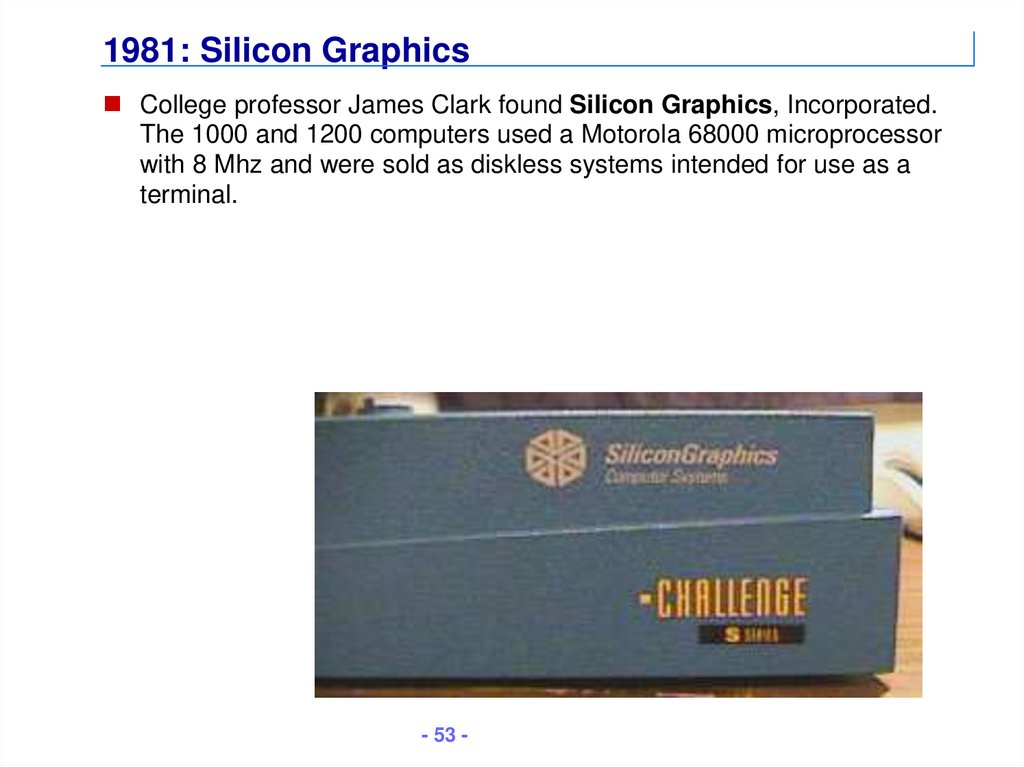
53. 1981: Silicon Graphics
College professor James Clark found Silicon Graphics, Incorporated.The 1000 and 1200 computers used a Motorola 68000 microprocessor
with 8 Mhz and were sold as diskless systems intended for use as a
terminal.
- 53 -
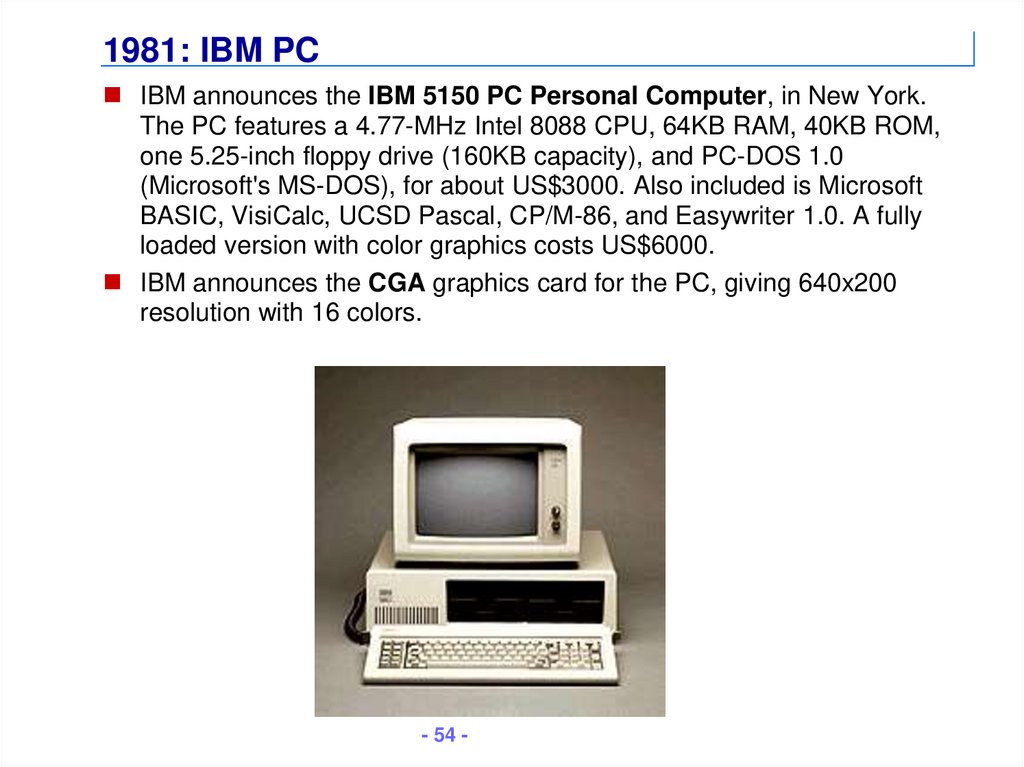
54. 1981: IBM PC
IBM announces the IBM 5150 PC Personal Computer, in New York.The PC features a 4.77-MHz Intel 8088 CPU, 64KB RAM, 40KB ROM,
one 5.25-inch floppy drive (160KB capacity), and PC-DOS 1.0
(Microsoft's MS-DOS), for about US$3000. Also included is Microsoft
BASIC, VisiCalc, UCSD Pascal, CP/M-86, and Easywriter 1.0. A fully
loaded version with color graphics costs US$6000.
IBM announces the CGA graphics card for the PC, giving 640x200
resolution with 16 colors.
- 54 -
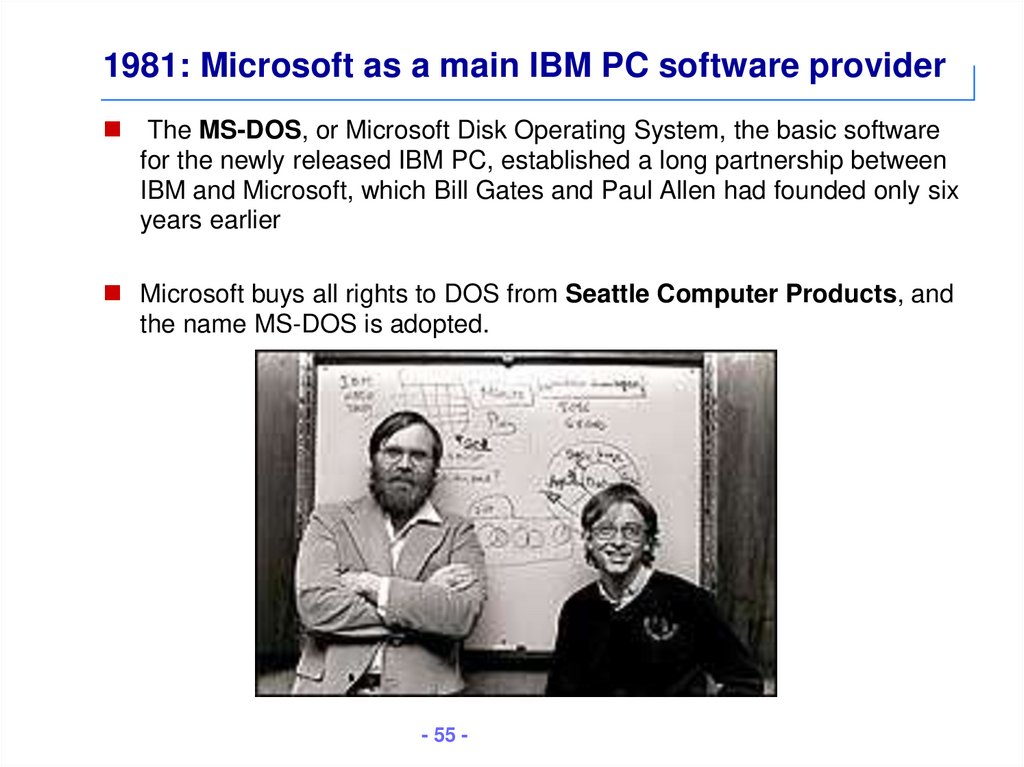
55. 1981: Microsoft as a main IBM PC software provider
The MS-DOS, or Microsoft Disk Operating System, the basic softwarefor the newly released IBM PC, established a long partnership between
IBM and Microsoft, which Bill Gates and Paul Allen had founded only six
years earlier
Microsoft buys all rights to DOS from Seattle Computer Products, and
the name MS-DOS is adopted.
- 55 -
56. 1981
Novell Data Systems ships the Novell Data Management Computer,with the ability to share its hard drive space with other computers
through software control and network cards.
Ashton-Tate ships dBase II, the early industry-standard database
program.
Intel ships the 8087 math coprocessor. [446.504]
National Semiconductor announces the 32000 chip, the first
commercial 32-bit microprocessor. The 32000 family includes CPUs
and peripheral chips.
- 56 -
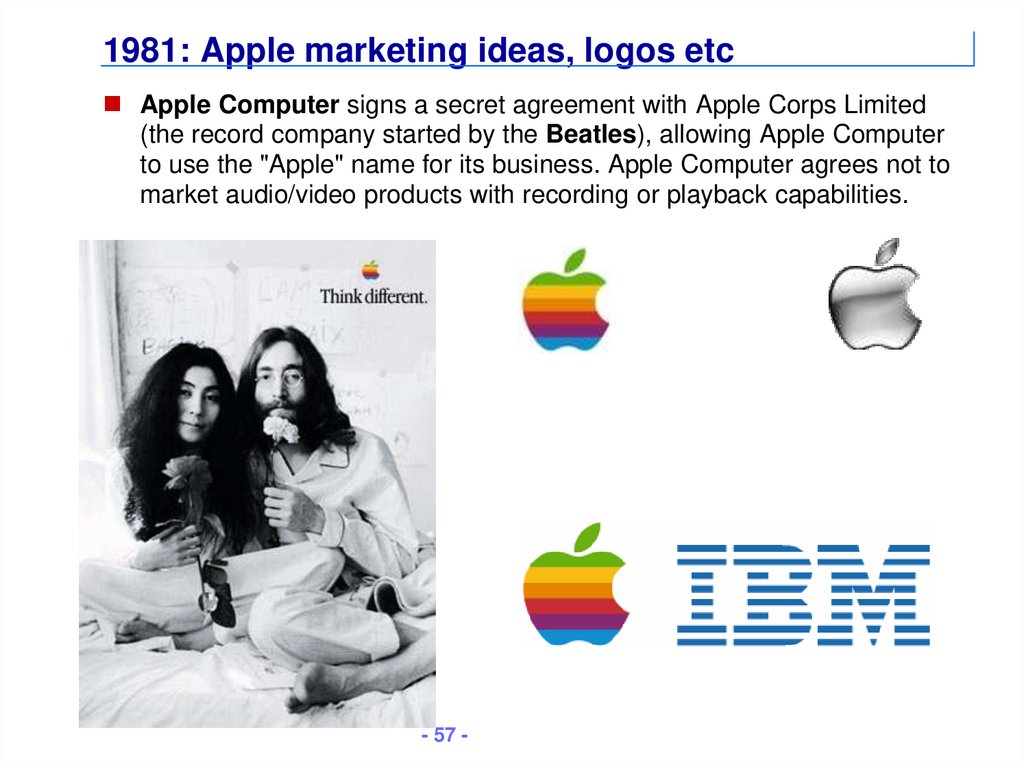
57. 1981: Apple marketing ideas, logos etc
Apple Computer signs a secret agreement with Apple Corps Limited(the record company started by the Beatles), allowing Apple Computer
to use the "Apple" name for its business. Apple Computer agrees not to
market audio/video products with recording or playback capabilities.
- 57 -
58. 1982: Sinclair & PSION & Symbian
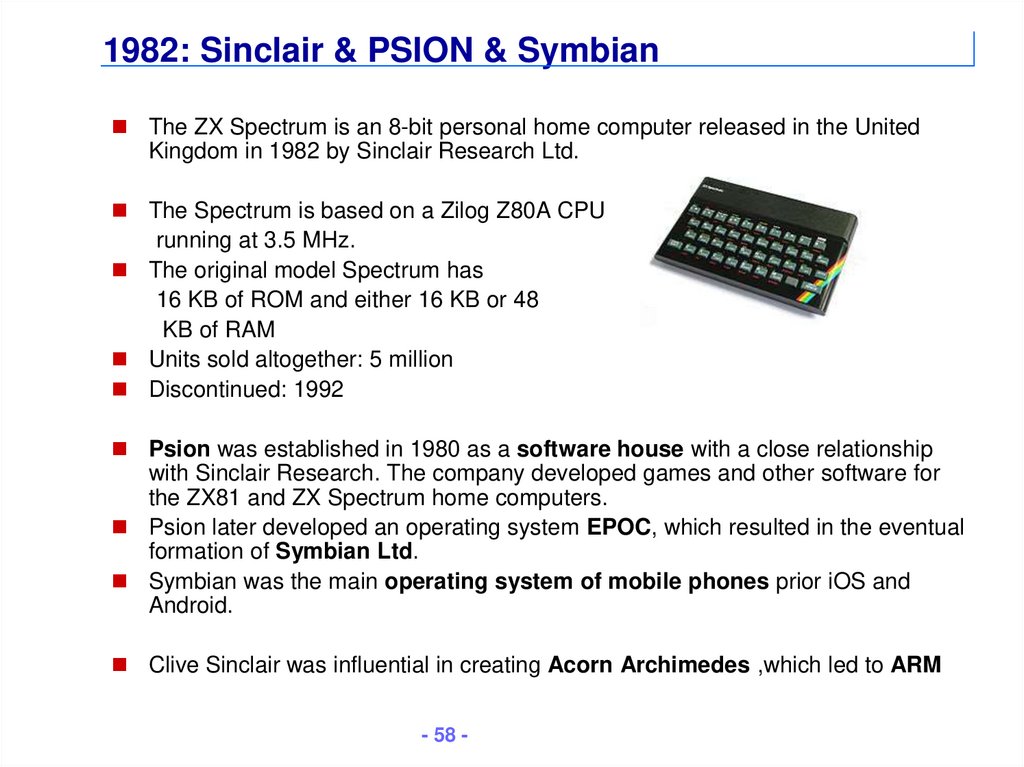
1982: Sinclair & PSION & SymbianThe ZX Spectrum is an 8-bit personal home computer released in the United
Kingdom in 1982 by Sinclair Research Ltd.
The Spectrum is based on a Zilog Z80A CPU
running at 3.5 MHz.
The original model Spectrum has
16 KB of ROM and either 16 KB or 48
KB of RAM
Units sold altogether: 5 million
Discontinued: 1992
Psion was established in 1980 as a software house with a close relationship
with Sinclair Research. The company developed games and other software for
the ZX81 and ZX Spectrum home computers.
Psion later developed an operating system EPOC, which resulted in the eventual
formation of Symbian Ltd.
Symbian was the main operating system of mobile phones prior iOS and
Android.
Clive Sinclair was influential in creating Acorn Archimedes ,which led to ARM
- 58 -
59. 1982: SUN Microsystems
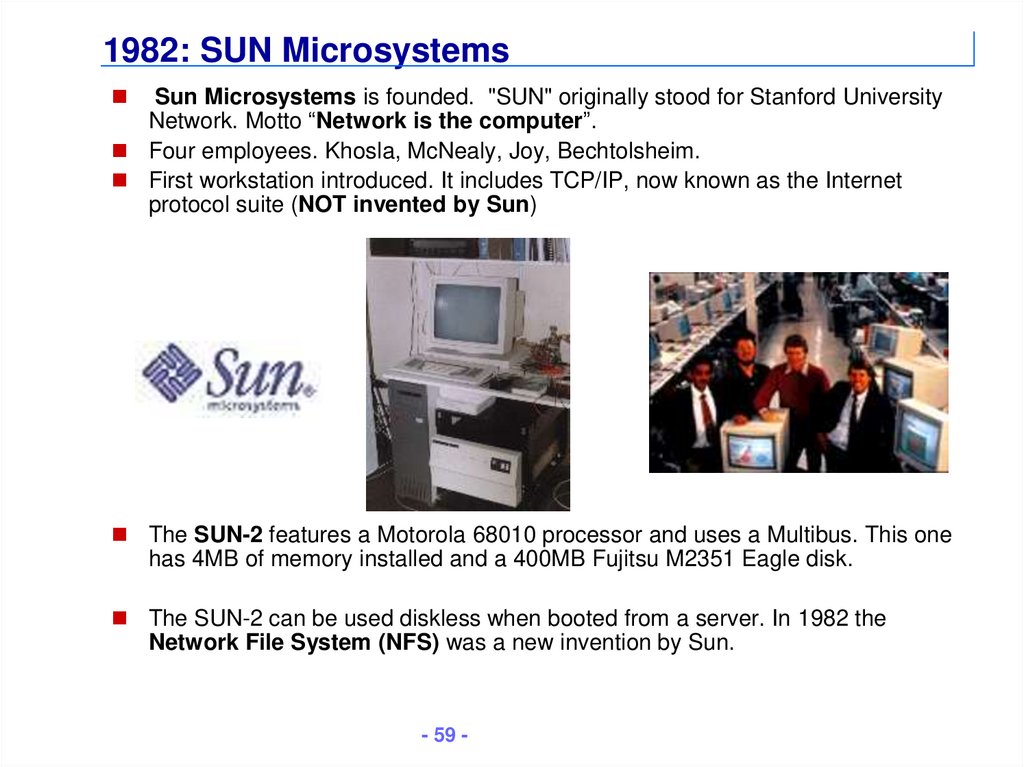
Sun Microsystems is founded. "SUN" originally stood for Stanford UniversityNetwork. Motto “Network is the computer”.
Four employees. Khosla, McNealy, Joy, Bechtolsheim.
First workstation introduced. It includes TCP/IP, now known as the Internet
protocol suite (NOT invented by Sun)
The SUN-2 features a Motorola 68010 processor and uses a Multibus. This one
has 4MB of memory installed and a 400MB Fujitsu M2351 Eagle disk.
The SUN-2 can be used diskless when booted from a server. In 1982 the
Network File System (NFS) was a new invention by Sun.
- 59 -
60. 1982
Microsoft signs an agreement with Apple Computer, for Microsoft todevelop applications for the Macintosh.
IBM splits its Personal Computer development team into three groups:
one to work on the PC XT, one to develop the PCjr, and one to start
work on the PC AT.
Compaq Computer Corporation is founded by Rod Canion, Jim
Harris, and Bill Murto, all former senior managers of Texas Instruments.
Intel introduces the 6-MHz 80286 microprocessor. It uses a 16-bit data
bus, 134,000 transistors (1.5 microns), and offers protected mode
operation. Initial price is US$360 each, in quantities of 100. It can
access 16 MB of memory, or 1 GB of virtual memory. Speed is 0.9
MIPS. Later versions operate at 8-MHz, 10-MHz (1.5 MIPS), and 12MHz (2.66 MIPS).
- 60 -
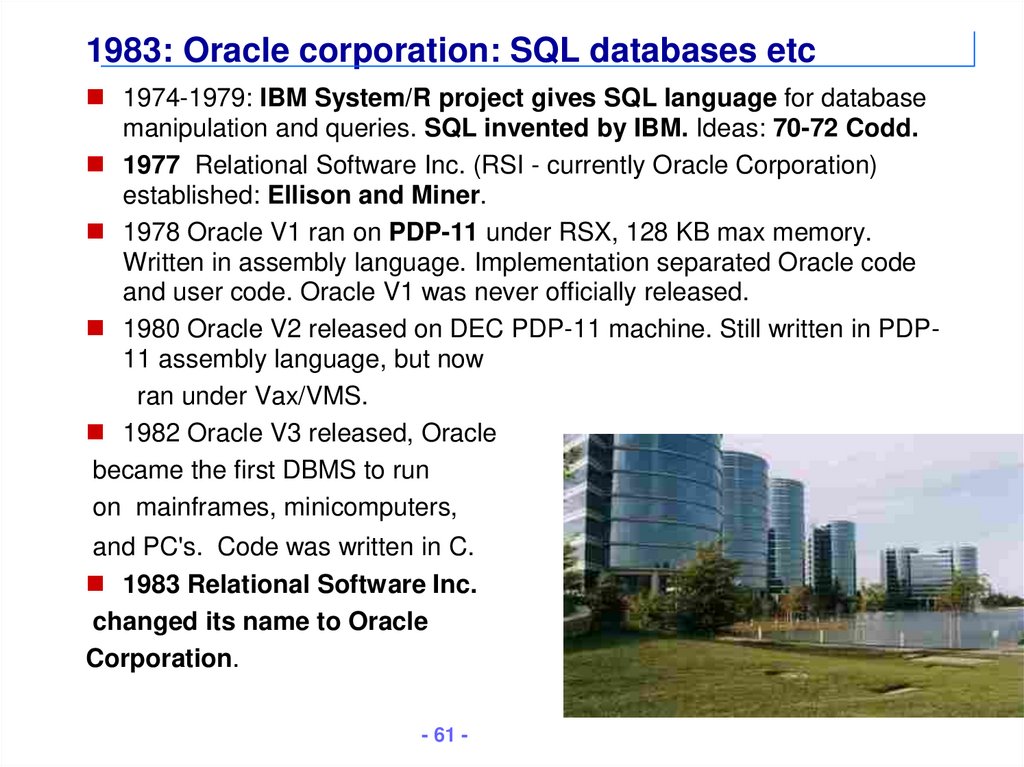
61. 1983: Oracle corporation: SQL databases etc
1974-1979: IBM System/R project gives SQL language for databasemanipulation and queries. SQL invented by IBM. Ideas: 70-72 Codd.
1977 Relational Software Inc. (RSI - currently Oracle Corporation)
established: Ellison and Miner.
1978 Oracle V1 ran on PDP-11 under RSX, 128 KB max memory.
Written in assembly language. Implementation separated Oracle code
and user code. Oracle V1 was never officially released.
1980 Oracle V2 released on DEC PDP-11 machine. Still written in PDP11 assembly language, but now
ran under Vax/VMS.
1982 Oracle V3 released, Oracle
became the first DBMS to run
on mainframes, minicomputers,
and PC's. Code was written in C.
1983 Relational Software Inc.
changed its name to Oracle
Corporation.
- 61 -
62. 1983: other important software
Big machines:AT&T announces UNIX System V.
AT&T Bell Labs designs C++.
Small machines:
Lotus Development ships Lotus 1-2-3 Release 1.0 for MS-DOS.
Functions: spreadsheet+database+graphics. US$1 million was spent
on promoting the release. It requires 256KB of RAM, more than any
microcomputer program at the time. Jonathan Sachs was the
programmer, with Mitch Kapor as the software designer.
Borland International is founded by Philippe Kahn. Borland
International releases Turbo Pascal for CP/M and 8086-based
computers.
- 62 -
63. 1983
The one millionth Apple II is made.Microsoft, SpectraVideo, and 14 Japanese computer companies
announce the MSX specifications for low-end, 8-bit home computers
systems. The standard is Zilog Z80, TI TMS9918A video processor,
General Instruments AY-8910 sound processor, NEC cassette interface
chip, Atari joystick interface, 64 KB RAM, Microsoft's 32 KB ROM-based
extended BASIC.
AT&T Bell Labs designs C++.
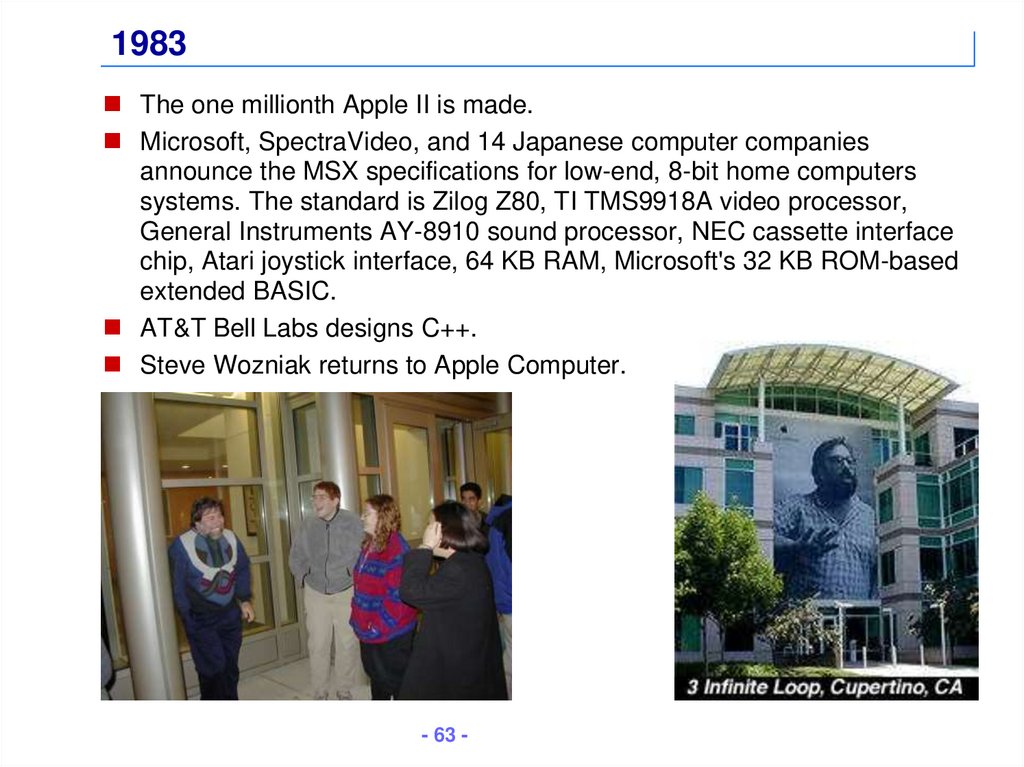
Steve Wozniak returns to Apple Computer.
- 63 -
64. 1983
The one millionth Apple II is made.Microsoft, SpectraVideo, and 14 Japanese computer companies
announce the MSX specifications for low-end, 8-bit home computers
systems. The standard is Zilog Z80, TI TMS9918A video processor,
General Instruments AY-8910 sound processor, NEC cassette interface
chip, Atari joystick interface, 64 KB RAM, Microsoft's 32 KB ROM-based
extended BASIC.
AT&T Bell Labs designs C++.
Steve Wozniak returns to Apple Computer.
- 64 -
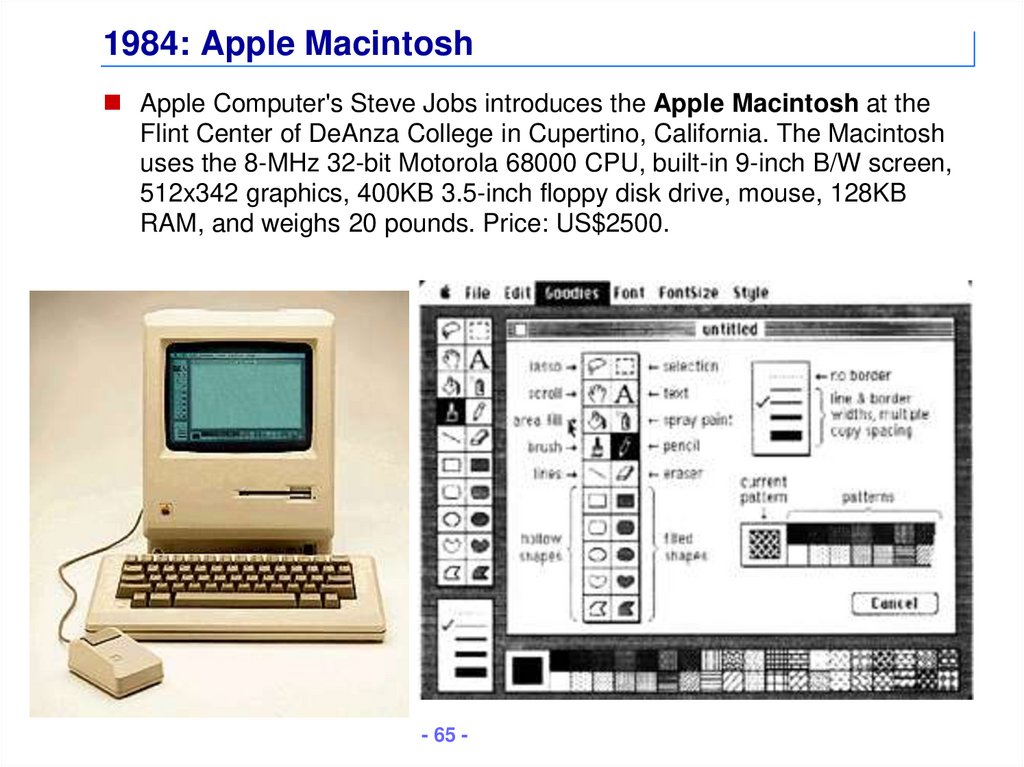
65. 1984: Apple Macintosh
Apple Computer's Steve Jobs introduces the Apple Macintosh at theFlint Center of DeAnza College in Cupertino, California. The Macintosh
uses the 8-MHz 32-bit Motorola 68000 CPU, built-in 9-inch B/W screen,
512x342 graphics, 400KB 3.5-inch floppy disk drive, mouse, 128KB
RAM, and weighs 20 pounds. Price: US$2500.
- 65 -
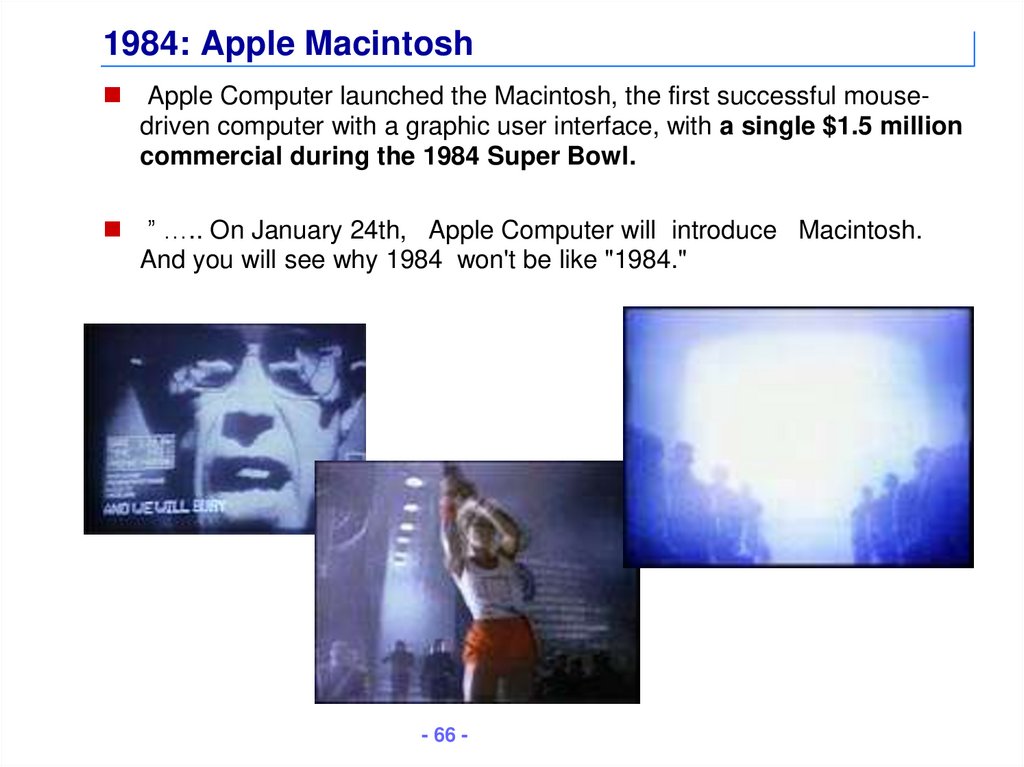
66. 1984: Apple Macintosh
Apple Computer launched the Macintosh, the first successful mousedriven computer with a graphic user interface, with a single $1.5 millioncommercial during the 1984 Super Bowl.
” ….. On January 24th, Apple Computer will introduce Macintosh.
And you will see why 1984 won't be like "1984."
- 66 -
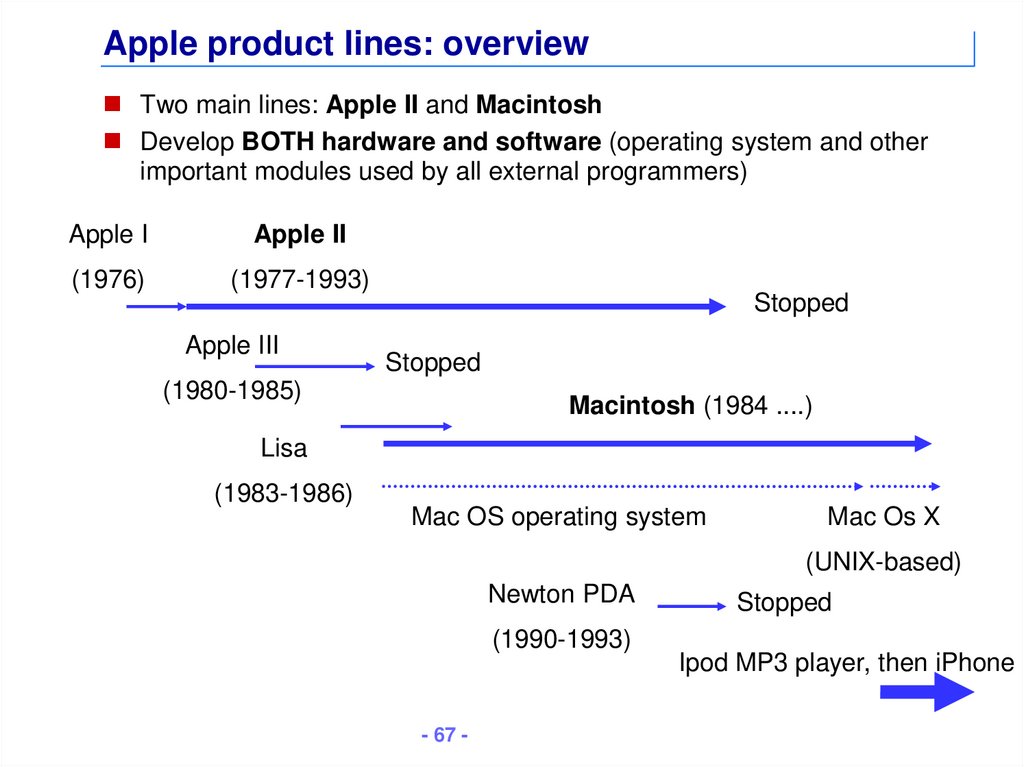
67. Apple product lines: overview
Two main lines: Apple II and MacintoshDevelop BOTH hardware and software (operating system and other
important modules used by all external programmers)
Apple I
Apple II
(1976)
(1977-1993)
Apple III
Stopped
Stopped
(1980-1985)
Macintosh (1984 ....)
Lisa
(1983-1986)
Mac OS operating system
Mac Os X
(UNIX-based)
Newton PDA
(1990-1993)
- 67 -
Stopped
Ipod MP3 player, then iPhone
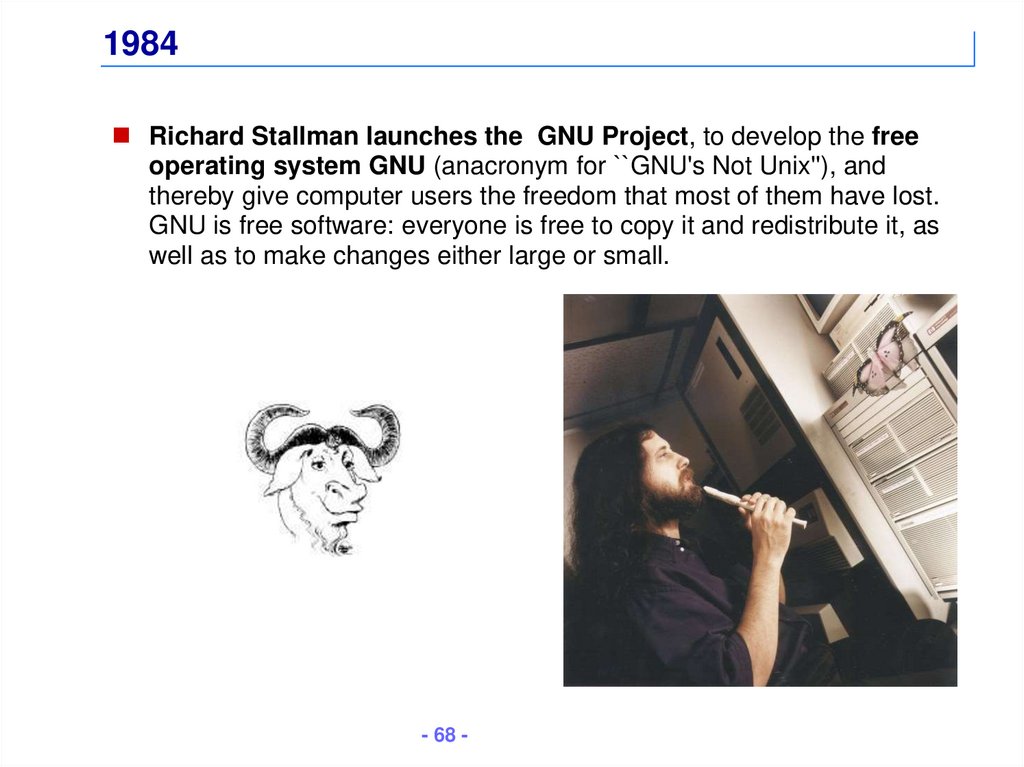
68. 1984
Richard Stallman launches the GNU Project, to develop the freeoperating system GNU (anacronym for ``GNU's Not Unix''), and
thereby give computer users the freedom that most of them have lost.
GNU is free software: everyone is free to copy it and redistribute it, as
well as to make changes either large or small.
- 68 -
69. 1984
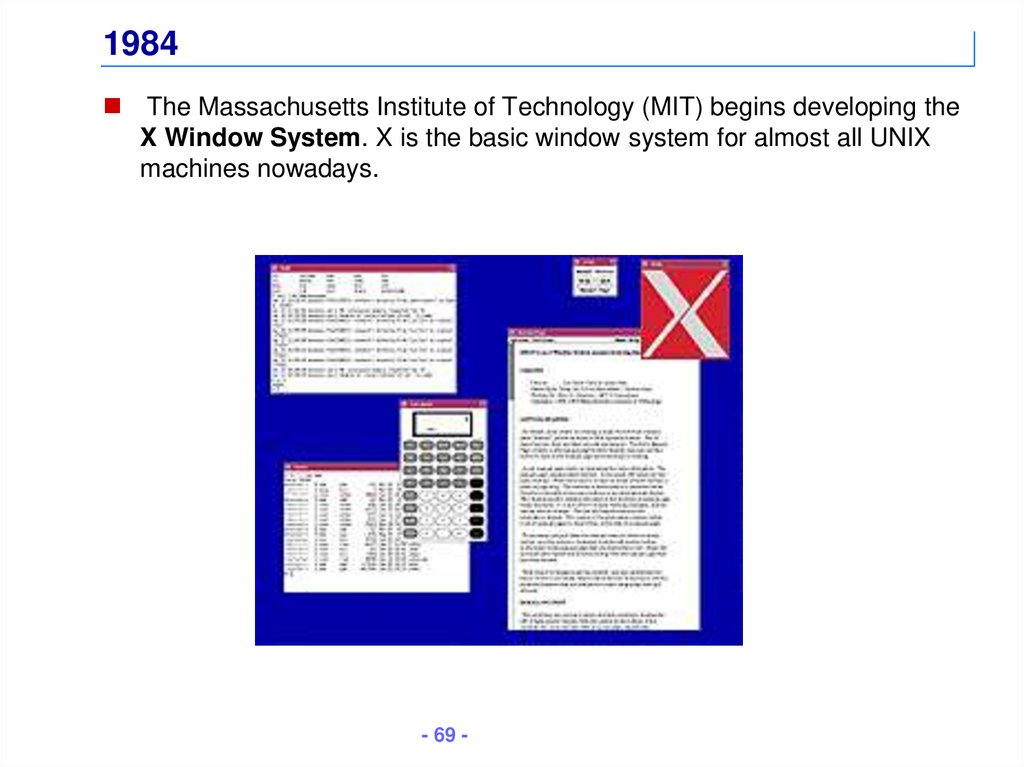
The Massachusetts Institute of Technology (MIT) begins developing theX Window System. X is the basic window system for almost all UNIX
machines nowadays.
- 69 -
70. 1985: Main highlihts
The modern Internet gained support when the National Sciencefoundation formed the NSFNET, linking five supercomputer centers at
Princeton University, Pittsburgh, University of California at San Diego,
University of Illinois at Urbana-Champaign, and Cornell University.
Able to hold 550 megabytes of prerecorded data, the new CD-ROMs
grew out of regular CDs on which music is recorded.
The C++ programming language emerged as the dominant objectoriented language in the computer industry when Bjarne Stroustrup
published "The C++ Programming Language."
Free GNU Emacs 15.34 released by Richard Stallman
- 70 -
71. Microsoft main product lines: overview
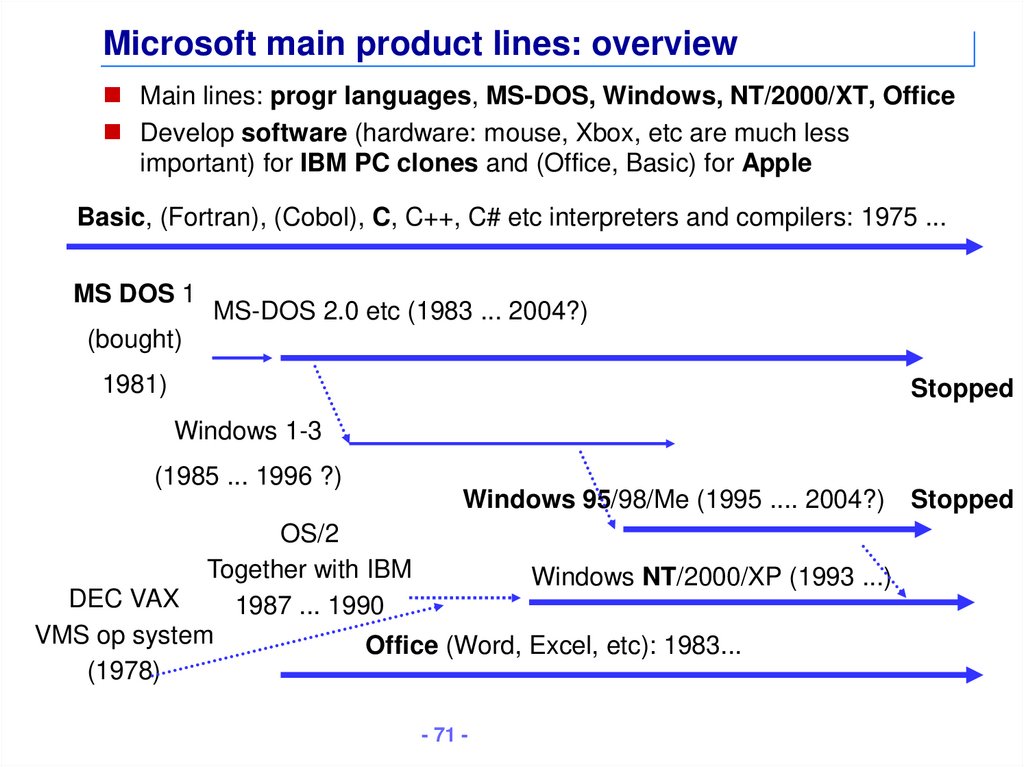
Main lines: progr languages, MS-DOS, Windows, NT/2000/XT, OfficeDevelop software (hardware: mouse, Xbox, etc are much less
important) for IBM PC clones and (Office, Basic) for Apple
Basic, (Fortran), (Cobol), C, C++, C# etc interpreters and compilers: 1975 ...
MS DOS 1
MS-DOS 2.0 etc (1983 ... 2004?)
(bought)
1981)
Stopped
Windows 1-3
(1985 ... 1996 ?)
Windows 95/98/Me (1995 .... 2004?)
OS/2
Together with IBM
Windows NT/2000/XP (1993 ...)
DEC VAX
1987 ... 1990
VMS op system
Office (Word, Excel, etc): 1983...
(1978)
- 71 -
Stopped
72. 1987
Motorola unveiled the 68030 microprocessor.Sun unveiled the Sparc microprocessor, based on RISC ideas.
IBM introduced its PS/2 machines, which made the 3 1/2-inch floppy
disk drive and video graphics array (VGA) standard for IBM computers.
Apple engineer William Atkinson designed HyperCard, a software tool
that simplifies development of in-house applications. HyperCard was
one of the inspirations for the web browser, which came in 1990.
- 72 -
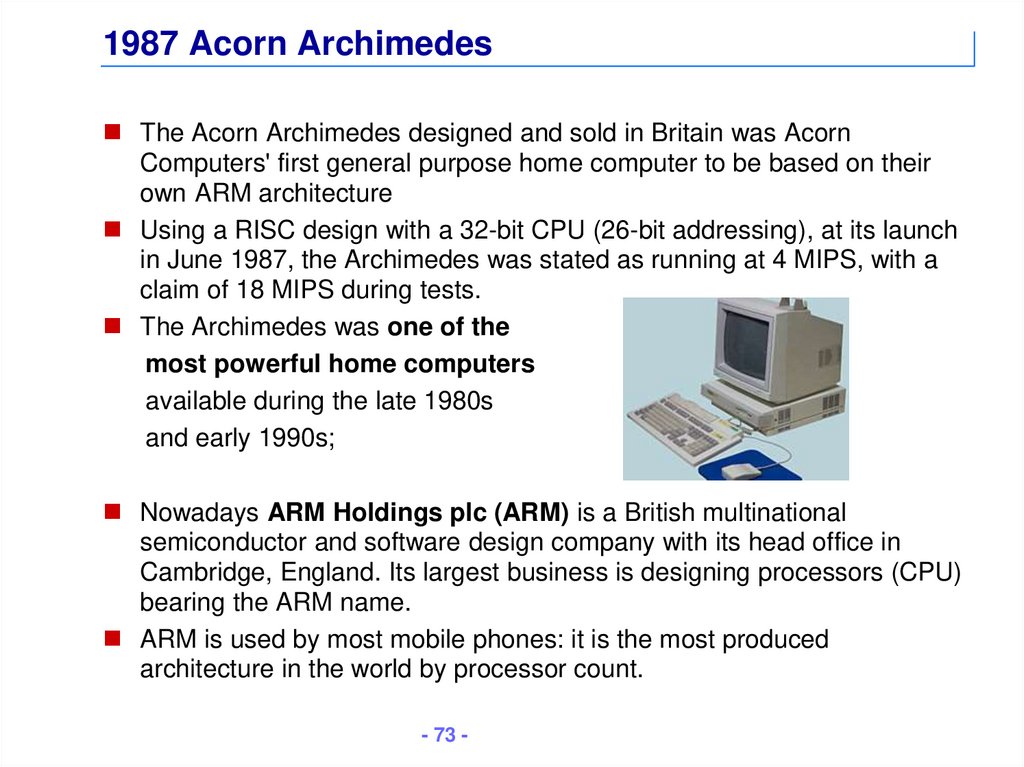
73. 1987 Acorn Archimedes
The Acorn Archimedes designed and sold in Britain was AcornComputers' first general purpose home computer to be based on their
own ARM architecture
Using a RISC design with a 32-bit CPU (26-bit addressing), at its launch
in June 1987, the Archimedes was stated as running at 4 MIPS, with a
claim of 18 MIPS during tests.
The Archimedes was one of the
most powerful home computers
available during the late 1980s
and early 1990s;
Nowadays ARM Holdings plc (ARM) is a British multinational
semiconductor and software design company with its head office in
Cambridge, England. Its largest business is designing processors (CPU)
bearing the ARM name.
ARM is used by most mobile phones: it is the most produced
architecture in the world by processor count.
- 73 -
74. Side note: CISC vs RISC processor architectures
CISC: complex instruction set computer (Intel, motorola 68000 series, ..)A large number of instructions, most are relatively slow
RISC: reduced instruction set computer (ARM, PowerPC, Sparc, ....)
A small number of instructions, all are very fast
In practice, CISC and RISC ideas converge in newer processors
- 74 -
75. 1987: GCC, the main C compiler on UNIX
GCC version 1.0 released by Free Software Foundation founder RichardStallman.
GCC once stood for GNU C Compiler, since it was used to compile
programs written in the C programming language for Stallman's "GNU's
Not Unix" (GNU) effort to create a clone of Unix. Now, though, because
GCC accepts programs written in many other languages as well, GCC
stands for GNU Compiler Collection.
GCC is the main compiler used on all kinds of UNIX-es, and several
ports of GCC (cygwin, djgpp) are highly popular on MS Windows as well
Ported to a very large number of processors
Compiles: C, C++, Objective C, Fortran, Java, Ada, (Pascal)
- 75 -
76. 1988
Apple cofounder Steve Jobs, who left Apple to form his own company,unveiled the NeXT workstation.
Compaq and other PC-clone makers developed enhanced industry
standard architecture -- better than microchannel and retained
compatibility with existing machine (ISA).
Pixar's "Tin Toy" became the first computer-animated film to win an
Academy Award, taking the Oscar for best animated short film. Pixar
was founded by Jobs.
Robert Morris' worm flooded the ARPANET. Then-23-year-old
Morris, the son of a computer security expert for the National Security
Agency, sent a nondestructive worm through the Internet, causing
problems for about 6,000 of the 60,000 hosts linked to the network.
- 76 -
77. 1989
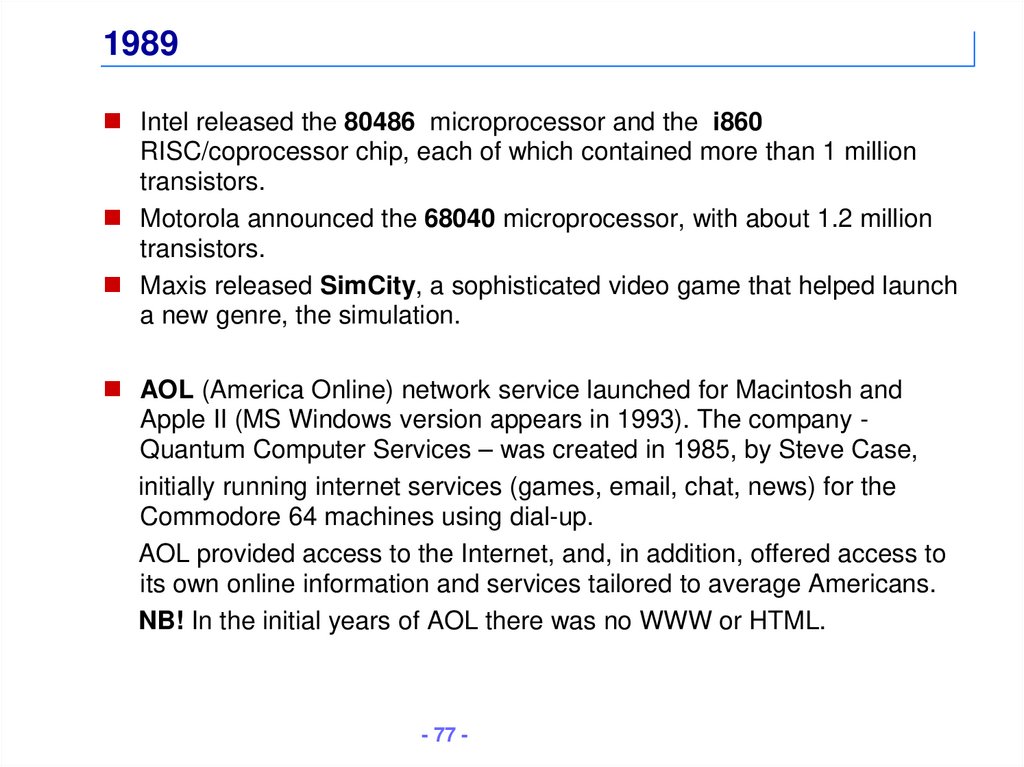
Intel released the 80486 microprocessor and the i860RISC/coprocessor chip, each of which contained more than 1 million
transistors.
Motorola announced the 68040 microprocessor, with about 1.2 million
transistors.
Maxis released SimCity, a sophisticated video game that helped launch
a new genre, the simulation.
AOL (America Online) network service launched for Macintosh and
Apple II (MS Windows version appears in 1993). The company Quantum Computer Services – was created in 1985, by Steve Case,
initially running internet services (games, email, chat, news) for the
Commodore 64 machines using dial-up.
AOL provided access to the Internet, and, in addition, offered access to
its own online information and services tailored to average Americans.
NB! In the initial years of AOL there was no WWW or HTML.
- 77 -