

 История
Похожие презентации:



From Restoration to The Enlightenment 1660-1798
1. From Restoration to The Enlightenment 1660-1798
Also known as. . .The Augustan Age,
The Neoclassical Period,
The Enlightenment, and The Age of Reason
2. Monarchy
Charles II—marked beginning of Restoration PeriodExiled to Europe—invited back after Oliver Cromwell’s
death
Set the tone of upper-class social & political life
Tried to emulate the sophistication & splendor of Louis
XIV’s court in France
Reestablished Church of England
Parliament—shared power with Monarchy
3. Why is this time known as the Restoration Period?
The period begins with the RESTORATIONof the Monarchy in 1660 bringing
Charles II from his exile in France.
1. Brings with him the indulgent and
artistic ways of Louis XIV’s court
2. Two distinct political parties resulted,
the Whigs and the Tories
a. Whigs want to limit royal authority
b. Tories support absolute royal
authority.
4. More politics and kings . . .
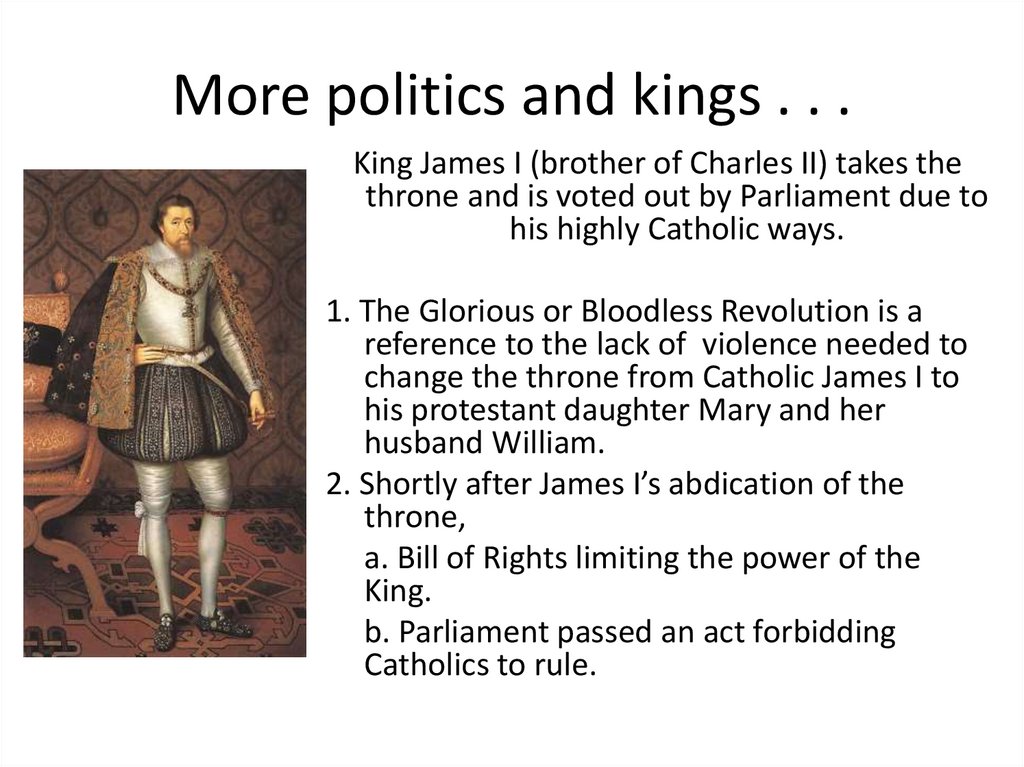
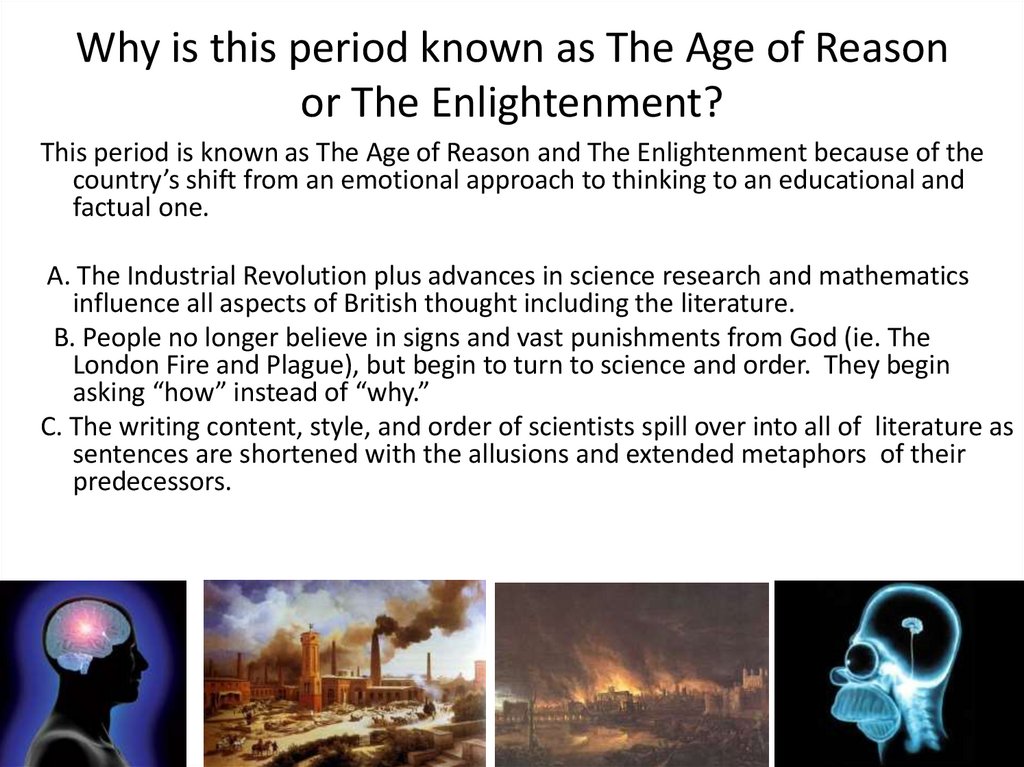
King James I (brother of Charles II) takes thethrone and is voted out by Parliament due to
his highly Catholic ways.
1. The Glorious or Bloodless Revolution is a
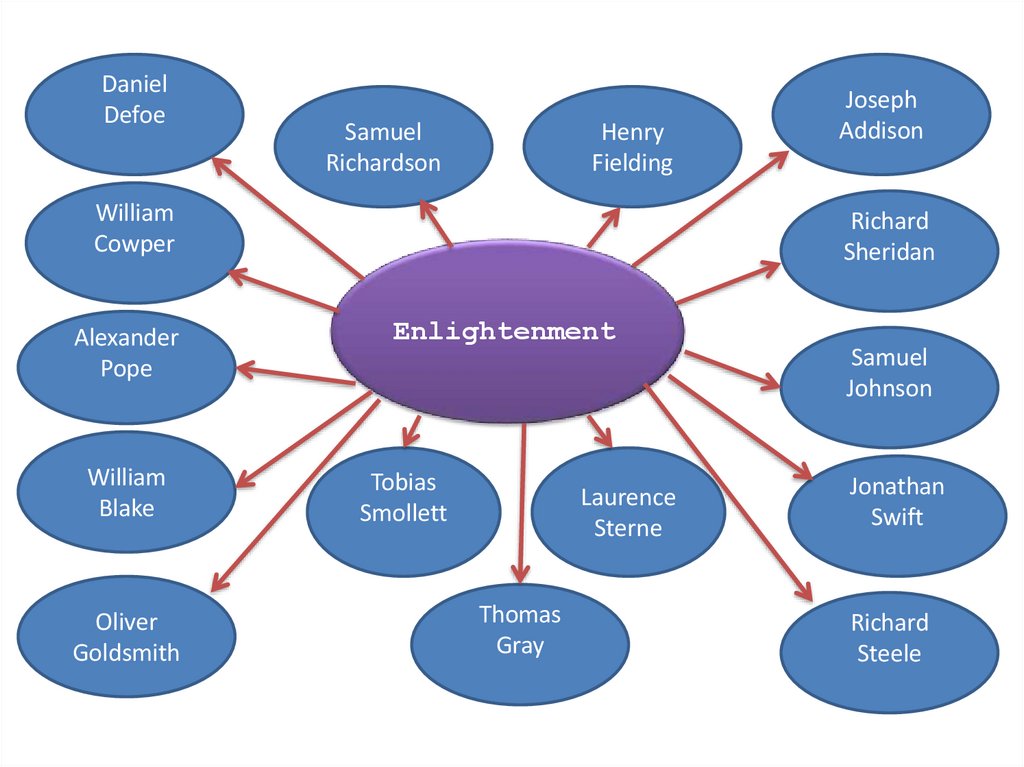
reference to the lack of violence needed to
change the throne from Catholic James I to
his protestant daughter Mary and her
husband William.
2. Shortly after James I’s abdication of the
throne,
a. Bill of Rights limiting the power of the
King.
b. Parliament passed an act forbidding
Catholics to rule.
5. The House of Hanover
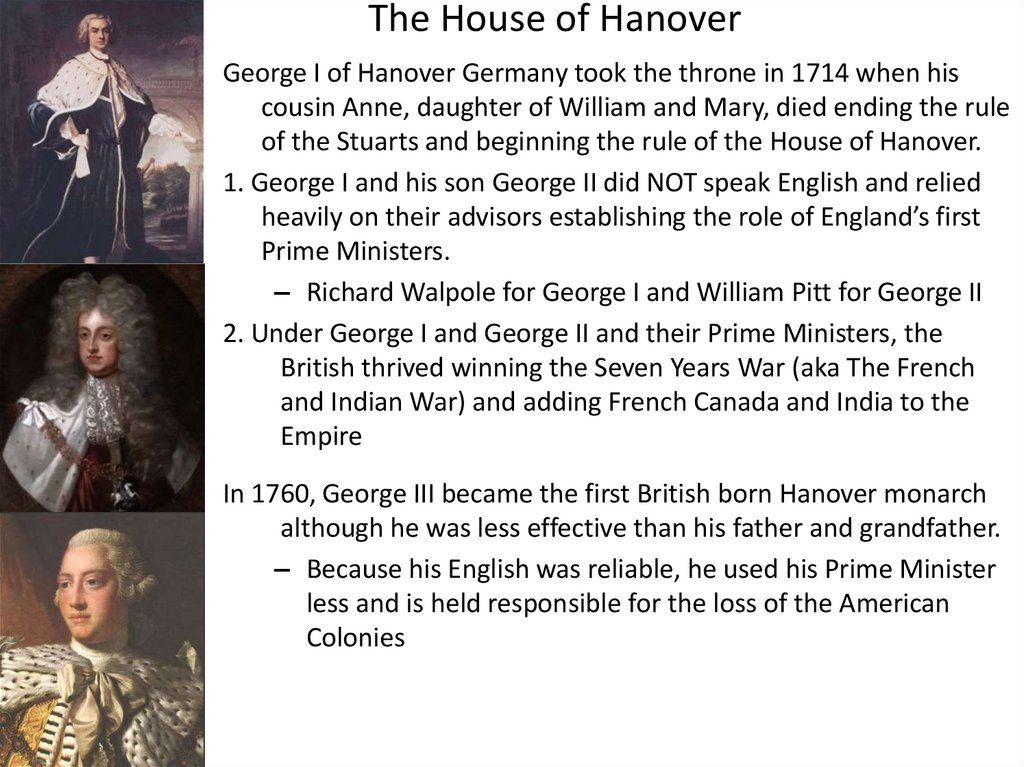
George I of Hanover Germany took the throne in 1714 when hiscousin Anne, daughter of William and Mary, died ending the rule
of the Stuarts and beginning the rule of the House of Hanover.
1. George I and his son George II did NOT speak English and relied
heavily on their advisors establishing the role of England’s first
Prime Ministers.
– Richard Walpole for George I and William Pitt for George II
2. Under George I and George II and their Prime Ministers, the
British thrived winning the Seven Years War (aka The French
and Indian War) and adding French Canada and India to the
Empire
In 1760, George III became the first British born Hanover monarch
although he was less effective than his father and grandfather.
– Because his English was reliable, he used his Prime Minister
less and is held responsible for the loss of the American
Colonies
6. Disasters
Great Plague—1665Last major outbreak of bubonic plague
Killed an estimated 100,000 people (20% of
London’s population)
Great Fire of London—1666
Uncontrolled fire that lasted for 3 days in central
London
Destroyed over 13,000 homes and numerous
government buildings
Few deaths recorded
7. Political Parties
ToriesSupported royal authority
Did not want war with France
Whigs
Wanted to limit royal authority with wealthy
merchants and nobles
Wanted to limit French expansion in Europe and
North America
8. Other Royalty
House of StuartEnglish Bill of Rights—put specific limits on royal
authority
William
Tried to oppose Louis XIV with Whig support
Began series of war with France
Act of Settlement—Parliament law that permanently
barred Catholics from throne
Anne—last monarch in House of Stuart
Faithfully ruler who united Scotland & England
9. Other Royalty (continued)
House of Hanover (Germany)Disliked by Tories
George II instituted 1st official prime minister
Seven Years’ War with France
Britain acquired Canada
George III wanted more control
Angered many due to thirst for power
Lost American colonies due to political blunders
10. The Age of Reason & Enlightenment
The Age of Reason & EnlightenmentPeople began to use scientific reasoning to
understand the world
Apply reason so people could understand the natural
causes of events
Scientific Method
Developed by Sir Isaac Newton
Still used today
Analyze facts
Develop a hypothesis
Test the hypothesis with experimentation
11. Enlightenment Philosophies
Inspired by Newton’s discoveriesJohn Locke
Encouraged people to use their intelligence to rid
themselves of unjust authorities
Rejected divine right of kings
Asserted the rights of citizens to revolt against
unfair government
12. Living Well
Improvement in living conditionsDevelopment of smallpox vaccine
Wealthy aristocrats built lavish estates with
beautiful lawns & gardens
Spacious new streets & squares in London
Coffeehouses
Gathering places for writers, artists, politicians &
other members of society
13. Women
Wanted to be educated equally as menWanted to be allowed to join professions to
strengthen relationship between the sexes
Salons
Private gathering places where women could
participate in the nation’s social
lifeiponзщдшtellectual life
14. Industrial Revolution
Period of major changes in agriculture,manufacturing, mining, transport, and
technology
Affected almost every aspect of daily life
Income and population grew
Living conditions differed greatly
15. Improvements in Industry
Machine OperationsIron making techniques
Introduction of canals along with improved
roads and railways
Steam power fueled by coal
Gas lighting
Printing
Chemicals
16. Literature of the Times
Social ObserversMiddle class grew and prospered
Ordinary men & women had more money, leisure
activities, and educational opportunities
New audience willing to read and pay for
literature who wanted literature to be written in a
clear language that they could understand
17. Journalism
Newspapers flourished—restrictions wereeased
The Tatler & The Spectator
Satisfied middle-class appetite for instruction &
amusement
Newspapers gave opinions on everything from
social manners to international politics and
did not report current events
18. Restoration Period
• Dryden, John (1631-1700), English poet,dramatist, and critic,
• Milton, John (1608-1674))English poet
19. Dryden, John (1631-1700),
• English poet and dramatist. He is noted for hissatirical verse and for his use of the heroic
couplet. His poetry includes the verse satire
Absalom and Achitophel (1681), Annus
Mirabilis (1667), and 'A Song for St Cecilia's
Day' (1687).
• Plays include the heroic drama The Conquest
of Granada (1672), the comedy Marriage а la
Mode (1673), and All for Love (1678)
20.
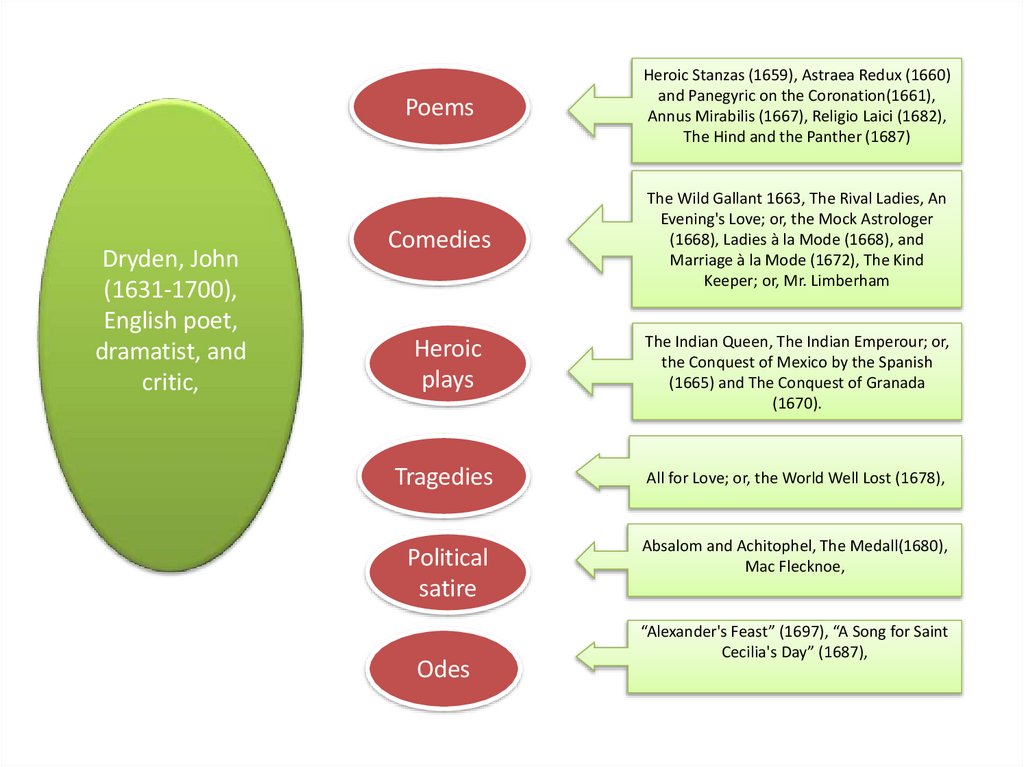
Dryden, John(1631-1700),
English poet,
dramatist, and
critic,
Poems
Heroic Stanzas (1659), Astraea Redux (1660)
and Panegyric on the Coronation(1661),
Annus Mirabilis (1667), Religio Laici (1682),
The Hind and the Panther (1687)
Comedies
The Wild Gallant 1663, The Rival Ladies, An
Evening's Love; or, the Mock Astrologer
(1668), Ladies à la Mode (1668), and
Marriage à la Mode (1672), The Kind
Keeper; or, Mr. Limberham
Heroic
plays
The Indian Queen, The Indian Emperour; or,
the Conquest of Mexico by the Spanish
(1665) and The Conquest of Granada
(1670).
Tragedies
All for Love; or, the World Well Lost (1678),
Political
satire
Absalom and Achitophel, The Medall(1680),
Mac Flecknoe,
Odes
“Alexander's Feast” (1697), “A Song for Saint
Cecilia's Day” (1687),
21. Milton, John (1608-1674)English poet
• English poet and prose writer. His epic Paradise Lost (1667)is one of the landmarks of English literature. Early poems,
including Comus (a masque performed in 1634) and Lycidas
(an elegy, 1638), showed Milton's outstanding lyric gift. He
also wrote many pamphlets and prose works, including
Areopagitica (1644), which opposed press censorship.
• Paradise Lost and the less successful sequel Paradise
Regained (1671) were written when he was blind and in
some political danger (after the restoration of Charles II), as
was the dramatic poem Samson Agonistes (1671).
• ..\lecture 6\plbk1.ppt
• ..\lecture 6\paradiselost_01_milton.mp3
22.
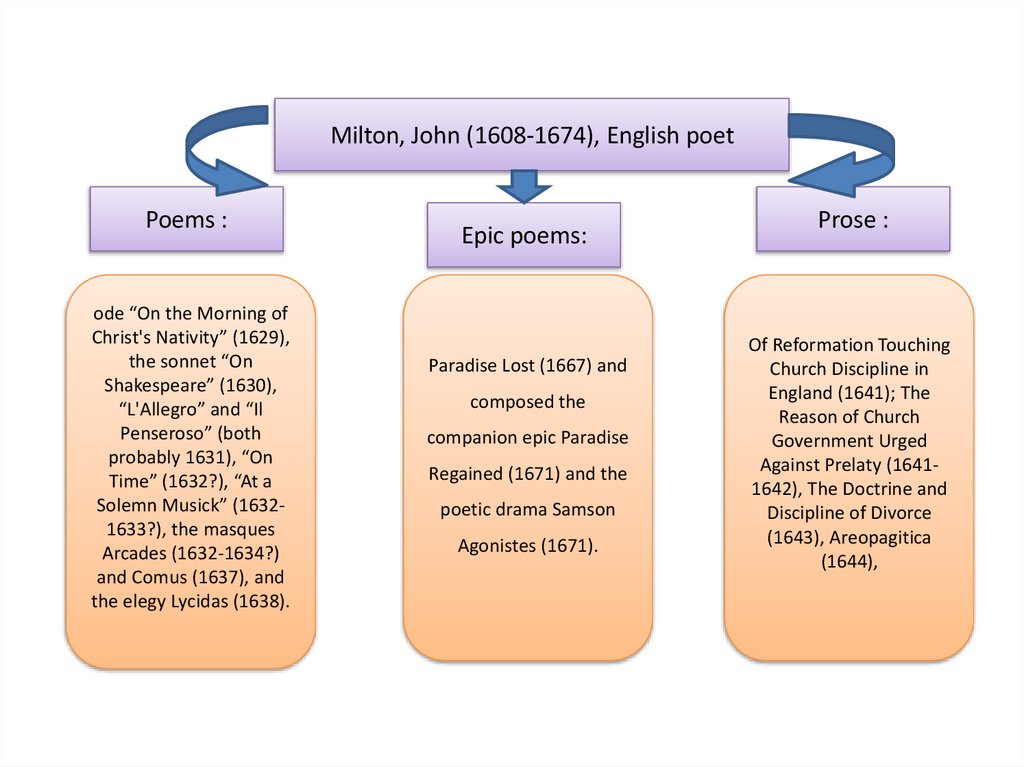
, Milton, John (1608-1674), English poetPoems :
ode “On the Morning of
Christ's Nativity” (1629),
the sonnet “On
Shakespeare” (1630),
“L'Allegro” and “Il
Penseroso” (both
probably 1631), “On
Time” (1632?), “At a
Solemn Musick” (16321633?), the masques
Arcades (1632-1634?)
and Comus (1637), and
the elegy Lycidas (1638).
Epic poems:
Paradise Lost (1667) and
composed the
companion epic Paradise
Regained (1671) and the
poetic drama Samson
Agonistes (1671).
Prose :
Of Reformation Touching
Church Discipline in
England (1641); The
Reason of Church
Government Urged
Against Prelaty (16411642), The Doctrine and
Discipline of Divorce
(1643), Areopagitica
(1644),
23. The Enlightenment – its ideals and objectives
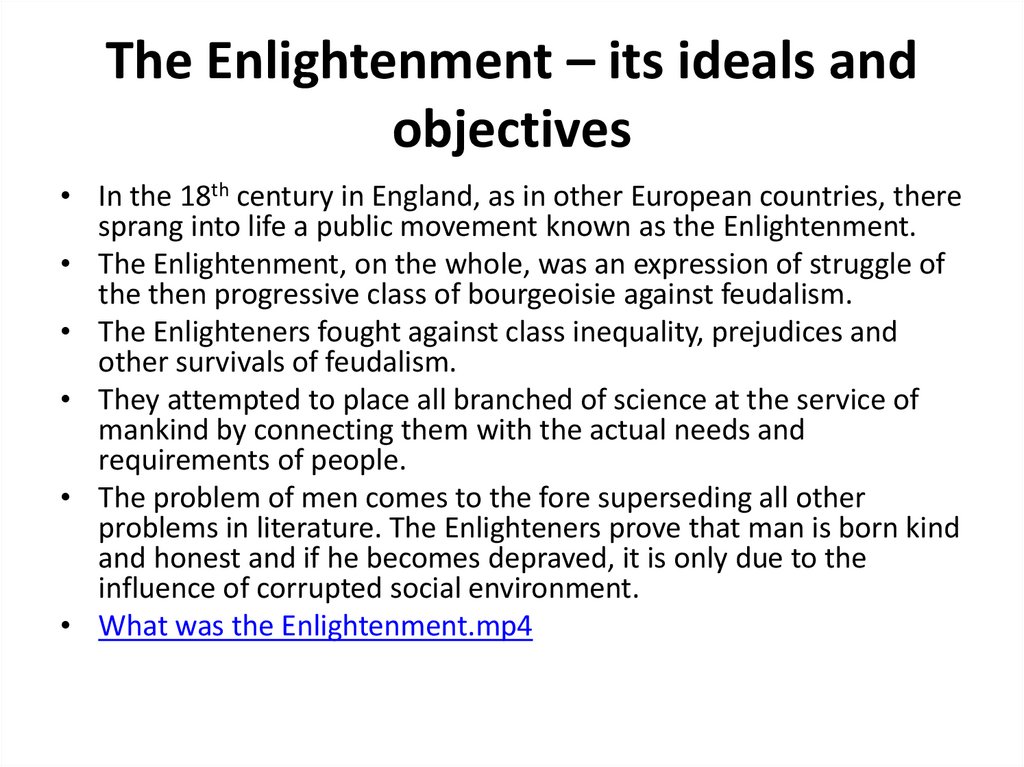
• In the 18th century in England, as in other European countries, theresprang into life a public movement known as the Enlightenment.
• The Enlightenment, on the whole, was an expression of struggle of
the then progressive class of bourgeoisie against feudalism.
• The Enlighteners fought against class inequality, prejudices and
other survivals of feudalism.
• They attempted to place all branched of science at the service of
mankind by connecting them with the actual needs and
requirements of people.
• The problem of men comes to the fore superseding all other
problems in literature. The Enlighteners prove that man is born kind
and honest and if he becomes depraved, it is only due to the
influence of corrupted social environment.
• What was the Enlightenment.mp4
24. Why is this period known as the Augustan Period?
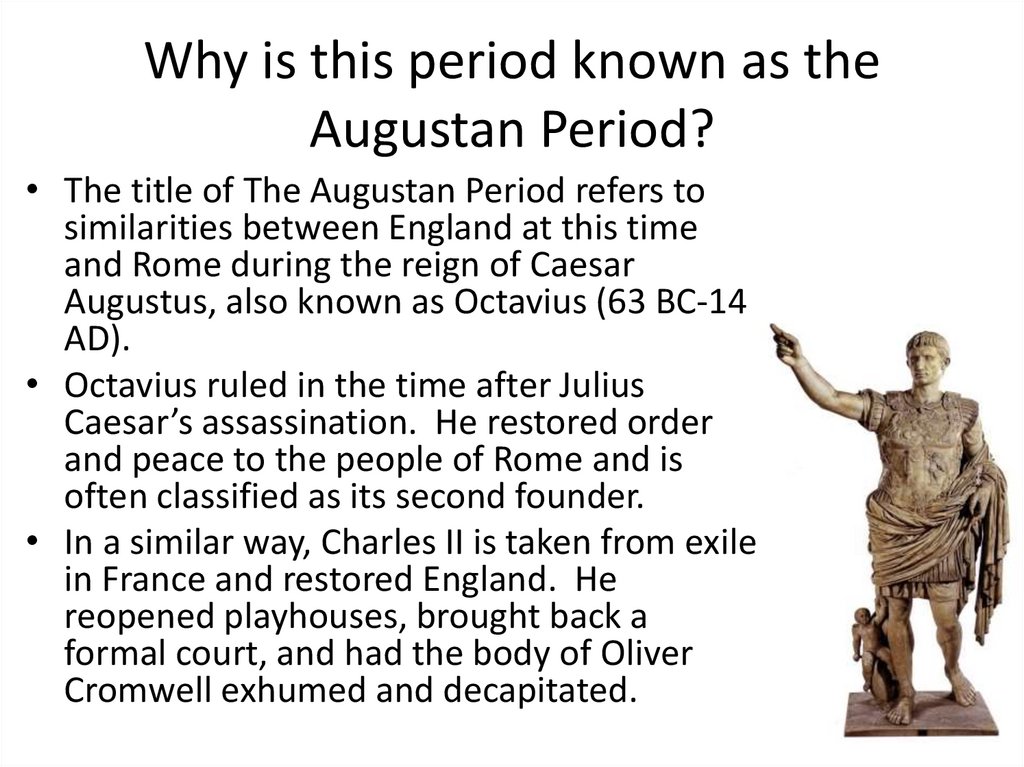
• The title of The Augustan Period refers tosimilarities between England at this time
and Rome during the reign of Caesar
Augustus, also known as Octavius (63 BC-14
AD).
• Octavius ruled in the time after Julius
Caesar’s assassination. He restored order
and peace to the people of Rome and is
often classified as its second founder.
• In a similar way, Charles II is taken from exile
in France and restored England. He
reopened playhouses, brought back a
formal court, and had the body of Oliver
Cromwell exhumed and decapitated.
25. Why is this period known as the Neoclassical Period?
• Most educated people of the time are familiarwith the classical works as well as the works of
their own time and country and found enjoyment
in their connection.
• They enjoyed allusions to the political
connections of the time periods and references
to the classical characters and themes.
• Works emphasizing these similarities are labeled
“neoclassical” meaning “new classics.”
26. Why is this period known as The Age of Reason or The Enlightenment?
This period is known as The Age of Reason and The Enlightenment because of thecountry’s shift from an emotional approach to thinking to an educational and
factual one.
A. The Industrial Revolution plus advances in science research and mathematics
influence all aspects of British thought including the literature.
B. People no longer believe in signs and vast punishments from God (ie. The
London Fire and Plague), but begin to turn to science and order. They begin
asking “how” instead of “why.”
C. The writing content, style, and order of scientists spill over into all of literature as
sentences are shortened with the allusions and extended metaphors of their
predecessors.
27. Key features
• • the rise of the novel as a popular if critically unprestigiousgenre;
• • the growth of journalism and magazines, with a corresponding
growth in professional authorship;
• • a noticeable increase in literary criticism, leading to the
establishment of what was critically acceptable and what was not;
• • a decline in the reputation of contemporary drama, while the
theatre attracted increasing support;
• • a reaction to Augustan neoclassicism in poetry, with moves
towards the funereal mode, or the rediscovery of simpler values;
• • towards the end of the eighteenth century, an attraction for the
fantastic, the exotic and the primitive.
28. Some more features
• Inevitability of Progress• Beneficence of God
• Perfection of MAN
• Superiority of Nature
29.
DanielDefoe
Samuel
Richardson
Henry
Fielding
William
Cowper
Alexander
Pope
William
Blake
Oliver
Goldsmith
Joseph
Addison
Richard
Sheridan
Enlightenment
Samuel
Johnson
Tobias
Smollett
Laurence
Sterne
Thomas
Gray
Jonathan
Swift
Richard
Steele
30. DANIEL DEFOE (1660-1731)
• Daniel Defoe (Foe) was born in London in 1660.• His first political pamphlet was “The True-Born
Englishman” (1701) in which he exposes the
aristocracy and tyranny of the church.
• The year 1719 marked a new period in Defoe’s
literary activity. At the age of 60 he published his
first novel “Robinson Crusoe”
• His other novels are: “Captain Singleton” (1720),
“Moll Flanders” (1722), “Colonel Jack” (1722),
“Roxana” (1724), “A Journal of the Plague Year”
(1722).
31. DANIEL DEFOE (1660-1731)
• video Emlightenment\Interesting Daniel DefoeFacts.mp4
• Top 10 Notes- Robinson Crusoe.mp4
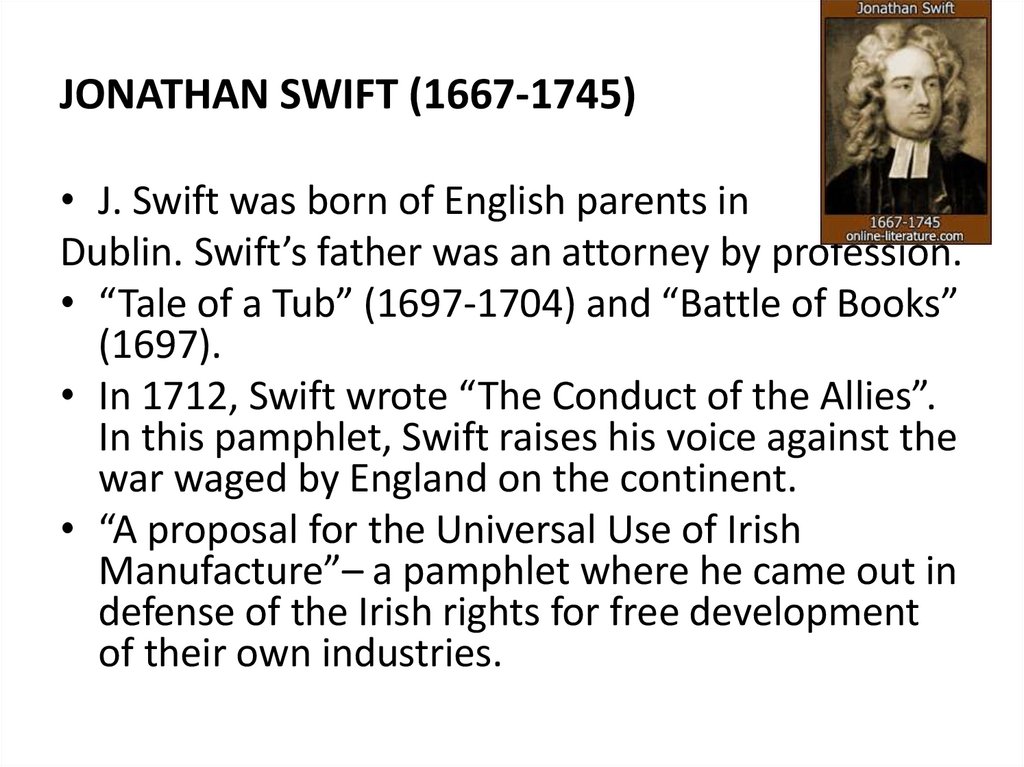
32. JONATHAN SWIFT (1667-1745)
• J. Swift was born of English parents inDublin. Swift’s father was an attorney by profession.
• “Tale of a Tub” (1697-1704) and “Battle of Books”
(1697).
• In 1712, Swift wrote “The Conduct of the Allies”.
In this pamphlet, Swift raises his voice against the
war waged by England on the continent.
• “A proposal for the Universal Use of Irish
Manufacture”– a pamphlet where he came out in
defense of the Irish rights for free development
of their own industries.
33. JONATHAN SWIFT (1667-1745)
• video Enlightenment\Top 10 Notes_ Gulliver'sTravels.mp4
• video Enlightenment\Satire in A Modest
Proposal.mp4
• video Enlightenment\A Modest Proposal
Summary.mp4
34. “Gulliver’s Travels”
• In 1716, Swift’s greatest work “Gulliver’sTravels” made its appearance. Swift portrays
contemporary life satirically. It contains the
adventures of a ship surgeon as told by him
and is divided into four parts of voyages.
35. “Gulliver’s Travels”
The first part contains an account of Lilliput and its little people. They are less than
six inches high. Everything else in the country is in the same proportion. Here the
satire is directed to the meanness and conventionality of the morality of politicians
and statesmen.
The second part tells of Brobdignag and its giants, they are sixty feet in height. The
giants live a simple Utopian life.
The third part tells about Laputa, a flying island. Ladago is a city with an absurd
academy and so on. Glubbdubdrib, and Ireland of magicians, and Luggnagg,
another island where wretched people continue living.
The fourth part brings Gulliver to the country of the Honyhnhums, where the
intelligent creatures are horses, and all the human beings (Yahoos) monsters are
reduced to the level of brutes. It is in describing these Yahoos that Swift shows
how bitterly he hated society vices. He decides that horses are clever and more
decent creatures than men.
36. HENRY FIELDING (1707-1754)
• Henry Fielding was born on the 22nd of April 1707 to anaristocratic family.
• Fielding began his literary career in 1728 and soon became
one of the most popular playwrights in London.
• In his best comedies “A Judge Caught in His Own Trap”
(1730), “Don Quixote in England” (1734), “Pasquin” (1736).
Fielding mercilessly exposed England courts of law, the
parliamentary system and the cupidity of state officials.
• He criticized the vices of the bourgeoisie and aristocracy –
their hypocrisy, greed and cruelty – and revealed the most
striking aspect of contemporary society.
37. HENRY FIELDING (1707-1754)
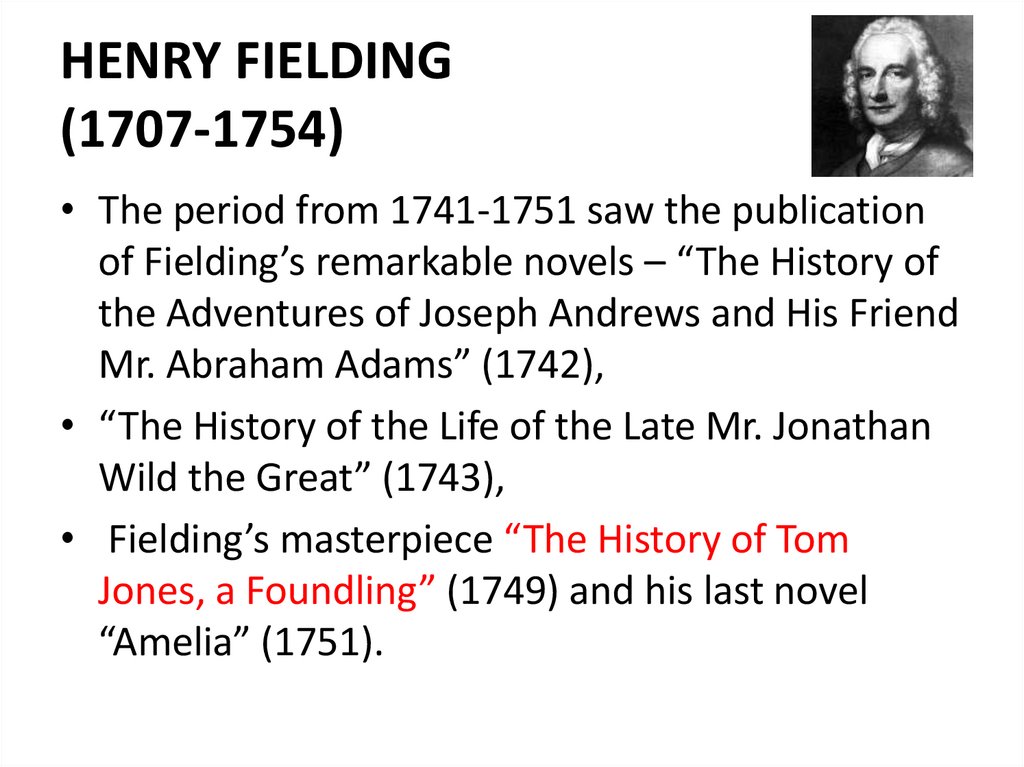
• The period from 1741-1751 saw the publicationof Fielding’s remarkable novels – “The History of
the Adventures of Joseph Andrews and His Friend
Mr. Abraham Adams” (1742),
• “The History of the Life of the Late Mr. Jonathan
Wild the Great” (1743),
• Fielding’s masterpiece “The History of Tom
Jones, a Foundling” (1749) and his last novel
“Amelia” (1751).
38. “The History of Tom Jones, a Foundling”
• “The History of Tom Jones, a Foundling” (1749) ishis principal novel. It contains a picture of life and
manners and tells the story of Tom Jones, a
generous, open, manly young fellow who gets
into all sorts of scrapes.
• In his works Fielding strongly criticizes social
relations in the contemporary England.
Aristocrats and men set in authority embody all
the evils; they persecute the heroes and obstruct
their every more and action.
39.
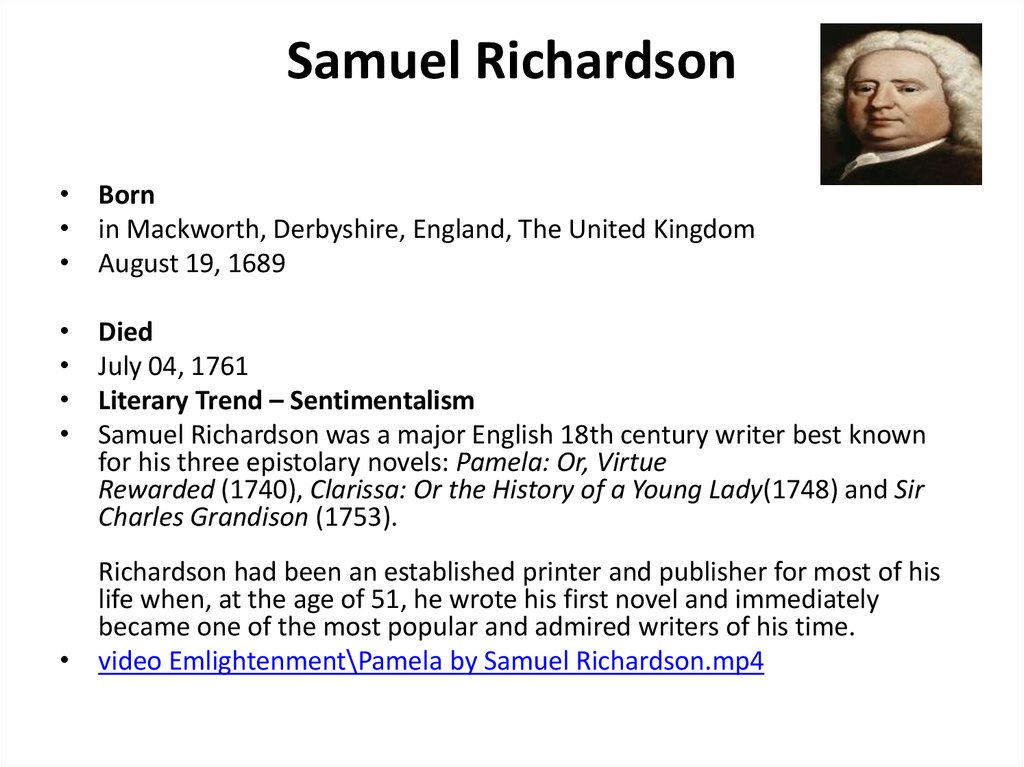
• video Enlightenment\tom-jones-2.ppt40. Samuel Richardson
• Born• in Mackworth, Derbyshire, England, The United Kingdom
• August 19, 1689
Died
July 04, 1761
Literary Trend – Sentimentalism
Samuel Richardson was a major English 18th century writer best known
for his three epistolary novels: Pamela: Or, Virtue
Rewarded (1740), Clarissa: Or the History of a Young Lady(1748) and Sir
Charles Grandison (1753).
Richardson had been an established printer and publisher for most of his
life when, at the age of 51, he wrote his first novel and immediately
became one of the most popular and admired writers of his time.
• video Emlightenment\Pamela by Samuel Richardson.mp4
41. RICHARD BRINSLEY SHERIDAN (1751-1816)
• Richard Brinsley Sheridan is the mostoutstanding satirist in the drama of the
Enlightenment.
• Sheridan’s tribute to the vogue of the day was
his comic opera “The Duenna” (1775). Its plot
shows the influence of Molliere and the
Spanish comedy. In 1777 he wrote “The
School for Scandal”.
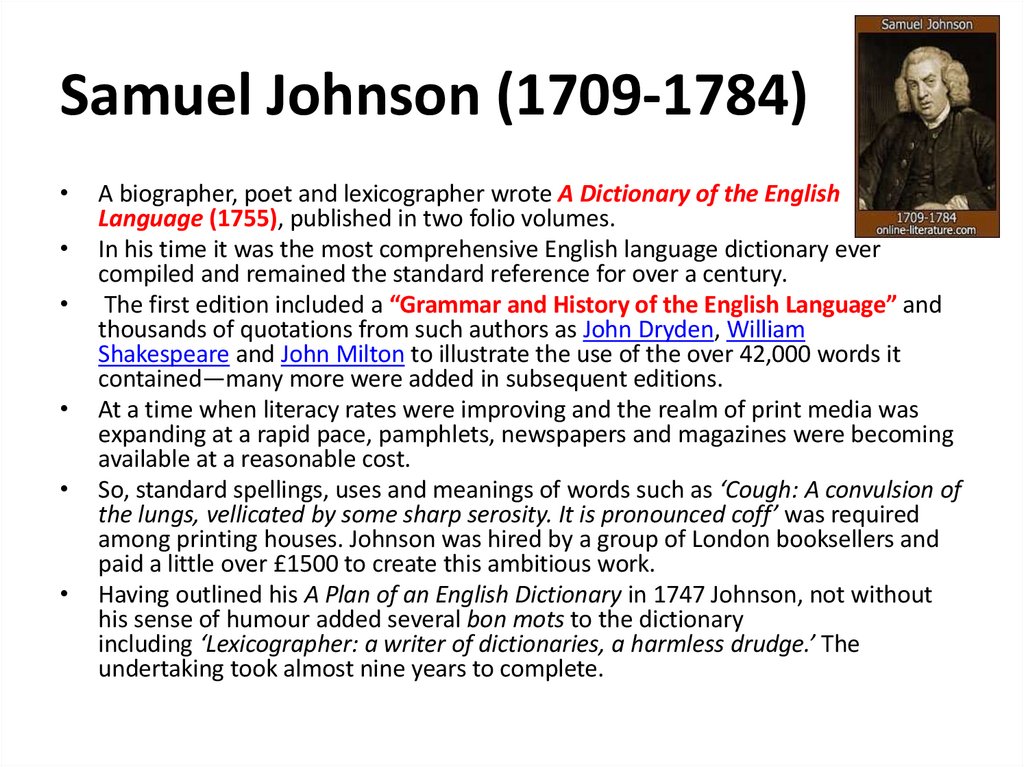
42. Samuel Johnson (1709-1784)
A biographer, poet and lexicographer wrote A Dictionary of the English
Language (1755), published in two folio volumes.
In his time it was the most comprehensive English language dictionary ever
compiled and remained the standard reference for over a century.
The first edition included a “Grammar and History of the English Language” and
thousands of quotations from such authors as John Dryden, William
Shakespeare and John Milton to illustrate the use of the over 42,000 words it
contained—many more were added in subsequent editions.
At a time when literacy rates were improving and the realm of print media was
expanding at a rapid pace, pamphlets, newspapers and magazines were becoming
available at a reasonable cost.
So, standard spellings, uses and meanings of words such as ‘Cough: A convulsion of
the lungs, vellicated by some sharp serosity. It is pronounced coff’ was required
among printing houses. Johnson was hired by a group of London booksellers and
paid a little over £1500 to create this ambitious work.
Having outlined his A Plan of an English Dictionary in 1747 Johnson, not without
his sense of humour added several bon mots to the dictionary
including ‘Lexicographer: a writer of dictionaries, a harmless drudge.’ The
undertaking took almost nine years to complete.