 Английский язык
Похожие презентации:







Insurance policy formation. Lecture 3
1. Lecture 3 Insurance policy formation
Hasan UmarovFinance Department
2. Lecture 3. Learning Outcomes:
• Describe the structure, function and content of aninsurance policy
• Explain why there are certain common policy exceptions
and conditions
• Differentiate between excesses, deductibles and
Lecture 3.
franchises
Learning Outcomes: • Explain how excesses, franchises and deductibles are
applied
• Differentiate between warranties, conditions and
representations
• Explain the significance of procedures relating to renewals
• Explain the meaning and significance of the cancellation
clause
Finance Department
2
3. Introduction
There are three things to remember about the insurance policy:1. the policy will contain the details of the terms and conditions;
2. generally speaking, neither party can rely on any negotiations leading up to
the contract, only on the contract itself; and
3. the policy is only evidence of the contract and not the contract itself.
Finance Department
3
4. Structure, form and content
A policy is generally issued in a scheduled form, i.e. the policy wording is preprinted, often in a booklet, and a schedule is incorporated into the policy. The policyschedule contains all the variable information concerning the insured and details of
the risks insured.
Every insurer has its own form of policy for the various classes of business it offers,
and these vary considerably in style and length.
Finance Department
4
5. Structure, form and content
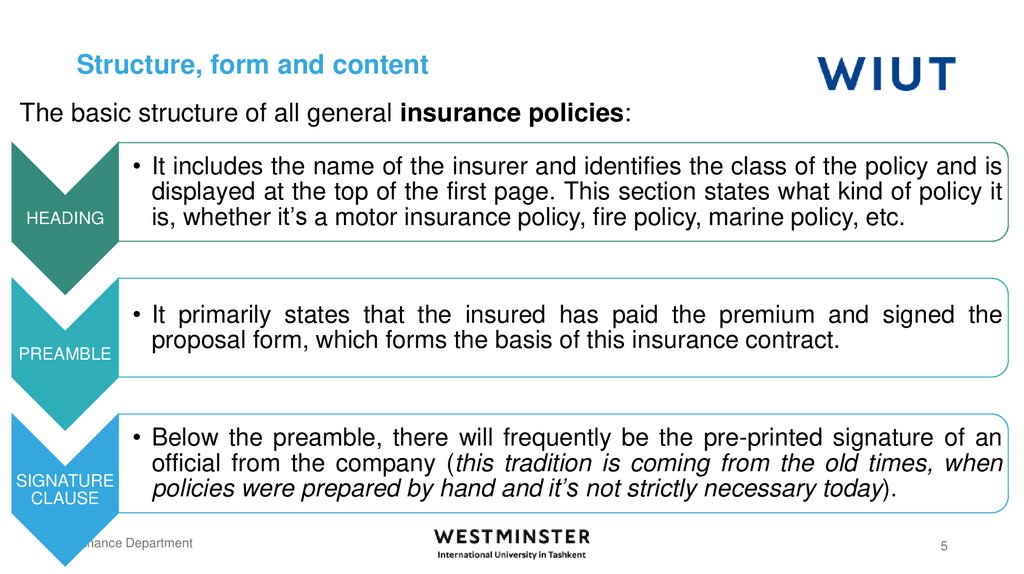
The basic structure of all general insurance policies:HEADING
PREAMBLE
SIGNATURE
CLAUSE
• It includes the name of the insurer and identifies the class of the policy and is
displayed at the top of the first page. This section states what kind of policy it
is, whether it’s a motor insurance policy, fire policy, marine policy, etc.
• It primarily states that the insured has paid the premium and signed the
proposal form, which forms the basis of this insurance contract.
• Below the preamble, there will frequently be the pre-printed signature of an
official from the company (this tradition is coming from the old times, when
policies were prepared by hand and it’s not strictly necessary today).
Finance Department
5
6. Structure, form and content
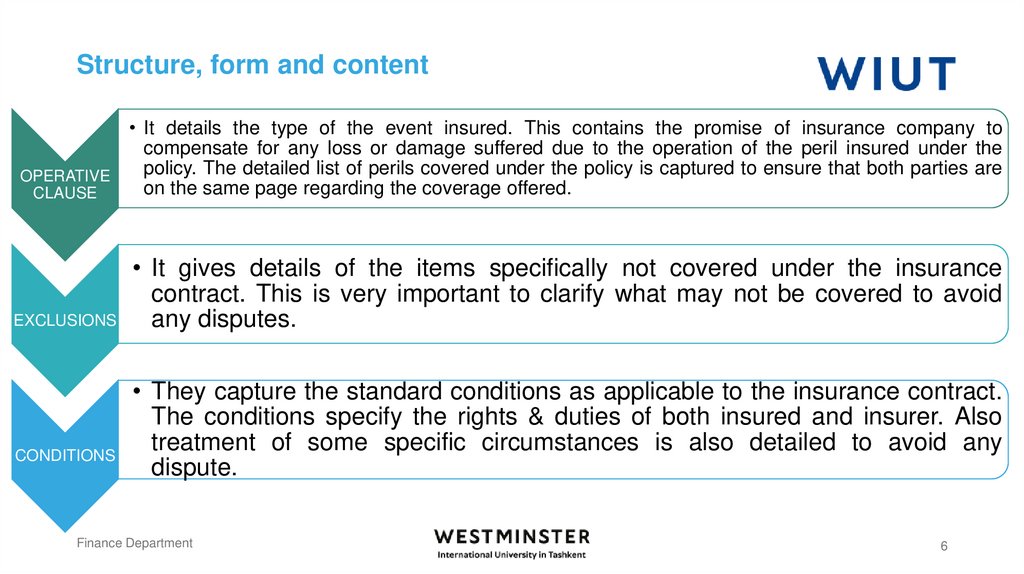
• It details the type of the event insured. This contains the promise of insurance company tocompensate for any loss or damage suffered due to the operation of the peril insured under the
policy. The detailed list of perils covered under the policy is captured to ensure that both parties are
OPERATIVE
on the same page regarding the coverage offered.
CLAUSE
• It gives details of the items specifically not covered under the insurance
contract. This is very important to clarify what may not be covered to avoid
EXCLUSIONS
any disputes.
• They capture the standard conditions as applicable to the insurance contract.
The conditions specify the rights & duties of both insured and insurer. Also
treatment of some specific circumstances is also detailed to avoid any
CONDITIONS
dispute.
Finance Department
6
7. Structure, form and content
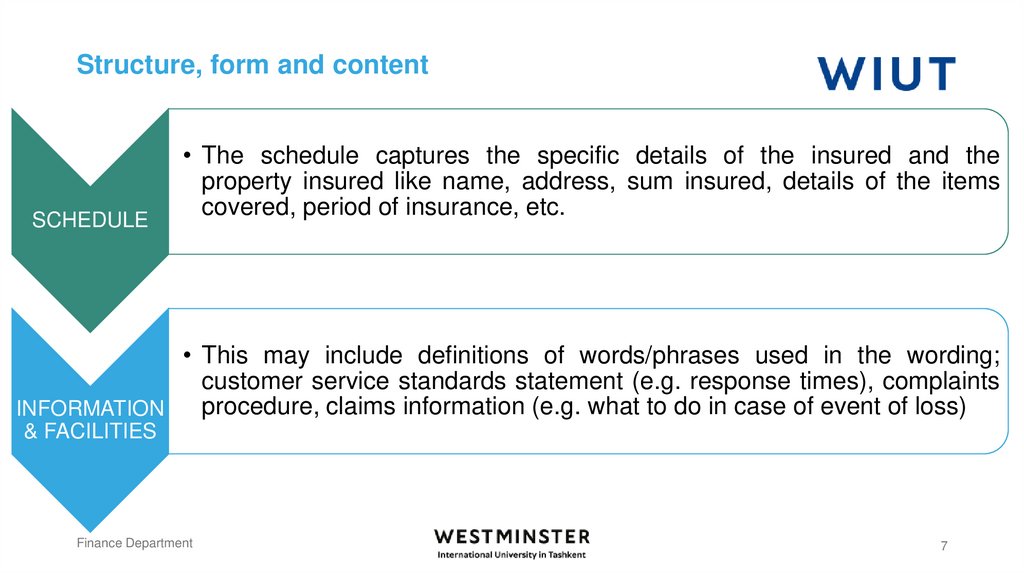
SCHEDULE• The schedule captures the specific details of the insured and the
property insured like name, address, sum insured, details of the items
covered, period of insurance, etc.
• This may include definitions of words/phrases used in the wording;
customer service standards statement (e.g. response times), complaints
procedure, claims information (e.g. what to do in case of event of loss)
INFORMATION
& FACILITIES
Finance Department
7
8. Exclusions & Exceptions
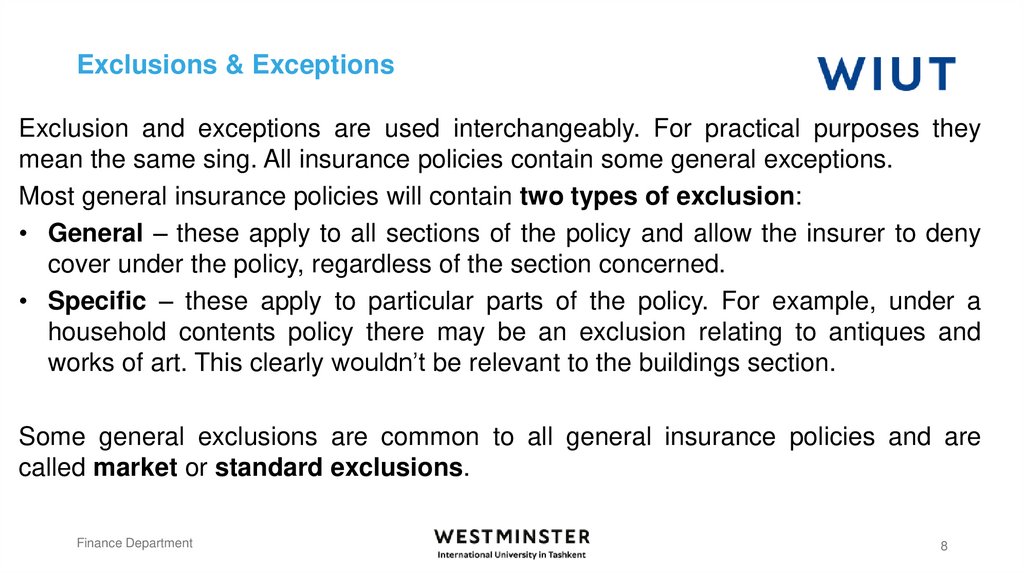
Exclusions & ExceptionsExclusion and exceptions are used interchangeably. For practical purposes they
mean the same sing. All insurance policies contain some general exceptions.
Most general insurance policies will contain two types of exclusion:
• General – these apply to all sections of the policy and allow the insurer to deny
cover under the policy, regardless of the section concerned.
• Specific – these apply to particular parts of the policy. For example, under a
household contents policy there may be an exclusion relating to antiques and
works of art. This clearly wouldn’t be relevant to the buildings section.
Some general exclusions are common to all general insurance policies and are
called market or standard exclusions.
Finance Department
8
9. Most typical exclusions & exceptions
Most typical exclusions & exceptionsExclusions include systemic losses, which impact multiple policyholder at once:
1. War and related perils only physical war, not cyber war. It is a fundamental risk
(meaning that it applies to the whole society) and it is usually the responsibility of the
government. Marine and aviation policies can be extended to war risks. Fundamental
risks can be insured in certain regions (e.g. earthquake is the fundamental risk in
California, but can be insured in Uzbekistan);
2. Radioactive contamination and explosive nuclear assemblies it is a
contamination as a result of a nuclear accident and liability for nuclear installations. It is
usually accepted (if accepted) by “market pools” (by several insurers&reinsurers in
accordance their underwriting capacity);
Finance Department
9
10. Most typical exclusions & exceptions
Most typical exclusions & exceptions3. Terrorism
4. Pollution and/or contamination it exists in most property policies, as insurance is
extended to the property only, not the liability of the property owner. However, if pollution
and/or contamination causes a damage to the property, then it is covered.
This exclusion became especially important after the “Exxon Valdez” oil spill in 1989 and
the Bhopal disaster in 1984.
Public liability insurance policies cover risks from an unexpected, identifiable events, not a
gradually operating cause. Gradual pollution is insured under an ”Environmental
impairment policy”;
Finance Department
10
11. Most typical exclusions & exceptions
Most typical exclusions & exceptions5. E-risks insurers are concerned regarding cumulative effect of “e-risks”. But, some
this exclusion can be “buy-backed” in some policies for additional premium;
6. Marine policies they are different from other insurance policies, regulated
specifically by “Marine Insurance Act 1906”, presence of international risks, etc. Besides,
there is a necessity to avoid double insurance;
7. Contractual liability insurance does not apply to liability assumed by the insured
under any contract or agreement
8. Sonic bangs damage arising from pressure waves from aircraft or aerial devices
travelling at sonic or super-sonic speeds
Finance Department
11
12. Conditions
Conditions can be either implied or express. The main conditions that appear areas follows:
1. Duties of the insured
2. Alteration the insured is obliged to notify the insurer about any changes that
might increase or worsen the “quality” of the risk
3. Action by the insured in the event of a claim how soon the claim should be
notified; the method of notification, etc.
4. Fraud there are severe consequences in case of fraudulent acts
5. Reasonable precautions fundamental condition - the insured should always
act as it is not insured. Insurance policy should not be an excuse for
carelessness or inactivity
Finance Department
12
13. Conditions
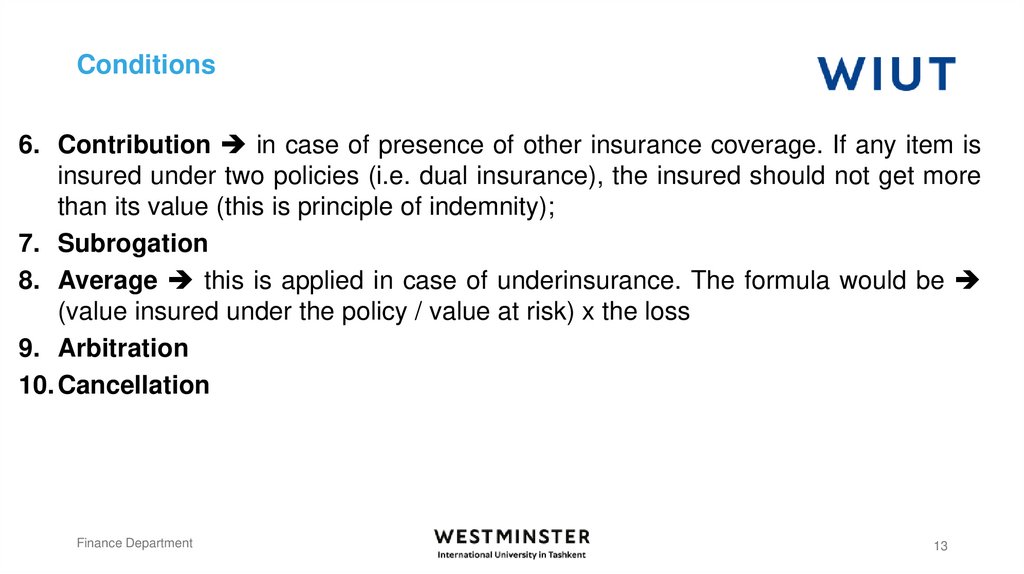
6. Contribution in case of presence of other insurance coverage. If any item isinsured under two policies (i.e. dual insurance), the insured should not get more
than its value (this is principle of indemnity);
7. Subrogation
8. Average this is applied in case of underinsurance. The formula would be
(value insured under the policy / value at risk) x the loss
9. Arbitration
10. Cancellation
Finance Department
13
14. Excesses, deductibles and franchises
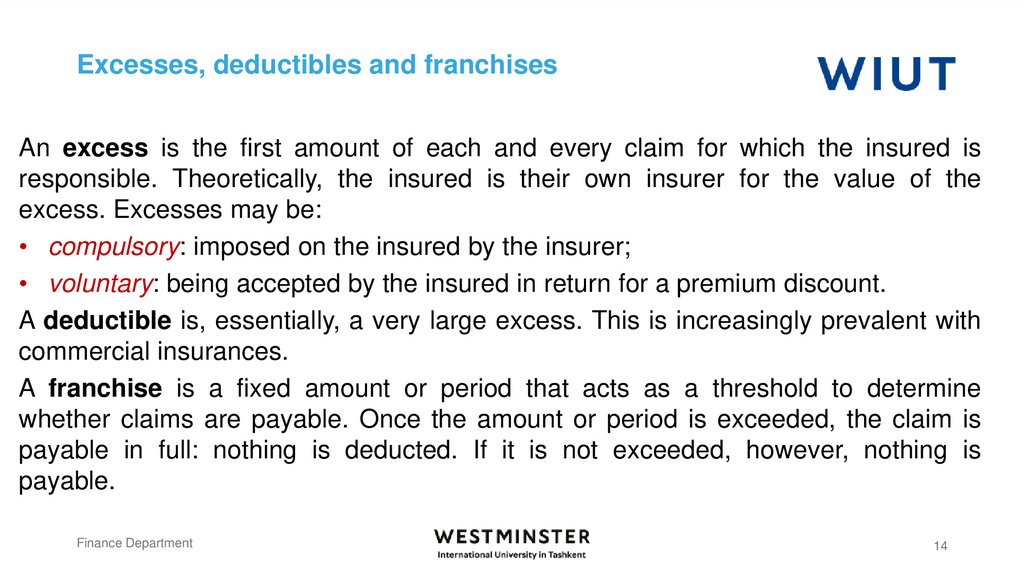
An excess is the first amount of each and every claim for which the insured isresponsible. Theoretically, the insured is their own insurer for the value of the
excess. Excesses may be:
• compulsory: imposed on the insured by the insurer;
• voluntary: being accepted by the insured in return for a premium discount.
A deductible is, essentially, a very large excess. This is increasingly prevalent with
commercial insurances.
A franchise is a fixed amount or period that acts as a threshold to determine
whether claims are payable. Once the amount or period is exceeded, the claim is
payable in full: nothing is deducted. If it is not exceeded, however, nothing is
payable.
Finance Department
14
15. Examples of insurance policies
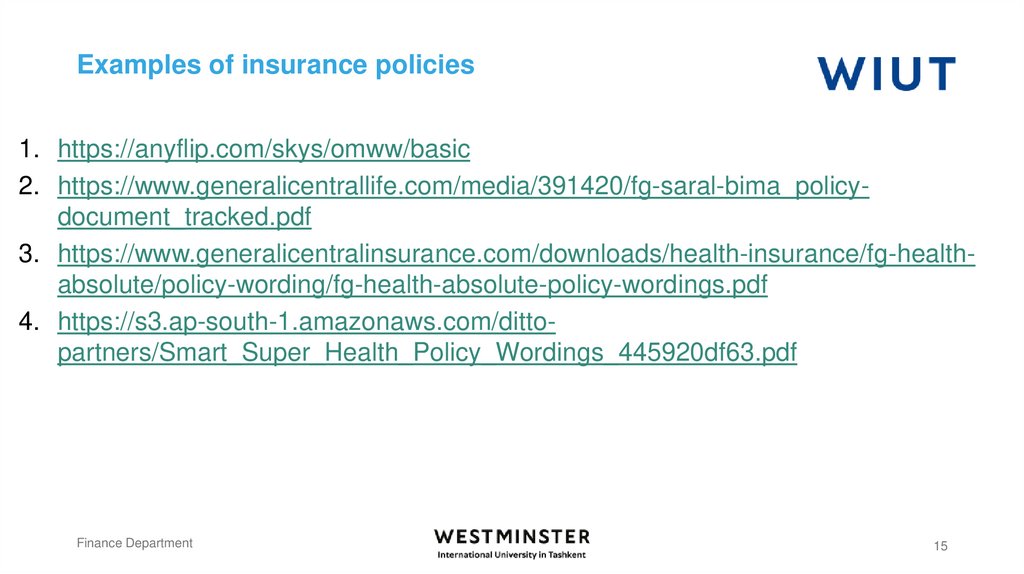
1. https://anyflip.com/skys/omww/basic2. https://www.generalicentrallife.com/media/391420/fg-saral-bima_policydocument_tracked.pdf
3. https://www.generalicentralinsurance.com/downloads/health-insurance/fg-healthabsolute/policy-wording/fg-health-absolute-policy-wordings.pdf
4. https://s3.ap-south-1.amazonaws.com/dittopartners/Smart_Super_Health_Policy_Wordings_445920df63.pdf
Finance Department
15
16. Insurance policy vs. Insurance Contract
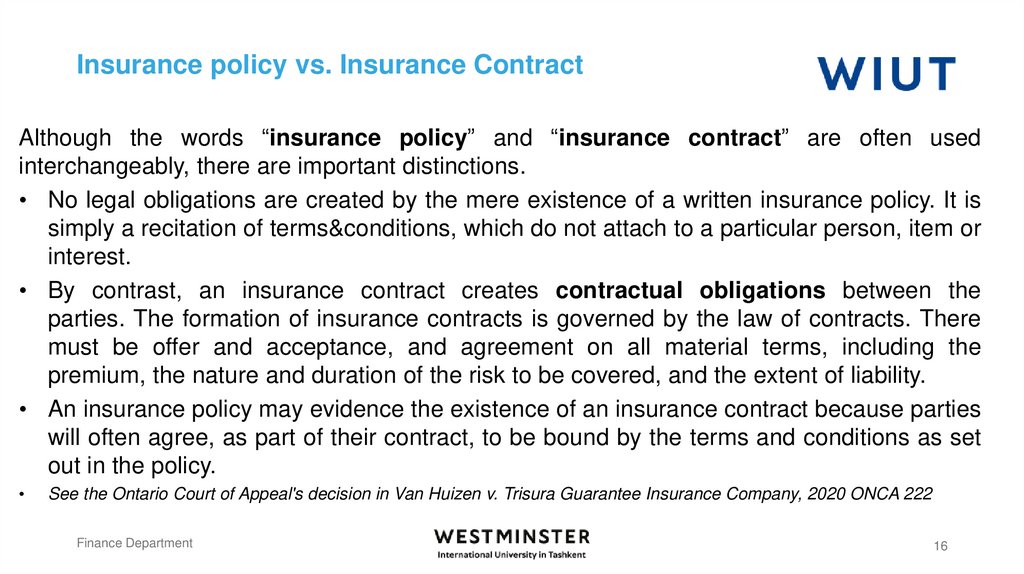
Although the words “insurance policy” and “insurance contract” are often usedinterchangeably, there are important distinctions.
• No legal obligations are created by the mere existence of a written insurance policy. It is
simply a recitation of terms&conditions, which do not attach to a particular person, item or
interest.
• By contrast, an insurance contract creates contractual obligations between the
parties. The formation of insurance contracts is governed by the law of contracts. There
must be offer and acceptance, and agreement on all material terms, including the
premium, the nature and duration of the risk to be covered, and the extent of liability.
• An insurance policy may evidence the existence of an insurance contract because parties
will often agree, as part of their contract, to be bound by the terms and conditions as set
out in the policy.
See the Ontario Court of Appeal's decision in Van Huizen v. Trisura Guarantee Insurance Company, 2020 ONCA 222
Finance Department
16
17.
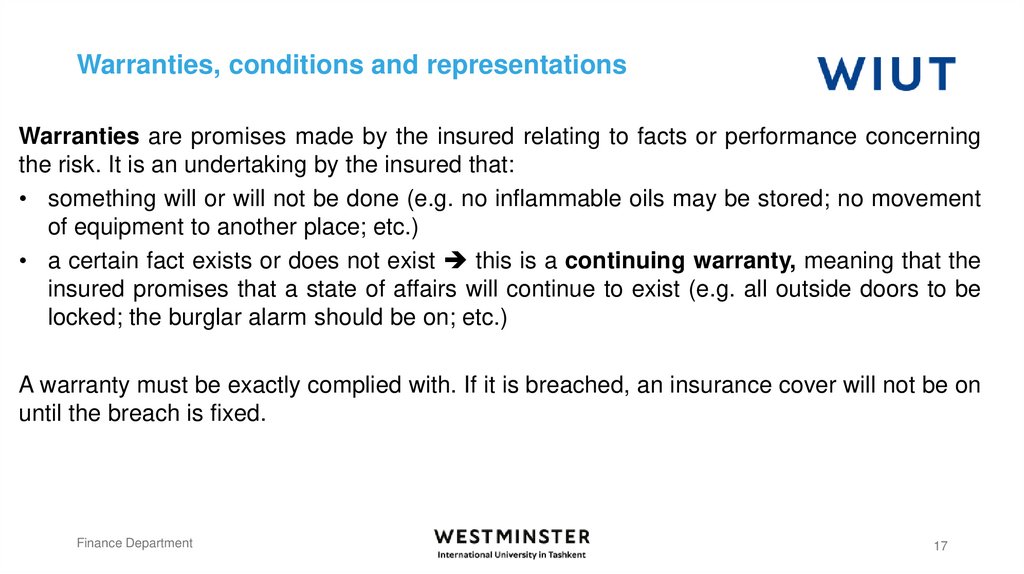
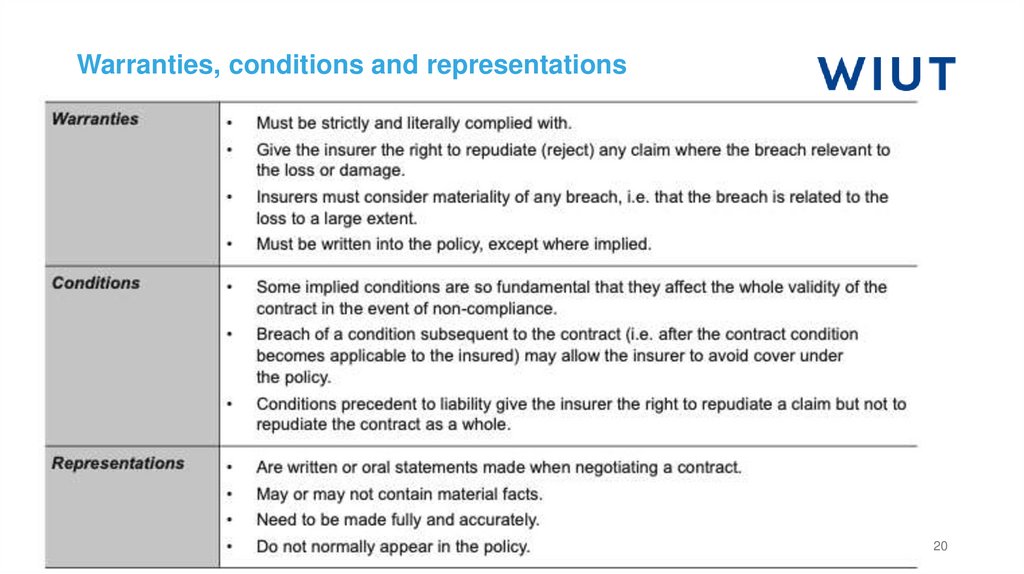
Warranties, conditions and representationsWarranties are promises made by the insured relating to facts or performance concerning
the risk. It is an undertaking by the insured that:
• something will or will not be done (e.g. no inflammable oils may be stored; no movement
of equipment to another place; etc.)
• a certain fact exists or does not exist this is a continuing warranty, meaning that the
insured promises that a state of affairs will continue to exist (e.g. all outside doors to be
locked; the burglar alarm should be on; etc.)
A warranty must be exactly complied with. If it is breached, an insurance cover will not be on
until the breach is fixed.
Finance Department
17
18.
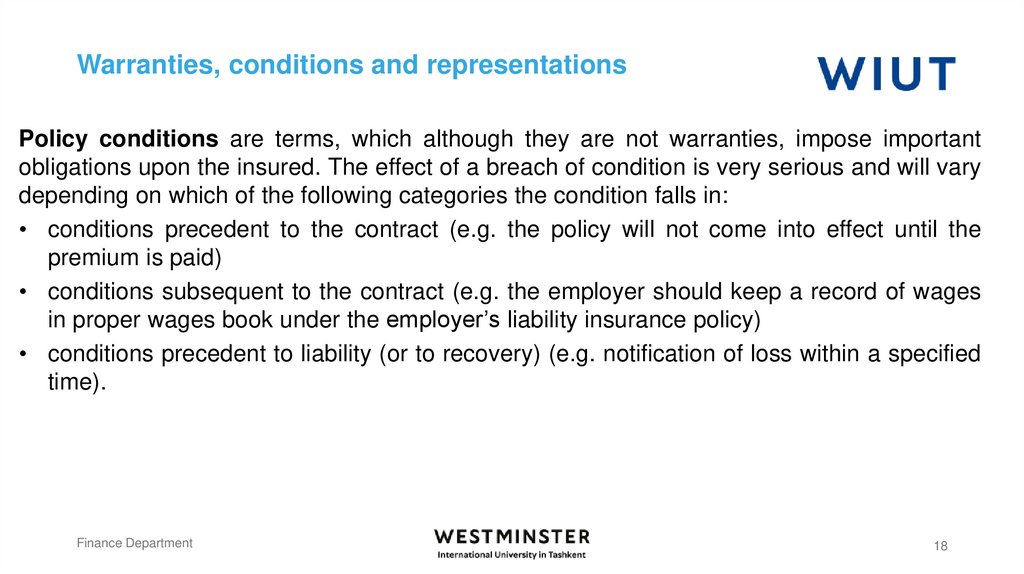
Warranties, conditions and representationsPolicy conditions are terms, which although they are not warranties, impose important
obligations upon the insured. The effect of a breach of condition is very serious and will vary
depending on which of the following categories the condition falls in:
• conditions precedent to the contract (e.g. the policy will not come into effect until the
premium is paid)
• conditions subsequent to the contract (e.g. the employer should keep a record of wages
in proper wages book under the employer’s liability insurance policy)
• conditions precedent to liability (or to recovery) (e.g. notification of loss within a specified
time).
Finance Department
18
19.
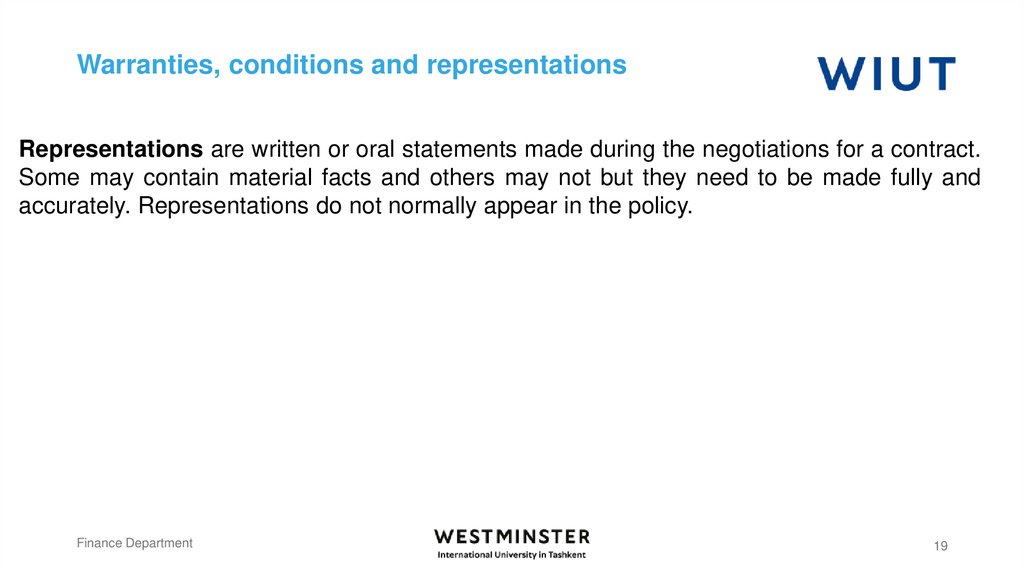
Warranties, conditions and representationsRepresentations are written or oral statements made during the negotiations for a contract.
Some may contain material facts and others may not but they need to be made fully and
accurately. Representations do not normally appear in the policy.
Finance Department
19
20.
Warranties, conditions and representationsFinance Department
20
21. Renewals and cancellation
Most general insurance policies are issued for a period of twelve months. Towardsthe end of that period they are said to be due for renewal.
The reasons why insurers keen on to encourage renewal of policies are twofold:
• Statistics If the client base remains stable, statistical information about the
portfolio will be more accurate.
• Cost Policy renewal is a lot cheaper than acquiring new business: think of the
marketing costs involved.
Finance Department
21
22. Renewals and cancellation
Policy renewal should be offered “in good time”.In accordance with the FCA of the UK, insurers at renewal, should:
1. Disclose the previous year’s premium on renewal notices
2. Include text to encourage consumers to check their cover and shop around for
the best deal at each renewal
3. Identify consumers who have renewed with them 4 consecutive years and
give them an additional notice to shop around (these changes happened
following unfairly good conditions given to new customers and absence of
competition at renewal)
Finance Department
22
23. Renewals and cancellation
The cancellation condition in an insurance policy defines how an insurance contract canbe cancelled during its currency, generally by the insurer. The insurer usually has to send at
least seven days' written notice of cancellation by recorded delivery to the insured's last
known address (most often, cancellation period is 30 days).
An insured may also have the right to cancel mid-term but, in this case, a short-period
premium may be charged, giving a less-than-proportionate refund. This is because,
most of the expenses in administrating insurance occurs at the start of the policy (checking
the proposal, giving quotations, setting up the policy, reconciling the premium, etc.).
If the insured claimed a loss and then cancels policy, no refund may be given (if in the 1st
year of policy, the insured had a loss, he can cancel the policy for the 2nd year).
Finance Department
23
24. Renewals and cancellation
Short-term policies (like travel insurance, baggage insurance) for less than 30 days, cannotbe cancelled.
Policy can be cancelled as a result of fulfillment (i.e. total loss of the subject-matter), breach
of a policy condition (i.e. become a voidable contract).
In case of fraudulent claim, the Insurer is not liable to pay the claim / can recover amounts
already paid / can also choose to terminate the contract from the date of the fraudulent act /
does not have to return any premiums.
Finance Department
24
25. Thank you
Finance Department25