


 Право
ПравоПохожие презентации:









Types of Crimes
1. Types of Crimes
Astana IT UniversityDepartment of General Disciplines
English for Academic Purposes
Types of Crimes
Week 6 Lesson 3
Reading
2. Table of contents
1Lead-in activity
4
Comprehension
2
Vocabulary Preview
5
Discussion
3
Reading
3. Lead-in activity
Imagine you see someone stealing a bike outside your university. What would you do?Or think about this: someone is writing graffiti on the wall near your dorm — would you report it or
ignore it?
Think for one minute about how you would react in these situations.
Talk about what kinds of crimes happen most often in your city and which ones you think are
most serious.
Be ready to share your ideas.
4. Vocabulary Preview
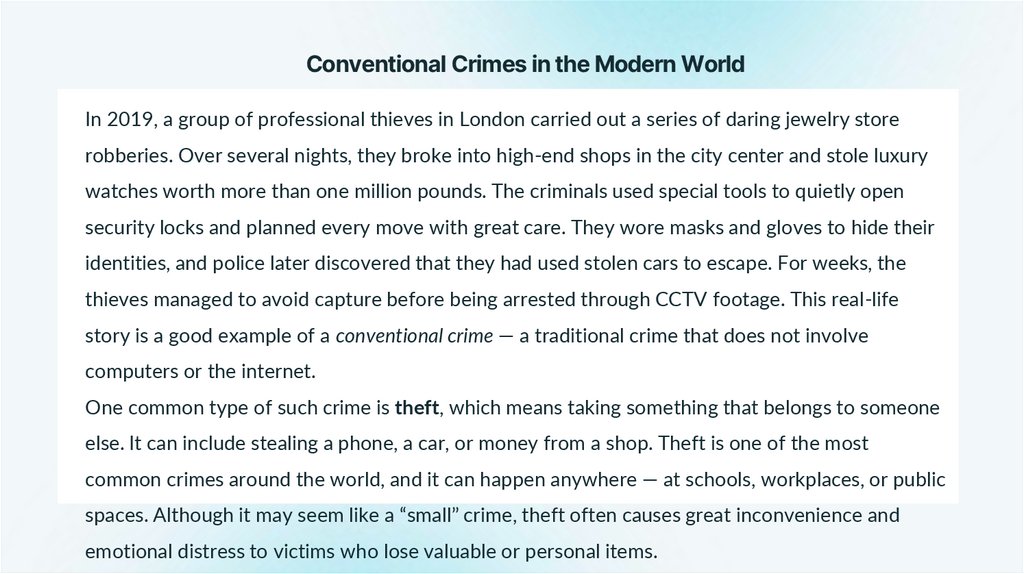
Conventional Crimes in the Modern WorldIn 2019, a group of professional thieves in London carried out a series of daring jewelry store
robberies. Over several nights, they broke into high-end shops in the city center and stole luxury
watches worth more than one million pounds. The criminals used special tools to quietly open
security locks and planned every move with great care. They wore masks and gloves to hide their
identities, and police later discovered that they had used stolen cars to escape. For weeks, the
thieves managed to avoid capture before being arrested through CCTV footage. This real-life
story is a good example of a conventional crime — a traditional crime that does not involve
computers or the internet.
One common type of such crime is theft, which means taking something that belongs to someone
else. It can include stealing a phone, a car, or money from a shop. Theft is one of the most
common crimes around the world, and it can happen anywhere — at schools, workplaces, or public
spaces. Although it may seem like a “small” crime, theft often causes great inconvenience and
emotional distress to victims who lose valuable or personal items.
5. Conventional Crimes in the Modern World
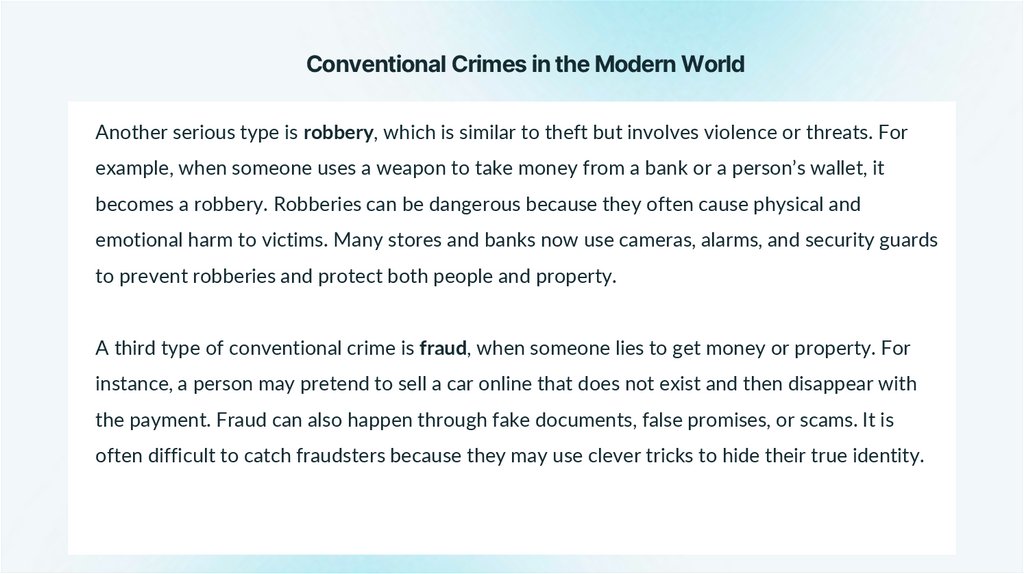
Another serious type is robbery, which is similar to theft but involves violence or threats. Forexample, when someone uses a weapon to take money from a bank or a person’s wallet, it
becomes a robbery. Robberies can be dangerous because they often cause physical and
emotional harm to victims. Many stores and banks now use cameras, alarms, and security guards
to prevent robberies and protect both people and property.
A third type of conventional crime is fraud, when someone lies to get money or property. For
instance, a person may pretend to sell a car online that does not exist and then disappear with
the payment. Fraud can also happen through fake documents, false promises, or scams. It is
often difficult to catch fraudsters because they may use clever tricks to hide their true identity.
6. Conventional Crimes in the Modern World
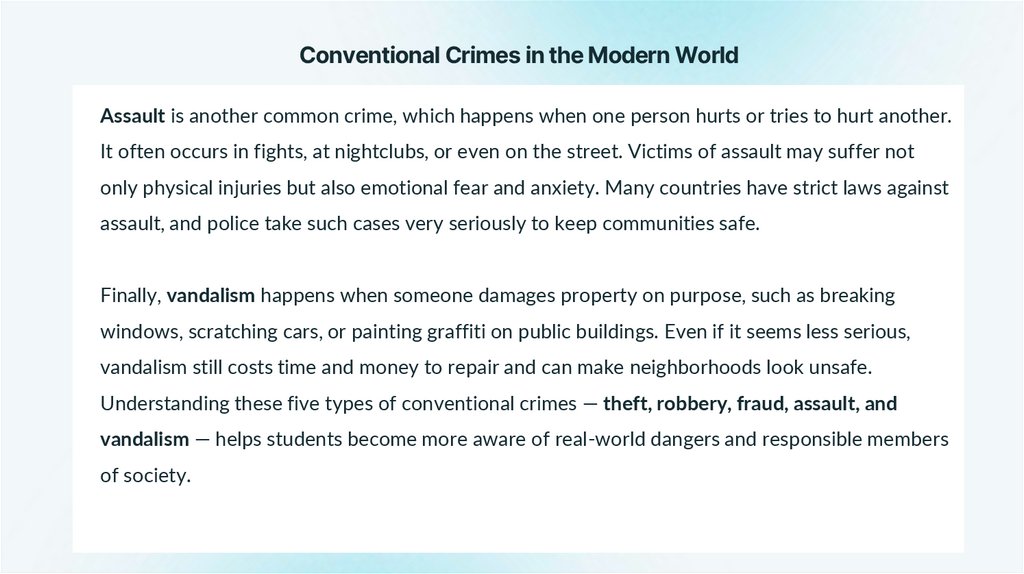
Assault is another common crime, which happens when one person hurts or tries to hurt another.It often occurs in fights, at nightclubs, or even on the street. Victims of assault may suffer not
only physical injuries but also emotional fear and anxiety. Many countries have strict laws against
assault, and police take such cases very seriously to keep communities safe.
Finally, vandalism happens when someone damages property on purpose, such as breaking
windows, scratching cars, or painting graffiti on public buildings. Even if it seems less serious,
vandalism still costs time and money to repair and can make neighborhoods look unsafe.
Understanding these five types of conventional crimes — theft, robbery, fraud, assault, and
vandalism — helps students become more aware of real-world dangers and responsible members
of society.
7. Conventional Crimes in the Modern World
Comprehension3. Respond to the open-ended questions below based on your understanding of the text
“Conventional Crimes in the Modern World.” Use complete sentences and provide detailed
answers.
What happened in the 2019 London jewelry store case, and why is it considered a
conventional crime?
How did the thieves in the case plan and carry out their crimes?
What is the main difference between theft and robbery?
Why can theft cause emotional problems for victims even if the stolen item is small?
In what ways do businesses and banks try to prevent robberies today?
How does fraud usually happen, and why is it often difficult to catch the criminals?
What are some possible physical and emotional effects of assault on victims?
Why do governments take assault cases very seriously?
What are some examples of vandalism, and how does it affect communities?
According to the text, why is it important for students to understand different types of
conventional crimes?
8. Comprehension
4. True or False (8 min)Read the statements below about the text “Conventional Crimes in the Modern World.” Decide if
they are True (T) or False (F). Correct the false statements.
1. The thieves in London stole luxury watches worth over one million pounds.
2. The criminals in the London case used the internet to hack into the jewelry stores.
3. Theft means taking something that belongs to another person.
4. Robbery and theft are exactly the same type of crime.
5. Fraud happens when someone lies to get money or property.
6. Assault means hurting or trying to hurt another person.
7. Vandalism includes damaging or destroying property on purpose.
8. Victims of assault only experience physical pain, not emotional problems.
9. Many businesses and banks use cameras and alarms to prevent robberies.
10. The text says students should understand conventional crimes to become more
responsible members of society.
9. Comprehension
DiscussionWhich of the five conventional crimes mentioned in the text do you think is the most common in
your city? Why?
Do you believe that conventional crimes are decreasing because of modern technology? Why or
why not?
How do you think security cameras and other technologies help prevent crimes like theft or
robbery?
Which type of crime do you think causes the most harm to society — physical, emotional, or
financial? Explain your opinion.
Have you or someone you know ever experienced or witnessed a conventional crime? How did it
affect you or them?
What can universities and communities do to help reduce conventional crimes?
Do you think learning about traditional crimes is still important for IT students in the age of
cybercrime? Why or why not?