 Биология
Происхождение насекомых
1.
ПРОИСХОЖДЕНИЕ НАСЕКОМЫХ2.
3.
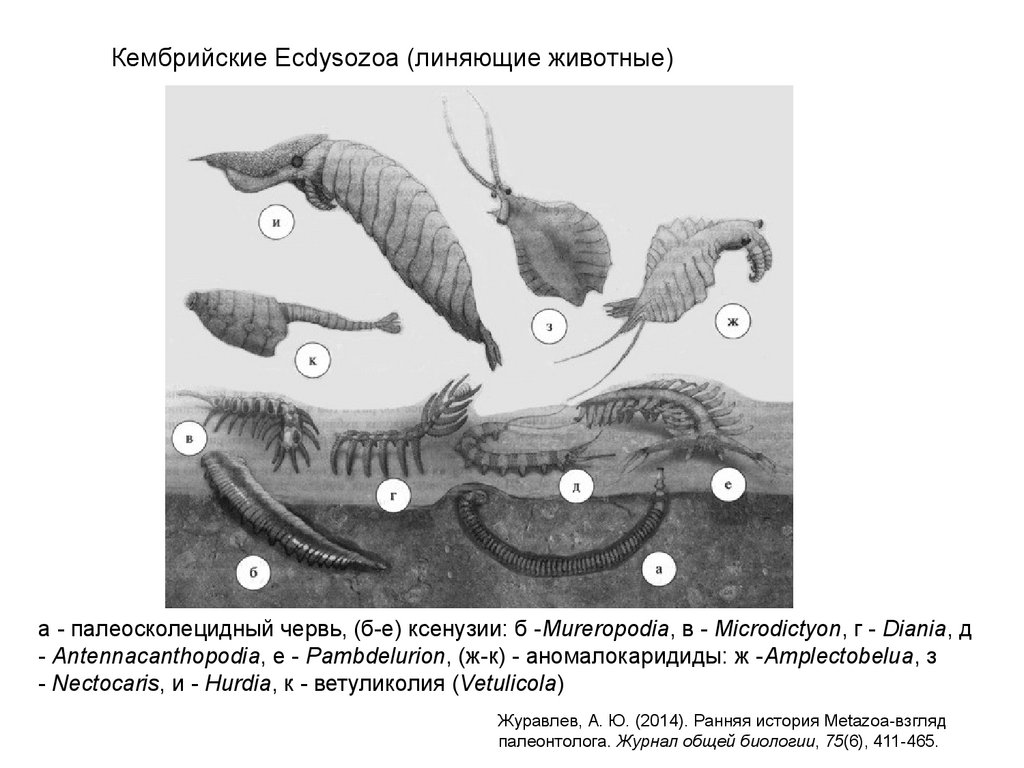
Кембрийские Ecdysozoa (линяющие животные)a - палеосколецидный червь, (б-е) ксенузии: б -Mureropodia, в - Microdictyon, г - Diania, д
- Antennacanthopodia, е - Pambdelurion, (ж-к) - аномалокаридиды: ж -Amplectobelua, з
- Nectocaris, и - Hurdia, к - ветуликолия (Vetulicola)
Журавлев, А. Ю. (2014). Ранняя история Metazoa-взгляд
палеонтолога. Журнал общей биологии, 75(6), 411-465.
4.
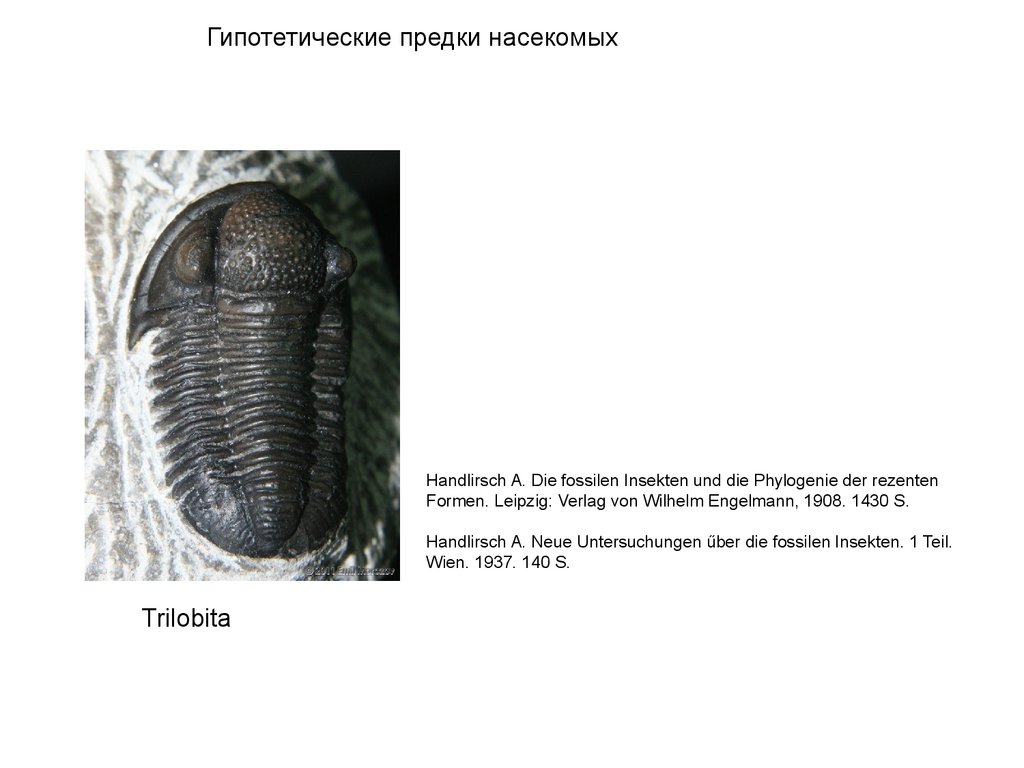
Гипотетические предки насекомыхHandlirsch A. Die fossilen Insekten und die Phylogenie der rezenten
Formen. Leipzig: Verlag von Wilhelm Engelmann, 1908. 1430 S.
Handlirsch A. Neue Untersuchungen űber die fossilen Insekten. 1 Teil.
Wien. 1937. 140 S.
Trilobita
5.
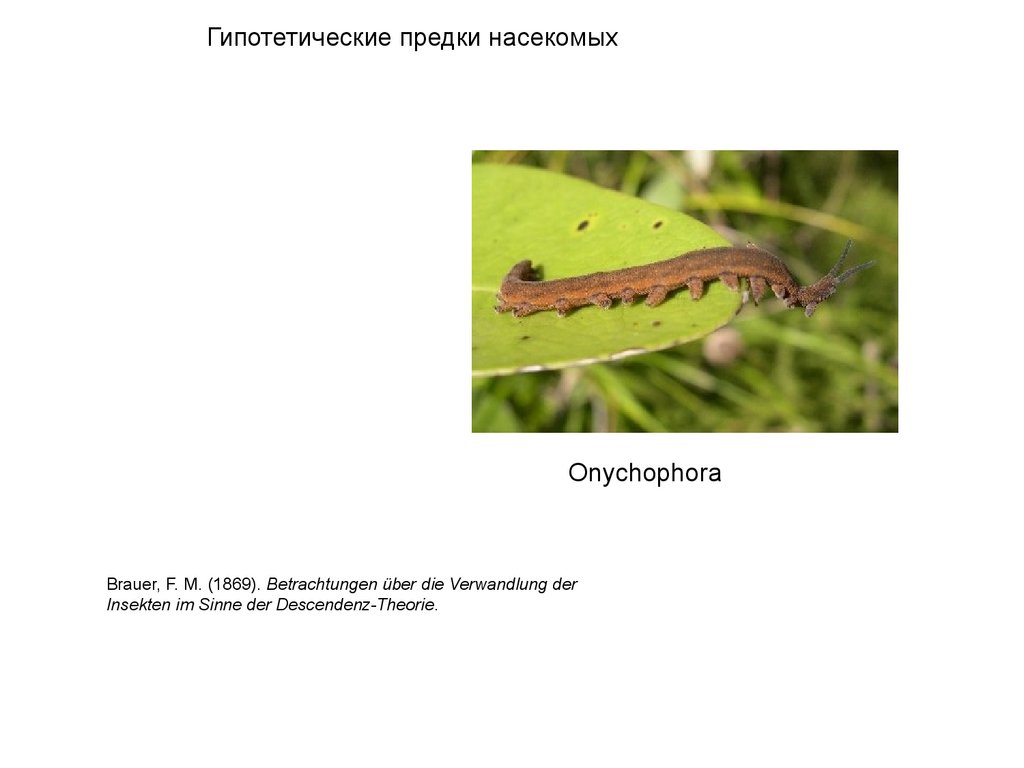
Гипотетические предки насекомыхOnychophora
Brauer, F. M. (1869). Betrachtungen über die Verwandlung der
Insekten im Sinne der Descendenz-Theorie.
6.
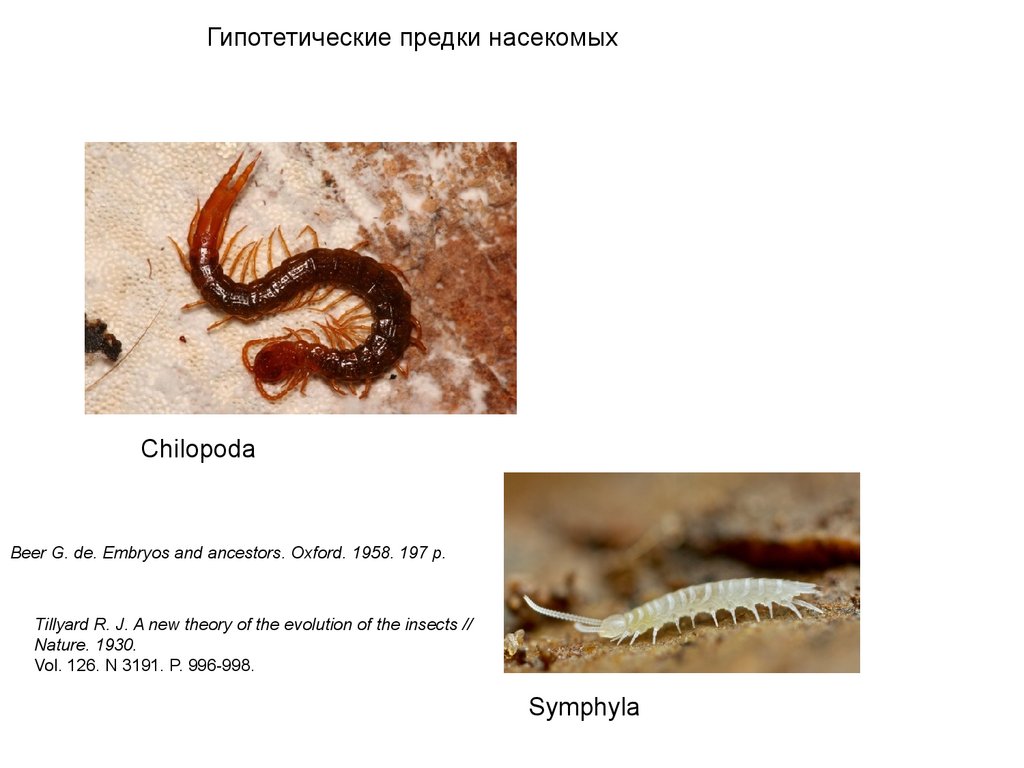
Гипотетические предки насекомыхChilopoda
Beer G. de. Embryos and ancestors. Oxford. 1958. 197 p.
Tillyard R. J. A new theory of the evolution of the insects //
Nature. 1930.
Vol. 126. N 3191. P. 996-998.
Symphyla
7.
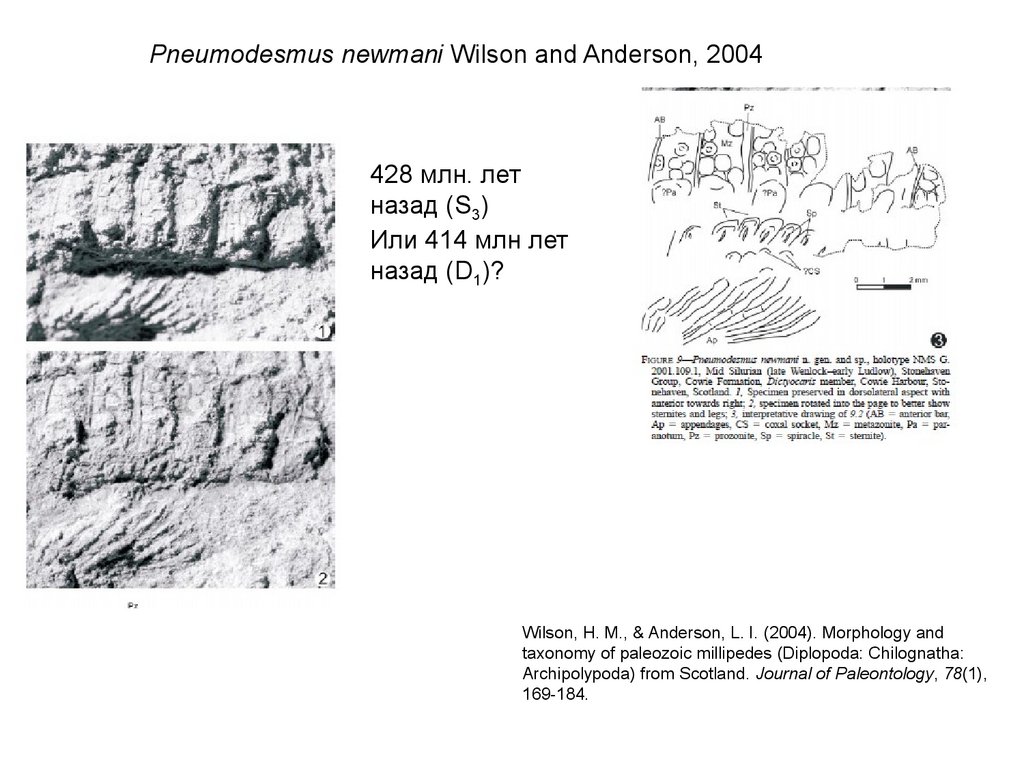
Pneumodesmus newmani Wilson and Anderson, 2004428 млн. лет
назад (S3)
Или 414 млн лет
назад (D1)?
Wilson, H. M., & Anderson, L. I. (2004). Morphology and
taxonomy of paleozoic millipedes (Diplopoda: Chilognatha:
Archipolypoda) from Scotland. Journal of Paleontology, 78(1),
169-184.
8.
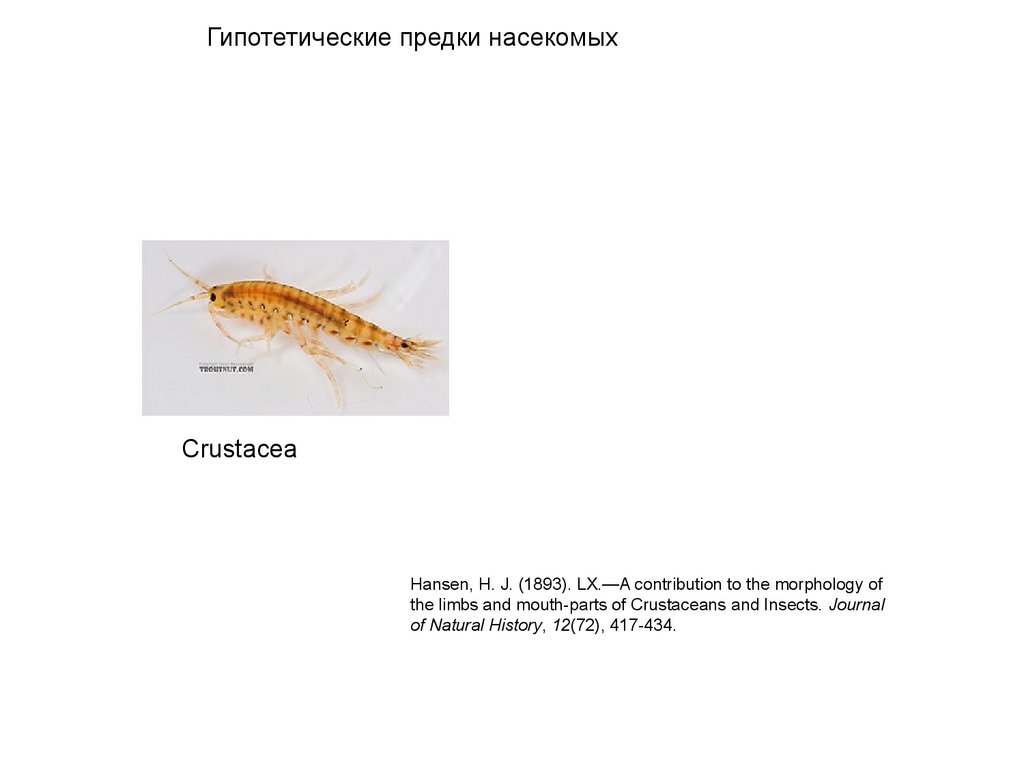
Гипотетические предки насекомыхCrustacea
Hansen, H. J. (1893). LX.—A contribution to the morphology of
the limbs and mouth-parts of Crustaceans and Insects. Journal
of Natural History, 12(72), 417-434.
9.
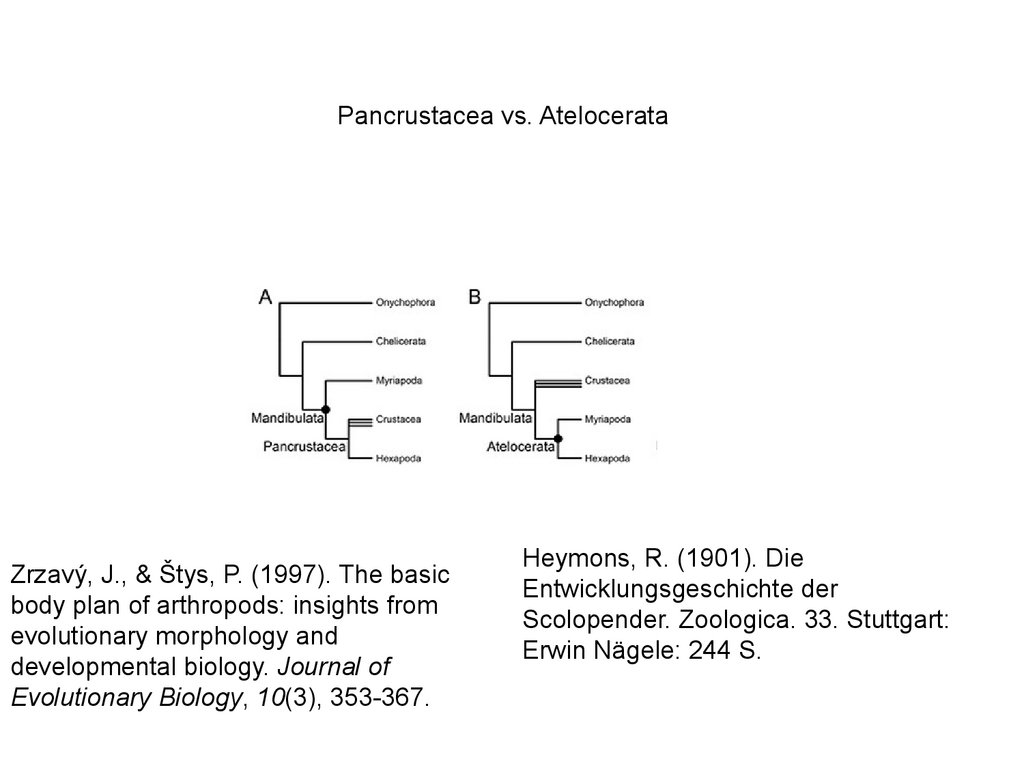
Pancrustacea vs. AtelocerataZrzavý, J., & Štys, P. (1997). The basic
body plan of arthropods: insights from
evolutionary morphology and
developmental biology. Journal of
Evolutionary Biology, 10(3), 353-367.
Heymons, R. (1901). Die
Entwicklungsgeschichte der
Scolopender. Zoologica. 33. Stuttgart:
Erwin Nägele: 244 S.
10.
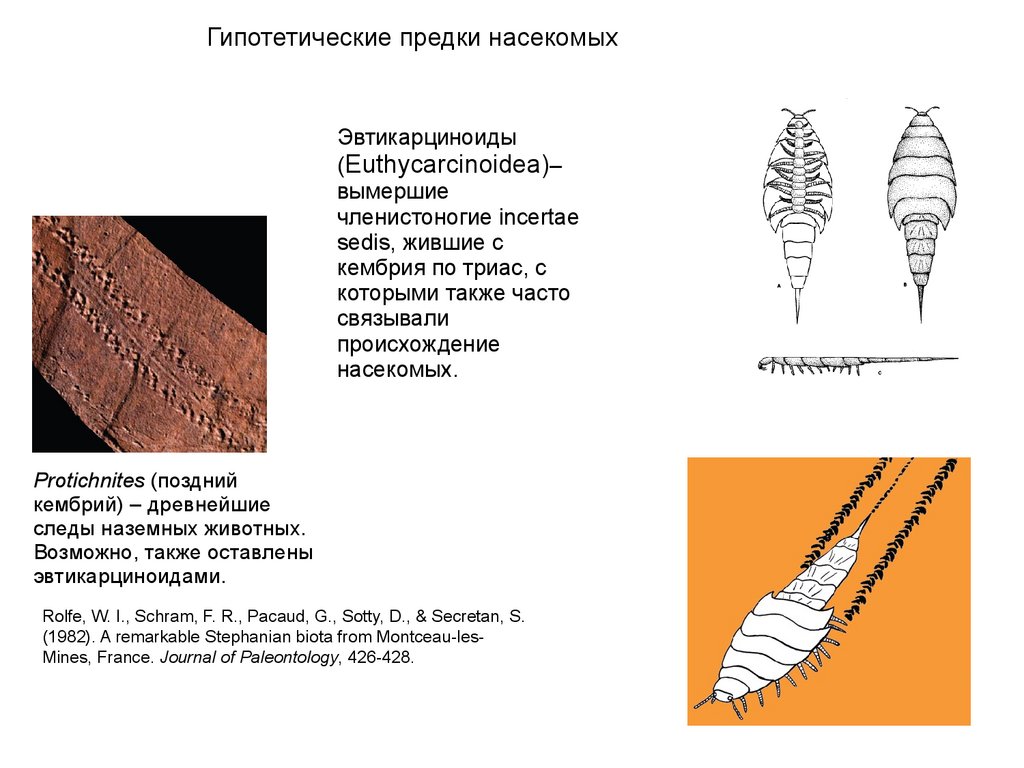
Гипотетические предки насекомыхЭвтикарциноиды
(Euthycarcinoidea)–
вымершие
членистоногие incertae
sedis, жившие с
кембрия по триас, с
которыми также часто
связывали
происхождение
насекомых.
Protichnites (поздний
кембрий) – древнейшие
следы наземных животных.
Возможно, также оставлены
эвтикарциноидами.
Rolfe, W. I., Schram, F. R., Pacaud, G., Sotty, D., & Secretan, S.
(1982). A remarkable Stephanian biota from Montceau-lesMines, France. Journal of Paleontology, 426-428.
11.
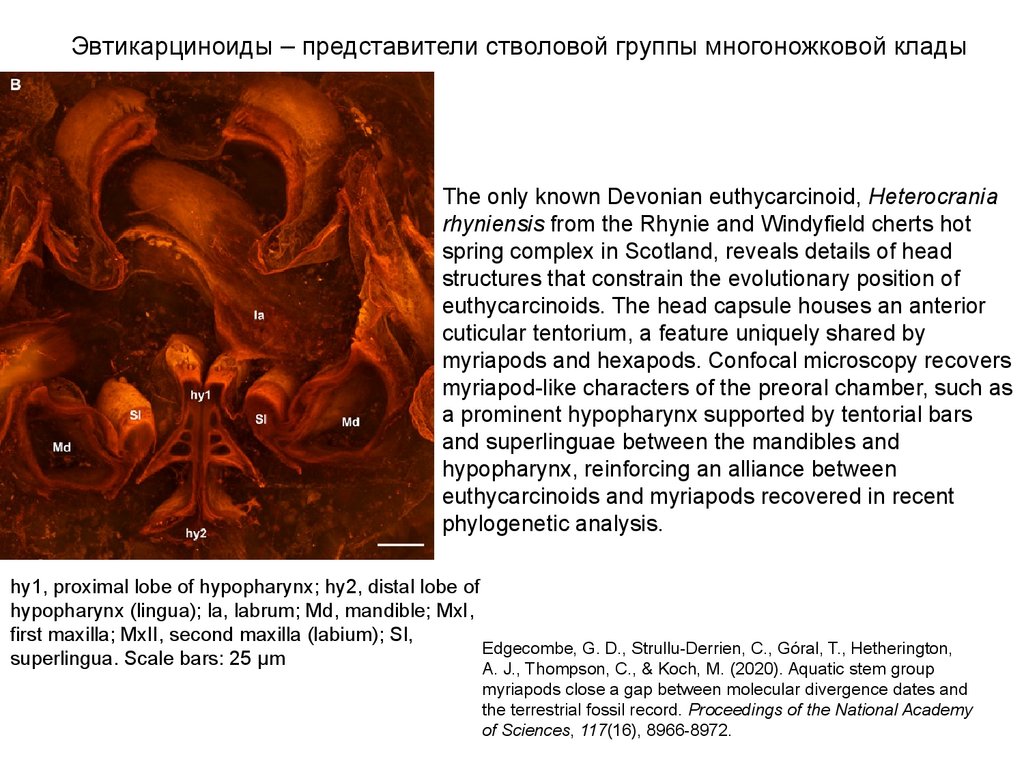
Эвтикарциноиды – представители стволовой группы многоножковой кладыThe only known Devonian euthycarcinoid, Heterocrania
rhyniensis from the Rhynie and Windyfield cherts hot
spring complex in Scotland, reveals details of head
structures that constrain the evolutionary position of
euthycarcinoids. The head capsule houses an anterior
cuticular tentorium, a feature uniquely shared by
myriapods and hexapods. Confocal microscopy recovers
myriapod-like characters of the preoral chamber, such as
a prominent hypopharynx supported by tentorial bars
and superlinguae between the mandibles and
hypopharynx, reinforcing an alliance between
euthycarcinoids and myriapods recovered in recent
phylogenetic analysis.
hy1, proximal lobe of hypopharynx; hy2, distal lobe of
hypopharynx (lingua); la, labrum; Md, mandible; MxI,
first maxilla; MxII, second maxilla (labium); Sl,
Edgecombe, G. D., Strullu-Derrien, C., Góral, T., Hetherington,
superlingua. Scale bars: 25 μm
A. J., Thompson, C., & Koch, M. (2020). Aquatic stem group
myriapods close a gap between molecular divergence dates and
the terrestrial fossil record. Proceedings of the National Academy
of Sciences, 117(16), 8966-8972.
12.
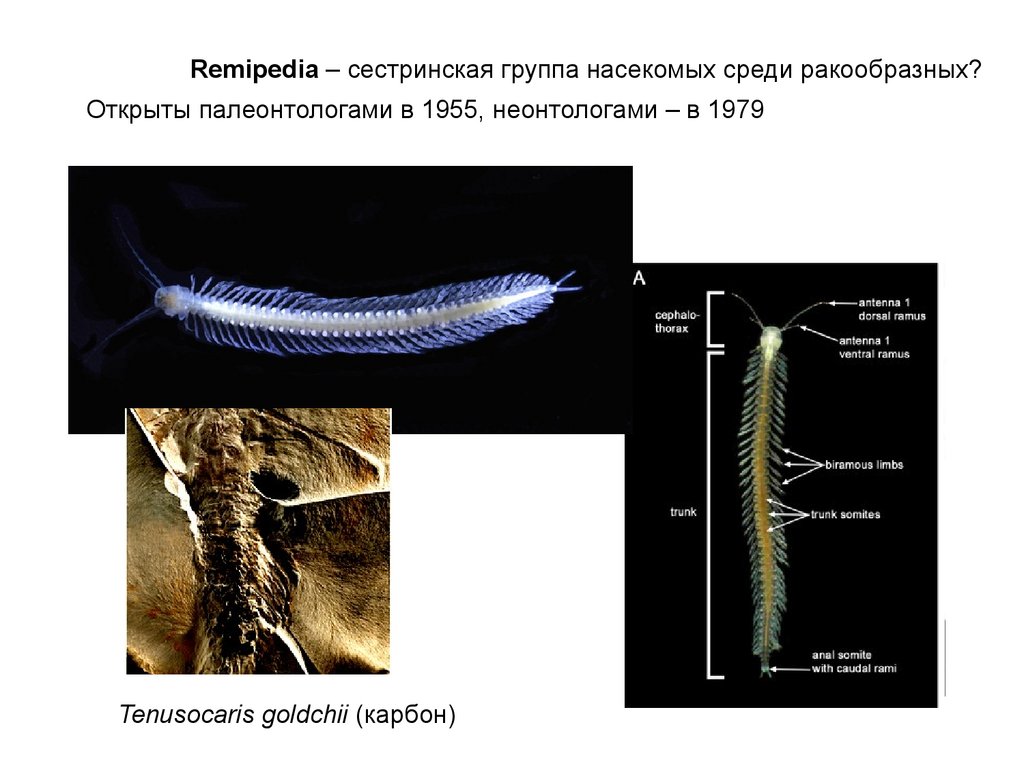
Remipedia – сестринская группа насекомых среди ракообразных?Открыты палеонтологами в 1955, неонтологами – в 1979
Tenusocaris goldchii (карбон)
13.
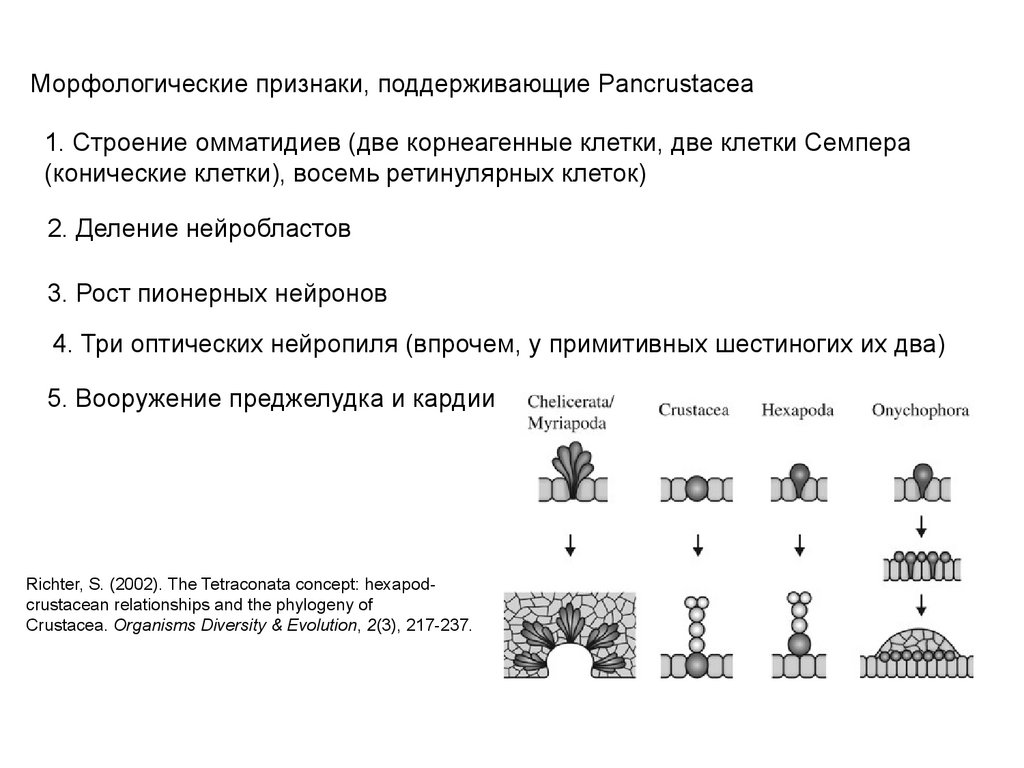
Морфологические признаки, поддерживающие Pancrustacea1. Строение омматидиев (две корнеагенные клетки, две клетки Семпера
(конические клетки), восемь ретинулярных клеток)
2. Деление нейробластов
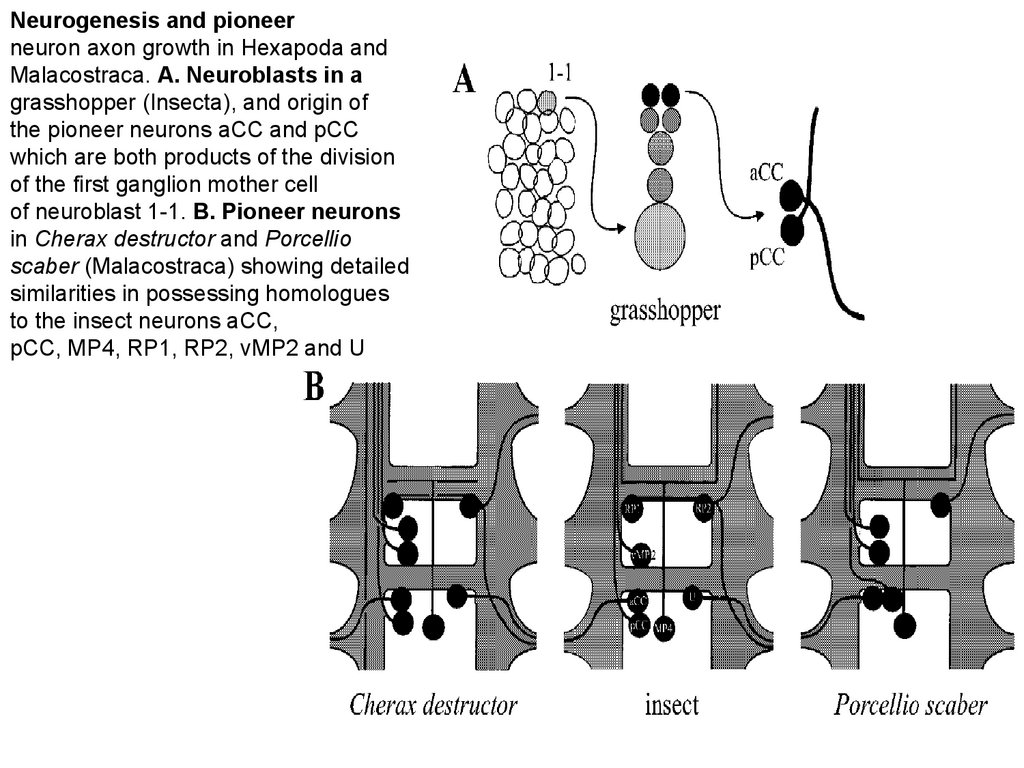
3. Рост пионерных нейронов
4. Три оптических нейропиля (впрочем, у примитивных шестиногих их два)
5. Вооружение преджелудка и кардии
Richter, S. (2002). The Tetraconata concept: hexapodcrustacean relationships and the phylogeny of
Crustacea. Organisms Diversity & Evolution, 2(3), 217-237.
14.
Neurogenesis and pioneerneuron axon growth in Hexapoda and
Malacostraca. A. Neuroblasts in a
grasshopper (Insecta), and origin of
the pioneer neurons aCC and pCC
which are both products of the division
of the first ganglion mother cell
of neuroblast 1-1. B. Pioneer neurons
in Cherax destructor and Porcellio
scaber (Malacostraca) showing detailed
similarities in possessing homologues
to the insect neurons aCC,
pCC, MP4, RP1, RP2, vMP2 and U
15.
16.
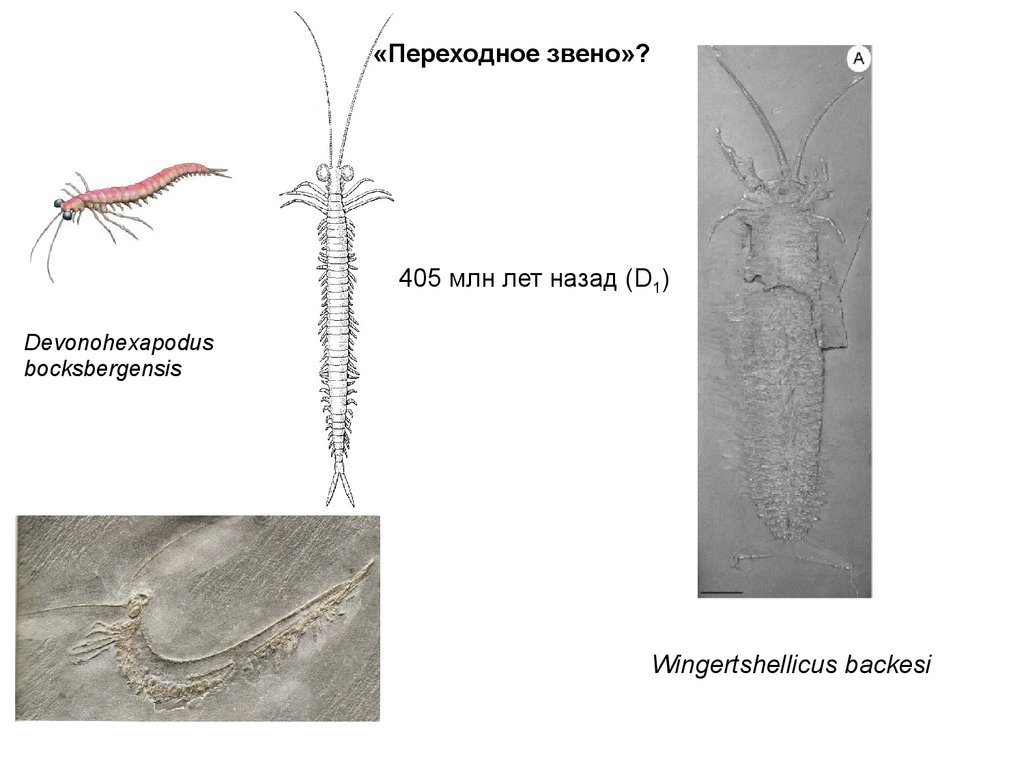
«Переходное звено»?405 млн лет назад (D1)
Devonohexapodus
bocksbergensis
Wingertshellicus backesi
17.
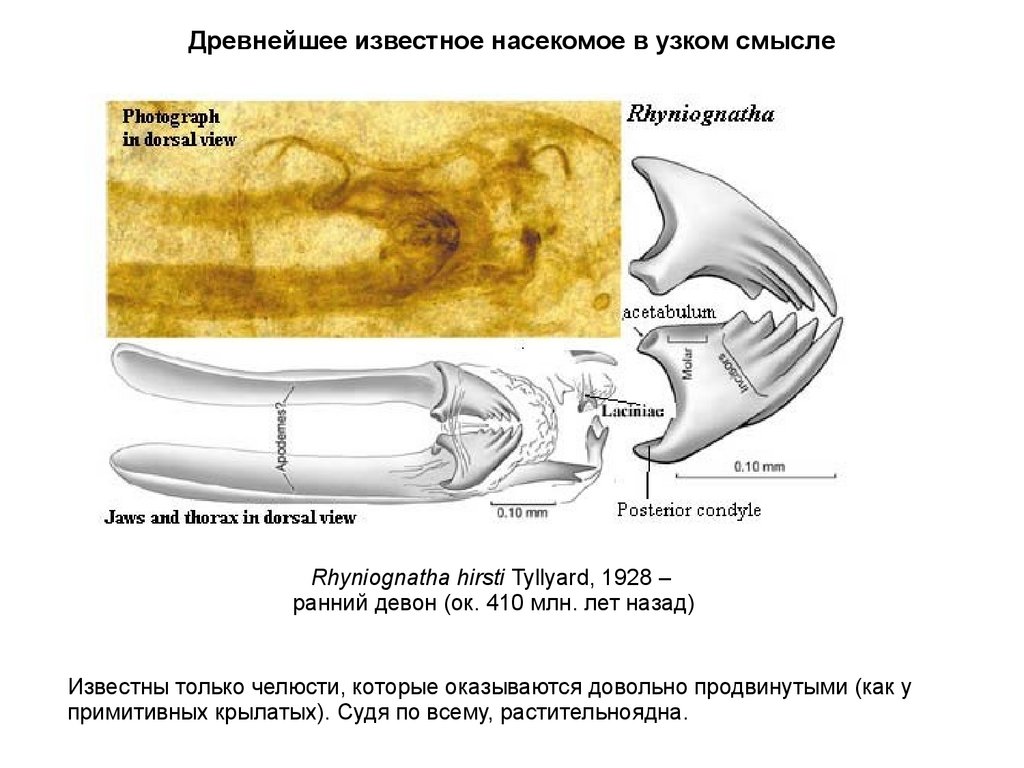
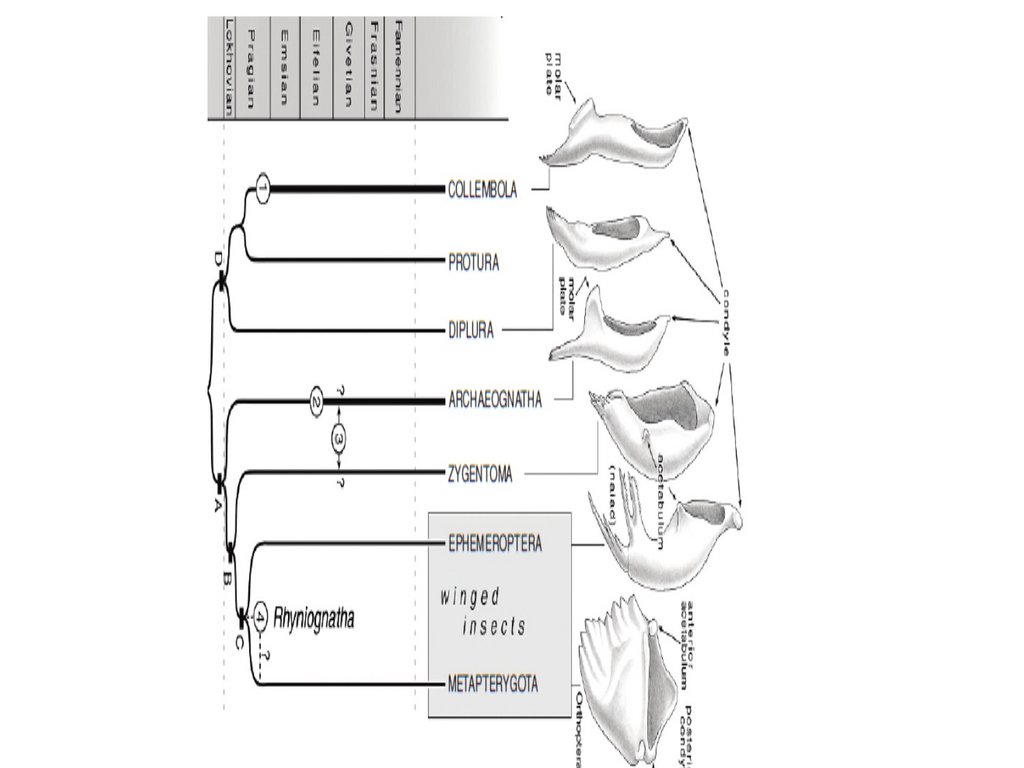
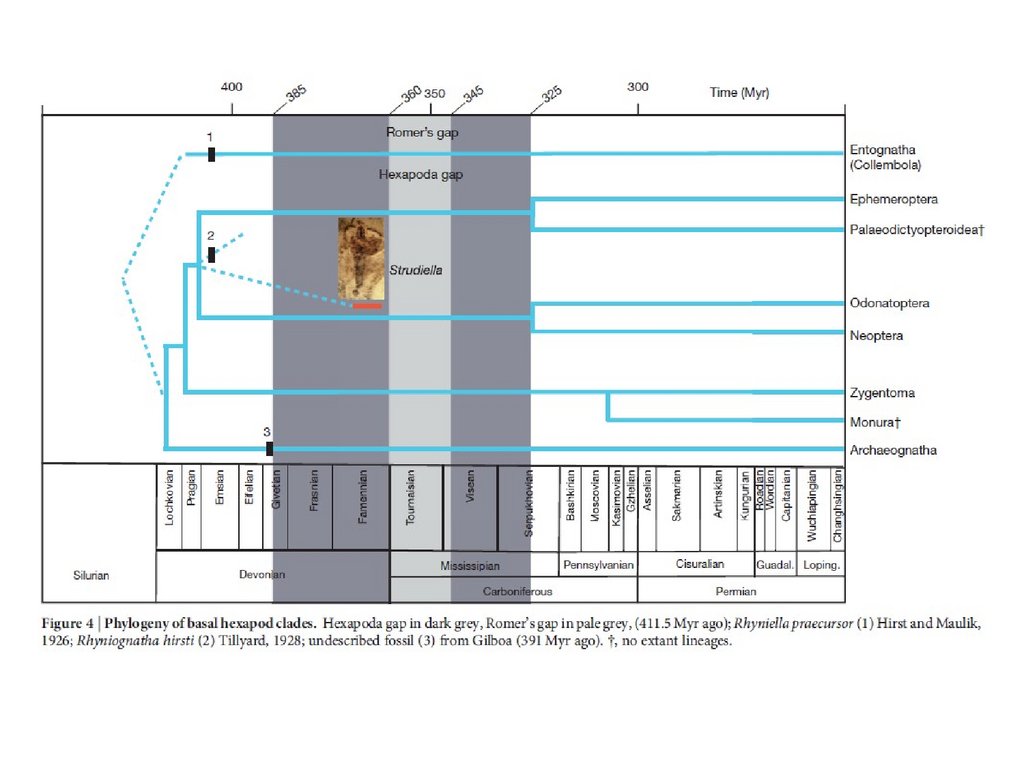
Древнейшее известное насекомое в узком смыслеRhyniognatha hirsti Tyllyard, 1928 –
ранний девон (ок. 410 млн. лет назад)
Известны только челюсти, которые оказываются довольно продвинутыми (как у
примитивных крылатых). Судя по всему, растительноядна.
18.
19.
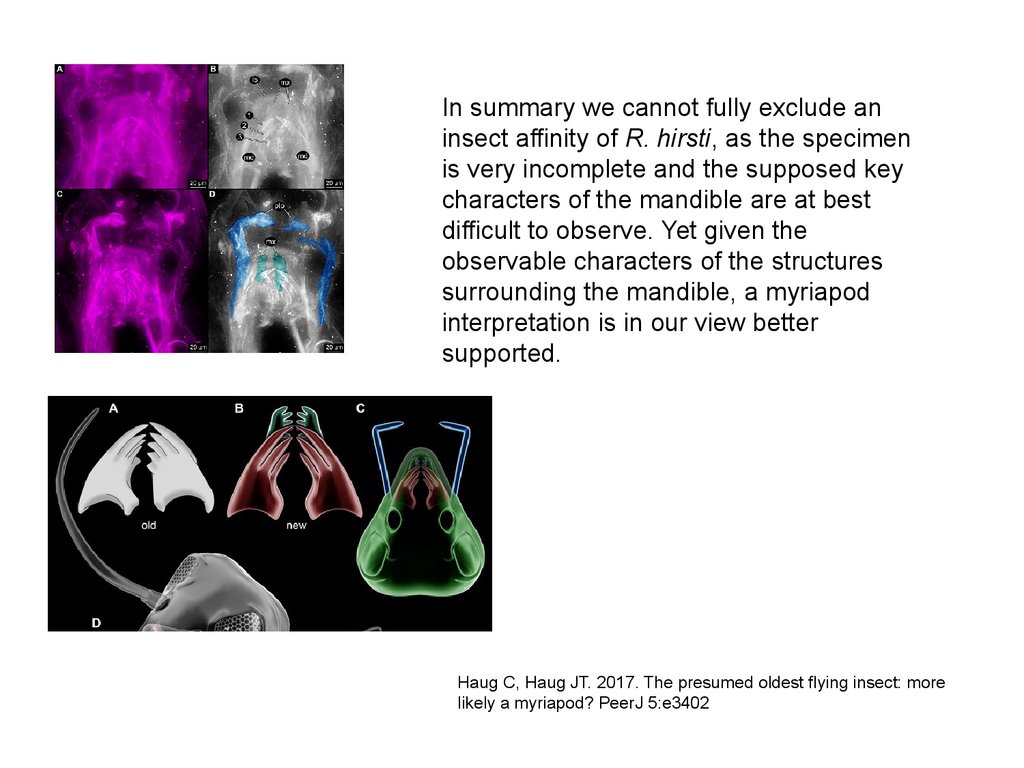
In summary we cannot fully exclude aninsect affinity of R. hirsti, as the specimen
is very incomplete and the supposed key
characters of the mandible are at best
difficult to observe. Yet given the
observable characters of the structures
surrounding the mandible, a myriapod
interpretation is in our view better
supported.
Haug C, Haug JT. 2017. The presumed oldest flying insect: more
likely a myriapod? PeerJ 5:e3402
20.
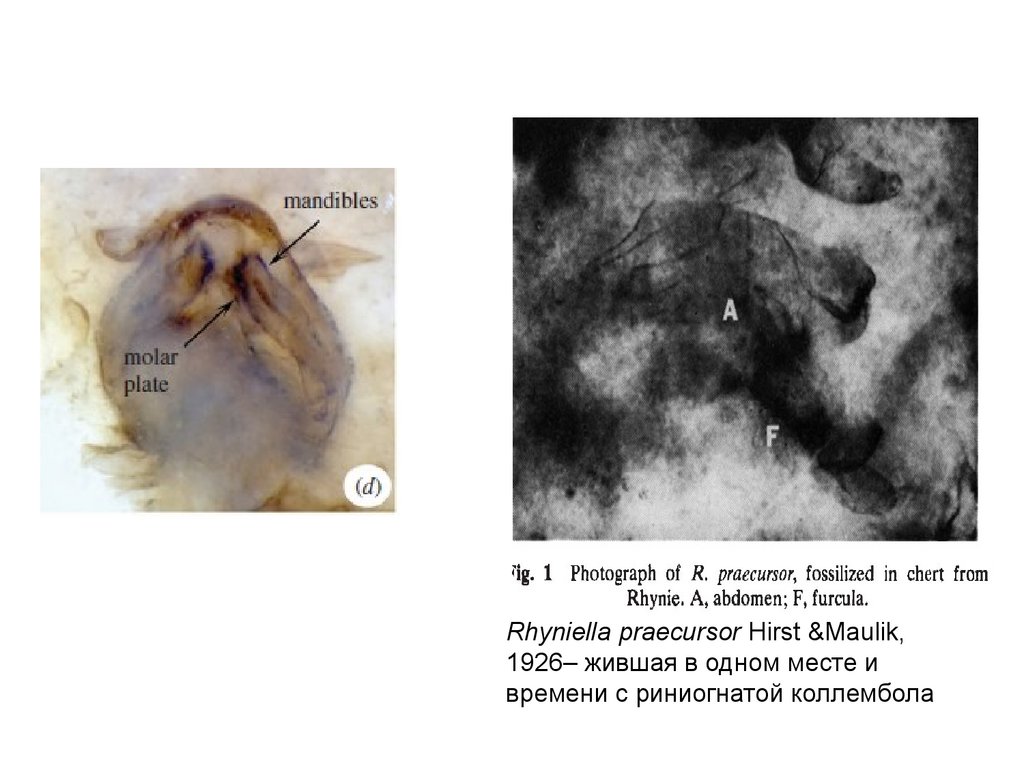
Rhyniella praecursor Hirst &Maulik,1926– жившая в одном месте и
времени с риниогнатой коллембола
21.
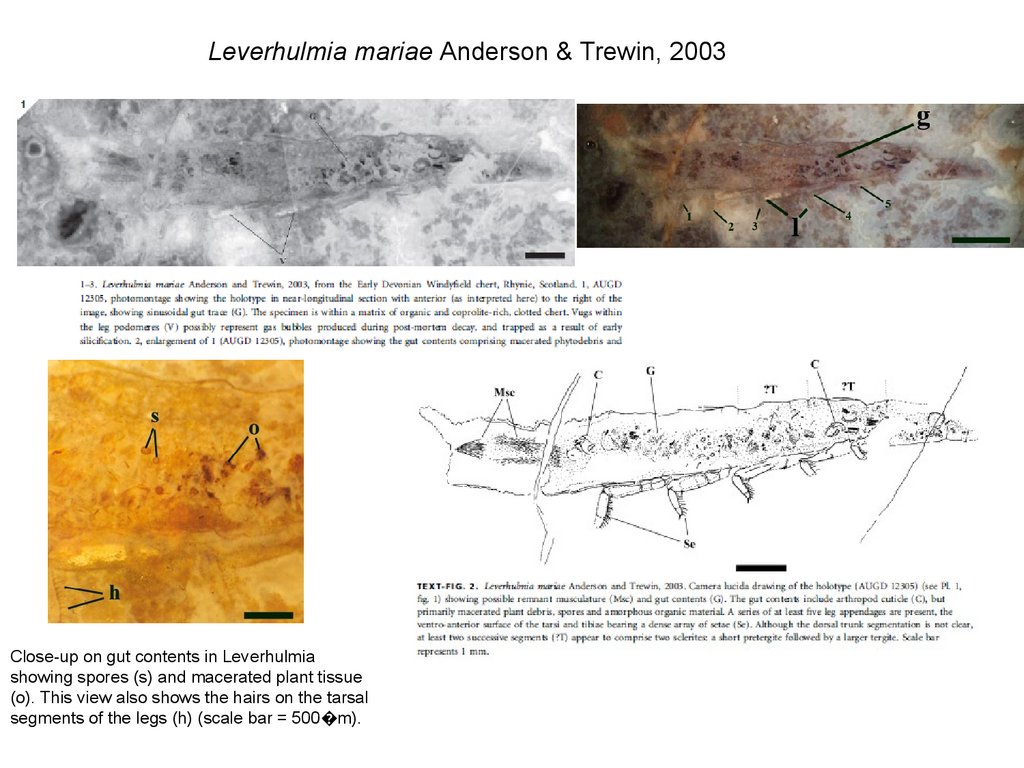
Leverhulmia mariae Anderson & Trewin, 2003Close-up on gut contents in Leverhulmia
showing spores (s) and macerated plant tissue
(o). This view also shows the hairs on the tarsal
segments of the legs (h) (scale bar = 500 m).
22.
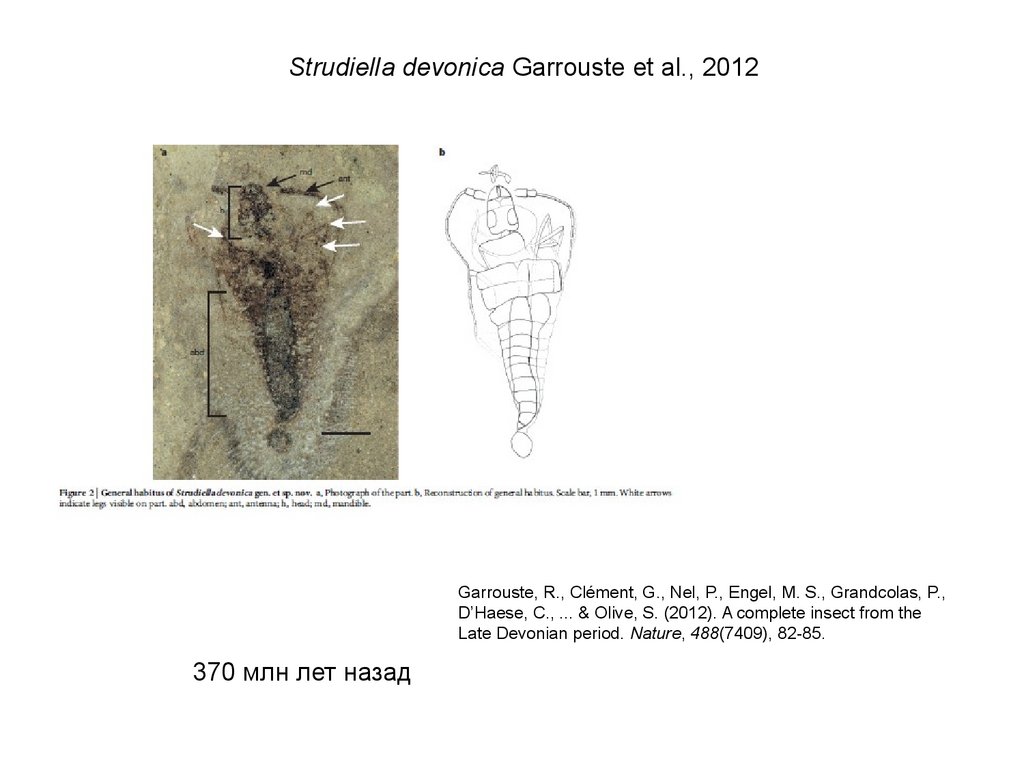
Strudiella devonica Garrouste et al., 2012Garrouste, R., Clément, G., Nel, P., Engel, M. S., Grandcolas, P.,
D’Haese, C., ... & Olive, S. (2012). A complete insect from the
Late Devonian period. Nature, 488(7409), 82-85.
370 млн лет назад
23.
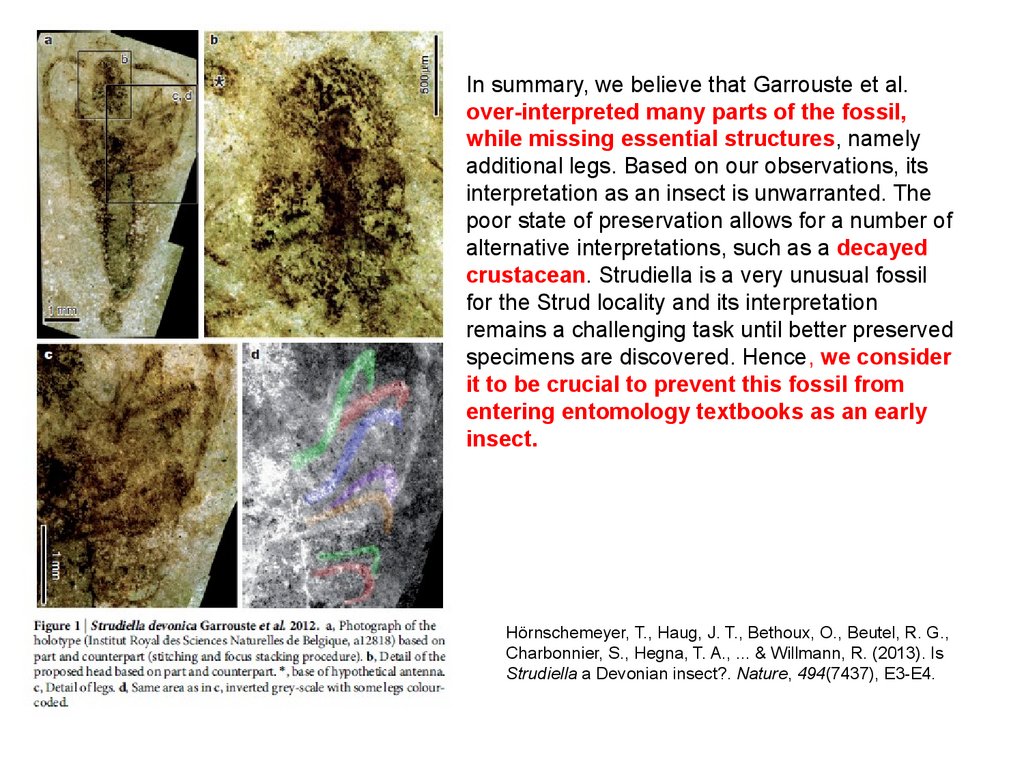
In summary, we believe that Garrouste et al.over-interpreted many parts of the fossil,
while missing essential structures, namely
additional legs. Based on our observations, its
interpretation as an insect is unwarranted. The
poor state of preservation allows for a number of
alternative interpretations, such as a decayed
crustacean. Strudiella is a very unusual fossil
for the Strud locality and its interpretation
remains a challenging task until better preserved
specimens are discovered. Hence, we consider
it to be crucial to prevent this fossil from
entering entomology textbooks as an early
insect.
Hörnschemeyer, T., Haug, J. T., Bethoux, O., Beutel, R. G.,
Charbonnier, S., Hegna, T. A., ... & Willmann, R. (2013). Is
Strudiella a Devonian insect?. Nature, 494(7437), E3-E4.
24.
25.
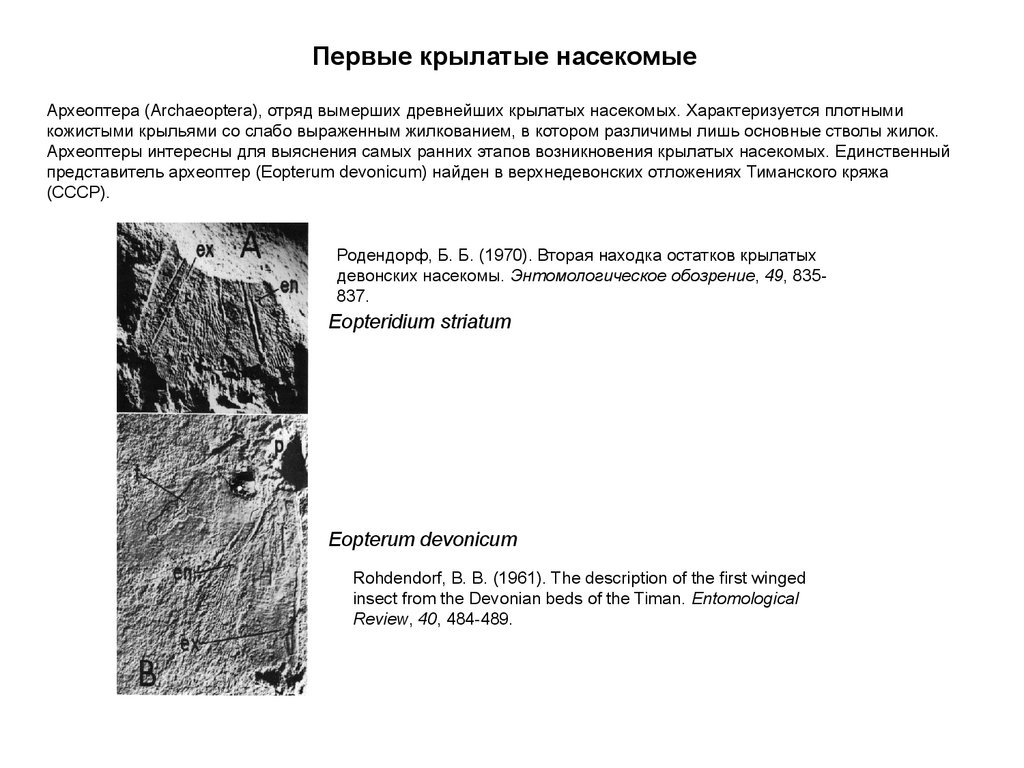
Первые крылатые насекомыеАрхеоптера (Archaeoptera), отряд вымерших древнейших крылатых насекомых. Характеризуется плотными
кожистыми крыльями со слабо выраженным жилкованием, в котором различимы лишь основные стволы жилок.
Археоптеры интересны для выяснения самых ранних этапов возникновения крылатых насекомых. Единственный
представитель археоптер (Eopterum devonicum) найден в верхнедевонских отложениях Тиманского кряжа
(СССР).
Родендорф, Б. Б. (1970). Вторая находка остатков крылатых
девонских насекомы. Энтомологическое обозрение, 49, 835837.
Eopteridium striatum
Eopterum devonicum
Rohdendorf, B. B. (1961). The description of the first winged
insect from the Devonian beds of the Timan. Entomological
Review, 40, 484-489.
26.
Первые крылатые насекомыеАрхеоптера (Archaeoptera), отряд вымерших древнейших крылатых насекомых. Характеризуется плотными
кожистыми крыльями со слабо выраженным жилкованием, в котором различимы лишь основные стволы жилок.
Археоптеры интересны для выяснения самых ранних этапов возникновения крылатых насекомых. Единственный
представитель археоптер (Eopterum devonicum) найден в верхнедевонских отложениях Тиманского кряжа
(СССР).
Родендорф, Б. Б. (1970). Вторая находка остатков крылатых
девонских насекомы. Энтомологическое обозрение, 49, 835837.
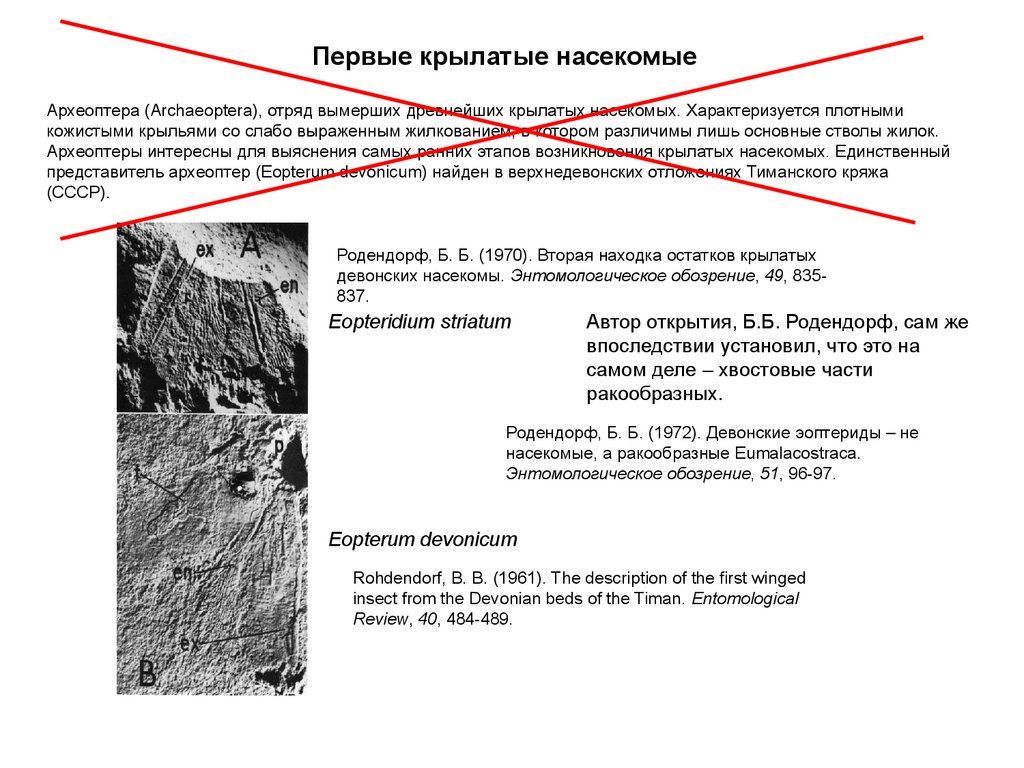
Eopteridium striatum
Автор открытия, Б.Б. Родендорф, сам же
впоследствии установил, что это на
самом деле – хвостовые части
ракообразных.
Родендорф, Б. Б. (1972). Девонские эоптериды – не
насекомые, а ракообразные Eumalacostraca.
Энтомологическое обозрение, 51, 96-97.
Eopterum devonicum
Rohdendorf, B. B. (1961). The description of the first winged
insect from the Devonian beds of the Timan. Entomological
Review, 40, 484-489.