 Мифология
Похожие презентации:







Mysterious creatures
1. MYSTERIOUS CREATURES
made by 9B class2. ASWANG
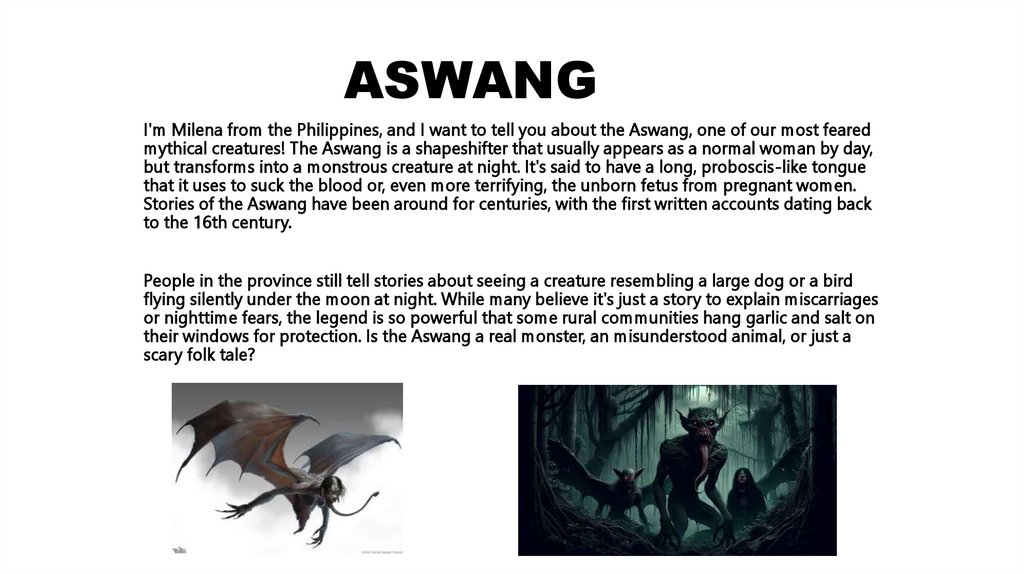
I'm Milena from the Philippines, and I want to tell you about the Aswang, one of our most fearedmythical creatures! The Aswang is a shapeshifter that usually appears as a normal woman by day,
but transforms into a monstrous creature at night. It's said to have a long, proboscis-like tongue
that it uses to suck the blood or, even more terrifying, the unborn fetus from pregnant women.
Stories of the Aswang have been around for centuries, with the first written accounts dating back
to the 16th century.
People in the province still tell stories about seeing a creature resembling a large dog or a bird
flying silently under the moon at night. While many believe it's just a story to explain miscarriages
or nighttime fears, the legend is so powerful that some rural communities hang garlic and salt on
their windows for protection. Is the Aswang a real monster, an misunderstood animal, or just a
scary folk tale?
3. Kelpie-water spirit (Келпи-водяной дух)
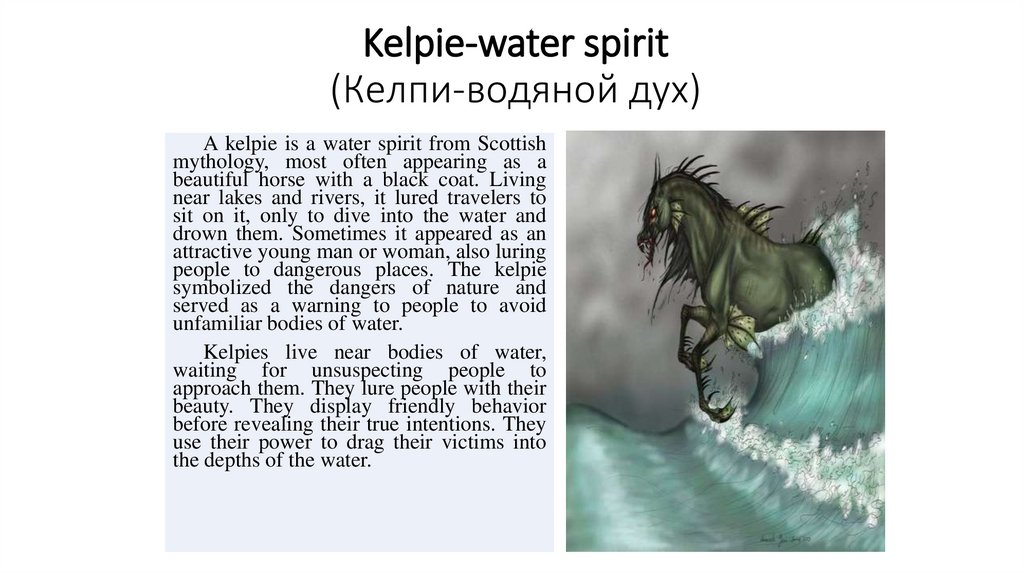
A kelpie is a water spirit from Scottishmythology, most often appearing as a
beautiful horse with a black coat. Living
near lakes and rivers, it lured travelers to
sit on it, only to dive into the water and
drown them. Sometimes it appeared as an
attractive young man or woman, also luring
people to dangerous places. The kelpie
symbolized the dangers of nature and
served as a warning to people to avoid
unfamiliar bodies of water.
Kelpies live near bodies of water,
waiting for unsuspecting people to
approach them. They lure people with their
beauty. They display friendly behavior
before revealing their true intentions. They
use their power to drag their victims into
the depths of the water.
4.
Hello, I'm Timofey from England, and I want to tellyou about Black Annis, a terrifying figure from
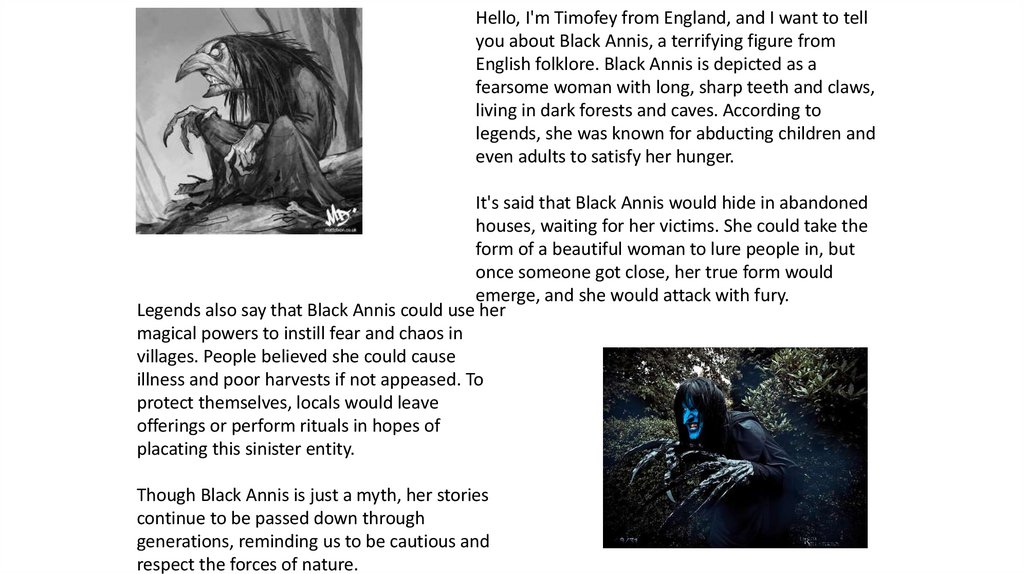
English folklore. Black Annis is depicted as a
fearsome woman with long, sharp teeth and claws,
living in dark forests and caves. According to
legends, she was known for abducting children and
even adults to satisfy her hunger.
It's said that Black Annis would hide in abandoned
houses, waiting for her victims. She could take the
form of a beautiful woman to lure people in, but
once someone got close, her true form would
emerge, and she would attack with fury.
Legends also say that Black Annis could use her
magical powers to instill fear and chaos in
villages. People believed she could cause
illness and poor harvests if not appeased. To
protect themselves, locals would leave
offerings or perform rituals in hopes of
placating this sinister entity.
Though Black Annis is just a myth, her stories
continue to be passed down through
generations, reminding us to be cautious and
respect the forces of nature.
5.
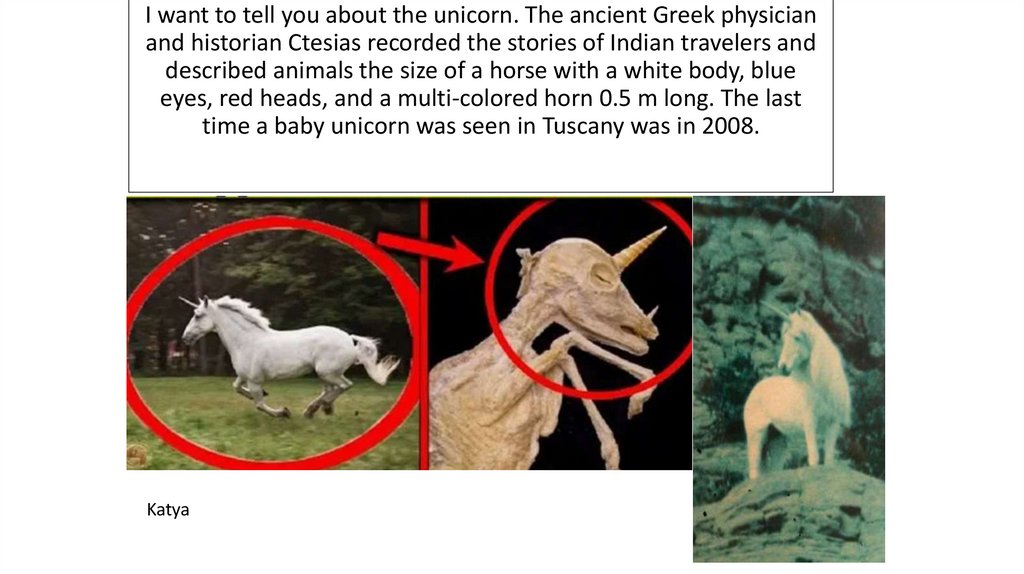
I want to tell you about the unicorn. The ancient Greek physicianand historian Ctesias recorded the stories of Indian travelers and
described animals the size of a horse with a white body, blue
eyes, red heads, and a multi-colored horn 0.5 m long. The last
time a baby unicorn was seen in Tuscany was in 2008.
Katya
6.
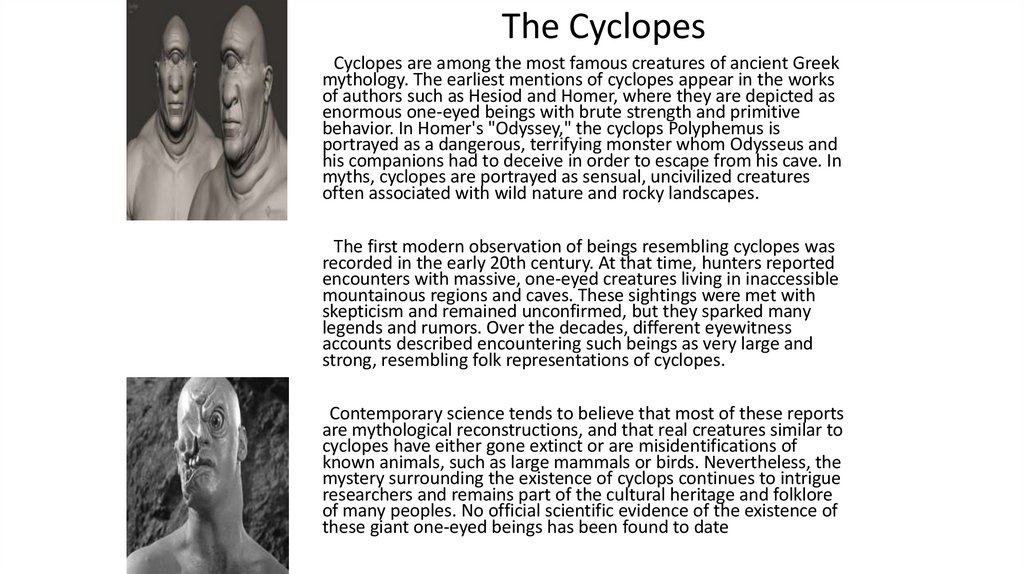
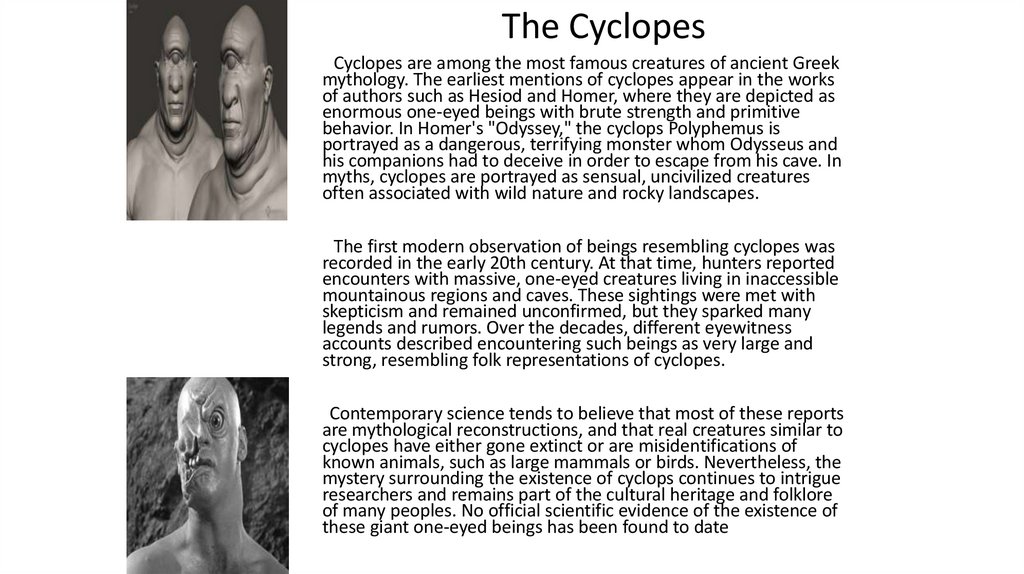
The CyclopesCyclopes are among the most famous creatures of ancient Greek
mythology. The earliest mentions of cyclopes appear in the works
of authors such as Hesiod and Homer, where they are depicted as
enormous one-eyed beings with brute strength and primitive
behavior. In Homer's "Odyssey," the cyclops Polyphemus is
portrayed as a dangerous, terrifying monster whom Odysseus and
his companions had to deceive in order to escape from his cave. In
myths, cyclopes are portrayed as sensual, uncivilized creatures
often associated with wild nature and rocky landscapes.
The first modern observation of beings resembling cyclopes was
recorded in the early 20th century. At that time, hunters reported
encounters with massive, one-eyed creatures living in inaccessible
mountainous regions and caves. These sightings were met with
skepticism and remained unconfirmed, but they sparked many
legends and rumors. Over the decades, different eyewitness
accounts described encountering such beings as very large and
strong, resembling folk representations of cyclopes.
Contemporary science tends to believe that most of these reports
are mythological reconstructions, and that real creatures similar to
cyclopes have either gone extinct or are misidentifications of
known animals, such as large mammals or birds. Nevertheless, the
mystery surrounding the existence of cyclops continues to intrigue
researchers and remains part of the cultural heritage and folklore
of many peoples. No official scientific evidence of the existence of
these giant one-eyed beings has been found to date
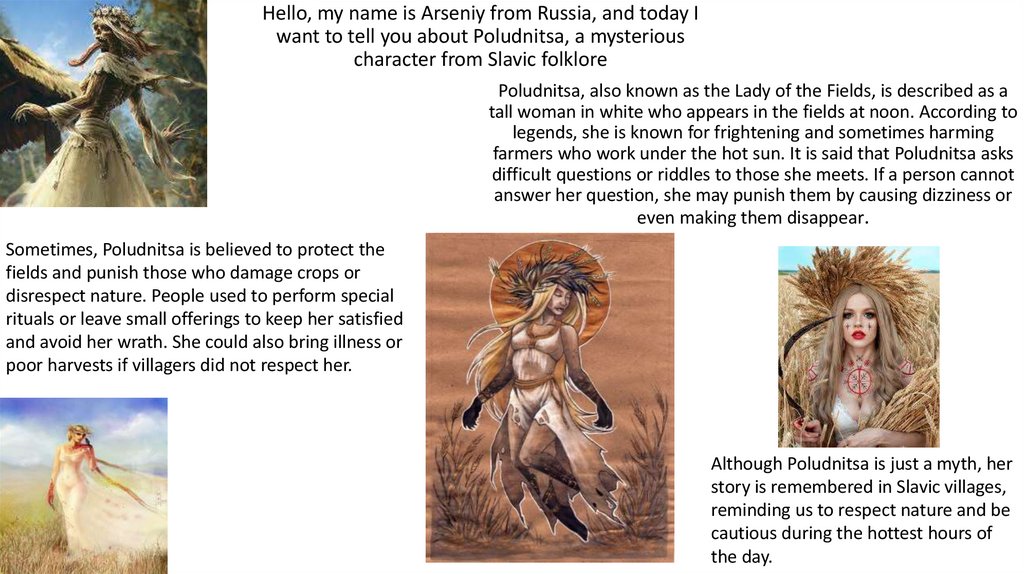
7. Hello, my name is Arseniy from Russia, and today I want to tell you about Poludnitsa, a mysterious character from Slavic
folklorePoludnitsa, also known as the Lady of the Fields, is described as a
tall woman in white who appears in the fields at noon. According to
legends, she is known for frightening and sometimes harming
farmers who work under the hot sun. It is said that Poludnitsa asks
difficult questions or riddles to those she meets. If a person cannot
answer her question, she may punish them by causing dizziness or
even making them disappear.
Sometimes, Poludnitsa is believed to protect the
fields and punish those who damage crops or
disrespect nature. People used to perform special
rituals or leave small offerings to keep her satisfied
and avoid her wrath. She could also bring illness or
poor harvests if villagers did not respect her.
Although Poludnitsa is just a myth, her
story is remembered in Slavic villages,
reminding us to respect nature and be
cautious during the hottest hours of
the day.
8.
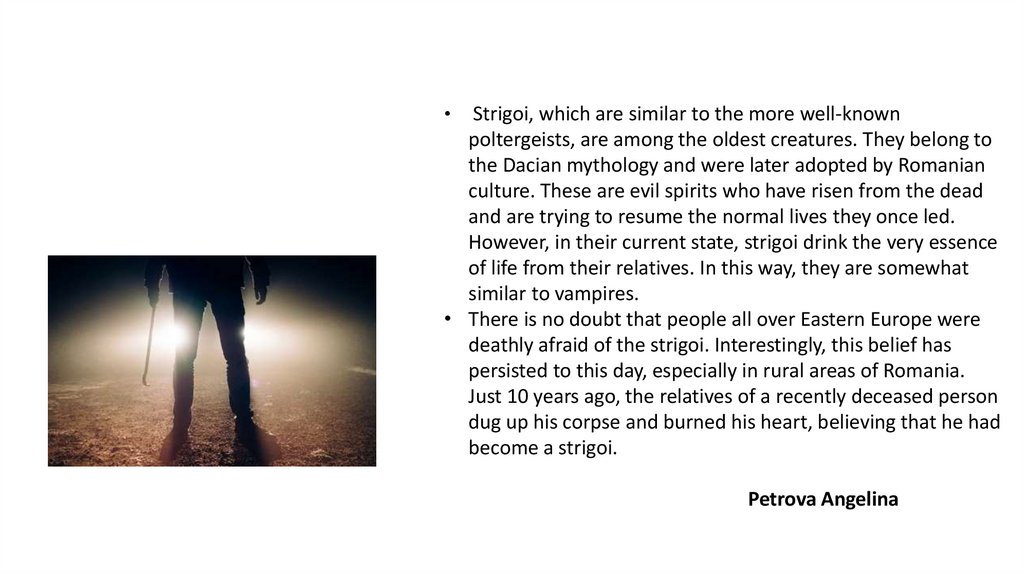
StrigoiStrigoi, which are similar to the more well-known
poltergeists, are among the oldest creatures. They belong to
the Dacian mythology and were later adopted by Romanian
culture. These are evil spirits who have risen from the dead
and are trying to resume the normal lives they once led.
However, in their current state, strigoi drink the very essence
of life from their relatives. In this way, they are somewhat
similar to vampires.
• There is no doubt that people all over Eastern Europe were
deathly afraid of the strigoi. Interestingly, this belief has
persisted to this day, especially in rural areas of Romania.
Just 10 years ago, the relatives of a recently deceased person
dug up his corpse and burned his heart, believing that he had
become a strigoi.
Petrova Angelina
9.
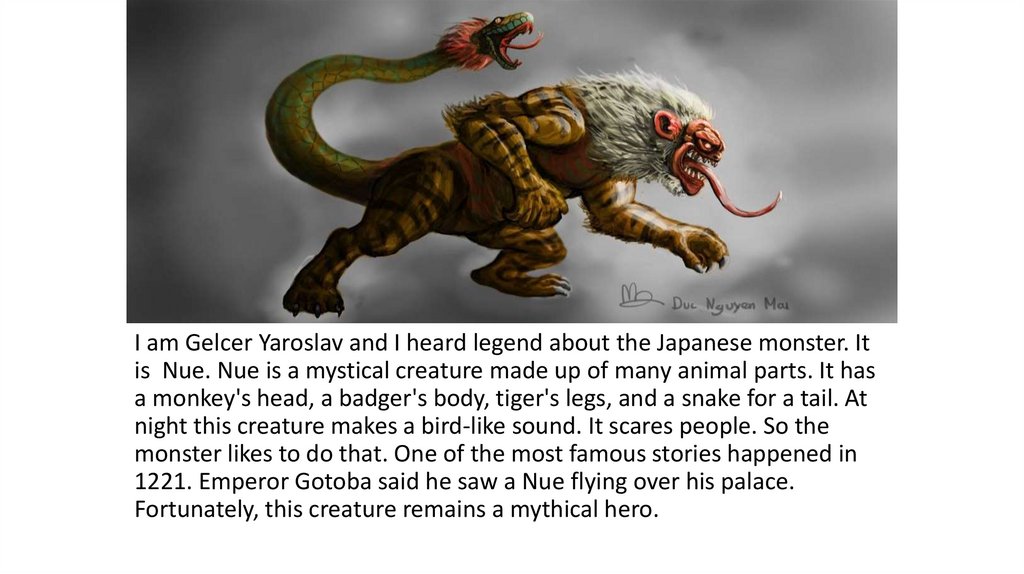
I am Gelcer Yaroslav and I heard legend about the Japanese monster. Itis Nue. Nue is a mystical creature made up of many animal parts. It has
a monkey's head, a badger's body, tiger's legs, and a snake for a tail. At
night this creature makes a bird-like sound. It scares people. So the
monster likes to do that. One of the most famous stories happened in
1221. Emperor Gotoba said he saw a Nue flying over his palace.
Fortunately, this creature remains a mythical hero.
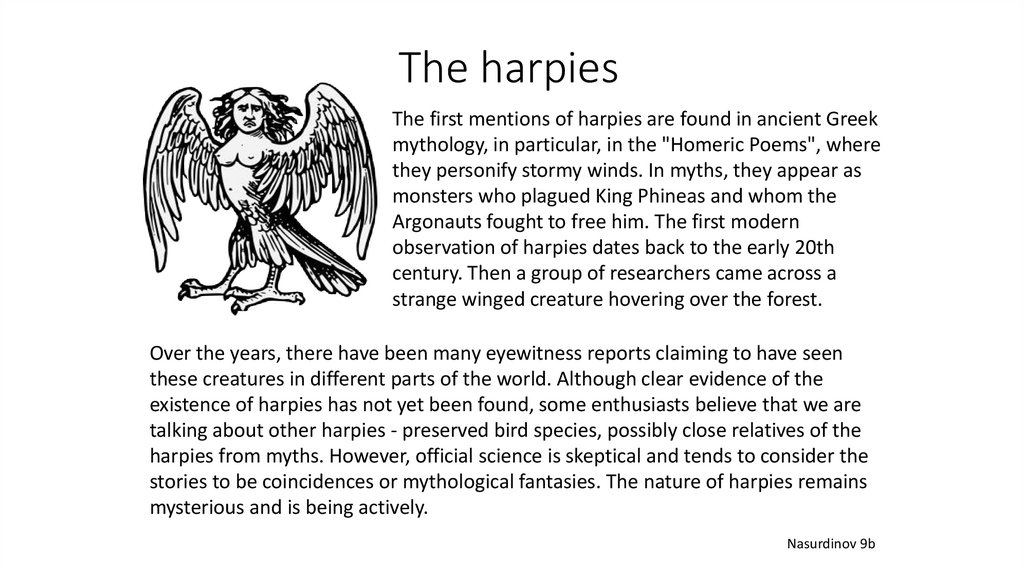
10. The harpies
The first mentions of harpies are found in ancient Greekmythology, in particular, in the "Homeric Poems", where
they personify stormy winds. In myths, they appear as
monsters who plagued King Phineas and whom the
Argonauts fought to free him. The first modern
observation of harpies dates back to the early 20th
century. Then a group of researchers came across a
strange winged creature hovering over the forest.
Over the years, there have been many eyewitness reports claiming to have seen
these creatures in different parts of the world. Although clear evidence of the
existence of harpies has not yet been found, some enthusiasts believe that we are
talking about other harpies - preserved bird species, possibly close relatives of the
harpies from myths. However, official science is skeptical and tends to consider the
stories to be coincidences or mythological fantasies. The nature of harpies remains
mysterious and is being actively.
Nasurdinov 9b
11.
The CyclopesCyclopes are among the most famous creatures of ancient Greek
mythology. The earliest mentions of cyclopes appear in the works
of authors such as Hesiod and Homer, where they are depicted as
enormous one-eyed beings with brute strength and primitive
behavior. In Homer's "Odyssey," the cyclops Polyphemus is
portrayed as a dangerous, terrifying monster whom Odysseus and
his companions had to deceive in order to escape from his cave. In
myths, cyclopes are portrayed as sensual, uncivilized creatures
often associated with wild nature and rocky landscapes.
The first modern observation of beings resembling cyclopes was
recorded in the early 20th century. At that time, hunters reported
encounters with massive, one-eyed creatures living in inaccessible
mountainous regions and caves. These sightings were met with
skepticism and remained unconfirmed, but they sparked many
legends and rumors. Over the decades, different eyewitness
accounts described encountering such beings as very large and
strong, resembling folk representations of cyclopes.
Contemporary science tends to believe that most of these reports
are mythological reconstructions, and that real creatures similar to
cyclopes have either gone extinct or are misidentifications of
known animals, such as large mammals or birds. Nevertheless, the
mystery surrounding the existence of cyclops continues to intrigue
researchers and remains part of the cultural heritage and folklore
of many peoples. No official scientific evidence of the existence of
these giant one-eyed beings has been found to date