
 Промышленность
Похожие презентации:









Lesson 3 Reading Traditional vs. Innovative ways of Transport
1. WEEK 8 LESSON 3
READINGTraditional vs. Innovative ways of Transport
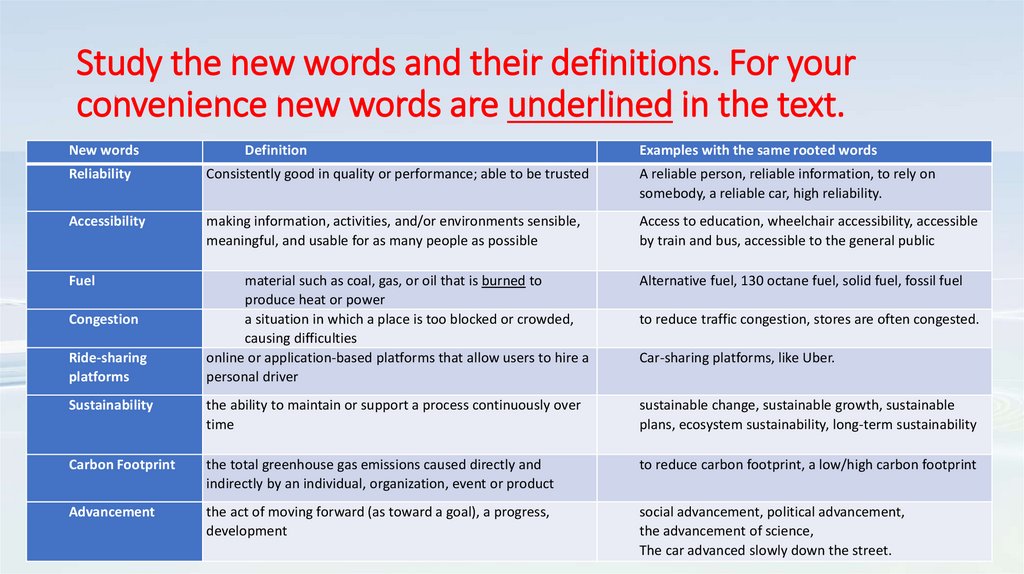
2. Study the new words and their definitions. For your convenience new words are underlined in the text.
New wordsDefinition
Examples with the same rooted words
Reliability
Consistently good in quality or performance; able to be trusted
A reliable person, reliable information, to rely on
somebody, a reliable car, high reliability.
Accessibility
making information, activities, and/or environments sensible,
meaningful, and usable for as many people as possible
Access to education, wheelchair accessibility, accessible
by train and bus, accessible to the general public
Fuel
material such as coal, gas, or oil that is burned to
produce heat or power
a situation in which a place is too blocked or crowded,
causing difficulties
online or application-based platforms that allow users to hire a
personal driver
Alternative fuel, 130 octane fuel, solid fuel, fossil fuel
Sustainability
the ability to maintain or support a process continuously over
time
sustainable change, sustainable growth, sustainable
plans, ecosystem sustainability, long-term sustainability
Carbon Footprint
the total greenhouse gas emissions caused directly and
indirectly by an individual, organization, event or product
to reduce carbon footprint, a low/high carbon footprint
Advancement
the act of moving forward (as toward a goal), a progress,
development
social advancement, political advancement,
the advancement of science,
The car advanced slowly down the street.
Congestion
Ride-sharing
platforms
to reduce traffic congestion, stores are often congested.
Car-sharing platforms, like Uber.
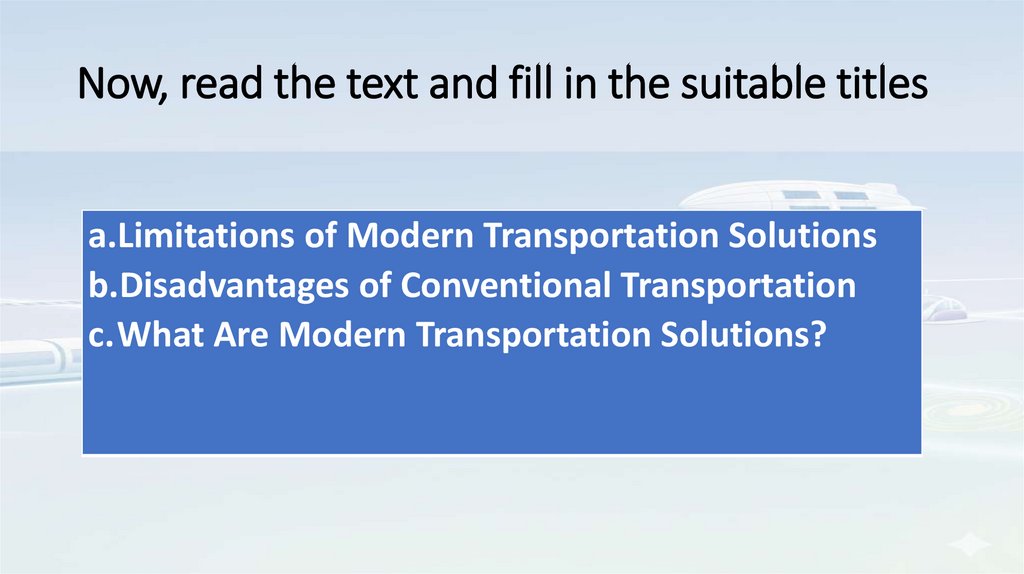
3. Now, read the text and fill in the suitable titles
a.Limitations of Modern Transportation Solutionsb.Disadvantages of Conventional Transportation
c.What Are Modern Transportation Solutions?
4. A Comparison of Conventional and Modern Transportation
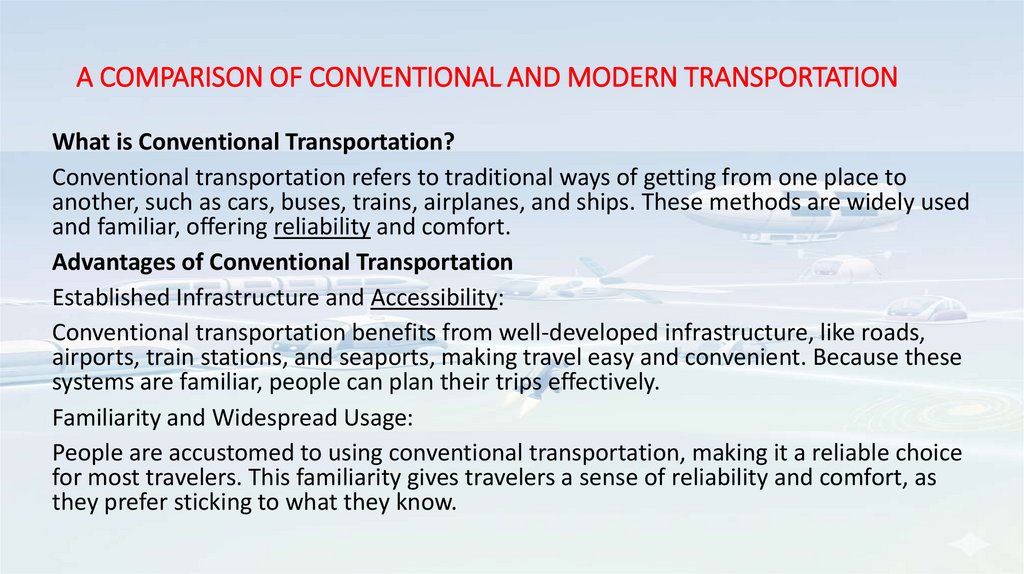
A COMPARISON OF CONVENTIONAL AND MODERN TRANSPORTATIONWhat is Conventional Transportation?
Conventional transportation refers to traditional ways of getting from one place to
another, such as cars, buses, trains, airplanes, and ships. These methods are widely used
and familiar, offering reliability and comfort.
Advantages of Conventional Transportation
Established Infrastructure and Accessibility:
Conventional transportation benefits from well-developed infrastructure, like roads,
airports, train stations, and seaports, making travel easy and convenient. Because these
systems are familiar, people can plan their trips effectively.
Familiarity and Widespread Usage:
People are accustomed to using conventional transportation, making it a reliable choice
for most travelers. This familiarity gives travelers a sense of reliability and comfort, as
they prefer sticking to what they know.
5.
• 1____________________________________________________________• Environmental Impact:
• Conventional transportation contributes significantly to pollution and greenhouse
gas emissions, raising concerns about its long-term sustainability. Vehicles that
use fossil fuels release carbon dioxide and other harmful pollutants into the air,
leading to air pollution and climate change.
• Limited Efficiency and Traffic Congestion:
• As urban populations grow, conventional transportation systems often struggle
with traffic congestion, leading to wasted time, fuel, and frustration.
• 2_________________________________________________________________
• Modern transportation solutions involve innovative and advanced methods to
improve travel, focusing on technology, sustainability, and efficiency. Examples
include electric vehicles, high-speed trains, ride-sharing platforms, and smart
mobility systems.
6.
Advantages of Modern Transportation SolutionsUse of Technology and Innovation:
Modern transportation integrates technology to enhance convenience and
efficiency, such as advanced navigation systems and real-time updates. With
mobile apps and online platforms, travelers can easily plan their journeys,
check schedules, and book tickets.
Environmental Sustainability and Reduced Carbon Footprint:
Modern transportation methods, like electric vehicles, hybrid cars and
sustainable options like electric bikes and scooters, reduce carbon emissions
and offer eco-friendly alternatives.
Increased Efficiency and Reduced Travel Time:
High-speed trains and advanced systems aim to save time and optimize
travel, reducing congestion and delays. Advanced transportation
management systems and artificial intelligence help optimize routes and
reduce congestion and delays.
7.
3_________________________________________________________High Initial Costs:
Building new infrastructure, such as charging stations for electric
vehicles and high-speed rail networks, requires significant investment.
Limited Availability in Some Areas:
Modern transportation solutions are not yet available everywhere,
particularly in rural or remote regions lacking the necessary
infrastructure.
In summary, while conventional transportation is familiar and reliable,
it has environmental and efficiency drawbacks. Modern transportation
solutions offer technological advancements and environmental benefits
but come with challenges like high costs and limited availability.
8. Choose the correct answer for the following questions about the text
1. What is the main difference between conventional and modern transportation solutions mentioned inthe passage?
A. Conventional transportation is more reliable, while modern solutions are more efficient.
B. Conventional transportation has more developed infrastructure, while modern solutions are more
environmentally friendly.
C. Conventional transportation is more affordable, while modern solutions are more technologically
advanced.
D. Conventional transportation is more widely used, while modern solutions are more innovative.
2. According to the passage, which of the following is a key advantage of conventional transportation?
A. Reduced environmental impact
B. Improved traffic flow
C. Widespread familiarity and accessibility
D. Enhanced technological integration
9. 3. Choose the correct answer for the following questions about the text
3. The passage suggests that modern transportation solutions aim to addresswhich of the following issues with conventional transportation?
A. Lack of reliability
B. High costs
C. Limited availability
D. Environmental concerns
4. What is one example of a modern transportation solution mentioned in the
passage?
A. Airplanes
B. Buses
C. Electric bikes and scooters
D. Trains
10. 3. Choose the correct answer for the following questions about the text
5. The passage states that a challenge of modern transportation solutions is:A. Lack of technological integration
B. High initial costs
C. Insufficient infrastructure
D. Limited familiarity for users
6. According to the passage, what is a key advantage of modern transportation
solutions?
A. Improved travel time and reduced congestion
B. Established and familiar infrastructure
C. Affordability for most travelers
D. Widespread usage and acceptance
11. Find true or false sentences. Correct the false statements.
1. Conventional transportation is known for its low environmentalimpact.
2. Modern transportation solutions often use technology to make
travel easier.
3. High-speed trains are a part of conventional transportation.
4. Building new infrastructure for modern transportation can be
expensive.
5. Modern transportation is available everywhere, including rural areas.