





 Бизнес
Похожие презентации:








1st-2nd Lessons_Types of business entities
1.
WELCOME BACKTO TERM 2
WHERE LEARNING
LEVELS UP!
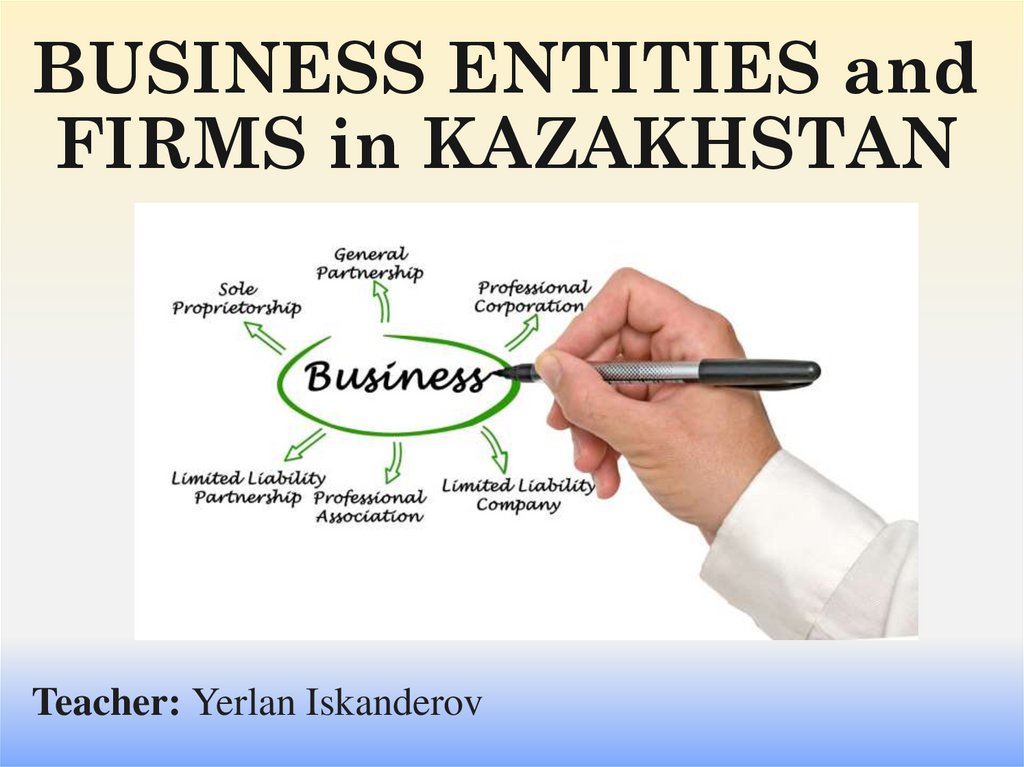
2. BUSINESS ENTITIES and FIRMS in KAZAKHSTAN
Teacher: Yerlan Iskanderov3. Lesson Objectives
• To distinguish legal forms of businessorganisation;
• To define and understand the key
characteristics
of
business
entities,
including
sole
proprietorships,
partnerships, limited liability companies
(LLCs), and corporations.
4. Think of a business you would want to have in the future….
5. BRAINSTORM
• What is a business?• What are the forms of business entities?
• What are the two main categories of persons
recognized by law of the RK in terms of legal
rights and responsibilities?
• How do financial liabilities differ for an
individual running a business versus a legal
entity?
6. What is a BUSINESS?
Business is an economicactivity that involves the
exchange, purchase, sale or
production of goods and
services with a motive to
earn profits and satisfy the
needs of customers.
Businesses can be both
profit or non-profit
organizations that function
to gain profits or achieve a
social cause respectively.
6
7. FORMS OF BUSINESS ENTITIES
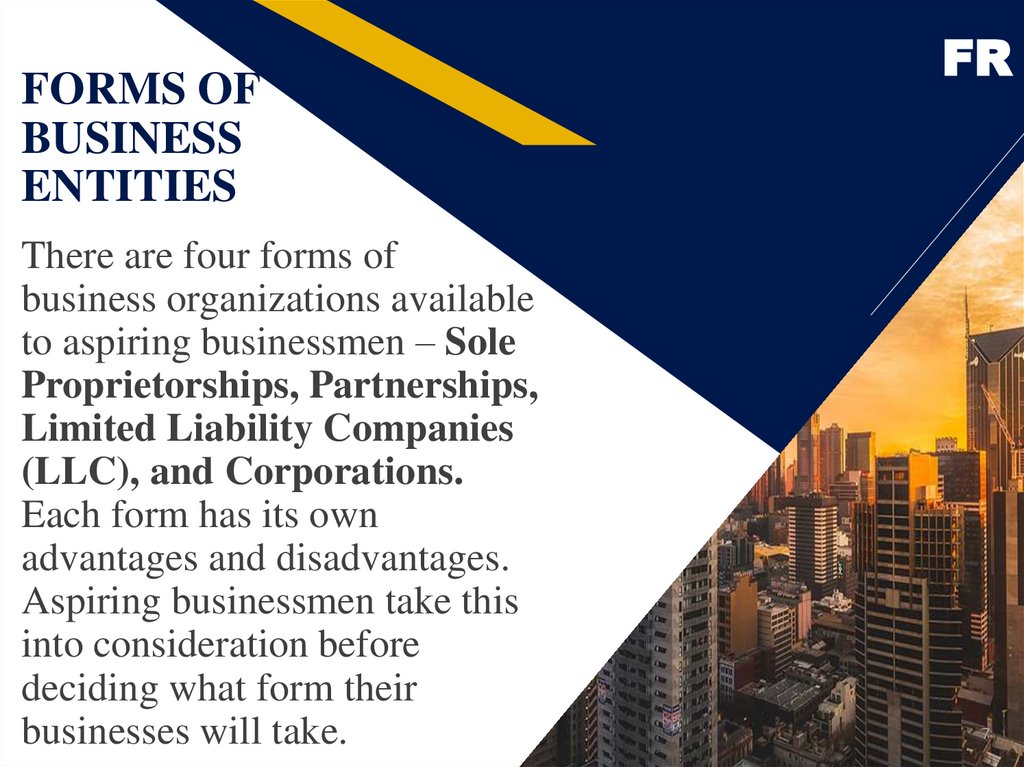
There are four forms ofbusiness organizations available
to aspiring businessmen – Sole
Proprietorships, Partnerships,
Limited Liability Companies
(LLC), and Corporations.
Each form has its own
advantages and disadvantages.
Aspiring businessmen take this
into consideration before
deciding what form their
businesses will take.
FR
7
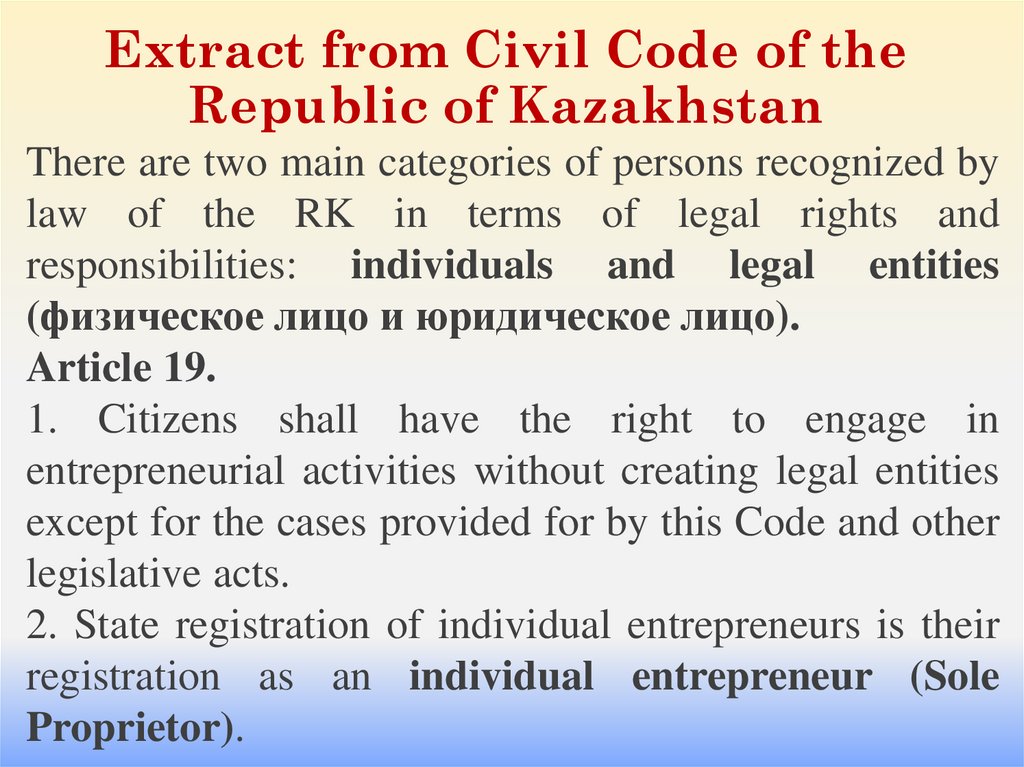
8. Extract from Civil Code of the Republic of Kazakhstan
There are two main categories of persons recognized bylaw of the RK in terms of legal rights and
responsibilities: individuals and legal entities
(физическое лицо и юридическое лицо).
Article 19.
1. Citizens shall have the right to engage in
entrepreneurial activities without creating legal entities
except for the cases provided for by this Code and other
legislative acts.
2. State registration of individual entrepreneurs is their
registration as an individual entrepreneur (Sole
Proprietor).
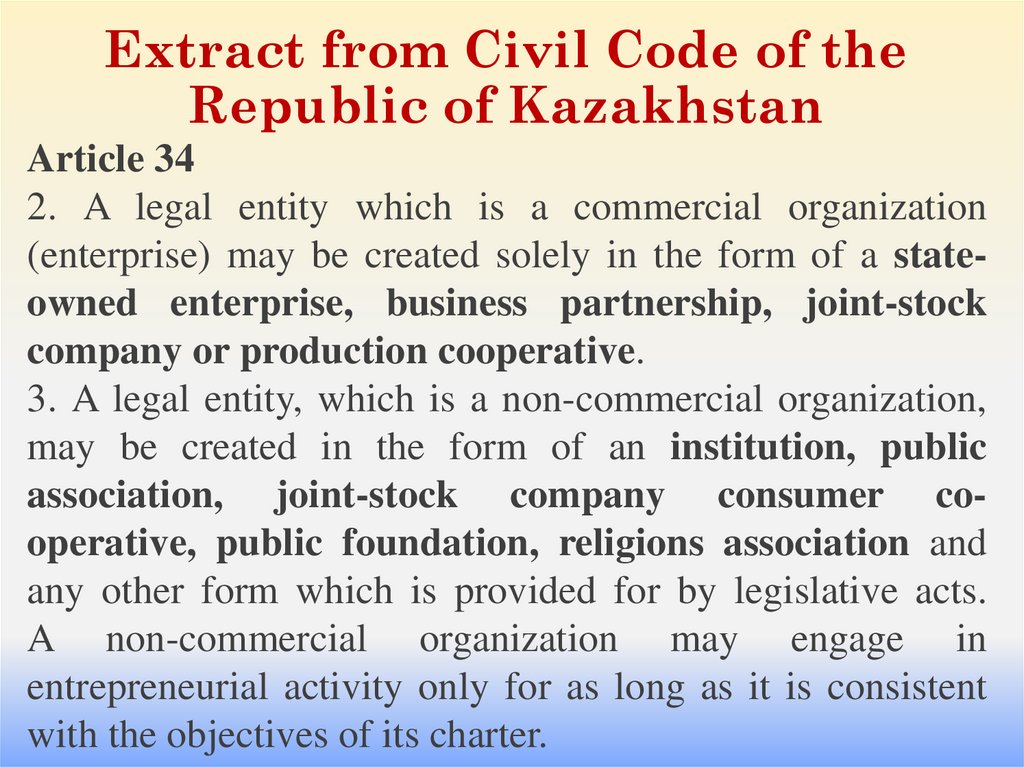
9. Extract from Civil Code of the Republic of Kazakhstan
Article 342. A legal entity which is a commercial organization
(enterprise) may be created solely in the form of a stateowned enterprise, business partnership, joint-stock
company or production cooperative.
3. A legal entity, which is a non-commercial organization,
may be created in the form of an institution, public
association, joint-stock company consumer cooperative, public foundation, religions association and
any other form which is provided for by legislative acts.
A non-commercial organization may engage in
entrepreneurial activity only for as long as it is consistent
with the objectives of its charter.
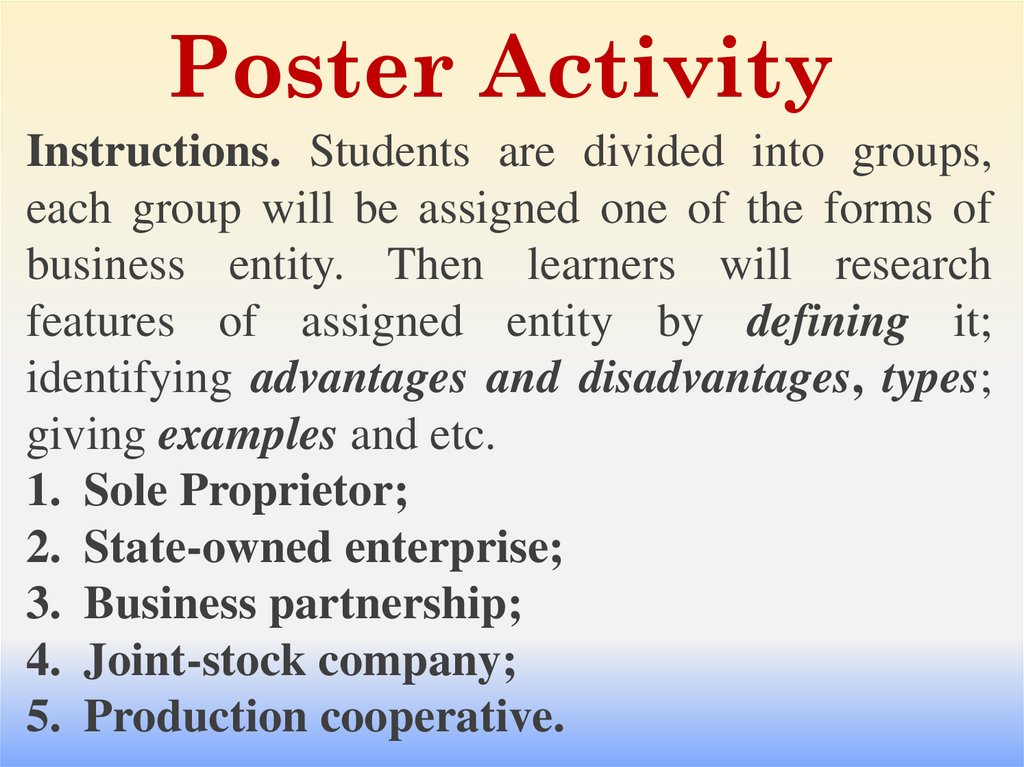
10. Poster Activity
Instructions. Students are divided into groups,each group will be assigned one of the forms of
business entity. Then learners will research
features of assigned entity by defining it;
identifying advantages and disadvantages, types;
giving examples and etc.
1. Sole Proprietor;
2. State-owned enterprise;
3. Business partnership;
4. Joint-stock company;
5. Production cooperative.
11. Poster Activity
DefinitionSole
Proprietor
State-owned
enterprise
Business
partnership
Joint-stock
company
Production
cooperative
Advantages
Disadvantages
Types,
Examples
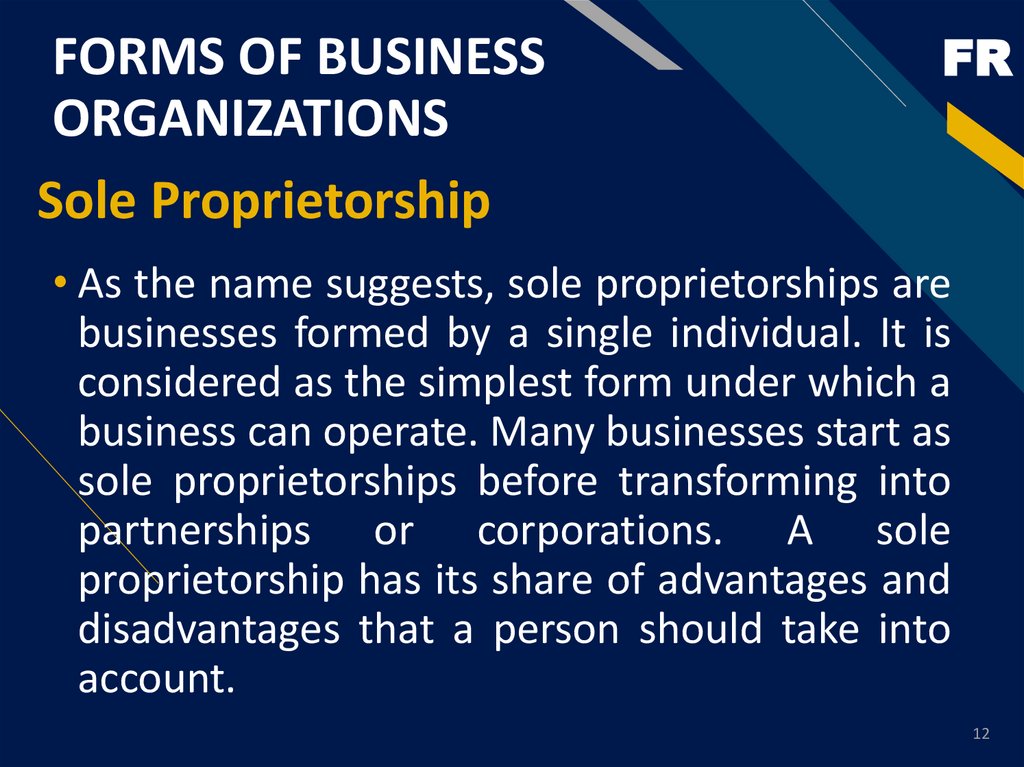
12. FORMS OF BUSINESS ORGANIZATIONS
Sole ProprietorshipFR
• As the name suggests, sole proprietorships are
businesses formed by a single individual. It is
considered as the simplest form under which a
business can operate. Many businesses start as
sole proprietorships before transforming into
partnerships or corporations. A sole
proprietorship has its share of advantages and
disadvantages that a person should take into
account.
12
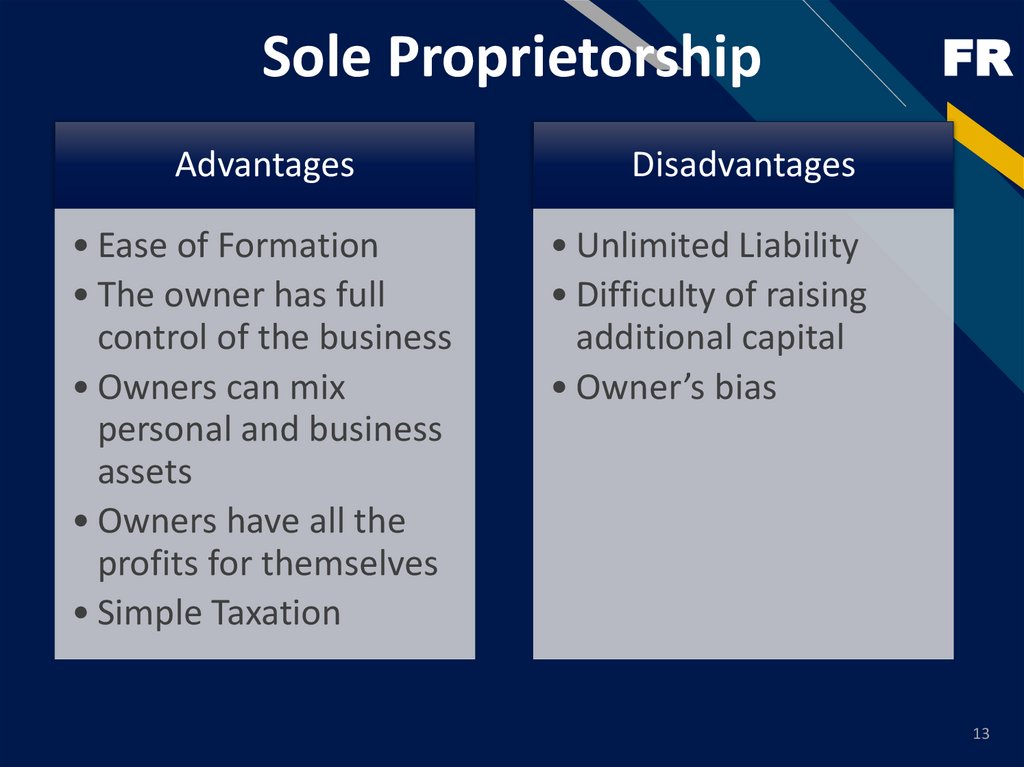
13. Sole Proprietorship
Advantages• Ease of Formation
• The owner has full
control of the business
• Owners can mix
personal and business
assets
• Owners have all the
profits for themselves
• Simple Taxation
FR
Disadvantages
• Unlimited Liability
• Difficulty of raising
additional capital
• Owner’s bias
Template Editing
Instructions and
Feedback
13
14. FORMS OF BUSINESS ORGANIZATIONS
PartnershipFR
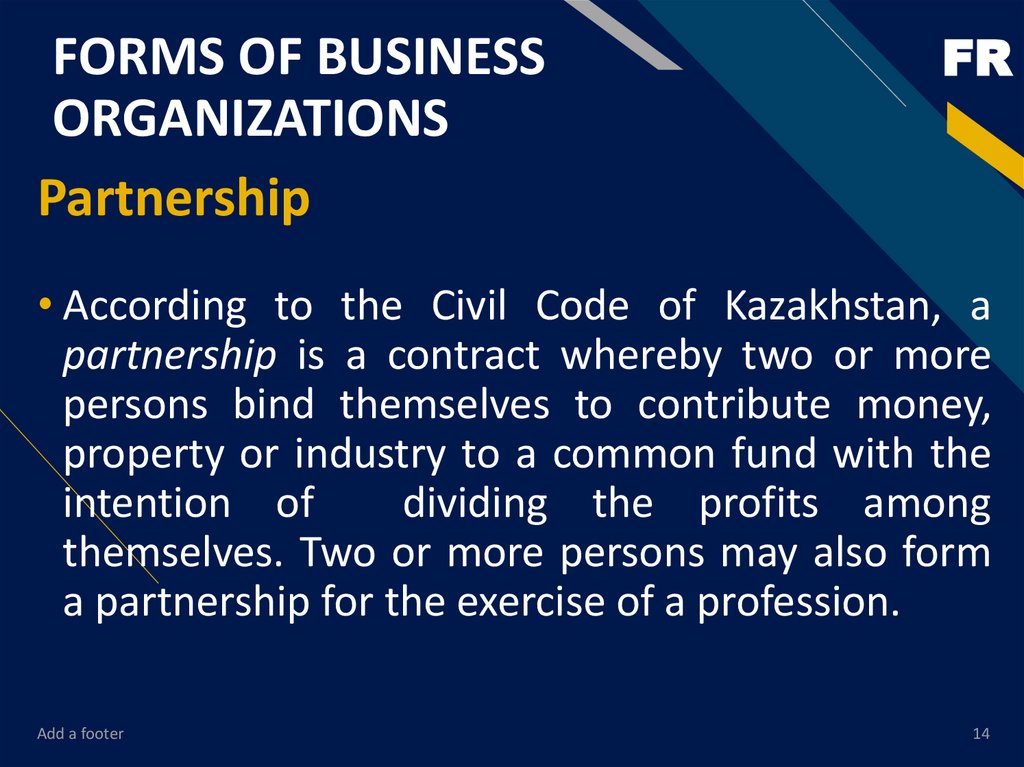
• According to the Civil Code of Kazakhstan, a
partnership is a contract whereby two or more
persons bind themselves to contribute money,
property or industry to a common fund with the
intention of
dividing the profits among
themselves. Two or more persons may also form
a partnership for the exercise of a profession.
Add a footer
14
15. Forms of Partnership
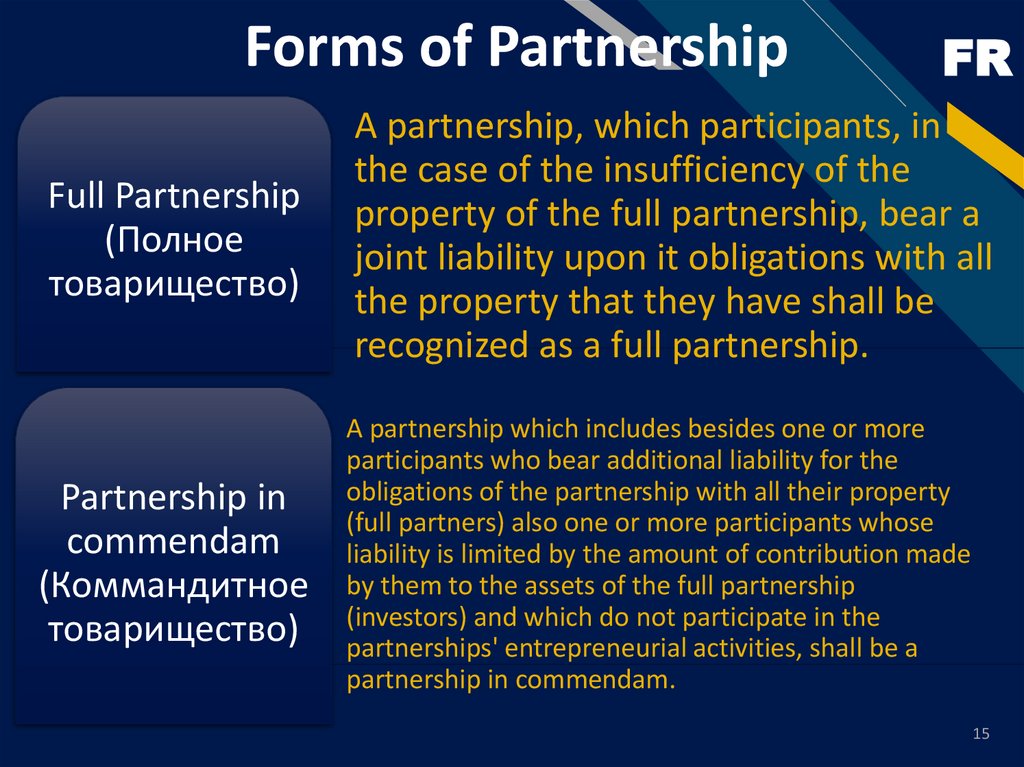
Full Partnership(Полное
товарищество)
FR
A partnership, which participants, in
the case of the insufficiency of the
property of the full partnership, bear a
joint liability upon it obligations with all
the property that they have shall be
recognized as a full partnership.
Template Editing
Instructions and
Feedback
Partnership in
commendam
(Коммандитное
товарищество)
A partnership which includes besides one or more
participants who bear additional liability for the
obligations of the partnership with all their property
(full partners) also one or more participants whose
liability is limited by the amount of contribution made
by them to the assets of the full partnership
(investors) and which do not participate in the
partnerships' entrepreneurial activities, shall be a
partnership in commendam.
15
16. Forms of Partnership
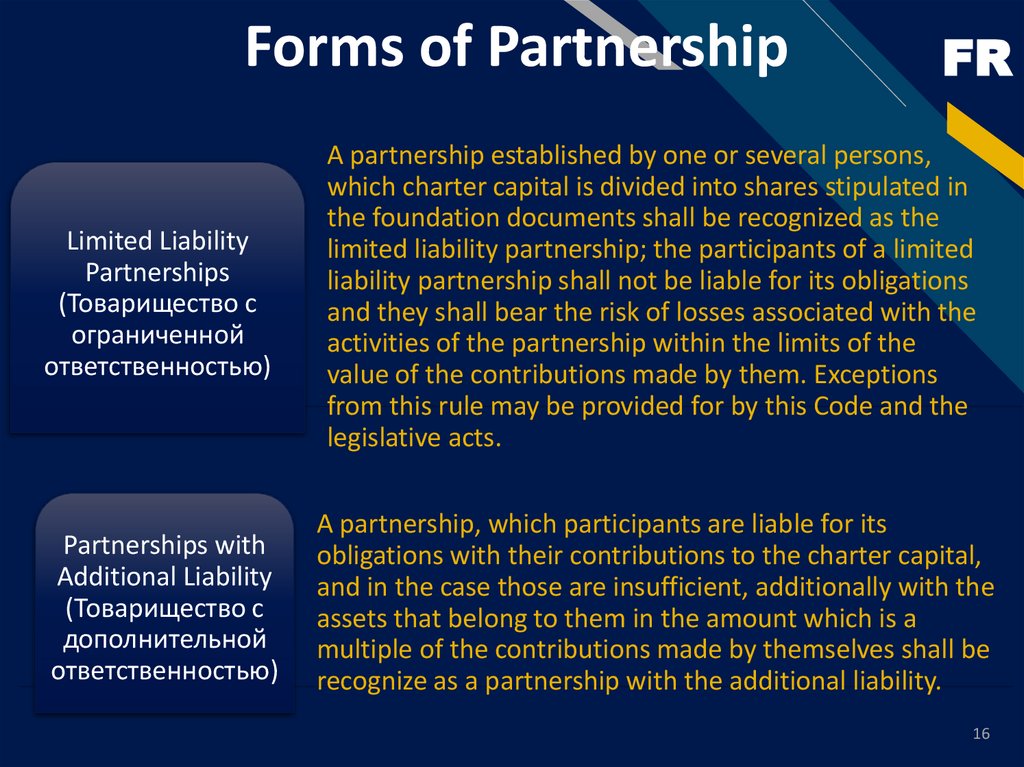
FRLimited Liability
Partnerships
(Товарищество с
ограниченной
ответственностью)
A partnership established by one or several persons,
which charter capital is divided into shares stipulated in
the foundation documents shall be recognized as the
limited liability partnership; the participants of a limited
liability partnership shall not be liable for its obligations
and they shall bear the risk of losses associated with the
activities of the partnership within the limits of the
value of the contributions made by them. Exceptions
from this rule may be provided for by this Code and the
legislative acts.
Partnerships with
Additional Liability
(Товарищество с
дополнительной
ответственностью)
A partnership, which participants are liable for its
obligations with their contributions to the charter capital,
and in the case those are insufficient, additionally with the
assets that belong to them in the amount which is a
multiple of the contributions made by themselves shall be
recognize as a partnership with the additional liability.
Template Editing
Instructions and
Feedback
16
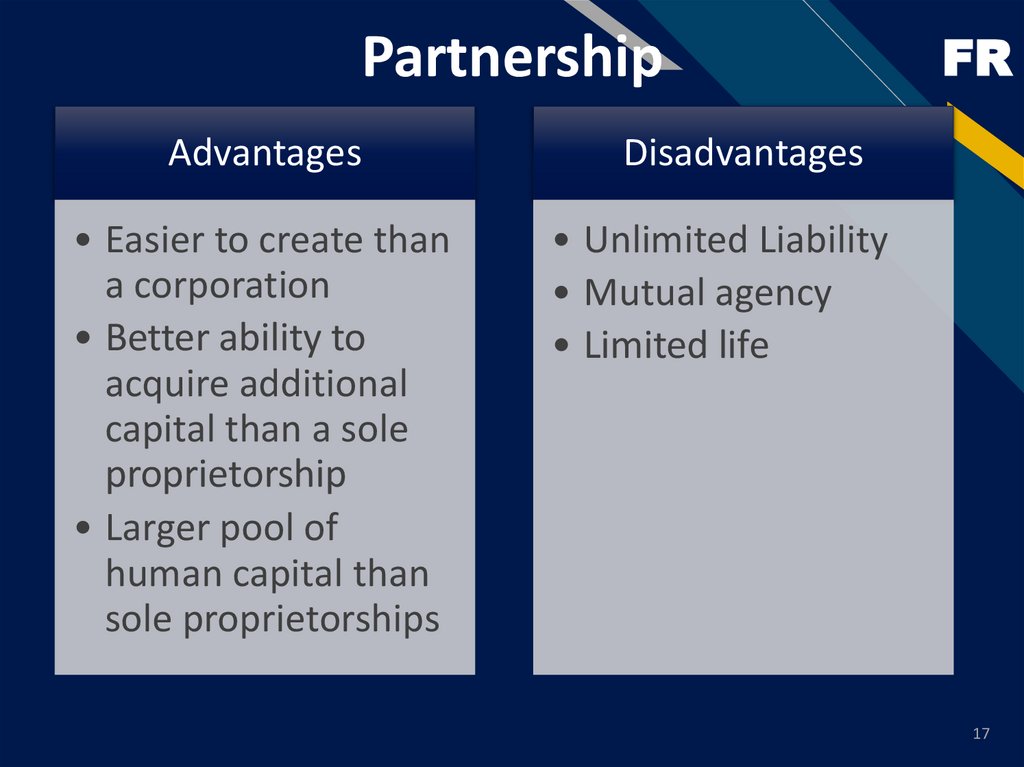
17. Partnership
AdvantagesDisadvantages
• Easier to create than
a corporation
• Better ability to
acquire additional
capital than a sole
proprietorship
• Larger pool of
human capital than
sole proprietorships
• Unlimited Liability
• Mutual agency
• Limited life
FR
Template Editing
Instructions and
Feedback
17
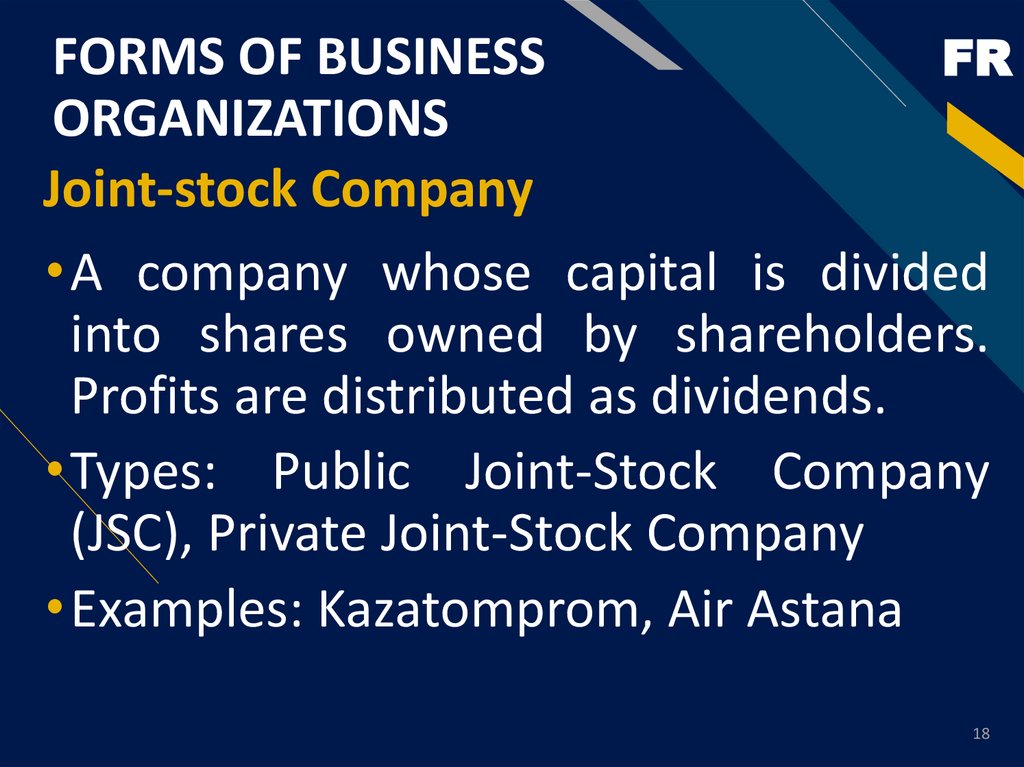
18. FORMS OF BUSINESS ORGANIZATIONS
FORMS OF BUSINESSFR
ORGANIZATIONS
Joint-stock Company
• A company whose capital is divided
into shares owned by shareholders.
Profits are distributed as dividends.
• Types: Public Joint-Stock Company
(JSC), Private Joint-Stock Company
• Examples: Kazatomprom, Air Astana
18
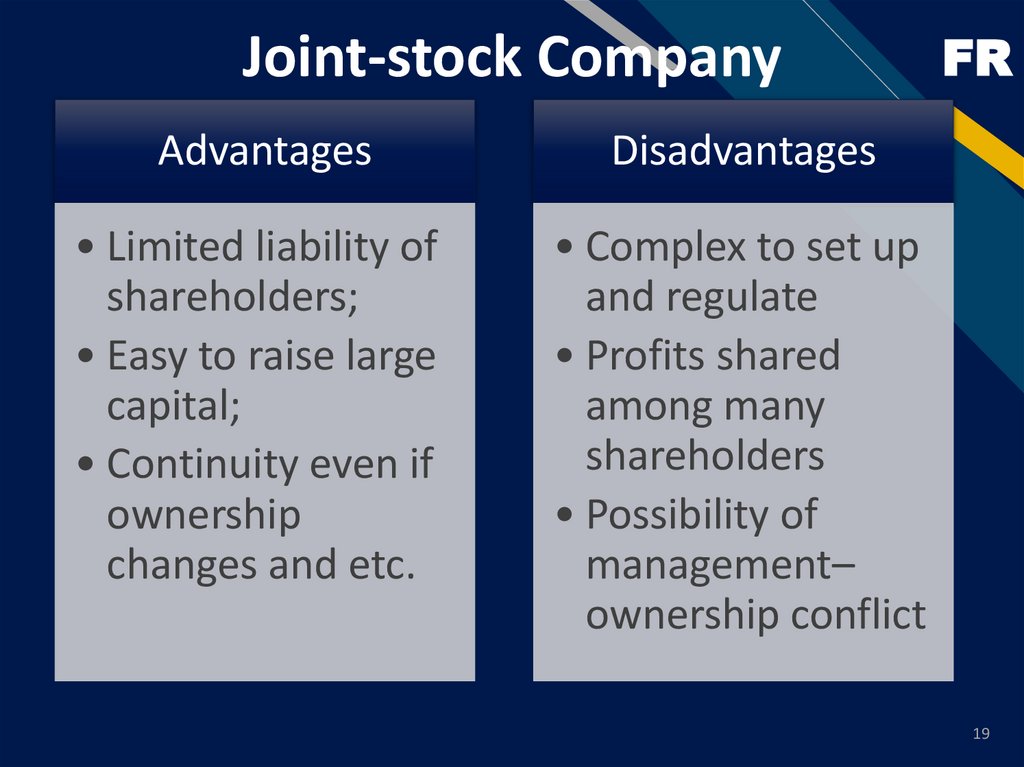
19. Joint-stock Company
AdvantagesDisadvantages
• Limited liability of
shareholders;
• Easy to raise large
capital;
• Continuity even if
ownership
changes and etc.
• Complex to set up
and regulate
• Profits shared
among many
shareholders
• Possibility of
management–
ownership conflict
FR
Template Editing
Instructions and
Feedback
19