















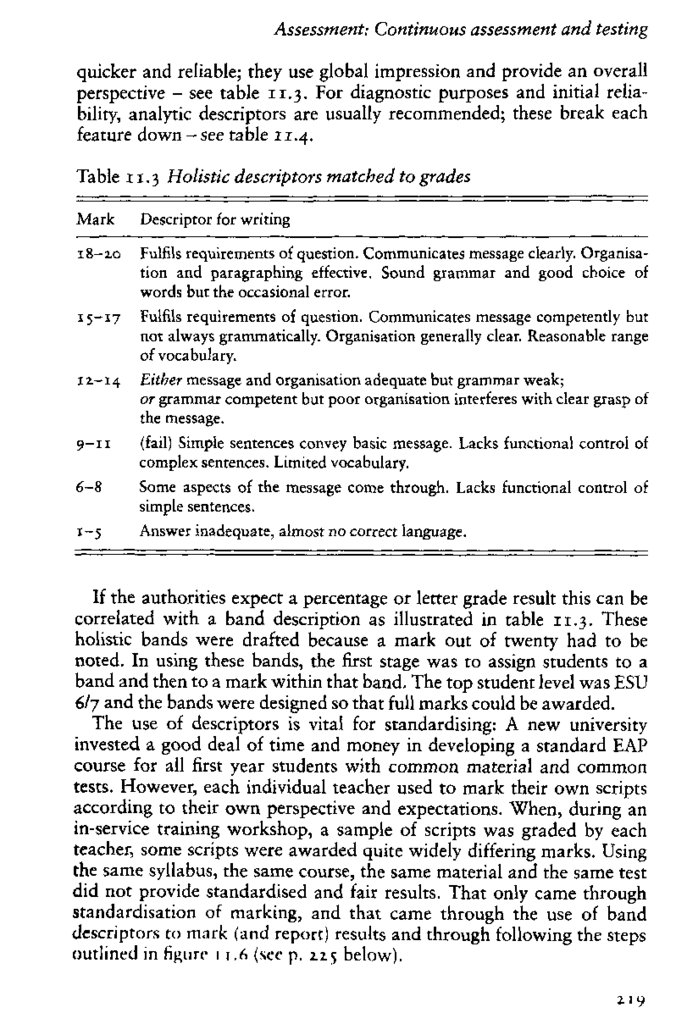
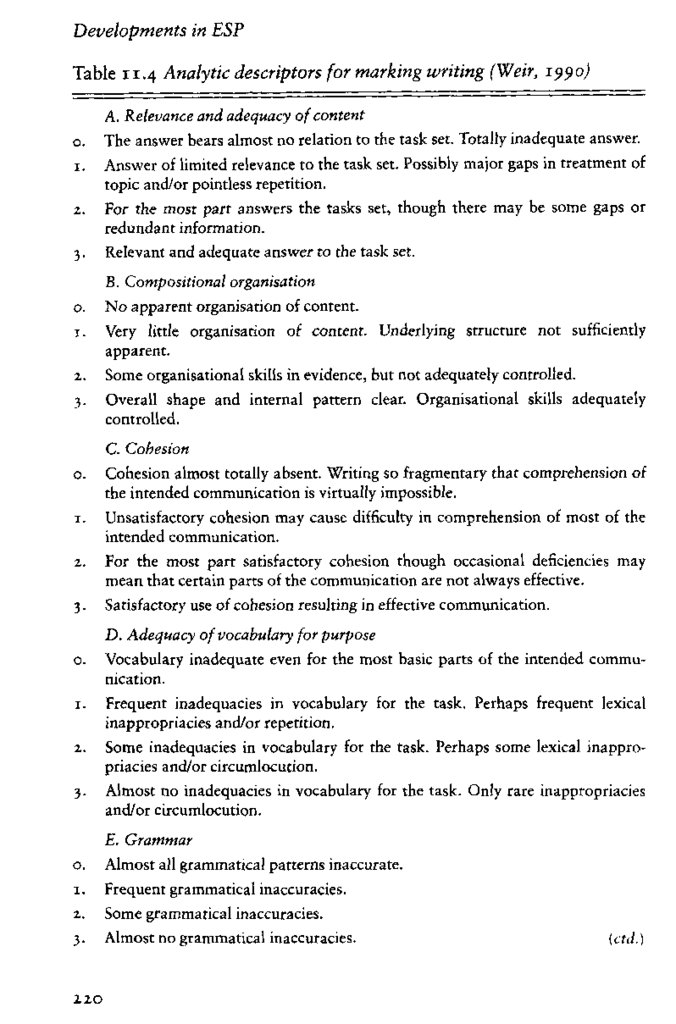
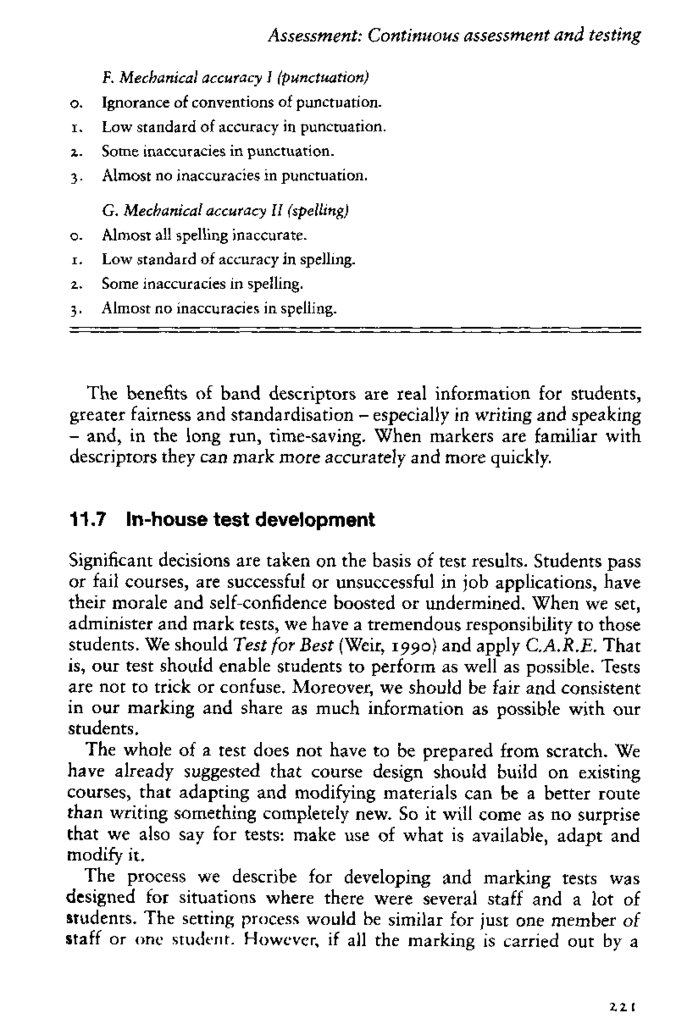
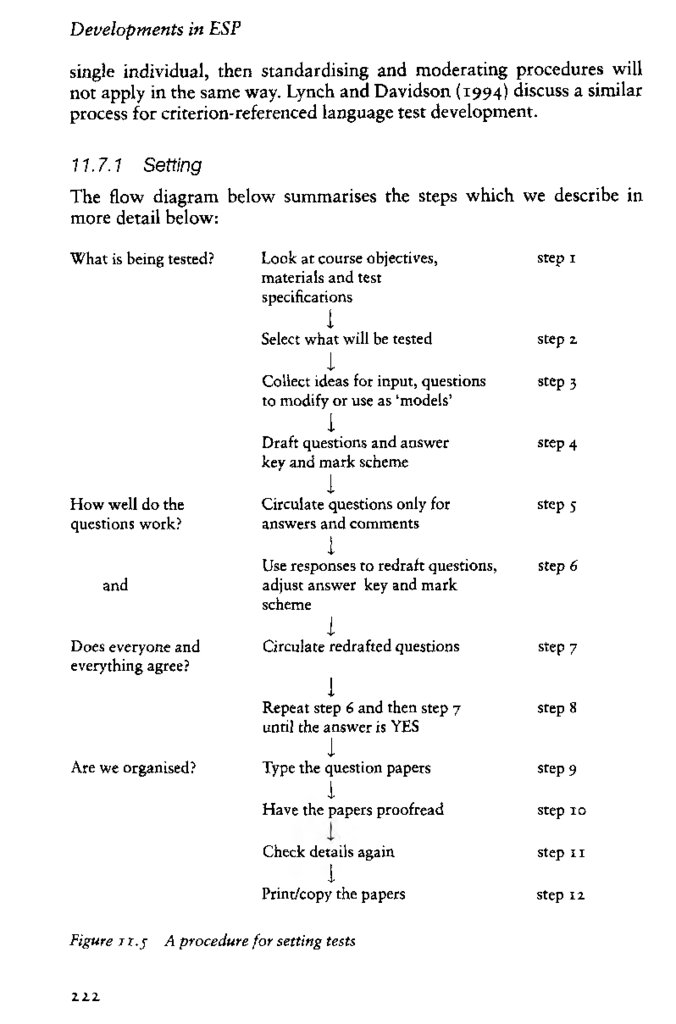



















 Английский язык
Похожие презентации:









Developments in English for Specific Purposes
1.
2.
C A M B R ID G E L A N G U A G E T E A C H IN G L IB R A R YA series covering central issues in language teaching and learning, by authors who have
expert knowledge in their field.
In this series:
Affect in Language Learning edited by ja n e A rnold
Approaches and Methods in Language Teaching second edition by Ja ck C. Richards and
Theodore S. Rodgers
Beyond Training by Ja ck C. Richards
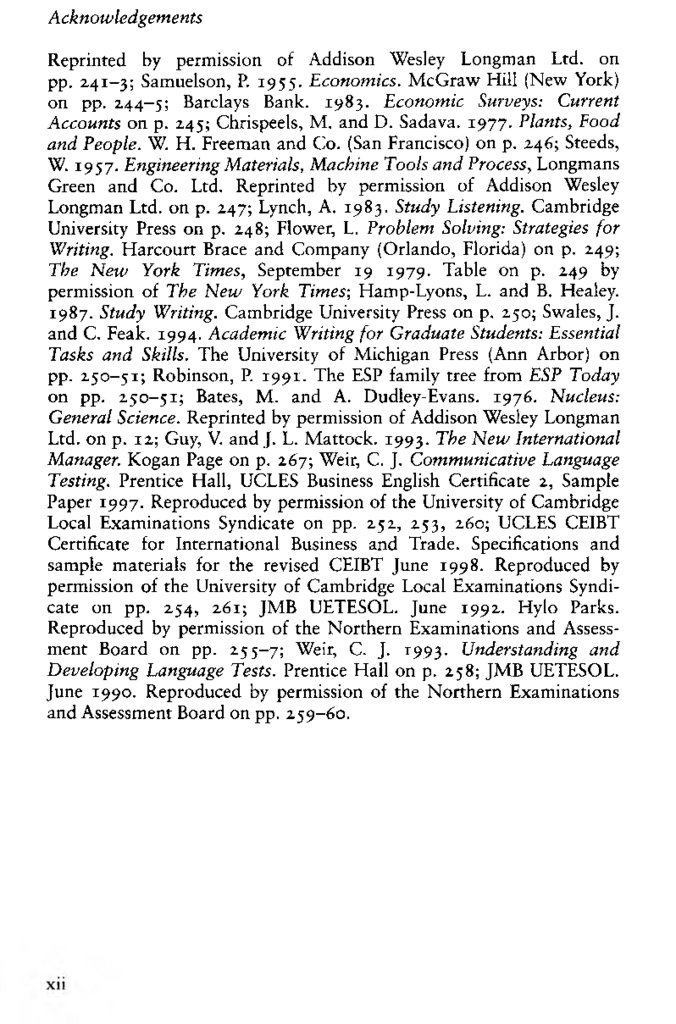
Classroom Decision-Making edited by M ichael Breen and A n d rew Littlejohn
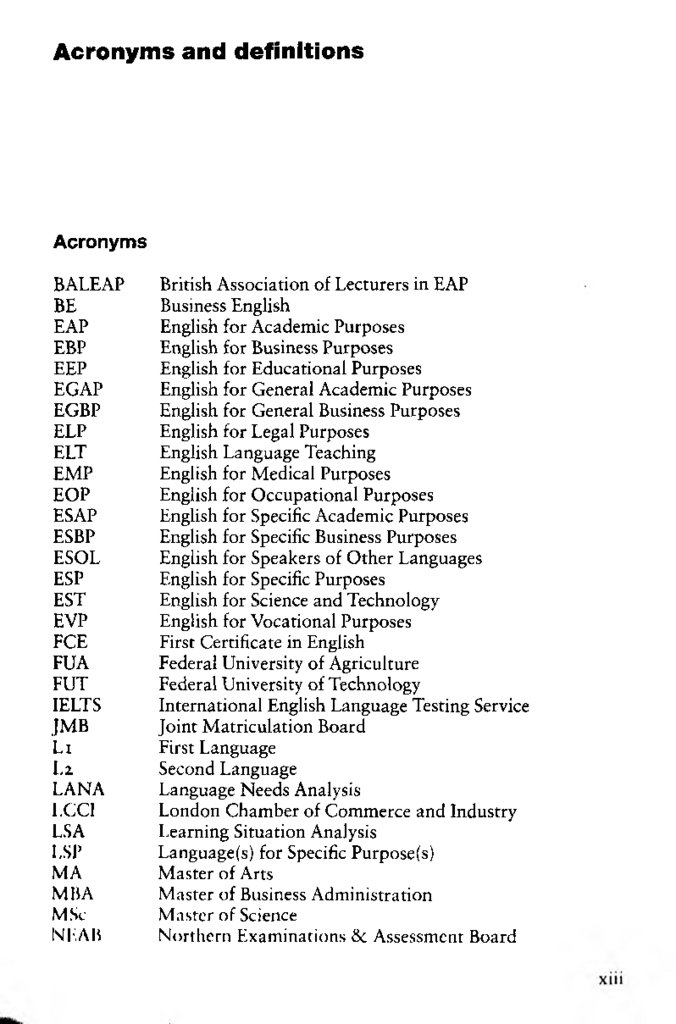
Collaborative Action Research for English Language Teachers by A nne Burns
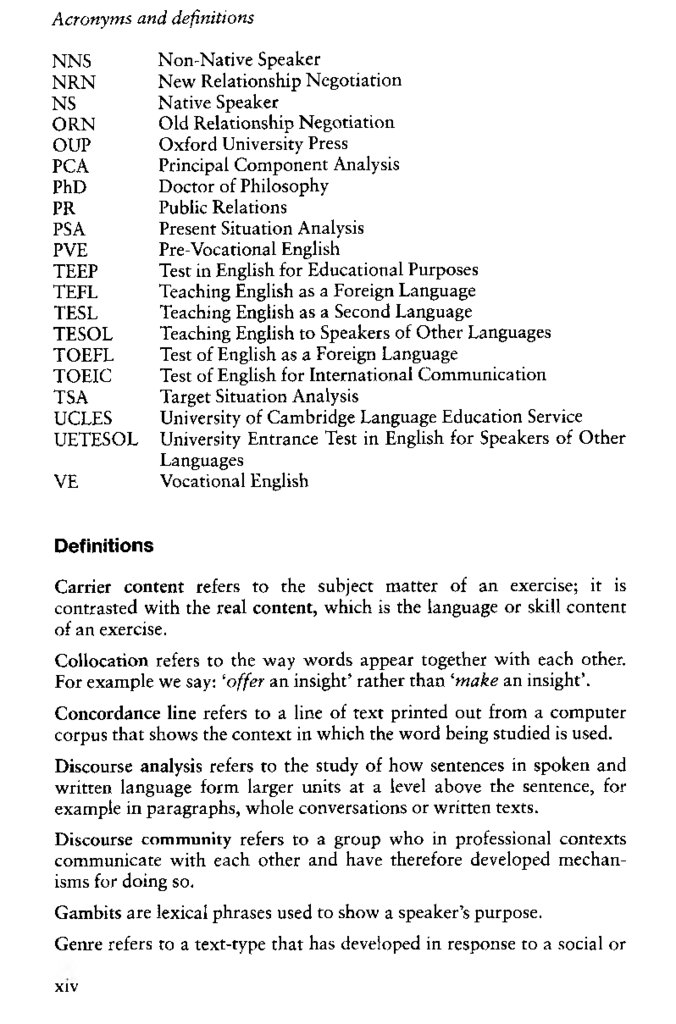
Collaborative Language Learning and Teaching edited by D avid Nunan
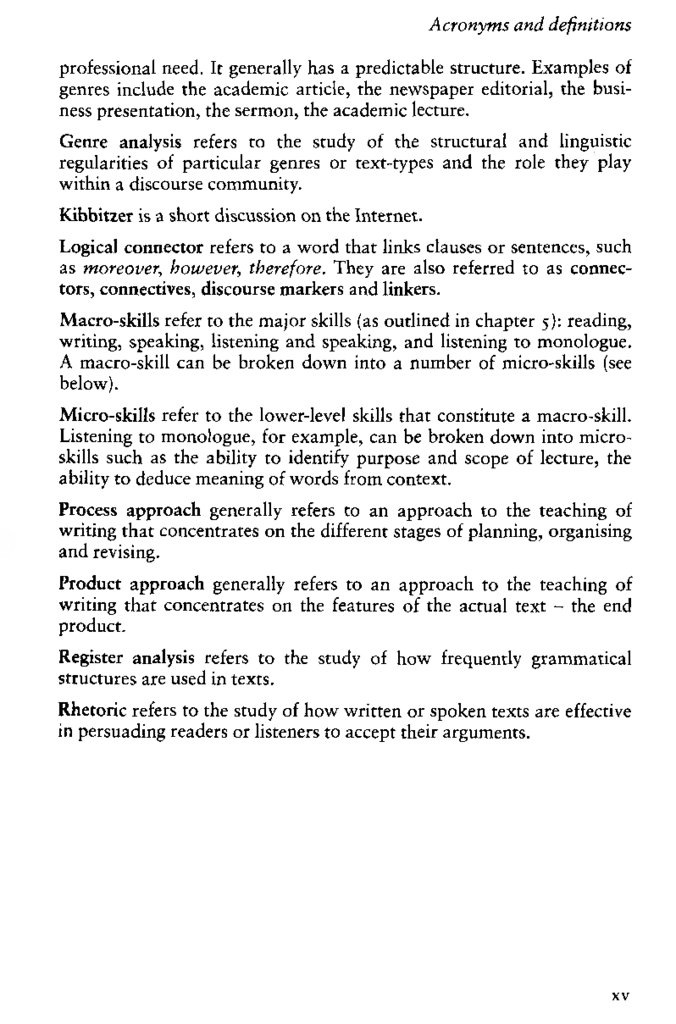
Communicative Language Teaching by William Littlew ood
Developing Reading Skills by Franfoise Grellet
Developments in English for Specific Purposes by Tony D udley-Evans and M aggie J o St
Jo h n
Discourse Analysis for Language Teachers by M ichael M cCarthy
Discourse and Language Education by E velyn Hatch
The Dynamics of the Language Classroom by Ian Tudor
English for Academic Purposes by R . R . Jo rd a n
English for Specific Purposes by Tom H utchinson and Alan Waters
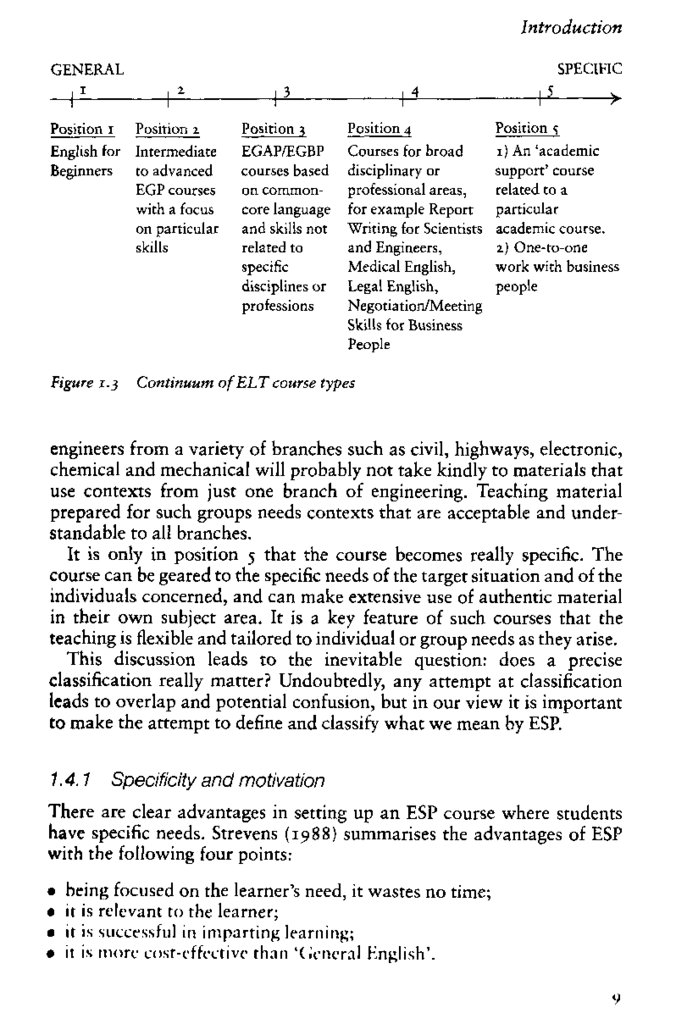
Establishing Self-Access b y D a vid G a rd n er and Lindsay M iller
Foreign and Second Language Learning by William Littlew ood
Group Dynamics in the Language Classroom by Z oltan D ornyei and Tim M urphey
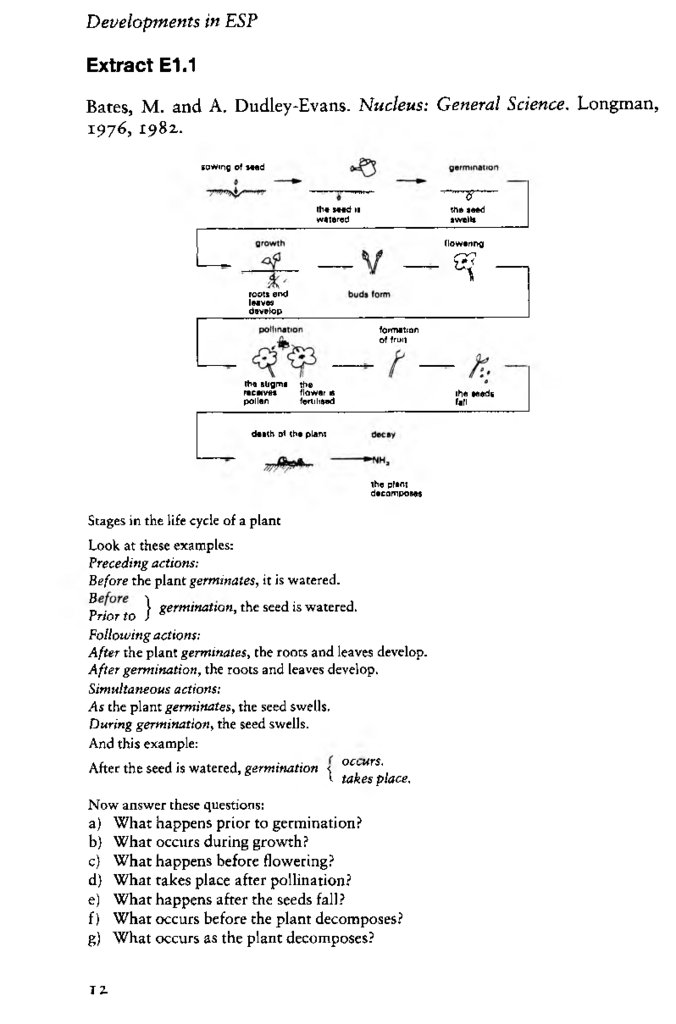
Language Learning in Distance Education by Cynthia White
Language Learning in Intercultural Perspective edited by M ichael Byram and M ichael
Flem ing
Language Teacher Supervision by Kathleen M. Bailey
The Language Teaching Matrix by Ja ck C. Richards
Language Test Construction and Evaluation by J . Charles Alderson, Caroline Clapham
and Dianne Wall
Learner-Centredness as Language Education by Ian Tudor
Learners’ Stories edited by P hil Benson and D avid Nunan
Lessons from Good Language Learners edited by C arol Griffiths
Listening in the Language Classroom by Jo h n Field
Managing Curricular Innovation by N u m a M arkee
Materials Development in Language Teaching edited by Brian Tomlinson
Motivational Strategies in the Language Classroom by Zoltan D ornyei
Psychology for Language Teachers by M arion Williams and R obert L . Burden
Research Methods in Language Learning by D avid Nunan
Rules, Patterns and Words by D ave Willis
Second Language Teacher Education edited by Ja ck C. Richards and D avid Nunan
Society and the Language Classroom edited by H y w el Coleman
Task-Based Language Teaching by D a vid Nunan
Teacher Language Awareness by Stephen A ndrew s
Teacher Learning in Language Teaching edited by D onald Freeman and Ja ck C. Richards
Teaching Languages to Young Learners b y Lynne Cameron
Testing for Language Teachers second edition by Arthur Hughes
Understanding Research in Second Language Learning by Jam es D ean B row n
Using Surveys in Language Programs by Jam es D ean B row n
Values, Philosophies, and Beliefs in T E SO L by Graham Crookes
Vocabulary edited by N orbert Schmitt and M ichael M cCarthy
Vocabulary, Semantics and Language Education by Evelyn Hatch and Cheryl B row n
Voiccs from the Language Classroom edited by Kathleen M. Bailey and D avid Nunan
3.
Developments in ESPA multi-disciplinary approach
Tony Dudley-Evans
Maggie Jo St John
C a m b r id g e
U N IV E R S IT Y P R E S S
4.
C a m b r id g eU N IV ERSITY P R E SS
University Printing House, Cambridge CB2 8BS, United Kingdom
Cambridge University Press is part of the University of Cambridge.
It furthers the University's mission by disseminating knowledge in the pursuit of
education, learning and research at the highest international levels o f excellence.
www.cambridge.org
Information on this title: www.cambridge.org/9780521596756
© Cambridge University Press 1998
This publication is in copyright. Subject to statutory exception
and to the provisions of relevant collective licensing agreements,
no reproduction of any part may take place w ith out the written
permission o f Cambridge University Press.
First published 1998
15th printing 2012
/4 catalogue record for this publication is available from the British Library
Library o f Congress Cataloguing in Publication data
Dudley-Evans, Tony, 1943Developments in ESP: a multi-disciplinary approach /Tony DudleyEvans, Maggie Jo St. John.
p. cm. - (Cambridge language teaching library)
Includes bibliographical references and index.
ISBN 0-521-59329-8.- ISBN 0-521-59675-0 (pbk.)
1. English language - Study and teaching - Foreign speakers.
2. English language -Technical English - Study and teaching.
3. English language - Business English - Study and teaching.
4. Interdisciplinary approach in education. I. St. John, Maggie Jo.
II.Title. III. Series.
PE1128.A2D768 1998
428'.007-dc21
98-30873
CIP
ISBN 978-0-521-59329-8 Hardback
ISBN 978-0-521-59675-6 Paperback
Cambridge University Press has no responsibility for the persistence or accuracy of
URLs for external or third-party internet websites referred to in this publication,
and does not guarantee that any content on such websites is, or will remain, accurate
or appropriate.
5.
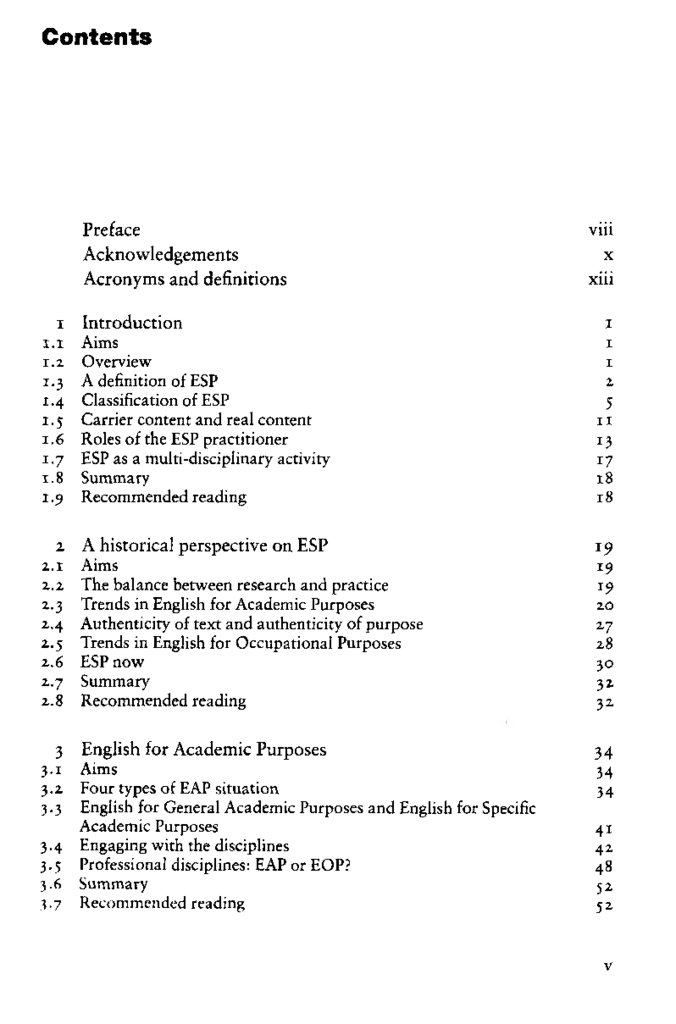
ContentsPreface
A ck n o w led gem en ts
A c ro n y m s and definitions
I
I.X
1 .2
1-3
1-4
i-S
1.6
i -7
1.8
i -9
z
2 .1
2 .2
2.3
2.4
2-5
2.6
*• 7
2.8
3
3 -i
3 -2.
3-3
3-4
3-5
3.6
3-7
Introduction
Aims
Overview
A definition of ESP
Classification of ESP
Carrier content and real content
Roles of the ESP practitioner
ESP as a multi-disciplinary activity
Summary
Recommended reading
viii
X
xiii
1
X
1
2
5
IX
13
17
18
18
A historical perspective on E S P
Aims
The balance between research and practice
Trends in English for Academic Purposes
Authenticity of text and authenticity of purpose
Trends in English for Occupational Purposes
ESP now
Summary
Recommended reading
19
En glish fo r A c a d e m ic Purposes
Aims
Four types of EA P situation
English for General Academic Purposes and English for Specific
Academic Purposes
Engaging with the disciplines
Professional disciplines: EA P or EOP?
Summary
Recommended reading
34
34
34
19
19
20
27
28
30
32
32
41
42
48
52.
52.
V
6.
ContentsE n glish for Business Purposes
Aims
Characteristics of Business English
English for General Business Purposes and English for Specific
Business Purposes
The role of needs analysis in Business English
Teachers of Business English
Key issues for Business English
English for Business Purposes versus English for Academic Purposes
Summary
Recommended reading
53
53
53
74
74
74
5.6
L a n g u a ge issues in E S P
Aims
Grammar in ESP
Vocabulary in ESP
Discourse and genre analysis
Summary
Recommended reading
6
6 .1
6.2
6.3
6.4
6.5
6.6
6.7
6.8
T h e skills in E A P and E O P
Aims
Reading skills in ESP
Listening to monologue
Listening and speaking skills in ESP
Speaking monologue
Writing skills in ESP
Summary
Recommended reading
95
7
7 -i
12 1
12 1
12 2
12 8
131
7-7
N e e d s analysis and evalu ation
Aims
Needs analysis
Evaluation
Collecting data for needs analysis and evaluation purposes
Summary
Recommended reading
Extracts
8
8 .1
8.2
8.3
8.4
C o u rse design
Aims
Parameters of course design
Balancing the parameters
Case studies
145
145
145
154
155
4
4 .1
4 .2
4-3
4.4
4-5
4.6
4-7
4.8
4-9
5
5 -r
5.2
5-3
5-4
5-5
7 -2.
7-3
7-4
7-5
7.6
VI
55
57
59
61
72
73
73
80
87
94
94
95
95
IOI
10 5
112
114
12 0
12 0
139
14 0
14 0
7.
Contents8.5
8.6
8.7
Developing a course outline
Summary
Recommended reading
9 The role of materials
9 .1
9.2
9.3
9.4
9.5
9.6
9 .7
9.8
10
1 0 .1
10 .2
10 .3
10 .4
10 .5
10 .6
и
11.1
11.2
11.3
11.4
11.5
11.6
11.7
11 .8
11.9
11 .10
16 2
16 9
16 9
170
Aims
The purpose of materials
Writers or providers o f materials?
Teacher-generated material
Learner-generated material
Materials and technology
Summary
Recommended reading
17 0
17 0
17 2
17 6
18 0
18 4
18 5
18 6
Classroom practice and beyond
187
Aims
Learners’ specialist knowledge
Class size
Beyond the classroom
Summary
Recommended reading
18 7
18 8
19 6
204
209
209
Assessment: Continuous assessment and testing
210
Aims
W hy assess?
Classroom assessment
Classroom tests
Public examinations developed in the U K
Reporting test results: band descriptors
In-house test development
ESP test questions
Summary
Recommended reading
2 10
2 10
2 11
2 13
2 14
2 17
221
2 25
228
2 29
Epilogue
230
Extracts
Guidance for tasks
References
Index
233
263
278
298
vii
8.
PrefaceIn this book we attempt to pull together the theory and practice of
English for Specific Purposes, drawing on our respective experience in
English for Academic Purposes (EAP) and English for Occupational
Purposes (EOP), and in different parts of the world. Between us we have
lived and worked in a large number of countries in every continent of
the world except - sadly - Australasia.
We have the particular aim of describing recent developments in
English for Specific Purposes (ESP), especially in the areas of content/
language integration and the growth of Business English. ESP has
continued to grow and expand into other areas - despite occasional
rumours of its death - and now has a healthy body of research,
publications and teaching materials. We have surveyed these areas in a
way that we hope will be accessible to both graduate students
embarking on a career in English Language Teaching (ELT) and teachers
already working in ESP/ELT.
There are a number of features in the book that merit a brief introduction:
Activities
In each chapter, there are three categories of activity: orientation, task
and reflection; the guidance notes provide responses to some of them;
the symbol • > tells you when there are guidance notes at the end of the
book.
Orientation tasks are to stimulate thought, and the ideas contained in
them are developed in the text so we suggest you do them before
reading further in the text. There is not usually a separate guidance note
for orientation tasks as the text provides most of the ideas.
Tasks provide an opportunity to apply ideas within the framework of
the book. There is a guidance note for each task.
Reflection tasks take you beyond the text to your own situation and ask
you to think about and apply the ideas more specifically and more
Vlll
9.
Prefacewidely. There is not usually a guidance note for reflection tasks as these
are open-ended and the responses depend on your situation.
Extracts
We have included a number of extracts from ESP textbooks and from
academic and professional texts. Some of these provide examples for
our discussion in the book, others are a source of activities in the tasks.
These extracts come after the epilogue, before the guidance notes.
Recommended reading
At the end of each chapter we have noted some of the books, journals,
articles and other sources of information we have found particularly
useful. For reasons of space, we just give the name of the author and the
date of publication there. Full details are in the bibliography.
IX
10.
AcknowledgementsAs much of our ESP experience has been in different institutions, we
begin by writing our own acknowledgements.
Maggie Jo
M y greatest debt is to Tony who has stimulated, encouraged and
supported me in the twenty years of my ESP career. He demonstrated to
a then chemistry teacher the fascination and challenge of ESP; he has
continued to be an inspiration; thank you, Tony.
John Swales was a powerful influence, first as a teacher and later as a
colleague at the Language Studies Unit, Aston University, along with
Ray Williams, Meriel Bloor, Sandy Urquhart and David Charles. In my
freelance travels around the world, especially in Nigeria, Jordan, Brazil,
the Philippines and Malaysia, I have met wonderful teachers and
students who have inspired me and helped me formulate ideas. I owe
special thanks to the Comskiptec team in Nigeria and the JUST team in
Jordan, for all we shared.
Tony
I would like to acknowledge a particular debt to three people who have
had a strong influence on my professional development and have
remained good personal friends. Martin Bates first showed me in Tabriz
in the 70s that ESP materials could be entertaining and inventive; Tim
Johns has been a wonderful colleague to work with at Birmingham,
especially in the early days of team-teaching; John Swales has been a
close friend since the 60s and Libya, where I taught him to read Arabic
newspapers, and an immense influence on my professional life, which
has been constantly enriched by his ideas and enthusiasms.
I would also like to express particular thanks to all my colleagues in
English Language Research at the University of Birmingham for pro
viding a friendly and supportive environment to work in, and the many
11.
Acknowledgementsstudents doing a PhD or following an M A course who have stimulated
my thinking and kept me up to date on the reading. I would particularly
like to mention Martin Hewings and Richard Cauldwell, who have
helped me formulate many of my ideas, Malcolm Coulthard, who has
provided much support and a benchmark of academic excellence, and
Willie Henderson, of Continuing Studies at Birmingham, who was a
stimulating colleague to work with on the discourse of economics.
Outside Birmingham, Ann Johns, Liz Hamp-Lyons and Peter Master
are/were great co-editors to work with on the journal English for
Specific Purposes.
Maggie Jo has always been a wonderful and challenging person to
work and live with.
Both of us
We owe a particular debt to Alison Sharpe, who showed great enthu
siasm for our book and guided us through the publication process. We
would also like to thank Mickey Bonin who took over from Alison and
helped us through the final stages. We also wish to acknowledge the
valuable contributions and comments of three anonymous reviewers
and Catherine Kuebart, and our subeditor Sylvia Goulding.
Finally, working together on this book has been a great experience,
extending and enriching an already full, exciting and unpredictable
relationship.
The editors, authors and publishers are grateful to the authors, pub
lishers and others who have given permission for the use of copyright
material identified in the text. It has not been possible to identify, or
trace, sources of all the materials used and in such cases the publishers
would welcome information from copyright owners.
Brieger and Comfort. 1 9 9 г . Production and Operations, Business
Management English. Prentice Hall, on pp. 2 .3 4 - 5 ; Herbert, A. J. 1 9 6 5 .
The Structure o f Technical English. Reprinted by permission of Addison
Wesley Longman Ltd. on pp. 2 3 6 - 7 ; Bates, M. and A. Dudley-Evans.
1 9 7 6 . Nucleus General Science. Reprinted by permission of Addison
Wesley Longman Ltd. on pp. 2 3 8 - 9 ; Skills for Learning Foundation,
1 9 8 0 . University of Malaya Press on p. 2 4 0 ; Hutchinson, T. and
A. Waters. 1 9 8 4 . Interface: English for Technical Communication.
XI
12.
AcknowledgementsReprinted by permission of Addison Wesley Longman Ltd. on
pp. 2 4 1-3 ; Samuelson, R 1955. Economics. McGraw Hill (New York)
on pp. 244-5; Barclays Bank. 1983. Economic Surveys: Current
Accounts on p. 245; Chrispeels, M . and D. Sadava. 1977. Plants, Food
and People. W. H. Freeman and Co. (San Francisco) on p. 246; Steeds,
W. 1957. Engineering Materials, Machine Tools and Process, Longmans
Green and Co. Ltd. Reprinted by permission of Addison Wesley
Longman Ltd. on p. 247; Lynch, A. 1983. Study Listening. Cambridge
University Press on p. 248; Flower, L. Problem Solving: Strategies for
Writing. Harcourt Brace and Company (Orlando, Florida) on p. 249;
The N ew York Times, September 19 1979. Table on p. 249 by
permission of The N ew York Times; Hamp-Lyons, L. and B. Healey.
1987. Study Writing. Cambridge University Press on p. 250; Swales, J.
and C. Feak. 1994. Academic Writing for Graduate Students: Essential
Tasks and Skills. The University of Michigan Press (Ann Arbor) on
pp. 2 5 0 -5 1; Robinson, P. 19 9 1. The ESP family tree from ESP Today
on pp. 2 5 0 -5 1; Bates, M. and A. Dudley-Evans. 1976. Nucleus:
General Science. Reprinted by permission of Addison Wesley Longman
Ltd. on p. 12 ; Guy, V. and J. L. Mattock. 1993. The N ew International
Manager. Kogan Page on p. 267; Weir, C. J. Communicative Language
Testing. Prentice Hall, UCLES Business English Certificate 2, Sample
Paper 1997. Reproduced by permission of the University of Cambridge
Local Examinations Syndicate on pp. 252, 253, 260; UCLES CEIBT
Certificate for International Business and Trade. Specifications and
sample materials for the revised CEIBT June 1998. Reproduced by
permission of the University of Cambridge Local Examinations Syndi
cate on pp. 254, 2 6 1; JM B UETESOL. June 1992. Hylo Parks.
Reproduced by permission of the Northern Examinations and Assess
ment Board on pp. 255-7; Weir, C. J. 1993. Understanding and
Developing Language Tests. Prentice Hall on p. 258; JM B UETESOL.
June 1990. Reproduced by permission of the Northern Examinations
and Assessment Board on pp. 259-60.
13.
Acronyms and definitionsAcronyms
BALEAP
BE
EAP
EBP
EEP
EGAP
EGBP
ELP
ELT
EMP
EOP
ESAP
ESBP
ESOL
ESP
EST
EVP
FCE
FUA
FUT
IELTS
JM B
Li
Li
LANA
I.CCI
LSA
LSP
MA
MBA
м
Sl
imm b
British Association of Lecturers in EAP
Business English
English for Academic Purposes
English for Business Purposes
English for Educational Purposes
English for General Academic Purposes
English for General Business Purposes
English for Legal Purposes
English Language Teaching
English for Medical Purposes
English for Occupational Purposes
English for Specific Academic Purposes
English for Specific Business Purposes
English for Speakers of Other Languages
English for Specific Purposes
English for Science and Technology
English for Vocational Purposes
First Certificate in English
Federal University of Agriculture
Federal University of Technology
International English Language Testing Service
Joint Matriculation Board
First Language
Second Language
Language Needs Analysis
London Chamber of Commerce and Industry
Learning Situation Analysis
Language(s) for Specific Purpose(s)
Master of Arts
Master of Business Administration
Master of Science
Northern Examinations 6c Assessment Board
14.
Acronyms and definitionsNNS
N RN
NS
ORN
OUP
PCA
PhD
PR
PSA
PVE
TEEP
TEFL
TESL
TESOL
TOEFL
TOEIC
TSA
UCLES
UETESOL
VE
Non-Native Speaker
New Relationship Negotiation
Native Speaker
Old Relationship Negotiation
Oxford University Press
Principal Component Analysis
Doctor of Philosophy
Public Relations
Present Situation Analysis
Pre-Vocational English
Test in English for Educational Purposes
Teaching English as a Foreign Language
Teaching English as a Second Language
Teaching English to Speakers of Other Languages
Test of English as a Foreign Language
Test of English for International Communication
Target Situation Analysis
University of Cambridge Language Education Service
University Entrance Test in English for Speakers of Other
Languages
Vocational English
Definitions
Carrier content refers to the subject matter of an exercise; it is
contrasted with the real content, which is the language or skill content
of an exercise.
Collocation refers to the way words appear together with each other.
For example we say: ‘offer an insight’ rather than ‘make an insight’ .
Concordance line refers to a line of text printed out from a computer
corpus that shows the context in which the word being studied is used.
Discourse analysis refers to the study of how sentences in spoken and
written language form larger units at a level above the sentence, for
example in paragraphs, whole conversations or written texts.
Discourse community refers to a group who in professional contexts
communicate with each other and have therefore developed mechan
isms for doing so.
Gambits are lexical phrases used to show a speaker’s purpose.
Genre refers to a text-type that has developed in response to a social or
xiv
15.
Acronyms and definitionsprofessional need. It generally has a predictable structure. Examples of
genres include the academic article, the newspaper editorial, the busi
ness presentation, the sermon, the academic lecture.
Genre analysis refers to the study of the structural and linguistic
regularities of particular genres or text-types and the role they play
within a discourse community.
Kibbitzer is a short discussion on the Internet.
Logical connector refers to a word that links clauses or sentences, such
as moreover, however, therefore. They are also referred to as connec
tors, connectives, discourse markers and linkers.
Macro-skills refer to the major skills (as outlined in chapter 5): reading,
writing, speaking, listening and speaking, and listening to monologue.
A macro-skill can be broken down into a number of micro-skills (see
below).
Micro-skills refer to the lower-level skills that constitute a macro-skill.
Listening to monologue, for example, can be broken down into micro
skills such as the ability to identify purpose and scope of lecture, the
ability to deduce meaning of words from context.
Process approach generally refers to an approach to the teaching of
writing that concentrates on the different stages of planning, organising
and revising.
Product approach generally refers to an approach to the teaching of
writing that concentrates on the features of the actual text - the end
product.
Register analysis refers to the study of how frequently grammatical
structures are used in texts.
Rhetoric refers to the study of how written or spoken texts are effective
in persuading readers or listeners to accept their arguments.
xv
16.
17.
1Introduction
1.1
Aims
We begin by considering what English for Specific Purposes (ESP) is,
how it developed, how it can be defined and classified, and what it can
offer the learner and the teacher. We then consider the various roles of
the ESP practitioner.
1.2 Overview
The teaching of English for Specific Purposes has generally been seen as
a separate activity within English Language Teaching (ELT), and ESP
research as an identifiable component of applied linguistic research. We
believe that for some of its teaching ESP has developed its own
methodology, and its research clearly draws on research from various
disciplines in addition to applied linguistics. This openness to the
insights of other disciplines is a key distinguishing feature of ESP which
we see as underlying much of the practice and research we will describe.
If ESP has sometimes moved away from trends in general ELT, it has
always retained its emphasis on practical outcomes. We will see that the
main concerns of ESP have always been, and remain, with needs
analysis, text analysis, and preparing learners to communicate effec
tively in the tasks prescribed by their study or work situation. It is often
said that ESP lacks an underlying theory. We believe that a theory of
ESP could be outlined based on either the specific nature of the texts
that learners require knowledge of, or on the basis of the needs-related
nature of the teaching. It is, however, interesting and significant that so
much of the writing has concentrated on the procedures of ESP and on
relating course design to learners’ specific needs rather than on theore
tical matters.
The study of languages for specific purposes has had a long and
interesting history going back, some would say, as far as the Roman and
Cireck Empires. Since the 1960s, ESP has become a vital and innovative
activity within the Teaching of English as a Foreign or Second Language
18.
Developments in ESPmovement (TEFL/TESL) (Howatt, 1984). For much of its early life ESP
was dominated by the teaching of English for Academic Purposes
(EAP); most of the materials produced, the course descriptions written
and the research carried out were in the area of EAP. English for
Occupational Purposes (EOP) played an important but nevertheless
smaller role. In recent years, however, the massive expansion of interna
tional business has led to a huge growth in the area of English for
Business Purposes (EBP). Within ESP the largest sector for published
materials is now that of Business English, and there is burgeoning
interest from teachers, publishers and companies in this area.
ESP activity used to be closely associated with projects led, and
usually staffed, by expatriate British, North American or Australasian
teachers, often in large numbers. Projects in the Middle East, in Iran
(Bates, 1978), Kuwait and Saudi Arabia (Harper, 1986) for instance, are
good examples (Mackay and Mountford, 1978). Local teachers seemed
to play relatively small roles in such projects, and it was even occasion
ally argued by non-native speakers that ESP work was too difficult for
them. We have always believed that local teachers’ knowledge of their
situations as well as their familiarity with their students’ motivation and
learning styles give them a potential advantage over native-speaker
expatriate teachers.
ESP is part of a more general movement of teaching Language for
Specific Purposes (LSP). LSP has focused on the teaching of languages
such as French and German for specific purposes, as well as English. In
many situations the approaches used are very similar to those used in
ESP; some, however, place a much greater emphasis on the learning of
vocabulary.
1.3 A definition of ESP
Orientation 1a
W hat is your definition of ESP? W hat aspects would you include?
We will begin by looking at three definitions of ESP found in the
literature, and then give our own. The three definitions are all relatively
late in time if we assume that ESP began in the 1960s, but they build on
earlier definitions.
Hutchinson and Waters (1987) see ESP as an approach rather than a
product, by which they mean that ESP does not involve a particular
kind of language, teaching material or methodology. They suggest that
19.
Introduction‘the foundation of ESP is the simple question: Why does this learner
need to learn a foreign language?’ The answer to this question relates to
the learners, the language required and the learning context, and thus
establishes the primacy of need in ESP. Need is defined by the reasons
for which the student is learning English, which will vary from study
purposes such as following a postgraduate course in an Englishspeaking country to work purposes such as participating in business
meetings or taking hotel bookings. These purposes are the starting
points which determine the language to be taught.
Strevens’ (1988) definition of ESP makes a distinction between four
absolute characteristics and two variable characteristics. The absolute
characteristics are that ESP consists of English Language Teaching
which is:
• designed to meet specified needs of the learner;
• related in content (that is in its themes and topics) to particular
disciplines, occupations and activities;
• centred on language appropriate to those activities in syntax, lexis,
discourse, semantics and so on, and analysis of the discourse;
• in contrast with ‘General English’.
The variable characteristics are that ESP
• may be restricted as to the learning skills to be learned (for example
reading only);
• may not be taught according to any pre-ordained methodology.
Robinson (1991) also accepts the primacy of needs analysis in
defining ESP. Her definition is based on two key defining criteria and a
number of characteristics that are generally found to be true of ESP. Her
key criteria are that ESP is ‘normally goal-directed’, and that ESP
courses develop from a needs analysis, which ‘aims to specify as closely
as possible what exactly it is that students have to do through the
medium of English’ (Robinson, 19 9 1: 3). Her characteristics are that
ESP courses are generally constrained by a limited time period, in which
their objectives have to be achieved, and are taught to adults in
homogeneous classes in terms of the work or specialist studies that the
students are involved in.
Each definition has validity but also weaknesses, either in the defini
tion or in the features described. Strevens’ definition is the most
comprehensive of the three quoted, but can lead to a certain confusion.
By referring to content in the second absolute characteristic it may
confirm the false impression held by many teachers that ESP is always
mid ncccssarily related directly to subject content. Robinson’s mention
20.
Developments in ESPof ‘homogeneous classes’ as a characteristic of ESP may lead to the same
conclusion. Much ESP work is, by contrast, based on the notion of a
‘common-core’ of language and skills that belong to all academic
disciplines or cut across the whole activity of business. ESP teaching
does not necessarily have to be related to content but it should always
reflect the underlying concepts and activities of the broad discipline.
Thus English for Academic Purposes (EAP), whether it is directly
related to the specific disciplines that students are studying or not,
should make use of the essentially problem-solving methodology of
academic study (Widdowson, 1983). Similarly, Business English
teaching should reflect the business context in which business meetings
or negotiations take place (Charles, 1994 and 1996).
We believe that a definition of ESP should reflect the fact that much
ESP teaching, especially where it is specifically linked to a particular
profession or discipline, makes use of a methodology that differs from
that used in General Purpose English teaching. By methodology here we
are referring to the nature of the interaction between the ESP teacher
and the learners. In more general ESP classes the interaction may be
similar to that in a General Purpose English class; in the more specific
ESP classes, however, the teacher sometimes becomes more like a
language consultant, enjoying equal status with the learners who have
their own expertise in the subject matter. We will look at these issues in
more detail in chapters 3 and 10.
In our definition we stress two aspects of ESP methodology: all ESP
teaching should reflect the methodology of the disciplines and profes
sions it serves; and in more specific ESP teaching the nature of the
interaction between the teacher and learner may be very different from
that in a general English class. This is what we mean when we say that
specific ESP teaching has its own methodology.
We also believe that language should be included as a defining feature
of ESP. While the specified needs arising from needs analysis relate to
activities that students need to carry out (rather than language), a key
assumption of ESP is that these activities generate and depend on
registers, genres and associated language that students need to be able
to manipulate in order to carry out the activity.
In our definition we use absolute and variable characteristics. Our
definition is:
1. Absolute characteristics:
• ESP is designed to meet specific needs of the learner;
• ESP makes use of the underlying methodology and activities of the
disciplines it serves;
4
21.
IntroductionESP is centred on the language (grammar, lexis, register), skills,
discourse and genres appropriate to these activities.
2. Variable characteristics:
• ESP may be related to or designed for specific disciplines;
• ESP may use, in specific teaching situations, a different metho
dology from that of general English;
• ESP is likely to be designed for adult learners, either at a tertiary
level institution or in a professional work situation. It could,
however, be used for learners at secondary school level;
• ESP is generally designed for intermediate or advanced students.
Most ESP courses assume basic knowledge of the language system,
but it can be used with beginners.
Task 1b
Discuss whether, according to our definition, the following courses
constitute ESP courses. Give reasons for your decision:
1. A course in remedial grammar for business people, with each unit
based on a particular grammatical weakness identified by tests.
2. A course that teaches undergraduate engineering students from
various branches (civil, electrical, mechanical etc.) to write reports
on design projects.
3. A course that teaches reading skills to a group of postgraduate
students from a range of disciplines, studying in a British university.
The texts used are of a general academic nature, but are exploited to
teach specific reading skills.
4. A course designed to prepare students for the Cambridge F C E
examination. The course is based on a careful analysis of the
contents of the test.
5. A course designed to teach social English to a group of business
people. The level of the students’ English is intermediate.
6. A course team-taught with a subject lecturer, that helps postgradu
ates of a particular discipline understand departmental lectures.
1.4 Classification of ESP
111 this section w e introduce and e xp lain the m an y abb reviatio n s that
have been used in describing ESP, term s such as EA P , EO P , E S T and EBP.
I'.SP has traditionally been divided into tw o m ain areas: En glish for
A cad em ic Purposes (КЛР) and English for O ccu p atio n al Purposes
22.
Developments in ESP(EOP). The classification is generally presented in a tree diagram as in
figure 1 . 1 (taken from Robinson, 19 9 1: 3-4).
Pre-experience
i - EOP ■
Simultaneous/In-service
Post-experience
Pre-study
ESP
For study in a
specific discipline -
In-study
Post-study
EEP/EAP
— Independent
As a school subject
— Integrated
Figure 1 . 1
E S P classification by experience
The diagram has, as well as the division into EAP and EOP, a useful
division of courses according to when they take place. These distinctions
are very important as they will affect the degree of specificity that is
appropriate to the course. A pre-experience or pre-study course will
probably rule out any specific work related to the actual discipline or
work as students will not yet have the required familiarity with the
content, while courses that run parallel to or follow the course of study
in the educational institution or workplace will provide the opportunity
for specific or integrated work.
Another typical tree diagram for ESP, which divides EAP and EOP
according to discipline or professional area, is shown in figure 1.2 .
English for Specific Purposes
ngllsh for Academic Purposes
English for
(Academic)
Science and
Technology
Figure 1 .2
6
English for English for
(Academic) (Academic)
Medical
Legal
Purposes Purposes
English for
Management,
Finance and
Economics
English for Occupational Purposes
English for
English for
Professional Purposes
Vocational Purposes
/
\
/
\
English for
English for
Pre*
Vocational
Medical Purposes
Business Vocational
English
Purposes
English
E S P classification by professional area
23.
IntroductionIn EAP, English for Science and Technology (EST) has been the main
area, but English for Medical Purposes (EMP) and English for Legal
Purposes (ELP) have always had their place. Recently the academic
study of business, finance, banking, economics and accounting has
become increasingly important, especially on Masters in Business
Administration (MBA) courses, but, as yet, no specific acronym has
become established for such courses.
The term EOP refers to English that is not for academic purposes; it
includes professional purposes in administration, medicine, law and
business, and vocational purposes for non-professionals in work or
pre-work situations. We may thus distinguish between studying the
language and discourse of, for example, medicine for academic
purposes, which is designed for medical students, and studying for
occupational (professional) purposes, which is designed for practising
doctors.
This classification places English for Business Purposes (EBP) as a
category within EOP. EBP is sometimes seen as separate from EOP as it
involves a lot of General English as well as Specific Purpose English, and
also because it is such a large and important category. A business
purpose is, however, an occupational purpose, so it is logical to see it as
part of EOP.
Within English for Vocational Purposes (EVP) there are two sub
sections: Vocational English, which is concerned with the language of
training for specific trades or occupations, and Pre-Vocational English,
which is concerned with finding a job and interview skills. It also deals
with succeeding in a job through an understanding of employer expecta
tions and policies (Anne Lomperis, personal communication).
A distinction should also be made between common-core English for
General Academic Purposes (EGAP) and English for Specific Academic
Purposes (ESAP) (Blue, 1988a). The same distinction can be made
between English for General Business Purposes (EGBP) and English for
Specific Business Purposes (ESBP) (Dudley-Evans and St John, 1996).
We discuss the differences in chapter 3 (EAP) and chapter 4 (EBP).
Reflection 1c
Into which categories o f figures 1 . 1 and i .z would you place courses
that you have taught?
7
24.
Developments in ESPThe use of classification trees creates a number of problems by failing
to capture the essentially fluid nature of the various types of ESP
teaching and the degree of overlap between ‘common-core’ EAP or EBP
and General English. The ‘common-core’ English and semi-technical
vocabulary taught in many English for General Academic Purposes
courses could well be extremely valuable in the teaching of what might
be referred to in General English as ‘factual description’ . Similarly, the
detailed focus on reading skills, such as ‘establishing main points’ or
‘inferring meaning from context’ that form a major part of EAP courses,
can just as validly be taught as part of an intermediate to advanced
General English course. Business English can also be seen as a ‘med
iating language between the technicalities of particular businesses . . .
and the language of the general public’ (Pickett, 1989), which puts it in
a position between General English and specialist English.
We therefore suggest that an additional perspective can be gained
through the presentation of the whole of English Language Teaching
on a continuum that runs from clearly definable General English
courses through to very specific ESP courses. Figure 1.3 illustrates this
continuum. It seems that positions z and 3, which are towards the
centre of the continuum, have much in common and it is only the
overall context of the programme that decides whether a given course
is classified as ESP or not. An advanced secondary school level course
that includes a focus on, say, listening skills will be seen as General
English as the course itself has the aim of teaching English as part of a
broad educational process. However, a similar component taught as
part of a pre-sessional course for international students about to
embark on a postgraduate course taught in English in an Englishspeaking country will be seen as ESP because it is part of a focused
course with a specific time period with clear and specific objectives.
The teaching material might, in fact, be quite similar, but the teaching
methodology is likely to be different.
The use of the continuum also clarifies the nature of more specific ESP
work. At position 4, the work is very specific in terms of the skills
taught, but the groups themselves are not homogeneous groups from
one discipline or profession. When we talk of engineers, scientists or
doctors, we are talking about broad groups: individual members may
have quite different needs and backgrounds. So, on the one hand,
detailed attention will be paid to a skill such as report writing, or
particular features of language and/or discourse of, say, a business
meeting, but, on the other hand, great care has to be taken in choosing
the actual skill or skills to focus on and the contexts in which to do so.
For example, some doctors will need to read and write medical journal
articles, others will need oral skills for talking to patients. A group of
8
25.
IntroductionSPECIFIC
GENERAL
11
1
12
1
|3
1
Position 1
Position z
English for
Beginners
Intermediate
to advanced
EGP courses
with a focus
on particular
skills
Figure i . }
Continuum o f E L T course types
11 4
11 5
Position я
Position 4
Position s
EGAP/EGBP
courses based
on commoncore language
and skills not
related to
specific
disciplines or
professions
Courses for broad
disciplinary or
professional areas,
for example Report
Writing for Scientists
and Engineers,
Medical English,
Legal English,
Negotiation/Meeting
Skills for Business
People
1) An ‘academic
support’ course
related to a
particular
academic course.
z) One-to-one
work with business
people
r>
engineers from a variety of branches such as civil, highways, electronic,
chemical and mechanical will probably not take kindly to materials that
use contexts from just one branch of engineering. Teaching material
prepared for such groups needs contexts that are acceptable and under
standable to all branches.
It is only in position 5 that the course becomes really specific. The
course can be geared to the specific needs of the target situation and of the
individuals concerned, and can make extensive use of authentic material
in their own subject area. It is a key feature of such courses that the
teaching is flexible and tailored to individual or group needs as they arise.
This discussion leads to the inevitable question: does a precise
classification really matter? Undoubtedly, any attempt at classification
leads to overlap and potential confusion, but in our view it is important
to make the attempt to define and classify what we mean by ESP.
1.4.1
Specificity and motivation
There are clear advantages in setting up an ESP course where students
have specific needs. Strevens (1988) summarises the advantages of ESP
with the following four points:
• being focused on the learner’s need, it wastes no time;
• it is relevant to the learner;
• it is successful in im parting learning;
• it is m ore cost-effective than ‘ G eneral E n glish ’ .
9
26.
Developments in ESPThe implication of these claims is that ESP teaching is more motivating
for learners than General English. Generally speaking, this is true; the
focused nature of the teaching, its relevance and cost-effectiveness
ensure that its aims are widely accepted by learners. Opinions about
specific work, however, vary. Many learners are hungry for material and
advice that will help them with their specific course or with particular
skills related to their course. Thus, for example, team-taught courses,
where the language teacher works together with the subject lecturer to
help international students understand actual lectures on postgraduate
courses, appear to be highly motivating (Johns and Dudley-Evans,
1980). Similarly, academic writing courses that give specific guidance
about the writing of essays and dissertations (Dudley-Evans, 1995) are
extremely popular in British universities.
When the context is an English-as-a-Foreign-Language situation,
motivation for more specific work may be much smaller. It is not
uncommon to hear in such situations the cry that students are looking
for a change in the English class from reading about the topics that
make up their subject courses and are looking for a little variety. As
Crofts (1977 cited in Swales, 1980: 67) argues ‘when students are very
familiar with a topic, they will be bored with any treatment of it as
something not fam iliar. . . When they do not have the knowledge that
is assumed to be known in a particular treatment of a topic given in the
ESP materials, they will be unable to cope with the topic in the intended
way without the help of the ESP teacher or some other source of
information’. Crofts goes on to suggest that EAP material should
concentrate on material that is parallel to the main subject course, but is
not actually part of it; in other words, topics that could have been
included in the main course, but were not.
The main conclusion here is that motivation in ESP has a profound
effect on the question of how specific the course is. High motivation on
the part of learners generally enables more subject specific work to be
undertaken; low motivation, however, is likely to lead to a concentra
tion on less specific work. Specialists in either academic or occupational
contexts who need English for specific tasks will be impatient with an
ESP course that does not address their difficulties with those tasks.
Other students who are studying English because it is on the timetable
of their institution or who have been sent on a course by their company
and who do not have specific, immediate and clearly definable needs
may be demotivated by more specific work and may be more motivated
by ESP work that falls more towards the centre of the continuum
outlined in figure 1.3 (p. 9).
10
27.
IntroductionTask 1d
Look at the six courses described in Task ib and decide where on the
continuum (figure 1.3 ) they should be placed.
1.5 Carrier content and real content
While discussing the question of specificity in ESP, it is important that
we clarify the role of the actual content. The notions of ‘carrier content’
and ‘real content’ are essential to the understanding of ESP work and to
an understanding of motivation in ESP. In ESP, any teaching activity,
whether its aim is to teach language or skills, is presented in a context.
Thus in the following short extract (on p. 12) from Nucleus: General
Science (Bates and Dudley-Evans, 1976) the aim of the exercise is to
present and practise the expressions of time sequence used in the
description of processes and cycles. It makes use of the context of the
life cycle of a plant in order to present this language. It is not the aim of
the exercise to teach students about the life cycle, although certain
lexical items, such as fertilised or decomposes may be useful.
The life cycle of a plant is the carrier content used to teach the specific
language that the unit in the book wishes to introduce at this stage. The
unit itself is entitled Actions in Sequence and is concerned with the
notion or scientific concept of Process. This exercise is just part of the
unit and the writer made the decision that the life cycle is an appropriate
topic which can be used to meet certain objectives of the unit. It is an
authentic topic which can be used as a vehicle for the real content of the
unit, the language of process. Students of any discipline can understand
the life cycle and describe it without becoming entangled in difficult and
technical content that will interfere with the main aim of the exercise,
the language associated with process. Another example would be the
use of a table of statistics to teach the language of comparison. The
statistics constitute the carrier content, but the real content is the
language used to make comparisons.
Task 1e •>
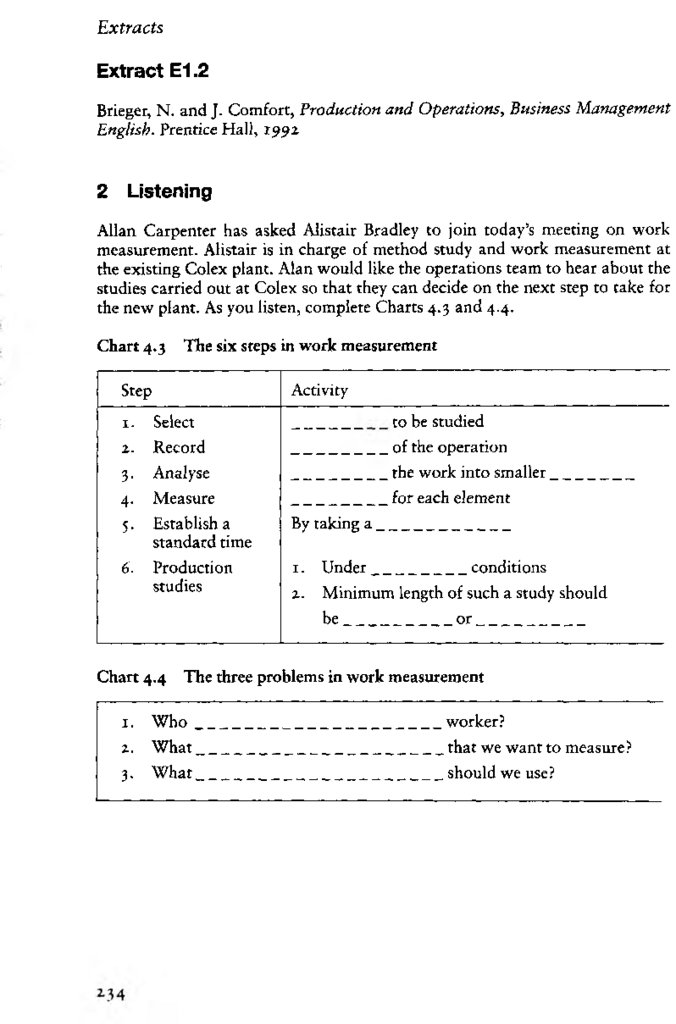
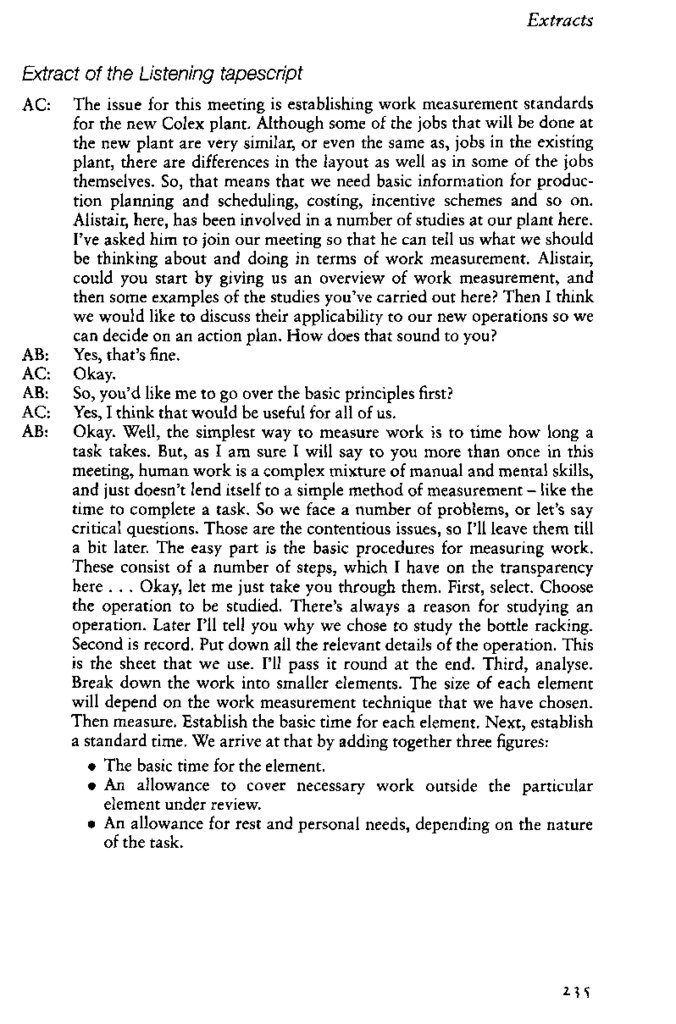
Look at Extract F.i.z (pp. 2 3 4 - 2 3 5 ) and decide what the real content of
the material is and what the carrier content is.
i i
28.
Developments in ESPExtract E1.1
Bates, M. and A. Dudley-Evans. Nucleus: General Science. Longman,
1976, 1982.
so w in g o f se ed
....a ■
th e se e d is
w atered
the seed
sw ells
flo w erin g
4
ro o ts end
lea ves
d ev elo p
form ation
o f fruit
the stigm a
re ceives
pollen
the
flo w er is
fertilised
the se ed s
fall
d eath o f th e plant
the plant
d e c o m p o ses
Stages in the life cycle of a plant
Look at these examples:
Preceding actions:
Before the plant germinates, it is watered.
^Vriorto } Serm‘nat'on>the seed is watered.
Following actions:
After the plant germinates, the roots and leaves develop.
After germination, the roots and leaves develop.
Simultaneous actions:
As the plant germinates, the seed swells.
During germination, the seed swells.
And this example:
After the seed is watered, germination < OCl~ursI takes place.
Now answer these questions:
a) What happens prior to germination?
b) What occurs during growth?
c) What happens before flowering?
d) What takes place after pollination?
e) What happens after the seeds fall?
f) What occurs before the plant decomposes?
g) What occurs as the plant decomposes?
12
29.
Introduction1.6
Roles of the ESP practitioner
Orientation 1f
ESP work extends beyond teaching. W hat other roles does an ESP
teacher have?
It will already be clear that we regard ESP teaching as extremely varied,
and for this reason we use the term ‘practitioner’ rather than ‘teacher’ to
emphasise that ESP work involves much more than teaching. We see the
ESP practitioner as having five key roles:
Teacher
Course designer and materials provider
Collaborator
Researcher
Evaluator
We will look briefly at each of these in turn in this chapter, but these
roles underlie much of the discussion in this book.
1.6.1
The ESP practitioner as teacher
ESP is a practical discipline with the main focus on helping students to
learn. With the ‘common-core’ EGAP or EGBP courses that we men
tioned earlier (p. 7) the methodology of ESP teaching may not differ
radically from that of General English. But there is one basic difference
that affects the methodology and becomes more pronounced as the
teaching becomes more specific: This is that the teacher is not in the
position of being the ‘primary knower’ of the carrier content of the
material. The students may in many cases, certainly where the course is
specifically oriented towards the subject content or work that the
students are engaged in, know more about the content than the teacher.
It is often stated that this provides the ESP teacher with the opportunity
to draw on students’ knowledge of the content in order to generate
genuine communication in the classroom. We do not disagree with this
statement, but feel that the situation is much more complicated than the
statement makes it appear.
In common-core situations using material such as the life-cycle of the
plant, it can be assumed that the content is rather more ‘general
knowledge’ than scientific knowledge, and that students do not need to
be biologists to understand it. Teachers will need a reasonable underfunding of the cycle before teaching the exercise, so that they can start
11
30.
Developments in ESPand possibly lead an introductory discussion drawing on the students’
understanding of the cycle before the actual exercise is tackled. Under
these circumstances, we believe that teachers remain the classroom
organisers; they have clear objectives for the class and a good under
standing of the carrier content of the teaching material.
When, however, teaching a much more specific course on, say, how to
write a business report, it is essential that the teacher adopts the stance
of the consultant who has knowledge of communication practices, but
needs to ‘negotiate’ with the students on how best to exploit these
practices to meet the objectives they have. The relationship is much
more one of partnership, and the Initiation-Response-Follow-Up
moves characteristic of classroom discourse (Sinclair and Coulthard,
1975) are absent. In specific ESP teaching it may be the learner who
asks the questions and the teacher who responds.
In some situations the role of the ESP teacher goes beyond that of the
classroom teacher and extends to giving one-to-one advice to students.
This is particularly common in EAP situations in Britain, USA and
Australia where often the most effective means of improving students’
ability to write essays, reports or dissertations is to give a tutorial or
series of tutorials on the actual piece of writing that they are engaged
with. A similar procedure is followed in non-English speaking countries
where academics have to publish in international journals that use
English and need advice on both language and discourse issues (Ventola
and Mauranen, 19 9 1). In EOP and especially BE situations, one-to-one
work may focus on language features as well as particular skills. There
is evidence that such individual attention often leads to dramatic
improvements in both communicative skills and linguistic accuracy. We
discuss one-to-one work in greater detail in chapter 10.
ESP teachers also need to have a great deal of flexibility, be willing to
listen to learners, and to take an interest in the disciplines or profes
sional activities the students are involved in. They must be ready to
change tack in a lesson to take account of what comes up, and to think
and respond rapidly to events. ESP teachers must also be happy to take
some risks in their teaching. The willingness to be flexible and to take
risks is one of the keys to success in ESP teaching.
1.6.2
The ESP practitioner as course designer and
materials provider
ESP practitioners often have to plan the course they teach and provide
the materials for it. It is rarely possible to use a particular textbook
without the need for supplementary material, and sometimes no really
suitable published material exists for certain of the identified needs. The
14
31.
Introductionrole of ESP teachers as ‘providers of material’ thus involves choosing
suitable published material, adapting material when published material
is not suitable, or even writing material where nothing suitable exists
(chapter 9).
ESP teachers also need to assess the effectiveness of the teaching
material used on the course, whether that material is published or self
produced. The role of course designer and materials provider described
here may seem a difficult and demanding role to someone new to ESP. It
is, but we believe that such demands make ESP teaching interesting.
There is, however, one danger. As Swales (1980) has commented, the role
of materials writer has become such a desirable characteristic of the ESP
teacher in the eyes of employers that there is a danger that the advantages
of published material are ignored even when that material is suitable for a
given situation. The point is often well made that there is a danger in ESP
course and materials provision of constant ‘re-invention of the wheel’ .
1.6.3
The ESP practitioner as researcher
Research has been particularly strong in the area of EAP, where there is
a healthy and developing range of published research, especially in
genre analysis (Swales, 1990; Bhatia, 1993). Research into English for
Business Purposes is more patchy, but there is nonetheless a growing
interest in investigating the genres, the language and the skills involved
in business communication (see, for example, Dudley-Evans and
St John, 1996, and the special issue (15: 1) of the journal English for
Specific Purposes on Business English (St John and Johnson, 1996).
ESP teachers need to be aware of and in touch with this research.
Those carrying out a needs analysis, designing a course, or writing
teaching materials need to be able to incorporate the findings of the
research, and those working in specific ESP situations need to be
confident that they know what is involved in skills such as written
communication. An ESP practitioner has to go beyond the first stage of
Needs Analysis - Target Situation Analysis (TSA) which identifies key
target events, skills and texts - to observe as far as possible the
situations in which students use the identified skills, and analyse
lamples of the identified texts. As part of this process, ESP teachers
generally need to be able to carry out research to understand the
discourse of the texts that students use.
1.6.4
The ESP practitioner as collaborator
W c have already argued for the im portance o f specific w o rk as part o f
rtii I'.SI’ program m e. We believe that subject-specific w o rk is often best
1 •>
32.
Developments in ESPapproached through collaboration with subject specialists (Johns and
Dudley-Evans, 1980). This may involve simply cooperation in which
the ESP teacher finds out about the subject syllabus in an academic
context or the tasks the students have to carry out in a work or business
situation. Alternatively, it may involve specific collaboration so that
there is some integration between specialist studies or activities and the
language. This might involve relating the reading component of an EAP
course to the actual content of a subject course by exploiting texts in
English that present additional relevant material, in other words, the
subject teacher provides the ‘carrier content’ for the English course.
Alternatively, it might involve the language teacher specifically pre
paring learners for the language of subject lectures or business presenta
tions one or two days before the subject lecture or presentation
(Henderson and Skehan, 1980). A third possibility is that a specialist
checks and comments on the content of teaching materials that the ESP
teacher has prepared. The fullest collaboration is where a subject expert
and a language teacher team-teach classes; in EAP such lessons might
help with the understanding of subject lectures or the writing of
examination answers, essays or theses (Johns and Dudley-Evans, 1980),
in EOP they might involve the language teacher and a business trainer
working together to teach both the skills and the language related to
business communication. We will look at these forms of collaboration
in greater detail in chapters 3 and 4.
1.6.5
The ESP practitioner as evaluator
The ESP practitioner is often involved in various types of evaluation,
including both the testing of students and the evaluation of courses and
teaching materials. Tests are conducted to assess whether students have
the requisite language and skills to undertake a particular academic
course or career, and - usually but not necessarily at the end of the
course - the level of their achievement. The first role is important in
countries such as the UK, USA, Australia and New Zealand, where
large numbers of international students do postgraduate courses or
research. For the purpose of assessing whether these students will be
able to cope from a language point of view, a number of internationally
recognised and validated tests exist, notably the British and Australian
International English Language Testing Service (IELTS) test, the N EAB’s
Test in ESOL and the American TOEFL test. All but the TOEFL test
have an ESP orientation (chapter 11) .
The ESP teacher also needs to be able to devise achievement tests to
assess how much learners have gained from a course. Very few of these
16
33.
Introductionhave been published, but the tests that were published with the Nucleus
Series have some interesting ideas (Vance, 19 81).
Evaluating course design and teaching materials should be done while
the course is being taught, at the end of the course and after the course
has finished. It is important to follow up with students some time after
the course in order to assess whether the learners have been able to
make use of what they learned and to find out what they were not
prepared for. Evaluation through discussion and on-going needs analysis
can thus be used to adapt the syllabus. In many situations the evaluation
forms the basis of ‘negotiation’ with students about their feelings about
the course, their needs and priorities, which are then fed into the next
stage of the course. These steps are all part of ‘formative’ evaluation.
Reflection 1g
Which of the above roles do you already undertake? W hat would you
need to feel confident in each role?
1.7
ESP as a multi-disciplinary activity
The title of this book refers to the multi-disciplinarity of ESP. We are
interested in two aspects of multi-disciplinarity: the need and willingness
to engage with other disciplines through teaching, and the need and
willingness to draw on the insights of researchers in other disciplines.
We have already indicated that we believe there is a need for some
ipecificity in both EAP and EOP teaching, and we develop this further,
especially in chapters 3 and 4. A glance at the bibliography will show
that the journals and books cited come from wide-ranging disciplines.
A key feature of ESP work is research into how spoken and written
texts work. In order to understand how these texts work, we need to
understand how they are used within a particular discipline or profeslion, and how they attempt to persuade their audiences of the validity
of their claims and arguments. Here the sociological studies of profeslions (for example Latour and Woolgar, 1979; Gilbert and Mulkay,
1984) and the rhetorical studies of how professions write (for example
Be/.crman and Paradis, 19 9 1) are very helpful.
Similarly, if we are to understand how business is conducted, we find
that texts from management training and human resource management
tell something of how business people think and work (for example
FUhcr ;ind IJry, 19 8 1; Handy, 1992).
17
34.
Developments in ESPIn all ESP work we now recognise that we have to be sensitive to
cultural differences, both in the academic and professional worlds. In
the academic world learners may not be used to having to participate
fully in seminars; in the business world some negotiators may feel
uncomfortable with a forceful result-oriented style of conducting a
meeting. Work in the area of cultural difference (Hofstede, 1983) and
cross-cultural communication (Trompenaar, 1993; Limaye and Victor,
19 9 1) has had an impact on the teaching of Business English.
The influence is not all in one direction, however. ESP research is
beginning to have its influence in other disciplines. Many of the findings
of genre analysis have been taken on board by those working in L i
writing or composition research (for example Bazerman, 1988; Myers,
1989, both of whom have also had an influence on ESP), and the
research into the rhetoric of different disciplines (for example
McCloskey, 1994 on economics) has been strengthened through contact
with applied linguists, especially those interested in genre.
1.8 Summary
We have in this introductory chapter presented a definition of ESP and
discussed various classifications of the types of ESP teaching. We have
also introduced the main themes that will be developed in this book: the
differences between English for Academic Purposes and English for
Occupational Purposes, especially in the area of Business English; the
need for both common-core and specific work in ESP; the need to find
out much more about the language, skills and genres used in these two
broad areas; and the various roles of the ESP practitioner as teacher,
course designer and materials provider, researcher, collaborator and
evaluator.
1.9
Recommended reading
Pauline Robinson’s (19 9 1) book is a very comprehensive introduction to
both the research and the materials developed in all branches of ESP,
while Johns and Dudley-Evans (1993) presents a view of the state of
ESP in the mid-1990s. Widdowson’s (1983) book presents his most
extensive statement about ESP. The journal English for Specific Pur
poses publishes a wide range of articles on ESP ranging from text
analysis to classroom descriptions.
35.
2A historical perspective on ESP
2.1
Aims
In this chapter we wish to trace the development of ESP, from its origins
in the 1 9 60s to the situation today, at the turn of the millennium. This
involves looking closely at the interaction between Applied Linguistics,
ELT and ESP, the relationship between theory and practice in ESP, and
the teaching materials that have been developed. We will also show how
ESP has been influenced by developments in education, business and
computer technology.
2.2 The balance between research and practice
ESP is essentially a materials- and teaching-led movement. It has been
influenced by developments and changes in Applied Linguistics and ELT,
but as a lively, ‘feisty’, ambitious, young movement within ELT it has also
had considerable influence on ELT. ESP was, for example, very influential
in showing how a communicative language curriculum could be turned
Into either a functional-notional syllabus or a task-based syllabus.
The original flowering of the ESP movement resulted from general
developments in the world economy in the 1950s and 1960s: the
grow th of science and technology, the increased use of English as the
international language of science, technology and business, the in
creased economic power of certain oil-rich countries and the increased
numbers of international students studying in the UK, USA and
Australia. The idea of language for specific purposes, however, has been
•ro u n d for a long time. Howatt (1984) argues that the need for
Commercial English for incoming Huguenot and other Protestant refu
gee» to England in the 1 6th century led to a focus on Business English in
•a rly ELT and that actual textbooks on ‘commercial English’ and
business letter writing were a feature of ELT from the 19th century.
It was undoubtedly in the mid- to late 1960s, however, that various
influences came together to generate the need and enthusiasm for
developing ESP as a discipline.
'9
36.
Developments in ESPThe relationship between theory and materials/teaching in ESP is
fascinating to trace. ESP was given its initial impetus by work in the
area of register analysis which looked at the grammar of scientific and
technical writing, and pointed to certain areas of priority for teaching
and materials production. Swales (1988), in his very influential Episodes
in ESP, points to Barber’s 1962 article on grammatical and lexical
features of ‘modern scientific prose’ as the real beginning, and acknowl
edges its influence on his own work. This article built on the descriptive
techniques of Linguistics, especially those that were eventually written
up in Halliday, Strevens and McIntosh’s 1964 book The Linguistic
Sciences and Language Teaching.
Subsequently, much material was produced as a result of the practi
tioner engaging with the teaching situation, carrying out a limited text
analysis and then writing a handout or series of handouts. This activity
may then have been written up and published as an article, forming the
basis of more extensive research.
This movement back and forth between theory and practice is
reflected in Swales’ choice of articles and materials for Episodes in ESP.
The book traces the history of ESP up to 19 8 1, and includes key
published papers and teaching materials, each one constituting an
episode. An analysis of the balance between theory and practice in the
episodes shows that there are six that describe teaching situations and
materials, five that discuss theory and linguistic analysis, and four
presenting extracts from textbooks.
This indicates that ESP has at some points in its history drawn on
more theoretical work in Applied Linguistics, at other times it has been
ahead of Applied Linguistics, and ESP experience in needs analysis and
materials production has fed into theoretical work.
2.3 Trends in English for Academic Purposes
We will look at the various trends in ESP under four headings - Register
Analysis, Rhetorical and Discourse Analysis, Analysis of Study Skills,
Analysis of Learning Needs - and illustrate through published teaching
materials how these movements have influenced ESP.
Orientation 2a
W hat materials do you use with your ESP students? W hat view of
language and language learning do they follow?
zo
37.
A historical perspective on ESP2.3.1
Register analysis
The work of Register Analysis (Barber, 196Z; Ewer and Hughes-Davies,
19 7 1 and 7Z, both reprinted in Swales, 1988) focused on the grammar
and vocabulary of Scientific and Technical English using what Swales
(1988: 1) refers to as an approach based on ‘lexicostatistics’ . The
assumption was that, while the grammar of scientific and technical
writing does not differ from that of General English, certain gramma
tical and lexical forms are used much more frequently. Thus the
predominant tense is the present simple, and the passive voice is used
much more frequently than in General English, but not more frequently
than the active voice. This research also points to the importance of
semi- or sub-technical vocabulary, such as ‘consists of’, ‘contains’,
'enables’ , ‘ acts as’ that is more likely to occur in scientific, technical or
academic writing than in general contexts.
The first significant ESP (EST) textbook, A. J. Herbert’s The Structure
o f Technical English, was published in 1965. The book is designed for
students who have studied some English but need training ‘in the special
structures and linguistic conventions of the English used in technical
and scientific writing so that they may be able to follow the current
literature in English in their particular subject’ (the description on the
back cover).
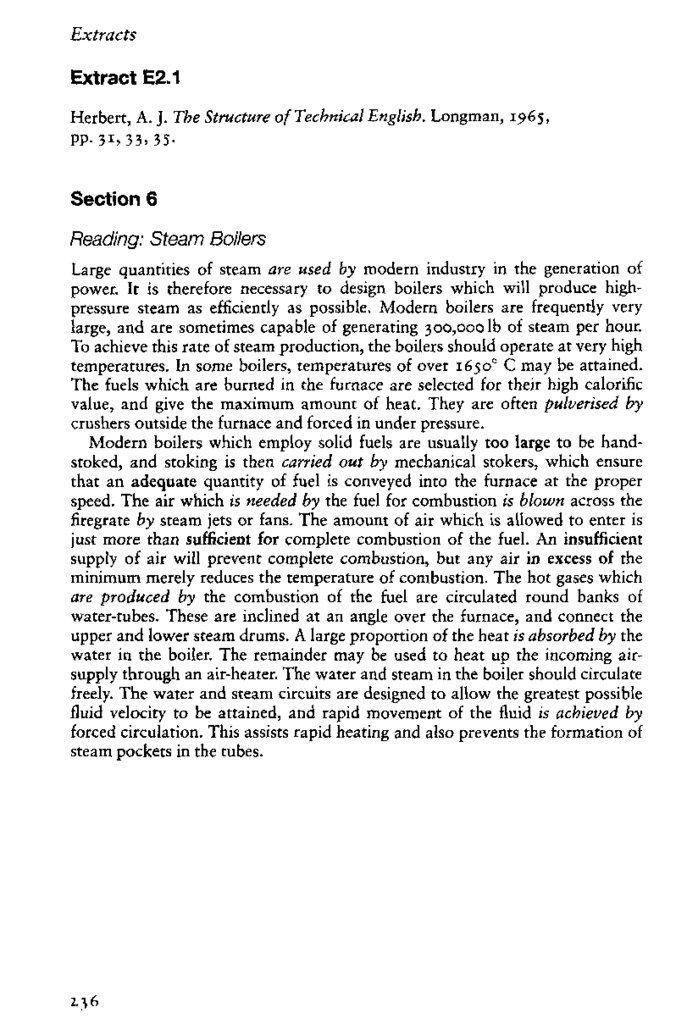
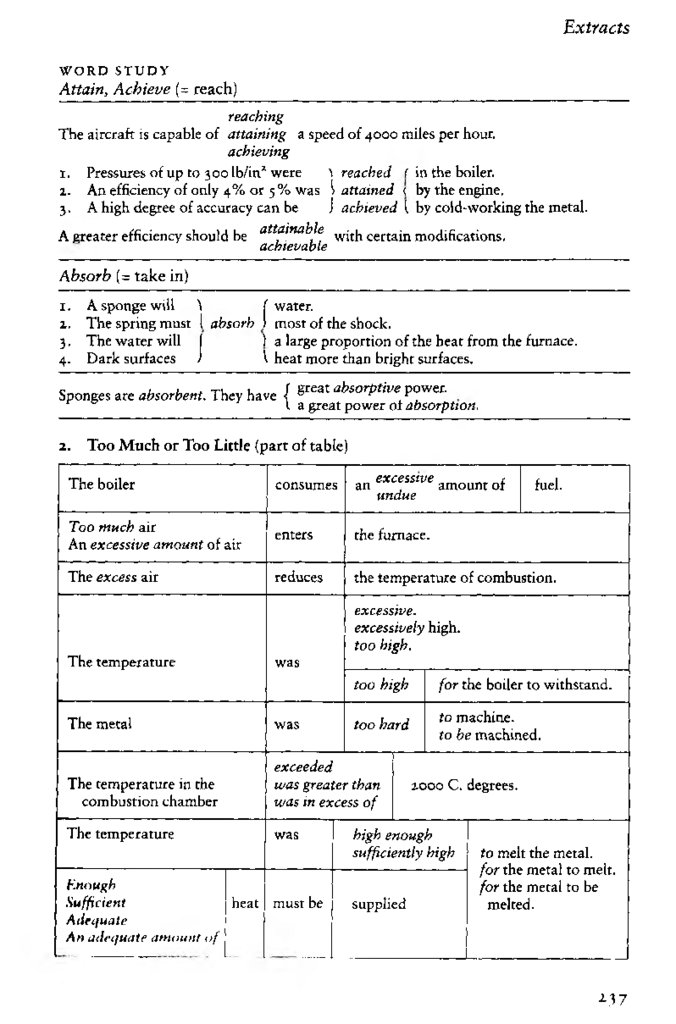
The Extract E z .i (see pp. 236-7) is typical of the format of the book:
it begins with a long specially constructed reading text on a technical
topic, but one that appears to be based on a description from an
encyclopedia rather than a textbook. This then leads into a number of
exercises focusing on language, initially on semi-technical language and
then on one of the key aspects of grammar identified by Barber, the
passive form of the verb. Exercise z of this extract is interesting in that
it takes the notion of quantity and presents a whole range of lexical
items related to ‘too much’ and ‘too little’. It is characteristic of the
book that all the exercises - both in this extract and elsewhere in the
book - focus on these lexical and grammatical points; there are no
exercises checking comprehension of the reading passage or developing
reading or other skills. In focusing on the ‘notion’ of quantity, however,
it shows an early if limited awareness of the value of a functional/
notional approach to the teaching of lexis.
As Swales (1988) remarks, The Structure o f Technical English was
driven by the linguistic analysis that underpinned it. The coverage of
language, especially semi-technical vocabulary (for example word
Ktudy in Extract E z .i (pp. Z37)), has been admired, but as a textbook
for classroom use it left a lot to be desired. The passages were dense
sind lacked authenticity, the accompanying diagrams were not very
zi
38.
Developments in ESPsupportive, and, worst of all, the exercises were repetitive and lacking
in variety. All in all, most of those who taught with The Structure o f
Technical English found it a difficult book to use. There were also
theoretical objections: these were that the concentration on a restricted
range of grammar and vocabulary was an insufficient basis for a
textbook on English for Science and Technology and that this concen
tration on form needed to be replaced by a concentration on language
use and communication.
Most materials produced under the banner of Register Analysis
followed a similar pattern, beginning each chapter with a long specialist
reading passage. Beginning a unit with a reading passage, usually
related to a specific discipline, seems to have been standard practice in
EAP, probably arising from situations where General English materials
were supplemented by subject-specific reading passages.
These perceived weaknesses of the Register Analysis approach and
attempts to rectify them led to the second major movement in ESP,
rhetorical or discourse analysis.
2.3.2
Rhetorical and discourse analysis
While the work of Barber and other ‘lexicostatisticians’ examined the
language of specific registers, it offered very little explanation of why
certain grammatical patterns are favoured by the English of Science and
Technology, nor of how sentences are combined to form paragraphs and
whole texts or ‘discourses’ . The pioneering work in this area was done
by Lackstrom, Selinker and Trimble (1973) whose approach is perhaps
best summarised by Trimble’s later book English for Science and.
Technology: A Discourse Approach (1985). Trimble defines rhetoric as
‘the process a writer uses to produce a desired piece of text’ (p. 10) and
an EST text as ‘concerned only with the presentation of facts, hypo
theses and similar types of information’ . He suggests that a writer needs
to organise a text at four rhetorical levels: level A - the objectives of the
total discourse; level В - the general rhetorical functions that develop
the level A objectives; level С - the specific rhetorical functions that
develop the general ones; level D - the rhetorical techniques that
provide relationships between the level С functions.
This work introduced the idea of relating language form to language
use, making use the main criterion for the selection of ESP teaching
materials. It was Widdowson, however, in his early writings with Allen
who really made this approach the major movement in ESP in the 70s.
Swales talks of the Barber article having ‘a special importance for those
few people involved in ESP in the mid-sixties’ (Swales, 1988: 1, sentence
reordered). For the relatively large numbers who began to work in ESP
1z
39.
A historical perspective on ESPsituations at the beginning of the 1970s, Widdowson’s arguments for
the primacy of language use over form (usage in Widdowson’s termi
nology) and for an approach based on the communicative aspect of
language were extremely influential.
The Focus Series was a series of textbooks that put Allen and
Widdowson’s ideas into practice; here the emphasis was on key
functions in scientific and academic writing: definition, classification,
description and hypothesising, all at level С in Trimble’s chart, and on
the linguistic forms of cohesion. The Focus Series, although influential
from a theoretical point of view, was less successful as an actual
textbook, as it seems not to have been based on any substantial trials
in an actual teaching situation. More successful was The Nucleus
Series, which originated from teaching material developed at the
University of Tabriz in Iran. The series was strongly influenced by
Widdowson’s work, and also by work on semi-technical vocabulary. It
concentrated on the rhetorical function of description, and introduced
semi-technical vocabulary related to 1 1 key concepts or notions in
science (Wilkins, 1976). It thus focuses on Trimble’s Level D, as
illustrated by Extract E2.2 (pp. 238-9) which is concerned with the
description of structure.
The extract is taken from the General Science book, which acts as a
core book for the series, and shows most of the features of the course
(for a detailed description of how the course was written see Bates
[1978]). The material is clearly derived from a teaching situation; it is
entertaining and certainly avoids the laboriousness and predictability of
The Structure o f Technical English. There is also good visual support.
The main drawback of the course is that it is still primarily concerned
with teaching language. It does that effectively through the use of a
functional-notional syllabus and a good range of exercise types, but
neglects the development of specific study skills.
In the General Science book the real content, the semi-technical
language of scientific description, is taught through a wide range of
carrier content, from everyday to general science contexts. In the
specific books, the carrier content is much more closely related to the
discipline. There are exercises in reading and, in the specific courses,
some attention is given to listening; moreover, the exercises in both the
core course and the specific courses generate oral and written practice.
None of the four skills, however, are given specific attention and there
are few exercises that have the aim of developing particular study skills.
Specific work on study skills - missing from both The Structure o f
Technical English and The Nucleus Series - became the major focus in
КАР work in the late 1970s.
23
40.
Developments in ESP2.3.3
Analysis of study skills
The interest in skills seemed to develop fairly naturally from the
functional-notional materials we have discussed, and was consistent
with the ideas of communicative language teaching. The growth of
needs analysis, a trend that ran parallel with the rise of the skills
approach, identified priorities amongst the four skills for a given
situation. In many situations, especially when the medium of instruction
was not English, for example in Latin America, this meant a focus on
reading. In other situations it might involve a different skill, such as
listening for international students embarking on academic courses in
the UK, oral skills for business people conducting international negotia
tions, writing skills for engineers employed by an international
company, or for international students writing a postgraduate thesis.
The main principle of these skills-based courses was that the teaching
of language in itself is not sufficient for the development of the ability to
perform the tasks required of a tertiary level student, a business person
or a practising engineer. The basis of the approach is that, in addition to
language work, there is a need to address the thought processes that
underpin language use. These thought processes may either be fairly
general, relating to all academic or professional activity, or specific to a
particular discipline or profession. There is a clear overlap with related
work in teaching study skills to native speakers (Williams et al., 1984).
The skills were taught using general carrier content, and reading or
listening passages were chosen on the basis of general academic interest
and authenticity. It was assumed that the skills learnt through the
exercises could be transferred to the students’ own specific tasks.
We will exemplify this movement with an Extract (Ez.3, p. 240) from
the reading skills course Skills for Learning. This course was developed
by the University of Malaya ESP Project (UMESPP). The University of
Malaya, along with other Malaysian universities, had recently switched
to a M alay medium policy but wished to retain the use of English as a
‘library’ language. The course focuses on certain specific skills asso
ciated with reading such as ‘getting to know the main parts of a book’,
‘getting familiar with non-linear texts’, ‘learning to accept difficult
words’ , ‘reading for relevant information’ , ‘using contextual clues’ ,
‘assessing how much to read’. The aim of each lesson is made explicit
through the statement of why the skill is needed. We have chosen as an
example parts of the first two pages from Lesson 20 Using contextual
clues. The first exercise is a listening activity and a problem-solving
task; thereafter the exercises focus on the main purpose, that of
deducing meanings of difficult words from the context. This gradual
‘atomistic’ building up of a set of skills, either through individual, pair
24
41.
Л historical perspective on ESPor group work, is characteristic of courses focusing on reading or
listening skills.
The principles underlying the Skills for Learning course book are very
similar to the Reading and Thinking series published by Oxford
University Press in 1980. The main difference is that Reading and
Thinking consists of four books which move from a focus on functions
and notions to a concern with discourse matters, in particular with
judging writers’ stance towards the topics they are discussing.
2.3.4
Analysis of learning needs
In the late 1970s and early 1980s there was a period of consolidation in
ESP. In the early 1970s it was important to establish the need and
credentials for ESP work, and many articles, notably Strevens (19 71)
and Jordan and Mackay (1973) concentrated on this. The question was
whether ESP courses were more successful than General English courses
in preparing students either for working or studying in English. The
answer generally came in the form of reports on the success of courses
and materials and what Bowyers (1980) refers to as ‘war stories and
romances’. There are relatively few empirical studies on the effective
ness of ESP courses, although Foley’s discussion of the ESP programme
at the University of Petroleum and Minerals in Saudi Arabia (Foley,
1979) provides concrete evidence for the validity of the ESP approach.
Munby’s (1978) model for Needs Analysis - initially a PhD thesis and
later a book - was much discussed in the late 1970s and early 1980s.
The rather cumbersome nature of the model has meant that it has had
relatively little direct influence on the ESP profession, but at the time the
publication of the model was an indication of the ‘coming-of-age’ of
English for Specific Purposes.
Hutchinson and Waters’ various papers (1979, 1980a, 1980b and
19 8 1) indicate the consolidation of ESP work, but also, more signifi
cantly, a recognition that some of the accepted ideas of ESP needed
rethinking. They have perhaps been particularly influential in their
definition of what they consider ESP should not be. In their later book
(1987, p. 18) they state that:
1. ESP is not a matter of teaching ‘specialised varieties’ of English. . . .
1. ESP is not just a matter of Science words and grammar for Scientists,
Hotel words and grammar for Hotel staff and so on. . . .
3. ESP is not different in kind from any other form of language teaching
in that it should be based in the first instance on principles of
effective and efficient learning. . . .
W hile it is difficult to disagree w ith these actual statem ents, their
15
42.
Developments in ESPposition has been strongly associated with the argument against specific
work in ESP, a rejection of the idea that ESP methodology differs from
that of General English teaching, and even occasionally - although this
is clearly not their view - with the idea that ESP is dead. While these
negative associations are unfortunate, Hutchinson and Waters’ ideas on
a learning-centred approach to ESP are very interesting.
Hutchinson and Waters argued that ESP had concentrated too much
on the end product as revealed by Target Situation Analysis (Chambers,
1980) and linguistic analyses of lectures, textbooks and articles, and,
therefore, too little on the learning skills needed to enable students to
reach the desired end behaviour. They argued that students (their ideas
derived from a situation in which international students were being
prepared for study at a British Technical College) need the ‘target
performance repertoire’ - the end product - less than the ‘underlying
competence’ that the lecturer assumes and which enables the student to
reach the target performance repertoire. The underlying competence
consists of familiarity with the ‘standard visual modes of representation’
(Hutchinson and Waters, 1980 reprinted in Swales, 1988: 180); semitechnical and colloquial language; ‘familiarity with the world’, that is
with various metaphors frequently used in academic description, in this
case the pump and the circulation system; and ‘layman’s technology’
(ibid., p. 18 1), that is the workings of a car, the circulation of water and
electricity in the home, and domestic appliances.
These ideas are developed in their 1987 book and the concept of a
learning-centred approach is outlined. This involves considering the
process of learning and student motivation very fully and working out
exactly what is needed to enable students to reach the end target. Thus,
even though students may only need to read textbooks and articles in
their field, it may be that oral practice will help them reach that end.
Similarly, in reading a passage it may help students understand the text
if the teacher reads it aloud to them while they follow. Listening to a
text being read aloud is unlikely to be a skill that is required during
their academic studies, but the process of following a text being read
aloud clearly by a native speaker often helps students understand what
are the main and what are the subsidiary ideas, and make the links
between them (St John, 1989).
Another aspect of a learning-centred approach is that learners will
have developed certain learning skills from their academic study, or
experience at work, and these skills can be exploited in the ESP
classroom. Johns and Davies (1983) take this idea a stage further: in
arguing for an approach based on the text as ‘a vehicle for information’
rather than as ‘a linguistic object’, and on a topic-type analysis of text
(for a fuller discussion of this approach, see chaptcr 6), they suggest a
26
43.
A historical perspective on ESPmethodology that is based on group work in which learners ‘puzzle out
the meaning of the text’ (Johns and Davies, 1983: 1). This problem
solving approach reflects the real situation where students will be
reading on their own and trying to work out the meaning of a text; it is
characteristic of ‘real life’ .
The learning-centred approach also takes into account the fact that
different students learn in different ways. The emphasis on pair or
group work and problem solving allows for these differences.
We will now look at part of a unit (E2.4 pp. 2 4 1-3 ) from the
textbook Interface (Hutchinson and Waters, 1984) in which many of
their ideas are put into practice. As the authors (1987: 1 1 2 - 3 ) explain
in discussing another extract from the same textbook, the starter
provides ‘a context for the comprehension of the input’, which enables
students to feel their way into the topics or ‘carrier content’ of the unit
and raises interest. In the rest of the extract, the comprehension
questions encourage students to think for themselves and to draw on
their knowledge of the subject and of the world in general. This section
is concluded in step 4 by a task that pulls together topic and language,
and involves the student in converting written information into a visual
representation.
We have not included the whole section, but we will mention briefly
the Task that rounds it off. Hutchinson and Waters (1987: 1 17 ) explain
that the task ‘provides a clear objective for the learners and so helps to
break up the often bewildering mass of the syllabus by establishing
landmarks o f achievement' (emphasis added).
Reflection 2b
Look at extracts from published materials or your own in-house
materials. Decide to which of the various trends or movements in ESP
they belong. For courses taught in your organisation or your country,
which trends currently have most impact?
2.4 Authenticity of text and authenticity of purpose
One issue that caused a good deal of controversy in the development of
ESP was the question of whether texts used for reading, listening and
writing exercises should be authentic or not. The exact meaning of
Authenticity has often been unclear. Many have used it with reference to
unsimpliHed or ‘genuine’ texts that were used in ESP materials but were
*7
44.
Developments in ESPoriginally written for purposes other than language teaching. Others
have recognised that genuineness of the text does not guarantee
relevance and that a text is only truly authentic if it is exploited in ways
that reflect real world use. In other words, authenticity of purpose is as
important as genuineness of text.
In all the textbooks we have described, ideas for the texts were taken
from academic contexts but the texts were either simplified or, as in the
Focus or Nucleus series, specially written. Others (for example Phillips
and Shettlesworth, 1978) argued that students need to be exposed to
authentic texts and develop strategies for reading long, complex and
unsimplified texts if they are to be able to develop independence in their
study skills. They also suggested that texts simplified or specially
written by ESP teachers may in fact be misleading models of text for
students, as the ESP teacher may misconstrue the carrier content or
write in unnatural and inappropriate language. In contrast, Hutchinson
and Waters (1987) argued that it is more important to ensure that the
activities based on the text reflect the learning process than to use
genuine texts from the target situation.
A key aspect of authenticity is the level of the text exploited in the
ESP class. An unsimplified text on a science topic designed for school
pupils just beginning to study science is a genuine text, but is not an
authentic text for university level students, as these students will not be
able to use it to confirm or extend their knowledge of the topic they are
studying on their course. A key question is whether the activities based
on the text reflect the ways in which the text would actually be used by
students in their course work. Exercises that ask students to answer
comprehension questions by finding relevant sentences in the text are
not authentic, but those that ask students to use information from the
text in a task or problem-solving activity are.
Authenticity thus lies in the nature of the interaction between the
reader (or hearer) and the text (Widdowson, 1978, 1983). Part of the
process of needs analysis (see chapter 7) is finding out exactly how
learners use different sources so that activities in the ESP class can
reflect what happens in real life.
2.5
Trends in English for Occupational Purposes
The influences described under trends in EAP were also present in the
EOP courses of the late 1960s and early 1970s. Courses were at that
time largely concerned with written language.
The early commercial correspondence courses taught standard letter
formats for business transactions ranging from general complaints and
28
45.
A historical perspective on ESPrequests for information to specifics such as import/export arrange
ments. The underlying construct (the product approach) involved model
letters to copy, specialised vocabulary and the standard, formal cliched
phrases of the time. The emphasis on specialised vocabulary was also
seen in other materials where texts, including dialogues, were accom
panied by glossaries of difficult terms and a few comprehension
questions. The approach was definitely based on the linguistic system
rather than the use of the language.
Rightly or wrongly, the assumption at this stage was that learners had
a good grasp of language forms, after four or five years of school
English classes, so that what was needed were words and expressions
that occurred in work situations. An interesting point is that these texts
were usually genuine. The debate as to whether materials should be
limplified, simple versions or genuine seems to have been confined to
EAP, EST and the academic world.
From the mid-1970s into the 1980s the focus switched more and
more to spoken interactions based first on a grammatical, and then
gradually a more functional, construct. Materials were based on
functions such as Greetings, Making Introductions, Making Arrange
ments, Agreeing and Disagreeing. Formulaic language and gambits were
taught and practised in dialogues and role plays.
Many of these materials were designed for use with commerce,
iccretarial and business students. One landmark in the development of
Business English materials was The Bellcrest File, a video-based course
book published in 19 72. This marked the beginning of approaches
which gave more attention to the four skills, albeit within the existing
construct of grammatical syllabuses. The assumption was still that
learners had a grounding in the grammar but there was writing and
reading practice, together with plenty of drills and role simulations.
The first set of materials to adopt the business studies approach of
Case studies was published in this period. Agenda (Cotton and Owen,
1980) comprised cases for discussion with a separate workbook and
cassette to provide language practice.
These materials assumed little knowledge and no practical experience.
Gradually an understanding of the different needs of learners with jobexpcricnce led to new materials; from the mid-1980s there are materials
based on business communication situations such as meetings and
telephone conversations. A new video course, Visitron: the Language o f
Presentations (Howe, 1984) practised the language of presentations but
did not exploit features such as body language (whereas a more recent
publication, Effective Presentations [Comfort and Utley, 1995], has a
unit called Body Language).
The most extensive coverage of business communication situations
29
46.
Developments in ESPwas through the Longman Business English Skills Series (Ellis, O’Driscoll and Pilbeam, Eds.). Beginning in 1987, books on socialising,
telephoning, meetings and discussions, and presenting facts and figures
were published, followed in the 1990s by others on topics such as
exchanging information and negotiating. They follow a similar format,
giving practice in listening to and completing exchanges, noting the
kind of information given and matching it with language expressions; in
the later books there is some treatment of formality and informality in
these expressions. As students are asked to identify the purpose or type
of contribution, they can begin to see recurrent patterns of information.
As the early books in this series illustrate, up to the mid-1980s
attention was primarily on language and the teaching of language. Then
the focus began to shift and the perspective broadened to adopt tenets
of the business world, and this is still continuing. The interface between
language and behavioural skills is being explored, with more courses
paying attention to at least the basic skills, and management training
approaches and methods are being integrated with language training
techniques (see GEC Management College case study 1 in chapter 8).
There is a more general recognition that language teaching needs to
take on board the business context within which communication takes
place. In the more closely linked business world that has resulted from
developments in technology such as telecommunications, computer
networking, e-mail and video conferencing, it is vital for people to
communicate effectively across borders and to bridge cultural gaps.
Cross-cultural communication requires awareness and sensitivity to the
diversity of values and customs around the world.
2.6
ESP now
Orientation 2c
W hat are the trends and developments in ESP nowadays?
There is currently no dominating movement in ESP as there was with
Register Analysis, Discourse and Rhetorical Analysis, Skills-Based
Approaches and the Learning-Centred Approach. As in other branches
of ELT and many other human activities, there is now acceptance of
many different approaches and a willingness to mix different types of
material and methodologies. If there is less of the missionary zeal of the
early practitioners, there is wide agreement that ESP has a role in ELT
3°
47.
A historical perspective on ESPand that it is a movement which, while remaining firmly within the
ELT/Applied Linguistics discipline, has its own particular characteris
tics. It is now also taught by many non-native speakers who are able to
make use of their knowledge of the institution in which they are
working and of students’ learning styles and preferences.
Materials production and text analysis, of both written and spoken
discourse, still predominate in ESP. Analysis of spoken and written
texts, especially under the influence of Swales’ Genre Analysis (1990),
has assumed an important position in ESP. We will look at genre
analysis in chapter 5; at this stage we will restrict ourselves to saying
that it is an extremely useful tool of analysis that is of relevance to EAP,
Business English and the other smaller branches of ESP such as Legal
English. We believe, however, that it would be wrong to think of genre
analysis as a new movement in ESP.
One area that has come back into something of a prominent position
is Register Analysis, the analysis of grammatical features of specific
texts in the way started by Barber. With the advent of computer-based
corpora and the development of the ideas of genre analysis, it is possible
to relate the quantitative data that emerge from computer analysis,
especially from the use of concordancing programs (Johns, 1989;
Flowerdew, 1995), to discoursal features of text. This renders the
findings of Register Analysis much more meaningful. The work of Biber
(1988) has been influential in this regard.
We show in this book that ESP is capable of drawing on disciplines
outside Applied Linguistics; others, notably Swales in his final editorial
as editor of the journal English for Specific Purposes (1994, 13:3) and
Mauranen (1993), also suggest that ESP needs to be sensitive to move
ments in ELT and Applied Linguistics, such as the World Englishes
movement and analysis of different national styles of rhetoric.
One major change has been the emergence of Business English as a
major strand of ESP teaching. Early ESP work was dominated by
English for Science and Technology and it has often been remarked that
Swales’ Episodes in ESP is essentially a history of EST. However, in the
1990s, as Dudley-Evans and St John (1996) note, the largest area of
growth is Business English. And with the increasing numbers of interna
tional students taking Masters courses in Business, Finance, Accounting
and Banking, the area of academic Business English is beginning to
ansume much greater importance in EAP.
KSP has tended to be associated with countries in the Middle East and
l.utin America; the growth of EBP has coincided with the growth in the
economies of countries in South East Asia and the Pacific Rim. This
geographical area, which has often been unjustly neglected in surveys of
KSP ( I ickoo, 1988, is a notable exception), is already becoming much
}1
48.
Developments in ESPmore important in ESP work. Eastern Europe is also growing in
importance, especially in the area of Business English.
There is thus growing diversity in ESP teaching with interesting varia
tion between, on the one hand, the EAP situations in English-medium
institutions and those institutions where English plays a subsidiary role to
the national language, and, on the other, between approaches to EAP and
to Business English. All seem happy to be considered as part of ESP, but
the constraints of the very different situations lead inevitably to different
types of material and methodologies.
Task 2d
We present below two controversial statements about ESP. W hat are the
arguments in favour of and against these statements?
1. The increased specialism of ESP means that ESP teachers should also
specialise. If they are teaching EAP, they should concentrate on one or
two subject areas. If they are teaching Business English, they should
concentrate on certain sectors, such as banking.
2. The increased specialism of ESP means that small EAP units should be
attached to the individual academic departments that they serve.
These small units would then replace the large ESP centres that serve a
whole institution.
2.7
Summary
We have shown in this chapter that ESP has generally been concerned
with procedures and practical outcomes. It has been in the vanguard of
the developments in ELT, moving from grammatical, functional and
notional syllabuses to a more eclectic and task-based approach. EST
was the dominant movement for many years, but ESP today is a much
broader activity in which English for Business Purposes (EBP) has
become increasingly important. There is an impressive amount of
research, particularly into the target events of the academic world, and
this is becoming increasingly interdisciplinary.
2.8
Recommended reading
T h e fo llo w in g books are all relevant to the study o f the developm en t o f
ESP. S w a le s’ ( 1 9 8 8 ) b o o k is designed as a h istory; H u tch in so n and
32
49.
A historical perspective on ESPWaters’ (1987) has a good description of the various approaches to ESP;
Mackay and Mountford (1978) contains descriptions of course develop
ment that expand points made in our chapter. The textbooks, Ewer and
Latorre (1969), Allen and Widdowson Eds. (1974), Bates and DudleyEvans Eds. (1976) are examples of earlier approaches to ESP.
50.
3English for Academ ic Purposes
3.1
Aims
English for Academic Purposes (EAP) refers to any English teaching
that relates to a study purpose. Students whose first language is not
English may need help with both the language of academic disciplines
and the specific ‘study skills’ required of them during their academic
course. The study skills may involve any of the main skills (see chapter
6) depending on the context. It is very important to be aware of how, as
the study situation changes, the emphasis on different skills also needs
to change. The key aspect here is the extent to which either English or
the national language is used as the medium of instruction for subject
courses.
EAP has sometimes been seen as one movement within ESP; we shall
suggest that there are four different types of situation and that teachers
need to look very carefully at accounts of courses and materials before
deciding whether they are relevant to their own situation. We will also
look in detail at ways in which the language teacher can take the
initiative in developing cooperation with departments.
3.2
Four types of EAP situation
The key determinant of what an EAP course should contain is whether
or not the subject course is taught in English. In this regard there are
four types of situation, exemplified here using tertiary level institutions.
Some features may also apply to the teaching of English at secondary
school level, where, particularly in the senior, immediately pre-university
classes, English courses will have EAP components. We will, however,
focus here on the tertiary level. Teachers need to think carefully about
whether the success claimed for one kind of situation will transfer to
another. For example, materials teaching note-taking from lectures on a
pre-sessional course in a British university are unlikely to be relevant to
teaching note-making for reading in an English as a Foreign Language
(EFL) situation.
34
51.
English for Academic PurposesAs illustrated in table 3 .1, the four types of situation are:
1. An English-speaking country, such as UK or USA.
2. An English-as-a-Second-Language (ESL) situation where English is
the official language of education and is widely spoken, as in former
British colonies in Africa or South East Asia. (We are using ESL in
the specific British sense referring to this kind of situation, as
opposed to the more general American use of the term, which
applies to all EFL/ESL teaching.)
3. A situation in which certain subjects, such as medicine, engineering
or science, are officially taught in English, while for other subjects
and at other levels of education the national language is used.
4. A situation where all subject courses are taught in the national
language, but English may be important for ancillary reasons.
We will look at each of these in turn.
Table 3 .1 Situations in which ESP is taught
Situation 1
e.g. UK, USA, Australia
Students come from another country to study in a
foreign system; for them both general and academic
culture may be different; everything around them
operates in English.
Situation 2
e.g. Zimbabwe
Education at all levels has been mainly in English; the
Civil Service uses English, but people mostly use their
first language (Li) in everyday life.
Situation 3
e.g. Jordan
In tertiary education some subjects are taught in L i,
but others, such as medicine, engineering and science,
are taught in English.
Situation 4
C.g. Brazil
All tertiary education is taught in the L i; English is an
auxiliary language.
Orientation 3a
Look at table 3 .1 and consider how the needs of students, on entry to
tertiary education in the four situations, differ. Take into account the
students’ likely level of English, the different skills they need in English
and the communicative events they need English for.
52.
Developments in ESP3.2.1
EAP in an English-speaking country
It has long been a tradition that universities in English-speaking
countries accept large numbers of international students, and they have
generally set up English Language Units charged with the responsibility
of helping such students reach their full academic potential. Teaching is
done both on pre-sessional and in-sessional courses. The pre-sessional
courses generally run for between 4 and iz weeks prior to the beginning
of the academic year and focus on both academic language and the
‘study skills’ related to all the main skills. The courses aim to prepare
students for the studies they are about to embark upon. The focus is
therefore on common-core academic language and skills; some more
specific work is usually included, but cannot be very extensive as the
pre-sessional is a pre-study course. In-sessional work, however, runs in
parallel with the subject courses and therefore provides the opportunity
for integrated subject-language teaching and more specific work on the
key skills of academic listening, writing and reading, as well as more
‘common-core’ EAP courses.
As this work emanates from university settings, it has been widely
written about and has generated much interesting applied research. In
Britain, for example, the work of such units has become widely known
and influential through a number of publications under the auspices of
the British Association of Lecturers in EAP (BALEAP) describing the
needs of international students and courses designed to meet those
needs (for example Robinson, 1988; Brookes and Grundy, 1988; Adams
et al., 19 9 1; Blue, 1993; Hewings and Dudley-Evans, 1996).
Task 3b •>
Imagine tw o students, one doing a M asters course in Business Adm inis
tration (M B A ), the other doing a PhD research degree in a science
subject. Both students are from a non-English medium country in South
East A sia, such as T a iw an or Thailand. W h at do you predict to be the
m ain com ponents each one needs on a four w eek pre-sessional course?
D r a w up tw o lists.
3.2.2
EAP in ESL situations
An increasing amount of EAP work is being done in Anglophone
countries in Africa such as Zimbabwe, Nigeria and the new South
Africa (not strictly Anglophone but using English for much tertiary
36
53.
English for Academic Purposeseducation), and in South-East Asian countries, such as Singapore,
Philippines and, to some extent, Malaysia. In these countries (with the
exception of Malaysia) English is used throughout the education
system, in most cases from the primary school level, in others from the
secondary level. The language level may, in fact, be quite high, but it has
been found that many students in these situations need help with
adjusting to the demands made of them when they begin an under
graduate course. This is particularly the case with students from rural
areas who may well have had rather less exposure to English and may
have been less well taught at school level.
Students’ needs are in the area of study skills and in adjusting to the
abstract nature of the language of theory or model building (Bazerman,
1988; Mason, 1990; Henderson and Hewings, 1990) which they may
be encountering on a large scale for the first time at the beginning of an
academic course. Their English tuition up to tertiary level will generally
have been in the area of General English, and is unlikely to have
included specific preparation for study at university level, or for the
ipecific tasks carried out in English in a work or business context. In
many of these countries there has also been a tradition of study of
literary aspects of English, which is unlikely to prepare learners
effectively for studying a non-literary subject in English at tertiary level.
It has often been remarked that the needs of such students span the
needs of non-native speakers following an English-medium course and
those of native speakers in need of developing communication skills.
The most successful communication skills courses in ESL countries
make use of a combination of ideas from the EAP tradition and the
Communication skills for native speakers tradition (see for example
W illiam s et al., 1984).
There have, nonetheless, been different focuses in such courses. Some,
Ml for example in Nigeria or Kenya, have concentrated on developing
‘com m on-core’ study skills courses for students from a mixture of
disciplines, focusing particularly on reading and writing skills (ChukWUma et al., 19 9 1; Monsi et al., 1995; Obah, 1993). It is often difficult
to find material and activities of a common-core nature that are
lUfficicntly challenging and motivating for students with the relatively
high language level that we have already noted. The work reported
from the University of Zimbabwe (Mparutsa et al., 19 9 1) and the
University of Witwatersrand in South Africa (Starfield, 1994) would
tuggcst that more specific and subject-related courses have been more
tUCCessful in motivating students and really meeting their needs. Love’s
Work on geology (19 9 1 and 1993) and Mparutsa’s work on economics
{M parutsa et al., 1991) are particularly interesting in this regard; they
•h o w that introducing first year students to the basic underlying content
54.
Developments in ESPschemata of the subjects and the formal schemata (Carrell, 1983) of the
writing tasks expected of students is effective in both motivating these
students and bringing about improvement in their performance in
subject courses.
In other situations, notably in South East Asia, the focus of ЕАР/
Communication Skills courses has been much more on preparing
students for the communication tasks that they will have to carry out in
work situations once they have finished their academic course. A course
at Nanyang Technological Institute, Singapore, identifies the following
three key objectives, which are based on the recommendations and
advice of professional bodies and consultants (Cheung and Wong,
1988: 93):
1. to communicate technical and business information effectively in the
work and academic setting in several modes: written, oral, audio
visual and graphic;
2. to adapt material prepared in one form for presentation in another,
for example to adapt a written business proposal for a boardroom
presentation;
3. to communicate effectively with specialist and non-specialist audi
ences in job-related tasks, for example writing memos and letters,
chairing meetings, and interviewing or being interviewed.
The classes designed for such situations will largely be in-sessional and
included as part of the general timetable. Various reports (for example
Johns, 19 8 1; Makina-Kaunda, 1995) point to the danger of the English
class being allocated the worst timetable slots, such as Friday afternoon
or its equivalent. In courses built on a credit system it is essential that
the English course carries credit. If it does not, or if the English class
always takes place at a bad time of the day, it will not have status in the
eyes of students and motivation will fall.
3.2.3
EAP situations in which certain subjects are taught in English
In many countries, notably in the Middle East, English is used as the
medium of instruction for certain subjects, particularly medicine,
engineering and some science subjects. What distinguishes these situa
tions from those in the African and South-East Asian countries
described above is that there is no particular or general tradition of
English-medium education in the country, and the school system mostly
uses the national language to teach all subjects. Thus students have to
make the adjustment from studying all subjects in their national
language at school level to studying subjects such as science, medicine
and engineering in English at tertiary level. This has led some countries
38
55.
English for Academic Purposesto include some EAP work in the English curriculum at upper secondary
school level (see for example a description of the use of an ESP textbook
in Egyptian secondary schools [Dudley-Evans, 1987a]).
Students begin the courses with a much lower level of English than in
the ESL situations described in the previous section. This lower level
often leads to a situation where subject lecturers, most of whom are
themselves non-native speakers of English, may deliver lectures in a
mixture of English and the national language. This may involve
delivering the lecture in, say, Arabic, but dictating notes in English.
Examinations and assignments will be written in English, but are
sometimes designed so that they do not make large linguistic demands
on students. Full essays or technical reports may not be required, and
students will be tested through multiple choice questions, calculations,
diagrams and short-note answers (Douglas, 1977; Swales, 1980). In
other situations, for example the Jordanian University of Science and
Technology (JUST), students are required to write term papers in
English, but lecturers may not pay very much attention to linguistic
errors and weaknesses of presentation (Mustafa, 1995).
The crucial thing then is to find out how English is really used. This
may, of course, be quite difficult as the question of whether the course is
truly English medium may be an extremely sensitive one. Graves (1975)
talked of a difference between the formal and informal orders. The
formal order is the official view of how the course runs and how students
succeed or fail within the system. The informal order is ‘the same
institution as perceived and operated by its members’ (Graves, 1975).
Swales (1980) describes how the formal order of a particular course
Stipulated that 50 per cent of the mark was assigned to a written report
and 50 per cent to a map. After three years of poor attendance at the
English class, Swales found out that the informal order was to allocate
90 per cent of the marks to the map. He discussed the issue with the
department and a new ‘practicable formal order’ was set up where the
amount of writing was increased and the language teacher became
Involved in overseeing drafts of the report.
3.2.4
EAP situations where subject courses are taught in the
national language
Our final situation is where the subject courses are taught in the
national language but English is included on the timetable. In many
situations, for example in Latin America, countries in South East Asia
such as Thailand and Indonesia, in mainland Western Europe, Eastern
Europe and Scandinavia, the medium of instruction is normally the
national language.
39
56.
Developments in ESPIn South America, EAP has often been referred to as Technical
English (Ingles Instrumental), and the courses have focused almost
exclusively on reading. In Chile and Colombia, university-specific
projects led to the writing of materials that were published and became
available internationally (Ewer and Latorre, 1969; Reading and
Thinking in English, 1980); in Brazil the focus is much more on
developing a framework for materials and on teacher training, but
allowing individual institutions to write their materials within the
overall framework (Alderson and Scott, 1992; Celani et al., 1988). The
materials focus on key micro-skills related to the overall macro-skill of
reading, but also teach certain lexical and grammatical items relevant to
the comprehension of undergraduate academic reading texts.
The actual methodology used to teach this material is also fascinating:
the classes are taught in Portuguese and this enables the teacher to lead
some very detailed discussions about the linguistic features of the text
and the techniques of deducing meaning from a text in a foreign
language. In some respects, the classes resemble a problem-solving class
in applied discourse analysis with teacher and students analysing in
great detail the workings of an English text (Alderson and Scott, 1992;
Scott, 19 8 1a and 1981b).
The commitment of the teachers and their involvement in the writing
of materials lead to high motivation on the part of both teachers and
students. There are, however, many reports in the literature (Hutchinson
and Waters, 1987; Bates, 1978) which suggest that such mono-skill
courses are often rather less motivating, and in Brazil, too, there are
moves to introduce more variety.
The motivation problem is in a sense similar to that in the third type
of situation - it can be very difficult to decide what students’ real needs
are. In theory, students need to focus on the reading skill; in practice,
the reading of English textbooks or articles may be little more than an
optional extra and students may be more motivated by materials that
focus on other skills, or on delayed needs rather than supposed
immediate needs. By delayed needs we are referring to needs that arise
either in the final year (for example project work) or to communication
needs in future work.
The classes are again generally in-sessional, and the same issues of
status and motivation highlighted in the descriptions of the two
previous situations - ESL and English-medium situations - apply. A
further particular problem of all these situations is that English is often
taught only in the first year of the academic course. We have found that
there is a case for delayed or additional teaching of English in the final
years. While teachers on training courses readily accept this idea, very
few (if any) reports exist in the EAP literature of experiments on the
40
57.
English for Academic Purposestiming of the English course. This mismatch between the institutions’
perception of students’ need and their true needs and ‘wants’ (Hutch
inson and Waters, 1987) often results in a lack of student motivation
and the consequent disillusionment of teachers, as well as being a waste
of resources. Swales (1984) points to a loss of confidence in English
Language Centres that concentrate exclusively on first year support
work and suggests the expansion of their role to the teaching of
‘research English’ to postgraduates and young academic staff.
Reflection 3c
We began this section by warning that what works in one situation may
not work in another. Which of the four situations do you have experience
of? What examples of this ‘non-transferability’ have you come across?
3.3
English for General Academic Purposes (EGAP) and
English for Specific Academic Purposes (ESAP)
An awareness of the distinction between English for General Academic
Purposes (EGAP) and English for Specific Academic Purposes (ESAP) is
crucial to a full understanding of EAP (Blue, 1988a). EGAP refers to the
teaching of the skills and language that are common to all disciplines;
ESAP refers to the teaching of the features that distinguish one discipline
from others.
English for General Academic Purposes isolates the skills associated
with study activities such as listening to lectures; participating in super
visions, seminars and tutorials; carrying out practicals (largely in science
or engineering courses); reading textbooks, articles and other reading
material; and writing essays, examination answers, dissertations and
reports (Blue, 1993). There are particular skills associated with each of
these, so that, to take one example, reading almost any textbook involves
understanding the main ideas, distinguishing the main ideas and the
supporting detail, making notes on the main ideas, evaluating the writer’s
point of view, and, where necessary, skimming to understand the gist of
the argument or scanning to find specific information. Another example
is writing essays, reports and dissertations, which will involve the
forming of accurate sentences, the coherent structuring of the ideas and
adopting the appropriate stance for citing previous work on the topic.
English for Specific Academic Purposes integrates the skills work of
KGAP with help for students in their actual subject tasks. It adopts a
41
58.
Developments in ESPdevelopmental role (Turner, 1996) by showing how students can
transfer the skills they have learnt in the EGAP classes to the under
standing of their actual lectures or reading texts, or in writing the essays
and reports required of them by the department. This kind of work
generally involves some cooperation with the actual subject department.
Such contacts with the department and the possibilities for research into
disciplinary communication often raise the status of the EAP lecturers in
the eyes of subject departments.
Widdowson (1983) relates the specificity of an ESP class to a
dichotomy he sets up between training and education. Training involves
the development of certain skills and familiarity with specific schemata
while education aims to develop a general capacity or set of procedures
to cope with a wide range of needs. Widdowson sees ESAP courses as
more concerned with training and EGAP courses with education. We
disagree with Widdowson on this point: while we accept that certain
narrow-angle EAP courses focus on specific skills and schemata, and are
logically classified as training, most ESAP courses are as much concerned
with education and developing learners’ capacity as EGAP courses. The
difference is that ESAP courses focus on the actual tasks that students
have to carry out while EGAP courses select more general contexts.
Some writers on EAP, for example Hutchinson and Waters (1987),
have argued against subject-specific work. Blue (1988a) argued that
EAP teachers should concentrate on EGAP and that students will learn
ESAP through individualised project work. While this may be true on a
pre-sessional course, in all the other situations we feel that students
need and welcome a two-pronged attack on their needs and difficulties.
This benefits both motivation and the transfer of skills and language
learnt in the EGAP courses. The common-core EAP work makes more
sense and is more relevant if it is supplemented by specific work. In
Colombia, in the mid-1980s, staff teaching the Reading and Thinking
series had to respond to student wants by supplementing the commoncore course with specific work.
3.4
Engaging with the disciplines
For subject-specific work we suggest there are three levels of coopera
tion: Cooperation, Collaboration and Team-Teaching.
3.4.1
Cooperation
Cooperation is the first stage and involves the language teacher taking
the initiative in asking questions and gathering information about the
42.
59.
English for Academic Purposesstudents’ subject course, how English fits into their course and what the
department and students see as priorities. This is part of the Target
Situation Analysis required for needs analysis (see chapter 7). Some of
this can be related to the investigation of what Hutchinson and Waters
(1987) refer to as students’ wants; it also relates to establishing what the
expectations of the department are and, as far as possible, balancing
these expectations with students’ wants. This process is very important
as there are clear dangers in ESP teachers operating without much
consultation with the departments that students are studying in.
Yet cooperation is much more than this; it means finding out about
the conceptual and discoursal framework of the subjects students are
studying and occasionally introducing material that provides a slightly
different perspective on that content (see discussion of Crofts’ work
p. xo). Cooperation is encouraged by the language teacher taking an
interest in other aspects of the courses that students are following. We
are not suggesting that the ESP/EAP teacher has to do this, rather that
the dangers of ESP/EAP teaching becoming a ‘dry affair’ are reduced
when the teacher has an interest in and enthusiasm for the discipline
that students are following.
This interest and enthusiasm may also lead to a more systematic
attempt to find out about how a discipline works through analysis of
key texts in the discipline. An example is provided by research carried
out by Love (19 9 1 and 1993). As a result of extensive discussion with
colleagues in the Geology department and research into the discourse of
the main first year textbook used in the department (Read and Watson’s
Introduction to Geology [1968]), she found that there is a ‘discourse
cycle’ which encapsulates the basic underlying principle of the discipline
as taught in the first year of the undergraduate programme, that
principle being the key relationship in geology between geological
product (present features) and geological process (past processes). The
discourse cycle is (Love, 19 9 1: 92):
^ are evidence for
present geological features
^
past geological processes
are produced by
This research has arisen from a healthy curiosity about the discipline,
fuelled by discussions with lecturers in the Geology department at the
University of Zimbabwe, which in turn have set the agenda for a smallscale research project. ESP/EAP needs a lot more research of this
nature.
43
60.
Developments in ESP3.4.2
Collaboration
If cooperation largely involves the language teacher taking the initiative
and finding out what happens in the subject department, collaboration
involves the more direct working together of the two sides, language
and subject, to prepare students for particular tasks or courses. In
collaboration the language and subject teacher work together outside
the classroom. The collaboration has clear goals but also defined limits.
There are three options for collaborative work:
1 . The planning of a series of classes where the language class prepares
the students for a subsequent subject class taught in English.
2. The running of a class on a specific skill or related to a specific task
where the subject department has a specific input to the materials or
the language teacher uses material produced by the department.
3. The North American ‘adjunct’ model, in which the adjunct acts as a
back-up class to the subject, helping students with difficulties with
that class.
A good example of the first option was the collaborative economicsand-language course run for Iranian students of Finance at the Uni
versity of Birmingham in the 1970s (Henderson and Skehan, 1980). The
language level of the students was low and a major aim of the course
was to move students from a dependence on rote learning towards
developing critical thinking and a more questioning approach to
learning. The economics lectures were based on a 20-minute tape
accompanied by a set of 15 to 18 slides. Although the content and
organisation of the course were appropriate for the students, the
language was too difficult. A simplified version of the script was there
fore written by the language teacher working with the subject teacher
and recorded for use in the economics class.
All the language material was designed to prepare for the tape/slide
presentation run by the economics teacher and its aims were thus
subordinate to the aims of the economics class. Other English classes
running in parallel with this course presented a more systematic
approach to the teaching of relevant skills and language. Henderson
and Skehan (1980) conclude that the course was successful because the
collaboration resulted in a set of materials that were at the right
linguistic level for the students, but also had validity from the subject
point of view. They also recommend what they refer to as a ‘phased
approach to team-teaching’, a point that we will take up later in this
section (pp. 47-48).
An example of the second option is a reading programme run for
44
61.
English for Academic Purposesfirst-year Biology students in Colombia in the 1980s. The subject
courses were taught in Spanish, but an English reading course was a
compulsory part of the overall course. The material for the reading
course was selected by a biology teacher who was collaborating with
the language teacher. The material was carefully selected to run parallel
with the subject course; it revised the content but also introduced ideas
or examples that were not taught in the subject course. A key aspect of
the integration was that students would be rewarded in the subject
examinations (written in Spanish) for any points or examples taken
from the English reading material.
If, in the first option, the objectives of the English class are subordi
nated to those of the subject course, in this example of option two there
is a complementarity between the objectives of the English course and
those of the subject course. There is a true integration between the EAP
class and the subject class which has a positive effect on student
motivation.
The third option is a rather different model for subject-language
integration which has been developed in North America (Snow and
Brinton, 1988; Shih, 1986). The adjunct classes run parallel with the
subject course and students register for the adjunct class at the same
time as they register for the subject course. The adjunct classes focus on
the difficulties that students are facing in following the lectures, reading
the prescribed texts or writing the assignments set. The courses tend to
be attended by non-native speakers, but can be attended by native
speakers. Subject teachers do not attend the adjunct class and merely
have to agree that students can register for the adjunct class related to
their subject course; naturally many contribute rather more than this.
3.4.3
Team-teaching
The final level of subject-language integration is the actual working
together in the classroom of the subject and language specialists, usually
referred to as team-teaching. Much has been written about this aspect
of EAP teaching, particularly the work at Birmingham University
(Johns and Dudley-Evans, 1980; Dudley-Evans and Johns, 19 8 1). The
Birmingham work has been in two main departments, Highway En
gineering (originally Transportation) and Plant Biology, and has focused
on two main skills: listening comprehension and academic writing; the
format of the team-taught sessions is similar.
The work on listening comprehension involves the recording of a
■ubject lecture and the setting up of a follow-up tutorial run by both the
language and the subject lecturer who actually gave the lecture. The
procedure is as follows:
45
62.
Developments in ESPStage i : The language lecturer records the subject lecture.
At the beginning of term a timetable for recording is worked out so that
most lecturers teaching on the course are included and know when they
are due to be recorded.
Stage 2: The language lecturer listens to the recording and prepares a
handout with comprehension questions on key points o f the lecture and
a check on understanding o f the language used in it.
The focus is on checking that students are taking effective notes on the
content and can understand the technical and semi-technical vocabulary
used in the lecture.
Stage y. The language lecturer checks the questions with the subject
lecturer.
In the early stages of the team-teaching project it was vital to establish
good relations between the two teachers through this stage.
Stage 4: The session itself.
The session generally caters for 8 to 12 students considered to need
special help with English. The handout prepared in stage 2 forms the
basis of the session and the language teacher takes the lead in asking the
questions, with the subject lecturer commenting on the answers and
generally acting as an adviser. Students bring their lecture notes and use
these to answer the questions; a main aim is to show students whether
their notes have been effective in capturing the main points of the
lecture. Clearly the session provides a detailed follow-up to the lecture
that has been recorded, but the objective is to ‘empower’ students to
understand and take notes on all lectures. By seeing where their notes
have been inadequate and becoming aware of which points the lecturer
was expecting them to have grasped, students are able to adjust their
listening and note-taking practices. There is also an element of learning
to listen to lecturers as opposed to lectures; the student indirectly learns
something of the expectations of each lecturer and something of the
individual style that each lecturer adopts. The session is run by the
language teacher with the subject lecturer acting as an adviser, but
gradually, as the focus of the session moves away from the actual
questions on the handout to more general queries and questions, the
subject lecturer may play a more prominent role.
The team-taught sessions on writing have generally focused on the
writing of examination answers. The subject lecturer chooses a relevant
question, and the language teacher manages the discussion about the
meaning of the question and the planning of the answer. The subject
lecturer again acts as a kind of adviser commenting on the students’
suggestions about the meaning of the question and the plan. The session
46
63.
English for Academic Purposesoften ends with students writing part of the answer and both lecturers
providing feedback.
The early team-teaching work described in Johns and Dudley-Evans
(1980) concentrated almost entirely on lectures and examination
answers. Subsequently, the work diversified to include work on research
project outlines, the writing of titles (Dudley-Evans, 1984), dissertations
and essays (Dudley-Evans, 1995). We believe that there are three reasons
why this work has been successful and lasted for more than ten years:
1. As far as possible the roles of the two teachers have been clearly
defined.
2. The programme makes relatively few demands on the time of an
individual subject lecturer.
3. There is a mutual respect between the two teachers and an acceptance
of the other’s professionalism in his or her area of specialisation.
It is not uncommon for language and subject teachers to be rather
suspicious of each other, sometimes even highly critical. Clearly where
there is suspicion or hostility, collaboration or team-teaching is unlikely
to be successful. For example, if the language teacher feels, as some do,
that the main difficulty for non-native speakers in tackling a discipline is
that subject lecturers cannot write well or communicate effectively, that
language teacher will almost certainly have difficulty in establishing the
necessary rapport with the subject teacher. Similarly, if the subject
teacher secretly feels that the language teacher should not ‘meddle’ in
subject matters or does not really know much about the way that
communication takes place in disciplines, he or she is unlikely to have
the openness and flexibility required for collaboration.
3.4.4
From cooperation and collaboration to team-teaching
1. Begin with cooperation. Get in touch with the department. Get hold
of the syllabus for the different courses. Find subject teachers who
are interested in language and the discourse of their discipline; those
who have studied in an English-medium country often have this
interest. Take into account Selinker’s (1979) suggestions about the
qualities of a good specialist informant. The key qualities are an
interest in and a sensitivity to language issues.
г. Discuss with these subject teachers points about their courses and the
way they use language. Ask for advice on texts which could be used to
supplement texts in the discipline. Move on to ask specific questions
about texts and seek comments on your analysis of these texts.
3. Where this cooperation is working well, extend to collaboration and
then to team-teaching. Seek to obtain the support of the Head of
47
64.
Developments in ESPDepartment for this work; if s/he is supportive, it is more likely that
individual members will be cooperative.
Task 3d
a) Consider the applicability o f the three types o f cooperation to each o f
the four E A P situations described in the first part o f this chapter.
H o w feasible is each type in each situation? Com plete the follow ing
table b y inserting very feasible, possible and unsuitable.
b) Fo r a course you teach (have taught), consider the feasibility o f some
type o f cooperation: W h o w o u ld yo u talk to? W h a t w ould students’
attitudes be?
Situation r
Situation z
Situation 3
Situation 4
Cooperation
Collaboration
Team -teaching
3.5
Professional disciplines: EAP or EOP?
As we noted in chapter i , EAP has often been divided into different
specialisms. The most important of these has been English for Science
and Technology (EST), but English for Medical Purposes (EMP),
English for Legal Purposes (ELP) and English for Economics are all
course types which teaching materials have been prepared for. The rapid
growth in tertiary level courses on Business Management, Finance and
Accounting, and Administration means that courses have been set up
for these disciplines.
What is problematic about these categories is that they seem to fall
between two points: on the one hand, the focus on ‘common-core’ EAP
and, on the other, the concentration on the particular features of a
specific discipline that we have emphasised in the previous section on
cooperation. Do the very disparate disciplines in Science and Tech
nology such as Geology, Biology, Mechanical Engineering, Highway
Engineering have features in common that distinguish them as a set o f
disciplines from courses in the Social Sciences and Humanities? Do even
the various branches of Engineering - Civil, Chemical, Mechanical,
Electrical and Electronic - have that much in common with each other?
When we discuss a more specialist branch of ESP, such as Medical
48
65.
English for Academic PurposesEnglish, it is not always clear whether we are talking about the needs of
medical students (EAP), or practising doctors, or consultants in hospi
tals (EOP); each one of these groups needs awareness of and an ability
to use different genres.
Medical students, for example, have to read textbooks and articles, and
write essays and short clinical reports. These are EAP needs. Practising
doctors have different needs; as well as reading specialist articles, they
may prepare papers and slide presentations for conferences and, if
working in an English speaking-country, interact with patients in English.
These are EOP needs. Similarly, nurses have EAP needs while following
the academic part of their course and EOP needs when on the ward.
So the terms English for Science and Technology (EST), English for
Medical Purposes (EMP), English for Legal Purposes (ELP) and all the
others may be little more than useful umbrella terms derived from
teaching situations and the writing of teaching materials. There is,
though, some valuable research related to how professionals in these
areas communicate:
Medical English for academic purposes is often conflated with
English for Science and Technology. Malcolm (1987), for example, in
discussing tense usage in EST uses 20 experimental reports from the
Journal o f Paediatrics and makes the (unstated) assumption that the
findings apply to the whole of EST. Pettinari (1982) refers to Medical
English as one type of EST, but suggests that the influence on the
discourse of social structure and cultural tradition is greater than in
other types of EST.
In medical English for occupational purposes, there are three main
areas of research: the use of English in written medical communication,
the delivery of papers and slide presentations in English at international
medical conferences, and the role of English in doctor/patient interac
tion. The importance of English in the dissemination of medical
research has grown dramatically since the 1960s; Maher (1986) shows
that by 1980, 72 per cent of the articles listed in the Index Medicus (the
index of articles published in medical journals all over the world) were
published in English. He also shows that to obtain a wider readership
domestic medical journals may be written in English; for example, 33
per cent of medical journals published in Japan were written in English.
Research also shows that in academic medical journals there are four
main genres: the research paper, the review article, the clinical case notes
and editorials. Pettinari (1982, 1985) looked at another genre, the
lurgical report, and noted differences between those written by native
speakers and those written by non-native speakers. Salager-Meyer (1994)
und Adams-Smith (1984) investigate hedging and author comment in
mcdical journals and show that there is variation between genres.
49
66.
Developments in ESPDubois (198o, 19 8 1 and 1987) looked at short biomedical slide
presentations and found that presenters discuss aspects of the research
that go wrong more openly than in an article. There is also a consider
able stylistic shift in the presentations: the introductions and conclu
sions are scripted while the commentary on the slides is more informal.
Similarly, spoken interaction between doctors and patients, and
dentists and patients (Candlin et al., 1976 and 19 8 1; Coulthard and
Ashby, 1976) has been a very fruitful area of research, and one where
ESP has had an influence on the subject discipline. Insights from such
research have fed into courses on communication with patients, run for
native-speaker medical students (Skelton, 1994).
The language and discourse of economics have been the subject of
considerable analysis, although it is not clear whether it is the specific
discipline or the broad disciplinary area that is under discussion. Much
of the research has been concerned with the textbook and with the
abstract language and metaphors used to set up the models essential to
economic description (Henderson, 198x5 Henderson and Hewings,
1987 and 1990; Hewings, 1990). More recently researchers (DudleyEvans, 1993; Bloor and Bloor, 1993) have shown that there are
differences between academic articles in economics and those in EST in
terms of how authors present criticism of other authors and make
knowledge claims. This research has been taken up by economists
themselves, particularly those interested in questioning the rhetoric used
in economics (McCloskey, 1994; Backhouse, 1993; Brown, 1993). This
again shows how ESP has a role in influencing debate within disciplines
and demystifying the processes of communication.
English for Legal Purposes (ELP) is an important but ‘relatively
uncultivated corner of the ESP field’ (Swales and Bhatia, 1982, special
edition of English for Specific Purposes newsletter). Bhatia (1983: 2)
divides legal writing into three main areas: academic legal writing,
which consists of legal textbooks and research journals; juridicial
writing , consisting of court judgements, case-books and law reports, the
purpose of which is to report the proceedings of the court and the
decision of the judge; and legislative writing, which consists of Acts of
Parliament, statutory instruments, contracts, agreements, treaties, all of
which serve to legislate.
He argues that two main genres, legal cases and legislative writing,
should be the focus of attention and that the intertextuality between the
two genres should be brought out (Bhatia, 1987). He suggests that the
key moves in a legal case are (1) the Facts; (2) the Argument of the
judge including discussion of earlier cases; (3) the Principle o f law
deducible from the case; (4) the Decision of the judge. In analysing
legislative writing, Bhatia (1982 and 1983) is essentially concerned to
5°
67.
English for Academic Purposesshow how the variety of ways in which statements can be qualified
contributes to the complexity of the language. He also points to the
dangers of the EAP teacher treating a legal case as an example of the
narrative genre rather than a specific genre. Howe ( i 990, 19 9 3 ) draws
on this research and her own research to develop courses in ELP for
international students following undergraduate Law courses in Britain.
She argues that an understanding of the structure of problem questions
and law reports is of great help to such students.
We feel that text analysis has shown that all academic disciplines
share a common-core of language and discoursal features, and that the
most significant differences lie at the genre level. Each broad disci
plinary area, such as Engineering, Medicine or Law, makes use of a
number of genres. The set of genres varies from one disciplinary area to
another and the actual features of given genres may well also vary.
Various researchers (notably Swales, x990; Hopkins and Dudley-Evans,
1988; Thompson, 1993) have shown very convincingly that there is a
general pattern of organisation that predominates in the different
sections of an article or thesis from any discipline, but there is also
variation between different disciplines. Writing in the areas of science
and technology has, however, remained more strongly constrained by
academic discourse conventions and expectations of the relevant dis
course communities. Furthermore, it seems that EST discourse is the
proto-typical academic discourse that has acted as the model for the
development of distinctive discourse styles in other disciplinary areas
(Crookes, 1986).
We are not arguing, as does Spack (1988), that the lack of clear
differences between the broad disciplinary areas and the confusion
between academic and professional contexts mean that we should only
concentrate on the common-core. Rather the opposite: we believe and
argue consistently in this book that if we are to meet students’ needs we
must deal with subject-specific matters. Our case is that subject-specific
work needs to be into specific disciplines rather than into broad
disciplinary areas.
Task 3e
Th e tw o texts E 3 . 1 and E 3 .Z (pp. 2 4 4 - 5 ) are both from the field o f
econom ics. E 3 . 1 is a section from a textbook; E 3 . 2 is a forecast
published in a Barclays Bank survey. Fo r each text consider: the tenses
used, the am ount o f abstract language and the different audiences. W h a t
do your conclusions im ply for the teaching o f English for Econom ics?
68.
Developments in ESP3.6
Summary
We have covered a lot of ground in this chapter, from a classification of
four general types of EAP situations to a detailed discussion of the value
of specific work in EAP and a description of various broad disciplinary
areas in EAP. Our purpose in this chapter has been to draw out the
differences between the four different types of EAP situation and
emphasise that what works well in one situation may not work equally
well in another. We have described various approaches to English for
Specific Academic Purposes and stated our position that, where the EAP
course runs in parallel with the subject course, the EAP course will
benefit from some engagement with the actual subject course. EAP
needs both its general component and its specific component.
3.7
Recommended reading
Jordan (1997) provides an overview of EAP with an emphasis on British
EAP. A good mix of theory and practice in British EAP comes in edited
collections from BALEAP conferences: Robinson (1988), Adams et al.
(19 9 1), Blue (1993) and Hewings and Dudley-Evans (1996). Tickoo Ed.
(1988) is not exclusively about EAP, but contains a useful overview of
EAP and EOP work in South East Asia. British Council E L T Document
106 (1980) contains papers on cooperative work in ESP, while Brinton
et al. (1989) presents an American perspective on cooperation and
Selinker’s (1979) article describes identifying and working with a
subject specialist. Bhatia (1993) covers aspects of Legal English; the
E M P Newsletter (discontinued, copies in the Language Studies Unit,
Aston University) had a wide range of articles on English for Medical
Purposes; Dudley-Evans and Henderson (1990) look at the language of
economics.
5*
69.
4English for Business Purposes
4.1
Aims
In this chapter, we illustrate how the principles of ESP are applied in
English for Occupational Purposes (EOP) with a detailed look at
English for Business Purposes/Business English (EBP/BE), which is
currently the area of greatest activity and growth in ESP. Like English
for Science and Technology (EST), EBP is an umbrella term. Our
discussion here is concerned mainly with adult learners, working or
preparing to work in a business context, and deals with Business
English in an occupational, not an academic context. The academic
Business English required by students on courses in disciplines such as
business, finance, accounting and banking has more in common with
the study of other EAP disciplines.
We will consider general and specific purpose business courses,
identifying who the learners are, and the implications for teachers and
courses. We shall also discuss ways in which interdisciplinary issues and
research are altering perspectives. Aspects of the language of Business
English and the role of the skills are covered in chapters 5 and 6. We
begin here by considering who is using what as Business English.
4.2 Characteristics of Business English
4 . 2 . 1 Users of Business English
English has become the international language of business. A Finn
conducting business in South Korea uses English; a Brazilian doing
business with the Dutch uses English; the French in China often use
English; and an American and a German probably also employ
English. Thus most English-medium communications in business are
non-native speaker to non-native speaker (NNS-NNS), and the English
they use is International English, not that of native speakers (NS) of
English-medium countries such as the UK and Australia. This is a
point made in management books as well as language books, for
S3
70.
Developments in ESPinstance Guy and Mattock (1993) use the term ‘offshore English’ for
the English spoken between Europeans who do not share first
languages and have learned English for practical rather than academic
purposes.
One of the consequences of the role of English as the international
language is that ‘non-British managers may be able to understand each
other more easily when speaking English together than they can
understand a native speaker’ (Barham and Oates, 19 9 1, who by ‘nonBritish’ presumably mean non-native speakers); and the non-native
speakers (NNSs) may understand each other more easily than the
native speaker (NS) understands them. People who share a first
language (Li), may share a common use of English which is not the
NS use. The NS may have to learn to move from a literal under
standing to a contextually based one. For example, the NNS may
immediately understand the meaning behind ‘I insist on the importance
of this’ and ‘to resume our ideas’ . A NS may have to shake off the
emotional impact of ‘I insist’ and then recognise that the intended
meaning is ‘I emphasise the importance of this’; and how easily a
native speaker understands that ‘to resume’ is not ‘to pick up again on
earlier ideas’ but ‘to summarise our ideas’ could depend on the context
and their experience.
International English is about effective communication and, as one of
our course participants put it, ‘I’m not a native speaker. I don’t want
people to forget that. We come from different cultures and ways of
thinking; if my language sounds too good, people won’t remember
that.’ NNSs want to communicate effectively, but not necessarily like
NSs; and NSs of standard English also need to learn to use International
English. There are aspects of NS language which are unhelpful to
NNSs. For instance, phrasal verbs are generally less transparent than
alternative phrases. How many NNS learners would understand that
‘Business should take off next year’ means that the business should
really start to do well next year?
4.2.2 A definition o f Business English
Business English is difficult to define and limit in linguistic terms.
Pickett highlighted the fact that there is more than one face to business
communication with some of it being ‘a lot nearer the everyday
language spoken by the general public than many other segments of
ESP’ (1986: 16). The diagrammatic representation he used suggests two
particular aspects to business communication: communication with the
public and communication within (intra) a company or between (inter)
companies:
54
71.
English for Business Purposesgeneral English
I
communication with public
t
Business English
$
communication among businesses
I
specialised language of particular businesses
(such as insurance, pharmaceuticals)
For many businesses, communication with the public is most likely to
be in the L i. The Business English that NNSs require is mainly for inter
company and, in international conglomerates, intra-company dealings
(Nickerson, 1998).
The distinction Pickett makes is useful but probably not fine enough
for today’s wide-ranging business activities. Even within a particular
business, the language requirements of the team negotiating, say, a £zm
contract to build a generating station and of the team in charge of on
site installation may be very different. The purposes of the interactions,
the topics covered and the professional relationships will all affect the
choice of language.
4.3
English for General Business Purposes (EQBP) and
English for Specific Business Purposes (ESBP)
In the same way as EAP can be divided into English for General
Academic Purposes (EGAP) and English for Specific Academic Purposes
(ESAP), so we can talk of English for General Business Purposes (EGBP)
and English for Specific Business Purposes (ESBP)
English for General Business Purposes (E G B P ) courses are usually
for pre-experience learners or those at the very early stages of their
career. They are similar to general EFL courses with the materials set in
business contexts. Many learners attend these courses at a language
school and groups will usually be formed on the basis of language level
rather than job. There is a range of good published material for students
and teachers to choose from, with input in text, audio and video format
plus CD-ROM. The published course books are mainly designed for use
on the extensive courses that have one or two sessions a week, over
ecvcral months or years. Most units contain work on the traditional
four skills plus specific grammar and vocabulary development.
SS
72.
Developments in ESPThe underlying construct of the course is often grammatical, as in the
Macmillan Business English Programme (Badger and Menzies, 1993)
and Business Objectives (Hollett, 19 9 1). These courses are designed to
cover the grammar of English systematically with particular attention
given to verbs - tenses, conditionals and modals - which constitute 50
per cent of the grammar units in The Language o f Business English
(Brieger and Sweeney, 1994) and two-thirds of those in Grammar and
Practice (Duckworth, 1995).
The focus is presentation, through listening and/or reading, followed
by exercises to practise grammar and vocabulary. These focus on
accuracy and have correct answers. Finally, there are activities which
are more open-ended and develop fluency in one or more of the four
skills. The settings include ‘meeting people’, ‘making arrangements’ ,
‘talking about yourself and your company’, and ‘travelling’ . Typical
business carrier content topics include organisational charts, marketing,
branding, advertisements and product development.
Such courses teach a broad range of English through business settings
rather than English for specific business purposes. The vocabulary range
of EGBP books clearly differs substantially from that of EGP but the
language activities are core EFL ones and the answers are often
predictable with more closed, right/wrong responses than unpredictable,
open responses.
In contrast, English for Specific Business Purposes (ESB P ) courses
are run for job-experienced learners who bring business knowledge
and skills to the language-learning situation. These courses are care
fully tailored and likely to focus on one or two language skills and
specific business communicative events. The materials often include
selections from a range of published books, framework materials
(chapter 9) and specially written activities, probably stemming from
the learner’s own business context. Courses are frequently intensive;
groups are small, a maximum of 6-8, and senior staff may opt for
one-to-one tuition. Company courses may have groups with widely
differing language levels. They may be run in-company by company
staff, in-company by external trainers or off-site on the trainers’
premises (in-company courses are known as workplace English in the
United States of America).
In these courses, a focus on presentation and practice in accuracy and
fluency is uncommon. Instead, a more deep-end (chapter 10) approach
is followed, starting from a fluency activity, progressing to language and
skills work based on outcome, and leading to further fluency practice.
Settings and carrier content are mainly taken from the learners’ own
business contexts.
We saw that for EAP courses important variables were the language
5<>
73.
English for Business Purposesof the surrounding environment and the medium of academic study.
Table 4 .1 shows important variables on Business English courses.
Table 4 .1 Key variables in Business English courses
Variables
Factors to be considered
course duration
Is it intensive or extensive?
participants
Are they all from the same company or is it
an open registration course?
group size
Is it one-to-one or a small group?
location
Is it in-house, in country or overseas;
residential or non-residential?
mode o f learning
Is it class teaching, telephone teaching,
self-study?
trainers
Are they company employees or outsiders?
The answer to these questions can, to a degree, be predicted from the
position of learners in their company. Senior and middle management
are more likely to attend residential intensive courses in Englishipeaking countries with one-to-one teaching while secretarial and junior
itaff might be offered in-country, extensive, open registration courses
(Ellis and Johnson, 1994: chapter 7).
Reflection 4a •>
a) F o r a teacher, w h at w ould be some o f the differences in teaching
E G B P courses or E SB P courses?
b) Fo r a language school manager, w h at w o u ld be some o f the differ
ences in providing E G B P or ESB P courses?
4.4 The role of needs analysis in Business English
Needs analysis may be even more fundamental in Business English than
in, say, English for Science and Technology as learners’ needs can be
much more varied and the spectrum of language and skills less
predictable. The approach to needs analysis depends on the situation
and context. Pilbeam ( 1 9 7 9 ) suggests that needs analysis should be
concerned with establishing both a target profile of language skills
57
74.
Developments in ESPwhich sets down the actual activities that the participants have to carry
out (Target Situation Analysis) and a profile of personal ability in which
the participants’ proficiency in these activities is evaluated (Present
Situation Analysis). Such a language audit is particularly relevant to in
company work and helps to decide how many hours of language tuition
are needed to bridge the gap, or what should be prioritised where time
is limited.
Brieger (1997) suggests needs analysis for Business English will set
out to identify the range of general and specialist language knowledge
required, together with general and professional communication skills
(pp. 88-9).
A language audit may involve any of the techniques of needs
analysis that are discussed in chapter 7 plus a number of stages.
Holden (1993) uses a three stage analysis: the first stage tabulates
information through which target language needs are identified; the
second stage is an interview (or questionnaire) to establish learners’
perceptions of communication within their corporate culture; and the
final stage is a questionnaire to establish preferred learning styles.
Another multi-stage approach is the LANA system which uses inter
views and communication modelling at corporate and departmental
levels and a computer questionnaire with individuals (Reeves and
Wright, 1996). Cost-effectiveness is an important reason for carrying
out a thorough needs analysis in the development of a company-wide
training programme which may cover hundreds of employees over a
number of years.
For short intensive courses, less time and fewer resources will be
available but the EBP teacher can usually obtain some pre-course
information: participants may be willing to complete a short form and
supply examples of commonly used documents. This information
means that the EBP teacher can design the framework of the course
before participants arrive and determine specific needs when the
learners are on-site. In a one-to-one situation this can be achieved
through quite extensive interviewing and discussion as the learner is
fully involved in using the language during this process. In group
situations, learners may not want to spend much time sharing needs;
however, the early activities can be designed to combine this and
language practice. In twos or threes learners can interview each other
about their company, their job, their use of English and then report
back individually or summarise similarities and differences. The on
going evaluation we discuss and recommend in chapter 7 is also
effective for needs analysis.
58
75.
English for Business PurposesTask 4b •>
A short questionnaire has produced the following profiles of two
learners. Each will attend a separate four-and-a-half day residential
course with four tutor-contact sessions a day. (a) What would be the
main features you would include in their courses? (b) What would you
aim to find out when they arrive?
Learner M is Brazilian. Company produces and distributes veterinary
products. Major client is a Dutch company. Communicates by fax.
Occasionally meets Dutch colleagues in Brazil, less often in Holland.
Learner P is French. Works in ship building. Joint French-British
projects. Major contracts for Asian customers. Needs English for meet
ings with British and Chinese.
On extensive EGBP courses less effort may be put into establishing
individual learners’ needs. There are reports of attitudes such as ‘We
don’t have time to do a thorough needs analysis’ , ‘We just use a quick
chat before the course starts’, ‘Our students are happy with a set course
book’ (Nelson, 1995). Nelson suggested that ‘these kinds of attitudes to
needs analysis were still quite widespread in the industry’ . To combat
(his he has created a computer-integrated system which combines
questionnaire responses with placement test results. These can be
administered at the start of the course and quickly provide details for
the selection of suitable material.
4.6 Teachers of Business English
Orientation 4c
What do you feel are some of the characteristics that an EBP teacher
needs? In which ways might teaching EBP be different to teaching EFL/
EAP? Three factors to consider are: a) behaviour, b) knowledge required,
c) skills required.
Personality, knowledge and experience are important to a Business
Kn^lish teacher. In the larger EAP classes there may be few opportunities
far personal contact; on a one-to-one or small intensive course, personal
contact is a key factor and trainers need to be outgoing, tactful and
76.
Developments in ESPgenuinely interested in business issues (Ellis and Johnson, 1994: 27).
Successful Business English teachers will have the flexibility and adapt
ability of any ESP teacher; they will like people and be good at handling
them.
Most ESP teachers have a language teaching background and do not
have first-hand experience of the content and context of other disci
plines or business. There can be a good deal to learn and, for an EBP
teacher, more in one respect than for an EAP teacher: EAP teachers have
all been students themselves and been through the academic environ
ment. The study skills that are integrally linked on many courses with
language development are familiar. A teacher can say of examinations,
listening to lectures, note-taking, ‘I’ve been there, I’ve done that’ although their environment may have differed from that of some of
their learners in various ways including subject culture and genres.
Most EBP teachers have not worked in business; they cannot say of
budget-setting meetings or sales negotiations, ‘been there, done that’. In
non-EAP situations fewer teachers have experience of or actually work
within their students’ context. Acquiring such knowledge and skill takes
time and comes from reading, from talking to people - perhaps
shadowing them at work - from attending courses and conferences, and
through experience. Howe (1993) describes how, after some criticism of
her well-intentioned efforts, she set out to ‘find out about the law’
because ‘I had to know a great deal about the law and its language
before I could tangle with the Law School again’ (p. 148). On-going
professional development of this kind is essential for ESP practitioners.
The interdisciplinary nature of ESP is both a stimulus and a challenging
demand!
Being an effective business communicator depends not only on verbal
language proficiency but also on personal and interpersonal skills.
Increasingly ESP practitioners who work in-company or on companyspecific courses are delivering both language and skills. The trend is
towards ‘shorter, highly job-specific courses and an increasing emphasis
on skills courses’ (Pilbeam, 1992, 1 3 л : 3). In addition, intercultural
issues are increasingly a component of such courses. The complexities
of effective international communication place increasing demands on
us as English for Business Purposes practitioners.
Particularly for those involved with company language training,
acquiring knowledge and understanding in five areas seems necessary:
• a knowledge of the communicative functioning of English in business
contexts;
• an understanding of the business people’s expectations and learning
strategies;
60
77.
English for Business Purposes• an understanding of the psychology of personal and interpersonal
interactions in cross-cultural settings;
• some knowledge of management theories and practice;
• first-class training skills.
We shall consider some of the research and experience available to
Business English teachers in each of these five areas in the next section.
4.6
Key issues for Business English
4.6.1
The communicative functioning of English in
business contexts
We shall look at some of the research findings into language and
communication in Business English under four categories, moving from
the macro-level of discourse communities and genre to key communica
tive events and the micro-level of grammar and lexis.
a)
discourse communities
In the area of ESBP the trend towards finding out how discourse com
munities operate, noted in ESAP, is increasingly important. A concern for
Business English research is to discover how the language and discourse
used in business communication relate to the context - the business
relationship - in which it takes place. Charles (1994: 4) put it very
effectively in her research question: ‘How is the nature of the business
relationship within which a(n) . . . event is carried out reflected in the
interaction of the event?’ (. . . We have omitted the word ‘negotiation’ ).
The discourse and thus the language stem from the relationship. The
concern is to go beyond textual studies (such as those discussed in the
next section - Bhatia on promotional letters) to investigate in detail
how the discourse is affected by the relationship. Three factors seem
particularly significant: whether the relationship is new or old; where
the balance of power lies; and cultural values and attitudes.
Charles (1996) shows that a key factor in the analysis of negotiation
dUcourse is whether the business relationship is a new one (new
Ifletionship negotiation, NRN) or an old, established one (old relationih ip negotiation, ORN). If it is new, then it is likely that the Buyers and
Sellers will follow the roles expected of them by the business commu
nity: established business patterns and, during the negotiation, various
politeness strategies are used to save the professional face of the other
aide. If the relationship is established, then the roles expected by the
bukincss community may well be relaxed and the established business
f> 1
78.
Developments in ESPpatterns set aside so that the politeness strategies used serve to save the
personal face of the other side. (‘Face’ is the negotiated public image,
mutually granted to each other by participants in a communication
event. For a full discussion of face and politeness strategies see chapter 3
of Scollon and Scollon, 1995.)
The ‘rules of the game’ , or atmosphere, that apply in an interaction
are partly a product of the history and mythology of the past - and each
party has their own version of these; they are also affected by personal
ities, the immediacy of pressures, the legal framework and the power of
each party.
The relative power of each party is related to who needs who most or
who can hurt the other most. Where each side has relatively equal
power, there is likely to be give and take. Where power is unequal, the
party with most power will generally dictate the outcome. Yli-Jokipii
(1994) investigated power relationships as demonstrated through the
written documentation of the transactional stages of the buying and
selling process, noting that power almost invariably lay with the buyer.
However, power is present in all relationships and not merely in the
buying/selling process.
A third factor affecting the business relationship concerns cultural
values and attitudes. The assumption has been that it is possible to talk
about the business community as one international discourse commu
nity - the shared philosophy of that community resting on the Western
market system, however new that is to some countries. This, however,
seems a false position. Research suggests that Western models of
communication do not represent the complexity of cross-cultural com
munication (Limaye and Victor, 19 9 1).
b)
business genres
Swales (1990: 54) notes that ‘a discourse community’s nomenclature for
genres is an important source of insight’ . In the academic community
the use of terms such as ‘academic article’ , ‘review article’ , ‘letter’ and
‘essay’ are significant and an indication that there will be important
generic differences between them. The names used by business commu
nities to describe their activities are rather less useful than the names
used by the academic community. Barbara et al. (1996) discovered from
a preliminary needs analysis among Brazilian businesses that there was
a ‘clear mismatch between what the researchers meant by labels . . .
namely project, report, prospectus, memo, presentation and meeting,
and the respondents’ perception of the meaning of these terms. It also
became apparent that the terminology mismatch was not only between
researcher and organisation, but also between organisations.’
61
79.
English for Business PurposesIt is important that analysis of Business English is carried out on texts
- both written and spoken - to determine which genres exist, that is to
understand significant differences and specific communicative purposes.
For example, there may be certain discourse features common to all
business letters, for example the opening and the closing moves, but
they do not share one communicative purpose, and may even serve
several purposes. Letter writing in business and commercial English
courses used to be taught through the product-modelling approach (see
chapter 6). Given the changes to international business communication,
the validity of categories of business letter such as the ‘transmittal
letter’, the ‘request letter’, the ‘response letter’, the ‘confirmation letter’,
the ‘complaint letter’ needs verifying to establish whether they really are
separate genres. For instance, Bhatia (1993) analysed sales promotion
letters and job application letters and found the pattern of moves so
similar that they can be categorised together as a promotional genre (see
chapter 5).
Meetings and negotiations are also difficult to separate. It would
appear that a meeting within a company may serve various purposes
such as exchange of information, decision making, or a presentation
from an individual or a group. When, however, a meeting takes place
between representatives of two different companies the meeting will
almost certainly be a negotiation, however little actual bargaining takes
place during the actual meeting. The meeting may act as a forum for
sensing the position of the other side and checking up on developments
that are important to the business relationship between the two sides.
Charles (1996) has shown that negotiations are more likely to involve
the cooperative exchange of information than the ‘cut-and-thrust’
competitive bargaining that many older training manuals describe. This
perhaps reflects the influence that the Harvard model of negotiating has
had on businesses (see Fisher and Ury, 19 8 1) and the achievement of
Win/win scenarios.
Thus, as Firth (1995: 6) points out, negotiation activity takes place in
m any contexts, such as ‘offices, committee rooms, marketplaces, con
sultancy rooms, shops, used car lots’ . The actual bargaining may be
done by telephone, fax or e-mail after the meeting. Nonetheless, in
business the sales negotiation does have clear purposes and may be
Considered a genre.
0)
key communicative events
There is more of a consensus on the key communicative events of
business. Some of the results of needs analysis (Holden, 1993; Yin and
Wong, 1990; Khoo, 1994) and current prublished materials (Longman
M
80.
Developments in ESPBusiness English Series) identify seven core events. The five events
requiring primarily oral language are referred to as: telephoning,
socialising, making presentations, taking part in meetings and nego
tiating; those that require the written form are: corresponding and
reporting.
‘Socialising’ is probably a misleading term: it suggests that the focus
of interaction is social when, in fact, it remains business. The ‘social’
aspect of interactions is primarily aimed at establishing a good relation
ship in order to enhance the conduct of business.
Modern technology is changing the format of written correspon
dence, and this is a category that can be broken down in a number of
ways. We have standard letters, individualised letters, faxed memo
letters and e-mail; we also have standard order forms and invoices.
What constitutes an acceptable e-mail or faxed message is still evolving.
What is certain is that they have accelerated the move away from
formal, impersonal written communication; such messages still need the
hallmarks of good written communication, such as a clear purpose and
organised ideas, but format and language can be more informal and
personal - especially as they are more likely to be transmitted directly
and not passed through the hands of a bilingual secretary. However,
where there is a probability of e-mail messages becoming hard or shared
copy, they will be less casual than some of the e-mail messages in, say,
academic circles.
d)
functions, grammar and lexis
Until recently, Business English has been an experience-, intuition- and
materials-led movement, and reported research findings have been slow
to emerge and feed into practice. Thus earlier textbooks taught quite
elaborate gambits for functions such as taking turns, expressing opi
nions and disagreeing. For example: With the Chair’s permission I
would like to take up the point that. . .; It’s my considered opinion that
. . on the whole I agree with you, but it could be said th a t. . . With
more real data to hand, practitioners are realising that in many
situations much shorter and more informal phrases are used, and that
gambits can be both verbal and non-verbal: topic closure markers can
be verbal as in ‘OK O K’, ‘Well well’, ‘Good for you’, or non-verbal as in
shifting papers or taking out car keys. Topic introduction and topic shift
can be signalled by ‘What next?’, ‘So anything else?’, ‘On to X ’ or by
opening a new file (Linde, 19 9 1).
Much of the language-based research has been on written documents,
yet spoken transactions are fundamental to business. In addition, little
of the research has considered interaction between two non-native
64
81.
English for Business Purposesspeakers, although this is the communication that predominates inter
nationally. Thus there is, as yet, no identifiable core grammar and lexis
for Business English, but some broad areas to focus on are discussed in
chapter 5.
4.6.2
Learners ’ expectations and strategies
The expectations of business people can differ substantially from those
of secondary and tertiary level students and place very different
demands on providers of ESP courses. There may be expectations
concerning the physical resources, the management of the course and
the learning strategies.
Task 4d
For university students and business people in yo u r country, consider
w h at they w ould expect or accept on an English course. Com plete the
table below.
C ourse variables
Students
Business people
* group size
* hours/day
* materials / handouts
* pace o f classes
* course length
* learners’ age
* physical facilities
* assessment procedures
* pre-course inform ation
* quality and style o f
presentations
* appearance/dress o f
tutors
Business managers attending ESP courses may expect small groups of
ПО more than 6-8 people, or to have one-to-one tuition. Time is a
Valuable commodity and they expect to maximise its use; so many
Courses are short - a few days - and intensive. Participants may expect
Up to eight hours a day contact time plus some language preparation or
practice in the evenings. Each session needs to be well paced, with
Continuous momentum and clear objectives. As professionals, paying
82.
Developments in ESPdirectly for the course, they will look for high standards, quality and
value for money. In many countries, the average academic classroom
would be considered unsuitable; carpets, whiteboards, overhead projec
tors, small tables and comfortable chairs are minimum requirements
and handouts need to be more up-market than the ubiquitous wads of
blurred photocopies. Learning strategies need to be adapted to the
group’s needs; for professionals a task-based, problem-solving, deepend approach is often appropriate as it mirrors their work style and they
learn experientially through involvement.
Most working people cannot afford to take much time for language
learning and look for practical ways to build language development into
their working pattern. Some build language learning into their work
programme through telephone classes and tutored self-study. Telephone
classes provide individual tuition with no time loss for getting to a class;
arrangements between learner and tutor can be flexible but regular. The
tutor and learner work through specially designed materials, either as a
supplement to a class or as a sole activity (Mascull Ed., 1993). Listening
to cassettes while travelling to work is practical and there may be a role
for taped material that extends beyond listening activities. Tutored
distance-learning on the Internet is starting to develop and CD-Roms
are also viable for individual learning, although at the moment the
material is limited in interactivity and does not cover much more than
basic language (chapter 10).
Many jobs involve constant switches of attention and activity so
sitting in a classroom for several hours can feel uncomfortable. Learners
will benefit from varied activities that place them in different roles and
interactions. Problem-solving can tap into their existing skills and ways
of working.
4.6.3
The role of cross-cultural communication
One description of culture is ‘the way we do things round here’; another
is ‘the way in which a group of people solves problems’ (Schein, 1985
cited in Trompenaar, 1993: 6). Culture is complex and comprises
different aspects such as national, professional, organisational and
personal cultures. The essence of culture is not in fact what we can
easily see (the tip of the iceberg) but what lies underneath.
A sensitivity to cultural issues and an understanding of our own and
others’ values and behaviours is important in ESP. Language reflects
culture and culture can shape language. When we and our learners are
aware of the issues we may avoid misunderstandings and conflict which
can unintentionally arise from an inappropriate use of language.
66
83.
English for Business PurposesTask 4e
W A R N I N G : In dealing w ith cultural differences w e have to beware o f
stereotyping. Activities such as this one raise issues for discussion and
m ay not m atch the habits o f the individuals you meet and w o rk with.
H o w w o u ld you rank the follow ing items in im portance ( i = most
im portant, 1 0 = least important) for a foreign business person visiting
your country? C an you rank them for other countries you are fam iliar
w ith? (The key contains inform ation on Britain, France, Italy, Germ any,
Switzerland, Sw eden, Ja p a n , Spain and Hungary.)
Be patient
Smile
A ccep t invitations to go drinking
Understand local politics
Dress carefully for meetings
A rrive exactly on time fo r meetings
H ave good local introductions
Be prepared to w o rk late
Learn the local language
Say w h at you think directly
Th e ‘ Golden R ules’ o f International Business (from The N ew Interna
tional Manager by Vincent G u y and Jo h n M a tto ck , K ogan Press, 1 9 9 3 ) .
Trompenaar (1993), in his book on cultural diversity in business,
discusses seven dimensions of culture which he has found to be signifi
cant. Five concern relationships with other people, one concerns the
passage of time and one the environment. While all seven dimensions are
important, the four that seem most significant for Business English
teaching are the relationship dimensions of neutrahemotional; individualism:collectivism; specific:diffuse; and universalisnv.particularism.
How much eye contact is appropriate? What is the size of private
body space? How transparent are feelings in tone or body? These
questions are all related to the neutrahemotional dimension of culture.
A preference for working alone, competing with others or collaborating
Can depend on the individualistic.-collective dimension. In specific or
•egrcgating cultures, different aspects of life are kept separate, while in
diffuse cultures they spill over into each other. In diffuse cultures, such
an China and Indonesia, the boss is the boss at all times, whether at
Work or social events. In specific cultures, such as Australia and the
Netherlands, the boss is only the boss in the work context. Where an
67
84.
Developments in ESPindividual stands in this dimension affects how they do business and
whether getting to know people first is important (diffuse) or comes
later (separate).
The universalist approach is based on the concept of ‘one good way’
whereas particularism pays attention to the obligations of relationships
and circumstances. So universalists apply the same rules and procedures
across the board, while particularists encourage flexibility. For instance,
self-access centres can be quite well used in the UK tertiary system
where students have relatively few contact hours and live on or near
campus. Where they have been introduced elsewhere by UK specialists
however, they have often been less successful. Those specialists were
operating as universalists, thinking that what would work in one
country would work in another. Given the different circumstances such
as fuller timetables and long travelling times, particularists might have
recognised that the system would have to be substantially altered to be
successful.
Trompenaar refers to each dimension as a dichotomy, as in universalism:collectivism. Other writers discuss where, along a spectrum of
values and beliefs a culture lies. Thus, Hofstede (1991) refers to a high
and low tendency, for example high power distance, low masculinity.
Hofstede’s (1980, 19 9 1) dimensions include power distance, uncertainty
avoidance, individualism and masculinity.
In high power distance cultures, decisions are accepted from those
with power and status (usually derived from position and connections)
- as in most South American countries and Japan. In low power
distance cultures, people prefer to participate in decision making and
status is based on achievement and professional know-how - for
example in Scandinavian countries and Belgium. How people will
behave in meetings is affected by this dimension as it affects the style of
chairing, the degree of participation and the roles played.
In high uncertainty avoidance cultures, rules, plans and timetables are
important, and uncertainty is avoided by making it clear what will
happen and when - for example in Greece, Belgium, France, Japan,
Korea. In low uncertainty avoidance cultures, people are more relaxed
about rules and procedures - as in Great Britain and Malaysia;
uncertainty is acceptable so there is more flexibility about what happens
and when.
Highly individualistic cultures are ‘I’ cultures and include the USA,
Canada, Australia, and Great Britain. Low individualistic, highly
collective cultures are ‘we’ cultures such as Central American, South
American and Asian countries; the group (for example the family) is
more important than the individual. High masculinity is associated with
competitiveness - as in Japan, Austria, Switzerland; while in low
68
85.
English for Business Purposesmasculinity cultures, relationships, welfare and social justice are valued
- as in Scandinavian countries and Canada.
Within the interplay between language and culture, a crucial question
is ‘What does this event or statement mean to the other person?’ We
need to recognise when statements have a cultural bias. A comment that
letters written within the USA by NNS (Sims and Guice, 1992) are ‘too
personal. . . contain too much’, reflects the culture of individuals from
a neutral culture; such personal statements may be appropriate for
members of emotional cultures.
How are cross-cultural issues dealt with in EBP?
Business English has been much more open than EAP to the idea that
there is variation between different cultures but it is only recently that
this factor has really begun to affect teaching materials and course
content. A sensitivity to differences between cultures is necessary for
successful business communications in matters such as the purpose of
meetings, the use of direct or indirect negotiation tactics, the structuring
of information or the use of politeness strategies in letters or meetings.
All communication is cross-cultural in that each individual is unique.
At the moment most cross-cultural work in BE consists of discussing
issues, as in Task 4e, with attention focused on national characteristics.
However, we need to extend this to how different professional cultures
and gender affect language use. One vital question for BE teachers is the
extent to which the language taught is appropriate for an Englishspeaking culture, the learners’ culture or the cultures within which the
business transactions will take place. EGBP textbooks teach expressions
luch as ‘Could you possibly. . .?’, ‘Do you mind my asking if . . .?’ , ‘If
It’s alright with you . . .?’ These represent the indirectness of British
Culture. The first question that needs to be asked is: To what extent do
British business people actually use these? How authentic are they? The
lecond question is, even if British business people do use them, does a
speaker from another, more direct culture want to? If ‘Will you . . .?’
fit* the culture better than ‘Could you possibly . . .?’ then that may be
the appropriate language. Likewise ‘I can’t agree’ may be uncomfortable
where face saving is important.
It is not just verbal language but also body language that differs
between cultures. Even silence plays a role. In a simulation or case
•tudy, a learner may be silent because of language lacks or because his/
her culture says that silence is appropriate. Silence is in fact a useful
negotiating tactic - one that Europeans and Americans may be uncom
fortable with but which suits Asian cultures.
Stre ss an d fru stra tio n can lx- lo w e re d a n d su cc e ss raised th ro u g h an
f>9
86.
Developments in ESPawareness of the impact of all these issues in cross-cultural communica
tion. One of the first decisions is how to address the other person:
whether first names or family names are used can depend on status,
role, company culture and national culture. Another example is how the
process and language of an interaction are affected by the degree of
formality; Charles (1994) showed that a Finnish old relationship
negotiation (ORN) resembled the interaction in a British new relation
ship negotiation (NRN).
Deciding what is a suitable strategy in a given situation, for example
how to break a deadlock in a negotiation, is not the job of the BE
teacher. It is his or her job, however, to understand that such a strategy
has to be chosen and how it will affect the language used. Class
activities need to raise these issues in the preparation phase so that
learners can decide on their approach and assess their communication
accordingly. The language that would be appropriate for each group
will differ with their strategy.
4.6.4
Management theory and practice
An EBP teacher is not a business person and does not need to be one.
What EBP teachers need, just like any ESP teacher, is to understand the
interface between business principles and language. What do learners
do in their jobs? What are the fundamental concepts and attitudes?
What do people communicate about and how do they go about it?
‘ Shadowing’ business people (that is, following them around, listening
and observing) can be a fascinating learning experience.
There are also plenty of materials to read or listen to: course books
for Business Studies/ M BA courses; popular ‘business made easy’ books
(Drucker, 1993; Belbin, 1996; Kennedy et al., 1987); magazines and
journals; business pages of newspapers; company literature, both public
and internal - just glancing at the contents pages of course books for
Business Studies and M BA courses provides a feel of what the key areas
are. Skimming through the business pages of newspapers and maga
zines, particularly the feature articles rather than news stories, provides
a picture of current concerns, as do radio and TV programmes.
Management training videos are useful for illustrating the interactions
that are promoted as desirable.
This reading and listening may be in English or other languages. The
advantage of access to English-medium sources is that at the same time
as acquiring a feel for the business concepts the BE teacher can also
acquire the lexis and typical phrases. Business is good at inventing new
terms for its activities, and keeping abreast of these and their acronyms
is hard. Ask many a non-business native English speaker what JIT,
70
87.
English for Business PurposesTQM , the 4PS and SWOT stand for (just-in-time; total quality manage
ment; price, product, position and promotion; strengths, weaknesses,
opportunities and threats), or the difference between downsizing and re
trenching, and they may not know (cutting the workforce; cutting
expenditure).
4.6.5
Communication skills training
There is also an interface between language and communication skills;
in some areas language and skills cannot be separated. A spoken
message comprises the words themselves and the way in which they are
spoken; a face-to-face spoken message also contains body language. The
impact of each of these components depends on the context. What is
significant is that the words can play a very small role in the impact of
the message. Mehrabian (19 71) researched this interplay and found that
only 8 per cent of listeners’ belief in a message came through the words,
37 per cent came through how they were said and 55 per cent through
the body language. If people ‘hear’ one thing in the body language and
another in the words, it is the body language they believe.
While the main focus of BE courses for effective spoken language may
be language, pronunciation and intonation, body language and basic
communication skills cannot be ignored; the language may be fine but
how effective will a presentation be if the presenter faces the overhead
projector screen and the audience just sees a back? Similarly, a course
which develops effective written language will need to take account of
audience, purpose, planning, information structuring and layout of text,
because choices at the macro-level affect the language.
There are many First Language management training courses cov
ering appropriate skills for meetings, negotiations and business corre
spondence; attending these is an invaluable learning experience for
Business English teachers. The BE teacher’s role may not include
teaching these skills but we need to ‘walk the talk’ : that is to have a
Strong beginning and end to our presentations; to use visual aids
•ppropriately - not to read overhead transparancies aloud, to remember
that OHTs are visual aids and want very few words; to take turns as
•ppropriate; to chair adequately - to agree a process, to control, to gain
commitment; to write persuasively; to structure and lay out information
effectively. An important technique for Business English teachers is that
of handling video feedback effectively, because of its impact on con
fidence and motivation. A positive approach which looks first at
strengths and then at improvement points, and where the speaker/writer
can comment before peers or the teacher, is adopted in management
(ruining.
7'
88.
Developments in ESPManagement training principles sit comfortably with ESP since the
learning process is primarily experiential. Where participants have
experience and want their skills honed, combined language develop
ment and skills development courses can bring benefits. How effectively
and appropriately this can be achieved by language trainers alone must
depend on the background and experience of tutors. As in EAP work,
one option in such a situation is to team-teach (see case study i, chapter
8). For busy people a combined approach is very powerful, giving
delegates the language, the skill and the confidence to take action. The
BE teacher’s own training skills develop through team-teaching and
there can also be valuable insights into language and its use in business
settings. The work described in chapter 6 on active listening and
questioning is derived directly from our team-teaching.
4.7
English for Business Purposes versus English for
Academic Purposes
While the principles and approaches of ESP are as relevant to EBP/BE as
EAP, this chapter has shown some significant differences between the
two fields. For instance, there is a conceptual difference that affects how
those principles are practised: EAP operates within a world where the
fundamental concern is the acquisition of knowledge by individuals,
while in EBP the purpose is not centred on the learner as an individual
but as a member of a transactional world where the fundamental
concern is the exchange of goods or services. Every successful business
transaction will impact on other people - from the provider of raw
materials, to production staff, to policy makers. Thus there are different
priorities: ‘knowledge for its own sake’ and ‘knowledge for a profit
margin’ .
Another difference between the two fields is the language background
of users. In most EAP situations there is an interaction between native
and non-native speaker, whether through the NNS reading an Englishmedium textbook, listening to a lecture given by a NS or writing an
assignment or dissertation which will be read by a NS. There is an
inbuilt imbalance between the interactants at the level of English
language competence. In addition, there is a further imbalance of power
and authority, since the NNS often has a dependency on the N S’s
academic position and role. In EBP, most interactions are between non
native speakers, and the balance of power depends on their business
relationship. It is not possible to predict on the basis of language where
power lies.
Associated with this is the issue of culture. Language and culture
72.
89.
English for Business PurposesMnnot be separated. In English L i EAP situations, the NNS generally
has to adapt to both language and culture. In EBP situations, the NNS
may use the language but not adopt the culture: it is unlikely to be
appropriate for a Finn negotiating with a Vietnamese to adopt an
English-speaking cultural attitude.
We also mentioned that EBP teachers do not generally have any direct
experience of their learners’ context whereas all EAP teachers have
•tudied in an academic environment.
4.8 Summary
Business English is the current growth area in ESP and covers both courses
for pre-experience learners (EGBP) and courses for job-experienced
learners (ESBP). The primary concern is to communicate effectively, not
Btcessarily totally accurately. As professionals, business people have
Very clear purposes and expect high quality, value for money and
professionally delivered courses. More courses now combine language
in d skills development and more account is taken of the business
Context and business relationships. It is being recognised that the
language depends on variables such as status, power and how well
tltablished the relationship is. Although many of the short, intensive
Courses are for spoken interaction, writing is important. With more
ersonal computers and e-mail and less secretarial support, more
uiiness people have to compose their own correspondence. With the
grow th of transnational corporations, NNSs may have to write in
English because documents will be read or copied to a NS Head Office
Or to NS staff. The professional demands placed on Business English
teachers may well be higher than on those in other fields.
E
4.0
Recommended reading
Dudley-Evans and St John (1996) and the special edition of English for
Specific Purposes (vol. 15 .1) provide an overview of both research and
materials in the 1990s in BE. Ellis and Johnson (1994) provide an
introduction to the teaching of BE. The books by Scollon and Scollon
(*9У5) and Mead (1990) provide useful introductions to intercultural
lliues. The books by Trompenaar ( 1 9 9 3 ) and Handy (1992) will interest
those who want to find out more about business ideas and philosophy.
The BESIG Newsletter and Language and Intercultural Training
publish practical articles related to BE and training issues.
73
90.
5Language issues in ESP
5.1
Aims
In this chapter we will look at various language issues in ESP, focusing
on both EAP and EBP and considering in detail the questions of
grammar, vocabulary and discourse. This will also involve some discus
sion of recent developments in ‘genre analysis’ and its relevance to the
teaching of writing in particular, as well as to the teaching of reading
and speaking. We will begin by looking at the tricky question of
grammar and vocabulary in ESP.
Orientation 5a
H o w m uch o f the E S P teaching in your situation is concerned w ith
gram m ar and vocabulary? W h ich actual features o f gram m ar should w e
teach?
W h a t is yo u r students’ attitude to gram m ar and vo cabu lary teaching?
H o w far should w e attempt to meet their wishes in this respect?
5.2
Grammar in ESP
There are many misconceptions about the role of grammar in ESP
teaching and, indeed, it is often said that ESP teaching is not concerned
with grammar. While much of the skills-oriented work in EAP or EBP
does not concentrate on grammar in itself, it is incorrect to consider
grammar teaching as outside the remit of ESP. Where students have
grammatical difficulties that interfere with the essentially productive
skills of speaking and writing, or the essentially receptive skills of
listening and reading, it is necessary to pay some attention to those
difficulties. How much priority is paid to grammatical weakness
depends on the learners’ level in English and whether priority needs to
be given to grammatical accuracy or to fluency in using the language. If
74
91.
Language issues in ESPpriority is given to accuracy, then direct teaching of grammatical forms
to express particular meanings will be required.
For reading, where the learners’ grammatical weaknesses interfere
with comprehension of meaning, the relationship between meaning and
form can be taught or revised in context through analysis and explana
tion. This often includes the verb form, notably tense and voice;
modals, particularly in relation to the expression of certainty and
uncertainty; logical connectors such as ‘however’ , ‘therefore’ and ‘more
over’; noun compounds; and various expressions related to the notion
of ‘cause and effect’ (this list arises from discussions with Brazilian
teachers working on the ESP reading project there). Where English is
used as the medium of communication and students are expected to
present written work and make oral presentations in accurate English,
serious weaknesses in grammar require more specific help. This may
mean allocating time to concentrate on the given difficulty, teaching
both the form and its use in contexts relevant to learners’ needs.
5.2.1
Key grammatical forms
Verbs and tense
Which tenses should be taught? As we noted in chapter 1 , in the early
days of ESP, register analysis led to conclusions about which verb forms
and tenses predominated in scientific and technical English. The main
conclusion drawn by Barber (reported in Swales, 1988) was that any
grammatical work done on the verb in EAP should concentrate on the
present simple, active and passive voice and the modal verbs.
More recent research (for example Swales, 1988, in his introduction
to Barber’s article) has, however, suggested that frequency counts
carried out on a corpus containing a number of genres without
distinguishing between the genres may produce results of limited value.
For example, the use of the present perfect may be very important in the
academic article, where the pattern of tenses is as shown in table 5.1.
Table 5 .1 Tenses in academic articles
Section
Tense Predominantly Used
Introduction
Present simple (active and passive), present perfect
Method
Past passive
Discussion/Concl usion
Results: past
Comments: present
75
92.
Developments in ESPVoice
The idea that scientific or academic writing uses the passive voice more
frequently than the active is a myth; what is true is that such writing
uses the passive voice more frequently than some other types of writing.
Wingard (19 81) found that in his corpus of medical writing approxi
mately 60 per cent of the verbs were in the active voice and 40 per cent
in the passive. The choice of active or passive is constrained by
functional considerations; writers tend to use the we-form active when
they describe their own procedural choices (for example we selected
certain patients for detailed study) but the passive when standard
procedures are being described. Similarly, where writers contrast their
own work with previous work in the field, they tend to use the we-form
active for their own research, but the passive for the previous research
(Tarone et al., 19 8 1, 1998).
Modals
Modals, especially may, might, could, would, are one way of indicating
the degree of certainty of a writer’s commitment to a statement or
claim. If a writer states that ‘the discrepancy in the results may be due to
incorrect calibration of the instruments’, s/he is making a cautious
statement. If, however, s/he states that ‘the discrepancy in the results
could be due to incorrect calibration of the instruments’, the statement
is even more cautious. The writer is distancing him/herself from the
statement rather more with could than with may.
This phenomenon is generally referred to as hedging. There are many
other means of expressing hedging, for example the use of a reporting
verb such as suggest, appear to, seem to, tend to in order to distance the
writer from the statement that s/he is reporting. Compare:
• The data quoted in the Financial Times show that the value of the
dollar is rising.
• The data quoted in the Financial Times suggest that the value of the
dollar is rising.
In the first sentence the writer is aligning him/herself with the claim
through the use of the reporting verb show, while in the second the use
of suggest distances the writer from the claim and shows a neutral
position. On the other hand, it may be because the writer wishes to
soften a statement, for example to mitigate a criticism of another
member of the research or professional community. For example, if a
writer criticises another by saying: ‘Jones appears not have understood
76
93.
Language issues in ESPthe point I was making’, the use of appears mitigates the criticism and is
a politeness device rather than a distancing device. The writer is
committed to the criticism, but follows the convention that criticisms
are made politely.
Learners need to be able to appreciate the role of hedging in
academic, professional and business genres and to manipulate its actual
linguistic devices. They also need to understand why a writer of an
article or a report is using a hedging device.
We believe that the aspects of the verb form we have described in this
section, while not actually different from general English grammar, have
their own specific characteristics worthy of particular attention in ESP
grammar teaching. Other grammatical areas that are of particular
relevance to ESP follow exactly the same rules as in general English
grammar. These are the articles, nominalisation and logical connectors.
Articles
Certain uses of the articles are of particular importance in ESP. These
are the absence of an article (o article) in general statements with an
uncountable noun, as in:
Copper is a reddish metal.
Downsizing is a business phenomenon of the 80s and 90s.
Another area that seems to cause particular difficulties is the use of ‘the’
with named methods, procedures, formulae, graphs, cycles and other
concepts as in:
the Smith hypothesis, the water cycle, the Fry model
These two aspects of article usage seem to cause problems for non
native speakers, yet can be taught by making the rules of usage specific.
We have found that concentrating on these two aspects can make a
significant difference to the writing of students, while a detailed analysis
of all uses of the articles as in Huckin and Olsen (19 91) can be very
confusing for students. Concentration on a limited number of uses that
can be easily explained is usually more effective.
Nominalisation
Nominalisation, that is the use of verbal nouns usually ending in suffixes
such as -ation, -ition, -ity, -ment or -ness, is a major feature of the
abstract language favoured by academic writers (Mason, 1990). The use
of nominalisation (or grammatical metaphor in Halliday’s [1985]
77
94.
Developments in ESPphrase) enables complex information to be packaged into a phrase that
is simple from a grammatical point of view and that can be picked up m
the theme (first constituent) of the following sentence. Consider the
short text below:
A high primary productivity is almost invariably related to a
high crop yield. H igh productivity can be achieved by ensuring
that all the light which falls on the field is intercepted by the
leaves and that photosynthesis itself is as efficient as possible.
Greater efficiency in photosynthesis could perhaps be achieved
by selecting against photorespiration. (Chrispeels and Sadava,
19 77: 198-9).
The nominalised phrase which acts as the grammatical subject in
sentence 1 is also the grammatical subject of the second sentence. A key
part of the meaning is packaged in this nominal phrase; contrast what
we might say in informal language where we might transfer the main
meaning to the verb phrase, for example ‘the crop produces a large
amount’. In the quotation above the meaning in the first sentence is
carried bv the initial nominalised phrase and the final phrase ‘a high crop
yield’, another nominalised phrase. They are linked by ‘related to’. The
meaning of the rest of the second sentence is carried by the verb phrase
‘is intercepted by the leaves’ and the adjectival phrase that follows the
copula ‘as efficient as possible’ . In the third sentence the adjective
‘efficient’ is nominalised to ‘efficiency’ to carry the discourse forward.
Notice that we have in this short passage two examples of the verb
‘achieved’ , a verb without a great deal of meaning that carries the noun
phrases ‘high productivity’ and ‘greater efficiency in photosynthesis’.
Abstract language is a feature of any language used in academic
contexts and students w ho have had considerable experience of reading
and writing in their native language will be familiar with the use of
abstract language in their Lx- They will only need to adjust to the way
abstract language is used in English; on the other hand, students with
little or no experience o f abstract language in their L i will have to get
used to the whole concept and the way that meaning is packaged and
carried forward with such language.
Logical connectors
Logical connectors, such as moreover, however, therefore, have always
had a high profile in EAP teaching. They are generally seen as a key to
understanding the logical relationships in texts and therefore relevant to
the teaching of reading, listening and writing in EAP. Useful sources for
7«
95.
Language issues in ESPlists of logical connectors and their meanings are Swales and Feak’s
Academic Writing for Graduate Students (1994: гг) and Jordan’s
Academic Writing (1990).
While not in any way denying their importance, we have sometimes
felt that they have been over-emphasised in ESP materials and text
books. We have noticed a tendency on the part of some students to use
these connectors to an excessive degree which may in fact interfere with
communication rather than help with it.
5.2.2
Grammar in Business English
As noted by Robinson (19 9 1) and Dudley-Evans and St John (1996),
much less research has been published in the area of BE. The amount of
research is growing and will undoubtedly increase dramatically in the
next ten years or so. Nevertheless there is not as yet an established
‘common-core’ of business language in the way that there is in EAP.
We can draw up a list of grammar areas that business grammar
reference books single out. All place emphasis on the verb form,
especially tense and voice; then on modals and verbs of saying,
reporting and the difference between make and do, have, have got and
got. Wilberg and Lewis (1990: 10 4 -10 7 ) select 24 ‘ business verbs’ and
practise their forms: accept, advise, agree, confirm, consider, explain,
invite, object, offer, order, point out, propose, query, recommend,
refuse, reject, remind, reply, respond, say, speak, talk, tell and wonder.
And they give a longer list for reference (pp. 144-6).
Brieger and Sweeney (1994) also list some key functions of Business
English and give a number of grammatical realisations for each one.
The list contains a number of familiar functions that we would expect
to see such as ability and inability, agreeing and disagreeing', these are
relevant to a general English course as well as a Business English course.
There are also interesting additions to the standard list of functions that
are clearly very relevant to a BE course, assertion and downtoning and
checking and confirming (see also Duckworth, 1995).
The features of nominalisation noted as a feature of academic English
are also characteristic of certain more formal genres in Business English,
such as reports, contracts and some letters, yet there is much greater
variability as we will see in the discussion of genre below.
5.2.3
The teaching of grammar in ESP
Reference books outlining the meaning and form of grammatical points
can be particularly useful for the ESP teacher, and we list some in our
recommended reading.
79
96.
Developments in ESPHow do we actually use such supplementary material? We see no
problem in dealing directly and specifically with grammatical points
within the context of a class or programme that, in other components,
follows a more communicative or functional approach. In some situa
tions the work on grammar will be integrated into the teaching of
language use, such as how to express basic concepts like ‘cause and
effect’, ‘model building’ and ‘quantity’ or generic features of text like
‘the review of the literature’, ‘hedging’ and ‘making recommendations’ .
In other cases it will be integrated with comprehension work, and in yet
others it may involve the availability of self-study material and Com
puter Assisted Language Learning (CALL) programs which allow
students to home in on their own particular difficulties (see chapter 10).
Much of the grammar work we have discussed here goes beyond
traditional sentence-level grammar practice to encompass awareness of
the use of grammatical form in specific contexts. The context deter
mines what aspect of grammar is appropriate. Certain very specific
contexts will involve very particular uses of grammar, and the ESP
teacher needs to be sensitive to these contexts.
Task 5b
L o o k at the tw o texts E 5 . 1 and E 5 .2 (pp. 1 4 6 - 7 ) ; one is taken from a
biology textbook, the other is a business memo. Consider the gram m a
tical features o f the texts.
a) D o they have the features o f nominalisation and hedging described
above?
b) H o w m any logical connectors are there?
5.3 Vocabulary in ESP
The importance of the teaching of vocabulary in ESP is now widely
accepted (Swales, 1983). Our major concern will be with what is
referred to in EAP as semi-technical vocabulary (or occasionally subtechnical vocabulary) and in EBP as core business vocabulary.
In discussing the teaching of ESP it has often been said (for example
Hutchinson and Waters, 1987; Higgins, 1966) that the teaching of
technical vocabulary is not the responsibility of the EAP teacher and
that priority should be given to the teaching of ‘semi-technical’ or
‘core vocabulary’ . We believe that this idea oversimplifies the true
situation and we will therefore begin by discussing the teaching of
80
97.
Language issues in ESPtechnical vocabulary briefly before moving on to discuss the definition
and teaching of semi-technical and core business vocabulary in some
detail.
5.3.1
Technical vocabulary
We believe that the situation with regard to the teaching of technical
vocabulary is rather more complicated than the simple notion that ‘the
ESP teacher should not touch it’. While in general we agree that it
should not be the responsibility of the ESP teacher to teach technical
vocabulary, in certain specific contexts it may be the duty of the ESP
teacher to check that learners have understood technical vocabulary
appearing as carrier content for an exercise. It may also be necessary to
ensure that learners have understood technical language presented by a
subject specialist or assumed to be known by a subject specialist (note
emphasis). In any ESP exercise which exploits a particular context, that
context will use certain technical vocabulary. It is important that both
the teacher and the learners appreciate that this vocabulary is acting as
carrier content for an exercise, and is not the real content of the
exercise. However, students usually need to be able to understand the
technical vocabulary in order to do the exercise.
How do we deal with this technical vocabulary? In some circum
stances a term will be cognate with the equivalent term in the
students’ first language and will not therefore cause difficulty. Let us
assume that the carbon cycle in biology is being used as carrier
content. Both carbon and cycle and something similar to the noun
compound carbon cycle may exist in the students’ Lx although it may
reverse the order (for example ciclo de carbono in Spanish). The only
difficulty may be with pronunciation, as, for example, with the
pronunciation of cycle in English (saikl) compared with that in most
other languages (si:kl).
If the term is not cognate and is unfamiliar, then it may need to be
introduced and explained before the exercise is tackled. In many cases
there is a one-to-one relationship between the terms in English and the
learners’ L i, and so it will be enough to translate the term into the L i
after a brief explanation.
In ESAP and ESBP situations where the subject specialist is not
present, for example a one-to-one consultation, the language teacher
will need to adopt a questioning role about technical vocabulary. Has
the learner fully understood the term? If not, how can s/he check the
meaning? This will involve the use of technical dictionaries or other
such sources. An example is the use in medical writing of the expression
‘the patient presented with the symptoms of . . .’; this may sound
81
98.
Developments in ESPunnatural and ungrammatical to the non-expert, but is in fact normal in
Medical English.
In some situations learners starting a new academic course or profes
sional training programme will need help with technical vocabulary
that is completely new for them. One way to prepare learners for such a
situation is for the language teacher and the subject expert to prepare a
glossary of new terms with straightforward explanations of the terms.
Houghton (1980) reports how she collaborated with the teacher of
accounting to produce a specialist in-house dictionary designed for
students new to accounting (which was then published - Houghton and
Wallace [1980]).
5.3.2
Semi-technical and core business vocabulary
Our main concern in this chapter is with semi-technical vocabulary and
core business vocabulary. While most ESP literature agrees on the need
for teaching such vocabulary, there is not yet a satisfactory definition of
the concept.
Baker (1988: 92) lists six categories of vocabulary, all of which relate
to EAP. They are:
1. items which express notions general to all specialised disciplines;
2. general language items that have a specialised meaning in one or
more disciplines;
3. specialised items that have different meanings in different disciplines;
4. general language items that have restricted meanings in different
disciplines;
5. general language items that are used to describe or comment on
technical processes or functions in preference to other items with the
same meaning, for example occur rather than happen;
6. items used to signal the writer’s intentions or evaluation of material
presented.
Task 5c •>
R ead text E 5 .3 (p. 2 4 7 ) . Consider the fo llow in g vo cab u lary items or
phrases. W h ich o f Baker’s six categories do they fit into? readings, load,
extension, plot, worked, elastic, rapidly, proportionality, mild (steel).
We would suggest that the six categories overlap very considerably and
that there seem to be two broad areas: vocabulary that is used in general
language but has a higher frequency of occurrence in scientific and
82
99.
Language issues in ESPtechnical description and discussion (essentially categories i , 5 and 6 in
Baker’s list); and vocabulary that has specialised and restricted mean
ings in certain disciplines and which may vary in meaning across
disciplines (Baker’s categories 2, 3 and 4). See the examples given in
table 5.2.
Table 5.2 Vocabulary
Type of Vocabulary
Examples
General vocabulary that has a
higher frequency in a specific field
academic: factor, method, function, occur,
cycle-, evaluative adjectives such as relevant,
important, interesting; tourism: verbs such as
accept, advise, agree, confirm; collocations,
such as make a booking, launch a campaign
General English words that have a
specific meaning in certain
disciplines
bug in computer science; force, acceleration
and energy in physics; stress and strain in
mechanics and engineering
In terms of teaching ESP, it is the first category that should be given
priority, and this is the area that we shall refer to as semi-technical or
core business vocabulary. The specialised uses of general vocabulary in
specific disciplines we would regard as an aspect of technical vocabulary.
Semi-technical vocabulary can also be defined through the use of
computer-based corpora. Yang (198 6) came up with the most compre
hensive definitions of general, semi-technical and technical vocabulary
which are useful for those wishing to go into these concepts in more
detail. There are several useful word count lists: Xue and Nation
(1984); Lyne (1983); Ghadessy (1979); West (1953); Hindmarsh
(1980); and McArthur (19 81).
5.3.3
The teaching of vocabulary in ESP
The teaching of vocabulary in ESP follows similar general principles to
those in EGP. It is important to distinguish between vocabulary needed
for comprehension and that needed for production. In comprehension,
deducing the meaning of vocabulary from the context and from the
structure of the actual word is the most important method of learning
new vocabulary. For production purposes, storage and retrieval are
significant. Various techniques have been suggested for storing vocabu
lary: the use of word association, mnemonic devices and loci, that is the
use of visual images to help remember a word (Nattinger, 1988).
100.
Developments in ESPDifferent learners favour different techniques, and it is important that
teachers encourage learners to find out what works best for them. Each
of these techniques involves cognitive processing rather than mechanical
learning of lists. There are three ways in which vocabulary may be
gathered to facilitate cognitive processing.
1.
Situational, semantic and metaphor sets
Nattinger (1988) suggests that the use of word meaning is the key to
successful retrieval and that meanings can be presented in the form of
semantic, situational and metaphor sets. The retrieval of a vocabulary
item from memory is aided by the grouping of words according to their
meaning. This may be according to topic (situational sets), so that the
words associated with a library such as book, sbelf, borrow, loan
period, fine and so on can be taught together. Or it may be according to
chains of association (semantic sets) so that synonyms (for example
dear, expensive), antonyms (high quality, low quality) superordinates
and subordinate terms (vehicle, car) are taught. Alternatively, retrieval
may be aided by metaphor. Henderson (1982), for example, has shown
how the metaphor of the ‘wild horse’ has been used to describe inflation
in economics writing (such as out of control, run-away inflation,
galloping inflation, inflation - the riderless horse).
These examples have clear implications for the teaching of vocabulary
and argue for materials that encourage learners to build their own sets.
They also justify the syllabuses that are built on notions; one of the
perhaps understated strengths of using notions such as cause and effect,
measurement, quantity and structure is that each one brings together
vocabulary items that naturally belong in sets.
Reflection 5d
Take (i) the situational set o f a ‘restaurant’ (waiter, menu), (ii) the
semantic set o f ‘cause and effect’ (result in, lead to) and (iii) the
m etaphorical set that ‘argum ent is w a r ’ (he defended his claim s, he
attacked the idea that . . .) and think o f other vocabulary items that fit
into each set.
2.
Collocation and the use of corpora
The development of corpora of specific texts has provided an invaluable
research and teaching tool for vocabulary. The corpora provide the
84
101.
Language issues in ESPopportunity to draw up lists of key lexical items in general EAP or EOP
texts, or in specific disciplines. Of particular value is the opportunity to
examine the context in which a lexical item occurs, its collocation (Scott
and Johns, 1993).
Collocation describes the company that a word keeps; from this we
can examine lexical sets, a family of words the members of which
collocate with each other, for example strong and powerful which both
collocate with argument. This leads to the notion of lexical phrases,
certain phrases that always appear in the same form, such as by pure
coincidence (Carter and McCarthy, 1988). Lexical phrases are discussed
in the next section.
The following ‘kibbitzer’ taken from Tim Johns’ web-page (see
chapter 10 , p. 209) shows how an unnatural collocation can be
explained and corrected using examples taken from an appropriate
corpus. An international student had written in a draft chapter of his
dissertation the following sentence:
The variation of these ratios presents some insight about the
financial intermediary role of banks.
As Johns explains, the unnaturalness of the collocation of present and
insight led him to examine the collocations of both words. He looked at
concordance lines in a computer database and the examples he found
included:
Insight
1. inquiry is a mouthwatering one, offering an insight into the detail
2. own accord’ . Mr. Aleksashenko’s analysis offers an insight into the
mess
3. its yolk and white, the rotation of nuclei offers insights into their
fluid
Present
1. record findings, interpret data and present findings for different
audiences
2. the method used by the Guardian to present findings, but doubted
whether
3. immunity certificates. This inquiry will present its findings later this
As a result of this search the students’ sentence was revised to:
The variation of these ratios offers some insight into the role of
banks as financial intermediaries.
The main advantage of such an approach is that it takes vocabulary
«5
102.
Developments in ESPteaching away from looking just at the word to looking at the word in
context.
As will be discussed in chapter 10 , the big question with the use of
corpora and concordance lines is whether they should be used as
research tools for the ESP teacher/materials writer, or as teaching
material from which learners deduce rules about grammar or lexis.
Johns (19 9 1) has argued persuasively for the latter; our own experience
is that some students are not very curious about the printouts from the
corpus, and prefer to have the teacher summarise findings.
3.
Lexical phrases
Research into vocabulary learning (for example Nattinger and DeCarrico, 1992; Peters, 1983) has also suggested that learners do not
store vocabulary as individual words, but as chunks of language. We
will refer to these chunks as lexical phrases, short set phrases that are
frequently used in certain situations. In ESP, phrases such as ‘the table
suggests that . . ., as shown in the diagram, sales fell sharply’ are
examples.
Task 5e «оL o o k again at the texts E 5 . 1 and E 5.2. (pp. Z 4 6 - 7 ) .
a) Underline all the w o rd s that you consider to be sem i-technical in the
biology text and those that you consider to
be core
business
vo cabu lary in the m em orandum . C an yo u think o f any situational,
sem antic or m etaphor sets that they belong to?
b) L ist any collocations that you think w orth pointing out to learners;
c)
List any useful lexical phrases.
We believe that these lexical phrases tie in very well with the ideas
about the predictability of genres as outlined in the next section. To
express certain moves, a number of lexical phrases can be identified and
taught. For example, expressions such as sales fell sharply, are very
useful in the description of data in a discussion section of an academic
article, or thesis, or in a business presentation.
We do not advocate the unthinking learning of set phrases to express
the moves in genres, but there is no reason why we cannot introduce a
range of lexical phrases to provide learners with a number of options
for expressing moves when teaching speaking or writing. Indeed, when
learners have a limited need for English in certain predictable situations,
86
103.
Language issues in ESPthe learning of key lexical phrases may provide a very quick road to the
proficiency required of that situation (see Henry, 1996 for a description
of the use of an approach of this type with bank cashiers in Saudi
Arabia).
5.4
Discourse and genre analysis
Orientation 5f
T h e term genre is w id ely used in film, music, literature as w ell as in
language teaching. W h a t is your understanding o f a genre in these fields,
as well as in E SP teaching?
I
In this section we will look at the burgeoning influence of discourse
studies in general, and genre studies in particular on the development of
research in all areas of ESP. First, however, we should be clear about
how we will use the two overlapping terms of discourse analysis and
genre analysis. Any study of language or, more specifically, text at a
level above that of the sentence is a discourse study. This may involve
the study of cohesive links between sentences, of paragraph structure,
or the structure of the whole text. The results of this type of analysis
make statements about how texts - any text - work. This is ‘applied’
discourse analysis. Where, however, the focus of the text analysis is on
the regularities of structure that distinguish one type of text from
another type, this is genre analysis and the results focus on the
differences between text types, or genres.
We thus see genre analysis as part of discourse analysis. Discourse
analysis is both the global (umbrella) term for text analysis and, at the
applied level, an actual and specific method of analysis. The methods of
applied discourse analysis are valuable in looking at spoken text,
especially turn-taking and topic shift in spoken business discourse, and
certain general patterns in written text. On the other hand, genre
analysis with its particular focus on the distinguishing features of
different texts is especially useful in looking at both written and spoken
texts in all areas of ESP.
5.4.1
The findings o f discourse analysis
We have selected two areas of particular interest to ESP in discourse
analysis: firstly certain text patterns that may be used at any time and in
87
104.
Developments in ESPany text; secondly turn-taking and topic change within dialogue. We will
begin with one particular text pattern found in all text types, the
problem-solution pattern. This pattern was first extensively researched by
Hoey (1983) and Jordan (1984). The basic pattern consists of four parts:
Situation
Problem with that situation
Response to that problem
Evaluation of that response
If the evaluation of the response is negative, this starts another problem
sequence. Although the problem-solution pattern is a universal dis
course pattern available to any speaker or writer in any kind of situation
and which can be pinned down linguistically, it is also a strategy that is
widely used to present ideas in both academic and business contexts
(Ann Johns, personal communication). Indeed there is evidence that the
presentation of a report making recommendations is more effective
from a rhetorical point of view if it makes its case using problemsolution patterns.
We have emphasised the problem-solution pattern, but mention should
also be made of three other discourse patterns that we have found to occur
frequently in both spoken and written text. These are the hypotheticalreal, claim-justification and the general-particular patterns, all types of
matching relations (Winter, 19 8 1, 1986; Hoey, 1983). The hypotheticalreal pattern is widely used, particularly in academic lectures, to contrast
what the theory predicts (the hypothetical) and what happens in practice
{the real). Similarly, the hypothetical-real pattern may be used to evaluate
previous work in the field: the previous work is set up as the ‘hypothe
tical’, whereas the writer’s own results are the ‘real’ . The claim-justifica
tion pattern is used where a claim needs to be supported by evidence. The
general-particular pattern is widely used to provide detail after a general
isation. An audience needs the writer or speaker to provide a framework
or situation statement before specific points.
In spoken text the issues of turn-taking, and opening and closing
moves in conversation have been the focus of analysis in both discourse
analysis and the ethno-methodological conversation analysis (CA).
Discourse analysis has been particularly interested in the role of
discourse markers such as ‘well’, ‘so’, ‘right’, ‘oh’ and ‘I mean’ that
show the speaker’s intentions. Micheau and Billmyer (1987) conducted
research into the strategies used by both native and non-native speakers
in a discussion of a case study in an academic context in the USA. They
found that non-native speakers had a number of inappropriate strategies
for the situation they were participating in at an American university. In
particular, they failed to take advantage of the turn-taking possibilities
88
105.
Language issues in ESPopen to them and tended to violate the turn-taking principles by
interrupting at unsuitable points. They also used turns that were overlong and often attempted to enter the discussion through the use of
over-elaborate phrases.
The implications of these findings for teaching students to participate
in meetings or academic seminars are clear, and this study makes good
use of the essentially text-bound findings of discourse analysis to
investigate a situation in which cross-cultural differences led to difficul
ties of communication. In general, however, there is a danger that the
findings of discourse analysis, which are concerned with texts and how
they work as pieces of discourse, fail to take sufficient account of the
academic or business context in which communication takes place.
5.4.2
The findings of genre analysis
We will conclude this chapter by picking up the various strands of
discussion of genre analysis that have already occurred in earlier
chapters and by giving a full account of this developing area of research.
Genre analysis in ESP began with Swales’ pioneering work (Swales,
19 8 1 and 1990) on the introduction to an academic article. Swales
notes that there is a regular pattern of ‘moves’ and ‘steps’ that appear in
a certain order in the majority of introductions investigated. A ‘move’ is
a unit that relates both to the writer’s purpose and to the content that
s/he wishes to communicate. A ‘step’ is a lower level text unit than the
move that provides a detailed perspective on the options open to the
writer in setting out the moves in the introduction.
Swales’ model (Swales, 1990: 14 1) for the article introduction is
shown below:
M ove x
Step 1
Establishing a Territory
Step z
M aking topic generalisations
and/or
Reviewing items of previous research
Step 3
M ove 2
Step 1 A
Step 1 В
Step i С
Step 1 D
Claiming centrality
and/or
Establishing a Niche
Counter-claiming
or
Indicating a gap
or
Question-raising
or
Continuing a tradition
«9
106.
Developments in ESPM ove 3
Step i A
Occupying the Niche
Outlining purposes
Step i В
Step z
Step 3
Announcing present research
Announcing principal findings
Indicating research article structure
or
This model and its earlier version (Swales, 19 8 1) have had a major
influence on research and the teaching of writing in EAP. The advantage
is that the moves and steps seem to reflect a reality in text and in the
way in which writers approach the task of writing up their research.
From a pedagogic point of view it is possible to convert the analysis
very readily into teaching material that provides a way into both the
organisation of writing and the relevant language forms (see, for
example, Weissberg and Buker, 1990; Swales and Feak, 1994).
Swales’ work led to parallel research into other sections of the
research article such as the Results, Discussion of Results and Abstract.
Dudley-Evans (1994) then suggested an extension of the model to
account for the greater length and complexity of MSc dissertations.
Hopkins and Dudley-Evans (1988) adopted a similar approach to the
discussion sections of both articles and dissertations. The fullest
description of these moves comes in Dudley-Evans (1994). The list of
moves in discussion sections is shown below:
Move 1
Move 2.
Move 3
Move 4
Move 5
Move 6
Move 7
Move 8
Move 9
Information Move
Statement of Result
Finding
(Un)expected Outcome
Reference to Previous Research
Explanation
Claim
Limitation
Recommendation
The moves are essentially options open to the writer who will build his
or her argument through the careful choice and ordering of these moves
into cycles.
Research into the nature of the academic essay has been rather less
fruitful. The academic essay is much less predictable than the genres
discussed above and there appears to be relatively little consensus about
what exactly constitutes a good essay, even within specific disciplines
(O’Brien, 1 9 9 Z ) . A more tangible question is what stance a student
should adopt. Should the student adopt a critical or uncritical stance to
established theory? Should the student just report on this theory or
90
107.
Language issues in ESPdevelop his or her own position with regard to that theory? The answer
to these questions depends on the level of the students, the discipline,
the actual question and the lecturer for whom the essay is being written.
Much can undoubtedly be done to help students write a clear and wellstructured introduction or conclusion; to express guarded and appro
priately hedged opinions; to refer to previous research. The broader
question of the aims of writing an essay in a given discipline also need
to be addressed.
In the area of EOP, Bhatia (1993) has shown that the techniques of
genre analysis developed originally for the study of academic text can
be applied to business letters and legal documents. He looks at two
types of business letters which he calls promotional genres - the sales
promotion letter and the job application letter - and finds that they use
a virtually identical pattern of moves:
Move 1
Move 2
Move 3
Move 4
Move 5
Move 6
Move 7
Sales Promotion Letter
Jo b Application Letter
Establishing credentials
Introducing the offer
Offering incentives
Enclosing documents
Soliciting response
Using pressure tactics
Ending politely
Establishing credentials
Introducing the candidature
Offering incentives
Enclosing documents
Using pressure tactics
Soliciting response
Ending politely
He also looks at the structure of legal cases, the ‘abridged version of
court judgements’ (Bhatia, 1993: 118 ) and finds that they exhibit a
typical four-move pattern with the following moves:
Move 1
Move 2
Move 3
Identifying the case
Establishing the facts of the case
Arguing the case
3 .1 stating the history of the case
3.2 presenting arguments
3.3 deriving ratio decidendi ('the principle of law that the judge
wishes to set down for application to future cases of a
similar description)
Move 4 Pronouncing judgement
Thus far the research in genre analysis that we have reported has been
very much text-based. It undoubtedly offers the ESP teacher a way into
these texts, both for preparing reading and writing materials (see
chapter 6), but there is a danger of becoming ‘stuck’ in the text, by
which we mean being interested only in the surface features rather than
the context and other outside influences on the text. One of the main
advantages of genre analysis is its ability to relate textual findings to
91
108.
Developments in ESPfeatures of the discourse community within which the genre is pro
duced. Swales (1990: 14 -7 ) lists the following six defining character
istics of a discourse community:
1. A discourse community has a broadly agreed set of common public
goals.
2. A discourse community has mechanisms of intercommunication
among its members.
3. A discourse community uses its participatory mechanisms primarily
to provide information and feedback.
4. A discourse community utilises and hence possesses one or more
genres in the communicative furtherance of its aims.
5. In addition to owning genres, a discourse community has acquired
some specific lexis.
6. A discourse community has a threshold level of members with a
suitable degree of relevant content and discoursal expertise.
The concept of a discourse community is extremely useful, but it can be
difficult in practice to produce real and concrete examples of actual
discourse communities. An individual may be a member of many
discourse communities, and the actual communities may be so large and
amorphous that it may be easier to consider the concept of discourse
community as a ‘virtual’ concept (Miller, 1994) that relates to the ways
in which a writer or speaker producing a genre will be affected by
expectations of that genre. At the individual level, writers or speakers
construct their messages by imagining the needs of an imaginary reader
or set of readers. They will, during the process of writing or speaking,
constantly ask themselves the question ‘what do I need to explain to
make the message clear?’ At the same time they will also ask themselves
the question ‘what does the discourse community expect me to do in
terms of layout, organisation and structuring of the argument, or to
include in terms of content?’ Clearly, these two questions or processes
overlap, but we think that it is useful to separate - albeit a little
artificially - the role of writers or speakers as individuals and as ‘social
actors’ in a community.
Consideration of these issues leads to the conclusion that genre
analysis needs to take very seriously the academic and professional
contexts in which genres exist and the sociological research into those
contexts. Berkenkotter and Huckin (1995: 2 -3) argue that genre studies
have tended to ‘reify’ genres and see them as ‘linguistic abstractions’ .
They argue for an approach based on ‘case research with insiders’
investigating the ways in which writers use the genre knowledge that
they acquire ‘strategically’ to participate in a discipline’s or a profes
sion’s activities. We discussed (in chapter 4) Charles’ (1994 and 1996)
92
109.
Language issues in ESPfindings on how the nature of the business relationship is reflected in the
interaction of the event.
The more detailed sociological consideration of the context in which
texts are written is important for ESP, especially in the professional and
business contexts (Bazerman and Paradis, 19 9 1). There is evidence that
‘ local’ discourse communities either develop or adapt genres to meet the
needs and expectations of the readership, and that there is a dynamic
tension between the existence of models for a genre and the changes in
the professional or business context that necessitate adaptation of the
model (Berkenkotter and Huckin, 1995). Smart (19 9 1, 1993) shows
how the ESP teacher can play a role in helping writers understand this
tension and adapt their writing, as well as in the on-going discussion of
the suitability of the current models. The ESP teacher can be both a
teacher of genre and a genre doctor.
What does this mean for teaching learners to use specific genres? We
need to teach moves, but in a flexible manner (Dudley-Evans, 1995): In
EAP, we need to introduce the idea that different departments expect
students to adopt different stances. On British Masters courses in
business, finance and banking, students are often expected in their
essays to adopt the stance of the financial or business adviser making
recommendations to an imagined client. In more ‘mainstream’ academic
departments such as plant biology the stance expected is that of the
critical reader evaluating the previous literature in the field of study and
cautiously presenting claims arising from experimental results. In EOP,
writers also need to be familiar with appropriate politeness strategies in
making requests, complaints and in generally conducting business
activities through letters, faxes and e-mail messages.
Our examples have come from written genres as most of the
published research in genre analysis has been on written text. There
is, however, growing interest in spoken genres, and the techniques
that we have described are just as applicable to the analysis of spoken
as of written text.
Reflection 5g
Choose a journal, either one in the area o f applied linguistics or a subject
area that you are interested in. Take the abstracts at the beginning o f
each article and see if you can devise a set o f m oves that capture the
structure o f the abstracts. Consider also any evidence o f the w a y s in
which pressures from the discourse com m unity have influenced the texts.
93
110.
Developments in ESP5.5
Summary
In this chapter we have synthesised much of the research into the
language and discourse of academic and professional English. We have
moved from the grammar of academic English to the lexis of scientific,
technical and business communication, to certain discourse features of
spoken and written texts and, finally, to the genres used by academic
and professional discourse communities. In all the analyses we have
described, textual studies exist side by side with observations of insiders
using rhetorical strategies. We believe strongly that both types of study
are needed in ESP research. In fact, this balance between the more
quantitative and the more qualitative types of study exists in other
aspects of ESP work, for example in needs analysis, and we see no
essential conflict between them.
5.6
Recommended reading
Peter Master (1986, 19 9 1) writes about grammatical aspects of ESP;
Huckin and Olsen (19 91), Brieger and Sweeney (1994), Duckworth
(1:995), and Wilberg and Lewis (1990) can be used for reference. The
Collins Cobuild Grammar (1995) is also useful; it is based on the same
corpus as the Cobuild Dictionary. The volume edited by Lackstrom et
al. (1973) has various studies of register features of EST. For vocabulary,
Lewis (1993) and Carter and McCarthy (1988) are not specific to ESP
but are interesting. Martinez (1994) lists semi-technical vocabulary in
technical subjects, separating out Spanish cognates.
Swales (1990), Bhatia (1993) and Dudley-Evans (1987a) are good
introductions to genre; Myers (1989) and Bazerman (1988) have been
influential in this area. Halliday and Martin (1993) summarise the work
of the Sydney school of genre analysis. Dillon (1991) has a good
discussion of the rhetoric of the various social sciences.
94
111.
6The skills in EAP and ЕОР
6.1
Aims
In chapters 3 and 4 we looked at various linguistic features of EAP and
EBP but we did not go into great detail on the skills of listening,
speaking, reading and writing. We believe that the issues around these
skills do not differ dramatically between EAP and EOP, and so here we
will outline the key features indicating their relevance to both areas; we
will also consider how the skills are taught. We shall, in fact, treat them
as five skills: reading, listening (to monologue), listening and speaking,
speaking (a monologue), and writing.
We opted for five skills because, when we discuss listening compre
hension, we need to be clear about whether we are referring to listening
to monologue, as in an academic lecture or a business presentation, or
to listening as part of a group discussion, as in a business meeting or
negotiation or a seminar in which the listener will also contribute as a
speaker to the discussion. The same issue arises with speaking, which
may be interactive in a two-way or group discussion or may be
monologue, when the speaker is making a presentation.
The term ‘skills’ is used at two levels: there are five macro-skills of
reading, listening, listening and speaking, speaking, and writing, each
consisting of a number of micro-skills. Some (micro) skills such as
‘using cohesive and discourse markers’ will be associated with all the
(macro) skills; others such as ‘revising a first draft of a text’ will be
associated with a particular (macro) skill, in this case writing.
We will look at each of the five macro-skills in turn, but this does not
imply that we should necessarily teach them separately; an integrated
approach is usually desirable.
6.2
Reading skills in ESP
In this section we shall look at how the purpose of reading and the
balance between skills and language affect the teaching of reading in
ESP. Wc shall nor discuss the micro-skills in detail; there are several
9S
112.
Developments in ESPexcellent books and articles on this listed in the recommended reading.
We shall then discuss three key stages in designing and teaching a
reading course (or course component): the selection of texts, the
extracting and recording of information, and the use of the information
that has been gathered.
6.2.1
The purpose of reading: TALO to TAVI
One of the most important contributions to the approach to reading in
ESP was the shift from Text As a Linguistic Object (TALO) to Text As a
Vehicle of Information (TAVI) (Johns and Davies, 1983). Johns and
Davies encapsulated the key principles that, for ESP learners, extracting
information accurately and quickly is more significant than language
details; that understanding the macrostructure comes before language
study; and that application of the information in the text is of
paramount importance. The reader first processes the language and then
links the ideas to what is already known. Table 6.1 summarises their
key points.
6.2.2
The balance between skills and language
Around the same time, there was a second significant contribution to
teaching reading on ESP courses: the recognition that good reading
requires language and skills. Hosenfeld (1977) had shown that less
successful foreign language learners had a fragmented approach to text,
while successful learners went for overall meaning, guessing or skipping
language and information. Alderson (1984) tested several hypotheses
about the role of language and skills and showed that poor reading in a
foreign language is due in part to poor reading in the L i, together with
an inadequate knowledge of the foreign language. He showed that
learners need to reach a threshold level of language knowledge before
they are able to transfer any L i skills to their L2 reading tasks.
The reading component of an ESP course thus requires a balance
between skills and language development. Some of the key skills to be
learnt or transferred into the new language are:
• selecting what is relevant for the current purpose;
• using all the features of the text such as headings, layout, typeface;
• skimming for content and meaning;
• scanning for specifics;
• identifying organisational patterns;
• understanding relations within a sentence and between sentences;
• using cohesive and discourse markers
(ctd. p. 98);
96
113.
The skills in EAP and EO FTable 6 .1 TALO and TAVl
TALO
TAVI
Principles underlying text
selection
• texts illustrate syntactic
structures
• topics are of general
interest
• texts are specially
written, modified or
re-written
• new vocabulary is
controlled
• texts are graded and
short
• texts are selected by
teachers
• texts are chosen for
their value in relation
to students’ needs
• a range of authentic
texts are used
• grading is through tasks
and support
• texts are of different
lengths, getting longer
• texts are selected not
only by teachers, but
also by learners and
others
Preparatory activities
• almost none
• some translation of
vocabulary
• always: important as
direction finders, to
Working with the text
• focus on language and
what is unknown
• focus on detail and
understanding all the
sentences and words
• questions on syntax
• focus on information
and what is known
• guessing unknown
words
• focus on links between
meaning (function) and
form
Type o f teaching/learning
interaction
• teacher monologue
• teacher-centred: teacher
questions, student
responds, teacher
evaluates
• students w ork in groups
• reversal of roles:
students ask questions,
evaluate each other,
reach agreement
• model for self-study
• learner and learningcentred*
Follow-up activities
• comprehension
questions
• grammar and lexis
exercises
• using the information:
transfer, application or
extension
• applying techniques
awaken interest and to
establish purpose
* the term ‘ learning-centred’ was not used at this stage (19 8 3 ) but with their
discussion on modelling how students would study their subjects outside o f the
hnglish class one aspect of the concept is present in Johns and Davies’ approach.
97
114.
Developments in ESP• predicting, inferring and guessing;
• identifying main ideas, supporting ideas and examples;
• processing and evaluating the information during reading;
• transferring or using the information while or after reading.
Most of these skills are composed of several processes. We believe that
it has been a misconception in some interpretations of ESP that
skimming and scanning are the key skills (cf. the teaching of connectors
in writing). Skimming and scanning are useful first stages for deter
mining whether to read a document or which parts to read carefully.
Once a document has been identified as relevant, then ESP readers need
to read carefully, extract meaning and consider the author’s attitude.
Author’s attitude is particularly important; it is another misconception
that scientific discourse is attitude-free.
6.2.3
Designing and teaching reading courses
Where the balance between skills and language development lies in a
reading course depends on the Present Situation Analysis (PSA) of the
learners. The reading material will (i) be used for a given purpose preferably some application or transfer of information; (ii) be designed
to encourage the use (or teaching) of good skills; and (iii) have followup language work that concentrates on what is transferable. First
though, there must be a suitable text to process.
Selecting texts
Who chooses? Traditionally, texts have mainly been chosen by institu
tions and teachers: by institutions through the textbooks available on
the market; by teachers through the textbooks in their resource centre
and any supplementary material they provide. However, learners and
subject specialists also have an important role to play in selecting texts
for reading. The texts they supply can become part of a regular course
or be used just once.
The scenario where subject specialists contribute to text selection is
most likely in EAP and English for Vocational Purposes (EVP) situations
where there are set texts to study and to use. For instance, in EVP
situations there may be a need to understand particular manuals for
carrying out maintenance processes or for operating equipment. In
some training situations the actual texts for work use may be brought
into the language classroom; in others appropriate, interesting workrelated texts may be provided. In deciding what to use, an ESP teacher
will balance needs and motivational factors.
98
115.
The skills in EAP and EOFLearners may bring texts that they need to understand or texts they
think would be interesting and valuable. The advantage here is that
learners ‘own’ the texts and are involved and committed to them. These
texts may be allotted classtime or self-study time according to whether
they represent group or individual needs and interests.
What is chosen? The criteria used for selecting texts will relate to key
features of both carrier and real content. We have already mentioned
that the conceptual level of the carrier content must be neither trivial
nor distractingly high and that there must be both value and interest to
it. However, it is insufficient to satisfy carrier content criteria; our real
purpose is with the real content and the chosen texts must clearly
exemplify this. Table 6.2 summarises key criteria for selecting each text.
Table 6.2 Text Selection Criteria
Carrier content
Real content
conceptual level
novelty
value
interest
significance
relation to objectives
exploitability
clarity
accessibility
In addition to the criteria that each individual text should meet, there
are other factors to consider across a whole reading course or compo
nent (St John, 1992). These are summarised in table 6. 3.
Table 6.3 Text Selection Criteria across a Course
Criteria
Comment
a range of sources
the full range of topic types
to reflect what is read and written
full range of purposes
non-verbal information
dating
varied text lengths
examples of all those common to the field
(see Davies and Greene, 19 8 4 )
to cover all purposes shown by needs analysis
exploit realistically
carrier content for on-going use must stand the
test o f time
according to real reading; we process long and
short texts differently
When using extracts from a long text, readers will need to know that
it is an extract and to have one or two sentences (which probably have
99
116.
Developments in ESPto be specially written) for orientation. These provide the context
necessary for activating existing knowledge and accurate processing. If
only the start of long texts were used, then all the reading would be of
an introductory nature.
Once good texts have been selected, then activities can be written.
These will relate to the overall purpose of reading the text and so the
process begins from using the information gathered.
Using the information that has been gathered
Although this may be the final step in the process of reading a text, it is
the one from which the design of activities begins. Knowing what
students would really do with a text, and why, is necessary for setting
the task that will guide the reading process and determine all the other
activities. Whereas for EAP students it may be enough to make notes or
to add to previous notes, EVP students may carry out an action while
reading, for example when following instructions, and a BE student
may have to write a response or make a telephone call.
The first stage for the ESP teacher is to know what kind of tasks and
processing would be associated with particular texts or information.
Can general principles be deduced, data analysed, situations appraised
or problems solved? How would the expert set about understanding the
text? What information would be extracted and in what format?
Reflection 6a
Th in k o f different ESP learners (for exam ple a doctor, a waiter, an
engineering student, a secretary). Fo r each one d raw up a table showing:
w h at type o f documents they read, w h at they do w ith each type purpose and task in reading and w h ich skills and strategies are likely to
be most used w ith each docum ent. For exam ple:
Hotel receptionist
docum ents
purpose
task
skills
fax/letter
extract booking
check availability;
find details;
o f reservation
requirement
write reply;
relate to other
record booking
on form/com puter
information
Extracting and recording information
With a short document, highlighting the relevant information on the
actual text may be an appropriate strategy. For instance, the facts in a
r oo
117.
The skills in EAP and EOPbusiness letter or fax could be highlighted in one colour and the calls for
action in another. With longer or more complex documents extracting
the information and reorganising it and fitting it in with existing
knowledge is necessary. Visual representations can be very helpful for
this - especially for right-hemisphere learners (see chapter 10). Key
graphic representations include lists, columns, tables, matrices, tree
diagrams, flow charts, bubble diagrams and mind maps. Then there are
other two-dimensional representations such as maps, plans, pictures
and different kinds of graphs. Which type is appropriate depends in part
on the type of information.
Task 6b
Fo r each item in colum n A suggest one or m ore suitable visual
representation.
A
T yp e o f inform ation
В
V isual representation(s)
advantages and disadvantages
cause and effect
process
physical structure
numerical data
location
alternative procedures
com parison/contrast
h o w som ething w orks
One indication of a good balance among our chosen texts is a full range
of these visual representations. Flow diagrams in every chapter suggest
an over-emphasis on process texts, tree diagrams on classification texts.
Having determined the overall task, the individual activities are
designed to help the learner to process the language and relate the new
information to existing schemata. These activities are not presented
randomly but sequenced. A learner may decide just to do the main task,
in their own way. If the learner carries out the other activities these
should be building on each other so that at the end the main task has
either been completed or is now easy to complete.
6.3
Listening to monologue
T h e a b ility to fo llo w m o n o lo g u e , s p e c ific a lly th e le c tu re , is p a r t ic u la r ly
im p o rta n t in F.A P situ a tio n s an d h as re ce ive d a g re a t d eal o f atte n tio n in
101
118.
Developments in ESPboth research and teaching materials. In EOP situations, doctors and
other professional people attend conferences and listen to presentations;
technicians have to listen to and understand instructions; business
people and other professionals listen to policy presentations.
Comprehension of a lecture, seminar or business presentation will
involve the same two-stage process we noted for second language (Lz)
reading comprehension, the first being processing of the language, the
second being the change to background knowledge of the topic that
results from the understanding of the language. The process of listening
to monologue has much in common with the reading process.
Orientation 6c
D ra w up a list for w a y s in w h ich :
a) reading and listening to m onologue are similar;
b) listening to m onologue differs from reading.
6.3.1
Micro-skills and language
A significant number of micro-skills related to listening are seen as
necessary for effective comprehension of monologue. Flowerdew (1995:
12) quotes Richards (1983) who lists the following micro-skills;
ability to
1. identify the purpose and scope of monologue
z. identify the topic of lecture and follow topic development
3. recognise the role of discourse markers
4. recognise key lexical items related to subject/topic
5. deduce meanings of words from context
6. recognise function of intonation to signal information structure (for
example pitch, volume, pace, key)
This research is drawn from the study of academic lectures, but it will
equally apply to other monologues, and indeed to many conversational
situations.
Both reading and listening thus involve a focus on the meaning of the
text and on making links between meaning in different parts of the text.
Both involve guessing the meaning of unknown words from the context
and understanding the role of logical connectors. The key difference is
that the listener does not get a second chance to catch the meaning of
the listening text, whereas the reader can go over a text as often as s/he
needs until the meaning is clear. As a result, a speaker includes much
ioz
119.
The skills in EAP and EOPmore redundancy in the text, more statements introducing and summar
ising the topic, and more repetition. If listeners can recognise the
redundancy used in a monologue, this will improve their ability to
follow topic development.
There are, we believe, five specific features of listening to monologue
that influence the design of listening courses and materials.
6.3.2
1.
Distinguishing features of monologue
Phonology
One key feature which distinguishes listening to a lecture or seminar
from reading a textbook or article is that listeners have to cope with
phonological features of language as well as the other features of text.
They have to be able to cope with the intonation patterns and to
recognise unit boundaries (Brazil, 1985). They also need to be able to
recognise phonological signals indicating both the main points of the
lecture and the digressions into asides, jokes and other topics unrelated
to the main topics of the lecture (Flowerdew, 1995).
2.
Speed of delivery
Listeners also have to cope with the speed of delivery; research
(Flowerdew, 1994) indicates that a high speed of delivery causes
comprehension difficulties for non-native speakers. Griffiths (1990), for
example, found that a fairly fast speech rate of 220 words per minute
led to a significant fall-off in comprehension amongst lowerintermediate learners. Interestingly, the use of a very slow speech-rate,
100 words per minute, did not lead to better comprehension than with
the average rate of 15 0 words per minute.
3.
Real time processing
A monologue has to be understood as it is delivered. There is no
opportunity to listen to certain sections of the lecture again in the way
that a written text can be re-read until it is understood. Nor is there
the possibility of skim reading or skipping certain sections of text
(Buck, 1992). There is rarely a second chance to listen to the lecture.
This creates the need for listeners to discipline themselves not to lose
concentration on the main thread of the argument in sections of the
lecture in which the lecturer introduces an aside in colloquial language
that is difficult for the non-native speaker to comprehend (DudleyKvans and Johns, 198 1).
10^
120.
Developments in ESP4.
Note-taking in real time
The taking of notes is a complex task that requires a student to be
assessing whether or not a point made by the lecturer needs to be noted
down and how it can be taken down in such a way as to be under
standable when the notes are consulted at a later stage. The student has
to process the language, relate the new information to existing schemata
and find a way to record that new, related information. Various
descriptions exist in the literature (for example Chaudron et al., 1995)
of courses designed to help students develop a technique for taking
effective notes from lectures.
In non-English-medium situations the note-taking skill may be much
less important, and possibly redundant. Note-making (more concerned
with summarising than just getting the information down) might form
part of a reading skills course. In EOP situations, note-taking is likely to
be more limited; a few key points or queries may be jotted down. The
audience will often be given related material to take away.
5.
Deducing the speaker’s attitude
In some monologues it will be important to deduce the stance the
speaker is adopting towards the information that he or she is reporting.
Is the speaker favourable towards, neutral towards or critical of the
work he or she is reporting? In EAP situations this is almost invariably
done cautiously, using politeness strategies - certainly in the case of
criticisms - and it is often difficult for non-native speakers (and some
times native speakers) to deduce exactly what the speaker’s attitude is.
This may also be a problem in reading comprehension, but it is much
more difficult to pick up attitudes in a talk.
6.3.3
The teaching of listening comprehension
There seem to be two questions that frame approaches to the teaching
of listening comprehension. Should the teaching material focus on the
micro-skills, building them up in an atomistic way until the student
has control of each one? Lynch’s (1983) Study Listening is an excellent
example of such an approach. Or should the material adopt a taskoriented approach in which students initially listen for specific infor
mation (which may be required as part of a larger task that involves
the use of other skills), for example as in Executive Listening (Waistell,
1993). Our experience is that a focus on extracting meaning from the
listening text is the key micro-skill, and that learners, whether of EAP
or EOP, need to have the experience of listening to monologue
104
121.
The skills in EAP andEO Pdelivered at an authentic speed and try to extract the key information
for a specified purpose. As with teaching reading, developing a control
of the micro-skills should be secondary to the overall aim of extracting
information.
What do we use for listening practice? As with reading, the listening
text must be authentic in source and purpose. An orally delivered
lecture is very different from a written text; reading aloud from a
written text does not reflect normal use and such listening lacks
authenticity of purpose. (The exception is the (poor) practice that is
sometimes met when academics read out their written paper!) Similarly,
a recording which involves, say, a business person talking about his or
her area of expertise to non-experts will be different in content and
purpose from how s/he would talk to peers and therefore not an
authentic task for that context.
So how can we supplement published listening materials and retain
authenticity of speech with its hesitations and redundancy, its less
compact and complex grammar? Some suggestions include:
• choosing a topic, making notes and delivering a short talk from those
notes;
• asking a colleague from the specific area to record a short talk on a
relevant topic;
• recording discussions between academics or professionals;
• recording radio or television programmes and choosing a few short
sections.
Task 6d •>
Consider the tw o extracts o f listening com prehension activities, E i . z
(pp. 2 3 4 - 5 ) and E 6 .1 (p. 2 4 8 ).
a) W h a t are the differences in their approach to teaching listening?
b) W h ich approach w o u ld be m ost suitable for yo u r o w n situation?
6.4
Listening and speaking skills in ESP
6.4.1
Spoken interaction in EAP and EOP
This section concentrates on situations where listening and speaking are
both required within the real time of the communicative event. In these
circumstances participants have dual roles —as listeners and as speakers.
We shall use the term ‘spoken interaction’ to cover situations where
1 os
122.
Developments in ESPboth these skills are employed, where to say the right thing in an
appropriate way requires good listening skills as well as speaking skills.
In the earlier years of ESP development spoken interactions received
almost no attention. In EOP teaching there has been more attention to
spoken interactions. In fact, courses may concentrate entirely on this
aspect, for example courses for students in the hotel and catering fields
or for air traffic controllers.
Active listening
Good listening is vital in spoken interactions, particularly in business,
and goes beyond understanding the words and the key points; it is a skill
and an art. Active listening has been adopted from management inter
personal skills courses and is an example of an interdisciplinary cross
over. Active listening includes the non-verbal and the verbal encourage
ment given to a speaker, for example, non-verbal physical expressions,
gestures and movements, and verbal ‘back-channelling’ devices such as
‘uh uh, really, right, that’s interesting, tell me more’ and questions.
Active listening also involves paraphrasing and summarising so that
the speaker knows that their message has been heard. Thus active
listening can involve speaking; it is about showing that we have been
listening and understanding, and not thinking about other matters. The
purpose is not to take over the turn but to encourage the speaker so that
we find out more.
Reflection 6e •>
a) List some o f the verbal encouragements and some o f the non-verbal
encouragem ents used in English and in another language - yo ur L i if
it is not English.
b) W ith a partner, take turns in active listening. T h e speaker talks for up
to five minutes on a topic o f interest to them. Th e listener is active
and summarises at the end. If, as the speaker, you do not feel the
listener is actively participating, then stop and w a it for encourage
ment. D oes the sum m ary give the same im portance to points as you
did? H a s anything been missed out - or added?
An additional feature of good listening relates to body language. What
body language conveys has a cultural dimension (see chapter 4). Scollon
and Scollon (1995) discuss how a smile may be a sign of satisfaction in
one culture (western cultures) and a signal of a potential problem in
another (Asian cultures). Matching (but not mimicking) the speakers’
1 06
123.
The skills in EAP and EOPbody language and tone of voice can make them feel more comfortable
and thus encourage them to talk.
For an effective spoken interaction it is not enough to be a good
listener. It is also necessary to steer the interaction; hearing all about
product specifications when you want to know about delivery dates is
not efficient. An effective spoken interaction encourages talk (through
active listening) and controls the direction of the interaction - and
questioning is one way to achieve that.
Questioning
Orientation 6f
Brainstorm , and then try to group, different purposes for asking
questions and different kinds o f question.
Questioning is another skill and art needed for effective spoken interac
tion and, like active listening, it goes beyond just the words. Ques
tioning is a powerful means of controlling communication. Questions
can be asked for a range of purposes, using a variety of language forms.
Questions may be about information - for detail, for reasons, for
feelings; they may be about clarification - checking understanding,
confirming; they can also be tactical - to stall for time, to disturb, to
show the strengths or weaknesses of arguments. To ask questions,
learners need to know several language structures:
1 . use of the auxiliary with subject/verb inversion
2. ‘Wh’ words + auxiliary + inversion
3. statements and (rising) intonation
4. statements + tags (These are frequently not genuine questions: they
can be used to confirm information but are often used merely to
express a view or desire.)
In EGP and EGBP, these structures are generally taught separately as
specific grammatical forms. However, in ESP situations a different
perspective is useful; one based not on the format of the question but on
the response the question will lead to. Three of the common categories
of response are closed, limited and open:
Closed-response questions lead to ‘yes/no’ answers (grammatical struc
ture 1). In social conversation, Grice’s maxim of quantity (1975) means
that responders often go beyond the yes/no and provide additional
107
124.
Developments in ESPinformation. However, different maxims may operate in business or
diplomacy and closed questions may result in a yes/no response with no
additional information. Closed questions are a weak way to obtain
information, but a powerful means of checking information or gaining
commitment. For example:
Did the order arrive on time?
Will you be available on the 23rd?
Limited-response questions lead to specific information (grammatical
structure 2) and are good for obtaining details. For example:
What was last year’s turnover?
Which machine is playing up?
Open-response questions give a wider scope to the responder and do
not bias the content of the response. They are vital for information
gathering as they are the least directive. For example:
In what ways is that a problem?
How do you see this developing?
How do you think we should . . . ?
They are mainly formed using ‘Wh’ structures with verbs of emotion or
expansion, for example, ‘what do you fe e l. . . ?’, ‘to what extent. . . ? ’,
‘can you expand on that?’
Additional categories of questions are probing and building. Often
questioners work from within their own frameworks and ask questions
based on their own perspective and state of knowledge. That way
information can be missed. The art of questioning is to work from the
responder’s framework which can lead to new insights. Careful listening
gives rise to questions which are generated by the speaker’s words.
Probing questions narrow down the information and generally concen
trate on facts; they are often also limited-response questions. Probing
can be cued as in the following examples:
. . . everyone . . . Exactly who?
. . . always . . . When?
Building questions aim to expand and may attempt to deal with feelings
and values as well as facts; they are often open.
What are your concerns about. . . ?
Why do you think th at. . .?
The questions asked will depend on the purpose and the kind of
response required and these may vary during an interaction. A technical
discussion or a sightseeing tour may focus on detail and use limited108
125.
The skills in EAP and EOPresponse questions. During a business meeting all types of question may
be needed: For instance, at the start of a meeting a closed question may
get the ball rolling but then open and building questions will establish
interests and concerns. Limited response and probing may clarify details
before commitment is sought through closed questions.
One-to-one spoken interactions
Many spoken interactions involve just two people; telephone conversa
tions (excluding telephone conferencing) are one example. Many social
situations, even where there are more people, also revolve around
dialogues.
Telephone conversations can be difficult to handle mainly because of
the absence of body language. Mehrabian’s results (19 71) showed that a
listener’s trust and belief in what is said can depend more on the body
language than on the words.
An additional difficulty is that certain stages or types of telephone call are
still quite conventional and can use phrases that will not be met elsewhere:
Stage
Phrase
getting going
X speaking.
W h o ’s calling?
getting the person you want
Can you put me through to . . . ?
Hold on, please.
A good deal of the speaking work carried out in Business English falls
under the heading ‘socialising’ . The term encompasses the spoken
interactions that surround the actual discussion of business matters. We
prefer to use the term ‘building relationships’ as this expresses the real
purpose of these interactions. A good business relationship depends on
credibility, understanding, goodwill and trust. This is only partially
generated through the business discussions. Building relationships is
also to do with attitudes, as shown through features such as smiles, eye
contact and topics of conversation - and the value of these is culturedependent. Building relationships has a great deal to do with sensitivity
to others’ values.
Reflection 6g
W h at topics o f conversation are good for building business relationships
in your country, or others you know of?
109
126.
Developments in ESPMulti-person spoken interactions
One-to-one interactions also include meetings but issues such as turntaking and control have greatest significance in multi-person interac
tions. Non-native speakers often complain that they have difficulty in
getting into conversations, either informal, personal conversations or
more formal discussions in meetings. Micheau and Billmyer (1987)
have shown that NNS may use inappropriate strategies for entering a
discussion in an American university.
One key skill lies in recognising when the speaker is giving signals
that s/he is ready to finish the turn and ‘hand over the floor’ to another
speaker. This may be done by the nomination of another speaker which
can occur in meetings and in unstructured conversation. It is much more
likely, however, that other participants will have to enter the discussion
without being nominated. Listeners have to be aware of either syntactic,
phonological or non-verbal clues that the turn is coming to an end.
Syntactic clues are the approach of completeness of a given utterance, in
other words the reaching of a natural grammatical and semantic break.
The phonological signal of the willingness to hand over the turn is a
drop in pitch (Brazil, 1985; McCarthy, 19 9 1). Non-verbal clues include
looking around at others, moving papers to one side.
A second skill is to then gain entry at the end of the turn. Sometimes a
listener will anticipate the conclusion of a turn and complete it for the
speaker as a way of gaining the floor. There are also various phrases
(known as gambits) that can be used to facilitate entry, particularly in
discussions and meetings. These range from informal expressions such
as ‘Hang on a minute’ through ‘ Can I make a point here?’ to the formal
‘Madam chair’ .
Other skills are to handle the turn effectively - to judge how long is
appropriate and to prevent interruptions; to judge when a contribution
will be most effective; to know who will support an idea and to get that
support verbalised. These skills are developed in management training
programmes and are part of effective business communication and
Business English. They are also relevant for EAP seminar work. In the
1980s in the UK some work on seminar skills was reported and it was
recognised that both the purpose and format of seminars could vary
substantially. For instance, some students take part in seminars re
quiring the preparation and delivery of an oral paper and some are
involved in discussing problem-solving exercises. Seminar discussions
have much in common with other discussions and meeting situations the need to turntake, to check and clarify, to question and respond, to
give opinions. Seminar presentations share much with business presen
tation skills. Certainly the work reported on oral presentations, for both
1 10
127.
The skills in EAP and EOPnative and non-native university students, covers similar ground (see
speaking monologue).
6.4.2
The teaching o f spoken interactions
Whatever the focus of an ESP course, there can be a good deal of
listening and speaking going on. This should not be confused with
teaching effective spoken interaction. Task-based activities and group
work generate discussion and provide learners with practice; but what
of the input and feedback stages? Interestingly, these are often not an
explicit part even of work which comes under the heading of ‘speaking’
or ‘listening’ . As a result some of the features discussed earlier may
never be taught or discussed.
Speaking activities often just provide a scenario for interaction
whereas learners might find it helpful to consider first what the features
of a successful interaction would be. This would focus their attention on
appropriate language and skills, and provide a basis for evaluation at
the feedback stage.
On the listening side much comprehension work, particularly in EAP,
has evolved around note-taking and showing understanding by an
swering questions on the content (mostly by writing information down,
whether in prose or in a diagrammatic format). The listener is an
outsider. In EOP spoken interactions, writing is rare. The point is to
show that you have been listening actively and have really heard what is
said. If a speaker does not feel s/he has been heard, then that speaker
will keep repeating the point or withdraw from active participation.
Once the speaker knows s/he has been listened to, then even if the topic
or suggestion is rejected s/he more readily drops it.
Showing understanding is achieved through the use of paraphrasing,
summarising and questioning, all of which require the listener to take
part, to be an insider. However, listening practice provided in language
teaching materials usually places the learner as an outsider. Thus
learners fill in the blanks, take notes, answer comprehension questions.
However, the listener can become an insider when we add questions
with a different focus such as: ‘You are present when [x] is being
discussed. After (each stage of) the discussion summarise the key points
as you understand them.’ or ‘You are present at the meeting. What
questions would you wish to ask the speakers?’
Feedback
When students work on reading and writing, their efforts are tangible words on a page - and can be discussed and revised. The equivalent
tangibility in spoken interactions is gained through recordings, most
i i i
128.
Developments in ESPspecifically through video recordings. Equipment for video recording is
more expensive than books, but as essential. Underlying our approach
to the teaching of spoken interaction skills is the use of positive feedback
(based on recordings) to enhance learning. Confidence is a significant
factor for many people in speaking a language, and classroom feedback
should be based on maintaining and increasing confidence.
Reformulation works well for spoken language and it is useful to take
sections of an interaction and work through reformulating it. Likewise,
some spoken interactions can be treated as some writing is - as a
process of drafting; that is learners can be given an opportunity to
speak, to obtain feedback perhaps with reformulation, and then to
‘redraft’ by repeating the interaction.
6.5
Speaking monologue
Spoken monologue, that is oral presentations, can be a feature of EOP
and EAP work. Mostly the teaching of oral presentations in EAP occurs
in English-medium situations (table 3 .1 situation 1) with some examples
in EAP courses of situation 2. In EOP, oral presentations feature
particularly on courses for tour guides, sales representatives and profes
sional people such as doctors and engineers.
6.5.1
Key features o f oraI presentations
An effective oral presentation is built on language and skills and
requires confidence. ESP courses are likely to look at: structuring,
visuals, voice, and advance signalling as well as language.
Structuring a presentation has much in common with structuring
written communication in as much as listeners want a clear map to
follow; there should be a start, a middle and an end. The adage, ‘tell
’em what you’re going to say, say it, tell ’em what you’ve said’ still
works well for the broad structure.
Genre analysis of written articles shows a limited range of moves in
introductions and a more complex situation in discussions. Likewise, in
oral presentations, the moves in the introduction and conclusion include:
Introduction
Conclusion
establish credentials
state purpose and topic
summarise
indicate time
make recommendations
outline what is to come
call for action
1 Г2
129.
The skills in EAP and EOPThe middle is more complex, but a good start gets listeners on board. A
good end is essential; it is what remains with listeners. If only one stage
is planned and practised it should be the ending. The moves in the
middle section will depend on the type and purpose of the presentation.
It seems likely that the natural and logical orders used to structure
written information are valid. Thus the patterns of situation - problem
- solution(s) - evaluation, general to specific, and most to least
significant occur in oral presentations.
It is often said, ‘ Visuals are worth a thousand words’ . Yes, if they are
good and used well, otherwise . . .! Visuals can include a few written
words but are hardly visual if they are primarily text and then get read
aloud! However, there is specific spoken language associated with visual
aids which will:
signal that a visual aid is coming
say what the visual represents
explain why the visual is being used
highlight what is most significant
Voice work may include pronunciation but intonation usually hinders
comprehension more. Phrasing, pausing, speed of delivery, volume and
tone variation all play an important role and may need as much
attention as the actual words. Pausing is silence and often feels
uncomfortable to a less confident speaker. It is though essential proces
sing time for listeners. Silence is also a part of the language of visuals;
the silent time when the visual makes its impact and the audience
absorbs and processes the information.
Advance signalling or signposts help listeners follow both the structure
of the information and argument, and recognise the significance of
visuals. For instance through enumeration as in ‘I’ve divided my talk
into three parts’ or advance labelling as in ‘The next table helps us
understand why’ (Tadros, 1985).
6.5.2
Teaching oral presentations
For practical reasons, oral presentation work is often only a component
on courses with restricted numbers. However, it is possible, with
ingenuity, to include such work in large class situations (see chapter 10).
At the Federal University of Technology, Minna, Nigeria, staff found a
way in the mid-8os to develop oral presentation skills. Classes
(minimum 40) were split and half attended taped listening comprehennion work in an audio laboratory where a technician handled the
equipment but there was no English lecturer present. She was with the
113
130.
Developments in ESPother half where groups took turns to make small presentations and
receive feedback (Fashola, personal communication). In other situa
tions, oral presentations have been built into the outcomes of readingand writing-based projects; the presentations are prepared and given by
groups. Such a component has motivational value where learners want
to improve their spoken English even though their main immediate
needs are with the written word.
Oral presentation work often concentrates on the stand-up, prepared
talk accompanied by visuals. However, for many business people the
short, fairly impromptu presentation in a meeting is a more common
event; they may be asked to state the current position of a project, to fill
in details, to explain the need for extra resources. Most of the principles
and language of a longer prepared presentation apply in these situations
and fillers such as ‘well, that’s an interesting point’ or ‘thank you for
asking about that’ are useful devices as they give a second or two of
thinking time.
Feedback
As with spoken interactions, the confidence factor must influence how
feedback is handled. Strengths need highlighting and building on,
positive features discussing first. Areas for improvement need concrete
suggestions of ways and means of achieving it. The numerical rating of
different features may be suitable in EAP situations where grades are an
accepted part of life. We find them less appropriate, however, with
business people.
Task 6h •>
While we do not like to use rating charts for feedback on oral presenta
tions, it is useful to have a checklist of points to watch/listen for. Devise
a checklist under the headings: voice, body language, use of visuals,
structure of information, language, overall impact.
6.6
Writing skills in ESP
In this section we will summarise the main elements that constitute the
writing skill. We will then discuss the various approaches to the
teaching of writing, notably what are generally referred to as the
product and process approaches. We will suggest that the social
constructionist approach which builds on the results of genre analysis
ri4
131.
The skills in EAP and EOPand sociological studies of academic and professional discourse, pulls
together the merits of both the product and process approaches.
6.6.1
What is involved in writing
We have described genre analysis in some detail in chapter 5. We believe
that knowledge of genre is a key element in all communication and
especially significant in writing academic or professional texts. Knowl
edge of genre involves an understanding of the expectations of the
discourse community that reads the text and of the conventions that
have developed over time about the structure, the language and the
rhetoric of the genre. It also involves an awareness of the fact that
genres evolve with time and change in accordance with changes in the
communities that use them. Genre awareness will help with all the five
macro-skills, but here we focus on writing.
Developing writing skills also involves other skills, notably the skills
of planning, drafting and revising so that the end product is appropriate
both to the purpose of the writing and the intended readership. Writing
starts with the individual writer(s), these days often using a word
processor. S/he may begin by planning the piece of writing and then
doing the actual writing. This writing will then be revised before the
final draft is written. Alternatively, the writer may begin by writing as
much as possible and then revising, polishing and adding further points.
In planning, writing and revising writers will have in mind a reader
and will (or should) think about the needs of that reader and the
purpose of the document. They will have a map to guide them - their
message, audience and purpose. Writers need to ask themselves ques
tions such as whether to expand a point, provide an example or define a
term in order to help the reader understand the text or to persuade him/
her of the validity of the argument presented. The reader may be a real
person that is definitely going to read the text, for example a senior or
junior colleague in a company, a client from another company, a
supervisor in a university, an editor of a journal and so on. In other
cases, however, writers have to construct an image of an imagined
reader. In this situation writers need to ask themselves the same
questions as above, but they will also consider the expectations of the
discourse community.
For example, if we write an introduction to a business report or an
academic article, we need, on the one hand, to consider how the text
can be made clear and interesting to the people that will read the
introduction. The introduction also has to meet certain expectations
held by either the business or the academic community about how it
should be set out. We may choosc not to meet those expectations, but
i 14
132.
Developments in ESPultimately if we want to persuade the readership of the validity of our
argument, we are likely to present the introduction in a form that
matches their expectations. Of course an established person is able to
break the conventions, and this may indeed add to the persuasiveness of
the argument presented; a less established figure is unlikely to have that
freedom.
We believe that the same process applies in any professional or
academic writing. Successful writers are those who are able to persuade
readers of the validity of their arguments by using or adapting the
conventions of the genre they are using while showing an awareness of
the needs of the readership.
6.6.2
Approaches to the teaching o f writing
Orientation 6i
Consider h o w w riting is taught in your institution, (a) D o you fo llow a
particular approach, for exam ple the process or product approach? O r a
m ixture o f the tw o ? (b) W h a t kind o f activities do you use? (c) To w h at
extent does the w riting take place in the class or as hom ew ork?
A distinction is often made between a product and a process approach
to the teaching of writing.
The product approach
This term has generally been used to refer to concentration on the
features of the actual text - the end-product - that writers have to
produce. The product approach to writing usually involves the presenta
tion of a model text, which is analysed and then forms the basis of a
task that leads to the writing of an exactly similar or a parallel text.
Robinson (19 91) summarises the method in the following way:
M odel Text -> Comprehension/Analysis/Manipulation ->
N e w Input -» Parallel Text
In early days the use of a product approach often led to a rather
simplistic copying of the model text by merely changing certain words
from the original text to produce a new text. This was a purely
mechanical task which involved no real thought about the purpose of
the writing, the readership or the expectations of the discourse.
The use of models for text analysis and as a basis for thinking about
1 16
133.
The skills in EAP and EOPthe purposes and readership of a text can, however, have an important
role to play in teaching writing. This is especially true where the
teaching of writing is integrated with the teaching of reading. The
situation where the writer looks at a model, or previous example, of a
text s/he wishes to write and then adapts it for the specific purpose does,
in fact, reflect what frequently happens in business or academic writing.
The process approach
The process approach began as a reaction to the simplistic model-based
approach which focused only on the end-product. The process approach
has emphasised the idea of writing as problem-solving, with a focus on
thinking and process. It is most closely associated with the work of
Flower (1985) whose textbooks show students how to identify the
rhetorical problem, plan a solution or series of solutions to the problem
and finally reach an appropriate conclusion. This is the thinking stage;
the process stage involves translating the plan into paragraphs and
sentences, reviewing the first draft and then revising the text to produce
a number of subsequent drafts. In the actual teaching, the skills of
editing and review are taught through peer review and group work, and
the whole emphasis is on moving students on from over-concern with
sentence-level accuracy. The first stage in the process approach is the
thinking stage, which follows the sequence below:
Generate Ideas -» Select Ideas -+ Group the Ideas -> Order the Ideas
Robinson (19 9 1: 104) characterises the subsequent writing stages in the
following way:
Writing Task -» Draft 1 -* Feedback -* Revision -* Input -*■ Draft 2 -*■ Feedback
-♦ Revision -+ Draft 3
The social-constructionist approach
The process approach takes account of individual writers and readers. It
does not take into account the broader context of the writing process.
Writing is a social act in which writers have to be aware of the context
in which they are writing. That context places certain constraints on
what writers can write and on the ways in which they can express ideas.
We favour an approach to the teaching of writing in which writers are
ihown how to take on board the expectations and norms of the
community to which they belong (or which they aspire to join) and how
these expectations shape the established practices of writing within a
given community. As discussed in chapter 5, these communities are seen
йк discourse communities (Bi/.zdl, 198Z; Swales, 1990), and successful
' '7
134.
Developments in ESPwriting within a discourse community involves having an awareness of
the community’s values and expectations of text and an ability to
resolve the tension between writers’ creative needs and the norms for
writing generated by the consensus within the community.
The approach based on these principles is generally referred to as the
social constructionist approach to the teaching of writing and is closely
associated with the development of genre analysis as a key approach to
text in ESP and work on the sociology o f science (see Bazerman, 1988;
Myers, 1989). Work on various genres such as the academic article
(Swales, 1990), the dissertation (Dudley-Evans, 1994) ап^ business
letters (Bhatia, 1993) have shown how the establishment of a number of
moves can capture the regularities of writers’ communicative purposes
in certain genres. The social constructionist approach, however, does
much more than teach these moves; it encourages writers to consider
their role as members of a discourse community and what this implies
in terms of the style and stance that they should adopt.
A synthesis of approaches
The process and the social constructionist approaches have generally
been seen as two conflicting approaches to the teaching of writing.
Certainly in ESP work the process approach, although extremely
valuable in helping students organise and plan their writing, has failed
to tackle the actual texts that students have to produce as part of their
academic or professional work. Indeed, most advocating a process
approach to the teaching of writing (at least in the USA) seem to regard
the teaching of generalised strategies of planning, writing and revising
as sufficient and the detailed analysis of the target texts as beyond the
scope of the writing teacher (Raimes, 1993; Spack, 1988; Zamel, 1983).
The social constructionist approach has reintroduced the idea of
examining the end-product in a way that is much more acceptable than
the old model-and-imitation approach used in early teaching of writing.
It has also, as we have noted, extended the focus on the reader to take
on board the discourse community. We therefore believe that it com
bines the strengths of both the product and the process approaches to
the teaching of writing. The approach that we advocate follows the
stages below:
• Develop rhetorical awareness by looking at model texts;
• Practise specific genre features, especially moves and writer stance;
• Carry out writing tasks showing awareness of the needs o f individual
readers and the discourse community and the purpose o f the writing;
• Evaluate the writing (through peer review or reformulation).
118
135.
The skills in EAP and EOPTask 6j •>
Consider the three w riting exercises E 6 .2 - E 6 .4 (pp. 2 4 9 - 2 5 1 ) .
a) D o they exem plify the product, process or social constructionist
approaches to teaching w riting?
b) H o w w ell w o u ld the exercises w o rk w ith a class o f yours?
6.6.3
The teaching o f writing
Types of activities
When we come to translate the approaches outlined in the sections
above into teaching materials and actual exercises, we find that there
are six main exercise types. These are exercises that develop:
• rhetorical awareness;
• particular skills or language features step-by-step;
• more extensive writing skills through tasks (the deep-end approach);
• editing skills through peer review;
• editing skills through reformulation exercises;
• more specific rhetorical and linguistic awareness through integrated
teaching with subject specialists.
The writing class
How do we actually apply these activities in the writing class? We
believe that the writing class differs in a number of respects from other
skills classes. Firstly, we should recognise that learners are unlikely to
want to spend the whole class actually writing. Writing is a difficult and
tiring activity and usually needs time for reflection and revision, plus a
peaceful environment, none of which are generally available in the
classroom. However, the converse is also true: learners do not want all
the writing practice as out-of-class work. They want help and ideas
while writing, not only afterwards. A further distinction is that the
teacher will have certain knowledge about the conventions of writing in
business or academia, and such matters as the need for hedging in
certain circumstances, that learners expect to be taught. So the teacher
of writing needs to seek a balance between talking about writing and
setting up tasks where students actually write, singly, or in pairs or
groups, while in class.
119
136.
Developments in ESP6.7
Summary
We have in this chapter summarised the key elements involved in the
five skills of reading, listening to monologue, listening and speaking,
speaking, and writing, and discussed various approaches to the teaching
of these skills. The fact that we tackled each skill separately does not
imply that we favour the teaching of each skill in isolation. In fact, there
are strong reasons for integrating the teaching of these five skills, or at
least two or three related skills. Using one skill generally involves at
least one more of the other skills; writing generally involves some
reading, listening to monologue may be preceded or followed up by a
discussion or a reading activity, a discussion may lead to a follow-up fax
or letter.
Another reason is that skills are generally learnt more effectively
when taught with other skills in an integrated manner. For example,
research shows that following a written text when it is read aloud
increases understanding and retention when it is subsequently read
silently. Similarly, hearing the correct pronunciation of a vocabulary
item helps storage of that item in the memory and retrieval when it is
needed for speaking or writing.
6.8
Recommended reading
We include books or articles on each of the five skills:
Reading: Nuttall (1982); Grellet (19 8 1); Alderson and Urquhart (1984);
Carrell etal. (1988); Grabe (1993); St John (1992).
Listening : Flowerdew (1994).
'Writing-. Belcher and Braine (1995); Kroll (1990); Brookes and Grundy
(1990); Allwright etal. (1988).
Spoken interactions-. Furneaux et al. (1991) in Adams et al. Eds. (1991);
Micheau and Billmyer (1987).
Speaking: Dubois (1980, 19 8 1, 1985); Comfort and Utley (1995).
120
137.
7Needs analysis and evaluation
7.1
Aims
The key stages in ESP are needs analysis, course (and syllabus) design,
materials selection (and production), teaching and learning, and evalua
tion. These are not separate, linearly-related activities, rather they
represent phases which overlap and are interdependent. The simplicity
and clarity of figure 7 .1 is in reality more like figure 7.Z.
This cyclical representation places evaluation and needs analysis,
seemingly at opposite ends of a time span, in adjacent positions - and
even allows them to overlap. Needs analysis is the process of estab
lishing the what and how of a course; evaluation is the process of
establishing the effectiveness. Neither of these are one-off activities they both need to be on-going.
An initial pre-course needs analysis and a final end- or post-course
evaluation have different aims and perspectives. On the other hand, on
going needs analysis within a course and formative evaluation have
much in common. Robinson (19 9 1: 16) comments that ‘repeated needs
analysis can be built into the formative evaluation’ process. We support
Brown’s (1989: 223) suggestion that ‘the difference between needs
evaluation ------------------- >-needs
Figure 7 . ' Stages in the ESP process:
theory
evaluation
------------------- needs
Figure 7.2 Stages in the E S P process:
reality
138.
Developments in ESPanalysis and program evaluation may be more one of focus than of the
actual activities involved’ .
In this chapter we will look at both needs analysis and evaluation. We
will look at the fundamentals of each, focusing on the similarities and
differences between them. We will look at the issues in actually carrying
out needs analysis or evaluation and show that the three steps involved
in each, mainly collecting data, analysing data and implementing the
results, are very similar.
7.2
Needs analysis
Needs analysis is neither unique to language teaching - needs assess
ment, for example, is the basis of training programmes and aiddevelopment programmes - nor, within language training, is it unique
to LSP and thus to ESP. However, needs analysis is the corner stone of
ESP and leads to a very focused course.
Within ESP the definitions of needs and needs analysis have broad
ened with experience and research. For instance, in the 1960s and early
1970s, literature and language trained English teachers, faced with
teaching science students English for their subject studies, knew very
little of the ‘what’ or ‘how’ of those studies and concomitantly little
about the language of science and technology.
Data collection therefore began from first principles, and language
analysis was influenced by the General English stance and by ap
proaches in linguistics and register analysis which helped to define needs
as discrete language items of grammar and vocabulary. When Munby
(1978) published his Communicative Syllabus Design, the English
language teaching world had begun to recognise that function and
situation were also fundamental. Munby provided detailed lists of
microfunctions in his communicative needs processor; what he did not
include was how to prioritise them or any of the affective factors which
today, with our broader knowledge and understanding of language and
language learning, we recognise as important.
Teachers or trainers setting out nowadays to determine learners’
needs begin from a different and broader base. Before they approach
clients and students they can trawl the literature for previous needs
analyses, available materials, research findings. Not only are they able
to do so but we believe that they must. The information obtained from
clients and students will only be as good as (a) the questions asked and
(b) the analysis of the answers. For example, neither of us have ever
worked with police forces or on board ship and we know nothing about
how either group operates. If we went straight to them, we would have
122
139.
Needs analysis and evaluationto ask a great many questions, we would probably not distinguish the
relevant from the trivial, and we would probably have as many
questions at the end as we began with.
Instead we would do some groundwork which would include
checking the literature for relevant articles, looking for ESP teaching
material, contacting colleagues and organisations who might have
experience of such groups, reading material about the subject or
discipline. We would want to be as knowledgeable as possible before
hand because then we would:
• know what we did not know - that is, we would know what to ask;
• not waste our clients’ or students’ time;
• appear much more professional;
• know how we should analyse the data.
A crucial point, whenever data is being collected, is to know beforehand
what will happen to the raw data and to the information derived from
it. Much time and effort can be wasted in gathering responses that
cannot be interpreted or lead to more questions rather than answers. As
ESP practitioners we need to know exactly what we are trying to find
out and what we will do with the answers before we start (Berwick,
1989: 62).
7.2.1
What is meant by needs?
One difference between now and the 1960s is what we understand by
the concept of needs and needs analysis. A confusing plethora of terms
exists: needs are described as objective and subjective (Brindley, 1989:
65), perceived and felt (Berwick, 1989: 55), target situation / goaloriented and learning, process-oriented and product-oriented (Brindley,
1989: 63); in addition, there are necessities, wants and lacks (Hutch
inson and Waters, 1987: 55). These terms have been introduced to
describe the different factors and perspectives which have helped the
concept of needs to grow. Each of these terms represents a different
philosophy or educational value, and merits careful thought.
Briefly, objective and perceived needs are seen as derived by outsiders
from facts, from what is known and can be verified, while subjective
and felt needs are derived from insiders and correspond to cognitive
and affective factors. Thus, ‘to be able to follow instructions accurately’
is an objective/perceived need. ‘To feel confident’ is a subjective/felt
need. Similarly, product-oriented needs derive from the goal or target
situation and process-oriented needs derive from the learning situation.
These pairs can be seen as corresponding to a target situation analysis
fFSA) and a learning situation analysis (I,SA); a third piece of the jigsaw
12 ^
140.
Developments in ESPis what learners already know, a present situation analysis (PSA), from
which we can deduce their lacks. Thus, a TSA includes objective,
perceived and product-oriented needs; an LSA includes subjective, felt
and process-oriented needs; a PSA estimates strengths and weaknesses
in language, skills, learning experiences.
Task 7a •>
G roup the follow ing statements under the headings target situation
analysis (T S A ), learning situation analysis (L SA ) and present situation
analysis (PSA).
1 . I need to see vocabulary w ritten down.
2. I have occasional meetings w ith British colleagues.
3. I find it difficult to write persuasively.
4. I pick things up b y listening.
5. Student X needs to read m ore widely.
6. I like problem solving.
7 . I get m y tenses m ixed up.
8. I hate group w o rk .
9 . I have to write reports.
10 . M y problem is finding the right w ord.
To establish a workable course design, means analysis is suggested
(Holliday and Cooke, 1982: 133) as an adjunct to needs analysis.
Means analysis looks at the environment in which a course will be run
or, as in the original metaphor that generated the term, the environment
in which a project will take root, grow healthily and survive. The two
key factors considered are the classroom culture and the management
infrastructure and culture. An important perspective is that these are
viewed not as negative constraints but as relevant features. The negativeconstraints view corresponds to: ‘ideally we would do . . . but it is not
possible so we will compromise and do . . .’ The relevant-features
perspective is a positive approach which says: ‘what will be best in this
particular and given situation?’
Means analysis is an acknowledgement that what works well in one
situation may not work in another. While hotel staff around the world
may share some similar language needs, how they learn the language,
the conditions in which they are learning and where and how they apply
the language are not the same. So the needs, and how they are
prioritised, ordered and then met will be different.
124
141.
Needs analysis and evaluation7.2.2 A current concept of needs analysis
We see today’s concept of needs analysis including aspects of all these
approaches. Needs analysis in ESP, figure 7.3 below, now encompasses
determining:
A. professional information about the learners: the tasks and activities
learners are/will be using English for - target situation analysis and
objective needs
B. personal information about the learners: factors which may affect
the way they learn such as previous learning experiences, cultural
information, reasons for attending the course and expectations of it,
attitude to English - wants, means, subjective needs
C. English language information about the learners: what their current
skills and language use are - present situation analysis - which
allows us to assess (D)
D. the learners’ lacks: the gap between (C) and (A) - lacks
E. language learning information: effective ways of learning the skills
and language in (D) - learning needs
E professional communication information about (A): knowledge of
how language and skills are used in the target situation - linguistic
analysis, discourse analysis, genre analysis
G. what is wanted from the course
H. information about the environment in which the course will be run
- means analysis
personal
information
about learners
professional
information
about learners
environmental
situation
how to con
in the targe
situation
language
learning
needs
l‘ij(ure 7. f
What needs analysis establishes
language
information
about target situations
142.
Developments in ESPThe aim is to know learners as people, as language users and as
language learners; to know how language learning and skills learning
can be maximised for a given learner group; and finally to know the
target situations and learning environment such that we can interpret
the data appropriately.
7.2.3
The non-uniqueness o f needs analysis
The findings from a needs analysis are not absolute but relative and
there is no single, unique set of needs. The findings depend on who asks
what questions and how the responses are interpreted. What we ask and
how we interpret are dependent on a particular view of the world, on
attitudes and values. Berwick makes the point that ‘our perceptions of
need develop from what we believe is educationally worthwhile, that
needs are not simply “ out there” waiting to be counted and measured’
(p. 56). Users of needs analysis must recognise this and try to ensure
that the view of the world which is applied is congruent with the
situation rather than in conflict with it. This view will also affect what,
at the course design stage, is prioritised within a given set of needs.
7.2.4
Matching needs analysis to situation
In theory, needs analysis is a first step carried out before a course so that
a course outline, materials and other resources can be in place before
teaching begins. Practice may be rather different.
The way in which needs analysis is actually approached and con
ducted will differ according to each situation. Needs analysis and
courses are not mounted in a vacuum and must be developed around
available human and material resources. (The four case studies in
chapter 8 illustrate this.) Other variables that are influential can be
represented on a course cline of:
The amount of data collected and when it is collected may be very
different at opposite ends of the cline. In a situation where the course is
1 2.6
143.
Needs analysis and evaluationrepeated, with large numbers of students, substantial advance needs
analysis may be possible and justified. This often happens in EAP
situations when a new course is devised or an existing one revised
(Hewings and Dudley-Evans, 1996; Rea-Dickins and Lwaitama, 1995).
In contrast, many EOP courses are one-off, cater for a handful of
people and may be held at quite short notice. Often, participants can
provide some pre-course information (see Extract E .7 .1, pp. 14 0 -4 1)
that provides a framework for course design. However, sometimes there
is no opportunity to obtain information from participants until they
arrive. These are situations where trawling for as much background on
the Target Situation as possible, asking pertinent questions on arrival,
and evaluating and adapting throughout the course is the practical
approach. The initial framework may have to change. Certainly the
detail will have to be negotiated jointly while the course is running.
A word of warning: we must distinguish between overall needs and
course needs. This is our point (G) in the list of what constitutes needs
analysis (p. 125). The following cautionary tale indicates why. In the
mid-1980s, as part of a joint research project between a British and a
Spanish university, an analysis of Spanish science researchers’ English
needs was carried out. The needs analysis showed that all the
researchers needed to read English-medium journal articles, some of
them needed writing. On the basis of that, a one-week course (10 hours,
г hours per day) was devised around skills and language development
for reading scientific articles. After the first session, the participants all
said it was very interesting but that what they needed from the course
was writing; if necessary, they could read a text over and over again
with a dictionary and work out the meaning for themselves. The result?
On-the-spot planning and an instant writing course - with some long
late nights of preparation - and all because one question had not been
asked:
What do you need/want from the course ?
The questions had all been around:
What do you need English for?
An additional factor is that an ESP course is rarely long enough to cover
all that learners need. Thus, both at the needs analysis stage, and when
we meet with the learners, we need information that will help us select
and prioritise. For example: What could cause communication break
down? What are the absolute essentials? (see chapter 8).
127
144.
Developments in ESPTask 7b
A t the end o f the chapter there is a pre-course questionnaire E . 7 . 1 sent
out to participants w h o w ill attend short E O P courses.
a) W h a t questions w ill help m ost in designing the course?
b) W h a t else w o u ld you w a n t to know ?
c) C o u ld you include additional questions to obtain that inform ation?
7.3
7.3.1
Evaluation
What is evaluation?
There are many definitions of evaluation; fundamentally evaluation is
asking questions and acting on the responses. For us, evaluation is a
whole process which begins with determining what information to
gather and ends with bringing about change in current activities or
influencing future ones. We believe that evaluation must be more than
collecting and analysing data: to have value the evaluation process must
include action.
Evaluation is usually described as formative or summative. As ESP
practitioners we are most likely to be concerned with formative (on
going) evaluation which takes place during the lifetime of an activity (a
course), and the findings help to shape the course during its life-time.
Formative evaluation is typically undertaken at intervals and will
consist of a series of ‘mini-evaluations’ . Summative evaluation takes
place at (or after) the end of an activity and so does not influence that
version of the activity. Its purpose is to assess impact and to provide
information that can be fed into repeat versions or related activities.
Summative evaluation is therefore valuable for durable courses. Ideally
we would also evaluate sometime after the course and determine its
longer-term impact; this has rarely been possible in practice.
Evaluation can be both qualitative and quantitative. Tests and
objective-question questionnaires provide numbers and percentages for
individual items. They provide answers to what questions but cannot
easily address the how or why. More qualitative methods such as
discussions and interviews cover a wider picture, but may be less
comparable (cf . objective : subjective and perceived : felt needs).
Evaluation involves making judgements which means that we must
have criteria for comparative purposes; what the criteria are will depend
on which aspect of work is being evaluated and why, and are likely to
128
145.
Needs analysis and evaluationrelate to the course aims and objectives. If there is no clear objective for
a particular activity or material, how can its success be measured? For
example, a learner says at the end of a course: ‘I enjoyed the course; I
am much more confident in face-to-face interactions; there were some
excellent activities.’ We may think we have a good course. However, if a
key objective was to improve telephone interactions we may have to
think again. Thus, evaluation is also systematic: a set of random
questions does not amount to an evaluation.
Evaluation can be very threatening; it suggests change and change is
often resisted. The threat is greatest when evaluation is seen as an
imposed external act, over which there is no control. In fact evaluation
is a very constructive and powerful activity and a very stimulating one.
There is the chance to focus on what has been going well and to ask
what have been the most significant contributing factors so that less
successful aspects can be modified. Evaluation will also show weak
nesses or features that were just not suitable for the particular group of
learners. Evaluation should not be used only negatively to comment on
perceived problems. A good evaluation emphasises the successes and
discusses less successful aspects. It also addresses the crucial how and
why issues. Knowing how well something has worked is not significant
on its own. Understanding why will enable us to repeat success and
avoid the less successful.
7.3.2
What do we evaluate?
Evaluation in ESP situations is concerned with the effectiveness and
efficiency of learning; with achieving the objectives (assuming that the
needs analysis has set valid objectives). Has learning been maximised?
Have resources been optimally employed? Our focus in this chapter is
on evaluation as used by teachers and learners and on formative
evaluation; we are less concerned with large-scale project evaluation
involving outsiders (the recommended reading refers to some interesting
work with valuable results).
To be an integral part of a course, evaluation has to be built in as part
of the course design. To evaluate everything is unrealistic; priorities can
be set, the type and timing of data collection can be planned together
with the resulting actions, At different times evaluation might focus on
the materials used, the classroom activities, the out-of-class support, the
course design, methodologies, the role of assessment, that is any aspect
of the teaching-learning situation.
For one-off courses the important questions are those asked part-way
through; and they must focus on change that is feasible and immediately
implemcntabli1. If you ask about the hours of contact time, can you
i z<>
146.
Developments in ESPchange them? This is where evaluation overlaps with, and can be
equivalent to, on-going needs analysis. If you ask about the balance of
activity types can you actually change it? Could you focus more on, say,
spoken skills?
On courses that are durable, evaluation questions may be asked for a
range of different purposes. Some may evaluate in order to modify the
existing situation, some to provide information for the next version
while others could be support for longer-term change. Comments on
how effective group work is relate to the current course; comments on
new material will mean it can be revised for the next group. There will
be a benefit for the current group only if the comments can also be
applied to material still to come.
Evaluation results can be used to influence decisions and bring
about long-term change. A successful argument for more hours per
week on an EAP course needs to show positive achievements within
the existing time plus a general demand for more. Evaluation ques
tions can show whether this is the case. If a policy decision and money
are sought for adopting a new coursebook, teachers and learners need
to identify the deficiencies in the current one and show how they
would be overcome with the new. Again, evaluation techniques can
provide evidence.
Evaluation can have a variety of unexpected spin-offs. Jansen
(1995: 69) found students responded positively because of the involve
ment. St John (1995) reports that EAP lecturers in Nigeria found
evaluation encouraged more change; it ‘showed the way’ through the
sharing of different approaches, it motivated and encouraged both
students and staff, and exerted influence through an increase in commu
nication and awareness leading to better relationships and professional
respect from other colleagues.
Some of the questions to ask before an evaluation are:
Audience and purpose
• Who are the stakeholders? The term ‘stakeholder’ is used to cover all
those who have an interest or concern with the course. The client who
requests the course, the learners and the teachers are the main
stakeholders but there can be others (sponsors, organisers).
• What do you want to evaluate?
• What do you want to change?
Criteria for evaluation
• What are the objectives you are evaluating against? In some situations
these are not clearly set out and need to be defined before planning an
evaluation.
130
147.
Needs analysis and evaluationCriteria for analysis o f results
• What will you do with the answers? What can you change? What
requires the authority of others? And what will convince them?
Sources o f information
• Who can provide useful information?
• When would it be appropriate for them to do that?
7.4
7.4.1
Collecting data for needs analysis and
evaluation purposes
Who collects the data?
For both needs analysis and evaluation, outsiders or insiders could be
involved. Outsiders can be perceived as more objective since they
provide a fresh or alternative viewpoint and are not stakeholders.
However, as outsiders, they do not know the situation and the environ
ment so they may miss or misinterpret data. Holliday (1995: 124)
stresses how important it was that he knew the educational system of
the country in which he was asked to carry out a company needs
analysis. Without taking cultural and micropolitical factors into con
sideration his recommendations would not have been realistic. This
constitutes a real problem for a complete outsider who may find that
there are hidden agendas and that their support is being sought for a
decision that has already been made.
On the other hand, insiders will have a feel for the situation but can
be too close and involved, or lack expertise. A known, respected
outsider working together with insiders is one alternative (Alderson and
Scott, 1992: 36/37). The outsiders can be others in the same institution
who are not involved with the course that is being evaluated.
Complete outsiders are most likely to be used both for needs analysis
and evaluation on large-scale projects with external funding. External
evaluation is also used for accreditation and inter-institutional compar
ison. For instance, in recent years BALEAP (British Association of
Lecturers in EAP) has established a system whereby members visit prelessional courses to validate them. They are insiders in the sense that
they are involved in the same or very similar work in their own
institution, but outsiders in the sense that they do not belong to the
actual institution being validated. The system combines the perspective
of both insiders and outsiders.
i }'
148.
Developments in ESP7.4.2
Who provides the data and how?
Orientation 7c
Brainstorm on methods o f gathering data, for exam ple questionnaires,
and then try to group the suggestions. D ra w up a separate list o f sources
o f data , such as em ployers, and also try to group them. W h a t categories
did you think of? C a n you m ake any links between items in the tw o lists,
that is, are some methods m ore suitable for certain sources?
For needs analysis the main sources are:
• the learners
• people working or studying in the field
• ex-students
• documents relevant to the field
• clients
• employers
• colleagues
• ESP research in the field
For evaluation the main sources are:
• the learners
• people the learners work or study with
• documents and records used
• ourselves
• colleagues
The main data collection methods for needs analysis are:
• questionnaires
• analysis of authentic spoken and written texts
• discussions
• structured interviews
• observations
• assessments
For evaluation useful methods are:
• checklists and questionnaires
• assessment
• discussion
• record keeping
132
149.
Needs analysis and evaluationA brief discussion of these follows; the recommended reading suggests
more detailed sources.
Checklists and questionnaires
Questionnaires are generally more wide ranging than checklists and, as
they are used for quantitative information, they need careful construc
tion. Checklists are narrower in scope and more commonly used for a
qualitative feel. They can determine facts or attitudes.
Constructing good questionnaires is not easy (see the recommended
reading for help). When used with large numbers then only objective
responses can be analysed which restricts the information collected.
Striking the balance between enough answers and data, and time/
boredom for responders is difficult. Wording the questions so that they
and the responses are unambiguous takes time. All questionnaires
should be piloted before extensive use, and statistical techniques should
be used to analyse the results. In large-scale projects they can have a
valuable role as one among several methods. For small-scale work other
methods may be more informative and reliable.
Task 7d
Each o f the follow ing items is likely to cause problems. Fo r each item:
a) decide w h at the problem (s) is (are) and their causes.
b) write a better item.
c) use yo ur answers to construct a ‘Bew are the Fo llo w in g ’ checklist.
1 . D o you need spoken and written language?
yes/no
2. D o you use a lot o f English in your w o rk ?
□
a lot
П а little
□
not much
3. D o you prefer a friendly student-centred approach to a rigid teacherdom inated one?
yes/no
4. W h a t qualifications do you w an t yo u r teacher to have?
□ PhD
□ M Sc
□ BA
5. If your utterance is linguistically deviant do you w ant:
□
□
peer correction
□
language correction
a m etalinguistic signal
6. H o w much individual consultation w ith the teacher do you think you
should have on this course?
1 33
150.
Developments in ESPFor evaluation purposes, attitude scales (much used in market research,
for example Tull and Hawkins, 1976) such as paired comparisons, the
Likert scale, balanced non-comparative rating scales and adjective
checklists can quickly assess views - but not the reasons behind them.
Of the attitude scales the easiest to construct is an adjective checklist.
The Likert scale consists of statements that respondents agree or
disagree with. It reveals useful information and is easy to administer but
the statements need careful thought, particularly when the language is
not the L i (St John, 1988). Rating scales are easier to use and useful for
broad distinctions. The respondent ticks on a numbered descriptive
scale as in:
The text for this task was 1 2 3 4 5
where 1 = extremely easy, 3 = suitable and 5 = extremely
difficult.
The more positions there are, the finer the distinctions responders are
asked to make; between five and seven positions is normal for most
rating scales.
Task 7e •>
We have begun a rating scale for use after any lesson.
a) Devise a suitable scale for points 3, 4, 5, and 6.
b) Think of a particular lesson (such as reading, writing, expressing
cause and effect. . .) and devise an additional four points and scales.
Please give your views by ticking a box for each point.
1. Teacher’s presentation of the lesson □ poor. . . □ excellent
2. Usefulness of the exercises
□ low . . . □ high
3. Interest of the topic
4. Amount you learnt
5. Pace of the lesson
6. Overall assessment of the lesson
Structured interviews
The structured interview is extremely useful in evaluation and needs
analysis. Structured interviews consist of questions which have been
carefully thought out and selected in advance. Because the interviewer
has key questions which everyone is (and must be) asked, comparisons
can be made (and numbers crunched). Additional questions may be
134
151.
Needs analysis and evaluationasked to follow up responses for clarification and more detail. Struc
tured interviews are time consuming but provide valuable information
that we may not otherwise obtain. There should be an agreed time limit
for the interview, and where possible it should be recorded so that the
interviewer can really listen rather than take lots of notes. The art is to
gain the maximum relevant information in the minimum time. Key
skills for interviewers are active listening (combining both hearing and
processing), summarising and asking open questions. Interviewing takes
up other people’s time so it is good policy to let them know the results
and what action will follow from their help.
Observation
For needs analysis, observation can cover a range of activities from
watching a particular task being performed to shadowing individuals at
work. (To shadow someone is to follow everything they do for a block
of time such as a day, several consecutive days or one day a month.)
Observation and particularly shadowing are sensitive issues. People in
business may feel the content of events are commercially sensitive;
anyone may feel a personal threat at having their movements watched
and their words noted or recorded. Good groundwork beforehand is a
crucial part of the process so as to explain the purpose, give confidenti
ality assurances, possibly show the results of previous observation or
shadowing and thus gain people’s confidence. We want to observe or
shadow because that world is unfamiliar to us; we must remember that
ours is equally unfamiliar to them. We need to carefully explain what
we are looking and listening for, and why; equally, what does not
concern us and why not.
EAP examples of observation for needs analysis include sitting in on
subject lectures or practical sessions. In places where English is only a
medium of education, such observations have led to an understanding
o f how and when English and the L i are intertwined, of the code
switching which often goes on. In EOP situations, any relevant work
processes may be observed. As well as carrying out workplace observa
tion, ESP practitioners have also attended subject conferences and seen
how slide presentations, poster presentations and read papers are used
in different fields (Dubois, 19 8 1, 1985; Shalom, 1993; Rowley-Jolivet,
1998). Most observation or shadowing is for Target Situation Analysis
(TSA) purposes but it could be for the Present Situation Analysis (PSA)
o f a particular individual. In situations where English is not a medium
o f communication, observation and shadowing are still very useful for
understanding work patterns, although they cannot provide language
data for materials production.
И
5
152.
Developments in ESPMost observation for evaluation is of classroom activity, but it could
also include seeing how well a learner was coping with using the
language in their work or studies. Teachers are often reluctant to have
others observe their classes. Perhaps this stems from unfortunate
experiences in teaching practice and a misunderstanding of purpose.
Classroom observation requires careful groundwork and handling. For
peer evaluation, we believe the focus must be on the learners and the
material and not on the colleague, the teacher. The observer and teacher
should talk about and agree on the purpose of the observation before
hand. Is it concerned with the learners’ behaviour, for instance, their
interactions in group work, the way in which they approach tasks, or is
it to determine how well some (new) material works, for example, to
note when learners are interested or bored, involved or passive, clear or
confused; to see whether any parts are difficult to teach?
After the session, observer and teacher should share their perceptions
of what was happening. As always, the early comments must focus on
positive features. When these have been noted and discussed, then
attention can turn to where improvements might be introduced. It takes
discipline to carry this approach through, particularly where there has
been a culture of observation meaning negative comments. It is impor
tant to avoid this because it is easy to take things personally, even when
the focus is not on the teacher. Also, beginning with negative comments
sets up the wrong perspective. It is more productive to build on the
positive.
Analysis of authentic texts
Analysing authentic texts is a crucial stage of needs analysis. The texts
can be written documents or audio and video recordings of events such
as lectures, meetings, telephone interactions, classroom activities. The
logistics of obtaining spoken data for needs analysis mean that it is less
accessible than written documents. As with observation, confidentiality
is an important issue; people may wish to white-out information such as
figures and company names. The analysis may be for TSA purposes, to
determine the key linguistic features of a communicative event or genre
that is new to us. Alternatively, the texts may be samples of participants’
language and help us to carry out a PSA.
Authentic texts are invaluable for learning about real and carrier
content. They can also form the basis of classroom materials, with three
provisos: the client/source has given permission; fictitious facts replace
confidential ones; and anything which can directly identify the author is
removed.
For evaluation, the texts learners produce in class can be looked at to
136
153.
Needs analysis and evaluationevaluate progress towards the objectives and to identify needs that have
not yet been met.
Assessment
Assessment includes formal and informal judgements of students’
performance and progress through classwork, assignments and tests.
Testing or assignments may form part of a pre-course PSA or evaluate
progress. Issues of assessment and testing are covered in chapter n .
Discussions
All the other methods require advance preparation and planning.
Discussions are more informal; they can be planned but are often more
spontaneous. Discussions can pave the way in both needs analysis and
evaluation to other methods such as interviewing and observing or be
an end in themselves. Talking informally to students over coffee or
taking a few minutes of classtime can provide insights into how
activities went, what was most beneficial, where difficulties arose, what
else they would like to cover - but it is important to check whether the
views are representative of everyone or only reflect the vocal minority.
Record keeping
For evaluation, record keeping is a must. This can include teacher
records of what actually happened in lessons, and learner records such
as diaries and journals. What is needed in record keeping is systematicity: records must be made immediately, as other events dull our
memories. Information on similar points over time is essential for
comparative purposes so it is useful to devise evaluation forms even as a
sole teacher (exactly what is recorded depends on what is being
evaluated). But a record-keeping system will only work, if it is simple,
quick, easy to use and suits the culture.
7.4.3
How do we analyse the data?
We made the point that the results of a needs analysis are not unique.
Even with the same raw data different interpretations are possible. First
though, the raw data must be converted into information. With small
amounts of quantitative data manual methods can be employed to
process the data into information - a simple tally system. Some data,
such as written comments, will be more subjectively processed.
Large scale needs analysis for business or EAP using questionnaires
1 37
154.
Developments in ESPcan generate the quantities of data that require statistical analysis and
the help of computer software. Several statistical techniques can be
useful. Jones (19 91) described how Principal Component Analysis
(PCA) provided insights into the needs of FRANCE TELECO M
employees who carried out technical assignments overseas. He had a
70-item questionnaire that gathered data on skills and functions on a
four-point scale. With 400 completed questionnaires a simple tally and
ranking was inappropriate. By using PCA, which is a type of correla
tional analysis that can resolve data into underlying factors, he was able
to identify clusters of variables. By talking to management he could
then match each cluster to a significant speech event.
Nelson (1994) has devised a computer-generated system for Business
English course design which starts with a placement test and a needs
analysis questionnaire completed by students. The questionnaire covers
both the TSA and Learning Situation Analysis (LSA). All the informa
tion is fed into the computer for processing and charts are drawn to
show needs and wants of both students and sponsors. The program is
designed to search out the areas most needed for study. There is a
manual override to the system at all stages so that teachers can influence
the process.
LAN A (LAnguage Needs Analysis) (Reeves and Wright, 1996) is
another tool intended either for individual needs analysis or as part of
an audit. The complete system uses interviews, modelling and a
computer-based questionnaire. An individual responds to the LANA
cues concerning his/her function, tasks, topics, language. The software
analyses the responses and presents the results in a series of threedimensional histograms.
A characteristic of ESP situations is limited time, and needs will
invariably exceed the available time, so the analysis must help in
selection and prioritisation. The original design of the data collection
and analysis has to allow for this. Will statistics be used? If so, which
techniques will be used? These questions need answering before data
collection.
There are dangers in interpreting data, especially when a little knowl
edge has been gained. We believe that needs analysis must result in an
understanding of a target situation such that we, the ESP practitioners,
could be efficient communicators in it. If we do not know how to
communicate in the target situation, we run the risk of passing on
misconceptions or false information. We illustrate this with a real case
which shows: (a) why our concept of needs analysis (see p. 125) includes
F, information on how language and skills are actually used; and (b)
how a view of the world affects the questions asked and the interpreta
tion of the answers.
13 8
155.
Needs analysis and evaluationThe English teachers at a tertiary institution wanted to revise a course
and materials which included writing skills. They carried out a needs
analysis, and essay writing was identified as a priority. The literatureand-language-qualified English teachers had a great deal of experience
in writing essays and teaching essay writing, so they were confident
about revising the objectives and materials for this section of the course.
However, no analysis of student essays was carried out. This was
unfortunate as the students were science students who write structured,
factual essays, with restricted content and a different purpose from
those introduced into the revised course. The essays in the language
class were expository, asking for opinions and quotations, and allowing
a wide range of content. The essays are two different genres. In science,
facts, ideas and theories are important, not quoted words.
7.4.4
What happens to the results?
Results either feed into course design (initial needs analysis), course re
alignment (on-going needs analysis / formative evaluation) or future
activities (summative evaluation). We would like to suggest that, what
ever the purpose was, some feedback of the results to those who
provided data is important - and often neglected. The feedback may be
how a text is to be used, how the design of a course component has
been influenced, the overall results of a mini-evaluation. Feedback is
good PR (public relations), good for the quantity and quality of future
cooperation.
Reflection 71
At the end of the chapter there are two questionnaires, E7.2 and E7.3,
used to evaluate short courses. What are the significant differences
between the two questionnaires and what are the advantages of each?
Consider the stakeholders who may see the results, what is being
evaluated, how the results may be used. Do both approaches have
validity for your situation?
7.5
Summary
Behind successful ESP courses is a continuous process of questioning.
Ascertaining what a course should contain, how it should be run;
checking throughout how valid the original answers were and how
effective the ideas they led to are; discovering what works best and why.
i V)
156.
Developments in ESPInitial needs analysis
On-going needs analysis Summative evaluation
formative evaluation
set objectives
revise objectives
inform future
determine approach
modify teaching and
materials
justify
measure
As a multi-disciplinary field the questions range over resource manage
ment, communication skills, language use, ways of learning, genre
conventions:
7.6
Recommended reading
Richard West’s (1994) survey article is not just about ESP, but includes a
wide range of relevant references. Richterich and Chancerel (1980) is
also about needs for language teaching in general, but has been very
influential. Chambers (1980) introduces the concept of Target Situation
Analysis, now widely used in ESP. Holliday (1995) has introduced the
idea of an ecological approach to needs analysis, taking the constraints
of the situation as a given and possibly exploitable feature of the
situation. Other reading concerned with evaluation, or the construction
of questionnaires is Celani et al. Eds. (1988); Aiderson and Beretta
(1992); Rea-Dickins and Lwaitama (1995); Bell (1987); Tull and
Hawkins (1976).
7.7
E 7.1
Extracts
Pre-course information questionnaire
PERSONAL DETAILS
Family nam e_________
First nam es___
N ationality__________
M ain language
Date of birth_________
Female/male__
Contact address______
Contact n u m b ers___________________
e-mail address
P R O F E S SIO N A L DETAIL S
Nam e o f organisation _______________________________
Length o f time with organisation____________________
1 40
157.
Needs analysis and evaluationJo b title ___________________________________________________________ _____ ___ _____—
Length of time in current job __ ___________________________________ _ _ _ _ _ _ _ _
Working language of organisation
________________________________________________.
CURRENT USE OF E N G L IS H
Do you use English in your current job? ______________________________________ __
If yes, is this mainly spoken, written or both? ______________________________________
H o w many hours a week are you likely to use English? ____________________________
Do you use English mainly in-company, externally or both? ________________________
Do you use English mainly with native speakers (for example Americans), non
native speakers or both? ___________________________________________________________
Please give details of previous English studies.
_____________________________________
Please give details of extended visits / stays in English-speaking countries.
FUTURE USE OF E N G LIS H
Do you want to improve your English for your current job or a new one?
Is there a particular reason for wanting to take a course at this point in your life?
If yes, please specify? _______________________________________________________________
Will your future use o f English be different to your current use?
If yes, please specify in what w a y s ._____________________________
YOUR JO B
Please describe the roles and responsibilities o f your job.
4 >
158.
Developments in ESPE 7.2 Evaluation of the workshop: English for research
communication
The course participants contributed to the content o f this evaluation form,
i . Please rate your experience in writing articles for publication.
a) You have drafted
о
1-3
4 -6
7 -9
io +
о
1-3
4 -6
7 -9
io +
b) You have had
published
z. H o w useful was this workshop for you?
о
г
i
з
(not)
4
5
(extremely!
3. W hat language is your mother tongue?
4. Please fill in the table.
most useful
unnecessary
could have been improved
5. Please indicate your feelings about the following (a to i):
very satisfied
a) achievement of
objectives
b) amount of input
c) level of input
d) participants’
contribution
e) handouts
f) number of
exercises
1 4 2
satisfied
fairly satisfied
not satisfied
159.
Needs analysis and evaluationg) duration of
workshop
h) the room
i) other facilities
When you tick ‘fairly satisfied’ or ‘not satisfied’ please give your reasons.
6. W hat were the best sessions/aspects of the course?
7. W hat were the least satisfactory sessions/aspects?
8. W hat improvements would you suggest for repeat courses?
9. W hat would you suggest for follow-up to this course?
to. Please list the outcomes of the course for you personally.
1 1 . Please add any other comments.
E 7.3
Course evaluation student questionnaire
This was devised by teachers who had been trying new approaches and new
materials in a course.
New approaches to learning and writing
Tick only the appropriate box, thus:
a) H o w did you find group activities in the classroom?
very interesting
□
interesting
□
not interesting
□
b) Did you find the activities before the actual writing exercises
very interesting
□
interesting
□
not interesting
□
43
160.
Developments in ESPc) Did you
like
□
tolerate
□
dislike
□
hate
□
discussing and correcting errors in your draftwork with your coileague(s)?
d) Editing each other’s written work was
very useful
□
useful
□
not useful
□
e) H o w did you find sharing the teacher’s comments in your marked work with
your neighbour?
very useful
□
useful
□
not useful
□
f ) H o w did you find working in pairs in class?
very useful
□
useful
□
not useful
□
g) Did the pre-writing activities make it easier for you to produce better pieces o f
writing?
Yes
□
No
□
h) Did you find the passages used for comprehension and summary relevant to
your area o f study?
Yes
i)
□
No
□
Did you find the passages and exercises
extremely difficult
□
above your level but challenging
□
within your level
□
below your level
□
144
161.
8Course design
8.1
Aims
In this chapter we will discuss the steps and the criteria for an integrated
approach to course design. Needs analysis asks questions about
students’ needs and wants, the expectations of the institution, the
features of the actual teaching situation. In developing a course outline,
there are additional questions to ask and issues to face. We shall discuss
these, illustrate their implementation through four case studies and
finally suggest an organisational framework for grouping and ordering
course items.
Orientation 8a
Consider the situation where you are redesigning your existing ESP
courses. Y ou have invited an E SP expert to com e for a w eek ’s seminar to
help w ith this process. W h a t are the issues that you w an t him or her to
address? W h at are the questions you w a n t to put to him or her?
8.2
Parameters of course design
There are a number of parameters that need to be investigated in
making decisions about course design. Our questions, as presented here,
show these as choices between two poles of a dichotomy. However, our
discussion illustrates that these choices represent the ends of a con
tinuum and that there are, in fact, a number of positions along that
continuum. Some of the positions are pre-determined by circumstances
- the client, the environment - others are determined by the course
designer.
I . S h o u ld the c o u rse be intensive o r exten sive ?
1 . S h o u ld the le a rn e rs’ p e rfo rm a n c e be assessed o r по п -assessed ?
<4S
162.
Developments in ESP3. Should the course deal with immediate needs or with delayed needs?
4. Should the role of the teacher be that of the provider of knowledge
and activities, or should it be as a facilitator of activities arising from
learners’ expressed wants?
5. Should the course have a broad or narrow focus?
6. Should the course be pre-study or pre-experience or run parallel with
that study or experience ?
7. Should the material be common-core or specific to learners’ study or
work?
8. Should the group taking the course be homogeneous or should it be
heterogeneous?
9. Should the course design be worked out by the language teacher
after consultation with the learners and the institution, or should it
be subject to a process o f negotiation with the learners?
8.2.1
Intensive or extensive
During an intensive ESP course the learners’ time is totally committed to
that ESP course. In contrast, an extensive ESP course occupies only a
small part of a student’s timetable or a professional person’s work
schedule.
ESP courses, both EOP and EAP, are frequently intensive. Companies
send their managers, secretaries or technicians on short intensive
courses in the expectation that an exclusive concentration on certain
skills or language for the period of the course will greatly enhance their
performance in activities that require English. Similarly, intensive EAP
pre-study courses are very common in English-medium situations.
Students are given language improvement and study skills sessions for
between one and six months (or even one year in a few cases) before
they actually begin subject courses. The assumption is that they need to
reach a certain level of proficiency before they actually begin their
subject course.
Advantages of intensive courses
There are clear advantages in the intensive course. The students are
totally focused on their purpose for learning English and, if the course is
residential, they can be immersed in an English-language environment,
even outside the actual class sessions. They have no distractions and,
because of the availability of time, a great deal of variety in the activities
can be introduced. Learners can, for example, spend time preparing an
oral presentation or writing a report, and then get feedback on their
performance. This total focus on the ESP course and the absence of
146
163.
Course designother distractions can mean that the intensive and residential course
makes the most effective use of time available for English and study/
communication skills.
Disadvantages of intensive courses
There are, however, dangers with the intensive course. Without
reinforcement, what is learnt on the intensive course may lie dormant.
With longer courses the total concentration on English and the absence
of academic or professional activity may become increasingly artificial.
We once visited a university where students followed a year-long
intensive English course before beginning their subject courses. Stu
dents’ motivation seemed to decline over the year, in some cases quite
dramatically. When we ran such courses in the UK we found that we
needed to make the courses more and more specific as the course
progressed and to bring in activities that were more related to students’
disciplines.
Advantages of extensive courses
There are advantages of extensive ESP courses. The course can run in
parallel with the subject course or the professional activity and can
relate to it, adapt to it as the learners’ experience or needs change, and
generally remain flexible. In EAP situations where the ESP course is part
of the timetable and learners are assessed, the profile of ESP as a subject
is raised, thereby increasing motivation.
Disadvantage of extensive courses
The main disadvantage of the extensive course is the potential lack of
continuity between classes, particularly if the classes are infrequent
(Robinson, 19 9 1 ). Each class and the material for it may have to be selfcontained in terms of both the aim of the class and the material used,
which does not allow for carry-over between classes.
The choice between intensive and extensive courses is generally deter
mined by circumstances within the institution or company for which the
course is being run. With extensive courses, however, it may be possible
to incorporate some intensive elements into an essentially extensive
course. Periods of time can be blocked for intensive work on a
particular skill, for instance listening comprehension at the beginning of
an EAP course, meeting skills in a company if an important series of
meetings are coining up. Indeed, it may be important that ESP course
'47
164.
Developments in ESPdesigners push for some intensive components of this kind when it has
beeh decided that the overall course should be extensive.
8. 2.2
Assessed or non-assessed
Assessed courses in EAP
A compulsory EAP course, where learners’ performance in English is
assessed along with other subjects at the end of a semester or academic
year, has definite advantages: It raises the status of the subject and
should ensure that it is taken seriously by both students and the
departments. It does, however, bring responsibilities. Where different
groups are taught by different teachers but take the same test, it is vital
that teachers coordinate to ensure that the testing is valid and fair. This
inevitably means some loss of freedom in the choice of topics and
material used on the course.
Assessed courses in EOP
Short intensive EOP courses are not usually concerned with testing
learners’ proficiency. There are, however, various standardised tests of
proficiency in business and professional communication and many
learners will find that passing one of these examinations enhances their
career prospects (chapter n ) . It is clearly possible for such a test to be
built in on longer intensive and extensive EOP courses.
8.2.3
Immediate or delayed needs
By immediate needs we refer to those needs that students have at the
time of the course, while by delayed needs we refer to those that will
become more significant later. Any pre-experience course, whether EAP
or EOP, is by definition a course that deals with delayed needs.
However, many EAP courses fall on the continuum between these
two points: the English course runs parallel with subject courses in the
first or second years of students’ subject course, but the students’
actual needs for English become more pressing in later years of the
course, or once they have graduated. For example, where the subject
courses are taught and assessed in the students’ L i, students often do
not need English much in the early years of the course, but may well
need to consult English sources when they write a dissertation in their
final year (see Bates for a discussion of Iran, 1978). Similarly, in
English-medium situations students may be required to make an oral
presentation in their final year. Is there any point in including a
148
165.
Course designcomponent on oral presentations in the EAP course two or three years
beforehand?
We believe that there is a strong case for running EAP components in
the final years rather than in just the first or second years, or at least
ensuring that the course continues till the final year. There is certainly a
case for running a short intensive course on presentation skills or
writing in the final year if that is when such skills are needed. Interest
ingly, we have noted that running courses in the final years of the
academic course is another factor that contributes to the raising of the
status of ESP courses.
We also believe that there is a strong case for concentrating on
professional skills where the subject course is taught in the students’ L i
or students are coping well with the academic courses taught in English.
Students often seem to be much more motivated by a course that
prepares them for oral and written communication in their future
professional world. Again there is logic in running such a course in the
final years of the course, especially where there is the possibility of
integrating the course into subject courses that also prepare students
more specifically for professional work (see Dudley-Evans, 1984).
8.2.4
Teacher as provider or as facilitator/consultant
Teacher as provider of input
The question of the role of the ESP teacher is a very important and a
controversial one (Hutchinson and Waters, 1987; Swales, 1988; Johns
and Dudley-Evans, 1993). In many situations the teacher expects, or is
.expected, to control the class, to provide information about skills and
language, to control the activities, possibly moving into pair or group
work for part of the class, but always at the suggestion of the teacher. In
these situations the role for the teacher generally matches the expecta
tions of the learners. We define this teacher role as teacher as provider
o f input and activities.
Teacher as facilitator or consultant
In other situations the ESP teacher manages rather than controls. S/he
may not make decisions about the course design but will negotiate with
the learners about what is most appropriate to include, and when to
include it. S/he will often get members of the class to bring material for
exploitation in class. We sec this role as teacher as facilitator or teacher
as consultant. A development of this is where the teacher knows
relatively little about flu1 content or the skill that is being taught in the
1 44
166.
Developments in ESPESP class, and proceeds by pulling together and organising the informa
tion that the learners, and - if possible - their lecturers or instructors,
are able to provide about the language or skill. A good example is the
British team-taught session or the American adjunct class where the role
of the English teacher is to act as a kind of intermediary between the
specialist teacher and the students. In a sense, the ESP teacher becomes
an equal with the students, but uses his or her greater knowledge of the
language and the nature of communication to help them interpret what
is happening in the specialist course or training.
This role is a difficult one to adopt for any teacher, especially an
inexperienced one. In many cultures it is a role that is alien to
traditional views of the role of the teacher. However, where it is
possible, it is a role that is very appropriate and productive with
sophisticated learners who have a clear and specific set of purposes.
The two teacher roles we have described are at opposite ends of a
continuum that goes from teacher as total ‘controller’ (or dictator,
Swales, 1984) to one as a total facilitator. There are many positions on
the continuum between these two ends. In many situations the role of
the teacher may constantly move between that as ‘provider of knowl
edge’ and that as ‘facilitator’ or ‘consultant’ . A good ESP teacher will
have certain information to impart to the students; there is no harm in
sometimes doing this in a traditional way, provided that room is also
allowed for less teacher-centred activities, such as pair or group writing,
or problem-solving activities. At other times the teacher may move
towards a stance in which s/he as an equal works out a strategy for a
reading or a writing task together with the students.
The institutional and cultural expectations of the learners must be
taken into account. One group of learners may welcome the teacher’s
adoption of a facilitator role, another may find it completely alien; but
this does not mean that attitudes cannot change or be changed.
8.2.5
Broad or narrow focus
Broad focus
By a broad focus we refer to a situation where we concentrate on a
range of target events, such as study or professional skills, or a variety
of genres. The focus is broad because of the range of target events
covered, but this does not imply that the skills are taught in a general
and superficial manner. Skills will be dealt with in great detail, and the
teaching material may even include some specific carrier content.
A broad focus has the advantage that it allows us to deal with a
number of skills even if the actual need is one skill. This may be
150
167.
Course designespecially useful if motivation is a problem. Learners may be basically
happy with a specific focus in the ESP course, but will still welcome, as
a change to normal routine, some general conversational work, or some
presentation of background information about Britain, the USA, or
other English-speaking countries. Introducing some variety of this kind
provides a broad focus for the course. In other situations there may not
be the time for such variety or learners may find it distracting.
Narrow focus
By a narrow focus (Williams, 1978) we mean that we concentrate on a
few target events, for example just the listening skill, or just one or two
genres. A narrow focus does not necessarily mean that we only use
specific, carrier content for teaching material. We may focus narrowly
on one or two skills, but use a wide range of general and specific carrier
content to teach those skills and related language. A narrow focus is
appropriate where the needs are limited and the learners are convinced
of the importance of concentrating just on those needs.
8.2.6
Pre-experience or in parallel with experience
By pre-experience we mean that the learners do not have experience of
the target situation at the time of the ESP course. By parallel with
experience we mean that the English course runs concurrently with the
study course or professional activity.
The course designer does not always make the decision on this
parameter. Institutions or companies often send groups for English
training before they have had much professional or academic experi
ence. In this case we have to bear in mind that we cannot assume too
much subject knowledge in the materials and need to focus on more
common-core study or professional skills.
We would, however, argue that there is always an advantage in
teaching ESP to learners who already have some subject or profes
sional knowledge. The teacher is able to draw on the learners’ knowl
edge, to ask them to give examples from this knowledge and to make
use of certain learning strategies that are familiar from learning about
their subject or profession. This is the case whether the course is
extensive or intensive. In EAP situations timetabling usually means
that we teach students with experience on an extensive course; in EOP
lituations the nature of business and professional work means that
learners with professional experience may only be able to follow
Intensive courses.
'S'
168.
Developments in ESP8.2.7
Common-core or specific material
By common-core material we mean material that uses carrier content
which is either of a general academic nature or of a general professional
nature. By specific material we mean that the material uses carrier
content that is drawn directly from the learners’ academic or profes
sional area, such as topics that EAP students are following in their
subject course, or case studies related to the professional work of ЕОР/
EBP learners.
Specific material
We have discussed specialist EAP work in chapter 3 and specialist EOP
work in chapter 4; our main conclusions there were that introducing
some specific work into the ESP class, either as the main focus of the
course or to supplement the common-core features of the course is
generally beneficial. However, the opportunity to introduce more
specific work depends on the timing of the course and other institutional
constraints as well as the motivation of the learners.
If the ESP course is pre-experience, it is much more difficult to make
the course specific. Learners will have little or no knowledge of the
topics that will be introduced in a subject course or the activities that
they will be undertaking in their work. It is therefore impossible to
draw very much on their knowledge or experience. They will probably
have some generalised knowledge of the way their discipline or profes
sion works so some limited specific ESP work may be possible, but, in
general, the ESP course will need to focus on the underlying competence
needed (Hutchinson and Waters, 1987), general EAP or EOP skills and
language.
8.2.8
Homogeneous or heterogeneous groups and motivation
Another factor to consider is whether the ESP class is made up of a
homogeneous group from one discipline or profession, or a heterogen
eous group of learners from different disciplines, professions or levels of
management. Even a group from one company, or even one department
of a company is unlikely to be homogeneous if it contains senior
managers, junior managers and secretaries, as each sub-group will have
different needs.
If the group is heterogeneous, it is difficult to introduce much specific
work, and it is again more appropriate to look for topics and activities
that are common to the various interests in the group.
If the group is homogeneous, it is possible to undertake more specific
42.
169.
Course designwork. The main question here is that of the motivation of learners (see
also discussion of this point in chapter i). Most will be enthusiastic
about ESP work that relates directly to their needs, helps them with
writing assignments or reports that they are actually having to write at
the time of the ESP course, or helps them understand the lectures or
meetings they are attending.
There are, however, situations where learners may be less enthusiastic
about specific work; in an EAP situation they may be looking for a
change in the English class from what they are doing in their subject
course while in an EOP situation they may feel - rightly or wrongly that they are competent in the main skills and language related to their
everyday work, but need help with a less immediately important skill.
This might be something like drawing up a contract with a foreign
company or negotiation skills for people who, in fact, rarely have to
attend meetings.
We believe that it is important to take account of motivational factors
and, as in needs analysis, we ignore learners’ wants at our peril. We do
feel that, if we have the option, it is better to set up homogeneous
groups for ESP classes. If this is not possible for all sessions, then we
should push for the opportunity to break groups down into homogen
eous groups for at least some of the time. Where groups are homo
geneous, the ESP teacher has much more flexibility and choice about
whether to use more specific materials, or to incorporate some specific
materials into an essentially common-core course.
It would, however, be wrong to think of the choice as being solely
between totally common-core material and totally specific material. In
those situations where it is possible to use specific material it may be
desirable to seek a balance between some common-core and some
specific carrier content in the material. In other situations it may be
desirable to use only specific carrier content.
One other aspect of the homogeneous/heterogeneous question is the
language level of the students. In ESP work, especially if we are trying
to run the ESP course with groups homogeneous from a study or work
point of view, it may be very difficult to ensure that groups are also
homogeneous in their language level. It is generally advantageous in
language learning to divide groups by level - but in ESP homogeneity in
the learners’ specific purposes is more important.
8.2.9
Fixed course design or flexible negotiated course design
A fixed course design is laid down in advance of the course and is rarely
deviated from; a flexible and negotiated course design allows room for
change based on feedback from learners (Nunan, 1988). Many of the
'H
170.
Developments in ESPpoints we have made about the role of the ESP teacher also apply here.
Many learners expect to follow a fixed syllabus and worry if that
syllabus is deviated from. Others really welcome the opportunity to
have a say in or even some control over what they are taught.
Institutional constraints are also relevant. Where an EAP course is
part of the subject timetable, and is assessed, it is important to ensure
that all students have covered the same material. This will lead to a
need for a more or less fixed course design. If, however, teachers or the
institution follow the philosophy that learners need to be involved in
making decisions about their learning and in assessing their own
progress, then a flexible negotiated syllabus is important. It is often the
policy with such courses that a record is kept of the decisions made by
the group about what should be taught and what skills and language
work this entailed, and how much time was spent on each aspect of the
course. Such records have been referred to as ‘retrospective syllabuses’
(Nunan, 1989).
Again we have described two positions at opposite ends of the
continuum. A middle position on the continuum may well be used with
a course following a more or less fixed design that also allows for some
time to be spent on topics and issues that learners raise themselves.
Similarly a negotiated course may well include some pre-planned
components.
Courses can also be repeatable (durable) or one-off. Repeatable
courses are those that are taught again after a specified period of time,
for example every term or year with EAP courses, every so many
months with EOP courses. The course outline and materials are
prepared and, although they may be revised after a course, they remain
essentially similar each time they are used.
One-off courses are run for a particular course or group and are not
repeated. A course outline and materials may be prepared, but it is more
likely that the course uses particular sources provided by the learners or
by the teacher to meet an expressed need or want.
8.3
Balancing the parameters
In planning a course, ESP teachers should first be aware of the options
and of the limitations arising from institutional and learner expectations.
In some circumstances, course design may be carried out before the
course takes place and the details may be revised either during the
course or, more likely, after the course has been run. Initial revisions
may be major, but thereafter the details may only need fine-tuning. In
other circumstances the teacher may be designing the course while
*54
171.
Course designteaching takes place or negotiating the course with the learners and
reacting quickly to the needs as expressed at the beginning of the course
and as they change over the period of the course. It is generally
important in such situations that the ESP teacher has a good deal of
experience in both teaching, and materials provision and writing. It is
also important to have a range of materials available.
8.4
Case studies
We will now look at four case studies which illustrate the implementa
tion of the parameters described in this chapter.
8.4.1
Case study 1: residential intensive поп-assessed EOP
course - GEC Management College, Dunchurch
This example illustrates a situation where the course is designed in
advance, taught and then evolves gradually over time through evalua
tion and shifts in client needs.
Background
A British and a French company merged, adopting English as the
company language and language improvement programmes, both
French and English, were initiated.
Needs analysis procedure
The client provided a brief of their aims for English and a management
college commissioned three draft course designs based on different
features of the brief. After a number of negotiations a course design was
agreed on. This was a team-taught, one-week residential course to
simultaneously develop management skills and English language for
conducting effective meetings and discussions in English.
There are about 35 hours of formal tutor contact plus preparation,
self-study, meal times and evenings. The participants, a maximum of
10 , are European business people, mainly with French as their L i. Their
background is varied: some are in technical departments, others are in
commercial, financial or legal work.
Course framework
The course was designed to be team-taught and experiential. The cycle
of activities is:
172.
Developments in ESPC* perform (video recorded) ^
prepare
feedback
^ input / language practice
There are two tutors: one, a Human Resource Development expert,
who leads the interpersonal skills work; the other, a language expert,
leads the language work. Their role is to facilitate learning through
providing task frameworks, directing discussions and giving input at a
suitable level (Berger and St John, 1993). At the design stage, a number
of mini language practice situations were planned. In fact, all the
language practice has been built into the skills tasks. The course is
designed around these and the language supports rather than determines
them. The course materials, which are common-core, consist of inhouse handouts and tasks plus Business English: an individualised
learning programme (Wilberg and Lewis, 1990).
Adaptations were made during the first and subsequent courses based
on tutor and participant evaluations. At the client’s request the course
was further adapted to take account of cross-cultural issues, not just
French and English but more broadly as the company has business
around the world. The current language components comprise original
components (•) and new aspects or aspects covered in a different
manner (• •):
• use of notes
• language guidelines relevant to first meetings
• conventions and expressions for saying ‘yes’ and ‘no’
• language for discussing change, that is dealing with data-based facts
and figures
• guided self-study
• • language for introducing visual aids
• • language for structuring a presentation
• • daily vocabulary development work
• • intensive listening practice based on video extracts of meetings
• • input and practice in questioning techniques, particularly asking
open and building questions
• • specific practice on summarising what you have heard and checking
on mutual understanding
• • most of the language feedback is combined with the skills feedback.
During feedback some work on pronunciation / intonation is built
in plus ‘common errors’ .
1 56
173.
Course design8.4.2
Case study 2: an extensive, repeated, assessed EAP course
for students at the Jordanian University of Science and
Technology (JUST), Irbid, Jordan
This example illustrates a situation where teaching and course design
happen simultaneously and a satisfactory course is achieved over time
(several years) through a number of revisions.
Background
Arabic is the main language in Jordan; English is a foreign language.
Some secondary schools provide English-medium education. At JUST,
English is the official medium of courses. There is a compulsory under
graduate course in English which all students must pass. The purpose is
to raise their level of English language and to try and ensure that no
student fails their subject studies because of English-language problems
- the entry levels are very different; some students are quite fluent,
others almost beginners.
The original courses and materials did not meet student needs and so
JUST established a project to develop new courses, write materials and
train English staff in ESP.
Needs analysis procedure
An initial Target Situation Analysis (TSA) was conducted using ques
tionnaires with students and staff, plus structured interviews with
subject lecturers. Formative evaluation during the next years refined the
needs and provided valuable feedback on materials and methods.
Lesson record sheets, focus groups with students, staff discussions,
questionnaires, test results and observation were all used for evaluation.
Broad results of needs analysis procedure
All faculties have prescribed reading and there are often handouts or
laboratory instructions in English (although Arabic was used too).
Subject lecturers felt students did not read widely enough, either in
subject areas or more extensively. The faculties also require writing,
from note-taking to short reports, laboratory reports, problem-solving
assignments, project reports and examinations. The major area of
difficulty was considered to be at the macro-level, understanding the
conventions, rhetorical awareness and organisation of ideas. (However,
й substantial proportion of students also have problems at the basic
Hcntencc level.) Students have to listen to lectures, demonstrations and
1 57
174.
Developments in ESPinstructions and comprehension was generally considered acceptable
although the speed of delivery by subject lecturers was seen as proble
matic. Speaking about their subject areas was generally acceptable but
students were less confident in other situations.
Course framework
The groups are fairly large, about 40, and heterogeneous in level (some
have attended English-medium schools) and subject disciplines, so the
courses are mostly common-core and focus on broad EAP skills areas.
The course materials were originally a mix of published selections and
in-house. One of the initial problems was lack of ESP experience. The
aim was to have in-house learner-centred material but staff did not have
experience of teaching ESP materials or of the desired learner-centred
approach. Without such experience, producing local materials is diffi
cult. With time the team became proficient ESP teachers and sound
materials adapters and writers. They produced, revised and published
full sets of in-house material.
Two courses are offered each semester:
Course h i , compulsory for all new undergraduates. Duration i z
weeks, total length 3 6 hours. Course content: Units 1 - 5 Strategies for
reading: topic sentences, paragraph organisation, paragraph develop
ment, dealing with unknown words, finding information quickly; Units
6 -7 Writing laboratory reports; Units 8 - 1 2 Explorations in reading,
listening and writing.
Course n z , compulsory before graduating. Duration 1 2 weeks, total
length 36 hours. It was felt that this course needed a different format and
focus so it is designed around the written and spoken presentation of a
term paper. The first units cover skills for gathering information, the
second block deals with organisation, language and skills for the written
version, the third group of units looks at editing for meaning, coherence
and accuracy while the last three units cover oral presentations.
8.4.3
Case study 3: extensive EAP specific course for students
studying international banking and finance at MBA level,
University of Birmingham (non-assessed)
The students are following a fairly intensive course in the Business School
which combines elements of training for work with an introduction to
the academic field appropriate to a Masters level course. The English
course focuses for the first term on essay writing, thereafter by negotia
tion with the students on oral presentations and/or dissertation writing.
158
175.
Course designBackground
The University of Birmingham places great emphasis on running inter
national courses and funds an English for International Students Unit to
run classes for such students. The course is also supported financially by
The Business School.
Needs analysis procedure
Discussions with department and students. The banking and finance
students originally followed the same English course run for the core
M BA group. This was not completely effective for them and so a
separate group was formed. The needs of this new group were deter
mined through discussion with students and follow-up discussion with
the lecturers teaching the course. Essentially the same material as for the
core M BA group was used, but it was given a different emphasis.
Course details
Course duration: tw o academic terms
Course length:
го one-hour sessions plus one-to-one tutorials on writing
Size of group:
10 -2 ,0
Resources:
a prepared course, plus all the resources of a British university
Participants:
students shown by the Birmingham assessment and diagnostic
test to need extra help with English plus others w ho come
voluntarily. M ost students are from South East Asia and the
Far East (Taiwan, H ong Kong, China, Indonesia and Japan);
others are from Latin America, Europe or the Middle East.
M ost w ill have obtained Band 6 in the IELT S test, and some
will have attended the pre-sessional language course run by
the English for International Students Unit.
Objectives:
First term -
Second term -
to write assignments that meet the departmental requirements;
to enable students to use sources for their assignments
without plagiarism
to help students with oral assignments (if required); to help
students with dissertation writing (if required)
The materials used include:
•pecific materials prepared by Martin Hewings and others focusing on:
• adopting an academic style through the use of appropriate lexis and
grammar;
• techniques for quotation and citation;
• describing and discussing data;
f 49
176.
Developments in ESP• the Visitron video (a published video-based course on oral presenta
tions in a business context);
• materials on writing an introduction, a method section and a discus
sion section of a dissertation.
The carrier content is from general academic business and finance topics
and is common to various groups, for example those following inter
national business, accounting, and money, banking and finance courses.
Student performance on the course is not assessed, but all their subject
examinations are in English.
The major change in the syllabus as a result of experience has been a
move away from a focus on writing an introduction for an assignment
to a concern with the appropriate academic stance for a student to
adopt in writing. This has led to a much greater emphasis on the
reasons for citation and quotation and acceptable limits of drawing on
sources rather than just setting out the bibliographic references. In other
words the teaching of writing has moved from a procedure that
combined aspects of the product and process approaches to one that
incorporates social constructionism.
8.4.4
Case study 4: an intensive one-off EOP course for research
scientists, India
This example illustrates a very specific ESP situation where a draft
programme is drawn up based on very little pre-course information,
and great flexibility is needed in implementing it. Such situations call for
experienced ESP practitioners.
Pre-course information
Course duration:
Course length:
Size of group:
Resources:
Participants:
3 j days
zo hours
г о -4 0
photocopying
post-doctoral agriculture and science researchers from universi
ties and research institutions
Assessment:
none
Course objectives: for participants to (i) produce more effective journal articles; (ii)
to increase the rate of acceptance o f articles by journal editors;
(iii) to spend less time on the whole writing process
Background
India is a multi-lingual society; English is a mother tongue for some, a
second language for many, the official language of the judiciary, a
160
177.
Course designmedium of some education and widely spoken. India has a large
scientific research community but is under-represented in international
research journals.
Needs analysis procedure
It was not possible to conduct a pre-course needs analysis directly with
participants, so no PSA or LSA was possible. The broad TS was to get
articles accepted in international, English-medium journals with
minimal revisions. A list of the target journals was provided. The TSA
which could be conducted pre-course consisted of:
• reading research into the process of writing
• reading research on scientific articles
• analysing articles in a selection of target journals
• building on previous experience
Sources of published teaching materials included:
Writing up Research by Weissberg and Buker (1990)
Academic Writing for Graduate Students by Swales and Feak (1994)
Course framework
An outline programme was drawn up in the UK and modified on
delivery. The major changes that took place on the spot were:
• re-ordering - covering Introductions before Results
• introducing a new topic at participants’ request - Abstracts
• spending more time on feedback and revisions
• omitting one task - writing a Procedure section.
The major changes for a later course were:
1. more on the reading and writing process; looking at why and how
articles are read, leading to reader orientation versus writer
orientation
X. more language work, particularly tenses and associated meanings,
and creating good links and transitions; areas where even those with
wide exposure to English felt unconfident
j. more on writing a good abstract; readers use this to decide on the
value of the article
4 . more attention to learning strategies because of knowing more about
the local environment.
161
178.
Developments in ESPTask 8b •>
W e sh o w below a set o f diagram s sh ow ing the positions on the various
course design continuum s fo r the last o f our exam ples, the intensive
w riting course for research scientists in India. R eread the course descrip
tion fo r our other three exam ples and d raw sim ilar diagram s for each
cline.
I
E A
Intensive Extensive
N o n -А I
Assessed -
D P
Im mediate -
N on-assessed
F В
Provider -
D elayed
Broad -
Facilitator
N a rro w
C
PE
Pa
Pre-experience Parallel
8.5
CC
Sp
Ho
Com m on-core Specific
He
H om ogeneous Heterogeneous
N
£
±
W
F
W orked out Flexible
Developing a course outline
Coming up with a course design is a dynamic mix of juggling and doing
jigsaw puzzles. Juggling because there are a lot of different aspects to
keep in mind and keep moving between - the balls a juggler has to keep
in the air. Jigsaw puzzles because we are taking different pieces and
shifting them around until they fit to make a satisfactory picture.
We have shown that there are many factors to consider and a variety
of situations in which courses are designed. Whatever the situation,
choices have to be made so criteria have to be clear. As Swales (1989)
put it, course design should be about what and why.
With the range of ESP courses that have been taught around the
world and the materials published, even for a new course, we should
not have to start from scratch - to invent a wheel. As with needs
analysis, an important part of the process is to learn from what else we
and others have done. Evolution rather than revolution or invention
may be the route for innovation.
Whatever the circumstances are, there are so many pieces to fit
162.
179.
Course designtogether that we like to be fairly systematic in our approach and to have
an organising framework. This is a matrix or grid of related compo
nents. The first of these comprise the target events and tasks that the
ESP learners need and want to perform, together with the associated
rhetorical awareness needs. From these we can consider the associated
skills areas and linguistic realisations - genre moves, grammar, vocabu
lary requirements - and micro-skills. However, the course is not just
about linguistic realisations and skills. It is also about materials, carrier
content topics, learning processes and classroom interactions. These
must all have their place within the grid.
A first stage may be to fill in whatever information we have, without
attempting to order it. Some of the items are the results of the needs
analysis (and because we take a broad perspective on needs analysis,
many of the features that are sometimes described as course design
variables were actually discussed there). Other items stem from existing
courses and available materials. The practicality of course design is that
it is affected by materials as well as determining them (see figure 7.2).
When we believe we have all the key items, we attempt to group and
order them in a way that enhances learning. When we have ordered and
shifted we should have a grid that helps us check that everything is
included and well-balanced (a completed jigsaw).
8.5.1
Ordering: criteria for prioritising
(a) Beginning with target events and rhetorical awareness
Our starting point is the macro-level - the target events in which the
learners want to operate successfully and the necessary rhetorical
awareness. Those target events need to be ordered, so we need criteria
with which to order them. One criterion is according to when the target
events are needed by the learners (this can only apply when the needs
are immediate rather than delayed). Thus at JUST, writing laboratory
reports was originally taught in the last two or three weeks of the
•emester because writing is a more difficult skill. However, it was
realised that students were having to write reports for their subject
tutors well before the end of the semester, so that section of the course
was moved to weeks six and seven.
A second key criterion is that using or learning certain language or
•kills is dependent on others. The linguistic building blocks must there
fore come before or at the same time as they are needed. This building
block criterion applies to learning as well as to use. We can ask of two
events, which is easier to learn? We can also ask, what is needed to learn
x? (Hopefully, we arc already aware of these because of our needs
163
180.
Developments in ESPanalysis - E + F, p. 125.) For instance, the passive uses the verb to
be; many ‘if clauses’ use the would/should/could modal verbs; the
metaphorical meaning of expressions may derive directly or indirectly
from their literal meaning.
These two criteria of ‘when needed’ and ‘building’ do not usually
order everything. Some items will now be in specific places in the jigsaw,
others could, at this stage fit in more than one place. They will fit into a
specific place either because of other related variables in the grid or
because of the materials or according to additional criteria such as:
building confidence. For instance, at Dunchurch presentations come
before meetings partly because it is easier to speak a prepared mono
logue than to take turns in a meeting. (Also, taking part in a meeting
may mean giving a brief presentation so the building block criteria also
applies to some extent.)
Task 8c
Lo o k at the case studies and deduce some o f the target events.
C ase study
Target events
J U S T course i n
Research scientists, India
D unchurch
University o f Birm ingham M asters in
IB F (International Banking and
Finance)
(b) From target events and rhetorical awareness to skill areas to
language
The target events will have been broken down into skill areas and the
appropriate rhetorical awareness considered as part of the needs
analysis. For the Birmingham IBF students, the needs associated with
writing their assignments broke down into four skill areas:
• writing a good introduction
• citing sources and attributing ideas
• writing in an academic style
• discussing data
Within those the students needed to develop an awareness of how to
164
181.
Course designhandle others’ ideas, what it was acceptable to use, what should be
attributed, what should be quoted and what could be termed plagi
arism. At the course design stage these skill areas also have to be
ordered and the same criteria apply: what is needed first, what is a
building block, what increases confidence?
Orientation 8d
In w h at order w o u ld y o u place the rhetorical awareness and skill areas
for the IB F course above? C an you think o f any associated language?
Because writing in an academic style is the most general of the skills,
and will be used throughout the assignment, it is the first component.
Rhetorical awareness of how to handle others’ ideas is also fundamental
and so the second component is citing sources and attributing ideas.
Banking and finance are heavily dependent on interpreting and pre
senting numerical data and so this is the third component. The data has
to be attributed and so this component can build on and recycle ideas
from the second component. Writing a good introduction is the final
component (largely by default - the others need to come earlier).
Associated with each of the four skill areas are particular functions
and language. We can find that particularly the micro-skills and also
some of the grammar, and even lexis, occur more than once, that is,
they match with more than one target event or skill area; there is no
one-to-one relationship between target event and skill area, or skill area
and function, or function and grammatical realisation. We do not want
to teach the same point more than once (although we do recycle for
practice) so this means that sometimes we must choose when to teach
that point and whether to recycle. The criteria for that choice are again
need: What does not occur elsewhere? Which of the various language
items will be most useful early on? Putting all this together led to the
grid shown in table 8.4.
Task 8e •>
Fo r the D unchurch course (case study 1) one target event is handling
meetings effectively:
a) Decide w h at some o f the skills areas and associated rhetorical
awareness, language and micro-skills are for that event.
b) D raw up a partial course grid for these com ponents.
1 (,4
182.
-aсw Q- 04 -*2
5
У
-<0 %
«
V
X ft» «
5 . SG § C 'S
a*
£
Ь О -О с
ы Л
IBF course
О w
j
a, u
C■ <
-4u
*S
« о
j s .s g
уUT3
ТЗ й
и .t= •— ЬО *-< 3W -c
’T<-J t£
S 2 -2 f^e П
t ! S1Й'r&t U
5 «
g^
.а
2
Jh cud’ сЯ
.1
§
Table 8.4 Partial course grid for Birmingham
<t>
E
и
fll л I
о*,л
J.S с
~
->"0
c S
■§ 2о (J
а -s S
>
3
сO-Q
о
U W
g
'6a
0
№
О
I
I
V
■a a S
^ § fi
atxO
>
л
3)
0С8
-J
£ D
w
>
2
lg
e-s
5 ”vS w
e .. S' "
2в*-°я я "O
u w ■S с
J*G
» <«U
qj
> V3
Оs
E 3
..
*-g a
-p e n
§ "§
1X
Tс3
<л « "O
qj
<u^ S S 6
S
2
2
С О
w S ’u ’u'
60
"O
s -S
rt to
V
aй;
S j 2 ьр
О
с -O
+
-» l- (Л ’£
<D
<L>
M
& J<- S« й
? srt £
й
-o
©w
G
o
О с
>>
tt> и
W
»s
.S G
.ts
>* ’c/5
£
£ я
О
3 ~o
(ОЛ*C
у
ьр Й 95
S3 -а
л
■*о
"< 2л
С -rt
-2
ВЯ
ьо
с
.a
rt
T
3 -O
§
g
ьв.Э
W у
W
13
.5
.=S U*-( <-*
* .s
183.
Course design8.5.2
The role of materials
We stressed in the chapter on needs analysis the process of discovering,
through reading, analysing texts, observing interactions, and asking
questions of experts, exactly what is involved in communicating effec
tively in the target situation and in learning to do so. Looking at existing
materials, published and unpublished, is part of this process; we can
learn about skill areas and associated language from materials. The final
choice of some features to be taught and the order they are taught in
will come from the materials we select.
For example, if you do not know what is important for interpreting
and presenting numerical data then a look at materials such as Wilberg
and Lewis Business English (pp. 84-95) or Swales and Feak Academic
Writing for Graduate Students (pp. 7 7 - ю г) or Williams Panorama
(each unit) would provide plenty of ideas. What you select for your
course will depend on the precise aims, language levels and your overall
approach.
Reflection 8f
L o o k at tw o or three books that deal w ith data com m ent (for exam ple
W ilb erg and Le w is, Sw ales and Feak, W illiam s).
a) List w h at each does / does not teach about data com ment.
b) Consider the m ain difference(s) in the approach o f each one.
c) Consider the effect o f choosing one book rather than another.
8.5.3
Timetabling
Through timetabling a final order for the course outline and a time
allocation are reached. In some circumstances - courses with few hours
or little time for course design - this may be part of the initial juggling.
Thus, for the India course we did not draw up a matrix of variables.
Instead we drew up the timetable of sessions and fitted the items in
directly. This ‘shortcut’ was possible because the course was short and
because we had a good deal of experience to draw on. We knew what
the main items under each variable were likely to be.
With the Dunchurch course we considered the timetable after
drawing up the first grid of what we wanted to teach. Much discussion
and information exchange went on in order to establish the course
content because this was the first course of its kind (dual purpose /
team-taught). In addition, there was time and finance for this. When the
167
184.
Developments in ESPcourse content was outlined, we began to think about how to teach it
and how long different activities would require. That gave us a feel for
whether everything could be included and which items had to have less
time allocated to them. The final order (the timetable) was also
influenced by practical learning issues such as: (a) varying the kind of
activities throughout the day, (b) not having heavy input sessions at the
end of the day, (c) having interactive rather than ‘passive’ work
immediately after lunch.
8.5.4
The role o f assessment and evaluation
Other factors to be built into the course design and timetabling are
assessment and evaluation. Both take up course time which must be
allowed for. Building them in ensures that (a) they happen and (b) they
are planned and effective.
At JUST, the course is extensive, with 15-week semesters. However,
little teaching takes place in the first week when registration is still in
progress; there is time out in the middle for testing and again at the end
when classtime is lost through subject examinations. The original
design of 15 weeks material was unrealistic and did not take account of
institutional activities. Now the course contains 12 weeks material and
staff find that they can cover everything.
Grading We have discussed criteria which we use to prioritise and order
items in a course. We have mentioned building blocks which are about
grading. What we have not used as a criterion is to go from easier to
more difficult. That is something which we address through the
materials and how we handle them in class. There is not enough
knowledge and evidence about language learning for anyone to order
all features of language according to simplicity / difficulty. Even if there
were, this would not necessarily help an ESP learner. The present perfect
may be trickier than the past simple but if both are needed to write a
good introduction or discussion then it is no good leaving the present
perfect until later.
Grading is achieved not through the course order / outline but
through the materials and methodology. When the language learning
will be difficult, the carrier content needs to be easy (but interesting and
not trivial). The more difficult an area of language, the more guidance
and support a learner needs in exercises and tasks as well as more
practice.
168
185.
Course designReflection 8g
Fo r a course you are teaching or have taught, d raw up a current or
retrospective course grid.
8.6
Summary
We have in this unit looked at the parameters for course design,
illustrating these with four case studies from our own experience. We
have also looked at the questions of ordering and grading. In our final
remarks we will restrict ourselves to two points. The first is to
emphasise the importance in course design of looking at other examples
from other situations. As we noted in chapter z, a significant part of
ESP literature is concerned with describing course design. A consider
able amount of time and energy can be saved if we learn from these
examples, by looking at the decisions other course designers made and
at the materials they selected, and then adapt these other approaches to
match the particular parameters in our own situation.
Our second point is about what we have not included in this chapter:
We have not described in detail either the theory or the practice of the
various approaches to syllabus design such as functional/notional, taskbased, lexical. This is partly because we looked at the issues involved in
these types of syllabus in chapter z. It also reflects our view that course
design is based on intelligent juggling of all the course parameters and
on experience of how best to match them with learners’ needs.
8.7
Recommended reading
The British Council ELT Document (1980) contains interesting articles
tbout a number of important ESP projects in Sudan, Saudi Arabia,
M exico, plus one of the first of the articles by Hutchinson and Waters
challenging the existing ESP orthodoxy. The Hewings and DudleyEvans volume (1996) looks at course design for EAP in British uni
versities while the Kenny and Savage volume (1997) looks at the role of
language in development projects. The Nunan book (1988) is a stan
dard reference for learner-centred courses.
186.
9The role of m aterials
9.1
Aims
Materials are used in all teaching. The core materials are usually paperbased but, where possible, ESP teachers also want to use audio and
video cassettes, overhead transparencies, computers and, occasionally,
other equipment or real objects. In this chapter, we will consider how
we can make the most of existing material or add our own. We will also
discuss how we can involve our learners and use learner-generated
material. We begin by considering why we use materials as this has
implications for what material we use and how we use it.
9.2 The purpose of materials
Orientation 9a •>
Before you read on: Brainstorm reasons for using materials. Then, for
each reason think of the implications that follow. Note these in a table
or as an ‘octopus’ as in these examples.
reasons
implications
reason
source of language
-implication -
implication - use real not invented examples
Four reasons for using materials which seem significant in the ESP
context are:
1. as a source of language
2. as a learning support
170
187.
The role o f materials3. for motivation and stimulation
4. for reference
9.2.1
Source o f language
In some situations, where English is a foreign not a second language, the
ESP classroom may be almost the only source of English. Materials then
play a crucial role in exposing learners to the language, which implies
that the materials need to present real language, as it is used, and the
full range that learners require.
Consider the situation where learners need to extract information
from English-medium subject textbooks. A reading-only course could
be suitable. However, if nearly every text comes from magazines such as
Time or the New Scientist, content and style will be journalistic. The
language differs substantially from the didactic/pedagogic style of text
books. So, the language is real but it cannot provide the range of
features that learners require.
Where the classroom is the primary source of language, the materials
also need to maximise exposure to the language, for instance, by
providing additional material: not everything needs to be studied in
detail; interested learners will use it for their own learning practice.
Another source of language in materials are the rubrics (instructions). In
monolingual situations, the L i may be used in the materials for
instructions and explanations. If learners have very little exposure to
English, having up to 50 per cent of the material written in the L i seems
a lost opportunity. When learners begin with a low level of language,
one solution is to use both languages and gradually remove the L i
version.
9.2.2
Learning support
As a learning support, materials need to be reliable, that is, to work, to
be consistent and to have some recognisable pattern. This need not mean
Я rigid unit structure; we would argue against a fixed format. There have
been materials published where each text is followed by ten comprehenlion questions. Such a constraint is an imposition that takes no account
of either the real or carrier content of the materials. The text may lend
Itself to detailed study and the asking of more than ten questions. More
likely, the questions that arise naturally will be fewer. The other
questions become trivial fillers and distract from the real objectives.
To enhance learning, materials must involve learners in thinking
•bout and using the language. The activities need to stimulate cognitive
not mechanical processes. The learners also need a sense of progression.
1 71
188.
Developments in ESP9.2.3
Stimulation and motivation
To stimulate and motivate, materials need to be challenging yet achiev
able; to offer new ideas and information whilst being grounded in the
learners’ experience and knowledge; to encourage fun and creativity.
The input must contain concepts and/or knowledge that are familiar but
it must also offer something new, a reason to communicate, to get
involved. The exploitation needs to match how the input would be used
outside the learning situation and take account of language learning
needs. The purpose and the connection to the learners’ reality need to
be clear.
9.2.4
Reference
Many ESP learners have little time for class contact and rely on a mix of
classes, self-study and reference material. For self-study or reference
purposes, materials need to be complete, well laid out and selfexplanatory. The learner will want explanations (possibly in an L i, as
well as in English), examples and practice activities that have answer
and discussion keys.
The materials will need to take account of different learning styles
and allow for the explorer, who will follow through a train of thought;
the browser, who will pick and choose at random; and the systematist,
who will work through methodically. This implies that an important
feature is the overt organisation of the material - through informative
contents pages and an index. Contents pages such as: Unit i - Reading:
The four Ps; Listening - Total Quality Control; serve little purpose.
Those that provide a matrix (or grid) of objectives, skills, language,
activity and topic are far more helpful.
9.3 Writers or providers of materials?
All this places high demands on the materials and great pressure on
materials writers. Not surprisingly, producing one hour of good learning
material gobbles up hours of preparation time. Each stage of finding
suitable carrier content, matching real content to learning and real
world activities, composing clear rubrics, planning an effective layout,
is time-consuming. Estimates vary but 1 5 :1 can be considered a
minimum. Preparing new materials from scratch for every course taught
is clearly impractical, even if every teacher actually had the ability. One
of the myths of ESP has been that you have to write your own materials.
This then leads to the myth that every ESP teacher is also a good
172
189.
The role o f materialsdesigner of course materials. We would dispute that; only a small
proportion of good teachers are also good designers of course materials.
What all ESP practitioners have to be is good providers of materials. A
good provider of materials will be able to:
1. select appropriately from what is available;
2. be creative with what is available;
3. modify activities to suit learners’ needs; and
4. supplement by providing extra activities (and extra input).
The balance between these will vary from course to course, situation to
situation.
9.3.1
Selecting from what is available
Selecting materials, like selecting a partner, involves making choices and
decisions. To make good choices we need to have good criteria on
which to base our decision. Numerous criteria, such as factors about the
learners, the role of the materials, the topics, the language, the presenta
tion, have been put forward for the analysis of materials and each of
them has validity. There are checklists for evaluating a whole book
which are useful when thinking of purchasing a set or using the book as
core course material (Cunningsworth, 1995). Operating with so many
possible variables is difficult. Our approach would be to use two or
three key criteria in the first instance. We would then apply others to
reduce the selection or to identify some of the weaknesses we would
want to address in our use of the material.
From our discussion of the purposes of materials we would suggest
that initial questions to ask when selecting materials include:
a) Will the materials stimulate and motivate?
b) To what extent does the material match the stated learning objectives
and your learning objectives? (It is rare for a single set of published
material to match the exact learning needs of any one ESP learner
group; and activities do not always meet the stated objectives.)
c) To what extent will the materials support that learning?
Very often it is not a whole book we need to evaluate but a unit or just
an activity. Identifying and separating the real content (exploited and
exploitable) and the carrier content of particular activities is crucial to
this process. The carrier content must be appropriate and the real
Content must match the course objectives. In our experience, the only
w ay to check this is to ‘ be a student’ and do the activities, thinking
Carefully about what we are actually having to do to complete them
Kiiccessfully.
17 ?
190.
Developments in ESP9.3,2
Being creative with what is available
Often, being creative with what is available is crucial, especially if the
work environment is heavily constrained. Situations can vary along the
cline of:
freedom to choose from any material
small range of material to choose from
given materials have to be used
For instance, on a recent in-service development course one teacher
was very frustrated because she had to work with a set book which she
and her computer science learners found dull and out-of-date. This was
a situation which called for two simultaneous strands of action:
preparing a persuasive case to change the situation and being creative
with the existing situation. As the carrier content was computer science,
the situation was particularly extreme because that is a field in which
technical developments have been so rapid that carrier content dates
rapidly.
Orientation 9b
Suggest w a ys in w h ich a teacher could have exploited the dated carrier
content, mentioned above, to the benefit and interest o f the learners.
Where possible no one would use unsuitable carrier content but there
can be situations where there is no alternative. Until we have succeeded
in changing the situation we have to be creative. The very act of being
creative can put a new perspective on material and reveal possibilities
such that it is no longer ‘making the best of a difficult situation’ . With
input where the carrier content is out-of-date, learners could:
• extract what is no longer true (and explain why);
• separate what they already know from what is new;
• extract what is true and re-write or re-tell it.
With carrier content that seems irrelevant, the focus must be clearly on
the real content. The purpose of the material needs to be explicit and
why this carrier content is being used could also be made explicit.
174
191.
The role o f materials9.3.3
Modifying activities to suit learners’ needs
Modifying activities is generally for when the input and carrier content
are adequate but some or all of the exploitation is unsuitable. There
could be many reasons why the exploitation seems unsuitable and each
requires different action.
Orientation 9c
B elo w are five reasons for m odifying materials. Fo r each reason, suggest
the kind o f m odification yo u could make.
i) There are too m any activities, so either there is repetition or too
m any different objectives are dealt w ith at one time.
г) Th e activities focus too strongly on carrier content.
3) T h e activities are too m echanical.
4) Th e activities focus too quickly on the detail o f the carrier content.
5) A n activity is linguistically flawed.
W h at action w o u ld yo u take?
Possible modifications
Reason 1 Select the activities that are central to the core objective. With
a mixed group these could be carried out by everyone while other
activities could be selected for weaker learners to practise later (repeti
tion) or faster learners to work on in spare class time (additional
objectives).
Reason z Replace them with activities which focus on real content. This
may mean preparing a new activity.
Reason 3 Change the rubric to change the focus or drop the activity.
Examples are activities which require learners to manipulate grammar
constructions without reference to meaning. For example, ‘Convert the
following sentences into (or out of) the passive’ . Ironically, we have
leen more rubrics which require learners to convert into the passive but
«pent more time on writing courses helping them to switch to active!
Reason 4 Add in an activity or two before those given in the material.
Reason 5 With an established, high-level group, ask them what the
problem is. Otherwise omit the exercise.
i7S
192.
Developments in ESP9.3.4
Supplementing by providing extra input and activities
There is no black-and-white dividing line between modifying materials,
supplementing with extra input and activities, and preparing materials
from scratch. In each case it is a question of degree and perspective. To
supplement with extra activities can be viewed as a form of modifica
tion. Changing the input is more likely to be viewed as supplementa
tion or preparing new material. The skills ESP practitioners need in
order to provide different input and extra activities, that is to write
materials, include:
• matching carrier content to real content;
• providing variety;
• grading activity level to learning and language level; and
• presenting the material well.
We discuss each of these in the next section on teacher-generated
material. Preparing materials benefits from a co-operative effort because
the exchange of ideas, availability of different abilities and strengths,
and piloting that can take place are invaluable for the quality of the
final material.
9.4 Teacher-generated material
9.4.1
Matching carrier content to real content
The development of new material along traditional lines could be from
one of two directions: one starting point (A) is having some good input /
carrier content. This may come from a client or from the learners or be
something we have come across. When the starting point is good carrier
content, the next stage is to analyse it to determine what real content it
could be exploited for. Then it is a question of whether, where and how
that real content fits into the course. The other starting point (B) is
where there is a gap in the course material; that is, there is a course
objective, some real content for which there is, no suitable material
available. In this case, the first stage is to search for some suitable
carrier content.
These two possibilities can be represented as:
176
193.
The role o f materialsProcess for Preparing N e w Materials
have some carrier content
I
determine its real content
search for suitable carrier content
match real and carrier content
to course framework
When the real and carrier content are matched, the next stage is to draft
activities. The (likely) resources, group sizes, approaches to learning
and target activities must be considered when selecting activities so that
they are appropriate for the learning environment. In ESP, the learners
are not primarily language learners; they are or have been learners of
other disciplines and this has to be a major consideration in the devising
and delivering of a course. To maximise learning means activating all
existing learning strategies (see chapter 10).
9.4.2
Providing variety
Variety is essential in any language class, but we feel that it is
particularly important in an ESP class as there is sometimes the danger
of the ESP class becoming rather a dry affair that fails to motivate
learners. We need to practise a number of micro-skills in one class, we
need to introduce a range of activity types and we need to vary the type
of interaction taking place during the class.
Variety in the micro-skills
A class may have as its aim one particular macro-skill, such as writing,
but the use of other macro-skills will both help the learning of the target
macro-skill and provide variety for the class. In the same way we feel
that we should ensure that we focus on a number of micro-skills in a
class; a reading class dominated by, say, deducing the meaning from
context is likely to be less effective and motivating than one that focuses
on a number of related micro-skills, for example deducing meaning
from context, learning certain key core business vocabulary items and
investigating collocations.
>77
194.
Developments in ESPVariety in activity types
Many textbooks use a relatively narrow range of exercise types but we
have always found that the use of a wide range of types increases
motivation, for both the learners and the teacher. Learners welcome this
variety, but, when we use a new exercise type, we must familiarise
learners with it so they know what they are expected to do. A visual
element in an exercise is often effective as it both increases variety and
avoids the danger of too much writing to be read and understood as
input for a task. We can use visuals for language work, to generate
spoken or written production, and as a comprehension check on a
reading or listening passage. Visuals include diagrams, flow charts,
graphs, bar and pie charts, matrices, photographs and sketches.
We should also make learners think when they do an exercise. An
exercise that requires some pulling together of ideas from different
sources, some drawing on the learners’ own knowledge, or even some
simple calculation is much more challenging than a purely mechanical
exercise, and can both increase motivation and improve the chances of
retention of the target language or skill. Again this should not happen
all the time: we also need to vary the amount of challenging material
and the demands that it makes on the learner.
Consider the exercise E6.4 (pp. 2 50 -51) taken from Swales and Feak
(1994). It asks the student to read a data commentary and then judge
whether some imaginary comments made by a supervisor are valid or not.
In our experience the exercise certainly leads to a lively discussion, and also
makes students realise that they can question evaluations of their writing.
Reflection 9d
Consider a published coursebook or yo ur o w n in-house m aterials and
look at:
a) the number o f different activity types in each unit;
b) h o w often certain exercise types appear over three or four units;
c) h o w visuals are used.
D r a w conclusions about whether there is sufficient variety and whether
the activities m ake learners think.
Variety in interaction
We need to ensure that the ESP class is varied in the nature of its
interactions. Changes from teacher input to individual work to pair work
1 78
195.
The role o f materialsto class discussion can provide this so long as they are not overdone. We
should also build in choice as far as possible: some students would rather
work on their own than in groups or pairs, so we can allow them to do so
for at least part of the class. Class size and learners’ expectations of how
they should be taught will affect how successful these changes are and the
teacher should be sensitive to these issues.
9.4.3
Grading exercises
Grading is concerned with the amount of support provided to enable
learners to do a set of exercises, and with providing learners with tasks
at different levels of difficulty. Many ESP practitioners find themselves
in the situation where their groups are of very mixed abilities. Such a
situation requires an approach to material which to some extent caters
for everyone. One way this can be achieved is to present each task or set
of exercises at three levels: unsupported / partially supported / fully
supported (Nunes, 1992). In addition, activities differ in their concep
tual level (Nunan, 1989) and can be graded according to complexity of
processing.
9.4.4
Presenting the material well
A final, important step is to present the material well. This includes
writing good, consistent rubrics, planning layout and proofing. Consis
tency helps learners to focus on learning rather than working out what
to do. A unit of material might have the following broad format.
OB J E C T I V E S STATED
---------> CONTEXT AND TASK STATED
In this unit you w i l l. . .
The purpose of this u n it. . .
Your overall task is . . .
You are asked to . . .
X
P R O V I S I O N OF I N P U T
< --------- P R E P A R A T O R Y EXERCI SES
Carrier content suitably
presented
(purpose = orientation)
i
S E QUENC ED, GRADED ACTI VI TI ES ---------> ACTI VI TI ES TO F OC U S ON
TO GATHER KEY I N F O R M A T I O N
MA CR O STRUCTURE ISSUES
I
A P P L I C A T I O N OF I N F O R M A T I O N
G ATHER ED
< --------
A C T I V I T I E S TO F O C U S ON
S T R U C T U R E S AND LEXIS
X
8 X T E N S I O N AC TI VI TI E S
--------- > A N S W E R KEY A ND T E A C H E R S ’ NOTES
When modifying or writing; materials, a checklist of different exercise
179
196.
Developments in ESPtypes and another one of prompts used in rubrics can be invaluable for
achieving variety in exercises and consistency in rubrics.
Reflection 9e
G o through some E SP textbooks and m ake a checklist of:
a) good exercise types;
b) key w ords and phrases used in rubrics.
9.5
Learner-generated material
Learner-generated material can provide both carrier content and activ
ities: in chapter 6, we mentioned some advantages of using texts which
have been chosen by the learners. Another way in which learners can
provide carrier content is through framework materials.
9.5.1
Framework materials
Most materials provide carrier content and activities for input and
practice, and one of the major difficulties ESP materials writers face is
balancing the levels and appropriateness of carrier content and real
content. Framework materials remove that difficulty. They do not
provide carrier content. Neither do they provide language input. Instead
they set a context, a framework, within which the learners fit their own
carrier content and their existing language competence.
What do framework materials look like?
In chapter 6, we gave examples of frameworks into which learners could
fit the ideas they extracted from reading and listening, such as tables,
matrices and flow diagrams. Framework materials take the same concept
of visual, diagrammatic representations but use them for the production
of language. So the ideas that are fitted into the framework are the
learners’ and the framework is a device for organising those ideas.
Frameworks that have already occurred in this book are: a flow
diagram (p. 250) and a classification tree (p. 6). With a flow diagram a
learner might describe the whole of a process or just state the purpose of
the process and then focus on a stage which is problematic or particu
larly crucial. A classification tree might lead to justifying why items arc
grouped together, or explaining differences.
1 80
197.
The role o f materialsThe framework below is useful for comparison, contrast or the listing
of advantages and disadvantages. Within a mixed business group the
topics discussed might range from the advantages and disadvantages of
a modified production process (production engineers), a proposed
promotional campaign (marketing personnel), a new product idea
(research and development), a structural re-organisation (personnel
officers) or the opening of a new agency (strategic managers). The
learners fit their own content into the framework.
Compare and Contrast
Relocation of head office to a new site
London
Midlands
prestigious
space to expand
close to Heathrow airport
some loss of personnel
traffic congestion
more flexible layout
more expensive
good road and air communication
short-term relocation costs
Advantages and Disadvantages
Production Process
Advantages
Disadvantages
iКi
198.
Developments in ESPA key aspect for using framework materials is what Ellis and Johnson
(1994) refer to as ‘the setting box’ . The setting box establishes the
criteria for a particular interaction by asking for each interactant ‘Who
am I?’ (a), ‘What are we talking about?’ (m) and ‘Why are we talking
about this?’ (p). (This parallels the m.a.p. we referred to when learners
are writing, chapter 6.) An additional significant feature of the setting
box is the question, ‘Where are we?’ . In the light of Charles’ (1994)
research (see chapter 4), we would wish to add, ‘What is our business
relationship?’. The setting box establishes the context for the interac
tion. Our framework map or setting box for spoken interaction would
be:
Framework m.a.p. / setting box for a spoken interaction
W h o are w e?
W h at is our (business) relationship?
W here are w e?
W h a t are w e talking about?
W h y are w e talking about this?
Using framework materials
Framework materials supplement rather than replace more traditional
materials. They may be used at a practice stage after specific language
input or as a starting point for a deep-end approach. Some frameworks
are designed to be completed by an individual while others require two
or more people. Since the language is from within the learners’ own
competences the same framework can be used by learners with different
language abilities. (However, some frameworks are more suitable for
advanced learners and others for elementary students.) Likewise, the
same framework can be used with professionals from different back
grounds and a session can generate the same language or same interac
tion but with a variety of carrier topics.
The frameworks can also be used for specific language practice. With
a flow diagram the grammatical structures used with ‘before’, ‘after’,
‘while’, ‘when’ can be introduced and practised, as can the active and
passive; by using an old, a current or a future process, different verb
tenses can be worked on the comparative (and superlative, if a third
column is added) can be practised using the frameworks on p. 18 1).
i 8z
199.
The role o f materialsFramework materials are enjoyed most by people with right-brained
learning styles because they use visual representation (see chapter 10).
With groups where learning styles are mixed, they complement the
more left-brained materials and provide a more balanced mix. Learners
who have only experienced traditional, teacher-centred education, may
need help and time to adjust to the concept of framework materials.
The very fact of having responsibility and choice over the material can
be both stimulating and intimidating.
Devising frameworks
In keeping with our earlier discussion on materials, we recommend first
using published frameworks devised and tested by others. When
modifying or devising additional frameworks the golden rule would be
‘Keep it simple’ . The visual variables within the frameworks are: shape,
size, colour, relative position and connections. The content variables are
primarily whether the framework generates particular language such as
cause and effect, process and sequence or generates particular interac
tions such as presentations, decision making, problem solving, brain
storming, evaluation. (For a fuller discussion see Ellis and Johnson,
I 9 9 4 -)
Task 9f
Consider the problem -solution pattern discussed in chapter 5.
a) Devise a fram ew ork for learners to present tw o alternative solutions
to a problem , evaluate the strengths and weaknesses o f each and
m ake a recom m endation for action.
b) Devise tw o setting boxes to accom pany the fram ew ork: one for a
learner giving an oral presentation; the other for a learner w riting a
report.
9.5.2 Activities that are devised by the learners
Creativity and learner involvement is also possible using traditional
materials through adopting a non-traditional approach to some of the
•ctivities. It has been traditional for teachers (materials writers) to ask
all the questions. In ESP situations, teachers may not know what the
most appropriate questions are while their learners may. We illustrate
lome ways in which learners can devise the activities and hope that you
will develop others.
18*
200.
Developments in ESP9.8
Recommended reading
Swales’ (1980) thoughts on ESP materials, although perhaps a little
dated, are still worth reading and Nunan’s (1989) ideas are relevant to
ESP. On materials evaluation, Cunningsworth (1995) includes a section
on ESP; the Sheldon (1987) volume also provides an interesting discus
sion. Ellis and Johnson (1994) and St John (1996) describe the range of
published materials for Business English. Nolan and Reed (1992) offer
framework materials for photocopying.
1 86
201.
10Classroom practice and beyond
10.1
Aims
We suggested in chapter i that ESP teaching can be very different to
EFL teaching and that there is a distinguishable ESP methodology. This
arises mainly from two factors associated with the learners:
• the specialist knowledge that they bring - both conscious and latent;
and
• the cognitive and learning processes that they bring with them from
their experience of learning and working within their specialist field.
One of the major corollaries of these two factors concerns the kind of
activities through which learning takes place:
• in addition to language-learning activities, the ESP classroom uses
tasks and activities that reflect the learners’ specialist world.
There is a further factor which, while not unique to ESP, has a
significant effect on ESP methodology and that is:
• the numbers of learners.
In this chapter we shall discuss the influence of these four features and
their impact on ESP classroom practice. We shall not look at the
classroom teaching techniques that all language teachers need; these are
well covered in other texts (Brown, 1994; Nunan, 19 9 1; Willis, 1996).
In considering which approach to take, it is most important to
remember that there is no best way; all techniques and methods are a
response to a particular situation. One of the skills ESP teachers need
is the ability to assess a situation from a variety of viewpoints and
then to select and adapt their methodology to match the learners’
needs. Flexibility and a willingness to take risks are the name of the
game!
The classroom is only one place in which learning takes place and so
we will also look in this chapter at more autonomous ways of learning.
Increasingly, developments in technology, such as computers, word
processors, CD-ROM and interactive video are influencing when, where
.« 7
202.
Developments in ESPand how we learn. So we shall look at how the hardware and software
are beginning to be used in ESP situations.
10.2
10.2.1
Learners’ specialist knowledge
Latent communication knowledge
ESP learners bring to their language learning some knowledge of their
own specialist field and the communication within it. Those who are
still students or apprentices to the specialist field bring less than those
who are already experienced and practising specialists. Some of this
knowledge, such as content knowledge, will be conscious; this can also
be true of certain aspects of communication such as form, for example
how the tense system in English works or format, for example the
IM RAD sections of a scientific report or paper (Introduction, Method,
Results And Discussion). Some knowledge will only be latent and
learners will not have the ability to control the use of that knowledge.
One aspect of the ESP teacher’s job may be to develop a conscious
awareness so that control is gained, whether over language, rhetorical
structure or communication skills. St John (1987) described how, in
context, the words ‘The aim of this investigation’ triggered the latent
knowledge of Spanish science researchers (see p. 127). They recognised
that this signalled the last move in the introduction section of a paper;
they could not actually verbalise that knowledge. Similarly, while
people may ‘know’ that standing in front of the overhead projector and
turning your back on the audience is poor technique, they may still do
just that when concentrating on their English. Until these aspects are
ingrained, familiar carrier content and/or a familiar format are impor
tant. When everything is unfamiliar the learner is overloaded.
10.2.2
Content knowledge
Teaching ESP is different from teaching EFL because learners have
knowledge that they need to use which we, the ESP teachers, generally
do not have. This can seem threatening until we realise that our learners
do not expect us to have such knowledge. Business people do not expect
a Business English teacher to know how to run a business; they expect a
knowledge of how language is used in business - which involves some
understanding of business concepts and contexts. Doctors do not expect
English teachers to diagnose, prescribe, prevent or cure illness; they
expect some understanding of the patient-doctor or nurse-doctor inter
actions so they can learn appropriate language.
In EFL the carrier content is selected from a stock of shared knowl
188
203.
Classroom practice and beyondedge and concepts. In ESP it is also necessary to include more specialised
carrier content. One of the skills an ESP practitioner has to acquire is
the ability to balance content level and language level and to ‘see’ the
real content.
An ESP teacher provides a bank of English for learners to use. Any
judgement of appropriacy, versus accuracy, can only be made jointly.
The ESP teacher is often more of a ‘consultant’ than a ‘teller’, giving
advice, suggesting alternatives and allowing the learner to make
informed decisions.
10.2.3
The impact o f learners ’ knowledge
How do these aspects of knowledge influence ESP classroom practice?
Roles and relationships
One effect is on the kind of relationship that is appropriate between
teachers and ESP learners. We discussed (in chapter 8) the negotiation
that takes place and how an ESP teacher has to play the role of a
‘consultant’ not a ‘font of all wisdom’. The ESP teacher must acknowl
edge and use the learners’ greater knowledge of the carrier content. An
appropriate diagrammatic representation of many ESP situations would
be figure i o .i not figure io .z.
ESP teacher •ФФ’ ESP learner
ESP teacher
I
ESP learner
Figure i o . i
Figure 10 .2
Exactly how this role is developed depends on the learners’ experi
ence, cultural expectations and what status a teacher has and how
Itatus is awarded.
Reflection 10a
In chapter 4 w e discussed some intercultural differences and in the next
section we discuss learning styles. Consider h o w easy or difficult different
learners m ay find it to accept the role as represented in figure 1 0 . 1 .
1 8 у
204.
Developments in ESPTeaching and learning materials
Another effect is on the kind of teaching materials used. Framework
materials (discussed in chapter 9), which use learners’ experience, are a
good example. The carrier content comes from those with that knowl
edge - the specialists, the language learners. The use of owned authentic
material from the learners’ job or studies is another example. By owned
authentic material we mean material which the individual learner uses
or produces versus authentic material from the discipline. Thus the
business report that is being written or the taped lecture or recom
mended reading text on which notes need to be made have an
immediacy and focused purpose that published material cannot have.
The immediacy affects both teacher and learner; the ESP teacher will
not have hours to mull over the input and determine activities. Learners
sometimes ask for an instant response but it usually works best to take
at least a few minutes of time while they work on some other material.
Methodological approaches
The above examples illustrate why language awareness work is integral
to successful ESP learning and why the deep-end strategy, certainly for
intermediate plus students is often more appropriate than the PPP
(present, practise, perform) tradition of EFL. PPP can work effectively
for beginners to intermediates or when both the language and the
communicative event are new to the learner. The deep-end strategy
takes performance as its starting point. The learners use their existing
Lz competence, discovering where it is adequate and where it fails
them.
The extreme of the deep-end strategy is to set a task and ask students
to perform. In practice the deep-end strategy involves providing pre
paration time before performance. In the PPP tradition a prior decision
is made by the materials writer as to what language and skills (a)
should/will be needed and (b) will be lacking. Communication is not
this predictable. The strength of the deep-end strategy is that the
approach to the task is the students’ and is likely to reflect their personal
and professional world. The deep-end strategy is particularly effective
on short intensive courses and where learners are proficient in the
communicative events in their L i.
The main input stage may come after the performance, based on
comments from the teacher and from the learner and peers. As the
preparation phase is controlled by the learners, another effective
approach is to develop materials that support each learning stage but to
supply them only on request, as an option.
1 90
205.
Classroom practice and beyond10.2.4
Harnessing learners' cognitive and learning strategies
Psychological research has shown that there are quite different ways of
viewing the world and approaching learning. For instance, some people
are divergent thinkers; others are convergent thinkers. Our general
approach may be predominantly right-brained (global/holistic) or leftbrained (analytical) or a mix. Analytic, left-brained thinkers are highly
verbal, linear, logical and temporal whilst global, right-brained thinkers
are highly visual and spatial, intuitive and relational (parts to whole)
(Kinsella, 1995).
Our culture also affects our learning styles. Learning is a social
process and so attitudes to learning and views of language have a
cultural dimension to them, determined by national culture, profes
sional culture and individual culture. For example, it is suggested that
Asian students look for structured learning, with a teacher as an
authority figure and are less comfortable with autonomous learning and
situations where there are several acceptable answers (ibid., p. 208).
Hispanics are more likely to develop a global learning style and accept
flexibility and negotiation while Anglo-Americans are more analytical
wanting planned, methodical approaches (ibid., pp. 204-8).
In language learning significant factors are also the extent to which an
individual is visually, aurally or kinaesthetically oriented. Visually
oriented learners need to see words to remember them and will read and
write a lot; auditory oriented learners can recall pronunciation and
meaning from hearing only. Kinaesthetic learners are stimulated by
touch and movement and benefit from learning through games and
drama.
In addition, in the ESP situation we also need to activate and build on
the learning styles and strategies which have been developed through
the specialist field, that is through the academic and professional
culture. If observation and deduction are central to the learning style of
icientists then in helping them to learn language we can attempt to
ictivate those same processes. For example deducing grammatical
patterns can be more effective than being told about them. Extracting
information into tables, flowcharts and other diagrammatic formats is
often more natural for EST learners than for their teachers.
Learning style is different from learning strategies which are specific
behaviours or techniques learners use such as grouping words, holding
mental conversations with themselves, getting someone to read aloud to
them, watching TV. The strategies chosen are often linked to the
Individual’s learning style. Following a text while it is read aloud is
helpful for visually oriented learners, while watching TV can suit
luditory learners.
1 У
i
206.
Developments in ESPResearch studies have shown that learning can be enhanced by
teaching in ways that encourage students to activate their own learning
styles (Dunn and Griggs, 1990). This suggests that teachers need both to
ascertain their learners’ styles and to recognise similarities and differ
ences with their own. Questionnaires (examples in Reid, Ed., 1995),
interviews and discussions can be used to raise awareness and an
understanding of these issues.
Teachers can also work to extend their own style, particularly to take
account of any major differences between their style and their learners’ ,
whether these arise through national culture (teaching in another
country) or through another discipline (humanities-trained teachers
working with science or medical students). This will make it easier for a
teacher to select and adapt activities to match learners’ styles. Learners
can also be helped to extend their style, to stimulate the use of both
sides of the brain, to adapt to the approach of a new discipline.
10.2.5
Integrating the methodologies o f other disciplines
One specific way in which cognitive learning processes can be harnessed
is through the methodologies of other disciplines. A strength of ESP
methodology is the way in which language learning and subject learning
approaches can be integrated. Widdowson (1983) referred to this when
he wrote ‘ESP is (or ought logically to be) integrally linked with areas of
activity (academic, vocational, professional) which . . . represent the
learners’ aspirations’ (pp. 108-9).
Two particular examples of subject learning approaches that have
been adopted in ESP situations are case studies and project work.
Case studies
Case studies are a feature of many professional courses such as business,
law, engineering and medicine. Their purpose is to present students with
some aspect of a real-life scenario, through which they can apply and
integrate knowledge, skills, theory and any experience. The role of case
studies varies from one profession to another: in law, cases establish
precedent; in medicine, case conferences can take the form of an
enquiry as to whether there is anything else that can be done. On
business courses, students are presented with data concerning some
aspect of an organisation’s business and a brief which could comprise
some questions, a specific problem or a decision about ‘where would
you go, what would you do now?’ . These case studies are carried out in
‘syndicates’ which provide experience of teamwork and develop stu
dents’ abilities to fulfil various team functions and roles. The results
192
207.
Classroom practice and beyondmay be written up as a report or poster and/or presented orally.
Evaluation considers the accuracy of the analysis, the appropriacy of
any models applied and the business rationale behind the proposed
solution.
The business case study approach fits comfortably within ESP princi
ples since it is activity based, often uses authentic material and involves
learners in both individual and group work. There is challenge, partici
pation and the use of professional know-how. It is a multi-skilled
approach in which learners’ attention is directed towards the task more
than the language (Krashen, 19 81).
On the negative side, business case studies can involve a large amount
of background reading, difficult texts and difficult concepts. Data over
load is a feature of their construction, so the time to read, understand
and absorb the data can be over-long when the students’ aim is to
develop language and skills. On EAP courses, where the students are
being prepared for the use of case studies in their subject courses, the
use of long case studies is clearly justified (Charles, 1984). On other
courses, the use of mini-case studies may be the best option. Some of the
case studies for introductory business courses can be adapted and used
with both EBP and non-EBP students. The tasks below are examples
from a book of mini-case studies suitable for students on introductory
business courses (Huggett R. 1990. Business Case Studies, CUP); they
could easily feature as ESP tasks:
• Design an advertisement / a market research questionnaire / a poster;
• Write a letter / a report;
• Draw up a business plan;
• Design an announcement for display on computer screens.
The briefs are one to two pages long and the language is not difficult.
On the negative side, experienced business personnel would find them
very simplistic. Another word of warning - many have been prepared
around western concepts of life and business; more serious adaptation
will probably be required to use them in other cultural situations.
The case-study approach can be broken down into three main stages:
data input, data processing and output presentation. Both the case and
the way it is used can reflect the learners’ professional world (Charles,
1984). However, each of the three stages may be handled slightly
differently for ESP purposes: there may be more structuring of activities
than usual and more of the work may be carried out in class so that
language work can be undertaken as required. Table xo.x. illustrates
tome of these differences. (The data processing stage can be further
broken down into several phases such as understanding and manipu
lating the data, analysis, the application of knowledge and skills, and
208.
Developments in ESPTable i o .i Using case studies
Stage
Business Course
ESP Course
1. Data input
Data presented through
paper documents - scope
for CD -R om .
Data presented through
paper documents, audio
and video recordings.
Good scope for C D -R om
in the future.
2. Data processing:
for example understanding and
manipulating data
N o specific help
given. Syndicate
members apply
experience and
learning from subject
modules.
Guided questions on
the input to focus
attention on key
aspects and areas where
language could hinder
understanding;
checking comprehension.
3. Output presentation
N o specific help given.
Oral presentation planned,
rehearsed, videoed for
language feedback;
support and feedback for
planning, drafting and
revising written reports.
weighing up alternative solutions - we have given just one phase.) The
case-study approach is a deep-end approach with the ESP teacher
making decisions about what language and skills to feed in as it
becomes apparent that without input or practice learners will be
hindered in their work.
An issue with case studies is the degree of subject expertise required
by the ESP teacher. Some understanding of the concepts behind a
particular case study seems essential: experienced professionals do not
require specialist guidance from the ESP teacher but they will have more
confidence in, and respect for, a teacher who has a grasp of the relevant
concepts. Students on or preparing for a subject course may benefit
from some guidance as to the approach they should adopt and the issues
they should take into consideration. As always, the carrier content
needs to be within the realms of their experience. The need for an
understanding of relevant subject or business concepts suggests that, in
the first instance, it is advisable for an ESP teacher who does not have
the subject or business background to work with a specialist somewhere
on the cooperative.-collaborativerteam-teaching continuum (see discus
sion in chapter 3).
194
209.
Classroom practice and beyondProject work
In a case study, the resource materials and brief which generate the
language and skills development are given to students. In project work
it is the students who find and assimilate information for a brief that,
preferably, they have generated for themselves. The degree of involve
ment and ownership is thus much higher. When students are well
prepared for project work and understand what is required of them, the
purpose and the benefits, their motivation can be very high. Project
work can be very rewarding but it is also a high-risk activity. Students
have to search out information for themselves, so there is a good deal of
out-of-class activity. The project begins in the classroom, moves into the
outside world and then back into the classroom, and provides an
opportunity for real world and classroom experience to overlap.
One of the first examples of project work was that used most
effectively by Herbolich (1979) with his Box Kites. In the late 1970s he
was working with engineering students at the University of Kuwait on a
Technical Report Writing course, one component of which was Manual
Writing. To successfully write manuals authors need to know how to
operate the machinery or produce something themselves, so it was
decided that the students should construct something and box kites
were selected. This was because:
• they were new to most people
• they required engineering skills
• the work was enjoyable
• the language involved was relevant
• there was little available information on them so there were
no short-cuts
The project worked well, an additional reason being that most of the
kites did work - they ‘flied and flied’ (Herbolich, 1979, reproduced in
Swales, 1985). In this project, there was a tangible object created from
the carrier content as well as that of the real content manual; the
Itudents worked in pairs but the topic was selected by the ESP teacher.
Project work has become a standard feature of much EAP work as
m ost students have to carry out a project during their undergraduate
ttudies (in postgraduate studies the project is the dissertation) and EAP
practitioners have devised work to parallel these. In subject projects
Itudents generally have to:
t . g e n e ra te a h y p o th e sis
I . c a r r y o u t a litera tu re re v ie w
) , test the h y p o th e sis
i9S
210.
Developments in ESP4. write a report
5. give an oral presentation or seminar.
A number of disciplines set library projects which involve stages 2, 4
and 5 but do not require the setting and testing of a hypothesis.
While many EAP courses now include input on all these aspects, the
EAP project rarely runs in parallel time with the subject project. There
fore, ESP teachers have to devise project situations. Few of us are as
creative as Herbolich and most projects do not have a tangible object as
their outcome, although projects can involve students in real research as
individuals, pairs or groups. Mini-research projects for individuals or
pairs can be formulated around interviews or questionnaires. More
often projects are based on library research, engaging individuals in
extensive purposeful reading followed by a written report and oral
presentation (Bloor and St John, 1988). Which of these three ap
proaches is most suitable depends on students’ goals, the circumstances
of the course and cultural considerations.
In many situations in life we gather information from more than one
source, collate it, select from it and then transform it into spoken or
written format to transmit to someone else. In ESP, it is appropriate to
provide opportunities for this, for example by giving several texts for
reading or listening and setting a task that exploits them jointly. The
gathering and then transmitting process involves a minimum of two skills
and probably all four, thus it is also often appropriate to use an integrated
skills approach. These are features common to both project work and
case studies which can also be built into smaller scale activities.
10.3 Class size
Class sizes can vary immensely, an ESP teacher could have just one
student, for example a business person; an ESP teacher could also have
several hundred students, for example in a first-year tertiary level class.
While this variation is not unique to ESP it seems to occur in ESP more
frequently than in other areas of English language teaching.
Orientation 10b
a) W h a t is the average size o f classes you regularly teach?
b) W h at class size is uncom fortably large for you?
c) W h at is yo ur ideal class size?
d) W h at class size is uncom fortably small?
If you can, plot your and other people’s results on a bar graph.
196
211.
Classroom practice and beyond10.3.1
When is large large ?
The notion of when a class is large is not an absolute, that is, there is no
given number of learners above which a class is large. Rather the notion
of what constitutes a large class depends on situation, purpose and
experience. In primary and secondary education a class of over 35-4 0
pupils may be a large class; in private EFL schools, over 15 students
could be large. Some of the largest classes are found in tertiary EAP
situations - 15 0 students is not uncommon in some countries, such as
Nigeria or Indonesia. For lecturers in these countries, 50 is a small
group.
A survey (Coleman, 1988) conducted under the Lancaster-Leeds
Language Learning in Large Classes Research Project (LLLLLC Report
no. 4) confirmed that the perception of large is related to the size of the
largest class teachers regularly teach. Table 10 .2 shows how the size of
the usual largest class regularly taught (column one) affects your view
of when a class becomes intolerably large (column two) and when
problems actually begin (column three).
Table 10 .2 Large class size
Largest
class taught
Large becomes
intolerable
1-2 0
2 1-4 0
4 1-6 0
6 1-8 0
8 1-10 0
10 1-12 0
rn -14 0
33-3
44-5
50.0
60.5
64.5
85.0
80.0
Large,
problems begin
25.0
34-1
37-4
4 2 .1
44-5
62.9
55.0
A large class cannot, therefore, be defined numerically. It is probably
best thought of as a size that requires a conscious and substantial
•Iteration to approach. The same can be said of a small group: teaching
two or three students also requires adaptation.
The term ‘large class’ generally sets up negative connotations of
Undesirable consequences and problems. However, a consideration of
•ims and opportunities can lead to a more positive viewpoint. Bolton
(1988) outlined how he chose to combine three groups of 25 into a
ttiegasection of 75. The purpose of the megasections could then be
different from the conventional class and, for the same total contact
time, more small group conferences and office hours (one-to-one work
1 97
212.
Developments in ESPin the USA) were offered. He found benefits for himself and students did
just as well, and in some cases better, than their counterparts in
conventional classes.
A similar approach was adopted at a Federal University of Tech
nology in Nigeria. Students were combined for sessions where the input
could be handled in plenary fashion so as to free some time and space
for discussion and activity in smaller groups.
10.3.2
Challenges of large classes
The difficulties teachers of large classes around the world feel they face
are similar, although circumstances and culture can introduce additional
or specific problems and each situation will have a unique constellation
of factors that require a particular solution. For instance, in Nigeria the
design of handouts had to take into consideration both costs and
shortages of paper and duplicating materials; a distinction had to be
made between those handouts which would be kept by students - a
limited number - and those which would be collected and re-used with
parallel groups and subsequent years. In that situation, physicalresource constraints were highly significant.
In other cases the challenge may be less tangible: For example, for a
teacher with responsibility for several hundred students and perhaps
two classes a week, learning names is extremely difficult. How problem
atic this is may be a matter of culture. In some cultures the use of names
is important and so this is a significant issue requiring an innovative
approach.
Orientation 10c
a) Brainstorm a list o f challenges w hich you and yo ur colleagues have
faced or w hich you imagine m ay arise in a large class.
b) Consider different w a y s o f grouping and categorising them.
c) W h a t are some o f the solutions that you have or might try?
The challenges which teachers around the world have listed during
workshops revolve around the issues such as control, for example of
behaviour and noise; assessment and feedback; individual attention;
mixed abilities; and use of the mother tongue. They are issues which
perhaps arise when (a) a teacher takes on all the responsibility for a
class, (b) teaching is equated with learning, and (c) personal attention is
seen as direct teacher-to-student time.
198
213.
Classroom practice and beyondThe solutions that teachers have proposed and practised generally
involve a shift of attitudes and an encouragement of the strategies that
the students themselves use to cope with large classes. The problem of
large classes may be greater through a teacher’s eyes than it is for the
students, and this may be because teacher training uses ideas and
textbooks devised in situations where classes are smaller (Coleman,
1 9 9 7 )-
10.3.3
Meeting the large class challenge
‘Large classes are not an aberration; they are a fact of our teaching
experience and they require practical solutions’ (Alimi, personal com
munication). Dealing with large classes to our own satisfaction as
teachers and to our students’ benefit presents us with opportunities for
innovation. When investigating how best to meet the demands of large
classes, consulting and observing learners may be the first step. Learners
know they cannot rely solely on the teacher and so they cope by asking
each other for help and sharing notes and ideas; they use a cooperative
approach. We describe below some of the innovations that teachers we
have met have introduced.
Changing the numbers
• Run classes at alternative times: Lecturers at FUT Owerri gave classes
before and after the standard day, when suitable rooms were free.
• Combine and split classes: At the Federal University of Technology,
Minna groups were combined for taped listening practice, under
technician and student control, so that oral presentations practice
could be introduced.
• Split classes: Lecturers chose to teach additional hours so that they
could split groups up.
• Team-teach: Lecturers at FUA participated in each other’s sessions,
helping with group work, observing and evaluating procedures and
materials. (This is different from the subject-and-language lecturer
team-teaching described in chapter 3.)
• Get the authorities to increase resources - teachers, rooms, materials
- so that class size can be reduced or out-of-class support be
increased.
Changing the approach
A l l o w le arn e rs to c o n s u lt e a ch other.
• Introduce pair and group work.
1 99
214.
Developments in ESP• Introduce new feedback procedures, for example:
instead of a full report from each group, students should mention just
one, new point (good for listening and thinking);
posters on the wall;
one or two groups only write up their ideas on the board, one
additional point, question or comment is elicited from other groups;
self-checking using teacher checklist;
self-checking through consultation with other groups; snowballing
(check answers in pairs, then fours, then eights);
peer assessment of written work;
taking questions instead of giving feedback and answers;
• Have core and alternative/additional activities.
The essence behind most of these approaches seems to be the four Ts:
Involvement
Interaction
Individualisation
Independence
with a modified teacher role as manager rather than controller.
Involvement can actually reduce rather than raise noise levels as the
buzz of active interaction is different to that of noisy boredom.
Individualisation is not one-to-one attention but allowing each person
to be an individual and work and contribute in their own manner.
Independence results from the teacher allowing students to learn in
their own ways rather than controlling them through teaching.
The four T s are one way of sharing responsibility within the class.
We mentioned earlier that learning is a social process. Left to ourselves
we naturally ask each other questions. The load on teachers is dramatic
ally reduced when they see themselves as responsible only for answering
what the class as a whole cannot solve. The four T s are a route to
dealing with learning and feedback constraints; they may not be able to
affect the physical constraints.
What is also clear from teachers is that success is neither immediate
nor guaranteed and that learners need time and training to work
differently but that most of them enjoy the switch. What will work in
one situation will not necessarily be suitable in another but there is only
one way to find out: by trying, by experimenting, by modifying and by
trusting - ourselves and our students. Participants in the COMSKIPTECH Project in Nigeria summed it up, ‘we have learnt that managing
change requires a lot of tact and patience; when introducing a new idea
don’t be discouraged if initial results are not brilliant’ (St John, 1995,
p. 152).
2.00
215.
Classroom practice and beyond10.3.4
When small is small - one- to-one
One-to-one teaching also offers unique challenges and opportunities.
Broadly speaking it can be divided into two categories: intensive and
extensive.
One-to-one
direct
direct
indirect
eg professionals in
business, diplomacy courses
eg E A P tutorials
eg telephone courses
Figure io .3 One-to-one teaching situations
Intensive courses equate almost exclusively with professional people
in the business and diplomatic worlds. Extensive one-to-one, where
contact is occasional or spread over several weeks or months, is found
in EAP and EOP situations. In most situations there is direct contact
between the tutor and learners. In the case of e-mail and telephone
courses there may be no direct contact, although they are also used as
an adjunct to contact courses.
Telephone courses
For people in jobs, taking time out for language learning can be difficult;
there is no guarantee of when the working day will end or when travel
may intervene. Classes in working time can solve some of this for the
Student and place the burden of travel time on the teacher.
Another solution to some of this is telephone teaching. This provides
One-to-one contact with no travel time and minimal disturbance to the
work routine - half an hour on the phone. If you are on the phone when
lomeone enters your office, they usually go off and come back later; if
you are with the teacher, others usually interrupt. So one-to-one on the
telephone is less prone to interruption!
One of the first successful telephone courses was set up by Telelangue
in Paris. The system involves testing and conducting a needs analysis on
the phone. From this the teacher can select units from a large bank
(Mascull Ed., 1 9 9 3 )- These units are then worked through on the phone.
The teacher calls at set times and the class can last from 30 -60 minutes,
either daily or a few times я week for a period of several months. The
го 1
216.
Developments in ESPone-to-one telephone sessions can be self-standing, although many
people combine them with attendance at a group class.
e-mail and the Internet
Indirect one-to-one contact is also possible through e-mail and Internet
which take us beyond the classroom (the final section of this chapter).
10.3.5
Challenges and opportunities in one-to-one teaching
Orientation 10d
Brainstorm ideas o f w h at you can do in one-to-one teaching that you
cannot do in group teaching situations.
One-to-one teaching is definitely different from class teaching. It can be
seen as ESP in its purest form: the needs of the single student can
entirely determine the learning, the carrier content can all be provided
by the student and the teacher can provide the real content through
continuously increasing the student’s awareness of language.
A key role of a teacher in a group situation is to manage: to manage
time, to manage materials, to control activities, to monitor relationships
yet remain apart. One-to-one teaching is different because the key role
of the teacher is to respond - it is not possible to remain apart. To
respond (as opposed to react) involves observation, processing and
interpreting - and then acting.
The one-to-one teaching situation is much more personal than the
class situation. In one-to-one the aim is to establish an interpersonal
learning dialogue. Interpersonal because communication is essentially
personal; learning because both participants will be learning: the
teacher about the individual, their work, their communication style,
their language and style; the student about language and language use;
and dialogue because it is a two-way process of negotiated give and
take.
Within this interpersonal learning dialogue we as teachers need to
match, rather than mismatch, our student’s style. Listening actively and
responding to him/her means matching in terms of both behavioural
and learning style. On an EAP course students may be encouraged to
modify and experiment with their learning style - particularly if theseare very different from those of the environment in which they will
study their chosen subjects. On a short, intensive one-to-one course a
202
217.
Classroom practice and beyondstudent wants to learn language, not a new learning style. Wilberg
(1987) gives an example of how mismatching in learning style was
ineffective: For four days he mismatched his learner’s immobile style
with excess energy. On the fifth day he matched stance and mood and
‘for the first time in the week, we began to get somewhere’ (p. 15).
A major advantage of one-to-one teaching is that you can - should,
must - go at the student’s pace. Wilberg (p. 9) likens the one-to-one
class to a partnered dance: You do not have to like or be liked by your
dance partner, only to adjust, to respond. ‘As dance partner your job is
to guide but not to rush, grip too firmly, confuse, tread on your student’s
mental toes’.
10.3.6
Meeting the challenges in one-to-one
In the class situation students can often ‘take a mental break’ when they
need to, for instance by taking longer on one exercise and less time on
another, by skipping an exercise. This gives them time to pause, to
process. Likewise, they may be able to take a physical break by, for
instance moving around during pair or group work. A danger in one-toone, particularly in the intensive situation, is that the learner can feel
pressurised because there is no one else to deflect the teacher’s attention.
All learners need time and space so, although one objective of one-toone classes is individual attention, that should not be equated with
undivided, constant attention.
One-to-one does not mean having to be there 100 per cent of the
time; giving the learner physical and mental space by becoming involved
in something else, such as the preparation of some materials or leaving
the room, is essential.
Variation in pace and type of activity can be extended through where
and how learner and teacher sit in relation to each other; even by
shifting furniture, playing music, altering what is on the walls. In class
situations teachers try to watch TTT (teacher talking time); in one-toone it is SSS (student silent space) that needs watching (Wilberg, p. 19).
We have discussed how in one-to-one situations what is required is
not so much a teacher as a partner to work with. To create this rapport,
it is necessary to be aware of power relationships. One way of reducing
teacher power is for the teacher to share information with the learner
and share decision making.
ESP teachers may also find themselves working with just two or three
learners. The principles behind one-to-one interaction still apply; the
advantage is that a wider range of interaction is possible: the learners
can negotiate among themselves.
2.0 <
218.
Developments in ESP10.3.7
One-to-one in EAP
In EAP situations the one-to-one tutorial is usually offered to help
students with written work, either class assignments or dissertations.
The tutorial may work at the correction level, for aspects such as faulty
grammatical constructions, infelicitous wording, and inappropriate
citation and referencing. At an earlier stage in the writing process (see
chapter 6), there are opportunities for more in-depth discussion. Allwright et al. (1996) discuss how one-to-one tutorials can contribute to a
critical approach to study. Focusing on one student’s approach to
citation, they discuss how the tutorial system went beyond the rather
remedial level of describing different citation systems (as practised in
Austria and the UK) to a more developmental role of enabling the
student to find his own voice. Through discussion and reformulation,
they reached a point of ‘That’s it! That’s the sort of thing I want to
write’ (Allwright et al., p. 77).
10.4 Beyond the classroom
Developments in technology, increases in demand but not in resources,
and research into learning are all changing the face of how, where and
when people learn. In this section we look at how ESP has adopted new
approaches and might adopt more.
Two factors coalesce - the understanding that learning is exploring
and the ability of technology to provide wide spaces for exploration. In
these two senses the use of technology complements and extends the
learner-centred methodology that predominates in ELT and ESP
teaching. The main advantage is that learners can access the source
material in their own time, work through the material at their own
pace, choosing topics and subject areas to match their own interests and
do all this without necessarily having to interact with a teacher. In other
words, learners are in control of their language learning and have
increased choice.
One aspect of this increased choice is that the new technology is
blurring the distinctions between self-study outside the class, distance
learning and institutional self-access centres (Moore, 1996).
10.4.1
Five modes o f technology
Essentially there are five modes that are being used in language learning
and, to some extent, in ESP teaching. They are the use of video discs,
the use of CD-Rom, the use of the Internet or World Wide Web, the use
204
219.
Classroom practice and beyondof e-mail and the use of the computer for either CALL (Computer Aided
Language Learning) work or Data Driven Learning based on corpora
held on the computer.
Video Discs and CD-Roms
We will take video discs and CD-Roms together. They can be used
(Sharma, talk given at a BESIG seminar held 1996):
1. to support a course by, for example, revising basic skills or language;
z. to enhance a course by providing extra topics for the course;
3. as free-standing material. The CD-Rom or video disc presents a selfcontained unit or set of units, and no other material is provided;
4. to provide data which can be exploited for language purposes;
5. to provide authentic material originally designed for a purpose other
than learning language.
Two particular features of CD-Roms make them invaluable in helping
learners with oral production and in listening to monologue. It is
possible to record yourself speaking and then compare very small
features of pronunciation, intonation or lexis with a model much more
easily than it is when using a cassette recorder; With monologue it is
possible to examine very closely a particular feature of a lecture or
presentation, for example an intonation feature, by clicking onto a split
second of the recording and playing it again and again until you have
grasped completely what the speaker is doing. Cauldwell (1996) has
shown that ‘zooming in and out of sounds on a CD’ can improve
learners’ understanding of fast speech.
The Internet
The Internet provides the opportunity for courses to be used by all
learners with access to the Internet. This means that a language school
or a language centre can place an ESP course on the Internet, and that
course may then be used by any student. It is even possible for
institutions to charge for access to their courses.
The general format for such courses is that learners follow them on
their own, in their own time. In other words, the sole interaction is
between the learner and the computer screen. Nesi (1996) argues,
however, that such courses can also be used with whole groups, with or
without a tutor, and for pair/group or whole class work. Nesi suggests
that where the course involves an aspect of communication, the
presence of a tutor acting in a ‘moderator’ role can be very helpful, if
rather expensive in terms of institutional costs.
zos
220.
Developments in ESPOf the English language courses available on the Internet few were
relevant to ESP at the time of writing. One of the few EAP related
courses is ‘Purdue University On-Line Writing Lab (http://owl.trc.
purdue.edu) which mainly provides handouts on writing skills. Purdue
students can arrange face-to-face tutorials to discuss their work.
The Internet can also be used as a source of material for ESP classes,
generally where students are involved in project work or case studies.
Here the students can either access the relevant web-page and use the
information, or they can download the actual pages for use in the ESP
activity. In the latter case the format of the web-page may well be rather
different from that of a document written in the traditional paper-based
format and may therefore need to be adapted. Material for down
loading can be purely investigative with no feedback on the language
and use of the program. Other material has pre-set interaction and can
provide answers to discrete item work.
Perhaps of most interest to ESP practitioners are interactive courses
with tutor presence and peer interaction. The patterns of interaction
possible are:
• participant to text
• one-to-one participant-to-participant or participant-to-tutor
• peer-to-peer in pairs or groups
• whole group
• whole group plus tutor
Nesi and Studman-Badillo (work in progress) suggest thinking of these
within figurative locations such as: the cafe for social interaction, the
bulletin board for course information, the lecture theatre for tutor-only
input.
Electronic mail (e-mail)
E-mail communication has become widespread in communication
between educational, administrative and business institutions. ESP
learners will almost certainly need to become familiar with the conven
tions of writing e-mail messages (see Gains, 1998), but this is a different
question from that of how e-mail can be used in ESP teaching. We have
read of e-mail being used for commenting on students’ writing and also
for student-to-student peer commenting. A writing course for business
people was launched in Brazil in 1998 (CEPRIL).
CALL materials
CALL materials have all the advantages of self-access materials; learners
can work on their own and can carry out tasks without support or
206
221.
Classroom practice and beyondfeedback from the teacher. Materials for CALL are generally produced
using authoring packages which enable the teacher to introduce ex
ercises into an existing exercise framework and use the same exercise
types. Flowerdew (1995) describes how a principled ESP approach to
course design was used to develop a CALL program to help Hong Kong
students acquire job seeking skills, such as writing application letters
and preparing CVs. Flowerdew’s article provides a very practical
introduction to the use of various authoring programs.
A similar approach has been taken to materials for grammar and
academic writing at the University of Birmingham. The materials,
known as the CALLCO materials, are available on the campus network
(Warren, 1997). Unlike the Hong Kong course developed by Flowerdew,
the materials are seen as supplementing the taught courses in grammar
and writing.
Computer-based corpora
As discussed in chapter 5, the establishment of a number of computerbased corpora of texts relevant to both EAP and EOP provides an
extremely useful resource for ESP researchers, teachers and ESP learners
(Biber, 1988; Biber et a i, 1994; Johns, 19 9 1; Scott and Johns, 1993).
For researchers and teachers there is the opportunity to look in detail at
lexical features; one example is to investigate the frequency of lexis in a
text or a corpus, and, using the techniques developed by Yang (1986),
to determine which are technical terms, semi-technical lexical items and
general vocabulary items.
For ESP teaching the corpora provide a resource for students wanting
to check whether they have used the correct collocation in their writing,
a question that frequently occurs when feedback is given on writing.
Students or professional writers usually do their writing themselves on
the word processor; they thus have the opportunity to check colloca
tions very easily with the use of a program such as Microconcord. This
type of activity has been referred to as Data Driven Learning (Johns,
1991).
Thurstun and Candlin (1998) show how MicroConcord (Scott and
Johns, 1993) can be used to teach the lexico-grammatical patterning of
certain key semi-technical words related to various functions used in
academic writing. Flowerdew (1998) shows how the concordanced
output from a corpus taken from students’ own writing can be
compared with that taken from a corpus of ‘expert’ writing to see what
the deficiencies are.
These activities usually involve some deduction from printouts of
Collocations, and are therefore consistent with the problem-solving
107
222.
Developments in ESPapproach we have advocated for ESP teaching. Another advantage is
that the investigation of the collocations presents vocabulary in
authentic contexts and provides actual uses rather than native speaker
intuition about the use of vocabulary which can often be wrong
(Sinclair, 19 9 1).
Programs such as MicroConcord and a recent version o f Wordsmith
(Scott, 1996, available electronically from OUP) are undoubtedly useful
research tools for ESP learning. The question is how useful they are for
teaching and self-directed learning. Such programs can provide challen
ging and empowering activities for the learner that involve finding out
about the way that vocabulary or grammar works, and there is consider
able evidence that vocabulary and grammar learnt deductively in this
way is retained for longer than that learnt in a more traditional manner.
The question is whether the time needed for such activities is fully
justified by the end-results. An activity that can take up to 30 minutes to
present various collocations deductively could be replaced by a short
5-minute presentation by the teacher. With learners who are curious
about language and enjoy working with computer programs the extra
time spent using data-driven learning techniques is justified. For learners
who are less curious about language and computers the benefits are
considerably fewer. We can talk in this context of technophiles and
technophobes; clearly technophiles will generally gain a lot from datadriven learning programs while technophobes may not.
Our final point above leads us very neatly into our conclusion. The
five modes we have described have undoubtedly widened choice in ESP
teaching, and provided the means whereby learners can do more on
their own and can control their own learning; but these activities
generally supplement the regular ESP class and the role of the teacher.
They do not normally replace the class and the need for the teacher.
Moore (1996) reports how the establishment of self-access centres in
Mexico and Poland using multimedia of the various types described
above proved extremely popular and motivating when they were first
introduced but were actually used less and less over time. There was
undoubtedly a Hawthorne Effect when the centres were first introduced.
(The Hawthorne Effect is where an innovation is initially seen as
popular because of its novelty value and the attention paid to the new
idea. Over time the popularity decreases as the novelty wears off.)
The use of the devices is most successful where it is integrated with
the classroom courses, and the learning activities are consistent in
methodology with those of the classroom courses. They appear to be
particularly successful with lower-level students on extensive courses
who need support with some of the more mechanical aspects <>l
language learning, such as learning grammar and vocabulary.
2.08
223.
Classroom practice and beyondWe support Sharma’s conclusions (BESIG seminar talk, 1996) that
ESP teachers should have at the same time a positive attitude towards
and a healthy scepticism of these technological devices.
10.5 Summary
In this chapter we have provided examples of how ESP teachers can
exploit the methodology of the disciplines and occupations that learners
are following through the use of problem-solving techniques, case
studies and project work. We have also shown how the role of
activating learners’ passive knowledge of the conventions of commu
nication in their discourse community is a key one for the ESP teacher.
We have emphasised that there is no one methodology for ESP. In some
cases, especially in the more ‘common-core’ EGAP or ESAP classes, a
more traditional methodology based on PPP (present, practise, perform)
may be appropriate. This will depend on the learners’ expectations and
preferred learning styles as well as on the materials being used.
We have also summarised the role of various technological innova
tions in ESP teaching. There are many ‘technophile’ ESP students who
gain independence through the use of CD-Rom, the Internet and Data
Driven Learning programs based on computer-based corpora. We have
suggested that the great value of such techniques, especially combined
with sociolinguistic analysis (Stubbs and Gerbig, 1993), lies in research
possibilities, particularly for ESAP and ESBP.
10.6 Recommended reading
We include Hutchinson and Waters (1987) because they take a different
view of methodology from ours and Holliday (1995), Kinsella (1995),
Oxford and Anderson (1995) because they address cultural contexts.
Charles (1984) discusses case studies, Coleman (1997) and Allwright
(1989) deal with large classes while Wilberg (1987) tackles one-to-one.
On the use of technology, there is Higgins and Johns (1984), Johns
(1989), Stevens (19 91) and two web pages: Tim Johns’ web page: http://
suni.bham.ac.uk/johnstf and an EST web page started by Roy Bower
and now managed by Tom Robb. The address is http://www.wfi.fr/
esti.html. Wordsmith can be downloaded from the Internet at http://
w.w.w.oup.co.uk/elt/catalogu/multimed/45 898 46 /4 5 8 9 8 4 6 .html.
209
224.
11Assessment: Continuous assessment
and testing
11.1 Aims
Assessment is a process of measuring, and one formal method of
measuring is to test. There are less formal, more qualitative methods of
assessing which are particularly important for feedback on learning. In
this chapter we will look at assessment procedures, ranging from formal
tests through tutor-assessed assignments to peer- and self-assessment.
We discuss some key features of public ESP examinations and show
how practices and examples from these can assist with the design of inhouse tests. (We use the term ‘test’ except when referring to these
examinations.)
11.2 Why assess?
The reasons for assessment can be grouped under two main headings:
for feedback to aid learning and for a comparable measure of compe
tence. Comparable measures are the reason for public examinations and
regular assessment or testing within educational institutions. Assess
ment as an aid to learning encompasses benefits such as reinforcement,
confidence building, involvement and building on strengths. Self- and
peer-assessment can also help to develop the independence that ESP
learners require for their continued progress.
The ultimate proof for an ESP course is how well the learners fare
when using English in their target situation; after the course they should
be more effective and more confident using English in their target
situations. In many ESP situations tests may be inappropriate: on a short
intensive course the time is needed for input and practice; the real effect
is likely to show itself some time after the course. That said, clients often
want immediate, tangible evidence of course outcomes and improve
ments; learners benefit from recognising their progress and teachers can
plan better when the learning is assessed. In addition, some organisations
will want to use assessment as a part of the Present Situation Analysis, to
help with course design and allocating learners to groups.
2.10
225.
Assessment: Continuous assessment and testing11.3 Classroom assessment
Classroom assessment and formal testing are both methods of assess
ment but the circumstances in which they take place are often very
different.
Orientation 11a
List w a ys in w h ich form al tests differ from classroom assessments.
Most tests are conducted under supervision and require candidates to
answer questions in a given time limit, without reference to books or
other people; the learner is not involved in setting or grading tests. In
contrast, continuous assessment can be based on work carried out over
a period of time and is more flexible and formative; the learner may
have some say in what the assessed task will be and can use additional
resources to complete the work. These differences are summarised in
table i i . i .
Table 1 1 . 1 Differences between tests and continuous assessment
Continuous Assessment
Tests
H o w long is there?
often no time limit
a set time limit
When is it done?
over a period of time
one block of time
Where is it done?
in class, at home, in a
library
in classroom or hall
H o w is it done?
m ay be able to ask
questions, may discuss
with others, may use
books
usually in silence, usually
own work, may use a
dictionary
W ho sets the tasks?
teacher, teacher and
learner
teacher or outsider
W ho ‘grades’ the work?
teacher, learner, peers
teacher or outsider
Classroom assessment may be carried out by the teacher or the
learners (self- or peer assessment).
11 i
226.
11.3.1Teacher assessment
Orientation 11b
Without using tests, how do you (or could you) formally assess your
learners? What do you assess? What methods do you use? H ow do you
record the results? What do you share with your learners?
One of the most common formal teacher assessment procedures is the
grading of written assignments, done in class or as homework.
However, other activities can also be assessed: tasks on reading or
listening passages, pair or group interactions. With reading and lis
tening, everyone can be assessed at the same time, although this is not
necessary; with pair or group work, assessment may be spread over
several occasions because of the time involved. If the classroom assess
ment is part of a pass/fail assessment procedure, it is good for the
learners if more work than stipulated is assessed. In that case, just the
best results can be used.
Continuous teacher assessment is important for the feedback that
both teacher and learners receive. While grades may be a formal
requirement, they provide limited information and may mean little to a
learner. Descriptors and comments are more informative (see later).
11.3.2
Peer and self-assessment
Peer and self-assessment are used to supplement teacher assessments
and have most value as an aid to learning. As a contribution to formal
measures, they will only be valid if they are consistent, and research
indicates that this is only achieved over time. This is hardly surprising even trained and professional examiners need regular standardising and
moderating meetings to ensure consistency! Peer and self-assessment are
therefore qualitative rather than quantitative.
As a learning device peer or self-assessment is increasingly recognised
as effective. Lynch (1988) reported that the ‘experience of trying out
this form of evaluation [which was peer assessment in an EAP situation
of oral presentations using anonymous questionnaires] makes us want
to persevere with it. We believe it has a marked effect on the extent to
which speakers take their audience into account’ (p. 12.4). A question
naire required peers to circle their response to questions such as: ‘Did
the speaker show clearly when they were moving to a new point? Yes /
Generally / N o’ . There was also space to fill in what the main strengths
212
227.
were ami to make suggestions for the future. Peer assessment of writingwork has also been successful.
There can be good, practical reasons for introducing peer assessment:
in large classes (see chapter 10), it is not possible for a single teacher to
comment on draft writing or to assess all the tasks. If constructive peer
assessment procedures are developed, these can reduce the burden on
the teacher and contribute to effective study techniques for the learners.
Peer and self-assessment help learners to become more self-directed.
We would distinguish between this self-assessment of a particular task
and the overall self-assessment used sometimes in needs analysis. Blue
(1988b) discusses the reliability of this and notes students’ over- and
under-estimating of their abilities.
11.4 Classroom tests
11.4.1
Purposes
ESP tests may be given as part of a PSA, to place, to check progress, or
to measure proficiency. As part of a PSA, an organisation may selec
tively test students to determine which macro-skill areas identified in the
needs analysis actually require most attention, or how much focus will
be given to, for example, accuracy or vocabulary development. Relevant
aspects only are tested at an appropriate level.
A placement test usually has some test of reading, perhaps cloze
passages and a test of listening, perhaps guided note-taking. These can
be marked very quickly and can be sufficiently reliable for grouping
students and advising them what language classes to attend. A short
written exercise may be given too, partly for validity and partly for use
where the reading and listening sections do not clearly suggest which
group a student is best suited to.
Progress tests measure mastery of classwork and a desirable outcome
would be for all students to get full marks. Achievement tests measure
mastery of a syllabus and take a longer and wider perspective than
progress tests. All students gaining full marks is theoretically possible
but unlikely since individuals have particular strengths and weaknesses.
A proficiency test aims to measure how well the students will perform
in their target language tasks and so fits within ESP principles. To help
students learn we break down communicative events and processes into
separate micro-skills and language items - and then provide practice in
them as discrete items and as a whole. Identifying and separating
discrete language items is a teaching device; an ESP proficiency test will
assess the whole rather than the discrete items; it will contain a series of
tasks and measure performance on these.
213
228.
Developments in ESP11.4.2
Characteristics of tests
There are some characteristics common to all good tests: Carroll
(1980) talks of C .A .R .E . (Comparability, Acceptability, Relevance and
Economy) while Bachman and Palmer (1996) have FA IR VP (Fairness,
Authenticity, Impact, Reliability, Validity and Practicality). In some
ESP situations the practical aspects behind setting, administering and
marking can be crucial. With large classes, paper shortages and costs,
for instance, we cannot use a question paper that requires students to
write on it as then it could not be re-used. Similarly, with a class of a
hundred or more students the speed of reliable marking is significant,
and cloze reading passages are more practical than open-ended com
prehension.
Another crucial factor is backwash / washback / impact. All tests have
a backwash effect, that is, the test will affect what is taught and how it
is taught. Backwash can be negative, for instance a test that uses only
multiple-choice questions will cause teachers and learners to spend too
much time practising this type of question. Backwash can be extremely
positive and we would wish to see all tests designed with positive
backwash in mind; a good test will cause teachers to teach what learners
need in ways which enhance the learning process. All the effort behind
needs analysis and course design can be negated if there is an examina
tion which does not match them.
11.5
Public examinations developed in the UK
We will discuss these because they demonstrate current thinking and
they provide valuable examples for in-house test development.
11.5.1
EAP examinations
In the UK, students can take one of two main EAP examinations: IELTS
or UETESOL (University Entrance Test in English for Speakers of Other
Languages). IELTS is also available at centres all over the world and is
therefore taken by the largest numbers. Both these examinations help
admissions tutors decide whether an applicant can cope with the
linguistic demands of a course.
A third examination, TEEP (Test in English for Educational Pur
poses), is no longer available through an examining board but is still
administered by the Centre for Applied Language Studies (CALS) at
Reading University. There are interesting features of this examination
214
229.
Assessment: Continuous assessment and testingthat are relevant for in-house test development and so it is included in
the discussion that follows.
The three examinations share a number of common features which
reflect current approaches to testing but there are also some significant
and interesting differences.
Similarities
• None of the three examinations has a simple pass/fail mark system.
The results are all reported using band descriptors (see later) and
provide a separate band level for each of the four language skills.
Results are not given as a percentage but on a scale:
IELTS
0-9
UETESOL
A,B,C,D
TEEP.
1,2,3
A short descriptor defines what level of proficiency each band
corresponds to. In the case of speaking and writing, these descriptors
can be used directly at the marking stage. For listening and reading,
marks are likely to be correlated with the bands. For example: A =
70+% ; В = 56-69% ; С = 4 0 -5 5 % ; D = 0 -39 % .
• The linguistic demands of academic courses can differ considerably,
so each examination assesses the candidates’ level of proficiency in
the different skills, and suggests what would be appropriate for
different types, of courses but each college or admissions tutor can set
their own minimum requirements. For example, IELTS suggest that
for linguistically demanding training courses, such as industrial safety
and engineering, band 6.0 is probably acceptable; for linguistically
demanding academic courses they suggest band 7.0 as probably
acceptable (1995 IELTS Handbook). In practice, many universities
accept a lower score because they provide language support and take
other factors into account.
• While an overall band level may be awarded, as with IELTS, the
separate band levels for each skill provide valuable information to,
candidates, teachers and admissions tutors. For instance, undergrad
uate students of mathematics are unlikely to need the same writing
proficiency as business studies students.
• All the questions in the three examinations are compulsory; there is
no choice in the questions. This is important for ensuring consistency
and fairness: different questions would introduce different criteria
and make standardisation impossible.
5
230.
Developments in ESP• Each examination usually sets candidates tasks on two reading and
two listening passages, and has two writing tasks. This is because
research supports the view that greater consistency of performance is
obtained by candidates carrying out multiple tasks.
• Similarities also exist within the very rigorous setting and marking
procedures. Within our own courses we may not have the facilities to
match the degree of rigour but the basic process is one we can
emulate (see the section on in-house test development).
• The same examination is offered to candidates of all subject disci
plines. For a test which will be taken by candidates with wide-ranging
and unknown backgrounds, the one-test solution is the most conve
nient (Alderson, 1988). However, as background knowledge has an
effect on test results (Alderson and Urquhart, 1985; Clapham, 1996),
all examining boards select carrier content that is as neutral and
accessible as possible.
Differences
One significant difference between TEEP and other examinations was
that it was constructed on the basis of detailed research into the
English-language needs of overseas university students as perceived by
both lecturers and students (Weir, 1983). This resulted in a more
integrated and thematically linked examination. For instance, one of the
writing tasks was carried out from the notes candidates made during
both listening and reading tasks. This activity mirrors closely the reality
of academic study where lecture notes and reading feed into assign
ments, so it has high validity.
11.5.2
EOP examinations
A long-standing EOP examination is the ESP component to the PLAB
(Professional and Linguistic Assessment Board of the UK General
Medical Council) examination which doctors trained outside the UK
must take before being able to practise in the UK. One component is a
patient-doctor interview in which both communicative ability and
medical competence are assessed. Australia has the Occupational
English Test, a set of tests related to the medical professions
(McNamara, 1996).
However, most EOP tests are business-related. Several UK examining
boards (LCCI, Oxford, UCLES) offer business-related examinations
and, like EAP tests, they are task-based proficiency tests. The design and
format are similar, with all four skills tested separately. Written tasks
2 .16
231.
Assessment: Continuous assessment and testinginclude completing forms, writing memos, letters and reports, while
understanding is tested using objective exercise types such as matching,
multiple-choice and gap filling. The carrier content is drawn from
business contexts and situations. One way in which they differ from
EAP examinations is that they are generally offered at several levels,
corresponding to scales 3 - 7 of the English Speaking Union’s scale
(p. zi8). There are examinations in international business and in trade,
business, tourism. Outside the UK, TOIEC (Test of English for Interna
tional Communication) is widely used in Japan and other Asian
countries. Like TOEFL, TOIEC is currently a multiple-choice examina
tion: practical but not pedagogically desirable.
Reflection 11c
If you have access to examples o f papers, compare and contrast them
with each other and with your own in-house tests.
11.6
Reporting test results: band descriptors
In public ESP examinations in Britain, the practice of reporting results
as a percentage (such as 60 per cent), a letter grade (such as B), or just
as pass/fail has largely been replaced by band descriptors. B- or 60 per
cent can only tell us that the result is better than C+ and worse than
80 per cent. To understand test results, users need to know what
specific criteria they refer to - and that is what the band descriptors
state.
The descriptors can be specific to a particular skill or give an overall
assessment. For marking and for maximum information, skill-based
descriptors are desirable. For simplicity of reporting, a final overall
descriptor may be appropriate. Most scales operate with either five,
seven or nine levels. If the aim is to cover all competencies, from
beginner to near native competence, then nine bands are suitable. When
the range of competencies within a group is narrower, for example in
some tertiary ESP situations, then five bands can provide sufficient
differentiation.
The English Speaking Union (ESU) produced a nine-scale level to
compare the standards of UK examinations (the middle five levels are
given in table 11.2 ). Some of these can be a useful starting point for
those wishing to develop their own descriptors.
217
232.
Developments in ESPTable x i . z E S U language test descriptors
Level
Descriptor
7
Uses the language effectively in most situations with few problems.
Communication is effective and consistent, with few hesitations and
uncertainties. (LCCI third level EBP exams, Cambridge Proficiency
Examination)
6
Uses the language competently in a variety of situations but with notice
able problems. Communication is usually effective. When difficulties arise
communication is recovered with ease. (UETESOL pass; Pitman higher
intermediate)
5
Uses the language adequately in familiar situations. Rather frequent
problems but usually succeeds in communicating general message. (Pitman
intermediate, First Certificate English)
4
Uses a basic range of language sufficient for familiar and non-pressurising
situations. Frequent problems restrict prolonged communication but
message communicated with repetition or assistance.
3
Uses a limited range of language adequate for short communication and
practical needs. Problems cause frequent breakdown o f communication
but message usually recovered with repetition and assistance. (First level of
LC C I EBP exams)
Reflection 11d
Consider some of the groups you have taught. Which of the ESU levels
did they generally correspond to?
For most in-house purposes, four or five bands are suitable and can
cover the expected range of ability (which in EFL versus ESL situations
may not extend to levels 8 and 9). Developing suitable descriptions
takes time and, as always, it pays to begin from what others have
invested time and expertise on. It is helpful to use tried and tested
descriptions as a starting point. (There are examples in Weir, 1990,
1993); IELTS information is available from the British Council and
UCLES.) The difficulties of writing your own include: the wording
(which needs to be positive), obtaining progression through the bands,
deciding which features to include and prioritise and deciding when a
higher level in any one feature becomes significant.
For marking writing or spoken interaction there are two kinds of
descriptors, holistic and (multi-trait) analytic (see Weir, 1990;
Hamp-Lyons, 19 9 1). For experienced users, holistic descriptors arc
z 18
233.
Assessment: Continuous assessment and testingquicker and reliable; they use global impression and provide an overall
perspective - see table 1 1 .3 . For diagnostic purposes and initial relia
bility, analytic descriptors are usually recommended; these break each
feature down - see table 11.4 .
Table 1 1 .3 Holistic descriptors matched to grades
M ark
Descriptor for writing
1 8 - io
Fulfils requirements of question. Communicates message clearly. Organisa
tion and paragraphing effective. Sound grammar and good choice of
words but the occasional error.
15 -17
Fulfils requirements of question. Communicates message competently but
not always grammatically. Organisation generally clear. Reasonable range
of vocabulary.
x z - 14
Either message and organisation adequate but grammar weak;
or grammar competent but poor organisation interferes with clear grasp of
the message.
9 -11
(fail) Simple sentences convey basic message. Lacks functional control of
complex sentences. Limited vocabulary.
6 -8
Some aspects of the message come through. Lacks functional control of
simple sentences.
1-5
Answer inadequate, almost no correct language.
If the authorities expect a percentage or letter grade result this can be
correlated with a band description as illustrated in table 1 1 .3 . These
holistic bands were drafted because a mark out of twenty had to be
noted. In using these bands, the first stage was to assign students to a
band and then to a mark within that band. The top student level was ESU
6/7 and the bands were designed so that full marks could be awarded.
The use of descriptors is vital for standardising: A new university
invested a good deal of time and money in developing a standard EAP
course for all first year students with common material and common
tests. However, each individual teacher used to mark their own scripts
according to their own perspective and expectations. When, during an
in-service training workshop, a sample of scripts was graded by each
teacher, some scripts were awarded quite widely differing marks. Using
the same syllabus, the same course, the same material and the same test
did not provide standardised and fair results. That only came through
standardisation of marking, and that came through the use of band
descriptors to mark (and report) results and through following the steps
outlined in figure 1 1.6 (sec p. 1 1 5 below).
г 19
234.
Developments in ESPTable 1 1 .4 Analytic descriptors for marking writing (Weir, 1990)
A. Relevance and adequacy o f content
0.
The answer bears almost no relation to the task set. Totally inadequate answer.
1.
Answer of limited relevance to the task set. Possibly major gaps in treatment of
topic and/or pointless repetition.
2.
For the most part answers the tasks set, though there may be some gaps or
redundant information.
3.
Relevant and adequate answer to the task set.
B. Compositional organisation
0.
N o apparent organisation of content.
1.
Very little organisation of content. Underlying structure not sufficiently
apparent.
2.
Some organisational skills in evidence, but not adequately controlled.
3.
Overall shape and internal pattern clear. Organisational skills adequately
controlled.
0.
Cohesion almost totally absent. Writing so fragmentary that comprehension of
the intended communication is virtually impossible.
1.
Unsatisfactory cohesion may cause difficulty in comprehension o f most of the
intended communication.
2.
For the most part satisfactory cohesion though occasional deficiencies may
mean that certain parts of the communication are not always effective.
3.
Satisfactory use of cohesion resulting in effective communication.
C. Cohesion
D. Adequacy of vocabulary for purpose
0.
Vocabulary inadequate even for the most basic parts of the intended commu
nication.
1.
Frequent inadequacies in vocabulary for the task. Perhaps frequent lexical
inappropriacies and/or repetition.
2.
Some inadequacies in vocabulary for the task. Perhaps some lexical inappro
priacies and/or circumlocution.
3.
Almost no inadequacies in vocabulary for the task. Only rare inappropriacies
and/or circumlocution.
E. Grammar
0.
Almost all grammatical patterns inaccurate.
1.
Frequent grammatical inaccuracies.
2.
Some grammatical inaccuracies.
3.
Almost no grammatical inaccuracies.
1 X0
(ctd.)
235.
Assessment: Continuous assessment and testingF. Mechanical accuracy I (punctuation)
0.
Ignorance of conventions of punctuation.
1.
Low standard of accuracy in punctuation.
2..
Some inaccuracies in punctuation.
3.
Almost no inaccuracies in punctuation.
G. Mechanical accuracy II (spelling)
0.
Almost all spelling inaccurate.
1.
Low standard of accuracy in spelling.
z.
Some inaccuracies in spelling.
3.
Almost no inaccuracies in spelling.
The benefits of band descriptors are real information for students,
greater fairness and standardisation - especially in writing and speaking
- and, in the long run, time-saving. When markers are familiar with
descriptors they can mark more accurately and more quickly.
11.7
In-house test development
Significant decisions are taken on the basis of test results. Students pass
or fail courses, are successful or unsuccessful in job applications, have
their morale and self-confidence boosted or undermined. When we set,
administer and mark tests, we have a tremendous responsibility to those
students. We should Test for Best (Weir, 1990) and apply C .A .R .E . That
is, our test should enable students to perform as well as possible. Tests
are not to trick or confuse. Moreover, we should be fair and consistent
in our marking and share as much information as possible with our
students.
The whole of a test does not have to be prepared from scratch. We
have already suggested that course design should build on existing
courses, that adapting and modifying materials can be a better route
than writing something completely new. So it will come as no surprise
that we also say for tests: make use of what is available, adapt and
modify it.
The process we describe for developing and marking tests was
designed for situations where there were several staff and a lot of
students. The setting process would be similar for just one member of
staff or one student. However, if all the marking is carried out by a
zz 1
236.
Developments in ESPsingle individual, then standardising and moderating procedures will
not apply in the same way. Lynch and Davidson (1994) discuss a similar
process for criterion-referenced language test development.
11.7.1
Setting
The flow diagram below summarises the steps which we describe in
more detail below:
What is being tested?
Look at course objectives,
materials and test
specifications
I
Select what will be tested
step 1
step z
1
Collect ideas for input, questions
to modify or use as ‘models’
i
Draft questions and answer
key and mark scheme
step 3
step 4
I
How well do the
questions work?
Circulate questions only for
answers and comments
step 5
I
Use responses to redraft questions,
adjust answer key and mark
scheme
and
I
Does everyone and
everything agree?
Circulate redrafted questions
step 6
step 7
I
Repeat step 6 and then step 7
until the answer is YES
step 8
I
Are we organised?
Type the question papers
I
step 9
Have the papers proofread
step 10
Check details again
step 1 1
i
Print/copy the papers
Figure 1 1 .5
zzz
A procedure for setting tests
step 12
237.
Assessment: Continuous assessment and testingWeir (1993) gives detailed general principles and specific guidelines for
test construction (pp. 19 -29 ) and states that ‘the one inescapable
guideline is that test writing should not be a solitary activity’ (p. 19).
We agree. As with materials, several people setting questions and
passing them around for comments produces better results.
As with course design and materials development, steps 1 to 4 (in
figure 11.5 ) are not linear or uni-directional. In practice, some key
objectives will be selected for testing, some test items or input will be
found and these will determine some of the other objectives. What must
be checked is that all the objectives tested are course objectives and
have been covered in the teaching so far. Test specifications such as the
length of the test and the number of marks it carries should be clarified.
When draft questions are circulated, we believe written answers should
be given for all questions, including the writing - it is not enough to just
‘read’ the questions. We also suggest that those who comment state
what they think is being tested by each item. This is important for
validity. Redrafting will be necessary if any of the responses do not
match the expected one, when the item does not test what was intended
and when there are comments such as ‘too difficult/easy’, ‘ambiguous’,
‘confusing’, ‘what does this mean?’ The ‘comment-redraft’ process will
continue until there is consistency.
Task 11e •>
A course you teach has writing and the language o f comparison/contrast
among the objectives you have decided to test. A colleague has drafted a
test question, E 1 1 . 9 (p. 262).
a) H ow suitable is it? Does it test the objectives? W hat else is tested?
b) If possible, draft an answer and compare it with other people’s.
The pedagogic stages are now complete and the next stage is admin
istrative (steps 9 to 12 , figure 11.5 ) . Working on the layout and proofing
for errors are two responsibilities. The two most common problems at
this stage are time and inaccuracy. In planning the timescale for test
setting it is easy to forget about the organisation and production time.
This can be considerable, particularly if it is not controlled by those
who set the test. Proofreading is difficult; it is easy to ‘see’ what is
expected and not what is actually there but it is unprofessional to mark
candidates for accuracy and have ‘mistakes’ in the typed question paper.
It is helpful if someone who has not been involved in preparation is one
of the proofreaders,
123
238.
Developments in ESP11,7.2
Marking
The first stage in the marking process is to confirm the answer key and
mark scheme for reading and listening and to standardise the marking
of writing and spoken interaction. This is done at meetings with all
markers present. A sample of scripts are selected in advance; any name
identification is covered and a reference number or letter given instead.
Where possible, each marker is given a copy to mark. Where photo
copying is not possible, the scripts can be circulated round the markers
who do not write anything on the scripts. Markers need a record sheet
and a copy of the answer key and mark scheme (steps i and z, figure
1 1 .6 opposite).
Each person marks the sample scripts, fills in their record sheet,
noting any occasion where they are uncertain of how to apply the
scheme or award marks. If there are no problems then everyone will
have given the same mark to each section of each script - this is
unusual! Normally there are a few items where students have thought of
other acceptable answers or there is some possibility of interpretation.
Slips in marking or adding up marks also happen. What is important is
that the group agrees exactly what will be accepted and then sticks to
that in marking all the scripts - even if yet another possibility arises
later (steps 3 and 4, figure 11.6 ). It usually takes longer to standardise
writing, and step 4a is needed if quite different band levels or descriptor
levels have been awarded. It is helpful to agree on benchmark scripts - a
set of scripts to exemplify each of the bands. Scripts can then be
compared with the benchmarks. (It is useful to keep the benchmark
scripts because then a check can be made from one course to another
that the same standard is operating.)
All the scripts are then marked from that scheme, preferably at one
time in one place. Otherwise the group will need to meet briefly when
all the scripts have been marked. If a marker feels the scheme penalises
a student in some way, s/he can note the discrepancy. If, when the
marks are totalled, the discrepancy would alter the band level, the
group can consider that script again. Certainly, all borderline scripts
should be reviewed - to check there are no ‘slips’ (steps 5 and 6, figure
11.6 ).
When standardising writing either have each script double-marked
(two markers) without revealing the band levels or re-mark a sample of
each marker’s scripts (again without knowledge of the band level). This
‘moderation’ can reveal whether an individual marker is consistent,
rather strict or rather lenient and action can be taken as necessary. In
addition, all borderline cases should be reviewed and discussed.
224
239.
Assessment: Continuous assessment and testingFigure 1 1.6
Confirming the answer key and mark scheme
step I
select range of sample scripts, make anonymous,
give reference number, prepare marker record sheets
step 2
hold standardising meeting for A LL markers
step 3
mark sample scripts according to initial key and
scheme
step 4
compare marks awarded, adjust and agree final key and
mark scheme
step 4a
mark more sample scripts until marking is consistent
step 5
mark scripts applying agreed scheme
step 6
meet to check borderline and problem scripts
I
I
I
I
11.8
I
ESP test questions
There are no question types specific to ESP; what may be different is
the frequency with which a question type is used. The writing of test
items is very similar to that of writing class materials. Every item type
that is used on a test should also be being used in teaching, although
they would be handled differently; but not everything used for teaching
is suitable for testing. The advantages and disadvantages of different
question types in testing are thoroughly discussed by Weir ( 1 9 9 0 ,
1 9 9 3 )-
11.8.1
Writing
All study- and work-related writing is written for a readership, for a
purpose, and about a specific matter, so one characteristic of ESP
writing tests is the provision of input and specification of purpose and
audience. This approach also means that examiners do not have a
conflict between assessing language and content which increases relia
bility in marking. By setting two short pieces, a wider sample is taken
and students have more chance to do well. Depending on level, Z 0 - 3 0
minutes is enough writing time plus an extra 1 0 minutes for reading and
preparation.
Where writing and reading arc tested separately, the input for the
2. Z S
240.
Developments in ESPwriting task is given mainly in non-verbal formats. This is particularly
common in EAP examinations. EOP tests are more likely to integrate
reading and writing. In many real-life situations, particularly in busi
ness, there has to be an immediate response to reading a document,
such as sending a memo or a letter. The direct ESP test is then to set an
integrated task and this is a feature of the advanced business examina
tions. In EAP situations, the immediate response to reading may just be
a few notes. Using the information may come rather later. Examples
E n . 1 - 1 1 . 3 are taken from EOP examinations; the format of E 1 1 .3
might well be used in an EAP examination - perhaps with a different
audience and document type.
Reflection 11f
a) Identify the audience and purpose given in examination writing tasks
E n . 1 to E 1 1 . 3 (pp. 2 5 2 -4 ). Consider h ow helpful each is.
b) W hat are the merits o f the different methods o f providing input?
c) The content o f E 6.2 (p. 249) looks suitable for your own in-house
test. Which part o f the input would you use and what would be the
task you would set for students o f about (i) band 4, (ii) band 7 (ESU
bands p. 2 18 )?
d) Choose one o f the question formats in E i i . i to E 1 1 . 3 (pp. 252-4)
and write your own item using different content/audience/purpose.
11.8.2
Reading
EAP examinations usually use two medium-length passages or one
longish one while for EOP there are usually several shorter texts. The
carrier content and lexical load have to be chosen such that they are
unlikely to either advantage or disadvantage particular people. There
will be a range of question types assessing understanding; it should not
be possible to answer the questions without text, for example because
of background kowledge. Both the overall purpose of reading the text
and the processes which will be used in responding to the test questions
need to reflect the target performance. Unless the examination is an
integrated one, the question types will be selected and designed so that
the output from the reading comprehension requires minimal written
production. Marking is thus more objective and quicker. As mentioned
above, EOP examinations may set integrated reading/writing tasks
with just a few specific comprehension questions.
Z26
241.
Assessment: Continuous assessment and testingTask 11g •>
Use Exam ple E 1 1 . 4 (pp. 1 5 5 - 7 ) for this task.
a) Try answering the questions without reading the texts. Can you get
any o f them correct?
b) In Q i and 2, how have the setters reduced the possibility o f guessing?
c) In which questions, if any, could you use different words to a
colleague in your answer and still be right?
d) Produce an answer key and mark scheme for this examination
question. W hat were some o f the issues you had to decide in devising
the mark scheme?
11.8.3
Spoken interaction
Spoken tests are actually assessing spoken interaction, that is, both
speaking and listening, as they are interactive. (It is also possible to
include a section of monologue when the student describes say a picture
or talks about an interest.) The interaction can be between student and
examiner, or two or three students can be tested together and interact
with each other. This has practical advantages as it reduces the time to
test a large group. Also the interaction is then between participants of
equal rather than unequal status, and students can choose who they
would wish to be tested with, which can boost confidence.
Unless the interaction is taped, the onus is on the examiner(s) to
assess each person rapidly and accurately. A standard procedure for this
is to use band descriptors. After a few minutes, a three-band-range
selection is made; this is narrowed to two as the test proceeds and the
final assessment is decided immediately afterwards.
In public examinations it is usual to have two or three phases: an
introductory one to set students at ease and gain a first impression of
their ability to handle social niceties, an interaction based on a given
stimulus, and lastly some more open discussion. For in-house tests the
interaction may be sufficient, although it sets students at ease to have a
moment or two of chat. Students will need a prompt card with the
written instructions as well as hearing them.
The stimulus can be in note form or through photographs and other
non-verbal devices. As with writing, the student does not have to search
for all the ideas and can concentrate on language and communication.
The best interaction is one which is purposeful and where the result is
unpredictable and negotiated - as in real life.
Z2.7
242.
Developments in ESPReflection 11h
Look at the stimulus for some spoken interaction tests such as E 11.5
(p. 258). If possible, carry out the interaction and record it.
a) How natural did it seem?
b) W hat range of functions and language were you using?
These stimuli can set up situations which measure language ability in
functions such as social exchanges, asking questions, providing or
exchanging information or explaining. What they do not attempt is the
assessment of more complex interchanges such as meetings or the
extended discourse of presentations. Where these are part of the course
objectives, continuous assessment may be more appropriate than a test,
and this will be greatly helped if the activity is video-recorded.
11.8.4
Listening
In addition, most examinations include listening comprehension, and
choices have to be made about the output which will be marked. The
arguments are the same as those for reading and writing: separate
processes to be assessed separately or integrated activities as in real life?
Again EAP tests are more likely to use non-verbal or short answer
formats while business-related tests include form-filling, fax and memowriting.
Task 11i
Look at the questions in E 1 1 . 6 to E n . 8 (from p. 259).
a) Can you answer any o f the questions without listening?
b) H ow have the setters reduced the possibility o f guessing?
c) In which questions, if any, might you use different words to a
colleague in your answer and still be right?
11.9 Summary
In this chapter we have discussed how classroom assessment, particu
larly by peers and learners themselves, can support learning both in
class and after a course. We have outlined procedures for setting and
22.8
243.
Assessment: Continuous assessment and testingmarking tests that help to ensure fairness and consistency. Among these
is the use of band descriptors for marking written and spoken produc
tion. Band descriptors are also more informative than grades for
reporting results.
11.10 Recommended reading
Weir (1990, 1993); Bachman and Palmer (1996); Heaton (1988);
Hughes (1989) are good on test specification and construction.
22 y
244.
EpilogueThis book has taken an essentially practical approach to ESP, balancing
aspects of theory with discussion and suggestions for pedagogy. It was
sometimes difficult to decide how theoretical or how practical the
orientation of different chapters should be. We wanted to present the
more theoretical aspects in ways that are both accessible to the ESP
teacher and of interest to those who wish to understand the underlying
framework or philosophy of ESP work. Similarly, we hope that the
more practical suggestions will stimulate those interested in methodolo
gical issues as well as providing ideas for the teacher.
A strength of the ESP profession is that it has always seen itself as
engaged in a practical activity in which the determination of learners’
needs and the attempt to meet those needs are given priority. Many of
the pioneers of ESP work were British teachers working in third world
countries with limited resources and time, and in those situations a nontheoretical ‘here we go’ attitude prevailed. Something of that spirit has
continued thirty or forty years on, even though ESP work is now much
less of an expatriate affair and most ESP projects are run and taught by
teachers from the country itself.
There have, however, been problems with this non-theoretical stance.
It has perhaps hindered ESP’s professionalisation as a self-standing
discipline in universities, or as a discipline that stands alongside and
complements skill courses in management training for non-native
speakers. A continuation of that stance would fail to do justice to the
increasing amount of principled discussion of topics such as text
analysis, discourse community and teaching methodology that appear
both in its main journal English for Specific Purposes and other applied
linguistics journals.
ESP has, as John Swales suggested in his final editorial for English for
Specific Purposes (From the Editors, in issue 13:3), tended to avoid
ideological issues. It has not largely been affected by questions such as
gender issues, controversies in Second Language Acquisition and issues
of learners’ rights. As Swales suggests, this comes from its maintenance
of a view of itself as part of applied linguistics, and certainly at the more
applied end of the increasingly wide spectrum of that discipline.
2 .3 0
245.
EpilogueESP has certainly tended to take an uncritical stance towards the
target situations and has seen its role as restricted to helping learners to
cope with those situations. Some have argued that EAP has been too
uncritical and has been ‘accommodationist’ in accepting the practices of
academic departments. Benesch (1996), for example, presents the
results of what she calls a critical needs analysis carried out in an
American university, which led to the ESP teacher running certain
classes that aimed - with the support of the subject department - to
modify the target situation.
These ideas are generating an interesting debate about the role of ESP.
Many practitioners would accept that the role of demystifying for
learners the academic or institutional discourse that they are confronted
with is a key role for ESP. The question is how far we should go in
questioning practices in departments and institutions. Many (for
example Allison, 1996) argue that ESP teachers have to accept the
realities of the situation that they are teaching in, and that any analysis
of discourse and rhetoric leads inevitably to a greater critical awareness
of communication patterns. We have argued in this book that ESP
should have the role of questioning certain institutional rhetoric and
practices, but the seemingly confrontational stance towards current
discourse practices adopted by advocates of the critical awareness
movement worries us. We do nonetheless look forward to the continu
ance of this important debate.
The discussion of cross-cultural issues has led to an awareness that
the increasing use of English in international business and publication,
and the privileging of the Anglo-American rhetorical style in these
discourses may disadvantage those who use other rhetorical styles.
Mauranen (1993) has argued that international journals should show
greater tolerance of different rhetorical styles. Many consider this to be
impossible, suggesting that editors and readers do not have the time to
make allowances for possible confusion arising from the use of a
different style. We believe that there is a need for greater tolerance on
the part of journal editors if they are to reflect the range of international
research in their journal; and the EAP profession has a role to play in
persuading the gatekeepers, that is editors and referees, to change their
practices in this regard. Here the experience of EBP is interesting;
despite its relative youth as a branch of ESP it has taken this issue very
seriously and the degree of awareness of cultural issues is at a high level.
What we need in these areas (and in fact in all ESP) is more than just
awareness of the problems - namely a willingness to take action to
overcome the consequences.
One of the underlying themes of this book is that ESP has been open
to influences from other disciplines, both from the academic world and
M i
246.
Epiloguefrom the business world. We believe that these influences are likely to
grow, and that ESP practitioners will also play an increasing role in
advising other academics and professionals on communication. Both of
these developments will force ESP practitioners to engage with more
ideological issues.
We thus expect two areas, critical approaches to research and
discourse (see also Pennycook, 1994) and cross-cultural issues (Connor,
1996) to have an increasing influence on the development of ESP.
We also expect much more questioning of the norms of ESP teaching
and research: on the pedagogical side this will arise from small-scale
classroom-based research (Allwright, 1988 and many examples in the
Brazilian ESPecialist); on the research side there will be increasing
concern about what language is culturally appropriate in different
situations. The openness of ESP to activities and research in other
disciplines should ensure continuing flexibility and will add new per
spectives to enrich its practices.
Recommended reading
We include a number of books and articles related to ‘critical’ issues.
Both Benesch (1996) and Pennycook (1994) have raised issues about
what they would see as ESP’s uncritical role. Allison (1996) presents a
very interesting alternative perspective. Fairclough (1989, 1992) has
been the most prominent critical linguist. The Ventola and Mauranen
(19 9 1) volume includes papers that discuss issues of contrastive
rhetoric.
131
247.
Extracts248.
ExtractsExtract E1.2
Brieger, N . and J. Com fort, Production and Operations , Business Management
English. Prentice H all, 19 9 2
2
Listening
Allan Carpenter has asked Alistair Bradley to join today’s meeting on w ork
measurement. Alistair is in charge o f method study and w ork measurement at
the existing C olex plant. Alan would like the operations team to hear about the
studies carried out at C olex so that they can decide on the next step to take for
the new plant. As you listen, complete Charts 4.3 and 4.4.
Chart 4.3
The six steps in w ork measurement
Step
Activity
Select
to be studied
2.
Record
o f the operation
3.
Analyse
the work into smaller
1.
4.
Measure
5.
Establish a
standard time
6.
Production
studies
for each element
By taking a
1.
Under
2.
M inimum length o f such a study should
be
Chart 4.4
conditions
or
The three problems in w ork measurement
1.
W h o ________________________________ worker?
2.
W h at_________________________________that we want to measure?
3.
W h at________________________________ should we use?
249.
ExtractsExtract of the Listening tapescript
AC:
AB:
AC:
AB:
AC:
AB:
The issue for this meeting is establishing work measurement standards
for the new Colex plant. Although some of the jobs that will be done at
the new plant are very similar, or even the same as, jobs in the existing
plant, there are differences in the layout as well as in some of the jobs
themselves. So, that means that we need basic information for produc
tion planning and scheduling, costing, incentive schemes and so on.
Alistair, here, has been involved in a number of studies at our plant here.
I’ve asked him to join our meeting so that he can tell us what we should
be thinking about and doing in terms of work measurement. Alistair,
could you start by giving us an overview of work measurement, and
then some examples of the studies you’ve carried out here? Then I think
we would like to discuss their applicability to our new operations so we
can decide on an action plan. How does that sound to you?
Yes, that’s fine.
Okay.
So, you’d like me to go over the basic principles first?
Yes, I think that would be useful for all of us.
Okay. Well, the simplest way to measure work is to time how long a
task takes. But, as I am sure I will say to you more than once in this
meeting, human work is a complex mixture of manual and mental skills,
and just doesn’t lend itself to a simple method of measurement - like the
time to complete a task. So we face a number of problems, or let’s say
critical questions. Those are the contentious issues, so I’ll leave them till
a bit later. The easy part is the basic procedures for measuring work.
These consist of a number of steps, which I have on the transparency
here . . . Okay, let me just take you through them. First, select. Choose
the operation to be studied. There’s always a reason for studying an
operation. Later I’ll tell you why we chose to study the bottle racking.
Second is record. Put down all the relevant details of the operation. This
is the sheet that we use. I’ll pass it round at the end. Third, analyse.
Break down the work into smaller elements. The size of each element
will depend on the work measurement technique that we have chosen.
Then measure. Establish the basic time for each element. Next, establish
a standard time. We arrive at that by adding together three figures:
• The basic time for the element.
• An allowance to cover necessary work outside the particular
element under review.
• An allowance for rest and personal needs, depending on the nature
of the task.
1И
250.
ExtractsExtract E2.1
Herbert, A. J. The Structure o f Technical English. Longman, 19 6 5 ,
pp- 3 1 , 33. 3 5 -
Section 6
Reading: Steam Boilers
Large quantities of steam are used by modern industry in the generation of
power. It is therefore necessary to design boilers which w ill produce highpressure steam as efficiently as possible. M odern boilers are frequently very
large, and are sometimes capable o f generating 300,000 lb of steam per hour.
To achieve this rate of steam production, the boilers should operate at very high
temperatures. In some boilers, temperatures of over 16 5 0 ° С may be attained.
The fuels which are burned in the furnace are selected for their high calorific
value, and give the maximum amount o f heat. They are often pulverised by
crushers outside the furnace and forced in under pressure.
M odern boilers which employ solid fuels are usually too large to be handstoked, and stoking is then carried out by mechanical stokers, which ensure
that an adequate quantity o f fuel is conveyed into the furnace at the proper
speed. The air which is needed by the fuel for combustion is blown across the
firegrate by steam jets or fans. The amount of air which is allowed to enter is
just more than sufficient for complete combustion o f the fuel. An insufficient
supply o f air will prevent complete combustion, but any air in excess of the
minimum merely reduces the temperature o f combustion. The hot gases which
are produced by the combustion o f the fuel are circulated round banks of
water-tubes. These are inclined at an angle over the furnace, and connect the
upper and lower steam drums. A large proportion of the heat is absorbed by the
water in the boiler. The remainder may be used to heat up the incoming airsupply through an air-heater. The water and steam in the boiler should circulate
freely. The w ater and steam circuits are designed to allow the greatest possible
fluid velocity to be attained, and rapid movement o f the fluid is achieved by
forced circulation. This assists rapid heating and also prevents the formation of
steam pockets in the tubes.
2 .3 6
251.
ExtractsWORD STUDY
Attain, Achieve (= reach)
reaching
attaining a speed o f 4 0 0 0 m iles per hour.
achieving
Pressures o f u p to 3 0 0 lb/in1 w e re
\ reached f i n the boiler.
A n efficiency o f only 4 % o r 5 % w a s \ attained < b y the engine.
A high degree o f a c c u ra c y can be
j achieved I b y c o ld -w o rk in g the m etal.
T h e a ircraft is capable o f
1.
2.
3.
A greater efficiency should be
att^ na^Je w ith certain m odifications.
achievable
Absorb (= t a k e in )
11
С w ater.
■
I absorb ) m ost o f the shock.
1.
A sponge w ill
2.
T h e spring m ust
3.
T h e w a te r w ill
jI
I a large pro po rtio n o f the heat fro m the furnace.
4.
D a rk surfaces
J'
\ h eat m ore than bright surfaces.
Sponges are absorbent. T h e y h ave { 8 reat absorptivepow er.
I a g reat p o w e r o f absorption.
2.
Too Much or Too Little (part of table)
T h e boiler
T o o much air
A n excessive amount o f air
T h e excess air
consum es
an excessive am ou nt o f
enters
the furnace.
reduces
the tem perature o f com bustion.
fuel.
undue
excessive,
excessively high.
too high.
T h e tem perature
w as
too high
for the boiler to w ith stan d.
too hard
to m achine.
to be m achined.
T h e m etal
w as
T h e tem perature in the
exceeded
was greater than
was in excess of
co m b ustio n ch am ber
T h e tem perature
Enough
Sufficient
Adequate
An adrquate amount of
w as
heat
m ust be
г о о о C. degrees.
high enough
sufficiently high
supplied
to m elt the m etal.
for the m etal to m elt.
for the m etal to be
melted.
■137
252.
ExtractsExtract E2.2
Bates, M . and T. Dudley-Evans. Nucleus General Science. Longman, 19 7 6 ,
19 8 2 . pp. 20 and 2 1.
Unit 3 Structure
Section 1
Parts and the whole
1. Look and read:
A house consists o f walls, a roof, floors,
doors and windows. (These are the
parts o f the house.)
It contains rooms. (The rooms are
inside the house.)
N o w complete this:
A room _______walls, a ceiling, a floor,
a _______a n d ________
A room o fte n _______furniture.
Answer these:
What does your classroom consist of?
W hat does it contain?
Complete this:
A milk bottle consists o f a glass
cylinder, a fla t_______, a tapering____
and a lid.
It contains_______
238
253.
ExtractsComplete this:
electron
nucleus
.(neutrons
\and
protons)
A n atom o f carbon consists o f . . . .
It contains a _______in the centre.
The nucleus consists o f _______and
empty
space
2. Read this:
The rooms in a house include a bedroom, a sitting-room etc. (These
are some o f the different kinds o f room.)
Complete these:
The rooms in a school include. . .
Furniture includes . . .
The solar system
planets. Planets
M ars, V e n u s ___
the Sun and
the Earth,
Look and complete:
Chemical substances
elements
~l I I
Fe О N
I
Г~
etc. etc.
compounds
“1
I
COa H aS 0 4
I
r~
etc. etc.
Chemical substances consist o f _______and
Elements i ncl ude. . . .
Compounds i ncl ude. . . .
•МУ
254.
ExtractsExtract E2.3
Skills for Learning, Foundation, University o f M alaya Press, 19 80 .
Using contextual clues
Activity A
CLASS WORK
INDIVIDUAL WORK
GROUP WORK
Activity В
GROUP WORK
It is not necessary to look up the meaning of every
difficult word you come across in your reading. Often
it is possible to deduce the meaning of an unknown
word from the context. In this lesson you will get an
opportunity to deduce the meaning of difficult words
using contextual clues.
Determine who ‘Г and ‘she’ are
A story will be read to you.
Decide who
a nd‘she' are in the story.
Think of words to complete the sentences (1)
Here are five sentences with blanks, {only 2 given here)
Think of as many different words or phrases as you can for each
of the blanks below.
1 At children’s parties ice-cream a n d ________ are often served.
2 I like this new gadget very much because it works better than
the egg-beater, the washing machine, th e _____ and the
automatic dishwasher.
Activity С
INDIVIDUAL WORK
PAIR WORK . .
CLASS WORK
Determine the meanings of the difficult words (1)
This is a step-by-step activity. A choice of simple, everyday words
or phrases is given for the difficult word in each text.
In each case, use the context to help you decide which of the
simple words or phrases has the same meaning as the difficult
one. Read each text right through first to make the context more
meaningful. Note down your answer.
Text A
Step 1
Our w ater problem is usually one of too much or too little water.
Either extreme could have serious repercussions on the country,
a rainstorms
b effects
с drought
Step 2
Whether it be in personal deprivation or in our agriculture and
industrial productivity, the present dry spell will certainly leave
its mark on agriculture,. . ,
a good luck
b values
с loss
(continues with additional steps)
240
255.
ExtractsExtract E2.4
Hutchinson, T. and A. Waters. Interface: English for Technical Communica
tion. Longman, 19 8 4 , pp. 1 0 0 - 1 0 1 , 10 3 .
STARTER
-----------------
Look at this table showing the fuel consumption of different
cars. Why do cars use different amounts of fuel at different
speeds? Why does consumption vary from car to car?
DAIHATSU
CHARADE
mph/kph
VOLKSWAGEN
PASSAT
VOLVO
244 DL
mpg/kpl
30/48
50/80
70/113
61/21.6
51/18.1
35/12.4
INPUT
53/18.8
42/14.9
31/11
40/14.2
38/13.5
28/10
(not all presented here)
Avoid
WastingPetrol-ЬшК
1
1
«п*л
I iVrwnq j* Я*i iv> tfmt rrq•»
лnmntчпim*a
мучu> K>4wbtw'wmwv» ш £»»I«uprew!
DOW
'MTH1"1»рЛ«кГ*MS«‘.r#
M « tn c « W u H i | н Г ‘ СЮ f A e‘‘t t m u '* * * w ■> * m i o u
W
f«»'" j* iad<« 1 и'1,-ь
Ow u«( i li*v> »**» *>«! *\p *t о. (а гч я с 'м м
«
d en кЙ jp гз ?ijvid» ,-«*«,
ij !h» i**#!1» ему «vhwi « i
M tf i tnr« t * 1м%л*л>«Ш” И(в1ИКот*ош «tennc «I та wrttmri 1
гэтф нпчН" ip '><№*t « Н а м ч и •«WЛ о и Ч Ч «* <ou
Smpfv <*■<* * tte *i0int h r Ы ю к *4) >’ J ЬцЛн* wtwfi tune*
u n o r n ^ 14 a tor«rOw<itn>e D T M im g к i иыЬщ 1 M >> w <J ^u«.«
»*r**tIWK^
С отоИ е ihe coupon
for a colour tMffet \nc
KENLOWE
МП
GATHERING
INFORMATION
a
b
с
STEP 1
Make notes about the Kenlowe fan under these headings:
advantages
cost
fitting
141
256.
ExtractsSTEP 2
What is the purpose of the coupon? Why is the information
it asks for necessary?
STEP 3 (e-l omitted)
a
b
Re-write these sentences, using words or expressions from
the INPUT to replace the ones in bold type. Make any
necessary changes to the rest of the sentence,
Do not drive your car at a higher speed than necessary,
A thermostat helps to prevent energy being used
unnecessarily,
с
d
Driving in town means changing gear all the time,
Bad weather made the aeroplane’s take-off later than
expected.
STEP 4
Read this description of a type of thermoelectric cooling fan
mechanism. Draw and label a simple diagram to show how
it works.
The Magnetic Clutch System
How does a thermoelectric cooling fan work? There are
several different types of mechanism, but the kind used in
most cars is the Magnetic Clutch System. It gets its name
from the way it uses an electromagnet as a clutch to
engage and disengage the fan. It operates as follows.
A thermostatic switch is linked to the engine cooling
system. When the engine heats up, the temperature of the
coolant rises, making the switch come on. Electricity now
flows to the electromagnet, and the magnet, acting as a
clutch, moves the fan into a position where it can be driven
by the engine. When the action of the fan has cooled the
engine, the magnet is turned off, the fan moves away from
the engine drive, and stops turning. The cycle is then ready
to begin again.
242
257.
ExtractsSTEP 9
Listening task
Copy this graph,
a
Complete it and label it with the information on the cassette.
60
4S
40
36
30
26
(%) jo
Efficiency
—i—
16
10
D
0 i _____
* ""
t
I(
i
tI
i
i I l
i
i
Il
1
Types of engine
b
TASK
----------
a
b
с
Why are some engines more efficient than others?
The thermoelectric fan is only one way in which the
efficiency of a car can be improved. Designers of modern
cars are trying to modify all aspects of the car (body,
engine, gears and transmission, electrical system, etc.) to
reduce fuel consumption,
Make a list of all the energy-saving modifications you know
about.
Say how each one helps to save fuel,
Write an advertisement for an energy-saving car,
incorporating all the modifications you have listed. Be
specific and use graphs where possible.
258.
ExtractsExtract E3.1
Samuelson, Paul A . Economics. N e w York: M cG raw Hill, i 9 5 5 > PP- 63/4.
p.
TH E DEM AND CURVE
The numerical data of Table 1 (not given here) can also be given a graphic
interpretation. On the vertical scale in Fig. 1 , we represent the various
alternative prices of wheat, measured in dollars per bushel. On the horizontal
scale, we measure the quantity of wheat (in terms of bushels) that will be
bought per month.
Downward-sloping curve portrays demand:
Fig. 1 . Prices are measured on
the vertical axis and quantities
demanded
on
the horizontal
axis. Each pair o f Q , P numbers
from Table r is plotted here as
a point, and a smooth curve
passed through the points gives
us the demand curve. The fact
that dd goes dow nw ard and to
the right portrays the very im
portant
“ law
of
dow nward-
sloping demand.”
Just as a city corner is located as soon as we know its street and avenue, so is
a ship’s position located as soon as we know its latitude and longitude.
Similarly, to plot a point on this diagram, we must have two coordinate
numbers: a price and a quantity. For our first point A, corresponding to $ 5 and
9 million bushels, we move upward 5 units and then over to the right 9 units. A
circle marks the spot A. To get the next circle, at B, we go up only 4 units and
over to the right 10 units. The last circle is shown by E. Through the circles we
draw a smooth curve, marked dd.
Z 44
259.
ExtractsThis picturization of the demand schedule is called the “ demand curve.”
Note how quantity and price are inversely related, quantity going up when
price goes down. The curve slopes downward, going from northwest to south
east. This important property is given a name: the law o f downward-sloping
demand. This law is true of practically all commodities: wheat, electric razors,
cotton, ethyl gasoline, cornflakes, and theater tickets.
The law o f downward-sloping demand: When the price o f a good is raised
(at the same time that all other things are held constant), less o f it will be
demanded. Or, what is the same thing: I f a greater quantity o f a good is
thrown on the market, then—other things being equal—it can be sold only
at a lower price.
Extract E3.2
Barclays Bank. Economic Surveys (Current Accounts 19 S 3J.
The direction of movement has, in general, been in line with the forecasts in our
last survey, with the United States showing deteriorating trends, while Japan
and, to a lesser extent European countries, have improved. For the United
Kingdom and Italy the size of the movement has been reasonably close to
expectations, but for a number of countries the magnitude of the swing has
been greater than expected. In particular, the US deficit has widened, the French
deficit has narrowed, and the Japanese surplus expanded at faster than expected
rates. In contrast, the Canadian and, more importantly, the German current
account performances have been disappointing, with the expected substantial
improvement having failed to materialise.
M 5
260.
ExtractsExtract E5.1
From: Chrispeels, M . J. and D. Sadava, 1 9 7 7 . Plants, Food and People, p. 26.
In the human brain, cell proliferation and cell growth occur very early in life,
and are most rapid in the last few months of pregnancy and the first year after
birth. Cell proliferation in the brain normally stops when the baby is six
months old, and by age three the brain has already reached 8 0 % o f its adult
body weight. A t that time the child has only reached 2 0 % of its adult body
weight. Thus the last months as a fetus and the first years of life are crucial to
the development of the brain. Protein malnutrition during this period results in
a physically smaller brain as reflected by reduced head circumference. An
examination of the brains of children who died from protein malnutrition
during the first year of their life showed that they had 1 5 to z o % fewer brain
cells than the normal child. These observations confirmed earlier experiments
showing that rats and other animals fed protein-deficient diets in early life had
physically smaller brains containing fewer cells than normal. Other experiments
show that such animals are also deficient in their learning capacity. Because it is
impossible to do controlled feeding experiments with children, it has been
difficult to show conclusively that this is also the case in humans. Malnourished
children generally score lower on intelligence and adaptive-behaviour tests than
their counterparts who are adequately nourished and live in a similar environ
ment. These studies suggest that protein malnutrition of infants may perma
nently restrict their mental abilities.
Extract E5.2
Adapted from an authentic memo
M EM O RANDUM
R E : M IN IM U M S T O C K Q U A N T IT IE S
Further to my memo dated 24.06. advising you of minimum stock quantities
for export to our Portuguese customers and after checking stocks the situation
is as follows:
Product 1
Product 2
Product 3
Product 4
Product 5
Product 6
Product 7
Product 8
OK
OK
OK
OK
OK
OK
- 10 0 0 mts
- 3000 mts (23rd August OK)
(continued)
14 6
261.
ExtractsKindly ensure that these are complete before the end of August so that we can
supply our customers without incurring any delays.
The next 3 months should be the busiest months o f the year and the stock
quantities as per my memo are absolute minimum quantities. It would take
only 2 big orders to exhaust our stocks. It is therefore imperative if w e want to
offer a good and smooth service to Portugal that these levels are respected or
exceeded at all times and that any stock-out or below the minimum level
situation is acted upon very promptly.
Thank you for your collaboration.
Extract E5.3
Steeds, W. Engineering materials, machine tools and processes. Longmans
Green & Co. Ltd., 1 9 5 7 , 3rd ed., p. 5.
Load-extension and Stress-strain Curves. If corresponding readings of load and
extension in a tensile test are plotted, a load-extension diagram or curve is
obtained. Alternatively the stress (the load — original area of the specimen)
may be plotted against the strain (the extension -r- gauge length). The diagram
shown in Fig. 4 a is typical o f annealed mild steel, while that at b is typical of
“ cold-worked” mild steel (material which has been “ worked” or deformed at
atmospheric temperature), most alloy steels, and many non-ferrous materials.
Up to some point A , called the limit o f proportionality, the extension or strain
(a)
(b)
F ig. 4 .
is directly proportional to the load or stress and the graph is a straight line. (In
the figure the extensions up to the point A have been greatly exaggerated in
order to separate the graph from the ordinate axis.) From A to В the extension
increases more rapidly than in direct proportion to the load but the specimen is
still elastic, so that if the load is removed the specimen will return to its original
length. The stress corresponding to the point В is known as the elastic limit.
2.4 7
262.
ExtractsExtract E6.1
Lynch, A . Study Listening, CUP, 19 8 3 .
Phase 2 Recognising sentence connections
Unit 7 Reference
To make sense of what we hear, we have to understand not only what the
important information in each spoken sentence is, but also how the sentences
relate to each other. To do this, we have to recognise the chains o f reference
in what is said.
Look at text 1. Notice how the words that refer to the same thing have
been joined up. These represent the chains of reference.
Text 1
Clearly
one of the great advantages
of |]miderdeveJc^ed_coui«ries J
such'as [Taiwan and Korea; is thatjthey j were able to exploit
a targe supply of cheap labour — That ( is going to be
meaningless in a future in which | labour
is used very little
in the production of goods.
Text 2
This is the original spoken version of text 1.
and of course the underdeveloped countries
one of the big advantages
once again as I mentioned before
for example Taiwan urn Korea
is that they were able to exploit
the fact that they had a large supply of cheap labour
now that is going to-be meaningless
in a future in which labour is not used at all for
or very used very little in the production of goods
Discussbn point 1
What are the chains of reference in text 2 ? Draw them in.
Discussion point 2
What differences do you see between texts 1 and 2 ?
People normally use more words in speaking than in writing, even to say the
same thing. This makes it very important to recognise the chains of reference
248
263.
ExtractsExtract E6.2
Flower, L. Problem Solving: Strategies for Writing. Orlando, Florida: Harcourt
Brace, and Company, pp. 1 5 6 - 1 5 7 .
You are writing an article on eating out for people who are following a lowcarbohydrate diet, and you plan to include a paragraph on fast-food restau
rants. Use the data in the following table for source material, and write a
paragraph tailored to your audience. H o w will you chunk the data? W hat
inferences can you draw?
N o w use the table for a different purpose. You are giving a talk to a group of
heart patients who must follow a low-fat, low-salt diet, and you plan to
mention fast food. Write a paragraph advising them of good and poor fast-food
choices. A third w ay you could chunk the information in this table is in terms
of food value per dollar. A survey of fast-food places in Pittsburgh in April of
19 8 4 turned up these prices: a Big M ac is $ 1 .3 0 ; Arthur Treacher’s Fish
Sandwich is $ 1 . 1 9 ; Long John Silver’s Fish is $ 1 . 8 1 ; an Egg M cM uffin is $.9 9 ; a
Taco Bell taco is $ .7 3 ; and a Dairy Queen Brazier Dog is $ .7 9 . Write a
discussion of fast foods in terms of the best food for your money.
N U TRITIO N AL CONTENT OF PO PU LA R FA ST FO O DS
Item
Protein
Calories (grams)
Carbohy
drates
Fat
(grams) (grams)
Sodium
(milli
grams)
HAMBURGERS
McDonald’s Big Mac
Burger Chef Hamburger
541
258
26
11
39
24
3i
13
962
440
16
39
24
836
3 18
19
19
19
not available
352
186
273
18
26
15
11
14
23
20
8
15
9 14
79
868
2 14
12 3
3
1
28
11
10
8
5
266
364
300
11
2
60
3i
9
19
329
4 14
393
FISH
Arthur Treacher’s Fish
Sandwich
Long John Silver’s Fish
(2 pieces)
OTHER ENTREES
McDonald’s Egg Muffin
Taco Bell Taco
Dairy Queen Brazier Dog
SIDE DISHES
Burger King French Fries
Arthur Treacher’s Cole Slaw
McDonald’s Chocolate
Shake
McDonald’s Apple Pie
Source: I he N n o York l imes, September 1 9 , 1 9 7 9 . Copyright (Г) 1 979 by The N e w York
I imcs Com pany. Krprintcii by perm ission.
149
264.
ExtractsExtract E6.3
Hamp-Lyons, L. and B. Healey. Study Writing. CUP, 19 8 7 , pp. 76/77.
A Using the following flow diagram as your guide, write a description of the
process of producing china cups. When you plan your text, consider:
1 making the text interesting with a variety of sentence types;
2 whether and when you need to use sequencers, and which ones to use;
3 choices of active or passive voice, and of tenses.
Write two paragraphs, and begin the second paragraph with ‘After the rough
edges are smoothed off, the cups . . .’ . (This extract does not include the flow
chart for the second paragraph).
Extract E6.4
Swales, J. and C. Feak. Academic Writing for Graduate Students. University of
M ichigan Press, 19 9 4 , pp. 94/95.
ITable и shows the number of years to complete a doctoral program for
both U.S. and international students at a major research university. *As can
be seen, international students on average complete doctoral programs in less
time than U.S. students in all divisions. 3The difference in years to completion
ranges from a relatively low 0.3 years in physical sciences/engineering and
humanities/arts to a high of 2.8 years in individual departmental programs.
250
265.
Extracts4The consistent difference in time to degree is not fully understood at
present. 5However, one key factor may be motivation. 6M any international
students have considerable external pressures, including sponsorship/scholar
ship restrictions, family obligations, and employer demands, which could
influence the length of time it takes to earn a doctorate.
Here are the instructor’s comments on the commentary. The instructor is a
professor of comparative higher education. M ark the comments as reasonable
(R) or unreasonable (U) and discuss your choices with a partner. If you find
some comments reasonable, how would you edit the passage? There are no
absolutely right or wrong answers here.
__
__
__
__
x. In sentences 2, 3, and 4 you throw aw ay the key finding that more rapid
progress to degree and higher completion rates is consistently in favor
of international students across all six divisions. You need to highlight
this more.
2. You need to stress that based on present knowledge, we can only
speculate about the explanations. As it stands I find sentence 5 hard to
interpret. Is it just your idea, or do you have any evidence for this
claim?
3. It is strange that you do not mention the English language factor. A t
least at first sight, this would seem to suggest that international students
ought to be taking longer.
4. Don’t you think you ought to finish by suggesting ways of getting at the
real causes of this striking phenomenon? Case studies? Interviews with
faculty and students?
T A B L E 1 1 . Years to Doctorate for Doctoral Programs at University of
Michigan, Ann Arbor, for Students Entering in 1 9 8 1 - 8 3
U.S. Citizens/Permanent
Residents
Division
Biological and
health sciences
Physical sciences
and engineering
Social sciences
Humanities and arts
Education
Individual
departmental
Overall
International Students
N
% Ph.D.
Median
Years to
Ph.D.
335
54
5-7
88
61
5-3
4 69
409
44
35
33
30
5-3
6.0
430
80
91
12
55
59
53
5°
5.0
5-3
5.0
4.0
38
41
6.5
4
705
5°
56
3-7
5.0
373
14 1
16
г>743
5-3
5-7
5-3
N
% Ph.D.
Median
Years to
Ph.D.
Source: Horace 11. K.u kliuin School o f Graduate Studies, University o f M ichigan.
ISl
266.
ExtractsExtract E11.1
U C L E S Business English Certificate 2, sample paper. 19 9 7 .
• You are taking your annual holiday at the beginning of next month and
will be out of the office for three weeks.
• Write a memo of 3 0 - 4 0 words to your secretary, telling him/her:
• when you are going on holiday and for how long
• what should happen to your mail
• what he/she should do in case of an emergency.
• W rite on your Answer Sheet.
267.
ExtractsExtract E11.2
U C L E S Business English Certificate 2, sample paper. 19 9 7 .
• You are the secretary in a company which makes plastic tableware. Your
boss has left the letter below for you to answer.
• Write a letter of 1 0 0 - 2 0 0 words to M s Jerome, explaining the reason for the
damaged goods. Use the information in her letter and the notes from your
boss.
• Do not include addresses.
• Write on your Answer Sheet.
Chris: Please write beck to Ms Jerome with
regrets, etc. We mustn't lose this customer!
Thanks - Hugh.
QUALITY CAFETERIAS INC.
NEW ROAD
MELBOURNE
6 October 1997
The Manager
Plastic-A-Plenty Co.
Gough Industrial Estate
Melbourne
Dear Sir or Madam
5 years to be exact.
PLASTIC TABLEWARE - Product nos. 0821 (forks) and 7234 (bowls)
We have used your company as a supplier to our restaurants for several years, and until recently
the quality of your products has always been good.
However, on 2 September this year, we took delivery of some plastic tableware which was of
extremely poor quality. Many o f the bowls were chipped and several o f the forks were broken.
We cannot use them in our cafeterias.
^
We will replace them free of charge.
I do hope that such a delivery will not be repeated, and that your supplies to us in the future will
again be o f high quality. If, however, w e receive any further faulty plastic tableware from you, we
will be obliged toTtndinother supplier to provide us with goods which meet our own high
standards. I am sure you witt-fao^able to provide us with a satisfactory explanation.
Yours faithfully
Ann Jerome
A. Jerome
Restaurants Director
~So do I! It was the faulty packing machine
(now repaired).
Tell her it won't happen again - she's an excellent
customer, so please offer our apologies!
*53
268.
ExtractsExtract E11.3
U C LE S C E IB T Certificates in English for International Business and Trade.
Specifications and sample material for the revised CEIBT. June 19 9 8 onwards.
TASKS
You have been asked to write a short article for Air Atlantic's staff newsletter, about the airline's
business passengers. You have already noted down the topics you will cover in each paragraph,
selected the relevant information to Include, and highlighted the particular statistical information
you wish to mention.
Now write your FOUR PARAGRAPHS, summarising the statistical information below.
'
A ir Atlantic's Business Passengers
Topics to cover
Recent trends m numbers of business passengers
Who flies business class (short-haul/long-haul flights)
Mam destinations o f business passengers
Numbers o f aircraft with Business Class facilities
1
2
3
Ц
Destinations of Business
Passengers (flying from UK)
Numbers of Business
Passengers
500.000
400.000
300.000
200.000
100,000
/993
/994
Уеаг
/ 995
This should be highlighted
Business Class Aircraft Update
180 aircraft with Business Class facilities
currently in fleet
7
Boeing 757s (with Business Class) on
order - delivery September 1996
4
Challenger Executive Jets on order
(30 sealer aircraft - all Business
passengers) - delivery Spring 1997
2 54
269.
ExtractsExtract E11.4
JM B U ETESO L, June 19 9 2 .
Question ЗА (15 marks)
Hylo Car Parks
Read the passage below and then answer the questions on pages 9 and 10 of the answer
book.
cars around in a manner
1 A DESIGN ENGINEER
similar to the way letter
from Plymouth plans to
blocks are moved in a
revolutionise multi-storey
car parks.
child’s hand-held word
puzzle,” says Harper2
Winston Harper-Douglas
believes that the space
Douglas.
between the roof of the
6
“All the technology is
available on the market.
car and the ceiling in the
conventional multi-storey
By utilising it, I aim to take
- at least one and a half
car parking into the 21st
metres - is wasted, and
century."
could be used to create
7
In
Harper-Douglas's
extra parking capacity.
vision motorists will drive
3
He calls his solution the
their cars on to a small
Hylo car park. Like the
bogey at the car-park en
conventional multi-storey,
trance, leave the car, key
their registration number
(where motorists drive
inside and park their cars)
into a ticket machine, and
it has cars stacked on
then walk away, unaware
many floors.
of where their vehicles will
But where a traditional
be positioned.
multi-storey might be 20
8
The bogey will be
metres high and have six
shuttled through the car
parking floors, a Hylo car
park by a series of com
park of the same height
puter-controlled lifts and
will have eight floors.
a track guidance system,
Extra capacity is also
and be finally deposited in
created because there is
a space only marginally
no longer a need for the
larger than the vehicle
driveways on each floor,
itself, almost like a product
which normally account
entering a warehouse.
for 30% of the entire floor 9
Different sections of the
area; the space saved will
car park will cater for short
be used for parking.
and long-term parkers as
In all, three times as many
well as for cars of different
cars can be parked in an
heights and sizes.
area of the same cubic 10
On returning to the car
capacity.
park, the motorist will
4
There is no access for
remain in the foyer, key
motorists. Computerised
his or her car number into
lifts will bring cars up and
the ticket machine, then
down.
wait for the computer to
5
"Every car will be on its
search for the car and
ow n pallet, and a central
request
its
retrieval.
com puter will movo the
Harper-Douglas claims it
will take a maximum of 1
minute 30 seconds for the
car to be returned to the
owner.
11
The Hylo car park has
one great drawback - its
huge cost, though HarperDouglas claims that some
of this will be offset by
savings on land cost.
12
He also believes that
the Hylo car park will
eliminate accidents and
thefts - a major problem
in large multi-storey car
parks
at
present
because motorists and
other members of the
public won’t have access
to the parking area.
13
The new car parks
could appeal to property
developers because of
fices could be built on top
of them, with ample
parking for the occupants.
14
“W e aim to make
everything as reliable as
possible, says HarperDouglas. Back-up gen
erators, lifts and electronic
scanners will ensure that
should there by any pro
blems, maintenance wor
kers will be able to climb
through the car park and
fix the system.
15
Harper-Douglas
has
taken out a patent on the
design. He says he has
had serious discussions
with developers for two
large Hylo car parks in
central London.
2-5 5
270.
ExtractsSection 3 Reading Skills
Question ЗА (15 marks)
The passage for this question is on page 7 of the question paper.
1.
From the list below select the 8 steps which refer to the way in which
Hylo car park would be used. Tick the boxes next to the letters you
select.
(a)
□
The motorist returns to the foyer.
(b)
О
C ar maintenance will be carried out if necessary.
(c)
I
(d)
О
The car is returned to its owner.
(e)
О
The motorist puts his or her keys into the ticket machine.
(f)
О
The computer moves the car up through the car park.
(g)
О
The car is deposited in its parking space.
(h)
О
The motorist keys in his or her car number.
CO
О
The motorist drives his or her car into the lift.
0)
О
The computer finds the location of the car.
(k)
О
The motorist re-enters his or her registration number in the
ticket machine.
(I)
О
The motorist drives his or her car onto a bogey.
I
The motorist drives his or her car up through the car park.
Now place the letters you selected in the correct sequence to show the order
in which they would occur in a Hylo car park.
1:
2:
3:
4:
5:
6:
7:
8:
(6 marks)
256
271.
Extracts2.
Written below are some statements about car parks. Complete the table
by putting H where the statement refers to HYLO car parks or С where
the statement refers to CONVENTIONAL multi-storey car parks and by
writing the paragraph number(s) in which the information occurs. If a
statement does not refer to information given in the passage put X in
BOTH boxes.
STATEMENT
Type of Paragraph
CarPark Numbers)
Theft is a problem
They have driveways
They are extremely expensive to build
Car parks will be built in warehouses
Drivers do not know where their cars are parked
There is less than 1|m of space between car and roof
(6 marks)
3.
The following is a brief description of a Hylo car park. Complete the
summary by inserting ONE WORD or an appropriate NUMBER in each
gap.
A Hylo is a design for a multi-storey car park which will provide
parking f o r ............................ times more cars than a conventional car
park of similar size. As the Hylo would reduce the gap between the
floors, it would be possible for it to h a v e .............................extra floors
for every six of a conventional car park. In the Hylo, each car would
be moved around the car park on a ............................... controlled by
a ............................. and returned to its owner with a maximum delay
o f ............................ seconds. Back-up generators, lifts and electronic
scanners would allow the system to b e .............................
(3 marks)
272.
ExtractsExtract E11.5
Weir, C. Understanding and Developing Language Tests. Prentice Hall, 19 9 3 ,
PP- 5 3 - 5 4 ST U D EN T’S PRO M PT SH EET A
You will find below information on two cameras, A and B. Your friend has
information on two more cameras С and D. Your friend has won some money
in a competition and wants to buy a camera. Using the information you both
have, you must help him/her decide which camera to buy. M ake sure you check
all the information before deciding. When you have finished discussing, you
should tell your teacher which camera you would buy, and why. Wait for the
other person to start the conversation
Camera A
Camera В
Price
90
8o
Weight (grams)
2 50
300
Size
small
medium
Flash
+
+
S T U D E N T ’S P R O M P T S H E E T В
You have won some money in a competition and want to buy a camera. You
have £90 to spend. You will find below information on two cameras, С and D.
Your friend has information on two more cameras A and B. Using the
information you both have, you must decide which camera you would buy.
M ake sure you check all the information before deciding. When you have
finished discussing you should tell your teacher which camera you would buy.
You must take the responsibility for starting the discussion and reaching a
decision. You only have ten minutes for this.
Price
Camera С
Camera D
Z 58
60
Weight (grams)
2 50
80
550
Size
small
small
Flash
+
273.
ExtractsExtract E11.6
JM B U ETESO L , June 19 90 .
In this part of the test, you are going to hear the final part of a talk about
alternative medicine once, followed by a question and answer session. As
you listen you should take notes so that later you can:
BOX A
(i)
Complete Table 1 on page 3.
For the column Condition, use words or
phrases from the list in Box A.
For Treatment, give an example for each
condition.
For Type, write F (Folk), M (Medical), or
T (Traditional).
For the last column, write yes, no, or
sometimes.
Write X where no information is given.
Any complaint
Asthma
Back pain
Baldness
Bone trouble
Cuts
Jaundice
Joints trouble
Malaria
Mental Illness
Muscle pain
Sleeping problems
TABLE 1
Condition
Treatment
Type
Is the treatment
effective?
Answer 1
Answer 2
Answer 3
Answer 4
is 9
274.
Extracts(ii) Circle the phrase or phrases, a -f, which best describe the doctor.
The doctor
a.
spoke rudely
d.
answered unhelpfully
b.
spoke pleasantly
e.
responded with sarcasm
c.
answered clearly
f.
responded with sensitivity
Extract E11.7
U C L E S Business English Certificate z, sample paper, 19 9 7 .
(Questions 13-17)
You will hear five people talking about different topics.
For each piece decide which topic A -H the speaker is talking about.
Write one letter A -H next to the number of the piece.
Do not use any letter more than once.
You will hear the five pieces twice.
A
Sales
В
Research and Development
14..........................................
С
Recruitment
15 .......................................
D
Marketing
16..........................................
E
Productivity
F
Accounts
G
Training
H
Customer Relations
13..........................................
17 .......................................
275.
ExtractsExtract 11.8
U C L E S C E IB T Certificates in English for International Business and Trade.
Specifications and sample material for the revised CEIBT. June 19 9 8 onwards.
T A SK 3
In Task Three you will hear a conversation about a proposed article on Ruiten’s
future activity. This article will feature in the annual report.
Listen to the conversation and note the main points the article will cover under
the appropriate headings on the notepad.
You will hear the conversation T W IC E . You will then have eight minutes to
note the main points the article will cover.
M ake rough notes in the space provided as you listen.
m uu
fi u a а i
NOTEPAD
Points fo r A rtic le
Personnel
More training fo r new s ta ff members
Launch o f Ruiten International Business school in 1997
Central personnel office w ill only appoint key posts from I Jan 1997
Local personnel offices to recruit local s ta ff
General O utlook
e n viro n m en ta l Issues
Proposed A c tiv ity In Key M arkets
z6 I
276.
ExtractsExtract E11.9
Draft question for in-house test.
You work in the marketing department of a company, Micov, that manufac
tures microwave ovens. Your market share has dropped recently, see figure a.
Your market research findings into availability and after sales service are in
figure b.
Write a memo for the marketing manager outlining the situation and recom
mending actions to improve the situation.
<L>
100 -<
Micov
Brillov Crowave
E3 1997
ЕЦ 1998
Figure a
„
Ц
Figure b
z6z
l
Micov
availability
□
i
b
Brillov
Crowave
after sales service
277.
Guidance for tasksChapter 1
Task 1b
i. Not an ESP class: main focus is on the language system rather than a
work or study purpose. The aims of the course may be specific concerned with aspects of grammar identified as weak - but this
specificity is a rather different specificity from that of ESP. 2. An ESP
course: based on a specific need, writing reports on design reports. 3.
An ESP course: a specific need, the reading skill. ‘Common-core’
materials does not mean that this is an EGP course, rather that the focus
is on the reading skill. 4. Not an ESP course: The Cambridge FCE
examination is an EGP examination; there is a specific purpose but that
purpose is related to General English. If learners are prepared for an
ESP examination, then the course is ESP. 5. Not an ESP course, but it
does have some features of an ESP course. The purpose, social English,
and the range of linguistic features, is so broad that we do not feel that
we can define this as an ESP course. If it was to develop a particular
business relationships in particular cultural contexts then it would be
ESP. 6. An ESP course of a very specific nature.
Task 1d
1. Position 2; 2. Position 4; 3. Position 3; 4. Probably Position 2;
5. Between Positions 2 and 356. Position 5.
Task 1e
The real content is identifying the key points of the listening passage,
the language o f sequence and the use o f diagrams to summarise the key
points. The carrier content is work measurement.
263
278.
Guidance for tasksChapter 2
Task 2d
Clearly the answer depends on circumstances in the ESP situation. We
believe that there are advantages in ESP teachers specialising, but not to
the extent that they teach only one skill or in only one department or
sector. Some variety and flexibility seems desirable, so we support the
idea that teachers should concentrate on certain subject areas for a
period of time.
E A P unit in department-. Advantages = easier administration; possibi
lity of considerable integration of the EAP work with the subject
teaching. Danger = professional isolation. Centralised unit-, opportunity
to coordinate work; greater variety of teaching; professional develop
ment through joint research projects, seminars and general discussion.
Perhaps the ideal is a combination of the two systems with EAP teachers
based in one centre, but working in teams in key departments?
Chapter 3
Task 3b
Both students will need all the skills. Postgraduate MBA: lecture
comprehension a major priority; reading comprehension fairly impor
tant; writing essays very important - the use of source material and
avoiding excessive copying from those sources can be a problem so this
will be a priority. PhD research student: less need of listening compre
hension; priorities will be reading and writing; may well need some
induction into the expectations of the department about research
students and the relationship with the supervisor, so spoken interaction
skills and language.
Task 3d
Different answers are possible. Our view is:
Situation i
Situation z
Situation 3
Situation 4
Cooperation
Very feasible
Very feasible
Very feasible
Very feasible
Collaboration
Very feasible
Very feasible
Possible
Possible
Team-teaching
Very feasible
Possible
Possible
Unsuitable
The answers will always depend on the language unit’s relationship with the subject
departments.
264
279.
Guidance for tasksTask 3e
The textbook extract: uses the present simple tense; uses very abstract
language to describe the actual graph, for example ‘This picturization of
the demand schedule . . . Quantity, price, demand’ become concepts
that do things, that is move up and down. Elsewhere more concrete: the
authors use ‘ w e ’ and the verb ‘g e t and wheat, electric razors, cotton
and so on as examples. Audience = students beginning economics, that
is first year undergraduates or higher secondary school classes.
The bank review: a report, uses the past simple and present perfect
tenses. The language used is that of increase and decrease. The inclusion
of the names of the various countries makes the extract quite concrete,
but much of the language of increase and decrease is abstract and
impersonal. Audience = professionals in business and finance.
The implication for the teaching of English for economics is that we
need to find exactly why students on such a course need English. Do
they need to read undergraduate textbooks, articles, reports, economics
journalism and so on?
Chapter 4
Reflection 4a
These are some suggestions that may be common to all situations. You
will probably have some others which are specific to an organisation/
country you know.
Teaching EGBP: you can develop relationships over time; you become
familiar with material; you can have a regular pattern to lessons.
Teaching ESBP: you have to establish ‘instant’ relationships; you may
use different material each time; there is no pattern to lessons/
courses.
Provision for EGBP: you need regular intakes; teaching hours may
concentrate in evenings - effect on use of rooms, staffing; you use
class sets of books; you may have to organise the taking of public
tests.
Provision for ESBP: block weeks of time; wide range of resources
needed; more staff planning-time needed; groups may be smaller effect on resources and costs.
Task 4b
For student M:
(a) Include writing skills - planning, grouping ideas, layout; developing
280.
Guidance for tasksbusiness relationships and handling meetings; language - for de
scribing current situations, making arrangements, expressing hopes
and future outcomes; vocabulary development.
(b) Find out - about the meetings: purpose, topics, one-to-one or group,
whether any difficulties regularly arise. Analyse faxes sent and
received.
For student P:
(a) Meeting skills and language - agreeing purpose and process, turntaking, listening and checking, questioning, building relationships.
(b) Find out - purpose and role in meetings, whether documents are
read/written in English, whether on project management or tech
nical side. Level of spoken language.
Task 4d
Your responses will be specific to a particular country. Ours are for
people coming to the UK for their course.
Course variables
Students in the UK
Business people
* group size
variable
small 1 - 8
* hours/day
one; six on pre-sessional
courses
6 -8
* materials / handouts
photocopies
printed + folder
* pace of classes
average
fast
* course length
i semester/ i year
1 week
* learners’ age
18 -2 5
*5-55
* physical facilities
chairs with arm-rest,
lecture hall
small tables, chairs, OHP
* assessment procedures
formal exams (UK none)
none
* pre-course information
none
printed booklet
* quality and style of
presentations
mixed
high
* appearance/dress of
tutors
casual
smart
z66
281.
Guidance for tasksTask 4e
The Golden Rules o f International Business
(From left to right: France, Germany, Italy, Switzerland, Sweden, Japan,
Spain, Hungary, Britain.)
F
Patience
Be on time
Smile
Introductions
Go drinking
Work late
Politics
Language
Dress
Directness
5
1
4
z
10
8
6
3
9
7
J
D
I
CH
8
1
10
2
3
7
8
1
10
5
1
6
2
1
8
3
10
S
9
7
5
4
3
6
7
8
5
4
3
9
9
2
6
4
S
9
7
6
10
4
3
2
1
4
8
3
5
9
6
10
7
E
H
GB
5
6
8
1
10
2
3
4
7
1
6
10
2
5
3
4
4
3
7
9
9
8
5
6
9
7
8
1
2
10
Like all statistics on attitudes and behaviour, the data in this table
should be treated with caution. Remember that these rankings represent
each nationality’s view of itself - and to some extent the way each
nationality would like itself to be viewed by outsiders. Nevertheless, the
patterns that emerge are generally confirmed by outsiders - eg expatri
ates with long working experience in the cultures listed.
(Taken from The N e w International Manager by Vincent Guy and John
Mattock, published by Kogan Page, 1993)
Chapter 5
Task 5b
The extract from the biology textbook uses a considerable amount of
nominalisation. Consider the subjects of each sentence: cell prolifera
tion, protein malnutrition, an examination o f . . ., these observations,
other experiments . . ., these are examples of nominalised forms. The
text is very formal and contains no personal forms. It is about
experiments and results rather than people. The reports of the experi
ments contain some hedging: the authors talk about it being ‘difficult
to show conclusively that this is also the case in humans’, and in the
conclusion they ‘ suggest that protein malnutrition of children may
permanently restrict their mental abilities’ . The text uses a number of
267
282.
Guidance for taskstime markers such as at that time and during this period. It uses only
one logical connector: thus.
The memorandum moves between a more formal and a more
informal style; the formal style is marked by the use of impersonal
expressions, such as ‘advising you of minimum stock quantities, it is
therefore imperative that . . The first person I is avoided, but the
writer does use some personal forms ‘my memo, advising you, if we
want to offer a good and smooth service’; so that and therefore are the
logical connectors.
Task 5c
Readings is Category 4, load is Category 2, extension is Category 2.,
plot is Category 1, worked is Category 4, rapidly is Category 5,
proportionality is Category 1 and mild is Category 1.
Task 5e
a) The semi-technical words in the biology text are: proliferation,
growth, occur, crucial, development, reflected, reduced, examina
tion, showed, observations, confirmed, experiments, containing,
deficient, capacity, controlled experiments, conclusively, score,
counterparts, studies, suggest, permanently, restrict, abilities.
The core business words in the memorandum are: memo, advising,
stock, export, customers, check, supply, incur delays, order, stock
out.
b) Collocations biology text: proliferation and growth occur, as
reflected by, an examination o f . . . shows, these observations
confirmed, other experiments show . . ., deficient in their . . .
capacity, show conclusively, these studies suggest.
Business memorandum: minimum stock quantities, checking stocks,
kindly ensure th at. . . (but rather out-dated - please will/could you
- more modern) supply our customers, exhaust our stocks.
c) Lexical phrases biology text: are crucial to, as reflected by, an
examination o f . . . showed, our experiments show th a t. . ., it has
been difficult to show that. . . these studies suggest.
Business memorandum: further to my memo (though this phrase
may be a little out-of-date and is best avoided), advising you o f
quantities, kindly ensure that . . . (again rather old-fashioned),
without incurring any delays, absolute minimum quantities, it is
therefore imperative, these levels are respected or exceeded, is acted
upon very promptly.
z68
283.
Guidance for tasksChapter 6
Task 6b
Some examples - you may have others.
advantages/disadvantages and compare/contrast-, two lists, columns;
cause/effect: diagram, two different shapes; process-, flowchart; physical
structure: diagram, sketch or photo of object; numerical data: graph,
bar chart, table, pie chart; location: diagram, sketch map to show
relative positions; alternative procedures: two parallel columns, two
vertical flowcharts; how something works: diagram, variations on a
flow chart.
Task 6d
Extract E 6.1 (from Tony Lynch’s Study Listening) shows an approach
based on building up learners’ control of micro-skills. Extract E i.z
(from Brieger and Comfort’s Business Management English Series)
shows a more task-oriented approach to listening.
Reflection 6e
a) uh, uh; really; that’s interesting; tell me more; mmm; smile, up/
down nod, lean forward, open gestures.
Task 6h
Voice: speed, loudness, variation, pausing, clarity of intonation and
pronunciation; Body Language: appropriateness of gestures and move
ments, firm stance, smile; Visuals: introduction to, relevance of, pin
pointing reason for, few words in and not reading them aloud;
Structure: introduction sets scene, gives purpose, where going, time,
how dealing with questions; logical, signposted points; powerful end;
Language: no major misunderstandings, signposting, as appropriate
and varied as reasonable; Overall Impact: impression of confidence,
message came across, listeners included and not bored.
169
284.
Guidance for tasksTask 6j
E 6.2 is an example of a process approach to teaching writing. It shows
the writer how s/he should adapt the writing to allow for different
readerships.
E 6.3 is an example of a product approach. Essentially students learn
from a model, but have to think carefully about how to apply it. It is a
good use of the model rather than the simplistic use we have criticised
in the chapter.
E 6.4 is an example of a social-constructionist approach. The students
have to think about their role as researchers and their relationship with
their supervisor.
Chapter 7
Task 7a
T S A : 2, 5, 9; LSA : i , 4, 6, 8; PSA: 3, 7, 10.
Task 7b
(a) Current and future use of English; also the standard of writing
under, your job. (b) What participants want from the course; more on
target events, (c) Yes, but keep to one piece of double-sided A4 paper.
Orientation 7c
One grouping is:
Source
Method
Documents
ESP research analysis, questions in
structured interviews
Colleagues
discussion, record keeping
Learners, ex-students
questionnaires, structured interviews, assessment
People working
observation
Clients, employers
structured interviews, discussion
Task 7d
i A double question. Respondents might need spoken or need written or
need spoken and written. 2 Question and answer format do not match.
270
285.
Guidance for tasksEither change the answer to yes / no; or (better) ask: How much . . .
3 Bias to question and vaJue judgement; will the terms be understood?
Probably use several statements and a Likert scale. 4 Relevance? Could
you change the teacher or their qualification? Leave it out. 5 Will ESP
learners understand these terms? Use 1,2 ,3 f ° r Уоиг first, second and
third choice: When you are talking and make a mistake do you like: a
classmate to correct you, the teacher to correct you, or the teacher to
give you a sign that there was a mistake? 6 Can you deliver? How much
can you offer? Leave it out.
Task 7e
a) one possibility: 3 lo w . . . high; 4 little . . . a great deal; 5 too/very
slow . . . too/very fast; 6 poor. . . excellent;
b) these will depend on the lesson you chose. For example, a reading
lesson could ask about text length: very short . . . very long; text
topic: boring . . . interesting; exercise: easy. . . difficult; or waste of
time . . . very useful.
Chapter 8
Task 8b
Case Study 1
G E C Dunchurcb
I
E A
Intensive Extensive
Non-А I
Assessed Non-assessed
D P
Immediate Delayed
F В
Provider Facilitator
N
Broad Narrow
/O i f K \ ЛГ^ А Л
PE
Pa
Pre-experience Parallel
CC
Sp
Common-core Specific
Ho
He
Homogeneous Heterogeneous
W
F
Worked out Flexible
2 .71
286.
Guidance for tasksCase Study г
JU S T
I
Non-А I
E A
Intensive Extensive
Assessed Non-assessed
PE
Pa
Pre-experience Parallel
CC
F В
D P
Immediate Delayed
Sp
Common-core Specific
Broad Narrow
Provider Facilitate r
Г А /О
Ho
He
Homogeneous Heterogeneous
N
W
F
Worked out Flexible
Case Study 3
M B A in IB F
I
E
Intensive Extensive
PE
A
D
Assessed Immediate Non-assessed
Delayed
Pa
Pre-experience Parallel
z jz
Non-А I
Г~/\
P
F В
Provider Facilitator
fT \ O*
CC
Sp
Common-core Specific
Ho
He
Homogeneous Heterogeneous
N
Broad Narrow
W
Worked out Flexible
F
287.
Guidance for tasksTask 8c
Case study
Target events
JU ST course h i
reading academic material; writing
laboratory reports; listening to
lectures / writing assignments
Research scientists, India
publishing in English-medium
international journals
Dunchurch
giving effective presentations;
handling meetings effectively
University of Birmingham
MSc in IBF
writing good assignments
Task 8e
Some of the areas we covered in these courses are given below. Our grid
can be extended to include a column in which suitable materials (some
were mentioned in the case studies) are noted alongside the relevant
feature.
Case study
Target event Skills areas
Dunchurch
handling
meetings
effectively
Language
Grammar
Vocabulary
controlling,
agreeing the
process,
turntaking
listening to
others,
asking good question
questions
types
Other
lexical
phrases
paraphrasing
288.
Guidance for tasksReflection 8f
Wilberg and Lewis: no activities (it is not the purpose of their book) but
provide stimulus and space for a learner to add language s/he could use.
They cover tenses, prepositional phrases, time phrases, vocabulary.
They do not consider the moves and sociological aspects such as attitude
and strength of claim. Good when you have the confidence / situation to
work from learners’ carrier content and framework material or to
supplement material which provides practice activities (for example
Panorama).
Panorama: mainly writing practice with some vocabulary input and
discussion of the order of information. The guided passages progress
from filling in words to completing sentences to writing guided para
graphs. The exploitation of the passages would need to encourage wider
discussion and some learners would want additional activities to
practise areas of weakness.
Swales and Feak: the most extensive section on data comment; do not
cover tenses; provide a wide variety of activities, from analysis of
information and attitude to language practice to discussion and writing
part or a full data commentary. This material works well when there is
plenty of time, so on long extensive or intensive courses when some
reading and activity is carried out in non-teaching time.
Chapter 9
Orientation 9a
Reason: source of language; implications: provide plenty of varied
input; provide full range; use real not invented examples.
Reason: as a learning support; implications: reliable; consistent; with
recognisable patterns; builds/develops.
Reason: for motivation and stimulation; implications: challenging; new;
achievable; creative; linked to learners’ reality.
Reason: for reference; implications: self-explanatory; well laid out;
complete; with explanations; with an answer key.
2-74
289.
Guidance for tasksTask 9f
(a)
situation
I
problem
Alternatively:
situation + problem
Solutions
strengths
weaknesses
solution i
solution i
recommendation
(b) oral presentation: Who am I? Who are the audience? What is my
(business) relationship with the audience? Where are we? Why am I
giving this presentation?
written report-. Who am I? Who are the readers? What is my
(business) relationship with the readers? What kind of document am
I writing? Why am I writing this document?
2*7 S
290.
Guidance for tasksChapter 10
Orientation 10d
Give undivided attention, record and transcribe spoken language,
reformulate as appropriate; respond rather than control, go at the
learner’s pace, allow learner to direct; design course and materials for
individual needs, shift activity or focus to suit the individual.
Chapter 11
Task 11e
(a) Suitability will depend on target group - content/level; does test
comparison/contrast; also tests writing recommendations.
Reflection 11f
a) E i i . i : audience - your secretary (perhaps unrealistic as you would
use your L i?); purpose - inform. E n . z : audience - valuable
customer; purpose - apologise. E i i . y . audience - airline staff;
purpose - inform. More focus might help writers decide the amount
of detail to include. Also, the real article would probably include
one or more of the visuals, say the bar chart and pie chart, with
comments, in preference to writing a prose version of the numerical
data.
Task 11g
a) We think not.
b) in Q i selecting is necessary before ordering; in Q2 paragraph
numbers are required, to show understanding.
c) possibly in E 11.4 no. 3 for example for last item: fixed, repaired.
Possibilities very limited so answer scheme could be objective.
d) Q i) l,h,f,g,a,k,j,d;
Q 2)C ,i2; C ,3; H , i i ; X ,X ; H , 7 ; X ,X ;
Q3) three/3; two/2; bogey/pallet; computer; ninety/90; maintained/
fixed.
The mark scheme for Q i is tricky: there must be some marks for
getting the 8 steps and some for the order. What will you do when
parts of the sequence but not the whole are correct? One option is
to give 7 (not 6 ) marks: half for each correct step and 1 for each
sequence of three correct letters. Then for Q2 give one mark for
276
291.
Guidance for taskseach line with both car park type and paragraph number correct
and half for each of the two X lines (5 not 6 marks). But what do
you do if students write out the car park type in full, instead of
giving just the initial? A decision based on circumstances must be
made before marking: either allow or penalise, for example one
mark for not following instructions. Q3 is half a mark for each
word. But what will you do about misspelt words? At the level of
the original exam correct spelling would be expected.
Task 11i
a) we think not
b) more responses than questions in E 1 1 .6 and E 1 1 .7
c) in E n . 8
*77
292.
References1 9 9 1. Socio-cultural Issues in
English for Academic Purposes. Review o f ELT, vol. 1 no. 2. London:
Adams, P., B. Heaton and P. Howarth.
Macmillan, Modern English Publications in association with The British
Council.
Adams-Smith, D. 19 8 4 . Medical discourse: aspects of authors’ comments. The
ESP Journal, 3: 2 5 - 3 6 .
Alderson, J. C . 19 8 4 . Reading in a foreign language: a reading problem or a
language problem?. In J. C . Alderson and A . H . Urquhart (Eds.) Reading
in a Foreign Language. London: Longman.
Alderson, J. C. 19 8 8 . Testing English for specific purposes: how specific can we
get?. In A . Hughes (Ed.) Testing English for University Study. E L T
Documents 1 2 7 .
Alderson, J. C. 19 9 5 . Language Testing in the 90s. Heme] Hempstead: Prentice
Hall International.
Alderson, J. C. and A. Beretta. 19 9 2 . Evaluating Second Language Education
Cambridge: Cambridge University Press.
Alderson, J. C. and M . Scott. 19 9 2 . Insiders, outsiders and participatory
evaluation. In J. C. Alderson and A . Beretta (Eds.) Evaluating Second
Language Education. Cambridge: Cambridge University Press, pp. 2 5 - 5 8 .
Alderson, C. and A . H . Urquhart. 19 8 4 . Reading in a Foreign Language.
London: Longman.
Alderson, J. C. and A. H. Urquhart. 19 8 5 . This test is unfair: I’m not an
economist. In P. C. Hauptman, R. Le Blanc and М . B. Wesche (Eds.)
Second Language Performance Testing. Ottawa: University of Ottawa
Press.
Allen, J. P. B. and H . W iddowson (Eds.). 19 7 4 and later years. English in Focus
Series. Oxford: Oxford University Press.
Allison, D. 19 9 6 . Pragmatist discourse and English for Academic Purposes.
English for Specific Purposes, 1 5 : 8 5 - 1 0 4 .
Allwright, J. М ., R. Clark and A . Marshall-Lee. 19 9 6 . Developing a critical
approach to study. In M . Hewings and A . Dudley-Evans (Eds.) Evaluation
and Course Design in EAP. Review o f English Language Teaching, 6.
Hemel Hempstead: Prentice Hall Macmillan in association with The
British Council.
278
293.
ReferencesAllwright, R. L. 19 8 8 . Observation in the Language Classroom. London:
Longman.
Allwright, R. L. 19 8 9 . Reports no. 3 and 12 o f the L L L L L C Project. Leeds:
University of Leeds.
Allwright, R. L., M-P. Woodley and J. M . Allwright. 19 8 8 . Investigating
reformulation as a practical strategy for the teaching of academic writing.
Applied Linguistics, 9: 2 3 6 - 5 6 .
Bachman, L. and A. S. Palmer. 19 9 6 . Language Testing in Practice. Oxford:
Oxford University Press.
Backhouse, R. 19 9 3 . The debate over M ilton Friedman’s theoretical frame
work: an economist’s view. In W. Henderson, A . Dudley-Evans and
R. Backhouse (Eds.) Economics and Language. London: Routledge.
Badger, I. and P. Menzies. 19 9 3 . The Macmillan Business English Program.
Hemel Hempstead: Macmillan.
Baker, M . 19 8 8 . Sub-technical vocabulary and the ESP teacher: an analysis of
some rhetorical items in medical journal articles. Reading in a Foreign
Language, 4: 9 1 - 1 0 5 .
Barbara, L., M . A . A . Celani, H. Collins and M . Scott. 19 9 6 . A survey of
communication patterns in the Brazilian business context. In M . J. St. John
and C. Johnson (Eds.) Special Issue: Business English. English for Specific
Purposes.
Barber, C . L. 19 6 2 . Some measurable characteristics of modem scientific prose.
In Contributions to English Syntax and Philology. Reprinted in J. M .
Swales (Ed.) 19 8 8 . Episodes in ESP.
Barham, K. and D. Oates. 1 9 9 1 . International Manager: Creating Successful
International Companies. London: Business Books.
Bates, M . 19 7 8 . Writing Nucleus. In R. M ackay and A . Mountford (Eds.)
English for Specific Purposes. London: Longman.
Bates, M . and A . Dudley-Evans. 19 7 6 . Nucleus: General Science. London:
Longman.
Bazerman, C. 19 8 8 . Shaping Written Knowledge. Madison, Wise: University of
Wisconsin Press.
Bazerman, C. and J. Paradis. 1 9 9 1 . Textual Dynamics o f the Professions.
Madison, Wise: University of Wisconsin Press.
BBC/ELTD U . 19 7 2 . English for Business/ The Bellcrest File. Oxford: Oxford
University Press.
Belbin, M . 19 9 6 . Management Teams - Why They Succeed or Fail. Oxford:
Heinemann.
Belcher, D. and G . Braine. 19 9 5 . Academic Writing in a Second Language.
Essays on Research and Pedagogy. N orw ood, N J: Ablex Publishing
Corporation.
Bell, J. 19 8 7 . Doing Your Research Project. M ilton Keynes: Open University
Press.
*79
294.
ReferencesBenesch, S. 19 9 6 . Needs analysis and curriculum in EAP: an example of a
critical approach. TESO L Quarterly, 30: 7 2 3 - 3 8 .
Berger, M . and M . J. St. John. 19 9 3 . Communication, content and skills in
intercultural training. Language and Intercultural Training, 14 : 4 - 5 .
Berkenkotter, C. and T. Huckin. 19 9 5 . Genre Knowledge in Disciplinary
Communication: Cognition/Culture/Power. Hillsdale, N J: Lawrence
Erlbaum Assoc.
Berwick, R. 19 8 9 . Needs assessment in language programming: from theory to
practice. In R. K. Johnson (Ed.) The Second Language Curriculum. C am
bridge: Cambridge University Press.
Bhatia, V. K. 19 8 2 . A n investigation into formal and functional characteristics
of qualifications in legislative writing and its application to English for
Academic Legal Purposes. Unpublished PhD thesis, Aston University.
Bhatia, V. K. 19 8 3 . Applied Discourse Analysis o f English Legislative Writing.
A Language Studies Unit Research Report, Aston University.
Bhatia, V. K. 19 8 7 . Language of the law. Language Teaching, 20: 2 2 7 - 2 3 4 .
Bhatia, V. K. 19 9 3 . Analysing Genre. London: Longman.
Biber, D. 19 8 8 . Variation across Speech and Writing. N e w York: Cambridge
University Press.
Biber, D ., S. Conrad and R. Rappen. 19 9 4 . Corpus-based approaches to issues
in applied lignuistics. Applied Linguistics 1 5 : 16 8 -9 .
Bizzell, P. 19 8 2 . College composition: initiation into the academic discourse
community. Review of Four worlds o f writing and Writing in the arts and
sciences. Curriculum Inquiry, 1 2 : 1 9 1 - 2 0 7 .
Bley-Vroman, R. and L. Selinker. 19 8 4 . Research design in rhetorical/gramma
tical studies: a proposed optimal research strategy. English for Specific
Purposes. Oregon State University, 8 2 - 8 3 : 1 - 4 and 86: 1 - 6 .
Bloor, M . and T. Bloor. 19 9 3 . H o w economists modify propositions. In
W. Henderson, A . Dudley-Evans and R. Backhouse (Eds.) Economics and
Language. London: Routledge.
Bloor, T. and M . J. St John. 19 8 8 . Project writing: the marriage of process and
product. In P. Robinson Academic Writing: Process and Product. E L T
Documents 12 9 .
Blue, G . 19 8 8 a . Individualising academic writing tuition. In P. Robinson (Ed.)
Academic Writing: Process and Product. E L T Documents 12 9 .
Blue, G. 19 88 b . Self-assessment: the limits of learner independence. In
A . Brookes and P. Grundy (Eds.). 19 8 8 . Individualization and Autonomy
in Language Learning. E L T Documents 1 3 1 .
Blue, G . 19 9 3 . Language, Learning and Success: Studying through English.
Developments in ELT. London: Macmillan, Modern English Teacher and
the British Council.
Bolton, J. K. 19 8 8 . Larger is sometimes better: approaches to larger classes. Paper
presented at the 22nd annual T E S O L Convention, Chicago, March 19 88.
280
295.
ReferencesBowyers, R. 19 80 . War stories and romances. In Projects in Materials Design.
E L T Documents Special.
Brazil, D. 19 8 5 . The Communicative Value o f Intonation. Discourse Analysis
Monographs , no. 8. Birmingham: English Language Research, The Uni
versity of Birmingham.
Brieger, N . 19 9 7 . Teaching Business English Handbook, York Assoc. Publ.
Brieger, N . and S. Sweeney. 19 9 4 . The Language o f Business English. Hemel
Hempstead: Prentice Hall International.
Brindley, G. P. 19 8 9 . The role of needs analysis in adult E SL programme design.
In R. K. Johnson (Ed.) The Second Language Curriculum. Cambridge:
Cambridge University Press.
Brinton, D. М ., A . Snow and М . B. Wesche. 19 8 9 . Content-Based Second
Language Instruction. N e w York: N ew bury House Publishers.
The British Council. 19 8 0 . Team Teaching in ESP. E L T Documents, 1 0 6
London: ETIC .
Brookes, A. and P. Grundy. 19 8 8 . Individualization and Autonomy in Lan
guage Learning. E L T Documents 1 3 1 . London: Modern English Publica
tions in association with The British Council.
Brookes, A . and P. Grundy. 19 90 . Writing for Study Purposes. Cambridge:
Cambridge University Press.
Brown, D. 19 9 4 . Teaching by Principles. Hemel Hempstead: Prentice Hall
International.
Brown, J. D. 19 8 9 . Language program evaluation: a synthesis of existing
possibilities. In R. K. Johnson (Ed.) The Second Language Curriculum.
Cambridge: Cambridge University Press.
Brown, V. 19 9 3 . Decanonizing discourses: textual analysis and the history of
economic thought. In W. Henderson, A . Dudley-Evans and R. Backhouse
(Eds.) Economics and Language. London: Routledge.
Buck, G. 19 9 2 . Listening comprehension: construct validity and trait character
istics. Language Learning, 4 2: 3 1 3 - 5 7 .
Candlin, С., C. J. Bruton and J. H. Leather. 19 7 6 . Doctors in casualty: applying
communicative competence to components of specialist course design.
1RA L, 14 : 2 4 5 - 7 2 .
Candlin, С., C. J. Bruton, J. H. Leather and E. G. Woods, 1 9 8 1 . Designing
modular materials for communicative language learning; an example:
doctor-patient communication skills. In L. Selinker, E. Tarone and
V. Hanzeli (Eds.) English for Academic and Technical Purposes: Studies in
Honour o f Louis Trimble. Rowley, M A : N ew bury House.
Carrell, P. 19 8 3 . Some issues in studying the role of schemata, or background
knowledge, in second language comprehension. Reading in a Foreign
Language , 1: 8 1 - 9 2 .
Carrell, P., J. Devine and D. Eskey (Eds.), 19 8 8 . Interactive Approaches to
Second I anguage Reading. Cambridge: Cambridge University Press.
28 1
296.
ReferencesCarter, R. and M . M cCarthy. 19 8 8 . Vocabulary and Language Teaching.
London: Harlow.
Carroll, B. J. 19 80 . Testing Communicative Performance: an Interim Study.
Oxford: Pergamon.
Carroll, B. J. and P. J. Hall 19 8 5 . Make Your Own Language Tests. Oxford:
Pergamon.
Cauldwell, R. 19 9 6 . Direct encounters with fast speech to teach listening.
System, 24: 5 2 1 - 5 2 8 .
Celani, M . A . A ., J. L. Holmes, R. C. G. Ramos and M . R. Scott. 19 8 8 . The
Brazilian ESP Project: an Evaluation. Sao Paulo: Editoria de PUC-SP.
Chambers, F. 19 80 . A re-evaluation of needs analysis. ESP Journal, 1: 2 5 - 3 3 .
Charles, D. 19 8 4 . The use of case studies in Business English. In G. James (Ed.)
The ESP Classroom. Exeter Linguistic Studies, 7. Exeter: University of
Exeter.
Charles, M . 19 9 4 . Layered negotiations in business: interdependencies between
discourse and the business relationship. Unpublished PhD thesis, The
University of Birmingham.
Charles, M . 19 9 6 . Business negotiations: interdependence between discourse
and the business relationship. English for Specific Purposes, 1 5 : 1 9 - 3 6 .
Chaudron, C ., L. Loschky and J. Cook. 19 9 5 . Second language listening
comprehension and lecture note-taking. In J. Flowerdew (Ed.) Academic
Listening: Research Perspectives. Cambridge: Cambridge University Press.
Cheung, D. and I. Wong. 19 8 8 . The communication skills and ESP interface:
the course at the Nanyang Technological Institute, Singapore. In
M . Tickoo (Ed.) ESP: State o f the Art. R L C Anthology Series, 2 1 .
S E A M E O Regional Language Centre, Singapore.
Chrispeels, M . J. and D. Sadava. 1 9 7 7 . Plants, Food and People. San Francisco:
W. H . Freeman.
Chukwuma, H ., T. Obah, P. Robinson and M . J. St John 1 9 9 1 . A comparative
study o f communicative skills projects: factors affecting success. Paper
presented at the 1 9 9 1 B A L E A P Conference, Southampton University, UK.
Clapham, C . 19 9 6 . The Development o f the IELT S: a Study o f the Effect o f
Background on Reading Comprehension. Cambridge: Cambridge Univer
sity Press.
Coleman, H . 19 8 8 . Report no. 4 o f the L L L L L C Project. Leeds: University of
Leeds.
Coleman, H. 19 9 7 . ‘Teaching large classes and training for sustainability’. In
A. Abbott and M . Beaumont (Eds.) The Development o f E L T : The
Dunford Seminars 19 7 8 -19 9 3 . Hemel Hempstead: Prentice Hall M ac
millan in association with the British Council.
Collins Cobuild Basic Grammar, Glasgow: Collins, 19 9 5 .
Comfort, J. and D. Utley. 19 9 5 . Effective Presentations. Oxford: Oxford
University Press.
282
297.
ReferencesConnor, U. 19 9 6 . Contrastive Rhetoric: Cross-cultural Aspects o f SecondLanguage Writing. Cambridge: Cambridge University Press.
Cotton, D. and R. Owen. 19 8 0 . Agenda. London: Harrap.
Coulthard, M . and М . C. Ashby. 19 7 6 . A linguistic description of doctorpatient interviews. In M . Wadsworth and D. Robinson (Eds.) Studies in
Everyday Medical Life. London: M artin Robertson.
Crofts, J. N . 1 9 7 7 . Subjects and objects in ESP teaching materials. Paper
presented to the Second Regional ESP Conference, held in Isfahan,
November 19 9 7 , cited in J. M . Swales (1980).
Crookes, G. 19 8 6 . Towards a validated analysis of scientific text structure.
Applied Linguistics, 7: 5 7 - 7 0 .
Cunningsworth, A . 19 9 5 . Choosing Your Coursebook. Oxford: Heinemann.
Davies, F. and T. Greene. 19 8 4 . Reading for Learning in the Sciences. London:
Oliver 8c Boyd.
Dillon, G . 1 9 9 1 . Contending Rhetorics. Bloomington: University of Indiana
Press.
Douglas, D. 1 9 7 7 . From School to University. Khartoum, Sudan: Khartoum
University Press.
Drucker, P. F. 1 9 9 1 . Management Tasks, Responsibilities and Practices.
Oxford: Heinemann.
Drucker, P. F. 19 9 3 . Managing for the Future. Oxford: Heinemann.
Dubois, B. L. 19 8 0 . The use of slides in biomedical speeches. English for
Specific Purposes, 1 : 4 5 - 5 0 .
Dubois, B. L. 1 9 8 1 . Non-technical arguments in biomedical speeches. Perspec
tives in Biology and Medicine, 24: 3 9 9 -4 x 0 .
Dubois, B. L. 19 8 5 . Popularization at the highest level: poster sessions at
biomedical meetings. International Journal o f the Sociology o f Language,
56: 6 7 - 8 5 .
Dubois, B. L. 19 8 7 . Something in the order of around forty to forty four:
imprecise numerical expressions in biomedical slide talks. Language in
Society, 16 : 5 2 7 - 4 1 .
Duckworth, M . 19 9 5 . Grammar and Practice. Oxford: Oxford University Press.
Dudley-Evans, A . 19 8 4 . The team-teaching of writing skills. In R. Williams,
J. M . Swales and J. Kirkman (Eds.) Common Ground: Shared Interests in
ESP and Communication Studies. E L T Documents, 1 1 7 .
Dudley-Evans, A . 19 8 7 a . Genre Analysis and ESP. E L R Journal no. 1.
Birmingham: ELR .
Dudley-Evans, A . 19 8 7 b . The use of an ESP textbook in Egyptian secondary
schools. In J. M . Swales and H . Mustafa (Eds.) English for Specific Purposes
in the Arab World. Birmingham: Language Studies Unit, Aston University.
Dudley-Evans, A . 19 9 3 . The debate over M ilton Friedman’s theoretical frame
work: an applied linguist’s view. In W. Henderson, A . Dudley-Evans and
R. Backhouse (Eds.) Economics and Language. London: Routledge.
283
298.
ReferencesDudley-Evans, A . 19 9 4 . Genre analysis: an approach to text analysis for ESP. In
M . Coulthard (Ed.) Advances in Written Text Analysis. London: Routledge.
Dudley-Evans, A . 19 9 5 . Common-core and specific approaches to the teaching
of academic writing. In D. Belcher and G . Braine (Eds.) Academic Writing
in a Second Language. N orw ood, N J: Ablex Publishing Corporation.
Dudley-Evans, A . and W. Henderson. 19 9 0 . The Language o f Economics: the
Analysis o f Economics Discourse. E L T Documents no. 1 3 4 . London:
Modern English Publications in association with The British Council.
Dudley-Evans, A . and T. F. Johns. 1 9 8 1 . A team-teaching approach to lecture
comprehension. In The Teaching o f Listening Comprehension. E L T Docu
ments Special. Oxford: Pergamon in association with The British Council.
Dudley-Evans, A . and M . J. St John. 19 9 6 . Report on Business English: A
Review o f Research and Published Teaching Materials. TO E IC Research
Report no. 2. Princeton, N J: The Chauncey Group International.
Dunn, R. and S. Griggs. 19 90 . Research on the learning style characteristics of
selected racial and ethnic groups. Reading, Writing and Learning Disabil
ities, 6: 2 6 1 - 8 0 .
Ellis, М ., N . O ’Driscoll and A . Pilbeam. 19 8 7 onwards. Longman Business
English Skills Series. London: Longman.
Ellis, M . and C. Johnson. 19 9 4 . Teaching Business English. Oxford: Oxford
University Press.
Ewer, J. and G. Latorre. 19 6 9 . A Course in Basic Scientific English. London:
Longman.
Ewer, J. and G. Hughes-Davies. 1 9 7 1 , 19 7 2 . Further notes on developing an
English programme for students of science and technology. English Lan
guage Teaching, 26, 1 and 3. Reprinted in J. M . Swales (Ed.) Episodes in
ESP.
Fairclough, N . 19 8 9 . Language and Power. London: Longman.
Fairclough, N . 19 9 2 . Discourse and Social Change. Cambridge: Polity Press.
Firth, A . 19 9 5 . The Discourse o f Negotiation: Studies o f Language in the
Workplace. Oxford: Pergamon.
Fisher, R and W. Ury. 1 9 8 1 . Getting to Yes. N ew York: Houghton Mifflin and Co.
Flower, L. 19 8 5 . Problem Solving Strategies for Writing. 2nd ed. San Diego:
Harcourt Brace Jovanovich.
Flowerdew, J. 19 9 4 . Academic Listening: Research Perspectives. Cambridge:
Cambridge University Press.
Flowerdew, L. 19 9 5 . Designing C A L L courseware for an ESP situation: a
report on a case study. English for Specific Purposes, 14 : 1 9 - 3 6 .
Flowerdew, L. (in press) C A L L Materials derived from integrating ‘expert’ and
‘interlanguage’ corpora findings. English for Specific Purposes.
Foley, J. 19 7 9 . Problems of understanding science and technological textbooks
in English for first year students at the University of Petroleum and
Minerals. Unpublished PhD thesis, University of London.
284
299.
ReferencesFurneaux, С ., С. Locke, P. Robinson and A . Tonkyn. 1 9 9 1 . Talking heads and
shifting bottoms: the ethnography o f seminars. In P. Adams, B. Heaton and
P. Howarth (Eds.) Socio-cultural Issues in English for Academic Purposes.
Review o f English Language Teaching, 1:2 . London: Modern English
Teacher in association with The British Council.
Gains, J. 19 9 8 . Electronic mail - a new style of communication or just a new
medium? An investigation into the text features of email. English for
Specific Purposes.
Ghadessy, M . 19 7 9 . Frequency counts, word lists and materials preparation: a
new approach. Forum, 1 7 : 2 4 - 7 .
Gilbert, G. N . and M . Mulkay. 19 8 4 . Opening Pandora’s Box: a Sociological
Analysis o f Scientific Discourse. Cambridge: Cambridge University Press.
Grabe, W. 19 9 3 . Current developments in second language reading research. In
S. Silberstein (Ed.) State o f the Art. TESO L Essays. Alexandria, Virginia:
T E SO L .
Graves, G. F. 1 9 7 5 . Communication and language. E T IC Archives.
Grellet, F. 1 9 8 1 . Developing Reading Skills. Cambridge: Cambridge University
Press.
Grice, H. P. 1 9 7 5 . Logic and conversation. In P. Cole and J. L. M organ (Eds.)
Syntax and Semantics y. Speech and Acts. N e w York: Academic Press.
Griffiths, R. 19 90 . Speech rate and N N S comprehension: a preliminary study in
time-benefit analysis. Language Learning, 40: 3 1 1 - 3 3 6 .
Guy, V. and J. Mattock. 19 9 3 . The N ew International Manager. London: The
Kogan Press.
Halliday, M . 19 8 5 . An Introduction to Functional Grammar. London: Arnold.
Halliday, М ., P. Strevens, and A . McIntosh. 19 6 4 . The Linguistic Sciences and
Language Teaching. Oxford: Oxford University Press.
Halliday, M . and J. Martin. 19 9 3 . Writing Science. London: The Falmer Press.
Hamp-Lyons, L. 1 9 9 1 . Assessing Second Language Writing in Academic
Contexts. N orwood, N J: Ablex.
Handy, C . 1992.. Understanding Organizations. Harmondsworth, UK: Penguin
3rd edition.
Harper, D. 19 8 6 . ESP for the University. E L T Documents 1 2 3 .
Heaton, B. 19 8 8 . Writing English Language Tests. London: Longman.
Henderson, W. 19 8 2 . Metaphor in economics. Economics. Reprinted in
M . Coulthard (Ed.) Talking about Text. Discourse Analysis Monographs
no. 1 3 , English Language Research, The University of Birmingham, 19 8 6 .
Henderson, W. and A . Hewings. 19 8 7 . Reading Economics: H ow Text Helps
or Hinders. British National Bibliography Research Fund Report 28.
Henderson, W. and A . Hewings. 19 90 . ‘A Language of Model Building? In
A . Dudley-Evans and W. Henderson (Eds.) The Language o f Economics:
The Analysis o f Economics Discourse. E L T Documents 1 3 4 . London:
Modern English Publications in association with The British Council.
28s
300.
ReferencesHenderson, W. and P. Skehan. 19 8 0 . The team-teaching of introductory
economics to overseas students. In Team Teaching in ESP. E L T Docu
ments 10 6 .
Henry, A . 19 9 6 . Natural chunks o f language: teaching speech through speech.
English for Specific Purposes, 1 5 : 2 9 5 - 3 0 9 .
Herbert, A . J. 19 6 5 . The Structure o f Technical English. London: Longman.
Herbolich, J. B. 19 7 9 . Box kites. English for Specific Purposes. English Language
Institute, Oregon State University no. 29. Reprinted in J. M . Swales (Ed.)
Episodes in ESP. Hemel Hempstead: Prentice Hall International.
Hewings, A . 19 9 0 . Aspects of the language of economics textbooks. In
A . Dudley-Evans and W. Henderson (Eds.) The Language o f Economics:
The Analysis o f Economics Discourse. E L T Documents 1 3 4 . London:
Modern English Teacher in association with The British Council.
Hewings, M . and A . Dudley-Evans. 19 9 6 . Evaluation and Course Design in
EAP. Review of ELT, vol. 6 no. 1. Hemel Hempstead: Prentice Hall
Macmillan in association with The British Council.
Higgins, J. J. 19 6 6 . Hard facts (notes on teaching English to science students).
English Language Teaching, 2 1 : 5 5 - 6 0 . Reprinted in J. M . Swales (Ed.)
Episodes in ESP. Hemel Hempstead: Prentice Hall International, 19 88 .
Higgins, J. J. and T. F. Johns. 19 8 4 . Computers in Language Learning.
Glasgow: Collins.
Hindmarsh, R. 19 8 0 . Cambridge English Lexicon. Cambridge: Cambridge
University Press.
Hinds, J. 19 8 7 . Reader versus writer responsibility: a new typology. In
U. Connor and R. B. Kaplan (Eds.) Writing Across Languages: Analysis o f
Lz Text. Reading, M A : Addison-Wesley.
Hoey, M . 19 8 3 . On the Surface o f Discourse. London: Allen & Unwin.
Culture’s Consequences: International Differences in
Work-Related Values. Beverley Hills, C A : Sage.
Hofstede, G . 19 8 0 . Cultures and Organisations: Software o f the Mind. N ew
Hofstede, G . 1 9 8 3 .
York: M cG ra w Hill.
Holden, B. 19 9 3 . Analysing corporate training needs - a three w ay approach.
Language and Intercultural Training , 14 : 4 - 6 .
Hollett, V. 1 9 9 1 . Business Objectives. Oxford: Oxford University Press.
Holliday, A . 19 9 5 . Assessing language needs within an institutional context: an
ethnographic approach. English for Specific Purposes, 14 : 1 1 5 - 1 2 6 .
Holliday, A . and T. Cooke. 19 8 2 . A n ecological approach to ESP. In Issues in
ESP. Lancaster Practical Papers in English Language Education 5. Lan
caster: Lancaster University, pp. 1 2 3 - 4 3 .
Hopkins, A . and A . Dudley-Evans. 19 8 8 . A genre-based investigation of the
discussion sections in articles and dissertations. English for Specific
Purposes, 7: H 3 - 2 2 .
Hosenfeld, C. 1 9 7 7 . A preliminary investigation of the reading strategies of
286
301.
Referencessuccessful and
non-successful
second language
learners.
System, 5:
110 -2 3 .
Houghton, D. 19 8 0 . A collaborative approach to the teaching of vocabulary
for accounting students. In Team Teaching in ESP. E L T Documents 10 6 .
London: E T IC Publications, The British Council.
Houghton, D. and R. G . Wallace. 19 80 . Students’ Accounting Vocabulary.
London: Gower Press.
Howatt, A. P. R. 19 8 4 . A History o f English Language Teaching. Oxford:
Oxford University Press.
Howe, B. 19 8 4 . Visitron: The Language o f Meetings and Negotiations.
London: Longman.
Howe, P. 19 90 . The problem of the problem question in English for Academic
Legal Purposes. English for Academic Purposes, 9: 2 1 5 - 3 6 .
Howe, P. 19 9 3 . Planning a pre-sessional course in English for Academic Legal
Purposes. In G . Blue (Ed.) Language, Learning and Success: Studying
Through English. Developments in English Language Teaching. London:
Modern English Teacher in association with The British Council.
Huckin, T. andL. Olsen. 1 9 9 1 . Technical Writing and Professional Communica
tion for Nonnative Speakers o f English. 2nd ed. N e w York: M cG ra w Hill.
Huggett, R. 19 9 0 . Business Case Studies. Cambridge: Cambridge University
Press.
Hughes, A . 19 8 9 . Testing for Language Teachers. Cambridge: Cambridge
University Press.
Hutchinson, Т., A . Waters and M . Breen. 19 7 9 . A n English Language Curri
culum for Technical Students. Practical Papers in English Language
Education, vol. 2, University of Lancaster.
Hutchinson, T. and A . Waters. 1980 a. ESP at the crossroads. English for
Specific Purposes. Oregon State University, 36 : 1 - 6 . Reprinted in J. M .
Swales (Ed.) Episodes in ESP.
Hutchinson, T. and A . Waters. 1980 b . Communication in the technical class
room: you just shove this little chappie in here like that. In Projects in
Materials Design. E L T Documents Special. London: E T IC Publications,
The British Council.
Hutchinson, T. and A . Waters. 1 9 8 1 . Performance and competence in ESP.
Applied Linguistics, 2: 5 6 -6 9 .
Hutchinson, T. and A . Waters. 19 8 4 . Interface. London: Longman.
Hutchinson, T and A . Waters. 19 8 7 . English for Specific Purposes. Cambridge:
Cambridge University Press.
Jansen, E. 19 9 5 . Joint Evaluation of short E F L courses between course-provider
and client as a means to improve course quality. In P. Rea-Dickins and A.
F. Lwaitam a. Evaluation for Development in English Language Teaching.
Review of English Language Teaching, Vol. 3 N o . 3. London: Modern
English Publications in association with The British Council.
287
302.
ReferencesJohns, A . 19 90 . L i composition theories: implications for developing theories
of Lz composition. In B. Kroll (Ed.) Second Language 'Writing: Research
Insights for the Classroom. Cambridge: Cambridge University Press.
Johns, A . and A . Dudley-Evans. 19 9 3 . English for specific purposes: inter
national in scope, specific in purpose. TESO L Quarterly, 25: 2 9 7 - 3 1 4 .
Johns, T. F. 1 9 8 1 . Some problems of a world-wide profession. In J. M cDonough
and T. French (Eds.) The ESP Teacher: Role, Development and Prospects.
E L T Documents 1 1 2 .
Johns, T. F. 19 8 9 . Whence and whither classroom concordancing? In T. Bongaerts, P. de Haan, S. Lobbe and H. Wekker (Eds.) Computer Applications
in Language Learning. Dordrecht, The Netherlands: Foris.
Johns, T. F. 1 9 9 1 . From printout to handout: grammar and vocabulary teaching
in the context of data-driven learning. In T. F. Johns and P. King (Eds.).
Classroom Concordancing. University of Birmingham: English Language
Research Journal, 4.
Johns, T. F. and F. Davies. 19 8 3 . Text as a vehicle for information: the
classroom use of written texts in teaching reading in a foreign language.
Reading in a Foreign Language, 1: 1 - 1 9 .
Johns, T. F. and A. Dudley-Evans. 19 8 0 . An experiment in team-teaching of
overseas postgraduate students of transportation and plant biology. In
Team Teaching in ESP. E L T Documents 10 6 .
Jones, C. 1 9 9 1 . An integrated model for ESP syllabus design. English for
Specific Purposes, 10 : 1 5 5 - 7 2 .
Jordan, M . P. 19 8 4 . Rhetoric o f Everyday English Texts. London: Allen &
Unwin.
Jordan, R. R. 19 90 . Academic Writing. Glasgow: Collins.
Jordan, R. R. 19 9 7 . English for Academic Purposes: A Guide and Resource
Book for Teachers. Cambridge: Cambridge University Press.
Jordan, R . R. and R . M ackay. 1 9 7 3 . A survey of the spoken English problems
of overseas postgraduates at the universities of Manchester and Newcastle.
Journal o f the Institute o f Education. Newcastle University.
Kennedy, G ., J. Benson and J. M cM illan. 19 8 7 . Managing Negotiations. Hemel
Hempstead: Prentice Hall Macmillan.
Kenny, B. and W. Savage. 19 9 7 . Language and Development: Teachers in a
Changing World. London: Longman.
Khoo, R. 19 9 4 . Empowering the E B T practitioner: a project perspective. In
R. Khoo (Ed.) The Practice o fL S P : Perspectives, Programmes and Projects.
Anthology Series 34. Singapore: SE A M E O Regional Language Centre.
Kinsella, K. 19 9 5 . Understanding and empowering diverse learners in the ESL
classroom. In J. Reid (Ed.) Learning Styles in the ESL/EFL Classroom
Boston: Heinle &c Heinle.
Krashen, S. 1 9 8 1 . Second Language Acquisition and Learning. Oxford:
Pergamon.
288
303.
ReferencesKroll, В. 19 9 0 . Second Language 'Writing. Cambridge: Cambridge University
Press.
Lackstrom, J. E., L. Selinker and L. Trimble. 1 9 7 3 . Technical rhetorical
principles and grammatical choice. TESO L Quarterly, 7: 1 2 7 - 3 6 .
Latour, B. and S. Woolgar. 19 7 9 . Laboratory Life: the Social Construction o f
Scientific Facts. Beverley Hills, C A : Sage.
Lewis, M . 19 9 3 . The Lexical Approach. Hove: LTP Publications.
Limaye, M . R. and D. A . Victor. 1 9 9 1 . Cross-cultural business communication
research: state of the art and hypotheses for the 1990s. Journal o f Business
Communication, 28: 2 7 7 - 2 9 9 .
Linde, C. 1 9 9 1 . W hat’s next: the social and technological management of
meetings. Pragmatics, 1: 2 9 7 - 3 1 7 .
Love, A . 1 9 9 1 . Process and product in geology: an investigation of some
discourse features of two introductory textbooks. English for Specific
Purposes, 10 : 8 9 - 1 0 9 .
Love, A . 19 9 3 . Lexico-grammatical features of geology textbooks: process and
product revisited. English for Specific Purposes, 1 2 : 1 9 7 - 2 1 8 .
Lynch, A . 19 8 3 . Study Listening. Cambridge: Cambridge University Press.
Lynch, A . 19 8 8 . Peer evaluation in practice. In A . Brookes and P. Grundy (Eds.)
Individualization and Autonomy in Language Learning. E L T Documents
1 3 1 . London: Modern English Publications in association with The British
Council.
Lynch, B. and F. Davidson. 19 9 4 . Criterion-referenced language test develop
ment: linking curricula, teacher and tests. TESO L Quarterly, 28: 7 2 7 - 4 4 .
Lyne, A . A . 19 8 3 . Word frequency counts: their particular reference to the
description of languages for special purposes and a technique for enhan
cing their usefulness. Nottingham Linguistic Circular, 1 2 : 1 3 0 - 4 0 .
M ackay, R. and A. Mountford. 19 7 8 . English for Specific Purposes. London:
Longman.
McArthur, T. 1 9 8 1 . Longman Lexicon o f Contemporary English. London:
Longman.
M cCarthy, M . 1 9 9 1 . Discourse Analysis for Language Teachers. Cambridge:
Cambridge University Press.
M cCloskey, D. 19 9 4 . Knowledge and Persuasion in Economics. Cambridge:
Cambridge University Press.
M cDonough, J. and C . Shaw. 19 9 3 . Materials and Methods in ELT. Oxford:
Blackwell.
M cN am ara, T. 19 9 6 . Measuring Second Language Performance. London:
Longman.
Maher, J. 19 8 6 . English for medical purposes. Language Teaching, 19 : 1 1 2 - 4 5 .
M akina-Kaunda, L. 19 9 5 . Evaluation as a tool for course development: a case
study of the language programme for engineering students at the M alawi
Polytechnic. In P. Rea-Dickins and A . F. Lwaitam a (Eds.) Evaluation for
2K9
304.
ReferencesDevelopment in English Language Teaching. Developments in English
Language Teaching. London: Modern English Teacher in association with
The British Council.
Malcolm, L. 19 8 7 . W hat rules govern tense usage in scientific articles? English
for Specific Purposes, 6: 3 1 - 4 4 .
Markee, N . 19 9 7 . Managing Curricular Innovation. Cambridge: Cambridge
University Press.
Martinez, M . S. 19 9 4 . Spanish-English cognates in the subtechnical vocabulary
found in engineering magazine texts. English for Specific Purposes, 1 3 :
8 1-9 2 .
Mascull, B. (Ed.). 19 9 3 . Languacom materials for teaching by telephone and
face to face. Ivry-sur-Seine, France: Telelangue/Languacom.
Mason, M . 19 9 0 . Dancing on air: analysis of a passage from an economics
textbook. In A . Dudley-Evans and W. Henderson (Eds.) The Language o f
Economics o f Language: the Analysis o f Economics Discourse. E L T
Documents 1 3 4 . London: Modern English Teacher in association with The
British Council.
Master, P. 19 8 6 . Science, Technology and Medicine. Englewoods Cliffs, N J:
Prentice Hall.
Master, P. 1 9 9 1 . Active verbs with inanimate subjects in scientific prose.
English for Specific Purposes, 10 : 1 5 - 3 4 .
Mauranen, A . 19 9 3 . Cultural Differences in Academic Rhetoric. Frankfurt-amM ain: Peter Lang.
M ead, R. 19 90 . Cross-Cultural Management Communication. London: John
W iley &c Sons.
Mehrabian, A . 1 9 7 1 . Silent Messages. London: Wadsworth.
Micheau, C. and K. Billmyer. 19 8 7 . Discourse strategies for foreign business
students: preliminary research findings. English for Specific Purposes,
6: 8 7 - 9 8 .
Miller, C. 19 9 4 . Genre as social action. In A . Freedman and P. M edw ay (Eds.)
Genre and the N ew Rhetoric. London: Taylor &c Francis.
M onsi, G ., A . M ango, E. M wangola and B. Murila. 19 9 5 . Kenyan universities
communication skills project evaluation: process and product. In P. ReaDickins and A . F. Lwaitam a (Eds.) Evaluation for Development in English
Language Teaching.
Developments in English Language Teaching.
London: Modern English Teacher in association with The British Council.
M oore, C. 19 9 6 . Multimedia for self-access - do we really need multimedia for
self-access? B ESIG Newsletter, 1.
Mparutsa, C., A . Love and A . Morrison. 1 9 9 1 . Bringing concord to the ESP
classroom. In T. F. Johns and P. K. King (Eds.) Classroom Concordancing.
English Language Research Journal 4. The University of Birmingham.
Munby, J. 19 7 8 . Communicative Syllabus Design. Cambridge: Cambridge
University Press.
zyo
305.
ReferencesM ustafa, Z . 19 9 5 . The effect of genre awareness on linguistic transfer. English
for Specific Purposes, 14 : 2 4 7 - 2 5 6 .
M yers, G . 19 8 9 . Writing Biology: Texts in the Construction o f Scientific
Knowledge. Madison, Wise: University of Wisconsin Press.
Nation, P. 19 90 . Teaching and Learning Vocabulary. N ew York: Newbury
House.
Nattinger, J. 19 8 8 . Some current trends in vocabulary teaching. In R. Carter
and M . M cCarthy (Eds.) Vocabulary and Language Teaching. London:
Longman.
Nattinger, J. and J. R. DeCarrico. 19 9 2 . Lexical Phrases and Language
Teaching. Oxford: O xford University Press.
Nelson, M . 19 9 4 . The Complete Business English Course Generator. London:
Media-Time Ltd.
Nelson, M . 19 9 5 . Intuition and Business English Course Design. B ES 1G N ews
letter, 3, p. 8.
N esi, H . 19 9 6 . Self-access: the students you may never meet. C A LL Review,
M arch: 1 4 - 1 5 .
Nickerson, C . 19 9 8 . Corporate culture and the use of written English. English
for Specific Purposes 17 .
Nolan, S. and W. Reed. 19 9 2 . Business English. English Teachers’ Resource
Book. London: Longman.
Nunan, D. 19 8 8 . The Learner-Centred Curriculum. Cambridge: Cambridge
University Press.
Nunan, D. 19 8 9 . Designing Tasks for the Communicative Classroom.
Cambridge: Cambridge University Press.
Nunan, D. 1 9 9 1 . Language Teaching Methodology. Hemel Hempstead:
Prentice Hall International.
Nunes, М . В. C. 19 9 2 . Action research and reading difficulty. English for
Specific Purposes, 1 1 : 1 7 7 - 8 6 .
Nuttall, C . 19 8 2 . Teaching Reading Skills. Cambridge: Cambridge University
Press.
Obah, T. 19 9 3 . Teaching an examination strategy to technology-oriented
university students in Nigeria: The (PWR) Plan. In G. Blue (Ed.) Language,
Learning and Success: Studying through English. Developments in English
Language Teaching. London: Modern English Publications in association
with The British Council.
O ’Brien, T. 19 9 2 . Writing for continuous assessment and in examination
conditions: a comparison of undergraduate performance. Unpublished
PhD thesis, University of Manchester.
Oxford, R . and N . Anderson. 19 9 5 . A cross-cultural view of learning styles.
Language Teaching, 28: 2 0 1 - 1 5 .
Pennycook, A. 19 9 4 . The Cultural Politics o f English as an International
Language. London: Longman.
29 1
306.
ReferencesPeters, A .
M.
19 8 3 .
The Units o f Language Acquisition. Cambridge:
Cambridge University Press.
Pettinari, С. 19 8 2 . The function of a governmental alternative in fourteen
surgical reports. Applied Linguistics, 4: 5 5 - 7 6 .
Pettinari, C. 19 8 5 . A comparison of the production of surgical reports by native
and non-native speaking surgeons. In J. D. Benson and W. S. Greaves
(Eds.) Systemic Perspectives on Discourse, vol. 2. N orw ood, N J: Ablex.
Phillips, М . K. and C. Shettlesworth. 19 7 8 . H ow to arm your students: a
consideration of two approaches to providing materials for ESP. In English
for Specific Purposes. E L T Documents 1 0 1 . London: E T IC Publications,
The British Council, pp. 2 3 - 3 5 . Reprinted in J. M . Swales (Ed.) Episodes
in ESP.
Pickett, D. 19 8 6 . Business English: Falling between two stools. Comlon 26:
16 -2 1.
Pilbeam, A. 19 7 9 . The language audit. Language Training, 1:2 .
Pilbeam, A. 19 9 2 . In this issue: beyond language training. Language and
Intercultural Training, 1 3 :3 .
Projects in Materials Design. E L T Documents Special. London: E T IC Publica
tions, The British Council.
Raimes, A . 19 9 3 . Out of the woods: emerging traditions in the teaching of
writing. In S. Silberstein (Ed.) State o f the Art. TESO L Essays. Alexandria,
Virginia: T E S O L Inc.
Reading and Thinking in English. 1 9 7 9 ,1 9 8 0 . Oxford: Oxford University Press.
Rea-Dickins, P. and A . F. Lwaitam a. 19 9 5 . Evaluation for Development in
English Language Teaching. Review o f English Language Teaching
Vol. 3 N o. 3. London: Modern English Teacher in association with The
British Council.
Read, H . H . and J. Watson. 19 6 8 . Introduction to Geology, vol. 1: Principles
(2nd ed.) London: Macmillan.
Reeves, N . and C. Wright. 19 9 6 . Linguistic Auditing. Clevedon, Avon: M ulti
lingual Matters.
Reid, J. 19 9 5 . Learning Styles in the ESL/EFL Classroom. Boston: Heinle &
Heinle.
Richards, J. C. 19 8 3 . Listening comprehension: approach, design, procedure.
TESO L Quarterly, 17 : 2 1 9 - 3 9 .
Richterich, L. and J. L. Chancerel. 19 80 . Identifying the Needs o f Adults
Learning a Foreign Language. Oxford: Pergamon.
Robinson, P. 3988. Academic 'Writing. Process and Product. E L T Documents
12 9 . London: M odem English Publications in association with The British
Council.
Robinson, P. 1 9 9 1 . ESP Today: a Practitioner’s Guide. Hemel Hempstead:
Prentice Hall International.
Rowley-Jolivet, E. 19 9 8 . La communication scientifique orale: etude des
292
307.
Referencescaracteristiques linguistiques et discursives d ’un genre. Unpublished PhD
Thesis. University of Bordeaux.
St John, M . J. 19 8 7 . Writing processes of Spanish scientists publishing in
English. English for Specific Purposes 6: 1 1 3 - z o .
St John, M . J. 19 8 8 . Attitudinal changes to self-access in EAP. In A . Brookes
and P. Grundy (Eds.) Individualization and Autonomy in Language
Learning. E L T Documents 1 3 1 . London: Modern English Publications in
association with The British Council.
St John, M . J. 19 8 9 . An interview with Maggie Jo St John. Past Present Future:
an E L T Newsletter. Rio de Janeiro, The British Council, 3: 3 - 4 .
S tJo h n ,M .J. 19 9 2 . Some criteria for text selection. The ESPecialist, 1 3 : 1 0 3 - 1 1 6 .
St John, M . J. 19 9 5 . Evaluation as an interactive component: a case study of a
Nigerian communication skills project. In P. Rea-Dickins and A . E
Lwaitama (Eds.) Evaluation for Development in English Language
Teaching. Review of E L T Vol. 3 N o. 3. London: Modern English Publica
tions in association with The British Council.
St John, M . J. 19 9 6 . Business is booming: Business English in the 90s. In M . J.
St John and C. Johnson (Eds.) Special Issue on Business English. English
for Specific Purposes, 1 5 : 3 - 1 8 .
St John, M . J. and C. Johnson. 19 9 6 . Special Issue on Business English. English
for Specific Purposes, 1 5 : 1 .
Salager-Meyer, F. 19 9 4 . Hedges and textual communicative function in Medical
English written discourse. English for Specific Purposes, 1 3 : 1 4 9 - 1 7 0 .
Schein, E. 19 8 5 . Organisational Culture and Leadership. San Francisco: JosseyBass.
Scollon, R. and S. W. Scollon. 19 9 5 . Intercultural Communication. Oxford:
Basil Blackwell.
Scott, M . 19 8 1 a . Teaching and unteaching coping strategies. Working Papers o f
Brazilian ESP Project, no. 1. Sao Paulo: Catholic University of Sao Paulo.
Scott, M . 19 8 1 b . Reading comprehension in English for Academic Purposes.
The ESPecialist, 3.
Scott, M . 19 9 6 . Wordsmith. Oxford: Oxford University Press, available on the
Internet (address p. 209).
Scott, M . and T. F. Johns. 19 9 3 . MicroConcord. Oxford: Oxford University
Press.
Selinker, L. 19 7 9 . On the use of informants in discourse analysis and language
for specialized purposes. IR A L , 17 : 1 8 9 - 2 1 5 .
Shalom, C. 19 9 3 . Established and evolving spoken research process genres:
plenary lecture and poster session discussions at academic conferences.
English for Specific Purposes, 1 2 : 3 7 - 5 0 .
Sheldon, L. 19 8 7 . E L T Textbooks and Materials: Problems in Evaluation and
Development. E L T Documents iz6 . London: Modern English Publica
tions in association with The British Council.
2 ‘Л
308.
ReferencesShih, M . 19 8 6 . Content-based approaches to teaching academic writing.
TESO L Quarterly, 20: 6 1 7 - 4 8 .
Sims, B. R. and S. Guice. 19 9 2 . Differences between business letters from
native and non-native speakers of English. The Journal o f Business
Communication, 29: 2 3 - 3 9 .
1 9 9 1 . Corpus, concordance and collocation. Oxford: Oxford
Sinclair, J.
University Press.
Sinclair, J. and M . Coulthard 1 9 7 5 . Towards an Analysis o f Discourse: the
English Used by Teachers and Pupils. Oxford: O xford University Press.
Skelton, J. 19 9 4 . Analysis of the structure of original research papers: an aid to
writing original papers for publication. British Journal o f General Practice,
1 9 9 4 : 4 5 5 - 59 Skills for Learning. 19 8 0 , 1 9 8 1 . Walton-on-Thames: Nelson and University of
M alaya Press.
Smart, G . 19 9 2 . Exploring the social dimension of a workplace genre and the
implications for teaching. Carlton Papers in Applied Language Studies, 9:
3 3 -4 6 .
Smart, G . 19 9 3 . Genre as community invention: a central bank’s response to
the executive’s expectations as readers. In R. Spilka (Ed.) 'Writing in the
Workplace: N ew Research Perspectives. Carbondale, II: South Illinois
University Press.
Snow, M . A . and D. Brinton. 19 8 8 . Content-based language instruction:
investigating the effectiveness of the adjunct model. TESO L Quarterly, 22:
553 - 7 4 Spack, R. 19 8 8 . Initiating E SL students into the academic discourse commu
nity: how far should we go? TE SO L Quarterly, 18 : 2 9 - 5 2 .
Starfield, S. 19 9 4 . Cummins, EA P and academic literacy. TESO L Quarterly,
2 8 :17 6 -17 9 .
Stevens, V. 1 9 9 1 . Classroom concordancing: vocabulary materials derived from
relevant, authentic text. English for Specific Purposes, 10 : 3 5 - 4 6 .
Strevens, P. 1 9 7 1 . Alternatives to daffodils. In Science and Technology in a
Second Language. C.I.L.T. Report 7. London: Centre for Information on
Language Teaching and Research, pp. 7 - 1 1 .
Strevens, P. 19 8 8 . ESP after twenty years: a re-appraisal. In M . Tickoo (Ed.)
ESP: State o f the Art. Singapore: SE A M E O Regional Language Centre.
Stubbs, M . and A . Gerbig. 19 9 3 . Human in inhuman geography: on the
computer-assisted analysis of long texts. In M . Hoey (Ed.). Data, Descrip
tion, Discourse. London: Harper Collins.
Swales, J. M . 19 8 0 . The educational environment and its relevance to ESP
programme design. In Projects in Materials Design. E L T Documents
Special. London: E T IC Publications, The British Council.
Swales, J. M . 1 9 8 1 . Aspects o f Article Introductions. ESP Monograph no. 1.
Language Studies Unit, Aston University.
294
309.
ReferencesSwales, J. M . 19 8 3 . Vocabulary work in LSP - a case of neglect. Mimeo,
Language Studies Unit, Aston University.
Swales, J. M . 19 8 4 . Thoughts on, in and outside the ESP Classroom. In
G. James (Ed.) The ESP Classroom. Exeter Linguistic Studies 7. Exeter:
University of Exeter.
Swales, J. M . 19 8 5 . ESP - The heart of the matter or the end of the affair? In
R. Quirk and H . W iddowson (Eds.) English in the World: Teaching and
Learning the Language and the Literatures. Cambridge: Cambridge Uni
versity Press in association with The British Council.
Swales, J. M . 19 8 8 . Episodes in ESP. Hemel Hempstead: Prentice Hall Inter
national.
Swales, J. M . 19 8 9 . Service English course design and opportunity cost. In
R. K. Johnson (Ed.) The Second Language Curriculum. Cambridge:
Cambridge University Press.
Swales, J. M . 19 90 . Genre Analysis: English in Academic and Research
Settings. Cambridge: Cambridge University Press.
Swales, J. M . 19 9 4 . From the editors: from John M . Swales. English for Specific
Purposes, 1 3 : 2.00-03.
Swales, J. M . and V. K. Bhatia. 19 8 2 . Special issues on Legal English. English
for Specific Purposes Newsletters, 67 & 68: 1 - 1 2 .
Swales, J. M . and C. Feak. 19 9 4 . Academic Writing for Graduate Students.
Ann Arbor: University of Michigan Press.
Tadros, A. 19 8 5 . Prediction in Text. Birmingham: English Language Research,
University of Birmingham.
Tarone, E., S. Dwyer, S. Gillette and V. Icke. 1 9 8 1 . On the use of the passive in
two astrophysics journal papers. English for Specific Purposes, 1 : 1 2 3 - 4 0 .
Updated for publication in English for Specific Purposes, 1 7 : 1, 19 9 8 .:
113 -3 2 .
Thompson, D. 19 9 3 . Arguing for experimental facts in science: a study of research
article results sections in biochemistry. Written Communication, 8 : 1 0 6 - 2 8 .
Thurstun, J. and C. N . Candlin. 19 9 8 . Concordancing and the teaching of the
vocabulary of Academic English. English for Specific Purposes.
Tickoo, M . 19 8 8 . ESP: State o f the Art. R L C Anthology Series 2 1 . Singapore:
S E A M E O Regional Language Centre.
Trimble, L. 19 8 5 . English for Science and Technology: A Discourse Approach.
Cambridge: Cambridge University Press.
Trompenaar, 19 9 3 . Riding the Waves o f Culture: Understanding Cultural
Diversity in Business. London: Nicholas Brealey Publishing.
Tull, D. S. and D. I. Hawkins. 19 7 6 . Marketing Research: Meaning, Measure
ment and Method. London: Macmillan.
Turner, J. 19 9 6 . Between the discourse of language and the language of
discourses: the contested space of EAP. Paper given at the Knowledge and
Discourse Conference, Hong Kong, 19 9 6 .
14 4
310.
ReferencesVance, S. 1 9 8 1 . General Science Test Books. Parts 1 and 2. London: Longman.
Ventola, E. and A . Mauranen. 1 9 9 1 . Non-native writing and native revising of
scientific articles. In E. Ventola (Ed.) Recent Systemic and Other Func
tional Views on Language. Berlin: M outon de Gruyter, pp. 4 5 7 - 4 9 2 .
Waistell, M . 19 9 3 . Executive Listening. London: Longman.
Warren, T. 19 9 7 . The C A L L C O grammar project. Paper given at the 13th
B A LE A P Conference, University of Wales, Swansea, April 19 9 7 .
Weir, C. J. 19 8 3 . The Associated Examining Board’s Test in English for
Academic Purposes. In A . Hughes and D. Porter (Eds.) Current Develop
ments in Language Testing. London: Academic Press.
Weir, C. 19 90 . Communicative Language Testing. Hemel Hempstead: Prentice
Hall International.
Weir, C. 19 9 3 . Understanding and Developing Language Tests. Hemel Hemp
stead: Prentice Hall International.
Weissberg, R. and S. Buker. 19 9 0 . Writing Up Research: Experimental Report
Writing for Students o f English. Englewoods Cliffs, N J: Prentice Hall.
West, M . P. 1 9 5 3 . A General Service List o f English Words. London: Longman.
West, R. 19 9 4 . Needs analysis in teaching. Language Teaching, 2 7 : 1 - 1 9 .
W iddowson, H . 19 7 8 . Teaching Language as Communication. Oxford: Oxford
University Press.
Widdowson, H. 19 8 3 . Learning Purpose and Language Use. Oxford: Oxford
University Press.
Wilberg, P. 19 8 7 . One to One: A Teachers’ Handbook. Hove: Language
Teaching Publications.
Wilberg, P. and M . Lewis. 19 9 0 . Business English: an Individualised Learning
Programme. Hove: Language Teaching Publications.
Wilkins, D. A . 19 7 6 . Notional Syllabuses: A Taxonomy and its Relevance to
Foreign Language Curriculum Development. Oxford: Oxford University
Press.
Williams, R. 19 7 8 . E S T - Is it on the right track? In C. J. Kennedy (Ed.) English
for Specific Purposes. Special Issue M ALS (Midlands Applied Linguistics
Association Journal). Birmingham: The University of Birmingham,
pp. 2 5 - 3 1 .
Williams, R. 19 8 2 . Panorama. London: Longman.
Williams, R., J. M . Swales and J. Kirkman. 19 8 4 . Common Ground: Shared
Interests in ESP and Communication Studies. Oxford: Pergamon Press in
association with The British Council.
Willis, J. 19 9 6 . A Framework for Task-Based Learning. London: Longman.
Wingard, P. 1 9 8 1 . Some verb forms and functions in six medical texts. In
L. Selinker, E. Tarone and V. Hanzeli (Eds.) English for Academic and
Technical Purposes: Studies in Honour o f Louis Trimble. Rowley, Mass:
N ew bury House.
296
311.
ReferencesWinter, E. 19 8 2 . Towards a Contextual Grammar o f English. London: Allen &
Unwin.
Winter, E. 19 8 6 . Clause relations as information structure: two basic text
structures in English. In M . Coulthard (Ed.) Talking About Text. Dis
course Analysis Monographs no. 1 3 . Birmingham: English Language
Research, The University of Birmingham.
Xue G. Y. and I. S. P. Nation. 19 8 4 . A university word list. Language Learning
and Communication, 3: 2 1 5 - 2 9 .
Yang, H. 19 8 6 . A new technique for identifying scientific/technical terms and
describing science texts (an interim report). Literary and Linguistic Com
puting, 1: 9 3 - 1 0 3 .
Yin, К. M . and I. Wong. 19 9 0 . A course in business communication for
accountants. English for Specific Purposes, 9: 2 5 3 - 6 4 .
Yli-Jokipii, H. 19 9 4 . Requests in Professional Discourse: a Cross-Cultural
Study o f British, American and Finnish Business Writing. Helsinki: Suomalainen Tiedeakatemia.
Zam el, V. 19 8 3 . The composing processes of advanced E SL students: six case
studies. TESO L Quarterly, 1 7 : 1 6 5 - 8 7 .
297
312.
IndexAbstract language 78
Active listening 1 0 6 - 1 0 7 , 1 3 5
Adjunct classes 4 4 -4 5
Articles (a, the) 7 7
Assessment
continuous 2 1 1 - 2 1 2
in course design 1 4 8 , 1 6 8
peer 2 1 2 - 2 1 3
self 2 1 2 - 2 1 3
teacher 2 1 1 - 2 1 2
Attitude scales 1 3 4
Authenticity 2 7 - 2 8
authentic material 19 0
authentic texts 1 0 5 , 1 3 6
Backwash 2 1 4
B A LE A P 3 6 , 1 3 1
Band descriptors 2 1 7 - 1 2 1
Band levels 2 1 5 , 2 1 8
Body language 69, 7 1 , 1 0 6
Broad & narrow focus courses
15 0 -15 1
Business English 5 3 - 7 3
& cross-cultural communication
6 6 -7 0
definition of 5 4 -5 5
versus EA P 7 2 - 7 3
EG BP & ESBP 5 5 - 5 7
language research areas 6 1 - 6 4
needs analysis for 5 7 - 5 9
teachers of 5 9 - 6 1
Business relationships 6 1 - 6 2 , 70
building of 109
C A L L 8 0 , 1 8 4 , 2 0 6 -2 0 7
Carrier content 1 1 - 1 2 , 99, 1 7 4 - 1 7 7 ,
18 0
298
Case studies
as a methodology 1 9 2 - 1 9 4
of course design 1 5 5 - 1 6 1
C D -R om 6 6 , 1 8 4 - 1 8 5 , 2 0 4 -2 0 5
Characteristics of ESP 3 - 5
Claim-justification pattern 88
Class size 19 6 - 2 0 4
Classification of ESP 5 -9
Collaboration 16 , 4 4 - 4 5 , 82
Collocation 8 4 -8 6
Common core material 1 5 2
Common core work 3 7 , 5 1
Communication skills training
7 1-7 2
Concordancing 3 1 , 8 5, 86
Cooperation 16 , 4 2 - 4 3
Corpora 8 3 ,8 4 - 8 6 , 2 0 7 -2 0 8
Course design 1 4 2 - 1 6 9
case studies of 1 5 5 - 1 6 1
framework for 1 6 2 - 1 6 6
parameters for 1 4 5 - 1 5 5
prioritising in 1 6 3 - 1 6 6
Critical issues in ESP 23 2
Cross-cultural communication 18 , 62,
6 6 -7 0
Data collection 1 3 1 - 1 3 7
Data driven learning 207
Data interpretation 1 3 7 - 1 3 9
Deep-end approach 19 0
Definitions of ESP 2 - 5 , 25
of B E 5 4 - 5 5
Delayed needs 4 0 , 1 4 8
Discourse analysis 8 7 -8 9
Discourse markers 88, 64
Discourse communities 6 1 - 6 2 ,
92-9 3, ■' 5, 1 1 7 - 1 1 8
313.
IndexEA P 3 4 - 5 2
Sc the disciplines 4 2 - 5 1
E G A P Sc ESAP 4 1 - 4 2
in English-speaking countries 3 6
in E S L situations 3 6 - 3 8
in English-medium education 3 8 - 3 9
in Li-m edium education 3 9 - 4 1
EBP see Business English
EG A P 4 1 - 4 2
EG BP 5 5 - 5 7
ELP 5 0 - 5 1
EM P 4 8 -5 0
ESAP 4 1 - 4 2
ESBP 5 6 - 5 7
EO P 6 -7 , 2 8 -3 0
EPP 6 - 7
E S T 49
EV P 7
English for Economics 50
e-mail 2 0 2 , 206
E L T continuum 8 -9
Evaluation 1 2 1 , 1 2 8 - 1 3 1
in course design 16 8
formative 1 7 , 1 2 8
qualitative 12 8
quantitative 12 8
questionnaires for 1 4 2 - 1 4 4
summative 12 8
Examinations 2 1 4 - 2 2 3
public 2 1 4
EA P 2 1 4 - 2 1 6
EO P 2 1 6 - 2 1 7
marking 2 2 4 - 2 2 5
setting 2 2 2 - 2 2 3
Extensive courses 59, 1 2 6 , 1 4 6 - 1 4 8
case studies of 1 5 7 - 1 6 0
Face, personal 62
professional 6 1
Feedback 1 1 1 - 1 1 2 , 1 1 4
Formative evaluation 12 8
Framework materials 1 8 0 - 1 8 3 , 19 0
Functions, rhetorical &
communicative 2 2 - 2 3
Gambits 64
General-particular pattern 88
Genre Analysis 18 , 3 1 , 5 1 , 8 7, 8 9 -9 3 ,
118
Genres, academic 8 9 - 9 1 , 1 1 8
EOP 6 2 - 6 3 , 9 1
Genuine texts 2 7 - 2 8
Grammar in ESP 7 4 -8 0
teaching of 7 9 -8 0
in BE 79
Hedging 7 6 - 7 7
Hypothetical-real pattern 88
IELTS 2 1 4 - 2 1 6
Immediate needs 14 8
In-sessional EA P courses 3 6 -4 0
International English 5 3 - 5 4
Intensive courses 1 2 6 , 1 4 6 - 1 4 8
case studies of 1 5 5 - 1 5 6 , 1 6 0 - 1 6 1
Integrating skills 12 0
Internet 202, 2 0 5 -2 0 6
Kibbitzer 85
Lacks 1 2 3 , 1 2 5
Language audit 58, 13 8
Large classes 19 7 - 2 0 0 , 2 1 4
Learning situation analysis 1 2 3 , 1 2 5
Learners’ specialist knowledge
18 8 -18 9
Learning centred 26
Learning needs 2 5 - 2 7 , 1 2 5
Learning styles 1 9 1 - 1 9 2 , 20 2
Learning strategies 66, 1 9 1
Legal English 5 0 - 5 1
Lexical phrases 8 6 -8 7
Listening, active 1 0 6 - 1 0 7 , 1 3 5
Listening 1 0 1 - 1 0 5
insider, outsider i n
micro-skills 10 2
features of monologue 1 0 3 - 1 0 4
teaching of 1 0 5 - 1 0 5
testing of 228
Listening and speaking 10 5 - 1 1 2
one-to-one interactions 10 9
multi-person interactions 1 1 0 - 1 1 1
teaching o f г r 1 - 1 1 2
testing of 2 2 7 - 2 2 8
zyy
314.
IndexLogical connectors 7 8 - 7 9
LSP 2
Management training for BE 1 7 , 7 0 - 7 1
Materials, extracts of 1 2 , 2 3 4 - 2 4 3 ,
2 4 8 -2 5 1
Materials 1 7 0 - 1 8 6
adaptation 1 7 4 - 1 7 6
common core 1 5 2
& ESP history 2 1 - 2 7
framework 1 8 0 - 1 8 3
grading 16 8
learner-generated 1 8 3 - 1 8 4
purpose 1 7 0 - 1 7 2
selection 1 7 3
specific 1 5 2
Materials provider 1 5 , 1 7 2 - 1 7 3
Means analysis 1 2 4 , 1 2 5
Medical English 4 8 -5 0
Methodology, classroom 1 8 7 - 2 0 4
beyond the classroom 2 0 4 -2 0 9
in large classes 1 9 7 - 2 0 0
learning styles & strategies
19 1-19 2
one-to-one 2 0 1 - 2 0 4
using learners’ specialist knowledge
18 8 -19 0
Methodology, ESP 4 , 1 3 - 1 4
Methodology of other disciplines
19 2 -19 6
Modals 7 6 - 7 7
M otivation 9 - 1 0 , 3 7 - 3 8 , 4 0 - 4 1 ,
15 2 -15 3
M oves 89, 90, 9 1 , 1 1 2
Multi-disciplinarity 1 7 , 2 3 0 - 2 3 2
N arrow & broad focus courses
15 0 -15 1
Necessities 1 2 3 , 1 2 5
Needs analysis 14 , 2 5 - 2 6 , 5 7 - 5 9 ,
12 1, 12 2 -12 7
Needs analysis questionnaire 1 4 0 - 1 4 1
Needs
felt 1 2 3
learning 1 2 3 , 1 2 5
objective 1 2 3 , 1 2 5
perceived 1 2 3
300
subjective 1 2 3 , 1 2 5
Negotiations, sales 6 1, 6 9 -7 0
Negotiated course design 1 5 3 - 1 5 4
N ew technologies 2 0 4 -2 0 9
Nominalisation 7 7 - 7 8 , 79
Notions 2 1 , 2 3 , 84
Observation 1 3 5 - 1 3 6
Offshore English 54
One-off courses 1 5 4
One-to-one teaching 14 , 59, 2 0 1 - 2 0 4
Oral presentations 1 1 2 - 1 1 4
Personal face 62
Politeness strategies 6 1 - 6 2
Power balance
in business 6 2, 7 2
in teaching 203
Pre-sessional courses 3 6
Pre-exprience courses 1 5 1 - 1 5 2
Parallel-with-experience courses
15 1-15 2
Practitioners of ESP as
course designer 1 4 - 1 5
collaborator 1 5 - 1 6
evaluator 1 6 - 1 7
materials provider 1 4 - 1 5 , 1 7 2
researcher 1 5
teacher 1 3 - 1 4
Present situation analysis 12 4 , 1 2 5 ,
135, 1 36
Principal component analysis 13 8
Problem solution pattern 88
Process approach 1 1 7
Product approach 1 1 6 - 1 1 7
Professional face 6 1
Programme evaluation 1 2 8 - 1 3 1 (see
evaluation)
Project work 1 9 5 - 1 9 6
Questionnaires
analysis of 1 3 7 - 1 3 8
examples of 1 3 3 - 1 3 6 , 1 4 0 - 1 4 4
Questioning 1 0 7 - 1 0 9
Reading skills 9 5 - 1 0 1
micro-skills 96, 98
315.
Indexpurpose 96, xoo
tasks 1 0 0 - 1 0 1
testing of 2 2 6 - 2 2 7
Real content 1 1 - 1 2 , 99
Reformulation 1 x 2 , 1 1 8 - 1 1 9
Register analysis 20, 2 1 - 2 2 , 3 0 - 3 1
Rhetorical analysis 2 2 - 2 3
Self-access 2 0 4 -2 0 6
Seminar skills n o
Shadowing 1 3 5
Skills, macro 8c micro 95
Social-constructionism 1 1 7 - 1 1 8
Socialising 10 9
Sociological research 1 7 , 9 2 - 9 3
Specialist informants 4 5 , 4 7 , 9 8 , 1 9 4
Spoken interactions 1 0 5 - 1 1 2 (see
listening and speaking)
Spoken monologue 1 x 2 - 1 1 4
Stakeholders 1 3 0
Standardising tests 2 24
Structured interviews 1 3 4 - 1 3 5
Study skills 2 4 - 2 5 , 3 6 - 3 7
Subject specific work 4 2 , 5 1
Summative evaluation 12 8
T A L O 26, 9 6 ,9 7
Target events in course design 16 3
Target situation analysis 1 2 3 , 1 2 5 ,
13 5 ,13 6
TAVI 26, 96, 9 7
Telephone classes 66, 2 0 1
Telephone conversations 10 9
Team teaching
with subject teachers 16 , 4 5 -4 8 ,
I 55 - I 56
two + ESP teachers 19 9
Teachers, roles of 1 3 - 1 7 , 1 4 9 - 1 5 0 ,
18 9 ,2 0 2
Tense, in genre moves 7 5
Tests (see also examinations)
characteristics of 2 1 4
extracts from 2 5 2 - 2 6 2
in-house 2 2 1 - 2 2 5
marking 2 2 4 - 2 2 5
question types 2 2 5 - 2 2 8
setting 2 2 2 - 2 2 3
types 8c purposes 2 1 3
Texts, selecting for reading 9 8 -10 0
Turn-taking n o
U E T E SO L 2 1 4 - 2 1 6
Video discs 205
Visual representations 1 0 1 , 1 8 0
Vocabulary 8 0 -8 7
collocation 8 4 -8 6
common core 8
core business 8 2 -8 3
general 2 0 1
lexical phrases 8 6 -8 7
semi-technical 2 1 , 8 2 - 8 3 , 2 0 1
sets 84
technical 8 1 - 8 2 , 2 0 1
teaching 8 3 - 8 7
Voice 76
Wants 1 2 3 , 1 2 5
Word count lists 83
Writing skills 1 1 4 - 1 1 9
Writing
m.a.p. 1 1 5
process approach 1 1 7
product approach 1 1 6
social-constructionist approach
117-118
teaching o f 1 1 9
testing of 2 2 5 - 2 2 6
301
316.
l.ig liln ir iK S o iiic c I IK I.IdM illc m K r y n i- s |IK
\ i k M W u ’ I'lO -lM i |t> I | H
3 18 6‘>51JK.(W0 0 7 H/6 ‘>.VI‘
780521 596756
317.
Developments in English for Specific PurposesA m u lti-d iscip lin a ry approach
English for Specific Purposes (ESP) is now well established as an
important and distinctive part of English Language Teaching. Since the
late 1980s ESP has changed in two very significant respects. Firstly,
English for Business Purposes has become an increasingly important,
even dominant, area of ESP. Secondly, the work of discourse and genre
analysis, as well as the results of computer-based analysis provide a
fuller understanding of how specific texts, both written and spoken, work.
This book provides an update of these major developments in
ESP and a summary of where the discipline is now. It is practical
and accessible while covering a wide range of both theoretical and
methodological topics. It also charts how ESP has been influenced
by new ideas in the areas of management training, human resource
development, sociology and intercultural training.