 Бизнес
Похожие презентации:





Ethics in the Business World
1. Ethics in the Business World
ETHICS IN THEBUSINESS WORLD
TOPIC: ETHICAL AND UNETHICAL PRACTICES
IN THE BUSINESS WORLD OF TURKEY
2. Introduction
• Business ethics refers to the principles and rules that guidebehavior and decision-making. In Turkey, business ethics are
based on a combination of traditional values, religious
beliefs, and modern corporate practices. The influence of
Islam, family ties, and respect for elders form a unique
approach to business interactions.
• Turkey’s economy faces ethical challenges, including high
corruption, labor rights issues, and non-compliance with
environmental standards, which create a negative perception
in the international community. However, efforts by Turkish
companies in sustainable development and digital security
show positive trends.
2
3. Research Focus
• Ethical Practices in Turkey:• Corporate Social Responsibility (CSR): Turkish companies such as Arçelik and Zorlu
Holding actively participate in programs supporting local communities and protecting the
environment. For instance, Arçelik’s project of recycling plastics for household appliance
production.
• Labor Rights Compliance: Leading companies take measures to improve working
conditions and ensure employee safety, including safety training and certification.
• Turkish Hospitality: A fundamental principle in business that fosters long-term business
relationships and trust.
• Unethical Practices in Turkey:
• Corruption and Bribery: Examples include corruption scandals at the government and
corporate levels, leading to a decline in international investor confidence.
• Labor Violations: Exploitation of workers, particularly in the textile and construction
industries, where low pay and lack of insurance are common.
• Environmental Issues: Large infrastructure projects, such as dams, often spark protests
due to the destruction of natural ecosystems.
3
4. Comparative Analysis
• Organizational Behavior• Turkish companies often base their strategies on personal relationships and
trust, which contrasts with Western practices focused on contracts.
• The hierarchical structure of Turkish companies may hinder innovation
compared to the flatter structures in Western countries.
• Values and Norms
• Religious beliefs, such as adherence to principles of honesty and justice,
strongly influence business practices.
• Gifts and informal meetings, which are common, may be interpreted as
corrupt practices in other cultures.
• Communication Patterns
• Turkish businesspeople prefer face-to-face communication to build trust,
which is less common in Western corporate culture.
• Direct yet respectful communication often helps resolve conflicts.
4
5.
Key Ethical Issues• Transparency and Accountability: Lack of transparency in financial reporting hinders
international investments.
• Worker Rights: Insufficient regulation of working conditions, especially for migrant
workers.
• Environmental Compliance: Use of technologies harmful to the environment.
• Additional Ethical Aspects
• Innovation and Sustainable Development:
• Turkish companies, such as Enerjisa, are adopting renewable energy sources,
reducing their carbon footprint.
• Challenges include lack of government support for implementing eco-friendly
technologies.
• Digital Security:
• With the growth of business digitalization, companies like Turkcell implement
solutions to protect customer data.
• However, data breaches highlight the need for further investment in cybersecurity.
• Supply Chain Management:
• Issues include child labor and low safety standards in factories, undermining the
reputation of Turkish products in international markets.
5
6.
• Recommendations• Strengthen anti-corruption measures through stricter legislation and international monitoring.
• Enforce mandatory minimum standards for working conditions.
• Promote the use of environmentally friendly technologies through tax incentives.
• Develop a national cybersecurity strategy involving both business and government.
• Improve supply chain management through regular inspections and implementation of
international standards.
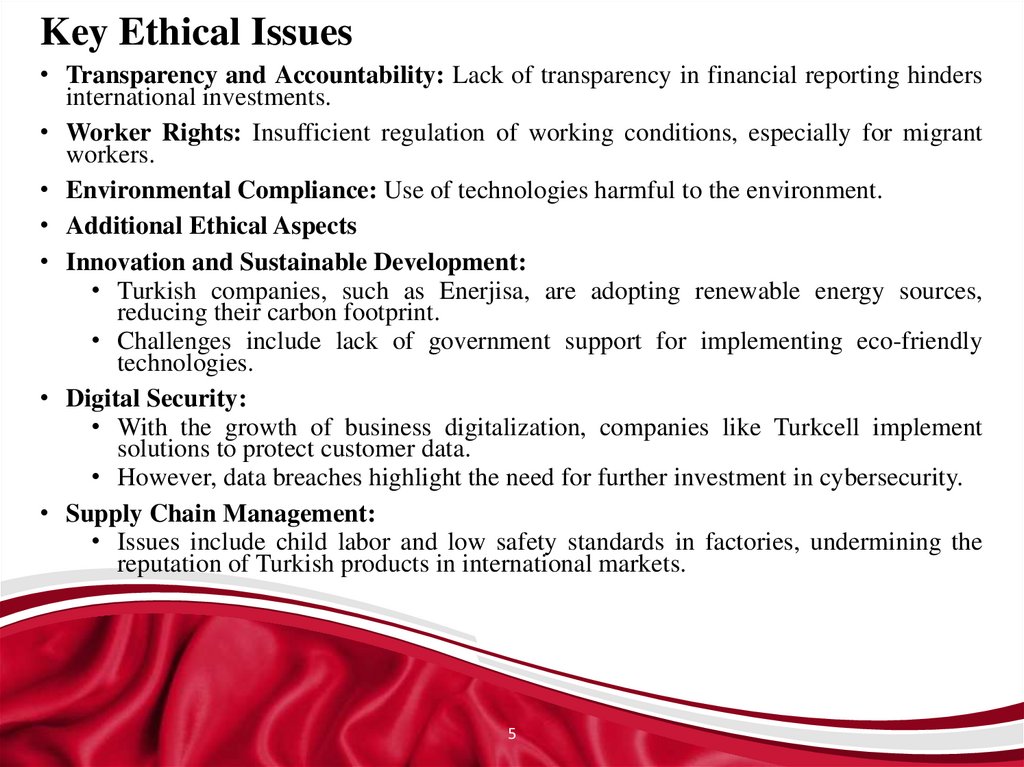
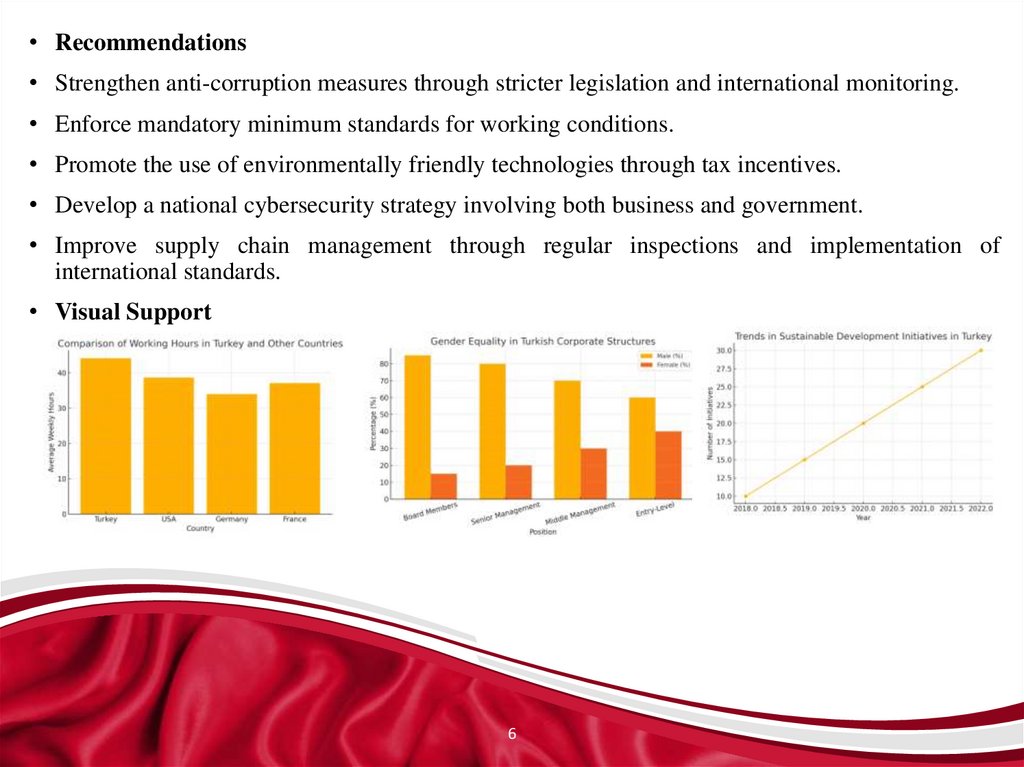
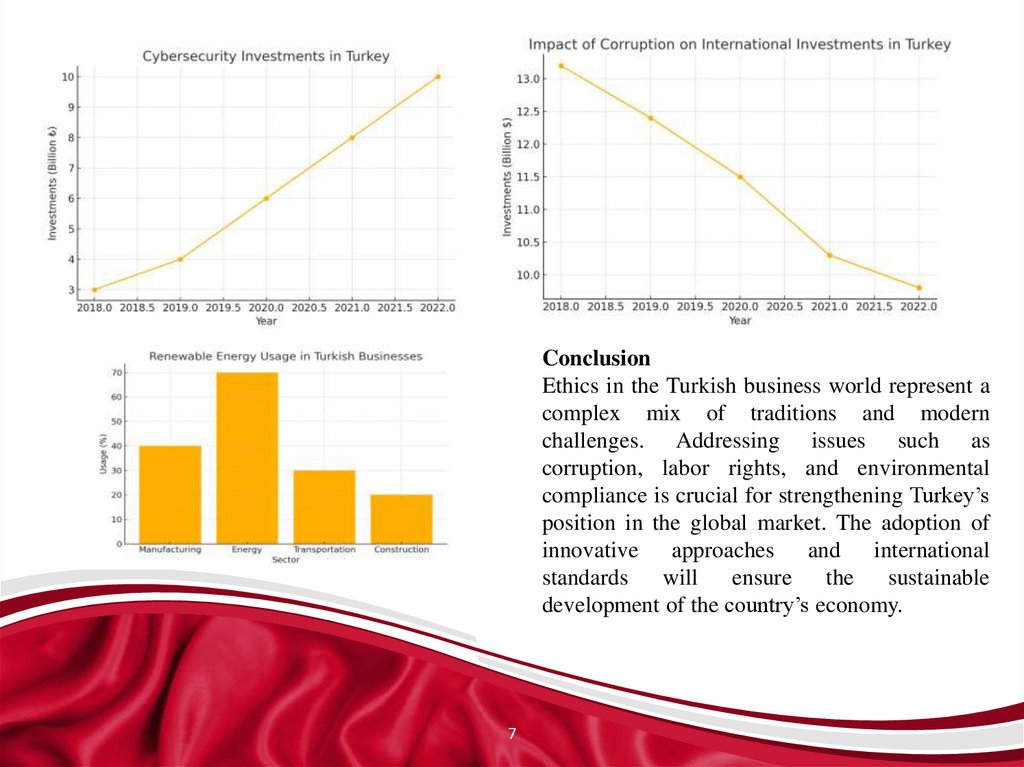
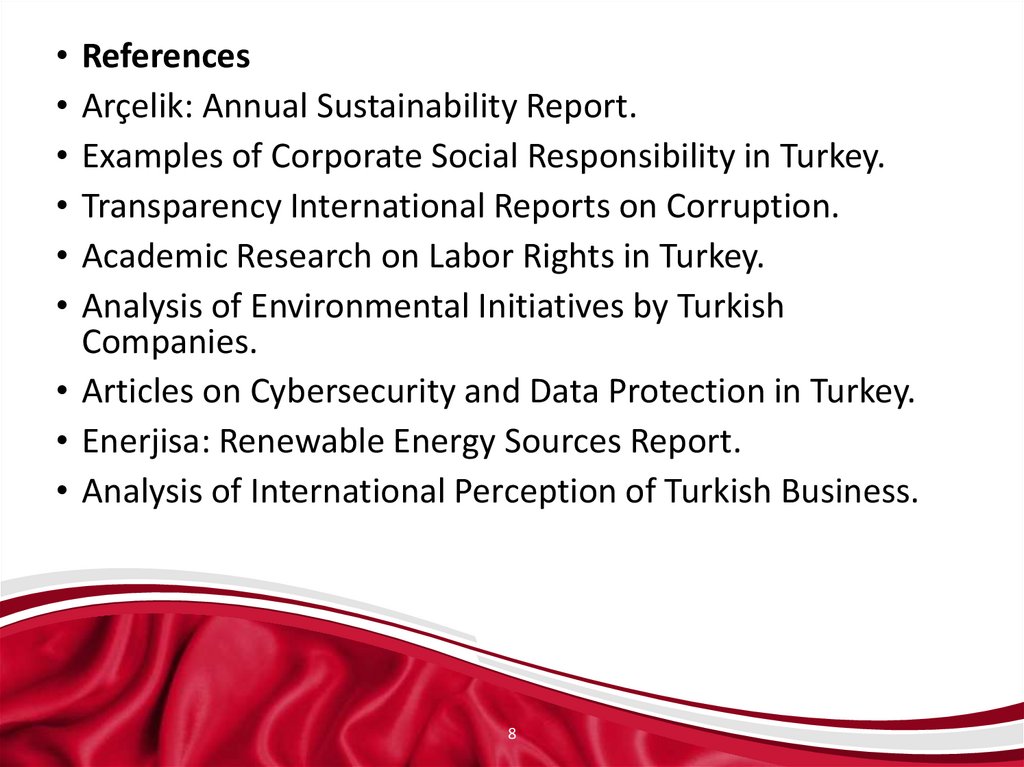
• Visual Support
6
7.
ConclusionEthics in the Turkish business world represent a
complex mix of traditions and modern
challenges. Addressing issues such as
corruption, labor rights, and environmental
compliance is crucial for strengthening Turkey’s
position in the global market. The adoption of
innovative approaches and international
standards
will ensure the sustainable
development of the country’s economy.
7
8.
• References• Arçelik: Annual Sustainability Report.
• Examples of Corporate Social Responsibility in Turkey.
• Transparency International Reports on Corruption.
• Academic Research on Labor Rights in Turkey.
• Analysis of Environmental Initiatives by Turkish
Companies.
• Articles on Cybersecurity and Data Protection in Turkey.
• Enerjisa: Renewable Energy Sources Report.
• Analysis of International Perception of Turkish Business.
8