






 Английский язык
Похожие презентации:






Test for the post - graduates
1. Подготовка к сдаче кандидатского минимума по английскому языку Вводное занятие
2. Слепнева Марина Анатольевна
Заведующая кафедрой Иностранных языков НИУ МЭИМ-913
495- 362-77-02, Виктория Вадимовна
slepnevama@mpei.ru
3. Структура кандидатского экзамена по английскому языку
• Письменный перевод собственной статьипо специальности (15000 п.зн.) - зачет
• 1. Письменное аннотирование научной
статьи на иностранном языке (40 минут) с
соблюдением рекомендованной структуры.
Объём 200 слов.
• 2. Устное реферирование текста по
специальности на иностранном языке (20
минут). Объём 10-15 предложений.
• 3. Беседа на иностранном языке по
вопросам, связанным с научной работой
аспиранта.
4. Допуск к экзамену
• 72 часа практических занятий• ДО 25 декабря – Письменное реферирование
и аннотирование на иностранном языке
иноязычных текстов общим объемом 85 000
печатных знаков, перевод аннотации (6-7
статей)(12 занятий)
• Январь – сдача терминологического словаря
(устно)
• Январь – презентация на тему диссертации
• Последние 3 занятия – сдача 15000 п.зн.
5. Требования к статьям 85000 п.зн.
• Строго по теме диссертации (датапубликации до 10 лет)
• Количество статей более 6
• Только научно-публицистические статьи
из проверенных источников
• Реферат – 1.5 листа (14 шрифт, 1.5
интервал)
• Аннотация – 0.5 листа
• Перевод оригинальной аннотации
6. Требования к терминологическому словарю
• 150 терминов (слова и словосочетания,сущ. известные узкому кругу
специалистов)
• В алфавитном порядке по английскому
языку
• В три столбика с нумерацией
• Третий столбик – дефиниция на
английском языке
7. Требования к презентации
Раскрыть тему диссертации7-10 слайдов
5-7 мин монологической речи
2 вопроса
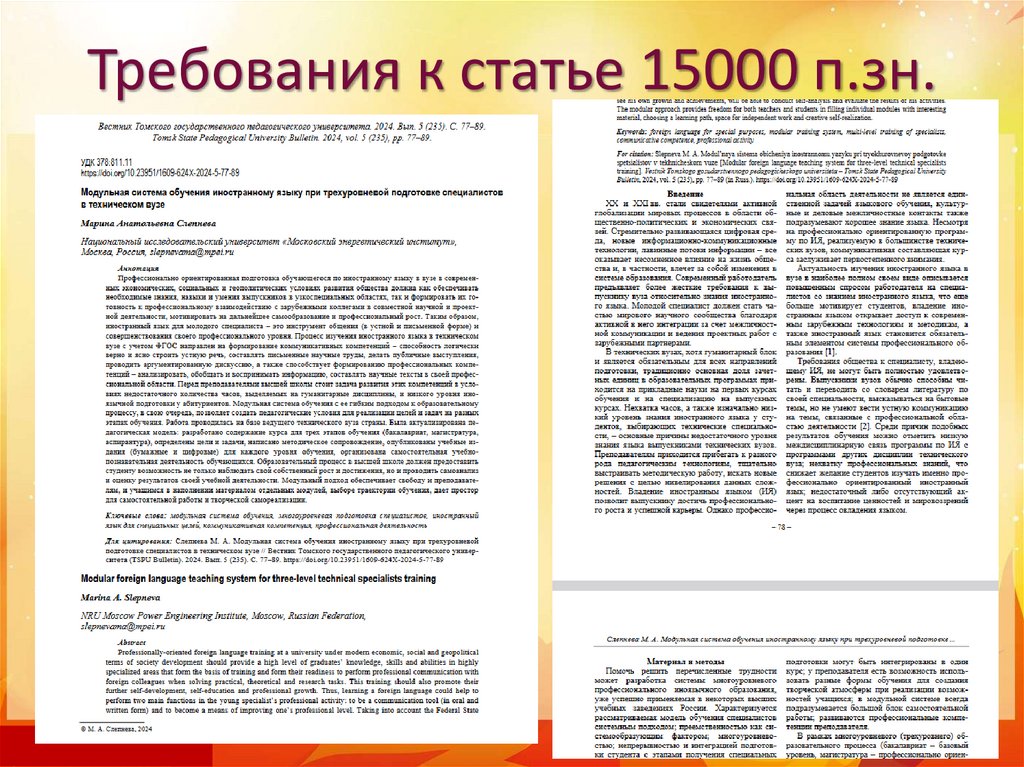
8. Требования к статье 15000 п.зн.
• Собственная публикации за последние2 года
• 10-15 тыс п.зн. с пробелами
• Использование грамматических
конструкций по списку
• Научная статья!!!
9. Требования к статье 15000 п.зн.
10. Платная консультация
• Договор с каф. ИнЯз• 12000 руб
• Самостоятельное
освоение 85000 п.зн.
• Дистанционная сдача
материала
• Встреча по
видеоконференции
• Запись до 10 ноября
11.
We start!12. Test for the post-graduates
1. to be applied2. is measured;
3. deals;
4. is assessed;
5. is;
6. is required;
7. are;
8. will be;
9. may be;
10. depends;
11. will deal;
12. produced.
Automatic Control System
The subject of automatic control (1) with systems which use feedback. Their mode of operation
(2) essentially as follows. The quantity which it is desired to control (3) by a suitable
instrument.
There (4) two systems, such as servomechanisms and process control systems. There is clearly
no fundamental difference in principle between them, but the components or “hardware” may
be quite different. In this text we(5) with both types of system with an attempt at an unified
approach.
In process control systems there (6) disturbances entering the system, such as changes in
ambient temperature or changes in fuel quality. In servomechanisms, on the other hand,
disturbances (7) relatively unimportant. That we desire it to have may be continually changing
as for example when a gun (8) to follow a moving target. The performance of a
servomechanism (9) in terms of the magnitude of the error signal (10) under operating
condition. The particular function of the error magnitude (11) on the type of input signal (12).
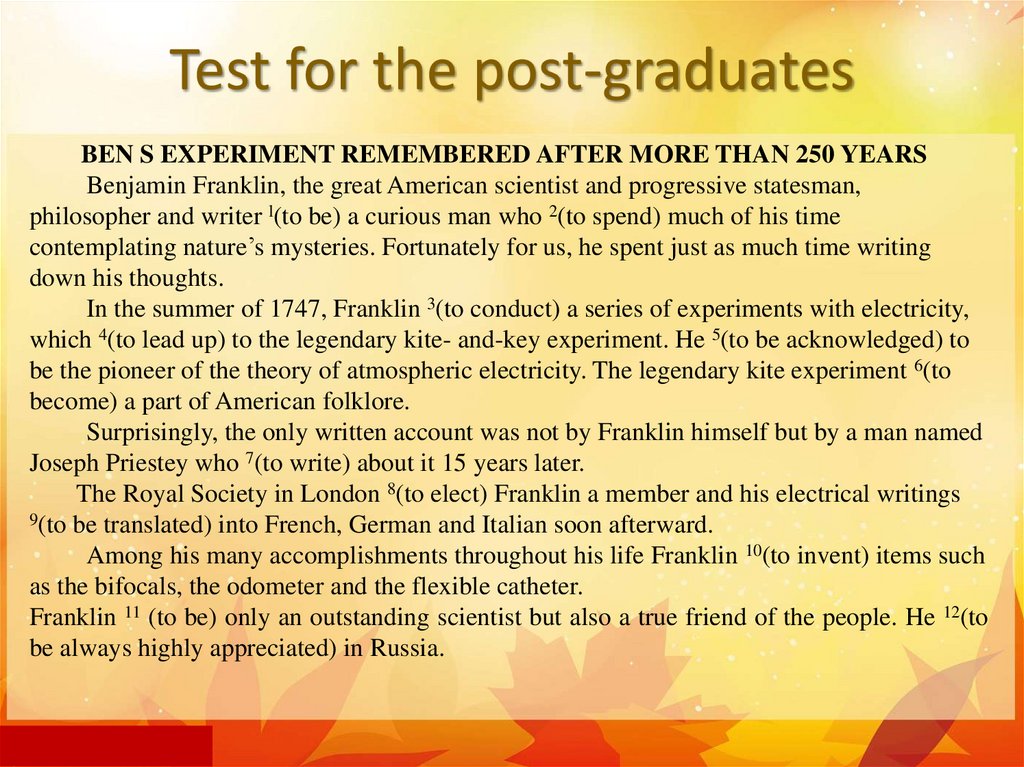
13. Test for the post-graduates
BEN S EXPERIMENT REMEMBERED AFTER MORE THAN 250 YEARSBenjamin Franklin, the great American scientist and progressive statesman,
philosopher and writer l(to be) a curious man who 2(to spend) much of his time
contemplating nature’s mysteries. Fortunately for us, he spent just as much time writing
down his thoughts.
In the summer of 1747, Franklin 3(to conduct) a series of experiments with electricity,
which 4(to lead up) to the legendary kite- and-key experiment. He 5(to be acknowledged) to
be the pioneer of the theory of atmospheric electricity. The legendary kite experiment 6(to
become) a part of American folklore.
Surprisingly, the only written account was not by Franklin himself but by a man named
Joseph Priestey who 7(to write) about it 15 years later.
The Royal Society in London 8(to elect) Franklin a member and his electrical writings
9(to be translated) into French, German and Italian soon afterward.
Among his many accomplishments throughout his life Franklin 10(to invent) items such
as the bifocals, the odometer and the flexible catheter.
Franklin 11 (to be) only an outstanding scientist but also a true friend of the people. He 12(to
be always highly appreciated) in Russia.
14. Test for the post-graduates
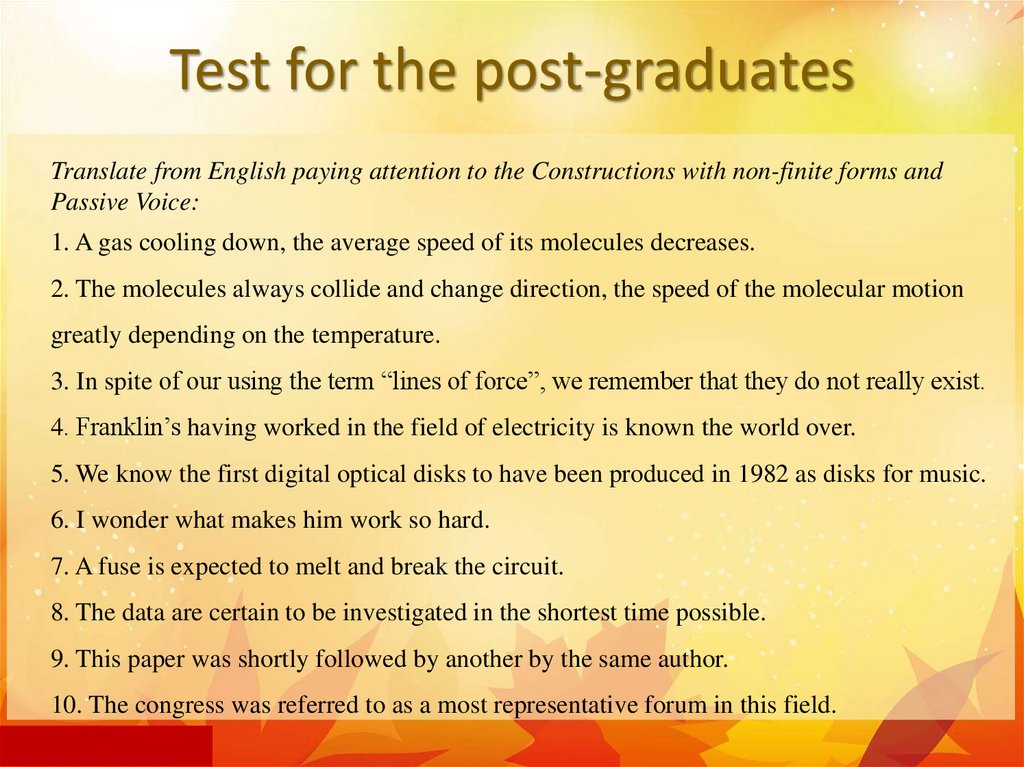
Translate from English paying attention to the Constructions with non-finite forms andPassive Voice:
1. A gas cooling down, the average speed of its molecules decreases.
2. The molecules always collide and change direction, the speed of the molecular motion
greatly depending on the temperature.
3. In spite of our using the term “lines of force”, we remember that they do not really exist.
4. Franklin’s having worked in the field of electricity is known the world over.
5. We know the first digital optical disks to have been produced in 1982 as disks for music.
6. I wonder what makes him work so hard.
7. A fuse is expected to melt and break the circuit.
8. The data are certain to be investigated in the shortest time possible.
9. This paper was shortly followed by another by the same author.
10. The congress was referred to as a most representative forum in this field.
15. Test for the post-graduates
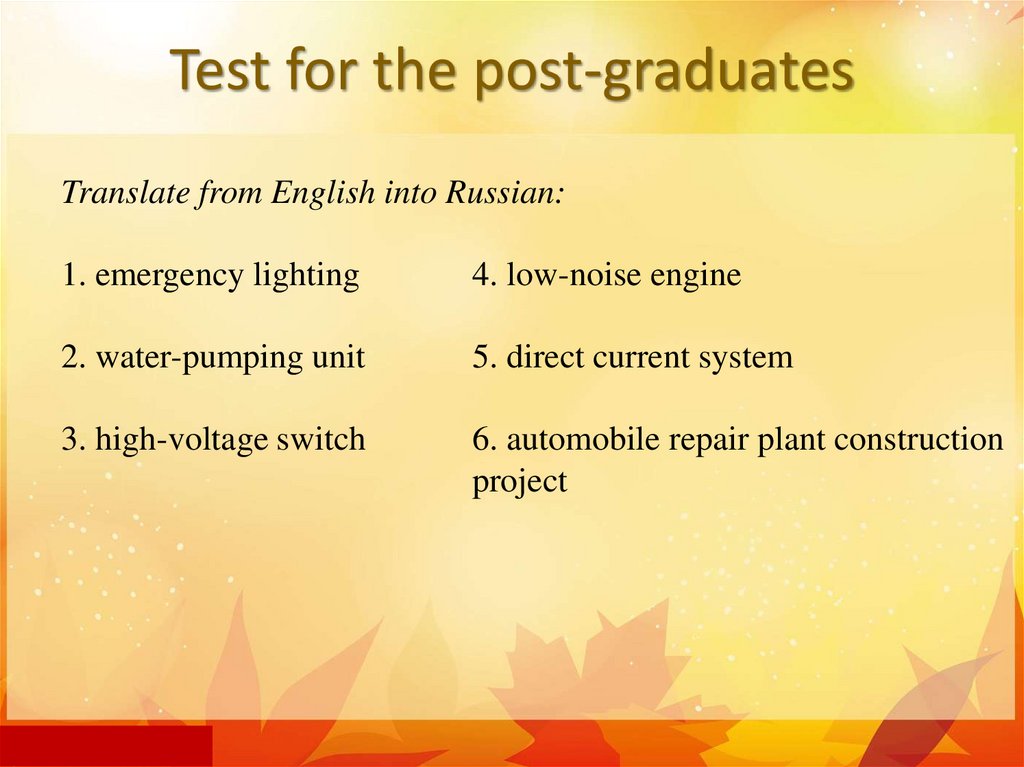
Translate from English into Russian:1. emergency lighting
4. low-noise engine
2. water-pumping unit
5. direct current system
3. high-voltage switch
6. automobile repair plant construction
project
16. Test for the post-graduates
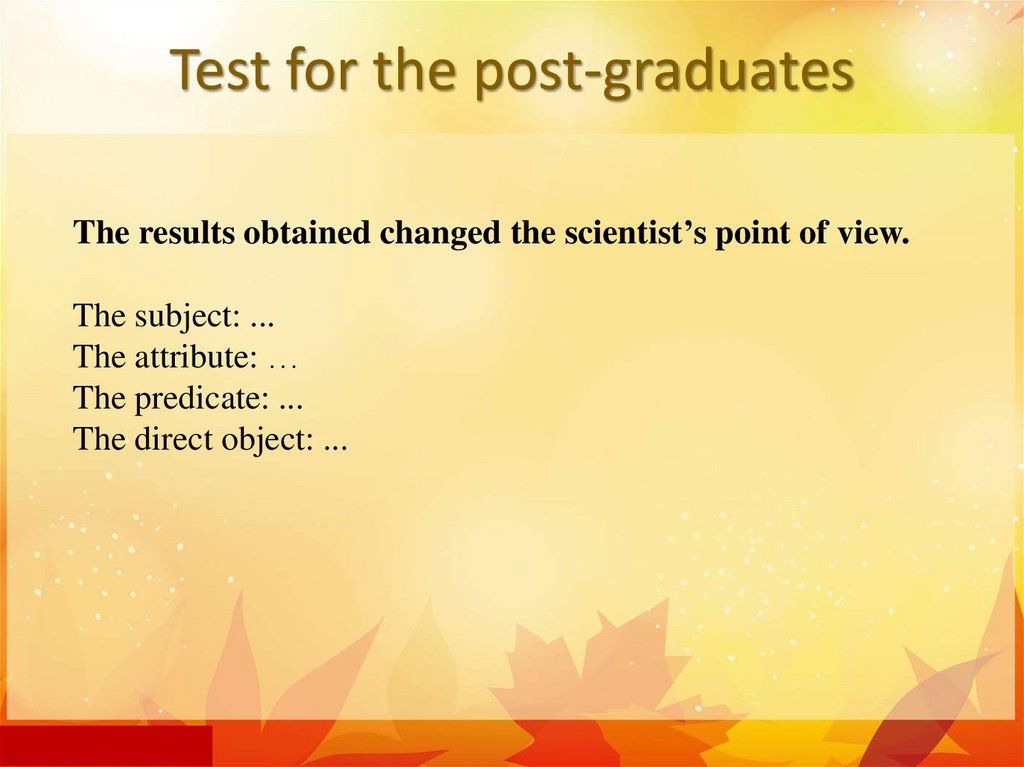
The results obtained changed the scientist’s point of view.The subject: ...
The attribute: …
The predicate: ...
The direct object: ...
17.
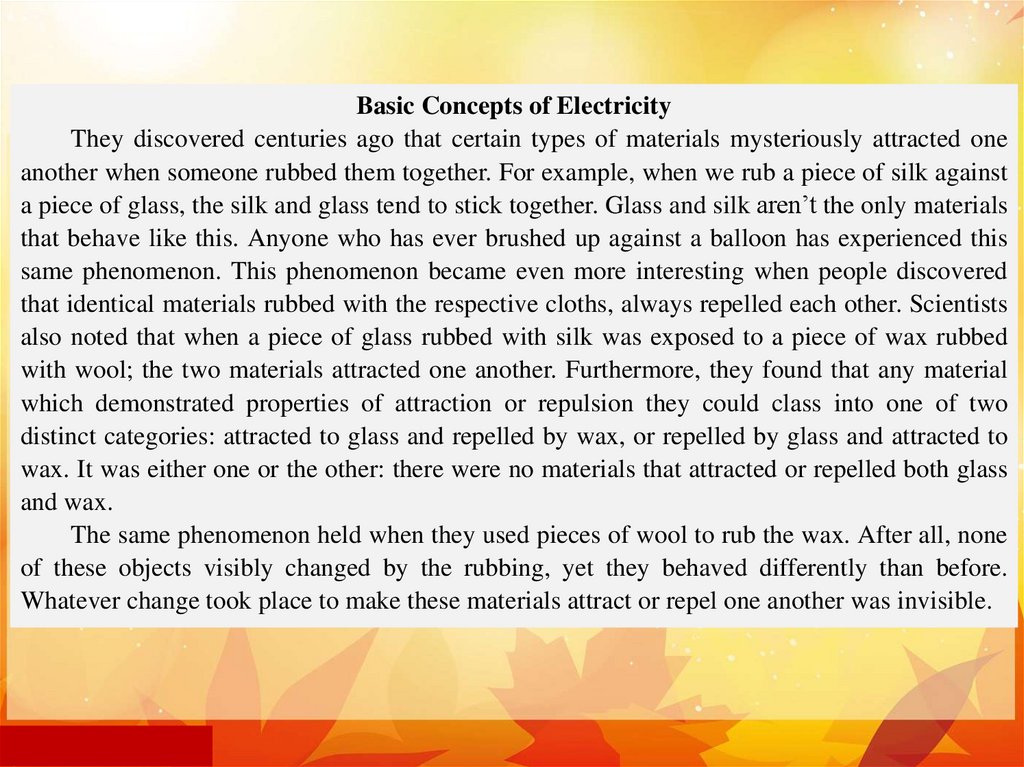
Basic Concepts of ElectricityThey discovered centuries ago that certain types of materials mysteriously attracted one
another when someone rubbed them together. For example, when we rub a piece of silk against
a piece of glass, the silk and glass tend to stick together. Glass and silk aren’t the only materials
that behave like this. Anyone who has ever brushed up against a balloon has experienced this
same phenomenon. This phenomenon became even more interesting when people discovered
that identical materials rubbed with the respective cloths, always repelled each other. Scientists
also noted that when a piece of glass rubbed with silk was exposed to a piece of wax rubbed
with wool; the two materials attracted one another. Furthermore, they found that any material
which demonstrated properties of attraction or repulsion they could class into one of two
distinct categories: attracted to glass and repelled by wax, or repelled by glass and attracted to
wax. It was either one or the other: there were no materials that attracted or repelled both glass
and wax.
The same phenomenon held when they used pieces of wool to rub the wax. After all, none
of these objects visibly changed by the rubbing, yet they behaved differently than before.
Whatever change took place to make these materials attract or repel one another was invisible.
18.
Some experimenters thought that invisible “fluids” were flowing from one object toanother during the process of rubbing and that these “fluids” were able to effect a physical
force over a distance. Charles Dufay [´ʧɑːlz du´fe] (1698 –1739) was one of the early
experimenters who demonstrated that there were two different types of changes effected by
rubbing certain pairs of objects together. Indeed, the fact that there was more than one type of
change manifested in these materials was evident by the fact that there were two types of
forces produced: attraction and repulsion. The hypothetical fluid transfer became known as a
charge.
An American researcher, Benjamin Franklin [ʹbendʒǝmIn ʹfræŋklɪn] (1706 –1790), came
to the conclusion that there was only one fluid which rubbed objects exchanged and that the
two different “charges” were nothing more than either an excess or a deficiency of that one
fluid. Following Franklin’s ideas that the wool rubbed something off the wax, the type of
charge that he associated with rubbed wax became known as “negative” (because he supposed
that wax had a deficiency of fluid), while the type of charge that he associated with the
rubbing wool became known as “positive” (because he supposed excess of fluid). He could
not imagine that his ideas would cause much confusion for students of electricity in the future!
Notes to the Text
to brush up against – сталкиваться, столкнуться (с чем-либо)
respective – соответствующий
to be exposed (to) – подвергаться (чему-либо)
to hold – оставаться (в силе) (зд.)
visibly – явно, заметно
to effect a physical force – совершать физическое воздействие
to manifest – проявить(ся), проявлять(ся)
19.
Great!Bye!