
 Английский язык
Похожие презентации:








Business English 101 Unit 4: Meetings
1.
2. In this lesson, we will:
1Discuss different types of workplace
cultures
2
Discuss different ways to lead a meeting
3
Introduce some vocabulary and
expressions that are useful in meetings
3.
Warm Up Questions1
When was the last time you attended a meeting?
2
Have you ever had to give a presentation at a meeting?
3
Who do you usually meet with?
4
What is the most important meeting during an average
month? What gets discussed?
4.
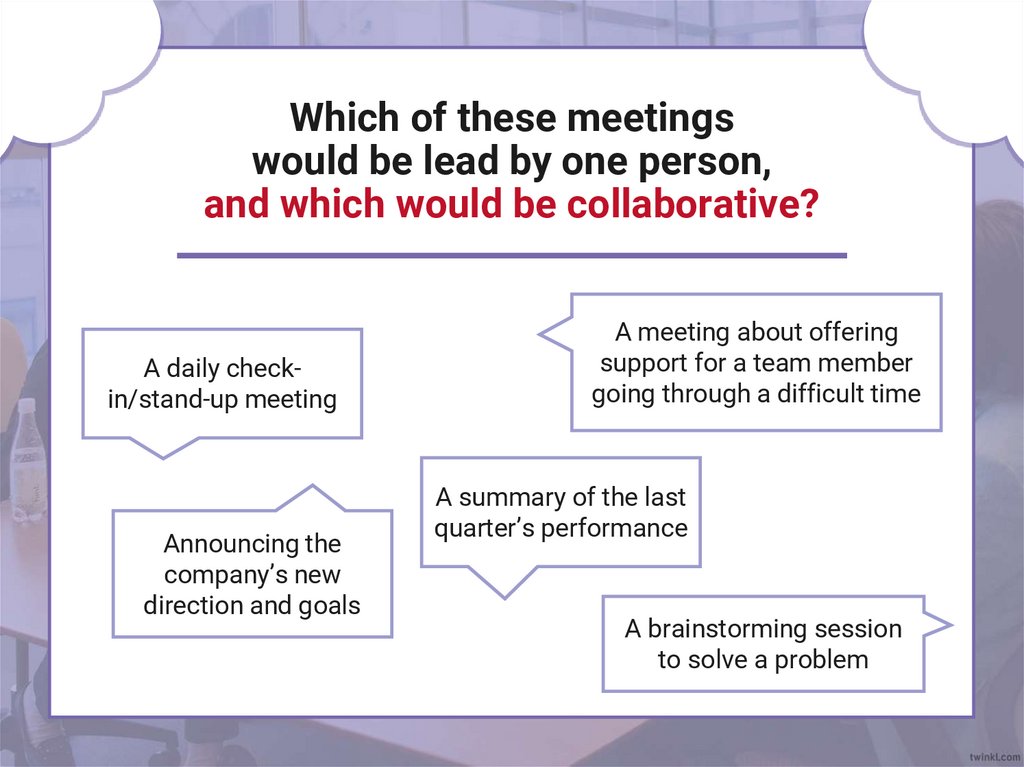
Which of these meetingswould be lead by one person,
and which would be collaborative?
A daily checkin/stand-up meeting
Announcing the
company’s new
direction and goals
A meeting about offering
support for a team member
going through a difficult time
A summary of the last
quarter’s performance
A brainstorming session
to solve a problem
5.
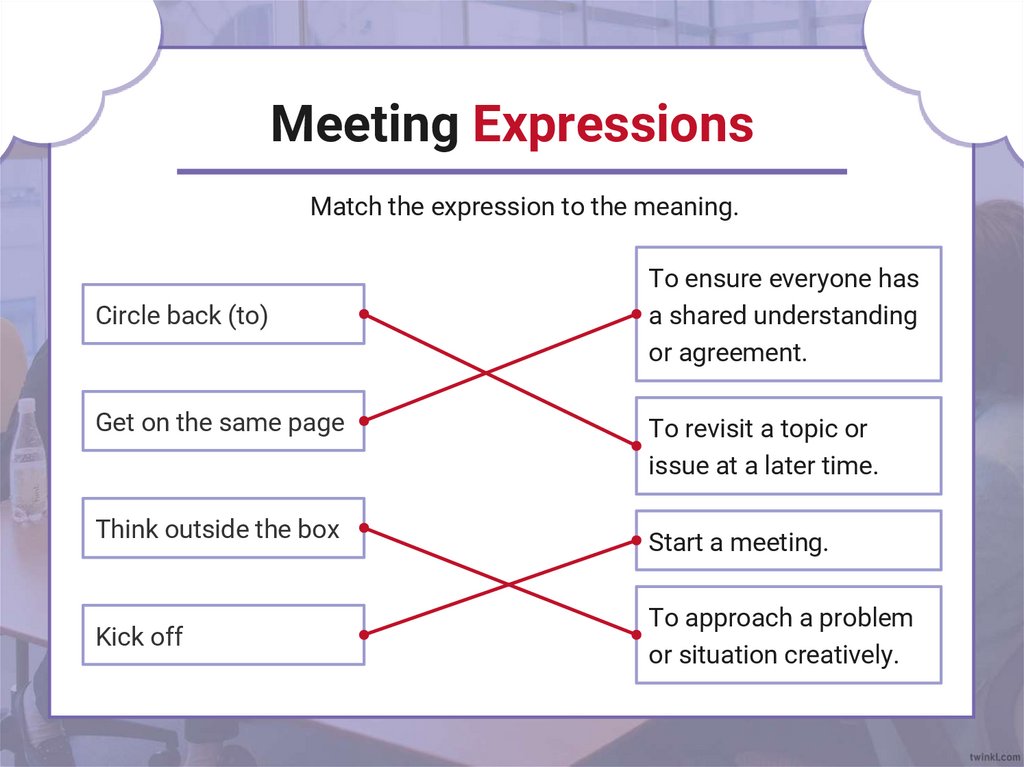
Meeting ExpressionsMatch the expression to the meaning.
Circle back (to)
To ensure everyone has
a shared understanding
or agreement.
Get on the same page
To revisit a topic or
issue at a later time.
Think outside the box
Start a meeting.
Kick off
To approach a problem
or situation creatively.
6.
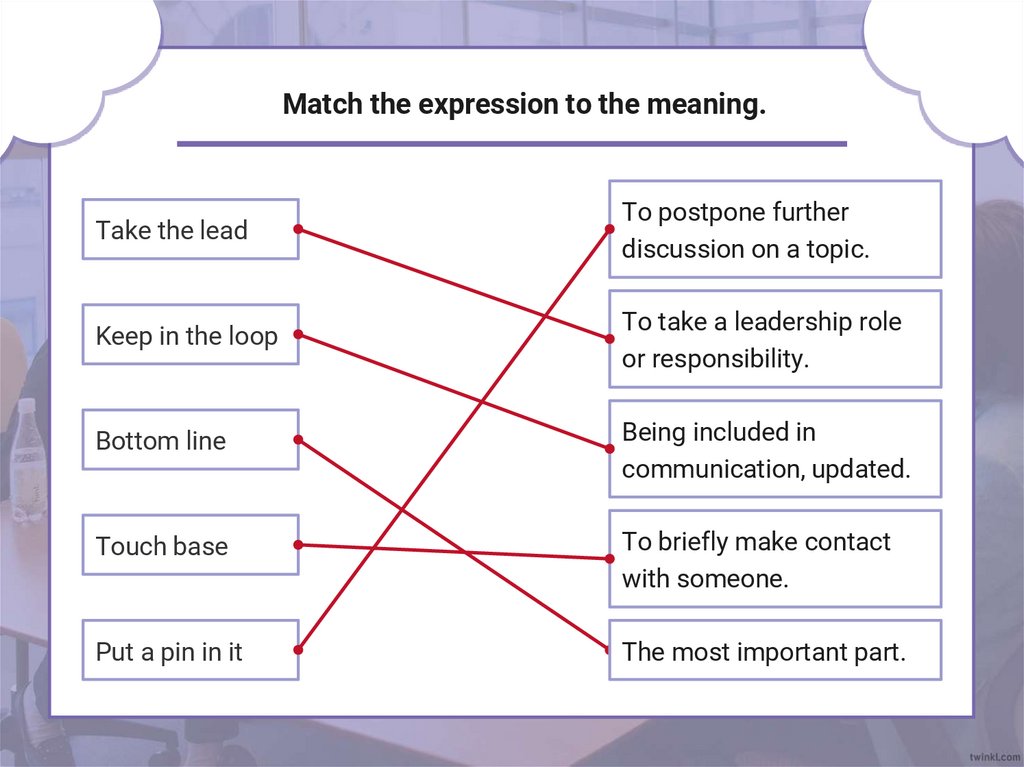
Match the expression to the meaning.Take the lead
To postpone further
discussion on a topic.
Keep in the loop
To take a leadership role
or responsibility.
Bottom line
Being included in
communication, updated.
Touch base
To briefly make contact
with someone.
Put a pin in it
The most important part.
7.
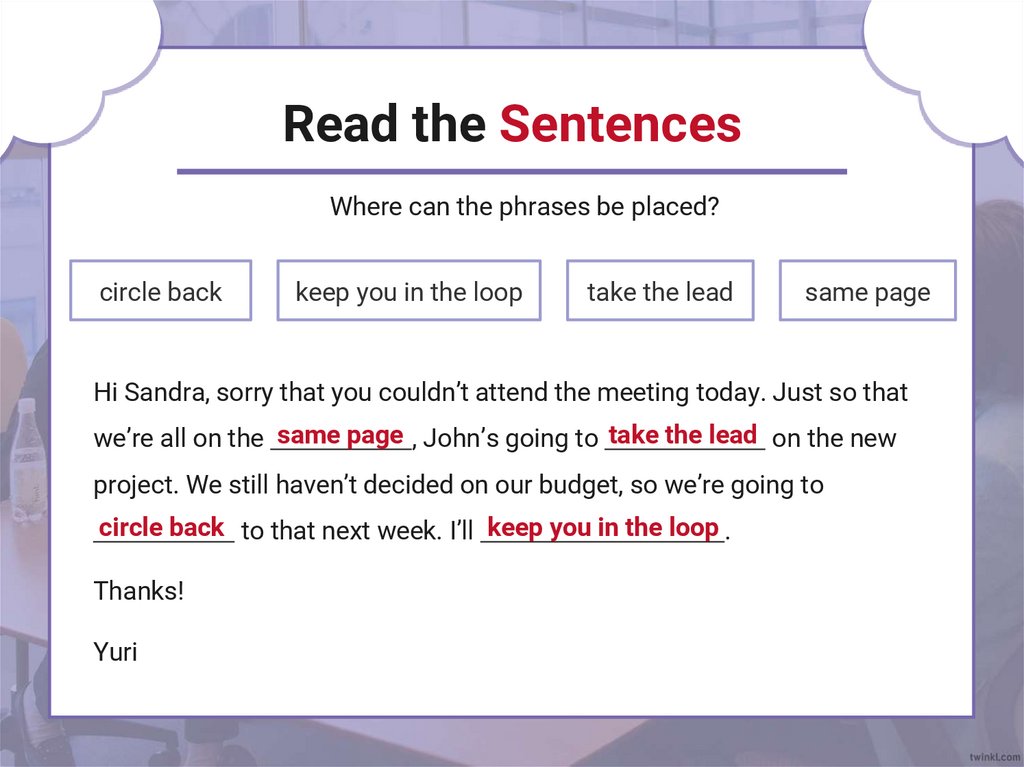
Read the SentencesWhere can the phrases be placed?
circle back
keep you in the loop
take the lead
same page
Hi Sandra, sorry that you couldn’t attend the meeting today. Just so that
we’re all on the same page , John’s going to take the lead on the new
project. We still haven’t decided on our budget, so we’re going to
circle back to that next week. I’ll keep you in the loop .
Thanks!
Yuri
8.
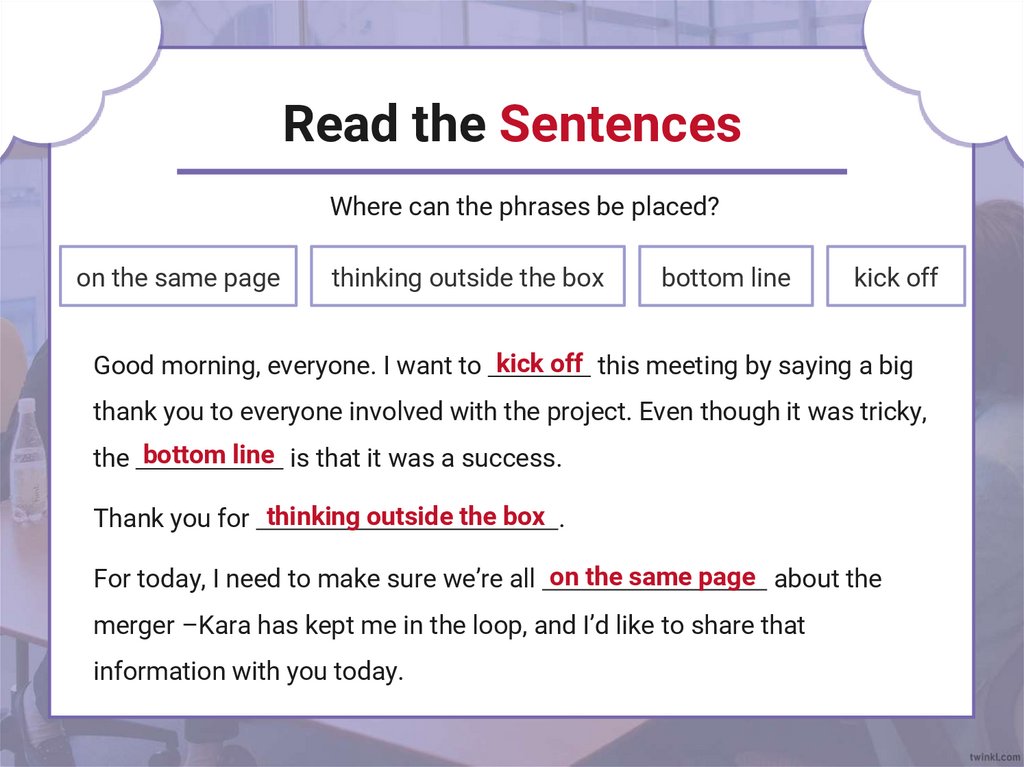
Read the SentencesWhere can the phrases be placed?
on the same page
thinking outside the box
bottom line
kick off
Good morning, everyone. I want to kick off this meeting by saying a big
thank you to everyone involved with the project. Even though it was tricky,
the bottom line is that it was a success.
Thank you for thinking outside the box .
For today, I need to make sure we’re all on the same page about the
merger –Kara has kept me in the loop, and I’d like to share that
information with you today.
9.
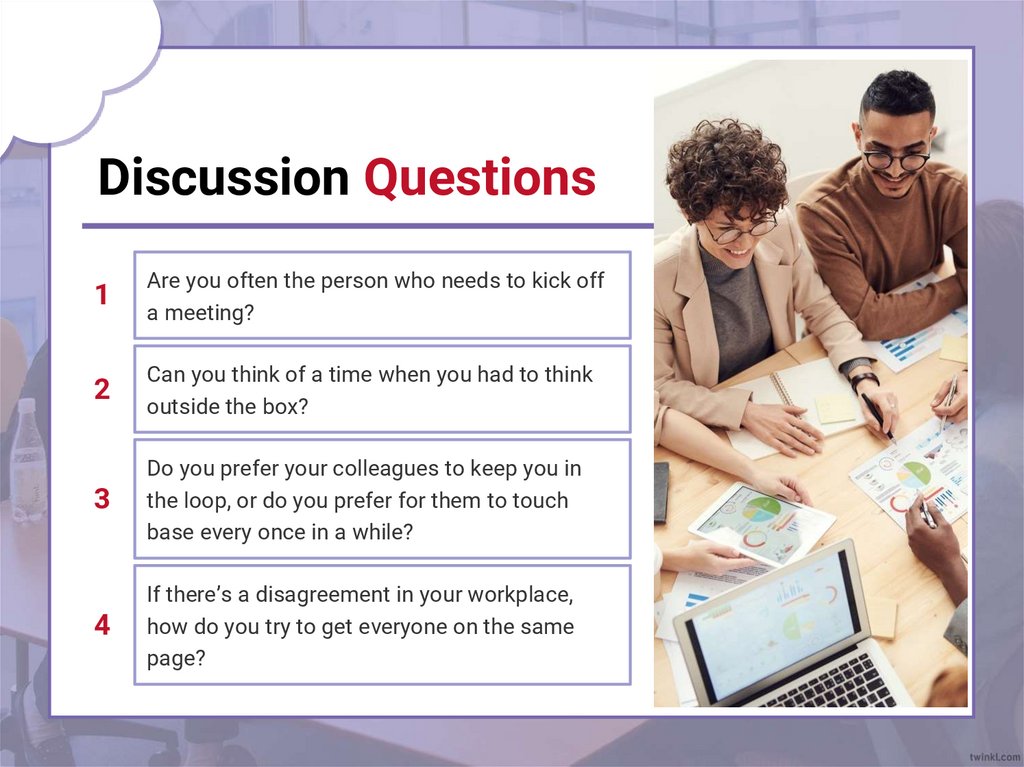
Discussion Questions1
Are you often the person who needs to kick off
a meeting?
2
Can you think of a time when you had to think
outside the box?
3
Do you prefer your colleagues to keep you in
the loop, or do you prefer for them to touch
base every once in a while?
4
If there’s a disagreement in your workplace,
how do you try to get everyone on the same
page?
10. Listen to the Dialogue
Write notes.Play audio
11.
Comprehension Questions1
From which team was Yara?
2
What suggestion did Yara make?
3
What were some of Ben’s concerns?
4
Was this meeting in-person or online?
5
What do you think happened next in the meeting? How
should Ben handle the conversation going forward?
12.
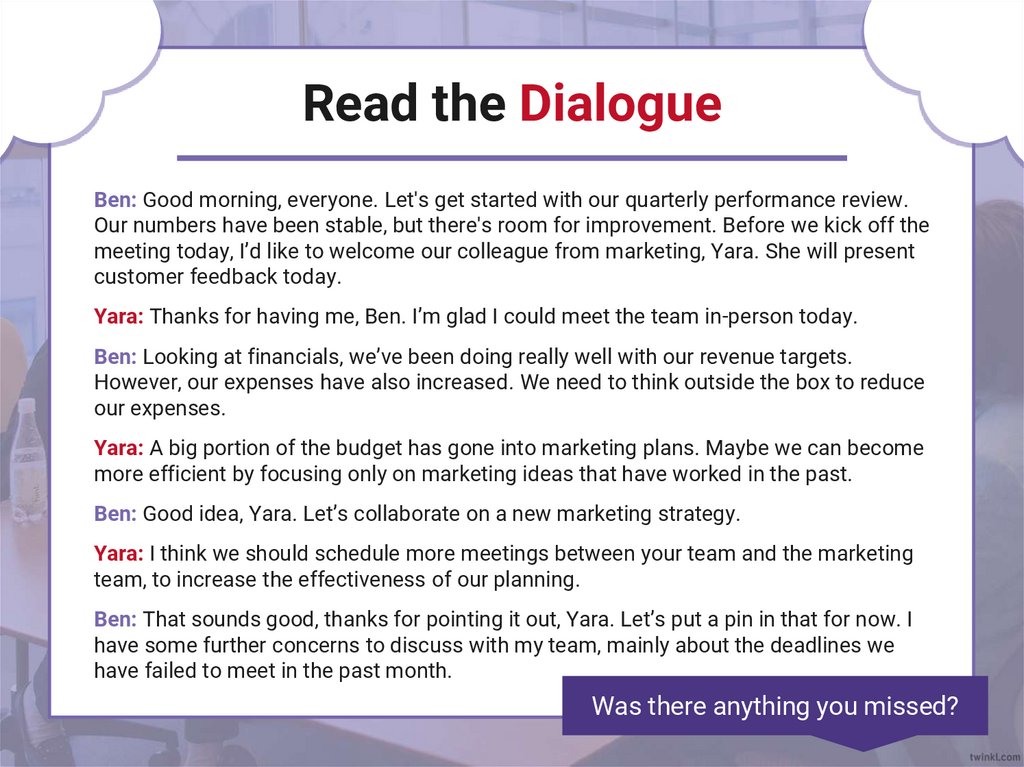
Read the DialogueBen: Good morning, everyone. Let's get started with our quarterly performance review.
Our numbers have been stable, but there's room for improvement. Before we kick off the
meeting today, I’d like to welcome our colleague from marketing, Yara. She will present
customer feedback today.
Yara: Thanks for having me, Ben. I’m glad I could meet the team in-person today.
Ben: Looking at financials, we’ve been doing really well with our revenue targets.
However, our expenses have also increased. We need to think outside the box to reduce
our expenses.
Yara: A big portion of the budget has gone into marketing plans. Maybe we can become
more efficient by focusing only on marketing ideas that have worked in the past.
Ben: Good idea, Yara. Let’s collaborate on a new marketing strategy.
Yara: I think we should schedule more meetings between your team and the marketing
team, to increase the effectiveness of our planning.
Ben: That sounds good, thanks for pointing it out, Yara. Let’s put a pin in that for now. I
have some further concerns to discuss with my team, mainly about the deadlines we
have failed to meet in the past month.
Was there anything you missed?
13.
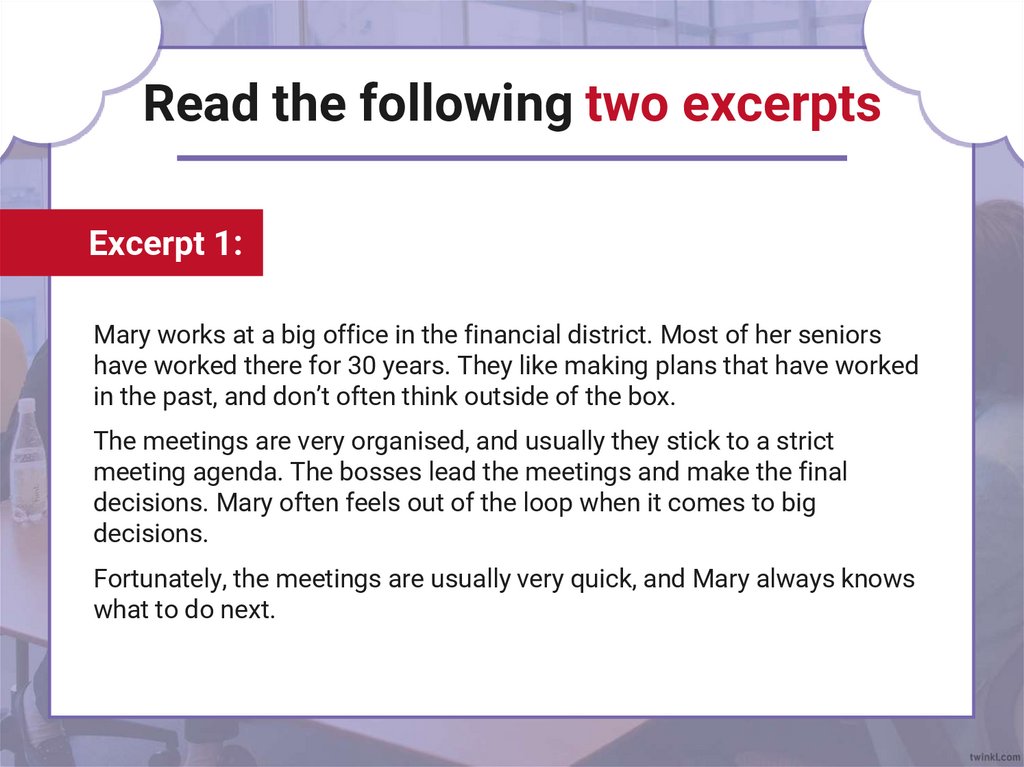
Read the following two excerptsExcerpt 1:
Mary works at a big office in the financial district. Most of her seniors
have worked there for 30 years. They like making plans that have worked
in the past, and don’t often think outside of the box.
The meetings are very organised, and usually they stick to a strict
meeting agenda. The bosses lead the meetings and make the final
decisions. Mary often feels out of the loop when it comes to big
decisions.
Fortunately, the meetings are usually very quick, and Mary always knows
what to do next.
14.
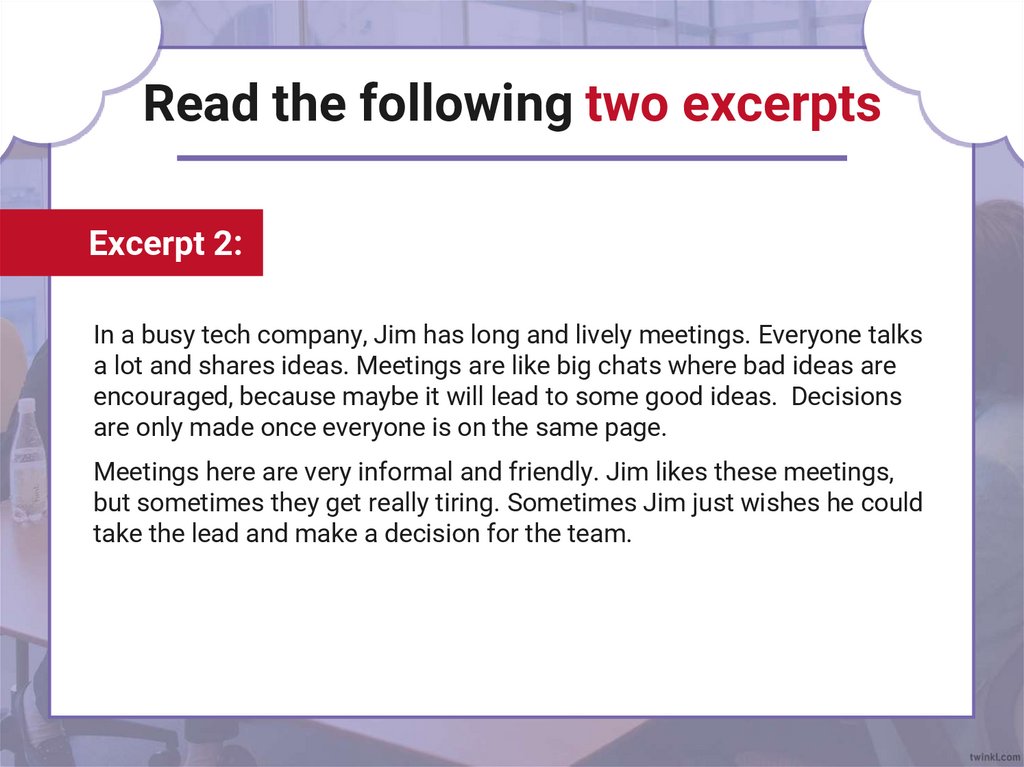
Read the following two excerptsExcerpt 2:
In a busy tech company, Jim has long and lively meetings. Everyone talks
a lot and shares ideas. Meetings are like big chats where bad ideas are
encouraged, because maybe it will lead to some good ideas. Decisions
are only made once everyone is on the same page.
Meetings here are very informal and friendly. Jim likes these meetings,
but sometimes they get really tiring. Sometimes Jim just wishes he could
take the lead and make a decision for the team.
15.
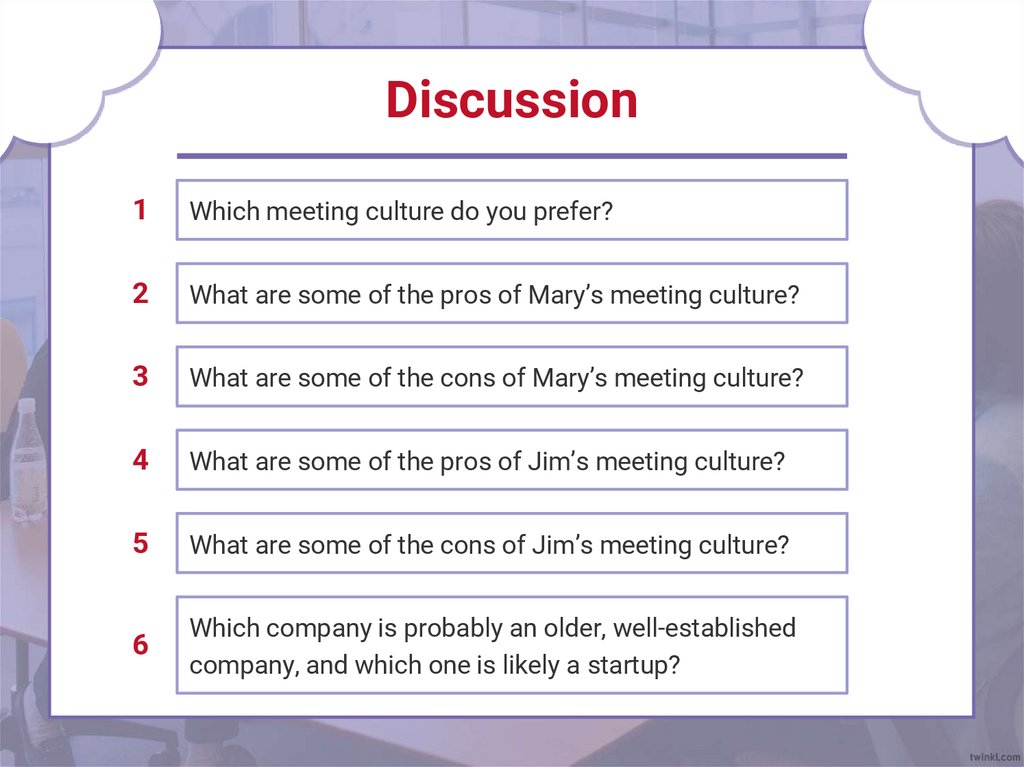
Discussion1
Which meeting culture do you prefer?
2
What are some of the pros of Mary’s meeting culture?
3
What are some of the cons of Mary’s meeting culture?
4
What are some of the pros of Jim’s meeting culture?
5
What are some of the cons of Jim’s meeting culture?
6
Which company is probably an older, well-established
company, and which one is likely a startup?
16.
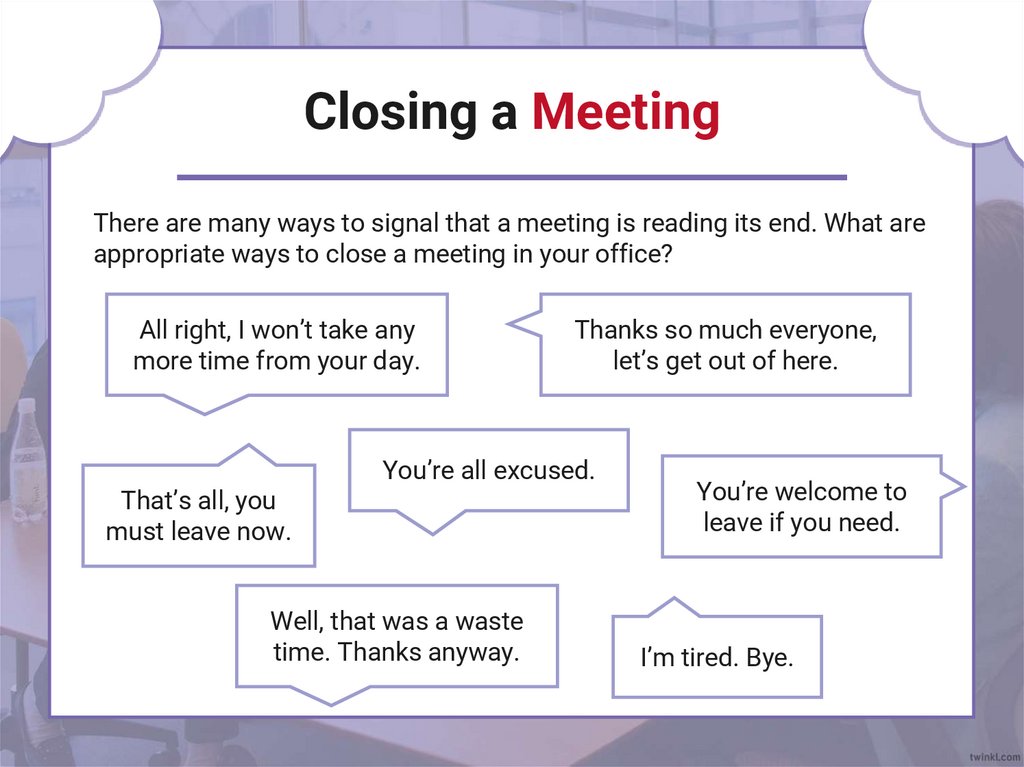
Closing a MeetingThere are many ways to signal that a meeting is reading its end. What are
appropriate ways to close a meeting in your office?
All right, I won’t take any
more time from your day.
That’s all, you
must leave now.
Thanks so much everyone,
let’s get out of here.
You’re all excused.
Well, that was a waste
time. Thanks anyway.
You’re welcome to
leave if you need.
I’m tired. Bye.
17.
Closing a MeetingUsually, meetings follow a set agenda, or plan.
Once the meeting has concluded, some action points
may need to be followed.
1
How do your meetings normally end?
2
Are your meetings usually long and drawn-out, or end
quickly?
3
Do your meetings follow an agenda?
4
Is there a person who takes minutes? (Meeting notes)
18.
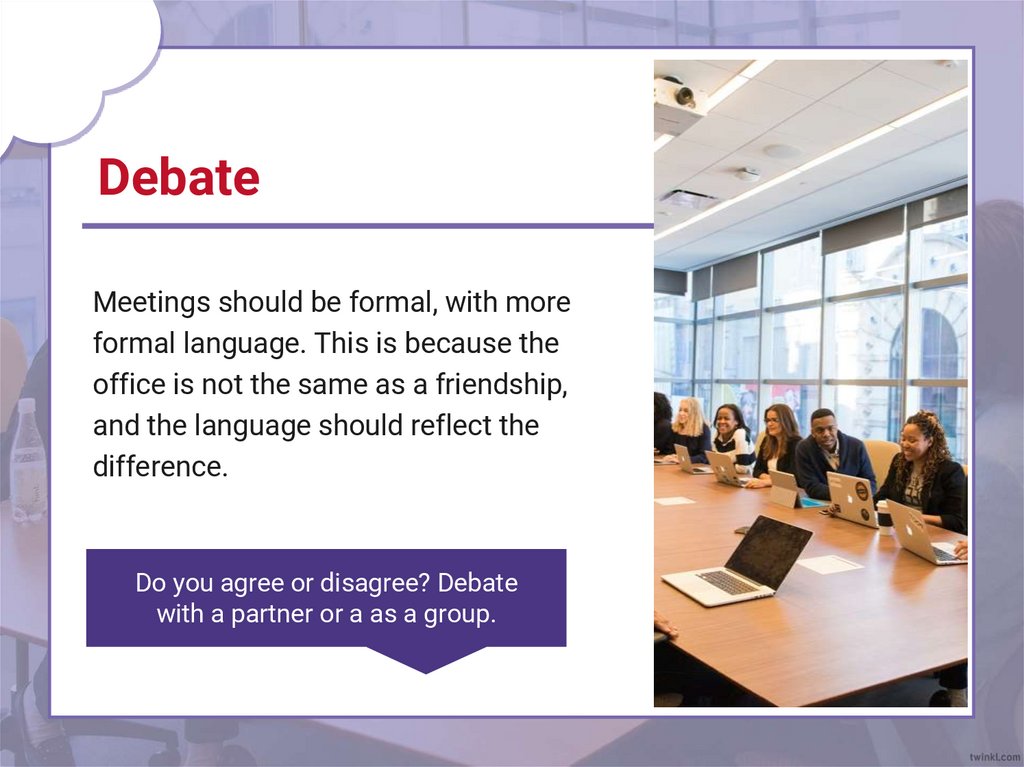
DebateMeetings should be formal, with more
formal language. This is because the
office is not the same as a friendship,
and the language should reflect the
difference.
Do you agree or disagree? Debate
with a partner or a as a group.
19.
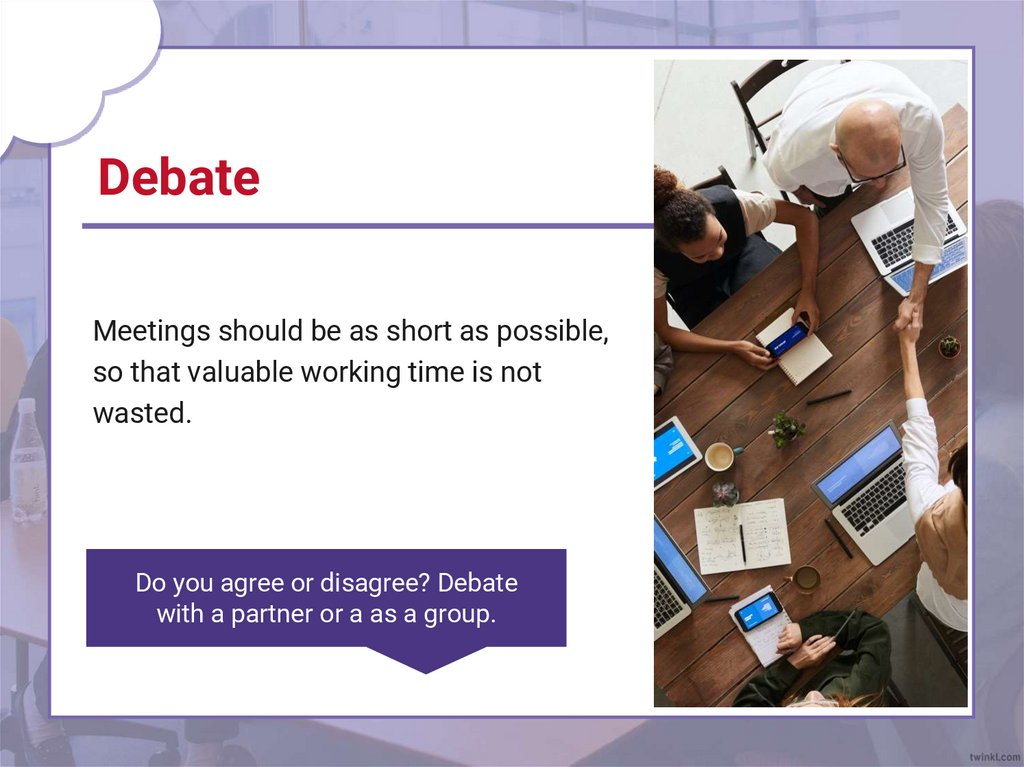
DebateMeetings should be as short as possible,
so that valuable working time is not
wasted.
Do you agree or disagree? Debate
with a partner or a as a group.
20.
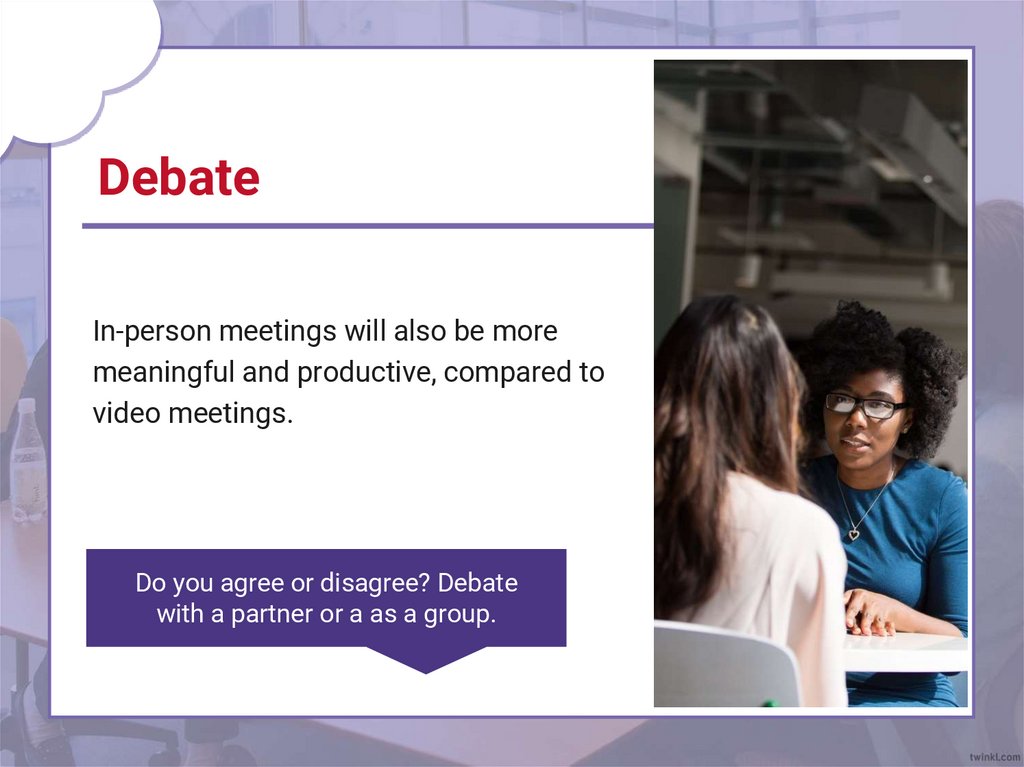
DebateIn-person meetings will also be more
meaningful and productive, compared to
video meetings.
Do you agree or disagree? Debate
with a partner or a as a group.
21.
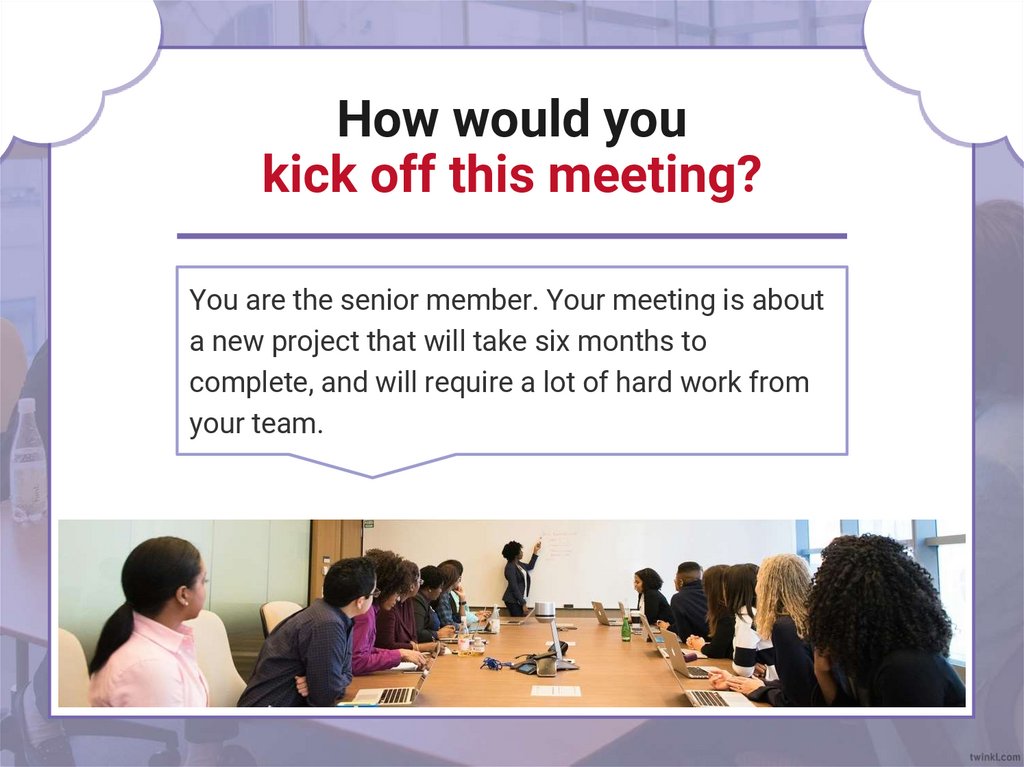
How would youkick off this meeting?
You are the senior member. Your meeting is about
a new project that will take six months to
complete, and will require a lot of hard work from
your team.
22.
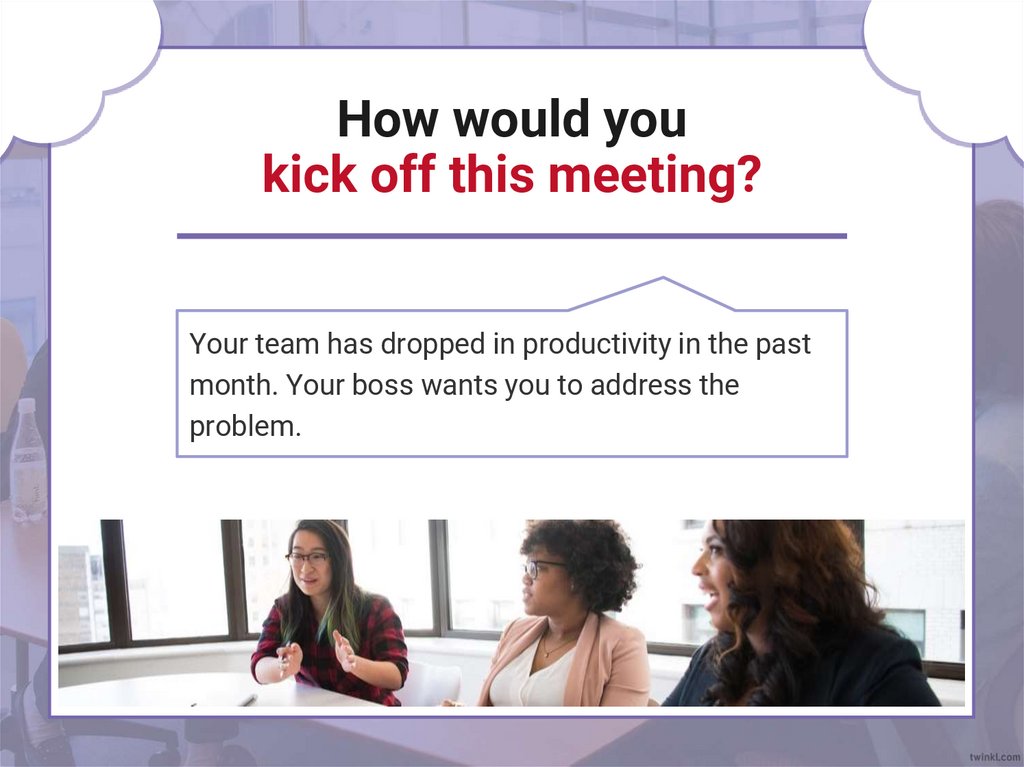
How would youkick off this meeting?
Your team has dropped in productivity in the past
month. Your boss wants you to address the
problem.
23.
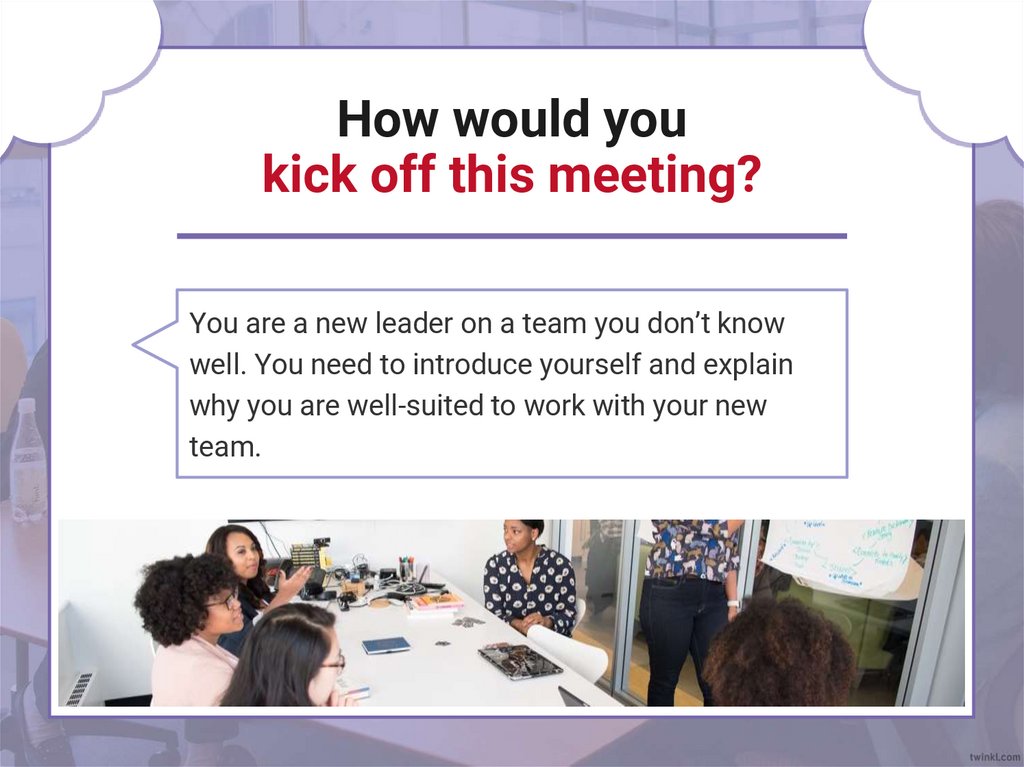
How would youkick off this meeting?
You are a new leader on a team you don’t know
well. You need to introduce yourself and explain
why you are well-suited to work with your new
team.
24.
BonusActivity
Online Meetings:
Discussion
1
How may online meetings be different to in-person
meetings?
2
How would the etiquette be different? Think about being
on-time, noise levels, and how to present information.
3
Do you think online meetings are more effective? Why or
why not?
25.
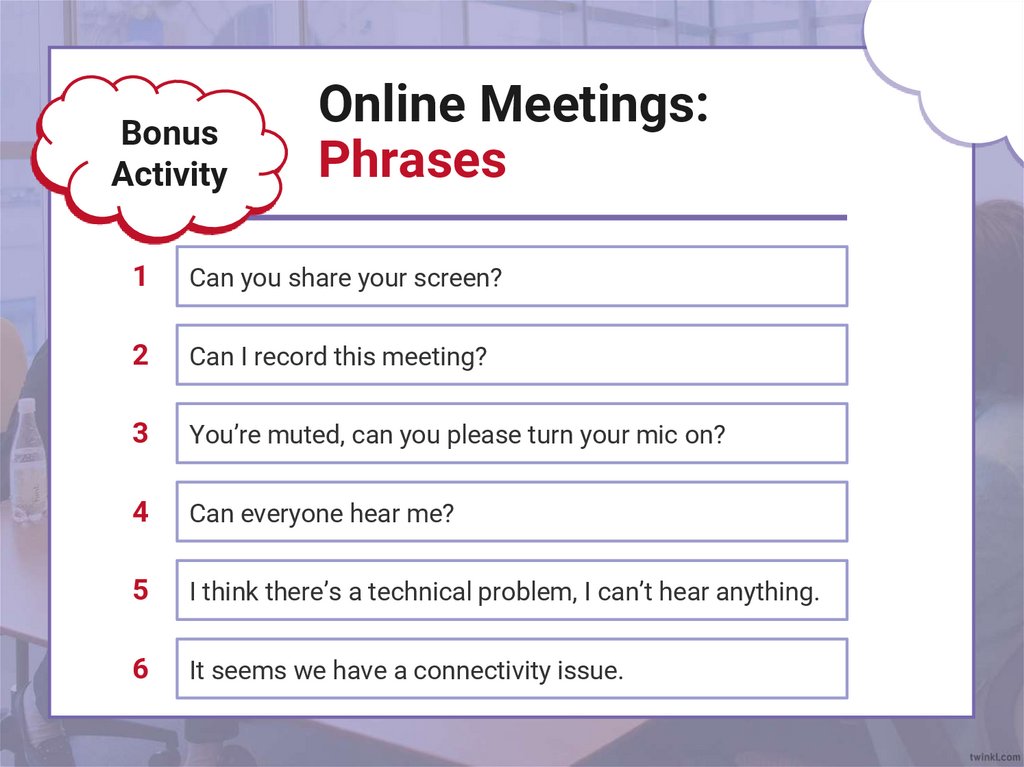
BonusActivity
Online Meetings:
Phrases
1
Can you share your screen?
2
Can I record this meeting?
3
You’re muted, can you please turn your mic on?
4
Can everyone hear me?
5
I think there’s a technical problem, I can’t hear anything.
6
It seems we have a connectivity issue.