







 Бизнес
Похожие презентации:







Chapter 7 Legal Structure and Equity Distribution
1. Chapter 7 Legal Structure and Equity Distribution
CHAPTER 7LEGAL STRUCTURE AND
EQUITY DISTRIBUTION
2. INTRODUCTION
• TECHNOLOGY VENTURE IS A TEAM SPORT.• INDIVIDUALS BECOME CO-VENTURERS WHERE
THEY
ARE
PROVIDED
AN
OWNERSHIP
INTEREST OR EQUITY IN THE VENTURE IN LIEU
OF ALL OR PART OF THE COMPENSATION
THAT THEY MIGHT OTHERWISE COMMAND IN
THE OPEN MARKET.
3. OWNERSHIP AND LIABILITY ISSUES
1. SOLE PROPRIETORSHIP2. GENERAL PARTNERSHIP
LIMITED PARTNERSHIP
LIMITED LIABILITY COMPANY
3. CORPORATION
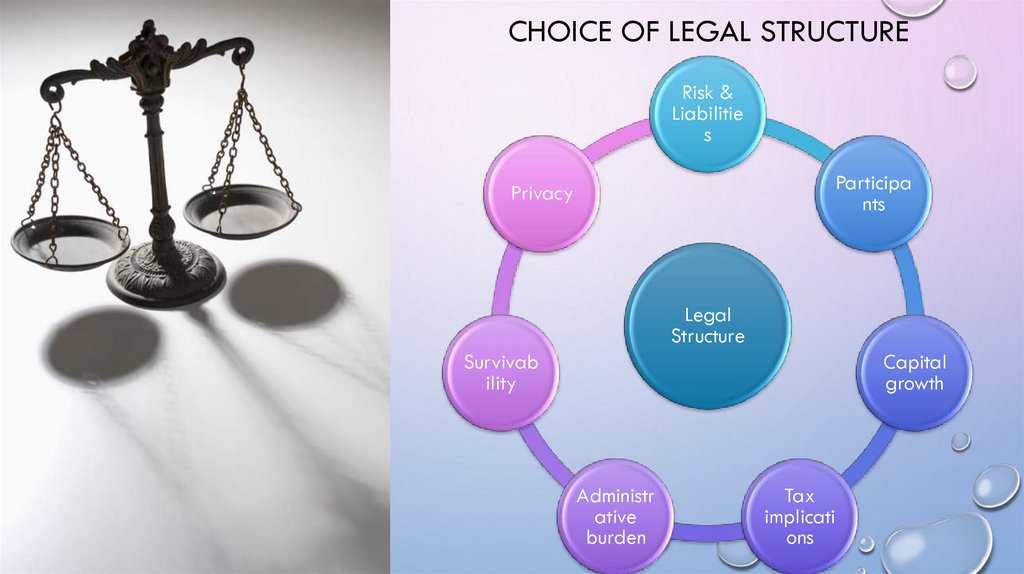
4. CHOICE OF LEGAL STRUCTURE
Risk &Liabilitie
s
Participa
nts
Privacy
Legal
Structure
Survivab
ility
Capital
growth
Administr
ative
burden
Tax
implicati
ons
5. Types of ownership & liability issues
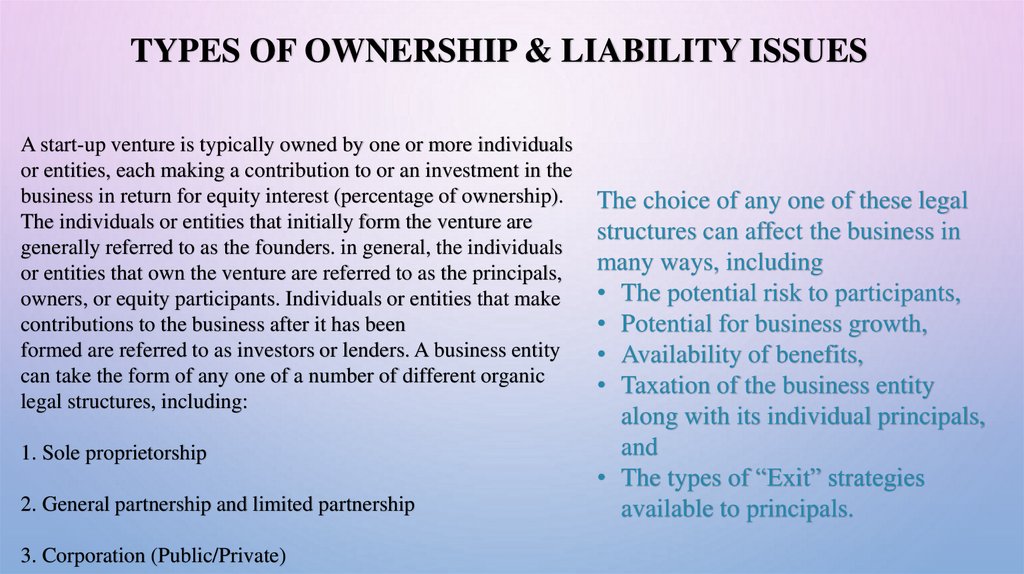
TYPES OF OWNERSHIP & LIABILITY ISSUESA start-up venture is typically owned by one or more individuals
or entities, each making a contribution to or an investment in the
business in return for equity interest (percentage of ownership).
The individuals or entities that initially form the venture are
generally referred to as the founders. in general, the individuals
or entities that own the venture are referred to as the principals,
owners, or equity participants. Individuals or entities that make
contributions to the business after it has been
formed are referred to as investors or lenders. A business entity
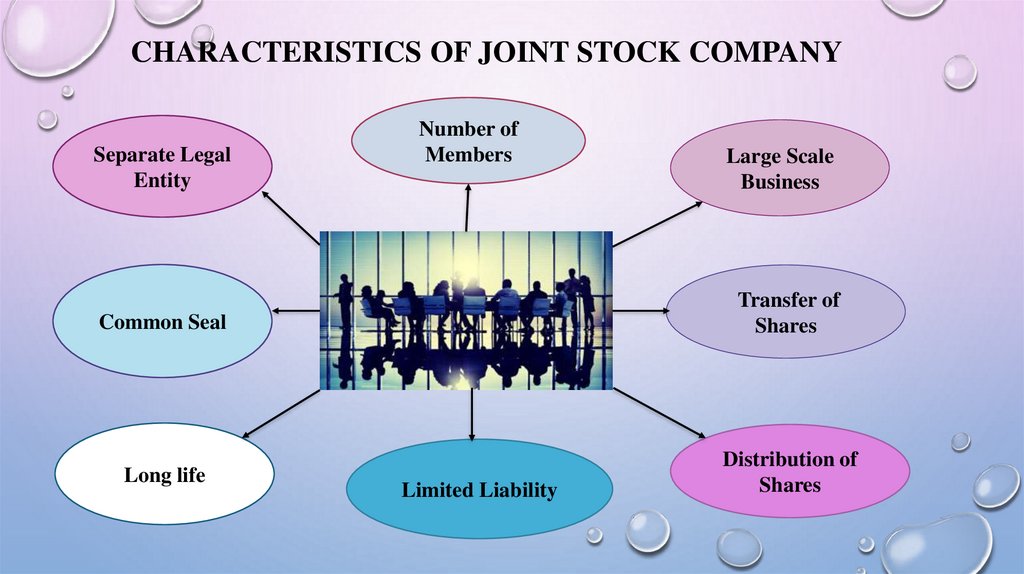
can take the form of any one of a number of different organic
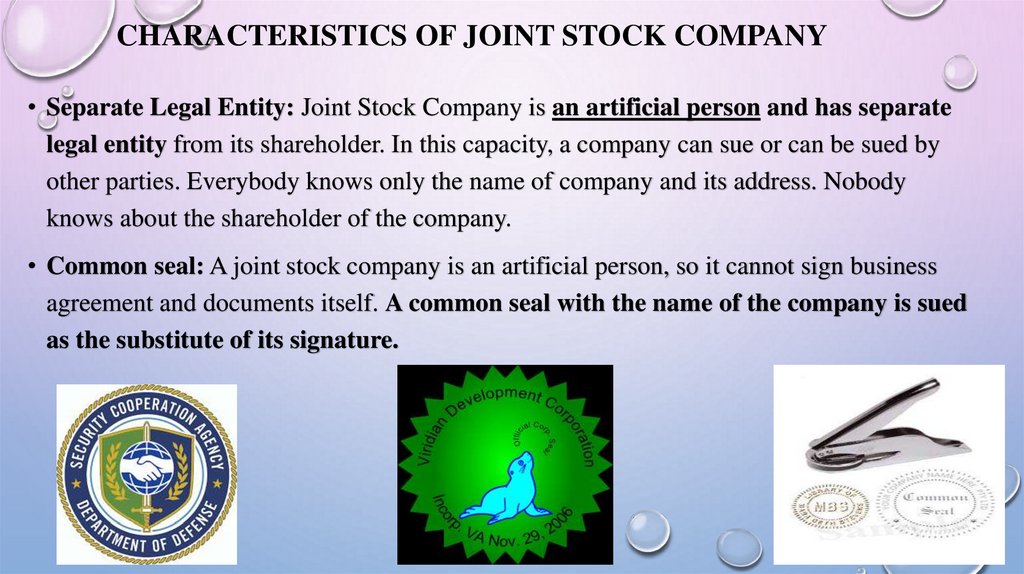
legal structures, including:
1. Sole proprietorship
2. General partnership and limited partnership
3. Corporation (Public/Private)
The choice of any one of these legal
structures can affect the business in
many ways, including
• The potential risk to participants,
• Potential for business growth,
• Availability of benefits,
• Taxation of the business entity
along with its individual principals,
and
• The types of “Exit” strategies
available to principals.
6. Types of Business Ownerships
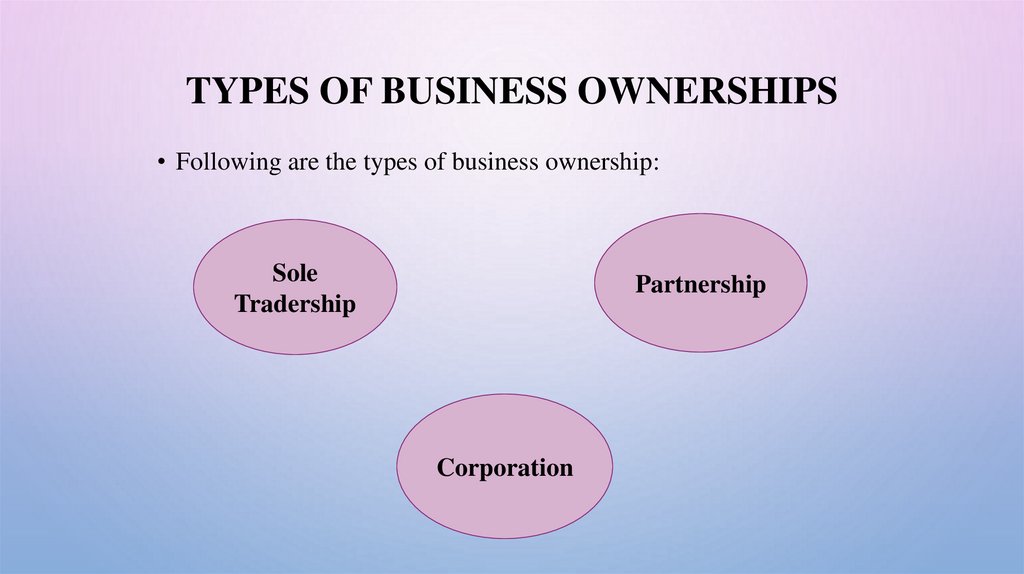
TYPES OF BUSINESS OWNERSHIPS• Following are the types of business ownership:
Sole
Tradership
Partnership
Corporation
7. Sole Proprietorship/ Sole Tradership
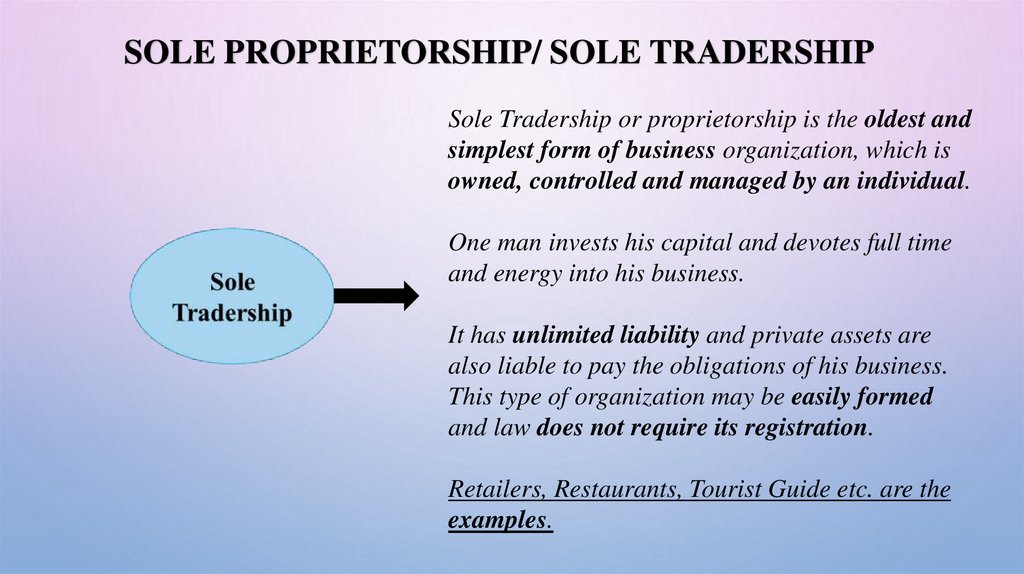
SOLE PROPRIETORSHIP/ SOLE TRADERSHIPSole Tradership or proprietorship is the oldest and
simplest form of business organization, which is
owned, controlled and managed by an individual.
One man invests his capital and devotes full time
and energy into his business.
It has unlimited liability and private assets are
also liable to pay the obligations of his business.
This type of organization may be easily formed
and law does not require its registration.
Retailers, Restaurants, Tourist Guide etc. are the
examples.
8. Sole Proprietorship/ Sole Tradership
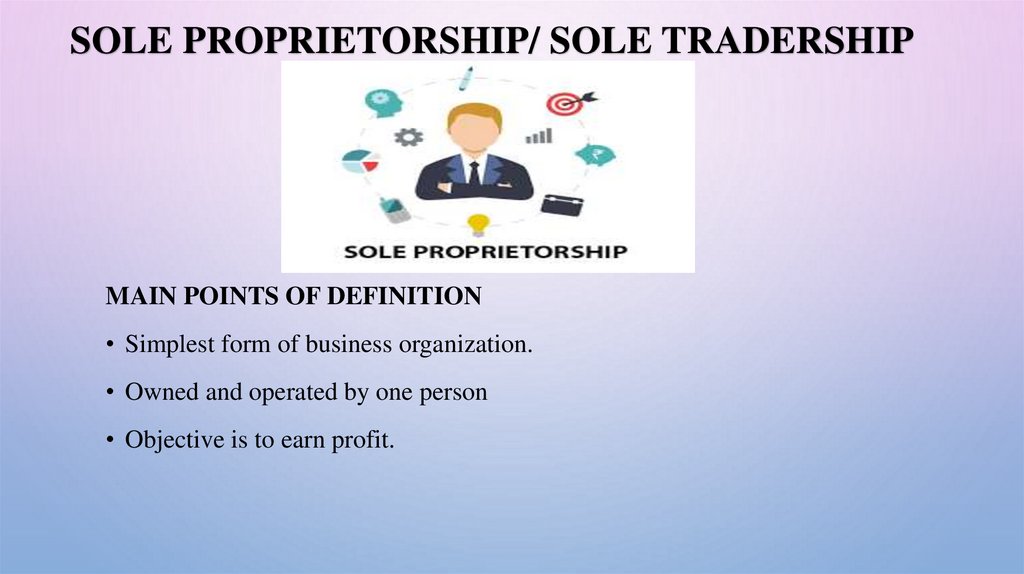
SOLE PROPRIETORSHIP/ SOLE TRADERSHIPMAIN POINTS OF DEFINITION
• Simplest form of business organization.
• Owned and operated by one person
• Objective is to earn profit.
9. Sole Proprietorship/ Sole Tradership
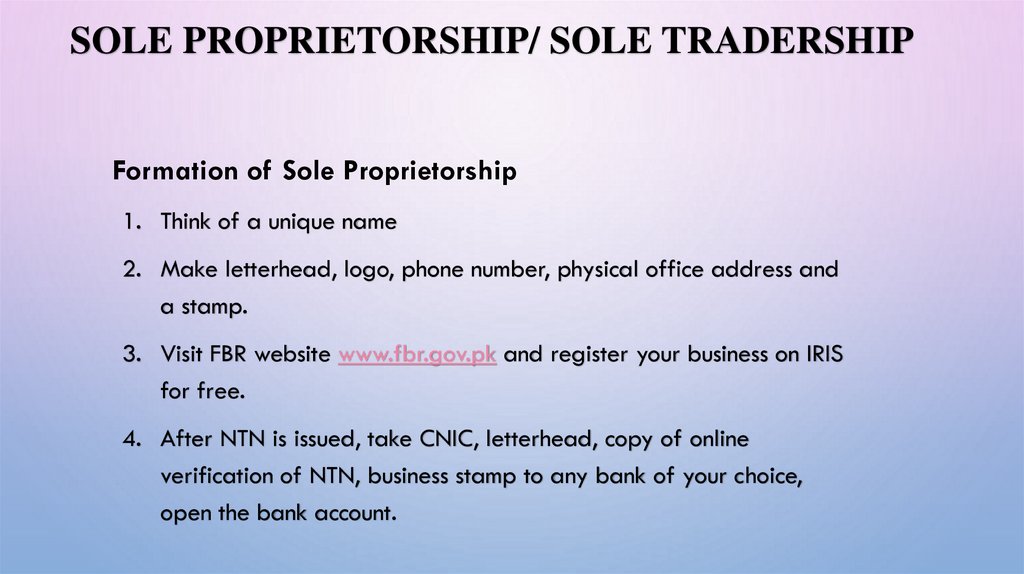
SOLE PROPRIETORSHIP/ SOLE TRADERSHIPFormation of Sole Proprietorship
1. Think of a unique name
2. Make letterhead, logo, phone number, physical office address and
a stamp.
3. Visit FBR website www.fbr.gov.pk and register your business on IRIS
for free.
4. After NTN is issued, take CNIC, letterhead, copy of online
verification of NTN, business stamp to any bank of your choice,
open the bank account.
10. Sole Proprietorship/ Sole Tradership
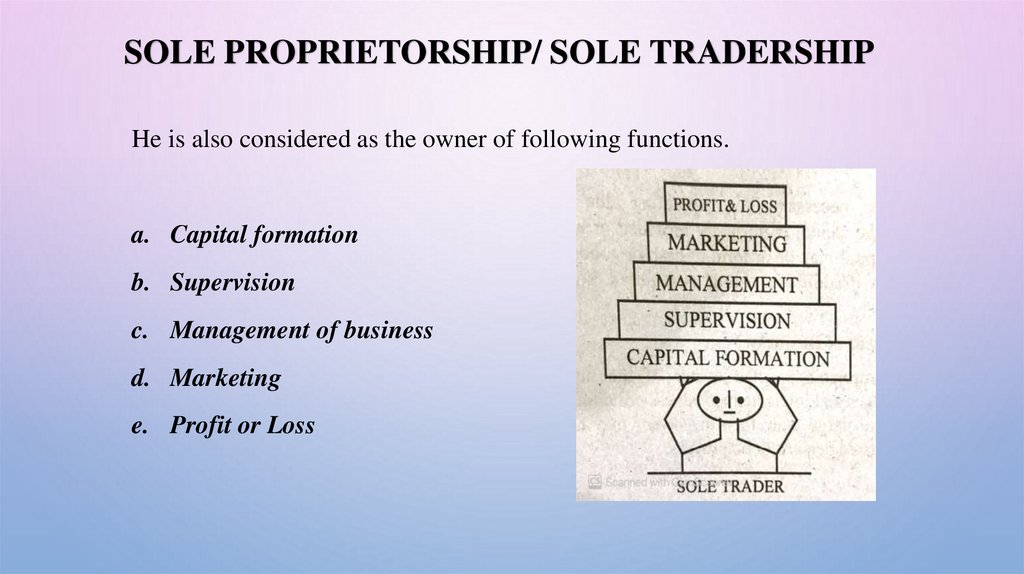
SOLE PROPRIETORSHIP/ SOLE TRADERSHIPHe is also considered as the owner of following functions.
a. Capital formation
b. Supervision
c. Management of business
d. Marketing
e. Profit or Loss
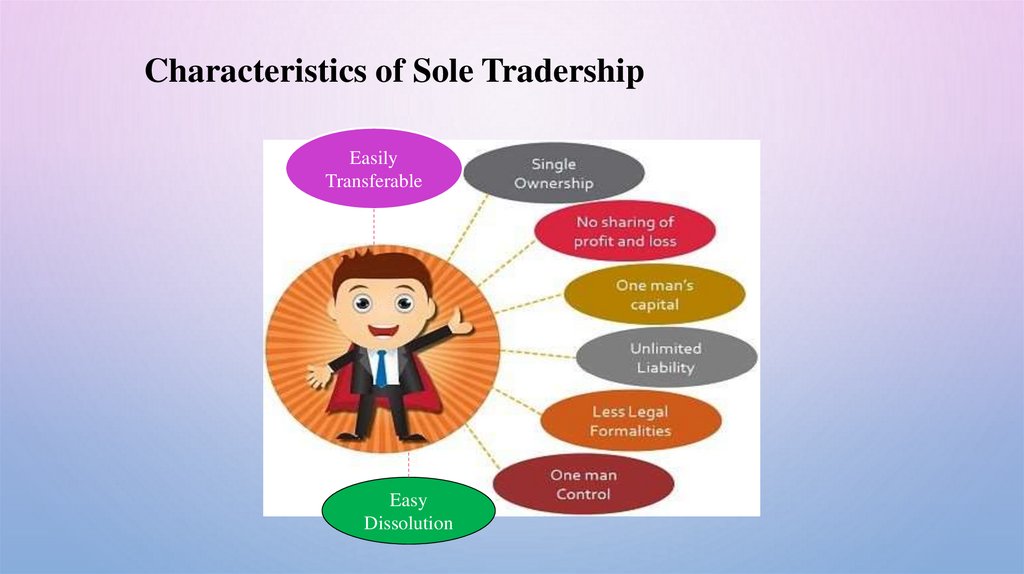
11. Characteristics of Sole Tradership
EasilyTransferable
Easy
Dissolution
12. Sole Proprietorship/ Sole Trader-ship
SOLE PROPRIETORSHIP/ SOLE TRADER-SHIP• Single ownership: One person owns the ownership of business. All the assets and
property belongs to sole trader. The persons who do not want to work as
employees, can became the owners by starting such business.
• No sharing of Profit and Loss: Whatever income generated from the sole
proprietorship business, it belongs to the sole proprietor only. Consequently, he
alone bears all the losses incurred by the firm. There is no sharing of the business
profits and losses.
13. Sole Proprietorship/ Sole Tradership
SOLE PROPRIETORSHIP/ SOLE TRADERSHIP• Unlimited liability: The sole tradership has unlimited liability. in case of
insolvency of the business or non-payment of business debts, he will be
responsible for the payments of the liabilities even from his personal
assets.
• One man’s capital: Capital is necessary for operating the business. it is
arranged and brought to the business by the sole proprietor only, either
from his personal resources or by borrowing, i.e. from the bank, financial
institutions, friends, relatives, etc.
14. Sole Proprietorship/ Sole Tradership
SOLE PROPRIETORSHIP/ SOLE TRADERSHIP• Less Legal Formalities: The legal requirements for formation, operation and
closure of a sole tradership business is almost nil, even it does not need
registration. there may be legal restriction on setting up a particular business e.g.
medical store etc. Although for the purpose of business, it can be registered and
obtain a certificate of registration.
• One Man Control: As only one person is in charge of all the activities, he has
full fledged control over it. Thus, the sole proprietor takes all the decision and
execute it, in the manner he wants.
15. Sole Proprietorship/ Sole Tradership
SOLE PROPRIETORSHIP/ SOLE TRADERSHIP• Easily Transferable: Such type of business can easily be transferred to another
person without any legal restrictions or permission. Moreover, the nature of
business can also be modified in the time of need or according to changing
circumstances.
• Easy Dissolution: The sole proprietorship can be easily dissolved, as there are no
legal formalities involved in it. The sale of business may take some days, but its
activities can be stopped at any time.
16. Merits of Sole Traderships
1.Easy Formation: A sole proprietorship is easy to form and very simple torun. generally there is no any legal restriction like registration etc. So, sole
proprietorship can be started without any difficulty and wastage of time.
2. Personal Interest: A sole proprietor has to take keen interest in the
business affairs because he is alone responsible for the profit or loss of the
business. So, A sole proprietor devotes his full time and energy for the
success of his business.
17. Merits of Sole Traderships
3. Freedom of Actions: In sole proprietorship, the control andsupervision of the business remains in the hands of one person. Sole
trader can do whatever he likes for the success of business because there
is not interference of any other person in business matters.
4. Contact with customers: In this business, the businessman has direct
contact with the customers due to limited market or scale. he keeps in
view their demand, liking and disliking, so, Sole trader produces goods
according to the demand of the customers.
18. Merits of Sole Traderships
5. Entire Profit: A sole proprietorship is the only businessman who enjoys100% profit and no one else can share his profit because he performs all the
business functions solely. Due to this, he willingly works hard for day and night.
6. Easy Transfer: Such type of business can be easily transferred to another
person without any restrictions of legal formality.
7.Easy Access: Generally, sole traders perform the business activities in their
homes or near the homes of customers. Because of this the customers have easy
access to the business of sole traders and vice versa.
19. Merits of Sole Traderships
8. Easy Dissolution: The sole proprietorship can be easily dissolved, as there areno legal formalities involved in it. The sale of business may some days but its
activities can be closed at any time.
9. Less Chances of Fraud: In sole tradership, the sole owner settles all business
affairs and transactions. That is why, there are very less chances of fraud in it.
10.Honesty: Due to unlimited liability of business, the sole trader performs his
functions or duties honesty and effectively to make the business successful.
20. Demerits of Sole Tradership
1. Shortage of Capital: A sole trader has less capital. He works onsmall scale, so he cannot make the use of modern expensive
technology. Due to limited production, he cannot get the benefits of
large-scale production.
2. Unlimited Liability: The sole proprietor alone has to bear the
responsibility of loss, which can be cause of business failure.
Sometimes, his private property can also be used to pay the business
debts and to compensate the burden of loss.
21.
Demerits of Sole Tradership3. Dependent on owner: The success of sole tradership is totally
dependent on the abilities of sole owner. In case of sickness, accident
or death of sole trader, his relatives or family members try to run the
business but they may not be successful.
4. Difficulty in credit: The banks and other financial institutions
hesitate to advance loan to sole proprietors due to non-availability of
proper securities and weak financial position. Sometimes sole trader
does not get loan because of high rate of interest on loan offered by
banks.
22. Demerits of Sole Tradership
5. Entire burden of loss: In sole tradership, the sole owner bears theentire burden of business looses alone because he himself performs
almost all the business tasks and has unlimited liability.
6. Not durable: This type of business organization is very much
temporary , because owner’s death, sickness, accident or heavy loss
can stop its activities.
23. Demerits of Sole Tradership
7.Lack of Skilled Persons: Due to limited sources, a sole trader cannot hire theservices of qualified and experienced persons. Therefore, he cannot make rapid
progress and achieve the maximum profit.
8. Lack of Employee Promotion: Due to limited volume of business and less
chances of expansion, the employees do not get promotion. Due to this, they do not
work hard and always try to get better employment at some other places.
24. Demerits of Sole Tradership
9. Lack of Advertisement: In modern era, advertisement plays a very importantrole in increasing the sale of product. A single man cannot bear the high expenses
of advertisement due to less, which keeps the sales volume limited.
10. Lack of Innovation: In sole proprietorship, a single man is responsible for the
loss, so he always feel fear for using new methods of production, which restricts
the innovation.
25. Partnership
PARTNERSHIPPartnership is the relation between two or
more persons who have agreed to share profit
of a business carried on by all or any of them
acting for all.
Like sole tradership it can be formed without
any legal formalities.
Every partner has unlimited liability in
partnership. The small and medium size
business activities are performed under such
organizations.
26.
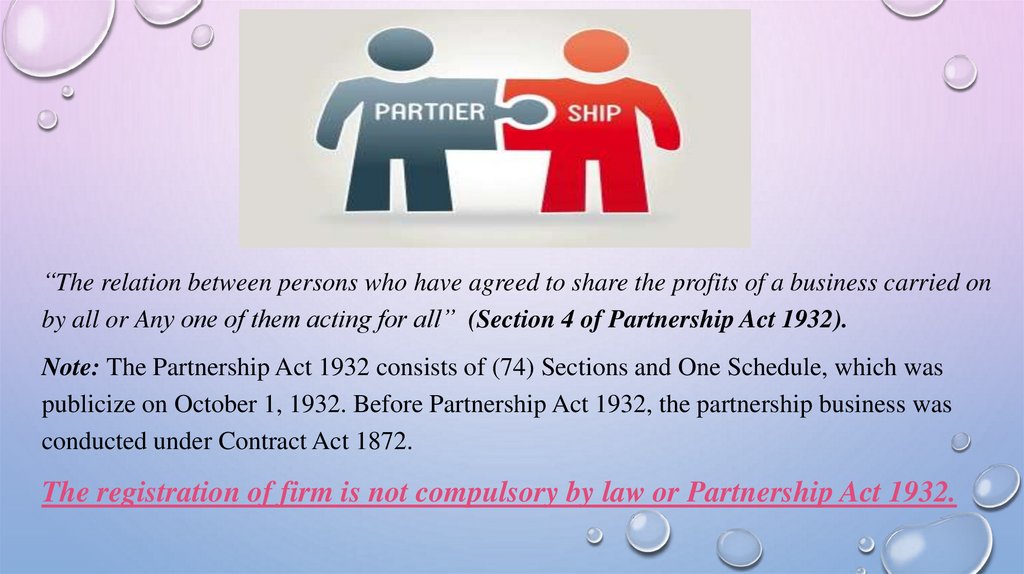
“The relation between persons who have agreed to share the profits of a business carried onby all or Any one of them acting for all” (Section 4 of Partnership Act 1932).
Note: The Partnership Act 1932 consists of (74) Sections and One Schedule, which was
publicize on October 1, 1932. Before Partnership Act 1932, the partnership business was
conducted under Contract Act 1872.
The registration of firm is not compulsory by law or Partnership Act 1932.
27. Main Points of Definition
• Partnership is the relationship between two or more persons• The relation is developed for the purpose of business
• The main objective is to earn profit
• An agreement between partners to settle the business affairs
• Every partner may take part in the affairs of business or one partner may run the
business on behalf of other partners.
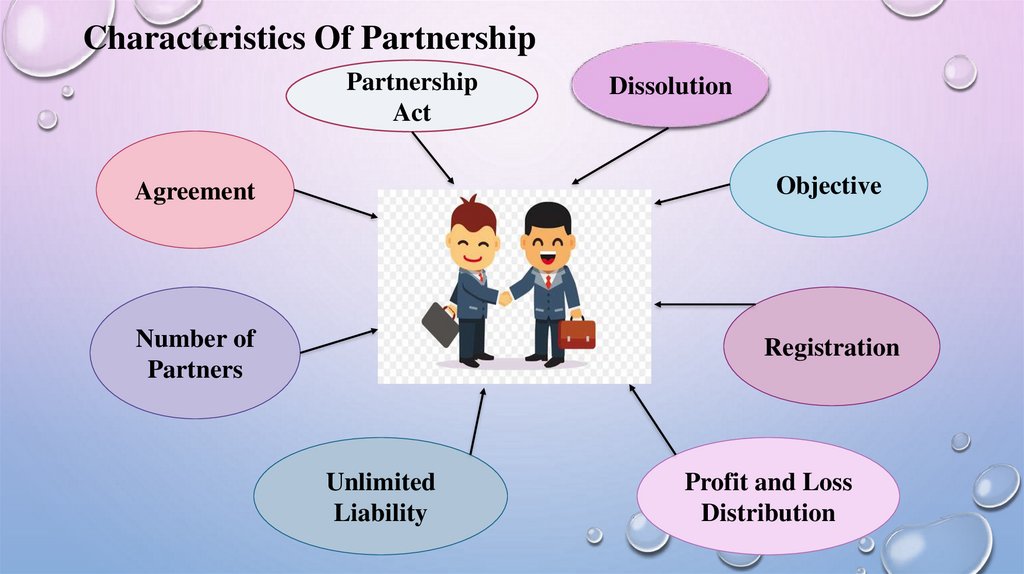
28. Characteristics Of Partnership
PartnershipAct
Dissolution
Agreement
Objective
Number of
Partners
Registration
Unlimited
Liability
Profit and Loss
Distribution
29. Characteristics Of Partnership
• Agreement: Agreement is necessary to form partnership. partnership agreementmay be written or oral. Partnership must be in writing in order to avoid any
future dispute.
• Number of Partners: In partnership, there should be at least two members. But
the number of members must not exceed twenty in case of ordinary business
and ten in case of banking business.
• Unlimited liability: In partnership, the liability of each partner is unlimited. in
case of loss, the private property of partners can also be used or sold to pay the
business debts according to the provisions of partnership deed.
30. Characteristics Of Partnership
• Partnership act: In Pakistan, all partnership businesses are established andperformed their functions under partnership act 1932.
• Objective: If two or more persons make efforts for special welfare or form an
institution for the same purpose then it is not called partnership. Only that
business is considered as partnership, which is established to earn profit.
• Dissolution: Partnership is a temporary form of business. In the absence of
partnership agreement, the partnership is dissolved of any partner leaves, dies etc
(section 40, 41,42,43& 44).
31. Characteristics Of Partnership
• Registration: It is not compulsory by law that a partnership firm should beregistered. It depends upon the will of partners whether they want to register their
firm or not. But it is necessary to point out that unregistered firms have to face
many problems. So, it is better to get the firm registered in order to avoid the
problems.
• Profit and Loss Distribution: The first and foremost aim of partnership is to
earn profit and the profit is distributed among the partners according to their
agreement. In case of loss all the partners also share in loss.
32. Advantages of Partnership
1. Large Capital: In sole-proprietorship, the sources and capital remain limited. Onthe other hand, in partnership every partner provides his share of capital for the
business. due to larger capital, the scale of production or volume of business can be
enlarged according to the requirements.
2. Mutual Consultation: In partnership, all the partners work with mutual
consultation to promote the business. thus minimizes the chances of loss in
partnership business. There is an old saying that two hands are better than one.
33. Advantages of Partnership
3. Division of work: In partnership division of work can easily be done because ofmore than one partner or owner. so, the partnership works on the principle of
divisibility and specialization in which every partner can contribute according to
his abilities for the promotion of business.
4. Personal Interest: Since the liability of the partners is unlimited in partnership
business, so they tale keen interest in business and try hard with honesty for the
success of business.
34. Advantages of Partnership
5. Contact with customers: The market of partnership business is not very vast andit is possible to have direct contact with customers. therefore, the goods can be
produced according to the demand of market and customer, which increases the
sale of business.
6. Easy Dissolution: In partnership, partners may dissolve their business at any
time with mutual consent, as no legal formality is required.
7. Flexibility: Partnership is a flexible type of business organization. Partners can
change the business size, volume and Nature of their business with mutual
consultation at any time.
35. Advantages of Partnership
8. Better Decision: In partnership business, there is possibility of better and carefuldecision regarding business policies through mutual decision and consultation.
9. Expansion of Business: Due to large number of partners, the size and scale of
business can be enlarged. Moreover, adding new partners during expansion process
can increase the capital.
10. Reduction in Loss: In partnership, if the firm suffers loss then the partners of
business share it. In this way the risk or burden of loss is reduced or minimized.
36. Disadvantages of Partnership
1.Unlimited liability: In partnership business, the liability of partners is unlimitedand personal property of the partners can be sold for the payment of the firm’s
debts. due to this the partners always try to avoid innovative and risky business.
2. Lack of Capital: It is quite right the capital of partnership business is greater
than the sole proprietorship. But as compared to the joint stock company, capital of
partnership business is small which does not allow innovation and its expansion on
large scale.
37. Disadvantages of Partnership
3. Uncertainty: The future of partnership business is consider uncertain.misunderstanding between the partners and insanity or death of any partner may
end the business activities.
4. Inefficient Partner: The partnership business progresses due to mutual coordination and consultation among partners. but in some cases, the inefficiency of
one partner may be a cause of business loss.
38. Disadvantages of Partnership
5. Transfer of rights: In partnership, no partner can transfer his share without theconsent of all other partners of business, which may be difficult in particular
circumstances.
6. lack of Secrecy: In case of misunderstanding or disputes among the partners, the
business secrets can be revealed. Whereas it does not happen in sole tradership.
39. Disadvantages of Partnership
7. Personal Disputes: During the routine work of partnership businessvarious personal disputes take place, which disturbs the working,
performance and goodwill of business.
8. Legal Defect: Partnership business can be started without the
permission of government. It does not have separate entity and legal
protection unless it is registered. An unregistered firm neither sue and nor
can be sued.
40. Disadvantages of Partnership
9. Limited Life: The life of partnership is very Limited and depends on the will ofpartners. If any partner retires or new partner enters into the business, the old partnership
may come to an end and the partners enter into new agreement to run the business.
10. Delay in Decisions: In partnership business, no partner can take decision
independently and all the decisions are made with mutual consultations. Sometimes the
partners do not easily agree to each other’s proposals or suggestions. So, decisions are
delayed and business may suffer loss.
41. Formation of Kinds of Partnership
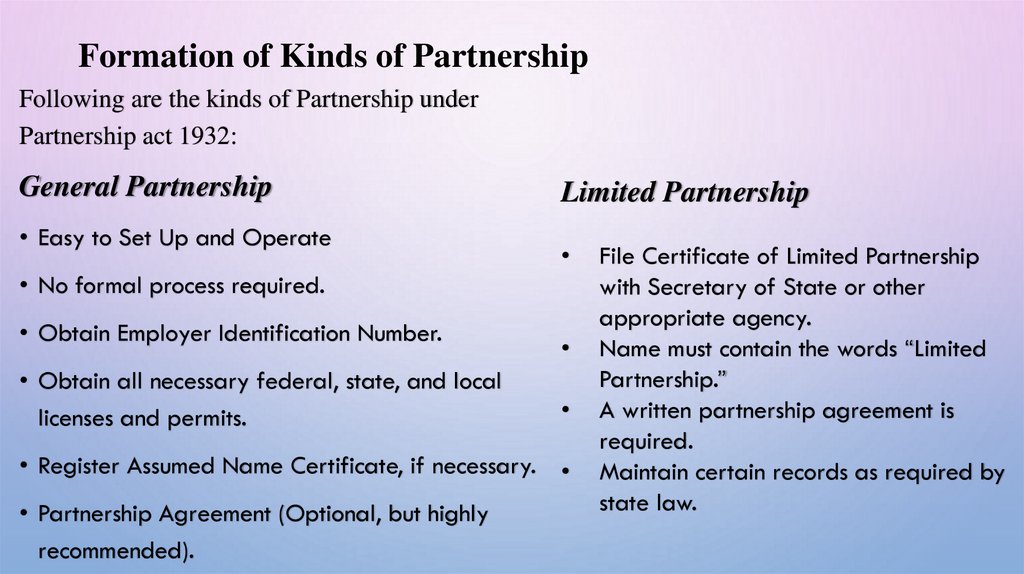
Following are the kinds of Partnership underPartnership act 1932:
General Partnership
• Easy to Set Up and Operate
Limited Partnership
• No formal process required.
• Obtain Employer Identification Number.
• Obtain all necessary federal, state, and local
licenses and permits.
• Register Assumed Name Certificate, if necessary.
• Partnership Agreement (Optional, but highly
recommended).
File Certificate of Limited Partnership
with Secretary of State or other
appropriate agency.
Name must contain the words “Limited
Partnership.”
A written partnership agreement is
required.
Maintain certain records as required by
state law.
42.
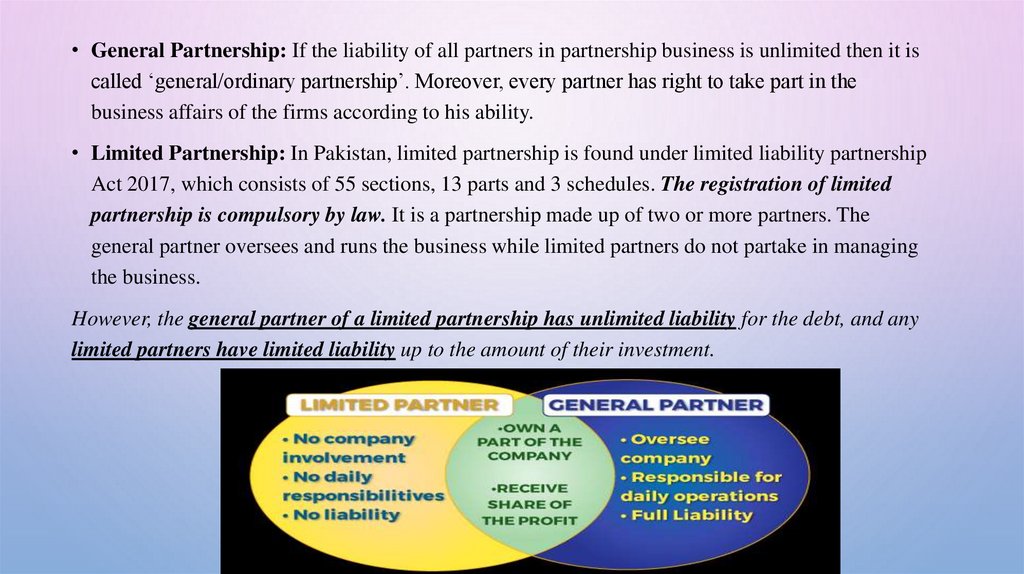
• General Partnership: If the liability of all partners in partnership business is unlimited then it iscalled ‘general/ordinary partnership’. Moreover, every partner has right to take part in the
business affairs of the firms according to his ability.
• Limited Partnership: In Pakistan, limited partnership is found under limited liability partnership
Act 2017, which consists of 55 sections, 13 parts and 3 schedules. The registration of limited
partnership is compulsory by law. It is a partnership made up of two or more partners. The
general partner oversees and runs the business while limited partners do not partake in managing
the business.
However, the general partner of a limited partnership has unlimited liability for the debt, and any
limited partners have limited liability up to the amount of their investment.
43.
• Partnership deed means a signed agreement aboutownership or legal rights among partners.
(Oxford Dictionary)
• Partnership deed is a document, which contains
all necessary rules and regulations required to run
the partnership business.
• Main Points of Definition
A document
Contains rules and regulations
For administering and managing the partnership business
44. Contents of a Partnership Deed
1. Name of firm: Name of firm should be written in partnership agreement.2. Nature of business: Nature of the business should be me mentioned in it.
3. Duration: Duration of partnership whether it is for definite or indefinite period should be
mentioned in it.
4. Capital: The total capital of the firm and the share of each partner should be decided in the
partnership deed.
5. Profit and Loss sharing rations: Profit and loss sharing ratio of business should be agreed
in partnership deed.
6. Date: Date of starting the partnership business should be written in partnership agreement.
7. Name of Partners: Name of the partners and their addresses should be described in the
partnership agreement.
45.
8. Location: Location of the business should be written in agreement.9. Salary: It should be decided in the agreement whether salary would be paid or not to
partners for their services rendered.
10. Rights and duties of partners: The provisions regarding' the rights and duties of
each partner are also written in the agreement.
11. Entry and Exist of Partner: Procedure to be followed for withdrawal or for the
admission of new partner should be mentioned in the partnership deed.
12. Ways of Dissolution: The manners under, which the firm may be dissolved and
procedure of dissolution should be decided.
13. Arbitration: In case of any dispute, provisions for arbitration should also be
available in the deed
14. Witness: The particulars about the witness of agreement provisions are also found
in it.
46. Corporation
CORPORATIONCorporation are also known as Joint Stock company
or limited company.
Corporation is a voluntary association of different persons
created by law as a separate body for specific purpose.
It has legal entity apart from its member. It can be sue
and be sued in its own name.
It enjoys a common capital contributed by its members. Such
capital is divided into transferable shares.
The liability of each member is limited to the value of share that
he holds.
47. Corporation
CORPORATIONNOTE:
In our country, joint stock companies are controlled under the
companies Act 2017.The Companies Act 2017 consists of 515
Sections, 13 Parts and 8 Schedules. Securities Exchange
Commission of Pakistan-SECP (previously named Corporate Law
Authority-CLA) is the regulatory body of this law in Pakistan.
48. Main Points of Definition
MAIN POINTS OF DEFINITION• An artificial person
• Created by Law
• Consisted of Large number of members
• Established for commercial purpose
• Capital is divided into transferable shares
• Suitable for large undertakings
People who work for the establishment of a company are called Promoters.
Persons who provide capital to company are known as Shareholders.
Individual who run the management of company are called Directors.
49. Formation of Corporation
FORMATION OF CORPORATION• Most Complex Form of Business to Set Up and Operate
• File Articles of Incorporation with the Secretary of State.
• Pay filing and license fees.
• Prepare and adopt by law.
• Obtain corporate minute book, corporate seal, stock certificates, and other desired
supplies.
• Follow corporate formalities.
50. Characteristics of Joint Stock Company
CHARACTERISTICS OF JOINT STOCK COMPANYSeparate Legal
Entity
Number of
Members
Large Scale
Business
Common Seal
Transfer of
Shares
Long life
Distribution of
Shares
Limited Liability
51. Characteristics of Joint Stock Company
CHARACTERISTICS OF JOINT STOCK COMPANY• Separate Legal Entity: Joint Stock Company is an artificial person and has separate
legal entity from its shareholder. In this capacity, a company can sue or can be sued by
other parties. Everybody knows only the name of company and its address. Nobody
knows about the shareholder of the company.
• Common seal: A joint stock company is an artificial person, so it cannot sign business
agreement and documents itself. A common seal with the name of the company is sued
as the substitute of its signature.
52. Characteristics of Joint Stock Company
CHARACTERISTICS OF JOINT STOCK COMPANYLong life: A company has a long life as compared to the other business
organizations. The business of company continues until it is legally wound up. If any
shareholder or director dies or retires or became insane or declared insolent or
withdraws his share capital, there is no effect on the continuity of the company’s
business.
Limited Liability: The most distinguished feature of joined stock company as
compared to sole proprietorship and partnership is that the liability of shareholders is
limited to the extent of shares purchased by them It means the private property of
shareholders cannot be used to compensate the debts or burden of loss of company.
53. Characteristics of Joint Stock Company
CHARACTERISTICS OF JOINT STOCK COMPANY• Number of Members: In case of multi-members private limited
company minimum number of members should be two and
maximum fifty whilst in public listed limited company
minimum members should be seven but there is no limit on
maximum number of members.
• Large Scale Business: Because of more members, a company has
large capital as compared to sole tradership and partnership, which
helps in doing the business on large scale.
54. Characteristics of Joint Stock Company
CHARACTERISTICS OF JOINT STOCK COMPANY• Transfer of Shares: The shareholders of public company can transfer or sell their shares to
other persons at stock exchange without the consent of other shareholders and management
of the company.
• Distribution of Profit: The first and foremost aim of company is to earn profit. The
company does not distribute the whole profit among the shareholders. Some portion of the
profit is transferred to reserve fund whilst the remixing portion is distributed as dividend
according to the shares of shareholders.
• Use of Word Limited: It is essential for limited company to use word limited with its name.
In case of private limited company, the words private limited should also be mentioned.
55. Advantages of Corporation
ADVANTAGES OF CORPORATION• Limited Liability: In Joint stock company the liability of the owners is limited to the
purchased shares. In case of loss or insolvency of company, the shareholders are not
required to pay anything more than the face value of their shares. In this way their
private property is saved.
• Large Capital: A joint stock company collects a large portion of its finance by
issuing shares. For this purpose a public company can issue its prospectus to general
public who buys shares of the company whilst private company cannot issue the
shares to general public.
56. Advantages of Corporation
ADVANTAGES OF CORPORATION• Expansion of Business: A joint stock company sells the shares, bonds and
debentures to collect a large amount of finance, which helps to expand the
business easily.
• Easy to Separate: Any member can separate himself or withdraw his
investment easily from joint stock company by transferring his shares or
selling them at stock exchange.
57. Advantages of Corporation
ADVANTAGES OF CORPORATION• Long-period Projects: Because of permanent or long life and huge capital, a
company can undertake those projects, which will give profits after many
years.
• Less Chances of Corruption: The government audits the various statements
regarding the incomes and expenses of a company from time to time, so the
managing authorities ger less chance of corruption
58. Advantages of Corporation
ADVANTAGES OF CORPORATION• Low Cost of Production: Availability of huge amount of finance,
government incentives, modern techniques of production and vast market
make possible for a joint stock company to produce goods on large scale at a
competitive lower cost. Low cost of production causes to increase the profit
of company.
• Increases in Govt.’s Income: A company pays different types of taxes to
government like income tax, sales tax, excise tax and import duty etc.,
which increases the govt. income.
59.
ADVANTAGES OF CORPORATION• High Profits: Because of large capital, economies of large-scale
production and technical skills, a company’s cost of production reduces
and rate of profit increases.
• Employment Opportunities: Because of their wide operation, joint
stock companies always need many employees in different
departments. So, they are also playing very important role in providing
employment opportunities in the country.
60. Disadvantages of Corporation
DISADVANTAGES OF CORPORATION• Monopoly: Due to large size and more resources, a joint stock company can
create monopoly by getting control over the market. Sometimes, few
companies make agreement to have monopoly for exploiting the consumers
and small businessmen.
• Nepotism: In joint stock company, the directors of company often employ
their inefficient and incapable relatives on key jobs of the company. As a result
of this, the cost of production increases and company faces loss.
• Late Decisions: In a company, the decision taking process is time consuming
because a meeting is necessary to solve the business problems and matters.
Sometimes delay in decisions may cause loss to business.
61. Disadvantages of Corporation
DISADVANTAGES OF CORPORATION• Difference of Opinion: The difference of opinions among the directors of the
company at all time of making decisions regarding company’s policies and matters
may result in loss.
• Centralization of Powers: In the process of join stock companies, most of the
political and economical powers remain in few hands. Due to this all the business
activities move around only few people.
• Double Taxes: The profit of a company is subject to double taxation. Firstly, a
company pays tax on the whole profit and secondly every shareholder pays tax on
the dividend received from the company.
62. Disadvantages of Corporation
DISADVANTAGES OF CORPORATION• Complicated Procedures: The formation of a joint stock company is
complicated procedure as compare to other forms of organization because
the founders of company have to observe many legal formalities. So, a lot of
time and money is wasted.
• Lack of Team Spirit: In joint stock company, there is large number of
shareholders and they change their status frequently. Therefore, there is
always lack of team spirit in this organization and every shareholder only
takes into consideration his own interest.
63. Disadvantages of Corporation
DISADVANTAGES OF CORPORATION• Misrepresentation of Financial Status: Sometimes, the directors of the company do
not present the true and fair picture of the company’s affairs to deceive the
inexperienced and innocent shareholders. Due to this, many shareholders sell their
shares and the selfish directors buy the same shares to earn profit.
• Minority Rights: Because of their personal contacts, sometimes the majority of
shareholders create a group to exploit the rights of minority.
64. EQUITY AND EQUITY TYPES
EQUITY IS SIMPLY ANOTHERTERM FOR AN OWNERSHIP
INTEREST IN A BUSINESS
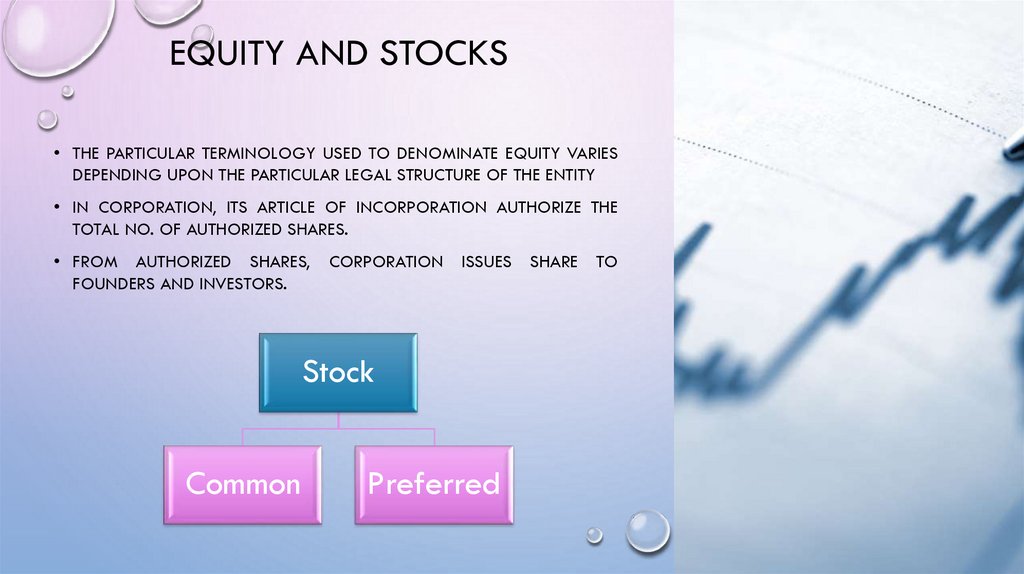
65. Equity and Stocks
EQUITY AND STOCKS• THE PARTICULAR TERMINOLOGY USED TO DENOMINATE EQUITY VARIES
DEPENDING UPON THE PARTICULAR LEGAL STRUCTURE OF THE ENTITY
• IN CORPORATION, ITS ARTICLE OF INCORPORATION AUTHORIZE THE
TOTAL NO. OF AUTHORIZED SHARES.
• FROM AUTHORIZED SHARES, CORPORATION ISSUES SHARE TO
FOUNDERS AND INVESTORS.
Stock
Common
Preferred
66. Common Stock
COMMON STOCK• COMMON STOCK REFERS TO THE
BASELINE OF OWNERSHIP IN A
CORPORATION AND A RIGHT TO
A PORTION OF PROFITS FROM
THAT COMPANY.
• LAST LINE OF DIVIDEND ETC.
67. Preferred Stock
PREFERRED STOCK• PROVIDE A SPECIFIC DIVIDEND ON A PERIODIC BASIS
• CLASSIFY THE STOCK AS SENIOR TO OTHER CLASSES OF
STOCKS IN THE ORDER OF DISTRIBUTION
• INDICATE THAT PREFERRED SHAREHOLDERS HAVE LIMITED OR
NO VOTING RIGHTS
68. Founder’s Stock
FOUNDER’S STOCK• THE RIGHT TO CONVERT SHARES INTO ANY OTHER CLASS OF
STOCK WHEN THAT CLASS OF STOCK IS OFFERED TO INVESTORS
• CLASS-A, ONE VOTE PER SHARE (INVESTOR), WHEREAS CLASS-B
10 VOTE PER SHARE (THEMSELVES).
RETAIN DECISION-MAKING
CONTROL
• Right to convert into any other share class
• Liquidation preferences
• Other name sweat equity shares
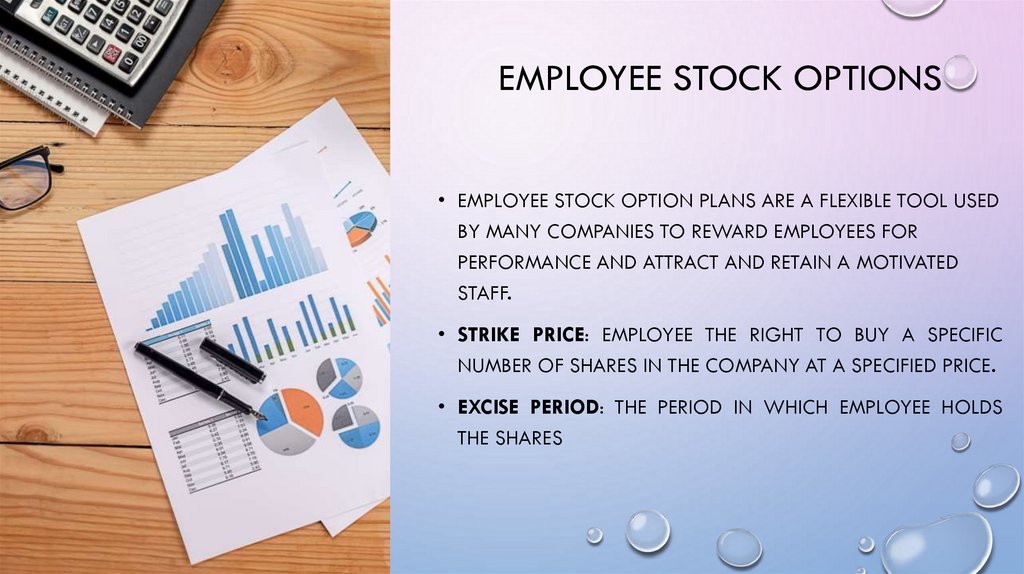
69. Employee Stock Options
EMPLOYEE STOCK OPTIONS• EMPLOYEE STOCK OPTION PLANS ARE A FLEXIBLE TOOL USED
BY MANY COMPANIES TO REWARD EMPLOYEES FOR
PERFORMANCE AND ATTRACT AND RETAIN A MOTIVATED
STAFF.
• STRIKE PRICE: EMPLOYEE THE RIGHT TO BUY A SPECIFIC
NUMBER OF SHARES IN THE COMPANY AT A SPECIFIED PRICE.
• EXCISE PERIOD: THE PERIOD IN WHICH EMPLOYEE HOLDS
THE SHARES
70. Other kinds of Stock
OTHER KINDS OF STOCK3.
REDEEMABLE PREFERENCE SHARES
• REDEEMABLE PREFERENCE SHARES ALLOW FOR THE REPAYMENT OF THE PRINCIPAL
SHARE CAPITAL TO SHAREHOLDERS. THE COMPANY MAY REDEEM THESE SHARES AT
AN AGREED VALUE ON A SPECIFIED DATE OR AT THE DISCRETION OF THE
DIRECTORS. THIS IS ON THE CONDITION THAT THE COMPANY IS A GOING
CONCERN.
• ANY REDEMPTIONS CAN BE PAID OUT OF THE COMPANY’S CAPITAL USING
PROCEEDS FROM A FRESH ISSUE OF SHARES.
4.
CONVERTIBLE PREFERENCE SHARES
• CONVERTIBLE PREFERENCE SHARES USUALLY CARRY RIGHTS TO A FIXED DIVIDEND
FOR A PARTICULAR TERM. AT THE END OF THE TERM, THE COMPANY CAN CHOOSE
TO CONVERT IT INTO ORDINARY SHARES OR LEAVE THEM AS THEY ARE.
5.
TREASURY SHARES
• TREASURY SHARES ARE THE COMPANY’S ORDINARY SHARES WHICH HAVE BEEN
ACQUIRED FROM SHAREHOLDERS. THE COMPANY WILL BE LISTED AS THE OWNER
OF THE SHARES BUT IS NOT ALLOWED TO EXERCISE THE RIGHT TO ATTEND OR
VOTE AT MEETINGS, AND NO DIVIDENDS MAY BE PAID TO THE COMPANY.
71. EQUITY DISTRIBUTION IN THE NASCENT VENTURE
NONMONETARY CONTRIBUTIONS• SWEAT EQUITY
• INTELLECTUAL PROPERTY (IP)
• AN INTANGIBLE RIGHT OR RELATIONSHIP
• RESOURCES
• CREDIBILITY OR ACCESS TO SOURCES OF CAPITAL
72. EQUITY DISTRIBUTION IN THE NASCENT VENTURE
Factors tending to influence the valuation of a nonmonetarycontribution
• THE RELEVANCE OF THE CONTRIBUTION TO THE VENTURE
• FAVORABLE ASSESSMENTS BY INDEPENDENT THIRD PARTIES
• UNIQUENESS OF THE CONTRIBUTION
• EXPERTISE IN THE TECHNOLOGY OR PROCESSES THAT FORM THE BASIS
OF THE VENTURE
• RELEVANT EXPERIENCE AND TRACK RECORD
• RELEVANT NETWORK
• REPUTATION AND GOODWILL
• EFFORTS ALREADY TAKEN THAT INCREASE THE LIKELIHOOD OF SUCCESS
OF THE VENTURE
73. How non-monetary contributions are valued?
HOW NON-MONETARYCONTRIBUTIONS ARE VALUED?
The valuation of non-monetary contributions can be
complex and depends on the context.
•Fair market value: For tangible goods, the value is often
determined by the item's "fair market value," which is the price it
would sell for on the open market.
•Professional appraisal: For high-value items such as real estate or
artwork, an independent, professional appraisal may be required to
determine the value.
•Commercial rates: The value of donated services is often
determined by the commercial rate that would have been charged if
the service were paid for.
•Legal precedent: In family law, courts recognize the value of nonfinancial contributions based on legal precedent and the unique
circumstances of the family
74. LaunchPad Innovations
LAUNCHPAD INNOVATIONS• BACKGROUND:
LAUNCHPAD INNOVATIONS IS A NASCENT VENTURE FOUNDED BY A GROUP OF FIVE STUDENTS WITH
DIVERSE SKILLS AND EXPERTISE. THEY'VE DEVELOPED AN INNOVATIVE MOBILE APP DESIGNED TO
STREAMLINE AND ENHANCE THE COLLEGE EXPERIENCE FOR STUDENTS. THE FOUNDERS, ALICIA,
BRANDON, CHLOE, DAVID, AND EMMA, EACH BRING UNIQUE STRENGTHS TO THE VENTURE.
FOUNDING TEAM:
1.
ALICIA: COMPUTER SCIENCE MAJOR, PROFICIENT IN APP DEVELOPMENT.
2.
BRANDON: BUSINESS ADMINISTRATION MAJOR, WITH A STRONG BACKGROUND IN MARKETING.
3.
CHLOE: DESIGN AND USER EXPERIENCE ENTHUSIAST, MAJORING IN GRAPHIC DESIGN.
4.
DAVID: FINANCE MAJOR, SKILLED IN BUDGETING AND FINANCIAL PLANNING.
5.
EMMA: COMMUNICATIONS MAJOR, ADEPT AT SOCIAL MEDIA MANAGEMENT AND CONTENT
CREATION.
75. LaunchPad Innovations
LAUNCHPAD INNOVATIONS• CONTRIBUTIONS:
MONETARY CONTRIBUTIONS: ALICIA INVESTED $5,000 IN THE DEVELOPMENT TOOLS AND
SOFTWARE LICENSES. DAVID INVESTED $2,000 TO COVER INITIAL MARKETING EXPENSES.
NON-MONETARY CONTRIBUTIONS: BRANDON UTILIZED HIS MARKETING SKILLS TO CREATE A
COMPREHENSIVE LAUNCH STRATEGY. CHLOE DEDICATED HER TIME TO DESIGNING THE APP'S USER
INTERFACE WITHOUT MONETARY INVESTMENT. EMMA MANAGED THE VENTURE'S SOCIAL MEDIA
ACCOUNTS AND CREATED PROMOTIONAL CONTENT.
CURRENT SITUATION:
THE VENTURE IS GAINING ATTENTION FROM POTENTIAL INVESTORS, AND THE TEAM NEEDS TO
ESTABLISH AN EQUITABLE EQUITY DISTRIBUTION PLAN.
THE TEAM ACKNOWLEDGES THAT CONTRIBUTIONS GO BEYOND MONETARY INVESTMENTS AND
INCLUDES THE SKILLS AND TIME EACH MEMBER DEDICATES TO THE VENTURE.
76. LaunchPad Innovations
LAUNCHPAD INNOVATIONS1. EACH GROUP MUST DISCUSS AND DECIDE ON AN EQUITABLE DISTRIBUTION OF
EQUITY CONSIDERING BOTH MONETARY AND NON-MONETARY CONTRIBUTIONS.
2. CONSIDER THE LONG-TERM VALUE EACH FOUNDER BRINGS TO THE VENTURE.
3. PROPOSE A PLAN THAT RECOGNIZES AND REWARDS BOTH FINANCIAL
INVESTMENTS AND NON-MONETARY CONTRIBUTIONS.
4. BASED ON THE EQUITY DISTRIBUTION PLAN, DETERMINE THE MOST SUITABLE
LEGAL STRUCTURE FOR LAUNCHPAD INNOVATIONS.
5. CONSIDER THE FUTURE GROWTH AND POTENTIAL INVESTMENT INTERESTS.