

 Английский язык
Похожие презентации:



Masters 2025 21st century skills, HOTS and LOTS in the textbooks
1.
The 21st century skills, HOTS andLOTS in the textbooks
2.
We will talk about:21st century skills: what and why
HOTS and LOTS: Bloom’s Taxonomy
HOTS and LOTS: Bloom’s Taxonomy in class
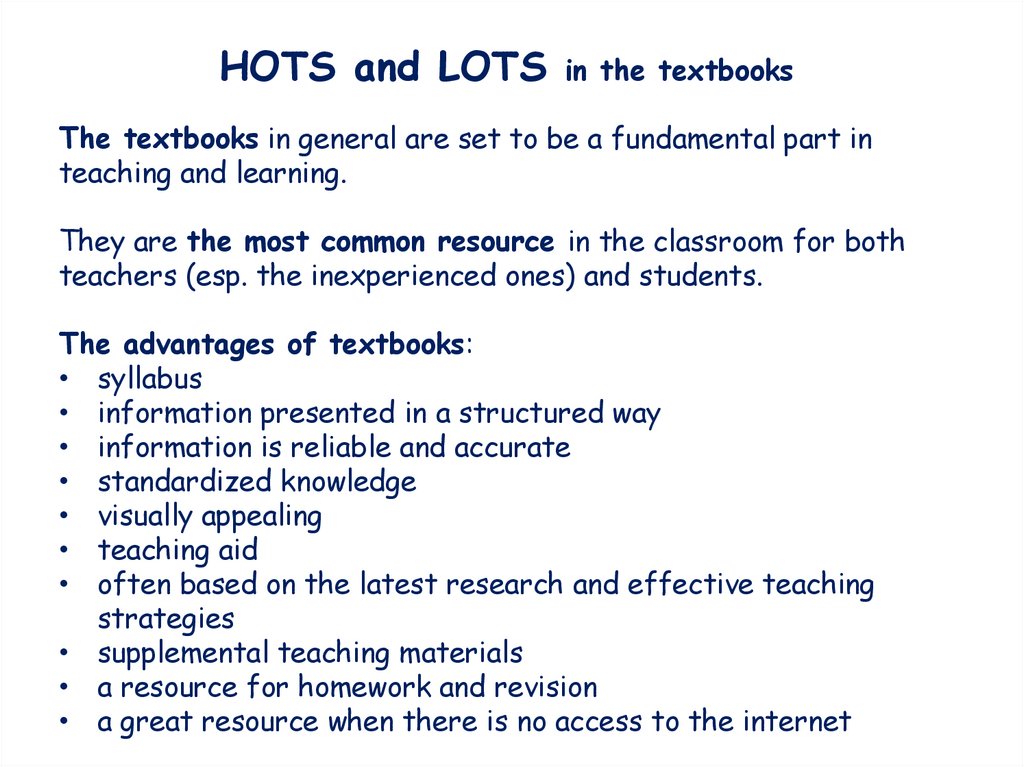
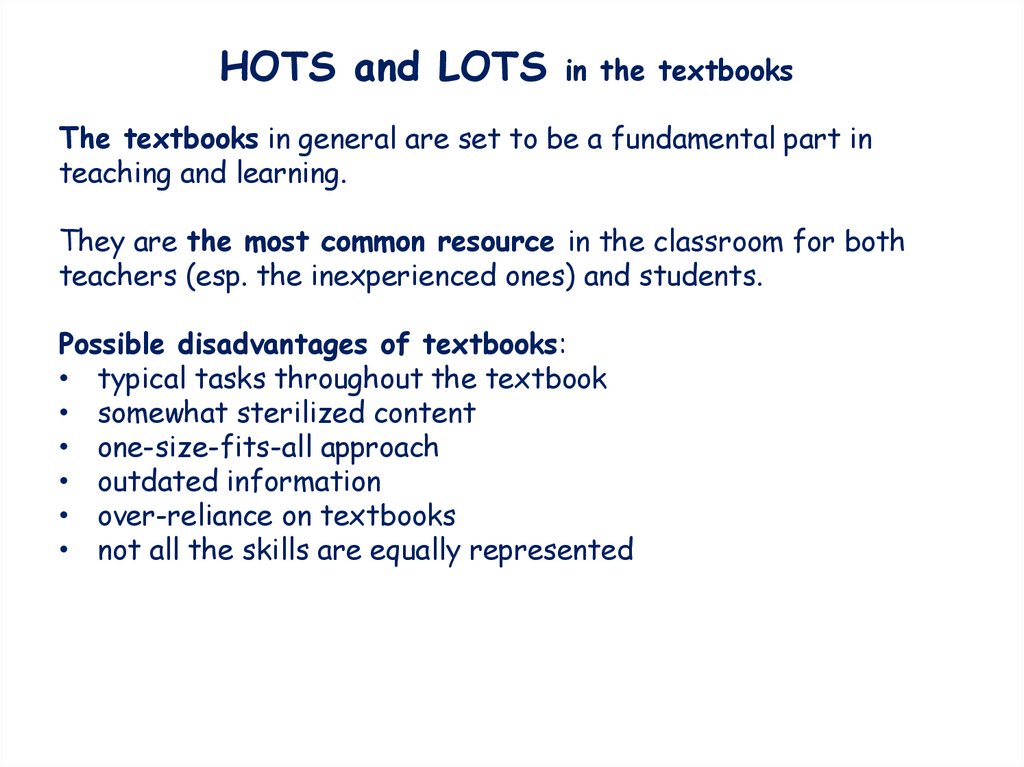
HOTS and LOTS in the English textbooks
practice
3.
A massive warm-upHandout O
(find it on the Google Drive)
Discuss the following statements and questions:
• There is / isn’t a place for debates and role-plays in my class.
• What does English language proficiency mean in the current world?
• Why on Earth should I adapt textbook materials?
• There’re receptive and productive skills. What’s all this fuss about the 21st century skills?
Finish the following sentences with your own ideas:
• The recent trends in education ….
• Nowadays, education is required …
• In this day and age, the most demanded skills ….
4.
The 21st century skills – what5.
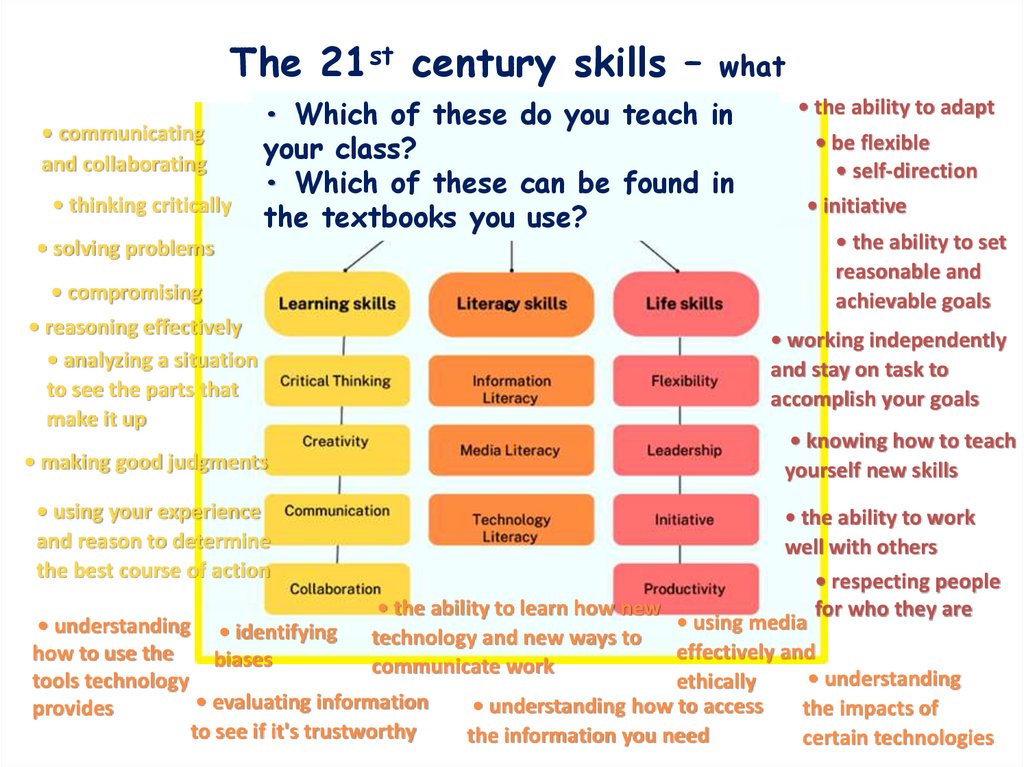
The 21st century skills – what• communicating
and collaborating
• thinking critically
• Which of these do you teach in
your class?
• Which of these can be found in
the textbooks you use?
• solving problems
• compromising
• reasoning effectively
• analyzing a situation
to see the parts that
make it up
• the ability to adapt
• be flexible
• self-direction
• initiative
• the ability to set
reasonable and
achievable goals
• working independently
and stay on task to
accomplish your goals
• making good judgments
• knowing how to teach
yourself new skills
• using your experience
and reason to determine
the best course of action
• the ability to work
well with others
• respecting people
for who they are
• the ability to learn how new
• using media
• understanding • identifying
technology and new ways to
effectively and
how to use the
biases
communicate work
• understanding
tools technology
ethically
• evaluating information
• understanding how to access
the impacts of
provides
to see if it's trustworthy
the information you need
certain technologies
6.
The 21st century skills – whyThe 21st-century skills classroom recognizes that tomorrow's jobs don't exist yet — and
that the way to prepare students for the "real world" is changing.
Imagine a classroom where students are tasked with helping a fictional fashion company
determine the logistics of their line of designer leashes for — what else? — flying tea cup
pigs. This isn't a business or fashion design class. It's a 21st-century, skills-based physics
class.
Students apply their understanding of net force, acceleration, and circular motion to
complete this playful, practical activity. The result? They are better able to recall
information from the beginning of the year, through a project that encourages play and
discovery.
7.
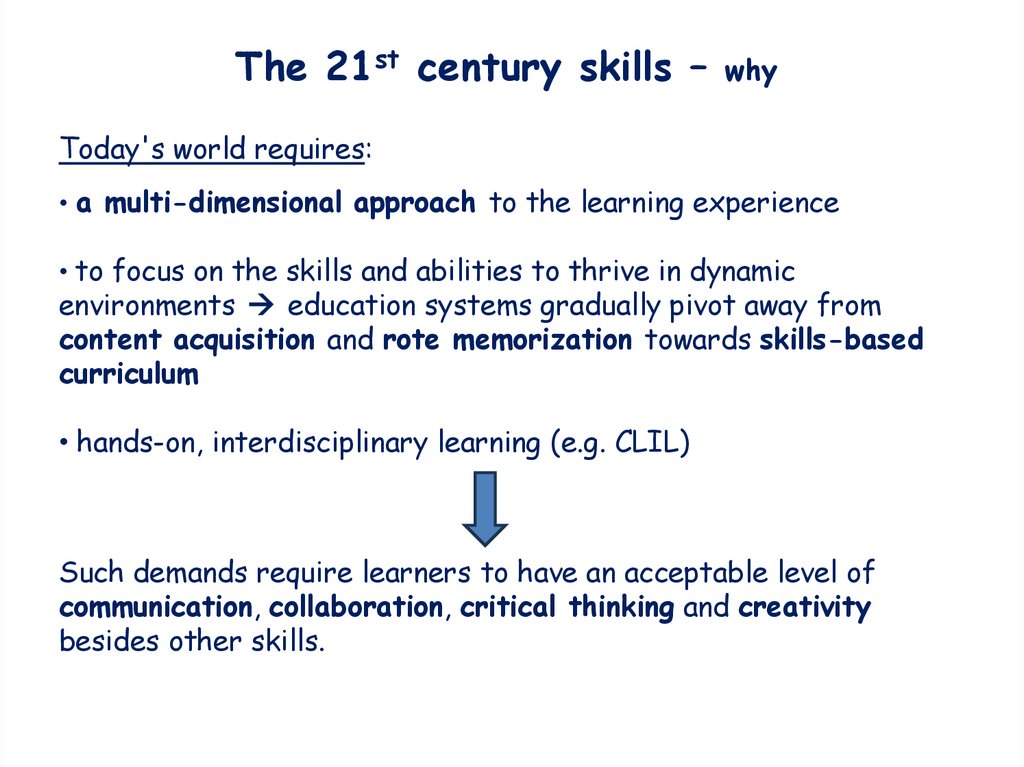
The 21st century skills – whyToday's world requires:
• a multi-dimensional approach to the learning experience
• to focus on the skills and abilities to thrive in dynamic
environments education systems gradually pivot away from
content acquisition and rote memorization towards skills-based
curriculum
• hands-on, interdisciplinary learning (e.g. CLIL)
Such demands require learners to have an acceptable level of
communication, collaboration, critical thinking and creativity
besides other skills.
8.
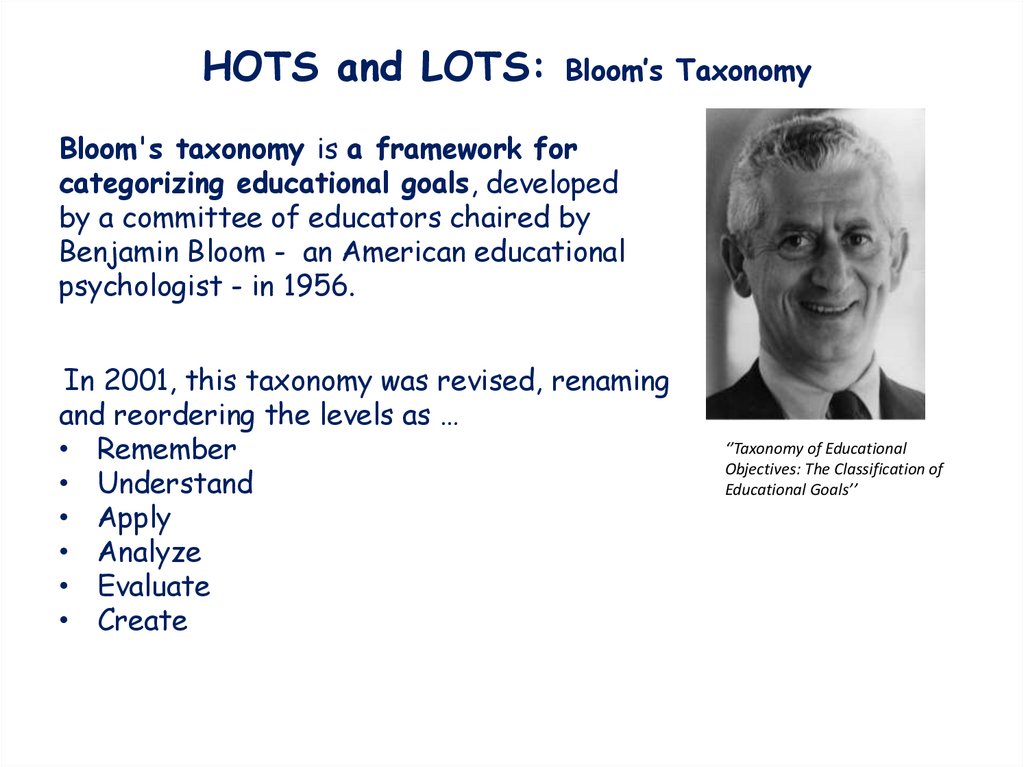
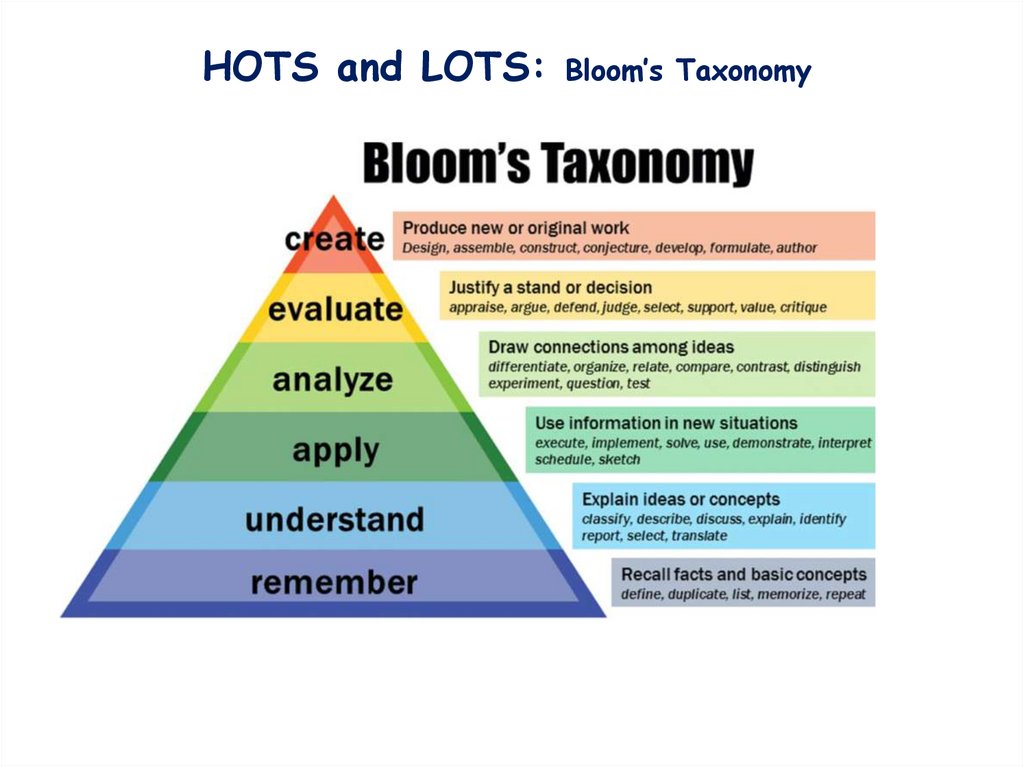
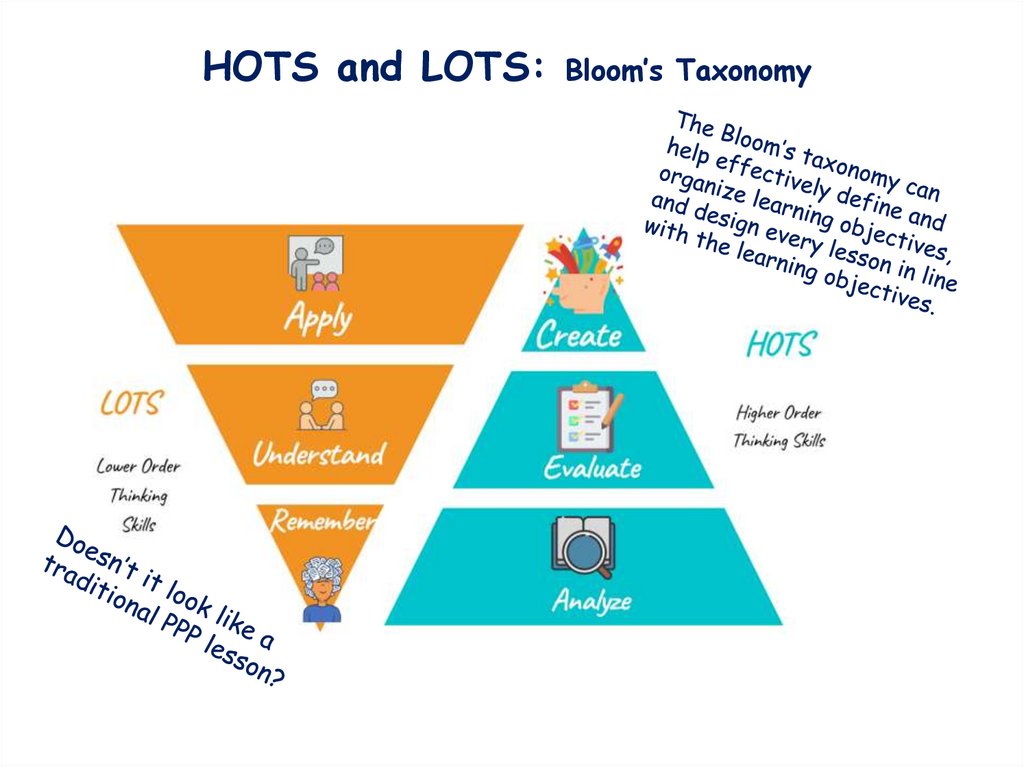
HOTS and LOTS: Bloom’s TaxonomyBloom's taxonomy is a framework for
categorizing educational goals, developed
by a committee of educators chaired by
Benjamin Bloom - an American educational
psychologist - in 1956.
In 2001, this taxonomy was revised, renaming
and reordering the levels as …
• Remember
• Understand
• Apply
• Analyze
• Evaluate
• Create
‘’Taxonomy of Educational
Objectives: The Classification of
Educational Goals’’
9.
HOTS and LOTS: Bloom’s Taxonomy10.
HOTS and LOTS: Bloom’s TaxonomyWhich is better?
NONE!
All are equally important
11.
HOTS and LOTS: Bloom’s Taxonomy12.
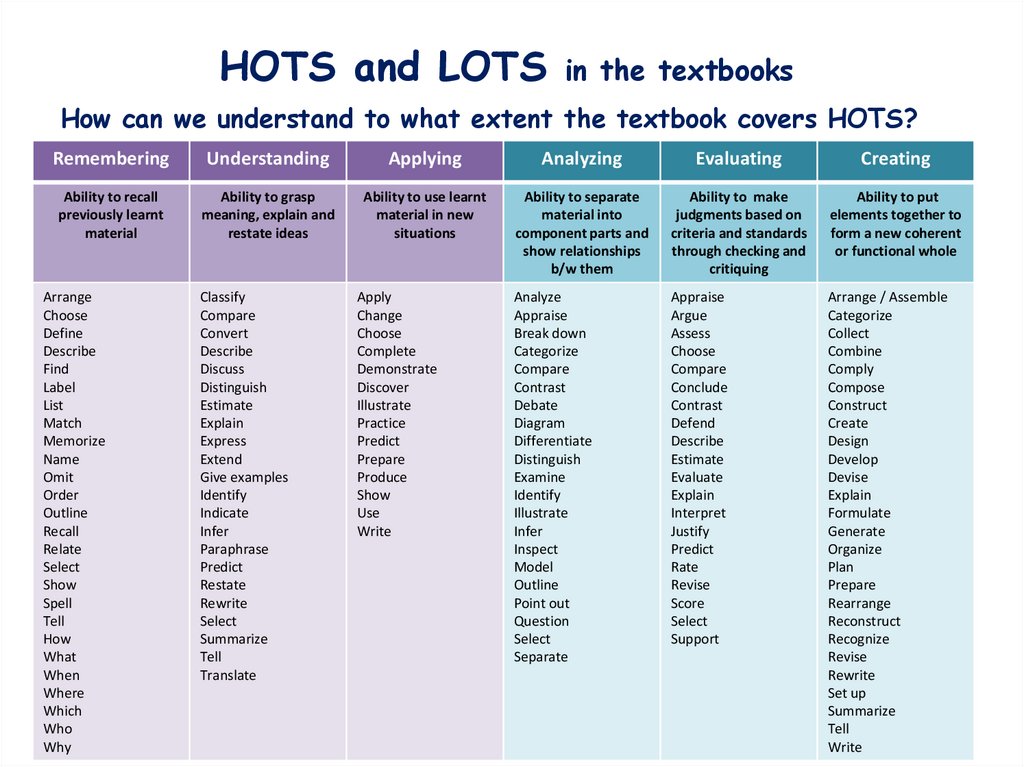
HOTS and LOTS: Bloom’s TaxonomyRemembering is the first step in the cognitive process. It arises when students
explain, discuss, inform, or specify an issue.
The next step is understanding. It occurs when students have completely
understood what they have read/watched/listened to. Retelling, inferring,
interpreting, explaining, predicting, and outlining information are the keywords at
this level.
The third step is applying. Students are required to apply what they have learned
in the classroom in a new context.
The fourth step is analyzing. It comprises breaking down a substance into its
constituent pieces and figuring out how the components fit together to form a
bigger structure. Differentiating, arranging, and attributing are some of the
keywords.
The fifth step is evaluating. It comprises making a decision based on a set of
criteria.
The last step is creating. Creating means putting elements together into a form
and the whole form is coherent and functional. The keywords at this stage are
generating or describing problems, planning, and producing.
13.
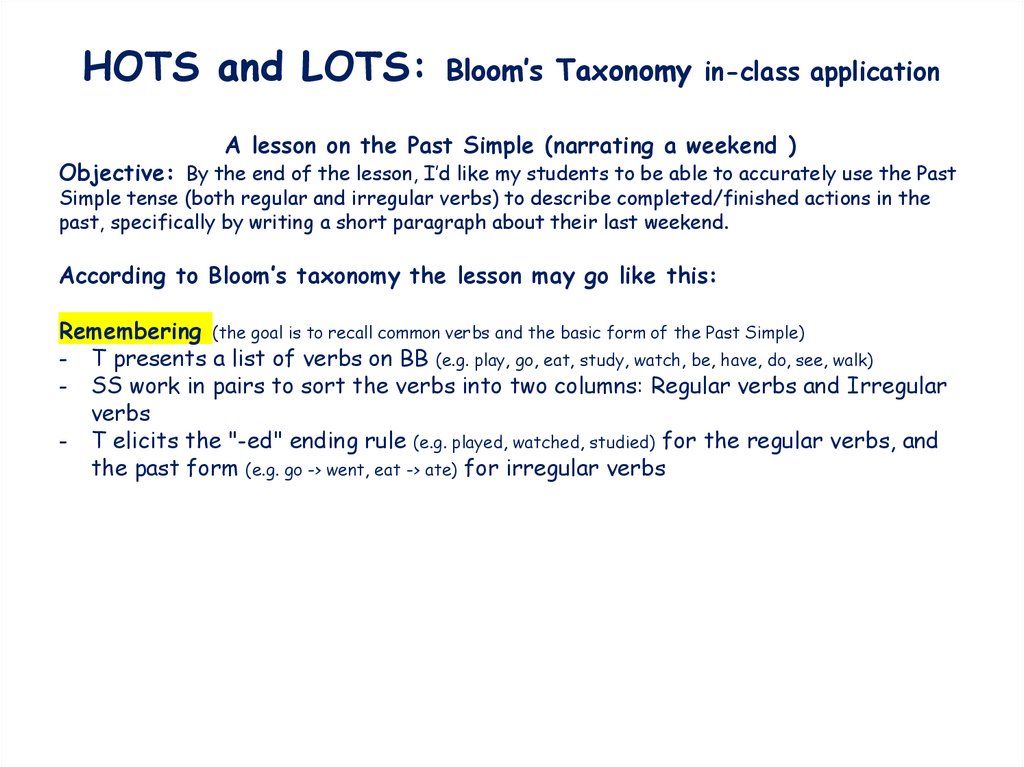
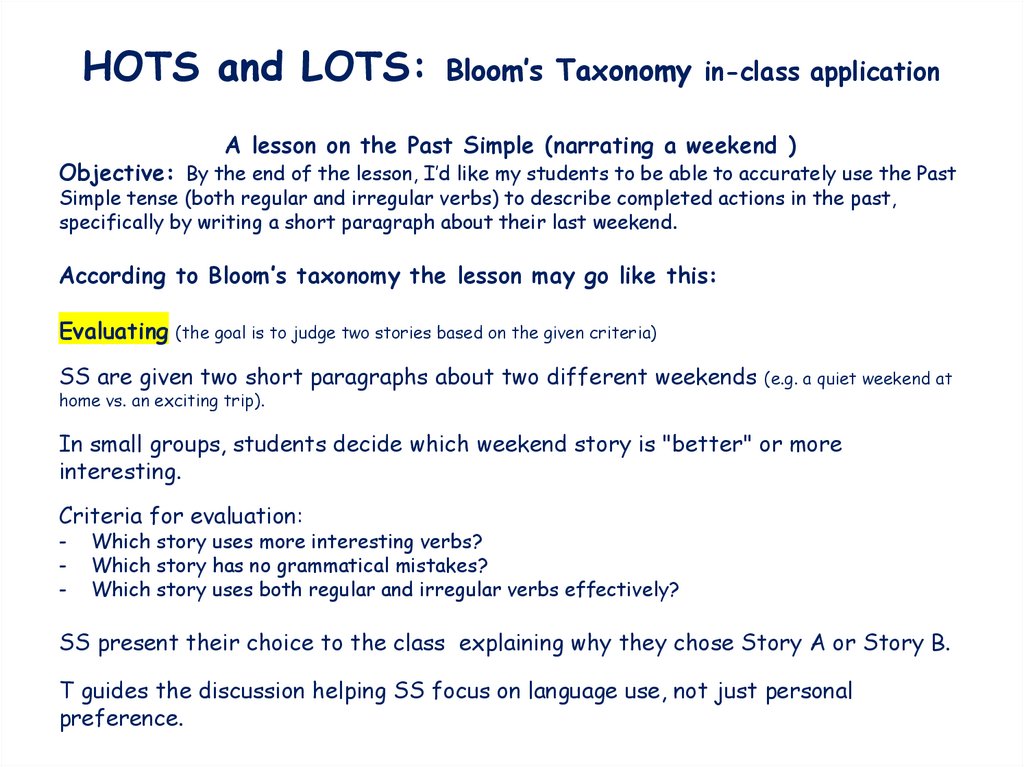
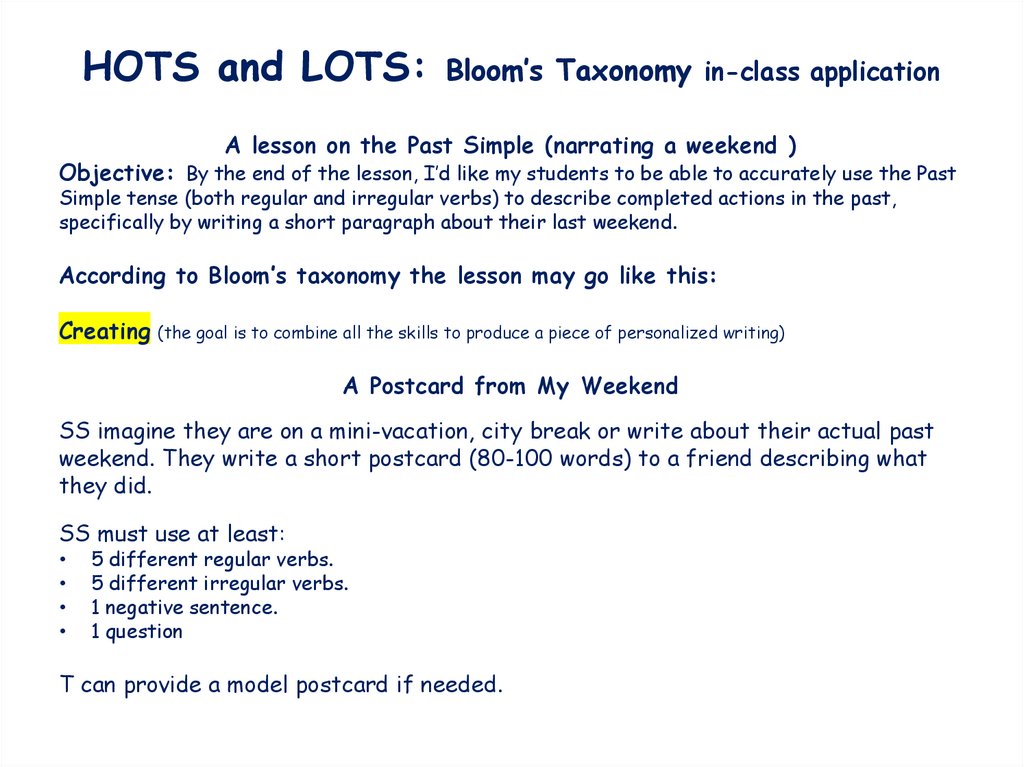
HOTS and LOTS: Bloom’s Taxonomy in-class applicationA lesson on the Past Simple (narrating a weekend )
Objective: By the end of the lesson, I’d like my students to be able to accurately use the Past
Simple tense (both regular and irregular verbs) to describe completed/finished actions in the
past, specifically by writing a short paragraph about their last weekend.
According to Bloom’s taxonomy the lesson may go like this:
Remembering (the goal is to recall common verbs and the basic form of the Past Simple)
- T presents a list of verbs on BB (e.g. play, go, eat, study, watch, be, have, do, see, walk)
- SS work in pairs to sort the verbs into two columns: Regular verbs and Irregular
verbs
- T elicits the "-ed" ending rule (e.g. played, watched, studied) for the regular verbs, and
the past form (e.g. go -> went, eat -> ate) for irregular verbs
14.
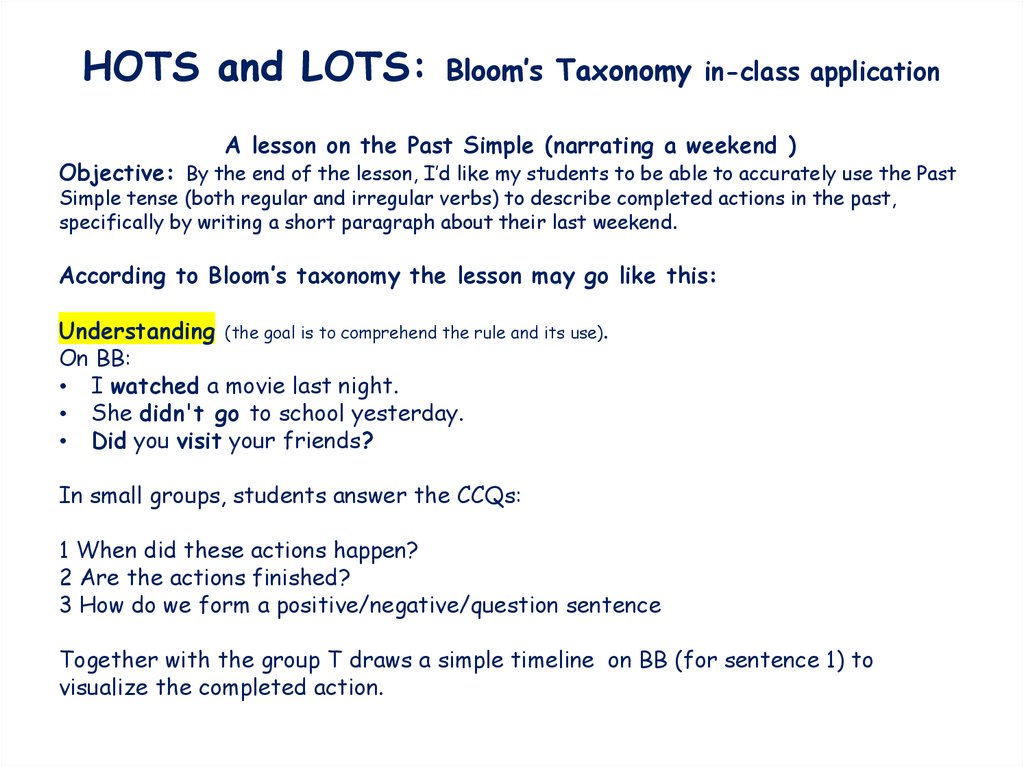
HOTS and LOTS: Bloom’s Taxonomy in-class applicationA lesson on the Past Simple (narrating a weekend )
Objective: By the end of the lesson, I’d like my students to be able to accurately use the Past
Simple tense (both regular and irregular verbs) to describe completed actions in the past,
specifically by writing a short paragraph about their last weekend.
According to Bloom’s taxonomy the lesson may go like this:
Understanding (the goal is to comprehend the rule and its use).
On BB:
• I watched a movie last night.
• She didn't go to school yesterday.
• Did you visit your friends?
In small groups, students answer the CCQs:
1 When did these actions happen?
2 Are the actions finished?
3 How do we form a positive/negative/question sentence
Together with the group T draws a simple timeline on BB (for sentence 1) to
visualize the completed action.
15.
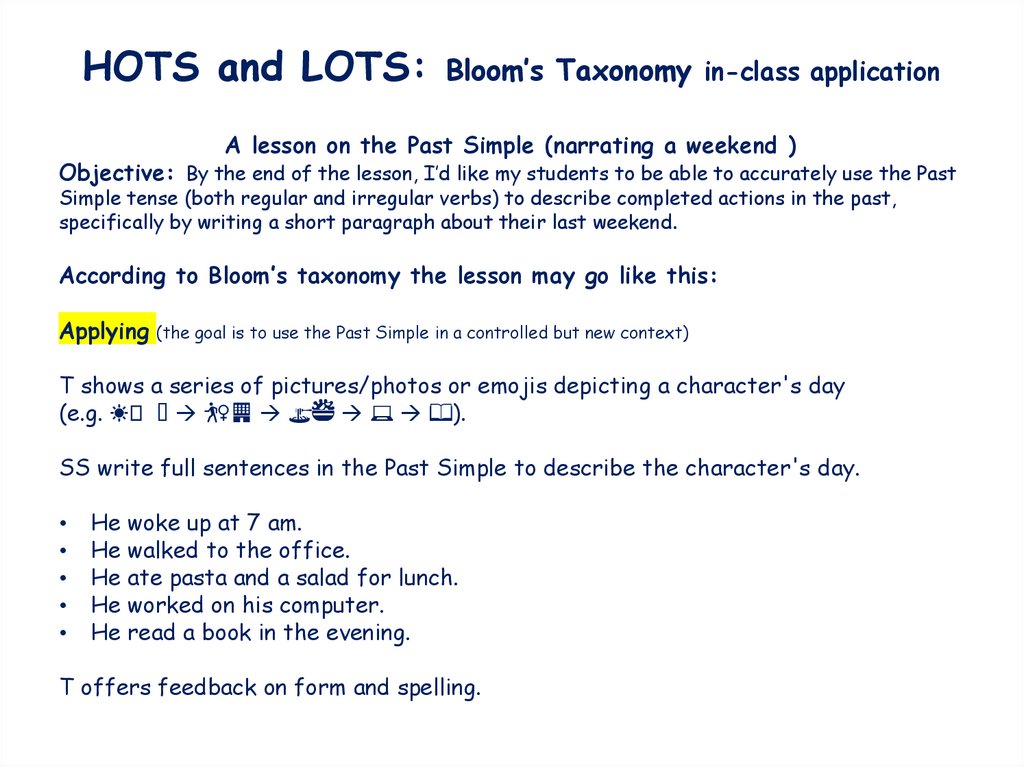
HOTS and LOTS: Bloom’s Taxonomy in-class applicationA lesson on the Past Simple (narrating a weekend )
Objective: By the end of the lesson, I’d like my students to be able to accurately use the Past
Simple tense (both regular and irregular verbs) to describe completed actions in the past,
specifically by writing a short paragraph about their last weekend.
According to Bloom’s taxonomy the lesson may go like this:
Applying (the goal is to use the Past Simple in a controlled but new context)
T shows a series of pictures/photos or emojis depicting a character's day
(e.g. ☀