 Литература
Похожие презентации:








The Archetype of the Fallen Angel and Its National Specificity: Milton's Satan and Lermontov's Demon in a Comparative
1. The Archetype of the Fallen Angel and Its National Specificity: Milton's Satan and Lermontov's Demon in a Comparative
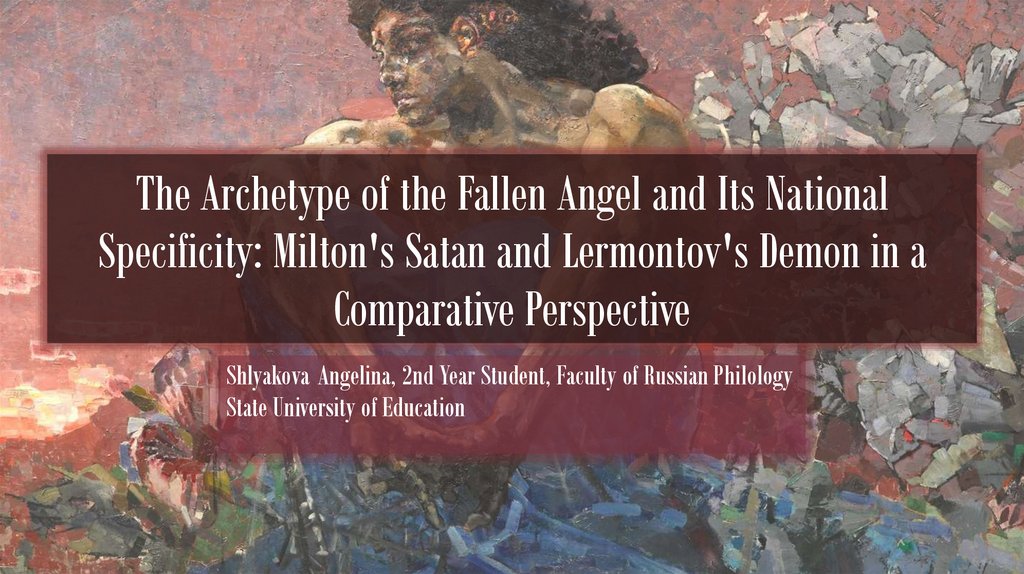
The Archetype of the Fallen Angel and Its NationalSpecificity: Milton's Satan and Lermontov's Demon in a
Comparative Perspective
Shlyakova Angelina, 2nd Year Student, Faculty of Russian Philology
State University of Education
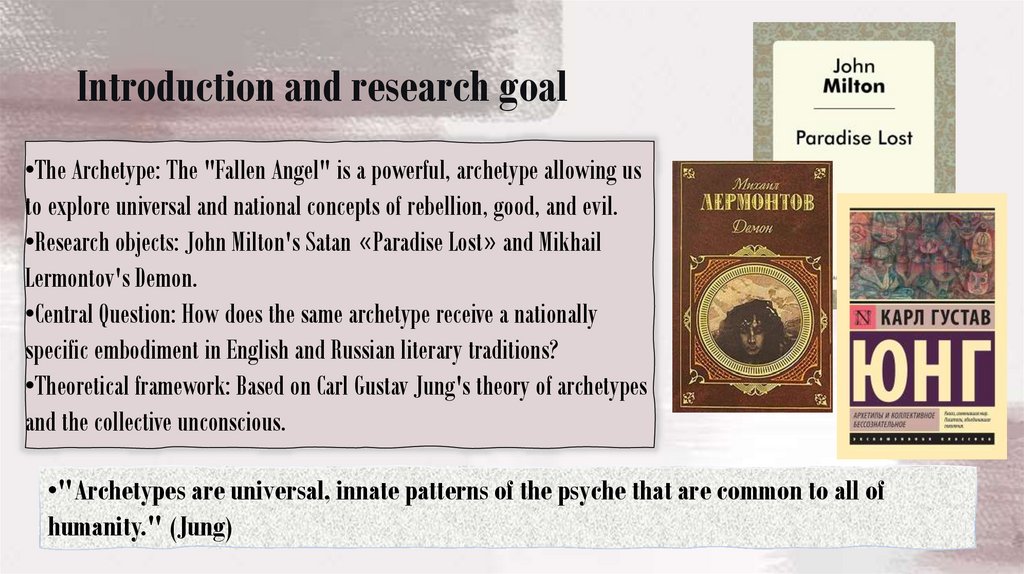
2. Introduction and research goal
•The Archetype: The "Fallen Angel" is a powerful, archetype allowing usto explore universal and national concepts of rebellion, good, and evil.
•Research objects: John Milton's Satan «Paradise Lost» and Mikhail
Lermontov's Demon.
•Central Question: How does the same archetype receive a nationally
specific embodiment in English and Russian literary traditions?
•Theoretical framework: Based on Carl Gustav Jung's theory of archetypes
and the collective unconscious.
•"Archetypes are universal, innate patterns of the psyche that are common to all of
humanity." (Jung)
3. Theoretical Basis: Jung's "Shadow" Archetype
Theoretical Basis: Jung's "Shadow" Archetype•The Shadow: The dark, repressed side of the personality, containing qualities
the conscious self denies.
•The "Fallen Angel" as a cultural shadow: In Christian culture, this figure
embodies the repressed aspects of pride, rebellion, and the potential for evil within
a divine system.
•Common archetypal core:
• The status of the exiled: Cast out from Heaven; the repressed part of the
psyche.
• Ambivalent nature: A blend of destructive force and tragic grandeur.
• Cognitive function: They bring knowledge of the darker aspects of
existence.
4. Comparison I: Reason for rebellion and motivation
Milton's Satan: the political rebelRebellion is a conscious, ideological choice
against divine authority.
Motivation: Vengeance and the will to power.
«To do aught good never will be our task, / But
ever to do ill our sole delight, / As being the
contrary to his high will / Whom we resist.»
Lermontov's Demon: the metaphysical
sufferer
Rebellion is a state of metaphysical boredom and
existential protest.
Motivation: not political, but a search for meaning.
«Он сеял зло без наслажденья. / ...И зло
наскучило ему.»
Conclusion: Satan is a politician rebelling against the system; Demon is a sufferer rebelling against
existence itself.
5. Comparison II: The condition of the characters; the nature of suffering.
Satan's Suffering: Active and OutwardFocused on the loss of status and power. His hell is an
internal, self-destructive realization.
««Farewell, happy fields, / Where joy for ever dwells! Hail, horrors!
hail, / Infernal world! and thou, profoundest Hell, / Receive thy new
possessor...»
«Which way I fly is Hell; myself am Hell; / And in the lowest deep, a
lower deep / Still threatening to devour me opens wide, / To which
the Hell I suffer seems a Heaven».
Demon's Suffering: Passive and Inward
An existential void, a sense of divine
abandonment. His hell is the meaninglessness .
"Что без тебя мне вечность, / Моих
владений бесконечность? / Пустые,
звучные слова, / Обширный храм — без
божества!"
Thus, the nature of their suffering defines the very direction of their rebellion: Satan's is an active,
outward struggle for a lost kingdom, while the Demon's is a passive, inward torment over a lost
meaning.
6. Comparison III: Relationship to the world and purpose of actions
Satan's Goal: power and destructionHis goal is power and sovereignty. He consciously
chooses Evil as his philosophy and aims to establish
his own kingdom. His attitude is destructive.
«Better to reign in Hell than serve in Heaven»,
«So farewell, hope; and with hope farewell, fear; /
Farewell, remorse! all good to me is lost; / Evil, be thou
my good;»
Demon’s goal: redemption and love
His objective is to return; he seeks not a new
kingdom but redemption and reconciliation. His
energy is directed toward healing sin through love.
«Меня добру и небесам / Ты
возвратить могла бы словом.»
Conclusion: Satan's relationship to the world is fundamentally destructive, aimed at establishing his
own power, while the Demon seeks reconciliation and a return to lost harmony.
7. Comparison IV: Will.
Satan's Will: An Instrument of DestructionHis will is a tool for ambition and revenge, ready for
any moral degradation to achieve his goals. It is
directed outward, toward the restoration of his power.
«But what will not ambition and revenge / Descend
to? Who aspires, must down as low / As high he
soared;»
Demon's Will: An Impulse for Salvation
The highest manifestation of his will is the courage
to attempt transformation. It is directed inward,
toward overcoming his own nature and achieving
salvation.
«И входит он, любить готовый, / С
душой, открытой для добра...»
Conclusion: Thus, Satan's will is an instrument of destruction, even at the cost of self-degradation,
while the Demon's will is an impulse for salvation through the acknowledgment of his own weakness.
8. Conclusion: National embodiment of the archetype
Thus, this research confirms that the universal Shadow archetype acquires distinct national content, demonstratinghow art reflects «the mental state of an entire people, epoch, and culture» [4]. Milton's Satan embodies the political
rebel, whose outward-directed conflict, will to power, and suffering from lost status epitomize the rational, willful
English spirit of the Enlightenment. In contrast, Lermontov's Demon personifies the metaphysical seeker, whose
inward rebellion reflects the "Russian soul" through reflection and existential suffering. As scholars note, «good
and evil in Lermontov's poem form a complex dialectical unity, where even the Demon is capable of sincere tears of
tenderness» [3], yet «the triumph of evil here paradoxically serves the fulfillment of a Divine plan» [3].
Ultimately, while Milton articulated the archetype through titanic will to power, Lermontov expressed it as
metaphysical longing, proving how fundamental archetypes are refracted through national consciousness to create
equally brilliant artistic phenomena.
Final Thesis: The universal archetype of the Shadow is filled with specific national content, demonstrating how national
consciousness shapes fundamental cultural patterns.
9. References
• 1.Лермонтов, М. Ю. Демон: поэма [Электронный ресурс] / М. Ю. Лермонтов //
Культура.РФ. — URL: https://www.culture.ru/poems/36747/demon (дата обращения:
08.11.2025).
• 2.
Milton, J. Paradise Lost [Electronic resource] / J. Milton. — Electronic data. — Project
Gutenberg, 2021. — Mode of access: https://www.gutenberg.org/cache/epub/26/pg26images.html (дата обращения: 08.11.2025).
• 3.
Анализ поэмы М. Ю. Лермонтова «Демон» [Электронный ресурс] //
Polka.academy. — URL: https://polka.academy/articles/569?block=3295 (дата
обращения: 24.11.2025).
• 4.
Архетип "тени" в искусстве XX в. [Электронный ресурс] // КиберЛенинка. —
URL: https://cyberleninka.ru/article/n/arhetip-teni-v-iskusstve-xx-v/viewer (дата
обращения: 24.11.2025).
• 5.
Бисерова, А.Д. Образ Сатаны в поэме Дж. Мильтона «Потерянный рай» и
трилогии Ф. Пулмана «Темные начала» / А.Д. Бисерова // Вестник РГГУ. Серия
«Литературоведение. Языкознание. Культурология». — 2024. — № 3. — С. 207–214.
• 6.
Юнг, К. Г. Архетипы и коллективное бессознательное / К. Г. Юнг; перевод с
немецкого А. Чечиной. — Москва: АСТ, 2020. — 352 с. — (Собрание сочинений; т. 9, ч.
1). — ISBN 978-5-17-132900-9.