
 Педагогика
Похожие презентации:






Effective Techniques of Teaching Vocabulary in Different Age Groups
1. Effective Techniques of Teaching Vocabulary in Different Age Groups
EFFECTIVETECHNIQUES OF
TEACHING
VOCABULARY IN
DIFFERENT AGE
GROUPS
2.
2This dissertation provides information about the methods and techniques of
vocabulary memorization in different age groups and provides information
about the scientific work of scientists from Uzbek, European and CIS countries.
Structure of dissertation
Chapter 1: Modern techniques of vocabulary teaching.
Chapter 2: Cognitive approach to vocabulary learning.
Chapter 3: Effective techniques for different age groups.
Conclusion and recommendations.
3. Strategies and Techniques Contextual learning, Visual aids, word maps, card methods, stickers method, combination method,
STRATEGIES AND TECHNIQUESCONTEXTUAL LEARNING, VISUAL AIDS, WORD MAPS, CARD METHODS,
STICKERS METHOD, COMBINATION METHOD, CATEGORIZE, BOARD
RUSH, SNAP
THE COGNITIVE APPROACH EXPLAINS LANGUAGE LEARNING IN
TERMS OF MENTAL PROCESSES, NAMELY PERCEPTION, MEMORY,
ATTENTION, AND THINKING.
THE ACQUISITION OF LEXICAL UNITS OCCURS THROUGH MEANING
CREATION, DEEP PROCESSING, AND ASSOCIATION.
THE LEARNER IS AN ACTIVE PARTICIPANT AND USES VARIOUS
STRATEGIES TO PLACE NEW WORDS IN LONG-TERM MEMORY.
4.
Communicative techniques in EFL/ESL lessonsSlide points:
The main goal of the communicative approach is to prepare for real communication.
Communicative techniques used to increase vocabulary:
Role-play (role-playing games) - using words in a natural situation.
Information talk - communicating through the exchange of information.
Pair work / Group work - exchanging ideas, active use of words.
Task-based learning - mastering vocabulary in the process of completing a task.
Debate / Discussion - expressing opinions through new words.
5.
Memorizing words through cognitive and metacognitive strategies
Slide-appropriate scientific ideas:
Cognitive strategies
Word repetition, writing out, segmentation
Association: linking a word with an image, picture, color, sound
Word mapping: semantic maps, clusters
Morphological analysis: separating prefixes and suffixes
Contextual learning: mastering within a sentence, text
5
6.
Metacognitive strategiesSelf-monitoring: which words one knows and which ones
one does not
Planning: daily/weekly vocabulary learning plan
Monitoring: observing one's own learning activity during
the lesson
Self-assessment: tests, mini-quizzes, peer assessment
Strategy selection: knowing which method is most effective
for one
6
7.
Techniques for Young LearnersSong-based vocabulary learning • Gestures and TPR activities • Flashcards and
storytelling • Cartoon videos and games These methods keep children motivated
and engaged.
Techniques for Teenagers
Contextual learning through stories and texts Group tasks and competitions Word
maps and semantic networks • Debates and speaking clubs Teenagers learn better
with interactive and social activities.
Techniques for Adults
Authentic materials (news, podcasts, articles) Professional vocabulary tasks Selfdirected learning strategies Memory techniques like mnemonics and spaced
repetition Adults benefit from practical, goal-oriented methods.
7
8.
8I tested the methods among young foreign language learners in kindergarten.
Songs -60%
Games-70%
Visual tools-85%
Stories gave 45% results
Practice with matching-90%
Try word maps-75%
Word games featuring prefixes, suffixes, and roots -80%
Vocabulary Jeopardy-70%
9.
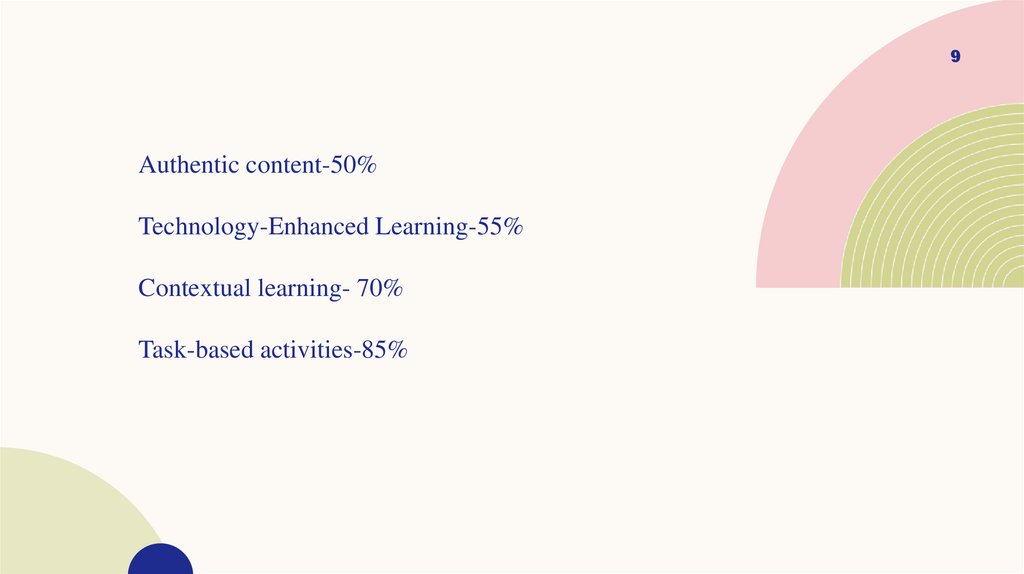
9Authentic content-50%
Technology-Enhanced Learning-55%
Contextual learning- 70%
Task-based activities-85%
10.
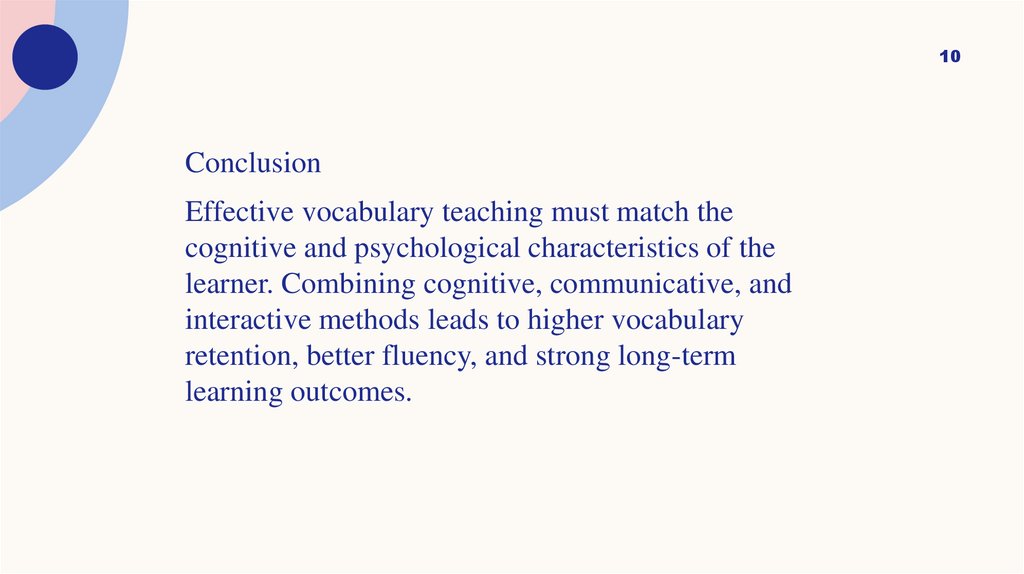
10Conclusion
Effective vocabulary teaching must match the
cognitive and psychological characteristics of the
learner. Combining cognitive, communicative, and
interactive methods leads to higher vocabulary
retention, better fluency, and strong long-term
learning outcomes.
11. Thank you for attention
THANK YOU FORATTENTION