





 Электроника
Похожие презентации:








Telephoning in business communication. Topic 8
1. TELEPHONING IN BUSINESS COMMUNICATION
Topic 8.2.
Plan:1. Notion and structural elements
of telephone communication
2. Making productive telephone
calls
3. Receiving productive telephone
calls
3. I. Notion and structural elements of telephone communication
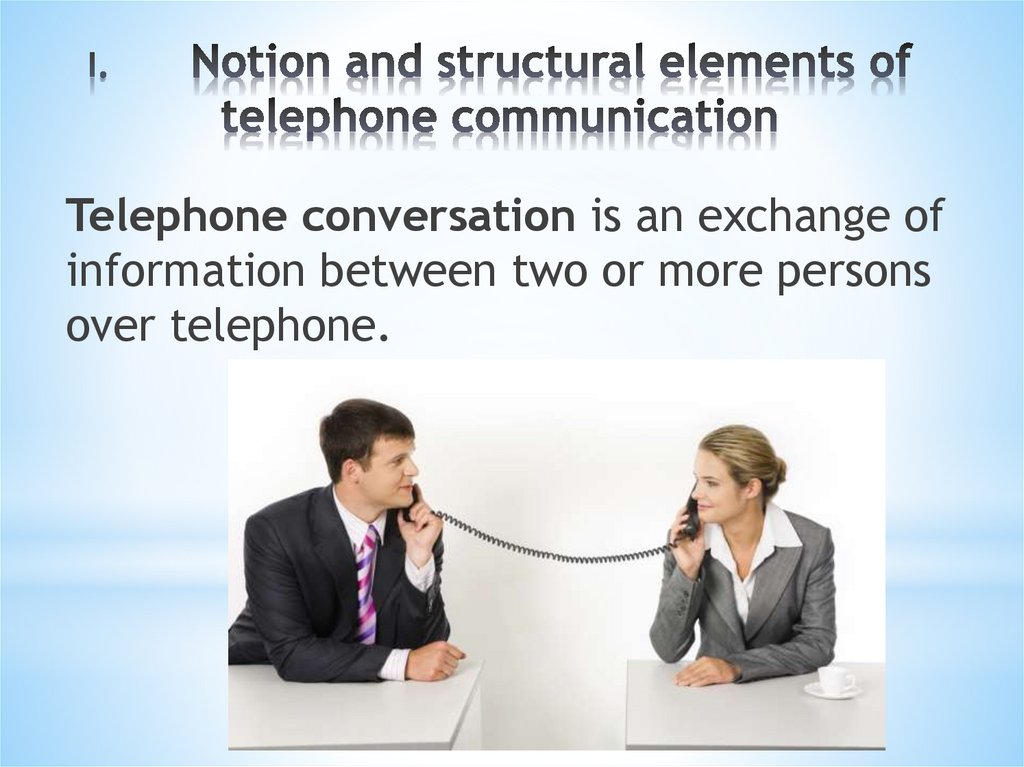
Telephone conversation is an exchange ofinformation between two or more persons
over telephone.
4.
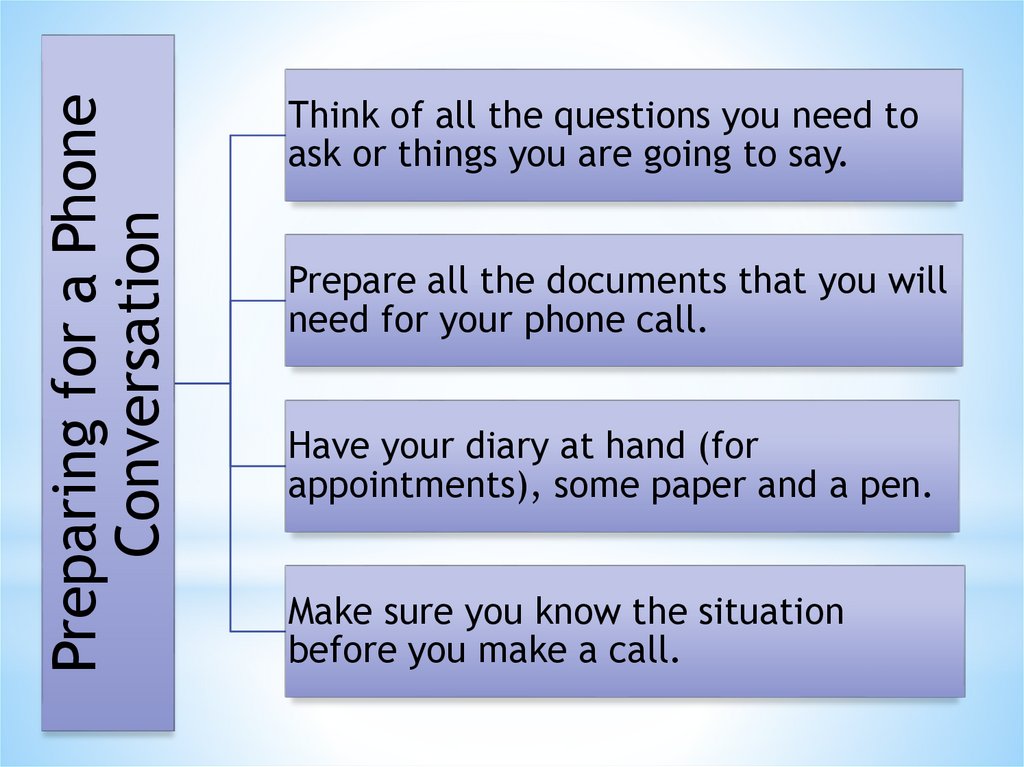
Preparing for а PhoneConversation
Think of all the questions you need to
ask or things you are going to say.
Prepare all the documents that you will
need for your phone call.
Have your diary at hand (for
appointments), some paper and a pen.
Make sure you know the situation
before you make a call.
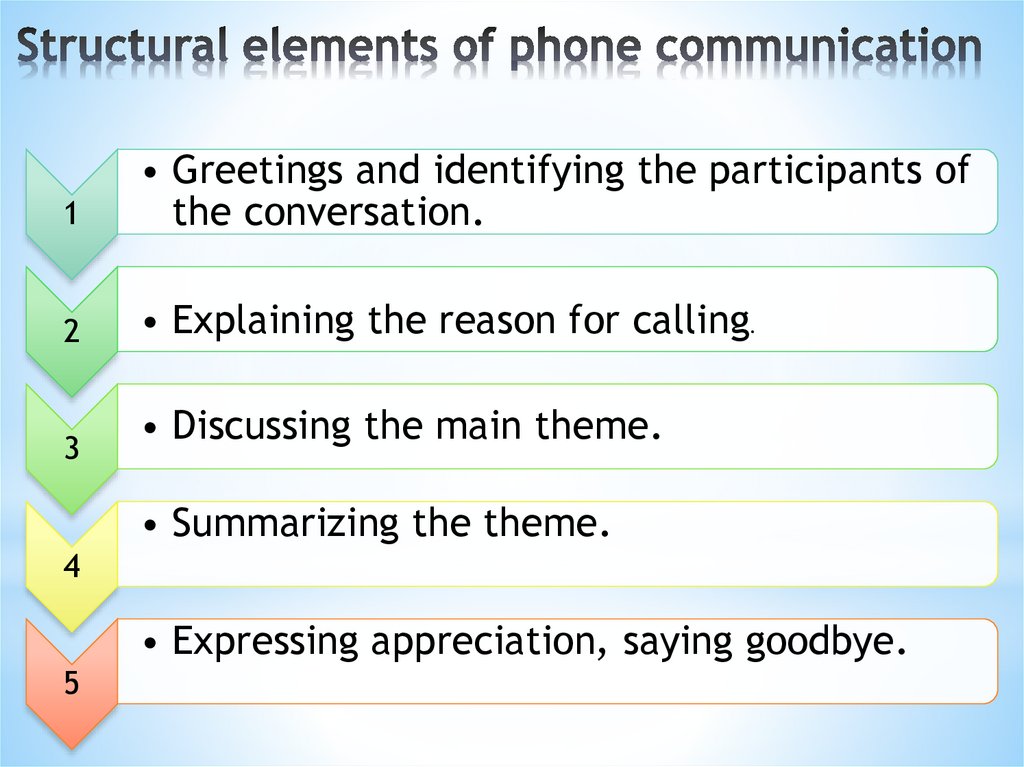
5. Structural elements of phone communication
1• Greetings and identifying the participants of
the conversation.
2
• Explaining the reason for calling.
3
• Discussing the main theme.
• Summarizing the theme.
4
• Expressing appreciation, saying goodbye.
5
6. 1. Greetings and identifying the participants of the conversation
1.1.Introducing
yourself
Good
morning! /
Hello, this is
... from ....
Hello, my
name's ...
calling from
...
1.2.
Saying who
you want
I'd like to
speak to ...,
please.
Could I have
the ...
Department,
please?
7.
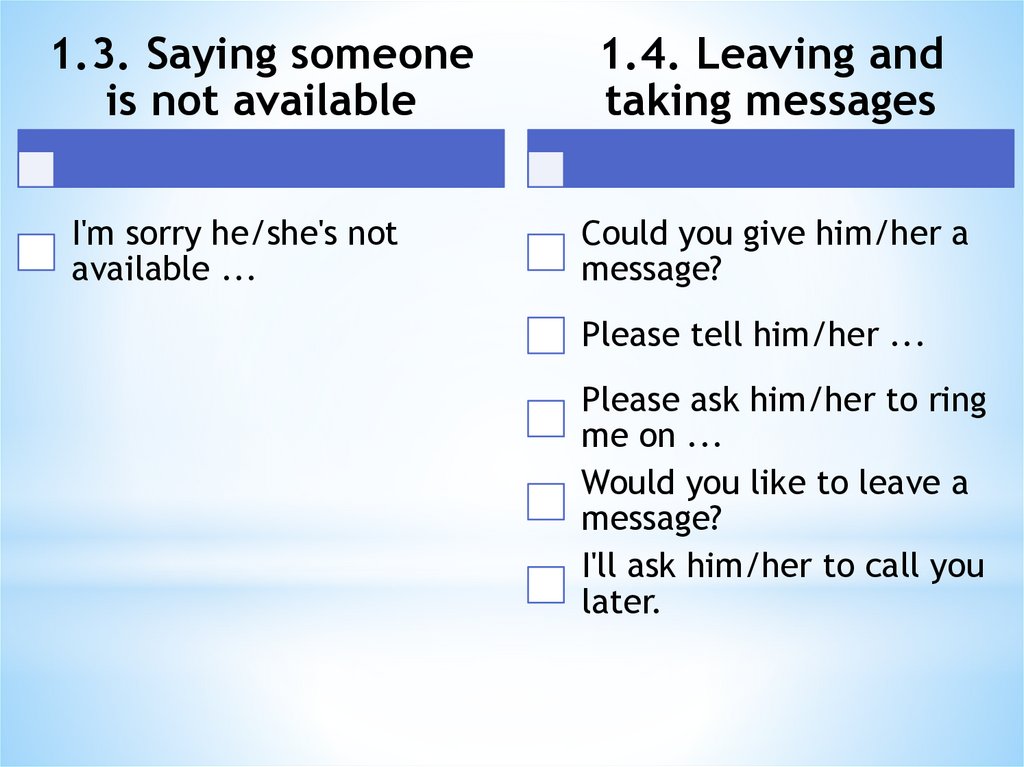
1.3. Saying someoneis not available
1.4. Leaving and
taking messages
I'm sorry he/she's not
available ...
Could you give him/her a
message?
Please tell him/her ...
Please ask him/her to ring
me on ...
Would you like to leave a
message?
I'll ask him/her to call you
later.
8.
Can anyone else help you?1.5.
Offering
to help
in other
ways
Can I help you perhaps?
Would you like to speak to his /her
assistant?
Shall I ask him / her to call you
back?
9.
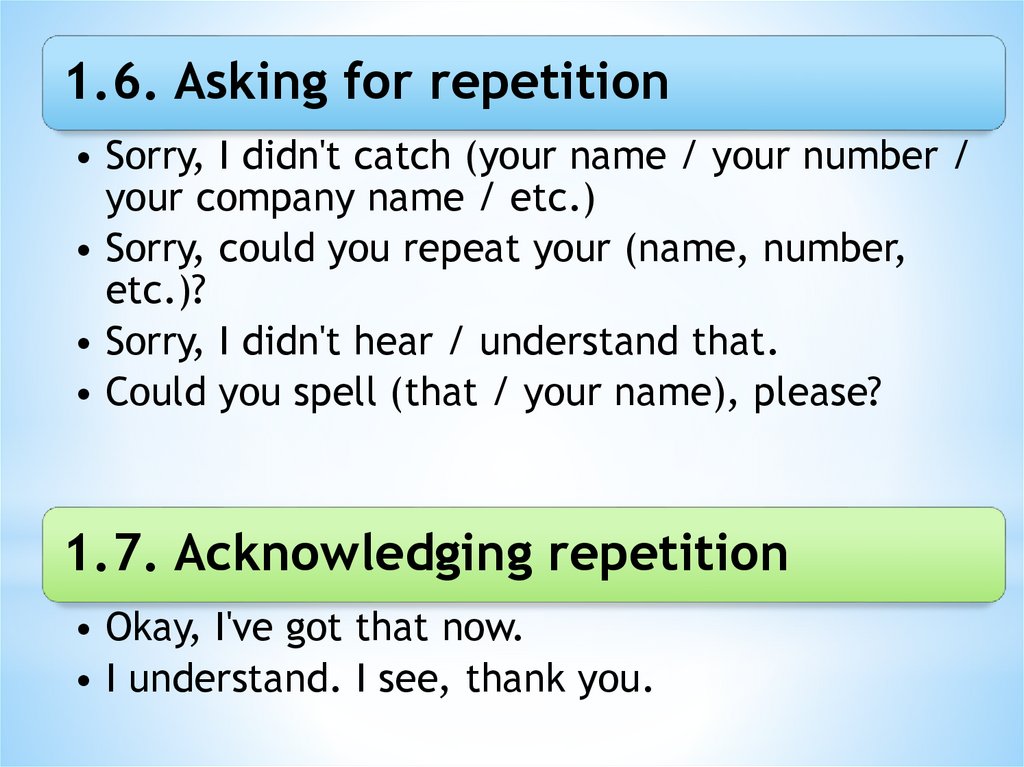
1.6. Asking for repetition• Sorry, I didn't catch (your name / your number /
your company name / etc.)
• Sorry, could you repeat your (name, number,
etc.)?
• Sorry, I didn't hear / understand that.
• Could you spell (that / your name), please?
1.7. Acknowledging repetition
• Okay, I've got that now.
• I understand. I see, thank you.
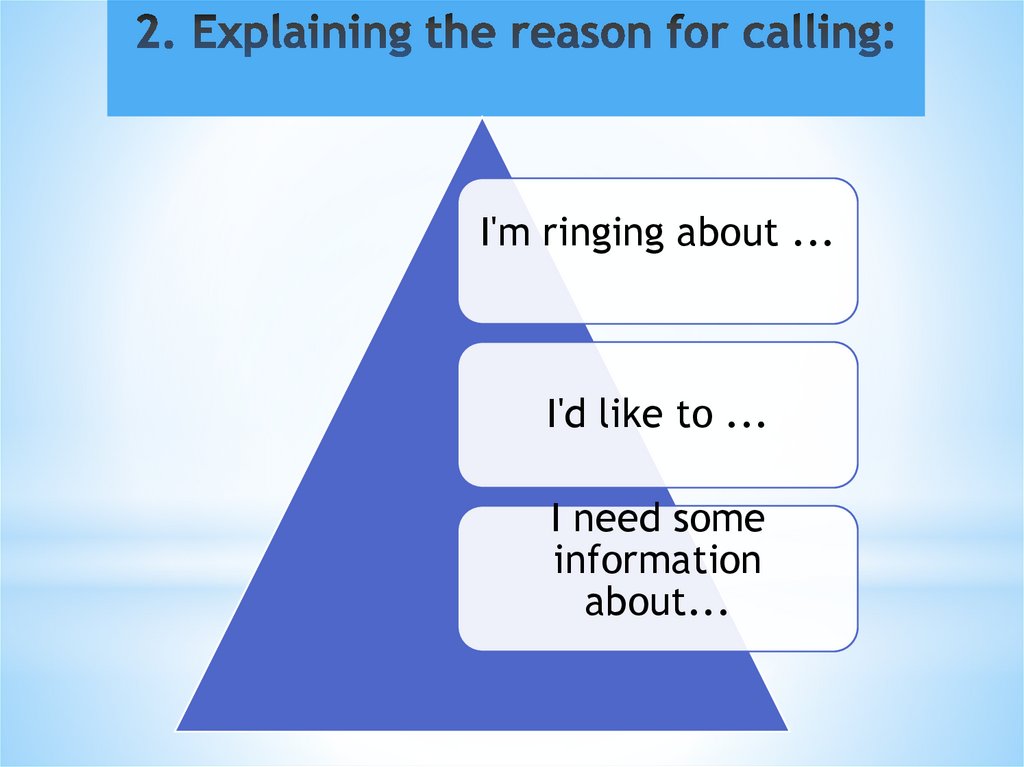
10. 2. Explaining the reason for calling:
I'm ringing about ...I'd like to ...
I need some
information
about...
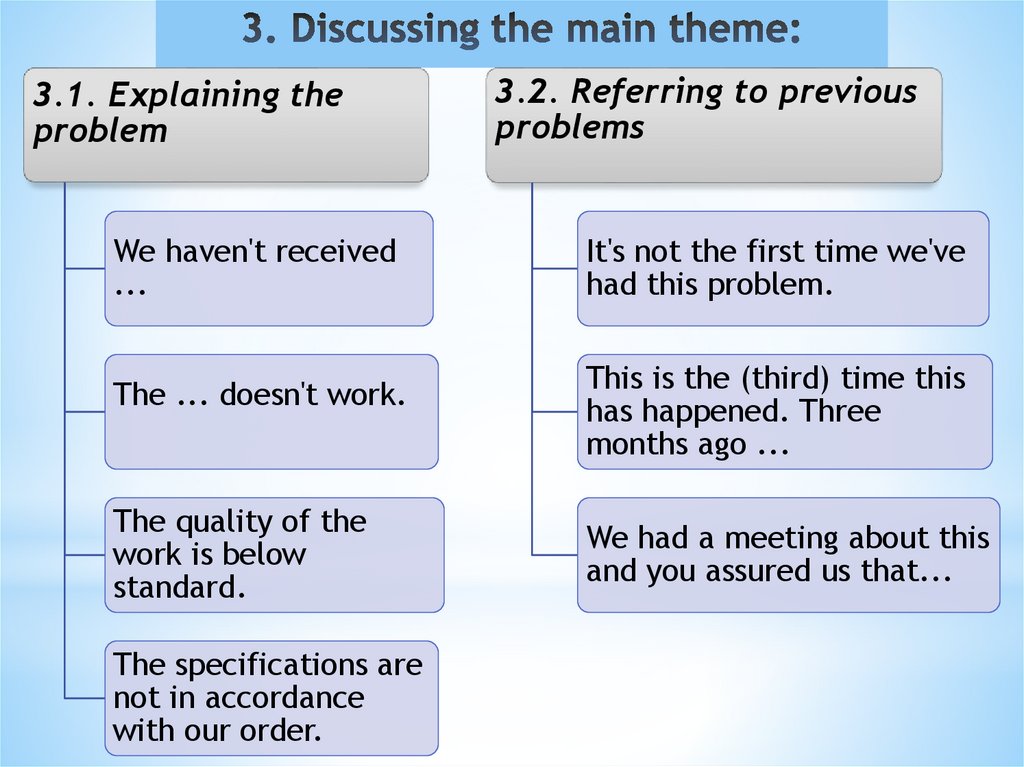
11. 3. Discussing the main theme:
3.1. Explaining theproblem
We haven't received
...
The ... doesn't work.
The quality of the
work is below
standard.
The specifications are
not in accordance
with our order.
3.2. Referring to previous
problems
It's not the first time we've
had this problem.
This is the (third) time this
has happened. Three
months ago ...
We had a meeting about this
and you assured us that...
12.
3.4.Apologizing
3.5.
Denying an
accusation
Can you tell
me ... ?
I'm sorry to
hear that.
No, I don't
think that
can be right.
What's the
matter with
…?
I'm very sorry
about the
problem /
delay /
mistake ...
3.3. Asking
for details
I'm sorry but I
think you're
mistaken.
13.
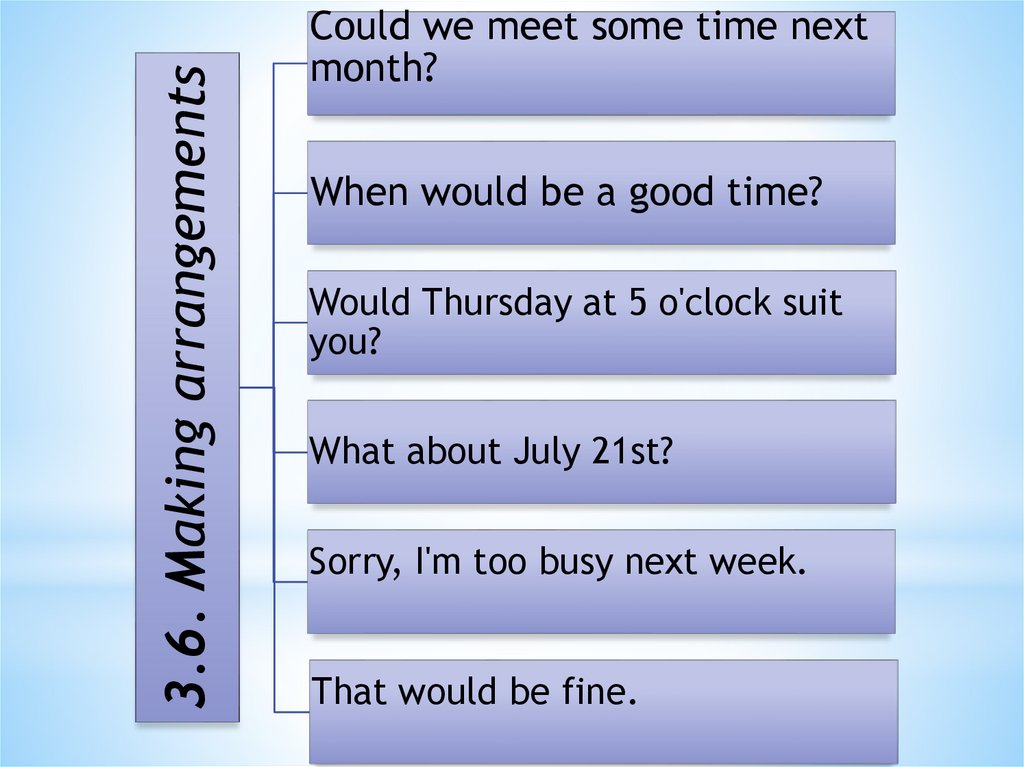
3.6. Making arrangementsCould we meet some time next
month?
When would be a good time?
Would Thursday at 5 o'clock suit
you?
What about July 21st?
Sorry, I'm too busy next week.
That would be fine.
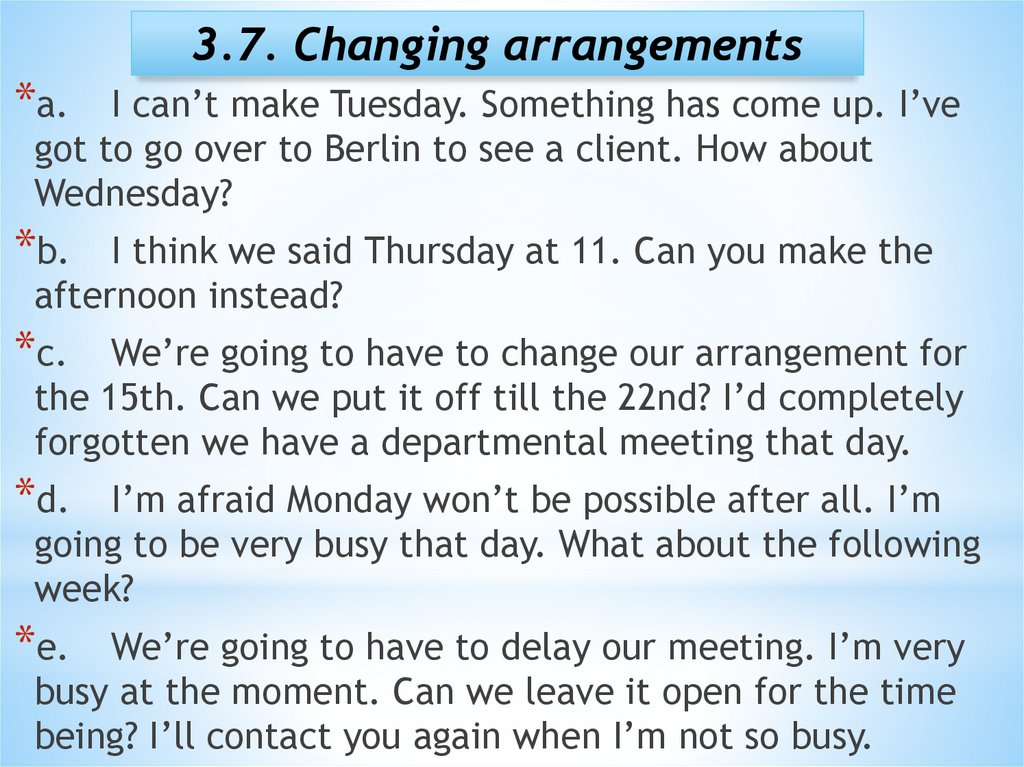
14. 3.7. Changing arrangements
*a.I can’t make Tuesday. Something has come up. I’ve
got to go over to Berlin to see a client. How about
Wednesday?
*b.
I think we said Thursday at 11. Can you make the
afternoon instead?
*c.
We’re going to have to change our arrangement for
the 15th. Can we put it off till the 22nd? I’d completely
forgotten we have a departmental meeting that day.
*d.
I’m afraid Monday won’t be possible after all. I’m
going to be very busy that day. What about the following
week?
*e.
We’re going to have to delay our meeting. I’m very
busy at the moment. Can we leave it open for the time
being? I’ll contact you again when I’m not so busy.
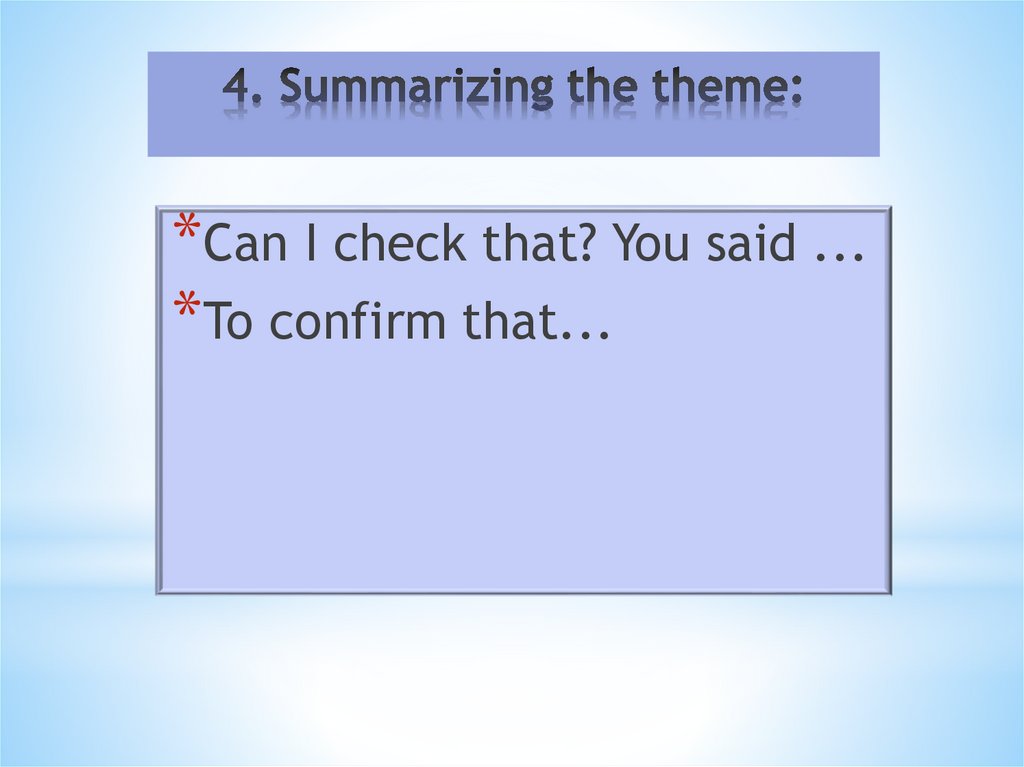
15. 4. Summarizing the theme:
*Can I check that? You said ...*To confirm that...
16.
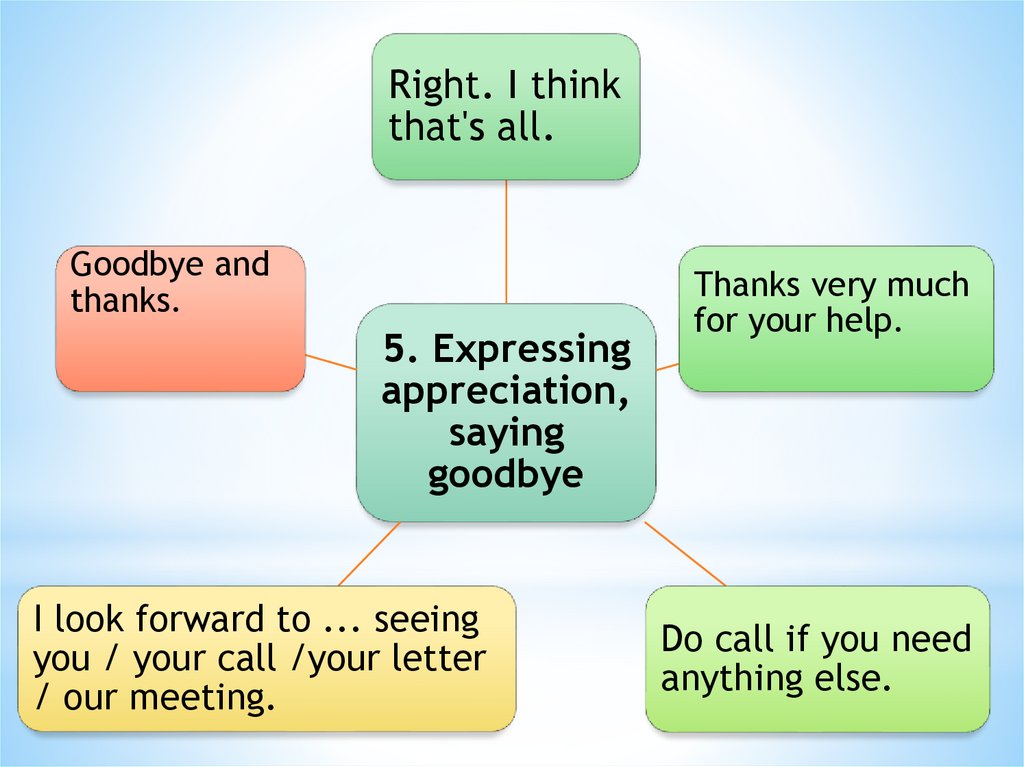
Right. I thinkthat's all.
Goodbye and
thanks.
5. Expressing
appreciation,
saying
goodbye
I look forward to ... seeing
you / your call /your letter
/ our meeting.
Thanks very much
for your help.
Do call if you need
anything else.
17. II. Making Productive Telephone Calls
1. Plan a mini-agenda.Before placing a call, jot down notes
regarding all the topics you need to
discuss.
18. 2.Use a three-point introduction: .
(1) name the person you are calling,(2) identify yourself and your
affiliation,
(3) give a brief explanation of your
reason for calling.
For example:
"May I speak to Larry Lopez? This is Hillary Dahl
of Sebastian Enterprises, and I'm seeking
information about a software program called
Power Presentations."
19. 3. Be cheerful
- Let your voice show the samekind of animation that you
radiate when you meet a person.
- In your mind try to envision the
individual answering the phone.
- A smile can affect the tone of
your voice, so smile at that
person.
20. 4. Be accurate.
For example:"It may take me two
or three minutes to
get that information.
Would you prefer to
hold or have me call
you back?"
21. 5. Bring it to a close. (The responsibility for ending a call lies with the caller.)
For example:"I've certainly enjoyed talking with you.“
"I've learned what I needed to know, and
now I can proceed with my work."
"I must go now, but may I call you again in
the future if I need ...?"
22. 6. Avoid telephone tag.
1) If you call someone who's not in,ask when it would be best for you to
call again.
2) State that you will call at a
specific time — and do it.
3) If you ask a person to call you,
give a time when you can be reached
— and then be sure you are in at that
time.
23. 7. Leave complete voice mail messages.
7. Leave complete voice mail messages.1. Don’t hurry.
3. Provide a complete
message, including
-your name,
-telephone number,
-the time and date of your
call.
2. Enunciate clearly.
4. Explain your purpose so
that the receiver can be
ready with the required
information when
returning your call.
24. III. Receiving productive telephone calls.
III. Receiving productive telephone calls.1. Identify yourself immediately.
Provide your
-name,
-title or affiliation,
-greeting.
For example:
"Larry Lopez, Proteus Software. How may
I help you?"
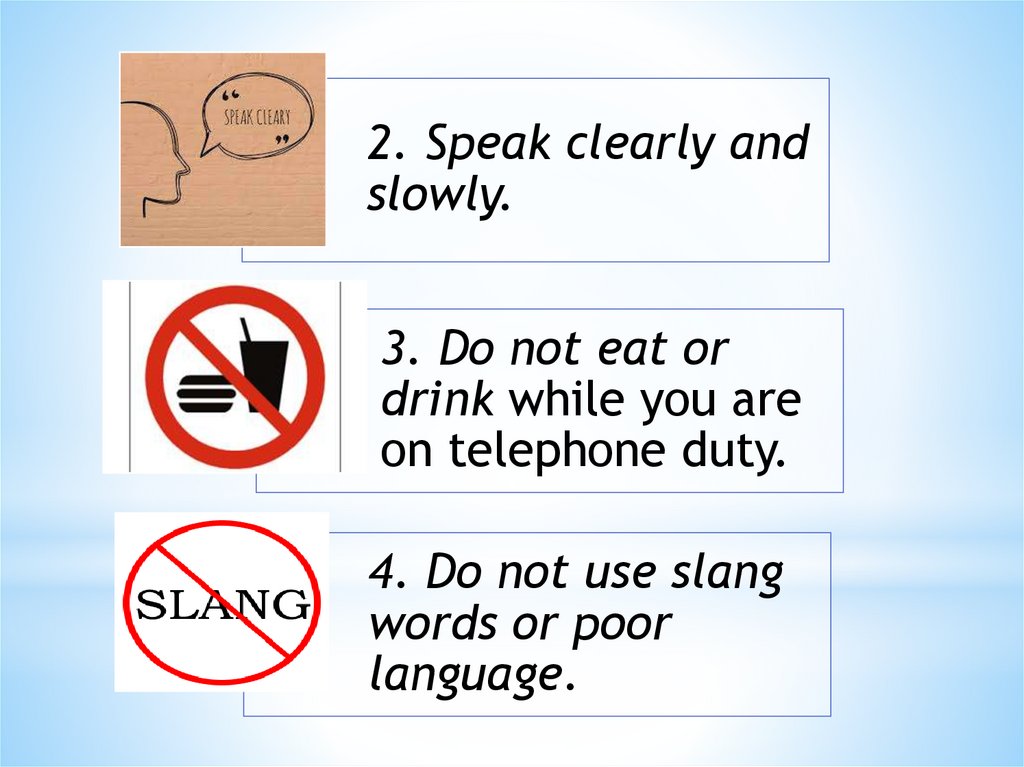
25.
2. Speak clearly andslowly.
3. Do not eat or
drink while you are
on telephone duty.
4. Do not use slang
words or poor
language.
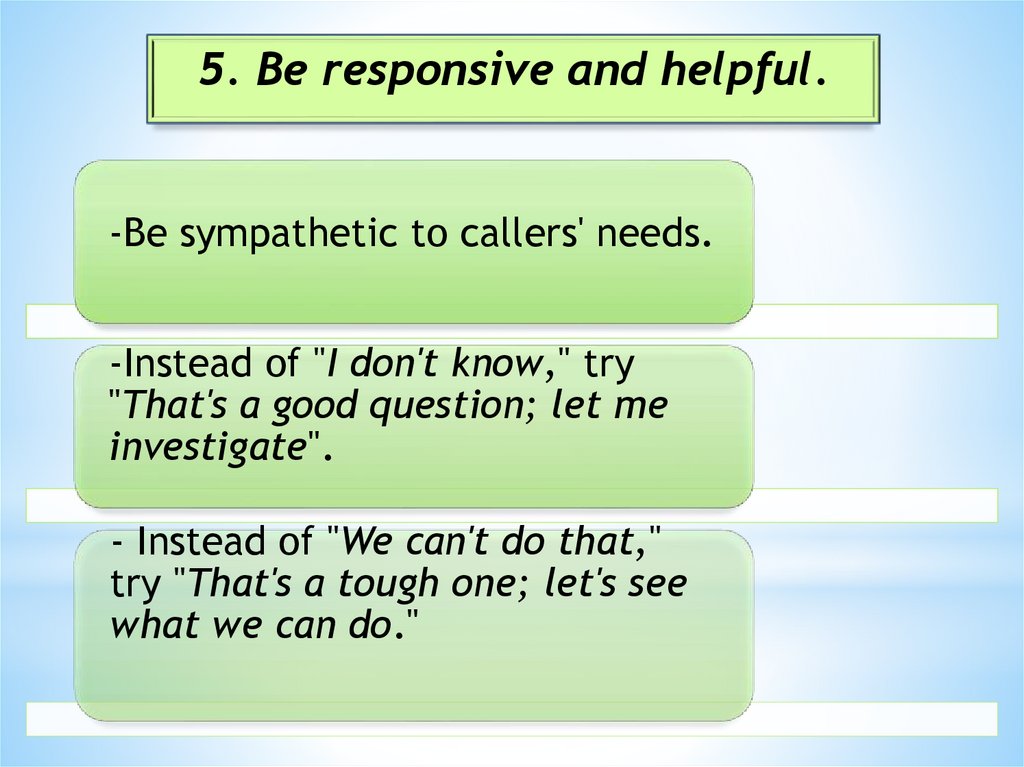
26. 5. Be responsive and helpful.
-Be sympathetic to callers' needs.-Instead of "I don't know," try
"That's a good question; let me
investigate".
- Instead of "We can't do that,"
try "That's a tough one; let's see
what we can do."
27.
6. Always focus on the call.Try not to get distracted by
people around you.
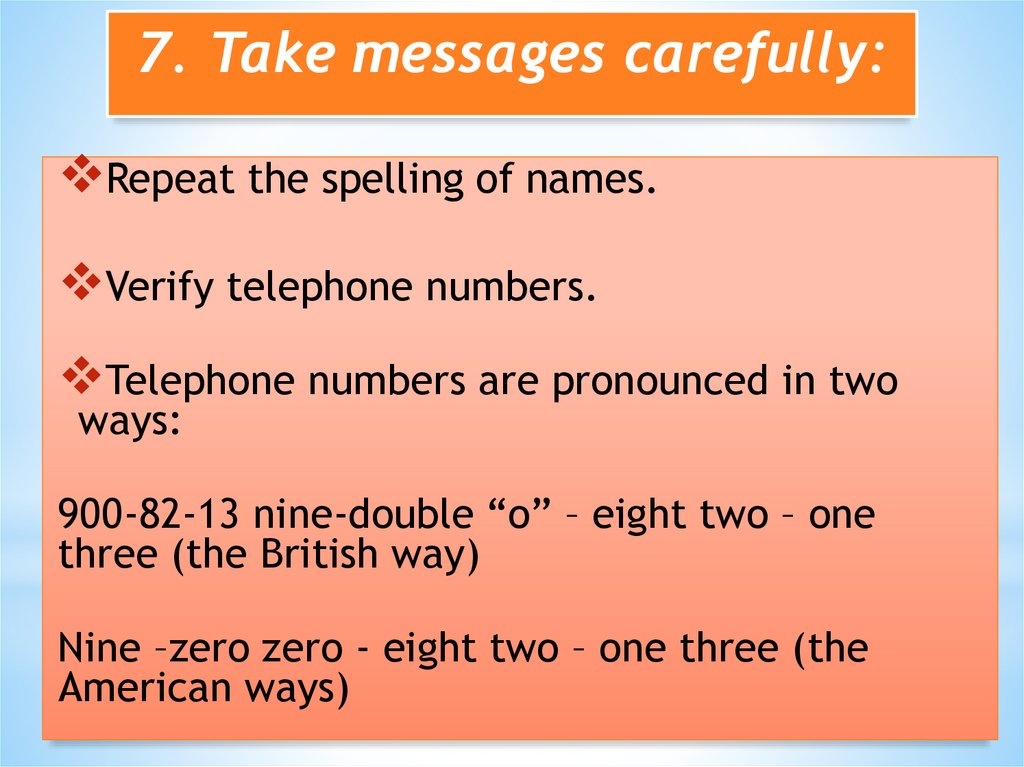
28. 7. Take messages carefully:
Repeat the spelling of names.Verify telephone numbers.
Telephone numbers are pronounced in two
ways:
900-82-13 nine-double “o” – eight two – one
three (the British way)
Nine –zero zero - eight two – one three (the
American ways)
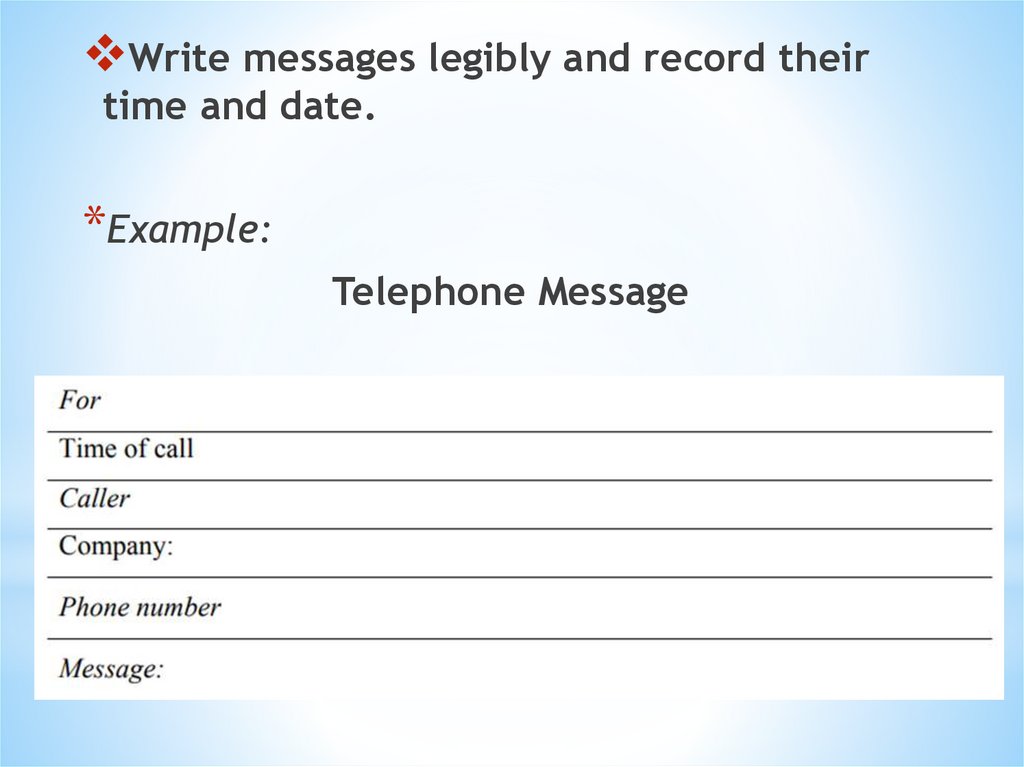
29.
Write messages legibly and record theirtime and date.
*Example:
Telephone Message