 Лингвистика
Похожие презентации:





Phrase: General Characteristics
1. Phrase: General Characteristics
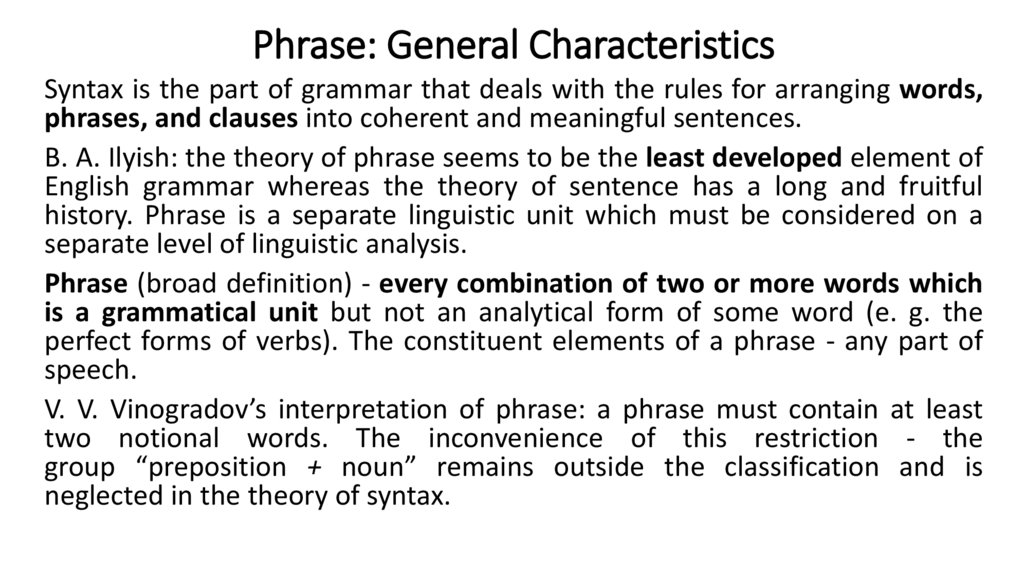
Syntax is the part of grammar that deals with the rules for arranging words,phrases, and clauses into coherent and meaningful sentences.
B. A. Ilyish: the theory of phrase seems to be the least developed element of
English grammar whereas the theory of sentence has a long and fruitful
history. Phrase is a separate linguistic unit which must be considered on a
separate level of linguistic analysis.
Phrase (broad definition) - every combination of two or more words which
is a grammatical unit but not an analytical form of some word (e. g. the
perfect forms of verbs). The constituent elements of a phrase - any part of
speech.
V. V. Vinogradov’s interpretation of phrase: a phrase must contain at least
two notional words. The inconvenience of this restriction - the
group “preposition + noun” remains outside the classification and is
neglected in the theory of syntax.
2.
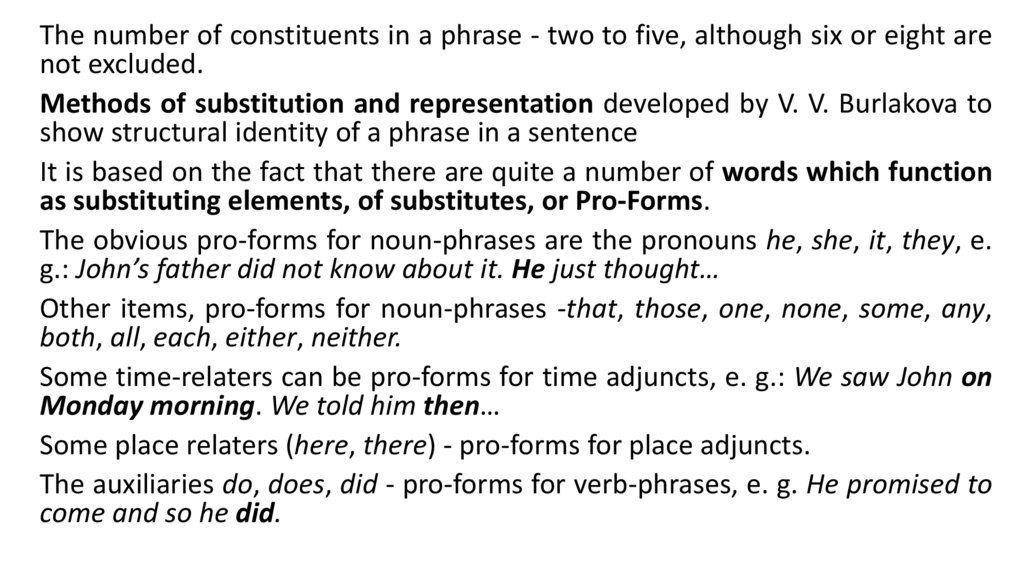
The number of constituents in a phrase - two to five, although six or eight arenot excluded.
Methods of substitution and representation developed by V. V. Burlakova to
show structural identity of a phrase in a sentence
It is based on the fact that there are quite a number of words which function
as substituting elements, of substitutes, or Pro-Forms.
The obvious pro-forms for noun-phrases are the pronouns he, she, it, they, e.
g.: John’s father did not know about it. He just thought…
Other items, pro-forms for noun-phrases -that, those, one, none, some, any,
both, all, each, either, neither.
Some time-relaters can be pro-forms for time adjuncts, e. g.: We saw John on
Monday morning. We told him then…
Some place relaters (here, there) - pro-forms for place adjuncts.
The auxiliaries do, does, did - pro-forms for verb-phrases, e. g. He promised to
come and so he did.
3.
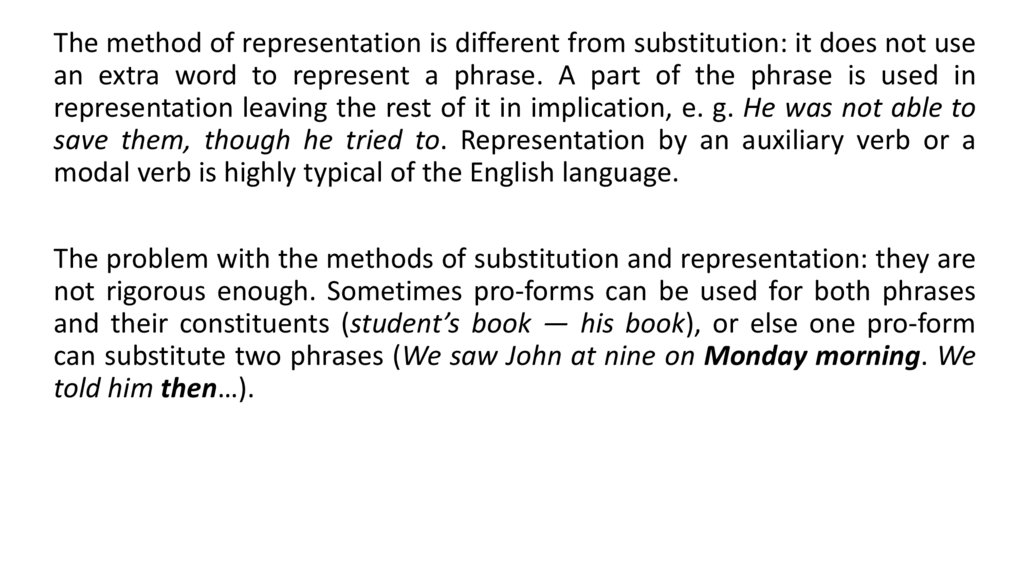
The method of representation is different from substitution: it does not usean extra word to represent a phrase. A part of the phrase is used in
representation leaving the rest of it in implication, e. g. He was not able to
save them, though he tried to. Representation by an auxiliary verb or a
modal verb is highly typical of the English language.
The problem with the methods of substitution and representation: they are
not rigorous enough. Sometimes pro-forms can be used for both phrases
and their constituents (student’s book — his book), or else one pro-form
can substitute two phrases (We saw John at nine on Monday morning. We
told him then…).
4.
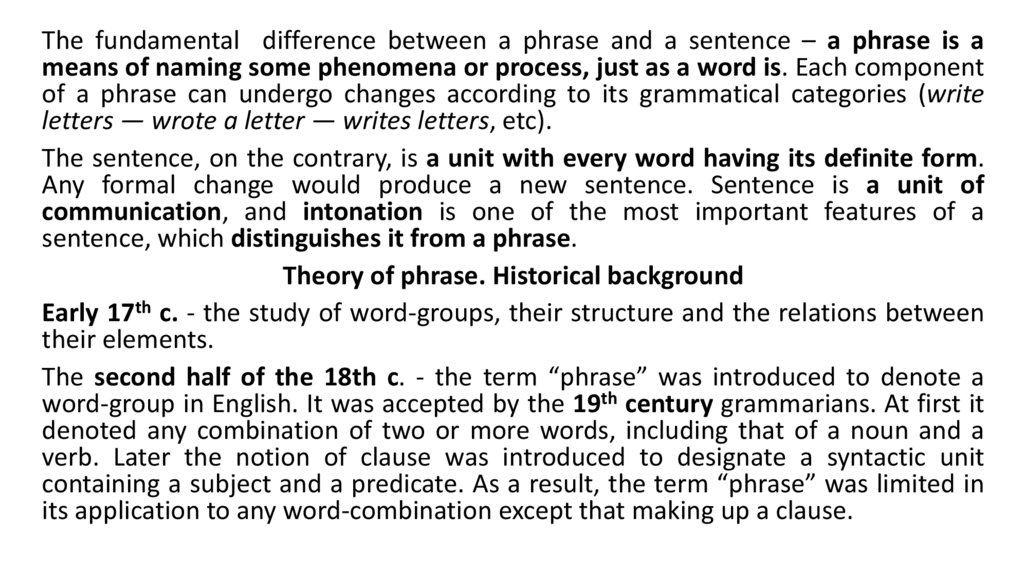
The fundamental difference between a phrase and a sentence – a phrase is ameans of naming some phenomena or process, just as a word is. Each component
of a phrase can undergo changes according to its grammatical categories (write
letters — wrote a letter — writes letters, etc).
The sentence, on the contrary, is a unit with every word having its definite form.
Any formal change would produce a new sentence. Sentence is a unit of
communication, and intonation is one of the most important features of a
sentence, which distinguishes it from a phrase.
Theory of phrase. Historical background
Early 17th c. - the study of word-groups, their structure and the relations between
their elements.
The second half of the 18th c. - the term “phrase” was introduced to denote a
word-group in English. It was accepted by the 19th century grammarians. At first it
denoted any combination of two or more words, including that of a noun and a
verb. Later the notion of clause was introduced to designate a syntactic unit
containing a subject and a predicate. As a result, the term “phrase” was limited in
its application to any word-combination except that making up a clause.
5.
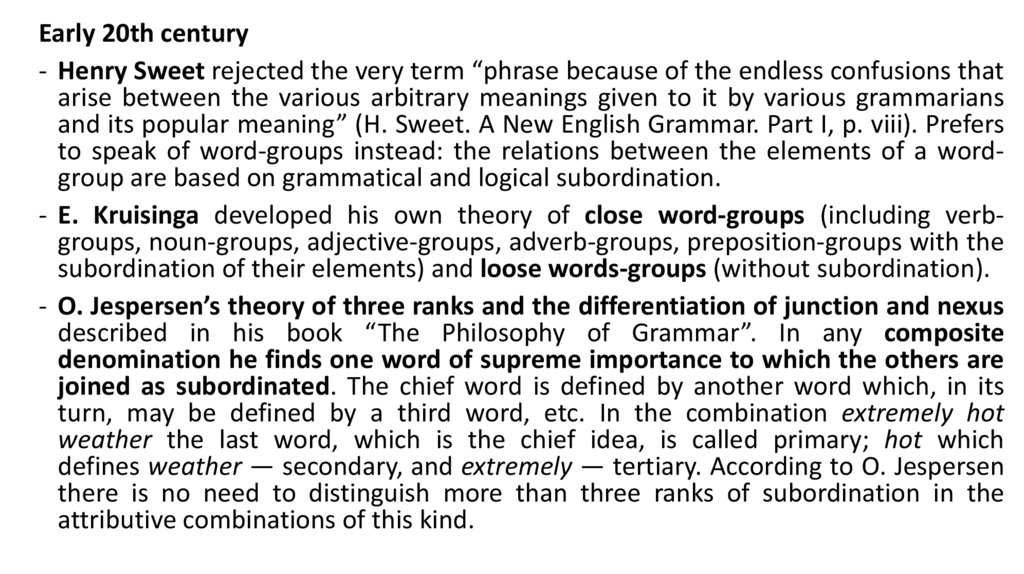
Early 20th century- Henry Sweet rejected the very term “phrase because of the endless confusions that
arise between the various arbitrary meanings given to it by various grammarians
and its popular meaning” (H. Sweet. A New English Grammar. Part I, p. viii). Prefers
to speak of word-groups instead: the relations between the elements of a wordgroup are based on grammatical and logical subordination.
- E. Kruisinga developed his own theory of close word-groups (including verbgroups, noun-groups, adjective-groups, adverb-groups, preposition-groups with the
subordination of their elements) and loose words-groups (without subordination).
- O. Jespersen’s theory of three ranks and the differentiation of junction and nexus
described in his book “The Philosophy of Grammar”. In any composite
denomination he finds one word of supreme importance to which the others are
joined as subordinated. The chief word is defined by another word which, in its
turn, may be defined by a third word, etc. In the combination extremely hot
weather the last word, which is the chief idea, is called primary; hot which
defines weather — secondary, and extremely — tertiary. According to O. Jespersen
there is no need to distinguish more than three ranks of subordination in the
attributive combinations of this kind.
6.
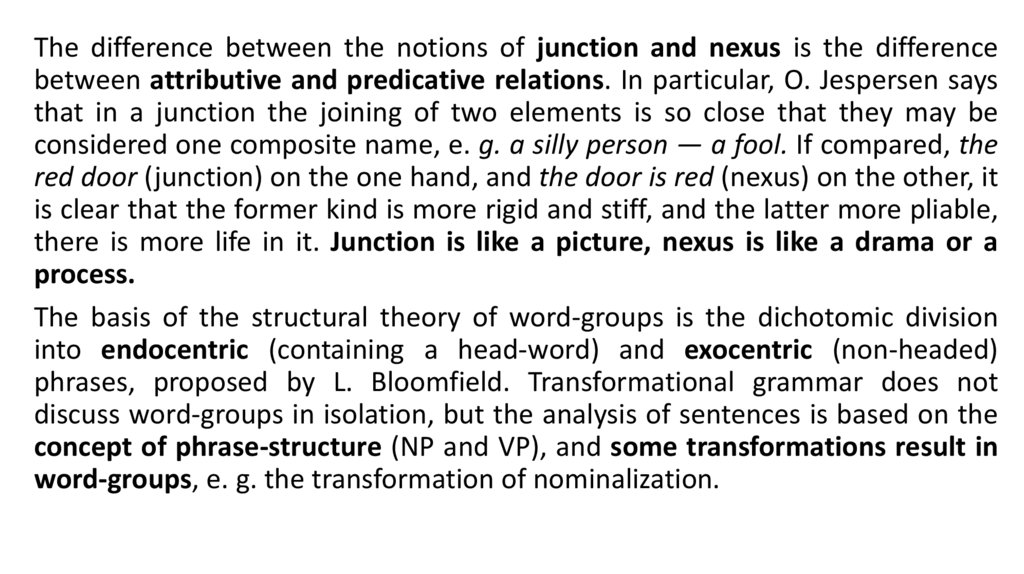
The difference between the notions of junction and nexus is the differencebetween attributive and predicative relations. In particular, O. Jespersen says
that in a junction the joining of two elements is so close that they may be
considered one composite name, e. g. a silly person — a fool. If compared, the
red door (junction) on the one hand, and the door is red (nexus) on the other, it
is clear that the former kind is more rigid and stiff, and the latter more pliable,
there is more life in it. Junction is like a picture, nexus is like a drama or a
process.
The basis of the structural theory of word-groups is the dichotomic division
into endocentric (containing a head-word) and exocentric (non-headed)
phrases, proposed by L. Bloomfield. Transformational grammar does not
discuss word-groups in isolation, but the analysis of sentences is based on the
concept of phrase-structure (NP and VP), and some transformations result in
word-groups, e. g. the transformation of nominalization.
7.
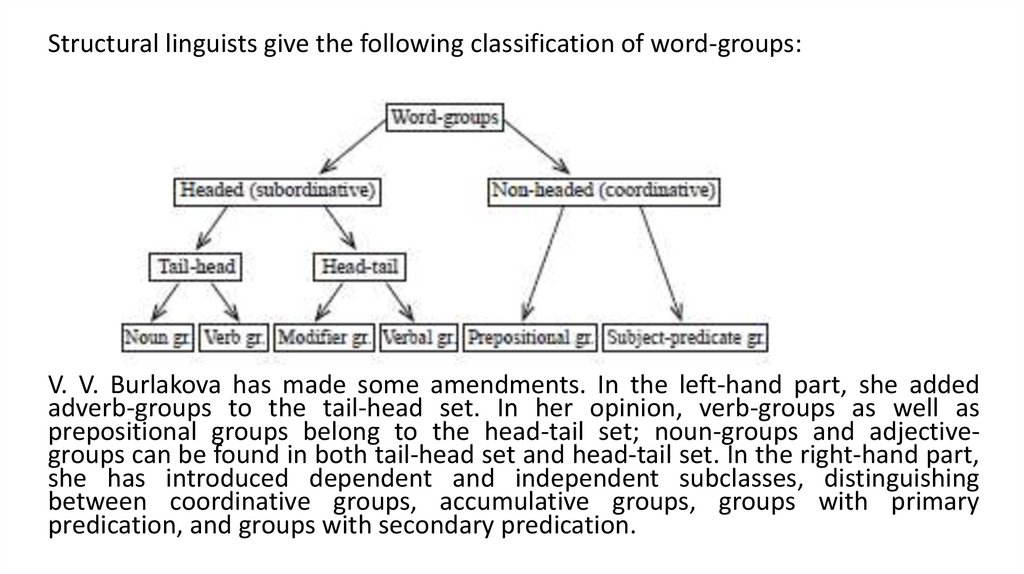
Structural linguists give the following classification of word-groups:V. V. Burlakova has made some amendments. In the left-hand part, she added
adverb-groups to the tail-head set. In her opinion, verb-groups as well as
prepositional groups belong to the head-tail set; noun-groups and adjectivegroups can be found in both tail-head set and head-tail set. In the right-hand part,
she has introduced dependent and independent subclasses, distinguishing
between coordinative groups, accumulative groups, groups with primary
predication, and groups with secondary predication.
8.
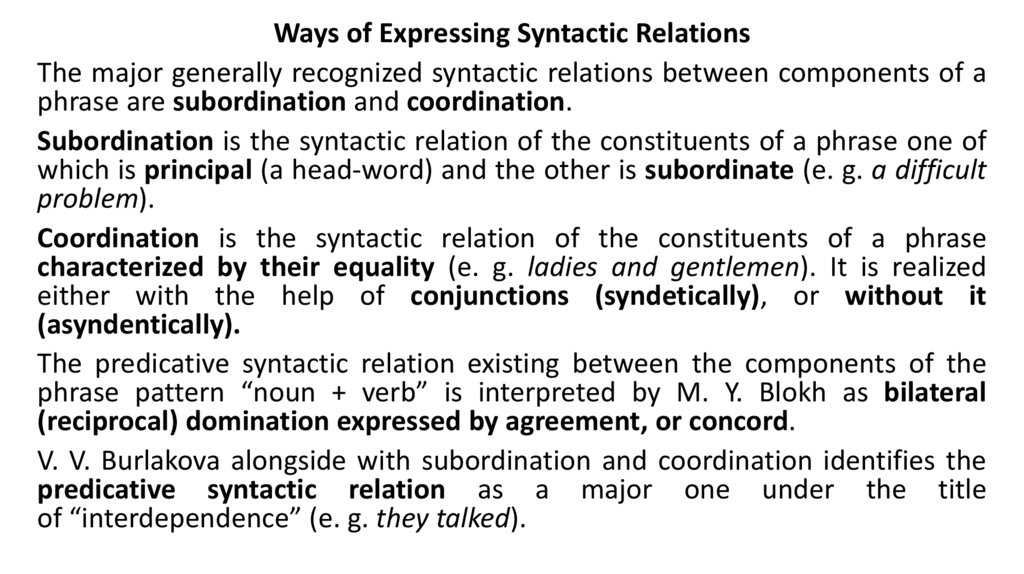
Ways of Expressing Syntactic RelationsThe major generally recognized syntactic relations between components of a
phrase are subordination and coordination.
Subordination is the syntactic relation of the constituents of a phrase one of
which is principal (a head-word) and the other is subordinate (e. g. a difficult
problem).
Coordination is the syntactic relation of the constituents of a phrase
characterized by their equality (e. g. ladies and gentlemen). It is realized
either with the help of conjunctions (syndetically), or without it
(asyndentically).
The predicative syntactic relation existing between the components of the
phrase pattern “noun + verb” is interpreted by M. Y. Blokh as bilateral
(reciprocal) domination expressed by agreement, or concord.
V. V. Burlakova alongside with subordination and coordination identifies the
predicative syntactic relation as a major one under the title
of “interdependence” (e. g. they talked).
9.
Number four in her classification is the relation of accumulation, which isfound between the subordinate elements of multi-component headed
groups, e. g. their own (children), (to write) letters to a friend.
I.I. Pribytok has added to those discussed the syntactic relation of apposition
(приложение), e. g. Uncle Andrew was very tall, the syntactic relation of
isolation (обособление), e. g. Last night, everything was closed, and the
syntactic relation of parenthesis (вводность), e. g. This is perhaps his first
chance.
Agreement (concord), government, and adjoinment
Agreement, or concord, is a way of expressing a syntactic relation which
consists in forcing the subordinate word to take a form similar to that of the
head-word. Linguistic units agree in such matters as number, person, and
gender. The two related units should both be singular or plural, feminine or
masculine. In Modern English this can be found between a noun and a verb in
a predicative phrase and also between the demonstrative
pronouns this/these/that/those and their head-words in attributive phrases,
such as this book, these books, etc.
10.
Government is understood as the use of a certain form of the subordinateword required by its head-word, but not coinciding with the form of the
head-word itself. In Modern English this way of expressing subordination is
limited to the use of the objective case forms of personal pronouns when
they are subordinate to a verb or follow a preposition, e. g. to invite me, to
find them, etc.
The adjoinment or the word order is the absence of both agreement and
government. For example, in the sentence He spoke of his intentions very
softly the adverb softly is subordinate to its headword spoke without either
agreeing with or being governed by it.
The connection between the adverb and the verb is preserved due to
their grammatical and semantic compatibility. This way of connecting
components of a phrase is a predominant one in Modern English. Searching
for an adequate designation of this phenomenon, linguistic scholars applied
to the theory of syntactic valency based on semantic properties of words, i.
e. their semantic compatibility.
11.
Syntactic valency is the combining power of words in relations to otherwords in syntactically subordinate positions.
The obligatory valency must necessarily be realized for the sake of the
grammatical completion of the syntactic construction; e. g. in the sentence We
saw a house in the distance the subject and the direct object are obligatory
valency partners of the verb.
The optional valency is not necessarily realized in grammatically complete
constructions; most of the adverbial modifiers are optional parts of the
sentence.
According to V. V. Burlakova, syntactic valency is the major factor of syntactic
relations in Modern English and within this type we should further
differentiate between the inflected forms of agreement or government and
non-inflected forms.