Похожие презентации:



The-Lifeboat-Case-R-v-Dudley-and-Stephens-1884
1.
The Lifeboat Case: R v.Dudley and Stephens
(1884)
A landmark judgment that shaped criminal law, this case explores the
profound tension between survival instinct and the sanctity of human life. It
remains a cornerstone of legal ethics and necessity defences.
2.
Case OverviewCitation
Court
(1884) 14 QBD 273
Court for Crown Cases Reserved (England)
Key Judge
Area of Law
Lord Coleridge, CJ (Lord Chief Justice)
Criminal Law – Defences to Murder (The Defence of
Necessity)
3.
Procedural JourneyInitial Conviction
Case Reserved
Higher Court Review
The Court for Crown Cases Reserved
Due to its exceptional legal and moral
convened to deliberate on the novel
Dudley and Stephens were found guilty
significance, the case was then referred
defence presented.
of murder at the Assize Court in Exeter.
to a panel of five judges for further
consideration.
4.
The Mignonette Tragedy: Facts of the CaseStranded at Sea
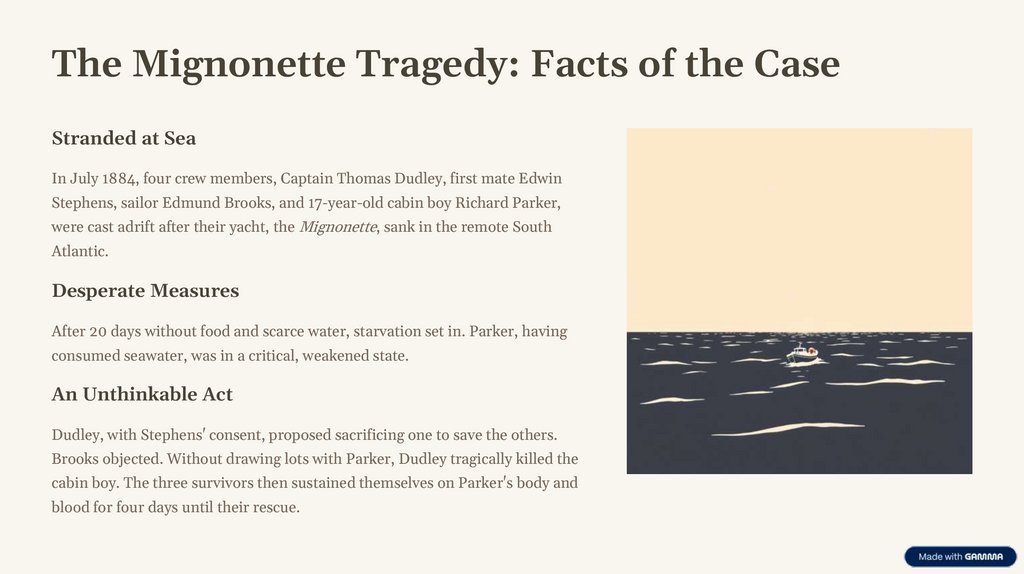
In July 1884, four crew members, Captain Thomas Dudley, first mate Edwin
Stephens, sailor Edmund Brooks, and 17-year-old cabin boy Richard Parker,
were cast adrift after their yacht, the Mignonette, sank in the remote South
Atlantic.
Desperate Measures
After 20 days without food and scarce water, starvation set in. Parker, having
consumed seawater, was in a critical, weakened state.
An Unthinkable Act
Dudley, with Stephens' consent, proposed sacrificing one to save the others.
Brooks objected. Without drawing lots with Parker, Dudley tragically killed the
cabin boy. The three survivors then sustained themselves on Parker's body and
blood for four days until their rescue.
5.
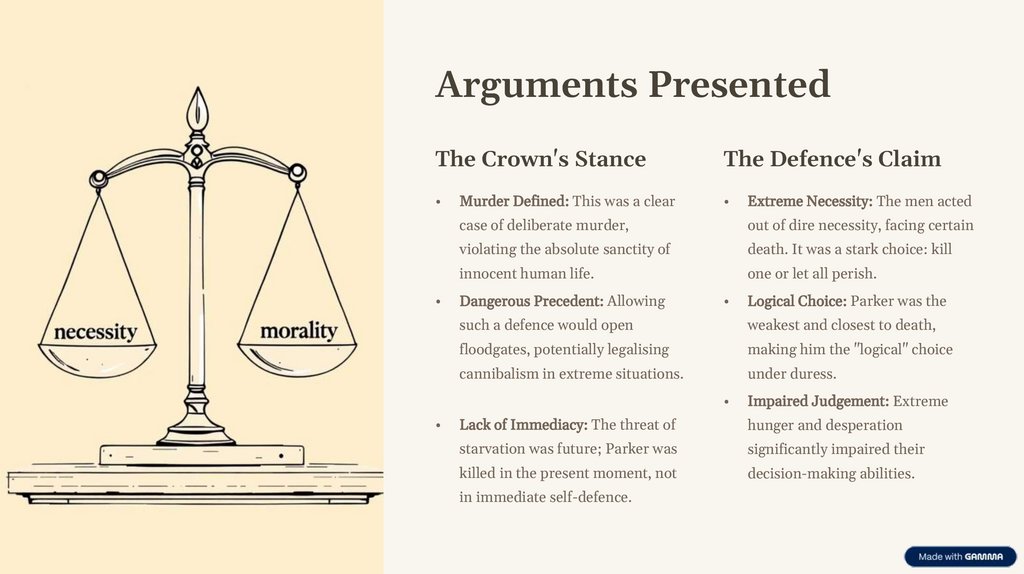
Arguments PresentedThe Crown's Stance
The Defence's Claim
Murder Defined: This was a clear
case of deliberate murder,
out of dire necessity, facing certain
violating the absolute sanctity of
death. It was a stark choice: kill
innocent human life.
one or let all perish.
Dangerous Precedent: Allowing
Logical Choice: Parker was the
such a defence would open
weakest and closest to death,
floodgates, potentially legalising
making him the "logical" choice
cannibalism in extreme situations.
under duress.
Extreme Necessity: The men acted
Impaired Judgement: Extreme
Lack of Immediacy: The threat of
hunger and desperation
starvation was future; Parker was
significantly impaired their
killed in the present moment, not
decision-making abilities.
in immediate self-defence.
6.
Judgment and Reasoning1
2
No Legal Precedent
Immeasurable Lives
Lord Coleridge affirmed there's no legal basis in English law
The court cannot determine the value of human lives. Allowing
permitting the killing of an innocent to save one's own life.
such a defence would descend into a "state of nature," where
Self-preservation is not an absolute legal principle that
the weakest are sacrificed, undermining the very foundation of
overrides all others.
law.
3
4
Absence of Immediate Threat
Moral Imperative
Unlike self-defence, which requires an instantaneous threat,
The honourable path was for all to face death rather than
starvation was a future peril, not immediate at the precise
commit murder. The men had a duty to uphold societal values,
moment of the killing.
even at personal cost.
7.
Final Outcome & Enduring SignificanceMercy Granted
Legal Legacy
Commuted Sentence: The Home Secretary commuted the
Landmark Precedent: Firmly established that necessity is
death sentence.
NOT a defence to murder in English common law, a
Imprisonment: Dudley and Stephens received six months'
principle that largely endures.
imprisonment, effectively time already served.
Ethical Quandary: Highlights the complex interplay
between moral instinct and legal principle, often compared
to the philosophical "trolley problem."
8.
The Lifeboat Case: A Timeless Legal DilemmaR v. Dudley and Stephens remains one of the most studied and debated cases globally, a testament to its profound impact on legal
theory, ethics, and the definition of criminal responsibility. It continues to provoke thought on the limits of human law in the face of
ultimate survival.