 Строительство
Похожие презентации:






Fundamentals of building construction
1.
Fundamentals ofbuilding construction
2.
The concept of a buildingWhat is a building:
This is an engineering and construction facility built on a
foundation.
Durable materials are used: stone, brick, concrete blocks.
The elements are joined with mortar for strength.
The role of the architect:
The architect creates a project that takes into account all the
details of the structure.
The project helps workers to carry out construction without
mistakes and ensures the safety of the future structure.
3.
The initial stages ofconstruction
Site preparation:
Excavation is carried out to create a flat foundation for
the foundation.
Foundation:
This is the lowest part of the building, which distributes
the load.
After excavation, foundation walls are built to ensure
the stability of the entire structure.
Task:
Protect the building from subsidence and destruction.
4.
The roof as the final elementThe main tasks of the roof:
-Protect the building from rain, snow, and wind.
-To prevent the penetration of moisture inside.
Features:
-The roof design depends on the climate and
architectural style.
-It can be gable, flat, attic, etc.
5.
The development of housingconstruction in the UK (since 1900)
New engineering systems:
-The introduction of hot water supply.
-The emergence of gas and electricity supply.
-This has increased comfort and changed the layout of
the houses.
The popularity of semi-detached houses:
-They are cheaper to build than detached mansions.
-They provided more privacy than apartment buildings.
6.
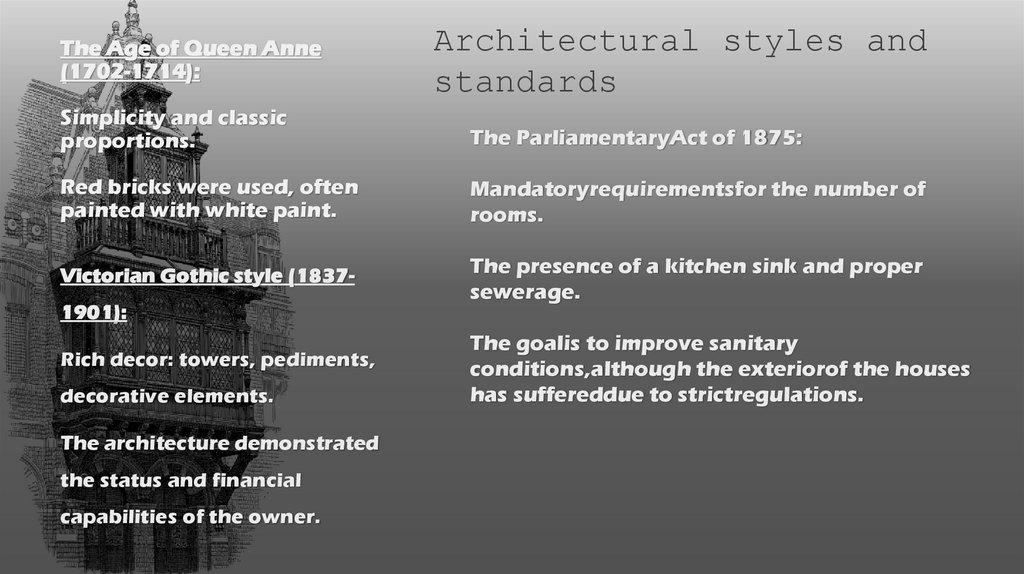
The Age of Queen Anne(1702-1714):
Architectural styles and
standards
Simplicity and classic
proportions.
The ParliamentaryAct of 1875:
Red bricks were used, often
painted with white paint.
Mandatoryrequirementsfor the number of
rooms.
Victorian Gothic style (1837-
The presence of a kitchen sink and proper
sewerage.
1901):
Rich decor: towers, pediments,
decorative elements.
The architecture demonstrated
the status and financial
capabilities of the owner.
The goalis to improve sanitary
conditions,although the exteriorof the houses
has suffereddue to strictregulations.
7.
Types of building structures1. Frame structures:
-The base consists of a wooden
frame.
-Lightweight, easy to assemble,
but less resistant to fire.
3. Refractory structures:
-Only non-combustible
materials (concrete, metal
frame) are used.
-Maximum fire safety.
2. Non-combustible structures:
-The walls are made of stone or
brick.
-The interior decoration can be
made of wood.
-They are more resistant to
damage.
8.
Modern buildings and materials9.
The main structural elementsThe structure of any building includes key elements:
walls, columns, beams and arches.
The beams serve to accommodate loads and are divided
into simple, cantilevered, built-in and continuous.
Modern columns and beams are most often made of steel
or reinforced concrete, which ensures high strength and
durability of the structure.
10.
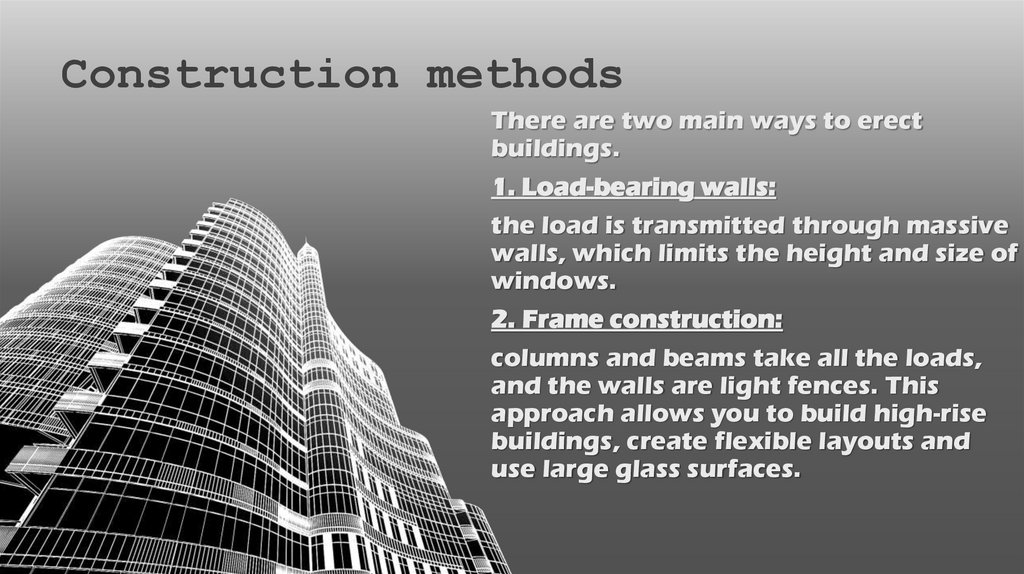
Construction methodsThere are two main ways to erect
buildings.
1. Load-bearing walls:
the load is transmitted through massive
walls, which limits the height and size of
windows.
2. Frame construction:
columns and beams take all the loads,
and the walls are light fences. This
approach allows you to build high-rise
buildings, create flexible layouts and
use large glass surfaces.
11.
Features of modern architectureModern buildings are characterized by steel, concrete
and glass materials, which provide a combination of
strength and aesthetics. In architecture, light, air and
comfort are important, so buildings are equipped with
the necessary systems — water supply, electricity,
ventilation and heating. Frame structures and curtain
walls make it possible to create spacious and comfortable
living spaces, including multi-storey complexes and
modern residential areas.