Похожие презентации:






Comparison-of-University-Systems-USA-vs-Russia (1)
1.
Comparison of UniversitySystems: USA vs. Russia
This comparison will allow us to gain a deeper understanding of the
fundamental differences and similarities between higher education
systems in the USA, represented by the University of California, Berkeley,
and in Russia, using the Herzen University as an example.
2.
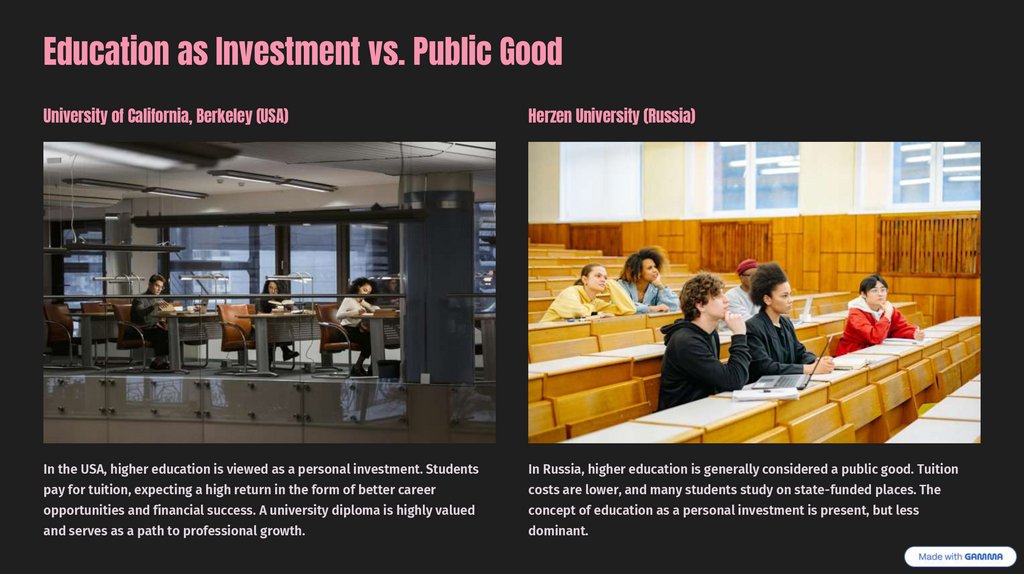
Education as Investment vs. Public GoodUniversity of California, Berkeley (USA)
Herzen University (Russia)
In the USA, higher education is viewed as a personal investment. Students
In Russia, higher education is generally considered a public good. Tuition
pay for tuition, expecting a high return in the form of better career
costs are lower, and many students study on state-funded places. The
opportunities and financial success. A university diploma is highly valued
concept of education as a personal investment is present, but less
and serves as a path to professional growth.
dominant.
3.
Individual Study Plans vs. FixedPrograms
Flexibility at Berkeley
At the University of California, Berkeley, each student has an
individual study plan. The university publishes extensive
lists of courses, and students choose both mandatory and
elective disciplines according to their major, leading to
significant differences in schedules.
Structure at Herzen University
Most programs at Herzen University follow a fixed
curriculum. Students study in academic groups and take the
same courses together. Electives exist but play a less
significant role, and the schedule is less flexible.
4.
Retaking Exams: Rules andConsequences
University of California, Berkeley
If a student fails a course, they cannot simply retake the exam. Instead, the
student must re-enroll in the entire course, pay for it again, and complete it
in the following semester. This highlights the high cost of each academic
failure.
Herzen University
Students are typically allowed to retake exams multiple times without
additional charge. Full course repetition is much rarer, giving students more
opportunities to remedy the situation without significant financial loss.
5.
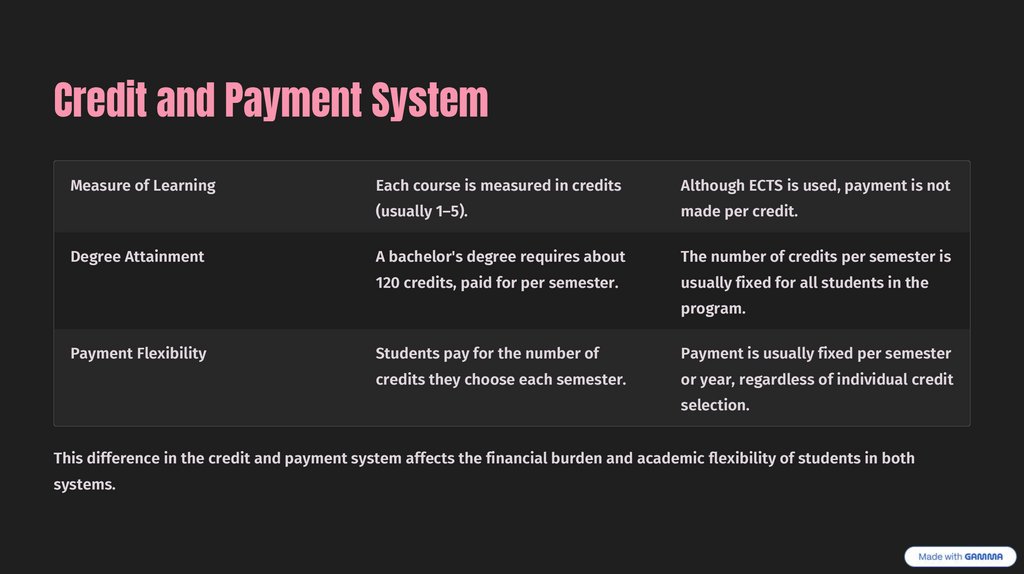
Credit and Payment SystemMeasure of Learning
Degree Attainment
Each course is measured in credits
Although ECTS is used, payment is not
(usually 1–5).
made per credit.
A bachelor's degree requires about
The number of credits per semester is
120 credits, paid for per semester.
usually fixed for all students in the
program.
Payment Flexibility
Students pay for the number of
Payment is usually fixed per semester
credits they choose each semester.
or year, regardless of individual credit
selection.
This difference in the credit and payment system affects the financial burden and academic flexibility of students in both
systems.
6.
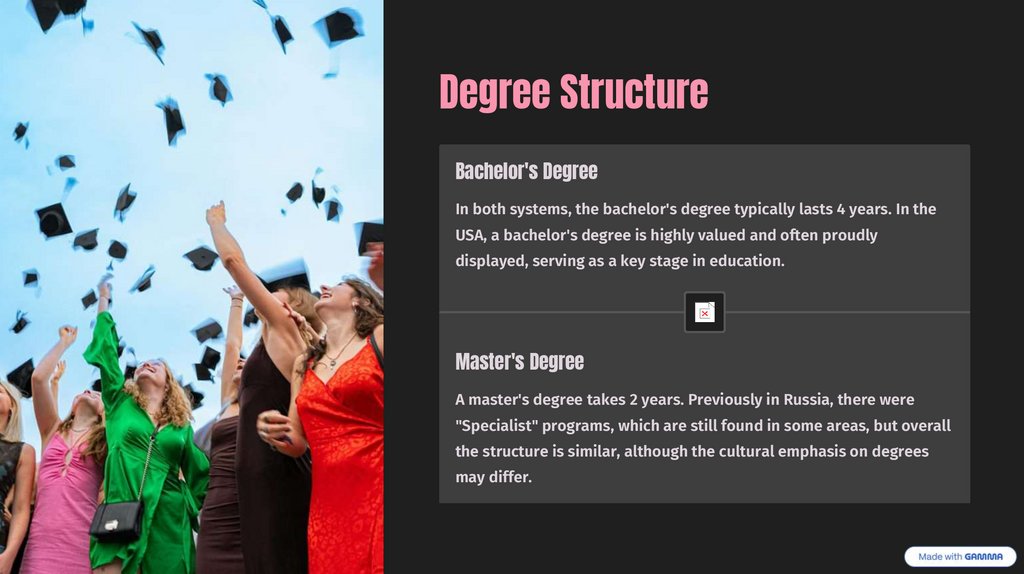
Degree StructureBachelor's Degree
In both systems, the bachelor's degree typically lasts 4 years. In the
USA, a bachelor's degree is highly valued and often proudly
displayed, serving as a key stage in education.
Master's Degree
A master's degree takes 2 years. Previously in Russia, there were
"Specialist" programs, which are still found in some areas, but overall
the structure is similar, although the cultural emphasis on degrees
may differ.
7.
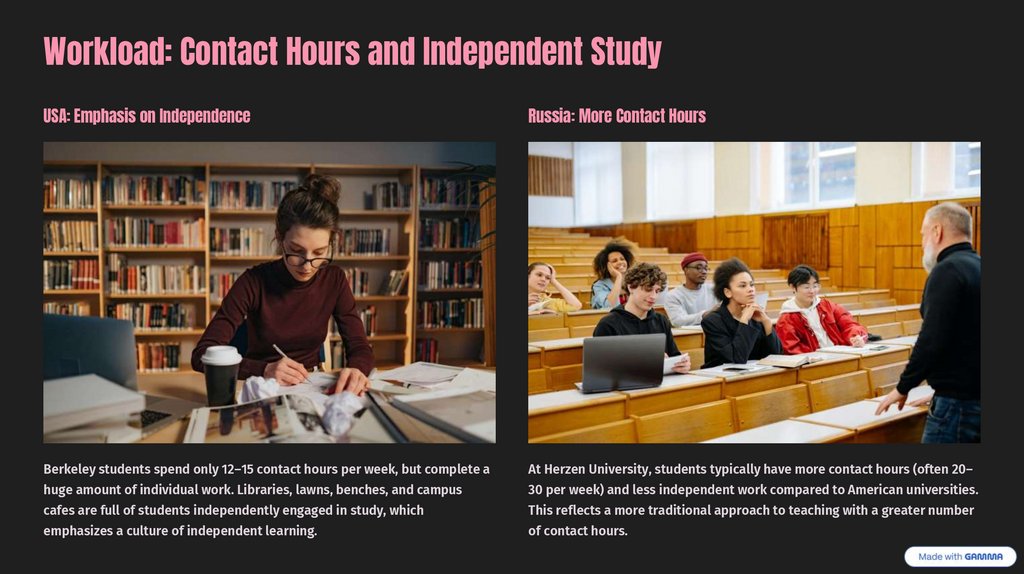
Workload: Contact Hours and Independent StudyUSA: Emphasis on Independence
Russia: More Contact Hours
Berkeley students spend only 12–15 contact hours per week, but complete a
At Herzen University, students typically have more contact hours (often 20–
huge amount of individual work. Libraries, lawns, benches, and campus
30 per week) and less independent work compared to American universities.
cafes are full of students independently engaged in study, which
This reflects a more traditional approach to teaching with a greater number
emphasizes a culture of independent learning.
of contact hours.
8.
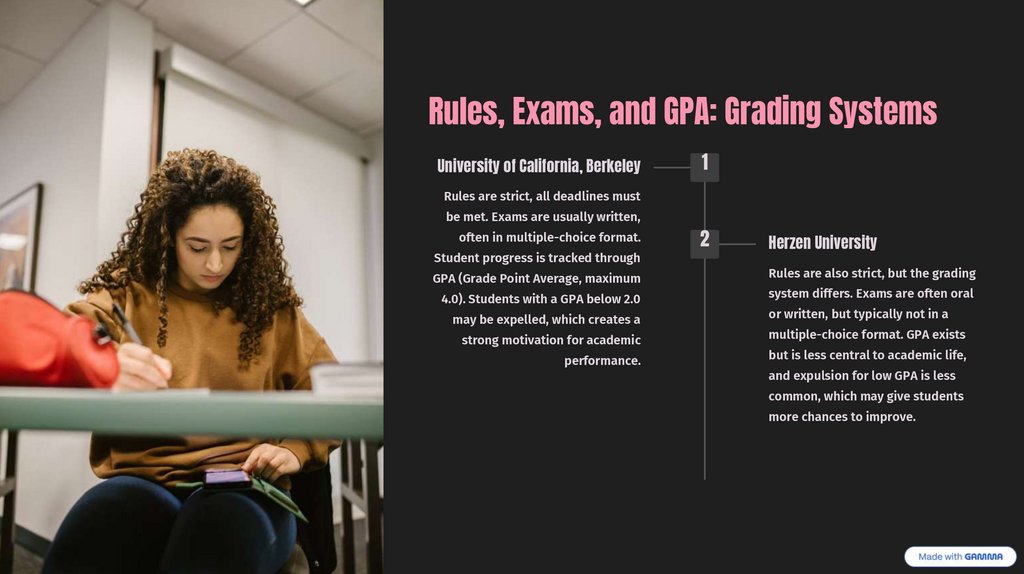
Rules, Exams, and GPA: Grading SystemsUniversity of California, Berkeley
1
Rules are strict, all deadlines must
be met. Exams are usually written,
often in multiple-choice format.
Student progress is tracked through
2
Herzen University
GPA (Grade Point Average, maximum
Rules are also strict, but the grading
4.0). Students with a GPA below 2.0
system differs. Exams are often oral
may be expelled, which creates a
or written, but typically not in a
strong motivation for academic
multiple-choice format. GPA exists
performance.
but is less central to academic life,
and expulsion for low GPA is less
common, which may give students
more chances to improve.
9.
Information Technology: Campus InfrastructureUSA: Universal Digitization
Russia: Developing Infrastructure
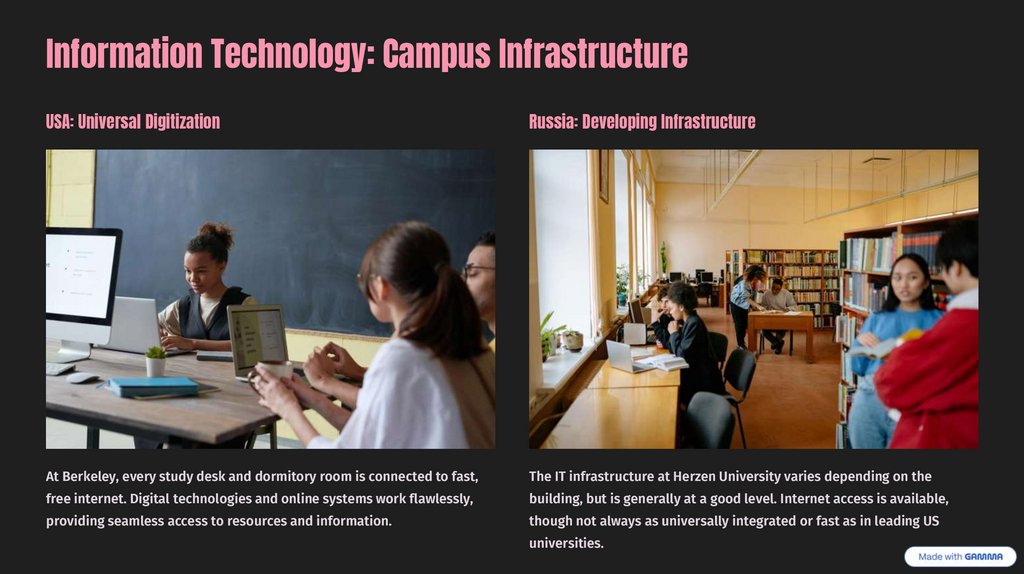
At Berkeley, every study desk and dormitory room is connected to fast,
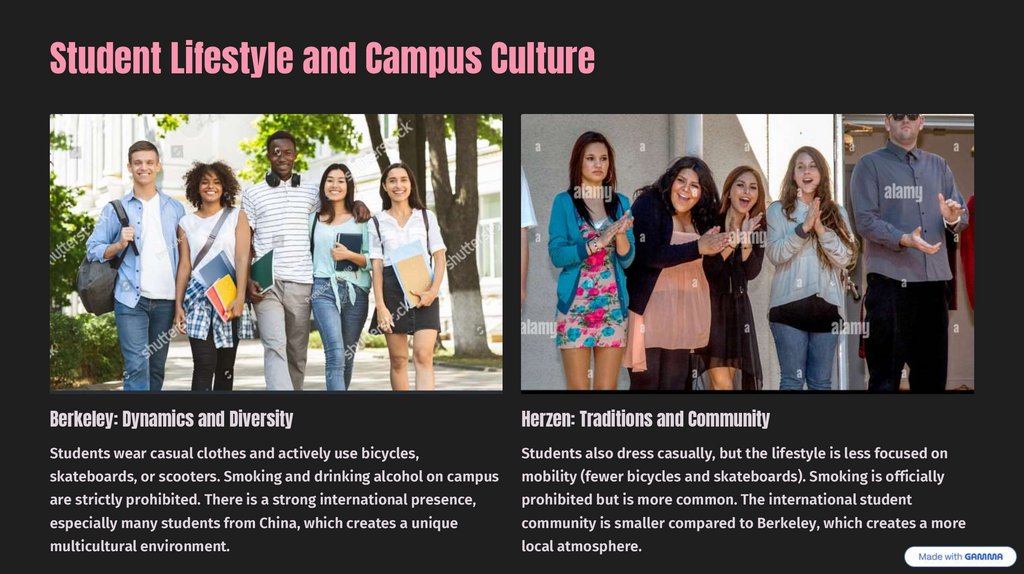
The IT infrastructure at Herzen University varies depending on the
free internet. Digital technologies and online systems work flawlessly,
building, but is generally at a good level. Internet access is available,
providing seamless access to resources and information.
though not always as universally integrated or fast as in leading US
universities.
10.
Student Lifestyle and Campus CultureBerkeley: Dynamics and Diversity
Herzen: Traditions and Community
Students wear casual clothes and actively use bicycles,
Students also dress casually, but the lifestyle is less focused on
skateboards, or scooters. Smoking and drinking alcohol on campus
mobility (fewer bicycles and skateboards). Smoking is officially
are strictly prohibited. There is a strong international presence,
prohibited but is more common. The international student
especially many students from China, which creates a unique
community is smaller compared to Berkeley, which creates a more
multicultural environment.
local atmosphere.