
Похожие презентации:








Understanding-Trends-in-Central-and-West-Asia
1.
Understanding Trendsin Central and West Asia
Presented by the Center for Military-Strategic Researches
of the Ministry of Defense of the Republic of Kazakhstan.
2.
Introduction: Legacy, Resilience,and Strategic Imperative
Central and West Asia are no longer peripheral; they are strategic nodes
shaping the new Eurasia. Their vast energy resources, strategic location, and
growing role in trade place these regions at the heart of a transforming
world order.
Our report analyzes key transformation trends from a national interest
perspective, developing proposals for strengthening regional cooperation,
primarily in Kazakhstan-Pakistan relations.
3.
Pakistan's Strategic Resilience: A Foundation of GreatPersonalities
1
2
3
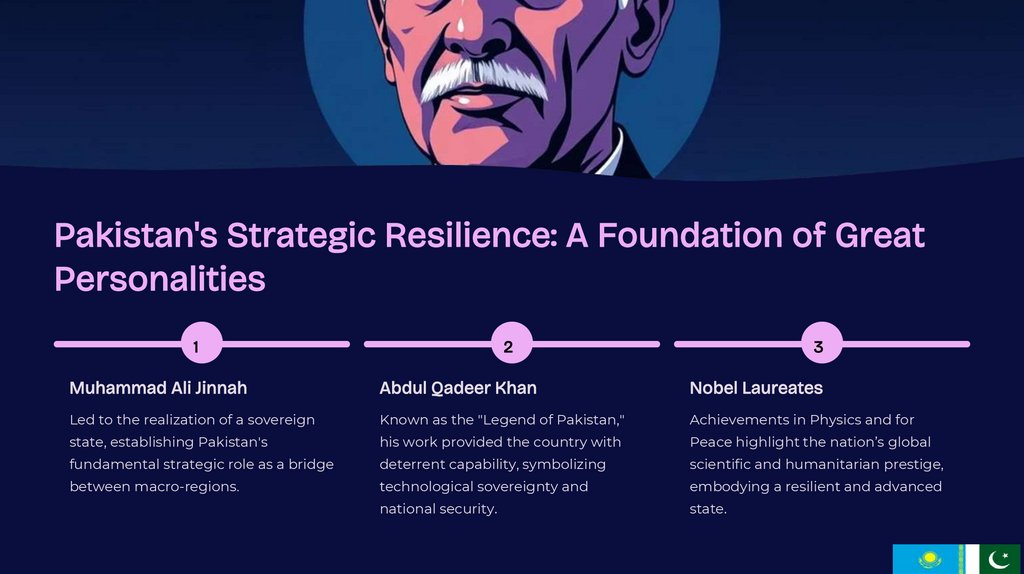
Muhammad Ali Jinnah
Abdul Qadeer Khan
Nobel Laureates
Led to the realization of a sovereign
Known as the "Legend of Pakistan,"
Achievements in Physics and for
state, establishing Pakistan's
his work provided the country with
Peace highlight the nation’s global
fundamental strategic role as a bridge
deterrent capability, symbolizing
scientific and humanitarian prestige,
between macro-regions.
technological sovereignty and
embodying a resilient and advanced
national security.
state.
4.
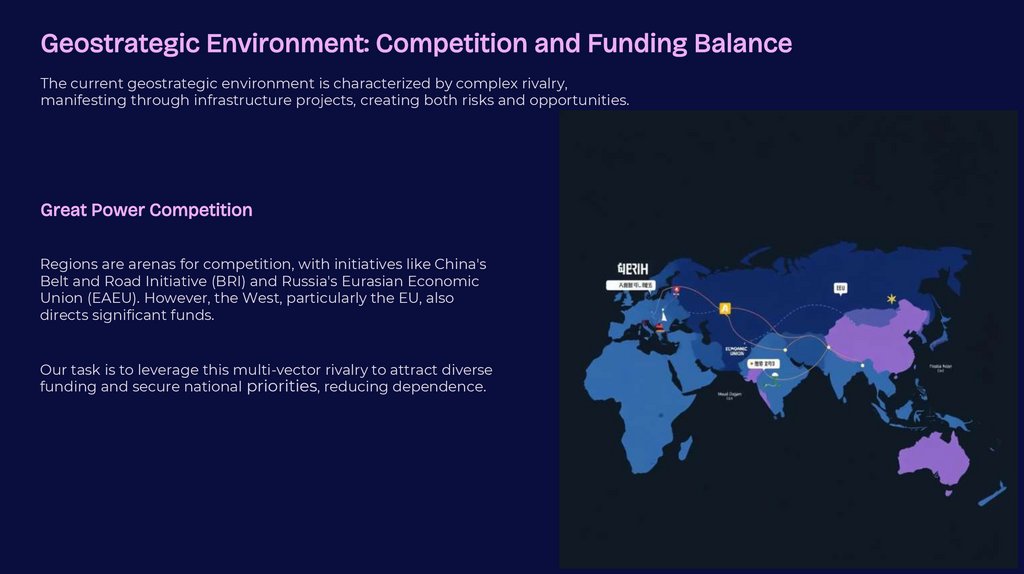
Geostrategic Environment: Competition and Funding BalanceThe current geostrategic environment is characterized by complex rivalry,
manifesting through infrastructure projects, creating both risks and opportunities.
Great Power Competition
Regions are arenas for competition, with initiatives like China's
Belt and Road Initiative (BRI) and Russia's Eurasian Economic
Union (EAEU). However, the West, particularly the EU, also
directs significant funds.
Our task is to leverage this multi-vector rivalry to attract diverse
funding and secure national priorities, reducing dependence.
5.
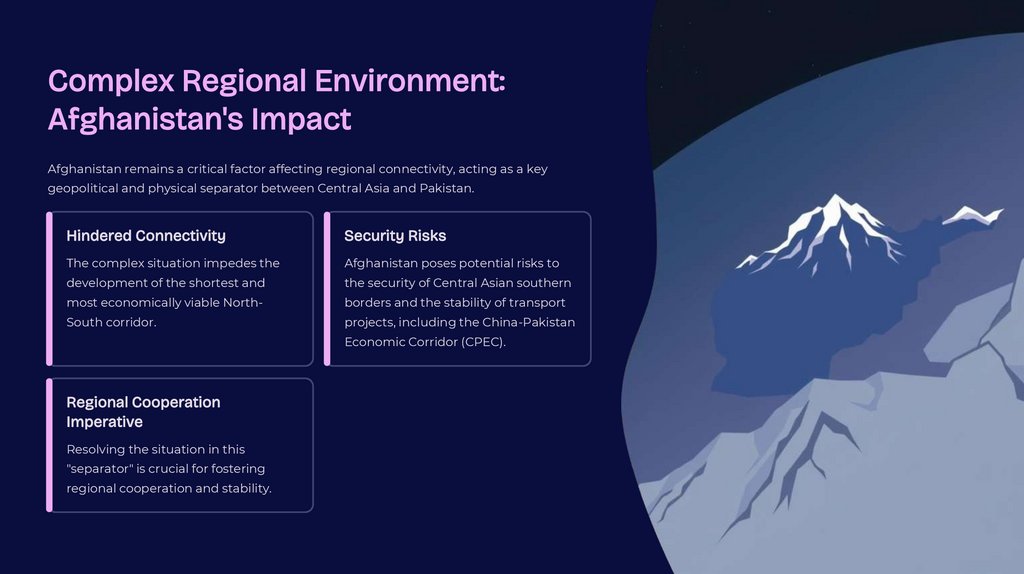
Complex Regional Environment:Afghanistan's Impact
Afghanistan remains a critical factor affecting regional connectivity, acting as a key
geopolitical and physical separator between Central Asia and Pakistan.
Hindered Connectivity
Security Risks
The complex situation impedes the
Afghanistan poses potential risks to
development of the shortest and
the security of Central Asian southern
most economically viable North-
borders and the stability of transport
South corridor.
projects, including the China-Pakistan
Economic Corridor (CPEC).
Regional Cooperation
Imperative
Resolving the situation in this
"separator" is crucial for fostering
regional cooperation and stability.
6.
Integration Imperative: Diversification and Security ofArteries
A key trend dictating the geostrategic environment is the pursuit of stable and diversified transport arteries.
Middle Corridor
Zangezur Corridor
Diplomatic Participation
The Trans-Caspian International Transport
Potential opening would create synergy
Requires active diplomatic and military-
Route (TCITR) is a vital alternative,
with the "Middle Corridor," accelerating
political participation to ensure long-term
connecting China and Central Asia with
freight delivery and enhancing Kazakh
stability in the South Caucasus for Eurasian
Europe via the Caspian Sea, Caucasus, and
transit competitiveness.
transit security.
Turkey.
7.
Pakistan and the North-South Axis: Breakthrough to the "Blue Economy"For landlocked Kazakhstan, the North-South axis through Pakistan
represents a strategic breakthrough to the global ocean.
Southern Gateway
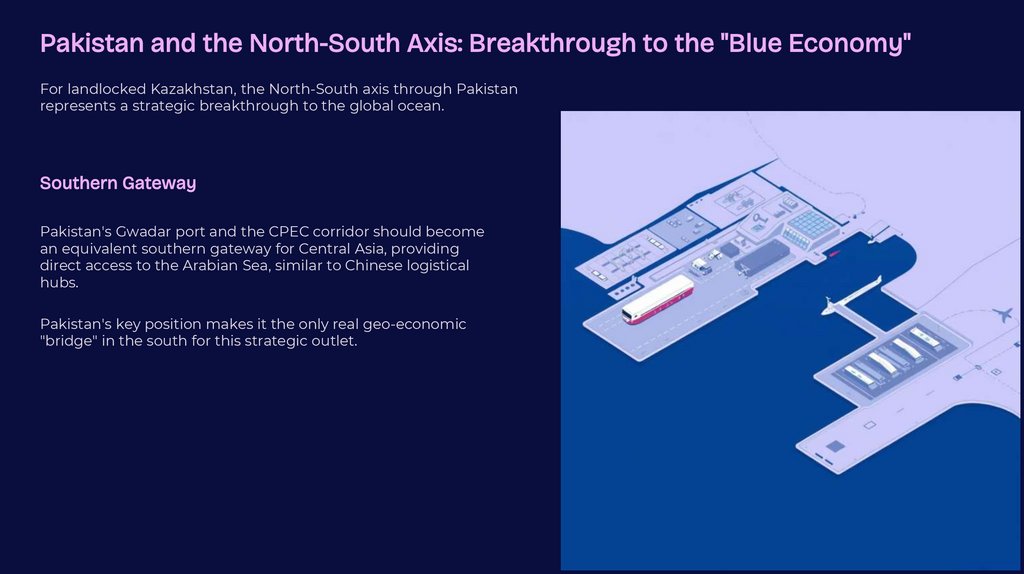
Pakistan's Gwadar port and the CPEC corridor should become
an equivalent southern gateway for Central Asia, providing
direct access to the Arabian Sea, similar to Chinese logistical
hubs.
Pakistan's key position makes it the only real geo-economic
"bridge" in the south for this strategic outlet.
8.
Integration into Pakistan’s"Blue Economy"
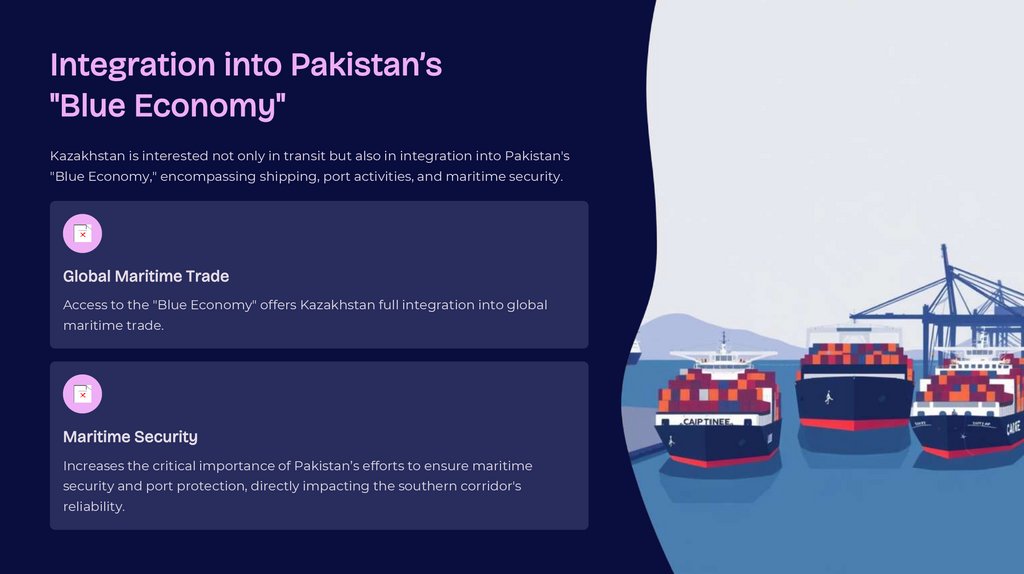
Kazakhstan is interested not only in transit but also in integration into Pakistan's
"Blue Economy," encompassing shipping, port activities, and maritime security.
Global Maritime Trade
Access to the "Blue Economy" offers Kazakhstan full integration into global
maritime trade.
Maritime Security
Increases the critical importance of Pakistan’s efforts to ensure maritime
security and port protection, directly impacting the southern corridor's
reliability.
9.
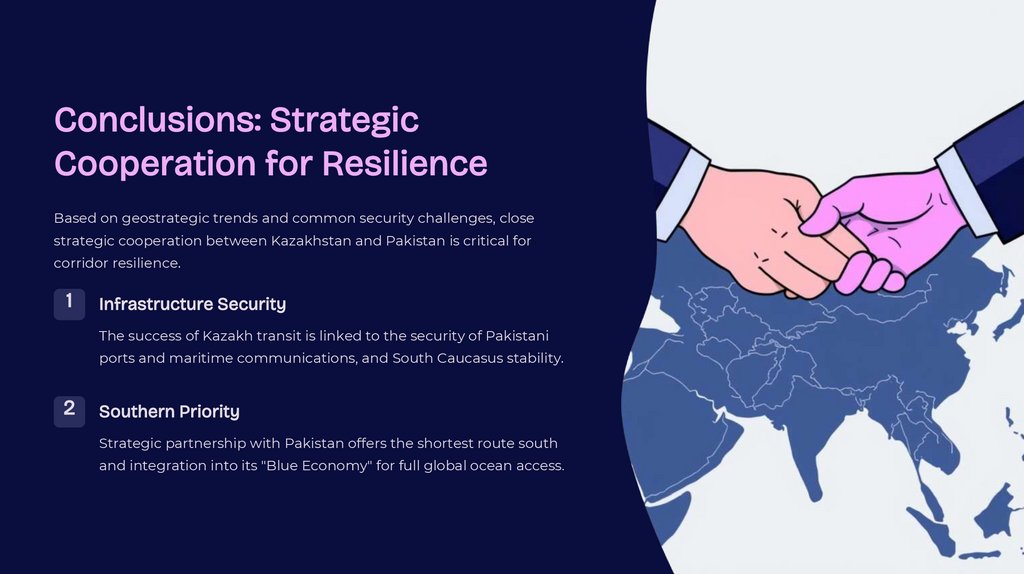
Conclusions: StrategicCooperation for Resilience
Based on geostrategic trends and common security challenges, close
strategic cooperation between Kazakhstan and Pakistan is critical for
corridor resilience.
1
Infrastructure Security
The success of Kazakh transit is linked to the security of Pakistani
ports and maritime communications, and South Caucasus stability.
2
Southern Priority
Strategic partnership with Pakistan offers the shortest route south
and integration into its "Blue Economy" for full global ocean access.
10.
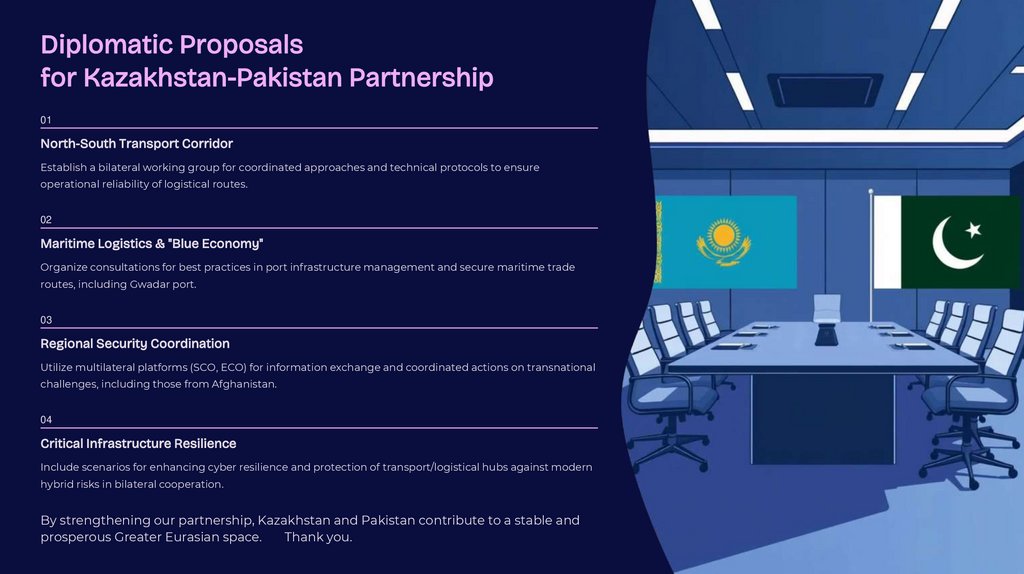
Diplomatic Proposalsfor Kazakhstan-Pakistan Partnership
01
North-South Transport Corridor
Establish a bilateral working group for coordinated approaches and technical protocols to ensure
operational reliability of logistical routes.
02
Maritime Logistics & "Blue Economy"
Organize consultations for best practices in port infrastructure management and secure maritime trade
routes, including Gwadar port.
03
Regional Security Coordination
Utilize multilateral platforms (SCO, ECO) for information exchange and coordinated actions on transnational
challenges, including those from Afghanistan.
04
Critical Infrastructure Resilience
Include scenarios for enhancing cyber resilience and protection of transport/logistical hubs against modern
hybrid risks in bilateral cooperation.
By strengthening our partnership, Kazakhstan and Pakistan contribute to a stable and
prosperous Greater Eurasian space.
Thank you.