
 Информатика
Похожие презентации:





Automation and Assistive Technologies
1. FOREIGN LANGUAGE 2
WEEK 2LESSONS 1-2
Module 1: Automation and Assistive Technologies
2025
School of GED
Astana IT University
2. Outline
Reading comprehensionOutline
Writing task
Grammar: relative
clauses
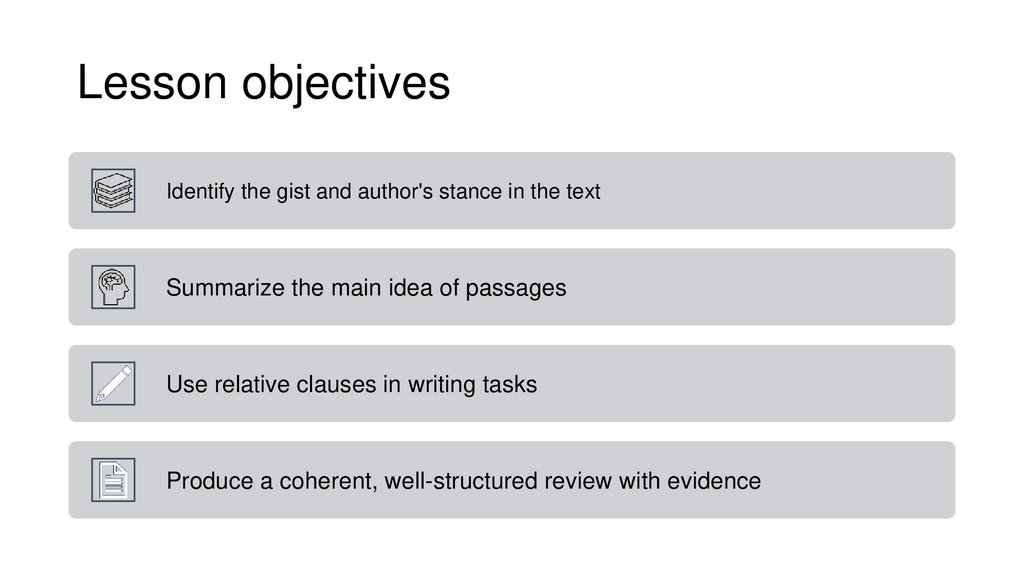
3. Lesson objectives
Identify the gist and author's stance in the textSummarize the main idea of passages
Use relative clauses in writing tasks
Produce a coherent, well-structured review with evidence
4.
Imagine waking up tomorrow and being unable touse your hands for one day. How would you check
the phone, the weather, or do your assignment?
What would you do?
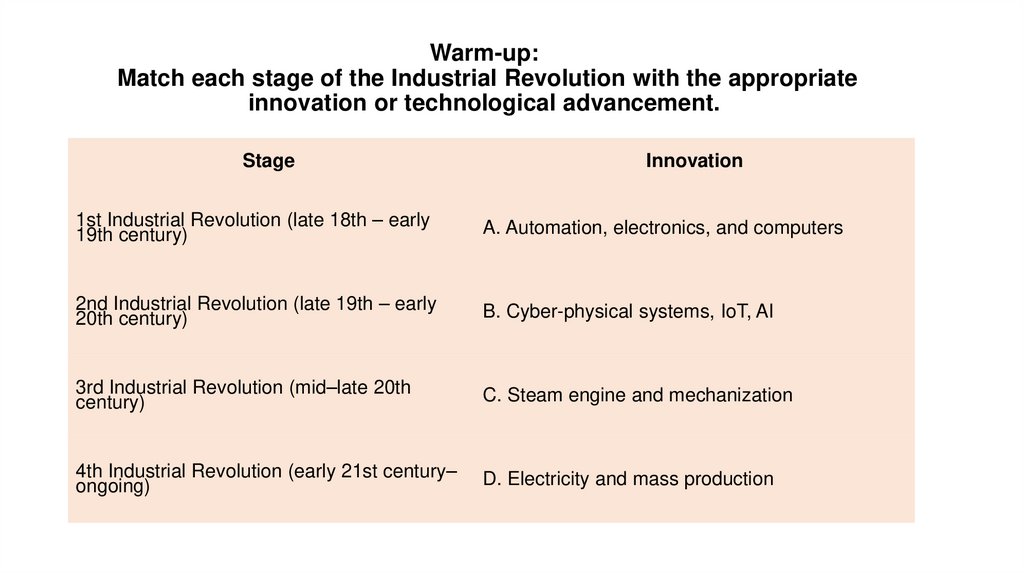
5. Warm-up: Match each stage of the Industrial Revolution with the appropriate innovation or technological advancement.
Warm-up:Match each stage of the Industrial Revolution with the appropriate
innovation or technological advancement.
Stage
Innovation
1st Industrial Revolution (late 18th – early
19th century)
A. Automation, electronics, and computers
2nd Industrial Revolution (late 19th – early
20th century)
B. Cyber-physical systems, IoT, AI
3rd Industrial Revolution (mid–late 20th
century)
C. Steam engine and mechanization
4th Industrial Revolution (early 21st century–
ongoing)
D. Electricity and mass production
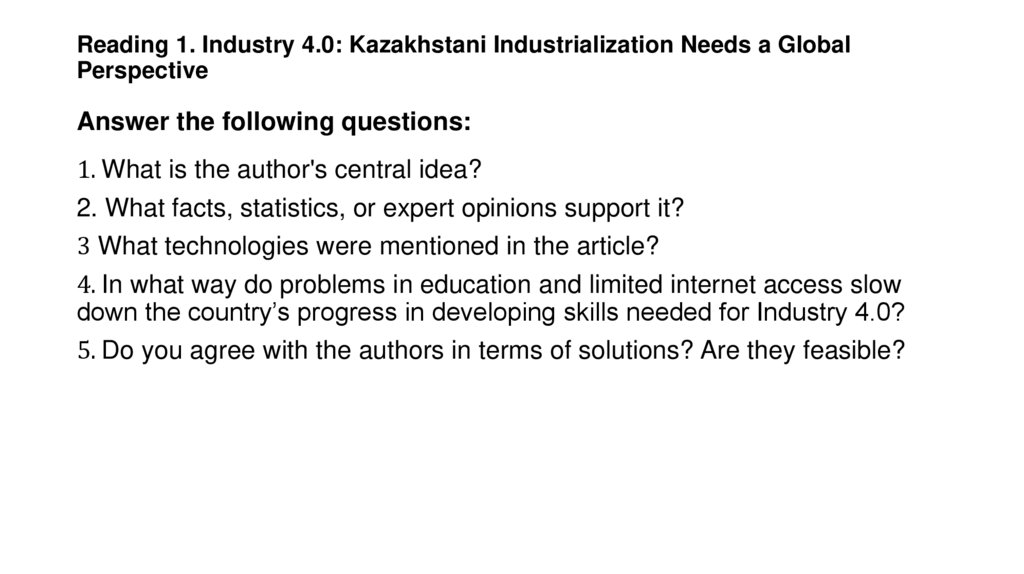
6. Reading 1. Industry 4.0: Kazakhstani Industrialization Needs a Global Perspective Answer the following questions:
1. What is the author's central idea?2. What facts, statistics, or expert opinions support it?
3 What technologies were mentioned in the article?
4. In what way do problems in education and limited internet access slow
down the country’s progress in developing skills needed for Industry 4.0?
5. Do you agree with the authors in terms of solutions? Are they feasible?
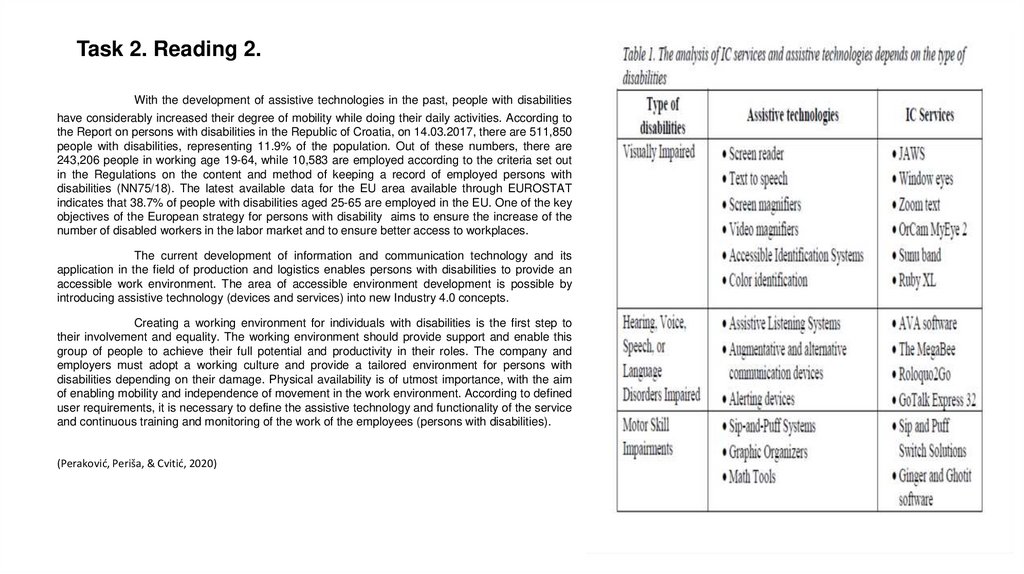
7. Task 2. Reading 2.
With the development of assistive technologies in the past, people with disabilitieshave considerably increased their degree of mobility while doing their daily activities. According to
the Report on persons with disabilities in the Republic of Croatia, on 14.03.2017, there are 511,850
people with disabilities, representing 11.9% of the population. Out of these numbers, there are
243,206 people in working age 19-64, while 10,583 are employed according to the criteria set out
in the Regulations on the content and method of keeping a record of employed persons with
disabilities (NN75/18). The latest available data for the EU area available through EUROSTAT
indicates that 38.7% of people with disabilities aged 25-65 are employed in the EU. One of the key
objectives of the European strategy for persons with disability aims to ensure the increase of the
number of disabled workers in the labor market and to ensure better access to workplaces.
The current development of information and communication technology and its
application in the field of production and logistics enables persons with disabilities to provide an
accessible work environment. The area of accessible environment development is possible by
introducing assistive technology (devices and services) into new Industry 4.0 concepts.
Creating a working environment for individuals with disabilities is the first step to
their involvement and equality. The working environment should provide support and enable this
group of people to achieve their full potential and productivity in their roles. The company and
employers must adopt a working culture and provide a tailored environment for persons with
disabilities depending on their damage. Physical availability is of utmost importance, with the aim
of enabling mobility and independence of movement in the work environment. According to defined
user requirements, it is necessary to define the assistive technology and functionality of the service
and continuous training and monitoring of the work of the employees (persons with disabilities).
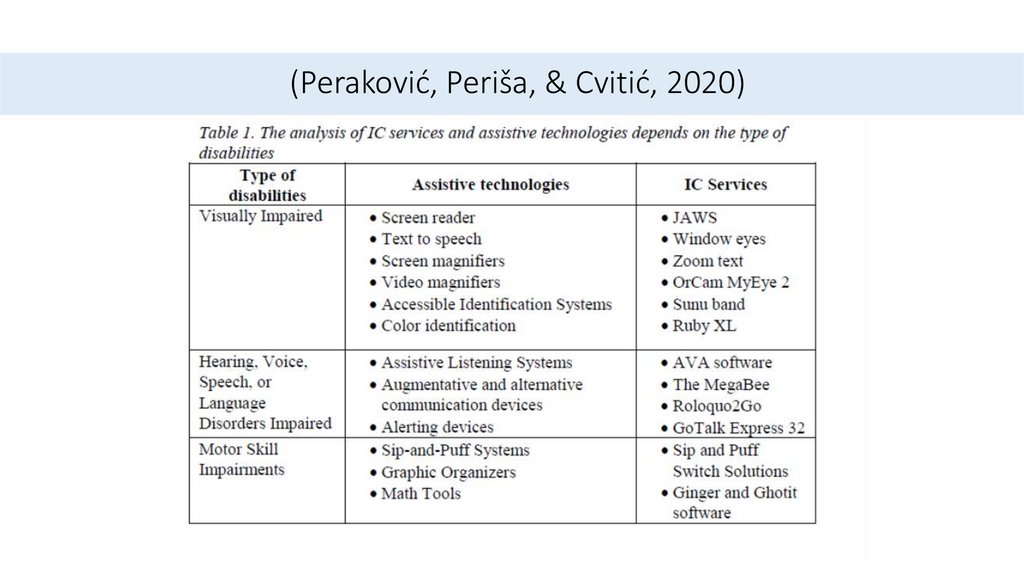
(Peraković, Periša, & Cvitić, 2020)
8. Read the suggested passage and answer the questions.
With the development of assistive technologies in the past, people with disabilities have considerably increasedtheir degree of mobility while doing their daily activities. According to the Report on persons with disabilities in the
Republic of Croatia, on 14.03.2017, there are 511,850 people with disabilities, representing 11.9% of the population.
Out of these numbers, there are 243,206 people in working age 19-64, while 10,583 are employed according to the
criteria set out in the Regulations on the content and method of keeping a record of employed persons with disabilities
(NN75/18). The latest available data for the EU area available through EUROSTAT indicates that 38.7% of people with
disabilities aged 25-65 are employed in the EU. One of the key objectives of the European strategy for persons with
disability aims to ensure the increase of the number of disabled workers in the labor market and to ensure better
access to workplaces.
The current development of ICT and its application in the field of production and logistics enables persons with
disabilities to provide an accessible work environment. The area of accessible environment development is possible by
introducing assistive technology (devices and services) into new Industry 4.0 concepts.
Creating a working environment for individuals with disabilities is the first step to their involvement and equality.
The working environment should provide support and enable this group of people to achieve their full potential and
productivity in their roles. The company and employers must adopt a working culture and provide a tailored
environment for persons with disabilities, depending on their damage. Physical availability is of utmost importance, with
the aim of enabling mobility and independence of movement in the work environment. According to defined user
requirements, it is necessary to define the assistive technology and functionality of the service, and continuous training
and monitoring of the work of the employees (persons with disabilities).
9. (Peraković, Periša, & Cvitić, 2020)
(Peraković, Periša, & Cvitić, 2020)10. Answer the questions on the text above:
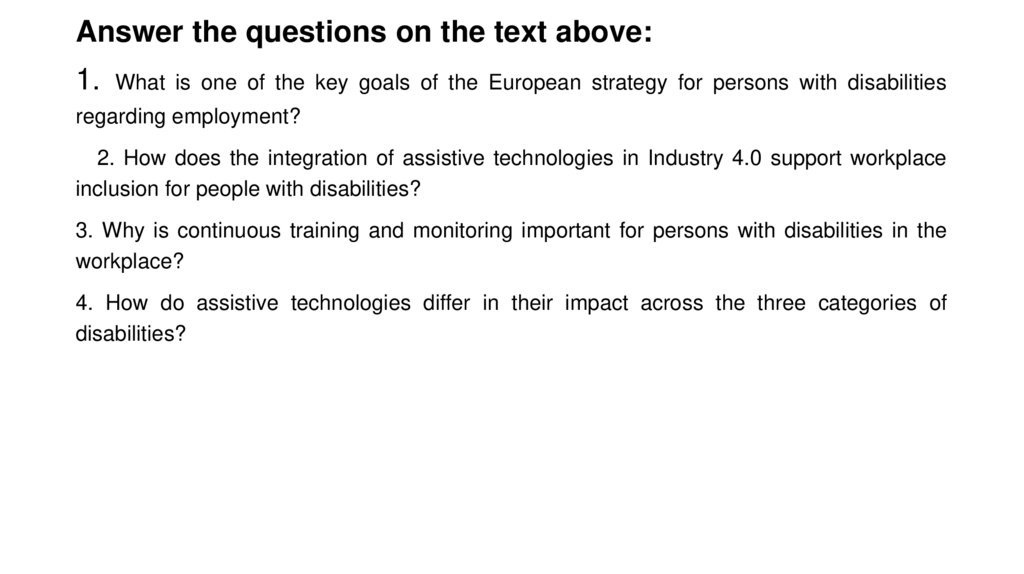
1. What is one of the key goals of the European strategy for persons with disabilitiesregarding employment?
2. How does the integration of assistive technologies in Industry 4.0 support workplace
inclusion for people with disabilities?
3. Why is continuous training and monitoring important for persons with disabilities in the
workplace?
4. How do assistive technologies differ in their impact across the three categories of
disabilities?
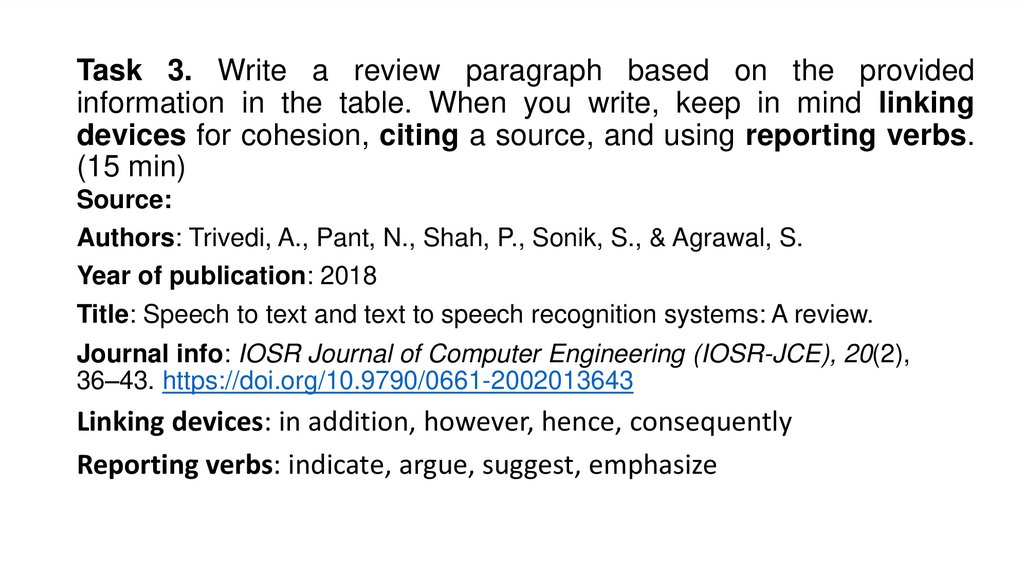
11. Task 3. Write a review paragraph based on the provided information in the table. When you write, keep in mind linking devices
for cohesion, citing a source, and using reporting verbs.(15 min)
Source:
Authors: Trivedi, A., Pant, N., Shah, P., Sonik, S., & Agrawal, S.
Year of publication: 2018
Title: Speech to text and text to speech recognition systems: A review.
Journal info: IOSR Journal of Computer Engineering (IOSR-JCE), 20(2),
36–43. https://doi.org/10.9790/0661-2002013643
Linking devices: in addition, however, hence, consequently
Reporting verbs: indicate, argue, suggest, emphasize
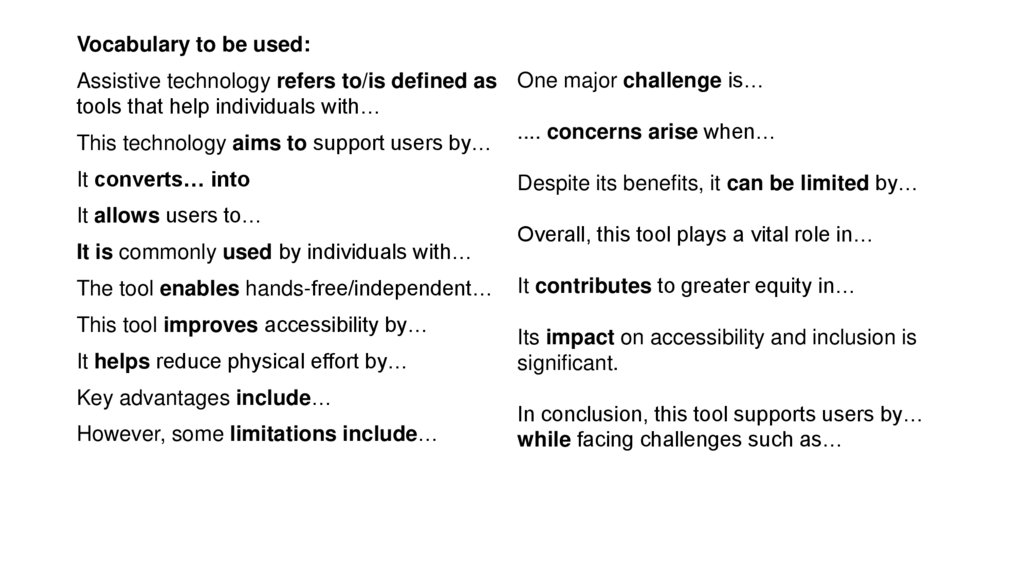
12. One major challenge is… .... concerns arise when… Despite its benefits, it can be limited by… Overall, this tool plays a
Vocabulary to be used:Assistive technology refers to/is defined as One major challenge is…
tools that help individuals with…
.... concerns arise when…
This technology aims to support users by…
It converts… into
It allows users to…
It is commonly used by individuals with…
The tool enables hands-free/independent…
This tool improves accessibility by…
It helps reduce physical effort by…
Key advantages include…
However, some limitations include…
Despite its benefits, it can be limited by…
Overall, this tool plays a vital role in…
It contributes to greater equity in…
Its impact on accessibility and inclusion is
significant.
In conclusion, this tool supports users by…
while facing challenges such as…
13.
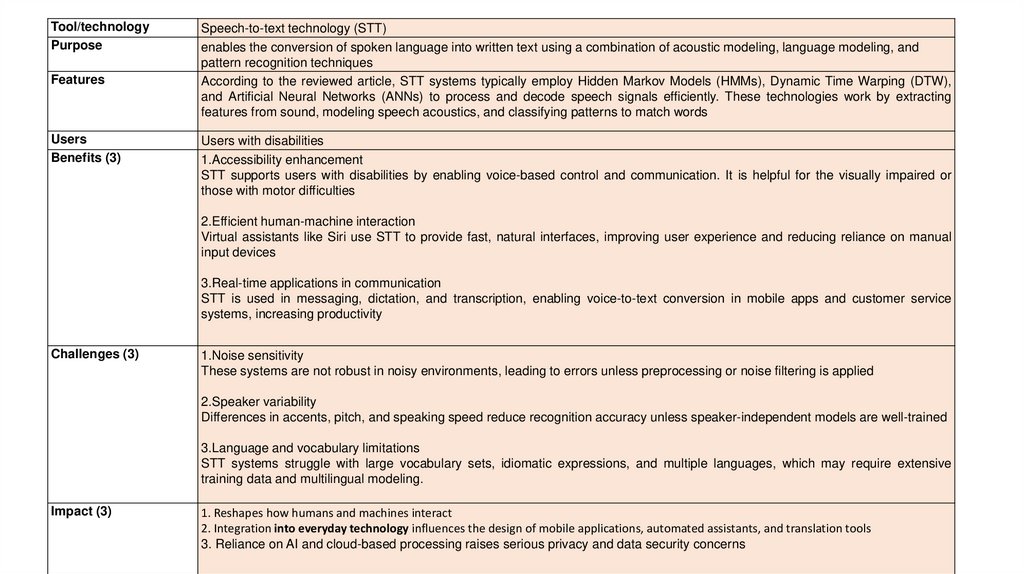
Tool/technologyPurpose
Features
Users
Benefits (3)
Speech-to-text technology (STT)
enables the conversion of spoken language into written text using a combination of acoustic modeling, language modeling, and
pattern recognition techniques
According to the reviewed article, STT systems typically employ Hidden Markov Models (HMMs), Dynamic Time Warping (DTW),
and Artificial Neural Networks (ANNs) to process and decode speech signals efficiently. These technologies work by extracting
features from sound, modeling speech acoustics, and classifying patterns to match words
Users with disabilities
1.Accessibility enhancement
STT supports users with disabilities by enabling voice-based control and communication. It is helpful for the visually impaired or
those with motor difficulties
2.Efficient human-machine interaction
Virtual assistants like Siri use STT to provide fast, natural interfaces, improving user experience and reducing reliance on manual
input devices
3.Real-time applications in communication
STT is used in messaging, dictation, and transcription, enabling voice-to-text conversion in mobile apps and customer service
systems, increasing productivity
Challenges (3)
1.Noise sensitivity
These systems are not robust in noisy environments, leading to errors unless preprocessing or noise filtering is applied
2.Speaker variability
Differences in accents, pitch, and speaking speed reduce recognition accuracy unless speaker-independent models are well-trained
3.Language and vocabulary limitations
STT systems struggle with large vocabulary sets, idiomatic expressions, and multiple languages, which may require extensive
training data and multilingual modeling.
Impact (3)
1. Reshapes how humans and machines interact
2. Integration into everyday technology influences the design of mobile applications, automated assistants, and translation tools
3. Reliance on AI and cloud-based processing raises serious privacy and data security concerns
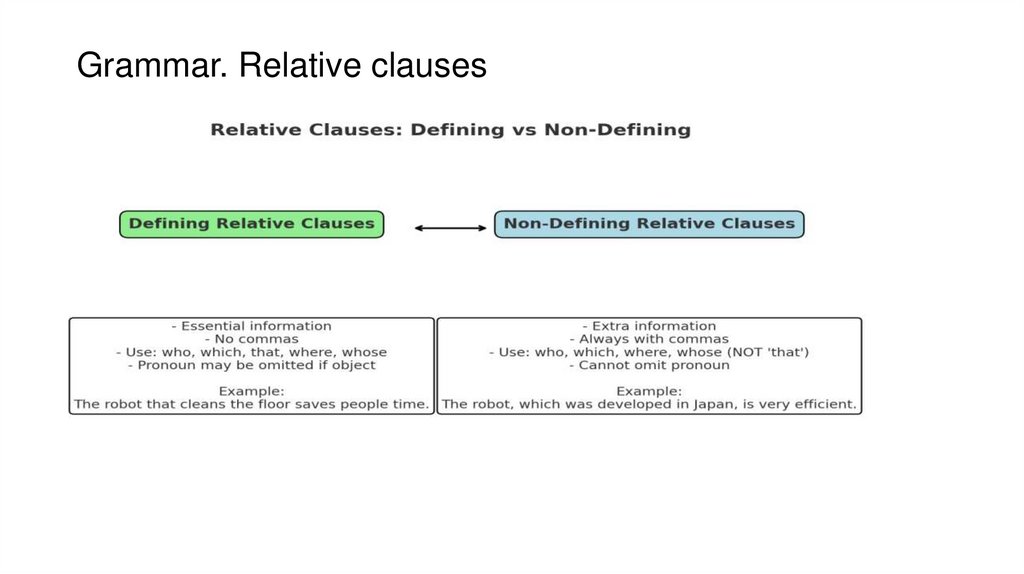
14. Grammar. Relative clauses
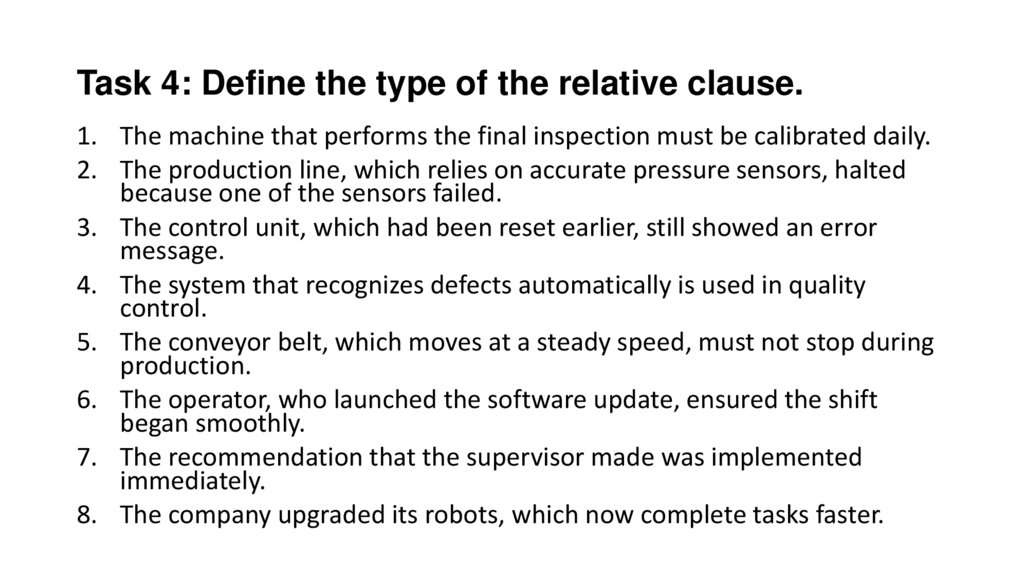
15. Task 4: Define the type of the relative clause.
Task 4: Define the type of the relative clause.1. The machine that performs the final inspection must be calibrated daily.
2. The production line, which relies on accurate pressure sensors, halted
because one of the sensors failed.
3. The control unit, which had been reset earlier, still showed an error
message.
4. The system that recognizes defects automatically is used in quality
control.
5. The conveyor belt, which moves at a steady speed, must not stop during
production.
6. The operator, who launched the software update, ensured the shift
began smoothly.
7. The recommendation that the supervisor made was implemented
immediately.
8. The company upgraded its robots, which now complete tasks faster.
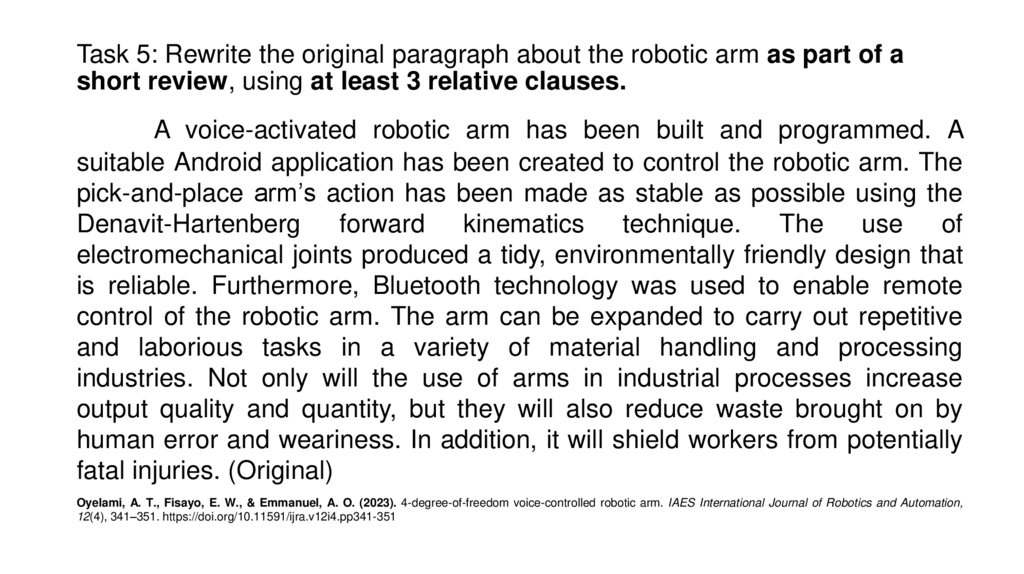
16. Task 5: Rewrite the original paragraph about the robotic arm as part of a short review, using at least 3 relative clauses.
A voice-activated robotic arm has been built and programmed. Asuitable Android application has been created to control the robotic arm. The
pick-and-place arm’s action has been made as stable as possible using the
Denavit-Hartenberg forward kinematics technique. The use of
electromechanical joints produced a tidy, environmentally friendly design that
is reliable. Furthermore, Bluetooth technology was used to enable remote
control of the robotic arm. The arm can be expanded to carry out repetitive
and laborious tasks in a variety of material handling and processing
industries. Not only will the use of arms in industrial processes increase
output quality and quantity, but they will also reduce waste brought on by
human error and weariness. In addition, it will shield workers from potentially
fatal injuries. (Original)
Oyelami, A. T., Fisayo, E. W., & Emmanuel, A. O. (2023). 4-degree-of-freedom voice-controlled robotic arm. IAES International Journal of Robotics and Automation,
12(4), 341–351. https://doi.org/10.11591/ijra.v12i4.pp341-351
17. References
Oyelami, A. T., Elegbeji, W. F., & Adeniyi, O. E. (2023). 4-degree-of-freedom voicecontrolled robotic arm. IAES International Journal of Robotics and Automation (IJRA), 12(4),341-351. https://doi.org/10.11591/ijra.v12i4.pp341-351
Peraković, D., Periša, M., & Cvitić, I. (2020). Analysis of the possible application of assistive
technology in the concept of Industry 4.0. University of Zagreb, Faculty of Transport and Traffic
Sciences.
Trivedi, A., Pant, N., Shah, P., Sonik, S., & Agrawal, S. (2018). Speech to text and text to speech
recognition systems: A review. IOSR Journal of Computer Engineering (IOSR-JCE), 20(2), 36–43.
https://doi.org/10.9790/0661-2002013643