 Английский язык
Похожие презентации:





The use of forms expressing unreality (the oblique moods) in appositive (attributive) and predicative clauses
1.
The Use of Forms ExpressingUnreality (the Oblique Moods) in
APPOSITIVE (ATTRIBUTIVE) and
PREDICATIVE CLAUSES
2.
APPOSITIVE(ATTRIBUTIVE) CLAUSE
In APPOSITIVE CLAUSES
introduced by ‘that’
the use of different forms of
the predicate depends on the
LEXICAL character of the
NOUN they modify
3.
APPOSITIVE(ATTRIBUTIVE) CLAUSE
As a rule, the Indicative Mood
is used in Attributive Clauses
e.g.: The idea that he thought himself
anything but intelligent was absurd.
4.
APPOSITIVE(ATTRIBUTIVE) CLAUSE
However, after nouns
expressing suggestion, order,
decision, agreement
the Oblique Moods are used in
Attributive Clauses
5.
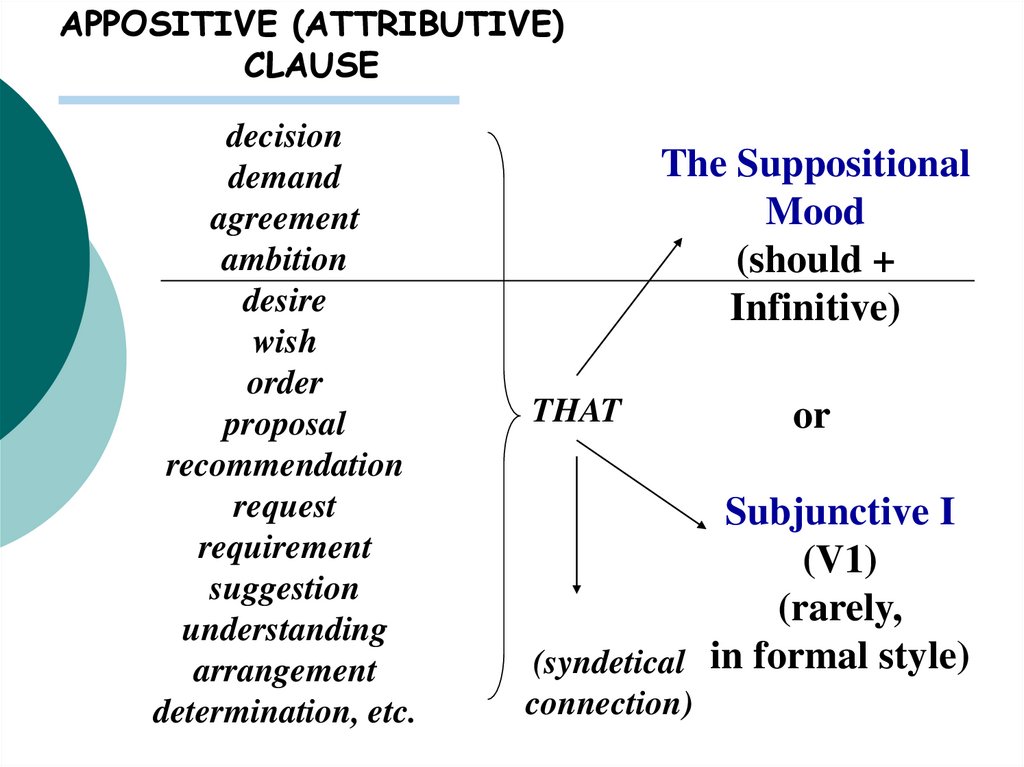
APPOSITIVE (ATTRIBUTIVE)CLAUSE
decision
demand
agreement
ambition
desire
wish
order
proposal
recommendation
request
requirement
suggestion
understanding
arrangement
determination, etc.
The Suppositional
Mood
(should +
Infinitive)
THAT
or
Subjunctive I
(V1)
(rarely,
(syndetical in formal style)
connection)
6.
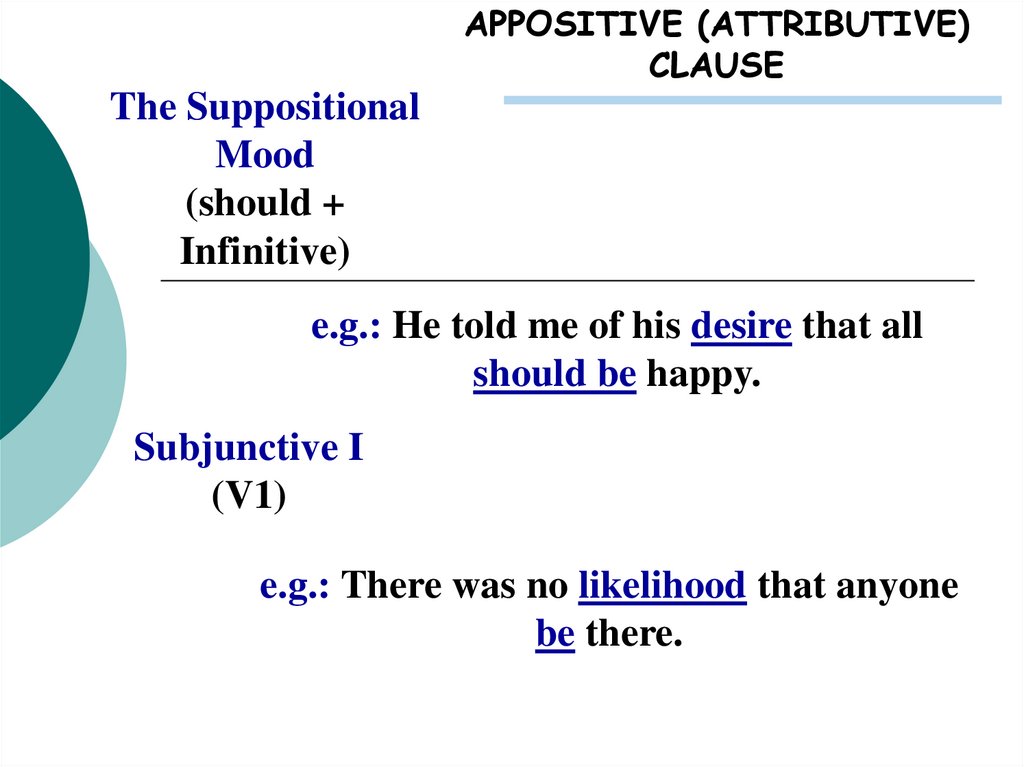
APPOSITIVE (ATTRIBUTIVE)CLAUSE
The Suppositional
Mood
(should +
Infinitive)
e.g.: He told me of his desire that all
should be happy.
Subjunctive I
(V1)
e.g.: There was no likelihood that anyone
be there.
7.
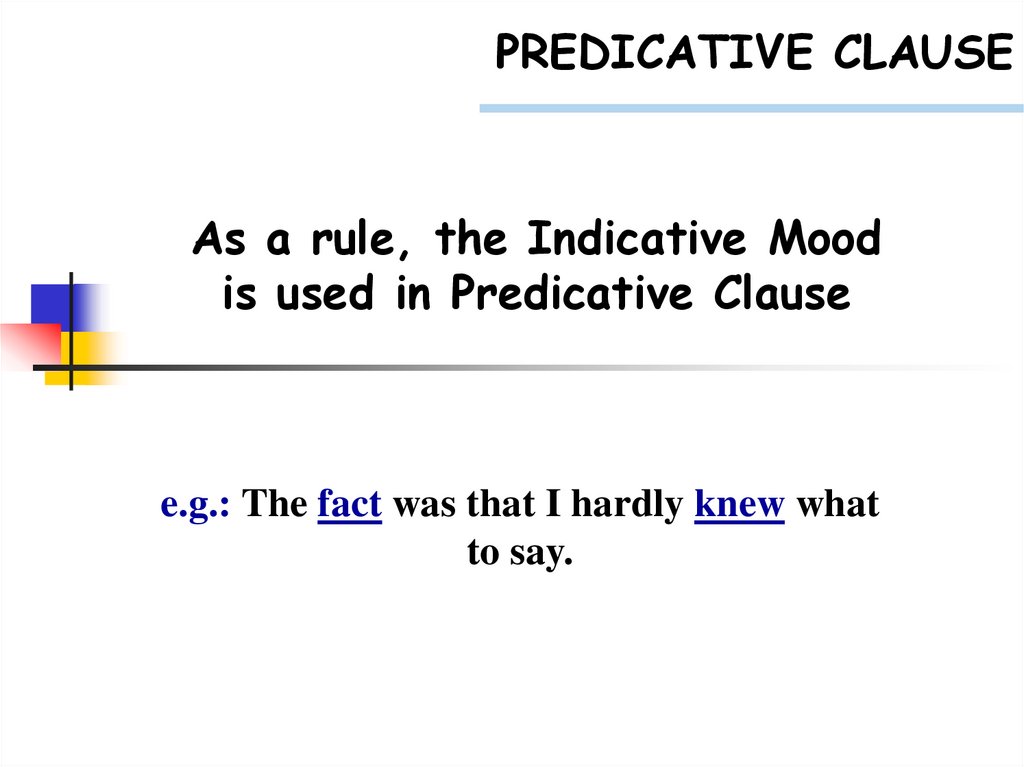
PREDICATIVE CLAUSEAs a rule, the Indicative Mood
is used in Predicative Clause
e.g.: The fact was that I hardly knew what
to say.
8.
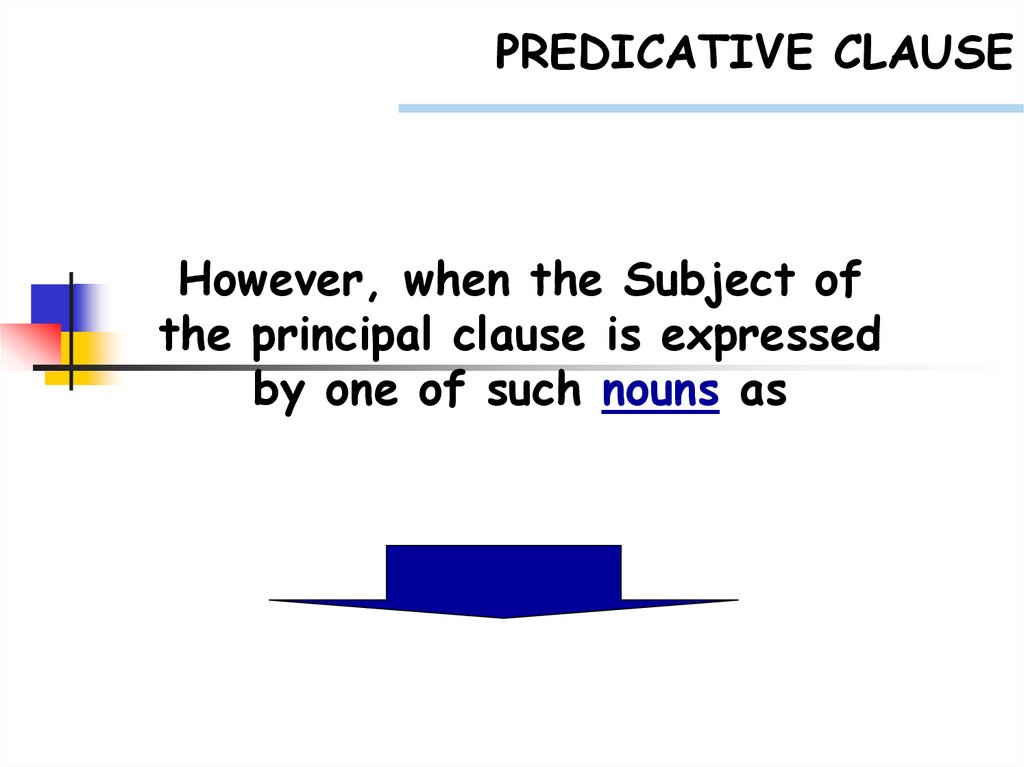
PREDICATIVE CLAUSEHowever, when the Subject of
the principal clause is expressed
by one of such nouns as
9.
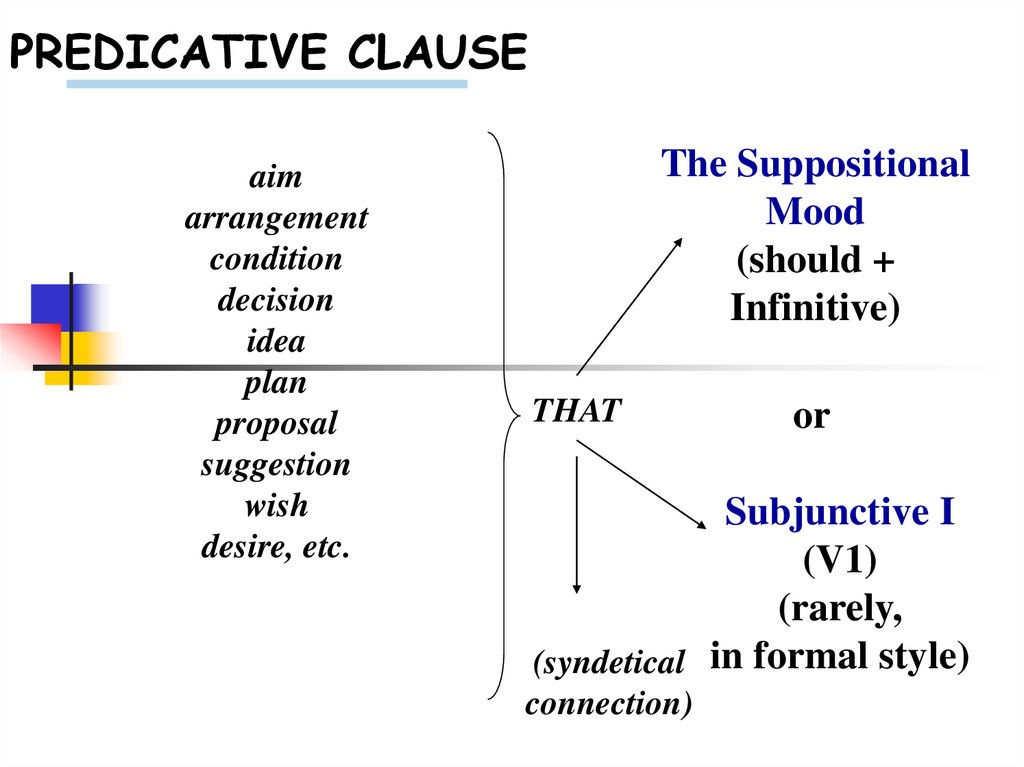
PREDICATIVE CLAUSEaim
arrangement
condition
decision
idea
plan
proposal
suggestion
wish
desire, etc.
The Suppositional
Mood
(should +
Infinitive)
THAT
or
Subjunctive I
(V1)
(rarely,
(syndetical in formal style)
connection)
10.
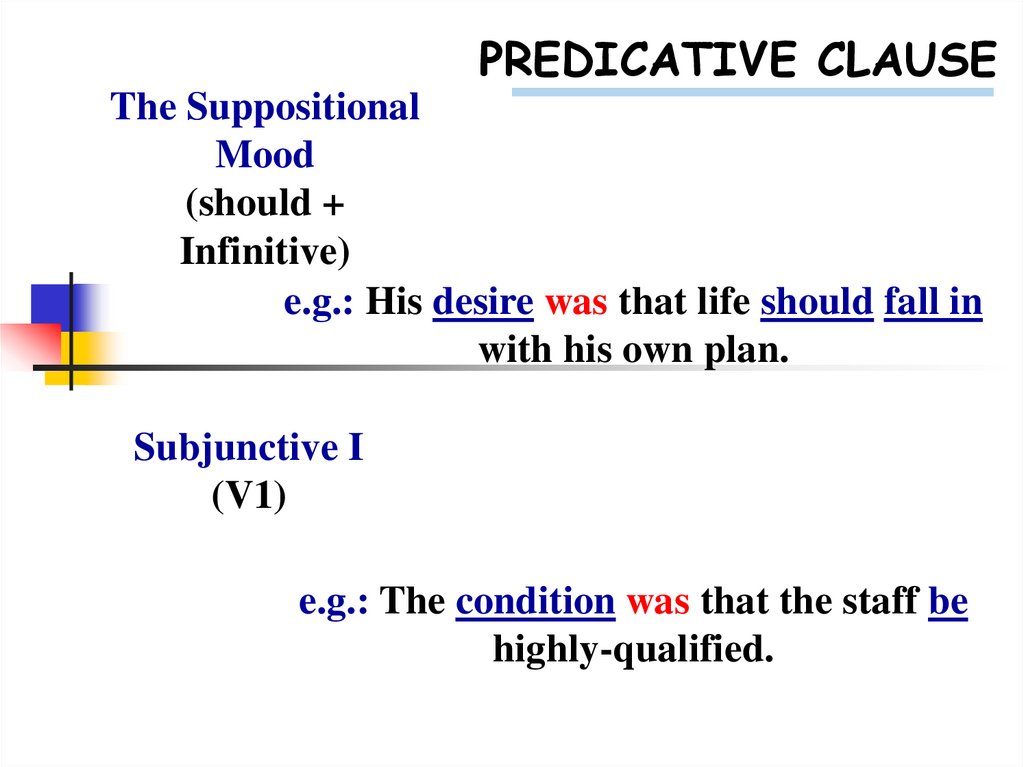
PREDICATIVE CLAUSEThe Suppositional
Mood
(should +
Infinitive)
e.g.: His desire was that life should fall in
with his own plan.
Subjunctive I
(V1)
e.g.: The condition was that the staff be
highly-qualified.