Похожие презентации:







Artificial-Intelligence-The-Future-is-Now (1)
1.
Artificial Intelligence: TheFuture is Now
2.
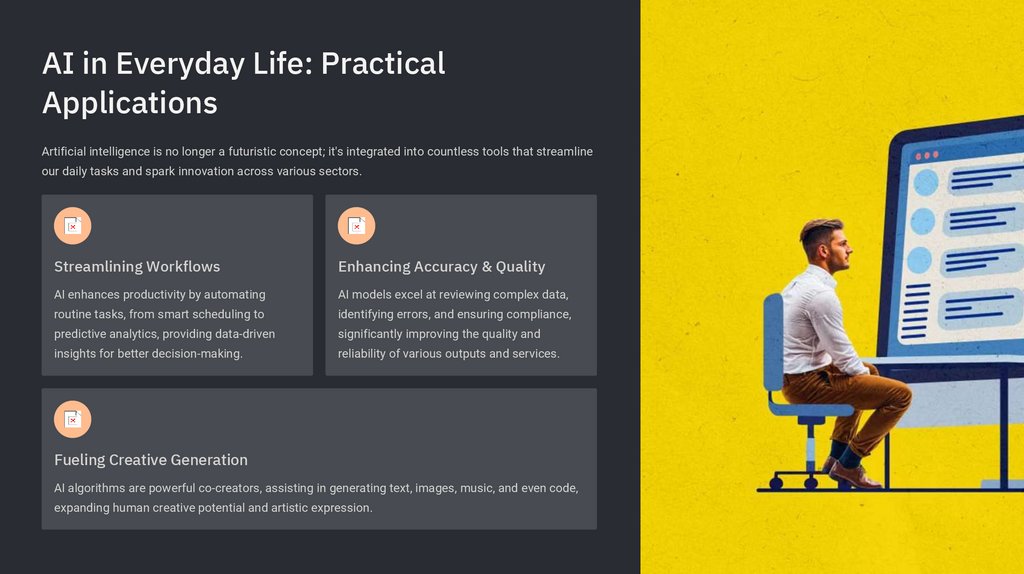
AI in Everyday Life: PracticalApplications
Artificial intelligence is no longer a futuristic concept; it's integrated into countless tools that streamline
our daily tasks and spark innovation across various sectors.
Streamlining Workflows
Enhancing Accuracy & Quality
AI enhances productivity by automating
AI models excel at reviewing complex data,
routine tasks, from smart scheduling to
identifying errors, and ensuring compliance,
predictive analytics, providing data-driven
significantly improving the quality and
insights for better decision-making.
reliability of various outputs and services.
Fueling Creative Generation
AI algorithms are powerful co-creators, assisting in generating text, images, music, and even code,
expanding human creative potential and artistic expression.
3.
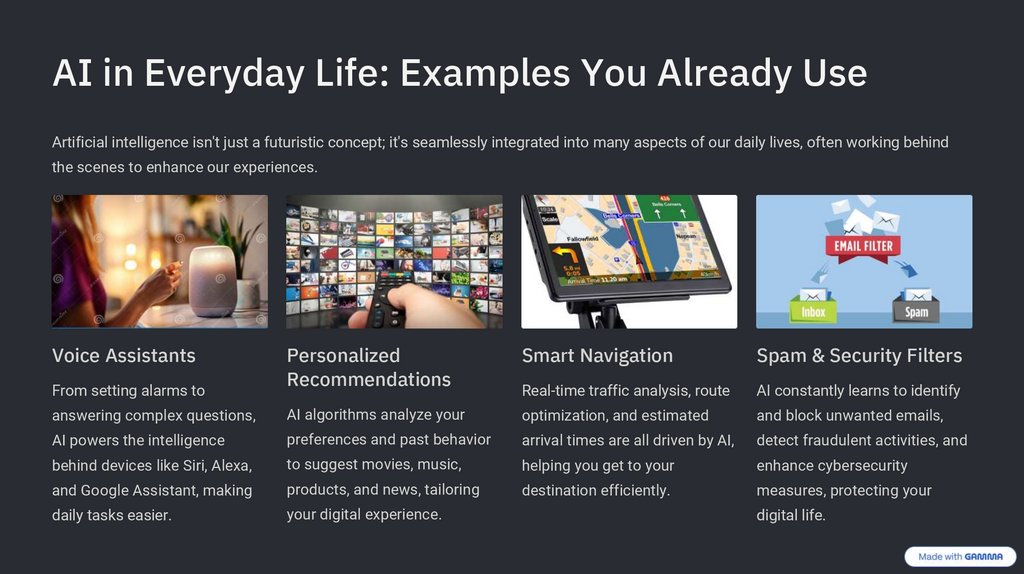
AI in Everyday Life: Examples You Already UseArtificial intelligence isn't just a futuristic concept; it's seamlessly integrated into many aspects of our daily lives, often working behind
the scenes to enhance our experiences.
Voice Assistants
Personalized
Recommendations
Smart Navigation
Spam & Security Filters
Real-time traffic analysis, route
AI constantly learns to identify
answering complex questions,
AI algorithms analyze your
optimization, and estimated
and block unwanted emails,
AI powers the intelligence
preferences and past behavior
arrival times are all driven by AI,
detect fraudulent activities, and
behind devices like Siri, Alexa,
to suggest movies, music,
helping you get to your
enhance cybersecurity
and Google Assistant, making
products, and news, tailoring
destination efficiently.
measures, protecting your
daily tasks easier.
your digital experience.
From setting alarms to
digital life.
4.
What is Artificial Intelligence? Definition and HistoryArtificial Intelligence (AI) refers to the simulation of human intelligence in machines programmed to
think like humans and mimic their actions. It encompasses learning, reasoning, problem-solving,
perception, and language understanding.
The concept of AI dates back to ancient myths, but modern AI began in the 1950s with pioneers like
Alan Turing, who questioned whether machines could "think." The term "Artificial Intelligence" was
coined in 1956 at a conference at Dartmouth College, marking the birth of the field.
5.
Types of AI: From Narrow to GeneralAGI (Artificial General
Intelligence)
ANI (Artificial Narrow
Intelligence)
Hypothetical AI with human-like cognitive
abilities across various tasks, able to learn
and adapt.
Designed for specific tasks like facial
recognition or voice assistants.
Dominant in today's AI landscape.
ASI (Artificial Superintelligence)
Theoretical AI that surpasses human
intelligence in all aspects, including
creativity and problem-solving.
6.
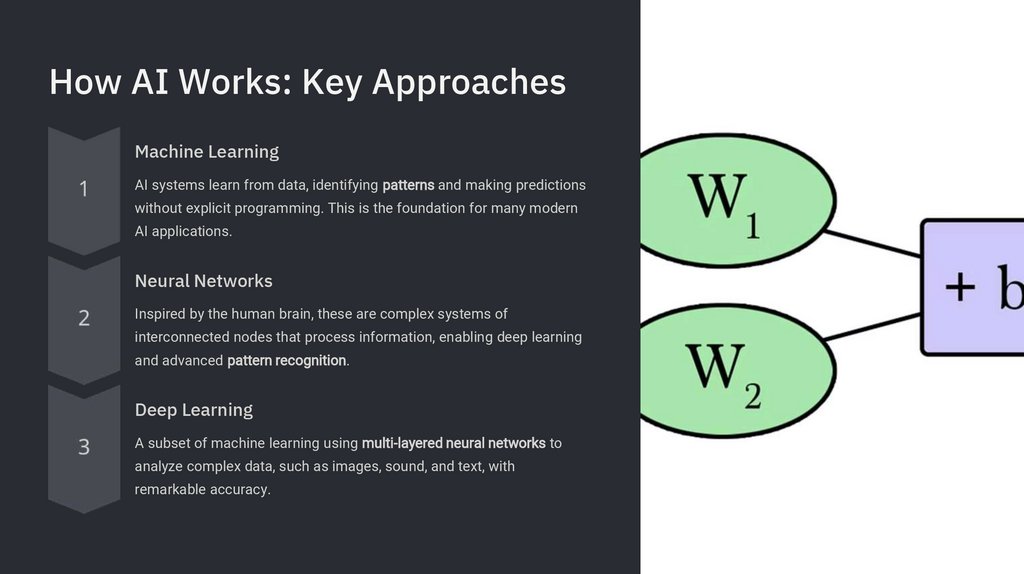
How AI Works: Key ApproachesMachine Learning
AI systems learn from data, identifying patterns and making predictions
without explicit programming. This is the foundation for many modern
AI applications.
Neural Networks
Inspired by the human brain, these are complex systems of
interconnected nodes that process information, enabling deep learning
and advanced pattern recognition.
Deep Learning
A subset of machine learning using multi-layered neural networks to
analyze complex data, such as images, sound, and text, with
remarkable accuracy.
7.
AI in Everyday Life: Examples You Already UseVoice Assistants
Recommendation Engines
Siri, Alexa, Google Assistant – AI interprets your commands and
Personalized suggestions on Netflix, Amazon, Spotify based on
provides information.
your past behavior.
Self-Driving Cars
Spam Filters
AI processes sensor data to navigate, detect obstacles, and
AI identifies and filters unwanted emails, improving your inbox
make driving decisions.
experience.
8.
AI in Business: Transforming IndustriesHealthcare
1
AI assists in diagnosis, drug discovery, and personalized treatment plans,
revolutionizing patient care.
2
Finance
Fraud detection, algorithmic trading, and risk assessment are enhanced by
Manufacturing
3
AI's analytical power.
AI optimizes production, predicts maintenance needs, and improves quality
control in smart factories.
4
Retail
From inventory management to customer service and personalized
marketing, AI drives efficiency and sales.
9.
Ethical Questions of AI:Responsibility, Bias, Privacy
Accountability
Bias
Who is responsible when AI
AI systems can inherit and
makes a mistake or causes
amplify biases present in their
harm? Defining legal and
training data, leading to unfair
ethical frameworks is crucial.
or discriminatory outcomes.
Privacy
The vast amounts of data AI
requires raise concerns about
surveillance, data security, and
individual privacy rights.
10.
The Future of AI: Prospects andChallenges
Exciting Prospects
Significant Challenges
Accelerated Discovery: AI will drive
breakthroughs in science, medicine,
could impact employment across
and engineering.
various sectors.
Personalized Experiences: Even
Control & Safety: Ensuring AI
more tailored services and
systems remain aligned with
products, from education to
human values and goals.
entertainment.
Job Displacement: Automation
Global Governance: Establishing
Solving Grand Challenges: Potential
international norms and regulations
to address climate change, poverty,
for AI development.
and resource scarcity.
Technological Singularity: The
theoretical point where AI
Enhanced Creativity: AI as a cocreator in art, music, and design.
surpasses human control.
11.
AI and Humanity: Collaboration or Competition?The Collaborative Future
The Competitive Edge
AI can serve as a powerful partner, augmenting human intelligence and capabilities. It handles repetitive tasks, analyzes vast datasets, and
While collaboration is ideal, concerns about AI's competitive impact persist. Automation may displace certain jobs, requiring societies to
offers insights, freeing humans to focus on creativity, critical thinking, and complex problem-solving. This partnership promises increased
adapt through retraining and new economic models. Ensuring human agency, ethical oversight, and a fair distribution of AI's benefits are
productivity and innovation.
critical challenges.
12.
Neural Networks: Strengths and LimitationsAdvantages
Challenges
Advanced Pattern Recognition: Excelling in identifying
Data Dependency: Require vast amounts of high-quality,
complex patterns in data, crucial for tasks like image and
labeled data for effective training, which can be difficult and
speech recognition.
costly to obtain.
Adaptability & Learning: Capable of continuous learning and
improving performance as they are exposed to more data.
"Black Box" Problem: Their decision-making process is often
opaque, making it difficult to understand or explain how a
particular output was reached.
Complex Problem Solving: Can model intricate relationships
High Computational Cost: Training large neural networks
and solve problems that are intractable for traditional
demands significant computational resources and time,
computational methods.
impacting development and deployment.
Automation of Perception: Automate tasks that require
Bias Amplification: Can unintentionally learn and amplify
human-like perception, enabling efficient processing of
biases present in the training data, leading to unfair or
sensory data.
discriminatory outcomes.
13.
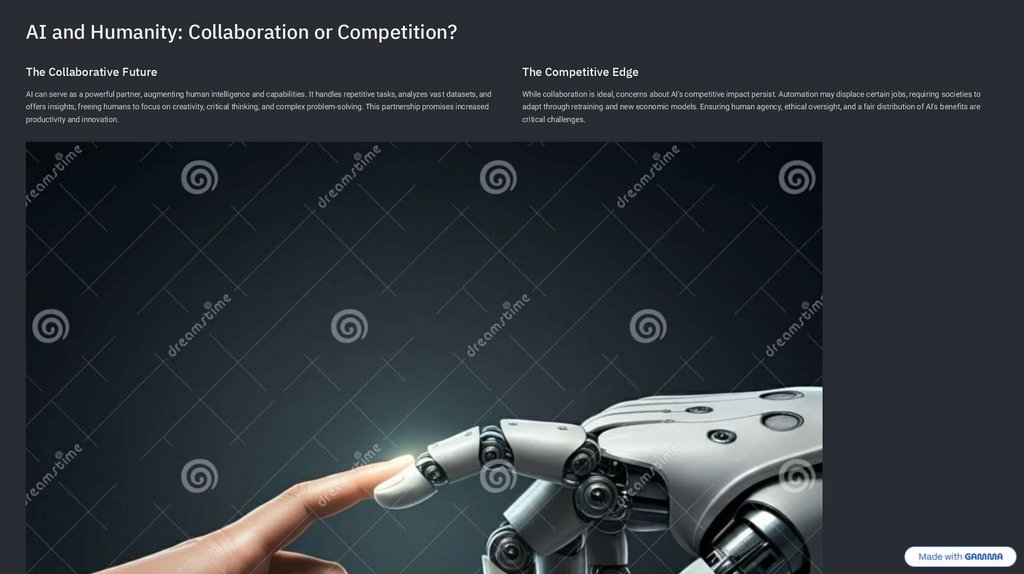
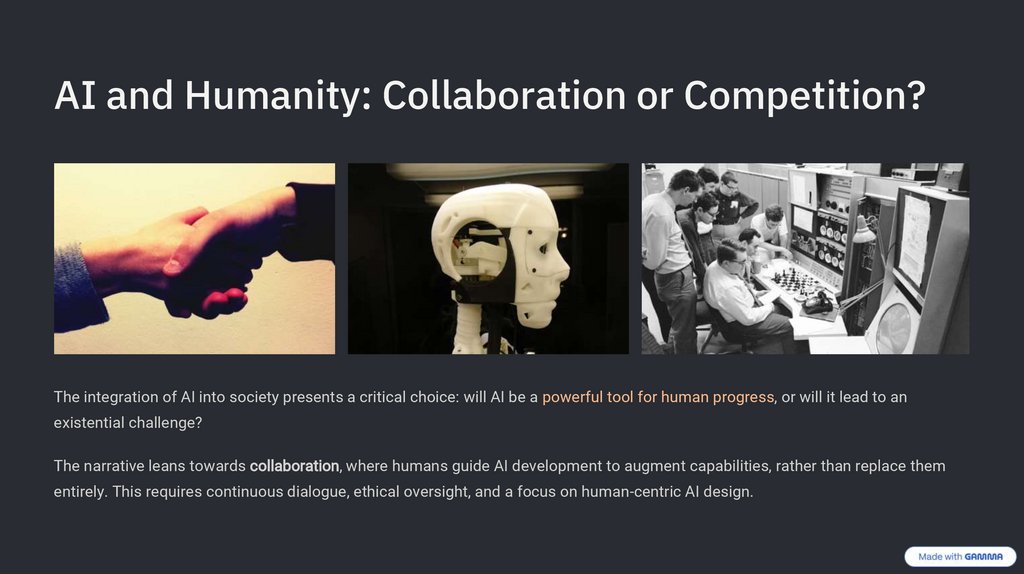
AI and Humanity: Collaboration or Competition?The integration of AI into society presents a critical choice: will AI be a powerful tool for human progress, or will it lead to an
existential challenge?
The narrative leans towards collaboration, where humans guide AI development to augment capabilities, rather than replace them
entirely. This requires continuous dialogue, ethical oversight, and a focus on human-centric AI design.
14.
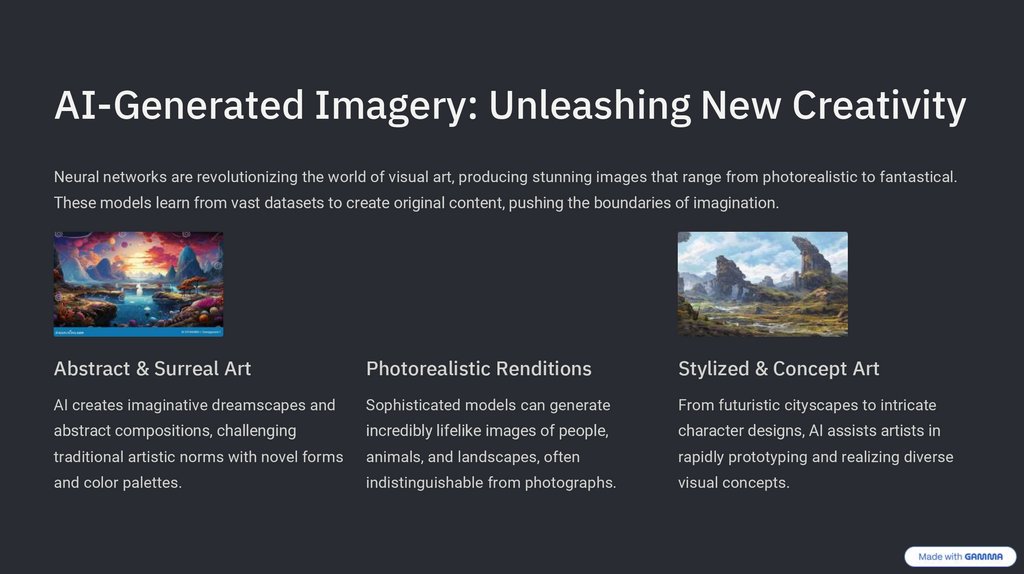
AI-Generated Imagery: Unleashing New CreativityNeural networks are revolutionizing the world of visual art, producing stunning images that range from photorealistic to fantastical.
These models learn from vast datasets to create original content, pushing the boundaries of imagination.
Abstract & Surreal Art
Photorealistic Renditions
Stylized & Concept Art
AI creates imaginative dreamscapes and
Sophisticated models can generate
From futuristic cityscapes to intricate
abstract compositions, challenging
incredibly lifelike images of people,
character designs, AI assists artists in
traditional artistic norms with novel forms
animals, and landscapes, often
rapidly prototyping and realizing diverse
and color palettes.
indistinguishable from photographs.
visual concepts.
15.
Conclusion: Are We Ready for a World with AI?The journey with AI has just begun.
It promises unprecedented advancements but also demands thoughtful consideration of its profound implications. Our
preparedness hinges on how effectively we navigate the ethical dilemmas, embrace the opportunities, and foster responsible
innovation.
The future is not just about developing smarter machines, but about building a smarter, more equitable future with them.